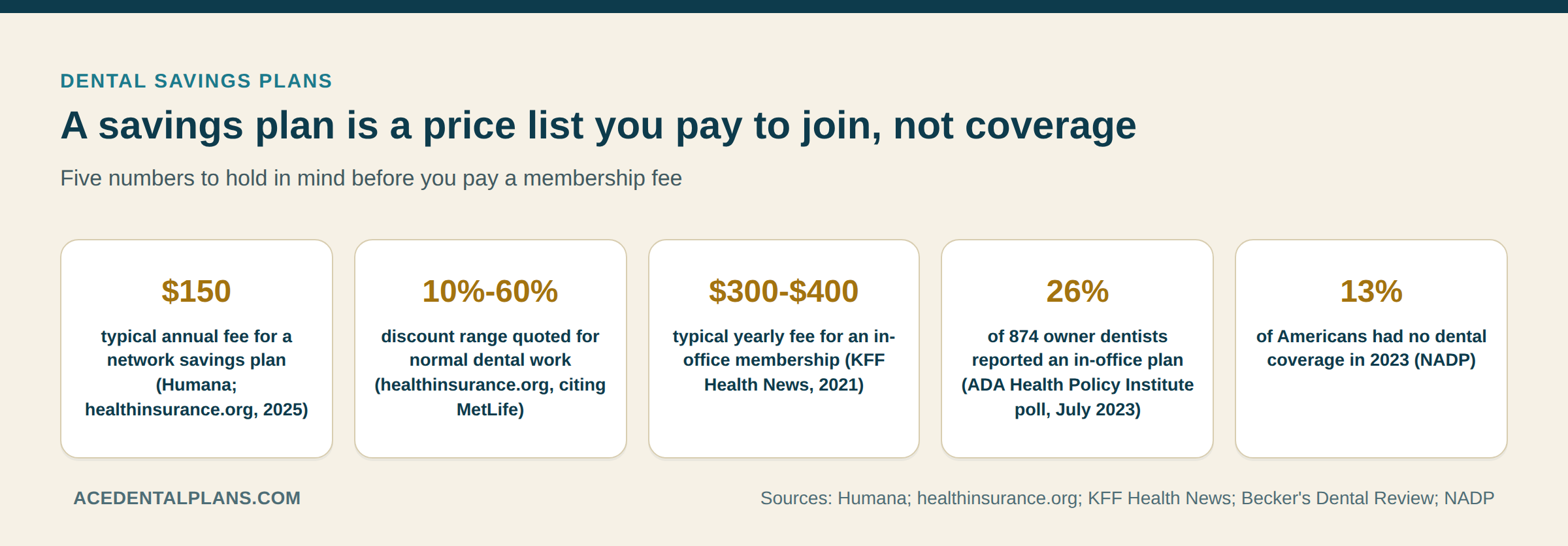
A dental savings plan is a membership, not insurance. You pay an annual fee, often around $150 for a network plan, and participating dentists charge you reduced fees at the visit. Published discount claims run from 10% to 60%, yet the plan pays nothing toward your bill. It saves money only when your dentist participates and the contracted fee sits below what that office would otherwise charge you.
This article explains how network savings plans and in-office memberships work from enrollment to receipt, how to read a fee schedule, and how to do the break-even math for a cleaning-only year, a crown year and an implant year. It also covers how states and federal agencies treat these products, which red flags to look for, and how to confirm that a dentist really participates. It does not rank or recommend any plan or company. Insurance mechanics, financing contracts and the cash price of each procedure have their own guides, which are linked where they come up.
Key Takeaways
- A savings plan is a price list you pay to access. The ADA says discount plans are technically not insurance: patients pay all treatment costs at the contracted rate, and there are no claim forms.
- The fee is small; the break-even is a division problem. At about $150 a year (Humana and healthinsurance.org, 2025) and a 20% discount, the plan pays for itself after $750 of discounted care. In-office memberships cost more: $300 to $400 a year in a 2021 KFF Health News report.
- “30% off” depends on the starting price. In one practice’s November 2025 schedule, a $1,850 retail crown becomes $1,295 for members. That is 7% below the 2024 national average of $1,399, not 30% below.
- No annual maximum also means no ceiling on your costs. Delta Dental of Colorado notes its savings plan has no out-of-pocket maximum. NADP reports that fewer than 5% of dental benefit enrollees reached their annual maximum from 2014 to 2023.
- Oversight is a patchwork. NADP says discount plans are not licensed in most states because they are not insurance. Nevada requires registration, bans words such as “coverage” in marketing, and requires refunds within 30 days after a timely cancellation.
- Verify the dentist before you pay the fee. Call the office, name the plan, and ask for the fee on your procedure code. One plan’s own schedule says it does not guarantee that any dentist stays in the network.
What a Dental Savings Plan Is, and the Names It Hides Behind
Ask five sellers what they offer and you may hear five labels: dental discount plan, dental savings plan, discount card, membership plan, referral plan. The ADA’s plan overview groups the network versions under “discount or referral plans.” The labels describe the same basic bargain. You pay a fee, and in return you get access to a list of reduced prices.
The structure has three parties. A seller, either a company or a single dental practice, writes the membership terms. Dentists sign a contract agreeing to charge members less than their usual fees. The member pays the seller a fee and pays the dentist for care. The ADA describes it this way: the company selling the plan contracts with a network of dentists, and patients pay all the costs of treatment at the contracted rate the plan determines.
What the plan does not do is just as important. NADP defines discount plans as non-insured programs in which a panel of dentists agrees to perform services for enrollees at a specified discounted price, and says plainly that they do not pay anything toward the cost of care. There is no insurer in the middle, no claim form and no explanation of benefits. The only document that tells you what you owe is the plan’s fee schedule or discount rule, and later the dentist’s receipt.
Law gives the product one more definition worth knowing. Nevada’s statute calls a medical discount plan a business arrangement or program evidenced by a membership agreement, in which providers offer services at a discount. It requires that members receive written disclosure that the plan is not a policy of health insurance. Other states use different terms, which is why the name on a mailer tells you little. The membership agreement is what counts.
Scale matters for context. NADP reported that 290 million Americans, about 87% of the population, had some form of dental benefit at the end of 2024, and that roughly 13% had no dental coverage in 2023. The people in that 13% are the audience for most savings-plan advertising. They are also the people for whom a wrong guess about how the product works costs the most, because a dental bill arrives with no insurer to share it. For how this product sits beside dental insurance plan types such as PPOs and DHMOs, the next section lines the three main versions up in one table.
Three Products That Share One Nickname
“Dental savings plan” covers at least three different arrangements. A network plan is sold by a company that contracts with many offices. An in-office membership belongs to one practice, which sets its own fee and benefits. And some insurers sell savings plans under their own brand, such as the Patient Direct plan described in a Delta Dental of Colorado fee schedule that states it is not insurance. An insurer’s logo on the card does not change the legal character of the product.
In-office plans are common enough to matter. In a July 2023 poll for the ADA Health Policy Institute, reported by Becker’s Dental Review, 26% of 874 owner dentists said their practice had an in-office dental plan. Another 22% were considering one. Of the 227 dentists who offered a plan, 169 ran it themselves and 58 contracted an outside company to administer it. The poll did not report fees, so it says how common the plans are and nothing about whether they are a good deal.
| Feature | Network savings plan | In-office membership | Dental insurance (PPO) |
|---|---|---|---|
| Who sells it | A company that contracts with a network of dentists (ADA); some are sold by insurers | One practice, sometimes through an outside administrator (ADA HPI poll, 2023) | An insurer, directly or through an employer |
| Who pays the dentist | You, at the contracted rate (ADA) | You, at the member fee | The plan pays its share; you pay the rest |
| Typical yearly cost | About $150 (Humana; healthinsurance.org, 2025) | $300 to $400 (KFF Health News, 2021); $350 to $600 on one Brooklyn practice’s page | $20 to $50 a month for one person, or $240 to $600 a year (healthinsurance.org, 2025) |
| Where the saving comes from | A fee schedule or percentage discount agreed with network dentists | Included visits plus a percentage off or a member fee list | Negotiated in-network fees plus benefit payments |
| Annual maximum | Generally none (Humana) | Generally none (KFF Health News) | Typically $1,000 to $2,000 (healthinsurance.org) |
| Waiting periods | None for most plans (Humana; Cigna) | None on the pages read, but some require a 12-month commitment | May apply, especially for major work (HealthCare.gov for stand-alone plans) |
| Claims and paperwork | No claim forms (ADA) | No claim forms | Filed by the office or the member |
| Oversight | Registration or licensing in some states; not licensed as insurance in most (NADP) | Described as “generally unregulated” by one advocate (KFF Health News, 2021) | State insurance regulators |
Read the table by row, not by column. The “Where the saving comes from” row is the one that differs most. A network plan can publish a fixed price for every code, a practice can promise a flat percentage, and an insurer can negotiate a fee and then add a payment on top. Those are three different mechanisms, and the annual-fee row tells you nothing about which one delivers more for your mouth.
A Visit From Enrollment to Receipt
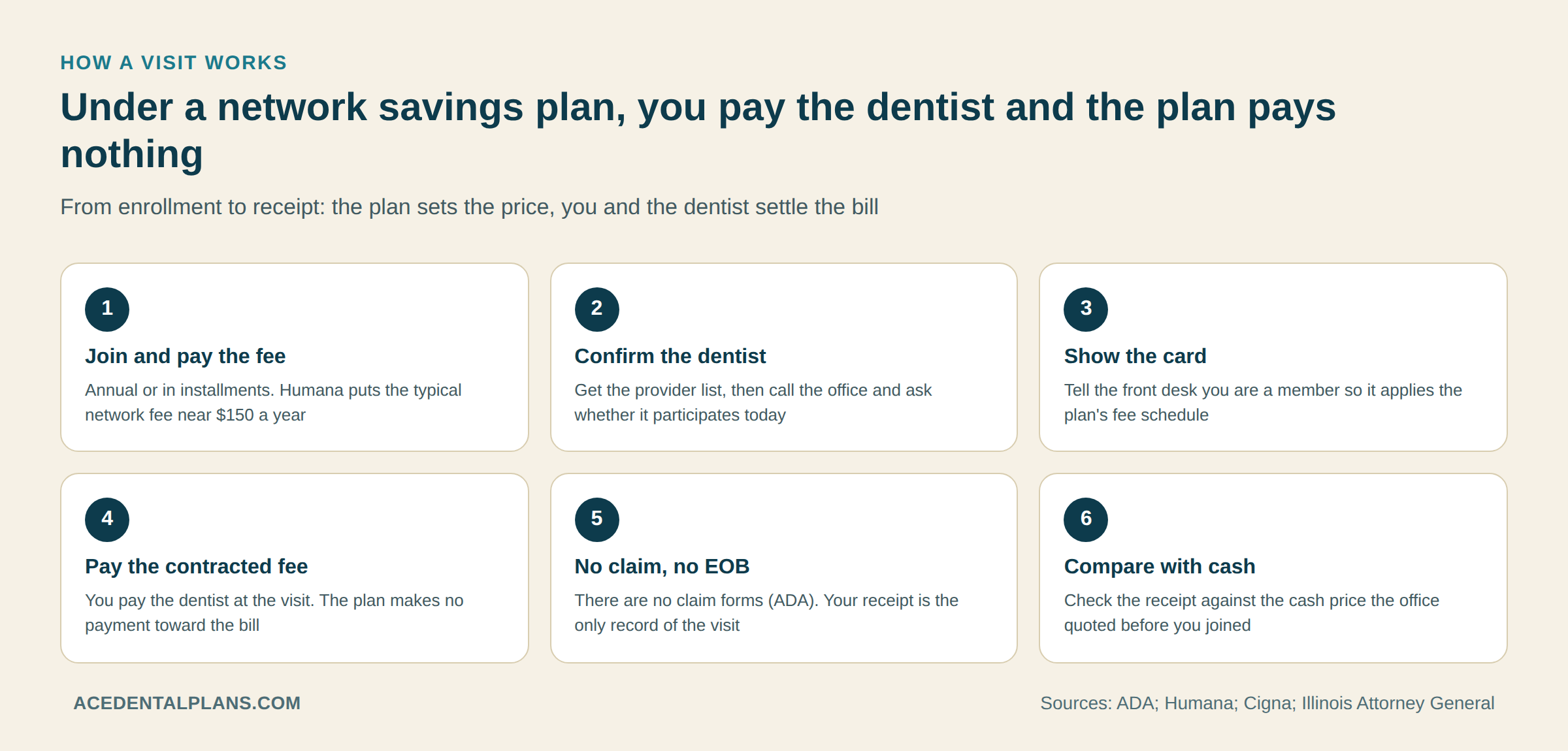
The mechanics are simpler than insurance, which is part of the appeal. Humana’s guide lays out four steps for its discount plan: choose a plan and pay the annual fee, schedule with a dentist in the network, tell the dentist you are a member so the office charges the discounted rate, and pay the discounted amount yourself. Cigna’s page adds that you show an ID card at the visit. The same pattern holds for most network plans.
Before the first visit, enrollment usually has two parts. You pick a plan and pay, either all at once or in installments. Humana says its fee can be split into monthly payments, and Delta Dental of Colorado says members can pay up front or in 12 installments. Then you look for a participating dentist. That second step is the one people skip, and it is the step that decides whether the money was well spent.
At the office, the front desk pulls up the plan’s fee for each procedure. Fee schedules identify services by dental procedure codes, so a line such as D2740 is a porcelain or ceramic crown whether the office calls it that or not. You pay at the time of service. The Illinois Attorney General’s consumer guide says the discounted rate usually must be paid when the service is provided, and Patient Direct’s own schedule says payments go directly to the office when services are rendered.
After the visit, nothing else happens. No claim goes to a plan, no explanation of benefits arrives, and no benefit balance changes. Your receipt is the record. If you want to know whether the plan saved you anything, you have to compare the receipt with the price the office would have charged without the card, which is a step the plan has no reason to do for you.
What the dentist agrees to
The participating dentist is the party most buyers never think about. The ADA says contracted dentists agree to lower their fees, and that is the whole of the dentist’s side of the bargain in the sources read for this article. Nothing there explains why a dentist chooses to join a network, so any claim about volume or marketing benefits would be a guess.
What the documents do show is where the plan sits in the money flow, which is outside it. Nevada’s chapter bars a medical discount plan from paying a provider any fee for health care services. Patient Direct’s schedule says payments go directly to the office when services are rendered. The plan’s job is to set a price, publish it and sell memberships. The dentist’s job is treatment and billing. When a disagreement arises about a fee, the plan cannot make the office whole and the office cannot send the bill to the plan.
Two other clauses in the Patient Direct terms are worth knowing. One says the member will not hold Delta Dental of Colorado liable for a participating provider’s negligence, so a plan listing is a price arrangement and not a quality guarantee. The other says not all general dentists perform all listed services, so a line on the schedule is not proof that your dentist offers that procedure. Both are ordinary contract language. Both are easy to miss.
For an in-office plan, the dentist is also the seller. A 2021 KFF Health News report quoted the chief executive of a membership-platform company describing the model as cutting out the middleman, meaning the insurer. That description fits the structure: one party sets the price, delivers the care and bills you. It also means there is no second party to appeal to if you disagree with what the office charged.
What the Membership Itself Costs: Fees, Installments and Add-Ons
Network plans advertise a small number. Humana puts the typical annual fee around $150, and healthinsurance.org, in an explainer posted in November 2025, gives an average of about $150 a year, or $12.50 a month. Neither Cigna’s nor Delta Dental of Colorado’s explainer page names a dollar amount. Delta Dental calls the fee “generally low” and says costs vary by provider, plan and region, so a plan-specific price has to come from the plan itself.
In-office memberships price higher because they usually include visits. KFF Health News reported in September 2021 that plans typically cost about $300 to $400 a year, with examples from $245 for a child and $285 for an adult at a Florida practice up to $348 a year, or $29 a month, at a Nevada practice. A current page from a Brooklyn, New York practice, with a copyright footer running to 2026, listed $350 a year for children 12 and under, $600 for adults and $500 for seniors 60 and older.
That same page shows a pricing quirk worth checking on any plan. It also listed monthly prices of $35, $60 and $50 for the three tiers. Multiplied by twelve, those come to $420, $720 and $600, which is $70, $120 and $100 more than the annual prices. Paying monthly can cost a fifth more than paying once. A plan that offers both options should state the difference, and the member should do the multiplication.
Add-ons are the third cost layer. Cigna’s page notes that some discount programs bundle extras such as identity protection, roadside assistance and wellness programs, which can make a plan look like a better value than its dental discounts alone justify. The Illinois Attorney General’s guide warns of initiation fees and “hidden non-refundable administrative fees” that may be due before enrollment and can exceed the savings. Nevada’s chapter on medical discount plans sets a $500 registration fee for the seller but no cap on what a plan charges members.
Put together, three questions cover the cost side. What is the all-in price for the first twelve months, including any enrollment or administrative fee? Does that fee cover one person or a household? And is the monthly option more expensive than the annual one? Answers belong in writing before any card number is typed.
What the Discount Really Is: A Headline Range Versus a Fee Schedule
The number most often quoted is 10% to 60%. Healthinsurance.org, in its November 2025 explainer, says typical discounts range from 10% to 60% for normal dental work when you use a participating dentist, and attributes the figure to MetLife. That range is wide enough to describe almost any plan. It tells you a discount exists, not what a crown or a deep cleaning will cost you.
Plans express the discount in three ways, and each answers a different question. A fixed fee schedule names a price for every procedure code. Delta Dental of Colorado’s Patient Direct schedule, effective November 1, 2025, lists a periodic exam at $10, an adult cleaning at $60 and a porcelain or ceramic crown at $825. A percentage schedule takes a stated share off the office’s own fee: one practice’s savings plan, effective November 2025, shows most lines at 30% off and extractions at 15% off. A flat membership discount, like the 10% off treatment and 20% off hygiene listed by the Brooklyn practice, is the simplest to state and the easiest to misjudge.
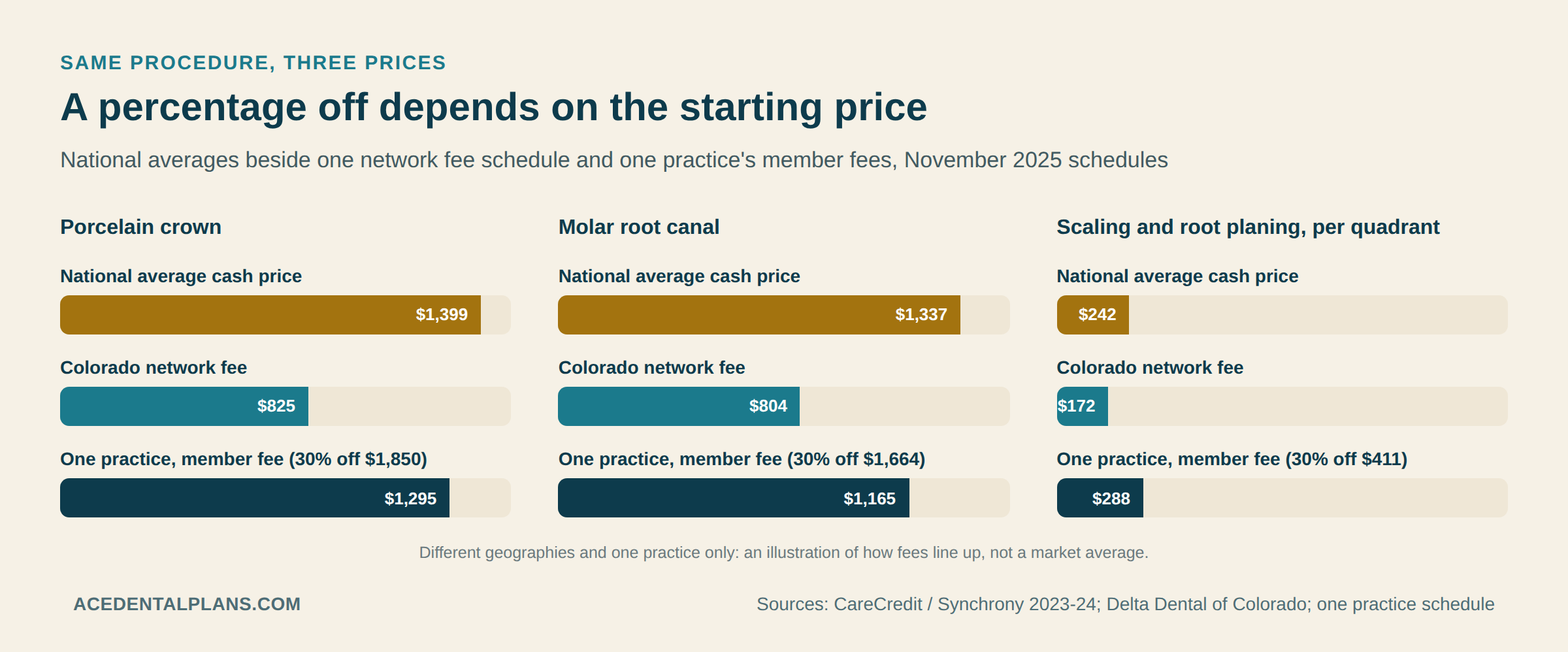
Each form leaves the same hole. A percentage is measured against some starting price, and the plan decides which one. Table 2 shows what happens when you check. It sets a national consumer-survey average for six procedures beside a network plan’s fixed fee and beside one practice’s retail and member fees. The comparison is rough on purpose: the national figures come from Synchrony cost studies published by CareCredit for 2023 and 2024, the network fees are from Colorado, and the practice is a single office.
| Procedure | National average cash price (CareCredit / Synchrony) | Network schedule fee, Colorado (vs average) | One practice: retail to member fee (member fee vs average) |
|---|---|---|---|
| Routine exam, cleaning and X-rays | $203 | $109 assembled from exam $10, cleaning $60, four bitewings $39 (46% below) | Cleaning $115 to $80.50; exams and X-rays $0 with membership, fee extra |
| Porcelain crown (D2740) | $1,399 | $825 (41% below) | $1,850 to $1,295 (7% below) |
| Molar root canal (D3330) | $1,337 | $804 (40% below) | $1,664 to $1,164.80 (13% below) |
| Scaling and root planing, per quadrant (D4341) | $242 | $172 (29% below) | $411 to $287.70 (19% above) |
| Periodontal maintenance (D4910) | $167 | $92 (45% below) | $207 to $144.90 (13% below) |
| Simple extraction (D7140) | $177 | $102 (42% below) | $231 to $196.35 (11% above) |
| Surgical extraction (D7210) | $363 | $163 (55% below) | $367 to $311.95 (14% below) |
Two patterns stand out. The network schedule sits 29% to 55% below the national averages on every line, which fits what a fixed fee schedule is for. The practice’s member fees tell a different story. Its retail fees ran from 1% to 70% above the national averages on these lines, so a 30% member discount landed only 7% to 13% below average on a crown, a root canal and periodontal maintenance. Member fees stayed above average on scaling and root planing and on simple extraction.
None of this says the practice’s plan is poor value. Its retail fee may reflect its costs or its market, and a member of that practice who would otherwise pay retail does save 15% to 30%. The point is narrower. A percentage off is a statement about one office’s list price, and the list price is not necessarily what anyone pays. For where that gap between list and cash comes from, see the guide to cash prices without insurance, and for typical figures by procedure, the dental price guide.
Consumer guides say the same thing in plainer terms. The Illinois Attorney General warns that a plan’s discounted rate may not be lower than what you could find by shopping around yourself, and Georgetown University’s Navigator guide cautions that discount plan savings may be no better than what a consumer could negotiate alone. Both warnings are reasons to get a second number before paying a fee.
Reading a Fee Schedule Line by Line
A fee schedule looks dull, and it is the most useful document a savings plan produces. Patient Direct’s runs to roughly 400 lines. The slice below shows how to read one, using three lines from the November 2025 version: a molar root canal (D3330) at $804, a core buildup (D2950) at $138, and a porcelain or ceramic crown (D2740) at $825.
Several features of a schedule deserve a second look before anything is signed.
- Fee type. Is each line a fixed dollar fee, or a percentage off the office’s own price? A fixed fee is a promise you can check. A percentage depends on a retail fee that may not be posted anywhere.
- What the line includes. The practice schedule above lists “any two exams per year” and “all radiographs” as no charge to members, which is a different bundle from the network schedule’s separate exam and X-ray lines. Compare like with like.
- What the schedule leaves out. Patient Direct’s terms say some procedures may require additional charges that are not included in the listed price and have no discount, that prices exclude gold or other precious metals, and that medical costs associated with a dental procedure are the member’s responsibility and are not discounted.
- What happens to unlisted procedures. The same schedule gives a 20% reduction from the dentist’s customary fee for general-dentist procedures it does not list, and says specialists are contracted to reduce their standard rates by 20%. A flat 20% off an unposted fee is not a price.
- Who may use the schedule. The practice schedule says discounts generally do not apply to specialist services such as periodontics, endodontics, orthodontics and oral surgery unless the schedule says otherwise. Yet that same schedule lists root canal, scaling and root planing, surgical extraction and orthodontic lines. Ask which rule governs.
- Which procedures are missing. The portion of the Patient Direct schedule read for this article lists an implant body (D6010) at $1,441 but returned no abutment or implant-crown lines, so it cannot support a complete implant price. A partial schedule produces partial answers.
Reading the retail and member columns
When a schedule shows both a retail fee and a member fee, the implied discount is the difference divided by the retail fee. On the practice’s crown line that is ($1,850 – $1,295) / $1,850, or 30%, which only restates the headline. The test worth running is on the retail column itself. The practice’s schedule defines member savings as a percentage discount off the office’s usual fees for uninsured, self-pay patients, so in that document the retail fee and the self-pay fee are meant to be the same number. Ask the office to confirm it. An office that quotes a lower cash price to a walk-in than its posted retail fee has made the member discount smaller than it looks.
The retail column also varies line by line. In Table 2 the practice’s retail fees ran 32% above the national average for a crown, 70% above for scaling and root planing, and 1% above for a surgical extraction. Uneven gaps like these are normal across offices. They mean a plan can be a good value on some lines and a poor one on others, which is why the lines you actually need are the ones to price.
One more rule: do not reason from the headline percentage when a fee schedule is available. The dollar fee for your procedure code, from the plan’s own document, is the number to compare with the office’s cash quote.
What You Give Up, and What You Gain, Compared With Insurance
Savings plans trade a payer for a price list. The gains are real. Humana says most discount dental plans have no waiting period and no annual limits, and healthinsurance.org adds that they generally have no deductibles and process no claims. Delta Dental of Colorado makes the same points and notes that cosmetic dentistry, often not covered by traditional insurance, can be part of the discount. Cigna’s page says the same about cosmetic work and suggests a discount program can be paired with insurance for those services.
The costs are just as real. A plan pays no part of the bill. Cigna notes that insurance typically pays preventive care in full “in most cases,” and that after premiums, deductibles and coinsurance, insurance can still cost less than a discount program, which in turn can cost more in a year depending on the care. Delta Dental of Colorado’s explainer states that its savings plan has no out-of-pocket maximum, so costs can keep adding up, and that its network is narrower than a typical insurance network.
The headline benefit, no annual maximum, is also smaller than it sounds for most people. NADP reports that from 2014 to 2023, fewer than 5% of dental benefit enrollees, on average, reached their annual maximum, and that about 65% of dental PPOs offer a maximum of $1,500 or more. Healthinsurance.org gives a typical range of $1,000 to $2,000. A person who plans a large course of treatment is the exception, and that exception is where a savings plan’s lack of a cap may matter. A person with ordinary needs rarely hits the ceiling.
Insurance is a risk-sharing product. It pays toward large bills up to a cap, and it asks for premiums and waiting periods in return. A savings plan is a pricing product. It lowers the price of each service but leaves the entire bill, and all the risk of a big one, with the member. The mechanics of the first are laid out in the explainer on how dental insurance works, and the typical tiers in the guide to what dental insurance may cover. The category hub lists all dental insurance and plans guides for readers comparing more than two options.
Break-Even Math: The Fee, the Discount and the Spending That Connects Them
The core arithmetic fits on one line. If a plan costs F dollars a year and takes a share d off prices, the plan pays for itself when the value of the care you buy, at the price you would have paid without the plan, reaches F divided by d. At a $150 fee and 20% off, that is $750. A person who needs $500 of care saves $100 and is $50 behind. A person who needs $1,500 saves $300 and comes out $150 ahead.
| Annual fee | 10% off | 15% off | 20% off | 30% off | 40% off |
|---|---|---|---|---|---|
| $150 (typical network fee) | $1,500 | $1,000 | $750 | $500 | $375 |
| $300 (low end of memberships) | $3,000 | $2,000 | $1,500 | $1,000 | $750 |
| $400 (high end of KFF range) | $4,000 | $2,667 | $2,000 | $1,333 | $1,000 |
| $600 (adult tier, one practice) | $6,000 | $4,000 | $3,000 | $2,000 | $1,500 |
The grid explains why a cheap card and a pricey membership can both be reasonable. A $150 fee at 30% off needs only $500 of care, so a person with a steady dental need clears it fast. A $600 membership at 10% off needs $6,000, which almost nobody reaches unless the plan also includes visits. The Brooklyn page shows the other side. It pairs a $600 adult fee with 10% off treatment, which on its own would need $6,000 of care to recover. What carries that plan’s value is the bundle: two exams, annual X-rays and two emergency exams at no extra charge, plus 20% off hygiene.
Four adjustments change the answer in real life.
- Subtract what is included. A membership that bundles two exams, X-rays and cleanings has a cash value. KFF Health News described a $348-a-year plan whose included exams, cleanings, X-rays and emergency exam it valued at $492. A patient who would have bought those anyway starts $144 ahead before any discount is applied. A patient who would have skipped them gets no credit.
- Use the real cash price as the starting point. The discount is measured against the office’s list price. Break-even should be measured against what you would actually have paid, including any prepayment or cash discount the office offers.
- Count only discountable lines. Lab fees, specialist services, precious-metal charges and medical costs may sit outside the discount, as the Patient Direct terms show. Spending that gets no discount does not help recover the fee.
- Remember the alternatives. A plan has to beat what you could do for free, which includes asking for a cash discount, a dental school or a health center.
For a single big-ticket item the arithmetic can be even tighter. Membership break-even for a lone crown is worked through in the guide to crown cost without insurance, and the answer there turns, as it does here, on whether the patient uses anything else the plan offers.
Three Hypothetical Years: Cleaning Only, a Crown and an Implant
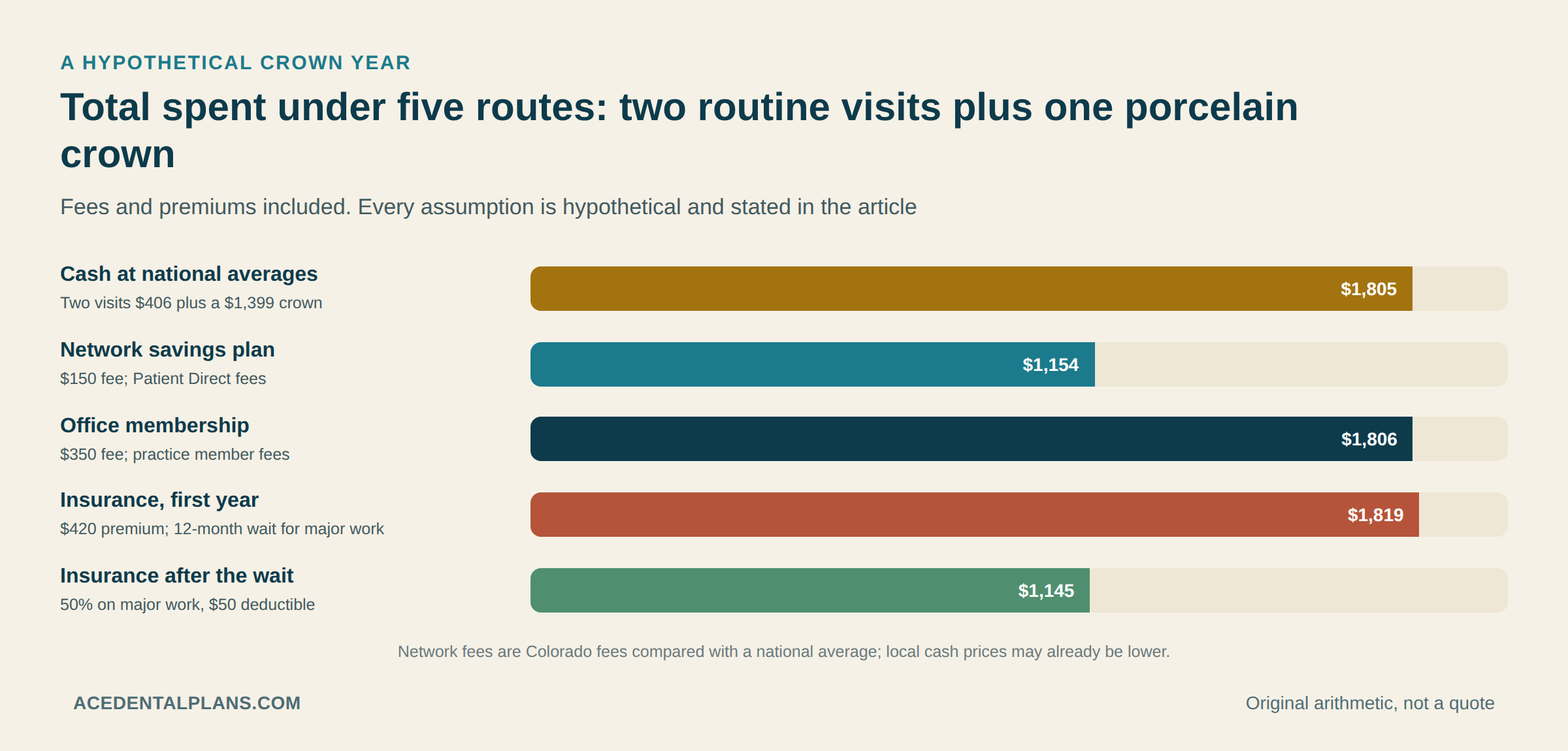
Arithmetic on paper only goes so far, so Table 4 prices three different years under five routes. Everything in it is hypothetical, and the assumptions are spelled out below the table so you can swap in your own numbers. The cash row uses 2023-2024 national averages from the Synchrony studies published by CareCredit. The network row uses the Patient Direct fees from Table 2 plus an assumed $150 membership. The membership row uses the practice’s member fees plus an assumed $350 membership, inside the $300 to $400 range KFF Health News reported. The two insurance rows assume a $35 monthly premium, which is $420 a year and sits inside healthinsurance.org’s $20 to $50 range.
| Route | Cleaning-only year (two routine visits) | Crown year (visits plus one porcelain crown) | Implant year (visits plus one single implant) |
|---|---|---|---|
| Cash at national averages | $406 | $1,805 | $4,750 |
| Network savings plan ($150 fee, Patient Direct fees; implant at 20% to 30% off) | $329 | $1,154 | $3,370 to $3,804 |
| Office membership ($350 fee, member fees; implant at 20% off) | $511 | $1,806 | $3,986 |
| Insurance, first year (12-month wait for major work) | $420 | $1,819 | $4,764 |
| Insurance after the wait (50% major, $50 deductible, $1,500 maximum) | $420 | $1,145 | $3,264 if covered; $4,764 if excluded |
The assumptions behind each cell are as follows. Two routine visits cost 2 x $203 = $406 in cash. Under the network plan they cost two exams at $10 and two cleanings at $60, plus one four-bitewing series at $39, which totals $179, and the $150 fee brings the year to $329. Under the membership, exams and X-rays carry no charge and two cleanings cost $80.50 each, so the year is $350 + $161 = $511. Insurance pays preventive care in full in this illustration, so the premium alone is the cost. For the crown, the cash price is $1,399, the network fee is $825 and the member fee is $1,295. For the implant, the cash price is the $4,344 national average for a standard single implant, and the plan discounts are assumptions, because the schedules read for this article do not price a complete implant. In the insured-after-the-wait case, the plan pays 50% of the amount above the $50 deductible and stops at $1,500.
The cleaning-only year
This is the year most people hope for, and no route moves much money. The network plan saves $77 against cash, the membership costs $105 more, and insurance costs $14 more. Delta Dental of Colorado’s explainer makes the same point in words: a savings plan can be cost-effective for people with generally healthy teeth who only need cleanings and check-ups. The difference between a gain and a loss here is small enough to disappear if your cash prices are lower than the national average, or if your office gives new patients a free exam. For the cash side of this year, see the guide to dental cleaning cost and the one on cleaning cost without insurance.
The crown year
Here the routes separate. The network plan saves $651 against cash, almost entirely because its crown fee of $825 sits so far below the $1,399 average. The membership roughly matches cash, because its $1,295 member fee is only $104 below the average and the $350 membership absorbs that and more. Insurance behaves in two ways. In its first year, with major work excluded for 12 months, it costs $14 more than cash. After the wait, with 50% coverage of an allowed amount equal to the national average, it saves $660. A real PPO often negotiates a lower allowed amount, which would improve the insured figure further.
The lesson is not that one route wins. It is that the waiting period, not the discount, decides the crown year for an insurance buyer, and the absolute fee, not the percentage, decides it for a plan member. For what the crown itself costs, see the guide to dental crown cost by material.
The implant year
Big bills are where the annual maximum bites. With the national average of $4,344 for a standard single implant, a 20% discount saves $869 and a 30% discount saves $1,303. An insurer that covers implants, after the wait, pays up to $1,500 in this illustration, which beats both. If the plan excludes implants, as some do, insurance pays nothing and the discount plan wins by $960 to $1,394 on these assumptions. That “if” is the whole story. Check whether the plan treats an implant as a covered major service, an alternate benefit or an exclusion before comparing anything. The guide to dental implant cost prices the parts, and the complete implants overview covers the procedure.
Two limits on this table deserve emphasis. First, the network fees are Colorado fees compared with a national average, so part of the saving reflects geography, and your own market may already price below the average. Second, a hypothetical discount on an implant is not a fee schedule. If a plan lists the implant body, abutment and crown separately, add them up from the plan’s own document.
What changes if your local prices are lower
The cash row in Table 4 uses national averages, and a patient in a lower-priced market could be paying less. Suppose local cash prices run 15% below those averages. The cleaning-only year then costs $345 in cash, which is $16 more than the network-plan total of $329. The crown year costs $1,534 in cash, so the network plan still saves $380 instead of $651. In the implant year, a 20% network discount on a $4,344 implant already 15% lower in your market produces a total of about $3,283 against $4,038 in cash, a saving of roughly $755. The plan’s advantage shrinks when your cash prices are already low, but it rarely disappears when the plan’s fee schedule is firmly below them. Those calculations repeat the earlier assumptions and change only the local price level, so they are as hypothetical as the table.
Reading Table 4 as a decision path
The table suggests a short sequence of questions, in order. If your known needs are two routine visits, add the plan fee to the plan’s price for those visits and compare the total with the office’s cash quote; if the plan is not lower, stop there. If a crown, root canal or other single large item is likely within twelve months, use the fee schedule’s dollar figure for that procedure and ignore the headline percentage. If the work is an implant or orthodontics, ask for every component in writing, because partial schedules and specialist rules distort the comparison.
If you already hold insurance, the next question is whether a waiting period or an exhausted maximum is what makes a plan attractive, since both are temporary. And if the numbers are close, choose the shortest term on offer and put the renewal date on your calendar. A plan that wins by $40 on paper can lose that margin to one unwanted renewal.
Using a Savings Plan Alongside Insurance, and Near the End of the Year
Savings plans and insurance are not mutually exclusive, but the rules for combining them are narrow. Humana’s page says you can have both and warns that you cannot use them both for the same procedure. It adds that some dentists may apply the discount after you reach your insurance annual maximum. Cigna’s page suggests a discount program can be paired with insurance for cosmetic services or after you exhaust your annual benefits.
Notice the hedging in both: “some dentists,” “can be paired.” Whether an office will give a plan discount on the portion of a bill that insurance would otherwise not pay is the office’s decision, and it may depend on its contracts. The question to put to the front desk is concrete: “If my insurance maximum is used up, will you honor this plan’s fee for the next procedure?” Ask for the answer in an email.
The calendar adds a second consideration. Insurance benefits are tied to a plan year, and a patient with unused benefits in late autumn may do better by using them than by buying anything new; the year-end dental benefits checklist explains what to check. A savings plan has no benefit year to lose, though its membership has its own term. Cigna’s page says its programs expire at the end of the year, while the Brooklyn practice asks for a 12-month commitment. The rule is to find the end date before paying, not after.
In-Office Membership Plans: What Sits Inside and Where They Differ
An in-office plan is a contract with a single practice. KFF Health News described the common design in September 2021: certain preventive services are free, other procedures are discounted, and there are no annual deductibles or waiting periods. The report contrasted this with traditional insurance, which it said often caps benefits at $1,200 to $1,500 a year, and noted that membership discounts can apply to unlimited treatment. A quarter of dentists offered such plans, it said, citing a 2021 ADA survey.
The terms differ widely, so no two plans compare by name. The Brooklyn page read for this article gives members two annual exams, annual 2D X-rays and two emergency exams at no extra charge. It takes 20% off hygiene services and 10% off dental treatment by the dentist, plus $500 off Invisalign and $100 off in-office whitening. It also says that percentage discounts do not apply when third-party financing is used, requires a 12-month minimum commitment and bills the fee automatically. The other practice schedule read for this article is run with an outside administrator that, by its own terms, does not pay dentists, and lists member fees at 30% or 15% off.
The 2023 ADA Health Policy Institute poll adds a structural point. Of the 227 owner dentists whose practices offered a plan, 169 ran it themselves and 58 used an outside company. So a membership may be an in-house program with in-house terms, or a branded product with a third party behind the curtain. The page should say which. A third-party administrator can also change who you call when something goes wrong.
Terms worth comparing between two offices are short: what is included, what the discount applies to, what is excluded, whether the discount covers work already diagnosed, whether financing cancels the discount, the minimum term and the cancellation rule. The guide to dentist visit cost without insurance works through membership break-even for a first visit, with four published office plans. One more question matters for the long run: what happens to your membership if the dentist retires, sells the practice or moves? A page that does not answer it is a page to read twice.
Group and Employer Versions: When the Benefit Is Only a Discount
Savings plans do not only reach people through ads. The ADA’s overview notes that discount plans were originally sold to individuals but that employers increasingly buy them as employee dental coverage. For a worker, that creates a labeling trap: a benefits guide may list a “dental program” without saying whether it is insurance.
The quickest test is to look for the features only insurance has. A dental insurance plan has an annual maximum, usually a deductible, a percentage the plan pays for each category of service and claim forms or electronic claims. NADP’s definition of a discount plan says it pays nothing toward the cost of care. If the summary lists none of the insurance features and instead shows a fee schedule or a discount range, it is a discount product. A very low employee contribution with no annual maximum and no waiting periods is a clue, though not proof, since some insurance products charge little.
Why does it matter? A worker who believes there is insurance may book a crown expecting a benefit payment and receive a bill for the full contracted fee. Another may skip an individual plan, thinking they are already covered. HealthCare.gov adds a related fact: dental coverage isn’t an essential health benefit for adults, so health plans don’t have to offer adult dental coverage. The employer’s choice of a discount product is a legal option, and it is the reader’s job to know what was chosen.
Regulation: Who Oversees a Product That Says It Is Not Insurance
The legal position is awkward by design. Because a savings plan is not insurance, insurance law does not usually apply. NADP says discount plans are not licensed in most states as insurance products. The NAIC’s consumer article puts the consequence plainly: because the cards are not insurance, buyers have fewer consumer protections, and many state insurance departments do not regulate the sellers. It adds that some states have recently passed licensing or registration rules. That article carries an undated placeholder, so read it as durable advice, not a current survey.
The states that do act do so in different ways. Four examples show the range.
- Nevada (NRS chapter 695H). It is unlawful to offer a medical discount plan without registering it. Registration costs $500, with a $500 annual renewal, and the plan must maintain a net worth of $100,000. Marketing may not use words that could suggest insurance, including “coverage,” “copay,” “preexisting conditions,” “guaranteed issue” and “PPO.” Members must receive written disclosure that the plan is not a policy of health insurance, in type not smaller than 12-point, within 10 business days of enrollment at the latest. On request the plan must provide, through a toll-free number, a list of participating providers within 50 miles, updated at least every six months. Timely cancellation triggers a refund of any required portion of fees within 30 days. Penalties reach $2,000 per violation.
- Florida (chapter 636, Part II). The statute’s table of contents shows a licensing requirement for discount plan organizations and separate sections on disclosures, marketing, fees, provider agreements and provider name listing. Only those headings were read for this article, not the section text.
- Connecticut. The Insurance Department’s FAQ says a seller of medical discount plans must be licensed in the state, and advises consumers to check with the Department that a seller is licensed before buying.
- Illinois. According to the Attorney General’s consumer guide, plans must register as a Preferred Provider Administrator, but that does not give the protections of insurance. The guide says, for example, that consumers are not protected from loss if the company fails.
At the federal level, the Federal Trade Commission’s consumer advice says a medical discount plan is not insurance, that some give legitimate discounts but others are just scams, and that suspected scams can be reported at ReportFraud.ftc.gov. Several plan documents also state their status under the Affordable Care Act. Patient Direct’s schedule says the plan does not meet minimum creditable coverage requirements, and the practice schedule says its plan is not a qualified health plan. Georgetown University’s Navigator guide says discount medical plans do not count as minimum essential coverage and that several state regulators have shut down plans over fraud.
For a member, the practical reading is modest. The laws read here mostly govern registration, wording, disclosure and refunds. None of them promises that a plan saves money, and Nevada’s chapter sets no cap on membership fees. The state on a card is not necessarily your state, and this article read four of them. The state insurance department and attorney general are the places to ask whether a seller is registered where you live.
Red Flags in the Pitch, and What Plain Dealing Looks Like
Most dental savings plans are what they say they are: a fee in exchange for lower prices at participating offices. The FTC’s consumer advice acknowledges that some medical discount plans give legitimate discounts while others are just scams. The sorting job falls to the buyer, and the warning signs published by regulators are consistent from one source to the next.
Slow down or walk away if
- The seller will not say, in plain words, whether the product is insurance or a discount plan, or the paperwork has no “this is not insurance” statement (NAIC).
- No list of participating dentists is available until after you pay (NAIC).
- The pitch uses insurance vocabulary such as “premium,” “co-payment,” “coverage” or “benefits paid” to suggest the product works like insurance (NAIC; Nevada bans words such as “coverage” and “copay” in marketing).
- You are urged to drop existing health or dental insurance, or told the plan is a substitute for it (NAIC; FTC).
- You are pushed to decide fast, asked for card or bank details before you have read the terms, or charged before you enroll (NAIC; Illinois Attorney General).
- The ad does not name the sponsoring company, or the hotline will not give you a company address and telephone number (Illinois Attorney General).
- A large initiation fee or “non-refundable administrative fee” appears that is not in the headline price (Illinois Attorney General).
One nuance keeps a legitimate plan from looking like a scam. The Illinois Attorney General lists claims of “no pre-existing conditions” and “no age restrictions” among the signs to watch for in ads for health care discount plans. Yet a dental savings plan really does lack waiting periods, which Humana, Cigna and Delta Dental of Colorado all state. The red flag is not the absence of limits. It is insurance-style vocabulary attached to a product that does not pay claims, and a sales pitch that stresses how much is “covered” while saying little about how the plan prices anything.
Plain dealing looks different. A seller that follows a statute like Nevada’s publishes a clear non-insurance disclosure, offers a toll-free number, supplies a provider list on request and has a refund route. NAIC’s advice to buyers adds a few items worth wanting from any seller: a toll-free customer service line, a reasonable complaint process, and clear refund and cancellation terms. Before buying, NAIC and the Illinois Attorney General both suggest checking for complaints with the state attorney general and the Better Business Bureau, and asking the state insurance department whether the seller must be registered or licensed.
Marketing phrases, decoded
Not every eye-catching phrase is a red flag. Several are accurate and still incomplete. A short decoding guide helps.
- “Save up to 60%.” “Up to” names the ceiling. Healthinsurance.org gives 10% to 60% as the typical range for normal dental work, and Humana says a savings plan won’t cover 100% of the cost of any procedure. The number that counts is the plan fee for your procedure code.
- “No waiting periods, no deductibles, no annual maximum.” Usually true, as Humana, Cigna and Delta Dental of Colorado state. The same list also describes a product that pays nothing, with no out-of-pocket maximum to cap what you owe.
- “A nationwide network.” A national headcount says nothing about your town. Nevada’s law uses the relevant unit: a list of participating providers within 50 miles of the applicant.
- “Start saving today.” The plan may indeed start at once. Check whether “today” also starts an automatic bill and a 12-month minimum, as one practice page states.
- “Family coverage.” The word “coverage” is the problem, since a savings plan covers nothing and Nevada bars it in marketing. Ask whether the fee is per person or per household, and who counts as family.
If something goes wrong, the FTC takes reports at ReportFraud.ftc.gov. For Medicare-related scams, the FTC’s page lists 1-800-MEDICARE. Where a state requires registration, the insurance department is the usual first stop, and the Illinois guide lists its attorney general’s health care helpline for people who feel they were misled.
Verifying That Your Dentist Is in the Network, Step by Step
This is the most valuable fifteen minutes in the whole process. A savings plan with a long list of dentists and no dentist you will visit saves nothing. The risk is not abstract: Delta Dental of Colorado’s Patient Direct schedule says the insurer does not guarantee any dentist’s continued participation, and that a member whose dentist leaves must select a new provider. A directory is a snapshot.
- Get the provider list before paying. A seller that will not show one is on NAIC’s warning list. Where a statute applies, the list may be a legal right: Nevada requires a complete and accurate list of participating providers within 50 miles on request, updated at least every six months.
- Call the dentist’s office, not only the plan. Name the plan exactly and ask whether the office participates today. Directories lag. Ask whether the plan’s fees apply to new patients as well as established ones.
- Ask for the fee on your codes. If a dentist has diagnosed treatment, ask for the plan fee for each procedure code and the cash fee beside it. Ask for the numbers by email or text so there is a record.
- Ask about exceptions. Lab charges, specialists, sedation, precious metals and procedures not on the schedule are common places for a discount to stop. Patient Direct’s terms are explicit about several of them.
- Ask about the contract’s end date. “Does your agreement with the plan renew, and is anything expected to change?” The answer will not always be known, but asking shows how settled the relationship is.
- Keep your evidence. Save a dated screenshot of the directory listing, the email with fees, and the receipt. If the office later refuses the discount, you have a basis for asking the plan for a refund.
- Check the first receipt. After the first visit, compare what you paid with the fee you were quoted. A mismatch on the first visit is easier to fix than one discovered after a second.

One more check is cheap and often skipped: compare the dentist’s quoted plan fee with what you could simply ask for in cash. The Illinois Attorney General warns that a plan’s discounted rate may not beat shopping around yourself. If the office will quote a cash price close to the plan fee, the fee has bought you little.
If your dentist is not in the network
Many people find their own dentist missing from a plan’s list. The options are limited but real. You can ask the office whether it will charge the plan’s fee for you anyway, which is a request and not an entitlement. You can ask for the office’s cash discount, if there is one, and compare it with the plan. Or you can use a network dentist for a single large procedure and stay with your own dentist for routine care, taking copies of your X-rays and records along so a second office does not repeat them.
Switching offices to chase a discount has a cost the fee schedule does not show: a new dentist, a new set of records and a new relationship. The plan’s terms say nothing regarding the quality of any participating provider, and Patient Direct’s own clause on negligence makes that explicit. For adults weighing other routes to lower prices, community health centers and dental school clinics come up again below.
Cancellation, Renewal and Refunds: The Terms That Decide Regret
The membership agreement is a contract, and its dull clauses decide whether a bad choice is a minor annoyance or a recurring charge. Four clauses are worth finding before anything is signed: how the plan renews, how you cancel, what is refunded, and what happens if the dentist you joined for leaves the network.
Renewal terms vary. Cigna’s explainer says its discount programs expire at the end of the year. The Brooklyn practice’s page says the fee is billed automatically, requires a 12-month minimum commitment and lists no cancellation terms at all. That absence is the kind of gap to ask about by name. A plan that bills automatically and gives no cancellation route in its public terms may still have one in the agreement you accept at checkout, but the buyer should see it first.
Refunds are where law helps in some states. Nevada requires a medical discount plan to allow applicants and members to cancel and, where appropriate, to refund any required portion of fees within 30 days after timely notice of cancellation. The Illinois Attorney General warns about the opposite: hidden non-refundable administrative fees due before enrollment that can exceed the savings. NAIC advises asking for clear refund and cancellation terms up front. Where no statute applies, the contract is the only protection.
The fourth clause, the dentist leaving the network, is the least often addressed. Patient Direct’s terms put the burden on the member to choose a new provider. Ask the plan whether a fee is refundable if the one dentist who made the plan worth buying leaves in month two, and ask for the answer in writing.
When the plan and the dentist disagree
A billing dispute under a savings plan has a different shape than an insurance denial. There is no claim to appeal, so the question is whether the office applied the agreed fee. Start by asking the front desk which fee it used, line by line, and compare it with the written quote you saved before treatment.
If the numbers still do not match, call the plan’s member line and ask for its answer in writing. Nevada’s chapter requires a toll-free number for questions and complaints, and NAIC advises wanting a reasonable complaint process. If that does not resolve it, the next steps are the places the regulators named: the state insurance department, the state attorney general, the Better Business Bureau and, for suspected fraud, the FTC. Keep the dated directory screenshot, the emailed fees and the receipt together.
Separate the billing question from the clinical one. A fee disagreement should not delay care that a dentist says is urgent, and a plan listing never changes what treatment a dentist recommends. If you have swelling, fever or trouble breathing, treat it as an emergency first and sort out the fee afterward.
Who Tends to Benefit, and Who Rarely Does
A savings plan is a tool, and tools fit some jobs. Table 5 sorts nine common situations by what a plan can do, what to check, and how often the fit seems worth pricing. The “fit” column is a judgment about arithmetic and structure, not a prediction for any one person, and it never ranks a brand.
| Situation | What a plan can do | Check first | Fit |
|---|---|---|---|
| No coverage; two cleanings a year; no known problems | Small saving on routine visits; the fee can cancel it (Table 4) | Is the plan fee for the exam, X-rays and cleaning below the office’s cash price? | Marginal |
| No coverage; a crown or root canal planned within months | Immediate start with no waiting period; the saving scales with the fee schedule | Is the dentist in the network? What is the written fee for every line? | Worth pricing |
| Insurance with the annual maximum already used up | May lower the price of remaining work, if the office honors the plan | Will the office apply the plan after the maximum is reached? Same procedure cannot use both (Humana) | Depends on the office |
| Employer PPO with an ample maximum and low use | Little to add; the plan cannot be used with insurance on the same procedure | Remaining benefits, plus any exclusions the plan might fill | Rarely adds value |
| Cosmetic work the insurer excludes | May discount services insurance typically does not pay for (Cigna) | Is the cosmetic service on the schedule, and at what fee? | Worth pricing |
| Orthodontics for a child or adult | Fee schedules list orthodontic lines: $4,142 for adolescent comprehensive treatment (Patient Direct) or $3,640 for members after 30% off $5,200 (one practice) | Specialist exclusions, payment structure, and whether financing cancels the discount | Depends |
| Family with mixed needs | One membership may cover several people with different needs | Is the fee per person or per household? Which relatives’ dentists participate? | Often worth pricing |
| Original Medicare with no dental benefit | Lowers prices, but pays nothing and leaves the whole bill with the member | Whether your Medicare plan includes any dental benefit; scam warnings | Depends |
| Your dentist is not in the network | Nothing, unless you are willing to change dentists | Whether the network dentist is a realistic choice | No benefit |
Two patterns recur in the table. Savings plans help most when a known, sizable treatment is coming soon and the dentist is already in the network, because there is no waiting period to sit through. They help least when the dentist is out of the network or when insurance with a generous maximum already covers most of the year’s needs. Everything else depends on the arithmetic in Tables 2 through 4.
Medicare deserves a short paragraph of its own. Medicare.gov says that in most cases Medicare does not cover routine cleanings, fillings or extractions, or dentures and implants, and that you pay all costs for non-covered services. That is why people on Original Medicare are a frequent target audience for discount products. A savings plan can lower the price of care, but it removes none of the bill. The guide to Original Medicare dental rules sets out the narrow exceptions, and the article on Medicare Advantage dental benefits explains what those plans offer for dental. Readers weighing their Medicare options can start with the guide to comparing Medicare dental benefits before buying anything outside Medicare.
For adults with no coverage of any kind, a savings plan is one of several routes, alongside community health centers, dental school clinics and public programs. The playbook for dental care without insurance sets those routes beside each other, and a plan fits as a complement to them, not a replacement.
Four Patients Priced From the Fee Schedules
Averages hide the people behind them. The four patients below use the fee schedules and national averages already cited, plus the hypothetical $150 network fee and $350 membership from Table 4. All are invented. They exist to show how the same two schedules can win in one case and lose in another.
A patient on periodontal maintenance four times a year
At the $167 national average, four maintenance visits cost $668. On the network schedule’s $92 per visit the total is $368, or $518 with the fee, a $150 saving. On the practice’s $144.90 member fee the total is $579.60, or $929.60 with the membership, which is $261.60 more than cash. The membership could still earn its keep if its included exams and X-rays replace visits the patient would pay for anyway, but the maintenance visits alone do not justify it. The care itself is covered in the guide to gum disease stages and treatment.
A patient with a cracked molar needing a root canal and crown
The national averages for a molar root canal and a porcelain crown total $2,736. On the network schedule the same two lines come to $1,629, or $1,779 with the fee, a saving of $957 before any buildup. On the practice’s member fees they total $2,459.80, or $2,809.80 with the $350 membership, which is $73.80 above the average. A buildup would add to both plan totals and an unknown amount to the average, so the comparison is directional. The percentage discount did not decide this case; the fee schedule did.
A patient who needs three simple extractions
Three simple extractions cost $531 at the $177 national average. The network schedule’s $102 each totals $306, or $456 with the fee, a $75 saving. The practice’s $196.35 member fee totals $589.05, or $939.05 with the membership, which is $408.05 above the average. This is the case where a small bill meets a large fee, and the fee wins.
A teenager who needs comprehensive braces
The CareCredit page lists metal braces at a $6,343 national average. Patient Direct lists adolescent comprehensive orthodontics at $4,142, or $4,292 with the fee, which is $2,051 below the average. The practice lists $5,200 retail, which is already below the national figure, and $3,640 for members, or $3,990 with the membership, a $2,353 difference. These are the biggest gaps in this article, and they carry the heaviest caveats. An orthodontic line on a fee schedule is a starting point, not a treatment plan. Case complexity, appliance type, specialist rules and the payment arrangement all change the real figure, and the Brooklyn practice’s terms show how a membership can withdraw its percentage discounts when third-party financing is used.
Procedure Notes: Where a Fee Schedule Helps and Where It Stops
Savings plans do not treat every service alike. Some procedures sit squarely on a schedule with a clear fee, while others depend on lab work, specialists or choices the schedule never mentions. The notes below use the two schedules read for this article, Patient Direct’s from Delta Dental of Colorado (November 2025) and the single practice’s savings plan (also November 2025). They are examples of how fees line up, not a market survey.
Exams, X-rays and cleanings
Preventive lines are where plans look strongest. Patient Direct lists a periodic exam at $10, a comprehensive exam at $15, four bitewings at $39, a full-mouth series at $83, a panoramic image at $62 and an adult cleaning at $60. The practice plan lists two exams a year and all X-rays at no charge to members, with the adult cleaning at $80.50 against a $115 retail fee. Those are small numbers that add up to a small saving, which is why Table 4’s cleaning-only year barely moves.
Fillings
The two schedules share a code, D2392, for a two-surface posterior composite, and they price it differently. Patient Direct charges $140. The practice lists a $317 retail fee and a $221.90 member fee, which is $81.90 higher than the network fee even after the discount. Nothing is wrong with either number. They show that the same procedure code can sit at very different prices across plans, which is the reason to compare dollars and not percentages. The page on filling cost without insurance covers cash prices for composite and amalgam.
Deep cleaning
Scaling and root planing is priced per quadrant, which turns a modest-looking line into a four-part bill. Patient Direct lists $172 per quadrant for four or more teeth and $120 for one to three. The practice lists $411 retail and $287.70 for members. The national average is $242 per quadrant. Four full quadrants therefore come to $688 on the network schedule, $1,151 at the practice’s member fee and $968 at the national average. Which price applies depends on how many teeth per quadrant need treatment, a clinical call. Details on pricing and plan treatment are in the guides to deep cleaning prices by quadrant and deep cleaning cost without insurance, and the broader course of treatment is in the guide to gum disease treatment cost.
Root canals and extractions
Both schedules list root canals by tooth type and extractions as simple or surgical. Patient Direct charges $548 for an anterior root canal, $604 for a premolar and $804 for a molar, and $102 and $163 for simple and surgical extractions. The practice’s member fees are $823.90, $949.90 and $1,164.80 for the root canals, and $196.35 and $311.95 for extractions. The practice’s schedule states that discounts generally do not apply to specialist services such as endodontics and oral surgery while listing those procedures anyway, so confirm who would do the work and whether the fee applies. For cash-price context, see the guides to root canal cost and extraction cost without insurance.
Dentures
Patient Direct lists a complete maxillary or mandibular denture at $935 each, a resin-base maxillary partial at $637 and a cast-metal-framework maxillary partial at $1,058. Those are per-arch fees, so an upper and lower set means two lines. The lines read did not include relines, rebases or repairs, which are the usual later costs, nor extractions needed before the denture. The guide to dentures, types and costs explains the options, and the guide to how long dentures last explains when relining or replacement may come due. Cash-pay prices are in the guide to dentures cost without insurance.
Implants
The implant line illustrates a schedule’s limits. Patient Direct lists the surgical placement of an endosteal implant body at $1,441. An implant tooth also needs an abutment and a crown, bone work in some mouths, and imaging. A savings plan that publishes only the body price leaves the reader with a fraction of the bill. Ask for every component in writing before comparing the total with a cash quote.
Orthodontics and cosmetic work
Plans advertise these categories because insurance often pays less for them. The adolescent comprehensive orthodontics line is $4,142 on Patient Direct and $5,200 retail, or $3,640 for members, at the practice. Both statements come with the specialist caveat discussed above. The guides to braces cost by type and cosmetic dentistry cost give the cash side of those decisions.
Paying the Dentist With HSA or FSA Money, and Where Plan Fees Fit
The treatment is the easier half of the tax question. IRS Publication 502 (2025) says medical and dental expenses include amounts paid for the prevention and alleviation of dental disease: cleanings, sealants and fluoride as prevention, and X-rays, fillings, braces, extractions and dentures as treatment. A dentist’s bill paid at a savings-plan rate is still a dental bill, so HSA or FSA money can normally pay it, subject to the account’s own rules. The publication also says cosmetic procedures directed at improving appearance are generally not includible.
The membership fee is harder. Publication 502 includes premiums for policies that cover medical care. The portion of the publication reviewed for this article did not mention discount plans or discount-card fees, and a savings plan is not an insurance policy. So whether the fee itself can be paid or reimbursed from an HSA or FSA is a question for the account administrator or a tax professional, not something to assume. Ask before enrolling and ask for the answer in writing.
One more tax point concerns itemizing. The same publication says only the part of medical and dental expenses above 7.5% of adjusted gross income is deductible, so a lower bill also counts fewer dollars toward that threshold. The side-by-side of account types, contribution limits and eligible expenses is in the guide to HSA versus FSA for dental expenses.
A Treatment Plan Priced Three Ways
A worked estimate shows how much the type of plan matters. Suppose a dentist’s written estimate lists six lines at the office’s list prices: an exam at $100, four bitewings at $70, an adult cleaning at $130, a two-surface posterior filling at $280, a core buildup at $300 and a porcelain crown at $1,500. These prices are invented for the exercise. The total is $2,380.
Three practical steps follow from the example. First, ask the office to restate the estimate with and without the plan, line by line, using procedure codes. Second, ask whether the discount applies to every line, including the buildup, labs and any materials upgrade. Third, ask whether choosing to finance the remainder changes the discount; the Brooklyn practice’s page says it does. For how to fund the portion that is left, see ways to pay for expensive dental work, and for the interest traps in some office loans, dental financing versus payment plans.
Questions to Ask Before You Pay the Fee
A savings plan is easy to join and awkward to leave, so the questions below are worth putting to the seller and to the dentist before the card number goes in.
- Is this product insurance or a discount plan, and where in the paperwork does it say so?
- What is the all-in cost for the first twelve months, including enrollment, administrative or renewal fees, and is the fee for one person or a household?
- Is the monthly option more expensive than paying once?
- Can I see the participating dentist list today, and when was it last updated?
- Does my dentist participate right now, and for which procedures and which patients?
- What is the plan’s fee for each procedure code on my treatment plan, in writing?
- Do lab fees, specialist care, sedation, precious metals or procedures off the schedule fall outside the discount?
- Does the discount apply to treatment already diagnosed, and does paying with financing cancel it?
- When does the membership start, when does it end, and does it renew automatically?
- What happens to my fee if I cancel, or if my dentist leaves the network?
- Is the seller registered or licensed in my state, and who handles complaints?
- What would my dentist charge in cash for the same work, and how does that compare with the plan fee?
None of these requires expertise. A seller that answers in plain numbers has told you something, and one that cannot has told you something more.
Mistakes that cost the most
Most regret traces back to a short list of avoidable errors.
- Paying before checking the dentist. A directory listing is not confirmation. Call first.
- Comparing percentages when dollars are available. A 40% discount off a high list price can land above a 15% discount off a low one, as Table 2 shows.
- Treating the fee as the only cost. Lab charges, buildups, sedation and materials such as gold may sit outside the discount.
- Counting included visits you would not have used. A free exam is worth its cash price only if you would have paid for it.
- Letting the plan renew unseen. Automatic billing and minimum terms turn a one-time choice into a recurring one.
- Using the plan and insurance on the same procedure. Humana says you cannot, so find out which one the office will apply first.
- Joining in a panic. Emergency symptoms such as facial swelling, fever with severe pain or trouble breathing call for urgent care first. Fee shopping comes after.
Bottom Line
Treat a savings plan as a purchase with a payback date, not as coverage. The payback date is the fee divided by the discount, adjusted for anything the plan includes, and it is reachable only if the dentist you will use is in the network and charges the plan’s fee on the day you sit in the chair.
That suggests an order of work. Start with the treatment you are likely to need, ask your own dentist what the cash price is, and then ask whether any plan the office accepts beats it by more than the fee. Put each answer in writing. If the numbers favor a plan, buy the shortest term on offer and calendar the renewal date. If they do not, the money is better spent on the treatment itself, or on a route such as a health center or dental school that lowers the price without a membership. Either way, the decision turns on a handful of figures you can collect in an afternoon.
Frequently Asked Questions
Are dental savings plans worth it?
They are worth it when the savings on care you will actually buy exceed the annual fee, and your dentist participates. At a $150 fee and a 20% discount, the break-even is $750 of care measured at the price you would otherwise pay. For a cleaning-only year the arithmetic is often close to even, while a planned crown or root canal can swing it clearly. Price your own treatment before paying anything.
Is a dental savings plan the same as dental insurance?
No. The ADA describes discount plans as technically not insurance: the company contracts with a network of dentists, patients pay the contracted rate, and no claim forms are filed. Insurance pays part of covered services up to an annual maximum, usually for a premium. A savings plan pays nothing toward your bill. Its only effect is a lower price from participating dentists.
How much does a dental savings plan cost?
Humana and healthinsurance.org both put the typical network plan fee around $150 a year. In-office memberships run higher: KFF Health News reported about $300 to $400 a year in 2021, and one 2026-era practice page listed $350, $500 and $600 for child, senior and adult tiers. Monthly options may cost more over the year than annual ones, and some sellers add enrollment fees, so ask for the first-year total.
How much can you save with a dental savings plan?
Quoted discounts range from 10% to 60%, but real savings depend on the fee schedule and the office’s own prices. In the schedules read for this article, a Colorado network fee was 29% to 55% below national average cash prices on six procedures, while one practice’s member fees ran from 14% below to 19% above average. Prices also differ by market, a point explored in why dental work is expensive.
Do dental savings plans have waiting periods?
Generally no. Humana says most discount dental plans have no waiting period, Cigna says there is no waiting period, and Delta Dental of Colorado says members avoid annual maximums, deductibles and waiting periods. That is a real difference from many insurance plans, which can delay coverage for major work. The terms still live in the agreement, so confirm the start date before paying, and ask about any minimum commitment.
Is there an annual maximum on a dental savings plan?
Most do not have one. Humana says most dental discount plans have no annual limits, and healthinsurance.org says the same. The tradeoff is that there is also no ceiling on what you owe. Delta Dental of Colorado notes its plan has no out-of-pocket maximum, so costs can keep adding up. NADP reports that fewer than 5% of dental benefit enrollees reached their annual maximum from 2014 to 2023.
Can I use a dental savings plan with dental insurance?
Sometimes, but not on the same procedure. Humana says you can hold both and cannot use them both for the same procedure, and adds that some dentists may apply the discount after you reach your annual maximum. Cigna suggests pairing a discount program with insurance for cosmetic services or after benefits run out. The office decides, so ask whether it will honor the plan after your maximum is used.
Do all dentists accept dental savings plans?
No. Only dentists who contract with the plan, or practices that run their own membership, offer the discounted fees. Delta Dental of Colorado calls its network narrower than a typical insurance network, and Patient Direct’s schedule says a dentist’s continued participation is not guaranteed. A directory listing is a starting point. A phone call to the office is the confirmation.
How do I find out if my dentist takes a dental savings plan?
Get the plan’s provider list, then call the dental office and ask whether it participates today. Ask for the plan’s fee on your procedure codes and a cash fee for comparison, preferably by email. Nevada, for one, requires plans to supply a list of participating providers within 50 miles on request and to update it at least every six months. A directory can lag behind the office’s real status.
Do savings plans apply to treatment my dentist has already recommended?
It depends on the plan, and no source read for this article guarantees it. Humana, Cigna and Delta Dental of Colorado describe no waiting periods, which suggests diagnosed work can be discounted from day one. A practice membership may be narrower. Ask in writing whether the discount applies to the exact treatment plan you already have.
Are dental discount plans legitimate or a scam?
Both exist. The FTC says some medical discount plans give legitimate discounts but others are just scams. Warning signs from NAIC and the Illinois Attorney General include no provider list before purchase, insurance-style words like “premium” and “co-payment,” pressure to decide quickly, large upfront fees, and an unnamed sponsor. Check the seller with your state insurance department and attorney general before giving payment details.
Who regulates dental discount plans?
It varies by state. NADP says discount plans are not licensed in most states because they are not insurance products. Some states regulate the sellers: Nevada requires registration with the Commissioner, Connecticut requires a license from its Insurance Department, and Illinois requires registration as a preferred provider administrator. At the federal level, the FTC polices deceptive marketing. Ask your own state’s insurance department what applies.
Can I use an HSA or FSA to pay for a dental savings plan?
Treatment paid at the plan rate normally qualifies, but the plan fee itself is uncertain. IRS Publication 502 (2025) includes dental treatment and premiums for policies that cover medical care. The part reviewed for this article did not mention discount plan fees, and a savings plan is not an insurance policy. Ask your HSA or FSA administrator or a tax professional before using account money for the fee.
What is the difference between a savings plan and an in-office membership?
A network savings plan covers many dentists and offers fee schedules or discount percentages. An in-office membership belongs to a single practice and often bundles exams, X-rays or cleanings with a discount on other work. KFF Health News described memberships at about $300 to $400 a year in 2021. A 2023 poll for the ADA Health Policy Institute found 26% of owner dentists offered one.
Are dental savings plans useful for people on Medicare?
They can lower prices, but they do not pay for care. Medicare.gov says Medicare generally does not cover routine cleanings, fillings, extractions, dentures or implants, and you pay all costs for non-covered services. Check what your own Medicare plan includes for dental before paying for a separate plan, and be wary of any seller who describes a discount card as Medicare coverage, since the FTC lists 1-800-MEDICARE for Medicare-related scams.
Can I cancel a dental savings plan and get a refund?
That depends on your state and the contract. Nevada requires plans to allow cancellation and to refund any required portion of fees within 30 days after timely notice. The Illinois Attorney General warns of non-refundable administrative fees that may be due before enrollment. One practice’s page lists a 12-month minimum commitment and no cancellation terms. Read the cancellation clause first and keep proof of any request.
Do dental savings plans cover implants, dentures or braces?
Plans do not cover anything; they price it. Some schedules list those procedures, though. Patient Direct’s November 2025 schedule lists complete dentures at $935 per arch, an implant body at $1,441 and adolescent comprehensive orthodontics at $4,142, but a complete implant also needs an abutment and crown. Check every component and any specialist exclusion on the plan’s own schedule.
When does a savings plan make sense instead of paying cash?
It makes sense when you expect enough discounted care to cover the fee, your dentist participates, and the plan fee for your procedure beats the cash fee. It rarely adds value when you have healthy teeth and a cash-discount offer, or when an insurance plan with a generous maximum covers most of your year.
Sources and Disclaimers
Definitions and plan-type statements come from the ADA, NADP and insurer consumer pages (Humana, Cigna, Delta Dental of Colorado). Regulatory statements come from the NAIC, the FTC, the Nevada statute, the Florida statute headings, the Connecticut Insurance Department, the Illinois Attorney General and a Georgetown University guide; only four states were read, and laws change. Cash-price averages come from a consumer cost survey (Synchrony studies via CareCredit, 2023 and 2024), not government data, and the plan fees come from one Colorado network schedule and one practice’s schedule, each effective November 2025, so they illustrate how fees line up and are not market averages. Membership fees come from a 2021 KFF Health News report and one practice page. Tables 3 and 4, every worked example, the percentage comparisons and the hypothetical $150 and $350 fees, $35 monthly premium and implant discounts are original arithmetic and illustrations. Several pages were read through summaries, and the NAIC page carries a placeholder date. National averages hide wide local variation. Confirm prices with the dentist and benefits and plan terms with the insurer or plan seller in writing.
- ADA: Dental plan overview, including discount or referral plans
- NADP: Understanding Dental Benefits
- KFF Health News (Sept. 17, 2021): Dentists Chip Away at Uninsured Problem by Offering Patients Membership Plans
- Becker’s Dental Review (Aug. 1, 2023): More than 25% of practices offer in-office dental plans, reporting an ADA Health Policy Institute poll
- healthinsurance.org (Nov. 2025): What’s the difference between dental insurance and dental discount plans?
- Humana: Discount dental plans
- Cigna: Discount dental programs
- Delta Dental of Colorado (May 29, 2024): What is a Dental Savings Plan?
- Delta Dental of Colorado (effective Nov. 1, 2025): Delta Dental Patient Direct General Dentist Fee Schedule, All Procedures
- Superior Dental Savings Plan, one practice (effective Nov. 2025): Fee schedule with retail and member fees
- Single-practice membership page, Brooklyn, NY: Child, adult and senior membership tiers and terms
- CareCredit: Average dental costs, citing Synchrony studies from 2023 and 2024
- NAIC: Be Careful When Purchasing a Discount Health Card
- Federal Trade Commission: This open season, is that really the health insurance you’re looking for?
- Nevada Legislature: Nevada Revised Statutes chapter 695H, Medical Discount Plans
- Florida Senate: Florida Statutes chapter 636, Part II, Discount Plan Organizations (section headings)
- Connecticut Insurance Department: FAQ on Medical Discount Plans in Connecticut
- Illinois Attorney General: Discount Health Plans consumer guide
- Georgetown University Center on Health Insurance Reforms: Navigator Resource Guide: What is a discount medical plan?
- HealthCare.gov: Dental coverage
- Medicare.gov: Dental services
- IRS: Publication 502 (2025), Medical and Dental Expenses
Important Information and Disclaimers
This article is general educational information. By using it, you accept the limits described below.
Not dental or medical advice
Nothing on this page is a diagnosis, a treatment recommendation or a substitute for an examination by a licensed dentist or physician. Reading this article does not create a dentist-patient or doctor-patient relationship. Only a licensed professional who has examined you and reviewed your history can tell you what your mouth needs. Do not delay, skip or stop professional care because of something you read here.
Prices are estimates, not quotes
Cost figures are ranges reported by the third-party sources cited in this article. Actual prices depend on your location, the provider, the complexity of your case, the materials used, the date of service and other factors, so what you pay may be higher or lower. A written treatment plan and fee estimate from the dental office is the only reliable number for your situation.
Insurance and plan examples are illustrations
Examples that use named amounts or percentages are hypothetical. Real benefits depend on your plan, network, waiting periods, annual maximum, deductible and the insurer’s rules at the time of treatment. A pre-treatment estimate or benefits check is not a promise of payment. Confirm the details with your insurer or plan administrator in writing.
Not insurance, legal, tax or financial advice
AceDentalPlans is an information publisher. Nothing here is insurance, legal, tax, investment or other professional financial advice, and nothing here recommends a particular provider, insurer, lender, discount plan or financing product. Company and product names belong to their owners and appear for identification only. Read the terms of any loan, financing offer or plan before you sign, and ask a qualified professional if you need advice on your own circumstances.
Third-party sources
This article cites government agencies, professional associations, insurers, lenders and other outside organizations. We do not control those sources. Their content can change, move or disappear, and listing a source is not an endorsement of it or of anything it sells.
No warranty
We aim for accuracy, but this article is provided “as is,” without warranties of any kind, express or implied, including warranties of accuracy, completeness, timeliness or fitness for a particular purpose. Some information may be out of date or contain errors by the time you read it.
Limitation of responsibility
To the fullest extent permitted by law, AceDentalPlans and its owners, authors and contributors are not responsible or liable for any loss, cost, injury, health outcome or other damage that results from using this article or relying on it. You are responsible for your own decisions about your care, your coverage and your money.
How this article is written
This article follows AceDentalPlans’ answer-first, U.S.-focused editorial approach. It uses conditional language for insurance, because coverage depends on the specific plan, and it names its sources so that you can read them yourself.