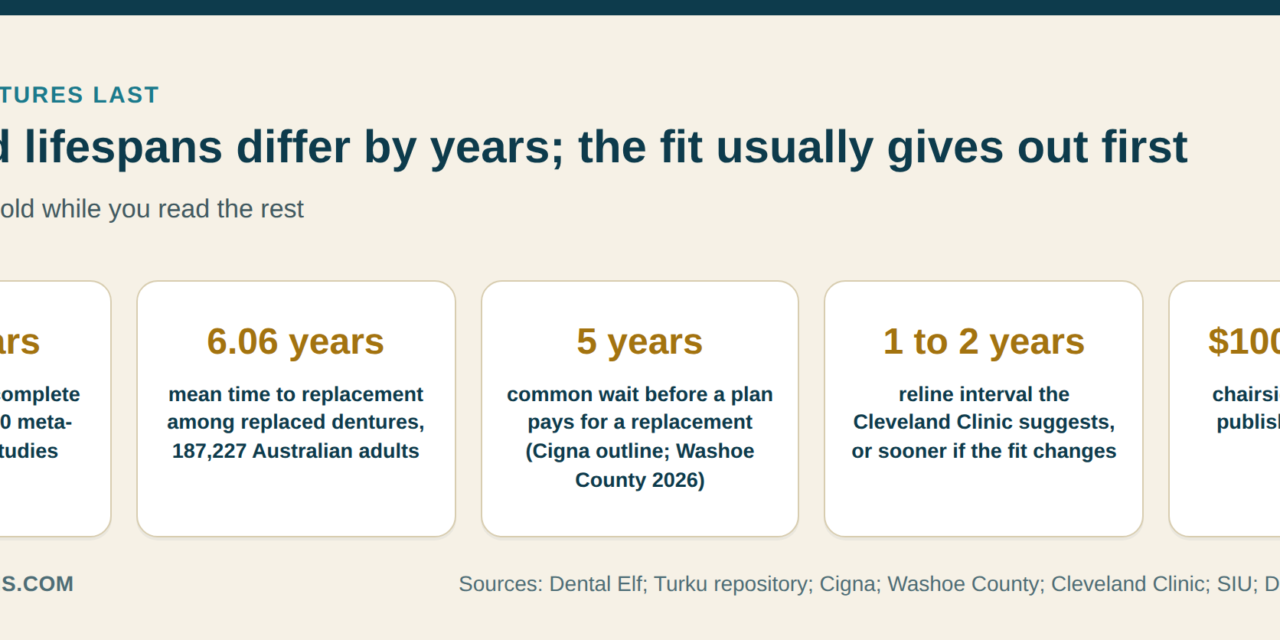
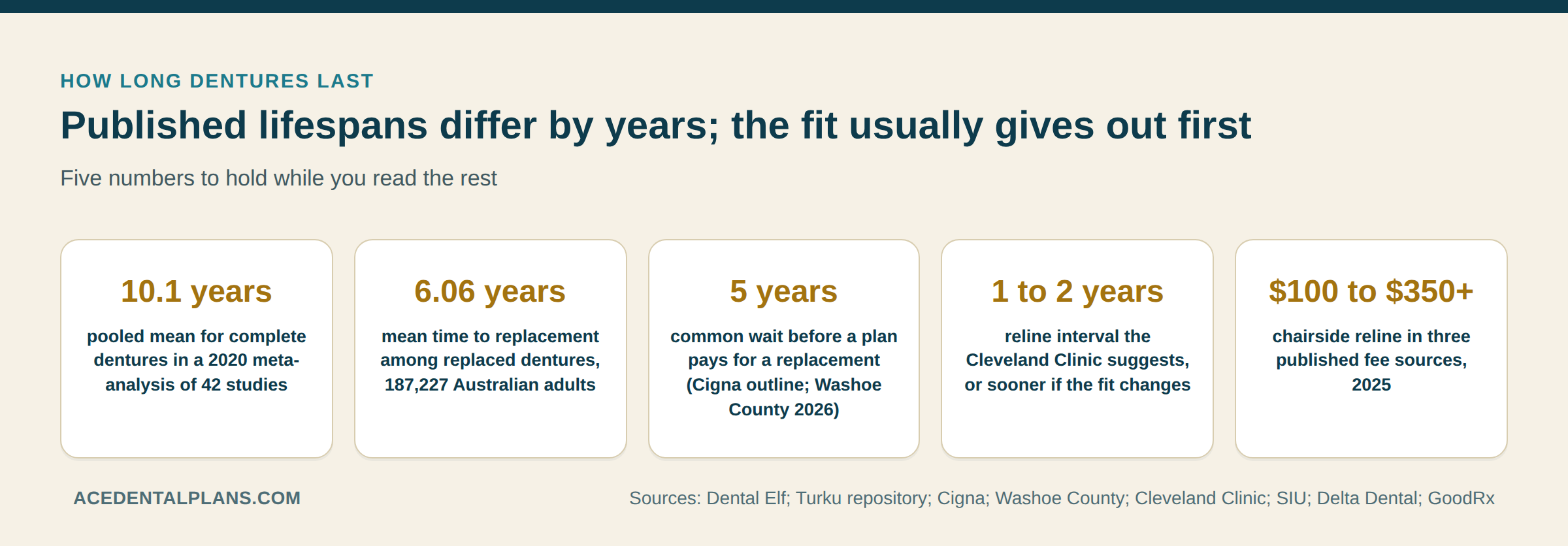
Most complete dentures are replaced somewhere between six and ten years after they are made, but the calendar is a weak guide. A 2020 meta-analysis put the average at 10.1 years, while records from Australian public clinics showed a mean of 6.06 years among the dentures that were replaced. A loose fit, a sore spot or a crack should prompt a visit sooner than a birthday does.
This article covers how long complete dentures, partial dentures and implant overdentures last. It explains what wears out, why the jaw keeps changing, and how reline, rebase, repair and remake differ in purpose and in price. It also looks at replacement clauses in dental plans and what Medicare and Medicaid do. First-time denture prices, types and the fitting process sit in the neighboring guides, linked where they come up.
Key Takeaways
- Published lifespans run from about 5 to 10 years for a complete denture. One dental chain’s page says 5 to 7, the Cleveland Clinic says 7 to 10, and a 2020 meta-analysis pooled 10.1. One university clinic reported medians above 15 years for patients who kept up maintenance.
- The fit usually fails before the denture does. In one small study the lower jaw lost bone about 2.5 times faster than the upper jaw over a year, which fits the pattern that lower dentures tend to loosen first.
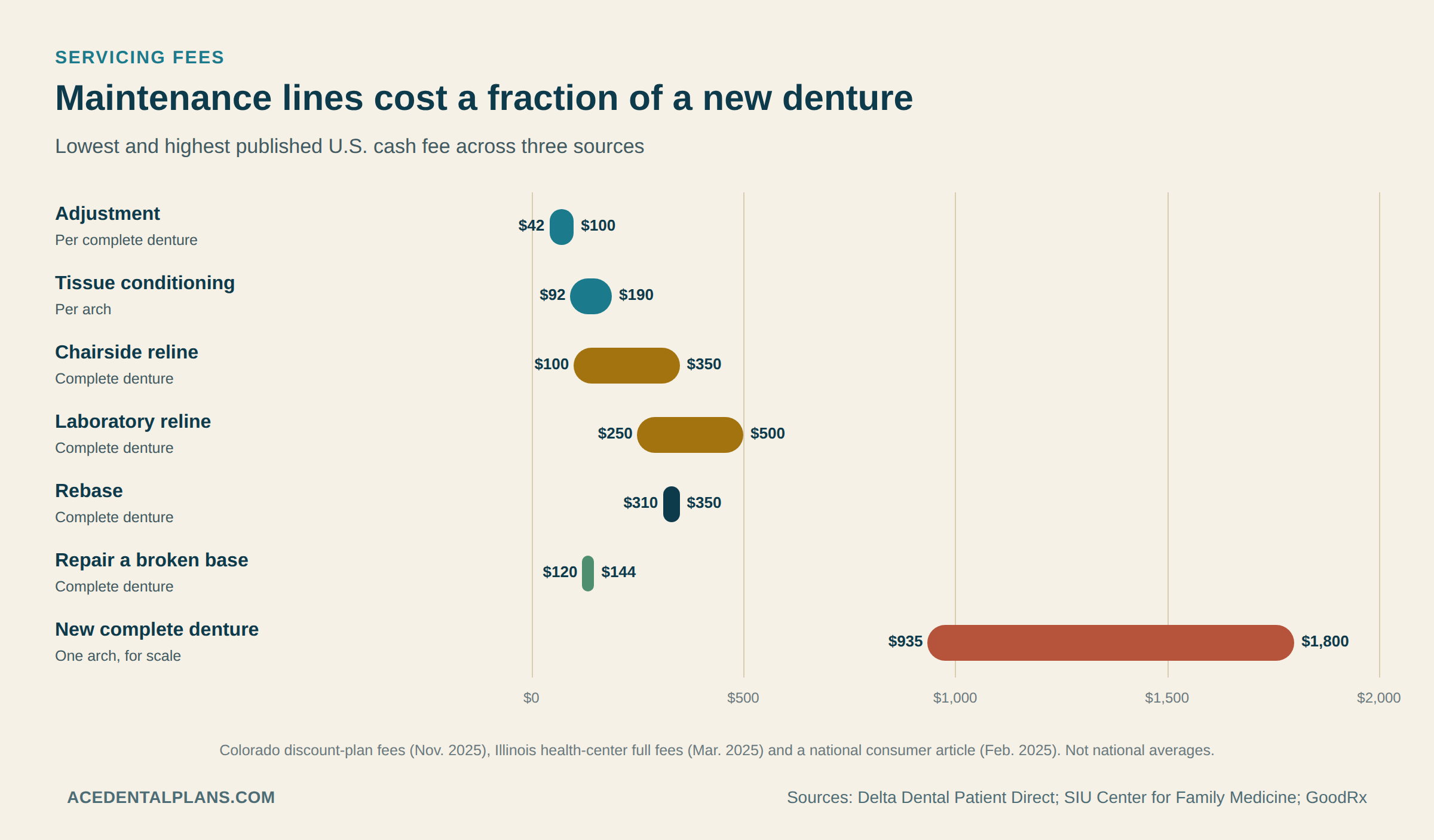
- Servicing costs a fraction of a new denture. In three published fee sources a chairside reline ran $100 to about $350 and a laboratory reline $250 to nearly $500, against $935 to $1,800 for a new complete denture.
- Plans often wait five years. Two plan documents cited here exclude replacement within five years and also exclude replacing a denture that can be made usable, so a reline may come first.
- Original Medicare does not cover dentures. Medicaid adult dental benefits are optional and set state by state; Washington’s rules allow one lifetime replacement per arch, at least five years after the first.
- A mouth sore or patch that lasts more than two weeks needs a dentist or doctor, whatever the denture looks like.
What the Research Says About Denture Lifespan, Source by Source
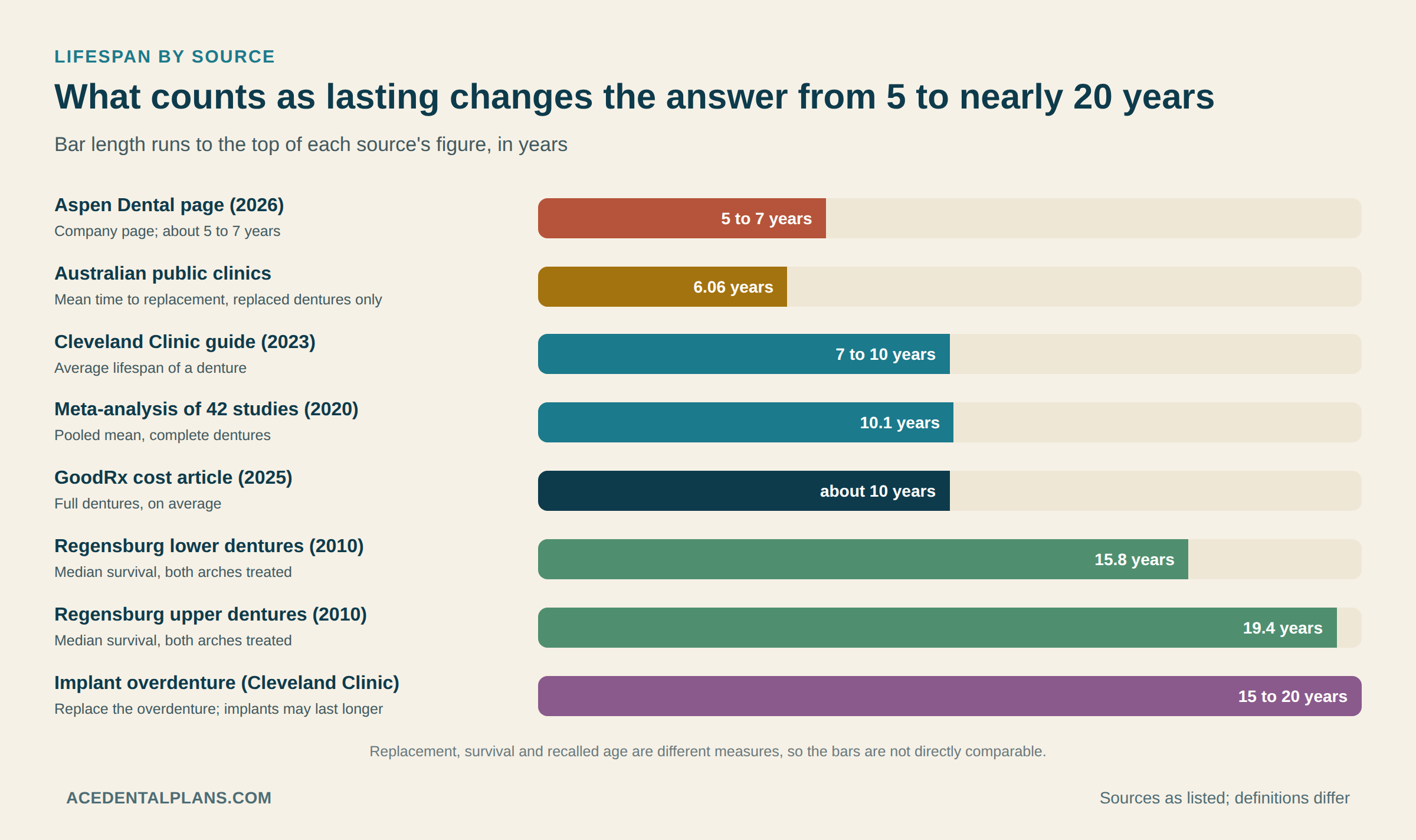
Nobody has measured denture life the same way twice. Some studies follow dentures until they break, some count how long until a patient got a new one, and some are patient guides that quote a range without saying where it came from. Table 1 lines up seven published figures with what each one counted.
| Source and year | What was measured | What it found | How to read it |
|---|---|---|---|
| Taylor and colleagues, meta-analysis, Journal of Prosthetic Dentistry, 2020 | 42 studies of complete dentures, mostly from university clinics | Pooled mean 10.1 years (upper 10.3, lower 8.6) | Many studies relied on patients remembering denture age; only one was built to measure longevity |
| Australian public-clinic records, 20-year retrospective study (data 2000 to 2019) | 187,227 adults who received complete dentures | 27.7% replaced, mean 6.06 years among those; more than 70% never replaced | Counts replacement, which depends on money and access as well as wear |
| Dorner and colleagues, Regensburg University, International Journal of Prosthodontics, 2010 | 353 complete dentures made 1984 to 2009 | Median survival 15.8 years (lower) and 19.4 years (upper) for patients with both arches | One clinic, closely followed; the authors note long service needed many maintenance procedures |
| Behr and colleagues, Regensburg, International Journal of Prosthodontics, 2012 | 174 cast clasp-retained partial dentures | 96.4% still in use at 5 years, 89.8% at 10 years | Median follow-up was only 3 years, so the 10-year figure rests on fewer cases |
| Cleveland Clinic patient guide, March 2023 | Clinic education page, no study cited | Average lifespan 7 to 10 years; reline every 1 to 2 years | A planning range; a second Clinic page says “up to seven years” |
| GoodRx cost article, February 2025 | Consumer price guide | Full about 10 years; partial at least 5; implant-supported 10 to 15 | Summary figures with no study named |
| Aspen Dental replacement page, 2026 | Company marketing page | About 5 to 7 years; evaluation after 5 | The shortest estimate, from a company that sells dentures |
The spread from 5 to nearly 20 years looks like a contradiction. Mostly it isn’t. A mean of 6.06 years from replaced dentures and a median of 19.4 years from closely monitored upper dentures answer two different questions, and a patient can sit in either group.
Why Lifespan Figures Disagree by Years, and Which One to Use
Start with the Australian records, because they are the biggest data set in Table 1. Of 187,227 adults, 27.7% had their dentures replaced during the observation period, and the average time to replacement among them was 6.06 years (standard deviation 3.93). The same study reports that 4.6% were replaced within two years, 18.4% between two and ten years and 4.6% after ten. That leaves more than 70% never replaced.
Replacement isn’t failure, though. The study found that adults over 80 had lower replacement rates. Lower socioeconomic status and living outside a major city were linked to lower replacement rates for dentures under 10 years old. One reading, and it is only a reading, is that some dentures stay in use because a new set was out of reach. A denture that is worn out but still on the bathroom counter counts as long-lived.
The meta-analysis has its own tilt. Its authors, as summarized by the Dental Elf, point out that most included studies were cross-sectional and depended on patients recalling how old their denture was. Most also came from university clinics, which may not represent primary care. Their finding that upper dentures outlasted lower ones (10.3 versus 8.6 years) is more reliable than the single headline mean. Pairs of dentures also lasted longer than single dentures in the Australian records, and in the Regensburg study the patients wearing only one complete denture needed more interventions.
So which number should you carry into the dentist’s office? A working range for a complete denture is about 5 to 10 years, with servicing along the way, and with the lower denture likely to need attention first. It’s a budgeting range. It isn’t a deadline, and nothing in the research says a denture must be replaced on a given birthday.
What Wears Out First: Teeth, Base, Clasps and Attachments
A denture is several parts bonded together, and each ages differently. The names below matter when an estimate says “repair” and you wonder which part is being repaired.
Complete dentures
The artificial teeth wear down with chewing. A dentist writing in DrBicuspid in 2009 lists signs that point to a remake: teeth worn down or repeatedly dislodging, a deteriorating base, and a collapsed vertical dimension (the bite closing up). The base is acrylic. The Clinic warns that hot water can warp it and that dentures that dry out can permanently lose their shape, so some of the wear that looks like age is care-related.
Relines are the most common maintenance event in the Regensburg complete-denture study. Its five-year event-free rates for relines were 69.7% for upper dentures and 80.5% for lower ones. Flipped around, that is roughly 30% of upper and 20% of lower dentures needing at least one reline within five years at that clinic. That is arithmetic from the published rates, not a figure the authors state.
Partial dentures
A partial denture hangs on the natural teeth you still have, so its life is tied to theirs. In the 174 clasp-retained partials followed at Regensburg, clasps fractured in 28 cases (16.1%), major connectors in 9 (5.1%) and minor connectors in 6 (3.4%). Decay turned up on supporting teeth in 31.6% of patients, periodontal inflammation in 35.6%, and 15 supporting teeth were lost altogether. Pressure areas appeared in 30.5% of patients, and far more often under lower partials (39.6%) than upper ones (12.5%).
The authors still reported about 90% survival at ten years. What shortens the real-world life of a partial is often not the partial. When a supporting tooth has to come out, the denture may need a tooth added or a new design, and tooth extraction cost becomes part of the replacement budget.
Implant overdentures
An overdenture snaps onto implants rather than resting on the gums. According to the Cleveland Clinic, implants can last a lifetime with care, but the overdenture itself is replaced every 15 to 20 years. GoodRx is more cautious, saying implant-supported dentures may need replacing after 10 to 15 years. A systematic review of 24 trials of lower overdentures found implant survival high whatever the attachment type (bar 95.8% to 97.5%, ball 96.2% to 100%, magnet 91.7%). The recurring chore was maintenance, such as replacing magnet inserts and re-activating the matrices or clips on ball and bar systems. No published price for those parts turned up in the sources opened for this article, so ask the office what a clip replacement costs before you choose a system.
Why the Fit Changes Before the Denture Does
Teeth hold bone in place. Once they are gone, the jaw gradually remodels, and the denture, which was made to match the ridge on impression day, doesn’t remodel with it. The Cleveland Clinic says the jawbone gradually shrinks after tooth loss. MedlinePlus puts the consequence in one sentence: over time your mouth will change, and you may need to have your dentures adjusted or replaced.
How fast, and where? A small study of 50 complete-denture wearers measured ridge height on X-rays at delivery and a year later. It was presented as a conference abstract at the 2004 meeting of the International Association for Dental Research. Resorption over that year was significant. The lower jaw lost about 2.5 times more than the upper, and people whose last extraction was within the previous year lost more than those extracted earlier. Wearing the denture at night made no significant difference to bone loss in that study, which is a different question from tissue health (see the care section).
That pattern fits three things readers notice. A lower denture loosens sooner than an upper. A denture made right after extractions needs the most early attention. The American Dental Association’s MouthHealthy page says an immediate denture may need to be relined or remade after the jaw has healed. And a person who has worn dentures for decades may find that a once-snug denture now needs adhesive to stay put. The full fitting sequence, immediate versus conventional, is covered in the guide to dentures: types, fit and coverage.
Loose fit is not the only thing that changes. Jaw swelling that makes dentures fit poorly or become uncomfortable appears on the National Institute of Dental and Craniofacial Research’s list of oral cancer symptoms. That doesn’t mean a loose denture signals cancer. It means a sudden change in fit with swelling, or any sore or patch lasting more than two weeks, deserves an examination before anyone relines anything.
Reline, Rebase or Remake: What Each One Does
Estimates for denture work use four verbs that patients tend to blur together: adjust, reline, rebase and remake. They solve different problems and sit at very different prices, so the words on the estimate matter.
Adjustment trims or reshapes a spot where the denture presses. MedlinePlus tells wearers to let the dentist make these changes, and the Cleveland Clinic adds that trying to adjust a denture yourself could break it. A reline adds new material to the side of the denture that rests on the gums, so the denture matches the ridge as it is now. According to a 2009 DrBicuspid article by a public health dentist, soft relines use silicone and are done chairside, while hard relines can be done chairside or processed in a laboratory.
A rebase replaces all of the acrylic except the teeth. The same article says it is recommended most often when the acrylic is too thin or needs more extension at the edges. A remake means a new denture. At some point, in that author’s words, “the old set just has to go.”
The piece is old, and the author notes there are no standard guidelines for choosing among these options. Still, the clinical criteria it quotes (from a 1995 article in the Journal of the American Dental Association) are a useful checklist of what a reline can and cannot fix. Poor retention or stability, teeth that don’t show when you speak, and a base that doesn’t reach far enough into the folds of the cheek point toward a reline or rebase. A bite that has collapsed, teeth worn down or repeatedly popping out, and a deteriorating base point toward a remake.

One practical consequence follows. A reline over a base that is cracking or teeth that are worn flat spends money on the part of the denture that was fine. If your estimate says reline and your denture is eight years old with visibly flattened teeth, ask the dentist why the teeth and base are judged sound enough to keep.
What Servicing Costs: Three Published Fee Sources
Prices for denture maintenance are harder to find than prices for new dentures. Table 2 pulls them from three places. The first is the fee schedule of a discount dental plan in Colorado (Delta Dental Patient Direct, effective November 1, 2025, which the plan states is not insurance). The second is the posted full-fee schedule of a federally qualified health center in Illinois (SIU Center for Family Medicine, effective March 1, 2025). The third is a national consumer cost article (GoodRx, updated February 2025). They aren’t averages of anything, and a private office in your city may charge more or less.
| Service | Delta Dental Patient Direct, Colorado, Nov. 2025 | SIU Center for Family Medicine, Illinois, full fee, Mar. 2025 | GoodRx national article, Feb. 2025 |
|---|---|---|---|
| Adjustment, complete denture | $42 | $50 | About $100 each; may be included in the denture fee |
| Tissue conditioning | $92 per arch | Not listed | Average $190 |
| Chairside reline, complete denture | $179 | $100 | About $350 or more |
| Laboratory reline, complete denture | $269 | $250 | Nearly $500 |
| Rebase, complete denture | $310 | $350 | Not listed |
| Repair broken base, complete denture | $144 | $120 | No price given |
| Replace one broken tooth | $135 | $135 | No price given |
| Repair or replace a partial denture clasp | $131 per tooth | $135 per clasp | No price given |
| Repair cast partial framework | $197 | $150 | No price given |
| New complete denture, one arch (for scale) | $935 | $1,500 | $1,800 for a traditional full denture |
Three patterns stand out. First, the cheapest service is also the most frequent one. Both schedules price an adjustment at about $42 to $50, though GoodRx’s $100 reminds you that some offices charge more. Second, laboratory relines cost roughly 40% to 150% more than chairside ones in these sources, which is the price of sending the denture out and getting it back. Third, a rebase sits just above a laboratory reline, so a quote that jumps from one to the other is a $40 to $100 question in these schedules, not a $700 one.
The health center’s schedule also shows how much income-based pricing can change the lines. Its laboratory reline is $250 at the full fee, but the schedule’s five sliding-scale tiers, based on family size and income, run from $13 to $163 for the same service. Chairside relines were listed at full fee only. The same clinic prices a complete denture at $1,500 in full and between $75 and $975 on the sliding scale. If you qualify for a clinic like this, the maintenance lines are where the saving is easiest to see.
Prices for a new denture, by type and by arch, are laid out in the dentures cost guide. The cash-pay side, including tiers and ways to lower the total, is in the guide to dentures cost without insurance. This article uses a new-denture fee only as a yardstick for the replace-or-service decision.
Reading the denture lines on an estimate
Both fee schedules in Table 2 list services by their ADA procedure codes (CDT codes), and the numbers are worth recognizing because the word “reline” on a quote can hide two different prices. Chairside relines are D5730 (upper complete denture) and D5731 (lower), and the partial-denture versions are D5740 and D5741. Laboratory relines are D5750 and D5751 for complete dentures and D5760 and D5761 for partials. Rebases are D5710 and D5711 for complete dentures and D5720 and D5721 for partials.
The smaller lines follow the same pattern. Adjustments sit in the D5410 to D5422 range, repairs of a complete-denture base at D5511 and D5512, a replaced tooth in a complete denture at D5520, a broken clasp at D5630, and tissue conditioning at D5850 and D5851. If an estimate shows one line for each arch, you are being billed for two services, so the figure in Table 2 doubles. If it shows no code at all, ask for one. Two different codes that both read “reline” are how a $179 service and a $269 service end up described by one word.
Replace or Service at Year Six: A Worked Comparison
Price shouldn’t decide whether a worn denture is fixable. Condition does, and only an examination can judge that. But once the dentist says either path is clinically reasonable, a cost-per-year comparison shows what the cheaper path has to achieve to be worth it.
Colorado discount-plan fees: service = $269 + $135 = $404. A remake is $935; if it lasts 7 years (the low end of the Cleveland Clinic’s 7 to 10), that is about $134 a year. The $404 of servicing is cheaper per year if it buys more than about 3 more years ($404 divided by $134).
Illinois health-center full fees: service = $250 + $135 = $385. A remake at $1,500 over 7 years is about $214 a year, so servicing wins if it buys more than about 1.8 more years.
The comparison ignores visits, follow-up adjustments, the likelihood of further relines on a new denture and anything a plan might pay. It only shows the break-even.
What does the break-even tell you? A denture with sound teeth and base that needs a laboratory reline is very likely to clear a two- or three-year bar, and the arithmetic favors servicing. A denture that needs a reline, a tooth, a repaired crack and a bite correction is a different case. Several repairs at once can mean the denture is nearing the end of its useful life. In the Regensburg study, long service came with “a high number of maintenance procedures.” A list of repairs isn’t automatically a sign of a failing denture, but it is a reason to ask.
Signs It Is Time: Each Sign Paired With a Likely Fix
The Clinic’s list of reasons to see the dentist is short. The denture feels loose, hurts or pinches the gums, clicks when you talk, looks damaged or discolored, or is more than 10 years old. Aspen Dental’s page adds difficulty eating or speaking. Those are the symptoms. Table 3 connects each one to what it often means and the usual next step, using the service definitions above and the prices from Table 2. It is a map for the conversation with your dentist, not a way to diagnose yourself.
| What you notice | What it often points to | Usual next step | Fee range in Table 2 |
|---|---|---|---|
| Denture rocks or slips, and used to fit snugly | Gums and bone have changed under the base | Exam, then reline or rebase if the teeth and base are sound | Reline $100 to nearly $500; rebase $310 to $350 |
| One tender spot or a red mark in the same place | A local pressure point | Adjustment at the office; do not file it down at home | $42 to about $100 |
| Diffuse soreness or redness under the whole base, often painless | Possibly denture stomatitis, linked to hygiene and night-time wear | Exam, nightly removal, thorough cleaning, fit check | Exam fee, plus any reline |
| Crack, chipped tooth, bent or broken clasp | Damage from a drop, wear or fatigue | Repair if the rest is sound; never glue it | Base $120 to $144; tooth or clasp $131 to $135 |
| Teeth look flat or shorter; chin sits closer to the nose; lips and cheeks look sunken | Worn teeth or a collapsed bite | Evaluation for a remake | New denture $935 to $1,800 |
| Clicking when you speak, food trapping, a new lisp | Loosened fit or shifted teeth | Adjustment or reline; check again after a week | $42 to $500 |
| You use more adhesive than before, or it no longer holds | The fit may have drifted | Ask about fit before buying stronger adhesive | Reline range above |
| Stained, porous or odorous despite cleaning | Surface breakdown or biofilm the home routine is not removing | Professional cleaning; remake if the surface is deteriorated | Not priced in these sources |
Two rows deserve a note. The stomatitis row draws on a 2023 Journal of Prosthodontics review summarized by the American College of Prosthodontists. It says the condition affects between 20% and 80% of denture wearers. It is usually painless, so dentists often see it before patients feel it. The adhesive row is our reading, not a published criterion. The ADA says some wearers “occasionally” use adhesive and that it should be used exactly as directed, so a steady rise in how much you need is worth mentioning at the next visit.
See a dentist or doctor promptly if
- A sore, lump, or white or red patch has lasted more than two weeks (National Institute of Dental and Craniofacial Research).
- Your jaw is swollen and the denture suddenly fits badly or becomes uncomfortable (same source).
- Soreness or irritation persists after the denture has been adjusted; the ADA says to consult your dentist if any problem persists.
- The denture has cracked or a piece has come off. Don’t use glue or an over-the-counter repair kit, which the Cleveland Clinic says can damage the denture permanently.
Swelling of the face or neck, trouble breathing or swallowing, or fever with severe pain calls for 911 or an emergency room.
A short decision path for the appointment
If you are staring at a denture and a calendar, these steps put the questions in an order that avoids paying for the wrong thing. They are a way to organize the conversation, not a treatment protocol.
- Rule out the mouth first. A sore, patch or swelling that has lasted more than two weeks needs an exam before any denture work.
- Separate fit from condition. Is the complaint that it moves (fit), or that it is cracked, stained, worn or ugly (condition)? Fit problems lean toward adjustment, reline or rebase. Condition problems lean toward repair or remake.
- Ask what a reline would not fix. If the dentist says the teeth and base are sound, a reline is a reasonable bet. If not, the reline money may be better spent toward a remake.
- Price both paths in writing, with codes, using Table 2 as a sanity check.
- Check the plan’s clock before booking. Look at the installation date, the five-year limit, the reline waiting period and how much of the annual maximum is left.
Care Habits With the Strongest Support, Including the Nightly Routine
Care can’t stop the jaw from changing, but it decides how much of a denture’s wear is self-inflicted. The sources agree on more than you might expect, and they disagree in two places worth sorting out.
On cleaning, the ADA’s MouthHealthy page says dentures should be brushed daily to remove food particles and plaque, after rinsing off loose debris, using a soft-bristle brush and a non-abrasive cleanser. The Cleveland Clinic is blunter about toothpaste: it says not to use it, or a regular toothbrush, because both are abrasive and can scratch denture plastic. The two statements fit together if “non-abrasive cleanser” means a denture product, mild hand soap or mild dishwashing liquid, which is what the Clinic recommends. The Clinic also says bleach can weaken dentures and change their color, and that whitening toothpaste shouldn’t be used on them.
On water, never use hot. The Clinic says heat can warp the plastic. Wash over a towel or a sink filled with water, because a denture dropped there is less likely to break. And don’t let them dry out. The Clinic says dentures that dry out can permanently lose their shape, which is the kind of slow damage that turns up later as a “bad fit.”
The nightly routine, and where the sources differ
MedlinePlus says to take dentures out at night and put them in water or a denture-cleansing liquid. The ADA says to keep them covered in water when they’re not in your mouth so they don’t warp. The Cleveland Clinic says to soak them overnight, in a denture solution on one page and in cool water on another, and to leave them out at least eight hours a day. So the question “water or cleanser?” has two accepted answers. Ask the office which suits your denture, especially if it is a partial with metal parts.
The evidence for taking them out is about gum tissue. The ACP’s summary of a 2023 review in the Journal of Prosthodontics names three primary causes of denture stomatitis: poor oral hygiene, poor denture hygiene and full-time, mainly night-time, wear. It recommends removal “at night, every night.” The same summary says treatment for frail, older or medically compromised patients lowers the risk of aspiration pneumonia. Bone loss is a separate matter: in the 50-patient study cited earlier, night-time wear made no significant difference to ridge resorption. Taking the denture out at night protects the tissue; it won’t stop the bone from remodeling.
- After the last meal: remove the denture over a towel or a water-filled sink and rinse off food.
- Clean it: brush every surface with a soft denture brush and a denture cleanser or mild soap, not toothpaste, and brush your gums, tongue and palate with a soft brush.
- Soak it: put it in cool water or a cleansing solution your dentist approves, overnight.
- In the morning: rinse off any cleaning solution before the denture goes back in.
Three things to skip: over-the-counter repair kits or glue, home adjustments, and bleach. The Cleveland Clinic says repair kits and glue may irreparably damage the appliance. It does suggest an occasional ultrasonic cleaner, which uses sound waves to dislodge deposits.
If you have a partial, the habits that matter most are the ones that protect your natural teeth. In the Regensburg partial-denture study, decay on supporting teeth showed up in 31.6% of patients, and the supporting-tooth event-free rate fell to 39.6% by year ten. The Cleveland Clinic recommends regular check-ups to protect gum health, prevent cavities in remaining teeth and keep the fit right. And at every visit, the dentist can look at more than the denture: NIDCR calls a regular checkup a good opportunity for an oral cancer examination.
How Plans Handle Replacement and Servicing: Clauses and Clocks
If you have dental coverage, the order of questions is the usual one. What type of plan is it? What is the deductible, and does the network matter? What percentage does the plan pay for dentures and for relines? How much of the annual maximum is left? And then the clauses that can override everything: waiting periods, frequency limits and exclusions. The general mechanics are laid out in what dental insurance may cover and in the guide to how dental insurance works. Here is how they apply after the first denture.
Humana’s consumer page (February 2026) says many plans cover up to 50% of the cost of crowns or dentures. It puts waiting periods for major work at three months to a year and typical annual maximums at about $1,000 to $2,000. Those are generalities. The two plan documents below show how specific clauses read.
What two plan documents say
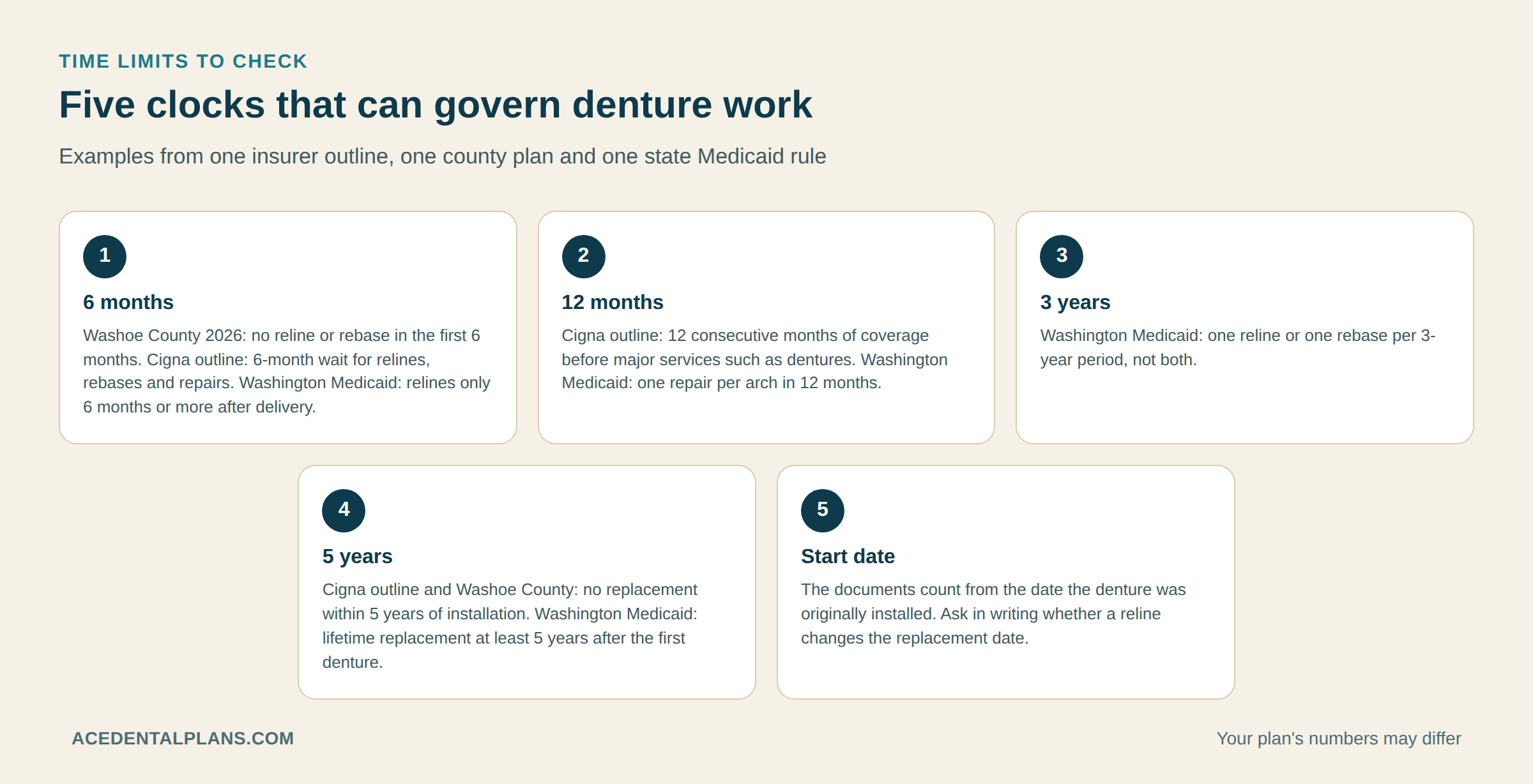
The Cigna Dental 3000/100 outline of coverage for Pennsylvania (form dated 9-17, with a 2022 footer) puts dentures in Class III, major restorative. They are paid at 50% after a $100 deductible and after 12 consecutive months of coverage. It excludes “replacement of a bridge, crown or denture within 5 years after the date it was originally installed.” Exceptions cover damage from an insured injury and cases where an opposing full denture or a necessary extraction makes replacement necessary. It also excludes replacing a denture “which is or can be made useable according to common dental standards.” Relines, rebases, adjustments and denture repairs are Class II. They also pay 50% after the deductible, with a six-month waiting period. The annual maximum is $3,000.
The Washoe County, Nevada, employee dental plan summary for calendar year 2026 reads similarly. Dentures are a major service at 50%, after a $50 deductible, with a $3,000 annual maximum. Replacement is covered only if the denture was installed at least five years earlier. Exceptions apply to medically necessary replacement after additional natural teeth are extracted and to a denture damaged beyond repair while the person was covered. Replacing a denture that meets, or can be made to meet, accepted standards of function is not covered at any time. Lost, missing or stolen appliances are excluded, and rebase and reline procedures are not covered in the first six months after initial placement.
Two readings matter. First, the “can be made useable” clause means the plan may expect a reline or repair before it will pay for a remake. Second, the clock runs from the installation date, not from the date you noticed a problem.
Replace in November 2026: the five-year date (December 18, 2026) hasn’t arrived, so the plan pays $0 and you owe $1,300.
Replace December 21, 2026: past the five-year date, but only $400 of the maximum remains. The plan pays $400 and you owe $900.
Replace January 5, 2027: the maximum has reset. The plan pays 50%, $650, and you owe $650.
Waiting saves $250 to $650 here, but only if your dentist agrees the denture can safely wait. If it can’t, ask whether a reline in the meantime would be paid as a Class II service (50%, after its own waiting period) and whether it changes the replacement date. The two documents above tie the clock to the date the denture was originally installed. Timing rules for plan years are covered in the guide to using dental benefits before year-end.
Get the answers in writing before you schedule. A predetermination (a written estimate from the plan, based on the codes the office will bill) is the cleanest way, and the office can usually submit one. A benefits phone call is not a promise of payment; the plan’s written response is closer to one, though still not a guarantee.
Medicare, Medicaid and Sliding-Fee Clinics
Medicare.gov says Original Medicare generally doesn’t cover routine dental care, and dentures sit on its not-covered list. Narrow exceptions exist for dental services during an inpatient hospital stay and for services directly tied to certain covered medical treatments. The details, including how seniors usually fill the gap, are in the guide to whether Original Medicare covers dental care.
Medicaid is different in kind. Medicaid.gov says states choose whether to provide dental benefits for adults and that there are no minimum requirements for adult dental coverage. So whether Medicaid helps with a reline or a replacement depends on your state, and inside a state, on the rules that apply to your eligibility category. Washington’s Apple Health rules, as published in the state administrative code (current through June 2025), show what a detailed policy can look like. Prior authorization is required for complete dentures. Replacement of a complete denture or overdenture is covered once per arch in a client’s lifetime, at least five years after the first one and only if medically necessary. Relines or rebases are covered once in a three-year period when done at least six months after delivery, with no reline and rebase both paid in the same three years. Repairs are covered once in 12 months per arch, and a repair can’t cost more than a replacement.
That one state’s rule is a good example of why the question “how long do dentures last?” gets a different answer from every payer. Washington effectively treats a denture as a five-year item with a lifetime cap; the Cigna and Washoe documents treat it as a five-year item with an annual maximum. Other states set other limits, and some cover little for adults. Call the state Medicaid dental program or your plan before assuming.
The need is not small. The Centers for Disease Control and Prevention reports that 17.3% of U.S. adults aged 65 and older had lost all their natural teeth in 2011 to 2016, down from 27.2% in 1999 to 2004. The share was 34.1% among those below the federal poverty level and 10.7% among those at 200% of the poverty level or above. For people in that first group, a sliding-fee health center or a savings plan with a posted fee schedule is often the realistic route. The Colorado fee schedule behind the first data column of Table 2 states that the plan is not insurance and that fees are paid directly to the office. The guide to how dental savings plans work covers what such plans do and where they fall short.
When Repeated Fixes Point Toward Implants or a Bridge
A denture that needs a reline every other year, loosens again within months, or sits on a lower ridge that has largely resorbed is the situation in which patients ask about implant-supported options. The numbers in this article give a rough shape to the comparison without settling it. A complete denture runs about 5 to 10 years in the sources above. An overdenture runs about 10 to 20 (GoodRx 10 to 15, Cleveland Clinic 15 to 20), and the Clinic describes the implants beneath it as potentially lasting a lifetime with care. The cost side is the reverse, and it’s large.
Those prices belong to other guides. A single implant, with what the quote includes, is in dental implant cost for one tooth. The arch-level totals and why they vary are in full mouth dental implants cost, and the whole treatment path is in the dental implants guide. Candidacy is a clinical question, and the implants guide covers what the exam and imaging look at.
For a partial denture that replaces one or two teeth, a fixed bridge is the other common comparison. Bridge designs and per-unit prices are in dental bridge cost by type and teeth, and the cash-pay side is in dental bridge cost without insurance. A traditional bridge is anchored to the teeth beside the gap. The Regensburg partial-denture numbers show how often supporting teeth are the weak point, so the decision begins with the condition of those teeth.
If you decide a bigger treatment is the right one, the question becomes how to pay for it. The guide to how to pay for expensive dental work compares eight routes side by side, and the dental treatments hub collects the related guides on dentures, implants and other restorations.
Questions to Ask at the Denture Check-Up
- What exactly is wrong with the fit? Ask for the answer in terms of the teeth, the base and the tissue, so you can tell reline from rebase from remake.
- Which service are you recommending, and what is the CDT code? A chairside reline, a laboratory reline and a rebase carry different codes and prices, as Table 2 shows.
- How long will I be without the denture? A chairside reline can be done in a visit; a laboratory service needs the denture to leave the office.
- Are the teeth and base sound enough to reline? If the answer is “mostly,” ask what would make you recommend a remake.
- What is the fee for each option, in writing? Include the exam, any follow-up adjustments and whether they are part of the fee.
- Does the work carry a warranty? If it does, ask how long it lasts and what it excludes.
- Will my plan treat this as a repair or a replacement? The answer changes the percentage, the waiting period and the frequency limit.
- What is the date my plan counts from? The original installation date, not the date of the last reline, is what the documents cited here use.
- Can the visit be timed around my annual maximum? If the fit is stable, a January date can mean a fresh maximum.
- What should I do at home between visits? Ask for a short written list for your denture material.
Bottom Line
A complete denture should be planned as a five-to-ten-year item that needs servicing, not as a one-time purchase. The lower denture usually loosens first, because the lower jaw changes faster. Relines and adjustments are the common events; rebases and remakes come when the acrylic or the teeth are the problem.
Which one you need is a clinical call that costs very different amounts. In the fee sources used here, a chairside reline ran $100 to $350 and a new denture $935 to $1,800. Asking the dentist to explain the choice is cheap insurance against paying for the wrong service. Plan documents and public programs add their own clocks, usually five years for replacement, and those clocks run from the date the denture was installed.
Take the denture out every night, clean it with the right products, and keep the appointments, because a dentist can see the gum changes and sores that you can’t. A sore or patch that lasts beyond two weeks isn’t a denture problem until a professional says so. When the repairs start to pile up, the discussion shifts from “how much is this reline” to “what kind of replacement fits my mouth and budget.” Have that conversation with an exam in hand.
Frequently Asked Questions
How long do dentures last on average?
Published figures for complete dentures run from about 5 to 10 years. A 2020 meta-analysis pooled a mean of 10.1 years, the Cleveland Clinic gives 7 to 10, and a dental chain’s page says 5 to 7. Australian public-clinic records showed a mean of 6.06 years among dentures that were replaced. Treat it as a planning range with relines along the way. Fit and condition, not the date, tell you when it’s time.
How often should dentures be relined?
The Cleveland Clinic recommends a reline every one to two years or whenever the fit changes. A 2009 article by a dentist says most standard dentures need one within the first three to five years. The sources disagree because there is no standard guideline, and in the Regensburg study about 30% of upper and 20% of lower dentures needed a reline within five years. Your dentist decides from the fit and the tissue.
How do I know if my dentures need to be replaced?
Common reasons include a fit that a reline can’t restore, teeth worn flat, a bite that has collapsed, a cracked or deteriorating base, and sores that return after adjustment. The Cleveland Clinic also suggests a visit when a denture is more than 10 years old, loose, painful, noisy when you talk, damaged or discolored. Only an exam can sort a reline from a remake, so book one rather than guessing.
Why do my dentures feel loose after a few years?
Bone and gum tissue keep changing after teeth are lost, and the denture does not. In a small study of 50 wearers, the lower jaw lost bone about 2.5 times faster than the upper over one year. That is a likely reason a lower denture often loosens first. A reline or rebase resurfaces the denture to match the ridge as it is now, if the teeth and base are still in good shape.
How long do partial dentures last?
GoodRx says partials typically last at least five years. In a University of Regensburg study of 174 cast clasp-retained partials, 96.4% were still in use at five years and 89.8% at ten, though median follow-up was only three years. Clasp fractures (16.1%) and decay on supporting teeth (31.6% of patients) were the main problems, so the natural teeth that hold the partial often decide its life.
How long do implant-supported dentures last?
The Cleveland Clinic says implants can last a lifetime with care, and that the overdenture is replaced every 15 to 20 years. GoodRx says implant-supported dentures may need replacing after 10 to 15 years. A systematic review of lower overdentures found implant survival high, from 91.7% to 100% depending on attachment, with upkeep that included replacing inserts and re-activating clips or matrices. Ask the office what that upkeep costs.
Should I soak dentures in water or in a cleanser overnight?
Both appear in the sources. MedlinePlus says to put dentures in water or a denture-cleansing liquid at night. The ADA says to keep them covered in water so they don’t warp. The Cleveland Clinic says to soak in a denture solution on one page and in cool water on another. Never use hot water or bleach. If your denture has metal parts, ask your dentist which one is safe for it.
Does dental insurance pay for replacement dentures?
Some plans may pay part, usually 50% of the allowed amount after a deductible, but replacement often has a time limit. A Cigna outline and a 2026 county employee plan summary both exclude replacement within five years of installation and exclude replacing a denture that can be made usable. Waiting periods, annual maximums and your exact plan decide the rest, so ask for a written predetermination before treatment.
Does Medicare cover denture repairs or relines?
Original Medicare generally doesn’t cover routine dental care, and Medicare.gov lists dentures among the items it does not cover. Narrow exceptions exist for certain hospital-linked dental services. Medicare Advantage plans are a separate question, so read the plan’s own coverage documents. Medicaid is separate: states choose whether to cover adult dental care, and Washington’s rules, for example, allow one lifetime replacement per arch after five years.
What is the difference between a reline and a rebase?
A reline adds new material to the tissue side of the denture so it fits the gums as they are now. A rebase replaces all of the acrylic except the teeth, which is recommended most often when the acrylic is too thin or needs more extension at the edges. In the three fee sources used here, a rebase for a complete denture ran $310 to $350, compared with $100 to nearly $500 for a reline.
Can I fix cracked dentures with glue?
No. The Cleveland Clinic says over-the-counter repair kits and glue may irreparably damage the denture, and that you should book a dentist appointment instead. Published cash fees for a professional repair of a complete denture base were $120 to $144 in two fee schedules, and $131 to $135 to repair a clasp or replace a tooth. Bring all the pieces with you.
Is it normal to need adjustments years after getting dentures?
Yes. MedlinePlus says your mouth will change over time and that you may need your dentures adjusted or replaced, and the ADA says the dentist will examine your mouth at check-ups to see whether dentures continue to fit. Published adjustment fees in the sources used here ran $42 to $50 in two fee schedules and about $100 in GoodRx’s article, and some offices fold early adjustments into the denture fee.
How much does it cost to replace one tooth on a denture?
Two published fee schedules list $135 to replace one broken tooth, and the Illinois health center lists $85 for a replacement tooth on a complete denture (code D5520), while the Colorado schedule lists $135 for the same code. Adding a tooth to a partial denture was $35 at the Illinois clinic and $135 in Colorado. These are cash fees from 2025 schedules, so ask your office for its own figure.
Sources and Disclaimers
Lifespan and care claims come from peer-reviewed studies and their abstracts, the American Dental Association’s MouthHealthy page, MedlinePlus, the National Institute of Dental and Craniofacial Research, the Centers for Disease Control and Prevention, a professional-society summary, patient guides from the Cleveland Clinic and one 2009 trade article cited for definitions. Fee figures come from two published fee schedules (a discount plan in Colorado and a health center in Illinois) and a consumer cost article, all 2025, and they are not national averages. Plan clauses come from one insurer outline, one county plan summary and one insurer consumer page, which show how clauses can read and are not rules for every plan. Washington’s Medicaid rules are one state’s example. The meta-analysis is cited through a published summary because the original page could not be read. The worked examples, the cost-per-year arithmetic and the percentages labelled as arithmetic are original illustrations built from those figures. Check prices with the dentist and benefits with the insurer.
- Dental Elf (National Elf Service) — Complete dentures: how long do they last? (summary of Taylor et al., 2020)
- University of Turku repository — Complete denture replacement: a 20-year retrospective study of adults receiving publicly funded dental care
- University of Regensburg — Dorner et al., Clinical Performance of Complete Dentures: A Retrospective Study (2010)
- University of Regensburg — Behr et al., Clinical Performance of Cast Clasp-Retained Removable Partial Dentures (2012)
- Journal of Advanced Prosthodontics — Attachment systems for mandibular implant overdentures: a systematic review (2012)
- Journal of Dental Research (conference abstract) — Rate of Alveolar Ridge Resorption in Complete Denture Wearers (2004)
- American College of Prosthodontists — Denture stomatitis: an interdisciplinary clinical review
- American Dental Association, MouthHealthy — Dentures
- MedlinePlus (National Library of Medicine) — Dentures
- National Institute of Dental and Craniofacial Research — Oral cancer
- Centers for Disease Control and Prevention — Table 35, adults 65 or older who have lost all their natural teeth
- Cleveland Clinic — Dentures
- Cleveland Clinic — Denture care
- Cleveland Clinic — Implant-supported dentures
- DrBicuspid — Reline, rebase, or remake: the denture dilemma (2009)
- GoodRx — How much do dentures cost?
- Aspen Dental — Replacement dentures
- Delta Dental Patient Direct — General dentist fee schedule, effective November 1, 2025
- SIU Center for Family Medicine — Dental fee schedules: full fee and sliding fees, effective March 1, 2025
- Cigna — Cigna Dental 3000/100 outline of coverage, Pennsylvania
- Washoe County, Nevada — Dental plan summary, calendar year 2026
- Humana — What does dental insurance cover?
- Medicare.gov — Dental services
- Medicaid.gov — Dental care
- Washington State Administrative Code — WAC 182-535-1090, Dental-related services: covered prosthodontics (removable)
Important Information and Disclaimers
This article is general educational information. By using it, you accept the limits described below.
Not dental or medical advice
Nothing on this page is a diagnosis, a treatment recommendation or a substitute for an examination by a licensed dentist or physician. Reading this article does not create a dentist-patient or doctor-patient relationship. Only a licensed professional who has examined you and reviewed your history can tell you what your mouth needs. Do not delay, skip or stop professional care because of something you read here.
Prices are estimates, not quotes
Cost figures are ranges reported by the third-party sources cited in this article. Actual prices depend on your location, the provider, the complexity of your case, the materials used, the date of service and other factors, so what you pay may be higher or lower. A written treatment plan and fee estimate from the dental office is the only reliable number for your situation.
Insurance and plan examples are illustrations
Examples that use named amounts or percentages are hypothetical. Real benefits depend on your plan, network, waiting periods, annual maximum, deductible and the insurer’s rules at the time of treatment. A pre-treatment estimate or benefits check is not a promise of payment. Confirm the details with your insurer or plan administrator in writing.
Not insurance, legal, tax or financial advice
AceDentalPlans is an information publisher. Nothing here is insurance, legal, tax, investment or other professional financial advice, and nothing here recommends a particular provider, insurer, lender, discount plan or financing product. Company and product names belong to their owners and appear for identification only. Read the terms of any loan, financing offer or plan before you sign, and ask a qualified professional if you need advice on your own circumstances.
Third-party sources
This article cites government agencies, professional associations, insurers, lenders and other outside organizations. We do not control those sources. Their content can change, move or disappear, and listing a source is not an endorsement of it or of anything it sells.
No warranty
We aim for accuracy, but this article is provided “as is,” without warranties of any kind, express or implied, including warranties of accuracy, completeness, timeliness or fitness for a particular purpose. Some information may be out of date or contain errors by the time you read it.
Limitation of responsibility
To the fullest extent permitted by law, AceDentalPlans and its owners, authors and contributors are not responsible or liable for any loss, cost, injury, health outcome or other damage that results from using this article or relying on it. You are responsible for your own decisions about your care, your coverage and your money.
How this article is written
This article follows AceDentalPlans’ answer-first, U.S.-focused editorial approach. It uses conditional language for insurance, because coverage depends on the specific plan, and it names its sources so that you can read them yourself.