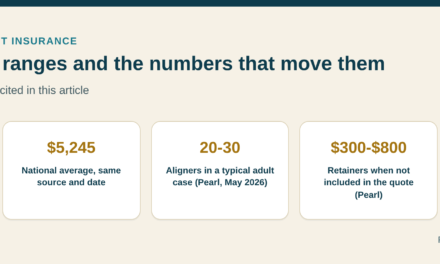
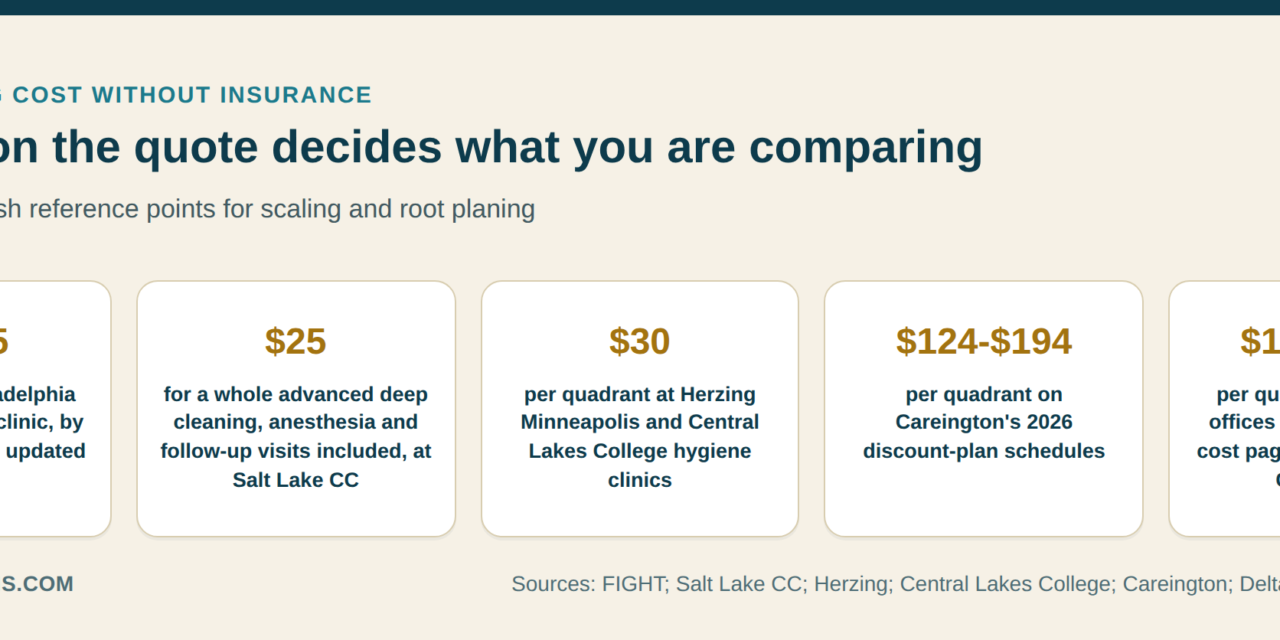
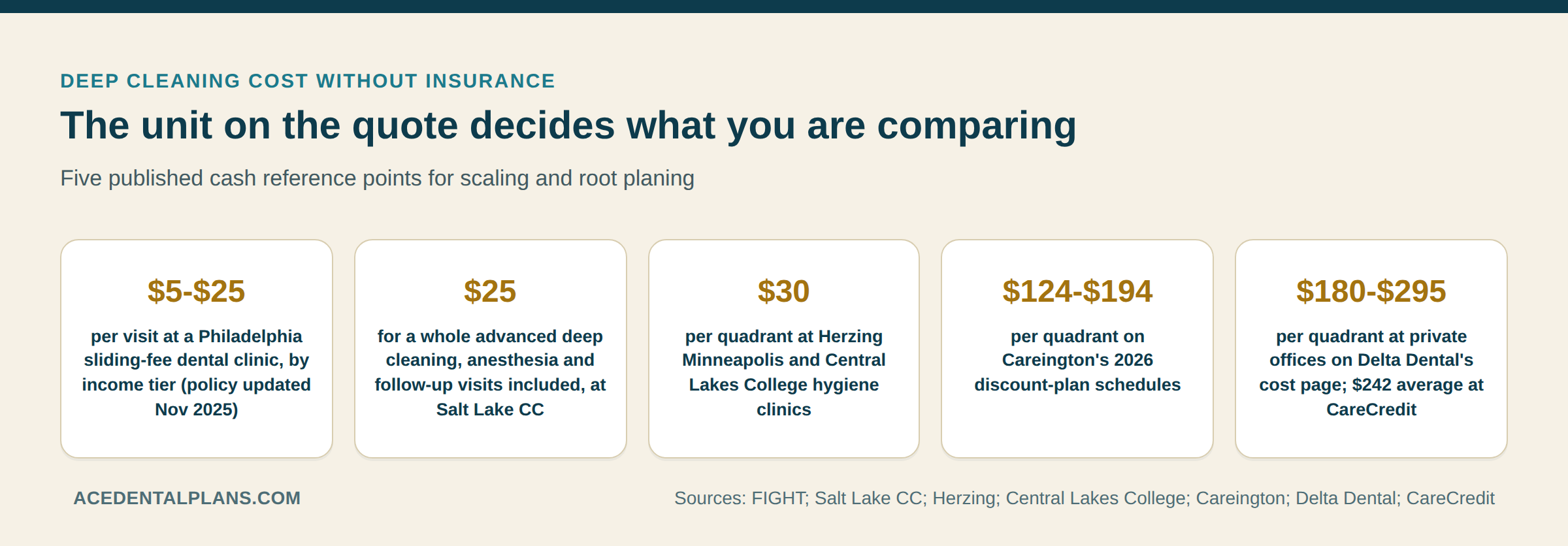
Paying cash, a deep cleaning (scaling and root planing) was listed at $180 to $295 per quadrant of the mouth on one national price page, so a full mouth can reach $720 to $1,180. Hygiene-school clinics publish $15 to $40 per quadrant, and one lists $25 for the whole course. The unit on the quote decides whether two prices can be compared at all.
This article is about the cash side: how a quote is built per quadrant, per visit or per course, what each setting charges, where numbing and other lines hide, how to put two quotes on one basis and when a savings plan repays its fee. It stops short of the insurance classification of the procedure and of the later stages of gum disease. Those have their own pages, linked where they come up.
Key Takeaways
- Ask for the unit. Delta Dental and CareCredit price scaling and root planing per quadrant, a Philadelphia nonprofit prices it per visit, and one hygiene school prices the whole course at $25.
- Four hygiene-school schedules list $15 to $40 per quadrant. Appointments run longer than private practice, and Clayton State’s page says treatment may take up to four hours.
- Three 2025–2026 discount-plan schedules list the same code at $124 to $194, $199 and $308. A member fee is only a saving if it sits below that office’s usual fee.
- Numbing is a line to ask about. One school bundles anesthesia and every follow-up visit into $25, while others list nitrous oxide separately at $10 or $20.
- Maintenance repeats. The American Academy of Periodontology says most patients need ongoing maintenance, so price the year, not the first visit.
- Sliding-fee discounts stop at 200% of the poverty guideline. Above it, HRSA’s rules provide none.
The Unit on a Deep Cleaning Quote: Quadrant, Visit or Course
A deep cleaning is not one procedure with one price tag. Dental offices divide the mouth into four quadrants, and the usual billing code is applied to one quadrant at a time. Two discount-plan schedules list the code D4341 for four or more teeth and D4342 for one to three teeth, which tells you the fee tracks how much of a quadrant needs treatment. So a quote of “$250” can mean a quarter of your mouth in one office and the entire treatment in the next.
The published cash prices use at least four different units. Delta Dental and CareCredit give a figure per quadrant. The Philadelphia FIGHT sliding fee policy ties the fee to the visit. Clayton State’s hygiene clinic lists $160 for the full set and $40 for each quadrant. Salt Lake Community College’s clinic sells an “advanced deep cleaning” for $25 that includes anesthesia and every follow-up visit needed to finish. Healthinsurance.org, citing WebMD from February 2025, says a deep cleaning costs up to $350 without anesthesia but does not say whether that is per quadrant or for the mouth.
The price detail by quadrant, along with how many teeth qualify for each code, is in the guide to deep cleaning cost. The rest of this article does not repeat those tables. It adds the fee schedules and quote-comparison tools that matter when no insurance is involved.
Published Cash Fees by Setting
Table 1 collects the cash fees that could be read directly from a provider’s own page or schedule, plus the two national price pages that anchor the private-office level. Read the column on the unit first. Then check the date, because several of these pages carry none.
| Setting | Source and date | Fee for four or more teeth in a quadrant | Unit and what else is on the page |
|---|---|---|---|
| Private offices, national pages | Delta Dental (no year); CareCredit, Synchrony 2024 study | $180–$295; $242 average | Per quadrant; periodontal maintenance $140–$220 and $167 |
| Discount plan, published schedules | Careington Care 500 (effective 1/1/2026); InterDent Gentle Dental Plan (1/1/2026); DecisionOne (11/15/2025) | $124–$194; $199; $308 | Fee by tooth count (D4341 or D4342); maintenance $72–$115, $135 and $170; membership fees not stated |
| Chain savings plan | Aspen Dental Savings Plan (1/1/2026) | 20% off the office’s usual fee | $49 a year; maintenance also 20% off; specialists excluded |
| Hygiene school clinics | Clark College (undated); Herzing Minneapolis (2025); Central Lakes College (page modified 9/2026); Clayton State (undated) | $20; $30; $30; $40 | Per quadrant; one to three teeth $15, $20, $25 and $30; maintenance $60, $40, $45 and $55 |
| Hygiene school, course price | Salt Lake Community College (undated) | $25 for the course | Includes anesthesia and all follow-up visits; $20 with college ID |
| Nonprofit sliding fee | Philadelphia FIGHT Family Dentistry (policy updated 11/12/2025) | $5 to $25 by income tier | Per visit, general services; no discount above 200% of the poverty guideline |
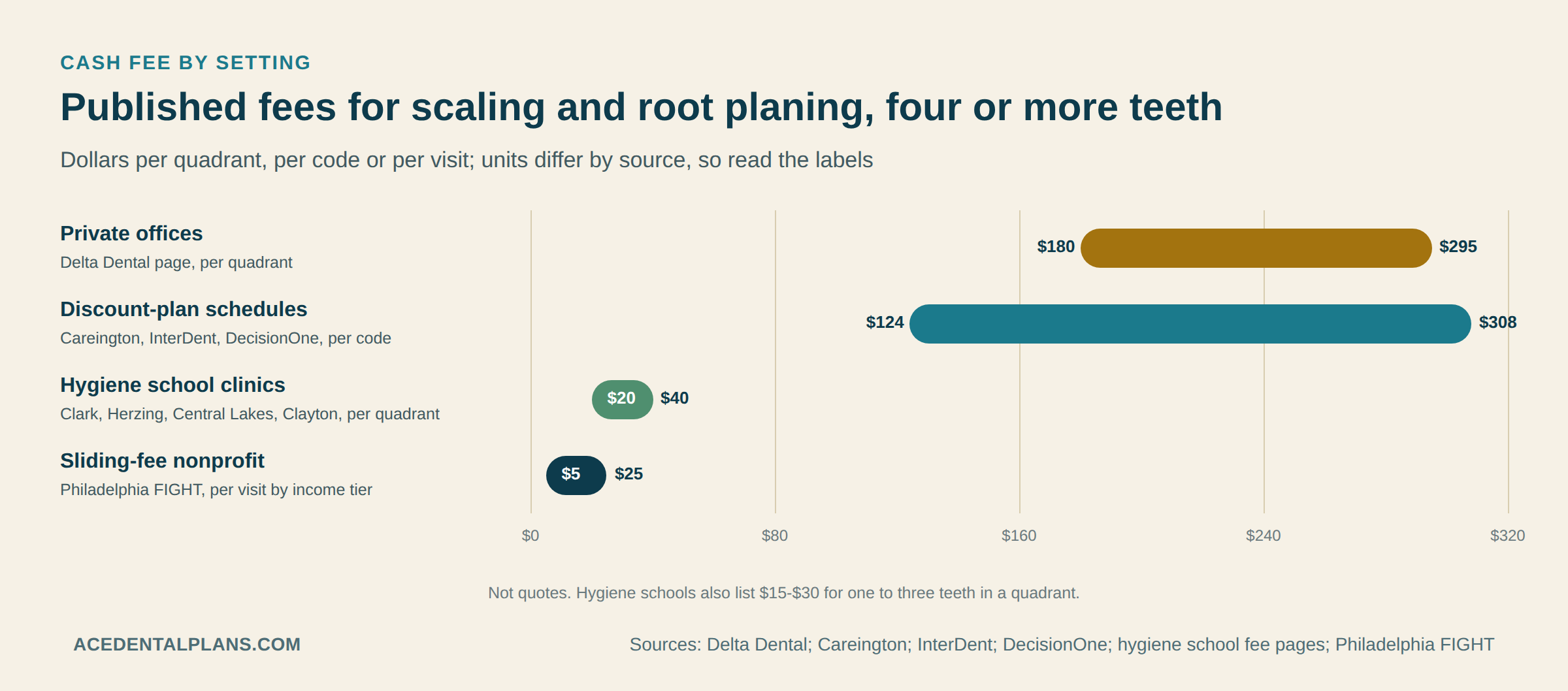
Three patterns stand out. First, the discount-plan schedules do not agree with each other: $308 for the same code is about two and a half times the lowest Careington figure of $124. The plans say the savings are a percentage off the participating office’s usual fees, so a fixed number on a schedule is the maximum for that plan, not a promise that it is the lowest in town. Second, the hygiene-school fees cluster tightly, between $15 and $40, even though the clinics sit in four different states. Third, the sliding-fee clinic is the only row where income, not the procedure, sets the price.
For a sense of where the private-office column sits among all cash prices for common services, the dental price guide lays out typical figures procedure by procedure. The article on dental costs without insurance explains how a list fee, a cash fee and a contracted fee differ. Both matter here because a deep cleaning quote often starts from the office’s list fee.
Hygiene-School Clinics: What $30 a Quadrant Buys and What It Costs in Hours
NIDCR says dental hygiene schools may offer supervised, low-cost care as part of training. For gum treatment that translates into a short, specific price list. Four clinics reviewed here publish a per-quadrant fee for scaling and root planing, and a fifth sells it as a course.
The Herzing University clinic in Minneapolis charges $30 per quadrant for four or more teeth and $20 for one to three, $30 for a full-mouth debridement and $40 for periodontal maintenance. Nitrous oxide is $10. Central Lakes College in Minnesota lists $30 and $25 for the same two quadrant types, $45 for periodontal maintenance and $5 per site for a locally delivered antimicrobial of the Arestin type. Clayton State University in Georgia prices the full set of four-plus-tooth quadrants at $160, or $40 each, with $120 for the one-to-three-tooth version and $55 for maintenance. Clark College in Washington lists $20 and $15 per quadrant, with its own example showing four quadrants at $60 to $80, and $60 for maintenance.
Salt Lake Community College’s clinic is different in kind. Its “advanced deep cleaning” costs $25, or $20 with a college ID, and the price includes anesthesia and all subsequent visits needed for completion. The same sheet says the clinic does not provide emergency or general dentistry and refers those needs elsewhere. That is a bundle price for the whole course, not a per-quadrant fee.
Four quadrants at four clinics
Multiply it out and the gap with private pricing is plain. Four quadrants cost $120 at Herzing, $120 at Central Lakes, $160 at Clayton and $60 to $80 at Clark, against $720 to $1,180 on Delta Dental’s private-office range. None of those clinic totals includes the exam, X-rays or charting the treatment may require, which are separate lines in each schedule, so the real comparison comes later in the cash-bill table.
What does the lower price ask of you? Time first. Clayton’s page says treatment may take up to four hours and may need multiple appointments. Herzing says appointments take longer than a typical private-practice visit. Then eligibility and rules. Central Lakes serves the public by appointment, first come first served, and does not accept dental insurance. Herzing is open to ages five and older, does not accept insurance, and gives 50% off to seniors 60 and older, 75% off to active military and veterans, and free treatment to its own students and faculty. Clayton takes only credit cards, charges $10 for a cancellation without 24 hours’ notice and requires fees to be paid before further treatment. Clark takes cash or a personal check, with full payment due at the first appointment of a new series.
That last caution deserves a sentence. Herzing’s page says it does not perform comprehensive or periodic exams. It does its own assessment to decide on treatment and sends its findings and radiographs to your own dentist. The pages reviewed do not describe how a school handles a patient whose disease is advanced enough for a periodontist, so ask that on the first call. For a price comparison of ordinary cleanings across the same kinds of clinics, see dental cleaning cost without insurance, which sets those settings side by side for routine care.
Sliding Fees: One Visit Price for Gum Treatment
The Philadelphia FIGHT Family Dentistry billing policy, updated in November 2025, shows a different pricing model. General dental visits cost $5 for a patient at or below 100% of the federal poverty guideline. The fee rises in $5 steps to $25 at 175% to 200%, and above 200% there is no discount. Scaling and root planing sits in the general-services list, with a fee tied to the visit. The policy does not say whether that is per visit or per quadrant, so ask. The clinic’s separate sliding fee page, effective in January 2026, lists “deep cleanings” among its general services and shows six slides, from $5 to $25 and then full fee.
The structure follows federal rules where the center receives Health Center Program funding. HRSA’s compliance manual says a full discount or a nominal fee applies at or below 100% of the guideline. Above that, partial discounts apply up to 200%, with at least three pay classes, and above 200% there are no discounts. It allows separate schedules for medical and dental services, and it says no patient is denied service for inability to pay. Not every center offers dental care, so the first call is to the dental line.
Waits are the other cost. Busy centers can book new dental patients weeks out, and gum treatment may be scheduled in several short visits. Bring proof of income and household size to the first call. The wider set of income-based and nonprofit routes, and how they compare for common dental needs, is in the article on dental care without insurance.
Reading the Per-Procedure Gap Between a Cleaning and a Deep Cleaning
At private offices a deep cleaning quadrant costs more than a routine cleaning by a wide margin: Delta Dental’s page lists $85 to $160 for the standard cleaning and $180 to $295 per quadrant. At hygiene schools the gap shrinks. Central Lakes charges $45 for an adult cleaning and $30 for a quadrant. Herzing charges $36 and $30. Clayton charges $45 and $40.

Why would a deep cleaning quadrant cost less than a routine cleaning at a school? The pages do not explain it. A plausible reading is that student-clinic fees are built around supervision and teaching hours, not the market price of the service. Whatever the reason, the cash patient’s takeaway is practical: at a school, the diagnosis decides your care, not the price list.
Discount and Savings Plans: When a Member Fee Beats the Office’s Own Fee
A dental discount plan is a membership, not insurance. The ADA says such plans contract with a network of dentists who agree to discount their fees, and that patients pay all treatment costs at the contracted rate with no claim forms. Healthinsurance.org puts the average annual membership fee at about $150 and typical discounts at 10% to 60% at participating dentists. Gum treatment is where the difference between a good plan and a poor one is largest, because the numbers are bigger.
Three published schedules show how the same code can land. Careington’s Care 500 sample schedules, effective January 1, 2026, list scaling and root planing for four or more teeth at $124, $134, $138, $150, $160, $167, $171 and $194 across eight schedules, and periodontal maintenance at $72 to $115. The InterDent Gentle Dental Plan schedule, also effective January 1, 2026, lists $199 for four or more teeth, $149 for one to three, and $135 for maintenance. The DecisionOne schedule, effective November 15, 2025, lists $308, $232 and $170.
Read the top of that range carefully. DecisionOne’s $308 sits above the $295 top of Delta Dental’s private-office range and well above CareCredit’s $242 average. That is not a contradiction. The schedules say savings are a percentage off a participating office’s usual and customary fees for uninsured, self-pay patients, and that savings may vary by location. A member fee only saves money if it sits below what that office would otherwise charge you, and the schedule cannot tell you that. The dentist’s own cash fee can.
Aspen Dental’s Savings Plan works the other way round, as a percentage. It costs $49 a year, with $29 for each added family member, and its January 2026 schedule lists scaling and root planing per quadrant at 20% off and periodontal maintenance at 20% off. Aspen’s comparison page lists gum disease treatment at 20% off as well. Specialists are generally excluded, and the plan is a discount arrangement, not insurance. The broader dental savings plans article explains how these programs are built and where they fall short.
The break-even formula for a gum-treatment year
Three numbers decide whether a plan repays itself in the year of the treatment: what you save on each quadrant, what you save on each maintenance visit, and the membership fee. Add the savings, subtract the fee, and the sign of the result is your answer. If a schedule does not publish the fee, use the plan’s own quote or healthinsurance.org’s $150 average as a stand-in, and mark the result as an estimate.
Table 2 prices one hypothetical year of treatment by route: all four quadrants treated, then two periodontal maintenance visits, with no exam, X-rays or numbing. It uses the published fees above and labels what is assumed. It is a comparison tool, not a forecast, because the real count of quadrants and maintenance visits is the dentist’s call.
| Route | How the year is built | Year total | What to remember |
|---|---|---|---|
| Private office at CareCredit averages (hypothetical) | 4 × $242 + 2 × $167 | $1,302 | Delta Dental’s range for the same pattern runs from $720 to $1,180 for the quadrants alone |
| Same office with Aspen Savings Plan | $49 + 80% of $1,302 | $1,091 | Assumes the office’s usual fees equal the averages; saves $211 |
| Careington schedule 501 | 4 × $124 + 2 × $72, plus a $150 plan fee | $790 | $640 in fees; the $150 fee is the healthinsurance.org average, not Careington’s price |
| Careington schedule 505 | 4 × $171 + 2 × $98, plus a $150 plan fee | $1,030 | $880 in fees before the plan fee |
| InterDent Gentle Dental Plan | 4 × $199 + 2 × $135 | $1,066 | Plan fee not stated on the schedule |
| DecisionOne Dental Plan | 4 × $308 + 2 × $170 | $1,572 | Higher than the private-office case above, before any plan fee |
| Hygiene school clinics | Four quadrants at $20–$40 each plus two maintenance visits at $40–$60 | $200–$270 | Central Lakes $210, Herzing $200, Clayton $270, Clark $200; exams, X-rays and charting extra |
| Nonprofit sliding fee (Philadelphia FIGHT) | Four general-service visits at $5–$25 | $20–$100 | Assumes maintenance is a general service, which the policy does not state |
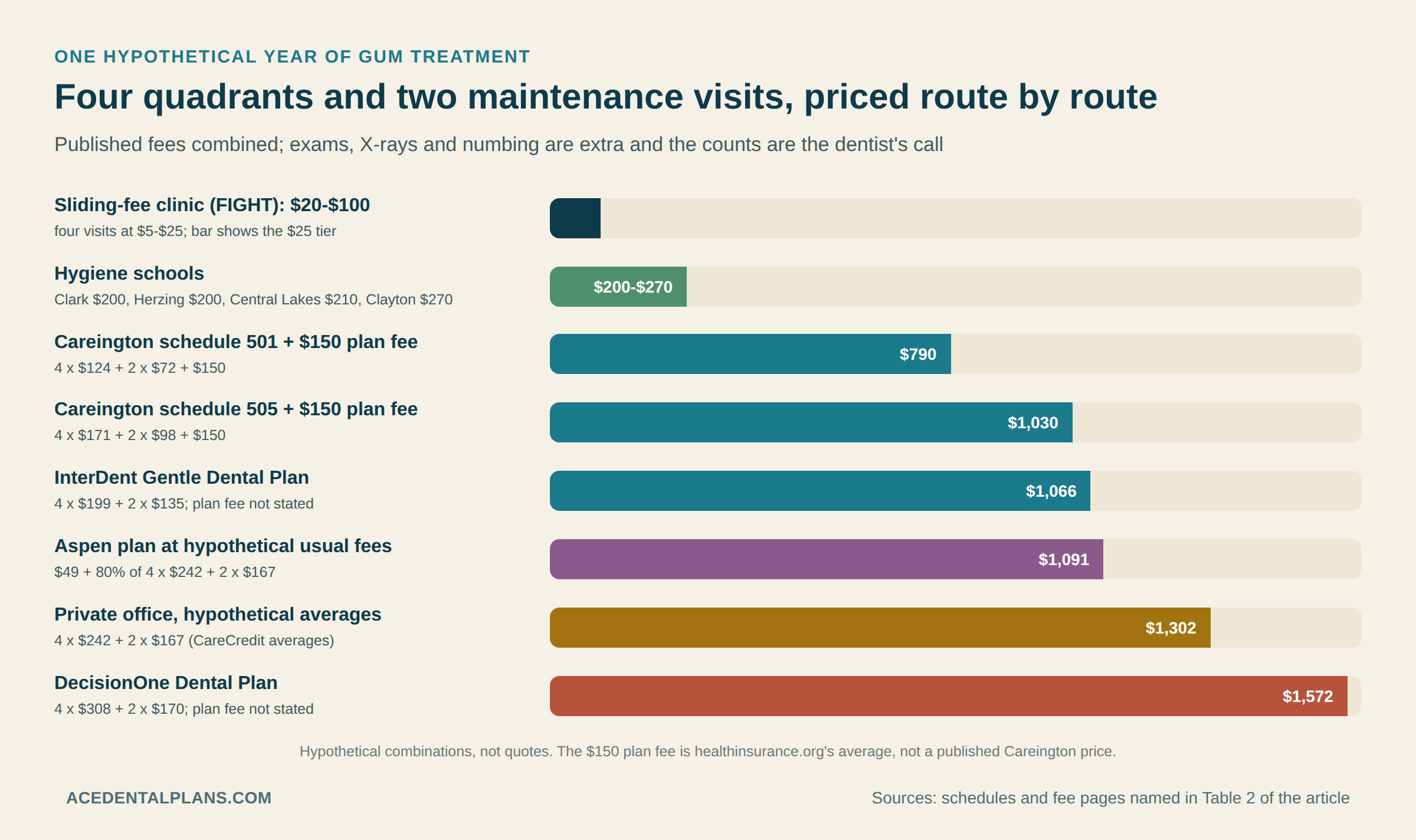
Two conclusions follow. First, the range inside the discount-plan group is almost as wide as the range between the plan group and the school group. Choosing a plan is not the same as choosing a low price, and the schedule for the specific plan matters. Second, hygiene schools and sliding-fee clinics sit several times below the private routes, and what they cost is time, acceptance and a smaller menu of services. For many readers, that makes the first decision about setting, not about plan.
Three Worked Cash Bills From Published Fees
Tables work for a single pattern, but treatment rarely arrives as four equal quadrants. Three hypothetical patients show how the same published fees behave when the pattern changes. In each case the fees are real, the pattern is invented, and exams, X-rays and numbing are left out unless a line says otherwise.
Patient one needs two quadrants, both with four or more affected teeth. At Delta Dental’s private-office range of $180 to $295 per quadrant, the bill is $360 to $590, and at CareCredit’s $242 average it is $484. On the Careington schedules, which list $124 to $194, it is $248 to $388 before the plan fee. At hygiene schools it is $40 at Clark, $60 at Herzing and Central Lakes, and $80 at Clayton. The difference between the top private figure and the Clark figure is $550 for the same two quadrants, which is why the setting is the first decision.
Patient two needs three full quadrants and one with only two affected teeth. Two plan schedules price both codes. InterDent’s fees give 3 × $199 + $149 = $746. DecisionOne’s give 3 × $308 + $232 = $1,156, a $410 gap between two plans for an identical code mix. At hygiene schools the same pattern costs $75 at Clark, $110 at Herzing, $115 at Central Lakes and $150 at Clayton. This is where reading the code on each quadrant pays off. A quote that lists four full-fee lines when the chart shows only two affected teeth in one quadrant is worth a question, though whether that quadrant qualifies for the lower code is the dentist’s clinical call.
Patient three uses a hygiene school for everything. At Herzing, which performs no exams and charges nothing for periodontal assessment, the bill is $20 for four to six bitewings, $120 for four quadrants, $20 for nitrous oxide at two visits and $40 for one maintenance visit, which comes to $200. At Central Lakes it is $20 for bitewings, $120 for the quadrants, $45 for maintenance and $10 for two antimicrobial sites, which comes to $195. At Salt Lake Community College the advanced deep cleaning is $25 and includes anesthesia and all follow-up visits, though the page does not price X-rays or maintenance separately for that package. These totals are close to what one private-office quadrant costs.
Visit by Visit: Where Each Cash Charge Lands
A cash patient feels the charges one visit at a time, so it helps to see the sequence and where the money is usually collected. The order below is a common one rather than a rule, and the dentist decides the details.
The assessment visit. Gum measurements, X-rays and an exam come first, because the dentist needs them to say whether you need scaling and root planing and in how many quadrants. This is the visit where exam and image fees appear, at $10 to $45 for X-rays in the school schedules and at a private office’s own fees elsewhere. Some schools, such as Herzing, assess without an exam and pass the findings to your dentist. At others the assessment is a separate $10 to $15 line, as on Clayton State’s sheet.
The treatment visits. One to four appointments, depending on how the work is split. Salt Lake Community College says treatment may take more than one visit, and Clayton State says it may take up to four hours. If numbing is used, the Dimensions of Dental Hygiene article says soft-tissue numbness from intermediate-acting agents lasts roughly three to five hours, so plan the rest of the day. This is where the per-quadrant fees, any nitrous oxide and any per-site antimicrobial lines are charged. Clark and Clayton want payment at or before the appointment, and a private office may take half at the start.
The re-measurement visit. After the gums have had time to respond, the dentist or hygienist measures again to see whether the pockets have changed. Whether that check is in the original price is a line to ask about, as Table 3 below shows. Some quotes include it and some bill it separately.
The maintenance visits. The American Academy of Periodontology says the majority of patients will need ongoing maintenance, and the dentist sets the interval. This is the line that repeats, at $40 to $60 at the hygiene schools and $72 to $220 across the plan schedules and private-office pages reviewed here.
Laying the sequence out this way shows why a quote for the “deep cleaning” alone understates the first year. Two of the four stages are priced outside the quadrant fee, and the last one repeats. A fair comparison between two offices lines up the same four stages, not just the second one.
Lines Outside the Quadrant Fee: Numbing, Nitrous Oxide, X-Rays and Charting
The quadrant fee is the headline, and it is rarely the bill. Four kinds of lines tend to sit beside it, and each is worth asking about before you agree to a number.
Numbing
An article in Dimensions of Dental Hygiene, dated January 2015, says patients with poor periodontal health frequently need anesthesia to scale and root plane each quadrant thoroughly. It adds that numbing all four quadrants for full-mouth treatment affects eating, drinking and speaking, and that soft-tissue numbness from intermediate-acting agents lasts roughly three to five hours. Whether the office quotes the numbing inside the quadrant fee or as a line of its own is a billing choice. Salt Lake Community College’s $25 course includes anesthesia, so for one clinic the question has a clean answer. Healthinsurance.org says anesthesia can significantly increase the price of a deep cleaning but gives no figure.
Nitrous oxide and sedation
Nitrous oxide appears as its own line at the clinics that list it: $10 per administration at Herzing and $20 per appointment at Salt Lake Community College, charged only after student requirements are met and a dentist approves it. Deeper sedation did not turn up with a price in any of the cash schedules reviewed. If the dentist suggests it, the quote should name the method and the line price.
Antimicrobials and add-ons
Central Lakes lists a locally delivered antimicrobial at $5 per site, and Herzing and Central Lakes each list fluoride or home-care products at small amounts. These are optional or case-specific, and a quote that adds several per-site lines can move the total. Ask which are recommended for you and which are routine to that office.
Exam, X-rays and charting
Plans and offices usually want current X-rays and gum measurements before they treat. School fee sheets show what those cost at the low end: Herzing lists a full-mouth series at $36 and four to six bitewings at $20 and charges nothing for periodontal assessment or charting; Central Lakes lists $45 for a full-mouth or panoramic image; Clayton caps radiographs at $45 and lists assessments at $10 to $15; and Clark lists a full-mouth series at $30 without treatment. In private offices these lines have their own prices, and the first-visit bundle is covered in dentist visit cost without insurance. Ask whether images from a recent exam can be reused. The ADA tells dentists to make a good-faith attempt to use earlier radiographs, though the decision is clinical.
One last quirk helps cash patients. Several schools also list a service called scaling in the presence of inflammation, a heavier cleaning for inflamed gums: $36 at Herzing, $45 at Central Lakes, $50 at Clayton and $15 per quadrant at Clark. Which service fits your gums is the dentist’s call, and it is a different rung from the one priced in this article.
Two Quotes, One Basis: A Line-by-Line Comparison
Two offices will not describe the same treatment in the same way, so the useful move is to convert both quotes into the same list of lines. Table 3 shows two hypothetical quotes for the same four-quadrant treatment and what is in each. The amounts are invented to show the method.
| Line | Quote A (itemized) | Quote B (package) | What to ask |
|---|---|---|---|
| Unit and code | $212 per quadrant for three D4341 quadrants; $150 for one D4342 quadrant | “Full-mouth deep cleaning” $840 | Is the price per quadrant or for the mouth, and what code is on each quadrant? |
| Treatment subtotal | $786 | $840 | Does the package assume all four quadrants? |
| Numbing | Included | $120 extra | Is local anesthesia inside the fee, and is nitrous oxide offered? |
| Exam and X-rays | Bitewings $60; exam already on file | Exam $40 and full-mouth series $90 | Are the images and exam needed, and can recent ones be reused? |
| Follow-up visit | Re-measurement visit included | $60 | Is the post-treatment check part of the price? |
| Maintenance later | $140 a visit | $165 a visit | What is the fee per maintenance visit and who sets the interval? |
| Payment terms | Half at the first visit, half at the last | Paid in full before the first visit | When is payment due, and is there a refund or payment-plan policy? |
| Total to start | $846 | $1,150 | Add every line before comparing |
The headline difference between the quotes was $54, $840 against $786. The difference on a like-for-like basis is $304. Neither quote is wrong. Quote B is a package with the extras priced separately, while A is itemized with the extras folded in, and only a table of lines shows that.

Written quotes help for another reason. CMS says people without insurance, or who do not use it, are usually entitled to a good faith estimate when they schedule care at least three business days ahead or ask for one, and that a bill at least $400 above the estimate may be disputable. The CMS page does not say how this applies to dental practices, so ask for an itemized written estimate as good practice. A deep cleaning quote that rises by hundreds of dollars after the first visit is the kind of surprise a written list avoids.
Periodontal Maintenance: The Cash Price That Keeps Coming Back
After a deep cleaning, most patients enter maintenance. The American Academy of Periodontology says the majority of patients will require ongoing maintenance therapy to sustain periodontal health, and that if non-surgical treatment does not achieve it, gum surgery may be recommended. Maintenance is billed as its own service, not as a routine cleaning.
The cash fee runs from $40 to $60 at the hygiene schools above and $72 to $115 on Careington’s schedules. InterDent lists $135 and DecisionOne $170. Delta Dental’s page gives $140 to $220 at private offices and CareCredit $167 on average. The Tennessee office whose membership page was reviewed lists its regular maintenance fee at $104 and takes 10% off additional periodontal treatment and maintenance for members. Compare the per-visit figure across all of these, and then ask the dentist how often the visit will happen, since the interval is a clinical decision made from how your gums respond.
If You Wait: What the Sources Say About Delay and Price
NIDCR describes the start of gum disease as swollen, red and bleeding gums, and says early disease caused by plaque can often be reversed with daily home care. If it is left untreated, the page adds, it can spread to the bones that support the teeth, making chewing painful, and in advanced cases teeth may become loose or need to be removed. It names scaling and root planing, a deep cleaning of the affected tooth, as one treatment, and says advanced cases may need surgery.
The CDC says about 4 in 10 U.S. adults aged 30 and older had periodontitis in 2009–2014, and that a yearly checkup can help detect gum disease, which can become serious before symptoms appear. Neither agency prices anything, and neither says that a month or two of delay changes a diagnosis. The timing of any given course of treatment is a conversation with the dentist or periodontist, not a rule that a reader can set from a web page. The condition itself, with its stages and symptoms, is explained under gum disease.
What can be said is how prices climb. On Careington’s January 2026 schedules a routine cleaning is $33 to $63, scaling and root planing for four or more teeth is $124 to $194 a quadrant and periodontal maintenance is $72 to $115. On Delta Dental’s private-office page the same three are $85 to $160, $180 to $295 per quadrant and $140 to $220. The next rung after maintenance, gum surgery and what follows a lost tooth, is priced in the article on gum disease treatment cost, and the routine cleaning visit that sits below all of this is broken down in dental cleaning cost.
Do not wait on cost if you have these
- Swelling of the face or gums with fever or a bad taste in the mouth.
- Severe or throbbing pain in a tooth or the jaw.
- A loose tooth that has changed quickly.
- Trouble breathing or swallowing. Call 911 or go to an emergency room.
Paying for It: Cash Terms, Payment Plans and Pre-Tax Money
The cash terms in the published schedules are strict, and they differ by provider. Hygiene schools tend to want payment at or before treatment. Clayton State accepts only credit cards and wants fees paid before further treatment, Clark accepts only cash or a personal check, and Central Lakes accepts cash, check, Visa and Mastercard. Herzing accepts credit and debit cards and cash. Know the method before the first appointment, because a clinic that does not take cards or checks will not take a promise to pay next week.
Private offices are more flexible and less predictable. Many offer payment arrangements, and the Philadelphia FIGHT policy shows what a structured version can look like: after a treatment plan is set, a patient can request a financial consultation, and staff draft a plan around how much the patient can comfortably pay and how often, with proof of income and a signed agreement. The same policy defers elective treatment if a balance is more than 90 days old with no payments in the last 90 days. The article on ways to pay for dental work compares eight routes, from office plans to credit and loans, side by side.
Pre-tax money is the other lever. IRS Publication 502 says amounts paid for the prevention and alleviation of dental disease can be included as medical expenses, with only the part above 7.5% of adjusted gross income deductible, so keep itemized receipts. Whether a health savings account or flexible spending account reimburses a particular bill depends on the account’s own rules.
If you do have coverage, the picture changes, and the cash prices above become the baseline you compare a plan against. How plans sort services into preventive, basic and major tiers is in what dental insurance covers, and the mechanics of premiums, deductibles and annual maximums are in how dental insurance works. Medicare.gov says Original Medicare in most cases does not cover dental services like routine cleanings, and Medicaid.gov says adult dental benefits are left to each state, with no minimum federal requirement.
Choosing a Route: A Decision Path
The published fees do not rank themselves, so a short sequence helps. Each step narrows the field, and most readers will stop at the first one that fits.
- Do you have a written diagnosis and treatment plan? If not, the first cost is the exam and gum measurements, and some hygiene schools do their own assessment and send it to your dentist. Get the plan in writing before pricing the work.
- Is your household income at or below 200% of the poverty guideline? If so, call the dental line of a health center first. HRSA’s rules offer a full discount or nominal fee up to 100% and partial discounts up to 200%, where the sliding scale stops.
- Do you have the time and a school nearby? A hygiene school lists the lowest per-quadrant fees reviewed here, and the cost is longer appointments, a screening and the school calendar.
- Do you want a private dentist? Ask the office for its cash fee for each code, and compare it with any plan schedule that office participates in. A plan helps only when the member fee is below the office’s usual fee.
- Is the total large? Ask about payment arrangements before you accept the date, and keep the itemized estimate. A balance that is understood is easier to carry than one that appears after treatment.
Many people combine routes. A school or health center can handle the first round of treatment, and a private dentist can take over maintenance if continuity matters to you. If you do, carry copies of your charting and X-rays so the next office can see where you started. The dentist then decides whether the records are enough or whether new ones are needed.
Questions to Ask Before You Agree to a Cash Deep Cleaning
- Is the fee per quadrant, per visit or for the whole mouth? Everything else depends on it.
- Which code is on each quadrant? D4341 covers four or more teeth in a quadrant and D4342 one to three, and the second is usually the lower fee.
- Is numbing included? Ask about nitrous oxide and the price of any other form of sedation.
- Which exam, X-rays and gum measurements are included? Ask whether recent ones from another office can be used.
- Is a follow-up visit to re-measure the gums in the price? If not, what does it cost?
- What is the fee for each maintenance visit, and how often will it be needed? The dentist sets the interval.
- Do you have a different fee for patients paying cash, a membership or a participating discount plan? Ask what the plan’s fee for the same code is, and whether you can see the office’s own fee list.
- When is payment due, and what if I need to split the visits? Ask about refunds, cancellation fees and payment plans.
Get the answers in writing with the date and the name of the person who gave them. A written itemized estimate is the one thing you can carry to a second office, a school clinic or a health center and have priced against.
Bottom Line
A cash deep cleaning has a price only after you attach a unit, a code count and a list of what is left out. Published fees run from $5 a visit at a sliding-fee clinic to $308 per quadrant on one discount-plan schedule, and much of that spread comes from who runs the chair and how they are paid, not from the work.
Start with the setting that fits your income and your time. A hygiene school or sliding-fee clinic offers the lowest published prices and asks for hours and paperwork in return. A discount plan can help if the schedule’s fee for your code sits below your dentist’s own cash fee, and the arithmetic is small enough to do on one page. A private office offers speed and continuity at the highest published price.
Whatever you choose, price the year, not the visit. Four quadrants, a follow-up and maintenance on a schedule your dentist sets are one treatment, and quotes that leave one of those out are not comparable. For the wider range of cash-pay price guides, see the full set of Dental Costs guides.
Frequently Asked Questions
How much does a deep cleaning cost without insurance?
Delta Dental’s cost page lists $180 to $295 per quadrant, and CareCredit’s 2024 study averaged $242 per quadrant, so a full mouth at private-office prices runs roughly $720 to $1,180. Hygiene-school clinics publish $15 to $40 per quadrant, and one lists $25 for the whole course. Discount-plan schedules ranged from $124 to $308 for the same code. The unit and what is left out of the quote decide the true total.
Is a deep cleaning priced per tooth, per quadrant or for the whole mouth?
Usually per quadrant, with a lower code for one to three teeth in a quadrant and a higher one for four or more. Some discount-plan schedules list those codes by tooth count without naming the unit, a Philadelphia nonprofit ties the fee to the visit, and one hygiene school sells the whole course for $25. Ask the office to state the unit and the code on each quadrant in writing.
What is the lowest-cost way to get a deep cleaning without insurance?
In the published schedules reviewed here, hygiene-school clinics and a sliding-fee nonprofit were lowest, at $15 to $40 per quadrant and $5 to $25 per visit. Both ask for more time, income paperwork or acceptance by the program, and neither replaces a diagnosis. Discount plans can help if the schedule’s fee is below your dentist’s usual cash fee.
Does the quoted price include numbing?
It depends on the office. Salt Lake Community College’s $25 course includes anesthesia, while Herzing and Salt Lake list nitrous oxide separately at $10 and $20. Healthinsurance.org says anesthesia can significantly raise the cost of a deep cleaning, without giving a figure. Ask whether local anesthesia is inside the quadrant fee, and the price of any other sedation.
Why would one discount plan list $308 and another $124?
The plans set different fee schedules and different networks, and their savings are described as a percentage off a participating office’s usual fees. DecisionOne’s $308 sits above Delta Dental’s private-office range of $180 to $295, while Careington’s lowest schedule lists $124. A member fee only saves money if it is below what the office would charge you in cash.
Is a dental savings plan worth it for a deep cleaning?
Often, because the treatment bill is large relative to the fee. Aspen’s plan costs $49 and takes 20% off scaling and root planing and periodontal maintenance. At hypothetical usual fees of $242 per quadrant and $167 per maintenance visit, four quadrants and two visits save about $260 before the fee. The result changes with the office’s own fees and with the number of visits, so run the numbers for your dentist.
How much is periodontal maintenance after a deep cleaning without insurance?
Published cash fees run $40 to $60 at hygiene schools, $72 to $115 on Careington’s schedules and $135 and $170 on two other plan schedules. Delta Dental lists $140 to $220 at private offices, and CareCredit’s 2024 average is $167. How often you need it is the dentist’s decision, so ask for the interval as well as the fee.
Can I get a deep cleaning at a hygiene school?
Some schools do it. Herzing, Central Lakes, Clayton State and Clark publish per-quadrant fees, and Salt Lake Community College sells a course. Appointments run longer than private practice, and clinics may screen patients. Herzing does not perform exams and sends its findings to your own dentist. Call first and ask how the clinic handles advanced cases.
What happens if I put off a deep cleaning?
NIDCR says untreated gum disease can spread to the bones that support the teeth, and in advanced cases teeth may become loose or need to be removed. Early disease caused by plaque can often be reversed with daily home care. How urgent your own treatment is depends on your measurements, so ask the dentist what delay is reasonable and what changes if you wait.
Can I pay for a deep cleaning in installments?
Many offices arrange payments, and terms vary. Philadelphia FIGHT’s policy describes a financial consultation after the treatment plan is set, with a payment plan built around what the patient can comfortably pay. Hygiene schools tend to collect fees at or before treatment. Ask about the policy, any fees and what happens to the balance if you miss a payment.
Sources and Disclaimers
National cash price ranges come from consumer cost pages (Delta Dental, Synchrony via CareCredit, healthinsurance.org), which describe different markets and years. Setting-specific fees come from the providers’ own pages and schedules: hygiene-school clinics, a nonprofit dental clinic’s billing policy, three discount-plan administrators, a chain savings plan and one private office. Several of those pages carry no date, and the article says so. Program rules come from HRSA, CMS, Medicare.gov, Medicaid.gov and the IRS, and clinical context from NIDCR, the CDC, the American Academy of Periodontology, the ADA and a hygiene-profession journal. Sums, break-even calculations and every sample bill are original arithmetic on published fees, and each hypothetical number is labeled as one. National averages say little about your ZIP code, so confirm prices with the dentist and any benefit rules with your insurer or plan administrator.
- Delta Dental — Dental cleanings: cost and insurance coverage
- Synchrony / CareCredit — Average cost of dental procedures
- healthinsurance.org — How much do dental cleanings cost without insurance?
- healthinsurance.org — Dental discount plan glossary entry
- Careington — Care 500 sample member fee schedules (effective January 1, 2026)
- InterDent — Gentle Dental Plan member fee schedule (effective January 1, 2026)
- DecisionOne Dental Plan — Fee schedule effective November 15, 2025
- Aspen Dental — Dental Savings Plan
- Aspen Dental Savings Plan — Member fee schedule effective January 1, 2026
- Aspen Dental — Savings plan compared with insurance
- Thomasson Dental — Membership plan and savings examples
- Herzing University Minneapolis — Dental clinic fees
- Central Lakes College — Dental hygiene clinic fees
- Clayton State University — Dental hygiene clinic
- Clark College — Dental hygiene clinic fee schedule
- Salt Lake Community College — Dental hygiene clinic services and fees
- Philadelphia FIGHT Family Dentistry — Dental billing policy (updated November 12, 2025)
- Philadelphia FIGHT — Sliding fee program (effective January 12, 2026)
- Health center sliding fee document — Basic dental sliding fee (updated January 20, 2026)
- HRSA — Health Center Program Compliance Manual, Chapter 9: Sliding fee discount program
- NIDCR — Gum disease
- NIDCR — Finding dental care
- CDC — About gum (periodontal) disease
- American Academy of Periodontology — Non-surgical treatments
- American Dental Association — Dental plan overview
- American Dental Association — X-rays and radiographs
- Dimensions of Dental Hygiene — Ask the expert: local anesthesia and scaling and root planing (2015)
- CMS — Good faith estimate
- Medicare.gov — Dental services
- Medicaid.gov — Dental care
- IRS — Publication 502 (2025), Medical and Dental Expenses
Important Information and Disclaimers
This article is general educational information. By using it, you accept the limits described below.
Not dental or medical advice
Nothing on this page is a diagnosis, a treatment recommendation or a substitute for an examination by a licensed dentist or physician. Reading this article does not create a dentist-patient or doctor-patient relationship. Only a licensed professional who has examined you and reviewed your history can tell you what your mouth needs. Do not delay, skip or stop professional care because of something you read here.
Prices are estimates, not quotes
Cost figures are ranges reported by the third-party sources cited in this article. Actual prices depend on your location, the provider, the complexity of your case, the materials used, the date of service and other factors, so what you pay may be higher or lower. A written treatment plan and fee estimate from the dental office is the only reliable number for your situation.
Insurance and plan examples are illustrations
Examples that use named amounts or percentages are hypothetical. Real benefits depend on your plan, network, waiting periods, annual maximum, deductible and the insurer’s rules at the time of treatment. A pre-treatment estimate or benefits check is not a promise of payment. Confirm the details with your insurer or plan administrator in writing.
Not insurance, legal, tax or financial advice
AceDentalPlans is an information publisher. Nothing here is insurance, legal, tax, investment or other professional financial advice, and nothing here recommends a particular provider, insurer, lender, discount plan or financing product. Company and product names belong to their owners and appear for identification only. Read the terms of any loan, financing offer or plan before you sign, and ask a qualified professional if you need advice on your own circumstances.
Third-party sources
This article cites government agencies, professional associations, insurers, lenders and other outside organizations. We do not control those sources. Their content can change, move or disappear, and listing a source is not an endorsement of it or of anything it sells.
No warranty
We aim for accuracy, but this article is provided “as is,” without warranties of any kind, express or implied, including warranties of accuracy, completeness, timeliness or fitness for a particular purpose. Some information may be out of date or contain errors by the time you read it.
Limitation of responsibility
To the fullest extent permitted by law, AceDentalPlans and its owners, authors and contributors are not responsible or liable for any loss, cost, injury, health outcome or other damage that results from using this article or relying on it. You are responsible for your own decisions about your care, your coverage and your money.
How this article is written
This article follows AceDentalPlans’ answer-first, U.S.-focused editorial approach. It uses conditional language for insurance, because coverage depends on the specific plan, and it names its sources so that you can read them yourself.