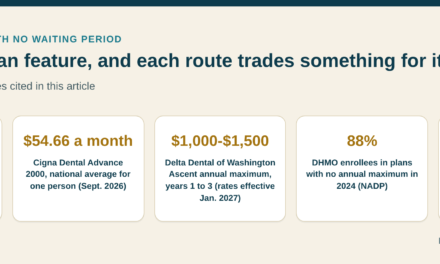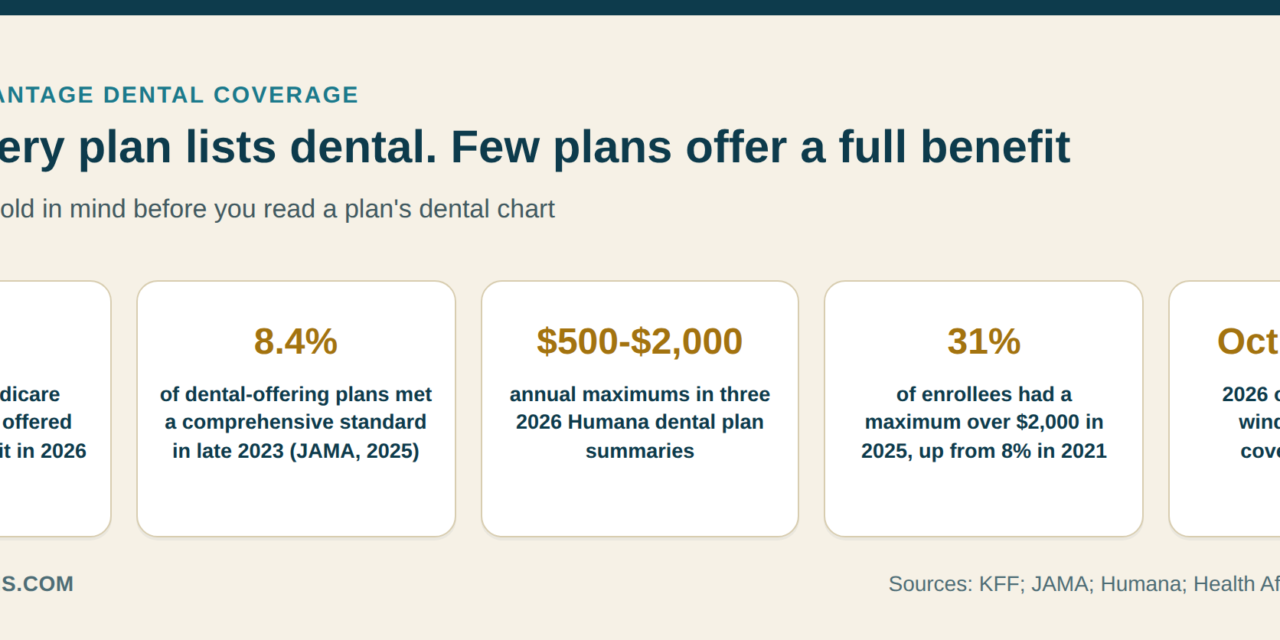
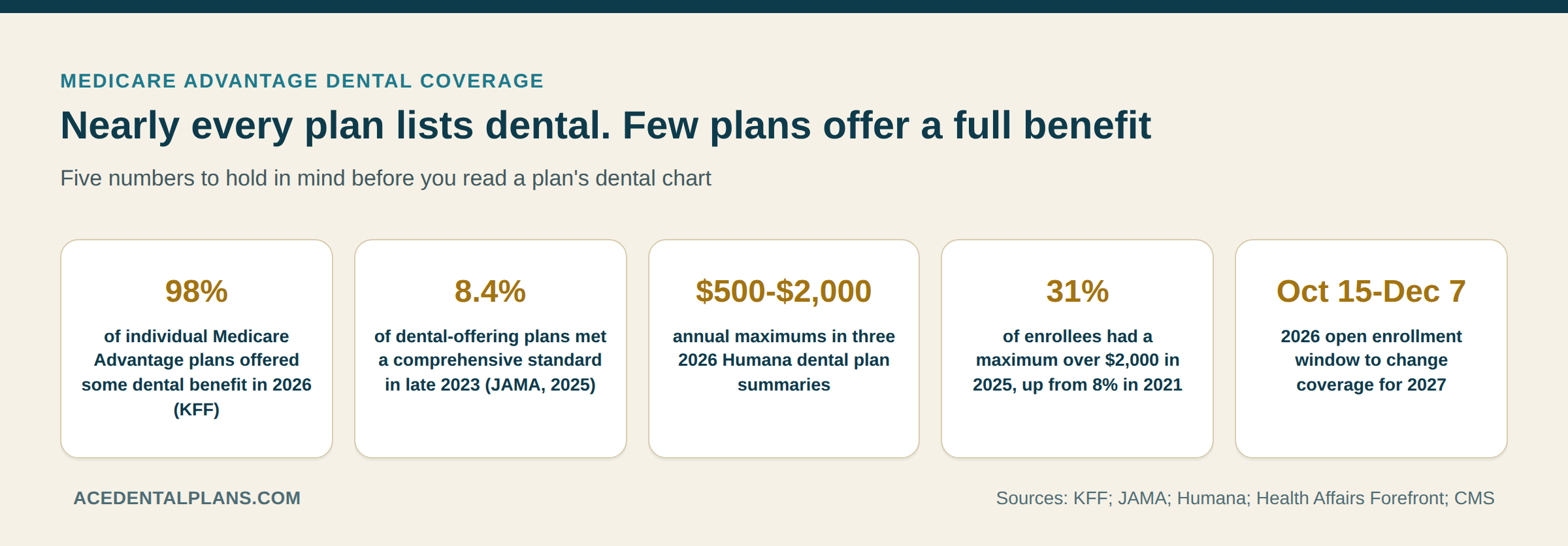
Most Medicare Advantage plans include dental coverage, but the benefit is often thinner than a stand-alone dental plan. In 2026, 98% of individual plans offered some dental benefit, yet only 8.4% of the plans with dental met a comprehensive standard in a late-2023 analysis. Three 2026 plan summaries showed annual maximums of $500, $1,000 and $2,000, which a root canal and a crown can use up quickly.
This article explains how Advantage dental benefits are built: preventive versus comprehensive designs, annual maximums, coinsurance, networks, allowance cards and the limits on dentures and implants. It also shows how a $2,500 treatment plan might split under four hypothetical plans and how to read the dental section of an Evidence of Coverage. Original Medicare’s dental rules and the enrollment process have their own pages, which are linked where they come up.
Key Takeaways
- Dental is an extra benefit. Original Medicare excludes most dental care, so any routine coverage in an Advantage plan comes from the plan’s supplemental benefits and varies by plan and county.
- “Has dental” is not “has comprehensive dental.” In a JAMA analysis of 5,485 plans with dental, 8.4% met three tests: $0 cleanings, a maximum of $1,500 or more, and no extra premium.
- The annual maximum decides big bills. A crown and a root canal can exhaust a $1,000 maximum, and you owe everything above it.
- Dental costs usually sit outside the out-of-pocket limit. MedPAC reports that cost sharing for non-Medicare supplemental services does not count toward the plan’s maximum out-of-pocket limit.
- Network type changes the bill. An out-of-network dentist may bill more than the plan pays, and some dental benefits have no out-of-network coverage at all.
- Open enrollment runs October 15 to December 7, 2026 for 2027 coverage, and dental allowances changed for many members in some 2027 plans according to one analyst report.
Why Dental Is an Extra Benefit Inside Medicare Advantage
Medicare Advantage, also called Part C, is Medicare delivered through a private plan. By federal rule, the plan has to cover what Original Medicare covers. The CMS booklet Understanding Medicare Advantage Plans (April 2026 edition) puts it plainly. Plans must cover all medically necessary services that Original Medicare covers, and most add extras such as vision, hearing and dental.
That structure explains the dental gap. Medicare.gov states that Original Medicare in most cases does not cover dental services such as routine cleanings and fillings, apart from narrow exceptions tied to hospital stays and certain medical treatments. Those exceptions do not disappear inside an Advantage plan, because the plan must cover what Original Medicare covers. For the full list of exceptions and how seniors pay when none applies, see whether Original Medicare covers dental care.
Everything beyond those exceptions is a supplemental benefit the plan chooses to offer. The American Dental Association’s Medicare Advantage FAQ for dentists says directly that it is the supplemental benefits that provide dental coverage. Federal regulation at 42 CFR 422.102 splits supplemental benefits into two kinds. A mandatory benefit is built into the plan and applies to every enrollee in it. An optional benefit is offered to every enrollee, who decides whether to buy it.
Why does the distinction matter to you? Because the dental line in a plan’s paperwork may be included for everyone, or it may be an add-on with its own premium. In the KFF analysis of 2021 plan data, about 10% of Medicare Advantage enrollees were in plans that charged a separate premium for any dental benefit, averaging $270 a year. More recent JAMA data, covered below, found that 64.6% of plans with dental charged no additional premium.
Where the money comes from
Plans pay for extras mostly with rebates, which are federal dollars returned to a plan when it bids below Medicare’s benchmark. The Medicare Payment Advisory Commission (MedPAC) reported in June 2025 that rebates would total about $86 billion for 2025, roughly $2,530 per enrollee. Plans split that money among lower cost sharing, drug coverage, Part B premium reductions and non-Medicare benefits such as dental, vision and hearing.
MedPAC’s bid data put the projected 2025 dental spending at $19 per member per month in conventional plans and $26 in special needs plans. Dental made up about 41% of conventional plans’ projected non-Medicare benefit spending. Do the arithmetic: $19 a month is $228 a year, averaged across every member, including the many who never see a dentist that year. A pool that size can pay for exams and cleanings for most people. It cannot pay for a crown for everyone who needs one, which is why annual maximums exist.
The same MedPAC chapter reports that in 2024 nearly 90% of conventional plans with dental benefits used spending limits to control costs. Hold on to that number. It means a dollar cap is the rule, not an exception, and the question becomes how high the cap sits.
How Many Advantage Plans Offer Dental, and How Many Offer a Full Benefit
Two different questions hide inside the phrase “Medicare Advantage covers dental.” The first is whether a plan lists any dental benefit. The second is whether that benefit would feel like dental insurance to someone used to an employer plan. The data answers the first question with a near-universal yes and the second with a much smaller number.
KFF’s 2026 spotlight, published in December 2025 from CMS benefit files, found that 98% of individual Advantage plans offered some dental benefit, similar to 2025. KFF notes in its figure definitions that “dental” includes plans offering preventive benefits only, such as cleanings. The CMS press release of September 28, 2026 says supplemental benefits, including hearing, dental and vision, are expected to remain stable for 2027, and it does not give plan-level detail.
The sharper picture comes from a research letter in JAMA (2025;333(6)) by Lisa Simon, Marko Vujicic and Kamyar Nasseh, which analyzed CMS plan benefit data from the fourth quarter of 2023. Of 6,333 plans, 5,485 offered a dental benefit (86.6%). The authors defined a comprehensive benefit as one with cleanings at no copay, an annual maximum of at least $1,500 and no extra premium for dental services. Only 460 plans, 8.4% of those with dental, met all of it. By enrollment, 94.0% of members were in a plan with dental, and 4.1% were in a comprehensive one.
| Measure | Figure | Data year | Reported by |
|---|---|---|---|
| Individual plans offering any dental benefit | 98% | 2026 | KFF |
| Plans with dental that met a comprehensive test | 8.4% (460 of 5,485) | Late 2023 | JAMA research letter |
| Enrollees in a comprehensive-benefit plan | 4.1% | Late 2023 | JAMA research letter |
| Dental plans with a maximum of $1,500 or more | 77.4% | Late 2023 | JAMA research letter |
| Dental plans with cleanings at no copay or coinsurance | 35.3% | Late 2023 | JAMA research letter |
| Enrollees with a maximum over $2,000 | 31% (8% in 2021) | 2025 | HealthScape Advisors, via Health Affairs Forefront |
| Projected dental spending per member per month | $19 conventional, $26 special needs | 2025 bids | MedPAC |
| Enrollees aware of their dental coverage | 54.2% | 2017-2021 surveys | JAMA Network Open study, as summarized by AJMC |
Read the table as a funnel. Nearly every plan has something, most plans with something have a maximum above $1,500, and fewer than one in ten pair that maximum with $0 cleanings and no extra premium. The figure below breaks the JAMA numbers into the individual tests so you can see where plans fall away.
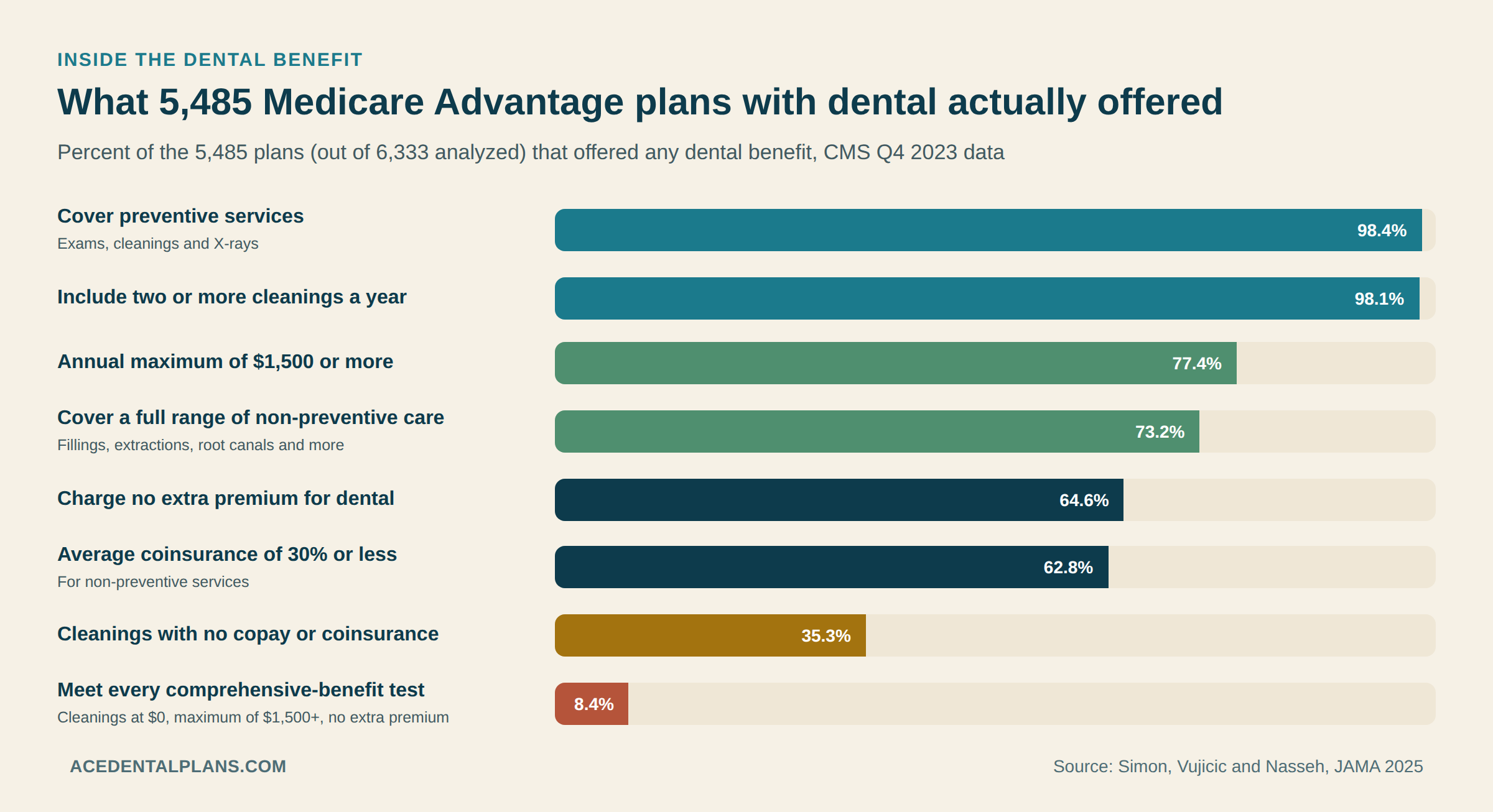
A fair caution about the 8.4%: it is a benchmark chosen by the researchers, who compared plans with what employer-sponsored dental coverage looks like. A plan that misses it might still suit a person who needs only cleanings and a filling now and then. A plan that meets it can still have a narrow network. The number describes plan design in late 2023, not the quality of care in any county in 2027.
Another caution concerns awareness. In a study of 2017 to 2021 survey data published in JAMA Network Open in 2025 and summarized by AJMC, only 54.2% of Medicare Advantage enrollees were aware of their dental coverage. A benefit that nearly half of members do not know about goes unused by default. That is part of why a plan’s dental line looks richer on the comparison page than it feels in practice.
What the national numbers cannot tell you
Plan-design statistics describe what plans promise. They do not describe whether a dentist near you accepts new patients, how long the wait is, or how often claims are denied. KFF’s 2026 spotlight states that no utilization or cost data on these benefits were yet available. MedPAC reported that until 2024 CMS’s encounter data system could not accept dental records, so national claims-level evidence is thin. The JAMA analysis covers late-2023 benefits, the Health Affairs estimates come from a consultancy’s plan data, and KFF’s 2021 distribution of maximums is older still.
No independent national summary of 2027 dental maximums turned up among the sources read for this article. The 2027 figures cited later come from CMS’s aggregate release and one analyst’s reading of Plan Finder data. The gap is the reason this article leans on plan documents and worked arithmetic: the numbers on your plan’s page are the ones that decide your bill.
Preventive-Only, Comprehensive and Allowance Designs: Three Benefits Behind One Word
The word “dental” on a plan page can mean three quite different designs. Sorting a plan into one of them takes about two minutes with its benefit summary, and it explains most surprises at the front desk.
Preventive-only
These plans cover exams, cleanings, X-rays and sometimes fluoride, and little else. KFF’s 2021 analysis found that 14% of Advantage enrollees with dental access had preventive coverage only. Benefits have grown since then. Health Affairs Forefront (June 2025) reported HealthScape Advisors’ estimates of preventive dental in about 90% of plans and comprehensive dental in about 84%, up from 79% in 2021. Those shares come from a different data set than KFF’s. Even so, the 2026 KFF figure counts preventive-only plans as having dental, so a plan can earn the “98%” with a cleaning benefit alone.
Comprehensive, schedule-based
These plans cover preventive care and also sort other services into preventive, basic and major tiers, each with a percentage the plan pays. Fillings and extractions often sit in one tier, root canals and crowns in another, and dentures in a third. A fee schedule sets the amounts, and a yearly maximum caps the total. The three Humana plan summaries in the next section follow this pattern. KFF’s 2021 data found that the most common coinsurance for extensive services was 50%.
Allowance-based
The ADA’s Medicare Advantage FAQ describes allowance plans as giving the member a set dollar amount to use on any covered dental service except cosmetic services. There may be no tiers and no percentage, just a pool of money. Network dentists are held to the plan’s maximum allowable fees, while out-of-network dentists may be paid on a different basis. Allowances can also arrive on a prepaid card, which is a separate topic covered later.
The quickest way to tell which design you are looking at is the layout of the benefit chart. Percentages in several rows suggest a tiered plan. A single dollar figure with a short list of exclusions suggests an allowance. A chart that stops after exams, X-rays and cleanings is preventive-only, whatever the marketing page says.
Three 2026 Plan Summaries Side by Side
Abstract percentages only go so far, so here are three real benefit summaries. Humana publishes 2026 dental plan summaries as PDFs, and three of them (codes DEN733, DEN416 and DEN213) show how much the same sponsor’s dental benefits can differ. They are used here as plan-document examples, not as an endorsement of Humana or a statement about its other plans. Plan sponsors write many such summaries, and yours may look nothing like these.
| Feature | DEN733 (PPO dental network) | DEN416 (PPO dental network) | DEN213 (Florida network, MA HMO) |
|---|---|---|---|
| Annual maximum | $500 | $1,000 | $2,000 |
| Deductible | $0 | $0 | $0 |
| Waiting periods | None | None | None |
| Out-of-network | Allowed; dentist may bill above what the plan pays | Allowed; dentist may bill above what the plan pays | No out-of-network coverage |
| Complete dentures | Listed at 70% of the fee schedule; one set every 5 calendar years | One set every 5 years | Covered in network; one set every 5 calendar years |
| Crowns | One per tooth every 5 calendar years | Limit of two codes per year per group | Frequency limits by code |
| Dental implants | No implant codes listed | No implant codes listed | Not listed |
| Unused benefit at year-end | Expires | Expires | Expires |
Several things stand out. The maximum is the biggest difference: $500 against $2,000 for the same sponsor. All three list a $0 deductible and no waiting periods, which is a feature of these particular summaries rather than a rule for Advantage dental. All three state that services not listed are not covered, and none lists implant codes. The two PPO summaries allow out-of-network visits, with the warning that the dentist may bill the member for more than the plan pays. The HMO-linked summary is in-network only.
The coinsurance column in these PDFs lists 100% for most services and 70% for dentures and bridge parts in DEN733. The most natural reading is the share of the plan’s fee schedule that the plan pays, up to the maximum. That is an interpretation of the table. It is worth confirming with the plan before treatment, since a “100%” printed next to a service can be mistaken for “you owe nothing.”
Frequency limits are the quiet constraint. Across these documents, dentures are limited to one set every five calendar years, and many services are limited per tooth or per lifetime. Denture adjustments, relines and rebases are not covered within six months of the first placement. A plan can look generous on its percentage and still say no to a replacement that arrives a month early.
Service by Service: What Advantage Dental Usually Includes and Where It Stops
The table below puts each common service next to what the published sources show and what you should confirm in your own plan’s chart. The “sources show” column mixes national analyses with the three Humana summaries, so treat each row as a prompt for a question, not as a statement about every plan.
| Service | What the sources show | What to confirm in the plan’s chart |
|---|---|---|
| Exams, cleanings, X-rays | 98.4% of plans with dental covered preventive services and 98.1% included two or more cleanings a year (JAMA, late 2023). In the Humana summaries, bitewing X-rays were limited to one set a year. | Copay per visit, frequency of each X-ray type, whether visits count against the annual maximum |
| Fluoride | About 67% of plans covered fluoride in 2025, up from 54% in 2021 (HealthScape Advisors via Health Affairs Forefront). | Whether fluoride is listed at all and how often |
| Fillings | Listed in the Humana summaries with per-tooth, per-surface frequency limits, such as one amalgam filling per surface every two years in DEN733. | Tier and percentage, material limits, repeat-filling rules |
| Root canals | Endodontic services were covered by about 78% of plans in 2025, up from 51% in 2021. Milliman put coverage at 84% of general-enrollment plans and 94% of special needs plans in 2025. | Percentage, per-tooth lifetime limits, whether a specialist is in network |
| Crowns | Humana’s DEN733 allows one crown per tooth every five calendar years; DEN416 limits crown codes per year. | Tier, percentage, replacement interval, whether the build-up is separate |
| Gum treatment | DEN416 allows scaling and root planing once per quadrant every three years and four periodontal maintenance visits a year. | Documentation required, quadrant limits, maintenance frequency |
| Extractions | DEN416 lists simple extractions with no frequency limit; DEN733 limits most extraction codes to once per tooth per lifetime. | Simple versus surgical split, impacted-tooth rules, sedation rules |
| Dentures | All three summaries limit complete and partial dentures to one set every five calendar years; relines and rebases are not covered within six months of placement. | Percentage, replacement interval, repair and reline limits |
| Implants | None of the three summaries lists implant codes, and each says unlisted services are not covered. | Whether implant surgery, the abutment or the crown is covered at all |
| Cosmetic work | The ADA FAQ describes allowance plans as covering any listed service except cosmetic services. | Exclusions for whitening, veneers and cosmetic bonding |
Two patterns repeat. Frequency limits are as important as percentages: a plan that pays half of a crown once per tooth in five years will not pay for the same tooth sooner. And dollar caps apply to everything together, so the order in which you schedule work matters, which the worked example below shows.
Cost context helps when you read the chart. Fluent’s 2024 claims data, reported in the Health Affairs Forefront piece, put average submitted charges per treatment at $226 for patients 65 and older versus $182 for the rest of the population. For typical national fees on individual services, the dental price guide for common procedures lists ranges, and the dental cleaning cost page shows what a routine visit is made of.
Annual Maximums, Deductibles and Coinsurance: How the Dollars Are Counted
The annual maximum
An annual maximum is the most the dental benefit will pay in a benefit year. After you reach it, the plan stops paying and you owe the rest, even for services the chart otherwise covers. The general mechanics are explained in the dental insurance costs and maximums. This section covers what is specific to Advantage plans.
What the numbers show
The picture has shifted upward. KFF’s 2021 data found that among Advantage enrollees in plans with more extensive dental coverage, 78% faced an annual dollar cap. The average limit was about $1,300, and 59% were in plans capped at $1,000 or less. Roughly 22% had a $2,000 limit and about 8% had limits above $2,000 up to $5,000.
Four years later, HealthScape Advisors found that 31% of enrollees had an annual maximum over $2,000 in 2025, against 8% in 2021, according to the June 2025 Health Affairs Forefront piece. The JAMA analysis of late-2023 data found that 77.4% of plans with dental had a maximum of at least $1,500. Those figures use different groups of plans and different years, so they should not be subtracted from each other. They agree on direction: caps moved up.
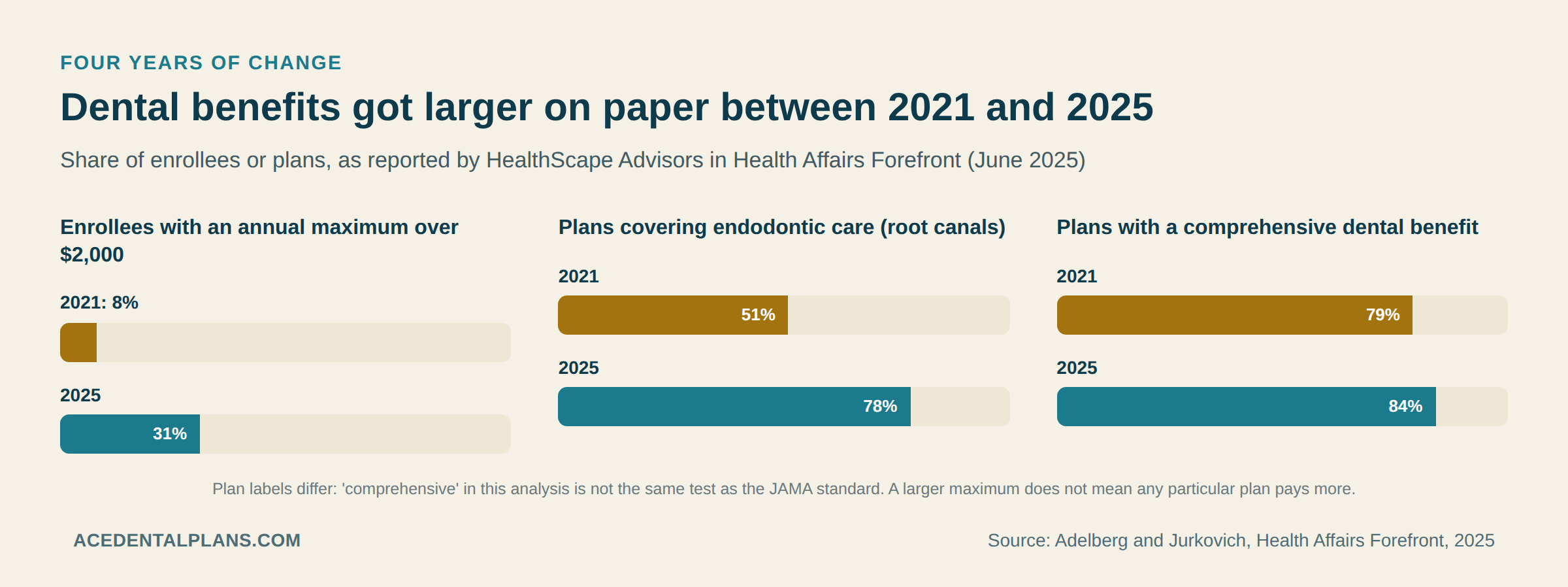
A higher share of large maximums does not mean your plan pays more. A plan can raise its cap and cut its coinsurance percentage in the same year, or add a deductible. That is why the four design features need to be read together: the maximum, the percentages, the frequency limits and the network.
Questions the maximum raises
Does a cleaning count against it? In some plans preventive services sit outside the cap, and in others they use it up first. Does the cap apply to in-network and out-of-network care combined? Do unused dollars roll over? In the three Humana summaries, unused amounts expired at year-end, and benefits were figured on a calendar year. Does a new plan year start January 1 for you even if you joined mid-year? For Advantage plans, coverage ordinarily changes on January 1, but the Evidence of Coverage is the document that states the benefit period.
Check before you schedule
- You owe the full amount of any service above the annual maximum, including at an in-network dentist.
- A treatment plan priced above the maximum is a reason to ask the office for a phased schedule in writing, not a reason to skip care your dentist says is urgent.
- Pain, swelling or a fever with a dental problem should not wait for a benefit year to reset. See the emergency notes in the disclaimer at the end of this article.
Deductibles, copays and coinsurance
Three words describe what you pay besides premiums. A deductible is the amount you pay before the plan starts paying. A copay is a flat dollar amount per visit or service. Coinsurance is a percentage of the allowed amount. A single dental chart may use all three: a $0 copay for cleanings, a deductible for non-preventive services and 50% coinsurance on a crown.
National figures on how these play out are limited to a few measures. In the late-2023 JAMA data, 35.3% of plans with dental had no copay or coinsurance for cleanings, and 62.8% had an average coinsurance of 30% or less for non-preventive services. KFF’s 2021 analysis found that 64% of enrollees in plans offering exams, cleanings or X-rays paid no cost sharing for them, and the most common coinsurance for more extensive services was 50%. The units differ: one counts plans and the other counts enrollees, and they are two years apart.
The three Humana summaries list a $0 deductible. That is a fact about those plans, and it would be a mistake to generalize. If your chart has a deductible, find out whether it applies to every service or only to major services, and whether preventive visits count toward it. The broader mechanics of tiers and percentages are covered in the guide to how dental insurance works.
Allowed amounts matter more than billed fees
Coinsurance applies to the plan’s allowed amount, not to the dentist’s list price. Suppose a crown carries a $1,300 office fee, and the plan’s in-network fee schedule allows $1,100. A 50% coinsurance means the plan pays $550 and you owe $550, and a network dentist writes off the $200 difference. An out-of-network dentist may bill you that $200. The Humana summaries and a Blue Cross and Blue Shield of Minnesota page both warn that out-of-network dentists may bill members for more than the plan pays.
A $2,500 Treatment Plan Under Four Hypothetical Benefit Designs
A worked example shows how the pieces interact. The plans below are invented for illustration. The fees are round numbers, not national averages.
| Design | Rules | Plan pays | You pay |
|---|---|---|---|
| A. Preventive-only | Exams, X-rays and cleanings only | $150 | $2,350 |
| B. $1,000 maximum | Preventive 100%, filling, root canal and crown 50% | $150 + $125 + $500 + $225 = $1,000 (cap reached on the crown) | $1,500 |
| C. $2,000 maximum | Preventive 100%, basic 80% (filling, root canal), major 50% (crown) | $150 + $200 + $800 + $550 = $1,700 | $800 |
| D. $1,500 allowance | Pays listed services at the fee schedule until the allowance runs out | $150 + $250 + $1,000 + $100 = $1,500 | $1,000 |
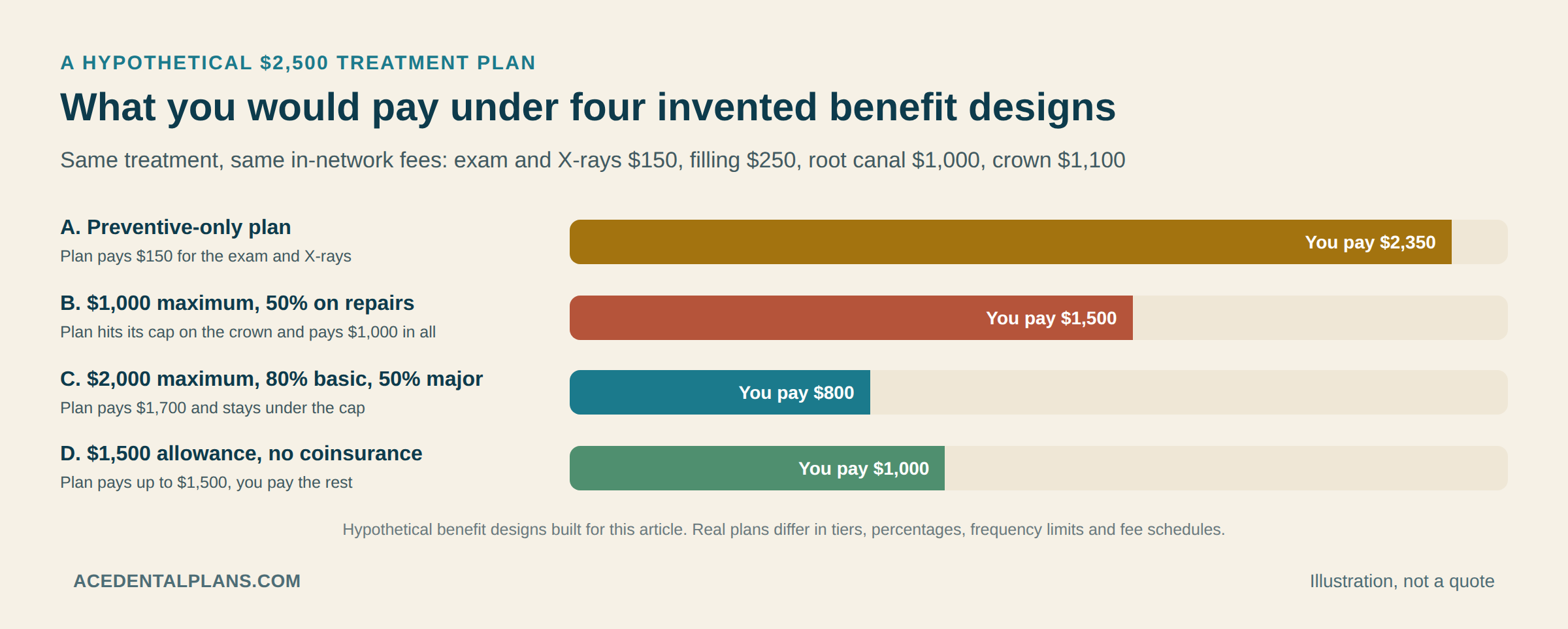
Design B shows the mechanics of a cap. By the time the crown is claimed, $775 of the $1,000 maximum is gone, so the plan pays $225 on a crown where the 50% rule alone would have paid $550. The crown looks “50% covered” on paper and ends up closer to 20% covered in practice.
Design D, the allowance, looks simpler and behaves similarly. It pays the first dollars of the bill in full and nothing after the allowance is gone. Neither design is better for every patient. If your needs were only the exam and the filling, Design D would leave you owing nothing, while Design A would leave you owing $250.
What an out-of-network bill adds
Now suppose Design C’s patient uses an out-of-network dentist who charges $3,200 for the same work, while the plan’s fee schedule allows $2,500. In plan summaries like the Humana ones, payment is figured against the plan’s fee schedule. The plan still pays $1,700, and the patient owes the $800 coinsurance plus the $700 difference, a total of $1,500. A network dentist who accepts the schedule would have left the patient at $800. Whether a plan allows out-of-network visits at all is a design choice: DEN213 in Table 2 pays nothing out of network.
When the calendar splits one treatment across two benefit years
Because the maximum resets, timing can change what the plan pays. Take Design B again. If the exam, filling and root canal happen in December, the plan pays $150 + $125 + $500 = $775. If the crown follows in January, the new year’s $1,000 maximum applies and the plan pays $550 on it. The plan’s total becomes $1,325, so you owe $1,175 rather than $1,500, a $325 difference.
That arithmetic is real, and it comes with a clinical caveat. A tooth that has had a root canal usually needs a crown within a period your dentist will specify, and delay can raise the risk of a fracture or reinfection. The time between steps is a clinical decision. Costs are a second factor, never the first. The cost side of the sequence is laid out in root canal and crown cost. Also check that your coverage in January is the coverage you have now, since a plan change at open enrollment can bring different percentages, a different network or a waiting period. The year-end checklist in what to check before dental benefits expire covers the general case for commercial plans.
Network Rules: HMO, PPO, PFFS and the Separate Dental Network
Your plan’s medical label does not fully tell you how the dental benefit behaves. CMS’s booklet describes the medical side this way: an HMO generally covers care only from network providers, with exceptions for emergencies, out-of-area urgent care and temporary out-of-area dialysis, and many HMOs require a referral for specialist care. A PPO has a network and also lets you see out-of-network providers, usually at a higher cost. A private fee-for-service (PFFS) plan has no network in the usual sense, and the booklet says a provider can charge up to 15% more than the amount Medicare pays.
Dental is a different animal. Some plans run the dental benefit through a dental carrier or a dental network that sits beside the medical network. In Table 2, two of the Humana summaries are attached to Advantage PPO plans and use a dental PPO network that allows out-of-network visits. The third is a dental benefit offered alongside an Advantage HMO, and it pays nothing out of network. The ADA’s Medicare Advantage FAQ states the general rule for dentists. In HMO-style dental benefits, patients generally must see a network provider to receive a benefit, except in an emergency. In PPO-style benefits, benefits are typically available at non-participating dentists.
What in-network and out-of-network mean for the bill
An in-network dentist agrees to the plan’s fee schedule and usually bills the plan directly. The Humana summaries state that in-network providers charge no more than the negotiated fee schedule, though coinsurance still applies. An out-of-network dentist has no such agreement. According to the same summaries, that dentist may bill you for more than the plan pays, and you may have to pay at the visit and submit a claim for reimbursement.
The difference between billed fee and plan payment is called balance billing. It is the main reason an out-of-network visit that looked fully covered ends with a surprise statement. The Blue Cross and Blue Shield of Minnesota dental overview makes the same point. Even for services listed at a $0 copay, out-of-network dentists may bill for the difference between the plan’s negotiated fee and their own charge.
The dentist may take your commercial plan but not this one
This catches people. The ADA’s FAQ explains that many commercial PPO dental plans include Medicare Advantage participation automatically, while others require a separate addendum or give dentists a way to opt out. So a dentist who participates in a carrier’s employer plans may not participate in that carrier’s Advantage product. A question like “Do you take Delta Dental?” is not specific enough. Ask: “Are you in network for the Medicare Advantage dental plan named on my card for 2027?”
One crown, three network situations
The same $550 from the plan produces three different bills. This is why the first question for any new dentist is the network, and the second is the fee schedule the plan will use. If an office is out of network, ask whether it will accept the plan’s allowed amount as full payment. Some do as a courtesy, many do not, and a written answer prevents a dispute later.
Specialists and the network
Root canals, gum surgery and complex extractions are often done by specialists, and a specialist’s network status is separate from a general dentist’s. The ADA told CMS in January 2026 that current network adequacy standards for supplemental dental benefits lack clear minimum thresholds for the inclusion of dental specialists, which is the ADA’s description rather than a finding by CMS. Before an endodontist, periodontist or oral surgeon takes over a case, ask the plan whether that office is in network for the dental benefit. Then ask the referring dentist whether a general dentist within the network can do the same procedure. The plan’s answer in writing is worth more than a verbal confirmation at the front desk.
Finding a dentist who is actually available
A directory listing is a starting point. The ADA told CMS in comments filed on January 26, 2026 that current network adequacy standards for supplemental dental benefits lack clear minimum thresholds for appointment availability, geographic distribution and inclusion of dental specialists. The association also cited research suggesting a substantial share of advertised in-network dentists may not be taking new patients. It used the term “ghost networks” for listings that look like access and are not. Those are the ADA’s positions, not CMS findings, and the ADA gave no percentage in the news item.
Geography matters too. In the JAMA analysis, about 66.1% of adults 65 and older lived in counties with at least one comprehensive-benefit plan, and 32.1% lived in counties with none. In its July 2025 letter to Congress, the ADA reported that in 90% of counties, one or two insurers accounted for more than half of Advantage enrollment. A strong dental benefit may simply not be offered where you live.
The pre-treatment estimate
Both the ADA’s FAQ and the Blue Cross and Blue Shield of Minnesota overview point to the pre-treatment estimate. The office submits the planned procedures and codes to the plan, and the plan returns what it expects to allow and pay. It is not a promise of payment, and your remaining maximum, eligibility and the plan’s review rules can change the final figure. Still, it turns a vague “covered” into dollars for each line, and it surfaces frequency limits before they surprise you. The codes on those estimates are explained in the guide to CDT codes on a dental bill.
Extractions, Dentures and Implants: Where Plans Draw the Lines
These are the services where a missing benefit does the most financial damage, and they matter to an older population. CDC data from 2017 to March 2020 show that 11% of adults ages 65 to 74 and 20% of adults 75 and older had lost all of their natural teeth. Tooth replacement is therefore not an edge case for Medicare-age patients.
Extractions
Extractions are usually the basic-tier service and the one most likely to be covered. In the Humana summaries, simple extractions appeared as covered services, though one plan (DEN733) limited most extraction codes to once per tooth per lifetime, and impacted-tooth removal carried its own frequency rules. What the chart calls a simple extraction and what the dentist performs may differ if the tooth fractures or needs sectioning, so ask whether a surgical code would be paid on the same terms. The price ranges for each type are in the tooth extraction cost guide.
Dentures
Original Medicare excludes most dental care, and Advantage plans may cover dentures. All three Humana summaries limited complete and partial dentures to one set every five calendar years. DEN733 listed dentures at 70%, in contrast to 100% for most other services in that plan, and it counted denture costs against a $500 annual maximum. Denture adjustments, repairs, relines and rebases were generally limited to one code per year and were not covered in the first six months after placement.
For national price ranges by denture type, see dentures cost: full, partial and implant-supported. For fit, care and types, the dentures guide goes further, and the question of replacement timing is in how long dentures last. That last one matters, because a five-year frequency limit is a financial clock that runs separately from the denture’s physical lifespan.
Implants
None of the three Humana summaries lists dental implant codes, and each states that services not listed are not covered. That is not a universal rule, since some plans may cover parts of implant treatment. Still, with three of three summaries leaving implants out, “assume it is excluded until the chart or a written estimate says otherwise” is a sensible starting position. The JAMA analysis did not measure implant coverage. When you ask a plan about implants, split the question into pieces: the surgery, the abutment, the crown on top, any bone graft, and the extraction that came before.
Prices for each piece are in the dental implant cost guide. Whether an implant-supported option is right for you belongs in a conversation with a dentist, with the full dental implants overview as background. If your plan excludes implants but covers a denture or a bridge, the plan’s payment for the covered alternative may be the number to compare against.
Flex Cards, Allowances and Spending Cards
Some plans deliver dental dollars on a prepaid card. The 2026 KFF spotlight notes that plans’ special supplemental benefits for the chronically ill (SSBCI) are often loaded onto a flex card or spending card that works at participating retailers. It adds that some monthly allowances expire at the end of each month. The same report found that an over-the-counter allowance was offered by 66% of individual plans in 2026, down from 73% in 2025, and a meal benefit by 57%, down from 65%. Cards are common, and so is the habit of changing them from year to year.
Federal rules shape what a card can do. Under 42 CFR 422.102, a mandatory supplemental benefit can reduce cost sharing through debit-card reimbursements or a uniform dollar allowance, and the reimbursements have to be limited to the plan year. CMS’s contract-year 2027 final rule, issued April 2, 2026, requires plans to post publicly the eligibility criteria they use for SSBCI, and it limits debit cards to the plan year. KFF reported in May 2026 that beginning in 2027, plans that use debit cards must link them to plan-covered benefits through real-time verification at the point of sale. Plans must also provide usage instructions, customer support and an alternative reimbursement process.
Practical questions to ask about a card with a dental or flex allowance:
- Is the dental allowance part of the dental benefit’s annual maximum, or a separate pool of money?
- Does it work only at network dentists, or at any dental office?
- When does the balance expire, and does it reset monthly, quarterly or yearly?
- Does the plan require a member to meet health-status criteria, as SSBCI does?
- If the card is declined at the dental office, what is the reimbursement process?
One more point from the CY 2027 rule. CMS rescinded a requirement, previously set to start January 1, 2026, that plans send a mid-year notice listing unused supplemental benefits. KFF reported that CMS cited survey data showing 70% of enrollees had used at least one supplemental benefit in the past year. With the notice gone, the reminder to use a dental allowance before it expires is on you.
Hospital-Linked and Medically Necessary Dental Care Inside an Advantage Plan
Not every dental service falls under the supplemental benefit. Medicare.gov lists the narrow situations where Original Medicare may pay. They are dental services received during an inpatient hospital admission for a dental procedure, specific services directly related to certain covered medical treatments, dental or oral exams before and during Medicare-covered dialysis for end-stage renal disease, and treatment of a complication during head and neck cancer treatment. For covered Part B dental services, Medicare.gov says you pay 20% of the Medicare-approved amount after the Part B deductible, and inpatient hospital stays follow Part A’s separate rules.
Because an Advantage plan must cover what Original Medicare covers, these services stay covered when you have an Advantage plan. What changes is the cost sharing, the network and the paperwork, which follow the plan’s medical rules instead of its dental chart. A tooth extraction needed before a covered heart procedure, for example, might be billed to the medical side with a medical diagnosis, while the same extraction without that link would go to the dental benefit. The ADA’s FAQ notes that diagnosis codes may help a claim get adjudicated favorably, which is one reason a dentist and a physician may need to document the connection together.
Questions that sort the two sides out are short. Is this service being billed to the medical benefit or the dental benefit? If medical, does the plan require prior authorization, and does the hospital or oral surgeon need to be in network? If dental, does the cost sharing use up the dental maximum? Ask for the answers before the procedure, and ask for the plan’s coverage decision in writing if the dentist believes the service is medically necessary. A written denial opens the appeal rights described earlier, while a verbal “that’s not covered” does not.
Do not wait on coverage questions if you have
- Swelling of the face or neck, trouble breathing or swallowing, or a fever with severe dental pain.
- Bleeding from the mouth that you cannot control.
- A knocked-out tooth or a jaw injury.
These call for emergency care first. Sort out billing afterward, and keep every bill, record and notice.
Premiums, the Part B Giveback and the Out-of-Pocket Limit
Dental coverage in an Advantage plan is paid for in several pockets at once. You keep paying the Medicare Part B premium, which the CMS fact sheet set at $202.90 a month for 2026 (up from $185.00 in 2025). On top of it, a plan may or may not charge its own monthly premium. KFF’s 2026 spotlight found that 67% of Advantage plans with drug coverage charged no premium beyond the Part B premium. CMS’s September 28, 2026 release projected that the average monthly premium across all Advantage plans would fall from $14.37 in 2026 to $12.00 in 2027.
Some plans use rebates to reduce the Part B premium, a feature often called a giveback. CMS’s booklet notes that some plans may have a $0 premium and may help pay all or part of the Part B premium. MedPAC reported that the average Advantage Part B premium reduction was $44 in 2025, when the Part B premium was $185. A Leerink Partners analysis of Plan Finder data reported by Healthcare Dive on October 1, 2026 found that Humana reduced or eliminated the giveback for 62% of members for 2027, against 11% at Centene, 7% at UnitedHealthcare and 5% at CVS. The point is not whom to avoid. It is that the same pool of rebate dollars funds dental, the giveback, drug coverage and cost-sharing reductions, so the dental benefit and the premium can move in opposite directions in the same year.
For most people, the dental benefit is one line among many. KFF’s 2026 data show that nearly every plan has one, which means dental alone rarely separates plans. What separates them is the size of the cap, the percentages, the network and everything else in the plan: hospital copays, the drug formulary and your doctors. A plan that adds $1,000 to a dental maximum but drops your cardiologist from the network is not an upgrade. The enrollment calendar and a step-by-step comparison are covered in comparing dental benefits at open enrollment.
How dental competes with other extras for the same rebate dollars
Dental is one of several benefits funded from the same pool, and MedPAC’s allocation figures show the trade-offs. Of the 2025 rebates, conventional plans put about 43% toward cost-sharing reductions, 28% toward non-Medicare services such as dental, vision and hearing, 23% toward Part D and 6% toward Part B premiums. Special needs plans put about 80% of their rebates toward non-Medicare services. Average rebates were $188 per member per month in conventional plans and $267 in special needs plans in 2025, MedPAC reported.
The other extras are moving at different speeds. KFF’s 2026 data found dental offered by 98% of individual plans, a share close to the prior year’s. Over-the-counter allowances fell to 66% of plans from 73%, and meal benefits to 57% from 65%. A plan deciding where to spend a fixed amount of rebate money can trim a grocery or over-the-counter line and leave the dental line alone, or the reverse. The trend is a reason to read each year’s ANOC rather than assume last year’s benefit mix will return.
How many people pick a plan for its dental line
The ADA’s July 2025 letter said 52% of enrollees choose their Advantage plan based on the perceived value of its dental coverage, and its February 2026 comments said more than half choose on advertised dental benefits. Deft Research data cited in Health Affairs Forefront found dental was the strongest supplemental influence on plan choice in 2024. If so many people choose on dental, it is worth reading past the headline: the advertised line “dental included” is the 98%, not the 8.4%.
Why the out-of-pocket limit usually does not protect your dental bill
Advantage plans have a yearly cap on what you pay for Medicare-covered services. For 2026, KFF reports that the statutory in-network maximum out-of-pocket (MOOP) limit is $9,250, and the enrollment-weighted average plan limit was $5,421 in network and $9,825 for in-network and out-of-network care combined. CMS’s booklet defines the limit as a yearly cap on what you pay for Part A and Part B covered services.
Routine dental is not a Part A or Part B service. MedPAC states that cost sharing enrollees pay for non-Medicare supplemental services does not count toward the MOOP limit, and that CMS sets no limit on that cost sharing. In plain terms, a $3,000 dental bill with a $1,000 plan payment does not move you toward your plan’s out-of-pocket cap. Two bills of the same size, one for a hospital stay and one for a crown, can behave differently for that reason.
There is one exception worth stating. Dental care that Original Medicare covers, such as services tied to certain covered medical treatments, remains Medicare-covered when delivered through an Advantage plan, so its cost sharing follows the plan’s medical rules. Whether a given service falls on the Medicare side or the supplemental side is a question to put to the plan in writing, before the service, with the procedure codes.
When a larger maximum is worth a higher premium: break-even arithmetic
A plan with a bigger dental maximum often costs more in premium, though not always, since the extra cost can also appear in a higher deductible or a narrower network. When a premium difference exists, you can test it with one line of math. Compare the extra premium for the year with the extra payment the bigger maximum would produce for the work you expect.
- Cleanings only. Neither plan pays anything beyond the preventive visits, so Plan Y costs you $360 more.
- Two crowns, $2,200 allowed. Plan X would pay half, $1,100, but its cap limits it to $1,000, leaving you $1,200. Plan Y pays $1,100, leaving you $1,100, plus the $360 premium, a total of $1,460. Plan X comes out $260 ahead.
- A $5,000 treatment plan at 50%. Plan X pays $1,000 and you pay $4,000. Plan Y pays $2,000, and you pay $3,000 plus $360, a total of $3,360. Plan Y comes out $640 ahead.
The break-even sits near $2,720 of allowed services at 50%. Below it, the cheaper plan wins. Above it, the plan with the larger maximum wins, and the gap widens until Plan Y’s own cap is reached. The calculation leaves out the network, the drug formulary, the out-of-pocket limit and every other line in the plan, and it assumes the preventive visits do not use much of the maximum. Its value is in making you ask what work you expect, rather than choosing the larger number by reflex.
Two caveats apply. Needs change, and a crown or an extraction can arrive without warning in any year. And most people cannot predict their need with this precision. The exercise works well as a range, so compute the result for a quiet year, a typical year and a heavy year, and see whether the answer changes.
Reading the Dental Section of the Evidence of Coverage, Line by Line
The Evidence of Coverage (EOC) is the contract-level document. The CMS booklet says it gives details about what the plan covers and how much you pay, and that plans send it by October 15. The Annual Notice of Change (ANOC), sent by September 30, lists what is different for the coming year. Plan sponsors point to the EOC’s benefits chart for dental details. The Blue Cross and Blue Shield of Minnesota dental overview, for example, directs members to Chapter 4 of its EOC.
Work through the dental entries in this order:
- Find the benefit period. The summaries used in this article run on a calendar year, with unused amounts expiring at year-end. Confirm yours.
- Find the maximum and what feeds it. Look for wording such as “plan coverage limit” or “allowance,” then for whether preventive visits, X-rays and out-of-network claims count toward it.
- Find the tiers and the percentages. Note which services are listed in each tier, and whether a deductible applies to some tiers only.
- Find the frequency and lifetime limits. One crown per tooth every five years and “once per lifetime” lines are where large bills hide.
- Find the network sentence. Is out-of-network care covered, and is payment based on the plan’s fee schedule or the dentist’s charge?
- Find the exclusion language. Sentences such as “services not listed are not covered” explain why implants or cosmetic work are excluded without being named.
- Find the authorization rules. Look for prior authorization, clinical review or dental-history review.
- Find any card or allowance rules. Look for monthly or yearly expiry and where the card works.
- Compare with the ANOC. What changed from this year’s maximum and percentages to next year’s?
Which document says what
Several documents carry dental information, and they answer different questions. The Medicare Plan Finder at Medicare.gov/plan-compare, which Medicare & You 2027 directs readers to, is the comparison tool. Plan benefit summaries, such as the Humana PDFs used in Table 2, show the maximum, the tiers and the frequency limits in compact form. The ANOC, sent by September 30, says what changes for next year. The EOC, sent by October 15, holds the full terms. And the provider directory, which may be a separate dental directory, tells you who is in the network.
When two of these disagree, quote the EOC when you call the plan, and ask the representative to identify the section. A brochure’s headline figure is not a contract term. The same applies to a marketing call or an online ad: write down what was said, then find the matching sentence in the EOC.
Prior Authorization, Denials and the 65-Day Appeal Clock
CMS’s booklet warns that you may need approval, called prior authorization, before a plan covers certain services or items. For dental, the JAMA data found that 88.2% of plans with dental had no prior authorization requirement for preventive services in late 2023. The Humana summaries add that claims may undergo clinical review and dental-history review, and that some services, such as anesthesia and cone beam imaging, are covered only with specified procedures.
When a plan denies a request or a claim, the Medicare.gov appeals page sets the clock. You, your representative or your provider can ask the plan for an organization determination, which is a coverage decision. If the plan denies it, you must file an appeal within 65 days of the date on the initial denial notice, and a late filing needs a reason. The plan’s decision times are 30 days for a standard pre-service appeal, 60 days for a standard payment appeal and 72 hours for an expedited appeal where waiting could seriously harm your health. Plans may extend these by up to 14 days in some cases and must tell you in writing. If the plan upholds its denial, the case goes automatically to an independent review entity, and further levels exist.
Two practical notes follow. First, keep the denial notice and its date, because the 65 days run from the notice. Second, the ADA’s FAQ explains that when an out-of-network claim is denied for lack of medical necessity, the provider may need to submit a waiver of liability, which holds the enrollee harmless, to request reconsideration. The ADA asked CMS in 2026 to prohibit plans from requiring dentists to sign one as a condition of helping a patient appeal. If your dentist hesitates over the paperwork, that is the reason. For questions the plan cannot answer, Medicare.gov lists 1-800-MEDICARE (1-800-633-4227).
Reading a dental claim statement from an Advantage plan
After a visit, the plan or its dental carrier usually sends a statement showing how each line was processed. The format varies, and the terms are close to what commercial dental insurance uses, which are explained earlier in this article. For an Advantage dental statement, look for these fields. They are the date of service, the procedure and tooth, the amount billed, the allowed amount, the amount the plan paid, any deductible applied and the amount you owe. Also look for the remaining annual maximum and any remark code explaining a reduction.
Three checks catch most errors. Does the allowed amount match what the pre-treatment estimate said? Does the remaining maximum on this statement match the one on the last? If not, a claim may have been processed in between, or a service may have counted that you did not expect. And does any remark cite a frequency limit, a missing tooth or a documentation request? Each of those has its own fix: a corrected claim from the dental office, additional records, or an appeal.
If you cannot reconcile a statement, call the plan’s member line and the dental office in the same week. Ask the plan for the claim number, the processed date and the specific remark. Ask the office whether the original claim lists the correct tooth, surface and date. A surprising number of problems are coding or data-entry differences, and both sides can fix them quickly when they hear about them promptly. The 65-day appeal window described earlier applies when the plan issues a denial notice, so keep that notice if you receive one.
Special Needs Plans, Dual Eligibility and Medicaid Dental
Special needs plans (SNPs) are Advantage plans for people with specific conditions, Medicaid coverage or institutional needs. KFF’s June 2026 enrollment update found 8.2 million people in SNPs, 23% of Advantage enrollment, and 78% of that enrollment was in dual-eligible SNPs (D-SNPs). KFF’s 2026 spotlight reports that a similar share of SNPs offered dental in 2026 as in 2025. MedPAC’s 2025 bid data show a larger dental projection for SNPs, $26 per member per month against $19 for conventional plans.
For people with both Medicare and Medicaid, there may be a second source of dental benefits. Medicaid.gov says states choose whether to provide dental benefits for adults and that there are no minimum federal requirements, so the answer depends on the state. A 2025 JAMA Health Forum commentary by Hawazin Elani and Benjamin Sommers counted 34 states with comprehensive adult dental coverage in Medicaid. If you have both, ask the D-SNP and the state Medicaid office how the two dental benefits fit together before scheduling expensive work, and ask for the answer in writing.
Why the Limits Matter More After 65, and Three Hypothetical Patients
What the oral health data show
A dental benefit built around two cleanings a year assumes mouths that need two cleanings. The data on older adults describe more demanding mouths. CDC’s surveillance report for 2017 to March 2020 found that 11% of adults ages 65 to 74 and 20% of those 75 and older had lost all their natural teeth. MedPAC, drawing on the Medicare Current Beneficiary Survey, reported that about 15% of beneficiaries had trouble eating solid food because of dental problems and about 17% had lost all their natural teeth.
Use of care is lower than need. KFF’s 2021 brief found that 47% of Medicare beneficiaries had no dental visit in the past year in 2018 data. Among the roughly half who used dental services, average out-of-pocket spending was $874, with 20% spending more than $1,000 and 10% more than $2,000. Those 2018 figures predate most of the benefit growth described above. MedPAC found that just over half of non-dually eligible Advantage enrollees with dental coverage visited a dentist in a given year from 2017 to 2022. The JAMA research team likewise described about half of Advantage beneficiaries as visiting a dentist annually, similar to traditional Medicare.
The ADA’s July 2025 letter cites a related finding from an ADA Health Policy Institute study. Enrollees with dental coverage were no more likely to have had a dental visit in the past year than those without, and restrictive plan characteristics were associated with unmet dental need and financial barriers. That is one study’s reading, summarized by ADA News, and it does not show that coverage is pointless. It does support looking at design details, since a benefit that exists but is hard to use may not change behavior.
What follows for a reader holding an estimate? Gum disease and tooth loss are the conditions most likely to push a treatment plan past a $1,000 maximum, so the periodontal and prosthetic rows of the chart deserve the closest reading. For how those conditions are staged, treated and priced, see the guide to gum disease symptoms, stages and treatment.
Averages hide the cases where the benefit design matters. These three patients are invented, and the plans are hypothetical. They show how the same kinds of rules produce different results.
Patient one: a cleaning and an exam each half-year
A retiree needs two exams and cleanings and one set of bitewing X-rays during the year. The plan lists preventive services at $0 with an in-network dentist and a $1,000 maximum. The allowed amounts total $400, and the plan pays all of it. The remaining $600 of the maximum goes unused and expires on December 31. For this patient, a basic plan is adequate, and a richer plan would cost more in premium or cost sharing to offer a benefit that goes unused. The dental cleaning costs in cash are in the dental cleaning cost without insurance guide for comparison.
Patient two: gum treatment and maintenance
The pattern is one many patients with gum disease encounter: a high first-year cost, then a smaller recurring cost that returns every year. Plans may limit SRP to once per quadrant every three years and maintenance to four visits a year, as DEN416 does. The costs behind each step are in the gum disease treatment cost guide and the deep cleaning cost guide, which also explain why plans may ask for X-rays and pocket measurements before paying.
Patient three: extractions and a denture
The mistake to avoid here is treating the allowance as a payment for the denture alone. It is shared by everything that comes first, including the extractions and any related exams. Tooth-replacement choices such as dentures, bridges and implants have separate cost and care tradeoffs, and a dentist is the person to weigh them. The full mouth dental implants cost page covers what happens to the price at the far end of that range.
Eight Mistakes That Raise the Bill
These errors come up repeatedly in the plan documents and sources used for this article. None of them requires bad luck to cause trouble.
- Reading “100%” as “nothing to pay.” A percentage next to a service describes the share of the plan’s fee schedule that the plan pays, up to the maximum. Frequency limits, the cap and any out-of-network balance can still leave a bill.
- Booking before checking the network. A listing in a directory is not a confirmation. Call the office, name the plan, and write down who answered.
- Counting on the cap resetting at the wrong time. The Humana summaries use calendar years. Your plan’s benefit period is in the EOC.
- Ignoring the sequence. Putting the largest procedure first or last in a benefit year can change what the plan pays, as the December and January example showed. Clinical timing still comes first.
- Letting an allowance expire. A card with a monthly or yearly expiry does not carry forward, and the mid-year reminder notice has been rescinded.
- Assuming dentures, crowns or implants follow the same rules. Each service has its own tier, percentage and limit, and an implant may not be listed at all.
- Missing the 65-day appeal window. Medicare.gov counts the days from the date on the initial denial notice.
- Changing plans for dental alone. A larger maximum does not help if your doctors, hospital or drugs are less well covered, and a dentist who is in network this year may not be next year.
A related caution concerns marketing. KFF’s account of the 2027 final rule notes that CMS did not finalize a proposal that would have barred marketing materials from listing the dollar value of supplemental benefits, so a large dollar figure in an advertisement remains allowed. A figure in an ad does not say whether the amount is a maximum, an allowance, a card balance or a lifetime limit. Nor does it state the coinsurance, the network or the frequency limits. The EOC’s wording governs.
A Year With an Advantage Dental Benefit, Month by Month
A benefit year has a rhythm, and working with it costs nothing. The sequence below is a general pattern, not a prescription, and clinical needs override calendar convenience.
- January. Look up this year’s maximum, percentages and frequency limits in the EOC, and confirm that your dentist is in the dental network for the new year. Networks can change from one year to the next, and the Annual Notice of Change is meant to describe provider-network changes, so a dentist who was in network in December may not be in January.
- January to March. If you are already in an Advantage plan and the dental benefit is not what the brochure suggested, the Medicare Advantage Open Enrollment Period runs January 1 to March 31, according to Medicare & You 2027. You may switch plans or return to Original Medicare.
- Spring. Schedule the preventive visits. They are usually the least costly use of the benefit, and an exam can reveal treatment needs with time to plan.
- Midyear. If the dentist recommends treatment, request a pre-treatment estimate and ask the plan how much of the maximum remains. Decide with the office whether the work belongs in one year or two.
- September. Look for the Annual Notice of Change, which plans must send by September 30. Find every dental line and compare it with this year’s.
- October. The EOC arrives by October 15, and open enrollment begins that day and runs through December 7. Use the plan comparison tools and the questions in this article before you decide.
- November and December. Use any allowance or card balance that expires on December 31. Ask whether the plan counts the date of service or the date it processes the claim, so that late-December treatment does not slip into the next year unexpectedly.
A short note on pacing. A year contains two cleanings, perhaps a filling and an X-ray, and for most people that is the whole benefit. The planning above matters for the year with a crown, a denture or gum treatment, which is the year that tests the plan. Reading the rules before that year arrives is cheaper than reading them after.
The 2027 Plan Year: What Changed and What to Compare Before December 7
The federal and the analyst accounts of 2027 do not say the same thing, and both can be true. CMS’s September 28, 2026 release said plan offerings were expected to be stable, with about 5,532 Advantage plans in 2027 against 5,553 in 2026. It added that supplemental benefits, including dental, vision and hearing, were expected to remain stable. It projected 34 million Advantage enrollees, and said about eight in ten Advantage beneficiaries could stay in their current plan with the same or a lower premium.
Healthcare Dive reported on October 1, 2026 that a Leerink Partners analysis of Medicare Plan Finder data found changes to dental allowances at several large insurers. The share of members affected was almost 70% for UnitedHealthcare, 45% for Centene’s Wellcare, 36% for CVS/Aetna and 23% for Elevance. Humana’s dental allowances rose modestly, according to the same report. Those figures come from one analyst reading of plan data as relayed by a trade publication, and the insurers described their own offerings differently. Treat them as a reason to check your own plan’s notice, not as a forecast for your county.
The reconciliation is simple. “Stable” is an aggregate statement about whether plans offer dental, vision and hearing. It says little about the size of a maximum, a percentage or an allowance inside a particular plan. KFF notes in its 2026 spotlight that plans may change the annual maximum or the cost sharing from year to year, and the ANOC is the document that shows how.
A short comparison routine
- Open the 2027 Annual Notice of Change and find every line with the word dental. Write down the old and new maximum, percentages and frequency limits.
- Check whether your dentist is in the 2027 dental network, using a call rather than only the online directory.
- If you expect a denture, a crown or a root canal in 2027, run the same arithmetic as Table 4 with your own estimate.
- Compare plans on the whole package: doctors, hospitals, drugs and the out-of-pocket limit, not dental alone.
- Remember the second window. People already in an Advantage plan can switch plans or return to Original Medicare between January 1 and March 31, 2027, according to Medicare & You 2027.
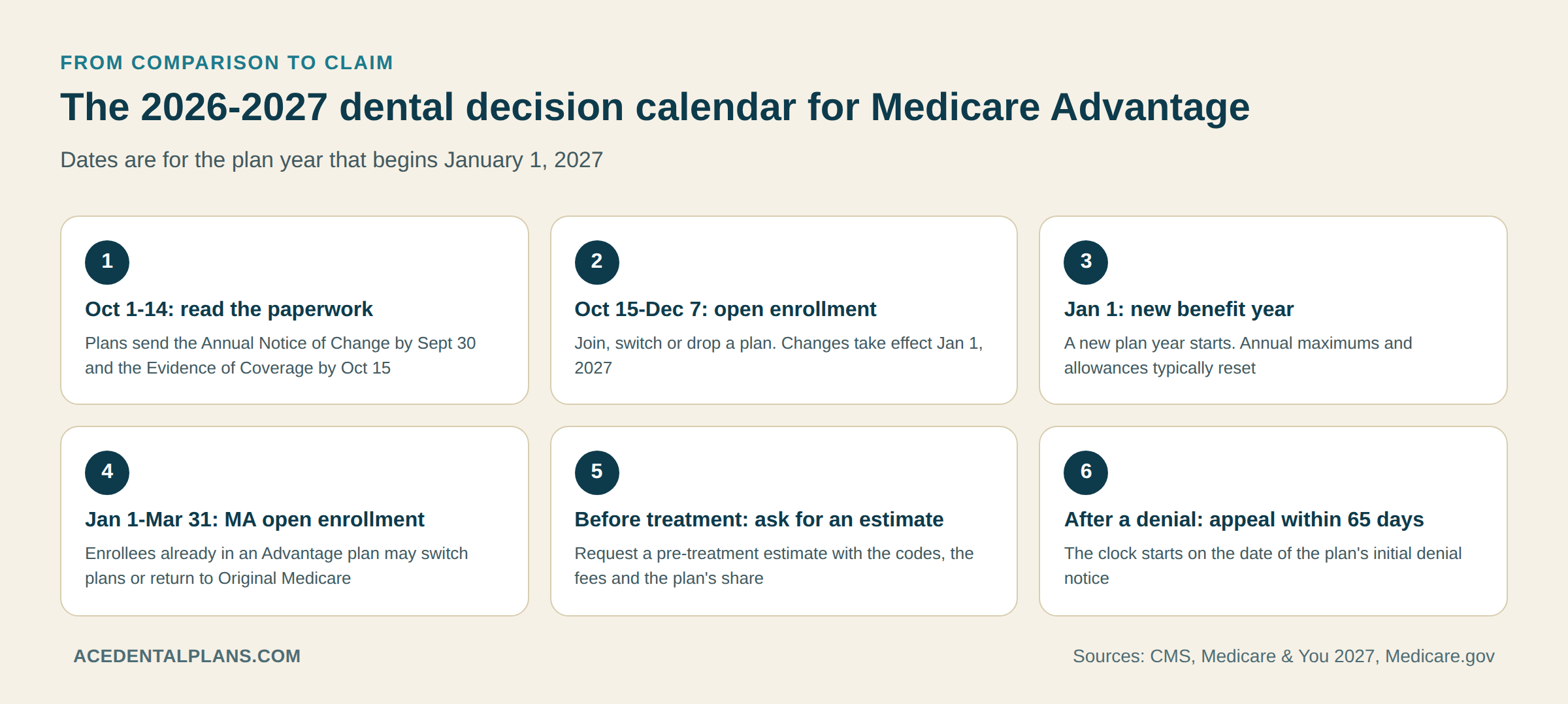
The step-by-step enrollment mechanics, plan comparison tools and the rules for returning to Original Medicare sit in the open enrollment guide linked earlier, so this article does not repeat them. The calendar below shows how the dates and the dental questions line up.
Advantage Dental, Stand-Alone Dental, Savings Plans and Other Routes Compared
An Advantage plan’s dental benefit is one way to cover dental costs among several. The table sets out how each route works and what to check. It does not rank them, because the right one depends on the work you need, your budget and where you live.
| Route | How the dental dollars work | What to check |
|---|---|---|
| Advantage plan’s built-in dental | A supplemental benefit with its own maximum, percentages and network, funded largely by plan rebates | Maximum, frequency limits, network, extra premium, whether implants are listed |
| Original Medicare alone | Dental is excluded in most cases; You pay 20% of the Medicare-approved amount after the Part B deductible, and only for narrow covered exceptions | Whether the service is tied to a covered medical treatment or hospital stay; everything else is paid by you |
| Original Medicare plus a stand-alone dental plan | A separate dental policy with its own premium and terms, and its own network | Premium, deductible, annual maximum, waiting periods, exclusions for implants and dentures |
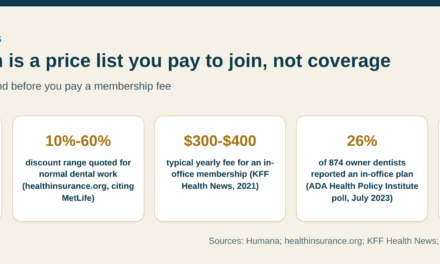
| Dental savings plan or office membership | A discount on fees in a network in exchange for an annual fee; not insurance and with no claims or maximum in the insurance sense | Annual fee, which dentists participate, whether discounted fees beat the Advantage allowed amount |
| Medicaid dental (for those who qualify) | Adult dental benefits are an optional state choice, with no federal minimum | Your state’s adult benefit, covered services, dentist participation, how it interacts with a D-SNP |
| Dental school clinics and community health centers | Reduced or sliding-scale fees for eligible patients, regardless of coverage | Waitlists, who does the work, income rules, hours |
Three observations help sort these. First, Original Medicare’s 20% coinsurance applies only to the narrow set of covered dental services. It follows the Part B deductible, which stood at $283 in 2026 per the CMS fact sheet. Do not use it to estimate a routine bill. Second, a stand-alone policy is a different product from the Advantage benefit and carries its own deductible, maximum and exclusions; the dental plan’s terms control how it works alongside your Advantage benefit. Third, a savings plan has no annual maximum, but it also pays no claims, so comparing it with an allowance means comparing a discount with a payment.
The features of each type, their costs and what they save are explained in the guide to dental savings plans and what they save. For the plan-type basics behind stand-alone insurance, the dental insurance and plans hub collects the related guides. The Health Affairs Forefront piece reports that 10% of Medigap buyers also bought a dental rider, with popular riders around $30 a month in most states. It also cites NADP Foundation counts of 31 million Americans over 55 without dental coverage, 19 million of them over 65. Those figures show how common the gap is, which is also why people go looking for a patchwork.
Paying for the Dental Work the Plan Leaves Behind
Even a good Advantage benefit leaves a balance on large treatment plans. The Cai and colleagues study in JAMA Network Open, summarized by AJMC, estimated that plans covered only about one-fourth of total costs for dental, vision and hearing services combined. Enrollees faced billions of dollars a year in out-of-pocket costs. MedPAC’s 2017 to 2022 survey data show that the enrollee out-of-pocket share of dental spending fell from 61% to 35%. Both can be true: the share has fallen, and a large share remains.
When the balance is yours, the order of options usually runs from lowest cost to highest. Ask the dentist about phasing the work across benefit years, with the clinical caveat noted earlier. Ask whether the office offers a discount for payment in full. Check dental school clinics and community health centers. Then look at payment arrangements, with attention to deferred-interest terms. The full menu is laid out in the guide to eight ways to pay for dental work, and the differences between a dentist’s installment plan and a loan are in dental financing versus payment plans.
If your coverage is thin in other ways too, dental care without insurance lists lower-cost routes that work whether or not you have a plan. For the cash-price baseline, the guide to dental costs without insurance shows the fees an Advantage allowed amount should be compared against.
Questions to Ask the Plan and the Dental Office
A short list, used before treatment and again before open enrollment, resolves most of what this article has covered. Ask the plan:
- What is the dental annual maximum, and which services count against it?
- What are the percentages for basic, major and prosthetic services, and does a deductible apply?
- Which frequency or lifetime limits apply to crowns, dentures, extractions and root canals?
- Is out-of-network care covered, and is payment based on your fee schedule or the dentist’s charge?
- Are implants, implant crowns or bone grafts listed anywhere in the benefit?
- Does any prior authorization or clinical review apply to this treatment?
- Is there a dental card or allowance, and when does it expire?
- Can I have the answer to these in writing, with a reference number for the call?
Ask the dental office:
- Are you in network for the dental benefit on my 2027 member card, and are you taking new Medicare Advantage patients?
- Can you send a pre-treatment estimate with the procedure codes and the plan’s share?
- If the total exceeds my remaining maximum, can the work be sequenced, and what are the clinical risks of waiting?
- If the plan denies a claim, will your office help with an appeal, and what paperwork will you need to sign?
- What is the cash fee for the same service if I decide not to use the plan?
Bottom Line
A Medicare Advantage dental benefit is a real feature with real limits. Most plans have one, a minority have a generous one, and the difference between them shows up on the first big bill rather than at the first cleaning. The numbers that predict that bill are few: the annual maximum, the percentages by tier, the frequency limits, the network rule and the exclusions. The marketing word “dental” predicts almost nothing.
Check those five against the dental work you are most likely to need. If the work is likely to be a cleaning and a filling, a modest plan may be enough. If it may be a denture or a crown, price it in your own plan’s terms before you decide, and keep the arithmetic in writing. When coverage runs out, the options for the rest are numerous and the order in which you try them matters more than which one you finally choose.
Frequently Asked Questions
Does Medicare Advantage cover dental?
Often, in part. Original Medicare excludes most dental care, and Advantage plans may add dental as a supplemental benefit. In 2026, 98% of individual Advantage plans offered some dental benefit, according to KFF, but that count includes plans covering only cleanings. How much a plan pays beyond preventive care depends on its annual maximum, percentages, frequency limits and network, so the plan’s Evidence of Coverage is the document to read.
Do all Medicare Advantage plans include dental coverage?
Nearly all, but not every one. In the late-2023 JAMA data, 86.6% of 6,333 plans offered a dental benefit, and 94.0% of enrollees were in such a plan. KFF’s 2026 figure for individual plans is 98%. The numbers differ because the data sets, plan types and years differ. Check the specific plan, because the same insurer may offer plans with and without dental in the same county.
What is a typical annual maximum for Medicare Advantage dental?
There is no single typical figure. KFF’s 2021 data found an average of about $1,300 among plans with more extensive coverage, and 59% of those enrollees were capped at $1,000 or less. By 2025, HealthScape Advisors estimated that 31% of enrollees had a maximum over $2,000. Three 2026 Humana summaries showed $500, $1,000 and $2,000. Your own plan’s chart is the only number that applies to you.
Does Medicare Advantage cover dental implants?
Sometimes, and rarely in full. None of the three 2026 plan summaries reviewed here listed implant codes, and each said unlisted services are not covered. The JAMA analysis did not measure implant coverage. Ask the plan separately about the surgery, the abutment, the crown and any bone graft, and get the answer in writing. Splitting the question this way also makes any price comparison cleaner.
Does Medicare Advantage cover dentures?
Some plans do, usually with a percentage and a replacement limit. In the three Humana summaries, complete and partial dentures were limited to one set every five calendar years, and one plan listed them at 70% under a $500 maximum. Relines and rebases were not covered within six months of placement. Check the percentage, the replacement interval and whether repairs count against the annual maximum.
Does Medicare Advantage dental cover root canals and crowns?
Many plans list them, and they are where annual maximums bite. HealthScape Advisors estimated that about 78% of plans covered endodontic services in 2025. The Humana summaries limited some root canal codes to once per tooth per lifetime and crowns to once per tooth every five years in one plan. The root canal cost and dental crown cost guides show what the fees are before the plan’s share.
Do I have to use an in-network dentist with Medicare Advantage dental?
It depends on the plan’s dental design. In the summaries reviewed, two PPO-style plans allowed out-of-network visits, with a warning that the dentist may bill more than the plan pays, and one HMO-linked plan paid nothing out of network. The ADA’s FAQ describes the same split: HMO benefits generally require a network provider, while PPO benefits are typically available out of network.
Do dental costs count toward the Medicare Advantage out-of-pocket maximum?
Usually not for routine dental. MedPAC states that cost sharing for non-Medicare supplemental services does not count toward the maximum out-of-pocket limit and that CMS sets no cap on it. The limit, $9,250 in network for 2026 per KFF, applies to Part A and Part B services. Dental services that Original Medicare covers, such as certain hospital-linked care, follow the plan’s medical rules.
Is there a waiting period for Medicare Advantage dental benefits?
Not always. The three 2026 Humana summaries listed no waiting periods and a $0 deductible. Other plans may differ, and waiting periods are not tracked in the national data used here. Look for “waiting period,” “effective date” and “new member” language in the EOC, and ask the plan whether a major service such as a crown has a different start date than preventive care.
When does my Medicare Advantage dental benefit reset?
For most plans, on January 1, because Advantage plan years run on the calendar year. The Humana summaries state that benefits are on a calendar-year basis and that unused amounts expire at year-end. The EOC states your plan’s benefit period. If you switch plans at open enrollment, the new plan’s maximum starts fresh on January 1, 2027 for changes made between October 15 and December 7, 2026.
What happens to unused dental benefits at the end of the year?
In the summaries reviewed, they expire. Some allowances load to a card with a monthly or yearly expiry, as KFF notes for special supplemental benefit cards. CMS rescinded a requirement for plans to send a mid-year notice listing unused supplemental benefits, so a reminder is no longer federally required. If you have preventive visits left, schedule them before December 31.
Can I buy a separate dental plan if I have Medicare Advantage?
People do buy stand-alone dental policies or join dental savings plans. The sources used here do not describe a rule against it, but a stand-alone policy’s terms control how it coordinates with other coverage. Ask the dental insurer whether it pays when you also have an Advantage dental benefit, and compare its premium, maximum and waiting periods with what the Advantage plan already gives you.
Is Medicare Advantage dental the same as a stand-alone dental plan?
No. An Advantage dental benefit is a supplemental benefit tied to the health plan, funded largely through plan rebates, with its own maximum and network. A stand-alone policy has a separate premium, deductible, maximum and waiting periods. The structure of each is compared in Table 5, and the general mechanics of plan types appear earlier in this article.
Can I switch Medicare Advantage plans for better dental coverage?
Within limits. CMS’s booklet and Medicare & You 2027 list open enrollment from October 15 to December 7, with coverage starting January 1. They also list a Medicare Advantage Open Enrollment Period from January 1 to March 31 for people already in an Advantage plan. Other special periods exist in specific circumstances. Compare the dental benefit alongside doctors, drugs and the out-of-pocket limit, not alone.
How do I find out what my plan will pay before treatment?
Ask the dental office to send a pre-treatment estimate to the plan, listing each procedure and code. The ADA’s FAQ and a Blue Cross and Blue Shield of Minnesota overview both point to this step. An estimate is not a promise of payment, and your remaining maximum and eligibility at the date of service can change it. Call the plan as well and keep the reference number.
What can I do if my plan denies a dental claim?
Read the denial notice, note its date, and file an appeal within 65 days of that date, according to Medicare.gov. Standard pre-service appeals get a decision in 30 days, payment appeals in 60 days, and expedited appeals in 72 hours if waiting could seriously harm health. If the plan upholds the denial, it forwards the case to an independent review entity. Medicare.gov lists 1-800-MEDICARE for help.
Are cosmetic procedures covered by Medicare Advantage dental?
Usually not. The ADA’s FAQ describes allowance plans as covering any listed service except cosmetic services, and the plan summaries reviewed here covered treatment categories, not whitening or veneers. If a procedure has both a cosmetic and a medical reason, the way the dentist documents and codes it can matter, so ask the plan before treatment.
How do I compare Medicare Advantage plans for dental?
Line up four numbers for each plan: the annual maximum, the percentages by tier, the frequency limits, and the network rule for your dentist. Then add any premium and allowance rules and test them against work you may need, as in Table 4. The Annual Notice of Change shows what is different for 2027, and the Evidence of Coverage holds the full terms. The calendar and tools are covered in the open enrollment guide.
Do many Medicare Advantage members actually use the dental benefit?
About half see a dentist in a year, similar to people in Original Medicare. MedPAC found that just over half of non-dually eligible enrollees with dental coverage visited a dentist in a given year between 2017 and 2022. A separate analysis found only 54.2% of enrollees were aware of their dental coverage. Reading the benefit summary at the start of the year is the simplest fix.
Can a Medicare Advantage dental plan have no extra premium?
Many do. In the late-2023 JAMA data, 64.6% of plans with dental charged no additional premium for preventive or non-preventive services. KFF’s 2021 analysis found about 10% of enrollees faced a separate premium for any dental benefit, averaging $270 a year. A $0 dental premium does not mean the benefit is large. Compare the maximum and percentages as well, and remember that the Part B premium is paid separately.
Sources and Disclaimers
Program rules, enrollment figures, premiums and dates come from CMS, Medicare.gov, Medicaid.gov, the Medicare Payment Advisory Commission (MedPAC) and the Code of Federal Regulations, read in October 2026. Plan-benefit prevalence and maximum figures come from KFF analyses of CMS benefit files and from peer-reviewed or trade-journal research, each named in the text with its data year, which ranges from 2018 to 2026. Real plan terms come from three 2026 Humana dental plan summaries and a Blue Cross and Blue Shield of Minnesota overview, used as examples of plan-document structure and not as statements about other plans. The ADA’s statements are the association’s positions. The Leerink Partners analysis of 2027 allowances reached this article through a trade-press report and is flagged as such. Every dollar example, including the $2,500 treatment plan, the gum-treatment and denture patients and the premium break-even, is an original illustration with invented round numbers, not a quote or a national price. National averages hide large differences by county, plan and dentist, and benefits change each January. Confirm prices with the dental office and benefits with the plan, in writing, before treatment.
- KFF — Medicare Advantage 2026 Spotlight: A First Look at Plan Premiums and Benefits
- KFF — Medicare Advantage in 2026: Enrollment Update and Key Trends
- KFF — Medicare Advantage Out-of-Pocket Limits: Variation and Trends
- KFF — Medicare and Dental Coverage: A Closer Look
- KFF — Changes to the Medicare Advantage Program Enhance Some Consumer Protections But Roll Back Others
- JAMA — Simon, Vujicic and Nasseh, research letter on Medicare Advantage dental benefits, JAMA 2025;333(6)
- Mass General Brigham — Investigation Uncovers Poor Quality of Dental Coverage Under Medicare Advantage
- Health Affairs Forefront — Medicare Advantage Dental Benefits: Steady Improvement, More Of The Same
- AJMC — Medicare Advantage Enrollees Underuse Dental, Vision, Hearing Benefits
- JAMA Health Forum — Fillings Needed for Gaps in Government Dental Coverage
- MedPAC — June 2025 Report to the Congress, Chapter 2: Medicare Advantage supplemental benefits
- CMS — Medicare Advantage and Medicare Prescription Drug Programs Expected to Remain Stable for 2027
- CMS — Contract Year 2027 Medicare Advantage and Part D Final Rule fact sheet
- CMS — 2026 Medicare Parts A & B Premiums and Deductibles
- CMS — Understanding Medicare Advantage Plans (April 2026 edition)
- CMS — Medicare & You 2027
- Medicare.gov — Dental services
- Medicare.gov — Appeals in Medicare health plans
- Medicaid.gov — Dental care
- eCFR — 42 CFR 422.102 Supplemental benefits
- American Dental Association — ADA urges reforms to Medicare Advantage dental benefits (ADA News, July 2025)
- American Dental Association — Maintain transparency, access in Medicare Advantage dental benefits, ADA urges CMS (ADA News, February 2026)
- American Dental Association — Medicare Advantage Frequently Asked Questions
- CDC — About Tooth Loss
- Humana — Humana Dental Medicare Network plan summary DEN733 (2026)
- Humana — Humana Dental Medicare Network plan summary DEN416 (2026)
- Humana — Humana dental plan summary DEN213, Florida GoldPlusDental Network (2026)
- Blue Cross and Blue Shield of Minnesota — Medicare Advantage PPO dental benefits overview
- Healthcare Dive — Insurers say their 2027 Medicare Advantage offerings preserve benefits. The data tells a different story
Important Information and Disclaimers
This article is general educational information. By using it, you accept the limits described below.
Not dental or medical advice
Nothing on this page is a diagnosis, a treatment recommendation or a substitute for an examination by a licensed dentist or physician. Reading this article does not create a dentist-patient or doctor-patient relationship. Only a licensed professional who has examined you and reviewed your history can tell you what your mouth needs. Do not delay, skip or stop professional care because of something you read here.
Prices are estimates, not quotes
Cost figures are ranges reported by the third-party sources cited in this article. Actual prices depend on your location, the provider, the complexity of your case, the materials used, the date of service and other factors, so what you pay may be higher or lower. A written treatment plan and fee estimate from the dental office is the only reliable number for your situation.
Insurance and plan examples are illustrations
Examples that use named amounts or percentages are hypothetical. Real benefits depend on your plan, network, waiting periods, annual maximum, deductible and the insurer’s rules at the time of treatment. A pre-treatment estimate or benefits check is not a promise of payment. Confirm the details with your insurer or plan administrator in writing.
Not insurance, legal, tax or financial advice
AceDentalPlans is an information publisher. Nothing here is insurance, legal, tax, investment or other professional financial advice, and nothing here recommends a particular provider, insurer, lender, discount plan or financing product. Company and product names belong to their owners and appear for identification only. Read the terms of any loan, financing offer or plan before you sign, and ask a qualified professional if you need advice on your own circumstances.
Third-party sources
This article cites government agencies, professional associations, insurers, lenders and other outside organizations. We do not control those sources. Their content can change, move or disappear, and listing a source is not an endorsement of it or of anything it sells.
No warranty
We aim for accuracy, but this article is provided “as is,” without warranties of any kind, express or implied, including warranties of accuracy, completeness, timeliness or fitness for a particular purpose. Some information may be out of date or contain errors by the time you read it.
Limitation of responsibility
To the fullest extent permitted by law, AceDentalPlans and its owners, authors and contributors are not responsible or liable for any loss, cost, injury, health outcome or other damage that results from using this article or relying on it. You are responsible for your own decisions about your care, your coverage and your money.
How this article is written
This article follows AceDentalPlans’ answer-first, U.S.-focused editorial approach. It uses conditional language for insurance, because coverage depends on the specific plan, and it names its sources so that you can read them yourself.