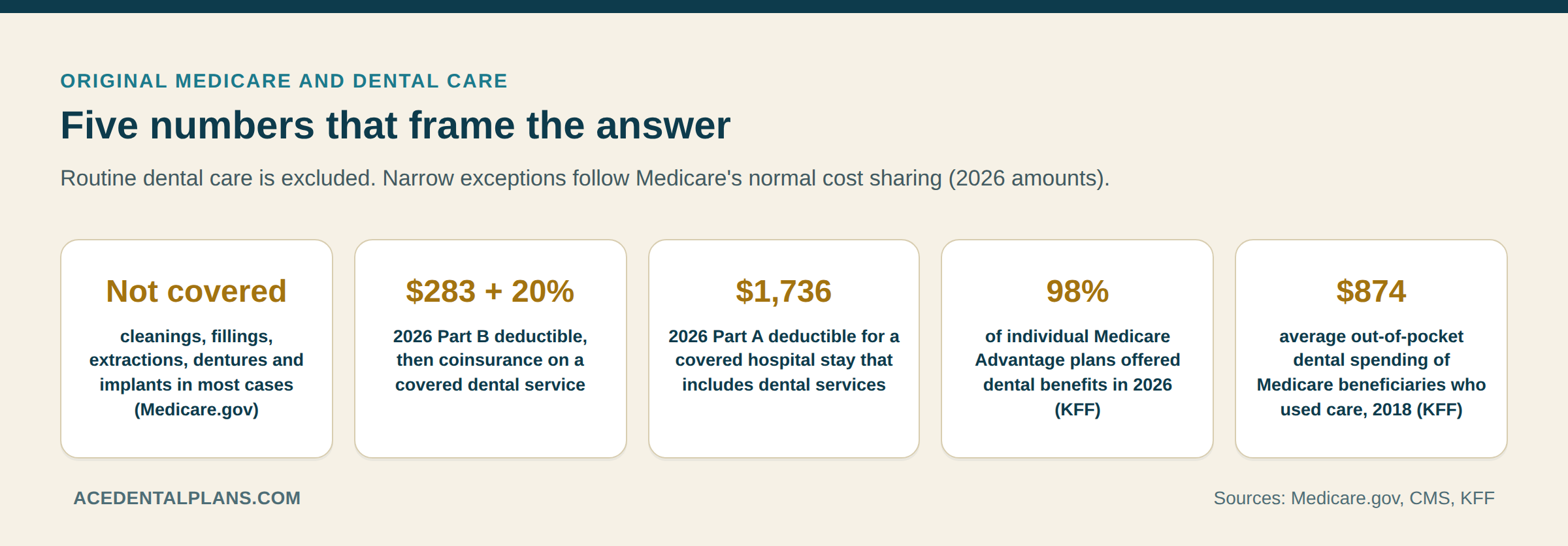
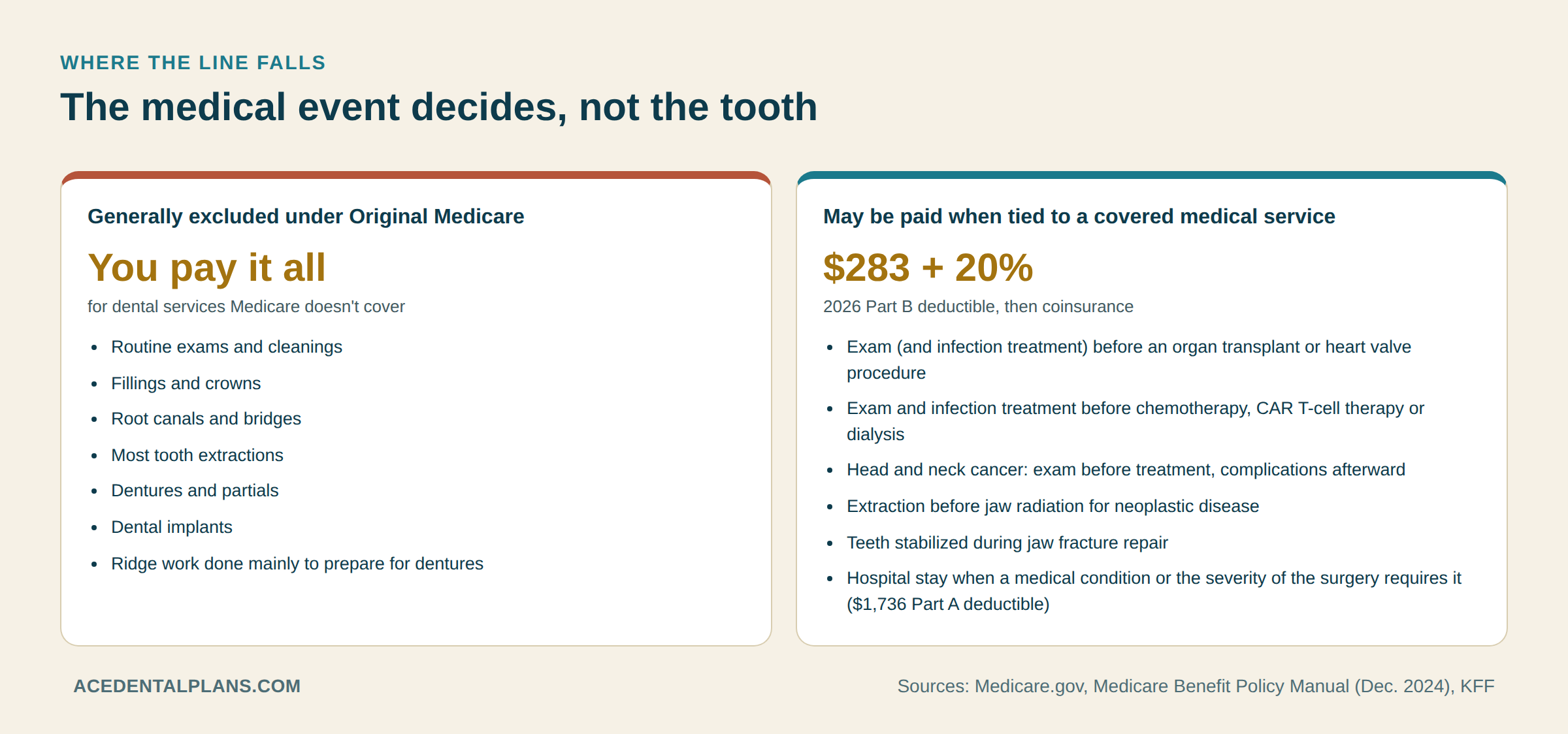
No, not for routine care. Original Medicare (Parts A and B) generally does not pay for cleanings, fillings, extractions, dentures or implants. It pays only when a dental service is closely tied to a covered medical service, such as an exam before a heart valve replacement or an organ transplant. In 2026, a covered dental service under Part B carries a $283 deductible and then 20% coinsurance.
This guide covers what Original Medicare excludes, the narrow exceptions and how the paperwork for them moves, and what 2026 cost sharing looks like. It also shows where an enrollee who needs a crown, a denture or a root canal can look for help. It treats Medicare Advantage and open enrollment only in summary, because each has its own guide, and it does not give clinical advice about any tooth.
Key Takeaways
- Routine dental care is excluded. Medicare.gov says that in most cases Medicare doesn’t cover routine cleanings, fillings or tooth extractions, and it does not cover dentures or implants.
- The exceptions are tied to a medical event: a transplant, a heart valve procedure, head and neck cancer care, chemotherapy, dialysis for kidney failure, a jaw fracture or a hospital stay that dental surgery makes necessary.
- When an exception applies, normal Medicare cost sharing applies too. For 2026 that is a $283 Part B deductible and 20% coinsurance, or a $1,736 Part A deductible for a covered hospital stay.
- Medigap does not add dental. Medicare.gov says Medigap policies generally don’t cover vision or dental care.
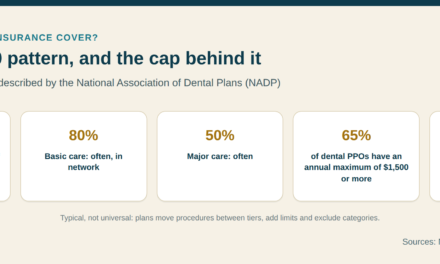
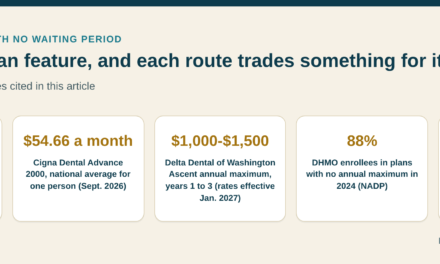
- Dental help comes from somewhere else: a Medicare Advantage plan (98% of individual plans offered dental benefits in 2026, per KFF), a standalone dental plan, Medicaid, the VA, PACE, a dental school or a community health center.
- Cash prices are the planning number if nothing else applies. Pearl’s May 2026 figures built on ADA fee survey data put a crown at $1,015 to $2,670 and a full denture at $1,360 to $3,565.
Original Medicare and Your Teeth: A Service-by-Service Answer
People ask the question as a yes-or-no, but the honest answer comes line by line. Table 1 sorts the usual dental bills by what Original Medicare does with them and what could change the answer. The “what could change it” column matters most, and it is almost always a medical event rather than a dental one.
| Dental bill | Original Medicare | What could change the answer |
|---|---|---|
| Routine exam, X-rays and cleaning | Not covered; Medicare.gov names routine cleanings as excluded | An oral exam that is part of a covered workup, such as before a transplant or heart valve replacement |
| Filling | Not covered; Medicare.gov names fillings as excluded | Treating an oral or dental infection that stands in the way of a covered transplant, valve procedure, cancer therapy or dialysis |
| Tooth extraction | Not covered in most cases | Extraction to prepare the jaw for radiation for neoplastic disease; an extraction that requires a covered hospital stay |
| Root canal, crown or bridge | Not listed as covered; the exclusion reaches care and treatment of teeth | Only if the work is itself the treatment of a linked infection or complication, which the claims contractor judges on the documentation |
| Dentures, partial or full | Not covered | Nothing in the dental exceptions; work done only to prepare the mouth for dentures stays excluded |
| Dental implants | Not covered | No general exception |
| Gum disease treatment | Not listed as covered | Complications of head and neck cancer treatment, or infection treatment tied to dialysis, may qualify |
| Jaw fracture, tumor removal | May be covered as medical care | Stabilizing teeth during jaw fracture reduction; ridge reconstruction done at the time of tumor removal |
| Hospital stay for dental surgery | May be covered under Part A | Hospitalization needed because of an underlying medical condition or the severity of the procedure |
Two rows deserve a second look. A root canal or crown is not named on Medicare.gov’s short list, which names cleanings, fillings, extractions, dentures and implants. The legal exclusion is written around care and treatment of teeth, though, so these procedures sit inside it. And gum treatment is the row where readers often hope for a medical angle. Unless the gum or bone problem is a complication of head and neck cancer treatment or an infection that blocks a covered procedure, it is a dental bill.
Reading the first column honestly
A dentist’s office will rarely say “Medicare doesn’t cover this” in those words. It may say “we don’t bill Medicare,” which sounds like a preference but is usually a statement about the rules. If you want an answer for your own case, ask whether the service is billed as routine dental care or as a service linked to a covered medical procedure. Then ask which doctor’s referral supports the link.
Where the Exclusion Comes From and What It Reaches
The language is in the Medicare Benefit Policy Manual, the CMS document that tells contractors how to apply the law. Its dental section says that items and services in connection with the care, treatment, filling, removal or replacement of teeth are not covered, subject to exceptions in federal regulations at 42 CFR 411.15(i). The version used here is the revision issued as Transmittal 13029 on December 31, 2024, effective January 1, 2025.
That sentence is broader than a list of procedures. It excludes the whole activity of looking after teeth, which is why a service that nobody calls “routine,” such as a crown on a broken molar, still lands outside Original Medicare. The consequence for you is that pain, urgency and medical necessity in the everyday sense do not trigger payment. What triggers it is a particular link to a covered medical service.
The denture trap in the manual
The manual contains a pointed example. A ridge reconstruction performed at the same time as the surgical removal of a tumor is covered. A ridge reconstruction “performed primarily to prepare the mouth for dentures is a noncovered procedure.” The manual also says services linked to non-covered services are not payable. It gives alveoplasty and frenectomy as examples that are excluded when done to prepare the mouth for dentures.
So a surgeon’s reason matters as much as the procedure. The same operation can be a covered part of cancer surgery or an excluded step toward dentures, depending on why it is being done. If you are being told a procedure is “medical” but it exists to make room for a denture, ask how it will be billed before you schedule it.
What “Original Medicare” means in this guide
Medicare.gov describes two main ways to get Medicare coverage. In Original Medicare, you pay for services as you get them. Medicare Advantage is a Medicare-approved plan from a private company that offers an alternative to Original Medicare. The exclusions and exceptions in this section belong to Original Medicare.
Medicare Advantage is a different arrangement. You must have both Part A and Part B to join one, and Medicare.gov says these plans offer extra benefits that Original Medicare doesn’t, such as vision, hearing and dental. Whether a particular plan’s dental benefit helps depends on its network, its annual dollar cap and its cost sharing, which come up again further down.
The Narrow Exceptions: Dental Work Tied to a Covered Medical Service
Medicare’s exceptions all share one idea. A dental service can be paid when it is so bound up with a covered medical treatment that the treatment can’t succeed without it. KFF, summarizing the federal fee schedule rules, quotes the standard as dental services “inextricably linked to, and substantially related and integral to the clinical success of” another covered service. It applies in either an inpatient or an outpatient setting.
That test came into focus in stages. The calendar-year 2023 Physician Fee Schedule final rule clarified how CMS reads the law, and later rules added specific situations. KFF’s tally of what has been added, with its labels for the rule that did the adding, is in Table 2.
| Covered medical event | Dental or oral service Medicare may pay for | First added (KFF’s timeline) |
|---|---|---|
| Organ transplant | Dental or oral exam as part of a comprehensive workup before a Medicare-covered transplant, plus necessary treatment of an oral or dental infection | 2023 rule (earlier policy covered kidney transplants only) |
| Cardiac valve replacement or valvuloplasty | Dental or oral exam before the procedure, plus necessary treatment of an oral or dental infection | 2023 rule |
| Head and neck cancer treatment | Dental or oral exam before Medicare-covered treatment; treatment of dental or oral complications after radiation, chemotherapy or surgery | 2023 rule (exam, starting 2024); 2024 rule (complications) |
| Chemotherapy, CAR T-cell therapy, or high-dose bone-modifying agents used in cancer treatment | Dental or oral exam and infection treatment before the therapy | 2024 rule |
| Dialysis for end-stage renal disease | Dental or oral exam before or alongside dialysis; treatment to eliminate an oral or dental infection | 2025 rule |
| Tumor removal, jaw radiation, jaw fracture | Ridge reconstruction at the time of tumor removal; tooth extraction before radiation for jaw disease; wiring of teeth for a jaw fracture; dental splints used with medically necessary treatment | Longstanding examples |
Medicare.gov’s own dental page lists the same family of situations in plainer words. It names oral exams and dental work before heart valve replacement or before organ, bone marrow or kidney transplants. It also names treatment of a mouth infection before chemotherapy and treatment of complications from head and neck cancer treatment. It adds oral or dental exams and infection treatment connected to dialysis for end-stage renal disease.
The Medicare Benefit Policy Manual’s revision effective January 1, 2025 lists the same pathways as numbered examples: transplant and heart valve work, chemotherapy and other cancer therapies, head and neck cancer, and dialysis for end-stage renal disease. It adds that integration between the professionals involved is a key factor, which is why the next section is about paperwork.
Read the table the way a claims examiner would. Each row begins with a covered medical event, and the dental service is the supporting act. A tooth that hurts for no medical reason, a crown that cracked on a walnut or a denture that no longer fits does not appear anywhere in it.
How narrow is narrow?
CMS itself sized these changes in the rulemaking, and KFF reports the estimates. For the 2023 rule’s transplant and valve scenarios, CMS projected about 190,000 additional dental services a year. For the cancer scenarios it estimated about 155,000 beneficiaries who might receive covered dental services, and for the dialysis scenario about 30,000 patients in traditional Medicare. KFF’s own reading is that the changes modestly expand coverage but are not a broad expansion of Medicare dental benefits.
Those are projections of added claims, not a count of everyone who might benefit, but they show the scale CMS had in mind: thousands of patients in specific clinical pathways, not the general older population. If you aren’t heading toward one of the medical events in Table 2, plan as though dental care is entirely your own bill.
Who decides the cases the rule does not list?
The rules also let Medicare Administrative Contractors, the private companies that process Part A and Part B claims in each region, decide payment in circumstances the written rule does not address. That is a real door, but it opens one claim at a time. It depends on the medical team documenting why the dental work was needed for the covered treatment to succeed, which brings us to how the paperwork moves.
Five Pathways, and What to Ask in Each
Table 2 is a list; a patient lives it as a sequence. These are the five main pathways, in the order a person is likely to meet them, with the question that matters most in each.
Organ transplant
The manual describes a dental or oral examination performed as part of a comprehensive workup before a Medicare-covered organ transplant, along with necessary treatment of oral or dental infection. KFF notes that before the 2023 rule only renal transplants were covered this way. Your transplant team decides what the workup requires. The question to put to them is which office will do the dental evaluation and whether it is enrolled with Medicare, because the referral has to exist before the visit.
Heart valve replacement or valvuloplasty
Cardiac valve work falls under the same manual example as transplants. An infection in the mouth is the concern that links dentistry to the valve procedure. Ask the cardiology team the same two things: where the evaluation should happen, and whether it can be billed as a service linked to the valve procedure. If the evaluation finds a problem, ask who documents that treating it is necessary for the procedure to go ahead.
Head and neck cancer
This pathway has the most moving parts. The exam before Medicare-covered treatment became a covered scenario starting in 2024. Treatment of dental or oral complications after radiation, chemotherapy or surgery was added by the 2024 rule. The manual’s longstanding examples include extracting teeth to prepare the jaw for radiation and reconstructing a dental ridge when a tumor is removed. Because radiation schedules are tight, the question is timing: how many weeks are available for the dental evaluation and any extractions before treatment starts?
Chemotherapy, CAR T-cell therapy and bone-modifying agents
For these cancer treatments, the manual lists dental examinations and infection treatment tied to the therapy. Medicare.gov describes it as treating a mouth infection before chemotherapy. The question for the oncology team is whether the specific therapy planned is among those named, since the pathway is written around particular treatments rather than all cancer care.
Dialysis for end-stage renal disease
The newest pathway, added by the 2025 rule, covers dental or oral exams before or alongside Medicare-covered dialysis for end-stage renal disease and services to eliminate an oral or dental infection. KFF reports that CMS estimated about 30,000 patients in traditional Medicare would be affected. The question for the dialysis team is whether the dental evaluation can be coordinated with the treatment schedule and who will write the referral.
Pathway mistakes that lead to denials
- Seeing the dentist first and asking for the referral afterward.
- Using a dental office that is not enrolled with Medicare and cannot bill incident to an enrolled physician.
- Letting the dental estimate bundle linked lines with unrelated work such as a crown.
- Assuming that a pathway for one cancer therapy applies to a different treatment.
How the Linked-Service Test Plays Out at the Surgeon’s and the Dentist’s Desk
A reader who has been told “Medicare covers the dental clearance before your transplant” often discovers that the sentence hides three or four moving parts. The First Coast Service Options page for providers, a Medicare Administrative Contractor, spells them out, and they are worth knowing before you book anything.
Two professionals have to be talking to each other
First Coast states that the linked-service policy requires an exchange of information or a referral between the medical provider and the dentist. The surgeon, oncologist or nephrologist is not just a bystander. If the dentist works alone, without a documented connection to the covered medical service, the claim has nothing to attach to.
For you, that means asking the medical team to put the referral in writing and name the covered procedure the dental work supports. Do it before the dental appointment, not after a denial.
The dentist has to be able to bill Medicare
Per First Coast, both medical professionals and dentists must be enrolled in Medicare, using form CMS-855I through the PECOS system, the Enrollment Gateway or paper. A dentist who is not enrolled may instead bill incident to an enrolled physician, provided the incident-to rules are met. A general dental office that has never treated a Medicare transplant or cancer patient may not have enrolled at all.
So the first phone call is simple: “Are you enrolled with Medicare, and have you billed a dental service that is linked to a covered medical procedure?” A hospital dental clinic or an oral surgery practice that already works with transplant and cancer teams may be a more natural fit than a neighborhood office. That is a question to ask, not an assumption to make.
Claims look more medical than dental
The contractor’s instructions describe a claim that does not resemble the dental claim form in a typical office. Providers bill with CDT or CPT codes where applicable. Part B claims use the CMS-1500 and Part A claims use the CMS-1450 (UB-04), or electronic equivalents. First Coast says plainly that it is not able to accept the CDT dental claim form or its electronic equivalent. Diagnosis codes (ICD-10) go on the claim at the highest specificity, for both the dental service and the linked medical condition or procedure. First Coast’s statement means an office cannot simply send its usual dental claim form to that contractor.
If the CDT versus CPT distinction is new to you, the guide to dental procedure codes on a bill explains why dental and medical billing speak different languages.
What happens when the office expects a denial
The contractor describes two modifiers for services a provider expects Medicare to deny as not reasonable and necessary. The GA modifier means a signed Advance Beneficiary Notice is on file. GZ means the provider expects a denial and has no signed notice. First Coast adds that using the modifier “serves as certification the provider believes Medicare should not pay the claim.” Leaving the modifier off certifies that the payment policies and the linked medical service apply.
The practical reading is this. When a dental office hands you a notice before treatment saying Medicare may not pay, it is protecting its right to bill you if the claim is denied. Take that notice seriously, ask what the estimated charge is, and decide whether to go ahead, move to a different route or ask the medical team for stronger documentation first.
The paper the contractor wants to see
For medical necessity, First Coast lists lab reports, office and progress notes, the patient’s history and physical, procedure reports and invoices where applicable. It also wants referral information showing that the dental service is inextricably linked to a covered medical service. Records must be properly authenticated. If you are the one carrying paperwork between two offices, you are carrying the material that decides the claim.
Reading a linked-service estimate line by line
An estimate from an office that bills Medicare for linked dental work has more columns than a typical dental treatment plan. The ones that matter are the office’s charge, the Medicare-approved amount, what Medicare is expected to pay and what you owe. A line that Medicare is not expected to pay should be marked as such, with the full fee beside it.
The three linked lines total $620 in approved amounts. If the Part B deductible has already been met, the patient owes 20%, which is $124, and Part B pays $496. The filling is a separate dental bill, so the patient owes $260 for it. The total patient share is $384. If the deductible has not been met, the first $283 of the $620 comes from the patient before coinsurance applies, so the patient would owe $283 plus 20% of the remaining $337, which is $67.40, for $350.40 on the linked lines, plus the $260 filling, for $610.40. All figures are hypothetical.
Four checks on any such estimate
- Is each line labeled linked or not linked? A single bundled total hides which lines Medicare is expected to pay.
- Which codes appear on the claim? The contractor wants CDT or CPT codes and ICD-10 diagnosis codes for both the dental service and the linked medical condition.
- What is the fee beside every line Medicare is expected to deny? That is the figure to weigh against the cash prices in Table 5.
- What happens if Medicare denies a line the office expected to be paid? Ask before treatment, because the answer decides who carries the risk.
Hospital Stays and Jaw Surgery: Dental Care Billed as Medical Care
The Medicare Benefit Policy Manual contains two statutory exceptions that allow Medicare to pay for inpatient hospital services connected to dental services. The first applies when hospitalization is required because of the individual’s underlying medical condition and clinical status. The second applies when it is required because of the severity of the dental procedure. Medicare.gov puts it in one line: some dental services during a hospital inpatient stay may be covered, for either of those reasons.
The wording is about the hospital, not the dental chair. It points to the patient’s medical condition and clinical status, or to the severity of the procedure, as the reasons for the stay. It does not mention comfort, anxiety or scheduling preferences, so treat those as reasons Medicare is unlikely to cite.
Jaw injuries and tumors
The manual’s examples show where the line between dental and medical work falls. Stabilizing or immobilizing teeth in connection with the reduction of a jaw fracture is covered. So is reconstruction of a dental ridge performed as a result of, and at the same time as, the surgical removal of a tumor. Dental splints are covered only when used together with covered treatment of a covered medical condition, such as a dislocated jaw joint. Extraction of teeth to prepare the jaw for radiation treatment of neoplastic disease is another example.
The common thread is the sequence. Something medical happens first or alongside, and the dental step is part of getting through it. A patient who breaks a tooth in the same fall that breaks the jaw is in a different position from one who breaks a tooth on a nut.
Get emergency care first and sort out coverage afterward if
- Your face or neck is swelling, or swelling is spreading toward the eye or throat.
- You have trouble breathing or swallowing.
- You have a fever together with severe tooth or jaw pain.
- Bleeding in the mouth will not stop with steady pressure.
- You have a suspected broken jaw after a fall or an accident.
These situations call for 911 or the nearest emergency room, and Medicare’s rules are a billing question for later. A hospital’s emergency evaluation for an infection or injury is a different thing from a dentist’s treatment of the tooth, so expect separate bills and ask the hospital’s billing office how each is classified.
What You Pay When an Exception Applies: The 2026 Part A and Part B Numbers
Coverage under an exception is not free coverage. It is Medicare coverage, with Medicare’s cost sharing attached. Medicare.gov’s dental page, which lists 2026 figures, says that for dental services Medicare doesn’t cover, you pay all costs. For the ones it does, the amounts depend on whether the service is billed under Part A (a hospital inpatient stay) or Part B (outpatient and professional services).
| Item | 2026 amount | What it means for a covered dental service |
|---|---|---|
| Part B standard monthly premium | $202.90 | Paid whether or not any dental exception is ever used; it does not buy routine dental care |
| Part B annual deductible | $283 | You pay the first $283 of Medicare-approved Part B costs in the year before Part B starts paying its share |
| Part B coinsurance | 20% of the Medicare-approved amount | Applies to a covered dental exam or procedure billed under Part B after the deductible is met |
| Part A inpatient hospital deductible | $1,736 | Applies to a covered hospital stay in which dental services are provided; days 1 to 60 then cost $0 per day |
| Hospital days 61 to 90 | $434 per day | Coinsurance if a covered stay runs that long |
| Lifetime reserve days (days 91 to 150) | $868 per day | You have 60 lifetime reserve days in total, and each can be used once |
| After day 150 | All costs | You pay everything after the reserve days are gone |
| Dental service Medicare does not cover | All costs | Includes most dental services; you pay the dentist’s full fee |
The premium, the deductibles and the daily amounts come from the CMS fact sheet on 2026 Medicare Parts A and B premiums and deductibles, released November 14, 2025. They match the figures on Medicare.gov’s dental page. The 20% coinsurance rule is from Medicare.gov. Medicare.gov also notes that outpatient hospital or other facility care may carry a facility copayment. Actual costs depend on other insurance you have, what the doctor charges, whether the doctor accepts assignment, the type of facility and where you get the service.
Why the deductible matters more than it looks
The Part B deductible is a calendar-year number. A covered dental exam in February, early in the year, is likely to be the first Part B service you use, which means the approved amount lands on the deductible and you pay it in full. The same exam in November, after a year of doctor visits and tests, may already sit beyond the deductible, so you owe only the 20%.
Neither version is a bargain relative to the dentist’s fee schedule, but both beat the alternative of paying the whole fee for something Medicare would have allowed. The timing is not something to engineer, since a transplant or cancer workup sets its own calendar. It is just a reason to expect different bills for the same service.
Assignment and what the dentist may charge
Medicare.gov lists “whether your doctor accepts assignment” among the factors behind your costs. The deductible and coinsurance are figured on the Medicare-approved amount, which is not always the amount on the dentist’s fee schedule. Ask any dentist or surgeon billing Medicare whether the office accepts assignment, and what that means for any difference between its fee and the approved amount, before you agree to a covered linked service.
Three Hypothetical Medicare Dental Claims, Line by Line
Abstract rules are easier to trust once you have watched them work on a bill. The three cases below are invented for illustration. They use only the 2026 Medicare cost-sharing figures from Table 3 and dollar amounts chosen for simple arithmetic, not prices from any dentist.
Case 1: A pre-treatment oral exam for head and neck radiation
A patient with a head and neck tumor is about to start radiation. The radiation oncologist refers the patient to an oral surgeon who is enrolled with Medicare. The surgeon examines the mouth, takes imaging and plans removal of a badly decayed tooth that would otherwise sit in the radiation field. Medicare’s longstanding examples include extraction before radiation for neoplastic disease, and the pre-treatment exam became an explicit covered scenario for head and neck cancer starting in 2024.
Suppose the approved amount for the exam and imaging is $260 and for the extraction is $300. The patient has met the Part B deductible earlier in the year because of other cancer care. The patient owes 20% of $560, which is $112. Part B pays $448. That is the pattern when everything lines up: the dental work is real, the cost sharing is the ordinary Part B kind, and the patient never sees the dentist’s full cash fee.
Case 2: A routine crown in the same month
The same patient has a cracked molar on the other side of the mouth that has no connection to the radiation field. The dentist quotes $1,400 for a crown. Medicare treats a crown as routine dental care, which Medicare.gov says it generally does not cover. The patient pays the full $1,400 unless some other coverage applies. That coverage might be a Medicare Advantage dental benefit, a standalone dental plan or Medicaid, all of which come later in this guide.
It is common to feel that the second bill is unfair, given that the first one was covered. The line Medicare draws is not about how serious or painful the problem is. It is about whether the dental service is part of a covered medical treatment.
Case 3: A hospital admission for dental surgery
A patient on a blood thinner needs several teeth removed, and the surgeon decides the procedure must be done in a hospital with monitoring. Medicare.gov says some dental services during an inpatient hospital stay may be covered, either because of an underlying medical condition or the severity of the procedure. If the stay qualifies, Part A’s 2026 inpatient deductible of $1,736 applies, and days 1 to 60 then cost $0 per day.
Suppose the stay is two days and the Part A deductible has not been met. The patient owes $1,736 for the hospital portion. The surgeon’s own fee is a separate question. Whether Medicare processes it, or it arrives as a dental bill, depends on how the service is classified, and the patient should ask the surgeon’s office before the admission rather than after. Both the $1,736 and the stay are hypothetical, and the example shows how a covered hospital stay can still be a large bill even when Medicare is paying.
Part A’s deductible is also why Medigap exists. Medigap policies are designed to help with some of Medicare’s cost-sharing amounts, but they do not add dental, which is covered in a later section.
What Medicare Enrollees Actually Spend on Teeth: What the Data Show
The exclusion has been in place for decades, so the spending pattern is well documented, even if the newest national figures lag. None of these numbers is a price for your treatment. They show how common the gap is and how unevenly it falls.
Coverage and visits
KFF’s analysis of 2019 data found that 47%, or nearly 24 million, of Medicare beneficiaries had no form of dental coverage that year. The ADA Health Policy Institute reports a similar picture for adults 65 and older in its more recent coverage figures. Of those adults, 54% had no dental benefits, 34% had private dental benefits and 11% had public benefits, with Medicare Advantage plans not accounted for. For visits in 2024, the same ADA page reports 76% of older adults with private dental insurance had at least one visit, against 28% with public insurance and 48% with none.
A CMS analysis of 2021 Medicare Current Beneficiary Survey data adds a wrinkle. It found that 56.6% of all community-dwelling beneficiaries had a dental visit. Among those with private dental coverage the share was 78.3%, among non-dually eligible Medicare Advantage enrollees with dental it was 54.9%, and among those with no dental coverage it was 50.5%. Coverage by itself, in other words, does not guarantee a visit, and a thin benefit may not change behavior much.
What people pay
KFF reported that in 2018, average out-of-pocket dental spending was $454 across all Medicare beneficiaries and $874 among those who used any dental services. One in five dental users spent more than $1,000, and one in ten spent more than $2,000. The CMS survey analysis for 2021 shows the same shape: 20% of all beneficiaries had no out-of-pocket dental expenses, 60% spent $1,000 or less, and 20% spent more than $1,000. Among beneficiaries with no dental coverage, 26% spent more than $1,000, compared with 15% of non-dually eligible Medicare Advantage enrollees with a dental benefit.
Teeth over a lifetime
The CDC’s National Center for Health Statistics reported that 12.9% of adults 65 and older had complete tooth loss in 2015 to 2018. The share was 8.9% at ages 65 to 69, 10.6% at 70 to 74 and 17.8% at 75 and older. The age-adjusted figure fell from 29.9% in 1999 to 2000 to 13.1% in 2017 to 2018. More older adults are keeping their natural teeth, which is good for health, and it also means more of them need fillings, crowns and gum care that Original Medicare excludes.
Why the coverage figures don’t match
Readers who compare sources will notice that 47% (KFF, 2019) and 54% (ADA, adults 65 and older) don’t agree. They shouldn’t be expected to. The KFF figure counts all Medicare beneficiaries who had no form of dental coverage. The ADA figure is for adults 65 and older and, as its page states, does not account for Medicare Advantage plans. The data years differ too. A third number, the CMS survey’s 2021 visit rates, measures use rather than coverage.
The safe reading is a range. Somewhere between a third and a half or more of older adults have no dental benefit at all, depending on who is counted and how, and a benefit that exists often comes with a cap that leaves large bills unpaid.
What Medicare itself costs in 2026, and why dental is not inside it
The Part B premium is $202.90 a month in 2026, according to the CMS fact sheet on 2026 premiums and deductibles, or about $2,435 a year before any service is used. Medicare.gov’s dental page is clear that the premium does not buy routine dental care: for services Medicare doesn’t cover, you pay all costs. People sometimes feel they have already paid for dental through the premium. They have paid for Part B, which pays for covered medical services.
The same premium follows people into Medicare Advantage. KFF reports that 67% of individual Medicare Advantage plans with drug coverage charge no premium beyond the Part B premium in 2026. It adds that CMS estimates the average monthly plan premium across all Medicare Advantage enrollees will be $14.00. A “$0 premium” plan with dental does not remove the $202.90. It means the plan itself adds nothing to it, so the cost of the dental benefit shows up elsewhere: in the annual cap, the network and the coinsurance.
For a budget, that is the comparison to make. The Part B premium is a fixed cost shared by Original Medicare and Medicare Advantage members alike, and dental decisions concern what you add on top and what you pay at the dentist.
Medigap Adds No Dental, and Medicare Advantage May
Medigap does not add dental
A Medicare Supplement Insurance policy, or Medigap, sounds like the obvious fix. Medicare.gov describes Medigap as extra insurance you may be able to buy from a private company that helps pay your share of costs in Original Medicare. It lists copayments, coinsurance and deductibles as examples. It also says Medigap generally doesn’t cover long-term care, vision or dental care, hearing aids, glasses or private-duty nursing.
The logic is simple. Medigap follows Original Medicare. If Medicare doesn’t approve a denture, there is no Medicare share for Medigap to pick up. If Medicare does cover a dental service under an exception, a Medigap policy may help with deductibles and coinsurance, depending on the plan letter, which this guide doesn’t compare. Adding Medigap to a plan for the sake of dental benefits would be paying for something it isn’t built to provide.
The practical result: a person with Original Medicare and Medigap who needs a crown still needs a second source of dental coverage, or a plan to pay cash.
Medicare Advantage dental benefits in brief
Medicare Advantage is the route that bundles a dental benefit into the Medicare coverage itself. KFF’s first look at 2026 plans found that 98% of individual Medicare Advantage plans offer dental benefits, the same share as hearing and slightly below vision at 99%. Medicare Advantage plans enrolled more than 34 million beneficiaries in 2025, or 54% of the eligible Medicare population, KFF reports. ADA News, reporting on the association’s July 2025 letter on Medicare Advantage, puts the figure from the enrollee side: 97% of enrollees are in plans that advertise some form of dental benefit.
“Some form” is the operative phrase. KFF says a dental benefit may include cleanings and preventive care or more comprehensive coverage, and that it often has an annual dollar cap. In 2021, KFF found the average annual limit among plans offering more extensive benefits was about $1,300, and 59% of enrollees in those plans had benefits capped at $1,000 or less. Those are older figures and plans change them yearly, but they show the shape of the benefit. For depth on networks, caps and what plans actually pay, see the guide to Medicare Advantage dental benefits.
A worked example with one published plan outline
Humana’s 2026 outline for one of its Medicare dental network plans (DENF52) lists a $0 deductible and a $500 annual maximum. Preventive and basic services are at 100% coinsurance and major services at 70%, with some crowns at 60% or 65%. It lists no waiting periods and limits crowns and dentures to one per tooth or arch every five calendar years. That is one plan, not a typical one, but it shows how the pieces interact.
The lesson is the same one that applies to every dental plan. The percentage is not the number to compare first. The annual maximum is, because it caps what the plan will pay no matter what the percentage says.
Standalone Dental Plans and Savings Plans Next to Original Medicare
People who stay in Original Medicare can still look for dental coverage separately, from private insurers that sell standalone dental plans. The mechanics are the same as any dental insurance: a premium, usually a deductible, coinsurance by service tier, an annual maximum, waiting periods and a network. The guide to annual maximums, deductibles and plan types covers those in full, and how dental insurance works follows a claim from premium to payment.
Which services a plan sorts into preventive, basic and major usually decides what you owe. A plain explanation of what dental plans cover by tier is a good companion when you read a benefit summary. Crowns and dentures often sit in the major tier, with the lowest percentage and the longest waiting period.
The arithmetic that decides whether a plan pays off
Take the annual premium, then subtract it from what the plan is likely to pay for the work you expect. Three numbers do most of the work: the premium times twelve, the annual maximum and the waiting period before major work is covered. A plan that pays 50% on major services after a twelve-month wait is a poor match for a denture you need in March.
Waiting periods are the reason timing matters, and why it is better to compare plans before the need arises rather than after a dentist finds it.
Reading a benefit summary for the four numbers that matter
Whether the plan is standalone or part of Medicare Advantage, the benefit summary answers the same questions in roughly the same order. Find these four before reading anything else.
- The annual maximum or cap. It limits what the plan pays in a benefit year, whatever the percentages say.
- The tier of the work you expect. Crowns, bridges and dentures commonly sit in the major tier, which usually has the lowest percentage.
- The waiting period. If major services carry a wait, work done before it ends is paid at zero.
- The frequency limit. The Humana outline, for example, limits crowns to one per tooth and dentures to one per arch every five calendar years.
The deductible and the premium come next, and the network comes last only because you can check it with a phone call. Out-of-network dentists may balance bill for the difference above the plan’s contracted fee, as the Humana outline says, so an out-of-network crown can cost more than its percentage suggests.
Savings plans are a different product
A dental savings plan is not insurance. Members typically pay an annual fee and receive discounted fees from participating dentists, usually without an annual maximum or claim forms. The page on dental savings plans explains how they work and where they fall short. They can make sense when a plan’s waiting period or cap would defeat it, but the discount applies only at participating offices, and the member still pays the discounted fee in full.
All of the plan-comparison guides sit together in the dental insurance and plans section of this site, if you want to read more than one.
Medicaid for People Who Also Have Medicare
Some people qualify for both programs. Medicaid is run by the states, and Medicaid.gov is blunt about dental. States have flexibility to determine what dental benefits are provided to adult enrollees, and there are no minimum requirements for adult dental coverage. Children are different, since Medicaid covers dental services for all child enrollees under its early and periodic screening benefit. For an adult with Medicare, the answer depends on the state, and sometimes on the year.
Two kinds of help, often confused
The Medicare Savings Programs are one thing, and full Medicaid dental benefits are another. According to Medicare.gov, the Medicare Savings Programs help pay Part A and Part B premiums. Of the four programs, the Qualified Medicare Beneficiary program also pays Part B deductibles, coinsurance and copayments, while the Specified Low-Income Medicare Beneficiary and Qualifying Individual programs pay Part B premiums only. The page doesn’t mention dental coverage.
That still matters for this topic. If a dental exam is covered under a transplant or cancer pathway, a Qualified Medicare Beneficiary may owe little or nothing of the 20% coinsurance. It won’t pay for a crown. Income and resource limits rise each year, and Medicare.gov lists the 2026 figures, which are worth reading on that page rather than copying here. The state-run State Health Insurance Assistance Program offers free counseling on these programs, at 1-877-839-2675, according to its national site.
State benefits move
Adult dental in Medicaid is a benefit states can add, trim or drop. A March 2026 Commonwealth Fund blog by Hawazin Elani and colleagues says state legislatures are debating cost-cutting proposals after H.R. 1, and summarizes a Health Affairs study of low-income adults ages 50 to 64 from 2010 to 2021. In that study, when states eliminated adult dental benefits, the share uninsured for dental care rose by 60 percentage points. The share with a dental visit in the prior two years fell by 37 percentage points. The effects of cuts were larger than the effects of expansions, and some lasted up to eight years.
Those results describe adults 50 to 64, not people 65 and older, so treat them as evidence of how fragile state benefits can be rather than as a prediction for any one enrollee. If you rely on a Medicaid dental benefit, confirm what your state covers this year and whether your dentist still takes it.
Questions for the state Medicaid office
- Do adult benefits in this state include dentures, partial dentures, crowns and extractions, or only emergency care?
- Is there an annual dollar limit or a frequency limit on dentures?
- Does the plan require prior authorization, and who requests it, the patient or the dentist?
- Which dentists near me accept Medicaid, and are they taking new patients?
- Does Medicaid pay anything toward the Medicare Part B coinsurance if a dental exam is covered under a linked-service pathway?
Write down the date and the name of the person who answers, because state rules change and a benefits line is not a promise of payment.
VA Dental Care and PACE: Two Narrow Doors
VA dental care and the VADIP option
The VA decides dental eligibility under its own classes, separate from anything Medicare does. The VA’s dental care page lists several, which fall into three practical groups. Class I covers veterans with a service-connected dental condition for which they receive compensation. Class IIC covers former prisoners of war. Class IV covers veterans with a 100% service-connected rating, or who are unemployable and paid at the 100% rate. The page describes these classes as eligible for “any needed dental care.”
Other classes are narrower. Class II is a one-time care category for certain Gulf War era veterans who apply within 180 days of discharge. Class IIA covers a service-connected noncompensable dental condition or a disability from combat wounds or service trauma, with care to keep a functioning set of teeth. Class III covers cases where a VA dental provider finds an oral condition is worsening a service-connected health condition. Other classes cover veterans in vocational rehabilitation, those whose dental problem is making a health condition harder to treat, and inpatients.
A veteran who doesn’t meet any class may be able to buy dental insurance at a reduced cost through the VA Dental Insurance Program (VADIP), if enrolled in VA health care or CHAMPVA. To use VA dental care at all, a veteran must apply for VA health care first, through the 10-10EZ application. The page says eligibility depends on a number of factors, including military service history and current health and living situation, so check it rather than assume.
PACE: a rare option with dentistry on the list
The Program of All-Inclusive Care for the Elderly is available only in some states that offer it under Medicaid. Medicare.gov says to join, you must be at least 55 and live in a PACE organization’s service area. You must also need nursing-home-level care, as certified by your state, and be able to live safely in the community with PACE’s help. PACE covers all Medicare- and Medicaid-covered care plus other care the PACE team decides you need. Dentistry is on the list of services it “may cover,” so it isn’t guaranteed for every participant.
The cost structure is unusual. With Medicaid, there is no monthly premium. With Medicare but not Medicaid, you pay a monthly premium for the long-term care portion plus a Part D drug premium. For care the PACE team approves, there is no deductible, copayment or coinsurance. PACE fits a small group of people with serious care needs, and for that group dental care sits inside the same program as medical care.
Dental Schools, Health Centers and the Seven Routes Compared
Two routes that publish their terms are teaching clinics and federally supported health centers. Neither is quick, and neither fits every case.
Dental school clinics
The University of Oklahoma College of Dentistry’s student care page is a useful example. It says treatment is closely supervised by faculty dentists and specialists, and that fees are normally 40 to 60% lower than private practice fees. It also says most procedures take about three hours and that patients are selected based on the educational needs of pre-doctoral students. Payment is expected before a procedure is performed, with no payment plans but with prepayment arrangements. Complete and partial dentures are among the services its adult clinic lists, without prices.
One school’s terms don’t describe another’s, but the pattern repeats: lower fees, long appointments, a screening process and prepayment. For a person on Medicare who has time and needs a denture, a crown or several fillings, that trade can be worth making. The cost guide to dental care without insurance describes how these clinics, health centers and other routes compare.
Community health centers
HRSA says health centers provide primary medical and dental care to people of all ages, whether or not they have health insurance, on a sliding fee scale based on ability to pay. Its Find a Health Center tool locates one near you. Not every center offers every dental service on site, and wait times differ. Call and ask what dental services are available, how the sliding fee is set, and whether they bill Medicare for a linked exam.
The seven routes side by side
Table 4 puts the routes side by side. It describes how each is built, not whether you personally qualify, which only the program can tell you.
| Route | Who may qualify | What it may pay for | Main catch |
|---|---|---|---|
| Medicare Advantage dental benefit | Enrollees in an individual plan that includes dental (98% of such plans in 2026) | Preventive care, sometimes more comprehensive coverage | Annual dollar cap and network rules; plan changes yearly |
| Standalone dental plan | Adults who can buy one from an insurer | Services by tier, per the plan | Premium, waiting periods and an annual maximum |
| Medicaid | People who meet state income and resource rules | Whatever the state covers for adults; no federal minimum | Benefits vary by state and can be cut; ADA’s Health Policy Institute says dentist participation has been stagnant |
| VA dental care | Veterans in certain eligibility classes | Any needed dental care for some classes; limited care for others | Narrow eligibility; must be enrolled in VA health care first |
| PACE | Age 55 or older, nursing-home level of care, living in a service area | Dentistry is among services PACE may cover | Only in some states; for people with serious care needs |
| Dental school clinic | Patients selected for training needs | Supervised care at reduced fees (one school: 40 to 60% below private practice) | Appointments of about three hours; screening; prepayment |
| Community health center | Anyone, regardless of insurance | Primary medical and dental care on a sliding fee scale | Services and wait times vary by center |
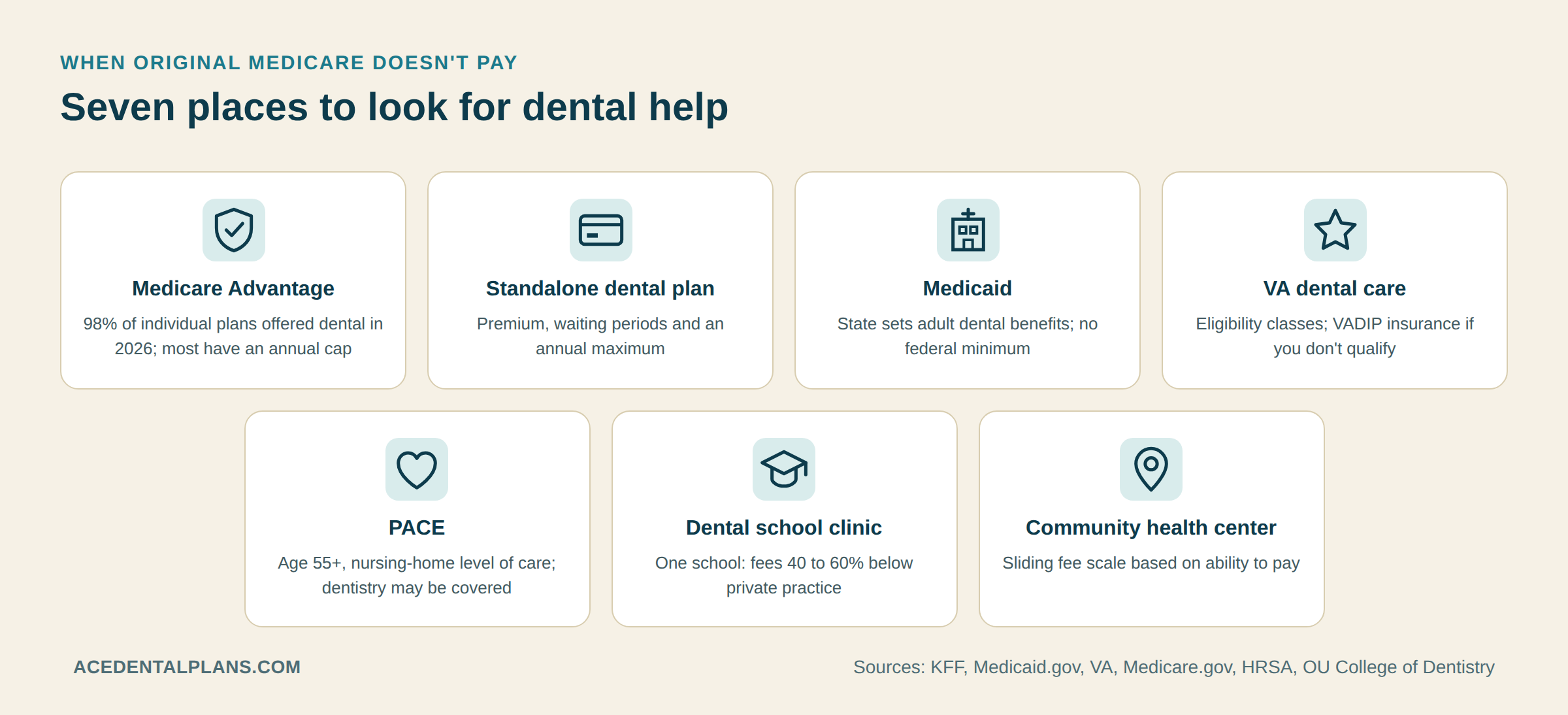
Most people end up combining two of these. A Medicare Advantage plan with a $500 cap and a dental school clinic for the large work is one sensible pairing. A health center for routine care and a standalone plan for the year a denture is due is another. The point is to match each type of bill with the route built for it, and to avoid paying a full-fee office for work a lower-fee route could handle.
Six Things People Say About Medicare and Dental, Checked
Dental coverage is a topic where half-truths travel. Each statement below is something a reader may hear from a relative, an advertisement or an office, checked against the sources used in this guide.
“Medicare covers dental if it’s medically necessary.”
Not as a general rule. The exclusion is written around care and treatment of teeth, and the exceptions depend on a link to a covered medical service. A tooth that is medically necessary to fix in the everyday sense, such as a painful cracked molar, is still a dental bill.
“My Part B premium includes dental.”
It doesn’t. The $202.90 monthly premium in 2026 pays for Part B coverage, and Medicare.gov says you pay all costs for dental services Medicare doesn’t cover.
“A strong Medigap plan covers dental.”
Medicare.gov says Medigap policies generally don’t cover vision or dental care. Medigap helps with your share of costs for services Original Medicare already covers.
“If my surgeon wants my teeth checked first, Medicare pays for whatever the dentist finds.”
The exam is the part with a clear path. The manual lists necessary treatment of an oral or dental infection for transplant, valve, cancer therapy and dialysis pathways, but it doesn’t turn routine fillings or crowns into covered care. Ask the dentist to separate the linked lines from the rest, as in the estimate example earlier.
“Medicaid will pay for my dentures.”
Maybe, in some states, in some years. Medicaid.gov says there are no minimum requirements for adult dental coverage. The Commonwealth Fund’s 2026 summary of research shows states have cut as well as expanded these benefits.
“If I have dental coverage, I’ll get dental care.”
Coverage helps, but it doesn’t guarantee a visit. In the CMS survey analysis for 2021, 54.9% of non-dually eligible Medicare Advantage enrollees with a dental benefit had a dental visit, against 50.5% of those with no dental coverage. ADA News, reporting on the association’s letter, cites a study finding that enrollees with dental coverage were no more likely to have had a dental visit in the past year than those without. Networks, caps, transportation and cost sharing all stand between a benefit and an appointment.
What Common Dental Work Costs in Cash When Medicare Doesn’t Pay
If no exception and no other coverage applies, the planning number is the cash fee. Table 5 uses national figures from Pearl’s dental cost tool, which says its figures are population-weighted averages based on ADA fee survey data and were last updated in May 2026. They are national ranges for the United States, before any insurance, and they cover the service named, not the extras around it.
| Service | National range | National average | What the figure covers |
|---|---|---|---|
| Adult cleaning | $100 to $265 | $155 | Routine adult cleaning (prophylaxis); exam and X-rays are separate |
| Simple tooth extraction | $170 to $450 | $260 | A fully erupted tooth; surgical extractions bill higher and the page gives no figure |
| Deep cleaning | $220 to $570 | $335 | Billed per quadrant; a full mouth is roughly four times one quadrant, and the page does not say whether the range is per quadrant |
| Root canal | $685 to $1,800 | $1,050 | The root canal only; the crown that usually follows is billed separately |
| Dental crown | $1,015 to $2,670 | $1,560 | One crown; materials are not priced separately on the page |
| Partial denture | $1,250 to $3,280 | $1,920 | A partial denture, one arch |
| Complete denture | $1,360 to $3,565 | $2,085 | Upper and lower cost about the same; replacing both arches is roughly twice a single arch |
| Implant post | $2,005 to $5,255 | $3,075 | Surgical placement of the post; the abutment, crown, bone grafts, sedation and imaging usually add to the total |

A second consumer source gives a similar picture for dentures. CareCredit’s August 2026 page lists a traditional full removable denture at an average of $2,022, with a range of $1,493 to $3,309. A resin-based partial averages $1,784 and a metal partial $2,293. The page says averages exclude consultations and maintenance. The $63 gap between the two full-denture averages is the kind of difference you should expect between sources, and neither is a quote.
Where to read the line-by-line version
Each row of Table 5 has its own price guide. The breakdown of dental cleaning cost separates the exam, X-rays and cleaning, and the page on simple and surgical extraction prices explains why a quote can move from one to the other. For gum treatment, deep cleaning cost works through quadrants.
A tooth that needs a root canal usually needs a crown afterward, which is why the root canal cost and dental crown cost pages belong together. On the replacement side, full, partial and implant-supported denture prices sit beside single-tooth implant cost, and the guide to denture types, fit and coverage covers the clinical side. If you want every procedure in one place, the dental price guide collects them.
How to compare a real quote with the table
Take a dentist’s written quote and match each line to a row in Table 5. A line that matches a row should land inside the range; a line well above the top of the range deserves a question. Check what the quote bundles in, since the table’s figures for a crown, for example, do not price materials separately, and a quote may include a temporary crown or a build-up that the national figure does not.
Two ways to read the same table, cost side only
Table 5 also lets a reader do a rough cost-only comparison. Suppose a tooth is failing and the dentist describes two paths: save it with a root canal and crown, or remove it and replace it with a partial denture. At the national averages, the first path is $1,050 plus $1,560, or $2,610. The second is $260 for the extraction plus $1,920 for a partial denture, or $2,180. The gap is $430 in favor of the second path on paper.
That is arithmetic, not a recommendation. A dentist weighs what the tooth can support, how long each option is expected to last and what each does to neighboring teeth, and none of that is in the table. The calculation is useful only for a different purpose: it shows that the cheaper line on a quote is not always the cheaper path, and that price per year of use differs from price today. Any decision belongs with the dentist after an exam.
Three Hypothetical Years for the Same 72-Year-Old
Averages are easier to judge when the same dental year is run through different coverage. Suppose a 72-year-old needs two cleanings, one root canal and one crown on the same tooth. At the Table 5 national averages, that is $310 for two cleanings, $1,050 for the root canal and $1,560 for the crown, a total of $2,920 in cash fees. Everything below is hypothetical arithmetic built on those averages and invented plan terms, with the plan terms stated in each case.
Case A: Original Medicare only, no other dental coverage
Medicare pays nothing for these services. The patient pays $2,920. A person who finds a dental school clinic can ask what the discount looks like; one school says its fees are normally 40 to 60% below private practice. Applied to $2,920, that would be roughly $1,170 to $1,750, with the longer appointments and screening described earlier. The school’s discount, applied to national averages, is only a rough guide.
Case B: Original Medicare plus a standalone dental plan
Suppose the plan costs $40 a month ($480 a year), pays 100% of preventive services, 80% of basic services (the root canal) and 50% of major services (the crown), with a $1,500 annual maximum. The plan’s share before the cap would be $310 + $840 + $780 = $1,930, which the maximum cuts to $1,500. The patient pays $2,920 − $1,500 = $1,420, plus $480 in premiums, for a total of $1,900.
Now suppose the same plan has a 12-month waiting period for major services. The plan pays $310 + $840 = $1,150, the patient pays $1,770 in fees plus $480 in premiums, and the total is $2,250. The waiting period costs the patient $350 in this example.
Case C: A Medicare Advantage plan with a dental benefit
Suppose the plan adds no premium beyond Part B for dental, covers preventive care at 100% and other services at 50%, and caps dental at $1,000 a year. The plan’s share before the cap would be $310 + $525 + $780 = $1,615, cut to $1,000 by the cap. The patient pays $1,920. A lower cap can leave the patient’s share close to Case B even without a monthly dental premium. A Medicare Advantage plan has other tradeoffs, including network rules, that this arithmetic ignores.
Case D: A person with Medicaid dental benefits
If the state’s adult Medicaid program covers these services and the dentist accepts Medicaid, the patient may owe little or nothing. This is the one case where the answer is a question instead of a number. What does my state cover for adults this year?
Plans for the year that include a large bill are easier to solve with a financing step. The guide on ways to pay for expensive dental work compares eight routes side by side, and dental financing versus payment plans explains the clauses that make borrowing cost more.
The Fall Calendar: Open Enrollment, Benefit Years and January 1
Open enrollment for 2027 coverage began October 15, 2026. Medicare.gov’s September 2026 key dates sheet says Medicare Open Enrollment happens every year from October 15 to December 7. It calls this the one yearly window when people can change health and drug plans. A health or drug plan must receive the enrollment form by December 7. New coverage starts January 1.
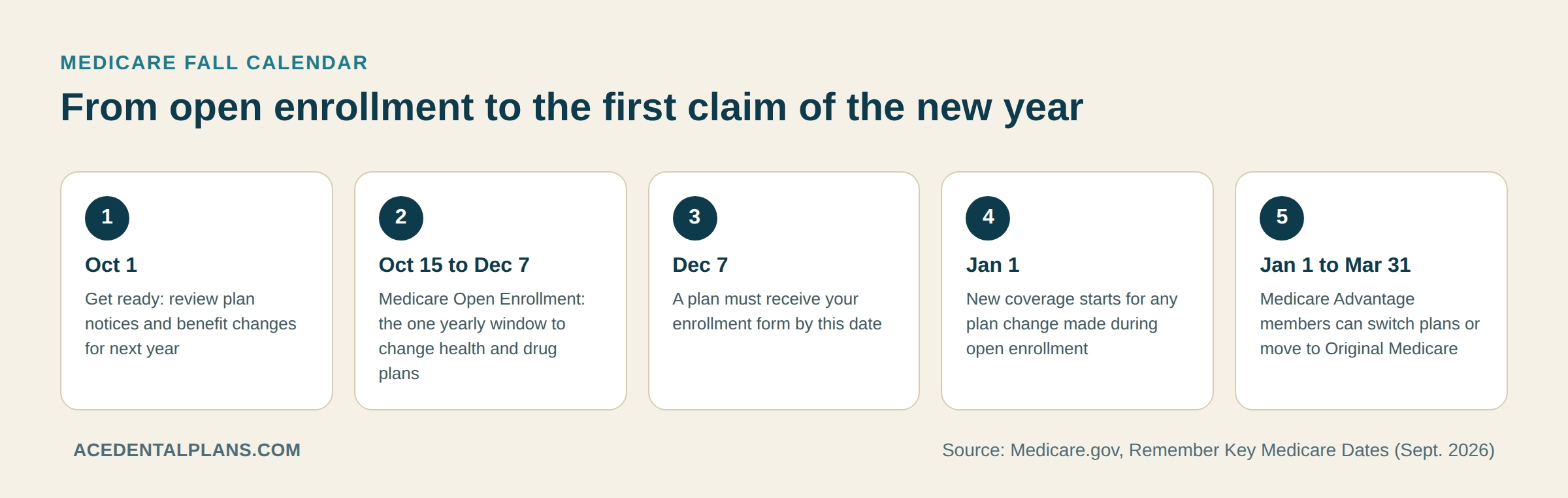
The same sheet says that between January 1 and March 31, people in a Medicare Advantage plan can switch to a different Medicare Advantage plan. Those enrolled in Medicare Advantage can also switch to Original Medicare during that window. The step-by-step comparison method belongs to the guide on comparing dental benefits during open enrollment, so only the dental-specific points follow.
A back-from-December-7 checklist
- Gather this year’s plan notices and write down the dental benefit you have now, including the cap and what you have already used.
- List the dental work you expect in the next twelve months, with the dentist’s written fee for each item if you have it.
- Check each plan you are considering against that list, using the cap, tiers, waiting periods and network.
- Call your dentist’s office and ask whether it is in network for each plan on your short list.
- Talk to a State Health Insurance Assistance Program counselor if you can’t decide between two plans.
- Submit any change so the plan has the enrollment form by December 7.
What to check in a plan’s dental benefit before December 7
- The annual dollar cap, and whether it applies to all dental services together.
- Which services sit in the preventive, basic and major tiers, and the coinsurance for each.
- Whether your dentist is in the plan’s network. Medicare.gov notes that in many cases you can only use doctors in the plan’s network.
- Waiting periods and frequency limits, especially for crowns and dentures.
- Whether the benefit is a fixed allowance, a coinsurance or a flat copay.
A dental benefit is only one part of a plan, and a plan with a good dental benefit may be a poor fit for the rest of your health care. That tradeoff is the reason many people use a free counselor. The State Health Insurance Assistance Program offers local, objective counseling on changing coverage during open enrollment at no cost, according to its national site.
The benefit year is a separate clock
A Medicare Advantage or standalone plan’s annual maximum resets on its own schedule, usually the calendar year. Unused dollars typically do not carry over. A person with a plan that has $500 left in December has a reason to book a pending crown or cleaning before the year ends, which is the subject of the guide to using dental benefits before year-end. If you are planning to change plans for January, the new plan’s cap and any waiting period start fresh, so weigh both when timing treatment.
Before Medicare Starts: HSAs, Employer Plans and Taxes
People approaching 65 face a few dental-specific surprises. IRS Publication 969 lists “You aren’t enrolled in Medicare” as a requirement for HSA eligibility and says that beginning with the first month you are enrolled in Medicare, your contribution limit is zero. It also says contributions made during a period of retroactive Medicare coverage are considered excess. Someone planning to keep contributing to an HSA should talk to a tax professional before enrolling.
After enrollment, existing HSA money can still pay for qualified medical expenses. IRS Publication 502 says the cost of preventing and alleviating dental disease counts as a medical expense, and lists dentist services such as X-rays, fillings, extractions and dentures, and artificial teeth. The same publication says Medicare Part B premiums are a medical expense. Only the part of your medical and dental expenses above 7.5% of your adjusted gross income can be deducted on Schedule A. The comparison of HSA and FSA rules for dental costs covers account mechanics.
If you are leaving an employer plan with dental coverage, ask the benefits administrator what happens to the dental benefit and whether it can be continued separately. Medicare does not replace it.
If a Medicare Claim for Dental Work Is Denied
There are two kinds of denial, and they call for different responses. If the dental office never billed Medicare, there is no claim to appeal. The conversation is with the office about whether it can bill Medicare for a linked service. If the office did bill and Medicare denied it, the Medicare Summary Notice tells you how to appeal.
Medicare.gov describes five levels for Original Medicare. At Level 1, redetermination by the Medicare Administrative Contractor, you must file by the date in the Medicare Summary Notice, and the contractor generally decides within 60 days. At Level 2, reconsideration by a Qualified Independent Contractor, you have 180 days after you get the contractor’s decision letter to ask. Level 3 is an administrative law judge hearing, with a 2026 minimum amount in dispute of $200. The levels beyond that matter only for disputes of larger amounts.
For a dental claim, the strongest appeal usually adds what was thin at the start: the referral, the notes showing why the dental service was needed for the covered treatment to succeed, and the codes. If you are unsure how to build the file, the free counselors at the State Health Insurance Assistance Program help with filing an appeal or complaint, according to their national site.
Why Original Medicare Still Lacks a Dental Benefit, and What Is Moving
The Medicare Benefit Policy Manual states the exclusion and then lists exceptions, some of them described as statutory and others set out in federal regulations. CMS has widened the exceptions in steps through the annual Physician Fee Schedule rulemaking. KFF notes that future coverage additions are evaluated through that rulemaking, using peer-reviewed evidence, clinical guidelines and standards of care.
The recent record is quiet. ADA News reported that the calendar-year 2026 fee schedule rule, released October 31, 2025 and effective January 1, 2026, “made no changes to the current payment of limited dental services.” The rule did add a quality improvement activity under the Merit-based Incentive Payment System. It targets physicians, who can earn credit for steps such as building dental referral networks. The CMS fact sheet on the calendar-year 2027 proposed rule, issued July 14, 2026, does not mention dental services.
This guide did not verify the status of legislation in Congress, so it makes no claim about bills. What can be said is that the narrow, linked-service model is the one in force, and the rules in this guide are the ones a 2026 claim will be judged by.
A short timeline of the exceptions
- 2023 rule: clarified the “inextricably linked” standard and covered dental or oral exams before organ transplants and cardiac valve procedures, according to KFF.
- 2024: an exam before head and neck cancer treatment took effect, and the 2024 rule added exams before chemotherapy, CAR T-cell therapy and bone-modifying agents, plus treatment of head and neck cancer complications.
- 2025 rule: added dental or oral exams and infection treatment connected to dialysis for end-stage renal disease, effective in 2025.
- December 31, 2024: the Medicare Benefit Policy Manual was revised, effective January 1, 2025, to describe these examples.
- 2026 rule: no changes to the payment of limited dental services, per ADA News.
- July 2026 proposed rule for 2027: the CMS fact sheet does not mention dental services.
Five Hypothetical Patients and Where Each Would Start
These are invented profiles, with invented names, meant to show how the routes in this guide fit different situations. None is advice for a real person.
Linda, 66, Original Medicare with a Medigap policy, cracked molar
Neither Medicare nor Medigap pays for a crown. Her options are cash at a local office, a dental school or health center for lower fees, or a standalone plan. A plan would need to be bought well ahead of the work, because major services often carry a waiting period. At Table 5 prices, a crown ranges from $1,015 to $2,670 nationally. With a cracked tooth, the cost of waiting is also a clinical question for her dentist, and the guide to crown cost without insurance compares the cash routes.
Raymond, 71, head and neck cancer, radiation starting in three weeks
His radiation oncologist can refer him for a pre-treatment dental exam, which Medicare can pay for under the cancer pathway, and for extraction of teeth that would sit in the radiation field. He should ask the oncology team which dentist or oral surgeon they work with and confirm that office is enrolled with Medicare. A filling on a tooth outside the radiation field is a separate dental bill.
Maria, 69, Medicare and Medicaid, needs a lower partial denture
Her first call is to her state Medicaid program or a State Health Insurance Assistance Program counselor. She needs to learn whether adult dental benefits in her state include partial dentures this year, and which dentists accept Medicaid. If she qualifies for the Qualified Medicare Beneficiary program, it pays Part B cost sharing but not the denture. If nothing is available, a health center’s sliding fee scale or a dental school clinic are the next calls.
Walter, 74, a veteran with a compensated service-connected dental condition
That description matches the VA’s Class I category, which the VA page describes as eligible for any needed dental care. He would apply for VA health care if he has not already, then ask the VA dental clinic what is covered. Medicare is not the payer for this care.
Ellen, 64, saving in an HSA, retiring next year
Her dental planning is partly a tax question. IRS Publication 969 says HSA contributions stop once Medicare enrollment begins, and contributions during a period of retroactive Medicare coverage count as excess. After enrollment she can still spend HSA money on qualified expenses, and Publication 502 treats dental treatment and dentures as medical expenses. How to time contributions and dental spending around her enrollment date is a question for a tax professional.
Questions and Papers to Have Ready Before Any Dental Work
A folder to assemble before the first appointment
Whichever route applies, the people who get answers fastest bring paper. A short folder helps with both the clinical and the billing questions.
- Your Medicare card and the card for any Medicare Advantage, standalone dental, Medigap or Medicaid coverage.
- A list of your medications and medical conditions, including any blood thinners or recent hospital stays.
- The medical team’s written referral, if a transplant, valve procedure, cancer therapy, dialysis or jaw injury is involved.
- Any dental X-rays or records from earlier dentists.
- For veterans, VA health care enrollment details; for Medicaid, the state card.
- The written estimate you already have, so a second office can compare it line by line.
Questions to ask, in order
The same handful of questions separates a covered linked service from an uncovered routine one, and a good estimate from a vague one. Ask them in this order, because each answer decides whether the next one matters.
For the medical team (surgeon, oncologist, cardiologist, nephrologist)
- Is a dental or oral exam part of the pre-treatment workup for the procedure you are planning, and can you put that in the referral in writing?
- Which dentist or oral surgeon do you already work with, and is that office enrolled with Medicare?
- If the exam finds an infection or a tooth that must come out first, who documents why it affects the success of the treatment?
- Will the work be done in the hospital or in an office, and does that change which parts Medicare processes?
For the dentist or oral surgeon
- Are you enrolled in Medicare, or would you bill incident to a physician who is?
- Do you accept assignment for the Medicare-approved amount?
- Is this visit billed as routine dental care or as a service linked to a covered medical procedure? Which codes will appear on the claim?
- If you expect Medicare to deny any line, may I see the written notice and the price for that line before treatment?
- What is the fee for each separate item that is not part of the linked service, such as a filling found at the same visit?
For the plan that pays for the rest
- Does my Medicare Advantage or standalone dental plan have a waiting period, a deductible and an annual maximum, and where does a crown or denture fall in the benefit tiers?
- Is my dentist in the network, and what happens to the benefit if the dentist is out of network?
- Does the plan require predetermination for crowns, dentures or extractions, and how long does a response take?
Write the answers down with the date and the name of the person who gave them. A benefits representative’s statement is not a promise of payment, but it is a record to point to if a claim goes sideways.
Bottom Line
Three questions sort almost every Medicare dental situation. First: is there a covered medical event, such as a transplant, a heart valve procedure, cancer care, dialysis, a jaw fracture or a necessary hospital stay, that this dental service is part of? If yes, ask the medical team for a written referral and ask the dentist whether the office bills Medicare. If no, Original Medicare is not the payer, and the useful question changes.
Second: what other source is built for this bill? A Medicare Advantage dental benefit, a standalone plan, Medicaid, the VA, PACE, a dental school or a health center each fit a different kind of person and a different kind of work. A cap of a few hundred or a thousand dollars suits cleanings and fillings better than a denture, so match the route to the bill rather than the other way around.
Third: what does the plan on paper pay in a real year? Run your expected work through the cap, the percentage and the waiting period, the way the hypothetical cases in this guide do, and compare the result with the cash fee. Then put the dates on a calendar. Open enrollment ends December 7, and each benefit year starts fresh on January 1.
Keep notes on every call, get the dentist’s estimate in writing before treatment, and treat any statement of coverage as an estimate until the claim is paid.
Frequently Asked Questions
Does Medicare cover dental cleanings and checkups?
No, not in most cases. Medicare.gov says Original Medicare generally doesn’t cover routine cleanings, fillings or tooth extractions. The exception is a dental or oral exam that is part of a covered medical workup, such as before an organ transplant or a heart valve replacement. Some Medicare Advantage plans cover preventive dental visits, usually within an annual dollar cap. If you pay cash, the cleaning cost without insurance guide shows what to expect.
Does Medicare cover dentures?
No. Original Medicare doesn’t cover dentures, and the Medicare Benefit Policy Manual says a ridge reconstruction performed primarily to prepare the mouth for dentures is a noncovered procedure. Pearl’s May 2026 national range for a complete denture is $1,360 to $3,565, with an average of $2,085. The denture cost without insurance guide breaks down what is inside a quote.
Does Medicare cover tooth extractions?
Generally no. Medicare.gov names tooth extractions among the services it doesn’t usually cover. The manual’s exceptions include extraction of teeth to prepare the jaw for radiation treatment of neoplastic disease. They also include dental services during a hospital stay that is needed because of a medical condition or the severity of the procedure. Pearl lists a simple extraction at $170 to $450 nationally. See the guide to extraction cost without insurance for ways to lower the bill.
Does Medicare cover dental implants?
No. Medicare.gov lists implants among the dental items Original Medicare doesn’t cover, and no general exception applies. Pearl’s May 2026 range for the implant post alone is $2,005 to $5,255, with the abutment and crown usually billed on top. The page on dental implants and what they involve explains the stages and what a full quote includes.
Does Medicare Part A or Part B cover dental?
Both cover dental only in narrow situations. Part A may cover dental services during a hospital inpatient stay when hospitalization is needed because of an underlying medical condition or the severity of the procedure. Part B may pay for dental services that are inextricably linked to a covered medical service, such as an exam before a transplant. In 2026, Part B services carry a $283 deductible and 20% coinsurance, and the Part A deductible is $1,736.
Does Medicare cover dental work before heart surgery or an organ transplant?
It may. The manual lists a dental or oral exam as part of a comprehensive workup before a Medicare-covered organ transplant, heart valve replacement or valvuloplasty, together with necessary treatment of an oral or dental infection. The dentist and the medical team have to coordinate, and the dentist has to be enrolled with Medicare or bill incident to an enrolled physician, according to First Coast Service Options. Ask for the referral in writing first.
Does Medicare cover dental care for cancer patients?
Some of it. According to KFF’s summary of the fee schedule rules, Medicare can pay for dental or oral exams before treatment for head and neck cancer. It can also pay for treatment of dental or oral complications after radiation, chemotherapy or surgery for that cancer. Exams before chemotherapy, CAR T-cell therapy or high-dose bone-modifying agents are covered too. Routine dental care that is unrelated to the cancer treatment is still excluded.
Does Medicare cover dental care for people on dialysis?
Sometimes. Since 2025, Medicare can pay for dental or oral exams before or alongside Medicare-covered dialysis for end-stage renal disease. It can also pay for services to eliminate an oral or dental infection, according to KFF and the Medicare Benefit Policy Manual. KFF reports CMS estimated about 30,000 traditional Medicare patients would receive these services. Fillings, crowns and dentures for the same patient remain outside Original Medicare.
Does Medicare cover oral or jaw surgery?
Some of it, when the surgery is medical in nature. The manual’s covered examples include stabilizing teeth during the reduction of a jaw fracture and ridge reconstruction performed at the time of tumor removal. Surgery performed primarily to prepare the mouth for dentures is noncovered. Ask the surgeon how the procedure will be billed before you schedule it.
Does Medicare cover a tooth infection?
Only in the linked situations, such as an infection that must be treated before a covered transplant, cancer therapy or dialysis. A tooth infection with facial swelling, fever or trouble swallowing is a reason to go to an emergency room immediately, and billing questions can wait. For symptoms and treatment, see the guide to tooth infection symptoms and treatment.
Does Medigap cover dental?
No. Medicare.gov says Medigap policies generally don’t cover vision or dental care, hearing aids, glasses, long-term care or private-duty nursing. Medigap helps with the cost sharing on services Original Medicare covers, so it follows Medicare’s lead. If you need dental coverage, look at a Medicare Advantage plan, a standalone dental plan or one of the other routes in Table 4.
Does Medicare Advantage cover dental?
Most individual plans include some dental benefit. KFF found 98% of individual Medicare Advantage plans offered dental benefits in 2026. The benefit may be only cleanings and preventive care or more comprehensive, and it often has an annual dollar cap. Check the cap, the network and the coinsurance for crowns and dentures before enrolling.
Do I need a separate dental plan if I have Medicare?
It depends on what you expect to need and what a plan would pay. Compare the annual premium with the plan’s likely payment after the waiting period, cap and coinsurance, as in the hypothetical cases in this guide. A plan that pays little in its first year may still pay off later, but a plan that caps benefits at a few hundred dollars may not outpace its premium.
Does Medicaid cover dental if I have Medicare?
It depends on your state. Medicaid.gov says states have flexibility to determine adult dental benefits and that there are no minimum requirements. If you qualify for the Qualified Medicare Beneficiary program, it also pays Medicare Part B deductibles and coinsurance, which would apply to a covered dental exam. Contact your state Medicaid office or a State Health Insurance Assistance Program counselor to confirm what applies to you.
Does the VA cover dental for veterans who also have Medicare?
The VA decides dental eligibility under its own classes. Its dental care page describes Class I (a compensated service-connected dental condition), Class IIC (former prisoners of war) and Class IV (100% service-connected or unemployable at the 100% rate). Others get limited or one-time care. Veterans who don’t qualify may be able to buy dental insurance through VADIP. Apply for VA health care first.
How much do dentures cost without insurance?
Published national averages range from about $2,022 to $2,085 for a full traditional denture. Pearl’s May 2026 range is $1,360 to $3,565, and CareCredit’s August 2026 range is $1,493 to $3,309. Partial dentures run about $1,784 to $2,293 on CareCredit’s averages. Because a denture is replaced over time, the how long dentures last guide helps turn the price into a yearly cost.
Where can seniors get low-cost dental care?
Dental school clinics and community health centers publish their terms. One school says fees are normally 40 to 60% lower than private practice, with long appointments and prepayment. HRSA says health centers provide dental care on a sliding fee scale based on ability to pay, whether or not you have insurance. The guide to dental costs without insurance compares additional routes.
When can I add dental coverage to my Medicare?
Medicare Open Enrollment runs October 15 to December 7, per Medicare.gov, and new coverage starts January 1. People in a Medicare Advantage plan can also switch plans between January 1 and March 31. Other windows exist for special circumstances, so contact Medicare or your State Health Insurance Assistance Program if you are outside these dates.
Can I use my HSA for dental care after I enroll in Medicare?
You can generally spend HSA money you already have on qualified medical expenses, and IRS Publication 502 includes dental treatment and dentures in medical expenses. You can’t keep making new contributions. IRS Publication 969 says your contribution limit is zero beginning with the first month you are enrolled in Medicare. A tax professional can sort out the timing, especially if Medicare coverage is backdated.
Is a dental emergency covered by Medicare?
Not as dental care in general. If you have facial swelling, trouble breathing or swallowing, uncontrolled bleeding or fever with severe dental pain, go to an emergency room and sort out coverage afterward. Whether a particular charge is paid depends on whether the service was dental or medical, so ask the hospital’s billing office. The cost guide on emergency dentist cost shows how those bills are built.
Sources and Disclaimers
Program facts come from Medicare.gov, CMS, the Medicare Benefit Policy Manual, the VA, Medicaid.gov, HRSA, the IRS and the national State Health Insurance Assistance Program site. They include what Original Medicare excludes, the 2026 premiums and deductibles, enrollment dates and appeals steps. Coverage and spending statistics come from KFF, the ADA Health Policy Institute, CMS survey data and the CDC. Cash prices come from Pearl’s dental cost tool, built on ADA fee survey data, and from a CareCredit page, and they are national figures for the United States before insurance, not quotes. Plan terms come from one Humana plan outline and are not typical. The dollar amounts in the worked examples and the three hypothetical years are original illustrations built from these figures, with invented plan terms where stated. National averages hide wide local differences, and Medicare rules and plan benefits change. Confirm prices with the dentist and benefits with Medicare, the plan or your State Health Insurance Assistance Program counselor before you decide.
- Medicare.gov — Dental services coverage
- CMS — 2026 Medicare Parts A & B Premiums and Deductibles
- CMS — Medicare Benefit Policy Manual, Transmittal 13029 (dental services), December 31, 2024
- KFF — Coverage of Dental Services in Traditional Medicare
- ADA News — CMS highlights medical-dental integration in 2026 Medicare Physician Fee Schedule
- First Coast Service Options — Dental services coverage
- CMS — CY 2027 Medicare Physician Fee Schedule Proposed Rule fact sheet
- KFF — Medicare Advantage 2026 Spotlight: A First Look at Plan Premiums and Benefits
- KFF — Medicare and Dental Coverage: A Closer Look
- ADA News — ADA urges reforms to Medicare Advantage dental benefits
- ADA Health Policy Institute — Coverage, Access and Outcomes
- CMS — MCBS: Utilization of Dental Services and Out-of-Pocket Expenses
- CDC National Center for Health Statistics — Prevalence of Tooth Loss Among Older Adults: United States, 2015–2018
- Medicare.gov — Learn what Medigap covers
- Medicare.gov — Your coverage options
- Medicare.gov — Remember Key Medicare Dates (September 2026)
- Medicare.gov — Programs of All-Inclusive Care for the Elderly (PACE)
- Medicare.gov — Medicare Savings Programs
- Medicare.gov — Appeals in Original Medicare
- State Health Insurance Assistance Program — About SHIP
- Medicaid.gov — Dental care
- Commonwealth Fund — Biting Into Medicaid: What Happens When States Cut and Expand Medicaid Dental Benefits
- U.S. Department of Veterans Affairs — VA dental care
- HRSA — Get health care
- University of Oklahoma College of Dentistry — Student Care clinics
- IRS — Publication 969, Health Savings Accounts and Other Tax-Favored Health Plans
- IRS — Publication 502, Medical and Dental Expenses
- Humana — HumanaDental Medicare Network plan outline DENF52 (2026)
- Pearl Dental Costs — Dental crown cost
- Pearl Dental Costs — Dentures cost
- Pearl Dental Costs — Partial dentures cost
- Pearl Dental Costs — Tooth extraction cost
- Pearl Dental Costs — Dental implants cost
- Pearl Dental Costs — Root canal cost
- Pearl Dental Costs — Dental cleaning cost
- Pearl Dental Costs — Deep cleaning cost
- CareCredit — How much do dentures cost?
Important Information and Disclaimers
This article is general educational information. By using it, you accept the limits described below.
Not dental or medical advice
Nothing on this page is a diagnosis, a treatment recommendation or a substitute for an examination by a licensed dentist or physician. Reading this article does not create a dentist-patient or doctor-patient relationship. Only a licensed professional who has examined you and reviewed your history can tell you what your mouth needs. Do not delay, skip or stop professional care because of something you read here.
Prices are estimates, not quotes
Cost figures are ranges reported by the third-party sources cited in this article. Actual prices depend on your location, the provider, the complexity of your case, the materials used, the date of service and other factors, so what you pay may be higher or lower. A written treatment plan and fee estimate from the dental office is the only reliable number for your situation.
Insurance and plan examples are illustrations
Examples that use named amounts or percentages are hypothetical. Real benefits depend on your plan, network, waiting periods, annual maximum, deductible and the insurer’s rules at the time of treatment. A pre-treatment estimate or benefits check is not a promise of payment. Confirm the details with your insurer or plan administrator in writing.
Not insurance, legal, tax or financial advice
AceDentalPlans is an information publisher. Nothing here is insurance, legal, tax, investment or other professional financial advice, and nothing here recommends a particular provider, insurer, lender, discount plan or financing product. Company and product names belong to their owners and appear for identification only. Read the terms of any loan, financing offer or plan before you sign, and ask a qualified professional if you need advice on your own circumstances.
Third-party sources
This article cites government agencies, professional associations, insurers, lenders and other outside organizations. We do not control those sources. Their content can change, move or disappear, and listing a source is not an endorsement of it or of anything it sells.
No warranty
We aim for accuracy, but this article is provided “as is,” without warranties of any kind, express or implied, including warranties of accuracy, completeness, timeliness or fitness for a particular purpose. Some information may be out of date or contain errors by the time you read it.
Limitation of responsibility
To the fullest extent permitted by law, AceDentalPlans and its owners, authors and contributors are not responsible or liable for any loss, cost, injury, health outcome or other damage that results from using this article or relying on it. You are responsible for your own decisions about your care, your coverage and your money.
How this article is written
This article follows AceDentalPlans’ answer-first, U.S.-focused editorial approach. It uses conditional language for insurance, because coverage depends on the specific plan, and it names its sources so that you can read them yourself.