Deep Cleaning Cost. Scaling and root planing, the treatment most people call a deep cleaning, typically runs about $180 to $295 per quadrant of the mouth without insurance, according to a Delta Dental consumer page. Treating all four quadrants therefore lands near $720 to $1,180. CareCredit’s 2024 cost study puts the average at $242 per quadrant, which works out to $968 for the full mouth. Student clinics charge far less.
This guide prices the treatment the way an estimate presents it: by quadrant, by tooth count, by visit and by what follows afterward. It also shows how plans usually classify the procedure and how the same fee turns into very different bills. It stops before the wider gum-disease pathway (stages, surgery, grafts, implants) and before routine cleanings, which have their own pricing.
Key Takeaways
- A deep cleaning is billed per quadrant (code D4341, or D4342 when only one to three teeth in a quadrant qualify), so a quote for “a deep cleaning” can mean one quarter of the mouth or all of it.
- Private-office reference points: $242 per quadrant (CareCredit, 2024) and $180 to $295 (Delta Dental). Four quadrants at those rates: $968, or $720 to $1,180.
- Low-fee settings sit far below that. A student hygiene clinic fee schedule from January 2023 lists $80 per quadrant, and another university clinic lists $10.
- Afterward comes periodontal maintenance, quoted at $140 to $220 per visit by Delta Dental and $167 on average by CareCredit. For many people that is the larger cost over a few years.
- Plans often class the procedure as basic, not preventive, and commonly allow it once per 24 months. A plan can deny it if the chart and X-rays do not show the required pocket depth and bone loss.
- The same $880 estimate can leave a patient owing $216, $465 or the whole $880, depending on classification, deductible and documentation.
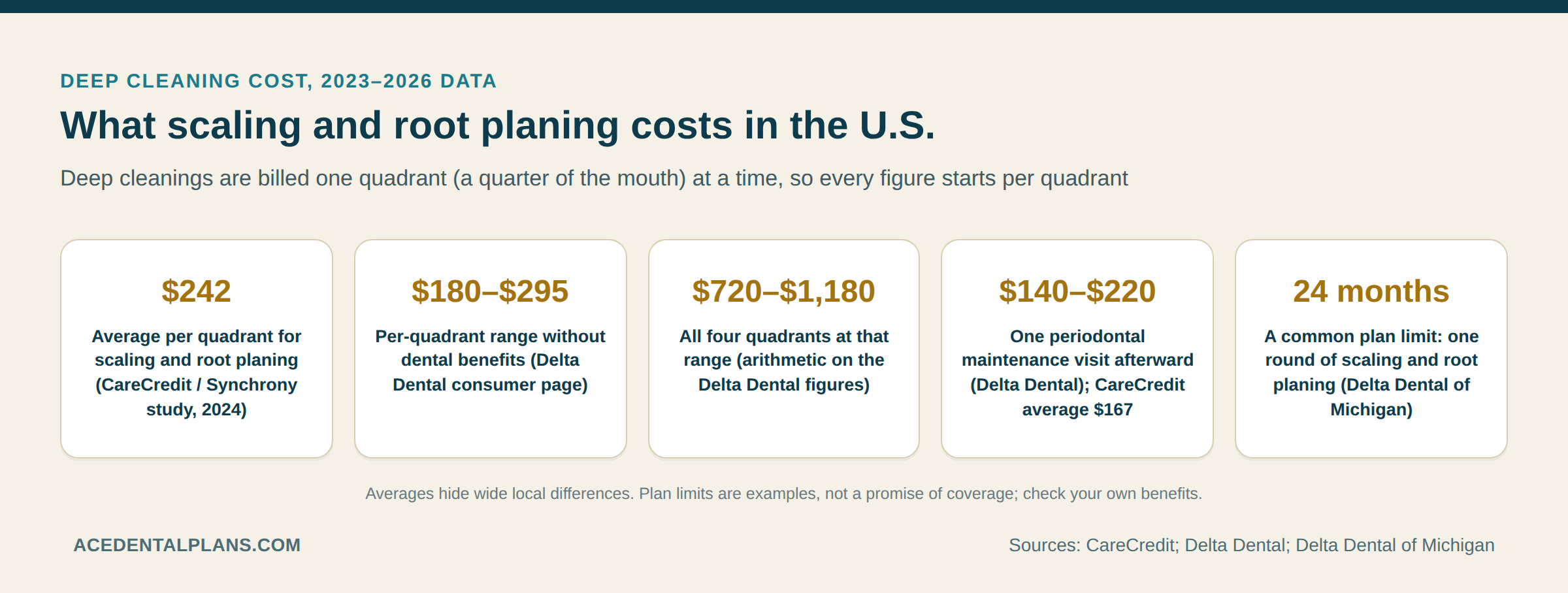 The main reference points for a deep cleaning, per quadrant, with the source on each card.
Deep Cleaning Prices Per Quadrant and for the Whole Mouth
Dental offices divide the mouth into four quadrants: upper right, upper left, lower left, lower right. A deep cleaning is coded and priced one quadrant at a time, which is why a quoted number needs a unit next to it. Two offices can both say “about $250” and mean a quarter of the mouth in one case and half in the other.
Table 1 collects every per-quadrant figure found in a primary or clearly labelled source, then multiplies by four to show the full-mouth equivalent. The last column adds periodontal maintenance, the recurring visit that normally follows. The sources describe different things, so read the second column before comparing any two rows.
| Source and date | What the figure represents | Per quadrant (D4341) | Four quadrants (our arithmetic) | Maintenance visit (D4910) |
|---|---|---|---|---|
| CareCredit / Synchrony cost study, 2024 | National average, private practices | $242 | $968 | $167 |
| Delta Dental consumer page (undated) | Average cost without dental benefits | $180 to $295 | $720 to $1,180 | $140 to $220 |
| Montana Medicaid fee schedule, July 2025 | What the state program pays a dentist | $197.60 (D4342: $106.70) | $790.40 | $79.04 |
| Pacific University dental hygiene clinic, January 2023 | Student clinic fee | $80 (D4342: $50) | $320 | $80 |
| IU Northwest dental clinic (undated) | Student clinic fee | $10 | $40 | $35 |
| NY State Dental Plan out-of-network schedule, October 2024 | Maximum plan reimbursement, not a price | $50 | $200 | $55 |
| healthinsurance.org consumer guide, March 2026 | “Up to $350” without anesthesia; unit not stated | Not stated | Not computed | Not given |
A few notes on reading it. The Montana and New York figures are what a program pays, which is useful for seeing how far a payer’s number can sit below a private fee, but nobody is quoted those amounts at the front desk. The two clinic rows come from educational settings where students treat patients under supervision, so they show the floor of the market, not a typical office.
The last row is the odd one. A healthinsurance.org guide says a deep dental cleaning can cost up to $350 if you don’t need anesthesia, but it doesn’t say whether that is per quadrant or for everything. Since it falls well below the other private-office figures for a full mouth and near them for a single quadrant, it stays out of the totals.
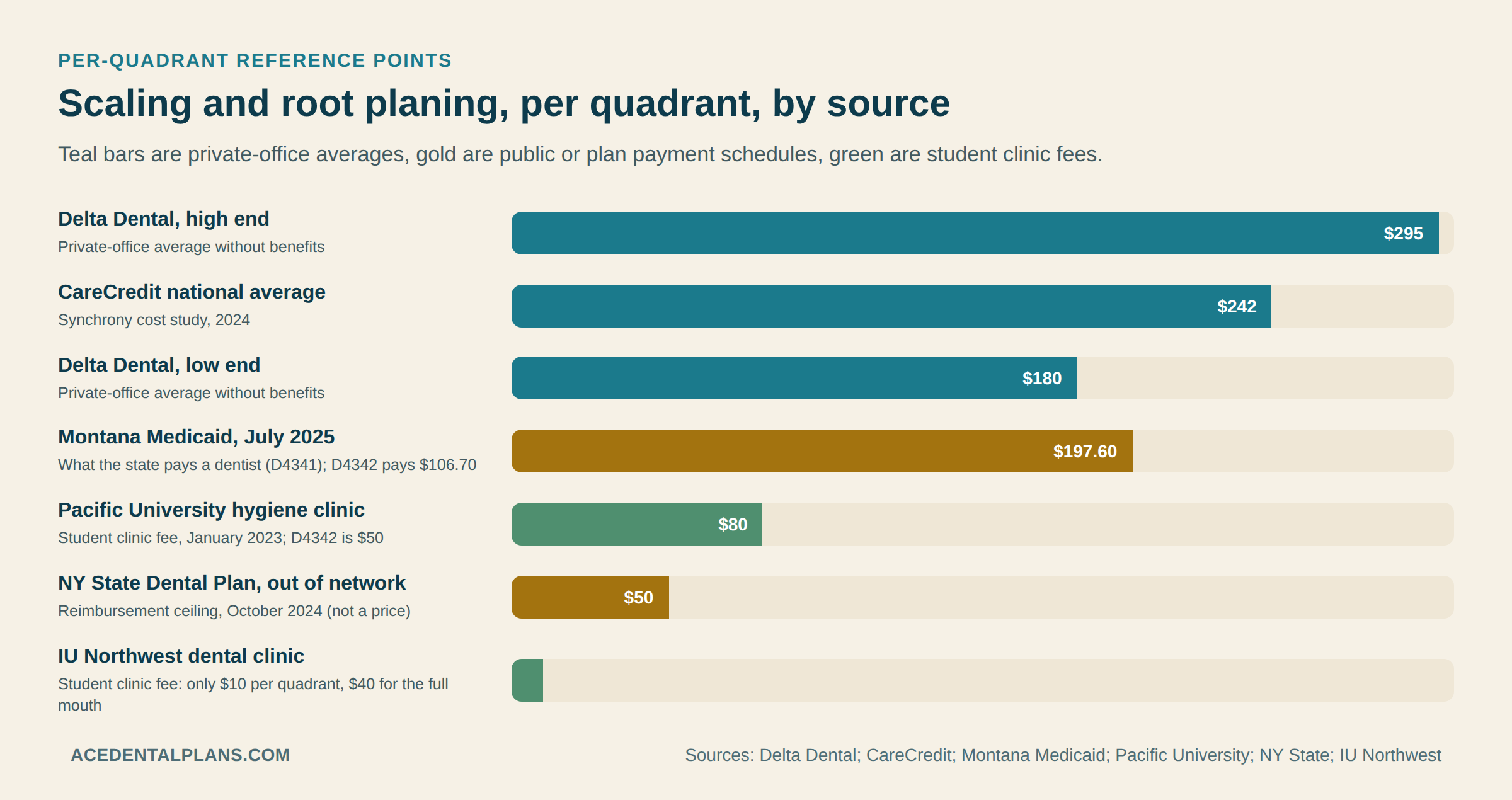 Per-quadrant reference points by source: private-office averages, public payment schedules and student clinic fees.
How a Deep Cleaning Differs From the Cleaning on Your Calendar
A routine cleaning is a preventive visit for gums that are healthy or mildly inflamed. In Delta Dental of Michigan’s billing guidelines, the routine prophylaxis code is the one for patients with healthy periodontal tissues or localized gingivitis. Scaling and root planing, in the same guidelines, is a therapeutic procedure: instrumentation of the crown and root surfaces designed to remove plaque and calculus.
The American Academy of Periodontology describes the two halves this way. Scaling removes plaque and bacterial toxins from beneath the gumline, and root planing smooths the tooth root so plaque and toxins have a harder time sticking again. The National Institute of Dental and Craniofacial Research calls the result a deep cleaning of the affected teeth and says the main goal of gum-disease treatment is to control the infection.
That difference shows up in price. On its consumer page, Delta Dental lists a standard cleaning at $85 to $160 and a deep cleaning at $180 to $295 per quadrant. Four quadrants at those rates cost roughly 4.5 to 14 times a single routine cleaning, depending on which ends of the two ranges you pair. It also explains why many offices ask for a separate appointment: the work tends to take longer and often involves local numbing.
It is not rare. The CDC reports that about 4 in 10 U.S. adults aged 30 or older had mild, moderate or severe periodontitis in 2009–2014 survey data, and says periodontitis cannot be reversed but can be slowed and managed with professional treatment. Whether you need scaling and root planing is a diagnosis the dentist or periodontist makes from measurements, not something a price list can settle.
Quadrant Math: Full-Mouth, Half-Mouth and the Cheaper Code for Fewer Teeth
Two codes cover the procedure. D4341 is scaling and root planing for four or more teeth in a quadrant. D4342 is the same service for one to three teeth in a quadrant. The code on your estimate therefore says something about the chart: a D4342 line means the dentist found only a few teeth in that quadrant that qualify.
D4342 is cheaper, because less of the quadrant is treated. Montana’s Medicaid schedule pays $106.70 for D4342 against $197.60 for D4341, about 54%. Pacific University’s clinic charges $50 against $80, about 63%. Dentistry IQ reports that many insurers base their D4342 allowance on 60% of what they allow for D4341, and the tables below use 60% as a round assumption.
Table 2 turns the Delta Dental range and the CareCredit average into totals for several treatment patterns. Not every patient needs all four quadrants, and some need a mix of the two codes.
| Treatment pattern | At $180 per D4341 quadrant | At $242 (CareCredit average) | At $295 per D4341 quadrant |
|---|---|---|---|
| One quadrant (D4341) | $180 | $242 | $295 |
| Two quadrants (both D4341) | $360 | $484 | $590 |
| Three quadrants (all D4341) | $540 | $726 | $885 |
| Three D4341 plus one D4342 | $648 | $871 | $1,062 |
| Two D4341 plus two D4342 | $576 | $774 | $944 |
| One D4341 plus three D4342 | $504 | $678 | $826 |
| Four quadrants (all D4341) | $720 | $968 | $1,180 |
Every figure is arithmetic. The D4342 quadrants are priced at 60% of the D4341 fee, rounded to the nearest dollar, and no office promised any of these totals. What the table does show is the spread. Between the cheapest and the dearest cell in the four-quadrant row sits $460, and a mixed pattern with several D4342 lines can shave a couple of hundred dollars off a full-mouth total.
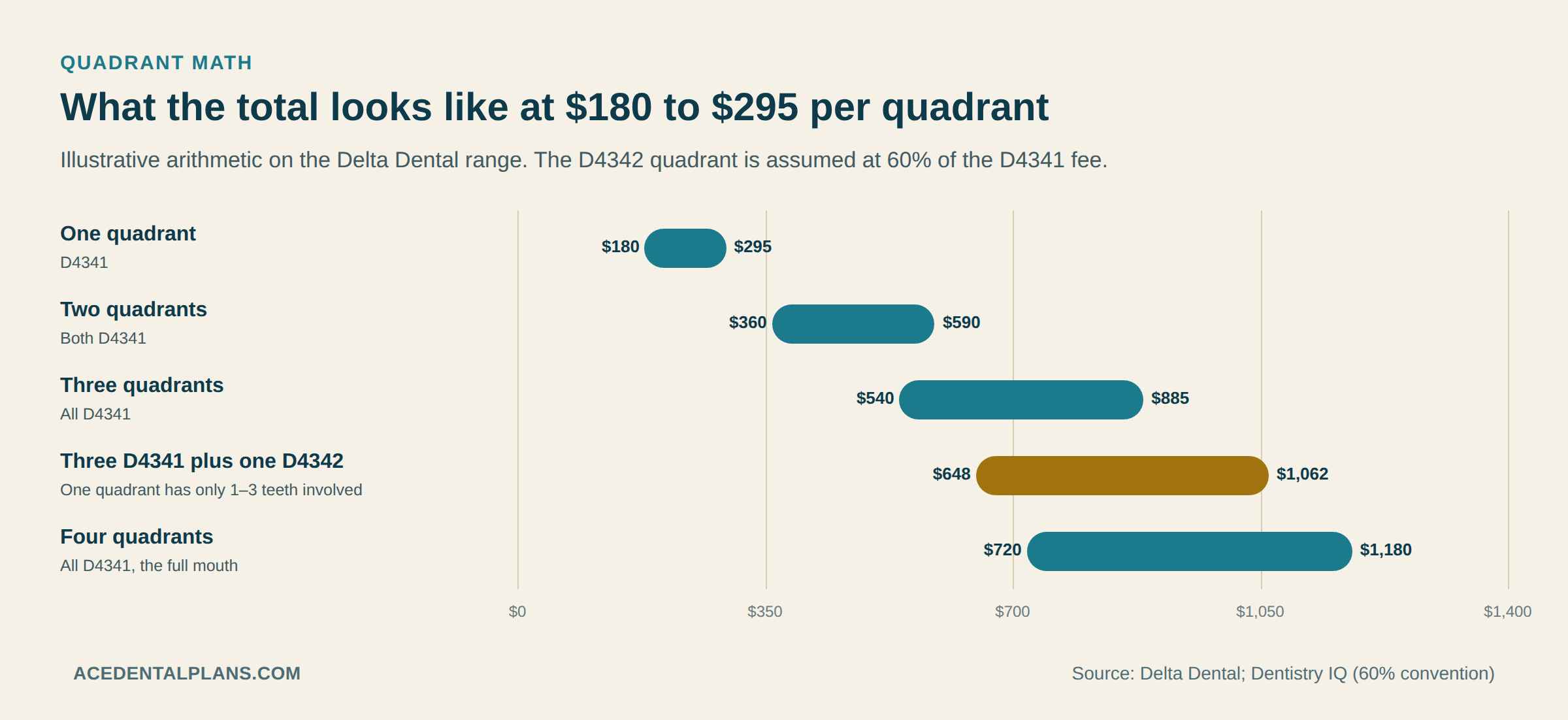 Illustrative totals by number of quadrants treated, using the Delta Dental per-quadrant range.
One Visit, Two Visits or Four: What Scheduling Does to the Bill
Offices schedule scaling and root planing in different ways. Some treat one quadrant per visit, some do a half-mouth at a time (upper right and lower right together, for example), and some finish the whole mouth in one or two long appointments. The clinical research on which approach works better is not dramatic. A Cochrane review, whose search ran through December 2006, concluded that the treatment effects of full-mouth scaling compared with conventional quadrant-by-quadrant treatment are modest, and that the choice should include patient preference and the convenience of the schedule.
From a cost standpoint, the code is per quadrant, so the sum on the estimate should be the same whether the work takes one visit or four. What changes is when the money is due, how many times you are numbed and how many days you take off work. If you are paying out of pocket, ask whether the office collects per visit or in advance, and whether spreading the quadrants across visits changes anything on the fee sheet.
Insurers have their own view of the one-visit route. Billing guidelines from Delta Dental of Michigan ask for extra documentation when three or more quadrants are treated on the same date: preoperative X-rays, periodontal charting, treatment records showing how long the work took, and an explanation of the circumstances that justified finishing in one sitting. Dentistry IQ’s coding advice for same-day four-quadrant treatment is a written narrative showing the time spent on each quadrant, at least 45 minutes per quadrant. Neither is a price, but both explain why a single-visit estimate can come with a note about records and why some offices prefer two appointments.
Anesthesia pushes in the same direction. An article in Dimensions of Dental Hygiene notes that numbing all four quadrants for full-mouth treatment can affect eating, drinking and speaking, and that intermediate-acting local anesthetics give soft-tissue numbness of roughly three to five hours. Whether a given patient is better off with one long visit or several short ones is a call for the clinician.
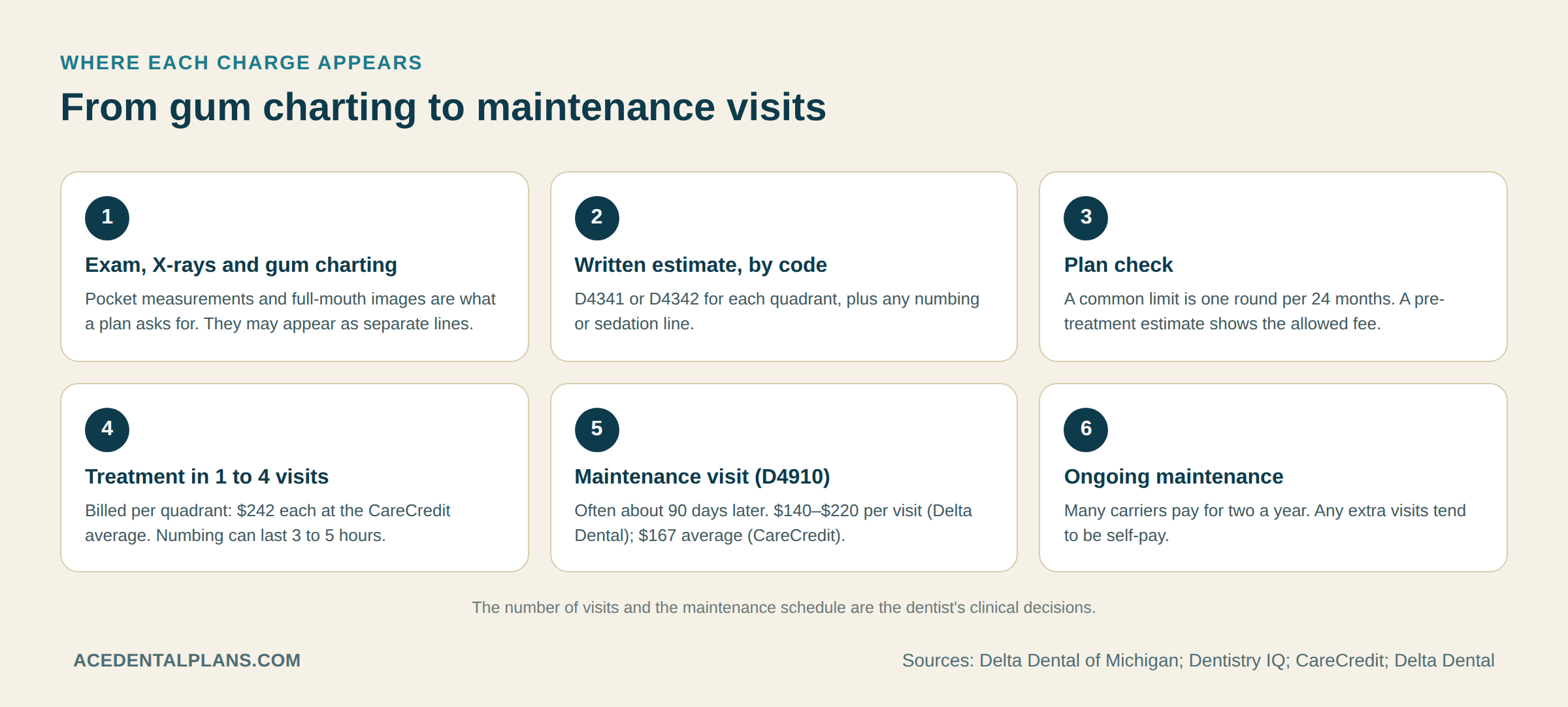 Where each charge appears between the first gum measurements and the maintenance visits that follow.
Numbing, Sedation and Other Lines That Show Up on the Estimate
Ask first whether local anesthesia is in the quadrant fee or listed on its own. No national source turned up that settles how offices bundle it, so the only safe answer is the one on your written estimate. If it is a separate line, it should have a price next to it.
Sedation is a different matter. CareCredit’s 2024 study lists an anesthesia line at $639 without saying what type it covers, so it is a rough marker for the cost of adding more than a local numbing shot, not a price for a specific method. Medicaid payment schedules are more specific: Montana’s July 2025 schedule pays $35.57 for analgesia (nitrous oxide) and lists non-IV sedation at $175.86 for patients 17 and under. Those are what the state pays a dentist, and a private office can charge more or less. If you are anxious enough that the dentist suggests sedation, the quote should name the method and the line price, and the plan may treat it as a separate benefit.
Records are the other recurring extra. A plan that pays for scaling and root planing typically wants full-mouth X-rays and a recent six-point pocket chart (more on that below). If those were not taken at a recent visit, expect an exam, an imaging line or both on the estimate. An antibiotic placed in the pockets or a prescription rinse also belongs to the broader gum-disease pathway, and those add-ons are priced elsewhere.
The Bill After the Bill: Periodontal Maintenance
A deep cleaning is rarely a one-time purchase. The American Academy of Periodontology states that the majority of patients will require ongoing maintenance therapy to sustain periodontal health. That maintenance is billed as periodontal maintenance (D4910), not as a routine cleaning, and it carries its own fee.
Table 1 shows the range. A maintenance cleaning runs $140 to $220 on Delta Dental’s consumer page, CareCredit’s 2024 average is $167, and the lower-fee sources sit at $35 to $80. Dentistry IQ’s coding guidance refers to D4910 as following the initial treatment about 90 days later, and the schedule after that is the dentist’s decision, based on how the gums respond.
That interval turns into an annual figure worth computing before you start. Four visits a year at the CareCredit average come to $668. At the Delta Dental range the same four visits come to $560 to $880. Run that out over two years and the CareCredit-average maintenance ($1,336) is larger than the $968 full-mouth treatment that started it.
One billing quirk is worth knowing. Under Delta Dental of Michigan’s guidelines, a routine prophylaxis is not payable when it is rendered on the same day as periodontal maintenance or as full-mouth scaling and root planing. So if your calendar had a routine cleaning booked for the week of your treatment, the office will probably cancel or convert it, not bill both.
How Plans Usually Class Scaling and Root Planing
Insurance explanations follow a standard order: plan type, deductible and network, coinsurance, annual maximum, then exclusions, waiting periods and frequency limits. Deep cleaning touches every item on that list, which is why it surprises people who assumed “cleanings” were covered in full.
Plan type and network come first. Guardian’s plan guide groups non-surgical periodontal services under basic procedures, which it describes as typically paid at 50% to 70%, in contrast to preventive care at 100%. It lists 100/70/50 and the richer 100/80/50 as common coinsurance formulas, with typical annual maximums of $1,000 to $2,000. A deductible may apply first, and Guardian notes that basic procedures can carry a waiting period of about six months. If the plan uses a PPO network and your dentist is in it, the plan’s allowed fee replaces the office’s standard fee. If not, the plan may pay only a reduced amount, and the balance can be billed to you. New York’s state dental plan, for instance, lists a maximum out-of-network reimbursement of $50 for D4341 as of October 2024.
Frequency is the exclusion that catches people. The standard limit, per Delta Dental of Michigan’s guidelines, is one scaling and root planing occurrence per 24-month period, and Dentistry IQ says most plans pay for it once every two years. If a plan has already paid for your upper right quadrant, a second round for that quadrant inside the window may be denied, and Delta Dental of Michigan says its contracted dentists cannot bill the patient when a request for retreatment is denied. Whether your office is bound by a similar rule depends on its contract.
Table 3 sets out how the related lines are usually handled. The statements come from different carriers and a coding publication, so treat them as common patterns, not as your plan’s rules.
| Line | Common treatment (source) | What to check on your plan |
|---|---|---|
| Scaling and root planing (D4341, D4342) | Grouped with basic procedures, often 50% to 70% (Guardian); commonly once per 24 months (Delta Dental of Michigan, Dentistry IQ) | Coinsurance, deductible, waiting period, last date it was paid for each quadrant |
| Fewer than four teeth in a quadrant (D4342) | Many insurers base the allowance on about 60% of the D4341 amount (Dentistry IQ) | Whether the plan lists D4342 separately |
| Records before treatment | Full-mouth X-rays and six-point pocket charting within the past 12 months (Delta Dental of Michigan criteria) | Whether recent X-rays on file are enough |
| Periodontal maintenance (D4910) | Many carriers cover two a year; further visits are the patient’s (Dentistry IQ) | Class (basic or other), yearly visit limit, whether a routine cleaning shares the count |
| Full-mouth debridement (D4355) | Most carriers give no separate benefit and pay toward a routine cleaning (Dentistry IQ) | Whether a quoted debridement is paid as a cleaning |
| Routine cleaning (D1110) on the same day | Not payable alongside periodontal maintenance or full-mouth scaling (Delta Dental of Michigan) | Whether the visit counts against your two yearly cleanings |
| Original Medicare | Does not cover routine dental services; limited exceptions tied to certain medical treatment (Medicare.gov) | Medicare Advantage dental benefits, if you have them |
| Medicaid (adults) | Adult dental benefits are optional for states, with no federal minimum (Medicaid.gov) | Your state’s adult dental benefit and its periodontal rules |
What a Plan Wants to See Before It Pays for Scaling and Root Planing
Because the procedure treats disease and not just buildup, plans ask for evidence that the disease is there. Clinical criteria published by Delta Dental of Michigan (effective December 2024, revised November 2025) show how specific the evidence can be. The criteria call for periodontal probing depths of 4 millimeters or greater on each involved tooth, radiographic evidence of bone loss on each involved tooth, and clinical attachment loss of at least 1 to 2 millimeters. Supporting documents include full-mouth X-rays with bitewings and six-point pocket charting done within the past 12 months.
Calculus alone does not meet the bar. The same criteria list root-surface calculus seen on radiographs only as a supporting finding. They give gingivitis without loss of attachment, and calculus without loss of attachment, as examples of situations where a request may be disapproved. They also say D4341 requires that at least four teeth in the quadrant meet the criteria, and that a quadrant with only one to three qualifying teeth must be coded D4342.
Other carriers set their own rules, and only Delta Dental of Michigan’s were available in writing here, so use it as an example of the kind of evidence a plan can ask for. Dentistry IQ’s coding advice points the same way, listing missing documentation and shallow pocket depths (not greater than 4 millimeters) among the common reasons claims are denied, alongside an annual maximum already used up.
What does that mean for a patient holding an estimate? Three things. First, a request to the plan before treatment (a pre-treatment estimate, sometimes called predetermination) shows the allowed fee and whether the plan accepts the codes. Second, if the chart shows inflammation without the pocket depth and bone loss the criteria demand, the dentist may propose a different service. Montana’s Medicaid schedule, for example, pays $98.80 for a cleaning coded for gingival inflammation (D4346) against $197.60 for a D4341 quadrant. Third, whether any of this is the right clinical call is for the dentist or periodontist, and a plan’s criteria are a payment rule, not a diagnosis.
A Worked Estimate: One $880 Treatment, Three Possible Bills
The following example uses round numbers to show how classification and documentation change what you pay. It is hypothetical throughout.
If the plan treats the procedure as basic and pays 80%: you owe the $50 deductible first. The plan pays 80% of the remaining $830, which is $664, and you owe the other 20% ($166). Your total is $216.
If the plan treats it as major and pays 50%: the deductible is the same $50. The plan pays 50% of $830, which is $415, and you owe $415. Your total is $465.
If the plan denies it: the chart did not meet its criteria, or the 24-month limit was already used. The allowed fee is $880, and whether the office may bill you for it depends on its contract with the plan.
If the office were out of network and charged $242 per quadrant against the plan’s $220 allowance, the $22 difference on four quadrants ($88) could be added to each scenario, depending on the plan’s rules for out-of-network claims. This is a hypothetical built from the Guardian percentages and the fee levels discussed above, not a quote.
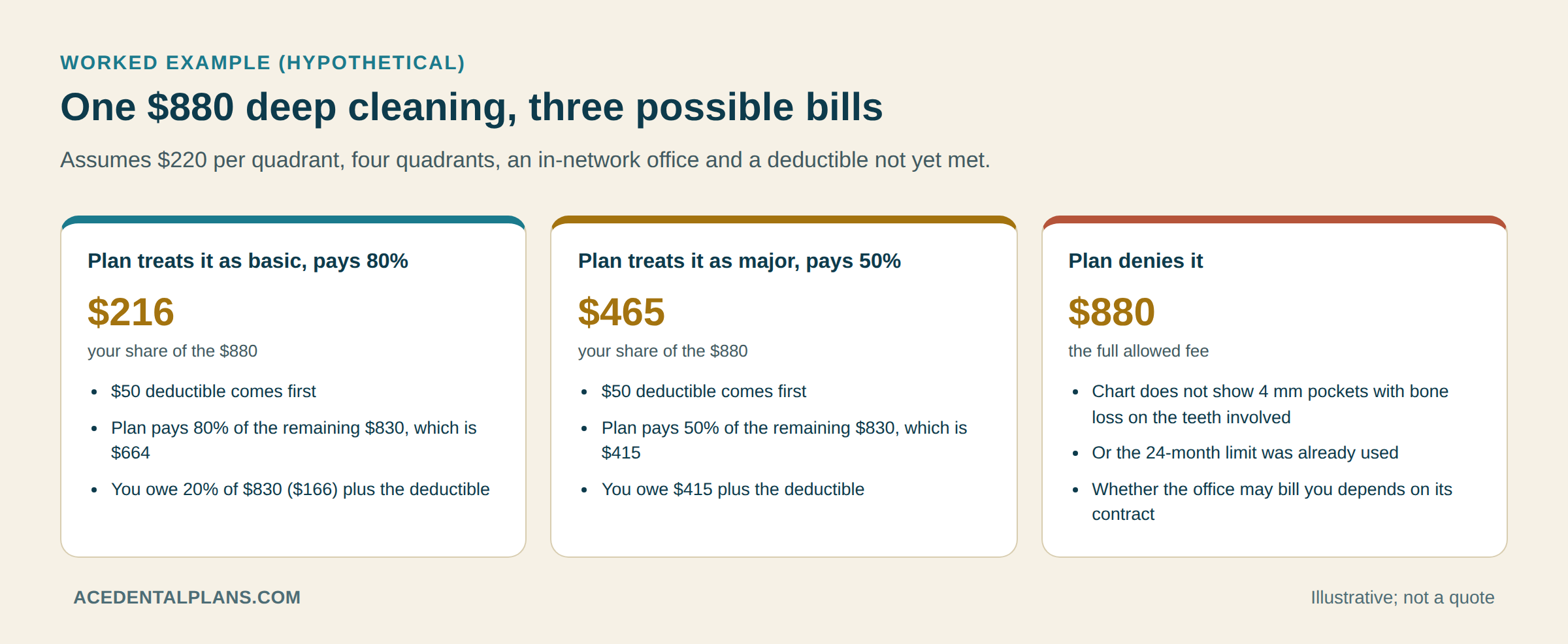 The same hypothetical $880 estimate under three different plan outcomes.
The gap between $216 and $880 is why the question “does my insurance cover deep cleaning?” has no useful one-word answer. The better version is: how does my plan classify D4341, what percentage does that class pay, and has it paid for these quadrants in the last 24 months?
The Annual Maximum, the Calendar and the Case Against Splitting
Most dental plans cap what they pay each plan year. Guardian puts a typical annual maximum at $1,000 to $2,000 per member, and everything above the cap falls to the patient. A deep cleaning at $880 plus a few maintenance visits can take a big share of a $1,000 plan before any other work is done.
That makes timing tempting. If a plan year resets on January 1, why not do two quadrants in December and two in January? Sometimes it helps. Sometimes it doesn’t, because the deductible resets as well, and the arithmetic needs to be run before the calendar is used as a strategy.
All four quadrants now: $880 × 80% would be $704, but only $700 of the maximum remains, so the plan pays $700 and you pay $180.
Two quadrants now, two in January: in December, $440 × 80% = $352, so you pay $88. In January the new year brings a fresh maximum and a fresh deductible: $50 deductible, then 80% of the remaining $390 is $312, so you pay $50 + $78 = $128. The two-part total is $216, which is $36 more than doing everything at once.
In this setup splitting costs more, because the maximum barely bites and the second deductible does. With a plan that has used most of its maximum, the answer flips. This is a hypothetical, and whether to treat in stages is a clinical decision first.
Two cautions. Dentists schedule scaling and root planing around the disease, not around plan renewal, and waiting on gum treatment to save money is a clinical judgment for the person who has measured the pockets. And the 24-month frequency limit, where a plan has one, means the quadrants you complete now may not be payable again for two years.
Paying Without Coverage: Lower-Fee Routes for Gum Treatment
Table 1 already shows how wide the range is. A full-mouth deep cleaning costs $968 at the CareCredit average, $320 at Pacific University’s student hygiene clinic (January 2023 fee schedule) and $40 at IU Northwest’s clinic. Those clinics are limited. IU Northwest says it provides preventive and scaling services but not restorative work such as fillings or extractions, and Pacific University’s page notes there is no fee for the screening visit and payment is expected on the day of service.
Dental schools with advanced clinics are another route. CU Anschutz says its patient care is typically 30% to 50% below nearby private practices, and up to 45% below for its Graduate Periodontics Clinic. It does not publish a fee list on that page, so the real figure comes from a call. Appointments in training settings are supervised and may take longer than a private office visit.
Public programs are less certain. Original Medicare does not cover routine dental services such as cleanings, according to Medicare.gov, with narrow exceptions tied to certain medical treatments. Medicaid.gov says states decide what dental benefits adults get, with no federal minimum, while children are covered for dental care through the EPSDT benefit. In some states the adult benefit includes periodontal treatment and in others it doesn’t, so ask the state program for its current dental benefit list.
Tax rules help at the margin. IRS Publication 502 (for 2025 returns) says amounts paid for the prevention and alleviation of dental disease can count as medical expenses, but only the portion above 7.5% of adjusted gross income is deductible on Schedule A. Whether a health savings account or flexible spending account will reimburse a particular charge is up to the account administrator, so ask before relying on it.
Questions to Ask Before You Agree to the Estimate
- Which code is on each quadrant, D4341 or D4342, and how many teeth does each cover?
- Is local anesthesia included in the quadrant fee, or listed as its own line? If sedation is suggested, which method and what price?
- Are the exam, X-rays and pocket charting already done, or are they additional lines on this estimate?
- Will you send a pre-treatment estimate to my plan, and can I see the plan’s allowed fee before treatment?
- How does my plan class this procedure, and has it paid for any of these quadrants in the past 24 months?
- How many visits are planned, and is payment due per visit or in advance?
- What will the first periodontal maintenance visit cost, and how many a year does the plan pay for?
- If the plan denies the claim, what do I owe, and does the office have a cash price or a payment arrangement?
Write the answers next to the estimate. If two offices give different answers to the first three, the totals aren’t comparable yet.
Frequently Asked Questions – Deep Cleaning Cost
Is deep cleaning priced per tooth or per quadrant?
Per quadrant. The codes are D4341 for four or more teeth in a quadrant and D4342 for one to three teeth, so the estimate shows one line per quarter of the mouth. A quadrant with only a few affected teeth is priced lower than a full one.
How much is a full-mouth deep cleaning without insurance?
At the CareCredit 2024 average of $242 per quadrant, four quadrants come to $968. At Delta Dental’s $180 to $295 per-quadrant range, the total is $720 to $1,180. Clinic fee schedules can be far lower, and your local office may differ from these averages.
Why was I quoted only half the mouth?
Dentists usually code and plan treatment by quadrant based on where the pockets and bone loss are. Teeth in other quadrants may not meet the criteria, or the dentist may be treating the mouth in stages. Ask whether the remaining quadrants are expected to be needed later.
Is a deep cleaning the same thing as a regular cleaning with a higher price?
No. A routine cleaning is a preventive service for healthy gums or mild gingivitis. Scaling and root planing treats the surfaces below the gumline in people with gum disease, takes longer and is billed under different codes with a different fee.
Does dental insurance cover deep cleaning?
Many plans cover some of it. Guardian, for instance, puts non-surgical periodontal services in the basic class, which it describes as typically paid at 50% to 70%. A deductible, a waiting period, a once-per-24-months frequency limit and documentation rules can all reduce what is paid.
Can I get a regular cleaning on the same day as a deep cleaning?
Plans commonly won’t pay for both. According to Delta Dental of Michigan, a routine prophylaxis is not payable when done the same day as full-mouth scaling and root planing or periodontal maintenance. Your office will likely replace the routine cleaning with the deep cleaning or the maintenance visit.
How often can scaling and root planing be done?
Plans often allow it once per 24 months, according to Delta Dental of Michigan and Dentistry IQ. That is a payment limit, not a clinical rule. How often you need treatment depends on your gums and the dentist’s findings.
Why do I need maintenance cleanings afterward, and what do they cost?
The American Academy of Periodontology says most patients need ongoing maintenance to sustain periodontal health. Periodontal maintenance (D4910) is priced above a routine cleaning: $140 to $220 at Delta Dental and $167 on average at CareCredit.
Does Medicare cover deep cleaning?
Original Medicare does not cover routine dental services such as cleanings, according to Medicare.gov. It makes narrow exceptions when dental care is tied to certain covered medical treatment, for example an exam before a heart valve replacement. Medicare Advantage plans vary, so check the plan’s own benefits.
Is anesthesia included in the price of a deep cleaning?
It depends on the office. Some quote local numbing inside the quadrant fee and others list it separately. For sedation beyond local anesthesia, CareCredit’s 2024 study lists an anesthesia line at $639 without naming the type, so ask for the method and price in writing.
Can I deduct deep cleaning costs on my taxes?
Possibly. IRS Publication 502 treats the prevention and alleviation of dental disease as a medical expense, but you can deduct only the part of your total medical and dental costs above 7.5% of adjusted gross income. A tax professional can tell you whether it applies to your return.
Sources and Disclaimers
Price figures come from the sources listed below and carry their own dates: the CareCredit figures are from a 2024 national cost study, the Delta Dental range is from an undated consumer page, and the fee-schedule rows are dated in Table 1. National averages hide large local differences, and several sources describe payments, not prices. The coverage mechanics come from carrier billing guidelines, a coding publication and a consumer plan guide, and your plan may differ. All dollar examples built on these figures, including the totals in Table 2 and the three hypothetical bills, are the author’s arithmetic and are labelled as illustrative. Confirm pricing with the dentist and benefits with your insurer before treatment.
- CareCredit — Average cost of dental procedures (2024 Synchrony cost study)
- Delta Dental — Dental cleanings: cost and insurance coverage
- healthinsurance.org — How much do dental cleanings cost without insurance?
- Delta Dental of Michigan — Prophylaxis and root planing code and billing guidelines
- Delta Dental of Michigan — Clinical criteria for scaling and root planing
- Dentistry IQ — Coding for basic periodontal treatment
- Dentistry IQ — Dental coding: D4341 and D4342 scaling and root planing
- Guardian — Choosing a dental insurance plan
- Montana Healthcare Programs — Dental services fee schedule, effective July 1, 2025
- New York State Department of Civil Service — Dental out-of-network reimbursement schedule, October 1, 2024
- Pacific University — Dental hygiene clinic services and fees
- Indiana University Northwest — Dental clinic services and fees
- CU Anschutz School of Dental Medicine — Dental fees
- American Academy of Periodontology — Non-surgical periodontal treatments
- NIDCR — Periodontal (gum) disease
- CDC — About gum (periodontal) disease
- Cochrane Library — Full-mouth disinfection for the treatment of adult chronic periodontitis
- Dimensions of Dental Hygiene — Ask the expert: local anesthesia and scaling and root planing (2015)
- Medicare.gov — Dental services
- Medicaid.gov — Dental care
- Internal Revenue Service — Publication 502, Medical and Dental Expenses
Important Information and Disclaimers
This article is general educational information. By using it, you accept the limits described below.
Not dental or medical advice
Nothing on this page is a diagnosis, a treatment recommendation or a substitute for an examination by a licensed dentist or physician. Reading this article does not create a dentist-patient or doctor-patient relationship. Only a licensed professional who has examined you and reviewed your history can tell you what your mouth needs. Do not delay, skip or stop professional care because of something you read here.
Prices are estimates, not quotes
Cost figures are ranges reported by the third-party sources cited in this article. Actual prices depend on your location, the provider, the complexity of your case, the materials used, the date of service and other factors, so what you pay may be higher or lower. A written treatment plan and fee estimate from the dental office is the only reliable number for your situation.
Insurance and plan examples are illustrations
Examples that use named amounts or percentages are hypothetical. Real benefits depend on your plan, network, waiting periods, annual maximum, deductible and the insurer’s rules at the time of treatment. A pre-treatment estimate or benefits check is not a promise of payment. Confirm the details with your insurer or plan administrator in writing.
Not insurance, legal, tax or financial advice
AceDentalPlans is an information publisher. Nothing here is insurance, legal, tax, investment or other professional financial advice, and nothing here recommends a particular provider, insurer, lender, discount plan or financing product. Company and product names belong to their owners and appear for identification only. Read the terms of any loan, financing offer or plan before you sign, and ask a qualified professional if you need advice on your own circumstances.
Third-party sources
This article cites government agencies, professional associations, insurers, lenders and other outside organizations. We do not control those sources. Their content can change, move or disappear, and listing a source is not an endorsement of it or of anything it sells.
No warranty
We aim for accuracy, but this article is provided “as is,” without warranties of any kind, express or implied, including warranties of accuracy, completeness, timeliness or fitness for a particular purpose. Some information may be out of date or contain errors by the time you read it.
Limitation of responsibility
To the fullest extent permitted by law, AceDentalPlans and its owners, authors and contributors are not responsible or liable for any loss, cost, injury, health outcome or other damage that results from using this article or relying on it. You are responsible for your own decisions about your care, your coverage and your money.
How this article is written
This article follows AceDentalPlans’ answer-first, U.S.-focused editorial approach. It uses conditional language for insurance, because coverage depends on the specific plan, and it names its sources so that you can read them yourself.