
Dental Financing vs Payment Plans. Depending on how it is structured, a $2,400 dental bill can end up costing $2,400 or close to $4,000. The label on the plan (“payment plan” or “financing”) rarely tells you which. The gap comes from who lends the money, how interest is charged, and whether a promotional rate is true 0% or deferred. Read the interest clause, not the plan name.
This guide explains the mechanics that separate an office payment plan from third-party dental financing: the lender, the interest method, fees, credit checks, credit reporting and the contract terms worth reading. It works through total-cost examples built on published rates. It does not rank every way of funding dental work, and it does not tell you which treatment to choose; that is a conversation with your dentist.
Key Takeaways
- “Payment plan” and “financing” are not legal categories. What matters is who holds the debt (the dental office, a card issuer, or a lender) and what the written agreement says about interest.
- “No interest if paid in full” is deferred interest. If any balance remains when the promotion ends, interest can be charged back to the purchase date. A “0% intro APR” charges interest only on what is left.
- In a CFPB example, a $400 purchase with $100 still unpaid when the promotion ended left $100 owed under a true 0% APR offer and $165 under deferred interest.
- On a hypothetical $2,400 treatment, the total paid ranges from $2,400 (interest-free, paid on schedule) to about $3,957 (36 months at 35.99% APR).
- A soft credit check does not affect your scores; a hard inquiry can. Some dental installment lenders report your payments to credit bureaus, so on-time payments help and missed ones hurt.
- Divide the balance by the number of promotional months, round up, and treat that figure, not the card’s minimum payment, as your required monthly payment.
 Five numbers that explain why two “monthly payment” offers for the same treatment can differ by more than $1,500.
The Short Answer: What Costs Less Depends on Three Clauses
Ranked by total cost, the usual order for the same treatment is simple. An interest-free plan you pay on schedule costs the price on the estimate and nothing more. A true 0% APR loan costs the same as long as you meet its conditions. A deferred-interest card paid off inside the promotional window also costs the price, and a fixed-rate installment loan costs the price plus interest from day one. At the bottom of the list sits a deferred-interest card that you miss by even a small balance.
Three questions place any offer on that list, and they take a minute to ask. Who is lending the money? Does interest start on the day of treatment, and is it charged on the whole amount or only on what you still owe? And what happens to the rate if you are late or short? Every other detail (credit tiers, term length, enrollment fees) is a refinement of those three.
The honest answer to “which costs less” is conditional. For a patient who can clear the full balance inside a 6-, 12- or 18-month promotion with room to spare, deferred interest costs the same as true 0%. For a patient whose budget is tight, the same promotion carries a retroactive penalty, and a plain fixed-rate loan with a known total can be the cheaper outcome in practice. The sections below give you the arithmetic to see which side of that line you are on.
Scope note: this article compares the structure of payment plans, cards and loans. Cash discounts, membership plans, health savings accounts, dental schools and public programs are different routes with their own trade-offs, and they are only mentioned here where they change the financing math.
Who Lends the Money: Four Structures Behind the Words “Payment Plan”
Front desks use “financing” and “payment plan” loosely, sometimes for the same product. Underneath, there are four arrangements, and the difference is who you owe.
The first is the in-house plan, the arrangement most patients picture when a receptionist offers to “work something out.” The American Dental Association describes this as “internal financing”: the practice acts as the lender, collects the payments, and may earn interest and fees for waiting. The ADA also warns practices that doing so brings federal and state lending rules and disclosure duties, and that managing a program takes real time. In practical terms, the person you owe is the person who will see you at the next cleaning. Terms are whatever the office writes. That can mean generous (a few equal payments and no interest at all) or ordinary (a stated APR, a late fee, and a down payment due before the work begins).
The second is a medical credit card. The most widely advertised is CareCredit, issued by Synchrony Bank, and the CFPB’s 2023 report named Wells Fargo and Comenity as the other main issuers at the time. You apply once, the card works at enrolled providers, and the dentist is typically paid within two business days. From then on the debt is between you and the bank. It is revolving credit: the same account can be used again, and promotional offers are attached to individual purchases.
The third is a third-party installment loan, a one-time loan for a specific treatment. The CFPB describes these as generally offered before treatment and authorized to cover that treatment only, for example a root canal. Sunbit says its loans are made by TAB Bank. Cherry describes itself as a platform that is “not a bank or a lender” and routes applications to partner lenders. Payments are fixed, and the term and APR are set when you sign.
The fourth is a loan or card you arrange yourself, such as a personal loan from a bank or credit union, or a general-purpose credit card. The dentist sees a patient who pays in full at the visit, and your debt has nothing to do with the office.
| Structure | Who holds the debt | How interest typically works | Application credit check | Reported to credit bureaus? |
|---|---|---|---|---|
| In-house payment plan | The dental practice | Set by the office: from no interest to a stated APR. An office that regularly offers plans of more than four installments, or with a finance charge, can fall into the creditor role under federal rules | Varies; many offices decide on their own judgment of the patient | Varies; ask. Unpaid balances can be sent to collections |
| Medical credit card (CareCredit and similar) | The card issuer (a bank) | Promotional periods of 6 to 24 months, either deferred interest or reduced fixed APR; a high standard purchase APR applies otherwise | Prequalification is described as having no impact on scores; the formal application can be a hard inquiry, so ask | Ordinarily as a credit card account; confirm with the issuer |
| Third-party installment loan (Sunbit, Cherry and similar) | A partner bank or lender | Fixed payments over a stated term; APRs advertised from 0% up to 35.99% | Soft check at application, according to both companies | Yes, according to both companies’ own pages |
| Personal loan or credit card you arrange | Your bank, credit union or card issuer | Fixed APR for a loan; variable APR on a card, with interest from the day of purchase unless a 0% offer applies | Often a hard inquiry once you formally apply | Yes, as a loan or card account |
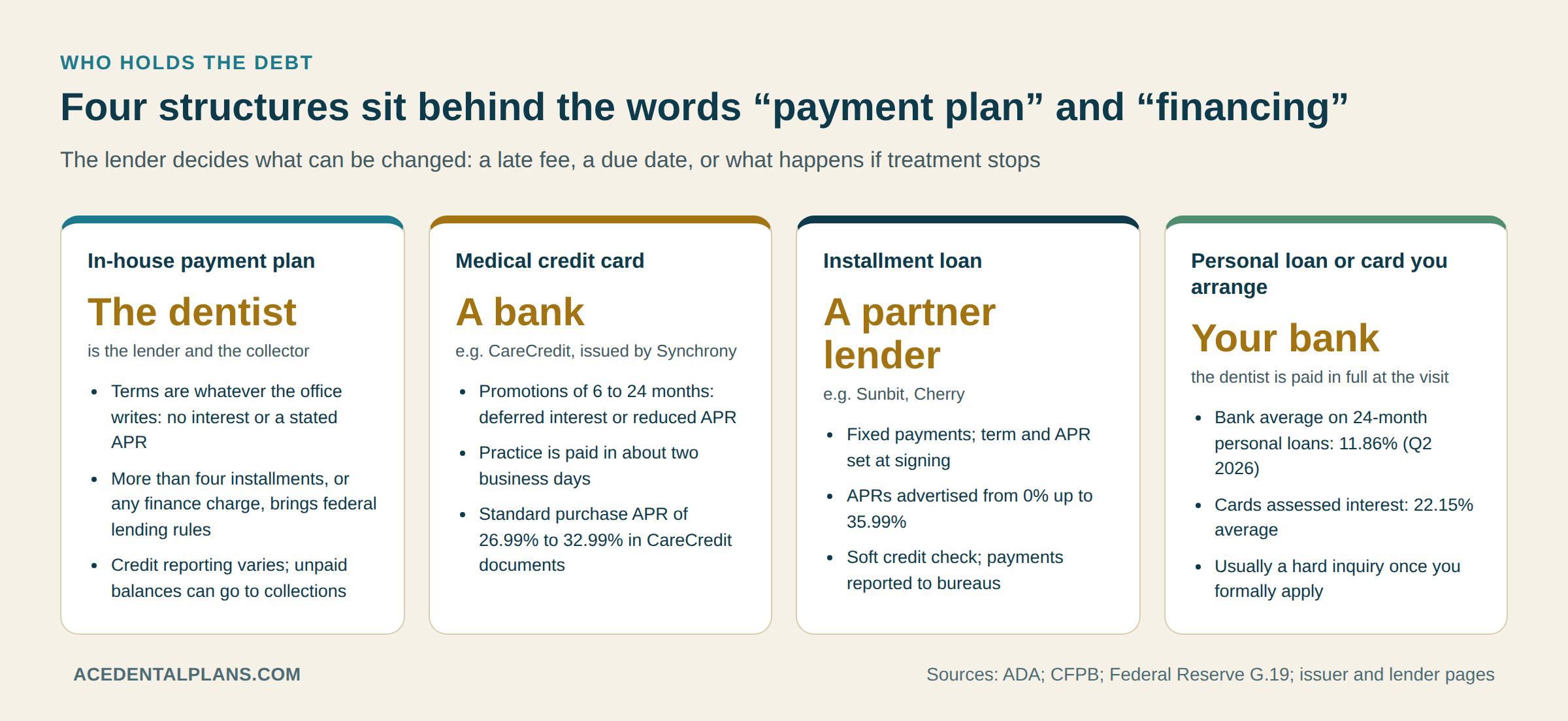 Who you owe changes who you call about a billing error, a hardship request or a treatment that is cancelled.
Why does the lender matter in dollars? Because each lender can only change the terms it owns. An office can waive a late fee on its own plan with a phone call. A card issuer follows its cardholder agreement, and a personal-loan lender follows its note. If treatment stops halfway (a referral to a specialist, a change of plan, a move), the dentist cannot cancel the bank’s loan. Ask in writing, before you sign, how an unfinished or revised treatment plan is handled, because the answer differs by structure.
Interest, APR and Fees: Reading the Real Price of Borrowing
An interest rate is the price of borrowing the principal. The CFPB defines APR as the interest rate plus any additional fees the lender charges, including origination charges, which is why it is the number to compare. Its advice is blunt: compare APRs to APRs, not APRs to interest rates, because the two are not the same thing. Lenders must give you the APR under the Truth in Lending Act before you commit.
A worked illustration shows how much a fee can move the real price. Suppose a lender offers $2,400 for 24 months at 11.86% interest, which gives a payment of about $112.82. Now suppose the lender keeps a 6% origination fee ($144) from the amount you receive, so you get $2,256 but still repay $112.82 a month. The interest rate hasn’t changed, but the APR has: solved from those cash flows, it comes to about 18.2%. This is a hypothetical built on one published average, not a quote, but the pattern is general. A lower headline rate with a fee can cost more than a slightly higher rate with none.
Fees in dental financing show up in several places. Some are charged to you: origination or processing fees on certain loans, late fees on cards and loans, returned-payment fees. Others are charged to the practice, which matters for the next section. Sunbit, for instance, states that patients pay “no add’l fees, deferred interest, or penalties” and that its fee falls on the practice. That is a company statement, and the loan contract is the document that decides it.
What rates are plausible? Three published reference points help. The Federal Reserve’s G.19 release reports that commercial banks’ average rate on 24-month personal loans was 11.86% in the second quarter of 2026. Credit cards assessed interest averaged 22.15% in the same quarter (20.94% across all accounts). The Fed’s figures are simple averages of banks’ most common rates, so a borrower with a thin credit file should expect to land above them. Against that, Sunbit and Cherry both advertise APRs from 0% up to 35.99%. The CFPB’s 2023 report called 26.99% the typical APR on a medical credit card, against roughly 16% for general-purpose cards at the time. A CareCredit cardholder-terms document reviewed for this guide lists a 32.99% purchase APR. Terms are account-specific and change. Read your own agreement.
One more mechanical point. On a fixed-payment loan, interest is charged on the balance you still owe, so early payments are mostly interest and later ones mostly principal. Pay a fixed-rate loan off early and you skip the interest that hasn’t accrued yet, provided the contract has no penalty for doing so, which is worth confirming rather than assuming. That is worth a direct question before signing: “Is there any fee or penalty for paying this off early?”
Deferred Interest Versus True 0%: Why the Last Dollar Can Cost So Much
These two offers sound identical on a brochure and behave very differently on a statement. A “0% intro APR on purchases for 12 months” means no interest accrues during the promotion; when it ends, you pay interest only on whatever remains, from that day forward. A “no interest if paid in full within 12 months” offer is deferred interest. Interest quietly accumulates from the purchase date, and it is charged only if the full balance isn’t cleared in time. The CFPB’s plain-language explanation puts the weight on the word “if.”
The bureau’s own example uses a $400 television and $25 monthly payments, so $300 is paid after 12 months. Under a true 0% APR offer, $100 remains and no interest has been charged. Under deferred interest, $65 of accrued interest lands on the account at once, and the amount owed is $165. The remaining balance is identical. The penalty for being short is not.
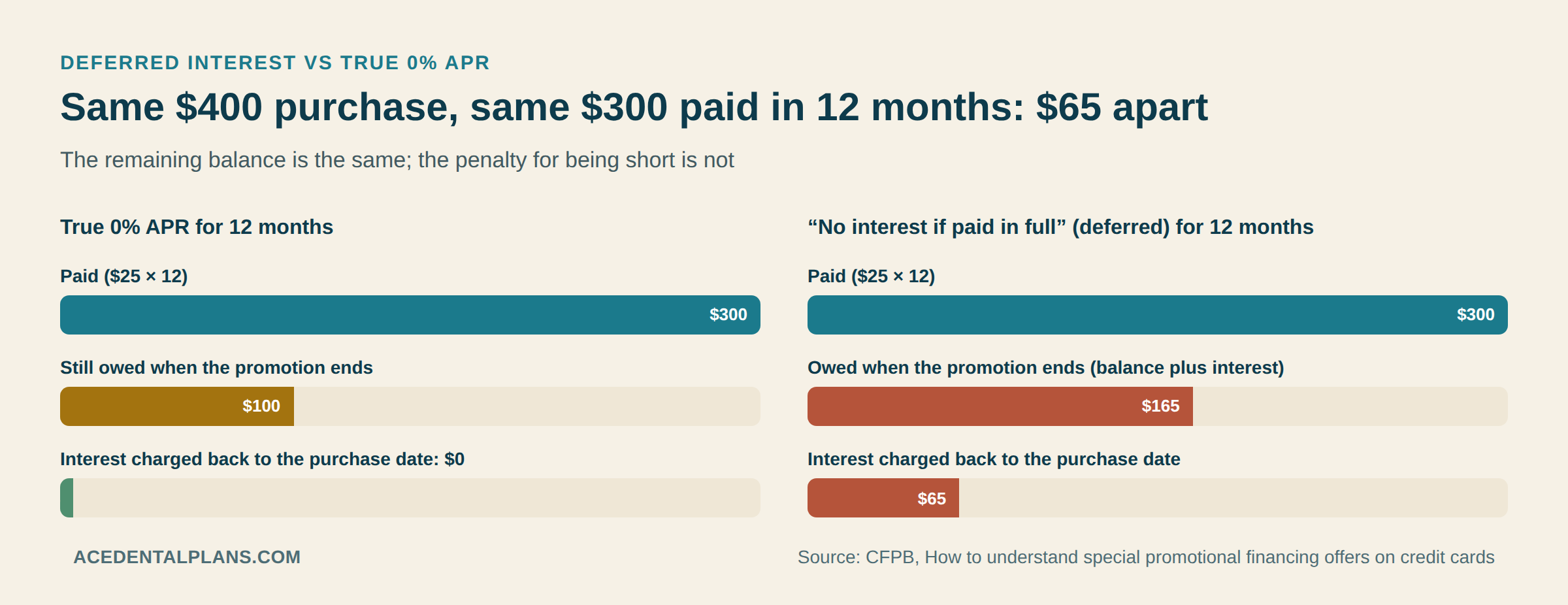 Same purchase, same $300 paid, two different balances. The difference is $65 of interest that deferred interest charges back to day one.
Dental bills make the effect larger because the amounts are larger. Synchrony, the issuer behind CareCredit, publishes its own worked example: a $1,200 purchase on a six-month deferred-interest promotion at 26.99% APR. A cardholder who sends six $200 payments owes nothing extra. One who pays only the minimums finishes the six months with $982 still owing plus $152 of accrued interest, and that interest is billed in a lump.
| Scenario (source) | Purchase and promotion | Paid during promotion | Owed when promotion ends | Interest charged at the end |
|---|---|---|---|---|
| True 0% APR, small shortfall (CFPB example) | $400, 12 months | $300 ($25 × 12) | $100 | $0 |
| Deferred interest, same shortfall (CFPB example) | $400, 12 months | $300 ($25 × 12) | $165 | $65 |
| Deferred interest, equal payments (Synchrony example) | $1,200, 6 months, 26.99% APR | $1,200 (6 × $200) | $0 | $0 |
| Deferred interest, small payments with a final payoff (Synchrony example) | $1,200, 6 months, 26.99% APR | Minimums for five months, then about $1,017 | $0 | $0 |
| Deferred interest, minimum payments only (Synchrony example) | $1,200, 6 months, 26.99% APR | About $33 to $39 a month | $1,134 ($982 balance plus interest) | $152 |
The CFPB looked at this pattern across the market. Its 2023 report found that consumers paid about $1 billion in deferred interest on healthcare purchases between 2018 and 2020. That sat on almost $23 billion financed through cards and loans with deferred-interest terms, across more than 17 million purchases. At the summary level, the report also put deferred-interest charges at roughly one in five purchases over 2015 to 2020, and about 34% for borrowers with credit scores below 619. Those figures cover all healthcare, not dental alone, but dentistry is one of the named uses.
Dental Financing vs Payment Plans. The report’s own hypothetical is close to a dental one. A patient on a medical credit card with a six-month promotion may pay $400 a month for six months and owe no interest. If the balance isn’t cleared at the six-month mark, interest at 26.99% runs from the purchase date. The CFPB says many medical credit cards offer deferred interest for between six and eighteen months, which overlaps the 6-, 12-, 18- and 24-month options CareCredit lists.
How to tell which kind of offer you have
Look at the sentence that describes the promotion, because the wording separates the two. “No interest if paid in full within X months” and “interest will be charged from the date of purchase if the promotional purchase is not paid in full” are deferred interest. “0% intro APR for X months” and “reduced APR” are not. A third wording ties a 0% rate to behavior. Cherry’s page says the 0% offer stays in place for the full plan “as long as you make on-time payments,” so a late payment is the trigger to ask about. And Sunbit states that its patients face no deferred interest at all, though its plans can carry APRs up to 35.99%. Neither of those is automatically better; they just fail in different ways.
There is one protection worth knowing. Under the federal credit card payment-allocation rule, any payment above the minimum normally goes to the balance with the highest APR. For a deferred-interest balance, that order flips in the last two billing cycles before the promotion ends: excess payments go first to the deferred-interest balance. The rule can’t rescue you from a plan that starts too late, but it means a large final-two-month payment is applied where you intend it.
When a Dentist’s Payment Plan Becomes a Regulated Loan
An office that lets you pay in a few installments isn’t necessarily running a credit business. Regulation Z implements the Truth in Lending Act. It defines a creditor as a person who regularly extends consumer credit that is subject to a finance charge or is payable by written agreement in more than four installments, not counting a down payment. The regulation contains additional tests, so this is a description rather than legal advice, but it explains a pattern that patients see. A plain split of the bill into two, three or four payments with no charge for waiting often sits outside the lending rules. A twelve-month schedule signed on paper, or any plan with a fee for paying over time, moves toward the regulated end.
What follows from that is paperwork. The ADA tells practices that offer financing to make proper disclosures under state and federal law. It notes that the third-party model shifts that compliance work to the outside lender. As a patient, you can use the same logic in reverse. If the office is extending credit, you should be able to find in the agreement the APR, the finance charge in dollars, the number and size of payments, and the total you will have paid. If any of those is missing from a multi-month plan, ask for it in writing before the first payment.
A reasonable expectation to hold: a dental office that is lending its own money is also deciding, patient by patient, whom to trust. That is why some in-house plans require a down payment, or limit the term, or are offered only to existing patients. The CFPB report observed that medical credit cards and installment loans have “largely replaced” the low- or no-cost informal payment plans that providers once offered directly. Plans still exist. Ask for one by name.
One $2,400 Treatment, Eight Ways to Pay It Off
Rates and promotions are abstract until they are multiplied by a real bill. The comparison below is a hypothetical $2,400 treatment total, paid under eight structures. For scale, a 2024 CareCredit-published cost study put the national average for a single implant, not counting the crown, at $2,143. Every rate comes from a published source named in the table or from a clearly stated assumption. Payments are calculated with the standard loan formula; the deferred-interest row uses a simple monthly accrual, so an issuer’s daily calculation would differ by a few dollars.
| Structure and assumption | Monthly payment | Total paid | Cost above the $2,400 price |
|---|---|---|---|
| Office plan, no interest, six equal payments | $400 | $2,400 | $0 |
| Deferred-interest card, 12-month promotion, 32.99% standard APR, $200 a month so it is cleared in time | $200 | $2,400 | $0 |
| Same card, $180 a month, so $240 is left at month 12 (retroactive interest of about $465, then payoff at 32.99%) | $180 | About $2,917 | About $517 |
| Personal loan, 24 months, 11.86% (Federal Reserve Q2 2026 bank average) | $112.82 | $2,708 | $308 |
| Fixed-payment card plan, 24 months, 14.90% (rate from a Synchrony promotional-terms document; payment rounded up) | About $117 | About $2,800 | About $400 |
| General credit card, 24 fixed payments, 22.15% (Federal Reserve Q2 2026 average for accounts assessed interest) | $124.69 | $2,992 | $592 |
| Installment loan, 24 months, 25% APR (illustrative point inside the advertised 0% to 35.99% range) | $128.09 | $3,074 | $674 |
| Installment loan, 36 months, 35.99% APR (top of the advertised range) | $109.92 | $3,957 | $1,557 |
 Hypothetical totals for a $2,400 bill. The cheapest and the most expensive structures differ by $1,557.
Read the table sideways first. The two zero-extra-cost rows depend entirely on behavior. The third row is the same card as the second, and its only difference is $20 a month. Meanwhile the fixed-rate rows cost something in every outcome, but they cannot surprise you, because the total is printed on the agreement. Whether certainty is worth $300 to $600 is a personal call, not a rule.
Also notice how little the monthly payment predicts the total. The 36-month loan has the lowest monthly payment of any row that charges interest, at $109.92, and the highest total by a wide margin. A lower monthly payment is usually bought with a longer term, and a longer term at a high APR is where the money goes. Dental Financing vs Payment Plans…
The Monthly Payment That Actually Clears a Promotion
The single most useful number on a deferred-interest or 0% offer is not the minimum payment on the statement. It is the balance divided by the number of promotional months, rounded up. Synchrony’s own materials warn that minimum payments are “not guaranteed” to pay off the promotional balance within the promotional period. The CFPB gives the same advice: work out the payment you need, and request that payments above the minimum go toward the promotional balance.
| Financed balance | 6-month promotion | 12-month promotion | 18-month promotion | 24-month promotion |
|---|---|---|---|---|
| $600 | $100 | $50 | $34 | $25 |
| $1,500 | $250 | $125 | $84 | $63 |
| $3,000 | $500 | $250 | $167 | $125 |
| $6,000 | $1,000 | $500 | $334 | $250 |
| $10,000 | $1,667 | $834 | $556 | $417 |
Compare those payments with what a card’s minimum formula produces. A CareCredit terms document lists the minimum as the greater of $30, 3.25% of the new balance, or 1% of the balance plus interest and fees, plus any past-due amount. Take the first two parts only. A $2,400 balance would call for a payment of roughly $78 in month one, and the amount declines as the balance falls. Following that schedule for 12 months leaves about $1,614 of the original $2,400 unpaid, so deferred interest would be charged on the whole thing. The calculation is approximate, but the shape is clear: the minimum is a floor for staying current, not a plan for finishing the promotion.
Three timing habits keep the arithmetic honest, and none of them takes more than a minute. First, the promotional period typically runs from the purchase date, not from the first statement, so the first month is already partly gone when the bill arrives. Second, aim to finish a month early; payments take days to post, and a final payment made on the last day can miss. Third, treat the clearing payment as a fixed bill from day one, and set up an automatic payment for that amount rather than for the minimum.
Closing a gap before the promotion date: a worked rescue
Deferred interest has one forgiving feature. The retroactive charge is triggered by the balance on the last day of the promotion, not by the history before it, so a shortfall spotted early is a problem with a deadline and not a verdict. A shortfall that is spotted early can often be closed cheaply, and the arithmetic favors acting at least a month ahead.
Two cautions apply, and both concern details that are easy to skip when a deadline is close and the balance looks small. First, ask the card issuer for the exact payoff figure for the last day of the promotion, because a payment calculated from your own spreadsheet can be a few dollars off and a few dollars is all it takes. Second, don’t move a deferred-interest balance onto a new account without checking the terms of the new account. Many general-purpose cards charge interest from the purchase date unless a 0% introductory offer applies, and a transfer fee can offset the savings. Run the numbers on both sides, including fees, before moving anything.
Financing Treatment in Stages: What Changes When the Bill Arrives in Pieces
Large dental plans, such as a crown after a root canal, or a series of restorations, often arrive in stages. Each stage raises the same financing question again, and the answers can differ.
On a medical credit card, new purchases can carry their own promotions, so a card might hold two or three balances with different end dates and rates. This is where the payment-allocation rule matters. Federal rules direct payments above the minimum to the balance with the highest APR first. A deferred-interest balance only gets priority in the last two billing cycles before its promotion ends. If you finance a second phase while the first is still running, a payment you meant for the first promotion can be absorbed elsewhere. Keep a simple list: each balance, its end date, and the monthly amount that clears it, and ask the issuer in writing how your payments are being applied.
On an installment loan, each phase generally means a separate application and a separate agreement, with the rate and credit check decided fresh each time. That is a cost in effort but also a chance to improve terms; a patient whose score has risen since the first phase may qualify for a lower APR on the second. On an in-house plan, ask at the start whether the schedule covers the whole treatment plan or only the current phase. An office that agrees to a single plan covering all phases gives you one payment to track and one set of terms to compare.
Whatever the structure, avoid letting the monthly total creep. Three small payments of $120, $90 and $140 each look manageable, and together they are $350 a month. Add them up when you make each financing decision, not after.

Credit Checks, Credit Reporting and What Financing Does to Your Score
Applying for financing involves one of two kinds of credit look, and the difference is concrete. The CFPB explains that a hard inquiry happens when a lender checks your credit after you apply, to decide whether to approve you. It can affect your score, because most scoring models consider how recently and how often you apply for credit. A soft inquiry, such as a prescreening or a check of your own file, does not affect your scores and is visible only to you.
Dental financing companies lean on that distinction. CareCredit describes its prequalification as giving an immediate response with no impact on credit scores. Sunbit says it runs a soft credit check, and Cherry says applying involves a soft check that does not hurt your score. Does the final step, the signed agreement or the opened account, add a hard inquiry? Ask at the desk, because the answer isn’t the same in every program. A personal loan or a new credit card you pursue on your own will generally involve a hard inquiry once you formally apply.
The practical consequence is about order, and order costs nothing to get right. Prequalify through the soft-check routes first, so that you see real offers from real lenders before any hard inquiry lands on your file. Hold the formal application until you have picked a structure. Several full applications in a short span invite precisely the “recent and frequent” pattern that scoring models read as risk.
How a new account moves the pieces of a score
According to myFICO, the general-population weights in a FICO score are payment history 35%, amounts owed 30%, length of credit history 15%, new credit 10% and credit mix 10%. The company adds that the importance of each varies by person. Financing touches three of those at once. A new account is “new credit” and shortens your average account age. A balance on a card counts under “amounts owed.” A $2,400 charge on a card with a $3,000 limit sits close to the limit, which usually reads worse than the same charge on a $10,000 limit. And every payment made or missed feeds payment history, the heaviest category.
That last point cuts both ways. Sunbit states that account openings and payment activity are reported to a major credit bureau, and Cherry says it reports payment-plan status to Equifax, TransUnion and Experian, usually starting after 30 days. On-time payments on those plans can therefore help build a file; a late payment can damage one. An in-house plan that is never reported is simpler, though it builds no credit. One that is reported only when it goes bad does the reverse of what you would want.
Medical debt reporting rules, and where dental plans sit
Debt owed directly to a provider usually reaches a credit report through collections. A 2025 summary from the Congressional Research Service notes that medical debt generally appears on credit reports only after collection action. It also describes the three national bureaus’ voluntary policy, announced for March 2022, of leaving out paid medical collections, medical debts under a year old, and medical debts under $500. A CFPB rule finalized in January 2025 would have removed medical debt from reports altogether. It was vacated in July 2025 after a court found that it exceeded the agency’s authority under the Fair Credit Reporting Act.
For a patient choosing a plan, two points follow. A balance on your own in-house plan is exposed to those reporting practices only if it goes to collections. Voluntary bureau policies can change, so check current practice before relying on a threshold. A balance on a card or an installment loan is different: it is a credit account that is typically reported from the start, regardless of the reason you borrowed.
If a Payment Is Missed: Late Fees, Promotions and Collections
Life interrupts payment schedules. It always has, and lenders know it. What happens next depends heavily on the structure, and that is worth knowing before the first payment rather than after the second.
On a medical credit card, there are usually two separate consequences. The first is a fee. One CareCredit terms document reviewed for this guide lists late fees of $30 when you have paid on time over the prior six billing cycles and $41 when you have not. The second is the effect on the promotion. The Synchrony pages reviewed here do not state whether a late payment ends a promotional period early, which is exactly why it belongs on your question list. Cherry’s page says a late fee may apply if a payment isn’t received within 15 days of the due date, and ties its 0% rate to on-time payments. The terms differ by account and by state, and the agreement you signed is the controlling document.
On an installment loan, a missed payment is a missed payment: a fee, a reported late payment after a grace window, and eventually a delinquent account. On a personal loan, similar. The difference is that a fixed-rate loan has no retroactive interest to trigger, so the damage is limited to fees, a lower score, and the continued interest you owe anyway.
On an in-house plan the consequences are more personal and less standardized. The office may call you, waive a fee, pause the plan, or in some cases decline to schedule further visits until the balance is current. If the debt is eventually sent to collections, it can appear on a credit report as described above. Ask the front desk, up front, what happens after one late payment. The answer shows how flexible the arrangement will be when you need it.
If you see a payment coming up short, call before the due date, not after. Ask what the office or lender can do (a date change, a short deferral, a revised schedule) and ask for the change in writing or by email. For a deferred-interest promotion in particular, ask a direct question: “If I pay this one late, does the promotional period still hold?” Then write down the name of the person who answered.
The Contract Terms Worth Reading Before You Sign – Dental Financing vs Payment Plans
Financing agreements are written to be signed quickly, often at a front-desk counter, on a tablet, with a line forming behind you. That is a poor setting for reading, and nothing stops you from asking for the agreement or the cardholder terms to be sent to you. The CFPB’s consistent advice on promotional offers is to review all terms and conditions, understand the rate that applies after the promotion, and calculate the payment you need.
The table below turns that into a checklist. It lists the terms that most change the dollar outcome, in roughly the order they appear in agreements.
| Term to locate | What to look for | How it moves your cost |
|---|---|---|
| APR and finance charge | The APR (not only the interest rate) and the total finance charge in dollars | The CFPB defines APR as the interest rate plus fees, so it is the figure that compares offers |
| Promotion type | “No interest if paid in full” (deferred) versus “0% intro APR” or “reduced APR” | Deferred interest can be charged on the original amount if any balance remains; the other types charge only forward |
| Promotion length and end date | The number of months and the actual date, counted from the purchase | Sets the monthly payment that clears the balance (Table 4) |
| Standard APR after the promotion | The rate that applies to anything left, such as the 26.99% or 32.99% shown in CareCredit documents | Applies to leftover balances, and in deferred-interest offers to the retroactive amount as well |
| Minimum payment versus payoff payment | How the minimum is calculated and whether it clears the balance inside the promotion | On many cards it does not, which is the usual route to a retroactive charge |
| Fees | Origination or processing fees, late fees, returned-payment fees, account or annual fees | A fee deducted up front raises the APR above the stated rate, as in the 18.2% example earlier |
| Conditions on a 0% rate | Wording such as “as long as you make on-time payments” | A late payment may change the rate on the rest of the plan; ask what exactly triggers it |
| Early payoff | Whether paying ahead or in full carries a fee or penalty | Lets you cut interest on a fixed-rate loan if your finances improve |
| Credit pull and reporting | Soft or hard inquiry; whether payments are reported to the bureaus | Affects your score both when you apply and every month afterward |
| Changed or cancelled treatment | What happens to the financed amount if the plan changes, is cut short, or is refunded | An installment loan is typically authorized for a specific treatment, and the debt does not vanish because the plan changed |
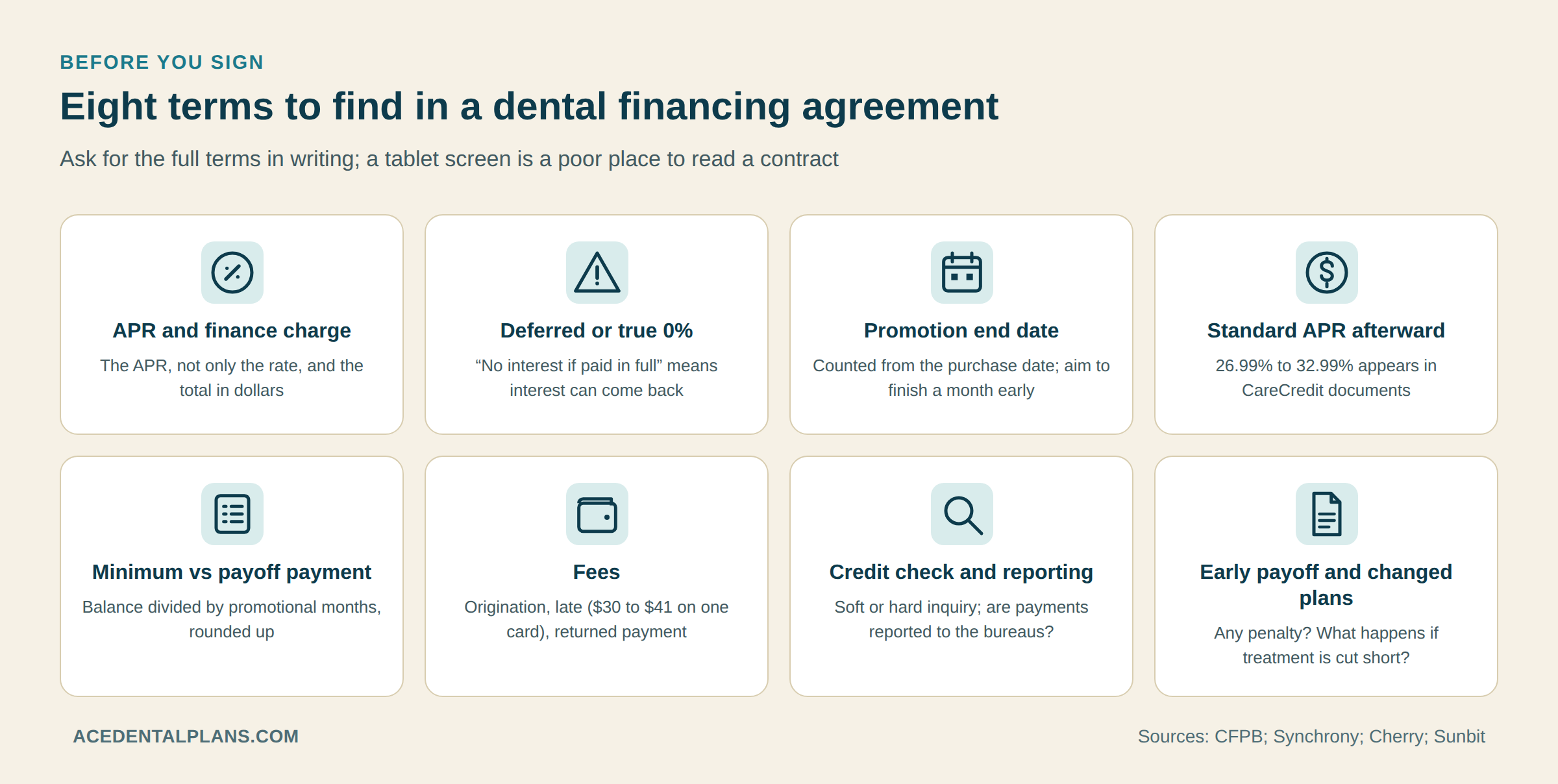 Eight items to find in the agreement before the first payment is set up.
Two of those rows deserve a second look. The first is the amount financed. A treatment estimate often changes between the first visit and the final bill, because of an added filling, a different material or an extra appointment. Ask whether the financing covers the whole plan, a single phase of it, or a dollar limit, and what happens to the next phase. The second is the name on the agreement. The CFPB’s report quotes one complaint in which a person says an office opened a credit card in their name to pay for services without consent. Read what you are signing, and don’t hand your phone or tablet to someone else to complete an application on your behalf.
Questions to ask at the front desk before you sign
These can be asked in person, by phone or by email, and a reasonable office will answer them without hesitation. Write the answers down, with the date and the name of the person who gave them.
- Who is the lender or card issuer, and who do I contact about billing?
- Is this a deferred-interest promotion or a true 0% or reduced APR?
- What is the APR if I do not finish inside the promotion, and when exactly does the promotion end?
- What monthly payment clears the balance in time, and can I set it up as an automatic payment?
- Does applying involve a hard or soft credit inquiry, and will payments be reported to the bureaus?
- Are there any fees, including origination, late, returned-payment or account fees?
- Is there a penalty for paying early?
- What happens if a payment is late, and does that change the rate on the promotion?
- Is the price the same whether I finance or pay in full today?
- If my treatment plan changes or is cut short, what happens to the financed amount?
The Dentist’s Side of the Ledger: Why Offers Differ From One Office to the Next
Whoever supplies the financing, the practice is paid and the patient owes, and the question is who pays for the arrangement in between. For third-party products, the dental office usually pays for that arrangement. According to the CFPB’s report, CareCredit tells providers they will be paid in two business days and charged a processing fee that depends on the financing option. The report cited a 2008 estimate of a 13.5% processing fee rate. Sunbit says its fees to practices start “as low as 1.9%,” which it illustrates as $57 on a $3,000 case. These are different products and the figures aren’t directly comparable, but both show that a slice of every financed bill goes to the financing company.
Why does a patient care? Because it explains why an office leans on one product, and why that product may not be the cheapest for you. The ADA frames the trade-off from the practice’s side, and it is a business trade-off as much as a clinical or a patient-facing one. Internal financing lets an office earn interest and fees but demands time and compliance; external financing outsources the compliance but gives up the interest. An office’s choice is partly a business decision.
None of the sources reviewed for this guide shows whether offices raise fees to cover financing costs, so no claim is made either way. A fair question is whether the quoted fee is the same whether you pay in full on the day or finance it. Ask, too, whether paying in cash earns a discount. A written answer protects you from being asked to pay a premium for the convenience of financing.
A Decision Path: Matching a Structure to a Budget
The following sequence is a way of organizing the numbers, not a recommendation about care, and it assumes you already have a treatment plan and an estimate from the dentist.
- Work out the clearing payment. Divide the amount you would finance by 6, 12, 18 or 24, as in Table 4. This is the number a promotional offer demands from you.
- Compare it with what you can pay reliably, with a margin. If the clearing payment fits comfortably, with room for a month when money is short, then an interest-free office plan, a true 0% loan or a deferred-interest promotion all cost the same. Pick the one with the kindest terms for a missed payment.
- If the clearing payment is a stretch, drop deferred interest first. A true 0% offer limits the damage from a shortfall, and a fixed-rate loan removes the retroactive risk completely. Both cost a little more if all goes well, and less if it doesn’t.
- If you need more than 24 months, compare APRs. At that length, the rate, not the promotion, controls the total. Check your bank or credit union and compare any other offers by APR, including fees.
- Weigh your credit position. Lower scores generally mean higher APRs and more deferred-interest charges. The CFPB report found that about 34% of purchases by people with scores below 619 carried them. Prequalification through soft checks reveals what you are actually offered.
- Ask the office about its own plan before you apply anywhere. A short in-house schedule with no interest, if it exists, may be both cheaper and simpler.
Notice what is missing from that list: picking the plan with the lowest advertised monthly payment. That number reflects term length more than price, as Table 3 showed. A plan that looks cheap each month, stretched over three years at a high APR, can be the most expensive one overall.

Frequently Asked Questions – Dental Financing vs Payment Plans
Is CareCredit a payment plan or a loan?
It is a credit card issued by Synchrony Bank, so it is borrowing. The promotional offers attached to individual purchases are what make it feel like a plan. Depending on the offer, they can be deferred-interest promotions of 6 to 24 months or reduced-APR plans with fixed monthly payments.
Does dental financing hurt my credit score?
It can, depending on the product. A soft prequalification does not affect your scores, while a hard inquiry and a new account can lower them briefly. Over time, on-time payments on a reported account can help, and late payments can hurt.
Can I get dental financing with bad credit?
Some programs advertise broader approval; Sunbit’s own page says it approves patients with scores of 500 and above. Lower scores usually come with higher APRs, and the CFPB found deferred interest was charged on a larger share of purchases for people with scores under 619. Look at the APR and the total, not just the approval.
What is the difference between “0% interest” and “no interest if paid in full”?
A true 0% APR offer charges interest only on what remains after the promotion ends. A “no interest if paid in full” offer is deferred interest: if any balance remains, interest can be charged back to the purchase date. The CFPB’s $400 example puts the gap at $65.
Do dentists charge interest on their own payment plans?
Some do and some do not. Terms are set by the practice, and a plan of more than four installments or with a finance charge can bring the office within federal lending rules, which require disclosures. Ask for the APR, the total finance charge and the total of payments in writing.
Is it cheaper to put dental work on a regular credit card?
Usually not for a balance you will carry. The Federal Reserve reported an average of 22.15% on credit card accounts assessed interest in the second quarter of 2026. On a $2,400 bill paid in 24 equal payments at that rate, the extra cost would be about $592. A card with an existing 0% introductory offer may cost far less.
What happens if I pay off dental financing early?
On a fixed-rate installment loan, paying early usually lowers the interest you owe, unless the agreement charges a fee for it. On a deferred-interest card, paying in full before the promotion ends is the goal. Ask whether any prepayment fee applies, and request that extra payments go to the promotional balance.
Can an in-house payment plan be sent to collections?
An unpaid balance owed to a dental office can be placed with a collector, as with other medical bills. The Congressional Research Service summary notes that medical debt generally appears on a credit report only after collection action. Contact the office early if you will be late; many will adjust a schedule before they escalate.
How long can dental financing last?
It varies widely. CareCredit lists no-interest promotions of 6, 12, 18 or 24 months and reduced-APR plans with fixed payments up to 60 months in one terms document. Sunbit advertises plans from 3 to 72 months, and Cherry from 1 to 60 months. Longer terms lower the payment and raise the total.
Why did my approved offer come back with a different rate than the ad?
Advertised ranges, such as 0% to 35.99% APR, describe the spread across all applicants. Your rate depends on your credit profile and the lender’s terms for that treatment, which is why prequalification is useful. Treat the advertised low end as the ceiling of generosity rather than the typical offer.
Sources and Disclaimers
Regulatory definitions, example calculations and consumer guidance come from the Consumer Financial Protection Bureau and the text of Regulation Z. Interest-rate benchmarks come from the Federal Reserve’s G.19 release. Product terms (APRs, promotional lengths, fees, credit-check and reporting practices) come from the issuers’ and lenders’ own pages and cardholder documents. These are marketing and contract materials and can change. Some are undated, and where two documents list different rates, both are noted. The $2,400 totals, the 18.2% origination-fee APR and the monthly-payment targets are original illustrations calculated for this guide with standard loan formulas and a simple monthly accrual for deferred interest, and are not quotes. National averages say little about your office, your credit profile or your state’s rules. Confirm the actual terms with the practice and the lender, and confirm any treatment questions with your dentist.
- Consumer Financial Protection Bureau — Medical Credit Cards and Financing Plans (report, May 2023)
- Consumer Financial Protection Bureau — How to understand special promotional financing offers on credit cards
- Consumer Financial Protection Bureau — What is the difference between a loan interest rate and the APR?
- Consumer Financial Protection Bureau — What is a hard inquiry? (hard versus soft credit inquiries)
- Consumer Financial Protection Bureau — Regulation Z, 12 CFR 1026.2: Definitions and rules of construction
- Consumer Financial Protection Bureau — Regulation Z, 12 CFR 1026.53: Allocation of payments
- American Dental Association — Patient Financing Options
- Federal Reserve Board — Consumer Credit, G.19 (terms of credit, Q2 2026)
- Synchrony — What is a deferred interest promotion?
- Synchrony (CareCredit) — CareCredit card terms and conditions (document accurate as of May 30, 2024; revision 3/2026)
- Synchrony (CareCredit) — Reduced APR and fixed monthly payments promotional terms (undated document)
- CareCredit — CareCredit for dental providers and patients
- CareCredit — Dental implant cost and financing (2024 Synchrony cost study)
- Sunbit — Dental financing terms
- Cherry — Patient financing terms
- myFICO — What’s in my FICO scores?
- Congressional Research Service — An Overview of Medical Debt: Collection, Credit Reporting, and Related Policy Issues (August 2025)
Important Information and Disclaimers
This article is general educational information. By using it, you accept the limits described below.
Not dental or medical advice
Nothing on this page is a diagnosis, a treatment recommendation or a substitute for an examination by a licensed dentist or physician. Reading this article does not create a dentist-patient or doctor-patient relationship. Only a licensed professional who has examined you and reviewed your history can tell you what your mouth needs. Do not delay, skip or stop professional care because of something you read here.
Prices are estimates, not quotes
Cost figures are ranges reported by the third-party sources cited in this article. Actual prices depend on your location, the provider, the complexity of your case, the materials used, the date of service and other factors, so what you pay may be higher or lower. A written treatment plan and fee estimate from the dental office is the only reliable number for your situation.
Insurance and plan examples are illustrations
Examples that use named amounts or percentages are hypothetical. Real benefits depend on your plan, network, waiting periods, annual maximum, deductible and the insurer’s rules at the time of treatment. A pre-treatment estimate or benefits check is not a promise of payment. Confirm the details with your insurer or plan administrator in writing.
Not insurance, legal, tax or financial advice
AceDentalPlans is an information publisher. Nothing here is insurance, legal, tax, investment or other professional financial advice, and nothing here recommends a particular provider, insurer, lender, discount plan or financing product. Company and product names belong to their owners and appear for identification only. Read the terms of any loan, financing offer or plan before you sign, and ask a qualified professional if you need advice on your own circumstances.
Third-party sources
This article cites government agencies, professional associations, insurers, lenders and other outside organizations. We do not control those sources. Their content can change, move or disappear, and listing a source is not an endorsement of it or of anything it sells.
No warranty
We aim for accuracy, but this article is provided “as is,” without warranties of any kind, express or implied, including warranties of accuracy, completeness, timeliness or fitness for a particular purpose. Some information may be out of date or contain errors by the time you read it.
Limitation of responsibility
To the fullest extent permitted by law, AceDentalPlans and its owners, authors and contributors are not responsible or liable for any loss, cost, injury, health outcome or other damage that results from using this article or relying on it. You are responsible for your own decisions about your care, your coverage and your money.
How this article is written
This article follows AceDentalPlans’ answer-first, U.S.-focused editorial approach. It uses conditional language for insurance, because coverage depends on the specific plan, and it names its sources so that you can read them yourself.