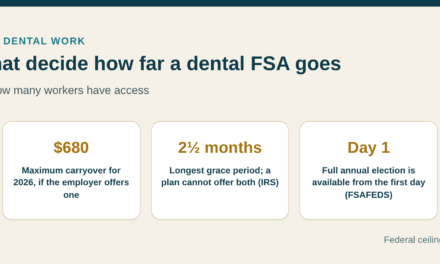
Dental insurance is a cost-sharing contract. You pay a monthly premium, and when you get care, the plan pays a set percentage of an agreed fee after any deductible, up to a yearly maximum. According to National Association of Dental Plans data reported by the ADA in 2025, about 81% of in-network maximums fall between $1,000 and $2,500. You pay everything the plan does not.
This guide follows the money between you, your employer, the plan and the dentist, explains why plans are built the way they are, and walks one invented policyholder through a full year. It also shows one treatment plan billed three ways and lays out how to choose among employer options. Plan types, coverage by procedure and claim mechanics have their own guides, which are linked where they come up.
Key Takeaways
- Five payments, four parties. Your premium share, the employer’s share, the plan’s claim payment, your cost share and the dentist’s write-off are separate payments that appear on different documents.
- The percentage applies to the allowed amount. In network, the dentist’s fee is replaced by a contracted amount, and the plan’s percentage is calculated on that figure.
- The annual maximum is a running tally. It counts every dollar the plan pays in claim order, and the ADA reports that many plans still use a $1,000 level set decades ago.
- Coverage is less common at work than people assume. The Bureau of Labor Statistics found dental care available to 44% of private industry workers in March 2026.
- Value depends on the year you have. In the invented examples here, the same plan saved one policyholder $194 and another $2,029.
- Two questions prevent most surprises: is this dentist in my network, and how much of my annual maximum is left?
Who Pays Whom: Four Parties and Five Payments
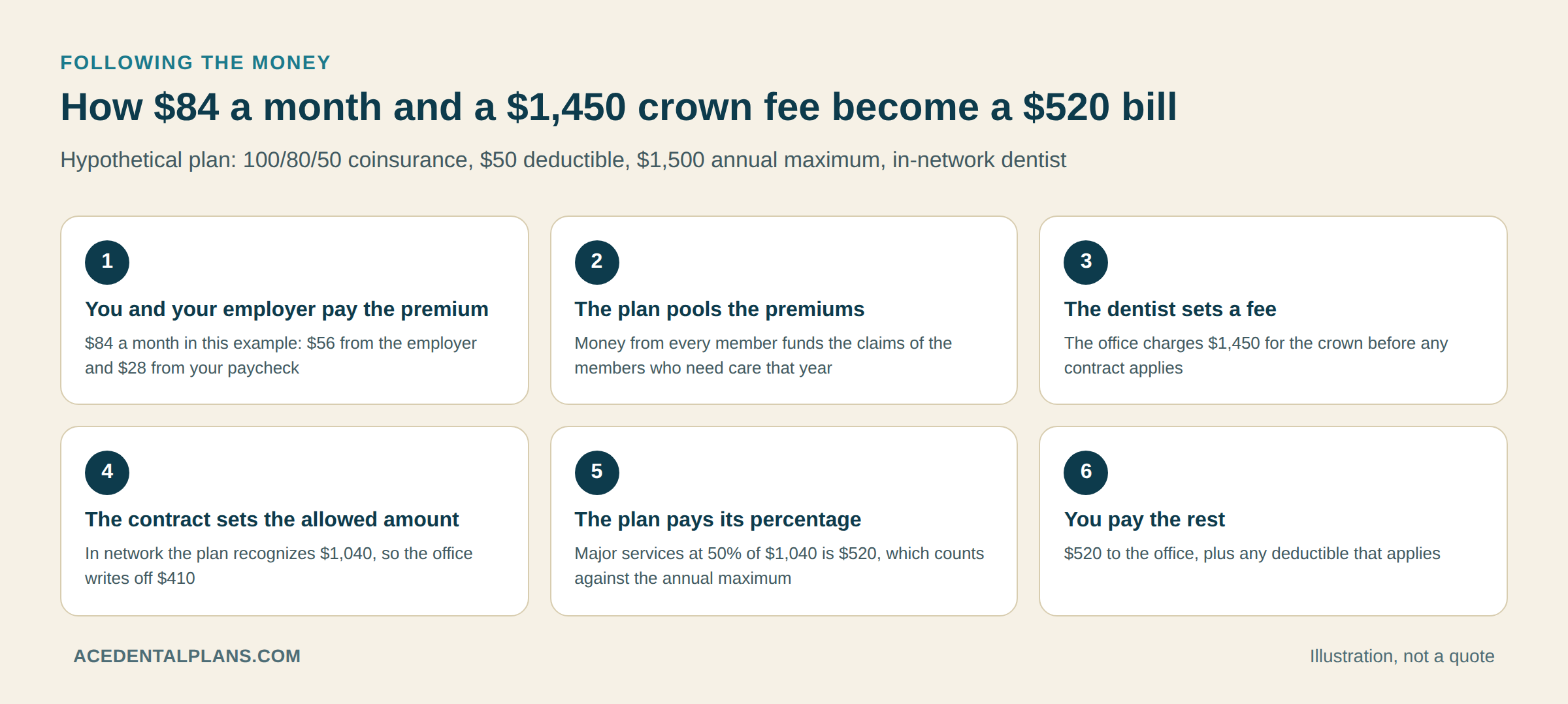
A dental plan looks like a two-party relationship, you and the insurance company. It is really four parties: you, your employer (if the plan comes through work), the plan or insurer, and the dentist. Money moves among them in five separate payments, and each shows up in a different place on your paperwork.
Seeing the five payments side by side clears up questions that otherwise feel like contradictions. Why does the plan “pay 80%” while the office still writes off money? Why does an EOB list a patient responsibility that is smaller than the office’s bill? Because those are different payments, between different parties, on different dates.
| Payment | From and to | What triggers it | Where you see it |
|---|---|---|---|
| 1. Your premium share | You to your employer, then to the plan | Enrollment; it recurs every pay period whether or not you visit a dentist | Payroll deduction on your pay stub |
| 2. The employer’s premium share | Employer to the plan | The employer’s contribution rule, often a set share of the monthly premium | Usually not visible to you; ask HR for the split |
| 3. The plan’s payment | Plan to the dentist, or to you if the claim is out of network | A claim for a covered service, after the deductible and the plan’s percentage | “Plan paid” on the explanation of benefits |
| 4. Your cost share | You to the dentist | Deductible, coinsurance or copay, anything above the annual maximum and services the plan excludes | “Patient responsibility” on the EOB and the dentist’s statement |
| 5. The contractual write-off | Nobody pays it; the dentist gives it up | In network, the gap between the office fee and the allowed amount | “Write-off,” “adjustment” or “not payable” on the EOB |
Payments 1 and 2 happen whether or not anyone sits in a dental chair. Payments 3, 4 and 5 happen only when a claim is filed. That timing difference is the whole idea of insurance in one sentence: people pay a steady amount in advance, and the pool covers part of the bill when care is needed.
Why the employer sits in the middle
In a group plan, the employer buys the coverage for its workers, negotiates the plan design with a carrier or broker, decides how much of the premium it will pay, and passes the rest to employees through payroll. In some employer arrangements the employer bears the claims itself and an insurer only administers the plan; NADP put the self-insured share of group dental benefits at 46% in its 2025 report. Employees rarely see that distinction, but it can matter when a question about a denied claim goes to HR instead of the carrier.
The employer’s contribution is also the reason a group premium looks small next to an individual one. Maya’s $28 is a third of the real price. That is not a discount on the plan, it is a share of the cost that someone else is covering as part of her compensation.
Why the dentist’s number never touches your premium
Your premium does not buy treatment at a fixed price. It buys a contract that applies when you need care: a set of percentages, a ceiling and a list of rules. The dentist’s fee is set separately, and the network contract sits between the fee and the percentage. A cheaper premium usually means a thinner benefit, a smaller network or a lower ceiling, and it does not change the fee list at the office.
Where Dental Coverage Comes From, and Why the Source Changes the Rules
Two people can both say “I have dental insurance” and hold very different contracts. The route by which coverage arrives shapes who chooses the plan design, who pays the premium, when you can enroll, and what happens when your job or income changes.
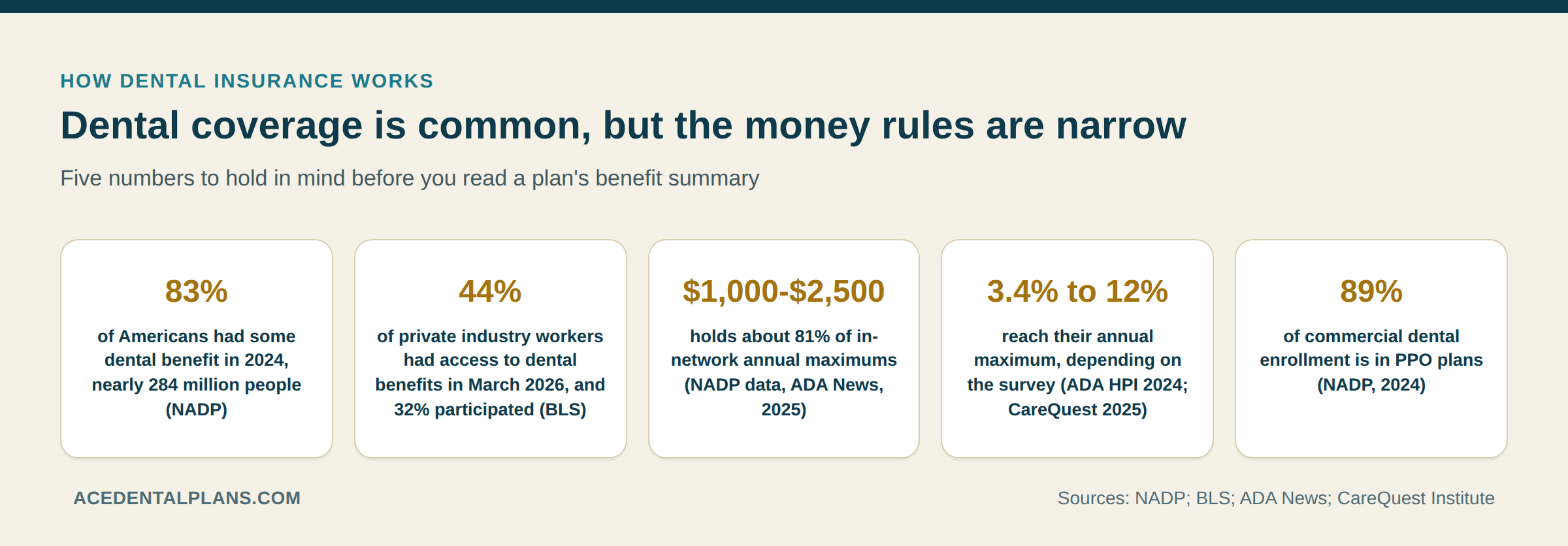
The scale is large. The National Association of Dental Plans (NADP) reported in its 2025 enrollment report, using 2024 data, that nearly 284 million Americans, or 83% of the population, had some form of dental benefit. That was a 2.3% decline from the year before. Within commercial coverage, preferred provider organization (PPO) plans made up 89% of enrollment, and NADP reported that 46% of group dental benefits were self-insured, meaning the employer carries the claims risk and a carrier administers the plan.
Through an employer
Group coverage is the route most working adults think of first, and it is far from universal. In the Bureau of Labor Statistics’ March 2026 employee benefits release, dental care was available to 44% of private industry workers, and 32% participated. For comparison, 71% had access to a medical plan and 46% participated. A job can offer health insurance and no dental plan at all.
Where an employer does offer dental coverage, it typically picks a small menu of options, shares the premium in some proportion, and runs open enrollment once a year. The BLS text read for this guide gave no dental premium-share figure, so the employer’s share in any example here is hypothetical. HR can tell you the real split.
Bought directly by an individual or family
People without an employer plan can buy dental coverage from an insurer or a broker. The buyer pays the whole premium and chooses among the plans sold where they live. Individual designs vary, and some carry waiting periods or lower maximums than group plans, so the certificate of coverage matters more than the marketing page.
Through the Marketplace
HealthCare.gov describes dental coverage as an essential health benefit for children: it must be available, in a health plan or as a separate dental plan, but you do not have to buy it. For adults it says dental is not an essential health benefit and health plans do not have to offer it. A separate dental plan carries its own premium and, for adults, “can have waiting periods before they start to cover services.” HealthCare.gov also states that you cannot buy a Marketplace dental plan unless you are buying a health plan at the same time.
Through Medicaid and CHIP
Medicaid.gov says states are required to provide dental benefits to children covered by Medicaid, and that under the Early and Periodic Screening, Diagnostic and Treatment benefit, services must be provided when determined medically necessary. For adults, “there are no minimum requirements for adult dental coverage,” and states decide what to offer. Adult Medicaid dental benefits therefore differ from state to state.
Through Medicare, or a plan that sits on top of it
Medicare.gov says Original Medicare generally does not cover routine dental services such as cleanings and fillings, and lists narrow exceptions tied to hospital stays and certain covered medical treatments. Many people get dental benefits through a Medicare Advantage plan instead, and NADP reported Medicare Advantage dental enrollment of 22.6 million in 2024. How those plans package dental is covered in Medicare Advantage dental coverage.
As a federal employee or retiree
The Office of Personnel Management runs the Federal Employees Dental and Vision Insurance Program (FEDVIP). Eligible people can enroll in a dental plan, a vision plan or both, in Self Only, Self Plus One or Self and Family tiers, during the annual Federal Benefits Open Season. OPM says premiums for enrolled federal and postal employees come out of pay before taxes. For 2026 open season, OPM announced 11 dental carriers offering 21 plan options.
What changes with the source
Three practical differences follow. The first is the enrollment window: employer plans have open enrollment and qualifying-event rules, Marketplace plans have their own annual period, and public programs have eligibility rules rather than dates. The second is portability: a plan tied to a job ends or changes when the job does. The third is who to call when something goes wrong, which is the plan administrator for an employer plan and a state or federal agency for a public program.
What a Premium Buys: Pooled Risk, a Budget and a Price Discount
Medical insurance exists mainly to protect against a rare, ruinous bill. Dental coverage is a different animal. Most people need dental care every year, the bills are smaller, and the plan puts a ceiling on what it will pay. The premium therefore buys three things at once, and which one matters most depends on the person.
A share in a pool
Every member’s premium goes into a common fund, and claims come out of it. In the year Maya and Alex had light claims, their premiums helped pay for someone like Sam, whose year exceeded the ceiling. Next year the roles may reverse. That is the insurance part, and it works because most members use less than they pay in and a few use more.
A way to budget
Because preventive visits are usually paid at or near the full allowed amount, a plan converts two predictable bills a year into a steady deduction from each paycheck. That feature is closer to prepaid care than to risk protection, and it is why dental plans often feel like a benefit more than insurance. The editorial point is simple: a plan that pays for the care you were going to get anyway offers budgeting and a lower price, not protection against a surprise.
A price discount through the network
The third thing the premium buys is access to contracted fees. Delta Dental’s own description of its PPO and Premier networks says dentists in them “agree to charge set fees, as part of their contract with Delta Dental,” and cannot bill PPO members above those fees. It adds that members typically save the most by using a PPO dentist, pay somewhat more at a Premier dentist, and save the least at a dentist outside the networks. Other insurers organize networks differently, but the logic is common: part of the value of a plan is the fee schedule.
How much of the premium returns as care
One way to ask whether a plan is a good deal is the share of premiums spent on patient care, called a loss ratio in insurance. For medical insurance, the ADA says, all states have a minimum ratio because of the Affordable Care Act, while “few have a similar standard for dental insurance plans.” Massachusetts passed a 2022 measure, Question 2, requiring dental insurers to spend at least 83% of premiums on patient care or refund the difference. The National Council of Insurance Legislators (NCOIL) adopted model legislation on dental loss ratios in January 2024, and the ADA reported 25 bills in 13 states that year.
The ADA page does not give a national average dental loss ratio, so this guide gives none. What the debate shows is that the question exists: a premium is not entirely care, and the share that goes to administration, taxes and profit is a legitimate thing to ask about. For an employee in a group plan, the loss ratio is invisible. What is visible is Maya’s version of the math, premium paid against benefits received.
Why the premium is not the price of care
The three jobs the premium does are all separate from the price of a given treatment. The dentist sets the fee, the network sets the allowed amount, the plan design sets the percentage and the maximum. A low premium usually reflects a plan design that pays less, a smaller network or a lower ceiling, and a high premium usually reflects the opposite. Neither tells you what a crown costs.
Contracted Fees: Why Your Dentist Bills One Number and the Plan Recognizes Another
Every dental office keeps a fee list. A plan keeps a different one for the dentists in its network. The distance between those two lists is the single biggest source of confusion about how coverage works, because it decides what the percentages are applied to. Why offices set the fees they do is a separate story, told in why dental work is so expensive, and typical fee levels by procedure appear in the dental price guide.
Three names for the number on the dentist’s side
The office fee goes by several names: the standard fee, the billed charge, the usual fee. It is what the office would charge a patient with no contract in place. On a claim form it appears as the “submitted” or “billed” amount, and on an EOB it is usually the first column.
That number is not necessarily what anyone pays. In network, it is replaced by the plan’s allowed amount. Out of network, it may be reduced to a plan-determined figure for the purpose of calculating the benefit, while the office remains free to bill the difference.
What the in-network contract does
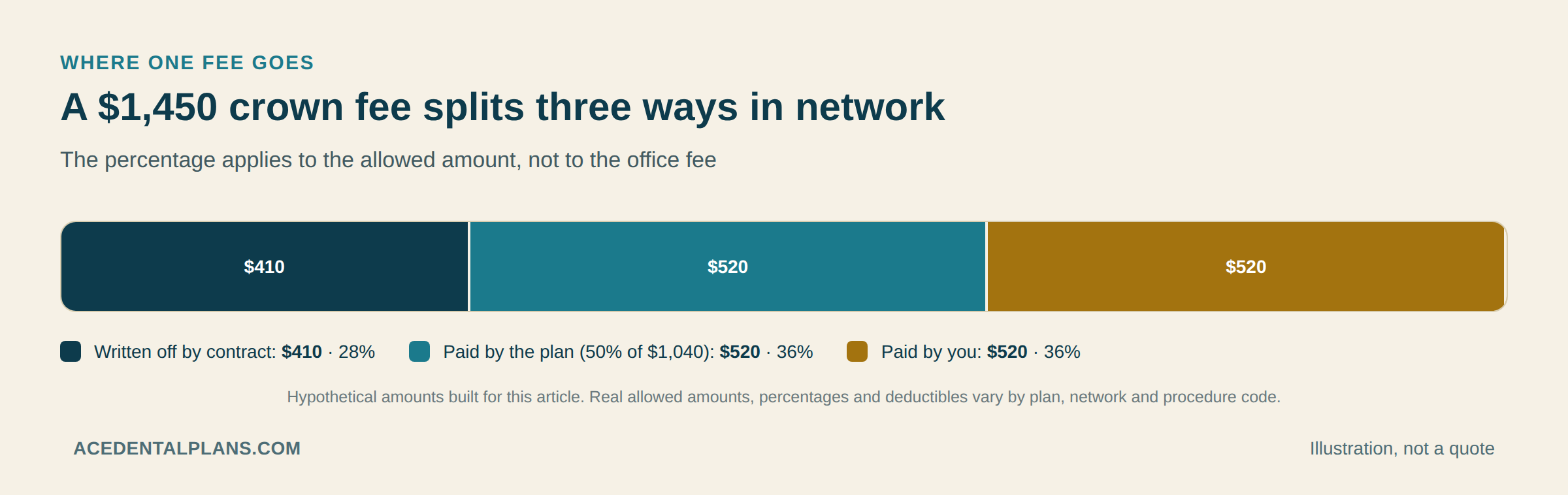
When a dentist joins a plan’s network, the contract typically sets a fee for each procedure code that the dentist agrees to accept for covered services. Patients pay the deductible and coinsurance calculated from that fee, and the dentist writes off the rest. The write-off is a contractual adjustment; it is not a gift from the plan and it is not a charge to the patient.
A dentist weighs a lower fee per procedure against steady patient flow and simpler collections. Offices reach different answers, and many belong to several networks at once. That is also why two patients with different plans can receive different bills at the same chair for the same crown.
Why the same insurer can have two fee levels
Plans from a single insurer can use different fee schedules. A common structure offers a smaller network with lower contracted fees alongside a larger one with higher fees, and a patient’s cost depends on which network the dentist belongs to and which one the employer bought. The practical lesson is that “in network with the insurer” is not a complete answer. The follow-up question is “which network, and what is the fee schedule for it?”
What happens when the dentist is out of network
Without a contract, the plan still calculates a benefit, but it does so from its own reference figure rather than from the office fee. Plans name this figure differently: maximum plan allowance, usual and customary, or something similar. Some plans pay the patient, not the dentist, for out-of-network claims, which can mean paying the whole fee at the desk and waiting for a reimbursement check.
Some plans also exclude out-of-network benefits altogether. Prepaid or managed-care designs, for example, may pay nothing for care outside the network, as the ADA’s MouthHealthy site notes. Reading the certificate for the sentence that begins with “out-of-network” is worth the ten minutes it takes.
Who receives the check
When a patient signs the dentist’s paperwork, they commonly authorize the plan to send the payment straight to the office. This is called an assignment of benefits. For in-network care it is routine. The patient then receives an EOB and the office sends a statement for the remaining balance. The money moves in a triangle: the plan pays the office, the patient pays the office, and the office writes off the contract difference.
For out-of-network care, whether the plan pays the office or the patient depends on the plan and on whether the patient assigned benefits. If a check arrives in your name, the plan paid you instead of the office, and the office will still expect its fee.
Why Plans Sort Care Into Preventive, Basic and Major
Most dental plans pay a higher share for checkups and cleanings than for fillings, and a higher share for fillings than for crowns. The pattern is so common that it is easy to treat it as natural law. It is a design choice, and the reasoning behind it explains several rules that otherwise feel arbitrary.
What follows is an editorial reading of the pattern, not a statement of any one insurer’s intent. Plan designs differ, and a few plans pay the same percentage for everything. The usual shape is a tiered schedule, such as 100% for preventive services, 80% for basic and 50% for major, as in the examples used throughout this guide.
Preventive care is cheap, predictable and schedulable
A checkup is a visit that most members can plan for twice a year, and its cost is small compared with the treatment it may help avoid. Paying a high share, often the full allowed amount, makes the visit easy to book and removes the cost question from the decision. A plan that pays for cleanings in full is, in effect, betting that early detection costs less than late treatment.
Because the cost per visit is low and the frequency is capped, the plan can predict its spending on this tier with some confidence. That predictability is part of why the percentage can be so high.
Basic care is the treatment people usually need at some point
Fillings, simple extractions and similar procedures are the repairs most members eventually need. They cost more than a cleaning and cannot be timed to suit the patient, so the plan shares the cost but leaves the patient with a meaningful part. The 80% tier gives the patient a reason to ask whether the work is needed and what it costs.
Major care costs the most and varies the most
A crown, a bridge or a denture can cost many times what a filling costs, and the number of members who will need one in a given year is hard to predict. A 50% tier limits the plan’s exposure on each claim. Together with the annual maximum, it caps what any one member can cost the pool, which is what lets an employer buy the plan at the price it does.
What the tiers mean for the patient
The practical consequence is that the same patient pays very different shares of different bills in the same year. Maya’s cleanings cost her nothing at the desk, her filling cost her about 42% of the allowed amount once the deductible is counted, and her crown cost her 50%. Reading a plan as “80% coverage” or “50% coverage” misses that the percentage depends on the procedure code.
Which procedures fall into which tier is the subject of what dental insurance may cover, including the services that move between tiers from one plan to another. Root canals, extractions and gum treatment are the usual examples. It is also worth knowing that the sorting is by code, not by how important the treatment feels. A filling that saves a tooth is basic, and a night guard that prevents years of wear may be excluded.
Why the Annual Maximum Barely Moves
Of all the rules in a dental plan, the annual maximum draws the most complaints, and for a reason that is easy to state: the dollar figure at the heart of many plans has stayed put for decades while dental prices and everything else have risen. The question this section tries to answer is why, using what the sources actually say.
What the numbers look like now
A December 2025 ADA News column reported that many plans still use a long-standing $1,000 level, that some plans have maximums of $2,000 or more, and that some have none. It cited NADP data on in-network maximums: 32.8% fall between $1,000 and $1,500, 48.2% between $1,500 and $2,500, and 17.2% between $2,500 and no maximum. Put together, about 81% of the in-network maximums in that data fall between $1,000 and $2,500. CareQuest Institute’s February 2026 report on the subject states that most plans offer an annual maximum of $1,500 or more.
The ADA column says these limits “have not kept pace with inflation or the rising costs of materials, technology and overall dental care.” Its subtitle says maximums have not increased in 50 years, while the body says the $1,000 level dates to “some 40 years ago.” The sources do not agree on the exact number, so this guide says only that the level is decades old.
Why it persists: the reasons the sources give
The ADA column reports a standoff. Insurers, it says, point to employers, who worry about premium increases and believe few employees reach the cap. The ADA states that it “does not support annual or lifetime maximums in any dental benefit program.” The column adds that raising maximums alone would not remove the imbalance, because patients pay a larger share of coinsurance as they approach their limit.
A plausible reading, offered here as editorial interpretation and not as a finding, is that a fixed ceiling is a cheap way to cap what a plan can lose. Because a plan with a $1,000 maximum has a known upper limit per member, it can set a premium with confidence. Changing the ceiling changes the premium, and the employer that pays most of the premium is the party most likely to resist.
How many people hit the ceiling? Four numbers that do not match
The published figures for how often members reach the maximum differ widely, and the sources do not reconcile them. The ADA Health Policy Institute’s 2024 analysis, reported in the ADA column, found 3.4% of patients reach the typical maximum, with another 3.3% within $100 of it. The ADA’s MouthHealthy page quotes NADP in saying that 2.8% of PPO participants reached or exceeded their annual maximum. An insurer survey cited by CareQuest found fewer than 5% of consumers reached their maximum from 2014 to 2023. CareQuest’s own 2025 survey found that 12% of adults with dental insurance said they reached or exceeded their annual maximum in the prior year, about 32 million people.
The denominators differ: patients who used care, enrollees in PPO plans, consumers in an insurer survey, and adults who self-reported in a national survey. The CareQuest authors suggest the low claims-based rates may reflect unmet needs rather than adequate coverage, since a person who avoids the dentist never reaches the cap. The practical takeaway for a reader is to treat the ceiling as a rare event in aggregate and a common one for anyone with major work.
What happens after the ceiling is reached
CareQuest asked adults who reached the cap what they did next. Thirty-nine percent paid full price for ongoing care, another 39% stopped or delayed treatment until benefits renewed, 13% negotiated a discounted fee with the dentist, and 3% used other savings options. Of those who reached the cap, 46% said it kept them from getting more dental treatment, including 59% of households earning under $30,000 and 35% of households earning $100,000 or more. A dentist can say what can safely wait, and a clinician’s answer should outrank a calendar.
How a $1,500 ceiling meets real bills
The arithmetic of the maximum is simple, and its effects are not. Every dollar the plan pays counts against the ceiling, in the order claims are processed. Once the running total reaches the maximum, the plan stops paying until the next plan year, and the patient owes everything else.
Two lessons follow from that example. The first is that the percentage in the benefit summary describes the plan’s behavior only while the maximum has room. The second is that timing treatment across the plan-year boundary is sometimes possible and sometimes not, which depends entirely on what the dentist says about urgency. A dentist can tell you whether a procedure can safely wait for January. A plan cannot, and a benefit calculator should not be the reason a tooth waits.
When treatment must be split between two years for the benefit’s sake, the dentist and the patient need to agree on a clinically sound sequence first. Splitting the work is a scheduling choice, and the clinical choice is the dentist’s. That boundary matters, and any year-end checklist should keep it in view.
Why Waiting Periods, Frequency Limits and Downgrades Exist
Dental plans carry a set of rules that feel like fine print designed to deny claims. Each has a reason a plan designer can state in a sentence, and knowing the reason helps in predicting where the rule will bite. This section gives the logic in editorial terms and leaves the full definitions to the terminology guide in dental insurance explained.
Waiting periods guard against buying coverage for a known problem
Imagine a plan with no waiting period for major services. A person with a cracked molar could enroll on Monday, have a crown on Friday, and cancel the next year. If enough people did that, the plan’s costs would rise and the premium would follow. A waiting period on major services narrows that window. It does nothing for a patient who has a genuine, unexpected need during the wait, and that is the cost of the design.
Some plans reduce or waive waiting periods for people who enroll when they first become eligible through an employer, and apply them to people who enroll later or switch from having no coverage. Whether the plan credits time served on a previous plan is a question for the new insurer, in writing.
Frequency limits keep the plan’s spending predictable
Limits on how often a plan pays for cleanings, X-rays, fluoride or replacement crowns exist because the plan prices the benefit on an expected rate of use. A patient whose dentist recommends something more often than the limit is not necessarily being overtreated. The recommendation and the benefit follow different logic: one is clinical, the other is actuarial. When they disagree, the patient pays for the difference.
Alternate-benefit clauses pay toward the cheaper adequate option
If two treatments can both restore a tooth acceptably, a plan may calculate its payment from the less expensive one. The clause protects the pool from paying for the most costly choice every time, and it leaves the patient and dentist free to choose the more expensive option and pay the difference. The patient’s task is to ask, before treatment, whether the plan has such a clause and how it would price the work.
Missing-tooth and replacement clauses limit paying for what was already lost
A missing-tooth clause may refuse to pay for a bridge or denture to replace a tooth that was lost before coverage began. A replacement clause may refuse to pay for a new crown or denture within a set number of years of the last one. Both aim at costs the plan did not price. Both can come as a surprise to someone who changed plans, because the history goes back to before the current enrollment.
Exclusions mark what the plan does not consider its job
Cosmetic work and many orthodontic and implant services are common exclusions or separate benefits. The line between a cosmetic and a restorative reason for the same procedure is one the plan draws from the dentist’s documentation, which is why the chart notes and the reason on the claim matter. The detailed procedure-by-procedure picture belongs to the coverage guide, and the general principle is that exclusions follow the plan’s definition of necessity, not the patient’s.
One Policyholder’s Year: From Open Enrollment to the Last Claim
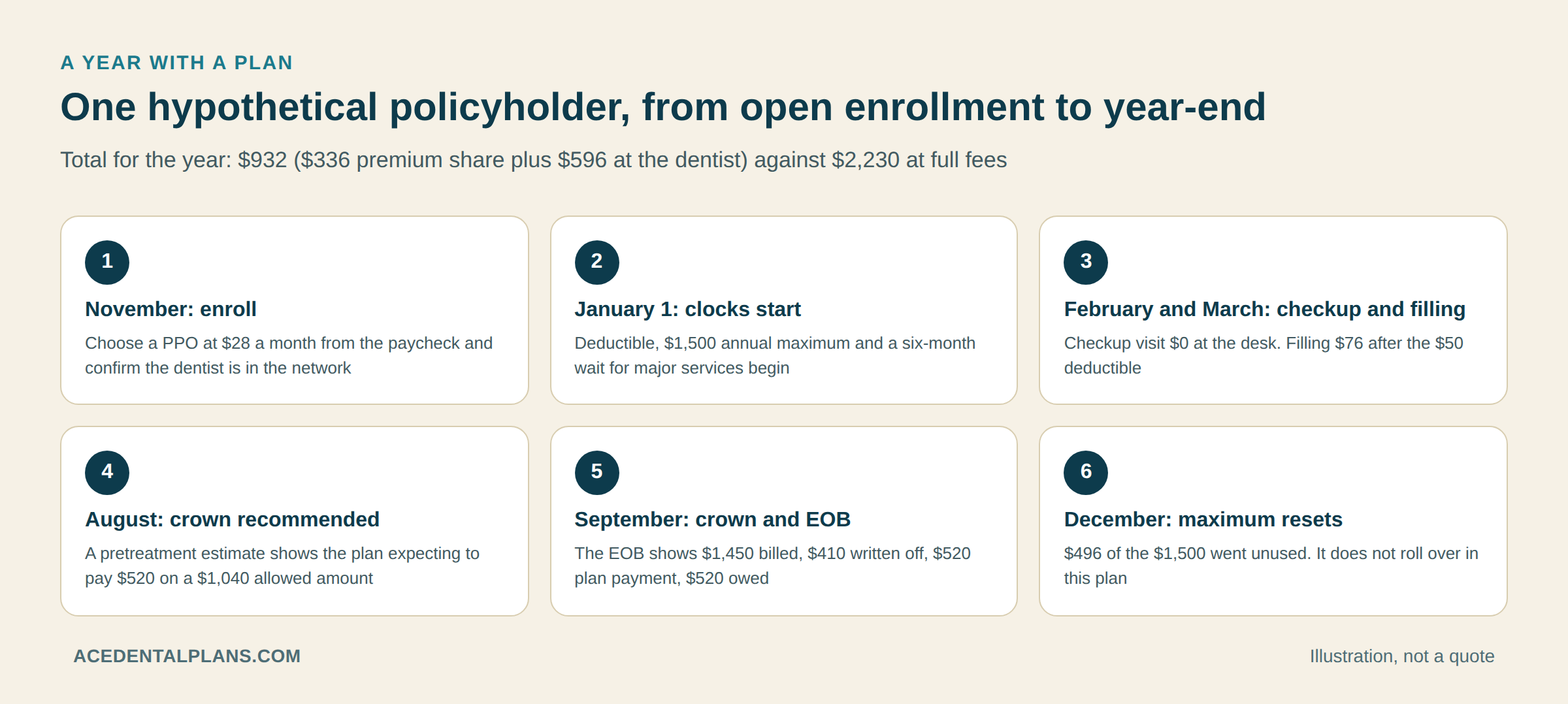
Rules are easier to hold onto as a story. The policyholder below is invented, and so is every dollar figure. The plan is a plain group PPO of the kind many employers offer, and real designs vary a great deal. What matters here is the order of events and where each number comes from.
Call her Maya. She works for a company with about 80 employees, has seen the same dentist for six years, and has no known dental problems. Her employer offers two dental options at open enrollment, and she has to choose one by the end of November.
November: choosing, and checking the network twice
Maya compares the PPO with a lower-premium prepaid option. The prepaid plan has fixed copays and no annual maximum, but her dentist is not on its list. The PPO would let her keep her dentist, at a higher monthly cost.
Before she signs, she looks her dentist up in the PPO’s online directory and then calls the office to ask whether it participates in that specific network. Directories lag behind contracts, and an office can be in one of an insurer’s networks and not another. A two-minute call is cheap insurance against a surprise on the first claim.
January 1: the clocks start
Coverage begins on the first day of the plan year. Three things start or reset at once: the deductible, the annual maximum and, because she is a new enrollee, the six-month waiting period for major services. Nothing has been paid by anyone yet. Her $28 payroll deduction has started, though, and it will continue every pay period whether or not she visits a dentist.
February: the checkup that costs nothing at the desk
Maya books an exam, X-rays and a cleaning. The office’s standard fee for the visit is $265, and what such visits cost in cash is broken down in exam, X-ray and cleaning prices. Because the office is in the PPO’s network, it has agreed to accept an allowed amount of $190 for those services. The plan pays 100% of the allowed amount, and the $75 difference is a contractual write-off that neither she nor the plan pays. She leaves owing $0.
The exam also turns up a cavity between two back teeth. The dentist explains the finding, and the front desk gives her a written estimate for the filling before she leaves, so the next bill holds no surprise.
March: a filling and the deductible
The filling has an office fee of $250 and a PPO allowed amount of $180. The deductible comes first: Maya owes the first $50 of the allowed amount. The plan then pays 80% of the remaining $130, which is $104, and Maya owes the other 20%, which is $26. Her share is therefore $76, the plan’s share is $104, and the write-off is $70.
By now $294 of her $1,500 annual maximum has been used: $190 for the February visit and $104 for the filling. The deductible is satisfied for the rest of the year.
July: the waiting period ends
June 30 passes without anything happening, which is how a waiting period usually ends. Nothing is mailed to her. If she had needed a crown in May, the plan would have paid nothing toward it, and her dentist would have had to choose between treating her at full fee and scheduling around the date. She did not need one in May, so the clause stays invisible.
August: a second cleaning and a recommendation
Her second cleaning of the year is another $265 at the office and another $190 allowed, so she owes $0 again. The plan’s X-ray limit means the dentist does not take bitewings this time, because they were taken in February. The dentist does find that an older, large filling on an upper molar has begun to fail and recommends a crown.
The crown’s office fee is $1,450. The PPO allowed amount is $1,040. Maya asks the office to send a pretreatment estimate to the plan before she schedules the work. Plans respond in different time frames, and the response is an estimate of benefits, not a promise of payment. Hers comes back in about two weeks and says the plan expects to pay $520.
September: the crown, the claim and the EOB
The crown takes two visits. The office submits the claim, and the plan processes it against the allowed amount: 50% of $1,040 is $520. About three weeks later Maya gets an explanation of benefits showing the billed charge ($1,450), the allowed amount ($1,040), the plan payment ($520), the write-off ($410) and her responsibility ($520). The EOB is not a bill, but the office’s statement for $520 arrives the same week and matches it.
The annual maximum now stands at $1,004 used and $496 remaining.
December: what the year added up to
Maya has $496 of unused annual maximum. It does not roll over, and nothing reimburses her for it. She has no other treatment planned, so it expires with the plan year. Had her dentist recommended a second procedure for the fall, she would have had a reason to schedule it before December 31 rather than January. That is the calendar logic behind the year-end advice in what to check before year-end.
The Same Treatment Plan, Three Ways to Be Billed
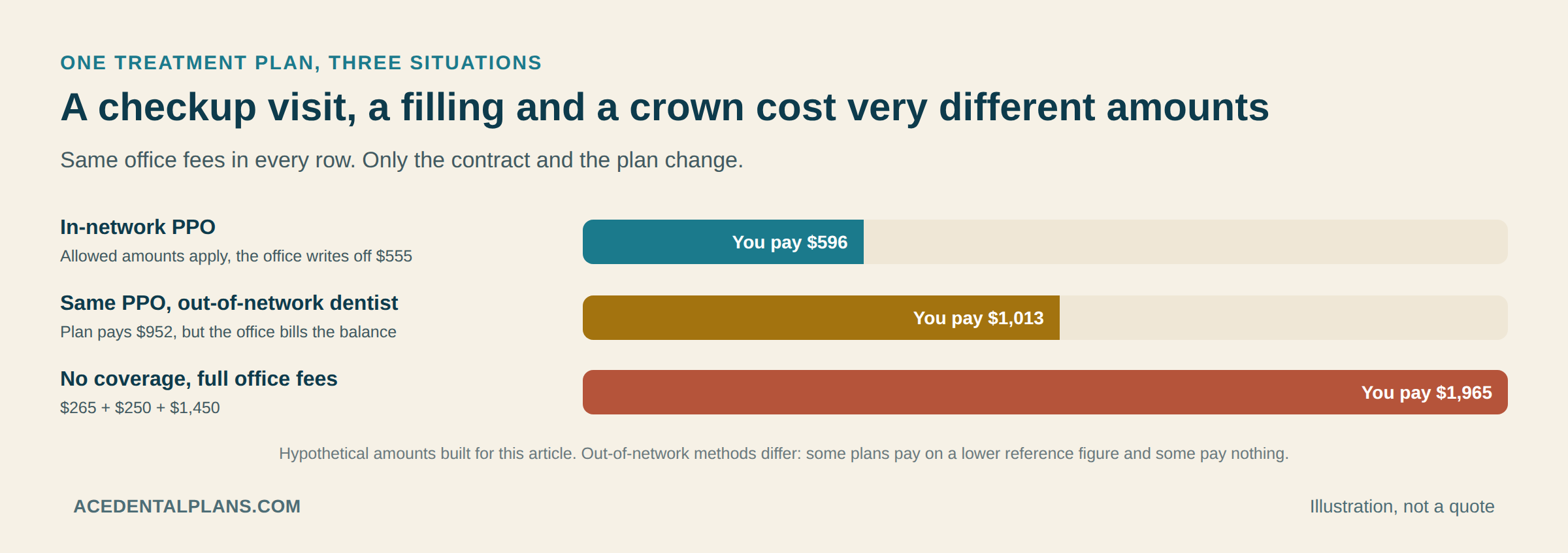
Maya’s dentist was in her network, which is why her crown cost $520 rather than something closer to $1,000. To see how much that one fact matters, take her three procedures (a checkup visit, a filling and a crown) and bill them under three situations. The office fees stay the same in every column. Only the contract and the plan change.
The situations are an in-network dentist under the PPO, an out-of-network dentist under the same PPO, and no coverage at all. For the out-of-network column, suppose the plan pays its percentages against its own out-of-network allowed amounts ($220, $215 and $1,200) and the dentist is free to bill the balance. Some plans use a different out-of-network method, and some pay nothing out of network. This is one common design, not a rule.
| Line | Office fee | In-network PPO: you pay | Out-of-network, same PPO: you pay | No coverage: you pay |
|---|---|---|---|---|
| Exam, X-rays, cleaning | $265 | $0 (allowed $190, plan pays $190) | $45 (plan pays $220 of the $265) | $265 |
| Filling | $250 | $76 (allowed $180, $50 deductible, plan pays $104) | $118 (allowed $215, plan pays $132 after the deductible) | $250 |
| Crown | $1,450 | $520 (allowed $1,040, plan pays 50%) | $850 (allowed $1,200, plan pays $600) | $1,450 |
| Total you pay | $1,965 at full fee | $596 | $1,013 | $1,965 |
| Plan pays | n/a | $814 | $952 | $0 |
| Written off by the dentist | n/a | $555 | $0 | $0 |
Two patterns stand out. The out-of-network plan pays more dollars ($952 against $814) yet leaves Maya paying $417 more. That sounds backwards until you see the write-off line: in network, the dentist gives up $555 of the standard fee by contract, and out of network that discount never happens.
How to read the in-network column
Start with the office fee and replace it with the allowed amount: $1,965 becomes $1,410, because $555 disappears by contract. Then apply the plan’s rules in order. The deductible reduces what the plan pays on the filling. The percentage applies to the allowed amount, not the office fee. The annual maximum is not close to being reached. What remains is $596.
One shortcut helps: the patient’s share on a given line is the allowed amount minus the plan payment. That is why the crown shows $520, not $725 (half of $1,450). Using the office fee in the percentage calculation is the most common error people make when they try to predict their own bill.
How to read the out-of-network column
Here the plan pays 100% of $220 on the visit, which leaves $45 of the $265 fee. It pays 80% of $165 on the filling (the $215 allowed amount less the $50 deductible), which is $132 and leaves $118 for her. It pays 50% of $1,200 on the crown, which is $600 and leaves $850. With no contract in place, the office is free to bill the difference between its fee and the plan’s allowed amount, and here it does.
The plan’s percentage did not change. Its starting point did, and so did the dentist’s obligation to accept it. Some out-of-network claims also pay the patient rather than the office, which means Maya might need to pay the full fee at the desk and wait for reimbursement.
How to read the no-coverage column
With no plan, the full fee is the starting point: $1,965. That does not mean it is the only price. Some offices set a lower cash fee, offer a discount for paying at the visit, or sell an in-house membership. Those routes are covered in dental costs without insurance and in the guide to how dental savings plans work. Crown fees themselves vary with material and tooth, as laid out in dental crown cost by material. The column here shows the standard-fee case so that the contract effect in the other two columns is visible.
None of these columns is a prediction. They exist to show where the dollars move when one variable changes at a time, and the same four questions apply to any real estimate: what is the allowed amount, which category is each line, how much of the deductible and maximum is left, and is the dentist in the network?
Choosing Between Employer Options: Match the Design to the Year You Expect
Employers that offer dental coverage often offer two or three designs at once, commonly a PPO, a prepaid or managed-care option and sometimes a higher-cost version of the PPO. The comparison that matters is not which design is “better” in the abstract. It is which one fits the dentist you use and the care you expect to need.
A reliable way to compare is to run your own likely year through each option, the same way Maya’s year was run through her PPO. Four numbers drive the result: the premium difference, the annual maximum (or the copay schedule, in a prepaid plan), the network, and any waiting periods. Table 3 pairs common situations with the design that tends to fit and what to verify before signing.
| If your year probably looks like this | A design that often fits | Why it tends to fit | What to verify first |
|---|---|---|---|
| Two cleanings and little else | The lowest-premium option that pays for preventive visits | Preventive visits are usually the part of a plan paid most generously, so a modest plan captures most of the value. | Cleaning frequency, whether X-rays are limited and the payroll deduction |
| You have a dentist you want to keep | A PPO, or any plan with out-of-network benefits | Keeping a dentist matters more than a small premium difference, and a network that includes the office makes the contracted fee apply. | Whether your specific office participates in that specific network |
| You know major work is coming (crowns, root canals) | A higher maximum with the shortest waiting period on major services | A $1,000 ceiling can disappear into a single crown, so the ceiling and the waiting period set the outcome. | Annual maximum, waiting period on major care, any downgrade clause |
| You want predictable prices per visit | A prepaid or managed-care plan with a published copay schedule | Fixed copays can be easier to budget, and some of these plans have no annual maximum. | Which dentists are in the network, referral rules for specialists, copay schedule for the codes you expect |
| A child may need braces | A plan with an orthodontic benefit | Orthodontic benefits often have a separate lifetime limit and age rules. | Orthodontic lifetime maximum, age limit, waiting period and how payments are scheduled |
| You prefer to pick any dentist | A plan with indemnity-style or strong out-of-network benefits | Out-of-network payment rules decide how much of the fee you carry. | How the plan sets its out-of-network allowed amount and who receives the payment |
A worked comparison: PPO against a prepaid plan
Return to Maya, with a second option on the table. The prepaid plan costs her $11 a month, or $132 a year, and publishes copays: $0 for exams and cleanings, $25 for a filling and $300 for a crown. Her dentist is not in its network, so she would have to assign herself to one that is.
What the comparison shows is not that the prepaid plan wins. It shows that the dollar difference is real and the trade-off is also real. Some people give up the dentist they know for a big difference in cost, and some do not. The right choice depends on how large the difference is for your own year and on how much the relationship with your dentist is worth to you.
When the premium difference is the whole story
If two plans pay almost the same benefits, the cheaper one wins, and a table is not needed. The harder case is when the higher-premium plan has a higher maximum or a shorter waiting period. Then the extra monthly cost buys you something specific, and you can price it. If the more expensive plan costs $216 more a year and raises the maximum by $500, the higher maximum only pays for itself if you expect to use more than the lower ceiling and then receive more than $216 of it back in plan payments.
Questions that separate the options quickly
- Which dentists near you participate, and is your own dentist among them?
- What is the annual maximum, and does preventive care count against it?
- How long is the waiting period for basic and major services, and does it apply to you if you enroll at the first opportunity?
- Is there a calendar-year or plan-year deductible, and which services does it apply to?
- Is there an orthodontic benefit, and what are its age and lifetime limits?
- What does the plan do when the dentist is out of network?
What the Premium Is Worth: Break-Even for Three Different Years
Whether a dental plan pays for itself is not a property of the plan. It is a property of the year you have. The same $84-a-month policy from Maya’s story gives three very different results depending on what the dentist finds, and the exercise below shows the pattern with invented numbers.
Each patient has the same plan: $50 deductible (not applied to preventive care), 100/80/50 percentages, a $1,500 annual maximum, and an $84 monthly premium of which the employee pays $28. The year’s total premium is $1,008, of which the employee pays $336. Each is treated at an in-network office with the allowed amounts used earlier.
Alex: two cleanings and nothing else
Alex has two preventive visits at $190 allowed each. The plan pays $380 in total. The office’s standard fee for each visit is $265, so without a plan Alex would pay $530 at full fees. With the plan Alex pays $336 in premium share and $0 at the desk.
From Alex’s side, the plan saved $194 against full fees. From the insurer’s side, it collected $1,008 and paid $380. The difference is what funds the people whose years look like Sam’s below.
Maya: two cleanings, a filling and a crown
Maya’s year was set out earlier. She paid $596 at the dentist and $336 in premium share, for $932. Against $2,230 at full fees, the plan and the contract saved her $1,298. The insurer collected $1,008 and paid $1,004.
Sam: two cleanings, a root canal and a crown
Sam has the same two cleanings and then a molar needs a root canal and a crown, a pairing whose cash prices are covered in root canal cost. Suppose the root canal’s allowed amount is $1,015 (office fee $1,320) and the crown is the same $1,040 allowed ($1,450 office fee). The plan classifies the root canal as basic and the crown as major.
The calculation runs in the order the claims arrive. The two cleanings use $380 of the maximum. The root canal comes next: Sam owes the $50 deductible plus 20% of the remaining $965, which is $193, so Sam pays $243 and the plan pays $772. The maximum used is now $1,152. The crown would normally be paid at 50%, $520, but only $348 of the maximum remains. The plan pays $348 and Sam owes the other $692.
Sam’s totals: $0 + $243 + $692 = $935 at the dentist, plus $336 in premium share, for $1,271. At full fees the same year would cost $530 + $1,320 + $1,450 = $3,300. The insurer collected $1,008 and paid $1,500, the maximum. Sam’s year is the type that premium pooling is designed to absorb.
Why the answer changes when the employer isn’t paying
All three households paid only 33% of the premium ($28 of $84). That is the main reason the numbers look favorable. If Alex had bought an individual policy at the full $84, the annual cost would have been $1,008 against $530 at full fees, and the plan would have lost $478 for Alex before any claim was considered. Maya’s total would have become $1,604 against $2,230. Sam’s would have become $1,943 against $3,300.
That arithmetic is why the same plan can be a sensible employer benefit and a harder sell as an individual purchase. Pooling works more smoothly when people with light years and heavy years share one plan, which is easier to arrange through an employer than through individual sales. The cash-pay side of the same arithmetic is worked in dental care without insurance.
What the exercise leaves out
Three simplifications are worth naming. First, taxes: premiums paid through some employer arrangements are deducted before income tax, which would lower the effective cost; ask your employer how your deduction is treated. Second, timing: Sam’s crown, for example, could have been scheduled in January instead of December, which would have placed it under a fresh maximum. Third, behavior: people with coverage may schedule care they would have put off, so the real “saving” is not always a dollar saved, but treatment completed. None of those changes the basic conclusion that the value of a plan depends on the year you have.
When Your Job, Your Plan or Your Household Changes
Because most dental coverage hangs on a job, a job change is the most common way a dental plan stops working the way you expected. Three situations come up again and again: coverage ends, a new plan starts, or work is in the middle of being done when either happens.
If job-based coverage ends
The Department of Labor says COBRA generally requires group health plans sponsored by employers with 20 or more employees in the prior year to offer continuation coverage to employees and their families after events such as voluntary or involuntary job loss, a reduction in hours, divorce or death. Qualified people “may be required to pay the entire premium for coverage up to 102% of the cost to the plan.” The DOL page does not address dental plans specifically, so the question for a dental plan is whether your employer’s dental coverage is part of the group health plan that COBRA reaches, and what the monthly cost would be. Ask the plan administrator in writing.
HealthCare.gov lists “losing other coverage” as a life event that qualifies for a Special Enrollment Period, so a Marketplace health plan may be available outside the usual window. Because HealthCare.gov also says a Marketplace dental plan can be bought only alongside a health plan, a person who wants only dental coverage cannot use that route. A separate dental plan, the page adds, can have waiting periods for adults.
If a new plan starts
A new plan generally starts its own clocks. The deductible and annual maximum begin from zero, and any waiting periods begin unless the plan waives them. Ask whether the new plan credits time on the previous plan, whether the maximum is prorated for a mid-year start, and which of your dentists are in the new network. If you have a crown or a bridge in progress, ask both insurers which one treats the work as theirs, and on which date of service.
If you are in the middle of treatment
A multi-visit treatment that spans a change in coverage is where the rules differ most between plans. Some plans pay on the date a procedure is started and others on the date it is completed, and a plan that is no longer active on the relevant date may pay nothing. Before changing plans, ask the dental office which date it will put on the claim, and ask the old and new insurer whether either would treat the date as theirs. The office’s answer should be in writing.
What does not change when you leave
The dentist’s fee list, your own treatment plan and the clinical urgency of any problem do not change because your coverage did. A dentist can tell you what is time-sensitive. If a change in plan creates a gap, the dentist’s office can also say what the cash fee would be and whether a payment arrangement exists, which is the starting point in the guide to paying for expensive dental work.
Open Enrollment Season: Four Calendars That Overlap in the Fall
October is when several enrollment windows open at once, which is why dental plan choices tend to cluster in the same few weeks. The dates below come from the agencies that run each program and apply to coverage that begins on January 1, 2027. Employer deadlines are set by each employer, so ask HR.
- Medicare Open Enrollment, October 15 to December 7. Medicare.gov says you can join, drop or switch a Medicare Advantage plan during this period, and that coverage starts January 1 of the next year as long as the plan receives your request by December 7. The page does not mention dental, so the dental benefit inside any Advantage plan is something to read in the plan’s own documents. The comparison steps are in Medicare open enrollment and dental benefits.
- Marketplace Open Enrollment, November 1 to January 15. HealthCare.gov says you can apply for 2027 coverage starting November 1, that December 15 is the last day to enroll or change plans for coverage that starts January 1, and that Open Enrollment ends January 15. Enrolling from December 16 through January 15 starts coverage on February 1. State-based marketplaces may run on their own schedules.
- Federal Benefits Open Season, November 9 to December 14, 2026. OPM’s FEDVIP page says enrollment takes place during this annual open season in November and December. The release says FEDVIP coverage continues into 2027 if enrollees make no changes.
- Employer open enrollment, set by the employer. Many employers hold it in the fall for a January 1 plan year, and some use another date, so the plan year in your documents is the only reliable guide.
What to check during any of them
The checklist is the same whichever door you walk through. Does your dentist participate in the network? What is the annual maximum, and has it changed? What are the waiting periods, and do they apply to you? What will come out of each paycheck? A plan you have used for years is not automatically the plan you will be offered next year, since premiums, networks and maximums can all change at renewal.
Money set aside for dental costs
Some employers offer a health savings account or a flexible spending account alongside the plan. The details differ and the limits change each year, so they are set out in the comparison of HSA and FSA rules for dental expenses. A separate question is the tax treatment of premiums. The IRS says medical and dental expenses can be deducted only if you itemize and only to the extent they exceed 7.5% of adjusted gross income, and that “the portion of your insurance premiums treated as paid by your employer” is not deductible. For most households the practical effect is that the employer’s share of the premium helps and the deduction does not.
Seven Surprises on a Dental Bill and the Rule Behind Each
Most dental bill surprises are not errors. They are a rule working as written, applied to a patient who had not seen it. Each one below traces to a mechanism already described in this guide, which makes it possible to ask the right question before treatment instead of after.
| Surprise | Mechanism | Question to ask before treatment |
|---|---|---|
| “The plan pays 50%, but I owe far more than half” | The percentage applies to the allowed amount. Out of network, the dentist can bill the gap between the fee and that amount. | What is the allowed amount for each code, and is the office in my specific network? |
| “The office is in network, but the specialist isn’t” | Network status belongs to each provider, not to the referral chain. A periodontist, endodontist or oral surgeon has a separate contract. | Is the specialist you are sending me to in my plan’s network, and what is the fee? |
| “The plan paid as if I had a cheaper crown” | An alternate-benefit clause pays toward the least costly adequate option, such as a lower-cost material or a different restoration. | Does my plan have an alternate-benefit clause for this treatment, and how would it price it? |
| “My deep cleaning wasn’t treated like a cleaning” | Each procedure code maps to a category, frequency rule and sometimes a documentation requirement. A deep cleaning is not a routine one. | Which codes will be billed, and what category and conditions does the plan apply to each? |
| “The maximum ran out in October” | All paid claims count against one yearly ceiling. Earlier treatment and larger procedures use it up in the order the claims arrive. | How much of my annual maximum has been used so far this plan year? |
| “The plan said this was too soon after the last one” | Frequency limits and replacement clauses restrict how often a service is paid, even if the dentist considers it necessary. | When was this service last paid, and what interval does the plan require? |
| “The estimate was wrong” | A pretreatment estimate is based on eligibility and benefits at that moment. It is not a guarantee, and facts can change before treatment. | Is this estimate in writing, and what could change it before the date of service? |
1. The percentage applies to a smaller number than the fee
This is the most common one, and it comes straight from the contracted-fee system covered earlier. A plan that pays 50% of a $1,040 allowed amount pays $520. A patient who hears “50%” and does the math on a $1,450 fee expects $725. The $205 gap is not a charge; it is the patient’s expectation being anchored to the wrong number.
2. Network status is provider by provider
A general dentist’s office can participate in a plan while the periodontist it refers to does not. The same applies to an oral surgeon, an anesthesiologist who comes to the office, or a dental lab the dentist uses. When a referral is made, ask the specialist’s office the network question directly rather than assuming the answer carries over.
3. The plan paid toward a different treatment
An alternate-benefit clause lets the plan pay toward the less expensive of two professionally acceptable treatments. It does not stop the patient from choosing the more expensive one; it changes what the plan contributes. The arithmetic of a downgrade is worked in the coverage guide linked earlier, which handles procedure-by-procedure rules.
4. A procedure code decided the category
Plans pay by procedure code, and a code is more specific than a name. A deep cleaning, priced in deep cleaning cost, is one example. The line “cleaning” on a patient’s mental list can appear as a routine prophylaxis, a periodontal maintenance visit or a scaling and root planing procedure, and a plan can class those three differently. The structure of those codes is explained in how to read CDT codes.
5. The yearly maximum ran out before the year did
The cap applies in claim order. Sam’s year in the break-even section shows how a $348 remainder meets a $1,040 crown. The practical question is not “what does my plan pay for a crown” but “what is left of my maximum on the day of the crown”.
6. Frequency and replacement rules
Plans commonly limit how often a service is paid: a number of cleanings per year, X-rays per period, or a restoration replaced within a number of years. The limits are set in the plan documents, differ from plan to plan, and are often counted from the date of the last paid claim, which may have been paid to a previous dentist.
7. A pretreatment estimate was treated as a promise
Plans often describe estimates as based on current eligibility and benefits and not as a guarantee of payment. Eligibility can end, a maximum can be used by another claim in the meantime, and a dentist’s final procedure can differ from the one estimated. A dated written estimate is still the most useful document to hold, since a changed outcome gives you something to compare against.
What a Dental Plan Does Not Do
Setting expectations is part of explaining how a plan works. Several things people assume a dental plan does are not in the contract, and the gaps are where most disappointment starts.
It does not set your dentist’s prices
A plan sets its own allowed amount, and an in-network dentist agrees to accept it. Out of network, the office keeps control of its fee. Either way, the plan does not regulate what the office charges for a service it does not cover, such as an elective procedure. If a treatment is excluded, the fee is whatever the office and the patient agree on, and the cash-pay guide at dentist visit cost without insurance shows how that figure is typically built.
It does not decide what treatment you need
Coverage rules follow the plan’s definitions, and they do not evaluate your mouth. A plan can decline to pay for a treatment the dentist recommends, and a plan paying for a treatment does not mean the treatment is appropriate. The dentist and the patient decide about care. The plan decides only what it contributes.
It does not pay for everything in the mouth
Exclusions, frequency limits and the annual maximum all mean the plan pays for a share of covered services, not the whole bill. A plan with a 100% preventive tier still has a deductible on other services, and a plan that sounds generous can pay little for a single large treatment. The word “coverage” describes eligibility for a payment, not the amount.
It is not the same as medical insurance
Dental plans and medical plans are usually separate products with separate networks, cards and claims. Some medically necessary dental-adjacent services, such as treatment connected to an accident or a hospital stay, may be handled by a medical plan, and the rules vary. The practical step is to ask both insurers before assuming one of them does not apply. Medicare is the most widely known example: the program’s dental rules are narrow and are explained in whether Original Medicare covers dental care.
It does not guarantee a price in advance
A pretreatment estimate reflects the plan’s rules on the day it is produced. If your maximum is used on another claim before the work is done, or the procedure performed differs from the one planned, the payment can change. The estimate is useful because it narrows the range, not because it fixes the number.
Do not postpone urgent care to fit a benefit year
- Facial swelling, a fever with tooth pain, trouble swallowing or breathing, or bleeding that will not stop need prompt care, whatever the plan’s remaining maximum.
- Pain that wakes you at night or a tooth that has broken should be evaluated by a dentist promptly. The plan’s calendar does not change how quickly an infection can spread.
- A dentist can tell you what is time-sensitive. A benefit calculator cannot.
Where Each Rule Is Written: Seven Documents and What Each One Settles
A dental plan’s rules do not sit in one place. The percentage is in one document, the network in another, the frequency limit in a third, and your actual remaining maximum in none of them until someone looks it up. Knowing which paper answers which question saves several phone calls.
| Document | Where you get it | What it usually shows | What it cannot tell you |
|---|---|---|---|
| Enrollment guide or benefit highlights | Employer open-enrollment materials | Plan options, premiums per pay period, headline percentages and the annual maximum | Frequency limits, exclusions, exact definitions |
| Certificate or evidence of coverage | The insurer’s member portal or HR | The full terms: covered services, exclusions, waiting periods, appeal rights | What your dentist charges or which dentists participate |
| Provider directory | The insurer’s online search | Dentists and specialists listed for a network | Whether the listing is current or applies to your specific plan |
| Dentist’s treatment plan | The dental office | Procedures, tooth numbers, procedure codes and the office’s fee for each | What your plan will pay, unless the office also includes an estimate |
| Pretreatment estimate (predetermination) | The plan, usually through the dentist’s office | The plan’s expected allowed amount, its payment and your share, at the time it was issued | A guarantee of payment; benefits can change before treatment |
| Explanation of benefits (EOB) | Mail, email or the insurer’s portal after a claim | Billed charge, allowed amount, plan payment, write-off, your responsibility and any reason codes | Whether the dentist’s separate statement matches the EOB; you compare the two |
| Benefits-used or accumulator report | The member portal, or a call to the insurer | Deductible met and annual maximum remaining as of today | Claims the dentist has not yet submitted |
The two documents that settle most arguments
If a benefit summary and the full certificate disagree, the full contract language generally controls, though you should ask the insurer or plan administrator to confirm that in writing for your plan. In practice, most questions are answered by reading the table of benefits and the limitations section of the certificate once, with a highlighter, in the weeks before open enrollment closes.
The second document is the EOB, which becomes useful only if you compare it with the dentist’s bill. The EOB shows the allowed amount and your responsibility. The office statement should show the same number, minus anything you have already paid. A mismatch is not always an error, but it is always a reason to call.
Reading a provider directory without trusting it
A directory is a marketing document as much as a legal one. Listings can lag behind contract changes, one insurer can run several networks under similar names, and an individual dentist may participate through one office but not another. The reliable sequence is to find the dentist in the directory, call the office, and ask: “Are you in network for the plan named on my card, under this group number?” The phone call is faster than disputing a bill.
Why the maximum remaining is the number to ask for
The most useful single figure before an expensive visit is the annual maximum remaining, because it is the one number the dentist’s office usually cannot see on its own. Some offices can look it up through the insurer’s provider portal, and some cannot. A member can usually see it on the insurer’s website, and a phone call to the number on the card gets it as well. If a $1,040 crown is on the calendar and $300 remains, that changes what to ask about scheduling.
Using a Plan Well: A Routine for the Benefit Year
People who get the most from a plan tend to do a few unglamorous things at the right time. None requires expertise. The routine below follows a calendar-year plan, so shift the months if your plan year starts on another date.
- Within the first month: save the documents. Download the certificate of coverage, note the annual maximum, the deductible, the waiting periods and the frequency limits, and screenshot the network directory entry for your dentist. When a claim is questioned in November, you will want what the plan said in January.
- In the first quarter: book the routine visits. Preventive visits are the part of a plan that pays most generously, and an early appointment leaves time to schedule any follow-up treatment before the year ends.
- Whenever a treatment plan arrives: ask for codes and fees in writing. A treatment plan without procedure codes cannot be checked against a plan, and a plan cannot give a reliable estimate without them.
- Before anything above a few hundred dollars: request a pretreatment estimate. It takes the office a few minutes to submit and the plan some days to answer. Treat the answer as an estimate, and keep it with the other papers.
- After each claim: compare the EOB with the dentist’s statement. The allowed amount, the plan payment and your responsibility should match on both. If they do not, call the office first and the plan second.
- By late summer: ask what is left of your maximum. A single call or portal check shows the remaining maximum and whether the deductible was met. This is the moment to decide whether treatment recommended earlier should be scheduled before the year ends.
- In the fall: read the next year’s options. Employers often hold open enrollment in the autumn. Premiums, networks, maximums and waiting periods can change from one year to the next, so the plan you have is not automatically the plan you will have.
- In the last month: check what will not carry over. Unused maximum usually does not roll over, though some plans offer a carryover feature. Only the plan documents can tell you.
What a dentist can and cannot say about timing
A dentist can tell you which recommended treatments are time-sensitive and which can wait, and the answer is clinical. A dentist’s office can usually tell you what the plan paid last time. It cannot tell you what the plan will pay this time, because that depends on your remaining maximum, your frequency history and the plan’s own review. Keeping those two kinds of answers separate is the most useful habit in this whole routine.
If the plan pays less than the estimate
Start with the EOB, which usually lists a reason for a reduction: a frequency limit, an alternate benefit, a maximum reached, a service not covered. Call the office to confirm the codes billed were the codes planned. Then call the insurer, quote the claim number and ask for the reason in writing. Plans generally describe an appeal process in the certificate of coverage, with a deadline counted from the date of the notice, so the first step is to find that deadline and write it on the calendar.
Questions to Ask HR, the Insurer and the Dental Office
Each of the three has information the other two lack. HR knows what the employer pays and which options exist. The insurer knows what is left of your maximum and how it classifies a code. The dental office knows its fee, its network status and what it has seen plans pay before. Asking each one the question it can answer saves time.
Questions for HR or the plan administrator
- What are all the dental options, and what is the payroll cost of each? The per-paycheck figure is what you will actually feel, and it should be compared with the plan’s maximum.
- Does the plan year match the calendar year? A plan year that starts July 1 moves the date when the maximum resets.
- Is there a waiting period for new employees, and does it apply to me? Some plans waive waiting periods for people who enroll when first eligible and apply them to late enrollees.
- Does the employer offer a savings account or flexible spending account that can pay the share I owe? A tax-advantaged account can lower the net cost of what the plan does not pay.
- What happens to my dental coverage if I leave or my hours drop? The answer affects whether continuation coverage is possible and for how long.
Questions for the insurer
- How much of my annual maximum and deductible has been used this plan year? This is the single most useful number before an expensive visit.
- Which category does the plan assign to each procedure code on my treatment plan? Giving the codes from the estimate avoids a general answer.
- Is the dentist in my network, and under which network name? Ask for the answer to be tied to your group number.
- What are the frequency limits and the date of my last paid claim for this service? A limit that counts from the last paid date can differ from the date of the last visit.
- Does the plan have an alternate-benefit or replacement clause that applies to this treatment?
- Can you send a written pretreatment estimate, and what could change it?
Questions for the dental office
- Which procedure codes and tooth numbers will be billed? The codes let both the insurer and you check the category and the fee.
- What is the office fee and what is the in-network allowed amount for each code?
- Will you submit a pretreatment estimate before scheduling, and how long does it usually take?
- Is any part of this treatment billed by someone else, such as a specialist, a lab or an anesthesia provider? Separate providers send separate bills.
- If the plan pays less than estimated, how will the balance be handled? Some offices collect an estimated share at the visit and settle after the EOB.
- Is there a cash or prepayment fee, and how does it compare with the in-network allowed amount? For a procedure the plan will not pay for, the office’s cash options matter more than the plan.
If a financing or payment plan will be part of the picture, dental financing versus payment plans sets out the questions to ask the office about the terms. Written answers matter more than spoken ones, so ask for an email or a printed estimate whenever a question involves hundreds of dollars.
Bottom Line
A dental plan is a contract with moving parts, and the parts act in a fixed order. The dentist’s fee is replaced by an allowed amount if the office is in network. A deductible may come off the top. The plan’s percentage applies to what is left, and the annual maximum stops the plan’s payments when the running total reaches it. What remains is yours, along with anything the plan excludes.
Most of the confusion people report comes from using the wrong starting number or the wrong remaining balance. The percentage applies to the allowed amount, not the office fee, and the maximum is a running tally, not a fixed benefit per procedure. Two questions answer a large share of billing surprises: is this dentist in my network, and how much of my maximum is left?
Whether a plan is worth its premium depends on the year you have, the share your employer pays, and the dentist you use. A year of two cleanings and a year with a crown and a root canal can differ by a thousand dollars in value from the same policy. Choosing between options is therefore less about finding the highest percentage and more about matching the network, the maximum and the waiting periods to what you expect to need.
Before treatment, ask for the codes and the fees in writing, request a pretreatment estimate, and compare the explanation of benefits with the office’s statement afterward. Those three habits cost little time and make the rest of this guide’s mechanics visible on your own paperwork. The guides on coverage by procedure, savings plans and year-end timing go deeper on each piece, and the dental insurance and plans section lists the rest.
Frequently Asked Questions
How does dental insurance work in simple terms?
You, and usually your employer, pay a monthly premium. When you get care, the dentist’s office sends a claim, and the plan pays a percentage of an agreed allowed amount, up to a yearly maximum. You pay the deductible, your share of the percentage and anything the plan does not cover. An in-network dentist also writes off the difference between the office fee and the allowed amount.
Why does my dentist’s bill not match what my insurance says it pays?
The two documents use different starting numbers. The dentist’s statement starts from the office fee, while the plan’s explanation of benefits starts from the allowed amount, and the percentage applies only to the second. In network, the gap between them is written off. Out of network, it may be billed to you. Compare the allowed amount and the patient responsibility on the EOB with the office statement.
Does dental insurance work like health insurance?
Partly. Both use premiums, networks, deductibles and coinsurance. Dental plans usually differ in having a low annual maximum, sorting services into percentage tiers, and paying for routine preventive care. Most dental plans cap what the plan pays and leave the patient to pay everything above the ceiling.
What is an annual maximum, and does it roll over?
It is the most the plan will pay for covered care in a plan year. Once paid claims reach it, you owe the rest until the year resets. Most plans do not roll unused dollars forward, though some have a carryover feature for people who use only preventive care. Your certificate of coverage will say whether yours does.
How does dental insurance work for a crown?
A crown is usually a major service. After any waiting period and the deductible, the plan commonly pays a lower percentage of the allowed amount than it does for fillings, often around half in the examples used in this guide, up to the remaining annual maximum. Ask the office to send a pretreatment estimate with the procedure code before you schedule the work.
Can I use my dental insurance at any dentist?
Often, but not always at the same price. A PPO or indemnity-style plan generally allows out-of-network dentists, with the plan paying from its own reference figure and the office free to bill the difference. Prepaid or managed-care plans may pay nothing outside their network. Check the network type before you assume a favorite dentist is usable.
How long is the waiting period before dental insurance pays for major work?
There is no universal length. Some plans have none, and others apply a waiting period to major services such as crowns, often to people who enroll later than the first window. The length appears in the certificate of coverage. Ask whether time on a prior plan counts, and get the answer in writing.
What happens to unused dental benefits at the end of the year?
In most plans the unused part of the annual maximum expires when the plan year ends. A flexible spending account may have its own rules on carryover and grace periods. Check your own plan documents for the carryover rule and the date it applies.
Can I have two dental insurance plans at once?
Yes, some people do, for example through two employers or through a spouse’s plan. The plans coordinate benefits: one is primary and pays first under its own rules, and the other may pay some of what remains. Combined payments generally cannot exceed the bill, and the second plan often pays less than people expect. Each plan applies its own maximum and deductible.
Does dental insurance pay for two cleanings every year?
Many plans pay for two routine cleanings and exams per year, often at or near 100% of the allowed amount in network. Some count the interval in months and others by calendar year, and some limit X-rays separately. A deep cleaning or periodontal maintenance is a different code and may fall in a different tier. The certificate lists the limits for your plan.
Is dental insurance worth it if I only go for cleanings?
It can be close to a break-even, depending on who pays the premium. If your employer covers most of it and you use two preventive visits a year, the plan may cost you about what the visits would cost anyway, and it also leaves room for a surprise. If you pay the whole premium and use only cleanings, the arithmetic is tighter. Run your own numbers with the allowed amounts for your office.
What is a pretreatment estimate, and should I ask for one?
It is a written estimate from the plan, usually requested by the dentist’s office, of what it expects to pay for a planned treatment. For anything beyond a routine visit it is worth asking. It reflects your eligibility and benefits on the date issued and is not a guarantee, so keep it with your records and compare it with the EOB later.
How do I find out how much of my annual maximum I have used?
Check the insurer’s member website, which often shows deductible met and maximum remaining, or call the number on your card and ask for both. Dental offices can sometimes see this through the insurer’s provider portal. Recent claims may not appear yet, so ask the office whether anything is still pending.
Why did my insurance pay less than the percentage I was told?
There are usually four reasons. The percentage may apply to an allowed amount lower than the office fee. A deductible may have come off first. The service may have fallen in a lower tier than you assumed, or the annual maximum may have been reached. The EOB normally lists the allowed amount and a reason for any reduction, so start there.
What is balance billing in dental care?
It is when a dentist who is not in your plan’s network bills you for the difference between the office fee and what the plan recognizes. In-network dentists generally agree not to do this for covered services. Whether a particular service counts as covered, and what state law says, can change the answer, so ask before treatment.
Will the plan pay me or the dentist?
For in-network claims the plan usually pays the dentist directly. For out-of-network claims it depends on the plan and on whether you signed an assignment of benefits at the office; some plans send the payment to the patient. If a check arrives in your name, the office will still expect to be paid its fee.
Does dental insurance cover braces?
Some plans include an orthodontic benefit, often with a separate lifetime limit, an age limit and a waiting period. Many plans have no orthodontic benefit at all. The pricing and insurance rules for braces are covered in braces: types, cost and insurance.
How is a dental savings plan different from dental insurance?
A savings or discount plan charges a fee for access to reduced prices at participating dentists. It does not pay claims, has no annual maximum in the insurance sense and usually has no waiting period. Because it is not a risk-sharing contract, the discount is the whole benefit.
Sources and Disclaimers
Program, enrollment and plan-structure facts in this guide come from government pages (Medicaid.gov, HealthCare.gov, Medicare.gov, the Department of Labor, the Office of Personnel Management, the Bureau of Labor Statistics and the IRS), professional bodies (the American Dental Association and its MouthHealthy site), a national industry association (NADP), a nonprofit research institute (CareQuest Institute for Oral Health) and one insurer’s published description of its networks. Each page was read through a summary tool, so figures are reported at summary level. Enrollment and survey percentages come from different surveys with different denominators, which is why they do not match each other. Every dollar figure for Maya, Alex, Sam, the plan designs and the office fees is an original hypothetical built for this guide, not market data, and real fees, allowed amounts, percentages and maximums vary by plan, network and dentist. Confirm prices with your dentist and benefits with your insurer or plan administrator.
- Medicaid.gov — Dental Care
- HealthCare.gov — Dental coverage
- HealthCare.gov — Dates and deadlines
- Medicare.gov — Dental services
- Medicare.gov — Joining a plan
- U.S. Department of Labor — Continuation of Health Coverage (COBRA)
- U.S. Bureau of Labor Statistics — Employee Benefits in the United States, March 2026
- ADA News — Dear ADA: annual maximums (December 2025)
- American Dental Association — Dental Loss Ratio (DLR)
- ADA MouthHealthy — Types of Dental Plans
- ADA MouthHealthy — Using dental benefits before the end of the year
- CareQuest Institute for Oral Health — Maxed Out: annual maximums in dental insurance (February 2026)
- National Association of Dental Plans — Report shows continued decline in dental benefits enrollment
- U.S. Office of Personnel Management — Dental and Vision Insurance (FEDVIP)
- U.S. Office of Personnel Management — 2026 Federal Benefits Open Season announcement
- Internal Revenue Service — Topic no. 502, Medical and dental expenses
- Delta Dental — PPO and Premier: How Delta Dental’s dual network works
Important Information and Disclaimers
This article is general educational information. By using it, you accept the limits described below.
Not dental or medical advice
Nothing on this page is a diagnosis, a treatment recommendation or a substitute for an examination by a licensed dentist or physician. Reading this article does not create a dentist-patient or doctor-patient relationship. Only a licensed professional who has examined you and reviewed your history can tell you what your mouth needs. Do not delay, skip or stop professional care because of something you read here.
Prices are estimates, not quotes
Cost figures are ranges reported by the third-party sources cited in this article. Actual prices depend on your location, the provider, the complexity of your case, the materials used, the date of service and other factors, so what you pay may be higher or lower. A written treatment plan and fee estimate from the dental office is the only reliable number for your situation.
Insurance and plan examples are illustrations
Examples that use named amounts or percentages are hypothetical. Real benefits depend on your plan, network, waiting periods, annual maximum, deductible and the insurer’s rules at the time of treatment. A pre-treatment estimate or benefits check is not a promise of payment. Confirm the details with your insurer or plan administrator in writing.
Not insurance, legal, tax or financial advice
AceDentalPlans is an information publisher. Nothing here is insurance, legal, tax, investment or other professional financial advice, and nothing here recommends a particular provider, insurer, lender, discount plan or financing product. Company and product names belong to their owners and appear for identification only. Read the terms of any loan, financing offer or plan before you sign, and ask a qualified professional if you need advice on your own circumstances.
Third-party sources
This article cites government agencies, professional associations, insurers, lenders and other outside organizations. We do not control those sources. Their content can change, move or disappear, and listing a source is not an endorsement of it or of anything it sells.
No warranty
We aim for accuracy, but this article is provided “as is,” without warranties of any kind, express or implied, including warranties of accuracy, completeness, timeliness or fitness for a particular purpose. Some information may be out of date or contain errors by the time you read it.
Limitation of responsibility
To the fullest extent permitted by law, AceDentalPlans and its owners, authors and contributors are not responsible or liable for any loss, cost, injury, health outcome or other damage that results from using this article or relying on it. You are responsible for your own decisions about your care, your coverage and your money.
How this article is written
This article follows AceDentalPlans’ answer-first, U.S.-focused editorial approach. It uses conditional language for insurance, because coverage depends on the specific plan, and it names its sources so that you can read them yourself.