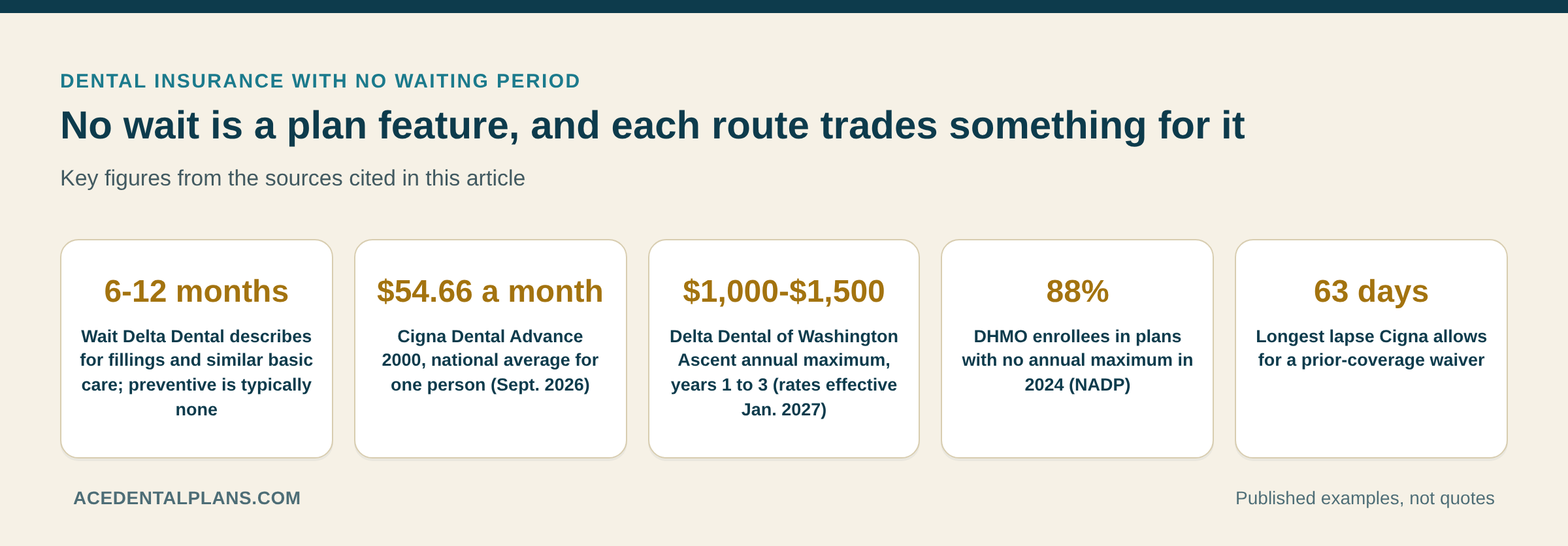
Yes, dental insurance with no waiting period exists, usually through a dental HMO, a graded individual plan, an employer group plan or credit for prior coverage. Published 2026 examples include a Cigna plan averaging $54.66 a month and a Delta Dental of Washington plan starting at $63.60. No wait does not mean full payment on day one.
This page explains how those plans work, what you give up in exchange for skipping the wait, and what to confirm in writing before you enroll. It compares published plan examples, runs a hypothetical first-year estimate and covers alternatives such as discount plans and dental school clinics. It doesn’t rank carriers or recommend a plan, and the general rules on how long waits last and when they apply have their own page on the site.
Key Takeaways
- Preventive care rarely has a wait. Delta Dental and Humana both say cleanings and exams typically carry no waiting period. A “no wait” promise therefore matters mostly for fillings, root canals, crowns and similar work, where waits of 6 to 12 months are common.
- Dental HMOs are the usual starting point, not a guarantee. Humana’s Dental Value DHMO page says “No waiting periods” and “No annual maximums,” and Guardian says full coverage with no wait is most common in HMO plans. Delta Dental says DHMO plans commonly do have waits, so the plan document decides.
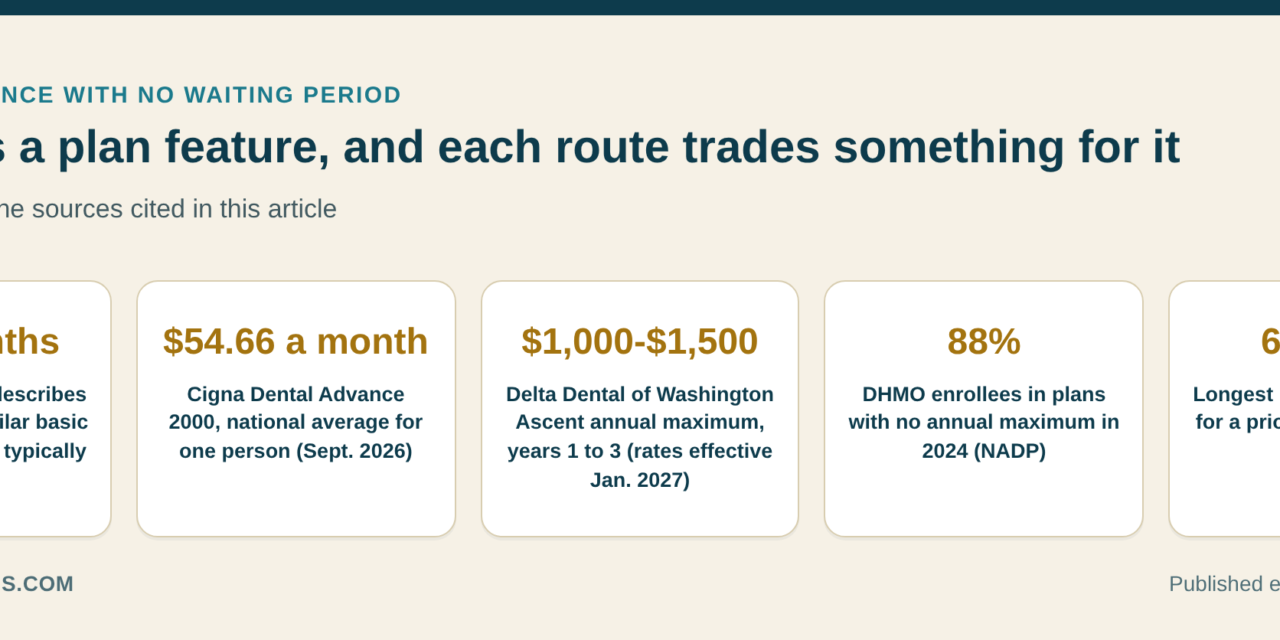
- Individual plans that skip the wait often start with smaller benefits. Delta Dental of Washington’s Ascent plan has no waiting period for covered procedures, but its annual maximum is $1,000 in year one and rises to $1,500 by year three (rates effective January 2027).
- The math can be close. In this article’s hypothetical, a no-wait plan came out only $155 ahead of paying cash over 13 months, because the first-year maximum capped what it paid.
- Prior coverage can erase a wait. Cigna says waits on basic and major care may be waived after 12 or more months of qualifying prior coverage with a lapse of no more than 63 days. Orthodontic and implant waits aren’t eligible.
- Discount plans have no wait but aren’t insurance. Cigna says they require an upfront membership fee and you still pay for each service at the discounted rate.
What a “No Waiting Period” Claim Actually Promises
A waiting period is the stretch after enrollment during which the plan won’t pay for certain services. HealthCare.gov puts the cost side plainly for Marketplace stand-alone dental plans: a plan with a waiting period doesn’t pay for services until it ends, and you still owe premiums during the wait. A plan with no waiting period pays benefits for covered services from the effective date, subject to everything else in the policy. Readers who want the general rules, including how long each type of wait typically runs, can start with how dental insurance waiting periods work; this page stays with plans that skip them.
Start by asking which services the promise covers. Delta Dental says there is typically no waiting period for preventive or diagnostic services such as routine cleanings and basic exams. Restorative services such as fillings and non-surgical extractions may wait 6 to 12 months. Crowns, bridges and dentures may wait 6, 12 or 24 months, with 12 months often standard. Humana’s consumer page says most dental plans have no wait for preventive care, and that its individual plans may include standard waits of 3, 6 or 12 months before all procedures are covered. A plan that advertises “no waiting period” for cleanings is describing something close to the norm.
The claim that deserves attention is the one for basic and major care. Cigna’s Dental Advance 3000 page, for instance, says no waiting periods were applied to any class, including child orthodontic coverage. Cigna’s Dental 3000/100 page is narrower: “No waiting periods for select services,” without naming the services. Those two sentences promise very different things, and only the plan documents say which one you’re buying.
What a missing wait does not remove
Skipping the wait changes when benefits start. It leaves the rest of the plan intact. A deductible (the amount you pay before the plan starts sharing costs) may still apply. Delta Dental of Washington’s Ascent plan lists $50, and Cigna’s Advance 2000 page lists a $75 lifetime deductible for individuals. Coinsurance, the share of the allowed amount you pay, still applies to most non-preventive care. The plan’s annual maximum still caps what it pays, and frequency limits still restrict how often a service is eligible. Ascent covers crowns at 50% per tooth every seven years, for example, and Cigna’s pages note that frequency limitations apply to preventive services.
Network rules also stay in force. Cigna’s pages say you can see any dentist but may pay more out of network if the dentist’s charges exceed Cigna’s reimbursement amount. So three different bills can follow the same procedure: one at an in-network dentist, one out of network and one after the maximum is spent.
Why waits exist in the first place
According to Delta Dental, pre-existing condition exclusion periods are designed to avoid situations where an individual buys insurance solely to cover a major procedure. That’s the problem a waiting period solves for the insurer. When a plan drops the wait, it has to protect itself some other way. Guardian says policies without a waiting period for complex care generally have higher premiums than policies with one. The examples later in this article show other levers: smaller benefits in the first year, flat copays instead of percentages, or a narrower network.
None of this makes no-wait plans a poor choice. It means the wait didn’t disappear; it moved into the price, the benefit schedule or the provider list. Your job is to find where.
Who has dental benefits at all
The National Association of Dental Plans (NADP) reports that nearly 284 million Americans had dental benefits in its 2025 enrollment report. That’s about 83% of the population, a decline of 2.3% from the year before. The summary the association published doesn’t split that figure between employer, individual and public coverage. Most people reach dental benefits through a job or a public program. That matters because the routes with the fewest waits are often not the ones sold to individual shoppers.
Five Routes to Coverage Without a Wait
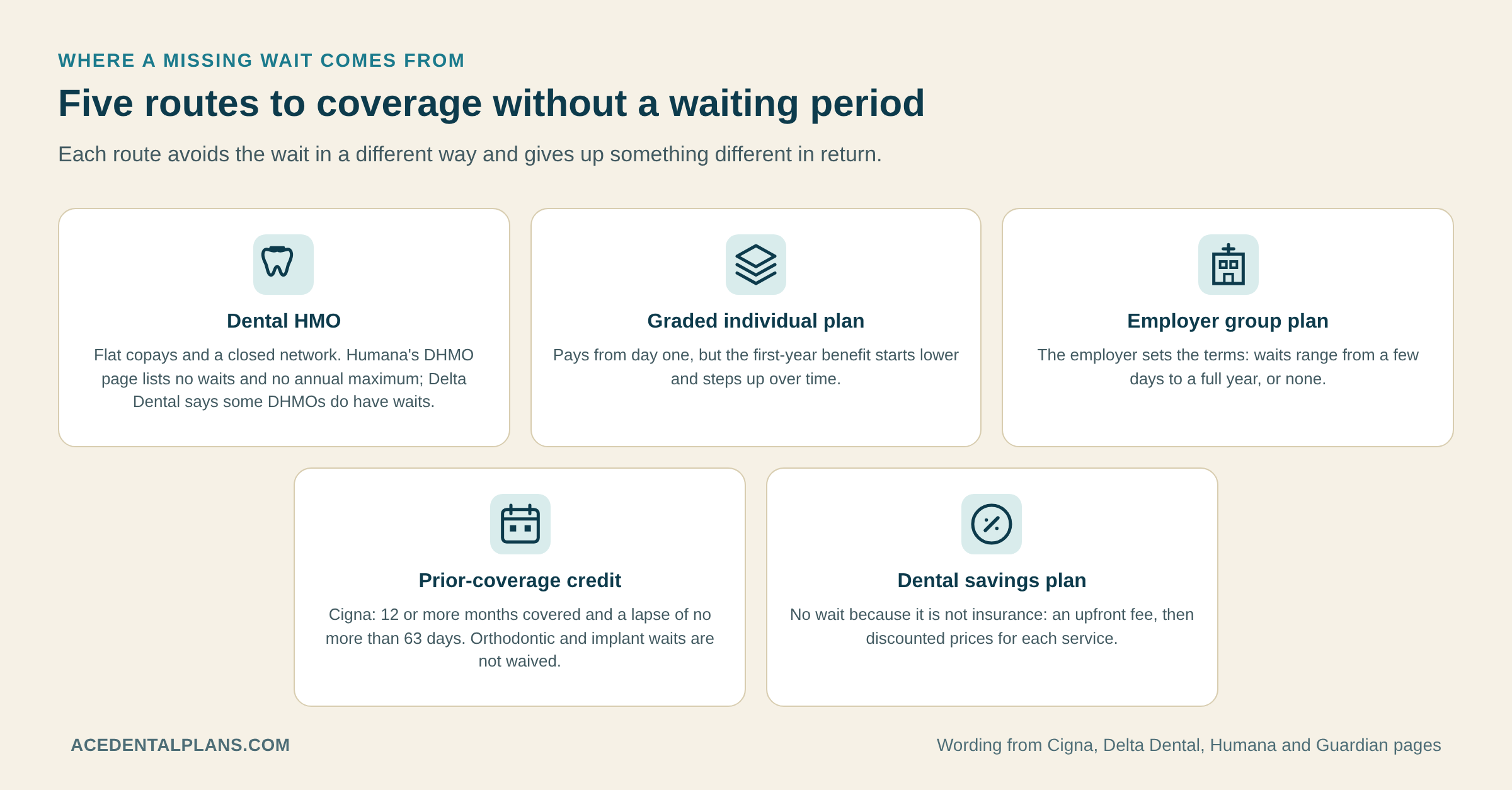
“No waiting period” isn’t a single product category. It shows up in five different places, each with its own cost and its own catch. The table below lays them side by side, using the wording the carriers themselves publish. Where two sources disagree, the cell says so.
| Route | How the wait is avoided | What you may give up | Source |
|---|---|---|---|
| Dental HMO (DHMO) | Many DHMOs publish no waits. Humana’s Dental Value DHMO page states “No waiting periods” and “No annual maximums.” | Closed network with a primary dentist; fixed copays instead of percentages; possible one-year contract and one-time enrollment fee. Delta Dental says DHMOs commonly do have waits. | Humana plan page (accessed 2026); Guardian; Delta Dental; Cigna |
| Graded individual plan | The plan pays from day one but starts with smaller benefits that step up. Delta Dental of Washington’s Ascent: “no waiting period for any covered procedures.” | Lower first-year maximum ($1,000 rising to $1,500 in Ascent); percentages that start low; availability by state. | Delta Dental of Washington (rates effective Jan. 2027) |
| Employer group plan | Employers choose their own terms. Delta Dental says employer waits range from a few days to a full year, and Delta Dental of Washington says some employer plans don’t have them. | You can’t shop it freely; a separate eligibility wait before you’re enrolled can still apply (Humana). | Delta Dental; Delta Dental of Washington; Humana; Guardian |
| Credit for prior coverage | A new plan waives or shortens the wait when you had comparable coverage. Cigna: 12 or more months of prior coverage with a lapse of no more than 63 days. | A gap in coverage can void it; proof of prior coverage may be required; orthodontic and implant waits may not be waivable. | Cigna Dental 3000/100 page (Oct. 2025); Delta Dental of Illinois; Guardian |
| Dental savings (discount) plan, not insurance | No claims and no benefit schedule, so there is nothing to wait for. Cigna: discount programs “come with no waiting period.” | An upfront membership fee, and you pay each service at the discounted rate. No annual benefit, so no insurer payment toward the bill. | Cigna discount dental programs page; Delta Dental |
Two patterns stand out. First, the routes that really cost nothing extra in waiting time (employer plans and prior-coverage credit) depend on your circumstances rather than on what you can buy today. Second, the routes you can buy on demand (DHMOs, graded plans and savings plans) each trade away something specific: choice of dentist, early benefits or insurance itself. The sections that follow take them one at a time.
Dental HMO Plans: Copays Instead of a Wait, but a Closed Network
A dental HMO (DHMO) works differently from the percentage-based plans most people picture. Cigna’s explainer says DHMOs typically charge a flat fee for each service, though they may also require coinsurance. They generally cover only in-network dentists, except in emergencies or where the law requires otherwise. You choose a primary dentist, and that dentist refers you to in-network specialists.
That structure explains why waits are rare. The plan isn’t sharing a pool of dollars up to a maximum; it’s paying a contracted dentist a set amount per member, and the member pays a published fee for each service. Humana’s Dental Value DHMO page lists no waiting periods, no annual maximums and no deductibles. Preventive services cost $0, while basic services such as fillings and extractions, and major services such as root canals, crowns and dentures, carry set copays. The NADP’s 2025 plan design report, which uses 2024 data, found that 88% of DHMO enrollees were in plans with no annual maximum, up from 78% the year before.
When a DHMO fits a short time frame
Someone who needs a crown soon and wants a known price may find a DHMO’s fee schedule easier to read than a PPO’s percentage rules. Guardian says DHMOs can be cheaper and have no deductibles or maximums, but you have to see an in-network dentist, and the choices may be quite limited. It also says no-wait coverage is available most commonly in Dental HMO plans, which generally don’t have waiting periods.
The catch is the provider list. Carriers usually run several products, and a dentist who accepts a carrier’s PPO may not participate in its DHMO. Humana’s page cites a nationwide network of more than 135,000 dentists and specialists (network data accessed October 2024). A national count says little about whether a participating office is near your home. Check the office you’d actually use, and ask whether it accepts new DHMO members.
Where the sources disagree
On whether DHMOs are the no-wait option, the carriers don’t line up. Guardian and Humana describe DHMO plans with no waits. Cigna says waiting periods are more often a feature of dental PPO plans, “but it depends on the plan.” Delta Dental’s consumer page, by contrast, says DHMO plans commonly have waiting periods. Most discount plans do not. Those statements can all be true, because they describe different carriers’ products. They are a good reason to treat “HMO” as a lead to check rather than a promise.
Humana’s page adds details worth reading before you enroll. Plans aren’t available in all states, and availability depends on state and age. Dental and vision plans (excluding its savings plan) may have a minimum one-year initial contract period. A one-time non-refundable enrollment fee may apply. Ask for the full copay schedule for the procedures you expect. Ask what each copay includes, such as lab fees or materials for a crown, so you can compare it with a PPO estimate line by line.
Individual PPO-Style Plans That Skip the Wait: How Graded Benefits Work
The second route is the one most shoppers mean when they search for the topic. It’s a plan you can buy as an individual, use with any dentist and start using right away. Several carriers publish these, and the examples in Table 2 come straight from their plan pages. They share a pattern. The plan pays from day one, but the benefit you can draw on in the early years is smaller than a mature plan’s, or the rules around it differ.
| Plan | Published premium | Annual maximum or benefit | Deductible | Waiting-period wording |
|---|---|---|---|---|
| Delta Dental of Washington Ascent (Washington only) | $63.60 (Eastern WA) or $73.15 (Western WA) a month, subscriber only, rates effective Jan. 2027 | $1,000 in year 1, $1,250 in year 2, $1,500 in year 3 and later | $50 | “No waiting period for any covered procedures” |
| Delta Dental of Washington Enhanced (comparison) | $55.40 (Eastern WA) or $63.75 (Western WA) a month, same basis | $1,000 | $50 | Waiting periods “may apply” |
| Cigna Dental Advance 2000 (not offered in GA, NV, NM, PA, WV) | $54.66 a month, national average for one person, Sept. 2026 | “Advance from $1,500 – $2,000 in dental benefits over 3 policy years”; no separate annual maximum stated | $75 lifetime | “No waiting periods applied to any class including implant coverage” |
| Cigna Dental Advance 3000 | $60.44 a month, national average for one person, Sept. 2026 | “Advance from $2,000 – $3,000 in dental benefits over 3 policy years” | $150 lifetime | “No waiting periods applied to any class including child orthodontic coverage” |
| Cigna Dental 3000/100 | $44 a month, national average for one person, Oct. 2025 | $3,000 a year | $100 a year | “No waiting periods for select services”; services not named |
A few cautions apply before reading anything into the premiums. Cigna’s figures are national averages for a single person and vary by location. Delta Dental of Washington’s rates are examples for one state’s market, with actual rates varying by plan effective date, age and location. The plans also differ in more than their waiting periods, which makes the premium gap between any two rows a rough guide at most.
Reading the Ascent plan as a case study
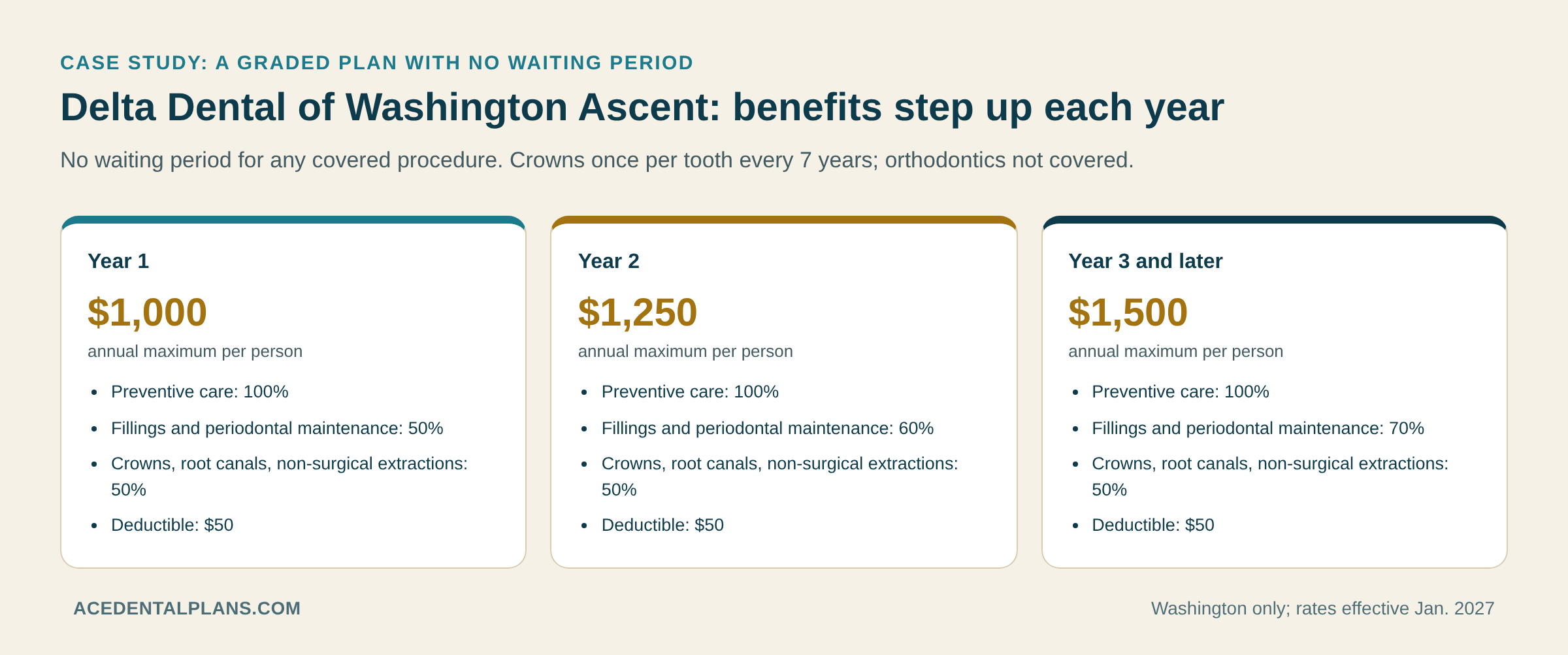
Delta Dental of Washington’s Ascent plan is the clearest published case of a no-wait design. Per its plan pages, the plan pays 100% for preventive care. Fillings and periodontal maintenance are covered at 50% in year one, 60% in year two and 70% in year three and later. Crowns, root canals and non-surgical extractions are covered at 50%, with crowns limited to one per tooth every seven years, and the page suggests a pretreatment estimate for crowns. The coverage percentages apply to the allowed amount, and orthodontics isn’t covered.
Look at the Enhanced row beside it. In the same published table, Enhanced shows the same $1,000 maximum, $50 deductible and 50% levels as Ascent’s first year, with waiting periods that may apply. Ascent’s published monthly rates run $8.20 to $9.40 above Enhanced’s, or roughly $98 to $113 a year. That gap isn’t a pure price of skipping the wait, since Ascent also steps up over time. It does give a sense of scale. In this one market, skipping the wait added less than $10 a month to the premium for comparable first-year benefits.
Why benefits start small
The design logic is easy to infer. A smaller first-year benefit limits what the insurer pays to someone who joins only to cover one expensive procedure, which is the exact risk waiting periods exist to manage. The plan pages don’t state that reasoning, so treat it as an explanation rather than a quotation. What the pages do state is the mechanism: Cigna describes its Advance plans as offering a range of benefits over 3 policy years, and Delta Dental of Washington shows the year-by-year maximums above.
Cigna’s wording needs a careful read. “Advance from $1,500 – $2,000 in dental benefits over 3 policy years” doesn’t say whether the amount is a yearly limit, a three-year total or a ramp. The page points to plan documents for exact limits, and so should you. Ask Cigna or a licensed agent how much the plan would pay in each of the first three policy years, in dollars.
Shorter waits are not the same as no waits
Some carriers market reduced waits rather than none. Anthem’s individual and family page says its Essential Choice PPO plans cover diagnostic and preventive care at 100% with no waiting period. It also describes them as having “shorter waiting periods than traditional plans” for basic, complex and major services, without giving durations. Its Family PPO plans mention no waiting periods only “depending on the plan you choose.” Annual maximums on the Essential Choice plans go up to $2,500. The Family PPO plans have a high or no annual benefit maximum, including no annual benefit limits for children of pediatric age. Those are real advantages, but they’re a different promise from “no waiting period,” and the headline on a comparison site may blur them together.
A caution about a plan’s own history
Even within one carrier’s lineup, terms differ and change. A Cigna broker plan comparison form dated 12/23 lists 6-month waits on basic services and 12-month waits on major services. It lists them for a plan with the same name as the Dental 3000/100 plan in Table 2. The current consumer page says “no waiting periods for select services.” The two statements aren’t necessarily in conflict, since the select services could be preventive and diagnostic care, and plan versions and state filings differ. Still, the contrast shows why a marketing sentence isn’t enough. Ask for the current policy form or certificate for your state and read the waiting-period schedule yourself.
What You Give Up When You Skip the Wait
Every no-wait route costs something. The cost shows up in one of four places, and it helps to name which one you’re paying.
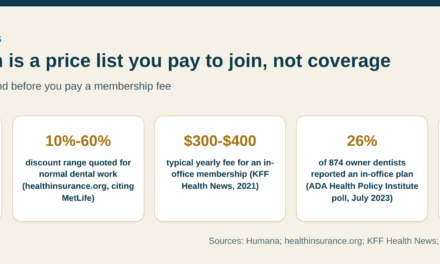
- Premium. Guardian says policies without a waiting period for complex care generally have higher premiums than policies with one. Delta Dental of Washington’s published rates suggest the gap can be small, under $10 a month in the Ascent-versus-Enhanced comparison above. A single comparison from one carrier in one state doesn’t predict yours.
- Early benefit size. Graded plans pay from day one but cap the first year low. A $1,000 maximum buys a root canal or a crown, but rarely both.
- Choice of dentist. A DHMO limits you to its network and a primary dentist. Out-of-network use on a PPO-style plan can leave you with the difference between the dentist’s charge and the plan’s reimbursement, as Cigna’s pages warn.
- Contract terms. Ascent is listed by Delta Dental of Washington as an annual contract. Humana says some dental plans may carry a minimum one-year initial contract and a one-time non-refundable enrollment fee. Cigna’s Advance plans use lifetime rather than annual deductibles, which can help if you need care across several years but is unusual enough to confirm.
One thing you don’t give up is protection from the plan’s other limits. The annual maximum, deductible, coinsurance, frequency limits and exclusions are all still there. A later section covers the ones most likely to surprise someone who bought a plan to get treatment started.
Run the Numbers: A Hypothetical First 13 Months
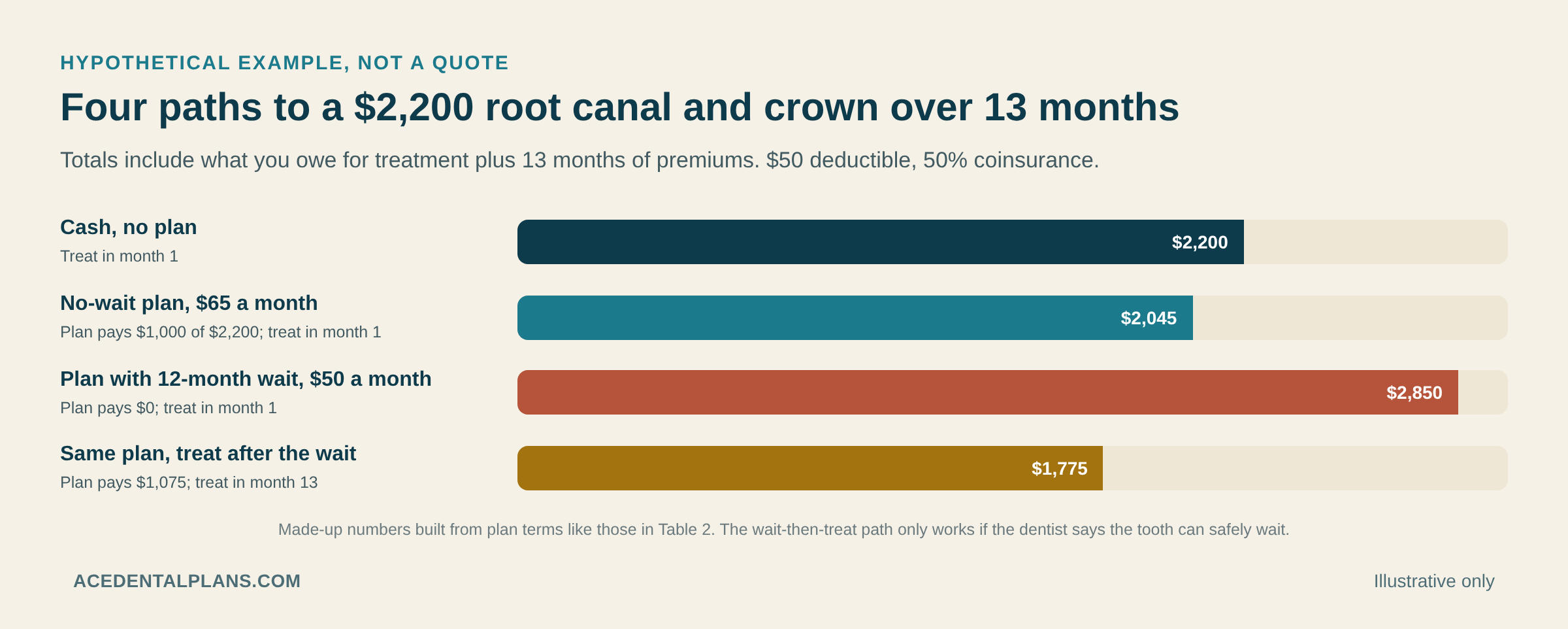
The useful question isn’t whether a no-wait plan is better. It’s whether the benefit it pays in the first year exceeds the premiums you pay for it, compared with the alternatives available to you. Here’s one worked comparison. Every number below is hypothetical, built from the kinds of terms in Table 2, and none of it is a quote.
On Path 2, the plan applies the deductible first: ($2,200 minus $50) at 50% is $1,075, which the $1,000 maximum trims to $1,000. You owe $1,200 for the treatment plus $845 in premiums (13 months at $65), or $2,045. On Path 4, the plan pays $1,075 and you owe $1,125, plus $650 in premiums, or $1,775.
| Path | When treated | Plan pays | You owe for treatment | Premiums, 13 months | Total out of pocket |
|---|---|---|---|---|---|
| 1. Cash, no plan | Month 1 | $0 | $2,200 | $0 | $2,200 |
| 2. No-wait plan ($65 a month, $1,000 first-year maximum) | Month 1 | $1,000 | $1,200 | $845 | $2,045 |
| 3. Plan with 12-month wait ($50 a month), treat now | Month 1 | $0 | $2,200 | $650 | $2,850 |
| 4. Plan with 12-month wait ($50 a month), treat after the wait | Month 13 | $1,075 | $1,125 | $650 | $1,775 |
What the comparison shows
Three results are worth pulling out. First, the no-wait plan beat cash by only $155 ($2,200 minus $2,045). The first-year maximum, not the coinsurance percentage, set the ceiling on the benefit. If the same plan had a $1,500 first-year maximum, the plan would have paid $1,075, you would have owed $1,125 and the total would have been $1,970, a $230 advantage over cash. Raising the maximum by $500 moved the outcome by only $75, because at 50% coinsurance the plan was never going to pay more than $1,075 on this bill.
Second, Path 3 is the cost of buying a plan with a wait and using it too early: the premiums bought nothing for this treatment. That’s the scenario no-wait coverage exists to prevent, and it’s the one where a no-wait plan clearly helps, if it pays anything at all.
Third, Path 4 was the lowest-cost route on paper, but it only works if the tooth can safely wait a year. That’s a clinical question for the treating dentist, not a spreadsheet one. A dental problem left untreated may get worse, and a more advanced problem may cost more to treat than the premium saved. Don’t delay recommended treatment to wait out a plan without asking your dentist whether delay is reasonable.
The break-even rule of thumb
You can run the same test on your own estimate in three lines. Estimate what the plan would pay on the treatment you need in year one: the allowed amount minus the deductible, times the coinsurance percentage, capped at the first-year maximum. Subtract the premiums you’d pay over the same period. If the result is small or negative, the plan’s value is coming from something else, such as protection against a bill you can’t predict or covered preventive visits. You should be able to name that something. If the result is clearly positive, the no-wait plan is doing what you bought it for.
Two refinements matter. A smaller bill changes the picture because the deductible takes a larger bite. On a $200 filling at Ascent’s year-one rate, the plan would pay $75 after the $50 deductible, and in year three it would pay $105 at 70%. And preventive visits count: if the plan pays 100% of routine cleanings and exams, the dollars you’d otherwise pay for those visits belong on the benefit side of your math.
Employer Dental Plans: Often the Shortest Route to Immediate Coverage
When a job offers dental benefits, the question changes from “which no-wait plan should I buy?” to “what are my employer’s terms?” Employers choose their own waiting periods, and the sources describe a wide spread. Employer-sponsored plans can set waits, Delta Dental says, “ranging from a few days to a full year.” Delta Dental of Washington says some employer-based plans often don’t have waiting periods. Guardian says employer-based group plans are more likely than individual plans to have no-wait options, and calls workplace coverage probably the strongest choice even when the plan has a waiting period.
Humana adds a wrinkle that’s easy to miss. Employer-based plans can have two separate waits: one before you become eligible for the plan at all, and another that applies to certain services after you enroll. Suppose, hypothetically, that a new hire faces an eligibility wait before enrolling and then a 6-month wait on basic care once covered. Ask HR for both numbers, not just the second.
What to ask your benefits office
- When does coverage start for a new hire or for someone enrolling during open enrollment, and is there a separate eligibility wait?
- Does the plan apply waiting periods to basic, major or orthodontic services, and does the length depend on how long you’ve been covered?
- Will the plan credit your prior dental coverage, and what proof does it need?
- Is the benefit year a calendar year, and how much of the maximum do you get if you join late in the year?
- Does the plan carry a missing-tooth clause or a replacement limit that could matter for what you need?
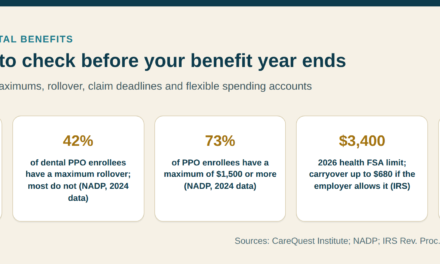
The answer to the late-in-the-year question matters more than it looks. If the benefit year follows the calendar, someone who joins in October may have only a few months to use that year’s maximum before it resets, even when the maximum itself is the full amount. Timing treatment around the reset can change what you pay. If you’re enrolling in the second half of a plan year, read about using benefits before the year ends.
Prior Coverage Can Cancel a Waiting Period: How the Credit Works
The cheapest way to avoid a wait is often to have already served one. Several carriers will waive or shorten a waiting period when you had comparable coverage right before joining. The rules look similar on the surface and differ in the details that decide whether you qualify.
A waiting period will be waived, Delta Dental says, if a comparable dental plan was terminated within a set window before the new plan’s start date. The former plan must have very similar coverage. Its Illinois page adds that waits may be waived if you or your dependents were covered for 12 continuous months. The previous coverage usually must have ended within the past 30 to 60 days, and you may need to provide proof. Cigna’s Dental 3000/100 page sets the bar at 12 or more months of prior dental coverage that included major restorative services. No more than 63 days can have lapsed. That applies to waits on its second and third classes of service. Delta Dental of Washington also names a gap of usually no more than 63 days.
Guardian is stricter. It says a waiting period may be waived with 12 consecutive months of prior dental coverage, plus a letter and benefit summary from the previous insurer. It adds that this generally applies to group coverage rather than every individual or exchange policy, and that any lapse, even a short one, likely makes you ineligible. Humana lists the common paths to a waiver. One is continuing coverage with the same insurer after changing employers. Another is rolling from an employer plan to an individual plan from the same insurer. A third is switching insurers without a coverage break, though the new insurer will likely want similar plans.
Where the credit stops
Cigna’s page states that orthodontia and implant waiting periods aren’t eligible for waiver. If you’re planning braces or an implant, a prior-coverage credit may help with fillings and crowns while leaving the longer wait in place for the treatment you care about most. Credit also depends on how closely the old plan resembles the new one. The former plan must have very similar coverage, Delta Dental says, so having had some dental insurance may not be enough.
A short decision path
- Check your gap. Count the days between your old plan’s last covered day and the new plan’s start date. The sources above range from “any lapse” to about 63 days.
- Keep the old plan until the new one starts. Delta Dental advises this, and it is the simplest way to avoid a gap.
- Request proof early. Ask your previous carrier or HR for a letter confirming coverage dates and a benefit summary. Guardian names both.
- Ask the new carrier in writing which services the credit applies to. Make sure the answer covers the specific service you’re planning, not only “waiting periods” in general.
- Keep the confirmation. If a claim is later denied for a waiting period, the written answer is your starting point for an appeal.
Dental Savings Plans: No Wait, but Not Insurance
A dental savings plan (also called a discount dental program) sidesteps waiting periods by not being insurance at all. Cigna’s page states that discount programs are not dental insurance, that they require an upfront membership fee, and that “discount” doesn’t mean free: you pay for each service at the discounted rate. It also says these programs come with no waiting period, so you can use them soon after joining. Delta Dental’s page agrees, noting that most discount plans, such as its Patient Direct, do not have waiting periods.
The trade is structural. There is no claim, no annual maximum and no insurer payment toward your bill, so there is nothing to wait for and nothing to run out. The savings come from the fees the participating dentist has agreed to charge members. Cigna’s page doesn’t state a typical discount, and neither does Delta Dental’s, so the only reliable number is the fee schedule from the program itself. Ask for it before you pay the membership fee, and ask the office you plan to use whether it participates in that program today.
Cigna’s page also notes that a discount program can be combined with dental insurance, for example to cover cosmetic work that insurance usually excludes. It says discount programs typically expire at the end of the year.
For a closer look at the two products side by side, comparing dental insurance with a dental savings plan covers premiums, fees, limits and when each tends to cost less. The short version for this topic: a savings plan removes the wait without raising the question of a maximum, but it also removes the insurer’s share of the bill.
Limits That Survive a No-Wait Promise
A plan that pays from day one can still leave a large balance. The usual reasons are the rules that sit alongside the waiting period. They matter more for a no-wait buyer than for most, because people who buy no-wait coverage tend to have a specific expensive procedure in mind.
The annual maximum
The annual maximum is the most a dental plan pays toward covered services during a benefit period. It’s not a medical-style out-of-pocket maximum; once you reach it, you pay the plan’s share too. CareQuest Institute’s February 2026 report says that after reaching the cap, the individual is responsible for 100% of additional dental expenses for the rest of the plan year. For a fuller explanation of how the cap, benefit periods and rollovers work, see what a dental annual maximum is.
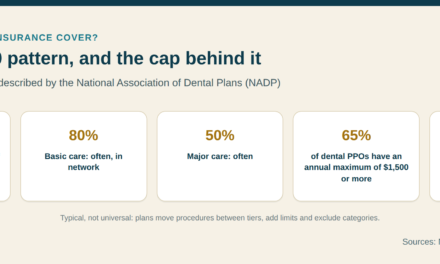
Here is how published figures place the no-wait examples. An ADA News piece from December 2025, citing NADP data, breaks in-network maximums into three bands. About 32.8% fall between $1,000 and $1,500, 48.2% between $1,500 and $2,500, and 17.2% at $2,500 or higher, including plans with no maximum. The same article notes many plans still promote the long-standing $1,000 level that was established some 40 years ago. Ascent’s year-one $1,000 sits in the lowest band. Cigna’s Dental 3000/100, with a $3,000 maximum, sits in the highest.
How often people hit the cap depends on who is counted. A 2024 ADA Health Policy Institute analysis cited by ADA News found that 3.4% of dental patients reach the typical annual maximum, and another 3.3% come within $100 of common limits. NADP data show that group DPPO enrollees reaching their maximum rose to 1.7% to 2.9%, the highest share in six years. CareQuest’s 2025 survey found that 12% of adults with dental insurance reported reaching or exceeding their maximum in the previous year, about 32 million people. Among those adults, 39% paid full price to continue treatment, 39% stopped or delayed treatment until benefits renewed, 13% negotiated a discounted fee and 3% used other savings options.
The gap between 3.4% and 12% shouldn’t be read as a contradiction. The figures come from different data (claims versus survey responses), different populations and different years. For a reader with a major procedure pending, the useful point is simpler. People with expensive treatment plans are the ones most likely to reach the cap, and a low first-year maximum puts a no-wait buyer closer to it than average.
Deductible, coinsurance and frequency limits
The deductible and coinsurance work as they do in any PPO-style plan: you pay the deductible, then a percentage of the allowed amount. Ascent’s 50% on crowns and root canals means the plan’s payment is half of the allowed amount after the deductible, not half of the dentist’s list price. Frequency limits can bite later. A crown covered once per tooth every seven years means a failed crown within that window might not be eligible for a second payment. It depends on the plan’s replacement rule, which is worth asking about directly.
Missing-tooth clauses and pre-existing conditions
Two exclusions deserve special attention if you’re buying coverage to fix a problem that already exists. A missing-tooth clause says the plan won’t pay to replace a tooth lost before the coverage started. Under such a clause, Delta Dental of New Jersey explains, the member pays the full cost of the replacement, which is usually an implant and crown, a bridge or dentures. Its own plans have no such clause and instead include a missing tooth inclusion for members aged 16 and over, subject to the group policy’s terms. Other carriers may not follow that approach.
The second is the pre-existing condition idea Delta Dental describes. Waiting periods are designed to prevent someone from buying insurance only to cover a major procedure, and basic conditions like cavities are usually covered right away. A plan with no wait may handle the same risk through limits that appear elsewhere in the document. If you have a known problem, read the exclusions and limitations section as carefully as the waiting-period schedule.
Estimates before treatment
Delta Dental of Washington’s Ascent page suggests a pretreatment estimate for crowns, and implant and crown benefits on several of its plans require a pretreatment estimate and clinical criteria. A pretreatment estimate (sometimes called predetermination) shows how a plan may handle a proposed treatment under current benefits. It isn’t a promise of payment, and it can change if your eligibility, remaining maximum or the treatment itself changes before the claim.
How to Confirm a No-Wait Claim Before You Pay
Headlines and search snippets compress plan terms into a few words. The sources all point the same way on what to do about it. HealthCare.gov advises getting details from the insurance company about waiting periods before you enroll. Delta Dental advises reading your benefit description carefully and asking specific questions. Delta Dental of Washington says the benefits summary lists any waiting period, its length and the procedures it covers. It warns that you’re responsible for the full cost of a procedure that isn’t covered during the wait.
Turn that advice into six concrete questions, and ask for the answers in writing, by email or in a plan document, with the document’s name and date.
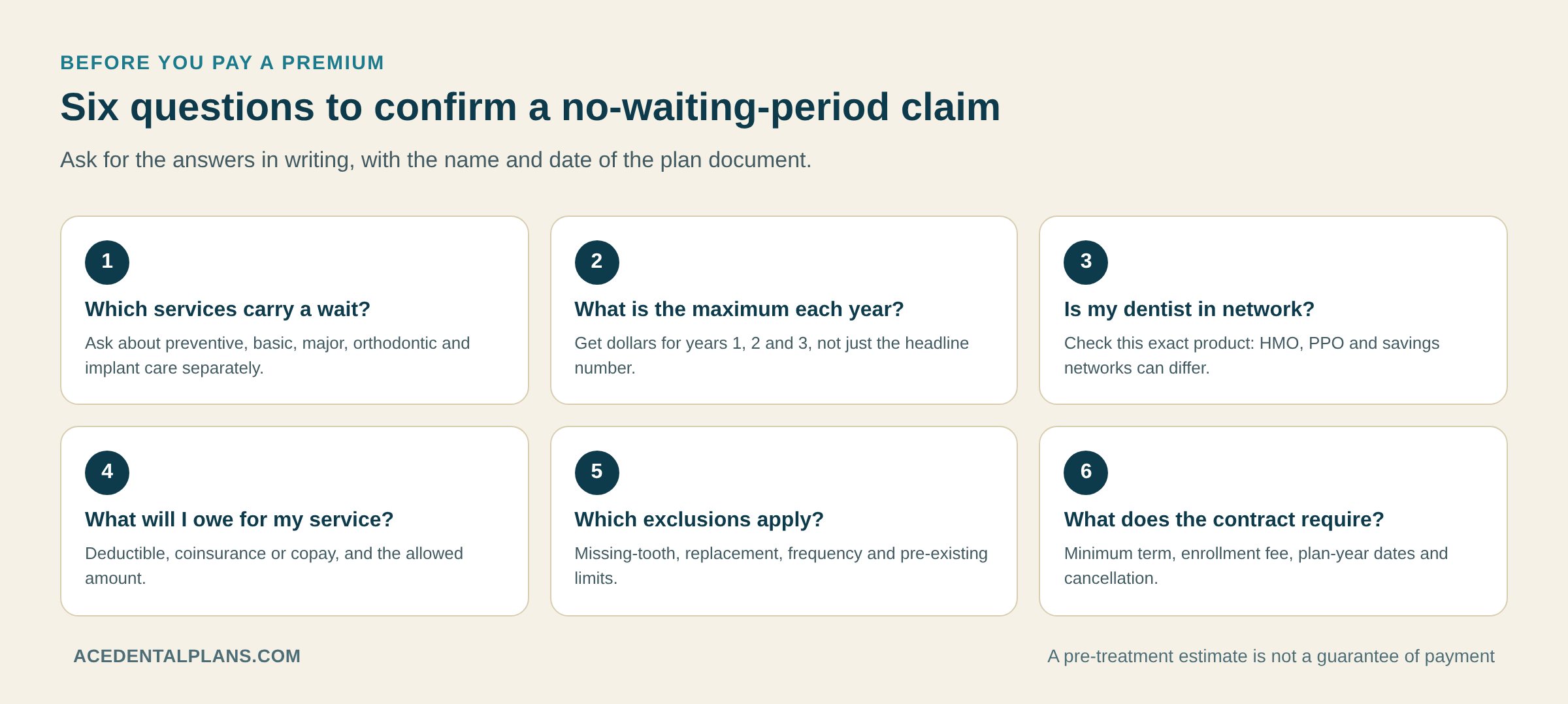
- Which service categories carry a wait, if any? Ask separately about preventive, basic, major, orthodontic and implant care. A “no waiting period” answer for cleanings tells you little about crowns, and the Cigna Dental 3000/100 wording (“select services”) shows why the category matters.
- What is the maximum in dollars for each of the first three years? On graded plans the year-one figure may be much lower than the number in the headline. Ask what happens to unused amounts.
- Is my dentist in network for this exact product? A dental HMO, a PPO and a savings program from the same company can have different participating offices. Ask the dentist’s office, not only the carrier.
- What will my deductible, coinsurance or copay be for the service I need? For a DHMO, ask for the copay schedule. For a PPO-style plan, ask for the percentage applied to the allowed amount and whether a deductible applies to that service.
- Which exclusions and limits apply to my situation? Missing-tooth clauses, replacement intervals, frequency limits and any treatment of conditions that began before coverage all belong on this list.
- What does the contract require? Ask about the minimum term, any enrollment fee, how the plan year is counted, the cancellation rules and when the first claim can be paid.
Finding the wait in your paperwork
Waiting periods usually sit in the benefit summary or schedule of benefits, sometimes with a separate rider for orthodontic or implant coverage. If a plan lists a service in one place and excludes it in another, ask which controls. For Marketplace buyers, HealthCare.gov says you can compare each plan’s costs, copayments, deductibles and covered services, and that if you pick a separate dental plan you’ll pay a separate premium. It also says you can buy a separate dental plan only when you’re buying a health plan at the same time.
For children, HealthCare.gov says dental coverage is an essential health benefit that must be available for anyone 18 or younger you cover, though you aren’t required to buy it. For adults, dental coverage isn’t an essential health benefit, which is one reason adult stand-alone plans carry the waits described above.
Who May Benefit From a No-Wait Plan, and Who May Not
There’s no one-size-fits-all answer, but a few situations come up repeatedly. These are decision paths, not recommendations for any individual.
- You mainly need cleanings and exams. Preventive care typically has no waiting period under Delta Dental’s and Humana’s descriptions, so paying more for a no-wait feature may buy little. Compare the plan on its preventive coverage and premium alone.
- A dentist has recommended major work soon. Guardian advises first working out what major services you need right away. Run the three-line test from the 13-month example, then compare the result with a DHMO copay schedule, a savings program and cash. The dentist can tell you whether the work can reasonably wait.
- You have employer coverage available. Ask what waits and eligibility rules apply before looking at individual plans. Guardian calls workplace coverage probably the strongest choice, even with a wait.
- You’re between jobs or plans. Prior-coverage credit may be worth more than any no-wait product, but only if you keep the gap short and collect proof of your dates.
- You’re planning orthodontics or an implant. Waits for those services may not be waivable, according to Cigna, and several no-wait plans exclude orthodontics (Ascent does). Cigna’s Advance 3000 page lists child orthodontic coverage with no waiting period, and Advance 2000 lists implant coverage with none. Verify the limits in the policy, because the pages give no dollar caps for those benefits.
- Your budget is tight. The premium is a certain monthly cost, while the benefit is conditional on a claim. The next sections cover lower-cost ways to get treatment started that don’t depend on a plan.
If No Plan Fits: Other Ways to Get Care Started
Insurance is one of several ways to pay for a procedure. For a person who needs care within weeks, it isn’t always the practical one. The National Institute of Dental and Craniofacial Research (NIDCR) says dental schools often have clinics where students gain experience treating patients, with experienced licensed dentists closely supervising. It recommends contacting a dental school in your state about its clinic services. The same page points to federally funded health centers where you pay what you can afford, based on your income.
Other options are worth a conversation with the dental office. Ask whether the practice offers an in-house payment plan, whether treatment can be sequenced so the most pressing part comes first, and whether a cash or membership price exists. The dentist is the right person to say what can safely be phased. A dedicated page on the site covers financing and payment plans, including how interest and deferred-interest terms work.
Tax-advantaged accounts
If you have a health savings account or flexible spending account, you may be able to use those dollars for dental work. IRS Publication 502 says you can include in medical expenses the amounts you pay for the prevention and alleviation of dental disease. That covers routine care as well as fillings, extractions and dentures. You can deduct only the portion of total medical and dental expenses that exceeds 7.5% of your adjusted gross income. Account rules differ by plan type, so check the details in a guide to using an HSA for dental work or with your plan administrator.
Don’t Let a Waiting Period Delay Urgent Care
A waiting period decides who pays, not whether you can be treated. The American Dental Association’s MouthHealthy site says that in a dental emergency it’s important to visit your dentist or an emergency room as soon as possible. It adds that most dentists reserve time in their daily schedules for emergency patients. For a knocked-out permanent tooth, it advises keeping the tooth moist at all times and getting to the dentist right away.
Seek prompt dental or medical care if
- Swelling of the face or neck is spreading.
- You have trouble breathing or swallowing.
- You have a fever along with severe dental pain.
- Bleeding from the mouth doesn’t stop.
- A permanent tooth has been knocked out.
Call 911 or go to the nearest emergency room for trouble breathing or swallowing or swelling of the face or neck. Sort out the coverage question afterward: ask the office to bill any plan you have, and ask for an itemized statement so you can see which services a waiting period affected.
Bottom Line
Dental insurance with no waiting period is real, and it comes in a handful of forms: dental HMOs, graded individual plans, employer group plans, prior-coverage credit and, outside insurance, savings plans. Each avoids the wait by giving up something else, such as a free choice of dentist, a larger first-year benefit or the insurer’s share of the bill. Preventive care rarely needed the feature to begin with.
The deciding numbers are the first-year maximum, the coinsurance or copay for the service you need, and the premium. In the hypothetical here, a $1,000 first-year cap held a no-wait plan to a $155 advantage over cash. Before you enroll, get the waiting-period schedule, the year-by-year maximums and the exclusions in writing. Ask the dentist for a written treatment plan and whether the work can wait. Then run the arithmetic on your own estimate.
Frequently Asked Questions
Is there really dental insurance with no waiting period?
Yes, though the details vary by plan and state. Cigna’s pages for Dental Advance 2000 and 3000 say waiting periods do not apply. Delta Dental of Washington says its Ascent plan has no waiting period for covered procedures. Humana’s Dental Value DHMO page says “No waiting periods.” Availability depends on where you live, and each plan trades something for the feature, so read the policy before relying on a summary page.
Which type of dental plan most often has no waiting period?
Guardian says no-wait coverage is most common in dental HMO plans and that employer-based group plans are more likely than individual plans to offer it. Cigna says waits are more often a feature of PPO plans but that it depends on the plan, and Delta Dental says DHMO plans commonly do have waits. Treat plan type as a clue and the written schedule of benefits as the answer.
Does “no waiting period” mean my crown is covered right away?
It may mean the plan can pay toward a crown from the start. How much depends on your deductible, the coinsurance percentage, the first-year maximum, the plan’s allowed amount and any frequency or replacement rules. Under Ascent, for example, crowns are covered at 50% of the allowed amount after the deductible, limited to once per tooth every seven years. A pre-treatment estimate shows how the plan may handle your case, but it is not a promise of payment.
Do cleanings and exams have waiting periods?
Usually not. Delta Dental says there is typically no waiting period for preventive or diagnostic services, and Humana says most dental plans have no wait for preventive care. Plan rules still apply to how often cleanings and X-rays are eligible, and Cigna’s pages note that not all preventive services are covered.
Can I buy dental insurance only when I need a root canal?
You can try, but plans are built to discourage it. Delta Dental says pre-existing condition exclusion periods are designed to avoid situations where someone buys insurance solely to cover a major procedure, and graded plans start with smaller benefits. Check the exclusions and the first-year maximum, and compare the result with paying cash or using a savings program.
Can a waiting period be waived if I had dental insurance before?
Sometimes. Cigna says waits on its second and third service classes may be waived with 12 or more months of qualifying prior coverage and a lapse of no more than 63 days. Delta Dental of Illinois says prior coverage usually must have ended within 30 to 60 days. Guardian says any lapse likely makes you ineligible. Ask for the credit rules in writing and gather proof of your prior coverage dates.
Do employer dental plans have waiting periods?
Some do and some don’t. Delta Dental says employer-sponsored plans can set waits ranging from a few days to a full year, and Delta Dental of Washington says some employer-based plans often don’t have them. Humana notes employer plans can have both an eligibility wait and a separate wait for certain services, so ask your benefits office about both.
Is a dental savings plan the same as dental insurance with no waiting period?
No. Cigna says discount dental programs are not dental insurance. You pay a membership fee and then pay for each service at the discounted rate, and there’s no waiting period. A savings plan has no annual maximum, but it also has no insurer payment toward your bill.
Why do plans with no waiting period cost more?
Guardian says policies without a waiting period for complex care generally have higher premiums than policies with one. The gap can be modest: in Delta Dental of Washington’s published January 2027 rates, Ascent runs $8.20 to $9.40 a month above Enhanced, which has similar first-year benefits and waits that may apply. Price differences between plans reflect more than the wait, so compare the whole benefit schedule.
Do no-wait plans cover implants or braces right away?
Some advertise it. Cigna’s Advance 2000 page lists implant coverage with no waiting period, and its Advance 3000 page lists child orthodontic coverage with none. Delta Dental of Washington’s Ascent plan doesn’t cover orthodontics. Cigna’s Dental 3000/100 page says orthodontia and implant waiting periods aren’t eligible for the prior-coverage waiver. None of the pages reviewed gives dollar limits for those benefits, so confirm them in the policy.
What happens if I reach my annual maximum early in the year?
You pay the cost of additional covered services yourself until the benefit period resets. CareQuest Institute’s 2025 survey asked insured adults who reached their maximum what they did next. Some 39% paid full price to continue treatment and 39% stopped or delayed treatment until benefits renewed. Another 13% negotiated a discounted fee, and 3% used other savings options. Ask your dentist whether treatment can be phased, and never delay urgent care to protect benefits.
Can I get a no-waiting-period dental plan on the Marketplace?
Possibly, but HealthCare.gov says separate dental plans can have waiting periods before they start to cover services for adults, and that you still owe premiums during the wait. It also says you can buy a separate dental plan only when you’re buying a health plan at the same time. Ask the insurer for the waiting-period details before you enroll.
What if I need urgent dental care during a waiting period?
Get the care. A waiting period affects who pays, not whether a dentist can treat you. The ADA’s MouthHealthy site says to visit your dentist or an emergency room as soon as possible in a dental emergency. Afterward, ask the office to bill any plan you have and request an itemized statement showing what the waiting period affected.
Sources and Disclaimers
Plan mechanics, waiting-period rules and example plan terms come from insurer and carrier pages (Cigna, Delta Dental and its state affiliates, Humana, Guardian and Anthem). Marketplace rules come from HealthCare.gov. Enrollment and plan-design figures come from the National Association of Dental Plans, and annual-maximum statistics come from ADA News and CareQuest Institute. Tax information comes from the IRS, and care-access and emergency guidance come from NIDCR and the ADA. Premiums and benefit amounts are the published examples as of the page dates named in the text, mostly 2025 to 2027 plan pages. National averages, state-specific rates and plan features change, and none of them is a quote. The 13-month comparison, the savings-plan example and the filling examples are hypothetical illustrations built from those terms. Confirm pricing with the dentist and confirm benefits, waiting periods and exclusions with the insurer in writing.
- HealthCare.gov — Dental coverage in the Health Insurance Marketplace
- Delta Dental — Dental insurance waiting period explained
- Delta Dental of Illinois — What is a benefit waiting period
- Delta Dental of Washington — No waiting period dental plans
- Delta Dental of Washington — Individual and family plan comparison, premiums and benefits
- Delta Dental of Washington — What are dental insurance waiting periods
- Delta Dental of New Jersey — Missing tooth clause and missing tooth inclusion
- Cigna — Cigna Dental 3000/100 plan page
- Cigna — Cigna Dental Advance 2000 plan page
- Cigna — Cigna Dental Advance 3000 plan page
- Cigna — Dental HMO versus PPO plans
- Cigna — Discount dental programs
- Cigna — Individual and family dental plan comparison (broker form dated 12/23)
- Humana — What is a dental insurance waiting period
- Humana — Dental Value DHMO plan page
- Guardian — Dental insurance with full coverage and no waiting period
- Anthem — Individual and family dental insurance plans
- National Association of Dental Plans — 2025 enrollment report on dental benefits
- National Association of Dental Plans — 2025 plan design data on maximums, deductibles and plan types
- ADA News — Dear ADA: annual maximums (December 2025)
- CareQuest Institute for Oral Health — Report on adults reaching dental annual maximums (February 2026)
- Internal Revenue Service — Publication 502, medical and dental expenses
- National Institute of Dental and Craniofacial Research — Finding dental care
- American Dental Association MouthHealthy — Dental emergencies
Important Information and Disclaimers
This article is general educational information. By using it, you accept the limits described below.
Not dental or medical advice
Nothing on this page is a diagnosis, a treatment recommendation or a substitute for an examination by a licensed dentist or physician. Reading this article does not create a dentist-patient or doctor-patient relationship. Only a licensed professional who has examined you and reviewed your history can tell you what your mouth needs. Do not delay, skip or stop professional care because of something you read here.
Prices are estimates, not quotes
Cost figures are ranges reported by the third-party sources cited in this article. Actual prices depend on your location, the provider, the complexity of your case, the materials used, the date of service and other factors, so what you pay may be higher or lower. A written treatment plan and fee estimate from the dental office is the only reliable number for your situation.
Insurance and plan examples are illustrations
Examples that use named amounts or percentages are hypothetical. Real benefits depend on your plan, network, waiting periods, annual maximum, deductible and the insurer’s rules at the time of treatment. A pre-treatment estimate or benefits check is not a promise of payment. Confirm the details with your insurer or plan administrator in writing.
Not insurance, legal, tax or financial advice
AceDentalPlans is an information publisher. Nothing here is insurance, legal, tax, investment or other professional financial advice, and nothing here recommends a particular provider, insurer, lender, discount plan or financing product. Company and product names belong to their owners and appear for identification only. Read the terms of any loan, financing offer or plan before you sign, and ask a qualified professional if you need advice on your own circumstances.
Third-party sources
This article cites government agencies, professional associations, insurers, lenders and other outside organizations. We do not control those sources. Their content can change, move or disappear, and listing a source is not an endorsement of it or of anything it sells.
No warranty
We aim for accuracy, but this article is provided “as is,” without warranties of any kind, express or implied, including warranties of accuracy, completeness, timeliness or fitness for a particular purpose. Some information may be out of date or contain errors by the time you read it.
Limitation of responsibility
To the fullest extent permitted by law, AceDentalPlans and its owners, authors and contributors are not responsible or liable for any loss, cost, injury, health outcome or other damage that results from using this article or relying on it. You are responsible for your own decisions about your care, your coverage and your money.
How this article is written
This article follows AceDentalPlans’ answer-first, U.S.-focused editorial approach. It uses conditional language for insurance, because coverage depends on the specific plan, and it names its sources so that you can read them yourself.