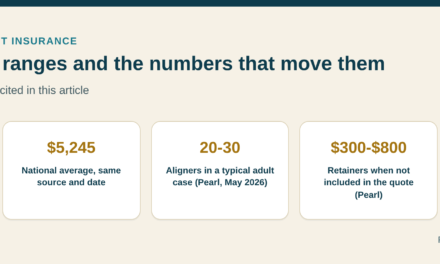
Gum Disease Treatment Cost. Gum disease costs climb with each stage. In insurer-negotiated data from March 2026, an adult cleaning averages about $117, a deep cleaning about $228 per quadrant, and a periodontal maintenance visit about $146. Gum surgery averages roughly $480 to $830 per quadrant at negotiated rates, while consumer cash ranges run $1,000 to $3,000. The earlier the stage, the smaller the bill.
This article walks up the whole ladder: gingivitis cleanings, deep cleaning, antimicrobial add-ons, maintenance, surgery, grafts and, at the far end, implants for teeth that were lost. Each rung gets a price, a billing code and the reasons the number moves. It does not repeat the detailed pricing of deep cleaning itself, and it can’t say which treatment your mouth needs. That decision belongs to your dentist or periodontist. Gum Disease Treatment Cost
Key Takeaways
- Gingivitis and periodontitis sit on different rungs. The NIDCR and the American Academy of Periodontology (AAP) describe gingivitis as reversible. The CDC says periodontitis can be slowed and managed but not reversed, so it usually brings a series of bills instead of one.
- Insurer-negotiated averages (CMS files via PayorMap, March 2026): $117 cleaning, $228 deep cleaning per quadrant, $146 maintenance visit, $480 flap surgery and $826 bone-reshaping surgery per quadrant, $2,356 for an implant body.
- Maintenance is the cost that repeats. According to the AAP, most patients need ongoing maintenance after deep cleaning; at $146 a visit, two to four visits a year come to $292 to $584 before any extras.
- Consumer cash ranges for gum surgery ($1,000 to $3,000 per quadrant) sit well above negotiated averages because they measure a different thing. Table 2 lines up the sources.
- Many plans class periodontal care as a major service. One 2026 Delta Dental of Iowa plan summary shows 50% coinsurance, a 6-month wait and a $1,000 annual maximum. In the worked example, that turns a $3,002 treatment course into a $2,002 bill for the patient.
- Original Medicare doesn’t cover most dental services. Dental school clinics, health centers and discount plans are the usual lower-fee routes.
 Five rungs of the gum disease cost ladder at average insurer-negotiated rates, March 2026.
The Cost Ladder: What Each Stage of Gum Disease Usually Involves
Gum disease isn’t a single diagnosis with a single price. The NIDCR describes it as an infection that inflames the tissues holding teeth in place, starting with swollen, red, bleeding gums and, if untreated, spreading to the supporting bone. Gingivitis, in the AAP’s words, is the mildest and a reversible form; periodontitis is where the tissue and bone that support the teeth are broken down. Dentists then stage periodontitis from initial to severe, and the stage drives the treatment plan.
How common is the problem? The CDC reports that about 4 in 10 U.S. adults aged 30 and older had periodontitis in 2009–2014, rising to roughly 60% of adults 65 and older. Those are old survey years, but they explain why so many people meet a periodontal estimate at some point.
Table 1 turns that clinical ladder into a price ladder. The figures are national averages of negotiated rates drawn from the insurer machine-readable files that the federal Transparency in Coverage rule requires, as summarized by PayorMap and refreshed in March 2026. A negotiated rate is the amount a dentist has agreed to accept from a plan, not a cash price. Treat the table as the floor of what a patient with a contracted plan sees. Gum Disease Treatment Cost:
| Rung | Typical service (CDT code) | Average (median) | Range in the files | Billed per |
|---|---|---|---|---|
| Gingivitis, routine | Adult cleaning (D1110) | $117 ($126) | $31–$282 | Visit |
| Gingivitis with heavy inflammation | Scaling with generalized gingival inflammation (D4346) | $74 ($67) | $31–$224 | Visit |
| Periodontitis work-up | Comprehensive periodontal evaluation (D0180) | $64 ($62) | $24–$225 | Evaluation |
| Periodontitis, nonsurgical | Scaling and root planing, 4+ teeth (D4341) | $228 ($160) | $36–$1,076 | Quadrant |
| Localized deep pockets | Local antimicrobial delivery (D4381) | $68 ($62) | $20–$185 | Tooth |
| After active treatment | Periodontal maintenance (D4910) | $146 ($127) | $38–$360 | Visit |
| Pockets that stay deep | Gingival flap surgery, 4+ teeth (D4240) | $480 ($485) | $83–$1,400 | Quadrant |
| Bone shape needs correcting | Osseous surgery, 4+ teeth (D4260) | $826 ($794) | $83–$2,500 | Quadrant |
| Tooth cannot be kept | Extraction of an erupted tooth (D7140) | $167 ($145) | $44–$698 | Tooth |
| Replacement | Implant body only (D6010) | $2,356 ($1,818) | $100–$6,520 | Implant |
Two oddities in that table are worth a minute. First, the scaling-with-inflammation code (D4346) averages less than a routine adult cleaning, even though it covers a harder job. That’s a sampling effect. Each average comes from a different set of contracts and a different number of records (272 for D4346, 740 for D1110), so neighbouring rungs don’t always rise in a straight line. Second, the ranges are enormous. The top of the deep cleaning range, $1,076 per quadrant, is almost thirty times the bottom. Outliers like that usually come from a few unusual contracts rather than a typical office, so the median is often the steadier number.
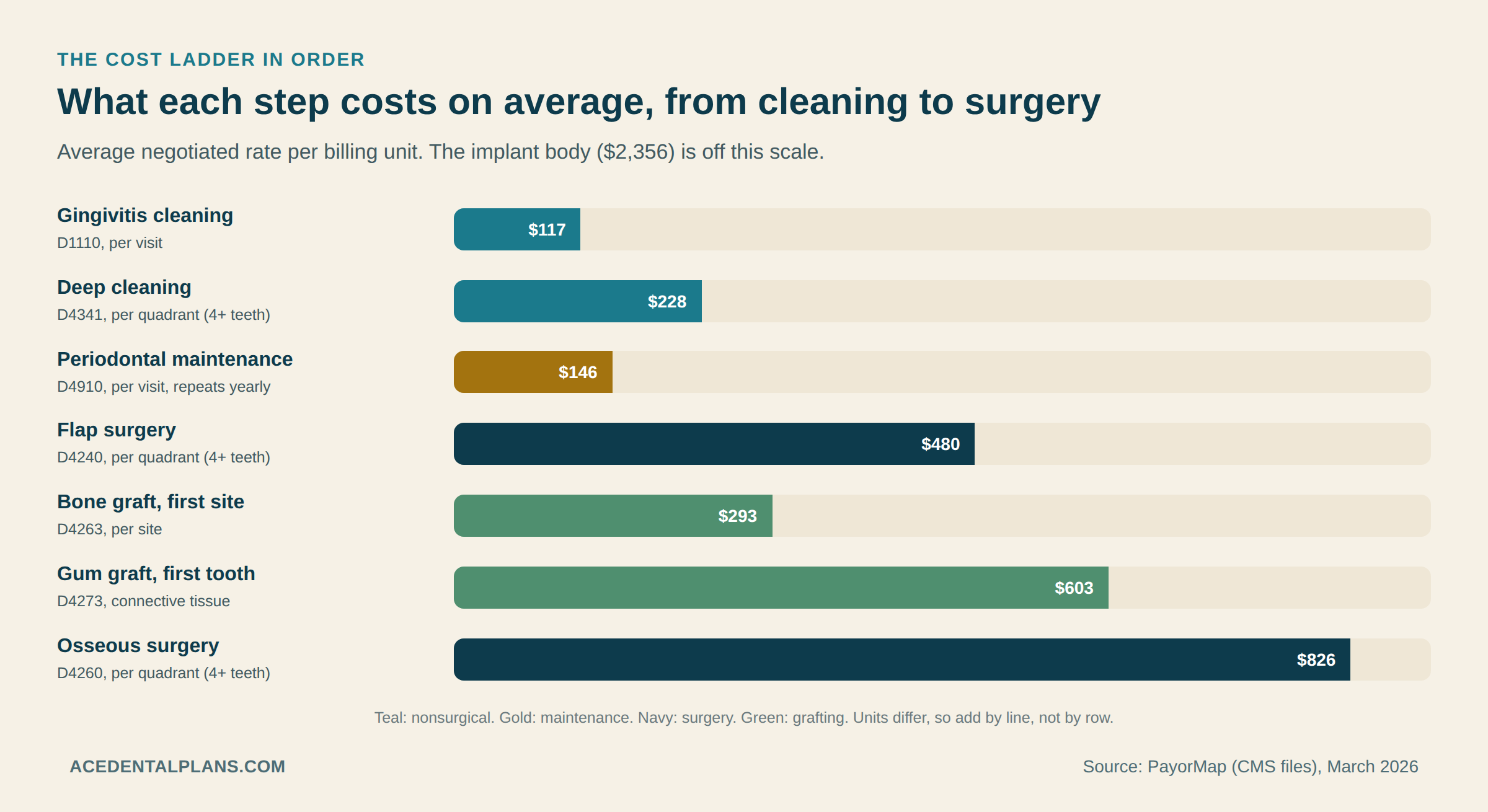 Average negotiated price of each rung, in ladder order; the implant body ($2,356) is off this scale.
Gingivitis: What the Mildest Stage Costs
For most people with gingivitis, the treatment is a professional cleaning followed by better home care. The ADA’s MouthHealthy page says gingivitis can usually be eliminated by a professional cleaning at the dental office, followed by daily brushing and flossing. The NIDCR makes the same point: early gum disease caused by plaque buildup can often be reversed by brushing and flossing every day.
On the bill, that means a prophylaxis (D1110) at an average negotiated $117, or a scaling code for heavier inflammation (D4346) averaging $74. Two fee schedules show how the pair looks outside insurer files. Boston University’s 2024 Dental Health Centers rate schedule, which applies to patients on BU’s health and dental plans, lists $112 for the adult cleaning and $108 for the inflammation code. The Delta Dental of Colorado Patient Direct schedule, a discount plan effective November 2025, lists $60 and $76.
A third code deserves a mention because it shows up when someone hasn’t been to a dentist in years. Full-mouth debridement (D4355) removes heavy plaque and calculus so the dentist can examine the teeth at all. Negotiated files average $219 for it, BU lists $190 and the Colorado discount schedule $85. It is a first step, not a stage of disease, and a later cleaning is usually still needed afterward.
The routine-cleaning price itself, with exams and X-rays around it, is a topic of its own. What matters for this ladder is the budget logic. Gingivitis is the only rung priced close to a regular visit, and the only one the NIDCR and AAP both describe as reversible.
Periodontitis Begins With a Diagnosis and a Deep Cleaning
Once the dentist or hygienist measures pockets and bone loss that a regular cleaning can’t address, the plan changes. A comprehensive periodontal evaluation (D0180) records the condition of the gums and bone. Negotiated files average $64, BU lists $125, Humana’s 2026 cost page shows $136, and the Colorado discount schedule lists $15. The spread tells you that some offices bundle this exam into other charges and some bill it alone, so ask.
Then comes scaling and root planing, the deep cleaning. Per the AAP, it means scaling beneath the gumline to remove plaque and bacterial toxins from the pockets and smoothing the roots so deposits are slower to return. Pricing is by quadrant: the code for four or more teeth in a quadrant (D4341) averages $228 in negotiated files, and the 1-to-3-teeth code (D4342) averages $108. Humana puts the range at $235 to $303 per quadrant, CareCredit’s 2022 article said $180 to $300, and NewMouth’s 2024 piece said $200 to $300.
A full mouth has four quadrants, so the arithmetic is simple. At the $228 negotiated average, all four come to $912. At the consumer range of $180 to $303 per quadrant, they come to roughly $720 to $1,212. Whether the work happens in one visit or two, whether numbing is billed separately and how plans treat the code are questions for a dedicated deep cleaning guide, so they’re left there.
One planning fact belongs here, though. Many patients do not require additional treatment after scaling and root planing, the AAP says, but the majority will need ongoing maintenance. The re-evaluation that follows the deep cleaning is where the next rung, or no next rung, gets decided.
Antibiotics, Rinses and Other Add-Ons: A Small Line With a Wide Spread
Between deep cleaning and surgery sits a grab bag of adjuncts. The NIDCR notes that medication such as an oral rinse may be prescribed. Cleveland Clinic says a periodontist may use antibiotics either alone or alongside other procedures. Whether any of these helps a particular mouth is a clinical judgment; the price side is easier to pin down.
The billed version of a medication placed directly into a pocket is the local antimicrobial delivery code (D4381), charged per tooth. Negotiated files average $68 per tooth, with a median of $62 and a range of $20 to $185 across 184 records. BU lists $90 and the Colorado discount schedule $79. Because it’s per tooth, the total depends on how many sites are treated.
Consumer sources describe other add-ons loosely. CareCredit’s 2022 gum disease article gave $12 to $380 for antibiotics without insurance and about $400 a year for a tray delivery system with its medication. It put laser treatment at $1,000 to $4,000 depending on severity. Those are one financing company’s consumer ranges from several years ago, with no insurer data behind them, and the article doesn’t say what share of patients receive any of these items. Prescription antibiotics are also filled at a pharmacy, so they rarely appear on the dental estimate at all.
Periodontal Maintenance: The Visit That Keeps Coming Back
After active treatment, the schedule changes from a cleaning twice a year to something closer to a standing appointment. Ongoing maintenance therapy is needed by the majority of patients to sustain periodontal health, the AAP says. Cleveland Clinic adds that frequency varies: some people may need only two cleanings a year, while others may need four.
Periodontal maintenance (D4910) carries its own code and its own price. Negotiated files average $146, with a median of $127 and a range of $38 to $360 over 553 records. Boston University’s 2024 schedule lists $154, and the Colorado discount schedule lists $92. PayorMap describes it as the procedure for patients with a history of periodontal disease, and all three sources price it above an adult cleaning ($146 against $117, $154 against $112, $92 against $60).
Run the visits through the year and the recurring cost becomes visible. Two maintenance visits at $146 come to $292, three to $438 and four to $584. A person without gum disease having two routine cleanings at $117 would spend $234. The difference is anywhere from $58 to $350 a year, and it continues for as long as the maintenance schedule does.
Insurance language shapes this line more than the fee does. A 2022 University of Michigan summary of a Delta Dental PPO option pays two additional periodontal maintenance procedures per calendar year. Members need a documented history of periodontal disease, and the visits come on top of two regular cleanings. It also lists periodontal maintenance and scaling and root planing as outside both the deductible and the annual maximum. A 2026 Delta Dental PPO Basic summary does something different. It notes that cleanings, regular and periodontal, are subject to a 30-day wait after scaling and root planing by the same office. Same service, two rule sets, so read the schedule of benefits before you assume how many visits are paid.
Gum Surgery: Flap, Pocket Reduction and Bone Reshaping Prices
Surgery enters when pockets stay deep after the deep cleaning has done what it can. Pocket reduction, as the AAP describes it, starts with the periodontist folding back the gum tissue and removing the disease-causing bacteria. The tissue is then secured in place, and irregular bone surfaces may be smoothed so bacteria have fewer places to hide. Cleveland Clinic says osseous surgery usually takes 30 to 60 minutes, with local anesthesia and sedation or nitrous oxide as options. Recovery commonly runs two to four weeks depending on how many teeth were treated.
Two codes carry most of the surgical price. Gingival flap surgery (D4240 for four or more teeth in a quadrant, D4241 for one to three) lifts the tissue for access and cleaning. Osseous surgery (D4260 and D4261) adds correction of the bone contour. Plenty of treatment plans also include grafting, covered in the next section, so a surgical quote often has several lines.
| Procedure (CDT code) | Negotiated average, March 2026 | University clinic fee, BU 2024 | Discount-plan fee, Delta Dental of Colorado, Nov. 2025 | Consumer cash figures cited |
|---|---|---|---|---|
| Flap surgery, 1–3 teeth (D4241) | $277 | $620 | $294 | Humana (2026): $1,264 for up to 3 teeth; NewMouth (2024): $1,000–$3,000 for a localized area |
| Flap surgery, 4+ teeth (D4240) | $480 | $927 | $405 | CareCredit (2023): about $1,000 per quadrant |
| Osseous surgery, 1–3 teeth (D4261) | $456 | $1,110 | $538 | CareCredit (2023): $1,000–$3,000 per quadrant for pocket reduction |
| Osseous surgery, 4+ teeth (D4260) | $826 | $1,392 | $746 | Same CareCredit range |
| Bone replacement graft, first site (D4263) | $293 | $490 | $299 | Humana (2026): $713 plus $573 per additional tooth |
| Bone replacement graft, each added site (D4264) | $174 | $335 | $284 | Not separately stated |
| Guided tissue regeneration, resorbable barrier (D4266) | $334 | $602 | $392 | Not separately stated |
| Connective tissue graft, first tooth (D4273) | $603 | $1,339 | $632 | Humana (2026): $1,344 plus $846 per additional tooth; NewMouth (2026): $600–$1,200 per tooth |
Read across a row and the pattern is consistent. The university schedule is the highest in every row, running about 1.7 times the negotiated average for four-plus-tooth osseous surgery ($1,392 against $826) and nearly twice for four-plus-tooth flap surgery ($927 against $480). The Colorado discount plan lands near the negotiated figures, and sometimes below them. That doesn’t make BU expensive in any absolute sense. The schedule is a published fee list for one university’s plan patients, while the negotiated column is what contracted dentists accept from insurers, so the two measure different transactions.
The consumer column adds the number most patients actually hear. CareCredit’s 2023 osseous surgery article puts pocket reduction at $1,000 to $3,000 per quadrant. It says periodontal treatments overall often run $4,000 to $6,000, and $8,000 to $10,000 when the disease is severe. Those totals aren’t in conflict with the per-quadrant figure: four quadrants at $1,000 each is $4,000. A 2022 CareCredit gum disease article listed gingival flap surgery alone at $4,000 to $6,000, which also reads like a whole-mouth figure.
 Published consumer cash ranges for periodontal surgery and related items; each source and year is named on the chart.
Why do consumer figures run higher than negotiated ones? Partly because a cash price is a list fee, which contracts usually discount. Partly because the sources count different things: a quadrant, a localized area, a tooth or a whole mouth. And partly because several consumer pages date from 2022 and 2023, while the negotiated averages come from 2026 files. Neither number is wrong. The only number that governs your bill is the one on your own estimate.
Bone and Gum Grafts: Why a Surgical Quote Has So Many Lines
A graft is a separate procedure with a separate code, and a single visit can include several. Regenerative procedures, per the AAP, come into play when the bone supporting the teeth has been destroyed by periodontal disease. They use membranes, bone grafts or tissue-stimulating proteins to encourage regrowth. Soft tissue grafts are different. A periodontist, the AAP says, takes gum tissue from the palate or another donor source to cover exposed roots from gum recession, which helps prevent more recession and bone loss.
Cleveland Clinic lists the material options: a bone graft can use your own bone, donated bone or synthetic bone, and a gum graft can use your own tissue, donated tissue or synthetic tissue. NewMouth’s 2026 guide says donor materials such as acellular dermal matrix may cost more than using your own tissue. Material choice is a clinical decision with a price attached, so ask which one the quote assumes.
The billing structure is the part to understand. Bone replacement grafts are billed once for the first site and again, at a lower price, for each additional site. Soft tissue grafts follow the same pattern. Humana’s 2026 cost page shows $1,344 for the first tooth plus $846 for each additional tooth in a row for a soft tissue graft. Bone grafting is $713 plus $573 per extra tooth.
One more distinction affects coverage. Gum recession can happen without periodontitis, and a graft to cover a root may be classed differently from a graft that rebuilds bone around diseased teeth. PayorMap’s note on the connective tissue graft code says documentation typically includes clinical findings and photographs, and that some payors want evidence of periodontal disease or earlier treatment attempts. Humana says its plans may help with gum disease treatment that is medically necessary. Expect a reviewer to ask what the graft is for.
When a Tooth Can’t Be Saved: Extraction and Implant Costs on This Path
The NIDCR says that in advanced gum disease, teeth may become loose or need to be removed. At that point the ladder branches into extraction and replacement, and the replacement options are each their own price class. Here is the thumbnail for the implant branch.
A simple extraction of an erupted tooth (D7140) averages $167 in negotiated files, with a range of $44 to $698. The implant body itself (D6010) averages $2,356 with a median of $1,818 and a range of $100 to $6,520. BU lists $2,070 for the implant body and the Colorado discount schedule $1,441. Humana’s 2026 page puts a single implant at $4,533, though the page doesn’t say what that figure includes, so it may reflect a fuller package than the body alone. The connector, the crown and any grafting are billed on top of the body price, and a full breakdown of a single-tooth implant package is a separate topic.
What’s particular to gum disease is sequencing. Ideal implant candidates, the AAP says, have healthy gum tissue free of periodontal disease, and it says implants need careful home care and regular visits to prevent peri-implant disease. In practice that means the periodontal budget and the implant budget are often one budget. A bone graft may precede the implant, and maintenance doesn’t stop afterward.
A simple piece of arithmetic frames the long game without recommending anything. Fifteen periodontal maintenance visits at $146 come to $2,190, close to the $2,356 average implant body. That’s five years of visits at three a year. A tooth that has been saved still needs maintenance, and an implant still needs follow-up, so the comparison is a reminder that both paths run for years, not a verdict on either.
Adding Up a Treatment Course: One Hypothetical Patient, Three Price Sources
Single prices are easy to quote and hard to use. What patients want is the total, so Table 3 builds one. The scenario is hypothetical. A patient with generalized periodontitis has a comprehensive evaluation, four quadrants of deep cleaning (each with four or more teeth) and three maintenance visits in the first year. Pockets then stay deep in two quadrants, so the plan adds osseous surgery in both plus a bone graft at one site. Each line uses the sourced unit price from Table 1 or Table 2.
| Line | Units | Negotiated averages (March 2026) | University clinic fees (BU 2024) | Discount-plan fees (Delta Dental of Colorado, Nov. 2025) |
|---|---|---|---|---|
| Comprehensive periodontal evaluation (D0180) | 1 | $64 | $125 | $15 |
| Scaling and root planing, 4+ teeth (D4341) | 4 quadrants | $912 | $1,020 | $688 |
| Periodontal maintenance (D4910) | 3 visits | $438 | $462 | $276 |
| Nonsurgical subtotal | $1,414 | $1,607 | $979 | |
| Osseous surgery, 4+ teeth (D4260) | 2 quadrants | $1,652 | $2,784 | $1,492 |
| Bone replacement graft, first site (D4263) | 1 site | $293 | $490 | $299 |
| Surgical add-on subtotal | $1,945 | $3,274 | $1,791 | |
| Course total | $3,359 | $4,881 | $2,770 |
Three things stand out. The nonsurgical half is cheaper than most people expect, and the surgical half is larger than the whole nonsurgical year in all three columns. The spread between the lowest and highest column, $2,770 to $4,881, is wide even though every line is a sourced number. And the university total of $4,881 sits inside CareCredit’s consumer range of $4,000 to $6,000, while the negotiated total sits below it, which is the pattern you’d predict from how the sources differ.
What the table leaves out matters as much. It excludes X-rays, any additional exams, local anesthesia or sedation billed separately, antimicrobial add-ons, prescriptions, a membrane or regeneration code, follow-up visits after surgery, and the maintenance visits in later years. In the other direction, it assumes surgery in only two quadrants. If your periodontist recommends none, the first-year total is the nonsurgical subtotal, and the surgical decision is something you and your clinician make after the re-evaluation, not before.
What Moves the Price of the Same Procedure
Geography
PayorMap’s state breakdowns show how far a negotiated average can swing. For deep cleaning with four or more teeth per quadrant, Vermont leads at $248 and Wyoming trails at $93. For osseous surgery with four or more teeth, New York averages $1,367 and California $1,152 against $440 in Iowa and $298 in South Dakota. State averages rest on different numbers of records and different insurers (South Dakota’s osseous figure is a single record), so they’re a rough guide. Still, a quadrant of osseous surgery in one state can cost more than three times the figure in another.
The unit being billed
A quadrant, a tooth, a site and a visit are not interchangeable. Deep cleaning and surgery are priced per quadrant, antimicrobials per tooth, grafts per site, maintenance per visit. A quote that lists a total without units hides the one thing you need to check, which is how many of each the plan assumes. If a quote shows “4+ teeth” for a quadrant where the dentist described only two or three diseased teeth, ask why.
Who performs the work, and how comfortable you want to be
According to the AAP, periodontists complete up to three additional years of specialized training in surgical and nonsurgical periodontal procedures. A specialist’s fee schedule can differ from a general dentist’s, and so can network status, which is why the question “is the office in my plan” deserves a phone call. Anesthesia is a second variable. Cleveland Clinic says local anesthesia is standard for osseous surgery with sedation or nitrous oxide as options, and add-on sedation typically carries its own code and fee.
Material and technique
Graft source (own tissue, donated or synthetic), the use of a membrane or regenerative proteins, and whether a laser is part of the plan all change the line items. Membranes, bone grafts and tissue-stimulating proteins are the regenerative tools the AAP lists. CareCredit’s 2022 article puts laser treatment at $1,000 to $4,000. None of these is a price tier that fits every patient, and the clinical case for any of them is something to hear from the clinician.
The patient’s health
Risk factors don’t show up as a line on an estimate, but they shape the plan around it. The NIDCR names smoking and tobacco use as the most significant risk factor. The CDC lists diabetes, smoking, stress, medications and genetics, and says gum disease can be more severe and take longer to heal in people with diabetes. Ask whether your health history changes the follow-up schedule, because follow-up is where the recurring cost lives.
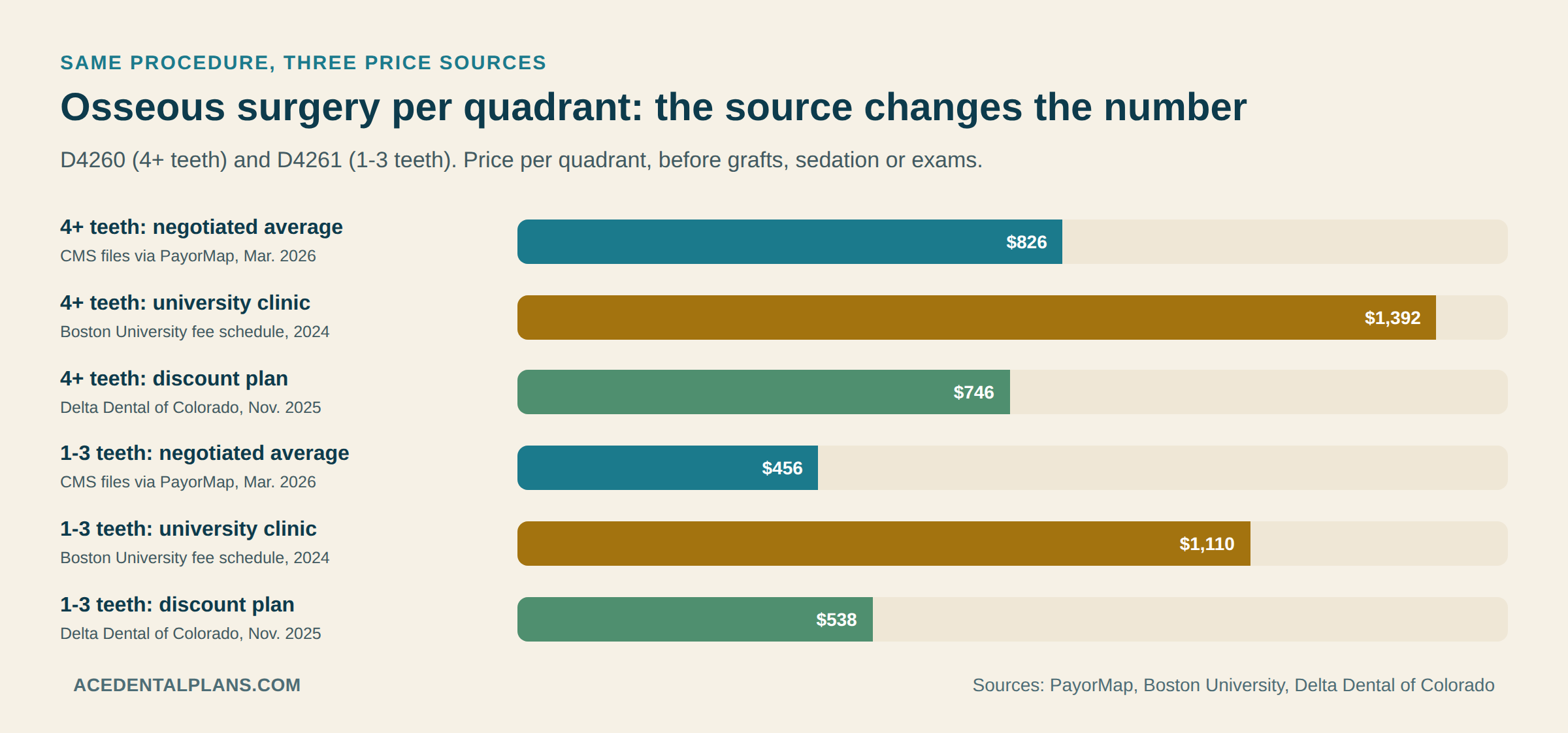 Osseous surgery per quadrant across three price sources, showing how much the source changes the number.
Insurance and Gum Disease Treatment: Classification, Limits and a Worked Estimate
Start with the plan type. A PPO pays a percentage of an allowed amount and reduces your cost when the dentist is in network. A capitation (DHMO) plan usually lists a flat copay for each procedure code instead, so for those plans, ask for the copay line for each code on your estimate. A discount plan, such as the Delta Dental Patient Direct schedule used in the tables above, is not insurance at all. Its own document says it doesn’t meet the minimum creditable coverage requirements under the Affordable Care Act. It just sets lower fees.
Next come the deductible and the network. In a 2026 Delta Dental of Iowa Farm Bureau plan summary, the PPO deductible is $50 per person. Then coinsurance. The same document classifies periodontal services (gum and bone diseases, complex procedures) as major services at 50% coinsurance for in-network care. A consumer guide at NewMouth, by contrast, says plans commonly pay 80% for nonsurgical care and 50% for surgical procedures, a reminder that classification differs plan to plan.
Then the annual maximum. That same Iowa plan summary caps benefits at $1,000. The ADA’s December 2025 reporting says the $1,000 level was established some 40 years ago and is still widely promoted. Meanwhile, in National Association of Dental Plans data cited there, 32.8% of in-network maximums fall between $1,000 and $1,500, 48.2% between $1,500 and $2,500, and 17.2% are higher or absent. Only 3.4% of dental patients reach the typical maximum, but a periodontal course is the kind of treatment that can.
Finally, the fine print. The Iowa summary has a 6-month waiting period for periodontal services. The 2026 Delta Dental PPO Basic summary lists scaling and root planing as a major service that is not covered in or out of network. The 2022 University of Michigan option goes the other way. Periodontic services sit under Basic Services at 100%, and scaling and root planing and periodontal maintenance fall outside both the deductible and the annual maximum. Three documents, three rule sets. When your treatment starts, the only summary that counts is yours.
 How a $1,000 annual maximum splits a $3,002 course in the worked example.
Two practical steps follow from that arithmetic. First, ask the office for a written treatment plan with CDT codes and a predetermination from the insurer before surgery. The ADA says pre-authorizations don’t guarantee payment, because eligibility or benefits can change between the estimate and the claim, and advises submitting predeterminations for complex, costly procedures close to the date of service. Second, ask whether the course can be split across benefit years. Phasing is a scheduling decision for the dentist, not a way to game the plan, and whether it is clinically reasonable depends on the case.
Paying Without Insurance: Medicare, School Clinics, Health Centers and Discount Plans
Start with what doesn’t exist. Medicare.gov says Original Medicare doesn’t cover dental services such as routine cleanings, fillings, extractions, dentures or implants, and that you pay all costs for non-covered services. Narrow exceptions exist when the dental work is tied to a covered medical event, such as an exam before a heart valve replacement or an organ transplant. Gum disease treatment on its own isn’t among them.
The lower-fee options come from a few directions:
- Dental school clinics. The University of Colorado’s Graduate Periodontics Clinic advertises fees up to 45% less than private practices. Tufts says its student-dentist comprehensive care clinic charges generally 25% to 50% less than area specialists, and its specialty teaching clinics also price below private practice. Neither page lists periodontal prices, so call for the schedule, and ask about appointment length and waiting lists.
- Federally funded health centers. HRSA says health centers must serve everyone, even if they can’t pay, and must adjust fees by income and family size. Health centers have dentists on staff, though the services offered vary by center.
- Discount plans. These aren’t insurance, but a fee schedule like Delta Dental’s Colorado Patient Direct sets lower prices on every code. In Table 3 it produced a $2,770 course, about 18% below the negotiated total and 43% below the university total. Check whether a membership fee applies, since the schedule itself doesn’t show one.
- Staging the work. Many patients need no further treatment after deep cleaning, the AAP says, so paying for the nonsurgical phase first and deciding about surgery at the re-evaluation spreads the cost and sometimes removes the later bill. Whether that suits your case is a clinical call.
Payment plans and medical credit cards solve the timing problem, not the price problem, because a promotional or deferred-interest account can add cost if it isn’t paid off on time. Read the terms before you sign, and compare the financed total with the cash price.
Questions to Ask Before You Accept a Periodontal Treatment Plan
An estimate for gum disease is really a sequence of decisions. The questions below turn it into numbers you can compare across offices.
- What is my diagnosis, and what stage does the chart show? Ask to see the pocket measurements behind it.
- Which CDT codes are on this estimate, and how many quadrants, teeth or sites does each assume?
- What will you re-measure after the deep cleaning, and when? What results would make surgery unnecessary, and what results would lead to it?
- How often will maintenance visits be, and what does each cost? Does my plan pay them as maintenance, as cleanings, or not at all?
- Are anesthesia, sedation, X-rays, medications and follow-up visits in the fee, or billed separately?
- If grafts are proposed, what material is assumed, and is the purpose to treat bone loss or to cover exposed roots?
- Is this office in my plan’s network, and if I’m referred to a periodontist, is that office?
- Can you submit a predetermination before surgery, and can the work be phased across benefit years?
- If a tooth can’t be saved, what is the plan and the price for removing and replacing it?
Frequently Asked Questions – Gum Disease Treatment Cost
Is treating gingivitis just a regular cleaning?
Usually, yes. The ADA’s MouthHealthy page says gingivitis can typically be eliminated by a professional cleaning followed by daily brushing and flossing. A heavier case may be billed under a scaling code for inflammation (D4346, averaging $74 in negotiated files), and your dentist decides which code fits.
How much does it cost to treat gum disease from start to finish?
There’s no single figure because the stage decides the path. The hypothetical course in Table 3, with deep cleaning, three maintenance visits and surgery in two quadrants, adds up to $2,770 to $4,881 depending on the price source. CareCredit’s 2023 article puts periodontal treatment at $4,000 to $6,000 on average and $8,000 to $10,000 for severe disease.
Does dental insurance cover gum disease treatment?
Many plans pay something, but the details vary widely. The plan documents cited above range from major service at 50% with a 6-month wait to basic service at 100%, and one lists deep cleaning as not covered at all. Your plan’s benefit summary, plus a written predetermination, is the only reliable answer.
Can a general dentist treat gum disease, or do I need a periodontist?
The sources opened here don’t say where the line falls, and the answer depends on the case. What the AAP does say is that periodontists receive up to three additional years of specialized training in surgical and nonsurgical procedures. If your dentist suggests a referral, ask what drove it and whether the specialist’s office takes your plan.
Can gum disease be cured, or will I keep paying for it?
Gingivitis is reversible, according to the NIDCR and the AAP. The CDC says periodontitis cannot be reversed but can be slowed and managed with professional treatment, and the AAP adds that most patients need ongoing maintenance. In budget terms, that means planning for periodic maintenance visits after the active phase.
How much does gum surgery cost per quadrant?
In negotiated files, flap surgery averages $277 (1–3 teeth) to $480 (4+ teeth) and osseous surgery $456 to $826. Published cash ranges are higher: CareCredit gives about $1,000 per quadrant for flap surgery and $1,000 to $3,000 for pocket reduction. Grafts, membranes and sedation are billed in addition.
What is the lowest-cost way to treat gum disease without insurance?
The documented routes are dental school clinics, income-based health centers and discount plan fee schedules. In the hypothetical course above, the discount-plan schedule was the lowest of the three sources. Phasing the work, so that surgery is decided after the deep cleaning re-evaluation, can also lower the amount you commit to up front.
Does Medicare pay for gum disease treatment?
Original Medicare doesn’t cover most dental services, including routine cleanings and extractions, according to Medicare.gov. It may cover dental work linked to certain covered medical treatments, such as an exam before a transplant. Gum disease care on its own generally isn’t one of them.
Is a gum graft the same as gum disease treatment?
Not necessarily. Soft tissue grafts, per the AAP, are a way to cover exposed roots from gum recession, while regenerative procedures aim to rebuild bone lost to periodontal disease. They carry different codes, and an insurer may ask which problem the graft is meant to solve before it pays.
What does it cost if I lose a tooth to gum disease?
An extraction of an erupted tooth averages $167 in negotiated files. The implant body alone averages $2,356, with the crown and connector billed on top, and the AAP says implant candidates should have healthy gum tissue free of periodontal disease. Bridges and dentures are other options with their own price ranges.
Does treating gum disease help with diabetes?
The CDC says gum disease can be more severe and heal more slowly in people with diabetes, and that treating gum disease may help lower blood sugar over time. The AAP describes the link as bidirectional. Talk with your physician and dentist about how the two plans fit together.
Sources and Disclaimers
Clinical descriptions of gum disease, treatment steps and maintenance come from the NIDCR, CDC, American Academy of Periodontology, the ADA’s MouthHealthy site and Cleveland Clinic. Negotiated-rate averages, medians and ranges come from PayorMap code pages that summarize CMS Transparency in Coverage files, refreshed March 2026. Each code has its own page at the same address pattern, so only a sample is linked below. Fee schedules come from Boston University’s 2024 patient rate schedule and Delta Dental of Colorado’s Patient Direct discount schedule effective November 1, 2025. Consumer cash figures come from Humana, CareCredit and NewMouth, dated 2022 to 2026 as stated in the text; they are published ranges, not audited prices. Insurance mechanics come from three plan documents (Delta Dental of Iowa 2026, Delta Dental PPO Basic 2026 and a 2022 University of Michigan summary) plus ADA reporting. Every worked example, including the dollar totals in Table 3 and the annual-maximum scenario, is a hypothetical built from the cited unit prices. National averages cannot predict your quote, and plan rules change. Confirm prices with the treating office and benefits with your insurer before treatment.
- National Institute of Dental and Craniofacial Research — Gum Disease
- Centers for Disease Control and Prevention — About Periodontal (Gum) Disease
- Centers for Disease Control and Prevention — Diabetes and Oral Health
- American Academy of Periodontology — Gum Disease Information: Gingivitis and Periodontitis
- American Academy of Periodontology — Non-Surgical Periodontal Treatments
- American Academy of Periodontology — Periodontal Surgical Procedures
- American Academy of Periodontology — Dental Implant Procedures
- American Academy of Periodontology — Gum Disease and Other Diseases
- ADA MouthHealthy — Gum Disease: Gingivitis vs. Periodontitis
- ADA News — Dear ADA: Annual Maximums (December 2025)
- American Dental Association — Pre-Authorizations
- Cleveland Clinic — Gum Disease Treatment
- Cleveland Clinic — Osseous Surgery
- PayorMap — D4341 negotiated rates, scaling and root planing, 4+ teeth
- PayorMap — D4910 negotiated rates, periodontal maintenance
- PayorMap — D4240 negotiated rates, gingival flap surgery, 4+ teeth
- PayorMap — D4260 negotiated rates, osseous surgery, 4+ teeth
- PayorMap — D6010 negotiated rates, implant body
- Boston University Dental Health Centers — 2024 Rate Schedule and Plan Coverage Percentages
- Delta Dental of Colorado — Patient Direct General Dentist Fee Schedule, effective November 1, 2025
- Humana — Gum Disease Treatment Costs and Insurance Coverage
- Humana — How Much Does Scaling and Root Planing Cost?
- CareCredit — Gum Disease: Causes, Symptoms, Treatments and Costs
- CareCredit — Osseous Surgery (Dental Pocket Reduction)
- NewMouth — Gum Grafts: Cost, Types, Benefits and Aftercare
- NewMouth — Periodontal Flap Surgery
- Delta Dental of Iowa — Plan Summary for Iowa Farm Bureau, plan year 2026
- Delta Dental Insurance Company — PPO Basic Plan Summary of Dental Benefits, plan year 2026
- University of Michigan Human Resources — Delta Dental PPO Option Summary of Benefits (June 2022)
- Medicare.gov — Dental Services
- HRSA Bureau of Primary Health Care — What Is a Health Center?
- University of Colorado School of Dental Medicine — Dental Fees
- Tufts University School of Dental Medicine — Price Comparison Guide
Important Information and Disclaimers
This article is general educational information. By using it, you accept the limits described below.
Not dental or medical advice
Nothing on this page is a diagnosis, a treatment recommendation or a substitute for an examination by a licensed dentist or physician. Reading this article does not create a dentist-patient or doctor-patient relationship. Only a licensed professional who has examined you and reviewed your history can tell you what your mouth needs. Do not delay, skip or stop professional care because of something you read here.
Prices are estimates, not quotes
Cost figures are ranges reported by the third-party sources cited in this article. Actual prices depend on your location, the provider, the complexity of your case, the materials used, the date of service and other factors, so what you pay may be higher or lower. A written treatment plan and fee estimate from the dental office is the only reliable number for your situation.
Insurance and plan examples are illustrations
Examples that use named amounts or percentages are hypothetical. Real benefits depend on your plan, network, waiting periods, annual maximum, deductible and the insurer’s rules at the time of treatment. A pre-treatment estimate or benefits check is not a promise of payment. Confirm the details with your insurer or plan administrator in writing.
Not insurance, legal, tax or financial advice
AceDentalPlans is an information publisher. Nothing here is insurance, legal, tax, investment or other professional financial advice, and nothing here recommends a particular provider, insurer, lender, discount plan or financing product. Company and product names belong to their owners and appear for identification only. Read the terms of any loan, financing offer or plan before you sign, and ask a qualified professional if you need advice on your own circumstances.
Third-party sources
This article cites government agencies, professional associations, insurers, lenders and other outside organizations. We do not control those sources. Their content can change, move or disappear, and listing a source is not an endorsement of it or of anything it sells.
No warranty
We aim for accuracy, but this article is provided “as is,” without warranties of any kind, express or implied, including warranties of accuracy, completeness, timeliness or fitness for a particular purpose. Some information may be out of date or contain errors by the time you read it.
Limitation of responsibility
To the fullest extent permitted by law, AceDentalPlans and its owners, authors and contributors are not responsible or liable for any loss, cost, injury, health outcome or other damage that results from using this article or relying on it. You are responsible for your own decisions about your care, your coverage and your money.
How this article is written
This article follows AceDentalPlans’ answer-first, U.S.-focused editorial approach. It uses conditional language for insurance, because coverage depends on the specific plan, and it names its sources so that you can read them yourself.