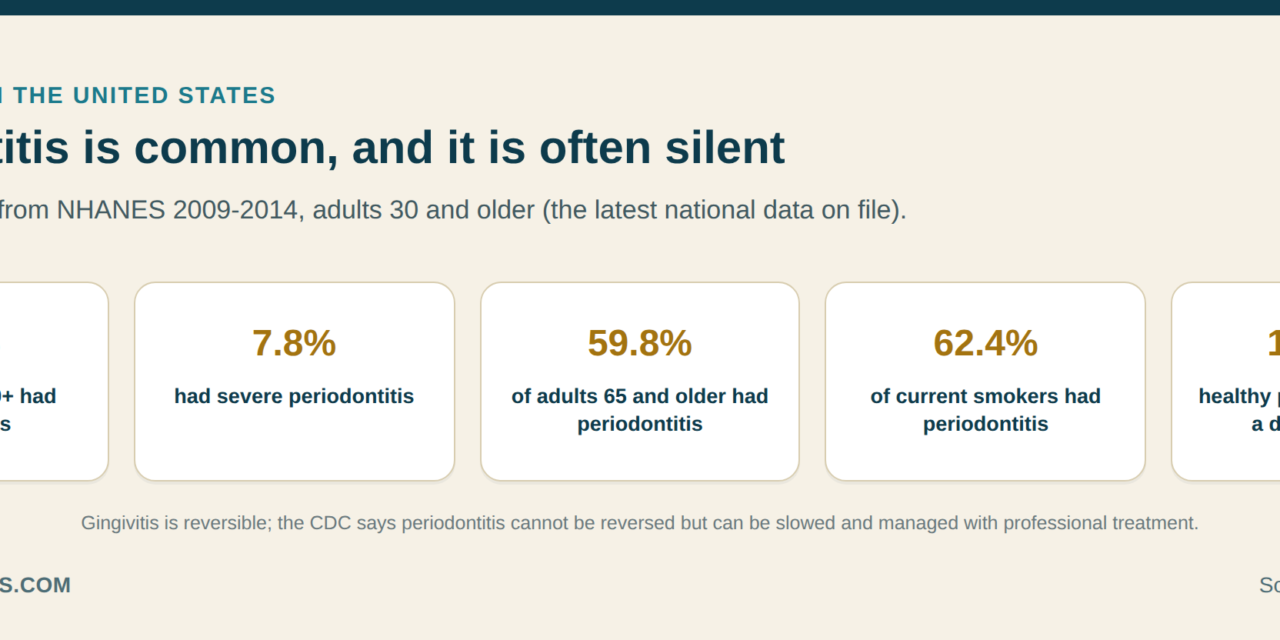
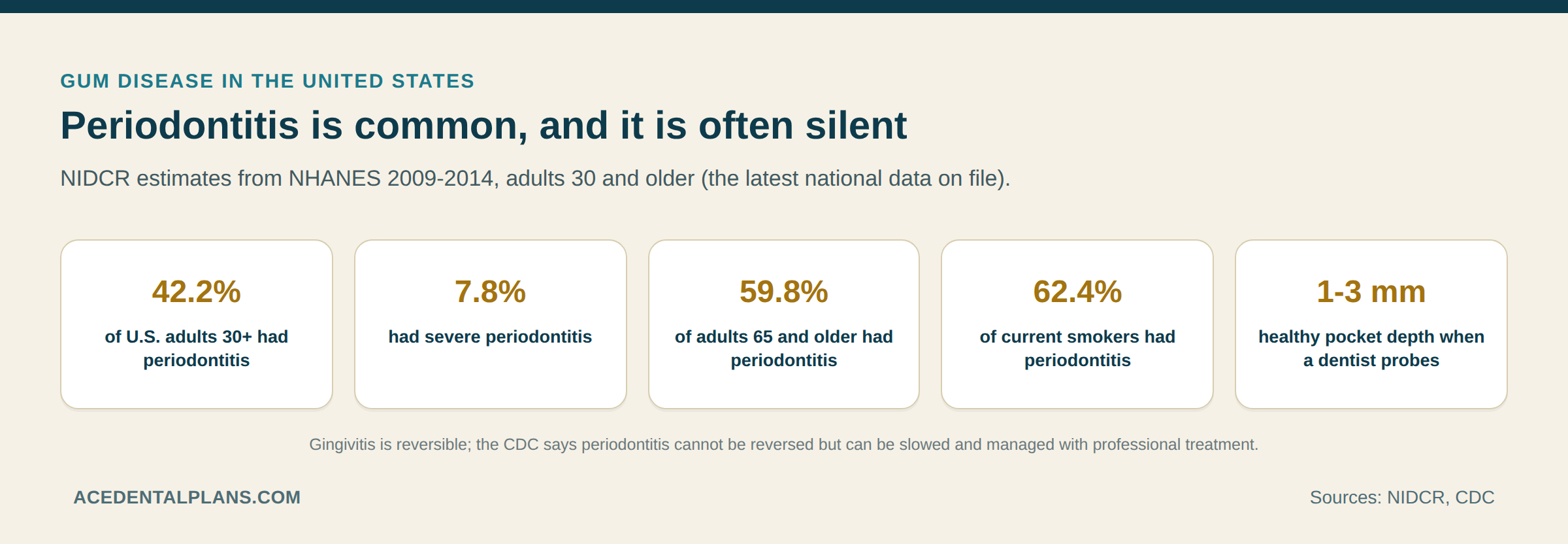
Gum disease is an infection of the tissues that hold your teeth in place, and it has two broad stages. Gingivitis, the early one, is reversible. Periodontitis can be slowed and managed but not reversed. About 42% of U.S. adults aged 30 and older had periodontitis in 2009–2014, according to NIDCR, and many felt no pain. Treatment runs from a routine cleaning to multi-visit surgery.
This guide covers what gum disease looks like, how it starts, who is more likely to get it, how a dentist stages it and what each treatment step involves. It also explains home care that matters, what happens when teeth are lost, how insurance usually sorts periodontal work and where the costs sit. Exact price tables live in the linked cost guides, and nothing here can tell you what your own mouth needs.
Key Takeaways
- Gingivitis is the mildest form and is reversible with a professional cleaning and daily home care. Periodontitis, per the CDC, “cannot be reversed, but it can be slowed down and managed with professional treatment.”
- NIDCR estimates 42.2% of U.S. adults 30 and older had periodontitis in 2009–2014 (7.8% severe), rising to 59.8% at age 65 and older and 62.4% among current smokers. Those are the latest national figures on file.
- Gum disease is often silent. According to the ADA, it is usually painless, so a probing exam and X-rays at a checkup are how most people first learn they have it.
- Smoking is described by NIDCR as the most significant risk factor. Diabetes, genetics, some medications, stress and hormonal changes also matter.
- Dentists describe periodontitis by stage (I to IV) and grade (A to C). The stage reflects severity and complexity; the grade reflects how fast it is likely to progress.
- Treatment is a ladder: better home care, professional cleaning, scaling and root planing, sometimes adjuncts, sometimes surgery, then ongoing maintenance. Many plans class periodontal work above a routine cleaning, so benefits and out-of-pocket costs can differ sharply.
What Gum Disease Is, and Where Gingivitis Ends and Periodontitis Begins
NIDCR defines periodontal disease as an infection that causes inflammation of the tissues that hold your teeth in place. Those tissues include the gums and the bone that supports each tooth, along with the ligament that connects the two. Healthy gums fit snugly around each tooth like a collar. When bacteria in plaque irritate them, the collar loosens, and the small space between gum and tooth deepens into what dentists call a pocket.
The American Academy of Periodontology (AAP) calls gingivitis the mildest form. The gums turn red, swell and bleed easily, often with little or no discomfort. At this point the damage is confined to the gum tissue, and the ADA’s MouthHealthy site says it can usually be eliminated by a professional cleaning.
Periodontitis is the next step. The CDC describes it as a chronic inflammatory condition that destroys supporting tissue, with bone loss as a main feature. A diagnosis under the current classification requires detectable clinical attachment loss at two or more teeth that are not next to each other. In plain terms, the damage has moved below the gum tissue itself. Teeth can loosen and, in advanced cases, NIDCR notes, may need to be removed.
Not every case of gingivitis becomes periodontitis. Untreated gingivitis can progress, according to the AAP and CDC, but the sources do not say how often or how quickly. The ADA adds that periodontitis “usually gets worse slowly, but there can be periods of rapid progression.” That is why a dentist watches the trend, not just a single visit’s numbers.
| Feature | Gingivitis | Periodontitis |
|---|---|---|
| What is affected | The gum tissue | Gums plus the ligament and bone that support the tooth |
| What you may notice | Red, swollen, tender gums that bleed easily; often little or no discomfort | Bleeding, receding gums, bad breath, loose or shifting teeth, pus, changes in bite; frequently nothing for years |
| What the dentist finds | Inflamed gums and plaque or tartar; pockets within the healthy range of 1 to 3 mm are the norm NIDCR cites | Deeper pockets, attachment loss and bone loss on X-rays |
| Reversible? | Yes, per the AAP, CDC and ADA | No; it can be slowed and managed (CDC) |
| Usual first step | Professional cleaning plus daily brushing and cleaning between teeth | Deep cleaning below the gumline (scaling and root planing), then reassessment |
| After treatment | Routine checkups and cleanings | Ongoing maintenance visits for most patients (AAP) |
One practical point sits inside that table. Because gingivitis can be undone and periodontitis cannot, the cost of waiting is lopsided. A few weeks of bleeding gums that settle after a cleaning is an inexpensive lesson. The same bleeding left for years is a different conversation, which is why the symptom list below matters more than it looks.
Symptoms: What You May Notice, and Why You May Notice Nothing
The CDC’s list is the most complete one from a federal source. It names red, swollen or tender gums, bleeding, receding gums, loose or sensitive teeth and painful chewing. It also names changes in how teeth fit together when you bite and in how a partial denture fits. The AAP adds bleeding when brushing, flossing or eating hard food, loose or separating teeth, pus and mouth sores. NIDCR and the ADA both list persistent bad breath, and the ADA adds a persistent bad taste.
Look at what is missing from that list: severe pain. Gum disease usually is not a toothache. The AAP says it is often silent until the advanced stages. The CDC warns that it “can often become serious before a person notices that they have symptoms.” A throbbing tooth can instead point to a cavity or a dental infection, which is a different problem with different urgency. If you are trying to sort a throbbing tooth from sore gums, the guide to cavity symptoms and pain covers the other side of that question.
Early signals worth writing down
Gum disease creeps. A short log helps a dentist more than a vague memory. Jot down the date you first saw pink on the floss or in the sink, whether it happens with every brushing or only some days, and whether a taste or odor has persisted despite brushing. Note any tooth that feels different when you bite down. None of these proves anything. Together they give the hygienist a place to start measuring.
Later signals
Gums that pull back and make teeth look longer are one sign. Spaces opening between teeth, a tooth that moves under your tongue and a partial denture that suddenly fits differently are others, all described by the CDC or AAP as signs the supporting structure may be changing. These are reasons to book a visit within days to weeks, not to wait for the next routine cleaning.
Six common assumptions, checked against the sources
- “It only affects older people.” Prevalence rises with age, from 29.5% at ages 30 to 44 to 59.8% at 65 and older in NIDCR’s tables. Even so, nearly three in ten adults in their thirties and early forties already had periodontitis in 2009–2014.
- “If it doesn’t hurt, it’s fine.” The ADA says gum disease is usually painless, and the AAP says it is often silent. Absence of pain is not evidence of absence.
- “It means I don’t brush properly.” Plaque is the trigger, but the CDC and NIDCR also list genetics, diabetes, smoking, medications and hormonal changes. The classification system grades cases partly by whether destruction is proportional to plaque, which concedes that some people lose more support than their plaque levels predict.
- “Bleeding means I should stop flossing.” The sources list bleeding as a sign of gum disease, not as a reason to stop cleaning. Per the ADA, cleaning between your teeth should not cause pain, and floss should never be snapped into the gums. Gentle technique and a word with the hygienist are the sensible response.
- “A strong mouthwash can fix it.” NIDCR says only a professional cleaning can remove tartar. A prescribed rinse can be part of a plan, but an over-the-counter product is not described as a treatment for periodontitis by any source opened here.
- “I will lose my teeth.” Not necessarily. The ADA says you do not have to lose teeth to gum disease, and the whole treatment ladder exists to keep them.
Signs that should not wait for a routine visit
Most gum disease is slow and calm. A few presentations are not, and sorting them quickly protects you. The AAP lists pus among the warning signs of gum disease, so pus is a reason to be seen promptly. Swelling that spreads into the face or neck, fever, trouble swallowing or breathing, or bleeding you cannot control belong in an emergency department. The disclaimer at the end of this article says the same.
Seek prompt care if
- A swollen, painful lump on the gum is present, especially with pus, a bad taste or a fever.
- Swelling spreads into your cheek, jaw, eye area or neck.
- You have trouble swallowing or breathing, or you feel unwell with a fever alongside dental pain: call 911 or go to an emergency room.
- A tooth has become loose quickly, over days to weeks, rather than gradually.
- Bleeding is heavy or does not stop with firm pressure.
For how infections inside and around a tooth are recognized and treated, see the guides to tooth infection symptoms and to a tooth abscess. If you need short-term comfort measures while waiting for an appointment, safe toothache relief steps are collected separately. None of them treats gum disease itself.
What Causes Gum Disease: How Plaque Becomes a Pocket
The sequence is simple even if the biology is not. Bacteria form plaque, a sticky film on teeth. Brushing and cleaning between teeth remove it. When it stays, the CDC explains, it hardens into tartar (also called calculus), which only a dentist or hygienist can remove. NIDCR states this directly: only a professional cleaning can remove tartar.
Bacteria in that buildup can spread below the gumline. There, their toxins worsen inflammation, and the CDC describes the result as gum tissue and bone destruction. The AAP puts the key point this way: plaque grows below the gum line, and the toxins trigger a chronic inflammatory response that destroys supporting tissue and bone. In other words, much of the damage is the body’s own inflammatory response to the bacteria, which helps explain why some people with similar plaque levels have very different outcomes.
That is also why plaque alone does not explain every case. The same classification system that stages periodontitis grades it by whether destruction is proportional to the amount of plaque, or out of proportion to it. Grade C, described later, is the pattern in which destruction exceeds what the plaque levels would predict.
Risk Factors: Who Is More Likely to Get Gum Disease
Risk factors do not sort people into those who will and will not develop gum disease. They shift the odds and, importantly, the speed. NIDCR names smoking and tobacco use as the most significant risk factor and lists older age, diabetes, genetics, stress, certain illnesses, medications, obesity and hormonal changes in girls and women. The CDC’s list adds poor oral hygiene, malocclusion, clenching or grinding, and poor nutrition. Table 2 collects what the sources actually say.
| Risk factor | What the sources say | What can be changed or watched |
|---|---|---|
| Tobacco | NIDCR: most significant risk factor. Periodontitis in 62.4% of current smokers, 45.8% of former smokers and 34.4% of nonsmokers (NHANES 2009–2014) | Quitting; NIDCR says it can improve treatment results |
| Diabetes | CDC: association with gum disease; about 60% of adults with diabetes had periodontitis. AAP: the relationship “goes both ways” | Tell the dentist; coordinate with your physician |
| Age | 29.5% at ages 30–44, 46.0% at 45–64 and 59.8% at 65 and older (NIDCR) | Not changeable; screening matters more with age |
| Sex | 50.2% of men and 34.6% of women (NIDCR) | Not changeable |
| Plaque and tartar | The direct cause; only professional cleaning removes tartar (NIDCR) | Daily home care and regular professional cleanings |
| Genetics | Listed by NIDCR, CDC and ADA | Family history is worth telling your dentist about |
| Medications | NIDCR and CDC list medications with oral side effects; the ADA names steroids, some anti-epilepsy drugs, cancer therapy drugs, some calcium channel blockers and oral contraceptives | Never stop a prescription on your own; ask the prescriber and dentist to compare notes |
| Hormonal changes | Pregnancy and menopause listed (CDC); girls and women in general (NIDCR) | Extra attention to cleanings during pregnancy |
| Stress, obesity, nutrition | Listed by NIDCR and CDC; mechanisms not detailed on those pages | General health habits |
| Crooked teeth, clenching, grinding | ADA: crooked teeth hard to clean; CDC lists malocclusion, clenching and bruxism | Ask about cleaning strategies and a night guard if recommended |
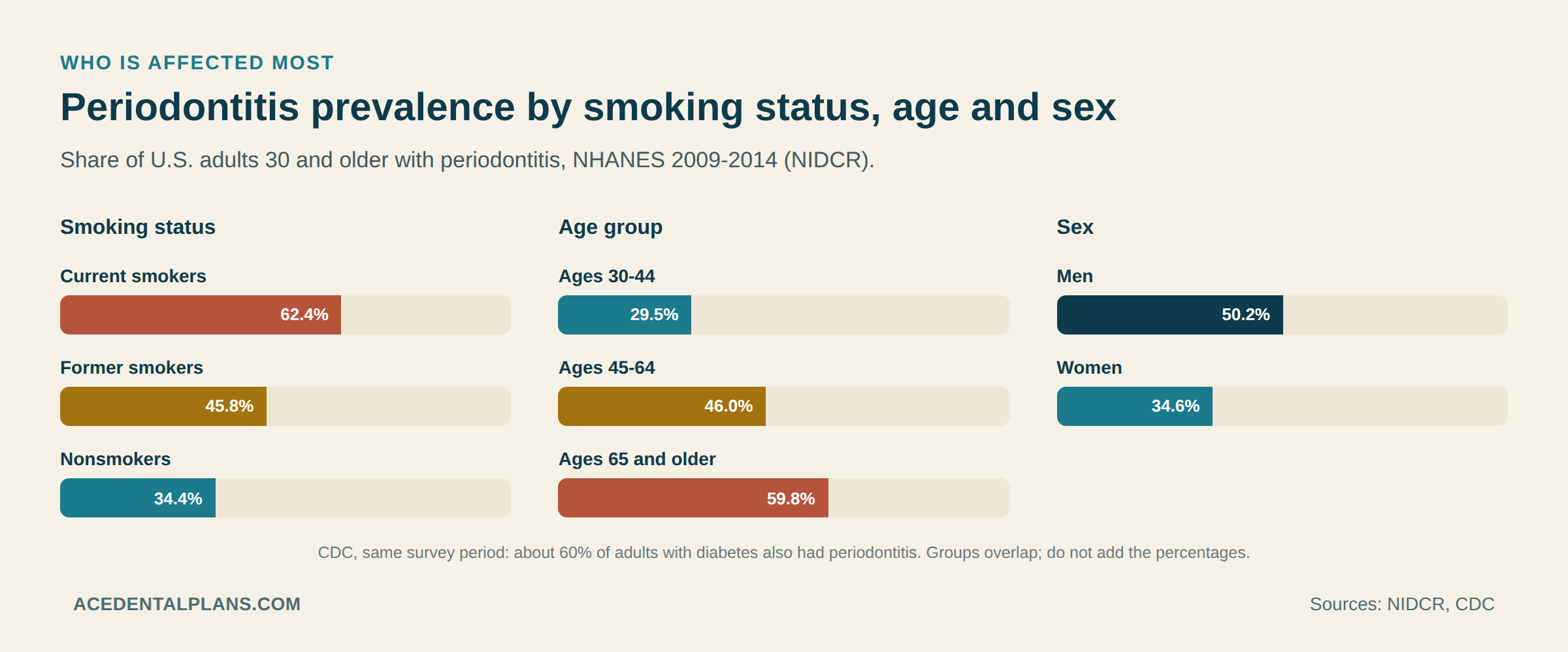
Two cautions on reading prevalence numbers. First, they describe groups, not individuals; a nonsmoker can have advanced disease and a heavy smoker can have healthy gums. Second, the figures overlap. Smokers, men and older adults are not separate populations, so you cannot add the percentages. They work as direction signs: where the sources agree, the arrows point the same way.
Why you may see 47% in one place and 42% in another
Search for how common gum disease is and two figures turn up. The ADA’s MouthHealthy page says chronic periodontitis affects 47.2% of U.S. adults over 30. NIDCR’s data page reports 42.2% of adults 30 and older with total periodontitis in 2009–2014, and the CDC says about 4 in 10. The sources opened do not reconcile the two. The MouthHealthy extract gives no survey year, while NIDCR names the survey cycle, the sample size and the standard error (plus or minus 1.4 points).
For planning purposes the difference does not change the message. Roughly four to five in ten American adults over 30 were estimated to have some periodontitis, and a probing exam is the only way to know whether you are one of them. This article uses the NIDCR and CDC figure throughout because it comes with a stated period and method.
What the ratios say
Raw percentages are easier to feel as ratios, and the arithmetic below is original to this article, using NIDCR’s 2009–2014 figures. Current smokers had periodontitis at 62.4% against 34.4% for nonsmokers, about 1.8 times as often, and severe periodontitis at 16.9% against 4.9%, about 3.4 times as often. Adults 65 and older were at 59.8% against 29.5% for ages 30 to 44, roughly double. Men were at 50.2% against 34.6% for women, about 1.45 times, and severe disease was 11.5% against 4.3%, about 2.7 times.
Two readings follow. First, the gap is wider for severe disease than for periodontitis overall, which is consistent with the classification system treating smoking as a grade modifier. Second, none of the gaps is a verdict on one person, and the survey measured a single point in time, so it cannot show that smoking caused each case. It does show why a dentist asks about tobacco before making a plan, and why the answer changes the forecast.
Smoking and vaping
The smoking numbers are the starkest in the data set. Among current smokers, 16.9% had severe periodontitis, against 4.9% of nonsmokers, according to NIDCR’s breakdown. The sources opened for this article do not give a figure for vaping, and the evidence on e-cigarettes and gum disease is not covered here. What the sources do say clearly is that quitting all forms of tobacco is part of prevention and can improve treatment results.
Medications
Several common drug classes show up on the ADA and CDC lists. The point for a patient is practical, not alarming. Bring a current medication list, supplements included, to every dental visit, because the dentist may read your gums differently when they know what you take. Do not change a medication because of something you read here.
Clenching, grinding and crowded teeth
The CDC lists malocclusion, clenching and teeth grinding among factors associated with gum disease, and the ADA lists crooked teeth that are hard to keep clean. Neither source gives a figure or explains the mechanism in the pages opened. The claim is modest: a bite that overloads teeth, or crowding that traps plaque, can make the picture harder to manage. If your dentist mentions a night guard, a bite adjustment or orthodontic movement as part of a gum plan, ask which problem each addresses. Jaw pain, clicking and related symptoms have their own guide on TMJ disorder, which is a separate condition.
Family history
Genetics appears on all three federal and professional lists. The sources do not quantify it, so there is no honest percentage to quote. A parent who lost teeth to gum disease is a useful thing to mention, because it may shape how closely a hygienist measures you over time.
Pregnancy and Hormonal Changes: Why Gums Can React
The CDC says that during pregnancy women may be more prone to gum disease and cavities, and that pregnant women are more likely to develop gingivitis. Pregnancy hormones can worsen gum inflammation, according to the same fact sheet. Menopause also appears on the CDC’s list of hormonal changes tied to gum disease, and NIDCR lists hormonal changes in girls and women among its risk factors.
The reassuring part is the CDC’s statement that regular and emergency dental care is safe at any stage of pregnancy, and that routine dental care is encouraged. Gums that bleed more than usual during pregnancy are a reason to book a cleaning, not to skip one. What to expect and what to ask at a visit while pregnant is covered in the guide to dental care during pregnancy.
Gingivitis in pregnancy is still gingivitis. The same logic applies: remove the plaque, clean between the teeth, and let a professional measure the pockets. If the gums were already inflamed before pregnancy, the dentist may want to look at them as a possible periodontitis case rather than assume the hormones explain everything.
Gum Disease and the Rest of the Body: What the Evidence Supports
Headlines about gum disease and heart attacks, dementia or cancer tend to flatten a messy evidence base. The most careful statements come from the professional bodies themselves. Per the AAP, a causal relationship between periodontal disease and other diseases “has not been conclusively established,” while adding that periodontal disease may contribute to the progression of other diseases. The ADA’s MouthHealthy page says some studies indicate that severe gum disease may be associated with other conditions such as diabetes or stroke, and that the link is not conclusive.
Diabetes: the two-way relationship
Diabetes is the connection with the strongest support in the sources opened. The CDC states there is an association between diabetes and gum disease. The AAP describes the relationship as going both ways: people with diabetes are more likely to have periodontal disease, and periodontal disease is often considered a complication of diabetes. The CDC says untreated periodontitis can make diabetes worse, and that treating gum disease improves blood sugar control among people with diabetes compared with no treatment or routine care.
The CDC fact sheet adds that adults 50 and older with diabetes have fewer than 20 teeth 46% more often than adults without diabetes. About 60% of U.S. adults with diabetes had seen a medical provider but not a dentist in the past year. For someone managing diabetes, the dentist belongs on the care team, and the dentist needs to know about the diagnosis and recent glucose results.
Heart disease and stroke
The American Heart Association reviewed the evidence in a 2012 scientific statement. It found that periodontal disease is associated with atherosclerotic vascular disease independent of known confounders, but that “no causal relationship” had been demonstrated. It also found no confirmation that periodontal treatment prevents heart disease or stroke, even though treatment reduces systemic inflammation and may improve some surrogate markers. The AAP, in contrast, says several studies show periodontal disease may increase heart disease risk and may worsen existing heart conditions, with inflammation as the proposed explanation.
Those statements are compatible. Association is not the same as cause, and a plausible mechanism is not proof of benefit from treatment. The practical reading: treat gum disease because it damages teeth and supporting bone, and do not expect it to be a substitute for blood pressure, cholesterol or other medical care. The AHA statement is also more than a decade old, so newer research may refine it.
Breathing and other claims
The AAP notes that bacteria associated with periodontal disease can be inhaled into the lungs and may contribute to respiratory illnesses such as pneumonia. The page also discusses other associations that are less settled. This article does not repeat those, because the sources describe studies and proposed mechanisms rather than established effects on an individual patient. If you have a chronic condition, ask your physician and dentist whether your gum health changes anything in your care plan.
A conversation guide for people with diabetes
The CDC fact sheet is short on clinical instructions, so the following is a list of topics to raise, not medical advice. Tell the dentist your diagnosis, your most recent glucose or HbA1c result and the medications you take. Ask whether your gum findings change the schedule of visits. Tell your physician when you begin periodontal treatment, since the CDC says treating gum disease is linked to better blood sugar control and your physician may want to watch your numbers. And keep both appointments: the CDC notes that about 60% of adults with diabetes saw a medical provider but not a dentist in the past year.
How a Dentist Diagnoses Gum Disease
Diagnosis is a measuring exercise. NIDCR says the dentist or hygienist checks gum inflammation, bleeding and recession, measures pockets with a probe, reviews your medical history, examines the teeth and often uses X-rays to look for bone loss. Healthy pockets are usually 1 to 3 millimeters deep, so a reading well beyond that range is a flag. The AAP’s comprehensive periodontal evaluation looks at teeth, plaque, gums, bite, bone structure and risk factors together, and the AAP recommends one each year.
A probe is a thin, blunt instrument marked in millimeters. The hygienist slides it gently into the space between gum and tooth and records the depth at several points around each tooth. That chart is the baseline against which every later visit is compared. Ask for a copy or a look at the screen. It is your data.
What X-rays add
Probing measures the soft side of the problem; X-rays show the hard side. NIDCR lists X-rays among the steps used to detect bone loss. In the staging system covered below, radiographic bone loss is one of the main measures of severity, expressed as a fraction of the root length. Comparing old and new images can show whether bone has changed even when the gums look calm.
When a referral comes up
NIDCR notes that a dental professional may refer a patient to a periodontist, a gum disease specialist. In the AAP’s description, periodontists have three years of specialized training beyond dental school, and the periodontist works with the patient and general dentist on a care plan. Referral is a clinical decision. If it comes up, ask what in your chart drove it and whether the specialist is in your plan’s network.
Preparing for a periodontal appointment
A little preparation makes a measuring appointment more useful. Bring a current list of medications and supplements, since the ADA and CDC both note that some drugs affect the gums. Bring your medical history, including diabetes status and recent test results if you have them. If you saw another dentist recently, ask that office to send X-rays, because a baseline helps show whether bone is changing.
Write down your symptom log and your questions. Ask whether the visit will include a comprehensive periodontal evaluation and how that appears on the estimate, because some offices bill it separately and some fold it into other charges. Find out in advance which of the visit’s services your plan treats as preventive, since a probing exam on a new patient can be classed differently from a routine cleaning.
A short glossary for your chart
- Plaque. The sticky bacterial film that forms on teeth (CDC). Removed by brushing and cleaning between the teeth.
- Tartar (calculus). Plaque that has hardened; only a dentist or hygienist can remove it (NIDCR).
- Pocket. The space between gum and tooth that deepens when the gum separates from the tooth (AAP). Healthy pockets are usually 1 to 3 mm.
- Clinical attachment loss (CAL). A measure of lost gum attachment used in the classification; detectable loss at two non-adjacent teeth is part of the periodontitis case definition.
- Bone loss. Loss of the jawbone that supports the tooth, seen on X-rays; the classification expresses it as a fraction of the root.
- Furcation. The area between the roots of a multi-rooted tooth; Class II or III involvement is one of the Stage III features in Table 3.
- Recession. Gum margin pulling back from the tooth and exposing root.
- Quadrant. One quarter of the mouth, the usual billing unit for deep cleaning and gum surgery.
- Periodontal maintenance. The recurring visits after active treatment that the AAP says most patients need.
Stage and Grade: Reading “Stage III, Grade B” on Your Chart
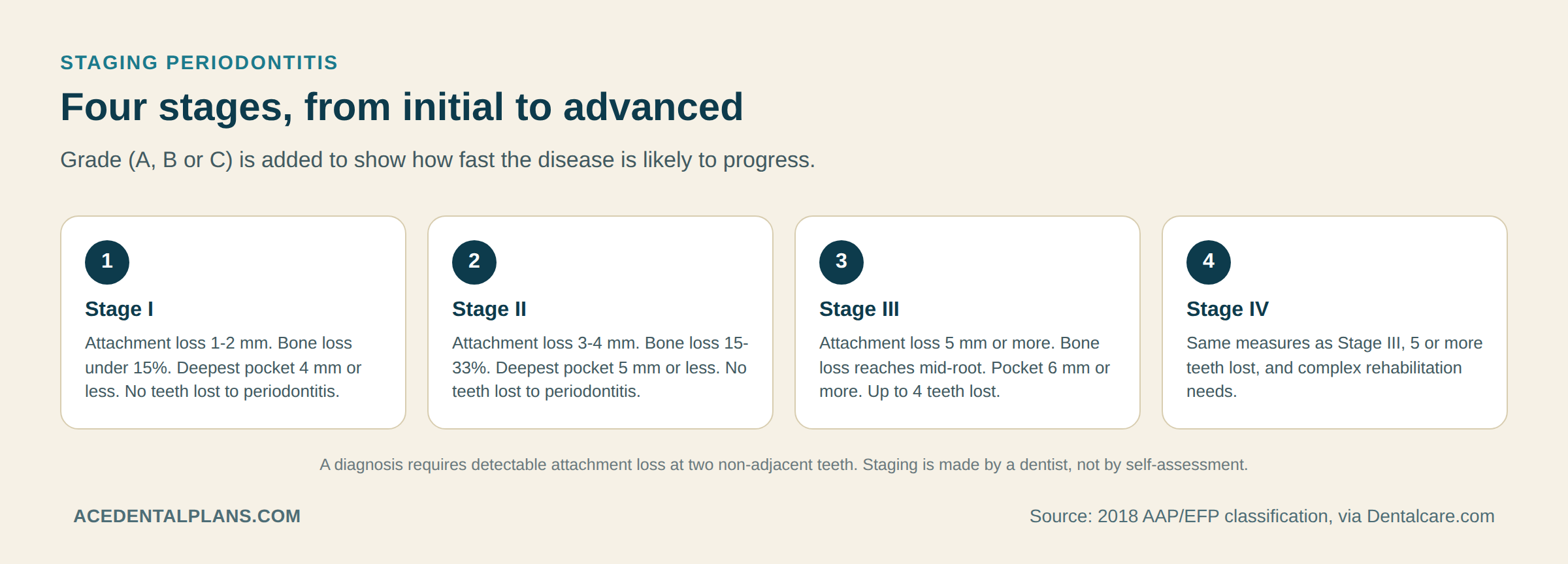
If you are told you have periodontitis, you may hear two labels. The AAP says a periodontist may assign a stage, from initial to severe, to describe severity, and a grade to indicate rate of progression and expected response to treatment. These come from the 2018 AAP and European Federation of Periodontology classification, summarized in Table 3 from a professional continuing-education course (Dentalcare.com) that reproduces the published criteria. The primary paper could not be opened for this article, so treat the figures as a secondary summary of the criteria.
The case definition comes first. Periodontitis requires detectable clinical attachment loss (CAL) at two non-adjacent teeth, plus identification of the form (periodontitis, necrotizing periodontitis, or periodontitis as a manifestation of a systemic disease). Stage and grade then describe the case. Think of stage as how much has already happened and how hard the case is to manage, and grade as how fast it seems to be moving.
| Stage | Attachment loss at deepest site | Radiographic bone loss | Teeth lost to periodontitis | Deepest probing depth | Added complexity |
|---|---|---|---|---|---|
| Stage I | 1–2 mm | Coronal third, under 15% | None | 4 mm or less | Mainly horizontal bone loss |
| Stage II | 3–4 mm | Coronal third, 15–33% | None | 5 mm or less | Mainly horizontal bone loss |
| Stage III | 5 mm or more | Extends to mid-third of the root and beyond | 4 or fewer | 6 mm or more | Vertical bone loss of 3 mm or more, furcation involvement (Class II or III), moderate ridge defect |
| Stage IV | 5 mm or more | Extends to mid-third of the root and beyond | 5 or more | 6 mm or more | Stage III features plus complex rehabilitation needs (for example fewer than 20 teeth remaining, bite collapse or severe ridge defect) |
What the grade adds
Grade is a forecast. Grade A means slow progression, with no loss over five years and low destruction despite heavy biofilm. Grade B is moderate, with less than 2 mm of loss over five years and destruction proportional to biofilm. Grade C is rapid, with 2 mm or more over five years, or destruction that outpaces what the plaque levels would explain. Risk factors can move the grade: a person who smokes fewer than 10 cigarettes a day starts at Grade B and 10 or more a day at Grade C. Diabetes with an HbA1c of 7.0% or higher moves a case to Grade C as well.
Extent and the words on your estimate
Dentists also describe extent. Under the classification, a case is localized when fewer than 30% of teeth are involved and generalized when more are. You may see a related idea on an insurance estimate. A code that separates four or more teeth in a quadrant from one to three teeth is a billing distinction, not the staging system, though the two often travel together. Ask your dentist to explain which of your teeth drive the stage.
Some patients feel a stage number is a verdict. It is not. Stages I and II describe less lost structure; stages III and IV describe more, plus the added complexity listed in Table 3. The number guides the complexity of care, and it is not a forecast of your whole future.
How to read a change in stage over time
A stage is a snapshot, and snapshots change. After treatment, pockets that were 6 mm may measure 4 mm. That is progress in disease control, but attachment and bone that were lost do not simply return, so ask your dentist how your own record handles it: whether the original stage stays on the chart and what the office tracks to judge success.
For a patient, the useful comparisons are your own earlier numbers rather than anyone else’s. Ask at each maintenance visit how many sites bleed now compared with the last visit, whether any pocket has deepened and whether the dentist sees any change on X-rays. Stable numbers are the goal. Three visits of stable numbers say more than one good day.
The Treatment Ladder: What Each Step Does and When It Comes Up
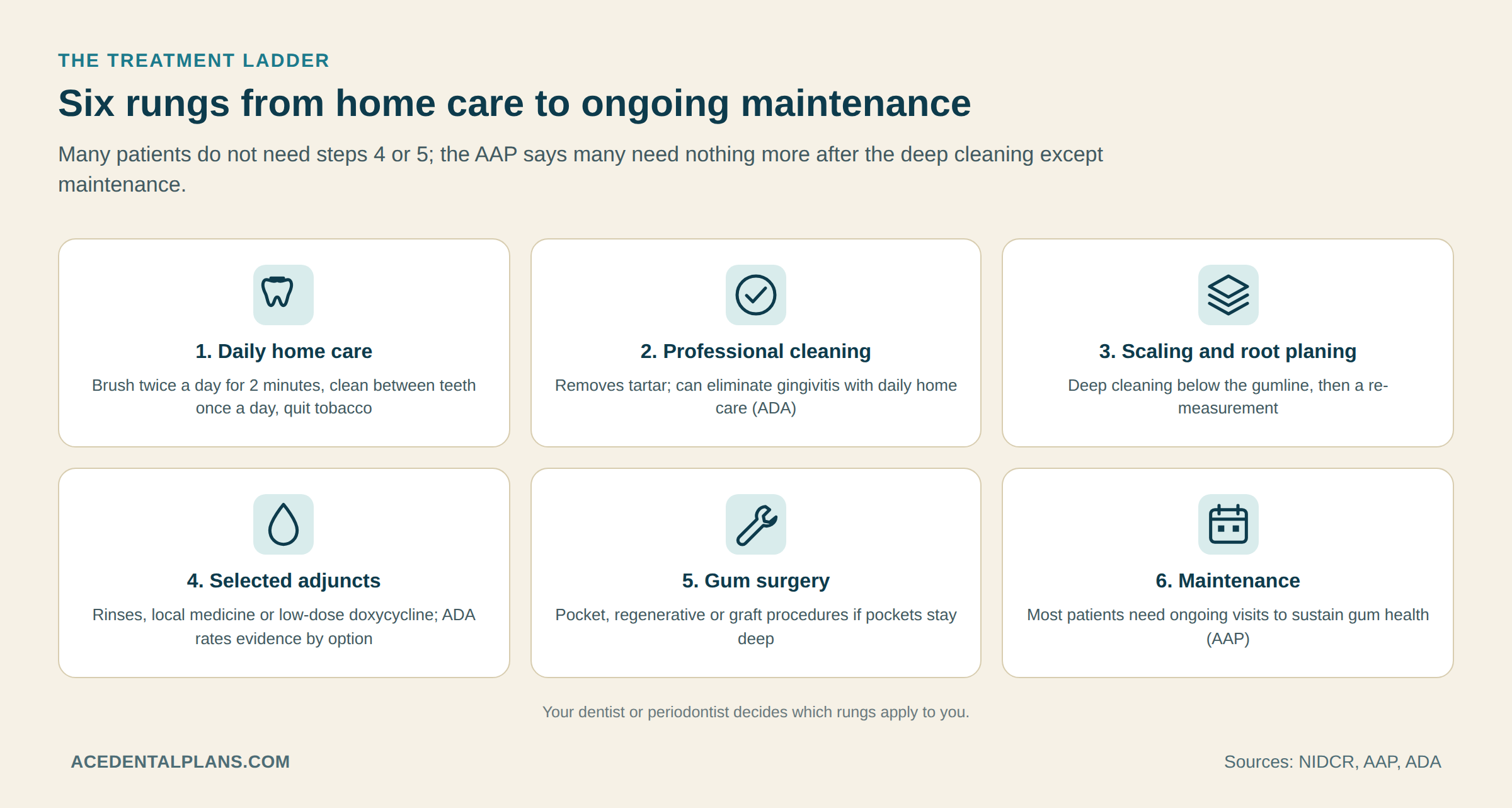
The NIDCR puts the aim plainly: the main goal of treatment is to control the infection. Everything on the ladder serves that. Steps are not a fixed sequence for everyone. A patient with gingivitis never climbs past the first rung, and a patient with advanced periodontitis may move through the nonsurgical steps quickly because the plan already anticipates surgery.
| Step | What it is | When the sources put it in play | What follows |
|---|---|---|---|
| 1. Home care upgrade | Brushing twice a day for two minutes, cleaning between teeth daily, tobacco cessation | Always, and on its own for early gingivitis (NIDCR) | Recheck at the next cleaning |
| 2. Professional cleaning | Removal of plaque and tartar a person cannot remove at home | Gingivitis; usually enough to eliminate it with daily home care (ADA) | Routine cleanings on the schedule your dentist advises |
| 3. Scaling and root planing | Deep cleaning of tooth surfaces and roots below the gumline | Periodontitis with pockets (NIDCR, CDC, AAP) | Re-evaluation; many patients need nothing more (AAP) |
| 4. Adjuncts | Rinses, locally placed medicine, systemic antimicrobials, low-dose doxycycline, lasers | Selected cases; the ADA guideline rates the evidence differently for each | Re-evaluation |
| 5. Surgery | Pocket procedures, regenerative procedures, soft tissue grafts | When nonsurgical treatment does not achieve good periodontal health (AAP) | Healing visits, then maintenance |
| 6. Maintenance | Periodic periodontal maintenance visits | Needed by the majority of patients after active treatment (AAP) | Continues on the schedule your periodontal team sets |
| 7. Tooth replacement | Extraction followed by bridge, denture or implant | When a tooth cannot be kept (NIDCR) | Implant or denture upkeep; the AAP says implants need care to prevent peri-implant disease |
Three hypothetical patients on the same ladder
Ladders are easier to understand with people standing on them. These three are made up, and none is a diagnosis; they show how the same sources lead to different paths.
The 29-year-old with bleeding when brushing. Suppose the chart shows pockets within the 1 to 3 mm range, inflamed gums, visible tartar and no bone loss on X-rays. That fits the picture the ADA and NIDCR describe for gingivitis. The path is a professional cleaning, a conversation about cleaning between the teeth and a recheck at the next scheduled visit. The billing unit is a single visit.
The 52-year-old with type 2 diabetes. Suppose the chart shows 5 mm pockets around several molars with bleeding, and X-rays show bone sitting lower around them. A periodontitis diagnosis becomes possible, and the dentist would stage and grade it. Because the CDC and AAP describe a two-way link with diabetes, the dentist and physician both want to know what the other is doing. The path may start with scaling and root planing by quadrant, then a re-measurement, then either maintenance or a surgery discussion. The billing units are quadrants and visits.
The 61-year-old who smokes a pack a day. Suppose the chart shows pockets of 6 mm or more, a molar that moves under finger pressure and bone loss to the middle of the root on several teeth. In the classification, smoking 10 or more cigarettes a day pushes a case toward Grade C, and NIDCR says quitting tobacco can improve treatment results. The path may include a referral to a periodontist and a deep cleaning. It also includes a hard conversation about whether the loose molar can be saved and, if not, a replacement plan that begins with healthy gums. The billing units multiply: quadrants, visits, possibly surgery sites, an extraction and a replacement.
What the three share is the sequence: measure, treat, re-measure, maintain. What differs is how many rungs each climbs, and each rung maps to a billing unit that the estimate should name.
Gingivitis: Cleaning, Better Habits and a Recheck
This is the cheapest stage to deal with, and the only one where the disease itself can be erased. NIDCR says early gum disease caused by plaque can often be reversed by daily brushing and flossing. As the ADA puts it, gingivitis can usually be eliminated by a professional cleaning followed by daily brushing and cleaning between teeth. The CDC calls gingivitis largely preventable and treatable with self-care and professional cleanings.
The word “usually” in those sentences does real work. If bleeding persists after a few weeks of consistent care, the problem may not be technique. Tartar left behind or the early stage of periodontitis can keep gums inflamed. The dentist can tell which. A visit that includes probing is more useful than another bottle of mouthwash.
On cost, a gingivitis visit is usually billed as a cleaning, so ask which code appears on your estimate. Prices for the routine visit, including the exam and X-rays that usually accompany it, are laid out in the guide to dental cleaning cost, and the cash price of a cleaning is covered separately for patients without coverage.
Scaling and Root Planing: What the Deep Cleaning Involves
Once measuring shows pockets and attachment loss, the standard first treatment is scaling and root planing, which most people call a deep cleaning. The AAP describes it as a deep cleaning of the root surfaces. The clinician first removes plaque and bacteria from the pockets below the gumline, then smooths the root so plaque and toxins have a harder time sticking again. The ADA guideline names scaling and root planing as the initial nonsurgical treatment for periodontitis.
The sources opened for this article do not detail the appointment itself: anesthesia, session length or what healing feels like. Those are the right questions to put to your own office. Ask whether the work will be done by quadrant or by half-mouth, whether a local anesthetic is used, how many visits the plan assumes, and when you will be re-measured. Billing follows the same units, which is why a price for “a deep cleaning” needs a unit beside it.
After the deep cleaning: re-evaluation
According to the AAP, many patients do not require additional treatment after scaling and root planing, and the majority will need ongoing maintenance. That sentence organizes the whole next phase. After the deep cleaning, the dentist re-measures to see whether pockets have shrunk and bleeding has dropped. Pockets that closed move you toward maintenance. Pockets that stayed deep are the ones that raise surgery as a question, which is why the AAP notes that surgery may be recommended if nonsurgical treatment does not achieve good periodontal health.
For deep cleaning prices by quadrant and how plans classify the procedure, the deep cleaning cost guide works through the arithmetic, and the cash cost of scaling and root planing covers patients paying without a plan.
Antibiotics, Rinses and Other Add-Ons: What the ADA Guideline Says
After scaling and root planing, a dentist or periodontist may add a second treatment to the first. NIDCR mentions an oral rinse, and the CDC lists medications such as a prescribed rinse or medicine placed under the gums. Which add-on, if any, is a clinical decision. What a patient can do is understand how strong the evidence is behind the suggestion.
The ADA’s 2015 clinical practice guideline on nonsurgical treatment of chronic periodontitis is a useful reference even though it uses the older “chronic periodontitis” label. It voted in favor of scaling and root planing as the initial nonsurgical treatment. For add-ons, it was in favor of systemic subantimicrobial-dose doxycycline, and gave a weak recommendation to systemic antimicrobials, chlorhexidine chips and photodynamic therapy with a diode laser. For doxycycline hyclate gel and minocycline microspheres placed in the pocket, the recommendation rested on expert opinion in favor, and for other lasers on expert opinion against.
Two caveats matter. The guideline says that “expert opinion for” does not imply endorsement and reflects lacking evidence. It also says low-dose doxycycline and full-strength systemic antimicrobials showed similar size of benefit, but were rated at different strengths because higher antimicrobial doses carry more potential for adverse effects. The guideline stresses that its recommendations should be combined with clinical judgment and patient preferences.
What a patient can reasonably ask
If an add-on appears on your plan, ask which problem it targets. Ask whether it goes in specific pockets or the whole mouth, what the alternatives are and how the office will tell whether it worked. For prescription antibiotics, ask about interactions with medicines you already take and about side effects. This article does not give dosing and cannot say whether an antibiotic suits any individual. The ADA guideline is also more than a decade old, so the dentist may reasonably cite more recent evidence.
Take-home trays and the FDA
The AAP describes tray delivery systems that patients use at home to deliver medication prescribed by their dental professional. It adds that FDA clearance of the tray does not by itself show that a particular medication delivered that way is proven for gum disease. That is a good example of the gap between a device being allowed on the market and a treatment being shown to work for your problem.
Gum Surgery and Grafts: When Pockets Stay Deep
Surgery enters the picture when the re-evaluation shows that nonsurgical care did not get the pockets or inflammation under control. The AAP says that if nonsurgical treatment does not achieve good periodontal health, the periodontist may recommend surgery. It describes several kinds, and each answers a different question.
- Pocket procedures. The periodontist folds back the gum tissue, removes the disease-causing bacteria and secures the tissue back in place. Irregular surfaces of damaged bone may be smoothed so that bacteria have fewer places to hide.
- Regenerative procedures. When the supporting bone has been destroyed, the periodontist folds back the gum, removes bacteria and may use membranes, bone grafts or tissue-stimulating proteins to encourage natural bone and tissue to regrow.
- Soft tissue grafts. Gum tissue taken from the palate or another donor source is placed over an exposed root to cover it. Per the AAP, this helps prevent additional recession and bone loss and may reduce sensitivity.
- Crown lengthening. Gum and bone are reshaped to expose more tooth, either for a “gummy” smile or so that a restoration can be done. It is a reshaping procedure and not a treatment for infection.
The fact that surgery has several versions explains why a surgical estimate can have many lines and why plans may ask what a graft is for. Covering a recessed root and rebuilding bone around diseased teeth can be billed and reviewed differently. How those lines are priced across the country is the subject of the gum disease treatment cost guide, which this article only summarizes.
Gum recession is not the same as gum disease
Receding gums appear on the CDC and AAP symptom lists, because periodontitis can pull the gum margin back and expose the root. But recession is also described as its own problem. The AAP says soft tissue grafts are used to cover exposed roots caused by gum recession and to help prevent more recession and bone loss, and that they may reduce sensitivity and improve appearance. Recession can occur with pockets and bone loss or without them. A dentist who measures both can tell which situation you are in, which also matters for how an insurer reviews a graft.
Decision points before agreeing
Surgery is a larger commitment of time, money and healing. Before you agree, find out what the re-measurement showed and which teeth or quadrants are involved. Ask what the surgery is expected to achieve, what happens if you wait and what the maintenance plan looks like afterward. A second opinion from another periodontist is a reasonable step before a major plan, and you can ask the office to share X-rays and chart readings for that purpose.
The AAP and NIDCR sources opened here do not give success rates, healing times or pain ratings for surgery, so none are quoted. Ask your periodontist for the numbers they use in their own practice, and for what the recovery looks like with your job and diet in mind.
Periodontal Maintenance: The Long Phase of Treatment
For most people with periodontitis, treatment does not end. In the AAP’s description, the majority of patients require ongoing maintenance therapy to sustain periodontal health. These visits carry their own billing code, periodontal maintenance (D4910), and are distinct from a routine cleaning.
How often visits occur is a clinical judgment. The sources opened for this article do not state a standard interval, and it would be wrong to promise one. The periodontal team sets the interval from your measurements, bleeding, risk factors and home care. Ask what your schedule is, why, and what would lengthen or shorten it.
Maintenance is also where insurance rules bite. Plans may count periodontal maintenance as a separate benefit from routine cleanings, with its own frequency limit. A 2026 Delta Dental PPO Basic summary, for instance, limits cleanings to two per calendar year. It also notes that regular and periodontal cleanings are subject to a 30-day wait after scaling and root planing by the same office. The cost section below explains how to check this for your own plan.
What a first year can look like
Here is a hypothetical sequence, built from the steps the sources describe, with no prices attached. Suppose the first appointment includes a comprehensive periodontal evaluation, probing and X-rays. At a second visit or two, the dentist or hygienist performs scaling and root planing, by quadrant or half-mouth. A re-measurement is scheduled some weeks later, as the office sees fit. If pockets have closed and bleeding has settled, the next step is a maintenance schedule. If some pockets remain deep, the periodontist discusses surgery or an adjunct for those areas only.
Through the rest of the year, maintenance visits recur at the interval the team sets. The annual comprehensive evaluation the AAP recommends can double as a progress check. What changes from year to year is usually the chart, not the plan: fewer sites that bleed, pockets that hold steady, and decisions that become routine.
Common maintenance mistakes
- Treating the end of the deep cleaning as the end of treatment and letting the next visit slide past a year.
- Assuming a routine cleaning in a general-dentist schedule is the same service, and billed the same way, as periodontal maintenance.
- Skipping home care because the gums feel better. Better-feeling gums mean the inflammation has dropped, not that the cause is gone.
- Letting a coverage limit decide the schedule before talking it through with the dentist.
Home Care That Matters Most
Professional treatment resets the mouth; home care keeps it reset. NIDCR’s prevention list is short and consistent with the ADA. Brush twice a day with fluoride toothpaste, floss daily or use an interdental brush, pick or water flosser as your dental professional recommends, get routine checkups and cleanings, and quit all tobacco. The ADA specifies brushing for at least two minutes each time, and says to clean between your teeth once a day.
Technique matters more than gear. The ADA advises guiding floss between teeth with a gentle rubbing motion and never snapping it into the gums. At the gumline, curve it into a C shape against each tooth. It also says cleaning between your teeth should not cause pain. Dental picks and tiny brushes can be good for hard-to-reach spots. A water flosser uses a gentle stream of water to rinse away food and plaque, and can help when other tools are hard to use, for example with braces or bridges. Products with the ADA Seal have been evaluated for safety and effectiveness.
Matching the cleaning tool to the gap
The ADA names several options for cleaning between teeth: floss, dental picks, tiny interdental brushes and water flossers. It does not rank them, and NIDCR leaves the choice to your dental professional. So the practical test is which tool you will actually use every day and can use without pain. Tight contacts between teeth suit floss; wider spaces may suit a small brush; people with braces or bridges may find a water flosser easier, per the ADA. Ask the hygienist to show you the tool and watch you use it once, because technique errors are easier to fix at the chair than from a leaflet.
Powered brushes
A 2014 Cochrane review of 56 trials with 5,068 participants found that powered toothbrushes reduce plaque and gingivitis more than manual toothbrushing in the short and long term. Plaque was 11% lower at one to three months and 21% lower after more than three months, with gingivitis 6% and 11% lower at the same points. The review rated the evidence moderate quality and said the clinical importance of the findings remains unclear. A powered brush is a reasonable option, not a requirement, and a manual brush used carefully for two minutes is still the baseline.
What home care cannot do
NIDCR is direct on one limit: only a professional cleaning by a dentist or hygienist can remove tartar. Rinses, oils, herbal products and gadgets that promise to dissolve tartar or reverse a pocket are not supported by the sources opened for this article. A rinse prescribed by a dentist is a different matter. Short-term comfort measures for a sore gum can ease symptoms while you wait for an appointment, but none of them treats the infection.
Diet and habits
The ADA lists a balanced diet alongside brushing and cleaning between teeth. NIDCR and the CDC list poor nutrition, obesity and stress among associated factors without quantifying them. The practical message is modest: eating well supports general health, which supports healing, and no dietary shortcut replaces plaque control. Tobacco is the one lifestyle factor with strong and specific numbers behind it.
What Happens If Gum Disease Goes Untreated
The pathway is slow but directional. According to NIDCR, gum disease starts with swollen, red and bleeding gums; if untreated it can reach the bone supporting the teeth, make chewing painful, loosen teeth and sometimes lead to removal. The ADA adds that periodontitis usually progresses slowly but can have periods of rapid progression, and the CDC calls periodontal disease a leading cause of tooth loss in its diabetes fact sheet.
Bone loss does not reverse on its own, which is why the CDC says periodontitis cannot be reversed. Treatment slows it. A tooth that has lost most of its bone support may become loose, shift position, change how your bite fits or need extraction. Those are also the later signs in the CDC symptom list: receding gums, loose teeth and changes in bite or denture fit.
Tooth loss in context
Tooth loss has several causes, and NIDCR’s national tables do not separate gum disease from decay or injury. What they do show is the scale. Adults aged 20 to 64 had an average of about 25.5 permanent teeth in 2017 to March 2020, and 2.0% had no natural teeth, down from 3.8% in 1999–2004. Among those aged 50 to 64, 5.9% had no natural teeth. Current smokers had a mean of 23.3 teeth and 7.6% had none, compared with 26.1 teeth and 0.3% among adults who never smoked. Those figures are age-adjusted and the latest cycle was partly disrupted by COVID-19.
Replacing Teeth Lost to Gum Disease: Implants, Bridges and Dentures
When a tooth cannot be kept, the options come from the same menu any missing tooth faces. What is particular about gum disease is that the disease that cost the tooth may still be there. The AAP says an ideal implant candidate has healthy gum tissue free of periodontal disease, adequate jaw bone and good general and oral health. In practice, that means periodontal treatment often comes first, and a bone-building procedure may be needed before an implant can be placed.
The AAP also says implants require conscientious home care and regular dental visits to prevent peri-implant disease, the gum and bone problems that can affect an implant itself. So the maintenance schedule does not end when a tooth is replaced. For what a single implant costs and what the quote includes, see the guide to dental implant cost. The wider treatment picture, including candidacy, procedure and recovery, is in the guide to dental implants.
Maintenance does not end with an implant
People sometimes assume that replacing a tooth removes the gum problem along with the tooth. The AAP’s implant guidance points the other way. It describes implants as intimately connected with the gums, says they need careful home care and regular visits to prevent peri-implant disease, and says periodic follow-up visits monitor the implant, the remaining teeth and the gums together. If you have had periodontitis, an implant schedule is a continuation of the periodontal schedule, not a replacement for it.
Removal itself is a separate decision and bill. The difference between a simple and a surgical extraction is explained in the tooth extraction cost guide. If dentures are the plan, types of dentures and how they fit and how long dentures last help set expectations about upkeep and replacement.
A bridge or denture is not a way around gum health either. The CDC lists a change in how a partial denture fits among the signs of gum disease, which is a reminder that the remaining teeth still need monitoring after a replacement is made.
Prevention: keeping gum disease from starting or coming back
The CDC says gingivitis can be largely prevented and treated with a combination of self-care and professional cleanings. It recommends brushing twice a day, flossing every day and a dental checkup at least once a year, or more often if the dentist advises. The AAP recommends an annual comprehensive periodontal evaluation. The two annual checks overlap, but the periodontal evaluation is specifically about the gums, bone, bite and risk factors, rather than cavities.
Prevention is also about risk management. Quit tobacco if you use it; NIDCR says this can improve treatment results. If you have diabetes, keep your dentist informed and, as the CDC notes, treatment of gum disease is linked to better blood sugar control. If you take a medication on the ADA or CDC lists, mention it. If you clench or grind your teeth, which the CDC lists among associated factors, ask whether a guard or a bite check makes sense. Cleaning between the teeth is the one habit that every source returns to.
Finally, prevention depends on being seen. The CDC warns gum disease can become serious before a person notices symptoms, and the ADA says it is possible to have it with no warning signs at all. A checkup with probing is the screening tool, and the most reliable reason not to skip one.
The Cost Ladder in One Table: Five Rungs, One Unit Each
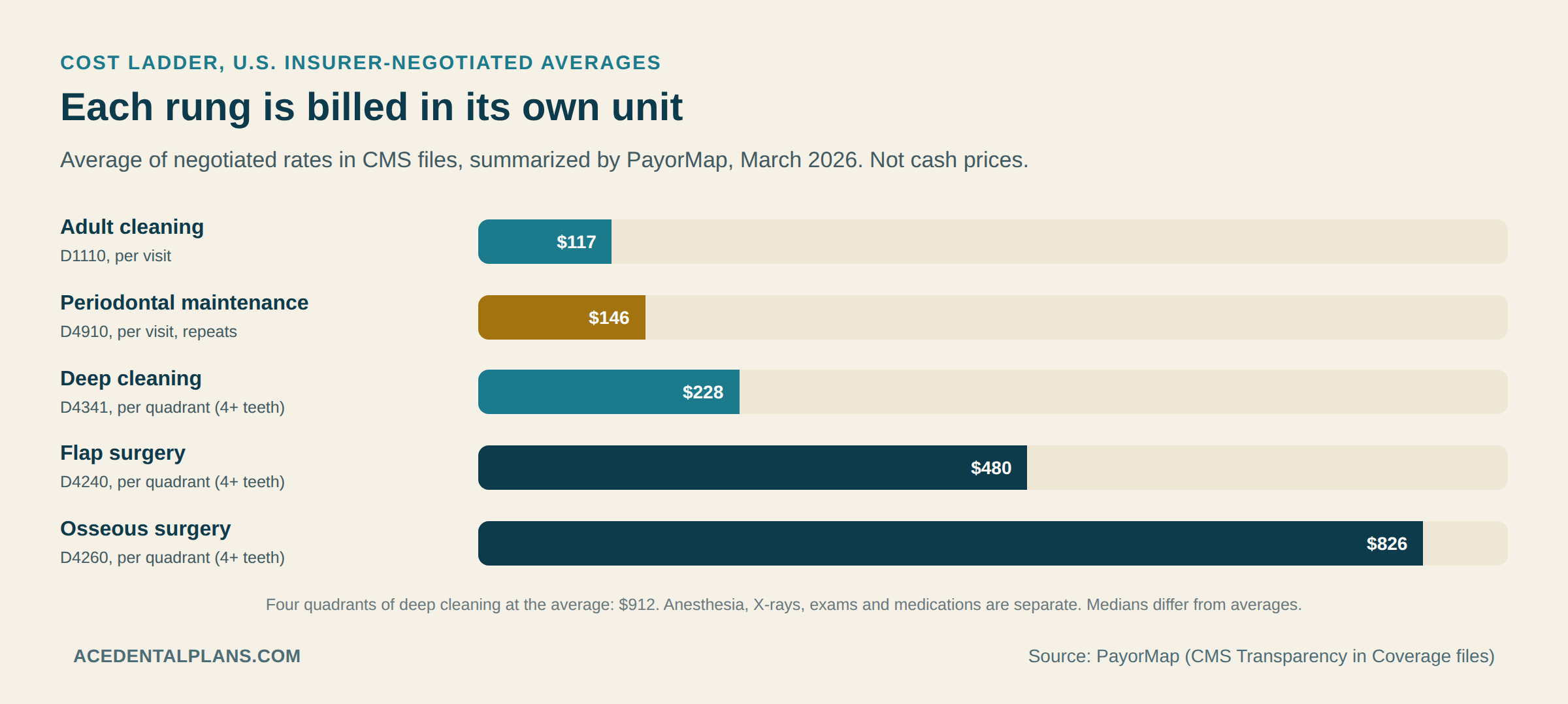
Costs rise with the stage, and they repeat. A cleaning is a one-time visit, a deep cleaning is billed by the quadrant, maintenance returns on a schedule and surgery is billed by the quadrant again. Table 5 puts the main rungs side by side using one consistent source. The figures are average rates that U.S. insurers negotiate with dentists, drawn from CMS Transparency in Coverage files and summarized by PayorMap with a March 2026 refresh. These are the amounts a contracted dentist accepts from a plan, not cash prices, and they cover the procedure only, not anesthesia, X-rays, exams or medications.
| Rung (CDT code) | Billed per | Average (median) | How two 2026 plan summaries treat it |
|---|---|---|---|
| Routine adult cleaning, for gingivitis (D1110) | Visit | $117 ($126) | PPO Basic: preventive and diagnostic, 2 per calendar year. Iowa: deductible waived for diagnostic and preventive care |
| Deep cleaning, 4+ teeth (D4341) | Quadrant | $228 ($160) | PPO Basic: major, not covered. Iowa Farm Bureau: periodontal services at 50% after a 6-month wait |
| Periodontal maintenance (D4910) | Visit | $146 ($127) | PPO Basic: periodontal cleanings preventive with a 30-day wait after a deep cleaning by the same office. Iowa: not stated separately |
| Gingival flap surgery, 4+ teeth (D4240) | Quadrant | $480 ($485) | Iowa: periodontal services at 50%. PPO Basic: not listed |
| Osseous surgery, 4+ teeth (D4260) | Quadrant | $826 ($794) | Iowa: periodontal services at 50%. PPO Basic: not listed |
Several things follow from reading it carefully. The units differ, so adding the column across is meaningless: four quadrants of deep cleaning at $228 is $912, and maintenance multiplies by the number of visits. The national range around any average is wide. PayorMap reports $36 to $1,076 for the deep cleaning code across 514 records, which tells you that a contract in one state and a contract in another can sit far apart. And a negotiated rate is not a cash price, so an office’s own fee for a patient without a plan may differ.
This article stops at the headline numbers. The full cost guide for treating gum disease compares negotiated, university-clinic and discount-plan prices, adds grafts, antimicrobials and extraction and implant lines and builds a first-year course. Patients paying cash for the deep cleaning step can start with the cash-price guide for scaling and root planing linked earlier.
If a flare-up sends you to an urgent visit, such as a gum abscess, the exam, X-ray and drainage lines are priced in the guide to emergency dentist cost. An urgent visit deals with the immediate problem, and the longer periodontal plan comes after.
How Insurance Usually Sorts Gum Disease Treatment
Coverage for periodontal work is less uniform than coverage for cleanings. The general rules for plan types, deductibles, networks, annual maximums and claims are covered in the pillar on how dental insurance works, and the tiers of preventive, basic and major services are laid out in the guide to what dental insurance covers. What is specific to gum disease is how plans classify the services and which limits they attach.
Classification varies plan to plan
Two 2026 plan summaries show the range. A Delta Dental Insurance Company PPO Basic summary classifies scaling and root planing as a major service that is not covered in or out of network. Periodontal cleanings, in contrast, fall under preventive and diagnostic at 0% patient cost, limited to two per calendar year. A Delta Dental of Iowa summary for an employer group lists periodontal services (gum and bone diseases, complex procedures) at 50% for PPO dentists. It adds a 6-month waiting period for endodontics and periodontics, a $50 deductible and a $1,000 annual maximum. Same carrier family, different plans, different treatment of the same disease.
The ADA’s December 2025 reporting on annual maximums gives context for that $1,000 figure. The National Association of Dental Plans data cited there put 32.8% of in-network maximums between $1,000 and $1,500, 48.2% between $1,500 and $2,500 and 17.2% above that or without a cap. The ADA Health Policy Institute found only 3.4% of dental patients reached the typical maximum in a 2024 analysis. A full periodontal course, with a deep cleaning, maintenance and possibly surgery, is the kind of treatment that can reach a cap, which is why the order of the arithmetic below matters.
The order to check things in
- Plan type. A PPO pays a share of an allowed amount; other plan types may use flat copays for each procedure code; a discount plan is not insurance and just sets lower fees.
- Deductible and network. Does the deductible apply, and is the periodontist in your plan’s network? Network status can change the allowed amount.
- Coinsurance by classification. Is deep cleaning basic or major? Is periodontal maintenance paid as a cleaning, as periodontal maintenance, or not at all?
- Annual maximum. Know how much remains this year and what resets in January.
- Exclusions, waiting periods and frequency limits. Look for a waiting period before periodontal benefits begin, a limit of once per period for scaling and root planing, and the 30-day wait the PPO Basic summary attaches to cleanings after a deep cleaning.
- A written estimate. Ask the office to send a predetermination to the insurer before surgery.
The ADA explains that pre-authorizations and predeterminations are processes payers offer to determine potential benefits for a specific patient, that they are not a guarantee of payment and that they reflect eligibility and remaining benefits when issued. Benefits are determined as of the date of service. The ADA advises submitting predeterminations for complex, costly procedures as close to the service date as possible, and patients should also contact the payer directly to verify benefits. Seeing the fine details of an estimate is exactly what the next section is for.
Questions to ask your insurer
A benefits call works better with a script. Ask whether periodontal services (scaling and root planing, periodontal maintenance, surgery) are classified as basic or major, and what percentage applies. Ask whether a waiting period applies and whether you have already served it. Ask what frequency limit applies to scaling and root planing, and whether periodontal maintenance is counted separately from routine cleanings. Ask whether any periodontal service sits outside the deductible or annual maximum and how much of the maximum remains this year. Ask whether the plan requires documentation such as pocket charts or X-rays and whether a predetermination can be submitted. And ask whether the periodontist is in your network. Write down the date, the representative’s name and a reference number, because plan answers by phone are not binding.
Reading a periodontal estimate line by line
An estimate has a code, a tooth or area, a fee, an allowed amount and what you owe. Codes come from the ADA’s Current Dental Terminology; the guide to CDT dental codes explains how to read them. Two details trip people up in periodontal estimates. One is the number of teeth per quadrant, since one code applies to four or more teeth and another to one to three. The other is the area, since a quadrant is not a tooth.
Three habits make estimates easier to check. Ask for the code and tooth or quadrant on every line. Ask what is bundled: whether the evaluation, anesthesia and X-rays sit inside the fee or on top of it. And ask how the plan counted each service against the annual maximum, since some plans apply certain periodontal services to the maximum and others do not.
A fill-in budget for the first two years
National averages cannot give you a personal total, but a short formula can. Fill in your own numbers from the written estimate and your benefits summary. Active phase: the allowed amount for each deep cleaning quadrant multiplied by the number of quadrants, plus the evaluation and any X-rays or anesthesia lines. Maintenance: the allowed amount for one maintenance visit multiplied by the visits your team schedules each year. Surgery, if proposed: the allowed amount per quadrant multiplied by quadrants, plus graft lines. Then subtract what the plan is expected to pay after the deductible, the coinsurance and the remaining annual maximum.
Do the arithmetic twice, once for each calendar year the treatment touches. The first year usually carries the active phase and may use up the maximum. The second carries maintenance, which is smaller per visit but continues. If the two-year total is a surprise, bring the worksheet to the dentist. It turns “this is too much” into “which line can be phased, and which cannot”.
Timing around the end of a benefit year
Benefit-year timing deserves a short note for anyone treated in the fall. According to the ADA, benefits are determined as of the date of service, not the date a predetermination was requested, and a predetermination pays only if you remain eligible and the plan maximum has not been used up at the time of service. In practice, a deep cleaning completed in November uses this year’s remaining maximum, and a surgery done in January draws on a new one if your plan year follows the calendar.
That sequence can help or hurt, depending on how much of this year’s maximum is already gone and on whether the periodontist considers the surgery time-sensitive. Whether to hold a procedure for January is a clinical and financial judgment to make with the office, using the written estimate and a benefits check, and the plan’s waiting periods and frequency limits still apply to both dates. The guide to using dental benefits before year-end walks through the planning questions. Do not delay treatment that your dentist considers time-sensitive for a better insurance calendar.
Medicare, Public Programs and Other Coverage
Medicare.gov states that Original Medicare does not cover dental services such as routine cleanings, fillings and tooth extractions in most cases, and that you pay all costs for non-covered services. Narrow exceptions exist. Some services may be covered when you are admitted as a hospital inpatient for a dental procedure, and so may dental work needed for a covered medical treatment to succeed, such as exams and treatment before a heart valve replacement or organ transplant, or treating a mouth infection before chemotherapy. Gum disease treatment on its own does not appear in those examples. The page does not discuss Medicare Advantage dental benefits.
That distinction is the one that sends many older adults looking for options. The guides to whether Original Medicare covers dental care, to Medicare Advantage dental coverage and to comparing dental benefits at Medicare open enrollment cover what Original Medicare leaves out and how to compare plans that add benefits. With prevalence of periodontitis at 59.8% among adults 65 and older, per NIDCR, the question is not a niche one.
Paying Without Insurance: Lower-Fee Routes and Sequencing
When there is no plan, the first lever is the order of work. According to the AAP, many patients do not need additional treatment after scaling and root planing, so paying for the nonsurgical phase first and deciding about surgery at the re-evaluation can keep the near-term bill smaller. Whether that suits your case is a clinical call, and your dentist should be told about the money constraint openly.
The second lever is price source. A full guide to dental school clinics, community health centers, sliding-fee programs, discount plans and payment options sits in the article on dental care without insurance, and the guide to dental savings plans explains how a membership works and where it breaks even. For spreading a larger bill over time, ways to pay for expensive dental work compares eight options, and HSA and FSA rules for dental expenses covers pre-tax accounts.
A caution runs through all of these: a lower price should not mean lower care. Ask any low-cost clinic about wait times, the number of visits the work takes and who provides follow-up maintenance. Maintenance is the long part of periodontal care, and the clinic that starts your treatment may not be the one that can keep you on a schedule.
Special Situations: Diabetes, Older Adults, Smokers and Children
Several groups appear again and again in the sources. Adults with diabetes show the two-way relationship described earlier, and the CDC fact sheet notes they are more likely to have severe tooth loss at ages 50 and older. People who smoke face the highest prevalence figures in the NIDCR table, and NIDCR says quitting can improve treatment results. Older adults have the highest age-group prevalence, at 59.8% for ages 65 and older.
Children are a smaller part of the picture. NIDCR says children with certain rare primary immunodeficiency disorders are nearly ten times more likely to develop gum disease. The sources opened do not give general figures for gum disease in children, so none are quoted. For adults taking medications on the ADA and CDC lists, or going through cancer treatment, the dentist and the prescribing physician should know about each other.
If you are pregnant and noticing gum changes, see the earlier section and the pregnancy guide. If you wear a partial denture and it suddenly fits differently, treat that as a symptom to report, as the CDC and AAP list it.
A note on how old the evidence is
Several of the strongest numbers in this article come from older work, and it is fairer to say so. The national prevalence estimates are from the 2009–2014 survey cycle, and NIDCR describes them as the latest NHANES data on the topic. The ADA clinical practice guideline on nonsurgical treatment dates from 2015, the American Heart Association statement from 2012 and the Cochrane review of toothbrushes from 2014. The staging system was published in 2018.
That does not make them wrong, and nothing in the sources opened says they were withdrawn. It does mean that a dentist or periodontist may be working from newer papers than the ones cited here, and that the prevalence of gum disease today may differ from the 2009–2014 snapshot. When your clinician’s advice differs from a number in this article, trust the clinician who has measured your mouth.
Questions to Ask Your Dentist or Periodontist
Good questions turn a diagnosis into a plan you can evaluate. Bring them in writing.
- What is my diagnosis: gingivitis or periodontitis? If periodontitis, what are my stage and grade, and which teeth drive them?
- Can I see my pocket measurements and X-rays? Which areas are deepest?
- What do you recommend first, and what result would you expect after it?
- When will you re-measure, and what results would change the plan?
- If you recommend an add-on such as a rinse, antibiotic or local medication, which problem does it address and what does the evidence say?
- If surgery is proposed, what is it meant to accomplish, what are the alternatives and what happens if I wait?
- How often will I need maintenance visits and how are they billed?
- Is a periodontist involved, and are they in my network?
- Which of my other health conditions or medications change your plan?
- What can I change at home, in detail, that will help most?
- What is the written estimate by code and area, and can it be sent to my insurer as a predetermination?
- If a tooth cannot be saved, what is the plan for replacing it and the timeline?
Talking about cost with the periodontist’s office
Cost conversations go better when they are specific and early. Ask the front desk for the fee for each code on the plan, and for the cash fee if you have no coverage. Tell the clinician that cost matters, and ask which parts of the plan are time-sensitive and which can be phased. Ask what happens if you finish the nonsurgical phase and decide to pause, and whether the office will hold your X-rays and chart for a second opinion.
A good office will separate the clinical judgment (what your mouth needs and when) from the administrative detail (what the plan or the schedule allows). If an office cannot or will not put a fee in writing before treatment, that is information too.
Comparing two treatment plans
If you collect a second estimate, comparing totals is not enough. Line the two plans up by code, area and number of visits. One office may propose deep cleaning of four quadrants and another of two, with a re-measurement before the rest; those plans are not the same product at different prices. Check what each assumes about anesthesia, X-rays and the maintenance schedule, and ask each office why it chose its sequence. A difference in total may reflect a difference in the plan itself.
Compare the follow-up as well. A lower price for the active phase can be offset by a higher price per maintenance visit, or by an office that sends maintenance elsewhere. Ask each office to state in writing who will do the maintenance visits and how they will be billed.
A 30-day checklist after a gum disease diagnosis
- Ask for your pocket chart and X-rays, or at least a read-through of the numbers, and write down your diagnosis in the dentist’s words.
- Start the home routine you were shown, with a tool for cleaning between teeth that you can use without pain.
- If you use tobacco, ask your dentist or physician about support for quitting; NIDCR says it can improve treatment results.
- Give both your dentist and your physician an updated medication list, and tell both about diabetes if you have it.
- Request the written estimate by code and area, and ask whether the office will send a predetermination.
- Call your insurer with the questions listed earlier, and note the date and reference number.
- Book the re-measurement visit before you leave the deep cleaning appointment, so that it does not slide.
- Put maintenance visits on your calendar as recurring appointments rather than one-off decisions.
The full range of oral health guides, from cavities and infections to jaw problems, is collected in the oral health and dental emergencies category.
Bottom Line
Gum disease is a staged condition with a built-in early exit. At the gingivitis stage, the cure is cheap, close to a routine visit, and fully reversible. At the periodontitis stage, the goal shifts from curing to controlling. The cost shifts from a single bill to a sequence: a deep cleaning, a re-measurement, sometimes surgery and then maintenance on a schedule.
Three decisions matter more than the rest. Get a probing exam with a written chart so you know your starting point. Keep the home routine short enough to do daily, with cleaning between teeth as the habit that moves the needle. And get the estimate in writing, by code and area, before treatment, with your benefits checked in advance. If you only remember one thing, remember that bleeding gums are information, and a dentist can read it far better than a mouthwash label can.
The rest is sequence: measure, treat, re-measure, maintain. Each rung has its own billing unit and its own line on the estimate, and each is easier to face when you know in advance which one comes next and who will be doing it.
Frequently Asked Questions
What are the first signs of gum disease?
Red, swollen or tender gums that bleed easily are the earliest signs, according to NIDCR and the CDC. Persistent bad breath or a bad taste can come with them. The catch is that early gum disease often causes little or no discomfort, so many people notice only a pink tint on the floss or in the sink. A dental exam with probing is the way to tell whether those signs mean gingivitis or something further along.
Is gum disease reversible?
Gingivitis is reversible. The ADA says it can usually be eliminated by a professional cleaning, followed by daily brushing and cleaning between the teeth. Periodontitis is different: the CDC says it cannot be reversed, but it can be slowed down and managed with professional treatment. In practice, that means the goal at the periodontitis stage is control, which usually includes a deep cleaning and then ongoing maintenance visits.
What is the difference between gingivitis and periodontitis?
Gingivitis is inflammation of the gums, the mildest form of gum disease, and the damage stays in the gum tissue. Periodontitis means the disease has reached the ligament and bone that support the teeth. A periodontitis diagnosis requires detectable attachment loss at two or more non-adjacent teeth. Table 1 sets the two side by side, and Table 3 shows how periodontitis is staged from I to IV.
Do bleeding gums always mean gum disease?
No, but bleeding that returns is worth having checked. Bleeding gums are one of the main signs listed by NIDCR, the CDC, the AAP and the ADA, and gum disease is the usual explanation. The sources opened here do not list the other causes in detail, so a dentist should look. If bleeding is heavy or does not stop with firm pressure, treat it as urgent rather than waiting for a routine visit.
Does gum disease hurt?
Often not. The ADA says gum disease is usually painless, and the AAP says it is often silent until advanced stages. Pain is more common with a gum abscess or a dental infection, which needs prompt care. Because the lack of pain can be misleading, the CDC recommends regular dental checkups so changes are caught before symptoms appear.
When should I see a dentist for gum disease?
See a dentist if gums bleed repeatedly, look red or swollen, are receding, or if teeth feel loose or your bite changes. The ADA advises seeing your dentist if you suspect gum disease, since the sooner it is treated the better. Go the same day if there is a swollen lump with pus, facial swelling, fever, or trouble swallowing or breathing; the last two are emergency-room symptoms.
What causes gum disease?
Plaque, the sticky bacterial film on teeth, is the cause. When it is not removed, it hardens into tartar that only a professional cleaning can remove, and bacterial toxins then inflame the tissues around the teeth. Risk factors modify who develops it and how fast. NIDCR calls tobacco the most significant, and diabetes, genetics, stress, certain medications and hormonal changes also appear on its list.
Can gum disease go away on its own?
Mild gingivitis may settle when plaque is controlled, but the sources describe that as the result of better care, not of waiting. NIDCR says early plaque-related gum disease can often be reversed by daily brushing and flossing. Periodontitis does not resolve by itself, and tartar cannot be removed at home. If bleeding persists after a few weeks of careful home care, a dental exam is the next step.
What are the stages of gum disease?
Informally there are two: gingivitis and periodontitis. A periodontist may stage periodontitis from I (initial) to IV (advanced), and assign a grade A, B or C for expected speed of progression. Stage depends on attachment loss, bone loss, probing depth and tooth loss, as summarized in Table 3. Dentists also describe extent, meaning how many teeth are involved.
How is gum disease diagnosed?
The dentist or hygienist looks at the gums, measures pockets with a probe, reviews your medical history and typically takes X-rays to check for bone loss, per NIDCR. Healthy pockets are usually 1 to 3 millimeters deep. The AAP recommends an annual comprehensive periodontal evaluation, which looks at teeth, plaque, gums, bite, bone structure and risk factors. A copy of the pocket chart is a useful record to ask for.
What is a deep cleaning and do I need one?
A deep cleaning, or scaling and root planing, cleans tooth roots below the gumline and smooths the root surfaces so that plaque and toxins stick less easily, according to the AAP. It is the usual first treatment for periodontitis, not for gingivitis. Whether you need one depends on your pocket depths and attachment loss. Your dentist decides, and the AAP notes that many patients need nothing further afterward except maintenance.
How much does gum disease treatment cost?
It depends on the stage and the unit billed. At average insurer-negotiated rates in the U.S. (PayorMap, March 2026), a routine cleaning is about $117, a deep cleaning about $228 per quadrant, periodontal maintenance about $146 a visit, flap surgery about $480 per quadrant and osseous surgery about $826 per quadrant. Cash fees can differ, and Table 5 shows what each average includes. Your written estimate is the number that counts.
Does insurance cover gum disease treatment?
Many plans cover part of it, but classification differs. One 2026 Delta Dental PPO Basic summary lists scaling and root planing as a major service that is not covered. A 2026 Delta Dental of Iowa employer summary lists periodontal services at 50% after a 6-month wait. Deductibles, annual maximums and frequency limits apply. Ask for a predetermination before surgery, remembering it is not a guarantee of payment.
Does Medicare cover gum disease treatment?
Generally not. Medicare.gov says Original Medicare does not cover most dental services, including routine cleanings and extractions, and that you pay all costs for non-covered services. Exceptions exist when dental work is needed for a covered medical treatment, such as an exam before a heart valve replacement. Medicare Advantage is a separate question, because those plans’ dental benefits differ by plan, so check each plan’s details.
Can gum disease cause tooth loss?
Yes, in advanced cases. NIDCR says that in advanced cases teeth may become loose or need to be removed, and the CDC calls periodontal disease a leading cause of tooth loss. The ADA stresses that you do not have to lose teeth to gum disease. Early diagnosis, deep cleaning where indicated and consistent maintenance are what the sources point to for keeping teeth.
Is gum disease linked to heart disease and diabetes?
There is an association with both, but the strength of evidence differs. For diabetes, the CDC and AAP describe a two-way relationship, and the CDC says treating gum disease improves blood sugar control. For heart disease, a 2012 American Heart Association statement found an association but no demonstrated causal relationship, and no confirmation that periodontal treatment prevents heart disease or stroke.
Can I treat gum disease at home?
Home care is essential, but it cannot replace professional treatment past the gingivitis stage. Brushing twice a day, cleaning between your teeth daily and quitting tobacco support every stage of treatment. NIDCR is clear that only a dentist or hygienist can remove tartar. If you are using a prescribed rinse or tray, follow the dentist’s instructions rather than improvising with products you find online.
Is it safe to get gum disease treatment during pregnancy?
The CDC says regular and emergency dental care is safe at any stage of pregnancy and encourages routine care. Pregnant women are more prone to gingivitis because of hormonal changes, so a cleaning is often useful. Any medication or procedure decisions should be made between your dentist and your obstetric provider, who know your particular situation.
Can gum disease cause bad breath?
It can. NIDCR, the AAP and the ADA all list persistent bad breath among the warning signs of gum disease, and the ADA adds a bad taste that does not go away. Bad breath has other causes too, so the dependable step is an exam that includes pocket measurements. If the breath problem comes with bleeding gums, receding gums or loose teeth, mention all of it at the visit.
Is gum disease hereditary?
Genetics appears on the risk factor lists from NIDCR, the CDC and the ADA, so family history can raise the odds. The sources opened give no percentage, and genes do not decide the outcome alone. Tobacco use, diabetes, medications and plaque control all play a part. If a parent or sibling lost teeth to gum disease, tell your dentist so that your gums are measured with that in mind.
Does quitting smoking help gum disease?
NIDCR says quitting tobacco can improve treatment results, and smoking is its most significant risk factor. In the 2009–2014 survey, 62.4% of current smokers had periodontitis compared with 45.8% of former smokers and 34.4% of nonsmokers. Those figures describe groups, not what happens to one person after quitting, so ask your dentist what to expect and about cessation support.
Sources and Disclaimers
Clinical descriptions of gum disease, its symptoms, risk factors, diagnosis and treatment come from NIDCR, the CDC, the American Academy of Periodontology, the American Dental Association (including its MouthHealthy site and 2015 clinical practice guideline), the American Heart Association and a Cochrane review. Prevalence and tooth-loss figures are NHANES estimates from 2009–2014 and 2017–March 2020 reported by NIDCR and the CDC, and they are not newer than those periods. Stage and grade criteria come from a continuing-education summary of the 2018 AAP/EFP classification, because the primary paper could not be opened. Price figures are U.S. insurer-negotiated averages from CMS files as summarized by PayorMap (March 2026), which are not cash prices. Plan details come from two 2026 plan summaries, the ADA, and Medicare.gov. Every worked example, including the pocket chart and the estimate, is a hypothetical built to show the mechanics. National averages cannot predict your quote or your benefits. Confirm prices with the treating dentist and benefits with your insurer in writing before treatment.
- National Institute of Dental and Craniofacial Research — Gum Disease
- National Institute of Dental and Craniofacial Research — Periodontal Disease in Adults (Age 30 or Older)
- National Institute of Dental and Craniofacial Research — Tooth Loss in Adults (Age 20 to 64)
- Centers for Disease Control and Prevention — About Periodontal (Gum) Disease
- Centers for Disease Control and Prevention — Diabetes and Oral Health: Fast Facts
- Centers for Disease Control and Prevention — Pregnancy and Oral Health: Fast Facts
- American Academy of Periodontology — Gum Disease Information
- American Academy of Periodontology — Gum Disease and Other Diseases
- American Academy of Periodontology — Comprehensive Periodontal Evaluation
- American Academy of Periodontology — Non-Surgical Periodontal Treatments
- American Academy of Periodontology — Periodontal Surgical Procedures
- American Academy of Periodontology — Dental Implant Procedures
- ADA MouthHealthy — Gum Disease
- ADA MouthHealthy — Flossing
- American Dental Association — Nonsurgical Treatment of Chronic Periodontitis Clinical Practice Guideline (2015)
- American Dental Association — Pre-Authorizations
- ADA News — Dear ADA: Annual Maximums (December 2025)
- American Heart Association — Periodontal Disease and Atherosclerotic Vascular Disease: Top Things to Know (2012)
- Cochrane Library — Manual versus powered toothbrushes for oral health (2014)
- Dentalcare.com — The 2018 AAP/EFP Classification of Periodontal and Peri-implant Diseases (CE610)
- Medicare.gov — Dental Services
- Delta Dental Insurance Company — PPO Basic Plan Summary of Dental Benefits, plan year 2026
- Delta Dental of Iowa — Plan Summary for Iowa Farm Bureau, 2026
- PayorMap — D1110 negotiated rates, adult prophylaxis
- PayorMap — D4341 negotiated rates, scaling and root planing, 4+ teeth
- PayorMap — D4910 negotiated rates, periodontal maintenance
- PayorMap — D4240 negotiated rates, gingival flap surgery, 4+ teeth
- PayorMap — D4260 negotiated rates, osseous surgery, 4+ teeth
Important Information and Disclaimers
This article is general educational information. By using it, you accept the limits described below.
Not dental or medical advice
Nothing on this page is a diagnosis, a treatment recommendation or a substitute for an examination by a licensed dentist or physician. Reading this article does not create a dentist-patient or doctor-patient relationship. Only a licensed professional who has examined you and reviewed your history can tell you what your mouth needs. Do not delay, skip or stop professional care because of something you read here.
Prices are estimates, not quotes
Cost figures are ranges reported by the third-party sources cited in this article. Actual prices depend on your location, the provider, the complexity of your case, the materials used, the date of service and other factors, so what you pay may be higher or lower. A written treatment plan and fee estimate from the dental office is the only reliable number for your situation.
Insurance and plan examples are illustrations
Examples that use named amounts or percentages are hypothetical. Real benefits depend on your plan, network, waiting periods, annual maximum, deductible and the insurer’s rules at the time of treatment. A pre-treatment estimate or benefits check is not a promise of payment. Confirm the details with your insurer or plan administrator in writing.
Not insurance, legal, tax or financial advice
AceDentalPlans is an information publisher. Nothing here is insurance, legal, tax, investment or other professional financial advice, and nothing here recommends a particular provider, insurer, lender, discount plan or financing product. Company and product names belong to their owners and appear for identification only. Read the terms of any loan, financing offer or plan before you sign, and ask a qualified professional if you need advice on your own circumstances.
Third-party sources
This article cites government agencies, professional associations, insurers, lenders and other outside organizations. We do not control those sources. Their content can change, move or disappear, and listing a source is not an endorsement of it or of anything it sells.
No warranty
We aim for accuracy, but this article is provided “as is,” without warranties of any kind, express or implied, including warranties of accuracy, completeness, timeliness or fitness for a particular purpose. Some information may be out of date or contain errors by the time you read it.
Limitation of responsibility
To the fullest extent permitted by law, AceDentalPlans and its owners, authors and contributors are not responsible or liable for any loss, cost, injury, health outcome or other damage that results from using this article or relying on it. You are responsible for your own decisions about your care, your coverage and your money.
How this article is written
This article follows AceDentalPlans’ answer-first, U.S.-focused editorial approach. It uses conditional language for insurance, because coverage depends on the specific plan, and it names its sources so that you can read them yourself.