Mild soreness when you bite can be part of normal healing for the first day or two after a filling, and it usually eases within a week or two. Pain that is sharp, gets worse, or comes with a bite that feels uneven is different. Call the dentist within a few days, because a filling that sits too high is a common cause and is often fixed by reshaping it in one short visit.
This page explains the main reasons a filled tooth can hurt under bite pressure: a high spot, an irritated nerve, a crack, clenching and a leaking edge. It gives a week-by-week timeline, food and activity guidance, a tiered list of warning signs, what the return visit involves, and what follow-up care can cost and how insurance may treat it. It cannot tell you which cause applies to your tooth. Only an exam can do that, and general sensitivity to hot and cold has its own page on the site.
Key Takeaways
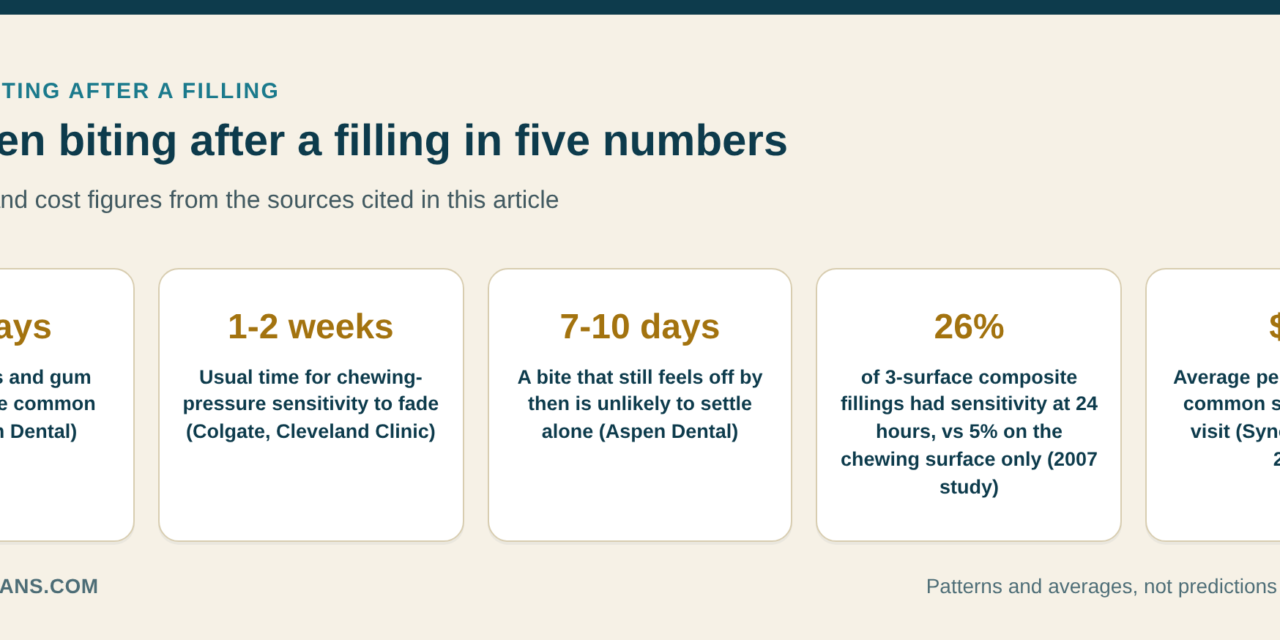
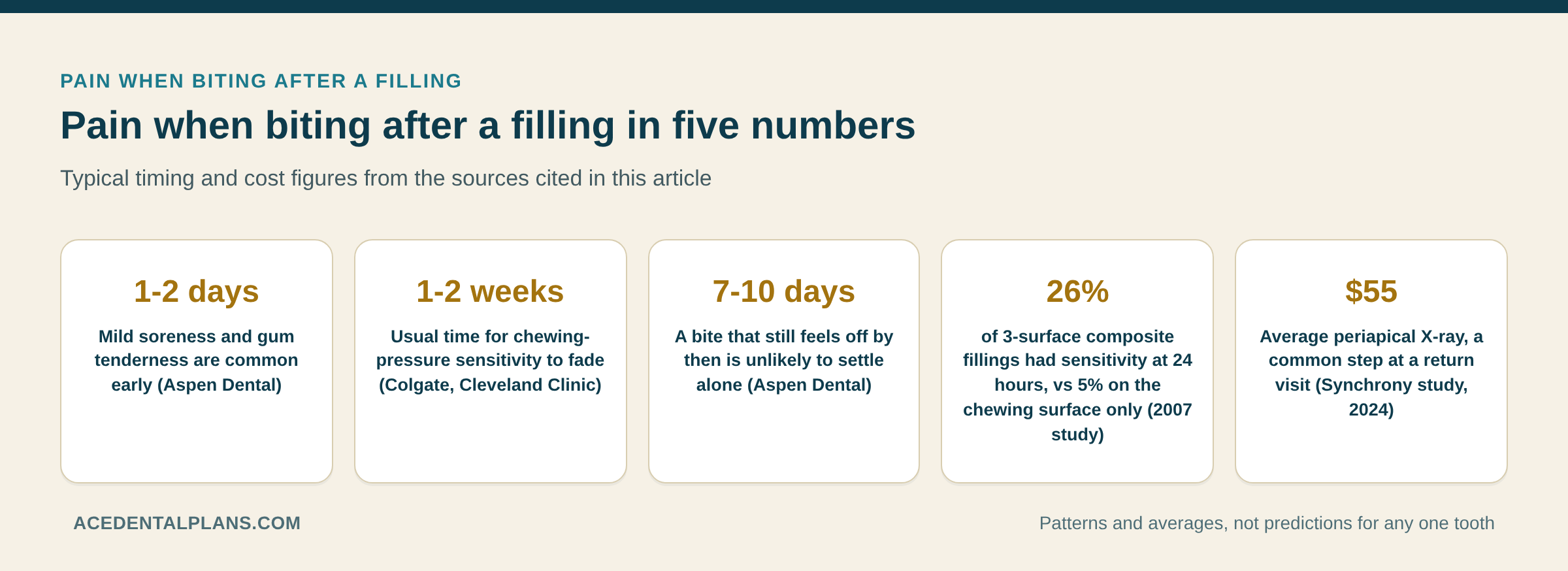
- Some soreness is expected early. Dental guidance from Aspen Dental describes mild soreness, gum tenderness and temperature sensitivity as common on days 1 and 2, improving over days 3 to 7, with most sensitivity minimal or gone by week 2.
- A high filling is a leading suspect for new biting pain. Kaiser Permanente and WebMD both say a filling that sits too high can disrupt the bite, and that the usual fix is for the dentist to reshape it. Kaiser advises telling the dentist right away.
- A bite that still feels off after 7 to 10 days is unlikely to settle alone. That is the guidance in the Aspen Dental resource, and it is why waiting out a high spot is a poor plan.
- Sharp pain on biting, especially pain that flashes when you let go, can signal a crack. The American Association of Endodontists (AAE) lists erratic chewing pain, possibly with release of biting pressure, as a cracked-tooth symptom.
- Lingering, throbbing or spontaneous pain should not wait. Cleveland Clinic describes pain that lasts more than a few seconds after heat, cold or sweets as a sign of irreversible pulp inflammation, which usually needs more than a bite adjustment.
- Follow-up costs run from small to substantial. A periapical X-ray averages $55 and a composite filling about $226 (2024 Synchrony study, via CareCredit). A porcelain crown averages $1,399 and a molar root canal $1,337. Ask whether a bite adjustment is included in the original filling fee.
Biting Pain After a Filling at a Glance: Six Possible Causes
Start with the whole map. The table below lines up the causes dentists usually consider when a recently filled tooth hurts under pressure, with what each tends to feel like, when it tends to appear and how soon to pick up the phone. It describes patterns that these sources report, not a way to diagnose yourself. Many people have more than one thing going on at once.
| Possible cause | What it tends to feel like | What a dentist may do | How soon to call |
|---|---|---|---|
| High spot (filling sits above the bite) | Soreness or a bruised feeling when the teeth close; the filled tooth seems to hit first; the bite feels “off” | Check the bite with marking paper and reshape the filling | Within a few days; say so right away if the bite feels high |
| Inflamed pulp (nerve irritation) | Ache or sensitivity to cold and sweets that may be worse with chewing; the concern is pain that lingers or throbs | Watch it, treat the cause, or recommend root canal treatment if the inflammation is irreversible | Within 1 to 2 weeks if it is not fading; sooner if it lingers, throbs or wakes you |
| Cracked tooth or broken cusp | Sudden sharp pain on biting, sometimes a flash when you release; it can come and go | Bite test, light test and X-rays; bonding, a crown or onlay, a root canal or extraction depending on depth | Within a few days; same day if the tooth feels loose or breaks |
| Clenching or grinding | Broad soreness, jaw ache, worn or chipped teeth, a restoration that keeps failing | Exam of wear and bite; a mouth guard may be discussed | Mention it at the next visit |
| Leaking edge or new decay | Pain with biting plus sweet sensitivity, a bad taste or a rough edge | Replace or repair the filling; treat the decay | Within a week or two |
| Referred pain (sinuses, jaw muscles) | Dull ache across several upper teeth rather than one | Rule out the tooth, then refer if needed | If it persists, within a couple of weeks |

Why a Filled Tooth Can Hurt Under Bite Pressure
A tooth is not a solid block. Enamel forms the hard outer shell, dentin lies beneath it, and the pulp at the center holds nerves and blood vessels. Around the root sits a thin cushion of tissue, the periodontal ligament, that holds the tooth in its socket and senses pressure. Biting pain after a filling can come from the ligament, from the pulp, or from the tooth structure itself.
The ligament is the quickest to react. Aspen Dental explains that a filling set slightly too high makes the tooth hit first, and the extra pressure can irritate the ligament around the tooth and cause soreness when chewing. Think of a pebble in a shoe: nothing is wrong with the foot, but every step lands on the wrong spot. A quick adjustment, the resource says, usually fixes it.
The pulp reacts differently. Removing decay and placing a filling can irritate it, and the same resource notes that deep cavities raise the risk and that the nerve may stay inflamed after treatment. An inflamed pulp tends to announce itself through temperature, sweets and sometimes pressure, and the pain can outlast the trigger. On the nerve side, Cleveland Clinic separates reversible pulpitis, where sensitivity to cold or sweets goes away quickly, from irreversible pulpitis, where the sensitivity lasts more than a few seconds.
The tooth structure itself matters too. A large filling or root canal, especially without a crown, can weaken a tooth and make a crack more likely, according to Cleveland Clinic. A cusp (one of the raised points on a chewing surface) that has lost support from decay and drilling can flex under load. That flexing is what many people describe as a sharp zing on biting.
Pressure pain versus temperature pain
The two kinds of pain tell a dentist different things. Pain on closing or chewing points first toward the bite, the ligament or a crack. Pain triggered by cold, heat or sweets points first toward the pulp or a gap under the filling. Many real cases mix both, which is why the dentist usually asks what triggers it, how long it lasts and whether it ever happens by itself.
For that reason, a short written note helps before you call. Record which tooth, what sets it off (biting, letting go, cold, sweets), how many seconds it lasts and whether it has improved since the day of the filling. Dentists use those details the way a mechanic uses “it rattles only when I turn left.”
How common is early sensitivity at all?
Common enough that some of it should not alarm you. A 2007 clinical study in Operative Dentistry followed 292 composite (tooth-colored resin) fillings in back teeth and checked patients at 24 hours, 7, 30 and 90 days. Sensitivity at 24 hours was reported in 5% of fillings on the chewing surface only, 15% of two-surface fillings and 26% of three-surface fillings. It decreased in every group by day 7 and later, and the differences among groups were no longer significant.
Two cautions apply. That study measured sensitivity in general rather than biting pain specifically, and it is almost two decades old, so treat the percentages as a sense of scale. It also fits what the dentist-facing explanations say: bigger fillings disturb the tooth more, and the disturbance usually settles.
The High Spot: How a Filling Changes Your Bite
A filling is “high” when its surface stands a little above where the natural bite would put it. The filled tooth then meets the opposing tooth first, and the other teeth close a split second later. Among the common reasons for pain when biting after treatment, Cleveland Clinic names a filling that sits too high, and it says the dentist can fix it by reshaping the filling.
What does it feel like? Usually like a tooth that is sore to close on, or a bite that seems to land on one spot. Kaiser Permanente tells patients that if the bite feels too high, they should let the dentist know right away. Aspen Dental describes the same pattern and adds that jaw soreness from holding the mouth open generally improves within 2 to 3 days, so jaw ache alone is not the signal. Pain that is specific to the filled tooth is.
Why a high spot is easy to miss on the day
Local anesthesia (numbing medicine) dulls the tooth, the gum, the lip and often the cheek for hours. Aspen Dental puts typical numbness at 2 to 4 hours, and Kaiser Permanente says a few hours. Because the area may still be numb, it can be hard to judge whether the bite is right when the dentist asks you to close down on the marking paper. The sensation often arrives only after the anesthetic fades, at home, in the evening. If you want the timing details, how long numbness lasts after a filling is covered on its own page.
How a dentist checks and fixes it
The standard tool is articulating paper, a thin colored strip. Pearl’s dental glossary describes it as paper that marks the contact points between teeth when a patient bites down, commonly used after placing a filling or crown. The marks show heavy or uneven contact, and the dentist reshapes the surface to create a more even and comfortable bite.
The same resource is candid about the limits. Articulating paper gives a visual indication of contact points but does not measure force precisely, and saliva, pressure and technique can change the result. In practice, that means the dentist combines the marks with your description of what feels heavy. An adjustment of this kind is generally a short chairside step rather than a new procedure, although the sources reviewed give no standard time, so treat that as typical rather than promised.
Why waiting it out is a weak plan
Some soreness fades by itself, which is why people hesitate. A true high spot behaves differently. The Aspen Dental resource says a bite that still feels off after about a week is unlikely to correct itself naturally, and it lists an uneven bite after 7 to 10 days as a reason to call. Waiting does not change the contact itself, and in the meantime one tooth keeps taking more load than its neighbors.
Does that mean calling the first evening? Not necessarily. Mild tenderness on day one is ordinary. The practical rule from these sources is to call early, within the first few days, if the bite clearly feels high or the pain is getting worse, and no later than about a week if it simply has not improved.
Nerve Irritation: When the Pulp Is the Source
The pulp is the soft tissue in the center of the tooth, and drilling near it irritates it even when the filling is well made. Aspen Dental says deep cavities raise the risk. A tooth that is not sealed correctly during a procedure can also leak and develop pulpitis (inflammation of the pulp), per the same source.
Dentists divide pulpitis into two broad stages. In reversible pulpitis, Cleveland Clinic says, the inflammation can resolve if the dentist repairs the tooth and seals it with a filling; the typical sign is sensitivity to cold or sweets that goes away quickly, without pain when the tooth is tapped. In irreversible pulpitis the inflammation is more advanced and the tooth cannot recover on its own. Signs include pain when the dentist taps the tooth and sensitivity to heat, cold or sweets that lasts more than a few seconds, with pain that may be throbbing, aching or sharp.
Which stage a tooth is in is a call a dentist makes with tests, not something to settle by reading. If your question is about cold and sweet sensitivity rather than biting, the page on tooth sensitivity after a filling covers how long that is normal. Here the point is narrower: pressure pain plus lingering temperature pain is a combination to report together.
Signs that point toward the pulp
- Pain that lingers after a hot or cold drink is gone. The AAE says lingering pain after hot or cold foods is likely a sign the pulp is damaged, and advises seeing a dentist or endodontist as soon as possible so the tooth can be saved.
- Constant or throbbing pain. WebMD says constant throbbing pain may mean the pulp is unhealthy.
- Pain that starts on its own. The Aspen Dental resource calls discomfort that occurs without eating, drinking or touching the tooth not typical healing.
- A tooth that hurts when tapped, which Cleveland Clinic lists among the signs of irreversible pulpitis.
What the AAE’s two-to-four-week guideline means
The AAE says temporary sensitivity to hot or cold after dental work may come from inflamed pulp and suggests waiting 2 to 4 weeks before concluding something is wrong; if pain persists or worsens, it should be checked. WebMD uses the same 2 to 4 weeks for sensitivity that does not subside. Colgate and Cleveland Clinic give a shorter expectation, with discomfort fading after a day or two and sensitivity to chewing pressure subsiding in a week or two.
Those windows seem to conflict, but they answer different questions. The shorter ones describe when most people feel better. The longer ones describe the point at which waiting stops being reasonable. Bite pain that is obviously worse, lingering or spontaneous does not need to wait for the longer window.
Cracked Tooth, Broken Cusp or Failing Filling
Teeth crack in more ways than most people expect, and the AAE sorts them into five types. Craze lines are tiny cracks in the outer enamel that cause no pain. A fractured cusp is a piece of the chewing surface breaking off, which the AAE says often happens around a filling. A cracked tooth has a crack running from the chewing surface vertically toward the root. A split tooth has distinct segments that can be separated, and a vertical root fracture starts in the root and extends upward.
The signature symptom is pain on biting that does not behave like a simple cavity. The StatPearls entry on cracked tooth syndrome (revised May 2024) calls sudden sharp pain on biting the most frequently reported symptom and notes that some patients feel a fleeting sharp pain when bite pressure is released. The AAE describes erratic pain when chewing, possibly with release of biting pressure, that may come and go and can make the tooth hard for a dentist to locate. Cold sensitivity is common, and a crack near the pulp can mimic irreversible pulpitis.
Who is more likely to have one
StatPearls says the condition predominantly affects adults aged 30 to 50 and that mandibular (lower) molars are the most commonly affected teeth, followed by upper premolars and molars. Causes named by Cleveland Clinic include aging, biting hard items such as ice or popcorn kernels, grinding and trauma, plus dental treatments: a large filling or root canal, especially without a crown, can weaken a tooth.
Be careful about reading cause and effect. A crack can predate the filling, or the filling can sit in a tooth that had already lost much of its structure. These sources do not claim that placing a filling cracks a tooth, and no sentence here should be read that way. The practical point is smaller: a big filling in a heavily used molar is the setting where a crack is most worth ruling out when biting pain does not settle.
How cracks are found and what happens next
Diagnosis is a matter of pattern recognition plus tests. StatPearls describes a bite test, in which force is directed through each cusp of the suspected tooth in turn while the patient reports which one triggers pain, and transillumination, which passes light through the tooth so a crack shows as a transition from light to dark. Add a visual exam, staining dye, X-rays and a periodontal probe to check for bone loss, in Cleveland Clinic’s account. X-rays are one tool among several; StatPearls names cone beam CT for cases where standard radiographs are inconclusive.
Treatment follows the crack. Per the AAE, a fractured cusp can often be handled with a new filling or a crown. A cracked tooth may need a root canal and a crown to keep the crack from spreading, and if the crack extends below the gum line the tooth generally cannot be saved. The AAE also says a crown gives maximum protection but does not guarantee success in every case.
Clenching, Leaks and Other Causes a Dentist Rules In or Out
Three further explanations come up often enough to deserve a mention. None is unusual, and each changes what the fix looks like.
Clenching or grinding. The National Institute of Dental and Craniofacial Research (NIDCR) lists flattened, chipped, cracked or loose teeth, worn enamel and tooth pain or sensitivity among the signs of bruxism, and says an exam looks for restorations damaged by it. WebMD notes that chewing, grinding or clenching can make fillings wear, chip or crack. The NIDCR says a mouth guard can separate the teeth and prevent damage. A new filling in a clencher takes the same force as before, so a tooth that was fine in a loose bite can start to ache.
A leaking edge. If the seal between enamel and filling breaks down, WebMD says, bacteria and food can get underneath and raise the risk of new decay, which left alone can reach the pulp and cause an abscess. Colgate adds that composite resin can shrink slightly as it hardens, creating a gap beneath it; a dentist can address that by changing the material or placement method.
Pain that is not from the tooth. The AAE says bruxism or a sinus headache can cause a dull ache in the upper teeth and jaw. If several upper teeth ache together, or the filled tooth passes every test, the dentist may look elsewhere. Whatever the cause, the AAE adds that ongoing pain is a reason to see a dentist or endodontist.
One rare item is worth knowing so it does not cause alarm. Colgate describes galvanic shock, a brief jolt that occurs when fillings of different metals touch, and calls it rare. It is brief, not a lingering ache, and it is not a typical cause of pain on biting down a few days later.
A Week-by-Week Timeline: What Is Typical and When to Act
Published guidance on how long post-filling discomfort lasts is consistent in shape and slightly different in the details. The table below combines what dental health systems and consumer resources report, and marks the point on each row where waiting should give way to a phone call. Your dentist’s own instructions come first. Fillings that are deep, large or in a clencher’s mouth can run longer than these windows.
| Time after the filling | What is commonly reported | What helps or what to do | Call if |
|---|---|---|---|
| Hours 0 to 4 | Numbness; most local anesthetics wear off within 2 to 4 hours (Aspen Dental), “a few hours” (Kaiser Permanente) | Be careful not to chew on the numb lip or cheek (Kaiser Permanente); if you eat sooner, chew slowly (Cleveland Clinic) | The bite feels too high once feeling returns (Kaiser: tell the dentist right away) |
| Days 1 to 2 | Mild soreness, gum tenderness and temperature sensitivity are common (Aspen Dental); Colgate says discomfort should fade after a day or two | Softer foods on the other side; over-the-counter pain relievers such as acetaminophen or ibuprofen (Cleveland Clinic) | Pain is sharp, is worsening, or the bite clearly feels uneven |
| Days 3 to 7 | Symptoms gradually improve, though the bite may still feel different (Aspen Dental); jaw soreness usually improves within 2 to 3 days | Return to normal foods as the tooth allows; keep brushing and flossing gently | Pain persists at 1 week, especially on biting (Colgate) |
| Days 7 to 14 | Most sensitivity minimal or gone by week 2 (Aspen Dental); “a week or two” for chewing-pressure sensitivity (Colgate, Cleveland Clinic) | Notice what remains: biting only, cold only, or both | The bite still feels off at 7 to 10 days; home care has not helped by 7 to 10 days (Aspen Dental) |
| Weeks 2 to 4 | Little should be left; the AAE and WebMD set 2 to 4 weeks as the outer window for temperature sensitivity after dental work | Book the exam rather than waiting for the window to close | Any lingering or worsening discomfort after 2 weeks (Aspen Dental); cold sensitivity beyond 2 to 3 weeks |
| Beyond 4 weeks | Not described as a normal healing pattern in these sources | Exam, bite check and X-ray | Any pain on biting or lingering sensitivity (AAE: ongoing pain warrants a dentist or endodontist) |

Notice the two clocks running inside that table. One is a healing clock, which says soreness should shrink steadily. The other is a mechanical clock: a high spot or a crack does not follow the healing curve, so pain that stalls or gets worse is information, however early in the timeline it appears. A day-4 tooth that hurts more than it did on day 2 deserves a call even though the table says day 4 should be easier.
What a flat or rising curve looks like
Many people can describe their pain on a 0 to 10 scale at the same time each evening. Over a week, a healing tooth trends down, even if unevenly. A tooth that stays the same, spikes with specific bites, or begins to hurt without any trigger is not following the usual curve. You do not need a chart; three jotted numbers are enough to give the dentist a useful picture.
Food and Activity Guidance While the Tooth Settles
The sources agree on a short list. Unless you had sedation, you can return to routine activities right away, says Cleveland Clinic, and eating is safe immediately, though waiting for numbness to wear off helps you avoid biting your cheek. If you eat sooner, it advises chewing slowly. For the specifics of timing and food types, when you can eat after a filling has its own breakdown. What follows concerns a tooth that already hurts on biting.
- Shift the load. Chewing on the opposite side for a few days takes pressure off the sore tooth. This is a practical measure rather than a sourced protocol, so mention it to your dentist if the pain lasts.
- Choose softer foods. Eggs, yogurt, pasta, soup (not scalding), mashed vegetables and well-cooked fish ask little of the tooth.
- Skip the hard and the crunchy. Ice, candy and popcorn kernels are items that can crack teeth, per Cleveland Clinic. A tooth that is already sore, or may be cracked, is a poor place to test that.
- Mind temperature extremes. If cold or heat also bothers the tooth, lukewarm food and drinks reduce the zings.
- Keep cleaning the area. Gentle brushing and flossing still matter. Pain is a reason to be gentle around the tooth, not to skip it.
- Use pain relievers by the label. Over-the-counter acetaminophen or ibuprofen can help with soreness or sensitivity, according to Cleveland Clinic. Follow the package directions and check with a doctor or pharmacist if you have other conditions or take other medicines.
- Leave aspirin off the gum. The American Dental Association’s MouthHealthy site says not to put aspirin on the aching tooth or gum tissues.
Two things the sources do not support: waiting for a sharp biting pain to “work itself out,” and treating a suspected crack as a reason to test the tooth with hard foods. If a chip, crack or broken filling is suspected, MouthHealthy advises rinsing with warm water and using cold compresses on the face to limit swelling, then seeing a dentist or emergency room as soon as possible.
Warning Signs: Three Levels of Urgency
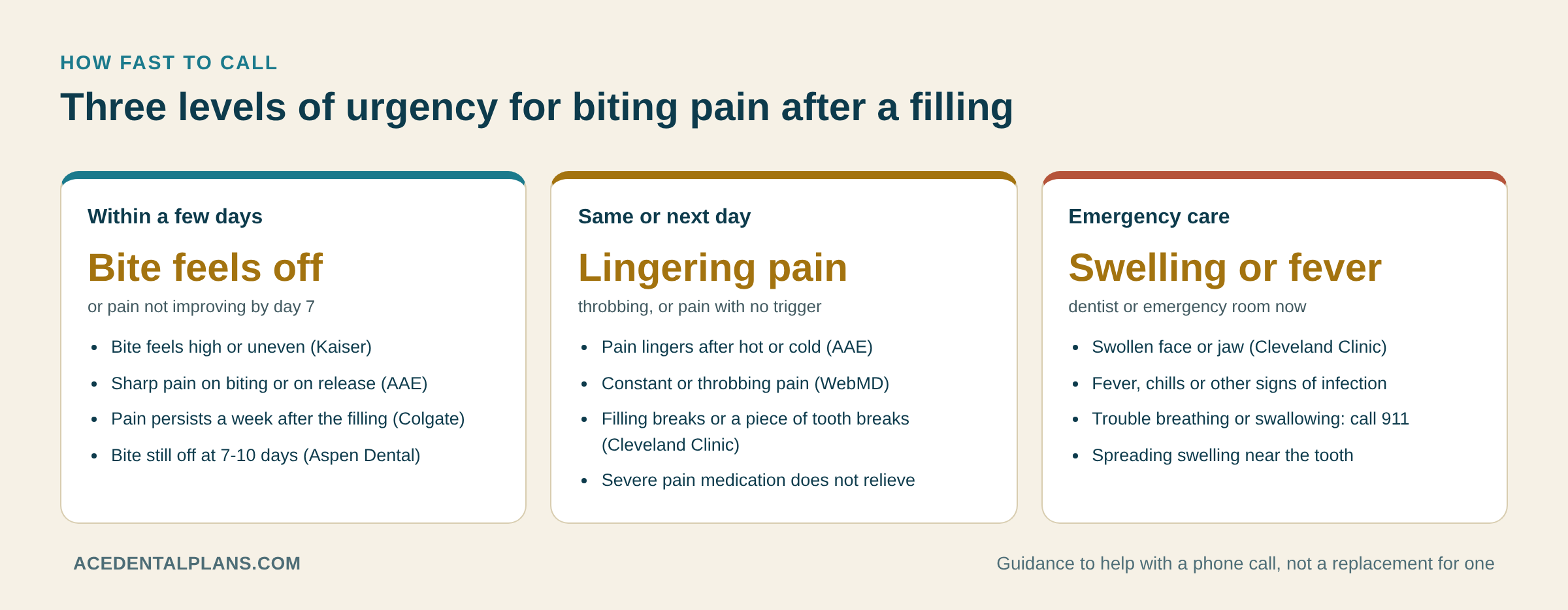
Red-flag guidance is most useful when it is sorted by speed. The lists below draw on Cleveland Clinic, the AAE, the Aspen Dental resource, WebMD and MouthHealthy. They are meant to help with a phone call, not to replace one.
Seek prompt dental or medical care if
- Swelling in the face or jaw appears, especially with fever, chills or other signs of infection (Cleveland Clinic advises calling right away).
- Swelling is spreading, or you have trouble breathing or swallowing: go to an emergency room or call 911.
- Pain is constant and severe and does not respond to over-the-counter medication.
- The gum beside the tooth swells, or you notice a bad taste or odor near the filling (Aspen Dental lists both as reasons to be seen).
- The filling breaks, or a piece of the tooth breaks off.
Within a few days
Call if the bite feels high or uneven, if a sharp pain hits when you close or when you let go, or if soreness has not improved after about a week. Colgate says pain that persists a week after the filling, especially when you bite down, eat or open your mouth, warrants an appointment as soon as possible. These are routine-urgent problems: a short visit now can prevent a longer one later.
The same day or next business day
Call promptly for throbbing pain, pain that lingers after hot or cold, and pain that starts without any trigger. The AAE says to see a dentist or endodontist as soon as possible when pain lingers after hot or cold foods, because early root canal treatment may save the tooth. The same page advises calling right away if the filling breaks or if severe pain does not respond to medication.
Emergency care
A swollen face or jaw, fever or chills, or any trouble breathing or swallowing makes this an urgent medical matter rather than a scheduling question. MouthHealthy says that in a dental emergency you should visit your dentist or an emergency room as soon as possible and call the dentist with as much detail as you can. If you cannot reach a dentist and the symptoms are severe, go to an emergency room.
What Happens at the Return Visit
A typical evaluation starts with questions. MedlinePlus says a dentist asks about symptoms, examines and probes the teeth, and may take X-rays. For a filled tooth that hurts on biting, expect the questions to be specific: which tooth, what triggers it, how long it lasts, whether it ever happens on its own, and whether the bite has felt different since the appointment.
Then come the checks. Depending on what you describe, the dentist may use some of the following; not every visit includes all of them.
- A bite check with marking paper to look for a high spot, as described earlier.
- Tapping or percussion. Pain when the dentist taps a tooth is among the signs of irreversible pulpitis in Cleveland Clinic’s description, so tapping is a useful sorting step.
- Temperature or vitality testing to see how the pulp responds. StatPearls lists vitality testing among its tools for suspected cracks.
- A bite test on each cusp and a light test (transillumination) when a crack is possible.
- A periapical X-ray, which shows the whole tooth and the tissue around its root, to look for decay under the filling and changes at the root tip.
- A review of the filling itself for rough edges, gaps, wear or a loose margin.
The visit often ends with one of three outcomes: an adjustment done on the spot, a short watch-and-recheck plan, or a treatment recommendation that comes with an estimate. If the plan involves more work, you can ask for it in writing, with the procedure descriptions, so you can check your benefits before agreeing.
Treatment by Cause: What a Dentist May Recommend
The right treatment depends on the cause, and the same symptom can have different fixes. The options below are what these sources describe; none of them is a recommendation for any individual tooth.
Reshaping the filling
For a high spot, WebMD says the filling is reshaped. Kaiser Permanente says the problem can usually be treated. Pearl’s description of articulating paper adds that adjustments may touch the filling, a crown or the natural tooth surface, with the aim of a balanced bite. This is the lightest-touch option and the one most people hope for.
Replacing or repairing the filling
A leaking edge, a gap or a cracked filling may call for replacement. Colgate notes that when composite shrinkage creates a gap, the dentist can change the material or the placement method. Replacement may also be what a dentist suggests if the original filling was close to the pulp and the tooth stays irritated, though that choice rests on exam findings, not on a rule.
Covering the tooth: bonding, onlay or crown
For cracks and weakened cusps, StatPearls describes several approaches: a direct composite that acts as an internal splint against flexing, a full-coverage crown that distributes bite forces across the tooth, and, when the pulp is involved, endodontic therapy with cuspal coverage. It notes that a crown is invasive and raises the risk of devitalization (the pulp losing its vitality), and that the long-term prognosis of endodontic therapy for a cracked tooth is described as poor. The AAE describes a fractured cusp as often treatable with a new filling or crown.
Root canal treatment
When the pulp is inflamed beyond recovery or infected, the AAE and Cleveland Clinic describe root canal treatment, usually with a crown afterward. Colgate says a dentist may refer you to an endodontist (a specialist in the pulp and the tissues around the root), who may find the cavity was deeper than suspected. If it comes to that, recovery has its own timeline, covered in how long root canal pain lasts after treatment.
Extraction
The AAE says that when a crack extends below the gum line, the tooth generally cannot be saved and extraction is needed. Extraction followed by a bridge or implant is listed for severe root or nerve damage in Cleveland Clinic’s guidance. It is the least common outcome of a biting-pain call and the one that makes early evaluation worthwhile.
Protecting the tooth from clenching
If grinding or clenching is part of the picture, the NIDCR says a mouth guard can separate the teeth and prevent damage, and may reduce muscle activity from grinding and clenching. Ask whether a guard makes sense, and check whether your plan lists it as a benefit; one 2026 Humana plan document reviewed for this article does not list night guards.
What Follow-Up Care Can Cost: Published U.S. Prices by Step
The cost of a biting-pain visit runs from nearly nothing to several thousand dollars, depending on what the exam finds. A reshaped filling sits at the low end. A cracked molar that needs a root canal and a crown sits at the high end. The table below collects the national figures that could be sourced, with the study year, so you can see which steps usually appear on an estimate and what each one averages.
| Step | When it may come up | National average | Range, where published |
|---|---|---|---|
| Routine exam | Evaluation visit, if billed as an exam | $203 (2023 Synchrony study) | $50 to $350 |
| Periapical X-ray | Look at the whole tooth and root tip | $55 (2024 Synchrony study) | $42 to $102 |
| Bite adjustment (reshaping the filling) | High spot | No reliable national price found in the sources reviewed | Ask whether it is included in the filling fee |
| Composite (tooth-colored) filling | Replace a leaking or cracked filling | $226 (2024 Synchrony study) | $145 to $480 front, $165 to $530 back (Delta Dental, 2024 data) |
| Porcelain inlay or onlay | Cover a weakened cusp | $976 (2024 Synchrony study) | Not published |
| Crown | Crack, or after a root canal | $1,114 porcelain-and-metal; $1,211 metallic; $1,399 porcelain (2024) | Not published |
| Root canal | Irreversible pulp inflammation or infection | $984 premolar or front tooth; $1,337 molar (2024) | Not published |
The exam figure comes from the 2023 edition of the Synchrony Average Procedural Cost Study and the procedure figures from the 2024 edition, as reported by CareCredit and dated January 2025 or later. Delta Dental’s ranges come from its 2024 internal claims data for out-of-network dentists, based on non-discounted charges. Both cover the 50 states and Washington, D.C., and both warn that actual cost varies by geography and provider. None of these figures is a quote.

Three ways the bill can stack up
Adding averages gives a sense of scale. Keep in mind that no real bill is an average. The sums below are hypothetical and use only the table’s figures.
- Bite adjustment only. An exam at $203 plus a periapical X-ray at $55 comes to $258 if both are billed separately, plus whatever the office charges for the adjustment, which may be nothing.
- Replacing a filling. The same $258 plus a $226 composite filling is $484.
- A cracked molar treated with a root canal and crown. The $258 evaluation, $1,337 for the root canal and $1,399 for a porcelain crown add up to $2,994.
Costs at that last level are covered in more detail on the site’s pages about root canal and crown pricing, so this article stops at the sum. What matters here is the spread: roughly $258 to about $3,000 in national averages, with the cause deciding where you land. That is one more reason to call early. A high spot caught in the first week usually sits at the cheap end.
What to ask about the first adjustment
Some offices may fold a post-filling bite adjustment into the filling fee, but the sources reviewed give no standard, so ask directly. Useful questions: Is a follow-up adjustment included in the original fee? Is the exam charged separately if I come in only for a bite check? Does the office offer any workmanship warranty on fillings? Having the answers before you sit down avoids a surprise at the front desk.
How Dental Insurance Treats a Return Visit
Run the numbers in a fixed order: plan type, then deductible and network, then coinsurance or copay, then the annual maximum, then exclusions, waiting periods and frequency limits, and finally the actual estimate. Walking through that order with a real plan shows how a small problem and a large one end up treated very differently.
Start with the category. Delta Dental says dental plans typically cover between 50% and 80% of the cost of basic procedures, including fillings, depending on the plan and the type of filling. Basic care is usually what a replacement filling falls under. Crowns, onlays and root canals commonly fall into a higher “major” tier with a lower percentage, though the label depends on the plan.
Humana’s Complete Dental page gives one concrete example of how these tiers are built. It lists preventive care at 100%, basic care such as fillings at 80% after the deductible with a 6-month waiting period, and major care such as crowns and root canals at 50% after the deductible with a 12-month waiting period. It lists a $50 individual deductible, an annual maximum of $1,250 in the first year rising to $1,500 later, and frequency rules: fillings once per tooth per 2 years, root canals once per tooth per lifetime, and crowns and onlays once per tooth per 5 years. That is one carrier’s design as published on its page. Your plan may differ on every number.
The rules that decide a biting-pain claim
- Waiting periods. A new plan may pay nothing toward a crown or root canal in its first months, even for a real emergency.
- Frequency and replacement limits. A limit such as “one filling per tooth per 2 years” can matter if the problem is a failing filling rather than a new one. Ask the insurer and the office how a re-do on the same tooth is classified.
- Adjustment benefits. A 2026 Humana Medicare Advantage supplemental plan document lists limited occlusal adjustment (a bite adjustment) at 50%, once every 3 calendar years, and lists exclusions related to occlusion. Plans differ, and a post-filling adjustment may be bundled into the filling fee, so ask which applies.
- Annual maximum. This is the most the plan pays in a benefit period. It is not a cap on what you can owe. Spending on earlier work this year may leave little for a crown, and the balance lands on you out of pocket.
- Network and allowed amount. Coinsurance applies to the plan’s allowed amount, not to the dentist’s list price. An out-of-network office may bill the difference.
For readers without insurance, a cash estimate with itemized steps is the equivalent. Ask for the exam, X-ray and any procedure listed separately, and compare offices on the same line items. Paying for dental work has its own pages on the site; here the practical advice is to call the same office first, because the office that placed the filling already has the records.
Special Situations: Old Fillings, Braces and Teeth That Clench
A filling placed months or years ago. New biting pain with an old filling is a different problem from pain after a fresh one. Fillings can last 10 to 20 years depending on material, Cleveland Clinic says, and Aspen Dental adds that fillings can crack, loosen or wear down over time. A loose margin, a leak or a crack in the surrounding tooth are the leading candidates, and a dentist will want X-rays.
Braces or aligners at the same time. Teeth under orthodontic force can be tender to bite on for reasons unrelated to a filling. If both are true, tell both offices. Soreness from braces has its own timeline, covered in braces pain and how long it lasts, and a tooth that is sore only after a filling visit deserves its own check. A braces wire that irritates the cheek is a separate problem with its own page on the site.
A known clencher or grinder. People who clench put heavy, repeated load on restorations. NIDCR lists chipped, cracked or loose teeth and damaged restorations among the findings in bruxism. If you wake with jaw soreness, say so before the dentist adjusts the bite, because the right bite contact for a clencher can differ from the contact for someone who does not clench.
Three Hypothetical Cases: Same Symptom, Different Paths
Real cases are messier than these, but the contrast helps. Each is illustrative, built from the patterns in the sources, and none is a diagnosis.
Case 1: Day 2, sore only when the molars close. A woman had a two-surface filling in a lower molar on Monday. By Wednesday the tooth is sore when she bites, the bite seems to land on one spot, and cold drinks do not bother it. This pattern fits a high spot. She calls, the dentist checks with marking paper and reshapes the filling, and the pain is gone a few days later. The cost may be nothing beyond the original fee, or a short visit charge, depending on the office.
Case 2: Week 3, lingering cold pain and tenderness. A man had a deep filling. Three weeks later, cold drinks still produce a pain that lasts well after the glass is down, and biting is uncomfortable. The dentist’s tests include tapping and a cold test, and the X-ray raises the question of pulp inflammation. If it is reversible, a watch-and-recheck plan or a new filling may help. If it is irreversible, a root canal and crown may be discussed, and the national averages in Table 3 become relevant.
Case 3: Month 5, flashes of pain on release. A man in his forties with a large filling in an upper molar notices a sharp flash when he lets go of a bite, only with some foods. It comes and goes, which makes it hard to reproduce. The dentist uses a bite test and a light test, finds a crack in a cusp and recommends coverage with an onlay or crown. Average figures from Table 3 range from $976 for an onlay to $1,399 for a porcelain crown, before insurance.
Questions to Ask the Dentist and How to Read the Plan
A few well-aimed questions turn a vague visit into an explicit plan. Take them with you, or ask them over the phone before the appointment.
- Is this more likely a bite problem, a nerve problem or a crack, and which tests will tell?
- If the filling needs adjusting, will you check the bite with marking paper while I am awake and able to feel it?
- If we wait and watch, what exactly should I look for, and by what date should I call?
- Would the treatment you suggest involve the same tooth being drilled again, and what does that do to its long-term outlook?
- Is any of this included in the original fee, and what is billed separately?
- Can I have a written estimate listing each procedure so I can ask my insurer for a pre-treatment estimate?
When the estimate arrives, read the fine print line by line. Check that the procedures match what you were told, that the fee for each is stated, and that insurance and the patient portion are separate columns. Remember that an insurer’s estimate reflects the plan on the day it was processed, not a promise of payment.
Bottom Line
Pain on biting after a filling is common in the first few days and usually eases within a week or two. A bite that feels high is the leading, most fixable explanation, so say so early rather than hoping it will wear away. Sharp flashes, lingering cold pain, throbbing or pain with no trigger point toward a crack or a nerve that needs an exam. Swelling, fever or trouble swallowing call for urgent care. On cost, the range runs from a quick adjustment to a few thousand dollars when a root canal and crown are involved, which is the strongest argument for calling sooner rather than later.
Frequently Asked Questions
Is it normal for a tooth to hurt when I bite down after a filling?
Mild soreness on biting is common for the first day or two. Aspen Dental lists mild soreness, gum tenderness and temperature sensitivity as typical early on, and Cleveland Clinic says some bite discomfort can happen if the filling is slightly high. Pain that is sharp, worsening or uneven-feeling is a reason to call rather than wait.
How long should it hurt to chew after a filling?
Most published guidance puts the fading of chewing-pressure sensitivity at about a week or two. Colgate says discomfort should fade after a day or two and sensitivity to chewing pressure should subside in a week or two. WebMD and the AAE use 2 to 4 weeks as the outer limit, and a dentist’s own instructions take priority.
Why does my bite feel uneven after a filling?
The most common explanation is that the filling sits slightly above the natural bite, so the filled tooth touches first. Kaiser Permanente says to tell your dentist right away if the bite feels too high. Swelling of the gum or lingering numbness can also change how the bite feels for a few hours.
Will a high filling wear down on its own?
Do not count on it. The Aspen Dental resource says a bite that feels off after a week is unlikely to correct itself naturally and lists an uneven bite after 7 to 10 days as a reason to call. A short reshaping visit is the usual remedy.
Will the dentist charge me to adjust a filling?
The sources reviewed give no national price or standard policy for a post-filling bite adjustment. Some offices may include it in the filling fee, while others may bill a short visit. Ask when you call, and ask whether the exam is charged separately.
Can getting a filling crack a tooth?
The sources reviewed do not say that placing a filling cracks a tooth. Cleveland Clinic does say a large filling or root canal, especially without a crown, can weaken a tooth, and the AAE notes that a fractured cusp often occurs around a filling. If sharp biting pain starts or continues, a bite test and light test can help find a crack.
Does pain on biting mean I need a root canal?
Not by itself. A bite adjustment fixes many cases, according to Aspen Dental and WebMD. A root canal is generally considered when the pulp is inflamed beyond recovery or infected, which tends to show up as lingering pain after hot or cold, throbbing, or pain that starts without a trigger.
Why does my tooth hurt when I let go of a bite instead of when I press?
Pain that flashes on release is a classic cracked-tooth pattern. StatPearls says some patients feel a fleeting sharp pain on release of bite pressure, and the AAE lists release of biting pressure among the symptoms. It is not proof of a crack, so it is worth reporting to the dentist.
Can I take ibuprofen or acetaminophen for it?
Over-the-counter acetaminophen or ibuprofen can help with soreness or sensitivity after a filling, says Cleveland Clinic. Follow the package label and ask a doctor or pharmacist if you have other health conditions or take other medicines. Pain that medication does not relieve is a reason to call.
Should I chew on the other side?
Many people find it more comfortable for a few days. That is a practical choice rather than a sourced protocol, so mention it to your dentist if the pain lasts more than a week. Avoid ice, hard candy and popcorn kernels, which Cleveland Clinic lists as common causes of cracked teeth.
Is it normal for an old filling to start hurting on biting?
It can happen, but it is a different situation from fresh-filling soreness. Fillings can crack, loosen or wear down over time, according to Aspen Dental, and a leaking edge can allow new decay, according to WebMD. A dentist usually needs an exam and an X-ray to sort out which applies.
When is pain after a filling an emergency?
Seek prompt dental or medical care for facial or jaw swelling, fever or chills, or trouble breathing or swallowing. Call right away if the filling breaks or severe pain does not respond to medication, Cleveland Clinic advises. MouthHealthy says to visit a dentist or emergency room as soon as possible in a dental emergency.
Does dental insurance pay for a visit to fix biting pain after a filling?
It depends on the plan and on what the visit involves. A bite adjustment may be bundled with the filling or billed separately, and a replacement filling, crown or root canal falls under different categories, waiting periods and frequency limits. Ask the office for a written estimate and ask the insurer for a pre-treatment estimate, which is not a guarantee of payment.
Sources and Disclaimers
Clinical statements in this article come from the American Association of Endodontists, the American Dental Association’s MouthHealthy site, the National Institute of Dental and Craniofacial Research, NIH’s StatPearls and MedlinePlus, Cleveland Clinic, Kaiser Permanente, WebMD, Colgate and Aspen Dental. The first three are professional or government sources; the others are health-system or consumer resources and are described that way in the text. The only peer-reviewed study cited is a 2007 clinical trial of postoperative sensitivity. Price figures come from CareCredit’s reporting of the Synchrony Average Procedural Cost Study (2023 and 2024 editions) and from Delta Dental’s 2024 internal claims data. Insurance examples are hypothetical and use plan details published by Humana. National averages blend many practices and regions, so confirm pricing with the dentist and benefits with your insurer.
- American Association of Endodontists — Cracked Teeth
- American Association of Endodontists — Tooth Pain
- American Dental Association (MouthHealthy) — Dental Emergencies
- American Dental Association (MouthHealthy) — Dental Filling Options
- National Institute of Dental and Craniofacial Research — Bruxism
- National Institute of Dental and Craniofacial Research — Tooth Decay
- MedlinePlus (National Library of Medicine) — Tooth Disorders
- NCBI Bookshelf, StatPearls — Cracked Tooth Syndrome
- Briso ALF et al., Operative Dentistry 2007;32(5):421-426 — Clinical assessment of postoperative sensitivity in posterior composite restorations
- Cleveland Clinic — Pulpitis: Types, Symptoms and Treatment
- Cleveland Clinic — Cracked Tooth (Fractured Tooth)
- Cleveland Clinic — Dental Fillings: Types, Materials and What They’re For
- Kaiser Permanente — Dental Fillings (Restorations)
- WebMD — Problems with Dental Fillings
- Colgate — Tooth Pain After a Filling: Is It Normal?
- Aspen Dental — Why Does My Tooth Still Hurt After a Filling?
- Pearl — Dental Articulating Paper (glossary)
- Delta Dental — Tooth Fillings Cost and Insurance
- CareCredit — Dental Procedure Cost List
- CareCredit — How Much Do Dental X-Rays Cost?
- Humana — Complete PPO Dental Insurance Plans
- Humana — HumanaDental Medicare Network (PPO) plan document, DEN972, 2026
Important Information and Disclaimers
This article is general educational information. By using it, you accept the limits described below.
Not dental or medical advice
Nothing on this page is a diagnosis, a treatment recommendation or a substitute for an examination by a licensed dentist or physician. Reading this article does not create a dentist-patient or doctor-patient relationship. Only a licensed professional who has examined you and reviewed your history can tell you what your mouth needs. Do not delay, skip or stop professional care because of something you read here.
Prices are estimates, not quotes
Cost figures are ranges reported by the third-party sources cited in this article. Actual prices depend on your location, the provider, the complexity of your case, the materials used, the date of service and other factors, so what you pay may be higher or lower. A written treatment plan and fee estimate from the dental office is the only reliable number for your situation.
Insurance and plan examples are illustrations
Examples that use named amounts or percentages are hypothetical. Real benefits depend on your plan, network, waiting periods, annual maximum, deductible and the insurer’s rules at the time of treatment. A pre-treatment estimate or benefits check is not a promise of payment. Confirm the details with your insurer or plan administrator in writing.
Not insurance, legal, tax or financial advice
AceDentalPlans is an information publisher. Nothing here is insurance, legal, tax, investment or other professional financial advice, and nothing here recommends a particular provider, insurer, lender, discount plan or financing product. Company and product names belong to their owners and appear for identification only. Read the terms of any loan, financing offer or plan before you sign, and ask a qualified professional if you need advice on your own circumstances.
Third-party sources
This article cites government agencies, professional associations, insurers, lenders and other outside organizations. We do not control those sources. Their content can change, move or disappear, and listing a source is not an endorsement of it or of anything it sells.
No warranty
We aim for accuracy, but this article is provided “as is,” without warranties of any kind, express or implied, including warranties of accuracy, completeness, timeliness or fitness for a particular purpose. Some information may be out of date or contain errors by the time you read it.
Limitation of responsibility
To the fullest extent permitted by law, AceDentalPlans and its owners, authors and contributors are not responsible or liable for any loss, cost, injury, health outcome or other damage that results from using this article or relying on it. You are responsible for your own decisions about your care, your coverage and your money.
How this article is written
This article follows AceDentalPlans’ answer-first, U.S.-focused editorial approach. It uses conditional language for insurance, because coverage depends on the specific plan, and it names its sources so that you can read them yourself.