
Dental Cleaning Cost. A routine dental cleaning with an exam and X-rays costs about $203 on average without insurance, and offices charge anywhere from roughly $50 to $350, according to a 2023–2024 industry cost study. A cleaning on its own is usually quoted lower, at $75 to $200. On many dental plans, an in-network routine visit costs the patient little or nothing, within frequency limits.
This guide splits the visit into its billing lines (exam, cleaning, X-rays, fluoride), compares adult and child fees, and shows how plans typically treat each line. It also explains which “cleanings” are not routine ones. It does not price deep cleanings or gum-disease treatment, which follow different rules and fees.
Key Takeaways
- The $203 national average (CareCredit, 2023–2024) bundles an exam, a cleaning and X-rays; stacking separately quoted line items from other surveys can land well above it.
- X-rays are the biggest swing item: bitewings average $65 a set, a panoramic image $200 and a full-mouth series $226.
- Child cleanings carry their own code and a lower fee. In four published fee schedules, the child price ran 67% to 78% of the adult price.
- One carrier’s sample PPO summary pays exams and cleanings at 100% with no deductible, but caps them at two a year and X-rays at set intervals.
- A cleaning coded for inflamed gums (D4346) or for gum-disease maintenance (D4910) is billed differently from a routine one, and plans may not treat it as preventive.
- Original Medicare does not cover routine cleanings, and adult Medicaid dental benefits depend on the state.
 The main cash-price reference points for a routine cleaning visit, with the source and year on each card.
What a Routine Cleaning Visit Costs, Line by Line
A “cleaning appointment” is really three services sharing one chair. The dentist examines the mouth, a hygienist (or sometimes the dentist) does the cleaning, and X-rays are taken if they are due. Some offices quote one package price, but insurers and itemized estimates split the visit into separate codes, and each code has its own price and its own coverage rule.
Table 1 lays the lines side by side. The private-office column draws on consumer cost surveys: the 2023–2024 CareCredit study and a 2026 healthinsurance.org guide. The next two columns show the low end of the market, using three educational dental clinics and one state Medicaid fee schedule. Those are not prices most patients can get everywhere, but they show how far the floor sits below the average.
| Service (CDT code) | Private-office reference | Educational clinic fees (three clinics) | Montana Medicaid fee (July 2025) |
|---|---|---|---|
| Periodic exam (D0120) | No separate national figure found | $5 to $10 | $27.66 |
| Comprehensive exam (D0150) | $70 to $200 | $10 to $15 | $39.52 |
| Adult cleaning (D1110) | $75 to $200 | $20 to $45 | $59.28 |
| Child cleaning (D1120) | No separate national figure found | $15 to $35 | $39.52 (through age 17) |
| Bitewing X-rays (D0272, D0274) | $65 per set | $5 to $20 | $23.71 (two films), $39.52 (four films) |
| Full-mouth X-ray series (D0210) | $226 average; $175 to $428 range | $30 to $40 | $79.04 |
| Panoramic X-ray (D0330) | $200 | $25 to $40 | $63.23 |
| Fluoride varnish (D1206) | About $30 added to a cleaning | $5 to $7 | $23.71 |
| Sealant, per tooth (D1351) | $42 | $6 to $15 | $31.62 |
Four points about the table. First, the Medicaid column is what one state program pays a dentist for the service, not a price a patient would be quoted. It is here because it is dated, itemized and public. Second, the educational-clinic fees come from fee sheets that show no effective date, so treat them as rough signposts, not current quotes. Third, the North Dakota clinic’s $45 adult and $35 child cleaning fees are described on its sheet as including bitewings and fluoride, so they are not cleaning-only prices. Fourth, the blank private-office cells are blank on purpose: no reliable national cash figure for those exact lines turned up, and guessing would not help you.
Why Adding the Lines Together Overshoots the $203 Average
Here is an oddity worth running the numbers on. Take the low end of the cleaning range ($75), the low end of the comprehensive-exam range ($70) and a set of bitewings ($65). That adds up to $210, already above the $203 national average for the whole visit. At the high end of the two ranges the same three lines reach $465.
Why the gap? Nobody can say for certain from the published material, but three explanations are plausible. The two surveys measure different things and different years. Offices that package a new-patient visit often price the bundle below the sum of its parts. And the $203 average blends returning patients, who may skip X-rays at a given visit, with new patients, who often need them. Whatever the cause, the practical lesson holds: a quote for the whole visit and a quote for each line are not directly comparable until you know what each one includes.
That matters when you call around. “How much is a cleaning?” can get you the hygiene fee alone at one office and the full exam-cleaning-X-ray package at the next. Ask which codes are included, and the comparison becomes apples-to-apples.
Exams: Periodic, Comprehensive and Problem-Focused
The exam is the part of the visit where the dentist, not the hygienist, evaluates your teeth, gums and soft tissues. It carries its own fee. Three exam codes show up on estimates. A periodic evaluation (D0120) is the routine recall exam for an established patient, and Aetna’s 2026 DMO summary lists it that way. A comprehensive evaluation (D0150) is a fuller workup, which offices often use at a first visit. A limited, problem-focused evaluation (D0140) addresses a specific complaint, such as a sore tooth.
The price gap between them is real. In Montana’s July 2025 Medicaid schedule the periodic exam is $27.66 while the comprehensive and the limited evaluations are both $39.52. At Indiana University Northwest’s educational clinic the periodic exam is $10 and the comprehensive exam $15. Private offices set their own fees, and healthinsurance.org put a comprehensive exam at $70 to $200 in 2026, depending on the dentist.
The reason this matters to you: a new-patient visit can include the more expensive exam code and a full set of X-rays in the same appointment. A returning patient who sees the same dentist every six months usually gets the periodic exam and, at most, bitewings. Delta Dental’s consumer pages note that cleaning appointments for new patients typically include an exam and X-rays, and that these services are often offered to returning patients too. If your first visit looks pricey, the exam and imaging lines are the usual reason.
If you only need a cleaning and have been a patient for years, ask the office to confirm which exam code it plans to bill. The question takes ten seconds, and it prevents a surprise at the front desk.
X-Rays: What Each Type Adds to the Bill
X-rays are the single biggest swing in a routine visit. CareCredit’s 2023–2024 averages put a set of bitewings at $65, a single periapical image at $55, a panoramic image at $200 and a full-mouth series at $226. A cone-beam CT scan, a specialized 3-D image, averages $466 in the same study. It answers specific clinical questions, so if it appears on a cleaning estimate, ask what question it is meant to answer.
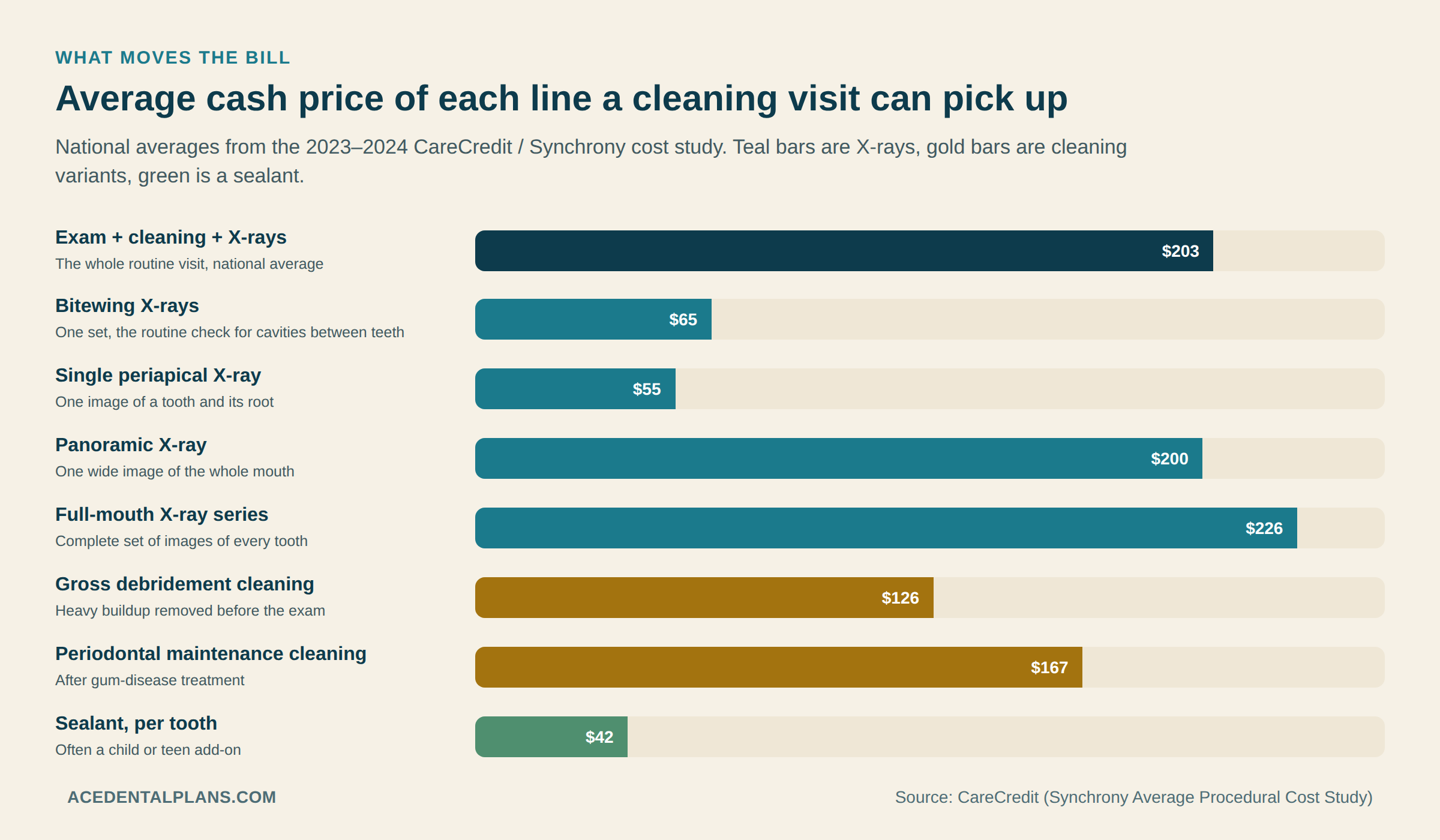 Average cash price of each line a cleaning visit can pick up, from the CareCredit / Synchrony cost study.
How often you need any of these is a clinical call, not a billing default. The ADA states that there is “no ‘one size fits all’” interval between dental X-rays, and that the right frequency depends on a person’s current oral health, age, risk for disease and any signs or symptoms. The dentist, who knows your history, is the person to make that call. The ADA also published updated X-ray selection recommendations in 2026, developed by an expert panel of its Council on Scientific Affairs and endorsed by the American Academy of Oral and Maxillofacial Radiology.
Insurers apply their own intervals on top of that. In the Delta Dental sample summary used later in this guide, bitewings are covered once a year for adults and twice a year through age 18, while a full-mouth or panoramic image is covered once every five years. Those intervals are payment rules, not clinical ones. A dentist can recommend a film sooner than the plan will pay for it, and the difference becomes your bill.
Two habits help. If you had X-rays taken recently somewhere else, ask whether the new office can use them, since that decision belongs to the dentist. And if a plan limits you to one set a year, ask your office to tell you before the images are taken, not after, so you can decide with the price in front of you.
Not Every Cleaning Is a Routine Cleaning
The word “cleaning” covers several procedures with different codes, different prices and, importantly, different insurance treatment. A standard adult cleaning, called a prophylaxis (D1110), is defined in the CDT code descriptions, as summarized by Dentistry IQ, as removal of plaque, calculus and stains from the tooth structures in the permanent and transitional dentition. When the gums are more inflamed, or the buildup is heavy, the code can change. So can the price.
| Code and name | When a dentist uses it | Price reference points | Coverage question to ask |
|---|---|---|---|
| D1110 Adult prophylaxis | Routine removal of plaque, calculus and stains from permanent or transitional teeth | $75 to $200 cash (2026); $59.28 Montana Medicaid | Is it paid at 100%, and how many per year? |
| D1120 Child prophylaxis | Primary or mixed teeth; the age cutoff differs by payer and office | $15 to $35 at three educational clinics; $39.52 Montana Medicaid | What age does the plan stop treating the visit as a child cleaning? |
| D4346 Scaling with generalized moderate or severe inflammation | Full-mouth cleaning after the exam when gums are inflamed but there is no attachment loss | No national cash figure found; $98.80 Montana Medicaid; $35 at IU Northwest | Does the plan class it as preventive, or as a basic service with a deductible and coinsurance? |
| Full-mouth debridement | A preliminary removal of heavy deposits that block a proper evaluation | $126 (CareCredit average, labeled gross debridement) | Is it covered, and does it replace or precede the regular cleaning? |
| D4910 Periodontal maintenance | Ongoing care after gum-disease treatment | $167 (CareCredit average); $79.04 Montana Medicaid; $35 at IU Northwest | Is it paid like a cleaning, or under the plan’s periodontal benefit? |
| D4341 / D4342 Scaling and root planing | Active gum disease with attachment loss or deeper pockets | $242 per quadrant (CareCredit average) | This is deep cleaning, a separate treatment with its own pricing |
Look at the D4346 row. Hygiene-industry guidance describes it as applying when more than about a third of the mouth shows moderate-to-severe inflammation without bone or attachment loss. Montana’s Medicaid fee for it is $98.80, about 67% more than that program’s $59.28 for a standard cleaning. The same coding guidance warns that a code existing does not mean a patient has coverage for it, because plans can take a long time to decide how to treat a newer code. That is why a cleaning you assumed was free can arrive with a balance.
The full-mouth debridement and periodontal maintenance rows are further along the severity scale. Debridement is described as a preliminary, superficial removal of plaque and calculus when heavy deposits prevent a comprehensive evaluation. Periodontal maintenance, by contrast, follows treatment of gum disease and continues as ongoing therapy. If either shows up on your estimate when you booked a routine cleaning, ask the office to explain the clinical finding behind it. This is the dentist’s judgment to make, and you are entitled to hear the reasoning and the cost before agreeing.
The bottom line on this table: a different code is not a sign of anything wrong. But it is the single most common reason a routine visit costs more than the plan summary suggested, so it deserves a question before the appointment, not after.
Children’s Cleanings: Smaller Fees, Different Age Lines
A child’s cleaning (D1120) is a separate code with a separate, lower fee. In the four published schedules in Table 1 that list both prices, the child fee was 75% of the adult fee at Pikes Peak State College ($15 against $20), 67% at Indiana University Northwest ($20 against $30), 78% at North Dakota State College of Science ($35 against $45) and 67% under Montana Medicaid ($39.52 against $59.28). No single national child-cleaning price turned up for private offices, so use those ratios as a rough sense of proportion, not a quote. The North Dakota fees also bundle bitewings and fluoride.
 Adult and child cleaning fees side by side at four published fee schedules; the child fee ran 67% to 78% of the adult fee.
The age line matters more than the price. North Dakota’s clinic prices a child cleaning for ages 11 and under, Indiana University Northwest for up to age 12, and Montana Medicaid for those through 17. Hygiene coding guidance says child prophylaxis applies to primary and transitional dentition and that the age is set by individual insurance plans. A 13-year-old may be billed as an adult at one office and as a child at another, and your plan may use a third cutoff.
Frequency is the other wrinkle. The American Academy of Pediatric Dentistry’s 2022 periodicity schedule recommends visits every six months for most age groups, with the interval based on each child’s needs and risk. For children at higher risk of decay or gum disease, it says recall appointments every three months may be warranted, and it ties professional fluoride to a caries-risk assessment. A dentist who recommends a three-month recall can collide with a plan that pays for two cleanings a year, so ask the office what a third and fourth visit would cost out of pocket.
Fluoride and sealants often ride along on children’s visits. In the CareCredit study, a sealant averages $42 per tooth. Healthinsurance.org says fluoride adds about $30 to a cleaning. Plans frequently limit both by age; the Delta Dental sample summary pays fluoride twice a year through age 18 and sealants once per tooth for dependents through age 14.
Coverage for children differs from coverage for adults. HealthCare.gov says dental coverage is an essential health benefit for children, so it must be available when a child is getting health coverage. Medicaid covers dental services for all child enrollees through its Early and Periodic Screening, Diagnostic and Treatment benefit. A Covered California copay schedule for its pediatric dental benefit listed oral evaluations, X-rays, cleanings, fluoride and sealants at no charge for members through age 18. Individual plans and states vary, so confirm with your plan.
How Dental Plans Usually Treat the Routine Visit
Preventive care is the part of a dental plan that tends to be most generous. Guardian describes preventive care, meaning checkups and cleanings, as typically paid at 100%, often without a deductible, and describes a common 100/70/50 structure in which preventive, basic and major care are paid at different percentages. Cigna’s Dental 1500 plan advertises $0 routine check-ups, including cleanings and routine X-rays, while applying a $50 deductible to basic and major services and adding that not all preventive services are covered and frequency limits apply.
What differs from plan to plan is the arrangement around that headline. Table 3 sorts the main arrangements by what the patient typically pays for a routine visit and which limits to check.
| Arrangement | What the patient typically pays | Limits and catches to check | Example from a plan document |
|---|---|---|---|
| Dental PPO, in network | Often $0 for exams, cleanings and routine X-rays; deductible commonly waived for preventive | Two exams and cleanings a year, X-ray intervals, an annual maximum, possible waiting periods | Delta Dental PPO summary: preventive and diagnostic at 100%, $0 deductible, 2 cleanings per calendar year |
| Dental PPO, out of network | Depends on the plan; charges above the plan’s allowed fee can fall to you | The ADA notes contracted PPO dentists generally accept the plan’s maximum allowable fee; others do not have to | Delta Dental summary: members may face charges above the plan’s approved fee |
| Prepaid or DHMO plan | Often a fixed copay schedule, with some routine services at no charge | Must use the plan’s dentists; visit fees and frequency apply | Aetna DMO 2026 summary: $0 office visit copay; periodic evaluation, adult cleaning and complete X-ray series at no charge, frequency limits in the booklet. Cigna prepaid in a state chart: $5 office visit fee, cleaning no charge, two a year |
| Marketplace pediatric dental | No charge for preventive services on a Covered California schedule for members through age 18 | Adult dental is not an essential health benefit; stand-alone adult plans can carry waiting periods | HealthCare.gov and Covered California copay schedule |
| Medicaid | Children: dental services are required. Adults: set by each state, with no federal minimum | Look up your state’s adult benefit | Medicaid.gov on EPSDT and adult dental |
| Original Medicare | Routine cleanings and X-rays are not covered, apart from narrow medical exceptions | Check any other plan you hold for added dental benefits | Medicare.gov dental services page |
| Dental discount plan or no plan | The contracted or cash fee, in full | Contracted dentists agree to discount their fees; the patient pays all costs at the contracted rate | ADA dental plan overview |
Read the table left to right in the order an insurer would. Plan type first, then whether the dentist is in the network, then the deductible and coinsurance. Next comes the annual maximum, which is the yearly dollar cap on what the plan will pay. Last are the exclusions: waiting periods, frequency limits and age limits. Whether routine visits count against the annual maximum differs by plan, which is why it is on the list of things to ask about.
Waiting periods deserve a line of their own. Guardian says buyers usually are not covered immediately for major work, with a wait of a few months to a year. For preventive care the picture is milder, and Cigna’s Dental 1500 page lists no waiting periods for select services, but it also notes that many dental plans carry waiting periods that vary by state. HealthCare.gov warns that a stand-alone plan with a waiting period will not cover adult services until it ends, while you still pay premiums. If you are shopping for a plan mainly to cover cleanings, read that clause first.
 Frequency limits in one carrier’s sample PPO summary; every plan sets its own.
Frequency limits like these are where “free” cleanings turn into bills. The sample summary above pays two oral exams and two cleanings per calendar year. It pays bitewings once a year for adults, one full-mouth or panoramic image every five years, and has an annual maximum of $500 or $750 per enrollee depending on the option. A person who moves from one office to another in the same year, and gets new full-mouth X-rays at the second office, may find the second set denied.
Reading a Preventive Estimate, Step by Step
An estimate for a routine visit is short, which makes it easy to skim. Walk down it in the same order a claims system would, and each line tells you something.
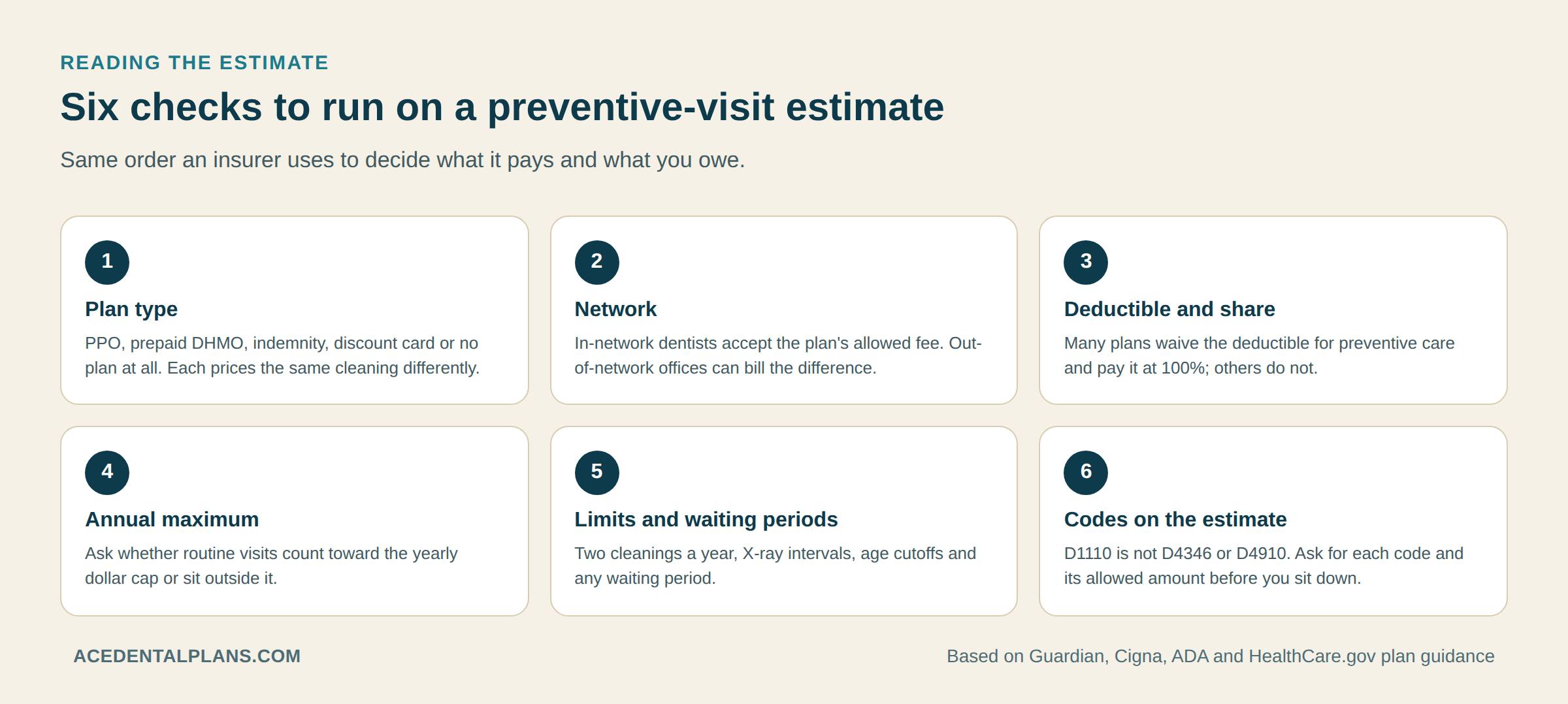 Six checks, in the order an insurer decides what it pays, to run on any routine-visit estimate.
Start with the codes. Each line should show a code beginning with D, a description and two amounts: the office’s fee and the plan’s allowed amount. The ADA notes that contracted PPO dentists must usually accept the maximum allowable fee set by the plan, so in network the allowed amount is the ceiling on what you owe for a covered line, apart from any share you pay.
Then check the percentage beside each code. Exams, X-rays and a D1110 cleaning will often show 100%. A D4346 or D4910 line may show something else, such as 80% after a deductible, because plans can put those codes in a different category. Finally, look at the limits. If you already used two cleanings this calendar year at another office, the third will not be paid, whatever the percentage says.
An illustrative example: Suppose your PPO pays preventive care at 100% with no deductible, and pays basic services at 80% after a $50 deductible. The plan’s allowed amounts are hypothetical: exam $60, adult cleaning $100, four bitewings $55.
Visit A, routine. Total allowed: $215. The plan pays all of it; you pay $0.
Visit B, inflamed gums. The hygienist bills a D4346 scaling at an allowed $120 instead of the $100 cleaning. If the plan treats that code as basic, you pay the $50 deductible, then 20% of the remaining $70, which is $14. You owe $64. The exam ($60) and X-rays ($55) are still paid at 100%.
Visit C, a third cleaning in the year. The plan allows two. Suppose you come in again at the allowed $100 rate. The plan pays nothing for it and you pay $100, or whatever the office charges.
Visit D, out of network. The office charges $140 for the cleaning and the plan’s approved fee is $100. If the plan pays 100% of the approved fee, you owe the $40 difference.
These percentages and amounts are invented to show the mechanics, not drawn from any plan.
Notice what moved the total in the example. It was never the deductible alone, and it was not the cleaning price. It was the code on the cleaning, the visit count and the network status. Those three are what to verify on a real estimate.
Pre-treatment estimates help here. Hygiene coding guidance advises offices to send a pre-authorization request to find out how a plan will treat a code before the visit, and to tell the patient about possible out-of-pocket costs. Not every office does that for a cleaning, so asking is reasonable. The answer is an estimate, not a guarantee of payment, and the plan’s final decision comes after the claim.
How Often Cleanings Are Recommended, and Where Plans Stop Paying
Delta Dental recommends scheduling a dentist visit every six months and says a professional cleaning at least once a year can greatly improve oral health. How often you need a visit depends on your gum health, cavity risk and medical history, and the dentist sets the interval.
Plans, however, count in round numbers. Two cleanings per calendar year is the pattern in the Delta Dental PPO sample and in the Cigna prepaid chart. Some people need visits more often, particularly those with a history of gum problems, and some are well served at longer intervals. If your dentist recommends more visits than your plan pays for, you are not being upsold. You are meeting a payment rule that was written for the average member.
Two practical points follow. A “calendar year” limit resets in January, while a “benefit year” limit resets on the plan’s anniversary. A visit in December and another in January can both be paid under the first kind, which gives you room to plan. And if you are changing jobs or plans, ask the new carrier whether visits already used under the old one count against anything. They usually do not, but the new plan may have a waiting period of its own.
When You Have No Dental Coverage: Lower-Fee Routes for Each Line
If you are paying cash, the useful move is to price the lines, not the visit. Healthinsurance.org’s 2026 guide lists membership plans offered by local dentists, dental schools, dental discount plans and federally qualified health centers with sliding fee scales as ways to cut the cost of a cleaning. It adds that discount plans will not work with every dentist.
The gap between the options can be large. At Indiana University Northwest’s educational clinic, a periodic exam, adult cleaning and four bitewings are listed at $10, $30 and $17, or $57 in total. At Pikes Peak State College, a periodic exam, adult cleaning and four-film bitewing set come to $5, $20 and $12, or $37. Under Montana’s Medicaid schedule the same three lines are $27.66, $59.28 and $39.52, which sum to $126.46. Against the $203 national average for the full visit, these are lower reference points, though they are not like-for-like. The educational clinics are staffed by students under supervision and Indiana University Northwest says it provides preventive services only, with no fillings or extractions. A visit there fixes the cleaning, not a cavity.
CU Anschutz’s dental school describes fees that are typically 30% to 50% below private practices in its area, with some clinics up to 55% less, and offers new patients a free screening exam and X-rays. That is one school’s program, not a national rule, and eligibility and appointment lengths differ by school. Check what each clinic provides before you plan around it.
For a private office, a few direct questions cost nothing. Ask for the fee for each code, not just the package. Ask whether the office has a fee for patients without insurance or an in-house membership. Ask if the fee changes when you pay at the visit, and whether recent X-rays from another office can be reused. Offices set their own policies on all of these, so a no is a data point, not an insult.
Questions to Ask Before You Book a Cleaning
The following list works for a phone call to an office or to the number on the back of your insurance card. Group the questions by who can answer them.
For the dental office:
- Which procedure codes will this visit include, and what is the fee for each one?
- Is this visit a new-patient comprehensive exam or a periodic exam?
- Will X-rays be taken, which kind, and are any of them optional today?
- If the hygienist finds inflamed gums or heavy buildup, will you stop and talk to me before billing a different cleaning code?
- Are you in network with my plan, and what is your fee if I pay without using it?
For the insurer:
- How are D1110, D1120, D4346 and D4910 classified under my plan, and at what percentage?
- How many cleanings and exams are paid per calendar or benefit year, and how many have I used?
- When did I last have bitewings or a full-mouth series, and when will the next one be paid?
- Does a routine visit count toward my annual maximum, and is there a waiting period?
Write the answers down with the date and the name of the person who gave them. Benefit quotes by phone are estimates, not guarantees of payment, but a record helps if the claim comes back different.
Frequently Asked Questions – Dental Cleaning Cost
How much is a teeth cleaning if I do not have insurance?
Healthinsurance.org put a cleaning alone at $75 to $200 in 2026, and CareCredit’s 2023–2024 study found an average of $203 for a routine exam that includes a cleaning and X-rays. Educational clinics and sliding-fee health centers often charge less. The exact price depends on the office, the region and whether the exam and X-rays are bundled.
Why is there an exam and X-ray charge when I only booked a cleaning?
A cleaning is one service, and the dentist’s exam and any imaging are separate services with their own codes. Delta Dental notes that cleaning appointments for new patients typically include an exam and X-rays. At a returning visit, ask which lines are planned so the estimate matches what you booked.
Does insurance pay for two cleanings a year?
Many plans do, and one carrier’s sample PPO pays two cleanings and two exams per calendar year at 100% with no deductible. Plans differ, though, and Cigna notes that not all preventive services are covered and frequency limits apply. Your benefit booklet or the insurer’s member line will give the exact count.
Do I pay a deductible for a routine cleaning?
Often not. Guardian says preventive care is typically paid at 100% without a deductible, and the Delta Dental sample applies a $0 deductible to preventive services. A deductible can still apply to other lines, and Cigna’s Dental 1500 plan applies a $50 individual deductible to basic and major services.
Is a child’s cleaning cheaper than an adult’s?
Usually, because it is billed under a separate child code with a lower fee. In four published fee schedules, the child price was 67% to 78% of the adult price. The age at which a patient is billed as an adult varies, with cutoffs of 11, 12 and 17 in the schedules reviewed here.
Does Medicare cover teeth cleanings?
Original Medicare does not cover routine dental services such as cleanings, fillings and extractions. Medicare.gov lists narrow exceptions, such as dental work tied to certain covered medical treatments or hospital stays. Check whether any other plan you hold adds dental benefits.
Are X-rays needed at every cleaning?
No. The ADA says there is no one-size-fits-all interval and that the dentist decides based on your oral health, age, disease risk and symptoms. Plans also set intervals, such as one set of bitewings a year for adults in one sample PPO, which can differ from what the dentist recommends.
What if the hygienist says I need a deeper cleaning?
That would be a different treatment with a different code, such as scaling and root planing, and it is priced per quadrant instead of per visit. Ask what the dentist found, what the cost will be and how your plan classes it before you agree. CareCredit’s average for scaling and root planing is $242 per quadrant, and plans may treat it differently from a routine cleaning.
Can I skip the exam and just get the cleaning?
Policies vary by office. The cleaning and the exam are separate services, but many offices expect the dentist to examine the patient as part of a hygiene visit. Call ahead and ask whether a cleaning-only visit is offered and what it costs.
Is fluoride included in the cleaning price?
Not necessarily. Healthinsurance.org says fluoride will likely add about $30 to the cost of a cleaning. At the sample PPO, fluoride is limited to twice a year through age 18, so adults may pay out of pocket.
Are dental school cleanings really cheaper?
Fee sheets from three educational clinics list adult cleanings at $20 to $45 (the $45 North Dakota fee also includes bitewings and fluoride), well below the $75 to $200 private range. Appointments there are run by students under supervision, and services may be limited, so check what each clinic offers and how long visits take.
Sources and Disclaimers
Cash-price figures come from the 2023–2024 CareCredit / Synchrony cost study, as relayed by CareCredit and Guardian, and from a 2026 healthinsurance.org guide. Educational-clinic and Medicaid fees come from the clinics’ and Montana’s published fee schedules; those schedules are not private-office prices, and the clinic sheets carry no effective date. Coverage examples come from carrier and employer plan summaries, a Covered California copay schedule and federal program pages. The worked examples, the stacked-line arithmetic and the child-to-adult ratios are our own calculations on those figures or hypothetical scenarios, and they are labeled as such. National averages hide large local differences, and plan rules change each year. Confirm prices with your dentist and benefits with your insurer before you book.
- CareCredit — Average cost of dental procedures (2023–2024 Synchrony study)
- Guardian — Cost of dental procedures without insurance
- Guardian — Choosing a dental insurance plan
- healthinsurance.org — How much do dental cleanings cost without insurance
- Indiana University Northwest — Dental clinic services and fees
- Pikes Peak State College — Dental center fee schedule
- North Dakota State College of Science — Dental clinic fee sheet
- CU Anschutz School of Dental Medicine — Dental fees
- Montana Healthcare Programs — Dental services fee schedule, July 2025
- Delta Dental — PPO Voluntary 1 benefit summary
- Delta Dental — What to expect at a dental cleaning
- Delta Dental of New Jersey — Cost of a dental cleaning
- Cigna — Cigna Dental 1500 plan details
- Aetna — 2026 DMO plan benefits summary
- State of Oklahoma Employees Group Insurance Division — Dental plan comparison chart
- Covered California — Dental copay schedule
- American Dental Association — X-rays and radiographs
- American Dental Association — Updated recommendations on dental X-rays (2026)
- American Dental Association — Dental plan overview
- American Academy of Pediatric Dentistry — Recommendations for pediatric dental care (2022)
- Dentistry IQ — Five CDT codes every dental hygienist needs to know (2022)
- Colgate Professional — The D4346 dental procedure code
- Medicare.gov — Dental services
- HealthCare.gov — Dental coverage
- Medicaid.gov — Dental care
Important Information and Disclaimers
This article is general educational information. By using it, you accept the limits described below.
Not dental or medical advice
Nothing on this page is a diagnosis, a treatment recommendation or a substitute for an examination by a licensed dentist or physician. Reading this article does not create a dentist-patient or doctor-patient relationship. Only a licensed professional who has examined you and reviewed your history can tell you what your mouth needs. Do not delay, skip or stop professional care because of something you read here.
Prices are estimates, not quotes
Cost figures are ranges reported by the third-party sources cited in this article. Actual prices depend on your location, the provider, the complexity of your case, the materials used, the date of service and other factors, so what you pay may be higher or lower. A written treatment plan and fee estimate from the dental office is the only reliable number for your situation.
Insurance and plan examples are illustrations
Examples that use named amounts or percentages are hypothetical. Real benefits depend on your plan, network, waiting periods, annual maximum, deductible and the insurer’s rules at the time of treatment. A pre-treatment estimate or benefits check is not a promise of payment. Confirm the details with your insurer or plan administrator in writing.
Not insurance, legal, tax or financial advice
AceDentalPlans is an information publisher. Nothing here is insurance, legal, tax, investment or other professional financial advice, and nothing here recommends a particular provider, insurer, lender, discount plan or financing product. Company and product names belong to their owners and appear for identification only. Read the terms of any loan, financing offer or plan before you sign, and ask a qualified professional if you need advice on your own circumstances.
Third-party sources
This article cites government agencies, professional associations, insurers, lenders and other outside organizations. We do not control those sources. Their content can change, move or disappear, and listing a source is not an endorsement of it or of anything it sells.
No warranty
We aim for accuracy, but this article is provided “as is,” without warranties of any kind, express or implied, including warranties of accuracy, completeness, timeliness or fitness for a particular purpose. Some information may be out of date or contain errors by the time you read it.
Limitation of responsibility
To the fullest extent permitted by law, AceDentalPlans and its owners, authors and contributors are not responsible or liable for any loss, cost, injury, health outcome or other damage that results from using this article or relying on it. You are responsible for your own decisions about your care, your coverage and your money.
How this article is written
This article follows AceDentalPlans’ answer-first, U.S.-focused editorial approach. It uses conditional language for insurance, because coverage depends on the specific plan, and it names its sources so that you can read them yourself.