Dentist Visit Cost Without Insurance. Paying cash, a first visit to a new dentist often lands between roughly $200 and $500. A 2024 national cost study averaged $203 for a routine exam with cleaning and X-rays, though offices charged anywhere from $50 to $350. A new-patient visit that adds a full-mouth X-ray series can run well above that. The first visit is an entry fee, and the treatment plan it produces is where the larger bills begin.
This article prices that first appointment line by line. It shows how the same visit costs less at student clinics, health centers and through membership or discount plans, and it explains what to ask before you book. It stops at the first visit. Routine cleaning detail, deep cleaning, fillings and other treatment have their own pricing and are mentioned only where they change the first-visit bill.
Key Takeaways
- The national average for a routine exam with cleaning and X-rays was $203 in a 2024 study, with a range of $50 to $350. A new-patient visit with a full-mouth X-ray series can add up to more.
- Two lines swing a first-visit bill most. One is the X-ray type, a $65 bitewing set versus a $226 full-mouth series on average. The other is whether the cleaning is bundled in, billed separately or postponed.
- Published fees at student-run hygiene clinics put an exam, full-mouth X-rays and cleaning near $50 to $55 in two examples, usually in exchange for longer appointments.
- Health centers with sliding-fee scales can price the same first visit at a fraction of the full fee. One published schedule ran from $45 to $245 depending on income.
- Office membership plans in the examples cost $258 to $600 a year. At $203 per cash visit, they only break even if you use both included checkups or need further treatment at the plan’s discount.
- Ask for the exam code, X-ray type, cleaning status and cash terms in writing before you sit down. The quote should say what is not included.
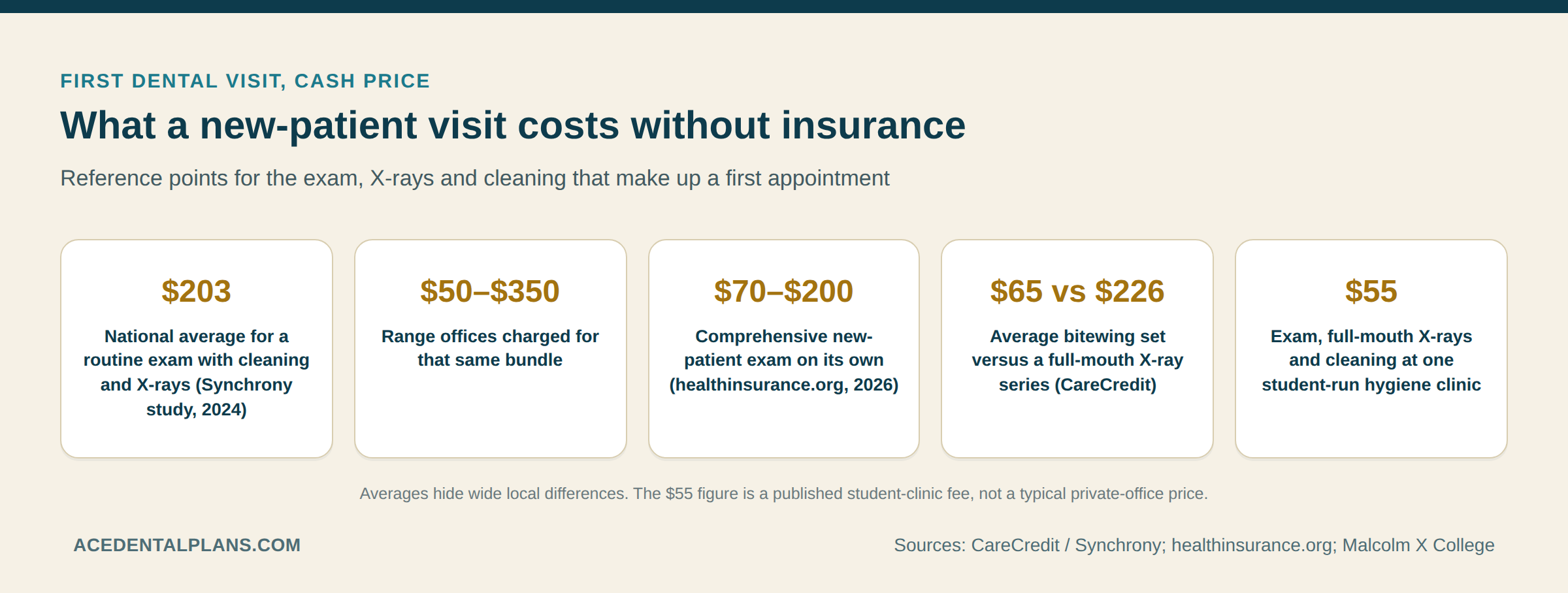 Cash-price reference points for a first dental visit, with the source and year on each card.
What a First Dental Visit Costs When You Pay Cash
A first visit has three billable parts: an exam, X-rays and, usually, a cleaning. Dentists bill each part under its own procedure code, so a quote you hear over the phone as one number is really three or four charges added together, and seeing them separately is the quickest way to tell whether the quote is ordinary or padded.
The figures below come from two cost sources. CareCredit publishes averages from the 2024 Synchrony Average Procedural Cost Study, which gives a bundled figure and X-ray averages. The consumer site healthinsurance.org, updated in March 2026, gives ranges for the comprehensive exam, the cleaning and a full-mouth series. They describe different slices of the market, so the table keeps them labeled. Dentist Visit Cost Without Insurance:
| Line on the estimate | Cash price | Source and year | What it is |
|---|---|---|---|
| Routine exam with cleaning and X-rays (one bundled price) | $203 average; $50–$350 range | CareCredit, Synchrony study 2024 | A single combined figure, so it does not show how much of it is X-rays |
| Comprehensive exam (D0150) | $70–$200 | healthinsurance.org, 2026 | The full evaluation a new patient typically gets |
| Bitewing X-rays | $65 average | CareCredit, 2024 | Images of the back teeth, used to look for decay between them |
| Single periapical X-ray | $55 average | CareCredit, 2024 | One tooth and its root |
| Panoramic X-ray | $200 average | CareCredit, 2024 | One wide image of both jaws |
| Full-mouth X-ray series | $226 average; $175–$428 range | CareCredit, 2024; healthinsurance.org, 2026 | A set of images of every tooth, often 16 to 18 films |
| Adult cleaning | $75–$200 | healthinsurance.org, 2026 | Routine cleaning of a mouth without active gum disease |
| Fluoride treatment | About $30 added | healthinsurance.org, 2026 | An optional add-on at some visits |
Add those lines and you get a range far wider than the $203 average. A comprehensive exam, one bitewing set and a cleaning total $210 at the low end of each range and $465 at the high end. Swap the bitewings for a full-mouth series and the same arithmetic gives $320 to $828. Those sums are the editors’ arithmetic on mixed sources, not a survey result, and nobody should expect to pay both ends at once.
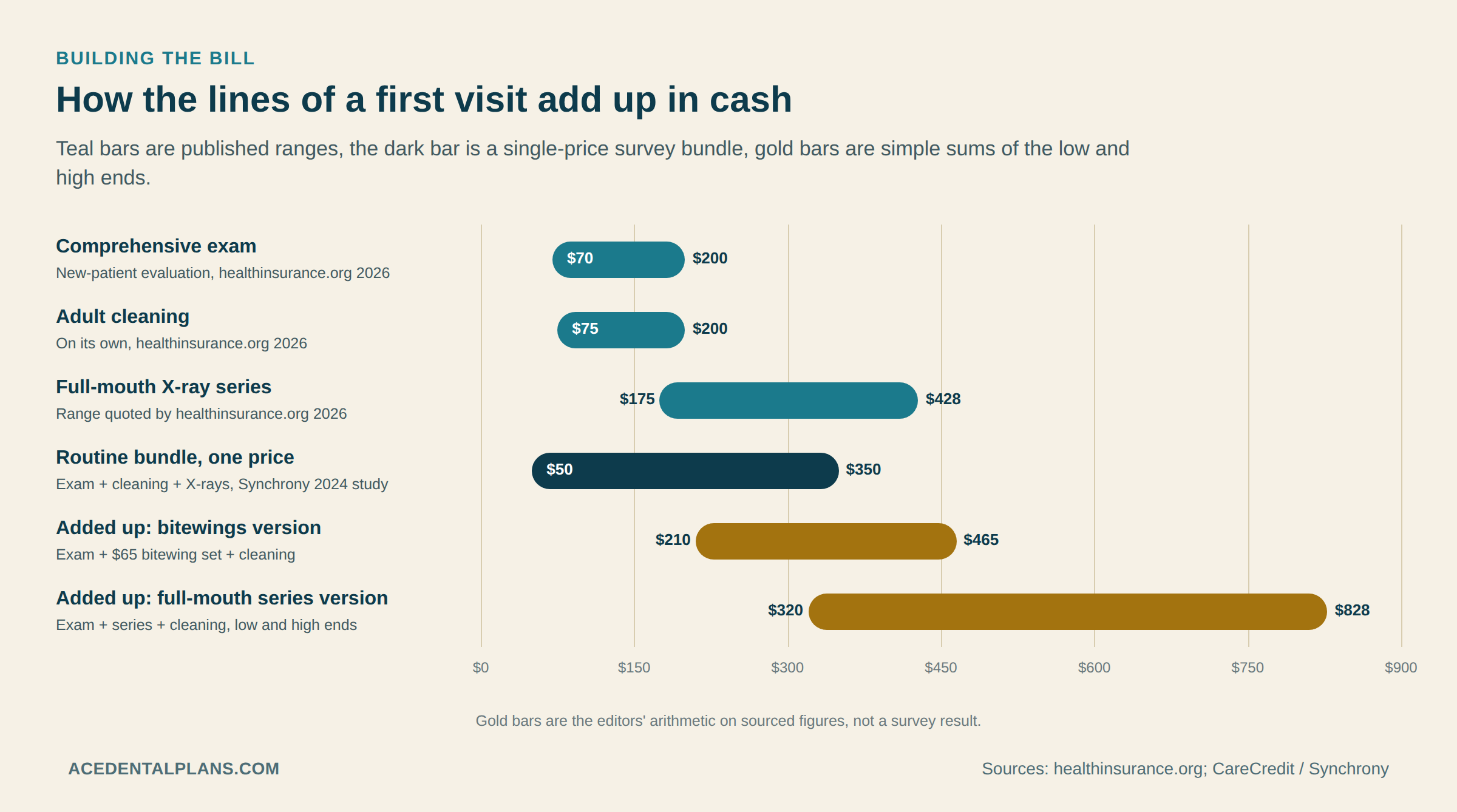 Published ranges for each line, next to the sums you get by stacking the low and high ends.
Why does the sum run higher than the average? The $203 figure is labeled a routine exam. A first visit is usually bigger than that. Delta Dental of Massachusetts, in its description of a first visit, says a full-mouth series of 16 to 18 images or a panoramic image may be taken. So a new patient should plan for a number above $203 unless the office offers a bundled new-patient price.
Context helps here, because plenty of people are in the same position. America’s Health Rankings, using CDC survey data, reported that 67.5% of U.S. adults had visited a dentist or dental clinic in the past year in 2024. An ADA Health Policy Institute analysis reported in ADA News put roughly one-quarter of people without any dental benefits in 2023.
Why a New-Patient Visit Costs More Than a Return Checkup
Three differences push the first-visit price up. The exam is broader, the X-rays are a baseline set rather than a refresh, and the cleaning may be harder because nobody has tracked your mouth yet.
The exam is comprehensive, not periodic
Dental billing separates a comprehensive evaluation (D0150) from a periodic one (D0120) and a limited, problem-focused one (D0140). A comprehensive exam covers your medical history, the teeth, gums and soft tissues, the bite and an oral cancer screening. Delta Dental of Massachusetts lists the same steps for a checkup and adds that your blood pressure may be taken at a first visit. A periodic exam later on is a shorter look at what has changed, so it usually costs less.
The size of that gap depends on the office. One Illinois dental fee schedule from 2020 lists its periodic evaluation (labeled for ages 0 to 18) at $60 and a comprehensive evaluation at $65, so the two fees sit close together there. Other offices may separate them more sharply. Ask for both fees: the comprehensive exam is the one you need on day one, while the periodic fee is what you will see at every return visit after it, so both belong in a yearly budget.
The X-rays are a baseline
A new patient has no image history in the chart. The dentist needs a starting set to look for decay between teeth, bone levels and anything below the gum line. That is why the X-ray line is the most variable one on a first-visit bill, and it gets its own section below.
The cleaning is a guess until the exam says otherwise
Offices often schedule the cleaning right after the exam. If the exam finds heavy buildup or gum inflammation, the plan can change, and the dentist may recommend a different type of cleaning that is priced separately. That service is its own topic. For this article, the point is narrower. A first-visit quote that includes a cleaning is conditional on the exam finding nothing that changes the cleaning.
X-Rays at Visit One: Which Set, and Whether You Need New Ones
The ADA and the FDA publish selection criteria for dental radiographs. For a new adult patient, they are specific. For an adult with natural teeth, they describe an individualized exam built from posterior bitewings plus either a panoramic image or selected periapical images. A full-mouth series is preferred when there is clinical evidence of generalized oral disease or a history of extensive dental treatment. The criteria also say that clinical judgment decides, not a fixed protocol.
Translate that to money. A bitewing set averages $65, a panoramic image $200 and a full-mouth series $226 in the CareCredit figures. A bitewing-plus-panoramic combination therefore averages about $265 on its own, which is more than a full-mouth series at the average price. That is plain arithmetic on sourced averages, and it matters because offices price these differently. Some charge less for a panoramic image, some less for a series. The dentist’s clinical reason decides which set is appropriate, and it is fair to ask what that reason is.
The ADA’s patient page on X-rays adds a point that saves real money. There is no “one size fits all” interval between X-rays; it depends on your oral health, age, risk for disease and symptoms. The same page recommends making a good-faith attempt to use radiographs from previous dental exams. If you had images taken in the last year or two, ask your former dentist how to get a copy. Then ask the new office whether it will accept them. Whether a particular dentist accepts them is a clinical call, and some will still want fresh bitewings.
Radiation is a reasonable thing to ask about, too. The ADA states that dental imaging accounts for less than 1 percent of the estimated collective annual effective dose received from medical imaging, which is useful context, though it is not a reason to skip images the dentist believes are needed.
A Worked Estimate: Reading a First-Visit Quote Line by Line
Suppose you call three offices and each one gives a different kind of answer. The scenarios below are hypothetical and use fees inside the ranges above, so you can see how the lines combine.
Read apples-to-apples, Office A’s $199 has no cleaning. If a cleaning costs about $100 elsewhere, that makes the special roughly $300. Office B’s $390 looks high but includes a panoramic image and bitewings, so it is worth asking whether both images are needed, since dropping one would trim $55 to $120. Office C’s $145 may be the lowest, but it excludes a cleaning that will likely be needed later, so the total depends on a later bill. None of these is a real quote. The lesson is that the lowest headline number is not automatically the lowest total.
The method works on any estimate. Write each office’s quote as four lines: exam, X-rays, cleaning and anything extra. Mark which lines are included, then fill the empty ones with the price from the same office’s fee list. Run the numbers on totals instead of headlines.
What the First Visit Does Not Include
Everything above buys information. It does not buy a single filling. After the exam and X-rays, the dentist usually lays out a treatment plan with the work found, in some order of urgency, and a fee for each item. The University of Iowa’s dental student clinics describe exactly this: the comprehensive exam appointment ends with a treatment plan that lists prioritized needs along with cost and time estimates.
That is the moment to slow down. A plan that lists six items does not have to be done in one sweep. Ask which items are urgent (pain, infection, a cracked tooth) and which can wait a few months, and ask for the plan in writing with a fee beside each line. A plan in writing lets you price the same work at a second office, at a student clinic or at a health center, which is much harder to do from a verbal summary. Confirm whether a second office charges for its own new-patient exam before you book it.
Three other charges tend to sit outside the quoted first-visit price. Deep cleaning, if the exam finds gum disease, is billed separately. Treatment itself, from a simple filling up, is billed per item. And some offices charge a fee for late cancellation or missed appointments. The Complete plan used as an example later in this article lists a missed-appointment fee unless you give 48 hours’ notice. The amount and the window differ by office.
Student Clinics: What Published Fees Show for the Same Visit
Dental and dental hygiene schools run clinics where students treat patients under supervision. NIDCR, the National Institute of Dental and Craniofacial Research, notes that dental school clinics let students gain experience while patients pay reduced fees. It points readers to the ADA’s program finder and the American Dental Hygienists’ Association to locate them. Three schools publish fees that let you price a whole first visit.
| Provider | Exam | X-rays | Cleaning | Adds up to |
|---|---|---|---|---|
| Malcolm X College dental hygiene clinic (student-run) | Screening free; comprehensive exam $10 | Full-mouth series $20 (adult) | $25 (adult) | $55 |
| Sacramento City College dental clinic (hygiene students) | Screening free | Full-mouth $25; bitewings $15 on request | $25 first appointment, $10 for each later one | $50 |
| University of Iowa dental student clinics | $17 screening, then $49 comprehensive exam fee | Charged separately; transfer recent images if you can | Not listed | $66 before X-rays and treatment |
| Southern Illinois University dental fee schedule (2020) | Comprehensive exam $65 full fee; $15–$49 on the sliding scale | Complete series $100 full fee; $15–$75 on the sliding scale | Adult $80 full fee; $15–$60 on the sliding scale | $245 full fee; $45–$184 sliding |
| Valley Health sliding-fee schedule (2026) | Basic and preventive dental visit: $20, $40, $60 or $80 depending on income tier | Per visit | ||
Two caveats come with those low numbers. First, the clinics are teaching programs, and the fees are for services performed by students with faculty checking the work. Sacramento City College states that its adult cleaning appointment takes two to three hours and its initial screening about 45 minutes. The University of Iowa says treatment appointments take longer because faculty supervise, and that emergency patients should expect a wait. The price is lower partly because the time is longer, so a student clinic trades hours for dollars, and whether that trade works depends on your schedule.
Second, eligibility rules and screening can limit who is accepted. The University of Iowa uses a two-step process, starting with a brief screening by a faculty dentist to decide whether the student clinic is suitable for your needs. Sacramento City College offers fee waivers for people with financial hardship, seniors and veterans, and lists no charge for enrolled district students. Check the program’s own page before building a budget on it, because screening rules, patient limits and fee waivers change from term to term and from school to school.
The fifth row, Valley Health, is a community health center, not a school. It belongs in the table because it shows a very different pricing model: a flat nominal fee per visit by income tier, discussed next.
Community Health Centers and Sliding Fees
The Health Resources and Services Administration says federally funded health centers served more than 32.7 million people in 2025. About 1,400 funded centers run more than 16,600 service sites. NIDCR describes these centers as offering care on a sliding fee scale based on income and points to HRSA’s Find a Health Center tool. Not every center provides dental care on site, so a call to the dental line is the right first step.
Sliding scales take two common shapes. The Wright Center’s 2024 dental schedule uses percentages. At or below 100% of the federal poverty level, a patient pays a $0 nominal charge at the time of service. In the next tiers the charge is the greater of $40 or 20%, 40%, 60% or 80% of the standard fee. Above 200% of the poverty level, it is the standard fee. Valley Health’s 2026 schedule uses flat nominal charges instead. Basic and preventive dental is $20 at the lowest tier, then doubles, triples and quadruples to $80 at the highest. Additional dental items such as fillings and extractions run from $50 to $110 across the tiers.
The Southern Illinois University schedule, which is old but itemized, shows what a percentage ladder does to a full first visit. Adding its comprehensive exam, complete X-ray series and adult cleaning gives $245 at the full fee and a series of lower totals as income falls.
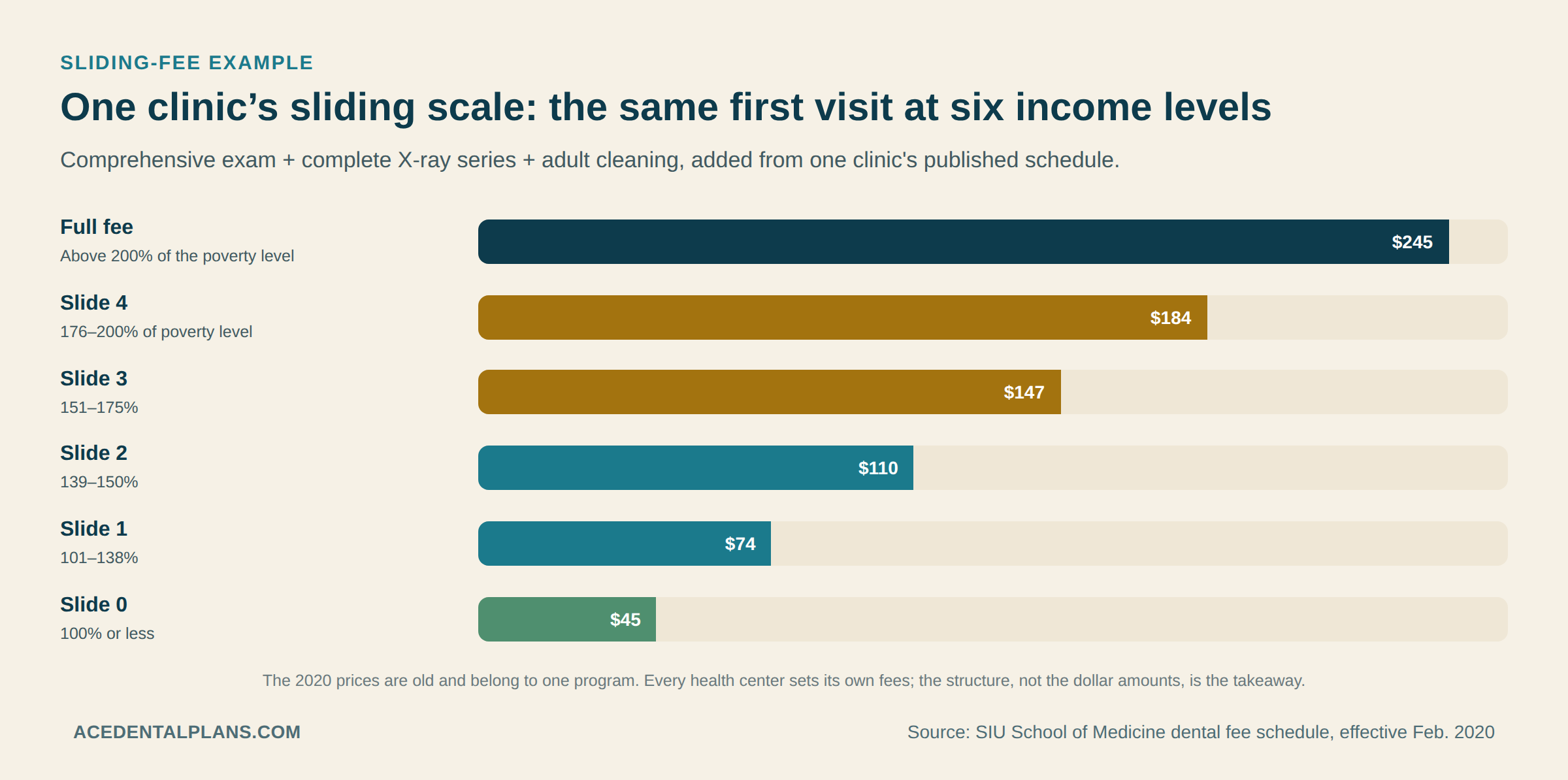 The same exam, X-ray series and cleaning priced at each income tier of one published sliding-fee schedule (2020).
Income tiers use the federal poverty level, which changes with household size. For a one-person household, the Wright Center’s schedule listed $15,060 as the 100% line, $30,120 as the 200% line and everything above as full fee. Bring proof of income, such as recent pay stubs or a tax return, to the first call or the first visit, because the size of the discount depends entirely on what you can show. Ask how the center counts household size, too.
Waiting lists and limited dental hours are common at busy centers, and a center that cannot see you for several weeks is not a failed option, though it does change how you plan around pain or a deadline. If you have pain now, tell the scheduler so, since emergency slots are handled differently from routine ones.
Office Membership Plans and the Break-Even Math
Some private offices sell an in-house membership: a flat yearly fee for a bundle of preventive visits, often with a percentage off other treatment. These are not insurance. The plans below come from the offices’ own pages and are examples of how the pieces are arranged, not national prices.
| Option | Yearly cost | What the page says is included | What to check |
|---|---|---|---|
| Office plan, “Complete” | $258 per person | 2 cleanings, 2 periodic exams, all necessary X-rays, 1 emergency exam; 10% off further treatment | Non-refundable if unused; auto-renews; $50 reinstatement fee if it lapses |
| Office plan, “Adult Care” | $400 per adult | 2 cleanings, 2 exams, X-rays at no added charge; 20% off most procedures | Paid in full at enrollment; excludes some items such as Invisalign |
| Office plan, “Adult Preventive” | $500 per adult | 1 cleaning every 6 months, 1–2 exams, X-rays as determined necessary, 1 emergency exam; 10% off treatment | Annual payment in full; no deductible or yearly maximum stated |
| Office plan, “New Patient” | $600 per adult | 1 comprehensive exam and 1 follow-up exam, cleanings every 6 months, X-rays as needed, oral cancer screening; 10% off treatment | Priced above the preventive plan; confirm the comprehensive exam is not also billed separately |
| Dental discount plan | About $150 on average | Reduced fees from participating dentists, usually 10% to 60% off | You still pay every visit at the discounted fee; the dentist must be in the network |
| Stand-alone dental insurance | $240–$600 in premiums ($20–$50 a month) | Pays a share of covered services up to a yearly maximum, typically $1,000–$2,000 | Deductibles, waiting periods and frequency limits; adults may face waiting periods before coverage starts |
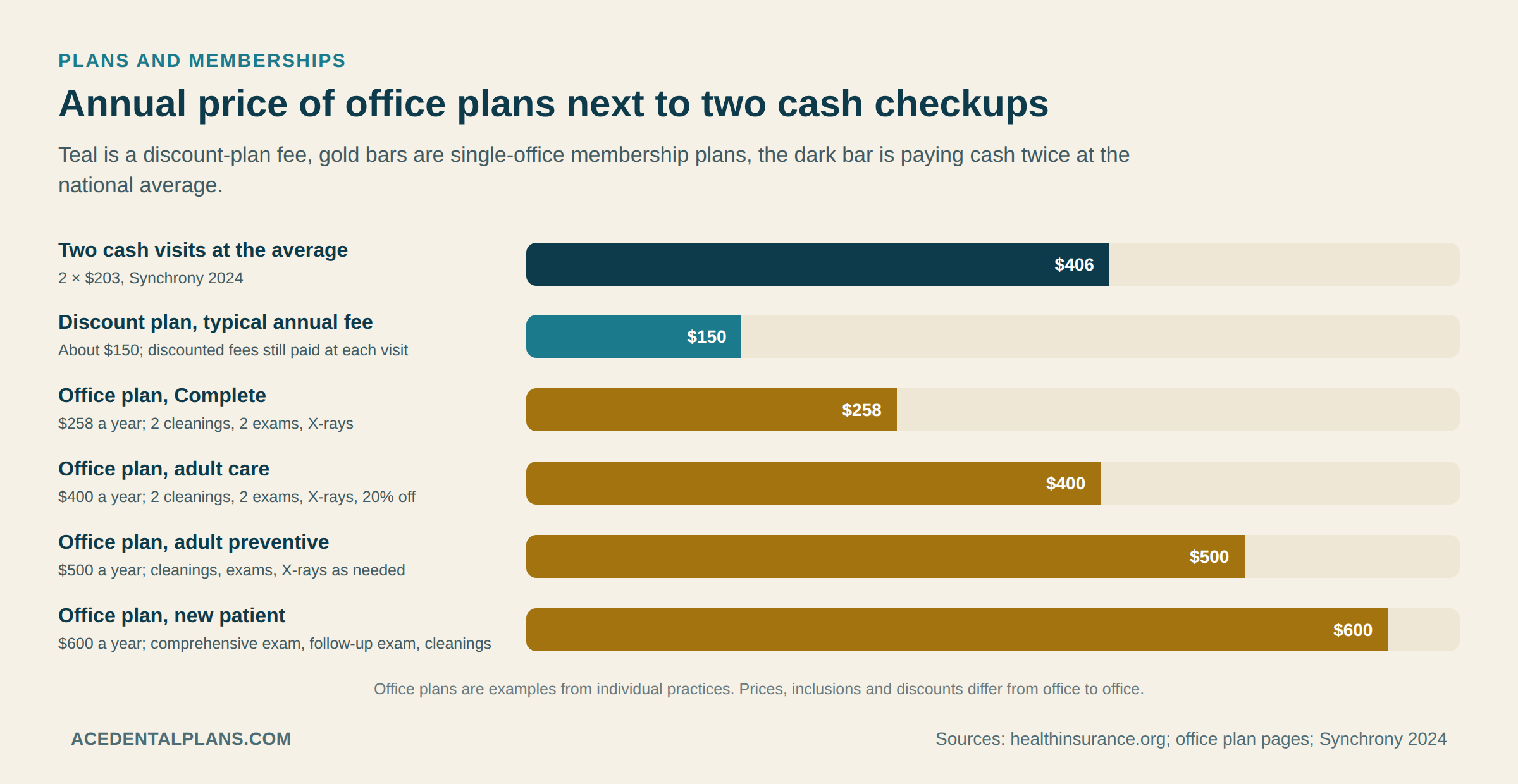 Yearly price of the plans in Table 3 beside the cost of two cash checkups at the national average.
The first thing the table shows is that a membership is not automatically a bargain. Two cash visits at the $203 average cost $406. The $400 adult plan covers two exams, two cleanings and X-rays for about the same money. Any saving comes from the discount on other work, or from an office whose cash fees run above the average. At $600, the new-patient plan costs $194 more than two average visits, unless the office’s own cash fees are high.
Read the terms before paying. The Complete plan’s page says it is non-refundable if unused, benefits do not carry over, and it auto-renews yearly unless you cancel in writing 14 days ahead. Another office’s plan says it cannot be combined with insurance or other discounts. A plan that charges the full year up front also ties up cash, which matters when money is tight and you are paying out of pocket.
Discount Plans, and How They Differ From Insurance
A dental discount plan is a membership, not coverage. The ADA describes it this way. The company selling the plan contracts with a network of dentists, and those dentists agree to discount their fees. Patients pay all the costs of treatment at the contracted rate, and there are no claim forms to file. The ADA also says discount or referral plans are technically not insurance plans.
Healthinsurance.org puts the typical annual fee at about $150, or roughly $12.50 a month. It says typical discounts run from 10% to 60% for normal dental work, as long as you use a participating dentist. It also states plainly that even with a discount plan you will still pay a significant amount for dental work, particularly if you need extensive work. There are generally no deductibles, waiting periods or annual maximums, which makes the plans fast to start.
For a first visit, a discount plan works like a coupon applied to each line. If a participating office’s regular exam fee is $120 and your plan takes 30% off, the exam costs $84. That illustration uses invented numbers inside the 10% to 60% range. Discounts vary by procedure, so check the plan’s own fee list for exams and X-rays, not just the headline percentage. Then call the dentist, not only the plan, and ask whether the office currently participates. Networks change.
Insurance sits at the other end of the spectrum. Healthinsurance.org puts premiums for an individual dental policy at $20 to $50 a month. It notes that policies typically pay for covered services up to a yearly maximum of $1,000 to $2,000, after any deductible. HealthCare.gov adds that adult dental is not an essential health benefit. A separate dental plan carries its own premium, and separate plans can have waiting periods before they start covering services for adults. For a first-year patient who needs only a checkup, a plan with a waiting period and a premium may cost more than it returns. For one with expected treatment, the math can reverse. That comparison belongs to the neighbouring articles on coverage, so only the first-visit angle appears here.
Medicare, Medicaid and Marketplace Rules for a Routine Visit
Public programs are uneven on routine dental care, so check before assuming. Medicare.gov states that Original Medicare does not cover dental services like routine cleanings, fillings, tooth extractions, dentures or implants. Medicare Advantage plans are separate private plans, and whether one offers dental benefits depends on the plan, so read its summary.
Medicaid.gov explains the split between children and adults. Dental services are covered for all child enrollees as part of the Early and Periodic Screening, Diagnostic and Treatment (EPSDT) benefit. For adults, states have flexibility to decide what dental benefits to provide, and there are no minimum federal requirements. Healthinsurance.org, citing CareQuest Institute and ADA data as of 2025, counted seven states with emergency-only adult Medicaid dental coverage and nine with limited coverage. The rest had broader benefits, and only a subset of those qualified as extensive.
That map means an adult’s routine first visit might be payable in one state and not in another, depending on how the state sets its adult benefit. Your state Medicaid office will tell you which category applies to you, and a call to a dentist who accepts Medicaid should confirm whether a new-patient exam and X-rays are payable. If you do have Medicaid, the first-visit prices in this article mostly stop mattering, which is a good reason to check before paying cash.
How to Ask an Office for a Cash Quote
The phone call is where most of the first-visit savings are found, and a scripted set of questions keeps it short. The six items in the figure below map onto the six charges that vary between offices.
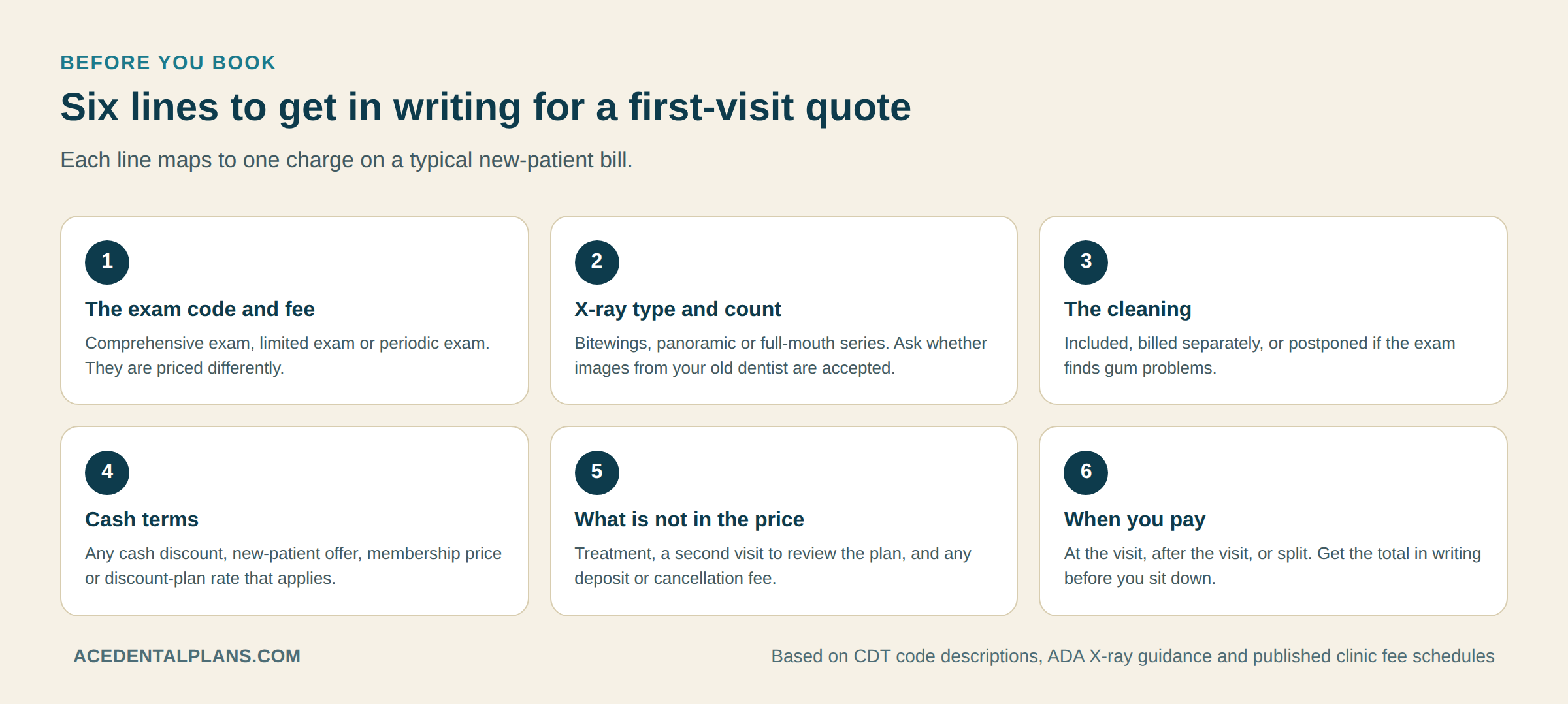 Six lines to get in writing before the first appointment.
Start with the exam, asking for the comprehensive exam fee and also for the periodic fee that will apply at later visits, so you can see how the price changes once you are an established patient. Next, ask what X-rays the office takes on a new patient and what each costs. If you have recent images, say so and ask whether they will be used.
Third, ask about the cleaning, and whether it is included in the price, billed as a separate line, or conditional on what the exam finds. Fourth, ask about cash terms. Some offices advertise a new-patient price, some offer a cash or same-day-payment discount, some run an in-house membership and some take part in a discount plan. Whether a given office does any of this is up to the office. This article found no national survey of how common new-patient offers are, so the only way to know is to ask.
Fifth, ask what the price leaves out. A bundled special often covers the exam and X-rays but not the cleaning, any treatment, or a follow-up visit to go over the plan. Sixth, ask when payment is due and whether there is a cancellation fee. Then ask for the answers by email or text. A written quote is easy to compare across offices and hard to misremember later, when the final bill arrives and the front desk recalls a different number.
If you are comparing a private office with a student clinic or a health center, add one more column: time. The clinics in Table 2 describe two- to three-hour cleaning appointments and waits, and a sliding-fee program may require income paperwork first. Money saved by a longer route is real, though so is the time cost, especially if you have pain.
Picking a Route Without Giving Up on the Dentist Relationship
Comparing options is easier when each has a clear purpose. A private office suits someone who wants a regular dentist, has flexible money for the first visit and values a short appointment. A student clinic suits someone with time, no coverage and a mouth that likely needs more than a checkup, since the savings can matter more as treatment adds up. A health center suits someone whose income falls inside a sliding-fee tier, and it can also act as a long-term dental home.
A membership suits a person who expects to return twice a year and wants the cost known ahead. A discount plan suits someone shopping among participating offices who wants a percentage off everything, including treatment. None of these is a ranking. Many people mix routes: a student clinic for the baseline exam and X-rays, then a private office or health center for the work that comes next, carrying the images along.
One practical habit pays off across all of them. Get the first set of X-rays and the written treatment plan in your own hands, either as printed copies or digital files. Records you hold can move with you, and a dentist reviewing them may need fewer new images.
Frequently Asked Questions – Dentist Visit Cost Without Insurance
How much is a dentist visit without insurance for a new patient?
Expect roughly $200 to $500 for an exam, X-rays and cleaning at a private office. A 2024 national study averaged $203 for a routine exam with cleaning and X-rays, with a range of $50 to $350. A first visit with a full-mouth X-ray series can come in above that. Student clinics and sliding-fee health centers can run far lower.
Why is my first appointment so much more than a regular checkup?
It includes a comprehensive exam and a baseline set of X-rays, and both cost more than the periodic exam and bitewings used at later visits. Delta Dental of Massachusetts says a first visit may include a full-mouth series or a panoramic image. If the quote seems high, ask which X-rays are included and why.
Do I need X-rays at a first dental visit?
Usually the dentist will want some. The ADA and FDA criteria for a new adult patient describe bitewings with a panoramic image, or bitewings with selected periapical images. They prefer a full-mouth series when there is generalized disease or extensive past treatment. If you have recent images, ask whether they can be used instead.
Can I get a cleaning at my first visit without paying extra?
It depends on the office. Some quote a bundle that includes it, some bill it separately, and some postpone it if the exam finds gum problems. Ask for each line to be listed so you can see which applies.
Is a new-patient special really cheaper?
Sometimes, but compare what it contains. Specials commonly cover the exam and X-rays, and a cleaning or treatment may be extra. The worked estimate earlier shows how a $199 special can end up near $300 once a cleaning is added.
Are dental schools really cheaper for a first visit?
The published fees say yes. Malcolm X College lists a comprehensive exam of $10, a full-mouth series of $20 and a cleaning of $25 for adults. Sacramento City College lists a free screening, $25 full-mouth X-rays and a $25 first cleaning. Appointments run longer because students are supervised, and a dental school may need to screen you before accepting you as a patient.
What is a sliding-fee scale?
It is a price schedule that charges less when household income is lower relative to the federal poverty level. Health centers use it for patients who qualify. At one published schedule, the same first visit cost $245 at the full fee and $45 at the lowest income tier.
Is a dental membership plan worth it for one visit?
Rarely. Plans in the examples cost $258 to $600 a year, while a single average visit costs $203. Plans make sense when you plan two visits, want the discount on likely treatment or the office’s cash fees run high. Read the cancellation and renewal terms first.
Does Medicare pay for a dental checkup?
Original Medicare does not cover routine dental care such as cleanings, fillings and extractions, according to Medicare.gov. Some Medicare Advantage plans include dental benefits, so check the plan’s summary. A dentist’s office can usually tell you what a given plan pays before the visit.
Can Medicaid cover an adult’s first dental visit?
Possibly, depending on the state. Federal rules require dental coverage for child enrollees but set no minimum for adults, and as of 2025 seven states offered only emergency dental coverage for adults. Check your state’s program before paying cash.
Should I get a second opinion on the treatment plan?
That is your call, and a dentist can explain which items are urgent. If the plan is large, getting the written plan and X-rays to a second office, student clinic or health center is a common way to compare. Ask whether the second office charges for its own exam.
Sources and Disclaimers
Cash prices come from the 2024 Synchrony Average Procedural Cost Study as published by CareCredit and from healthinsurance.org (updated March 2026). Fee-schedule figures come from the student clinics and health programs cited in the text. Clinical statements on X-rays rely on the ADA and the ADA/FDA radiograph selection criteria. Coverage statements rely on Medicare.gov, Medicaid.gov and HealthCare.gov. The estimates for Offices A, B and C and the membership example are hypothetical, and the sums in Table 1 and the build-up chart are the editors’ arithmetic on mixed sources. National averages cannot predict a local office’s fees, plan prices are single-office examples, and some fee schedules are several years old. Confirm every price with the dentist and every benefit with the insurer or program before you book.
- CareCredit — Average dental costs, from the Synchrony Average Procedural Cost Study
- healthinsurance.org — How much do dental cleanings cost without insurance?
- healthinsurance.org — Dental discount plan glossary entry
- healthinsurance.org — Dental coverage options and costs
- healthinsurance.org — To what degree does Medicaid provide adult dental coverage?
- American Dental Association — Dental plan overview
- American Dental Association — X-rays/radiographs
- American Dental Association and U.S. Food and Drug Administration — ADA and FDA radiograph selection recommendations for dental patients
- ADA News — Fewer patients uninsured but gaps remain
- America’s Health Rankings — Dental visit measure (CDC BRFSS data, 2024)
- National Institute of Dental and Craniofacial Research — Finding dental care
- Health Resources and Services Administration, Bureau of Primary Health Care — About health centers
- Delta Dental of Massachusetts — What happens during a dental checkup?
- University of Iowa College of Dentistry — Becoming a patient in the student clinics
- Sacramento City College — Dental clinic services and fees
- Malcolm X College — Dental hygiene clinic fee schedule
- Southern Illinois University School of Medicine — Dental fee schedule with sliding-scale levels (2020)
- Valley Health — Sliding fee policy and schedule 2026
- The Wright Center — Dental sliding fee schedule 2024
- Medicare.gov — Dental services
- Medicaid.gov — Dental care
- HealthCare.gov — Dental coverage in the Marketplace
- Office membership plan pages (single-practice examples) — In-house membership plans, $258 and $358 tiers
- Office membership plan pages (single-practice examples) — Dental savings plan, adult and kids tiers (April 2024)
- Office membership plan pages (single-practice examples) — In-house membership plan, new patient and preventive tiers
Important Information and Disclaimers
This article is general educational information. By using it, you accept the limits described below.
Not dental or medical advice
Nothing on this page is a diagnosis, a treatment recommendation or a substitute for an examination by a licensed dentist or physician. Reading this article does not create a dentist-patient or doctor-patient relationship. Only a licensed professional who has examined you and reviewed your history can tell you what your mouth needs. Do not delay, skip or stop professional care because of something you read here.
Prices are estimates, not quotes
Cost figures are ranges reported by the third-party sources cited in this article. Actual prices depend on your location, the provider, the complexity of your case, the materials used, the date of service and other factors, so what you pay may be higher or lower. A written treatment plan and fee estimate from the dental office is the only reliable number for your situation.
Insurance and plan examples are illustrations
Examples that use named amounts or percentages are hypothetical. Real benefits depend on your plan, network, waiting periods, annual maximum, deductible and the insurer’s rules at the time of treatment. A pre-treatment estimate or benefits check is not a promise of payment. Confirm the details with your insurer or plan administrator in writing.
Not insurance, legal, tax or financial advice
AceDentalPlans is an information publisher. Nothing here is insurance, legal, tax, investment or other professional financial advice, and nothing here recommends a particular provider, insurer, lender, discount plan or financing product. Company and product names belong to their owners and appear for identification only. Read the terms of any loan, financing offer or plan before you sign, and ask a qualified professional if you need advice on your own circumstances.
Third-party sources
This article cites government agencies, professional associations, insurers, lenders and other outside organizations. We do not control those sources. Their content can change, move or disappear, and listing a source is not an endorsement of it or of anything it sells.
No warranty
We aim for accuracy, but this article is provided “as is,” without warranties of any kind, express or implied, including warranties of accuracy, completeness, timeliness or fitness for a particular purpose. Some information may be out of date or contain errors by the time you read it.
Limitation of responsibility
To the fullest extent permitted by law, AceDentalPlans and its owners, authors and contributors are not responsible or liable for any loss, cost, injury, health outcome or other damage that results from using this article or relying on it. You are responsible for your own decisions about your care, your coverage and your money.
How this article is written
This article follows AceDentalPlans’ answer-first, U.S.-focused editorial approach. It uses conditional language for insurance, because coverage depends on the specific plan, and it names its sources so that you can read them yourself.