

Paying cash, a routine adult cleaning runs from about $10 at a dental hygiene school to $75–$200 at a private office, while one discount plan’s 2026 fee schedule lists $33 to $63. The setting you choose moves the price more than the cleaning itself does. A visit that adds an exam and X-rays averaged $203 in one national study.
This article compares what a cleaning costs when you pay cash, setting by setting: private offices, a national chain, hygiene and dental school clinics, income-based health centers, discount plans and office memberships. It covers children and adults, what a cleaning does and does not include, the break-even math on memberships, three sample cash bills and the questions that get a real price. Gum-disease cleanings are priced only as a ladder, and insurance mechanics are left to the pages linked along the way.
Key Takeaways
- Cash prices sort into four levels. A private office’s own fee, a discount-plan fee ceiling, a teaching-clinic fee and an income-based health-center fee can differ several times over for the same procedure.
- Hygiene-school fees in four published schedules ran from $10 to $50. Two of them bundle the exam, X-rays and fluoride into that one fee.
- A “$29 exam and X-rays” offer is not a cleaning price. Aspen Dental’s page, which runs through December 31, 2026, says cleanings are a separate cost at a later visit.
- Memberships are arithmetic, not bargains by default. At one office’s posted fees, a $395 adult plan only beat paying cash if the member also used the emergency exam.
- Health-center discounts end at 200% of the poverty guideline. Above that line, HRSA’s rules provide no sliding discount.
- Ask for the codes, the inclusions and the payment terms in writing. A cleaning quote that leaves out the exam or X-rays can double once they are added.
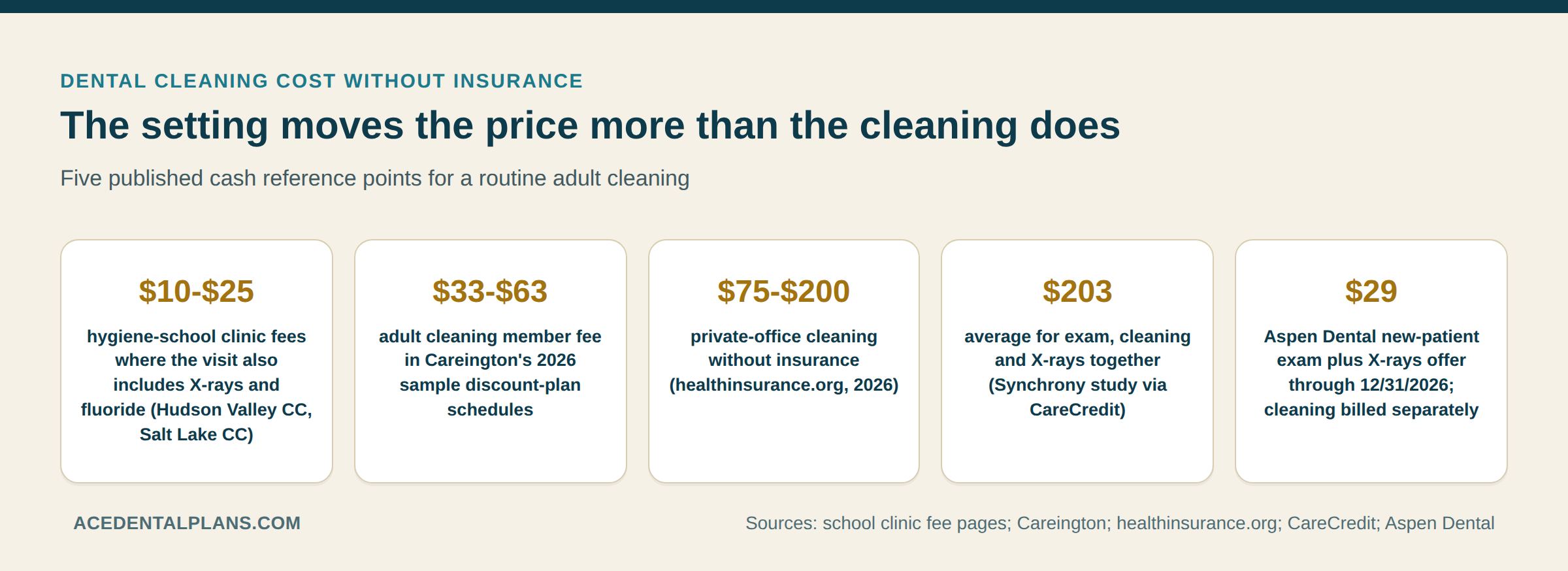
One Cleaning, Four Price Levels
Call five offices and ask what a cleaning costs, and you will hear five answers. The spread is not random. It sorts into levels set by who runs the chair and how that provider gets paid. A private office sets its own fee. A discount-plan dentist agrees to a fee ceiling in exchange for patients. A teaching clinic charges a fraction because students do the work under supervision. A health center prices by income.
Table 1 puts one published number from each setting side by side. Read the third column together with the fourth. A price means little until you know what is inside it. The Hudson Valley Community College hygiene clinic’s $10 includes an evaluation, fluoride and X-rays. A national survey’s $75 to $200 for a cleaning does not.
| Setting | Source and date | Price in the source | What the price covers | Main catch |
|---|---|---|---|---|
| Private office, survey range | healthinsurance.org (2026); Delta Dental page (no year) | $75–$200; $85–$160 | Cleaning alone | Each office sets its own fee; exam and X-rays are separate lines |
| Private office, one posted fee list | Thomasson Dental, TN (undated page) | $83 cleaning; $42 exam; $61 for four bitewings | Each line separately | One office in one state |
| National chain, new-patient offer | Aspen Dental (offer runs to 12/31/2026) | $29 for exam and X-rays | No cleaning price given | Select offices, age 21 or older; cleaning billed at a later visit |
| Discount-plan network | Careington Care 500 sample schedules (effective 1/1/2026) | $33–$63 cleaning; $18–$31 exam; $22–$36 four bitewings | Maximum fee a participating general dentist charges | Plan membership fee is not on the schedule; not available in VT or WA |
| Hygiene school clinic | Hudson Valley CC; SUNY Orange; Clark College; Salt Lake CC (undated pages) | $10; $20; $50; $25 | Hudson Valley and Salt Lake bundle evaluation, X-rays and fluoride; SUNY Orange and Clark price the cleaning alone | Student operators, longer visits, acceptance not guaranteed |
| Dental school clinic | UT Health San Antonio; University of Detroit Mercy | $50 screening with X-rays; $30 comprehensive exam; no cleaning price posted | Screening or exam, then a treatment plan | Visits can run two to three times longer than private practice |
| Health center sliding fee | Prism Health North Texas (updated April 2026) | $12, $30, $40 or $45 per preventive procedure by income tier | Each exam, X-ray or cleaning counts as a procedure | Proof of income; no discount above 200% of the poverty guideline |
| Office membership | Thomasson Dental plan (undated); KFF Health News (2021) | $395 adult; $300–$400 typical | Two exams, two cleanings, preventive X-rays and more in the one fee | Non-refundable and auto-renewing at the example office |
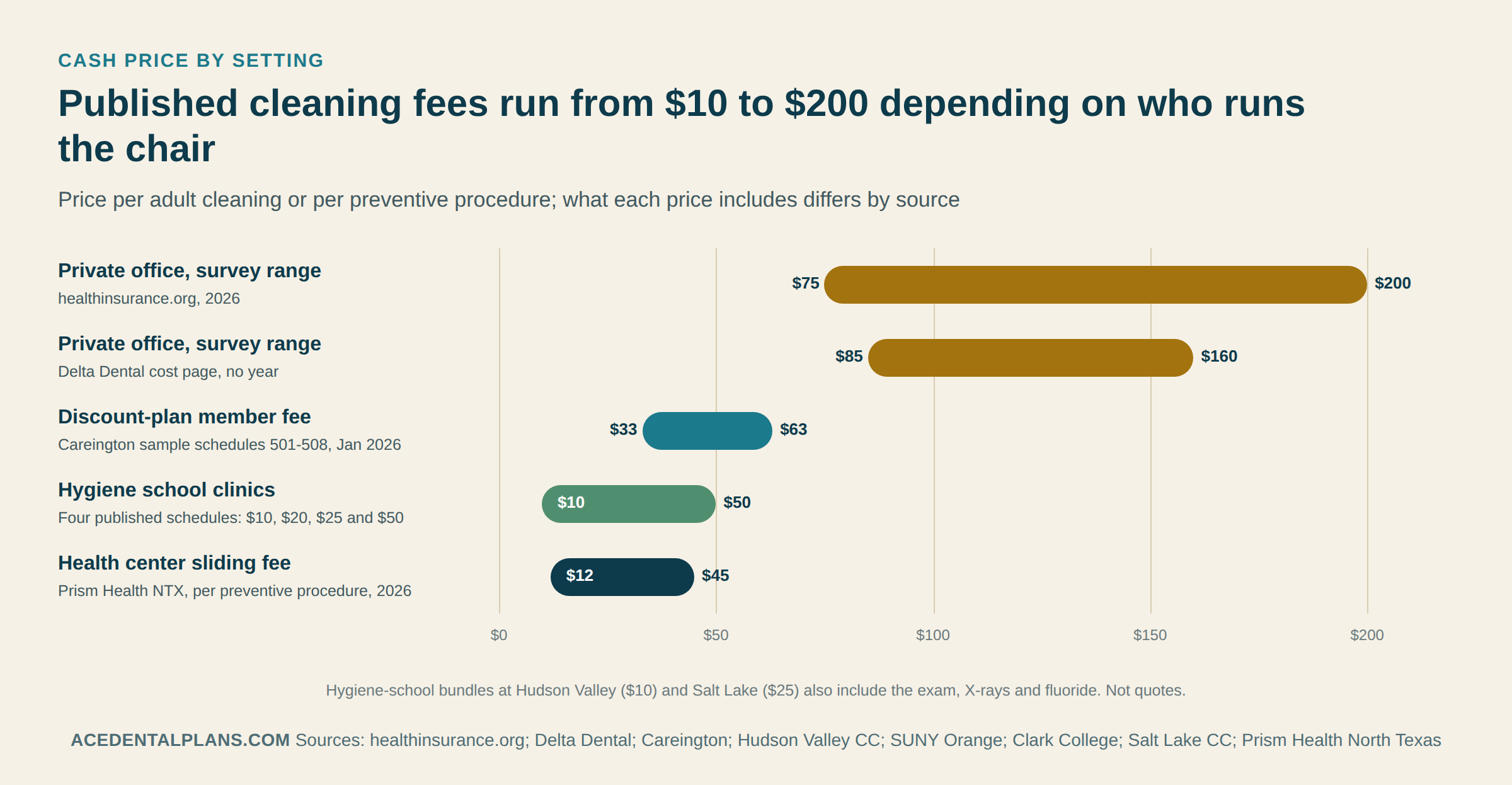
Two cautions apply to the whole table. The sources are different kinds of documents: a consumer guide, a plan’s sample fee schedule, college web pages, a health-center rate sheet. Some carry a date and some do not, and the table says which. And no row is a quote, because every office, school and clinic sets and changes its own fees.
For the national averages and a line-by-line pricing of the exam, X-rays and cleaning, the guide to dental cleaning cost does that job. The question here is narrower. Where can you buy the same cleaning for less, and what does each cheaper route cost you in time, eligibility or flexibility?
What a Cash Cleaning Includes, and What Gets Added
A routine cleaning, which dentists call a prophylaxis, is the hands-on part of the appointment. Delta Dental describes it in three steps. Plaque and tartar come off with a hand scaler or an ultrasonic scaler, the teeth are polished with a gritty toothpaste, and the visit ends with flossing. Nothing in that description includes an exam, X-rays or fluoride. Those are separate services that many offices bill on the same day.
That is why a cleaning price and a cleaning-visit price are different numbers. The exam is the dentist’s evaluation of your teeth and gums. X-rays are billed by type, and healthinsurance.org’s 2026 guide puts fluoride at about $30 added to a cleaning. Whether any of these happen at your visit depends on your history and the dentist’s judgment, not on a billing default.
X-rays are the line to watch because their timing is a clinical decision. The ADA says there is no “one size fits all” interval between dental X-rays, and that the right timing depends on current oral health, age, risk for disease and any symptoms. It also asks dentists to make a good-faith attempt to use radiographs from previous exams. Healthinsurance.org, quoting Delta Dental, says X-rays may be needed only once every two or three years for some patients. So a cleaning visit with no X-rays is ordinary, and a visit that includes a new set is a line you may reasonably ask about.
How often the cleaning itself is needed is another question for the dentist. Delta Dental says a cleaning is needed at least once a year and advises a dentist visit every six months. The CDC says to get a checkup at least once a year, or more often if your provider recommends it. Because you are paying cash, the interval you and your dentist settle on sets your yearly cost directly, which is where the sample bills later in this article come in.
One last inclusion issue. A visit booked as a cleaning can change once the exam is done. If the dentist finds signs of gum disease, the recommended service may become a different, costlier procedure that is priced separately. That ladder is laid out further down, and the point to carry forward is simple: ask what happens to the quote if the exam changes the plan.
Private Offices and National Chains: What the Cash Fee Is Made Of
A private office sets its own fee for every procedure, and the uninsured patient is usually the one who meets that fee in its plainest form. The published ranges bracket it. Healthinsurance.org’s 2026 guide gives $75 to $200 for a cleaning. Delta Dental’s cost page gives $85 to $160 for a standard cleaning, with no year attached. A Synchrony study reported on CareCredit’s site put the average routine exam with cleaning and X-rays at $203, in a range of $50 to $350.
Those figures agree more than they first appear to. The Tennessee fee list in the example above totals $186 for an exam, bitewings and cleaning, which sits just under the $203 national average and well inside the $50 to $350 spread. The office with a posted list is not an outlier. It is one real data point in the middle of the published range.
Whether an uninsured patient gets a different fee from an insured one is up to each office. No national survey turned up that counts how many offices offer a cash discount, a prepayment discount or a lower uninsured fee, so the only way to learn is to ask. The guide to dental costs without insurance explains how a list fee, a cash fee and an in-network fee relate to one another. The short version: an in-network fee is a contract rate that a cash patient does not automatically get.
The chain special, read closely
National chains advertise to the same cash buyer. Aspen Dental’s cost page offers new patients without insurance an exam and X-rays for $29, with a footnote calling it “a minimum $80 value.” The same footnote limits the offer to select offices and to patients 21 or older. It says the savings will vary with the doctor’s recommendation, and it states that the offer expires 12/31/26. An older version of the page, with an offer that expired in July 2024, showed the same idea at $19 in some states and $29 in others. Even the headline number moves by location and date.
The sentence that matters most for this article is a different one. The page says cleanings are a “separate cost” booked for a later visit. A $29 special is a price for the front door. It tells you nothing about the cleaning price, and a reader who treats it as one will underestimate the first month’s bill. Aspen’s page also says it does not accept Medicaid, which matters for anyone whose state program might cover an adult cleaning.
Used well, a special like this is a legitimate way to get a baseline exam. Used carelessly, it is a way to pay twice for images you did not need. The cost of an entire new-patient appointment, including how a comprehensive exam and a full set of X-rays are priced, belongs to dentist visit cost without insurance. Savings plans at chains are covered further down, because they change the cleaning line itself.
Student Clinics: Hygiene Schools and Dental Schools
NIDCR, the National Institute of Dental and Craniofacial Research, points readers without coverage to two kinds of teaching clinics. Dental schools run student clinics where treatment is supervised by licensed dentists, often at a discounted price. Dental hygiene schools may offer supervised, low-cost care as part of hygienist training. The two are not the same product, and for a cleaning the hygiene school is usually the cheaper and faster door.
Hygiene-school fees in four published schedules
The Hudson Valley Community College clinic in New York lists a $10 cash fee for an adult or adolescent (13 to 17) cleaning, $6 for a child aged 4 to 12, and free cleanings for adults 61 and older. College faculty, staff and students pay nothing either. Its page says the fee includes a periodontal assessment, an oral evaluation, fluoride treatment and radiographs. Paying by card adds a dollar. The page lists Fall 2026 clinic hours on three weekdays and requires all fees to be paid before treatment.
The Salt Lake Community College clinic bundles more explicitly. Adults and seniors pay $25 for an exam, cleaning, X-rays and fluoride together, and children and teens from 3 to 17 pay $15. Holders of a college ID pay $20. The same sheet prices an “advanced deep cleaning,” with anesthesia and the follow-up visits included, at $25, a number worth remembering when the price ladder below reaches deep cleaning. The clinic says it does not provide emergency or general dentistry, such as fillings or extractions, and will refer you elsewhere.
SUNY Orange in New York itemizes. An adult aged 20 to 54 pays $20 for a cleaning; seniors 55 and older, veterans of any age and college students pay $10; patients up to 19 pay $10. A four-film bitewing series is $10, a complete X-ray series $20 and a panoramic image $20. The page says seniors, veterans and students pay half of any other fee. The clinic is open to the public, but not everyone will be accepted, and it closes whenever the college is not in full session.
Clark College in Washington lists an adult cleaning at $50 and a child cleaning at $40. Its periodic and comprehensive exams are marked “no charge w/treatment,” and four bitewings cost $15 with treatment or $25 without. Full payment is due at the first appointment of a new series, and the clinic accepts only cash or personal checks. The sheet carries no effective date, and its file name suggests it may be several years old, so use it as a signpost for how teaching clinics itemize, not as a current price.
Dental-school clinics: a screening first, a price later
Dental schools run on a different model. UT Health San Antonio’s student clinic asks for a $50 screening fee at booking, which it says covers the screening and the X-rays taken with it. It states that its fees are “about 60 percent lower than private practice but vary by procedure,” that appointments can take two to three times longer than with a private dentist, and that patients must be 18 or older. It does not accept dental insurance. The page posts no cleaning price.
The University of Detroit Mercy School of Dentistry offers a free screening, charges $30 for the comprehensive exam, and says X-rays at the screening carry a minimum $60 charge. It warns that visits can last up to three hours, that patients should expect to be available at least twice a month, and that it may raise fees at any time. Again, no cleaning price is posted. Both pages are honest about what they are: a way into a long, supervised course of care, not a quick $25 cleaning.
A short checklist before you count on a student clinic
- Confirm the clinic is open to your category. Some limit adults, some set age ranges, and some accept only a number of new patients each term.
- Ask how screening works. At dental schools the screening decides whether you are a suitable teaching patient, and the fee may be due before you know.
- Ask how payment works. Cash-only, check-only, pay-in-advance and card surcharges all appear in the schedules above.
- Check the calendar. Hygiene clinics run on the college term and close for breaks, so a cleaning booked for December may wait until January.
- Ask what the clinic does not do. Several hygiene clinics do not treat cavities or emergencies, so you may need a separate dentist for those.
Fees at other schools are published too, and they change from year to year. How student clinics sit among the other lower-fee routes, and what the trade in hours looks like for general treatment, is mapped in the article on dental care without insurance.
Health Centers: How a Sliding Fee Prices a Cleaning Visit
Federally funded health centers are the only setting in this article whose discount rules are written down in a federal manual. HRSA’s Health Center Program Compliance Manual says a full discount, or a nominal fee, applies at or below 100% of the federal poverty guideline. Above 100% and up to 200%, patients get partial discounts across at least three pay classes. Above 200%, “no discounts are provided.” The manual applies to in-scope services with distinct fees and permits separate medical and dental schedules. It says no patient is denied service because of an inability to pay.
Two limits follow. Not every health center offers dental care on site, so the first call is to the dental line, not the main number. And the discount is a function of your household income and size, so the number you will pay is only knowable after you show proof. NIDCR describes the model in plain terms: you pay what you can afford, based on income.
Per procedure, not per visit
The Prism Health North Texas sliding fee scale, updated in April 2026, shows what that looks like for a cleaning. Its preventive tier, which covers exams, X-rays, cleanings, fluoride and sealants, charges per procedure. The fee is $12 for patients under 100% of the poverty guideline, $30 at 101–132%, $40 at 133–174% and $45 at 175–200%. Above 200% there is no discount.
Per procedure is the phrase to underline. A routine visit with an exam, one set of X-rays and a cleaning is three procedures, which prices at $36, $90, $120 or $135 depending on the tier, assuming each line counts separately. The document is also not fully consistent about a visit cap. Its table shows a $60 maximum per visit in the lowest tier, while a footnote says that tier’s single preventive visit shall not exceed $90. It does not state a cap for the higher tiers. Ask any center you call whether the fee is per procedure or per visit, and whether there is a ceiling.
That cliff is worth knowing before you walk in. A $135 visit at the top discounted tier is not automatically lower than a hygiene-school fee or a discount-plan fee, as Table 1 shows. Health centers matter most at the lower tiers, and for patients who want a dental home that can also handle fillings and extractions on the same sliding scale. For a cleaning alone, a higher-income patient may do better elsewhere.
What to bring: recent pay stubs or a tax return, proof of household size, photo ID, and any benefit letters. Waits for a new dental patient can be several weeks at a busy center, and emergency slots are handled differently from routine ones, so say so if you have pain.
Discount Plans: Reading a Published Member Fee Schedule
A dental discount plan is a membership, not insurance. The ADA says such plans contract with a network of dentists who agree to discount their fees. Patients pay all costs of treatment at the contracted rate, and there are no claim forms. Healthinsurance.org adds that the average plan has an annual membership fee of about $150, with discounts of 10% to 60% at participating dentists and generally no waiting periods, deductibles or annual maximums. The membership fee varies from plan to plan.
The useful thing about some plans is that they publish what the dentist may charge. Careington’s Care 500 plan posts eight sample member schedules, numbered 501 to 508, dated January 1, 2026. Across them, a periodic exam runs from $18 to $31, an adult cleaning from $33 to $63 and four bitewings from $22 to $36. A visit with all three lines prices at $73 on schedule 501, $99 on schedule 505 and $130 on schedule 508. Those figures are the most a participating general dentist will charge a member, so a particular office may charge less.
Three things the schedule does not tell you matter as much as the numbers it does. It does not explain how a member is assigned to a schedule, only that a participating provider has a complete fee schedule. It does not state the cost of joining. And it says the plan is not available in Vermont or Washington. Participating specialists do not use these fees and instead give a 20% discount off their normal fees.
Chain-run plans work on a percentage, not a fee list
Aspen Dental’s Savings Plan is a discount plan built on percentages. Its page lists $49 a year, with $29 for each added family member, and its January 2026 member schedule shows exams and X-rays at no charge, limited to twice per member per annual term. Adult preventive hygiene is 30% off, fluoride 30% off, and scaling and root planing and periodontal maintenance 20% off. The schedule explains that member savings are a percentage off the office’s usual fees for uninsured, self-pay patients, so the dollars depend on what that office normally charges.
The plan renews automatically every 12 months unless you cancel before the renewal date. Discounts generally do not apply to specialists. The page says it is not insurance and not an ACA-qualified health plan. Exact savings, it adds, vary by location. The broader dental savings plans article covers how these plans are built, who runs them and where they fall short.
Office Memberships: Break-Even at One Real Fee List
Many private offices sell their own membership as an alternative to insurance. KFF Health News reported in 2021, citing an ADA survey, that about a quarter of U.S. dentists offered them, with patients usually paying $300 to $400 a year. One Nevada dentist’s plan cost $29 a month, or $348 a year. It included two exams, two cleanings, X-rays and an emergency exam that he valued at $492, plus 20% off procedures such as fillings and extractions. The same article quotes a consumer advocate warning that the field is generally unregulated and that discounts often apply only at the dentist’s own practice.
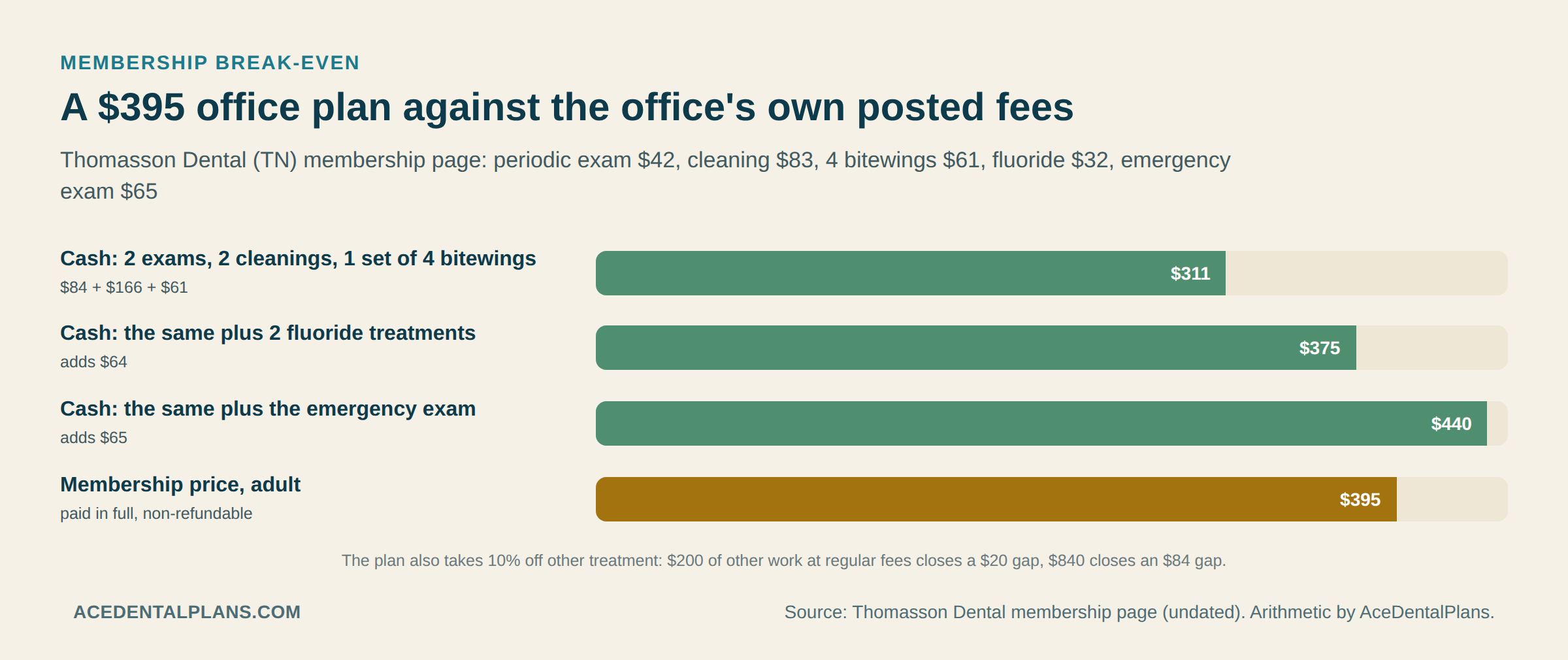
The Tennessee office whose fees appear above publishes enough to test the claim. Its adult plan costs $395, paid in full at enrollment, non-refundable, with automatic yearly renewal. It includes two periodic exams, one emergency exam, and two cleanings or two periodontal maintenance visits. Add two fluoride treatments, two oral cancer screenings, two periodontal screenings and preventive X-rays of an unspecified number, plus 10% off additional treatment. The page lists the office’s regular fee beside each service.
Put those fees to work. Two periodic exams at $42 are $84, two cleanings at $83 are $166, and one set of four bitewings is $61. That is $311. Add two fluoride treatments at $32 for $375. Add the $65 emergency exam, which most people never use, for $440. Against a $395 price, the plan costs $84 more than paying cash for the exams, cleanings and one X-ray set. It still costs $20 more with fluoride. It saves $45 only when every item, including the emergency exam, is used. The 10% discount closes the gap if you buy enough other work: $200 of additional treatment at regular fees covers the $20, and $840 covers the $84. A three-surface filling listed at $215 would cost a member $194.
| Route | Yearly cost | What the fee buys | Break-even in plain terms |
|---|---|---|---|
| Office membership, Tennessee example | $395 adult | 2 exams, 2 cleanings, X-rays, 1 emergency exam, 2 fluoride, 10% off other work | Cash value of the included items is $311 to $440 at the office’s posted fees; the plan wins only with fluoride, the emergency exam or about $200–$840 of other treatment |
| Office membership, Nevada example (KFF, 2021) | $348 | 2 exams, 2 cleanings, X-rays, emergency exam, 20% off other work | The dentist valued the package at $492, so full use saves $144; the value is his own figure |
| Aspen Dental Savings Plan | $49, plus $29 per family member | Exams and X-rays at no charge (twice per term); 30% off cleanings; 20% off gum treatment | At a hypothetical $150 cleaning fee, each cleaning saves $45; at $83 it saves about $25 |
| Discount plan with a published schedule (Careington Care 500) | Not stated on the schedule; $150 is the average cited by healthinsurance.org | Member fee ceilings: cleaning $33–$63, exam $18–$31 | Against a $150 regular cleaning, a $46 member fee saves $104 and repays $150 in two visits; against $83 it saves $37 and takes about four |
| No plan, pay cash each time | $0 | The office’s regular fee, no commitment | Cheapest if you skip a year or the office’s fees are already low |
Read across the table and one rule emerges. The savings come from the gap between the office’s regular fee and the member fee, multiplied by how many times you use it. A plan pays back fast where regular fees are high and slowly where they are already low. Fees you cannot see are the weak point. The comparison only works with the same dentist’s regular fee on one side and the member fee on the other, and a survey average is a poor stand-in for either.
Terms matter as much as arithmetic. The Tennessee plan cannot be combined with other plans or offers, renews automatically, and says rates may be adjusted annually with notice. KFF also notes that for a major procedure such as a crown, insurance often pays about half, which is more than most membership discounts. If you expect only routine care, none of that matters much. If a large bill is likely, the article on ways to pay for dental work compares routes to fund it.
Children, Teens, Adults and Seniors: Same Chair, Different Fee
Teaching clinics price children below adults, though by different margins. Clark College charges $40 for a child and $50 for an adult, which makes the child fee 80% of the adult one. Hudson Valley charges $6 for ages 4 to 12 against $10 for adults and teens, or 60%. Salt Lake Community College’s bundles run $15 against $25, also 60%. SUNY Orange charges $10 for patients up to 19 and $20 for adults 20 to 54, so the child fee is half.
The age line matters as much as the percentage. A 14-year-old pays the adult-and-adolescent fee at Hudson Valley, the child-and-teen fee at Salt Lake and the child fee at SUNY Orange. Ask which category your child falls into before you compare prices, and ask the same of a private office, which sets its own cutoff. Children’s coverage is also a separate question. Medicaid.gov says Medicaid covers dental services for all child enrollees as part of its EPSDT benefit, so a child with Medicaid should not be on the cash track at all.
Older adults appear in these schedules as a discount category. Hudson Valley makes cleanings free for adults 61 and older. SUNY Orange halves fees for patients 55 and older and for veterans of any age. For adults 65 and older, Medicare.gov says that Original Medicare in most cases does not cover dental services such as routine cleanings, with narrow exceptions tied to hospital stays and certain covered medical treatments. Whether Original Medicare or an Advantage plan pays anything toward a cleaning is covered in the explanation of whether Medicare covers dental, and until you have checked, treat cash as the default.
Which Cleaning Is on the Estimate: A Price Ladder
The word cleaning covers a ladder of procedures, and the rungs cost very different amounts. A routine prophylaxis sits at the bottom. Next is a full-mouth debridement, a heavier first cleaning when deposits are too thick for an exam. Above that is scaling and root planing, the deep cleaning, priced per quadrant of the mouth. Beyond that is periodontal maintenance, the recurring visit after gum treatment. Delta Dental’s cleaning page, which carries no year, lists all four without insurance. A standard cleaning runs $85 to $160, a full-mouth debridement $150 to $260, scaling and root planing $180 to $295 for a quadrant, and periodontal maintenance $140 to $220.
Other sources land in the same neighborhood. CareCredit’s page, citing a 2024 Synchrony study, averages $126 for a gross debridement cleaning, $242 for scaling and root planing per quadrant and $167 for a periodontal maintenance cleaning. The Careington schedules list $124 to $194 for scaling and root planing and $72 to $115 for periodontal maintenance as member fees. Clark College’s student clinic lists $15 to $20 per quadrant and $60 for maintenance, and Salt Lake Community College’s $25 advanced deep cleaning includes anesthesia and every follow-up visit needed to finish.
The American Academy of Periodontology describes scaling and root planing as a deep cleaning of the tooth root surfaces below the gumline, and says the majority of patients will need ongoing maintenance to sustain periodontal health. Which rung applies to you is a diagnosis, not a price decision, and the dentist or periodontist makes it after measuring the gums. The prices for that rung, with insurance classification, are in the guide to deep cleaning cost, and the cash-pay side, with line-by-line quote comparison, is in deep cleaning cost without insurance. The condition itself, its stages and its symptoms, is explained under gum disease.

If the cleaning turns into something else
- Ask before the hygienist starts a different procedure. A code change can multiply the line price several times.
- Ask for the finding behind it. You are entitled to hear what the exam showed and what the alternatives and costs are.
- You can pause. Asking for a written quote and booking the next visit later is a reasonable response, unless the dentist tells you a problem is urgent.
- Seek prompt care for swelling, fever or severe pain. Those are not cleaning questions, and the disclaimer at the end of this article lists the emergency signs.
A Year of Cash Cleanings, Priced Route by Route
To see how the settings compare over a full year, take one adult with healthy gums who goes twice. Each visit has a periodic exam and a cleaning, and four bitewing X-rays are taken once, at the first visit. Table 3 prices that year in each setting from the published fees, with the arithmetic in plain view. Every row is hypothetical in the sense that no one office charges all of these. The fees themselves are sourced.
| Route | How the year is built | Year total | What to remember |
|---|---|---|---|
| Private office, itemized (Tennessee list) | 2 × ($42 exam + $83 cleaning) + $61 bitewings | $311 | Add $64 if fluoride is done at both visits |
| Same office, membership | $395 adult plan | $395 | Includes fluoride and an emergency exam; non-refundable |
| Discount plan, schedule 501 | 2 × ($18 + $33) + $22 | $124 | Plus the unstated membership fee |
| Discount plan, schedule 505 | 2 × ($24 + $46) + $29 | $169 | Plus the unstated membership fee |
| Discount plan, schedule 508 | 2 × ($31 + $63) + $36 | $224 | Plus the unstated membership fee |
| Hygiene school (Hudson Valley) | 2 × $10 | $20 | Fee includes evaluation, fluoride and X-rays; hours are posted by semester |
| Hygiene school (Salt Lake CC) | 2 × $25 | $50 | Bundle includes exam, X-rays and fluoride |
| Health center, lowest to top discounted tier | 5 procedures × $12, $30, $40 or $45 | $60, $150, $200 or $225 | Assumes each exam, cleaning and X-ray set is a separate procedure |
| Chain with savings plan (hypothetical $150 cleaning) | $49 plan + 2 × $105 for the cleanings | $259 | Exams and X-rays at no charge, limited to twice per term |
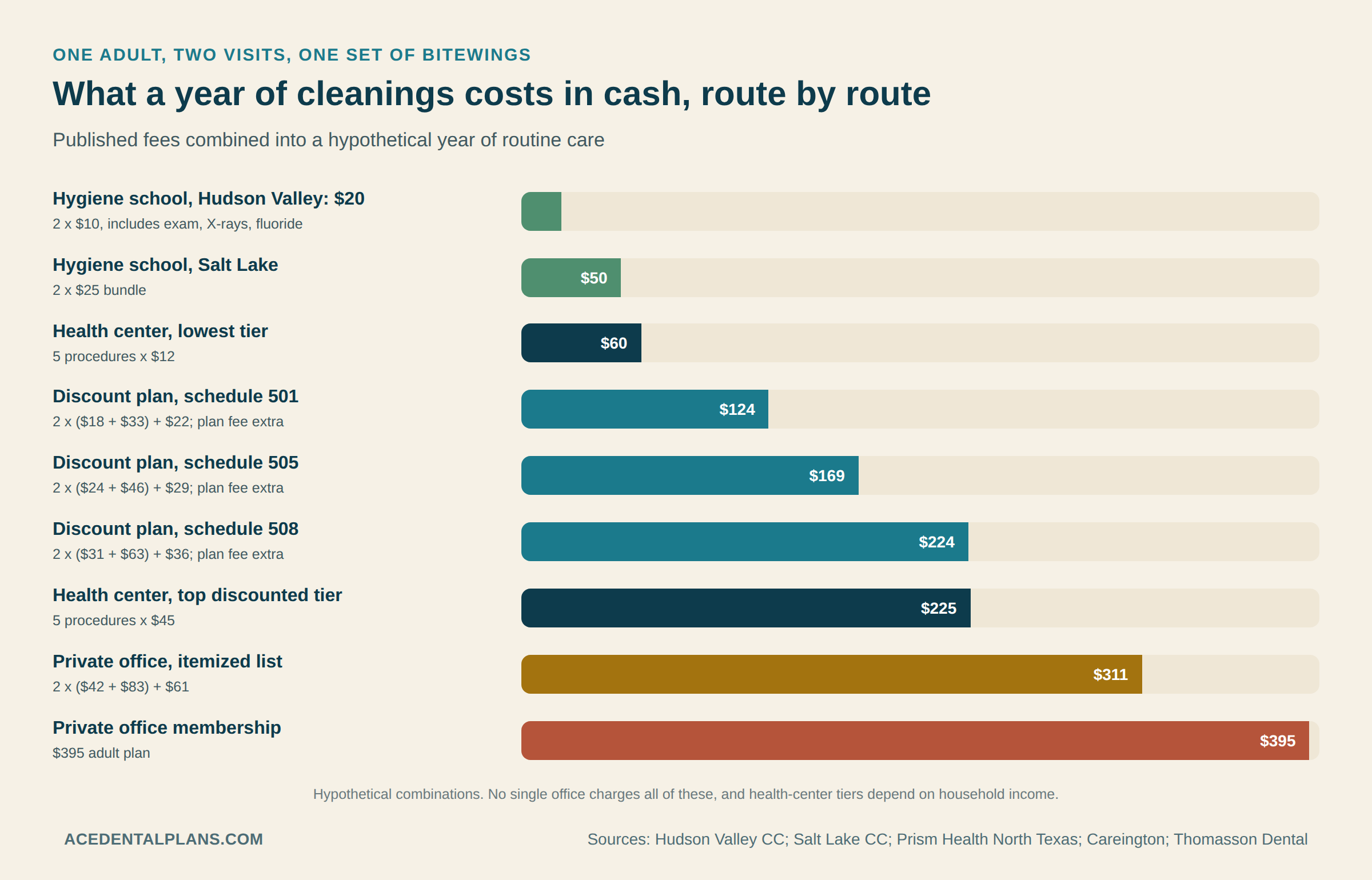
The spread is the point. The same year costs $20 to $50 at a hygiene school and $60 to $225 at a health center, depending on income. It costs $124 to $224 at the discount-plan fee ceilings before the plan fee, and $311 or more at a private office with a posted list. Those are not tiers of quality. The cleaning is the same procedure on a different payer model, and the differences live in time, acceptance and how many other services the setting can offer.
What Skipping Cleanings Can Cost, in Plain Arithmetic
Cash buyers skip visits more than anyone, and the reason is rarely carelessness. An ADA Health Policy Institute analysis reported in ADA News in June 2026 found that the share of people without dental benefits fell from about one-third in 2003 to roughly one-quarter in 2023. That still leaves about one in four people paying their own way. A cleaning that feels like a $150 decision is easy to put off.
The CDC says about 4 in 10 U.S. adults 30 and older had periodontitis in 2009–2014, and about 60% of adults 65 and older. It lists smoking, diabetes, poor oral hygiene and several other factors as associated with gum disease. It also says a yearly checkup can help detect and prevent gum disease, which can become serious before symptoms appear. A cleaning visit is where that look happens. Nothing here says that missing one cleaning causes gum disease. The point is narrower: regular visits are where problems are found while they are still small.
The price ladder turns that into arithmetic. Two routine cleanings a year at Delta Dental’s range of $85 to $160 cost $170 to $320. A four-quadrant deep cleaning at the same page’s $180 to $295 per quadrant costs $720 to $1,180, and at CareCredit’s $242 average it comes to $968. Periodontal maintenance afterward runs $140 to $220 a visit on the Delta page, and the interval between visits is the periodontist’s call. A cavity found late brings its own bill, which is priced in the guide to dental filling cost without insurance.
That last point is the useful one. When the cheapest route is a $10 to $50 teaching clinic, the cost of staying regular can be below the cost of one skipped year at private rates. It is a reason to match the route to your budget instead of dropping out of care.
Asking for a Cash Price: Questions That Produce a Real Number
Most price confusion starts with asking “how much is a cleaning?” and getting an answer about a different bundle than the next office meant. Specific questions fix that. They also work by phone in about three minutes, and they put the office on notice that you are comparing.
- What is the fee for each line? Ask for the exam, the X-rays and the cleaning separately, by CDT code if the office uses them: D0120 for a periodic exam, D0274 for four bitewings and D1110 for an adult cleaning.
- Which of those are included in the number you just gave me? This single question catches the $29 exam special and the $75 cleaning-only quote.
- Do you have a different fee for patients without insurance, a membership or a discount-plan rate? Whether there is one is the office’s choice, and a no is just data.
- Will you use X-rays I already have? The ADA asks dentists to make a good-faith attempt to use earlier radiographs, and the request costs nothing.
- What changes the quote if the exam finds gum disease or a cavity? Ask for the price of that next rung before you sit down.
- How and when do I pay? The schedules above include cash only, payment before treatment, a $1 card surcharge and payment at the end of each visit.
Then ask for the answers in writing, by email or text. A written quote is easy to compare across offices and hard to misremember when the bill arrives. CMS says people without insurance, or who do not use it, are usually entitled to a good faith estimate when they schedule care at least three business days ahead or ask for one. You may be able to dispute a bill that is at least $400 above it. The CMS page does not say how this applies to dental offices, and a cleaning bill rarely reaches that threshold. Ask for the written estimate as good practice, and do not count on the dispute process for a bill of a few hundred dollars.
One more habit: keep a copy of what you pay. IRS Publication 502 describes cleanings and fluoride as preventive dental care. It lists them among dental expenses that can count toward the medical-expense deduction once your total medical and dental expenses exceed 7.5% of adjusted gross income. Whether a health savings account or flexible spending account reimburses them depends on the account’s rules, which the comparison of HSA vs FSA for dental expenses goes through.
When Premiums Cost More Than the Cleanings They Pay For
For a person who needs only routine care, the cash route is often cheaper than a plan. KFF Health News reported in 2021 that annual dental insurance premiums typically ran $400 to $700 and that benefit caps were typically $1,200 to $1,500 a year. Table 3 shows two cash cleaning visits at $20 to $311 depending on setting. The arithmetic favors cash if you expect no work beyond the cleanings.
The picture flips when you expect fillings, a crown or more. Delta Dental says most of its plans cover all or part of the cost of preventive services such as routine cleanings, X-rays and exams, within frequency limits that vary by plan. Premiums, deductibles, coinsurance and annual maximums are laid out in how dental insurance works. The sorting of services into preventive, basic and major tiers is in what dental insurance covers. Waiting periods can mean a new plan pays little at first, so look at them before you count on a plan for early treatment.
For reference prices on other procedures, the dental price guide lists typical figures by service.
Bottom Line
A cleaning has no single cash price, and quoting one is a sign the quote is incomplete. Work from the visit, not the word. Ask what the number includes, price the exam and X-rays on their own lines, and keep the cleaning fee separate so you can compare it across settings that package things differently.
Then match the setting to what you have more of. If you have time and flexibility, a hygiene or dental school clinic is the lowest published price in this article. If you have income documents and a health center nearby, a sliding fee can price a visit at a fraction of the private rate at the lower tiers. At the top tier it lands near the discount-plan level. If you want a regular private dentist, a posted fee list or a discount-plan schedule gives you numbers to compare, and a membership repays itself only when you use what it includes.
Whatever you choose, settle the visit interval with the dentist. The arithmetic of a skipped year is rarely in your favor, and a $25 teaching-clinic visit keeps the door open. For the wider set of routes, see the full range of Dental Costs guides.
Frequently Asked Questions
How much does a teeth cleaning cost without insurance?
Healthinsurance.org’s 2026 guide puts a cleaning at $75 to $200, and Delta Dental’s cost page gives $85 to $160. A national Synchrony study averaged $203 for an exam with cleaning and X-rays. Teaching clinics post far lower fees, from $10 to $50 in four published schedules, and one discount plan’s 2026 schedule lists $33 to $63. The number you pay depends on the setting and on which lines the quote includes.
What is the lowest-cost way to get a cleaning without insurance?
In the published schedules reviewed here, dental hygiene school clinics were lowest, at $10 to $50 and sometimes with the exam, X-rays and fluoride included. Discount-plan fee ceilings and income-based health-center fees come next. Each lower price trades something: longer visits, an acceptance process, a limited menu of services or paperwork. Choose by the total of money, time and flexibility, not the fee alone.
Does a $29 new-patient special include a cleaning?
The Aspen Dental offer reviewed here does not. Its page prices an exam and X-rays at $29 for new patients without insurance at select offices, and says cleanings are a separate cost booked for a later visit. The offer is limited to patients 21 and older and runs through December 31, 2026. Ask any office offering a special what the cleaning will cost on the second visit before you book the first.
Is a dental school cleaning really cheaper?
Often, but the published evidence is thin on cleanings specifically. UT Health San Antonio says its student clinic fees are about 60 percent lower than private practice, with a $50 screening fee, and the University of Detroit Mercy lists a $30 comprehensive exam. Neither posts a cleaning price. Both say visits take longer. Hygiene-school clinics publish actual cleaning fees, which makes them the easier place to compare numbers.
Are dental discount plans worth it for cleanings?
They pay off when the gap between the dentist’s regular fee and the member fee, multiplied by your visits, exceeds the plan fee. Healthinsurance.org puts the average annual fee at about $150. Suppose a regular $150 cleaning and a $46 member fee: two visits repay it. At an $83 regular fee, it takes about four. The dentist must participate, so call the office, not only the plan.
Is a dental office membership worth it for two cleanings a year?
Only if its fee is below what you would pay in cash for the same items. At one Tennessee office, a $395 adult plan was worth $311 to $440 at the office’s posted fees, depending on whether fluoride and the emergency exam were used. Memberships are not insurance, may be non-refundable and may auto-renew. Ask for the office’s fee list and do the subtraction before you pay.
How much is a child’s cleaning without insurance?
At four teaching clinics, the child fee ran from 50% to 80% of the adult fee, for example $6 against $10 at Hudson Valley and $40 against $50 at Clark College. Private offices set their own fees and age cutoffs, and no national child-cleaning price turned up. Medicaid.gov says Medicaid covers dental services for all child enrollees, so check eligibility before paying cash for a child.
How often do I need a cleaning if I pay cash?
Delta Dental says a cleaning is needed at least once a year and advises a dentist visit every six months. The CDC says to get a checkup at least once a year or more often if your provider recommends it. The right interval depends on your gum health and risk, and the dentist sets it. Because cash payers feel every visit directly, it is fair to ask the dentist what interval fits your own risk.
Why did my cleaning quote jump after the exam?
Usually because lines were added: the exam, X-rays or fluoride that the first number left out. Less often, the exam finds signs of gum disease and the recommended service changes to a costlier procedure priced per quadrant. Ask for an itemized estimate with a code and a fee on each line, and ask what you are paying for and what you can decline or schedule later.
Can I use an HSA or FSA for a cleaning?
IRS Publication 502 lists cleanings and fluoride as preventive dental care among medical expenses that count toward the medical-expense deduction. Whether a particular health savings account or flexible spending account reimburses a cleaning depends on the account’s rules and your plan administrator. Keep the receipt and the itemized bill either way, and check the plan documents if you are choosing between accounts.
Sources and Disclaimers
Cash price ranges come from consumer cost surveys and a lender-sponsored study (healthinsurance.org, Delta Dental, Synchrony via CareCredit), which describe different parts of the market and different years. Setting-specific fees come from the providers’ own published pages and schedules: college hygiene clinics, dental schools, a health-center rate sheet, a national chain, a discount-plan administrator and one private office. Several of those pages carry no date, and the article says so where that matters. Program rules come from HRSA, Medicare.gov, Medicaid.gov, CMS and the IRS, and clinical context from the ADA, CDC, NIDCR and the American Academy of Periodontology. Sums, break-even calculations and the sample cash bills are original arithmetic on those published fees, and every hypothetical number is labeled as one. National averages say little about your ZIP code, so confirm prices with the dentist and any benefit rules with your insurer or plan administrator.
- Synchrony / CareCredit — Average cost of dental procedures
- healthinsurance.org — How much do dental cleanings cost without insurance?
- healthinsurance.org — Dental discount plan glossary entry
- Delta Dental — Dental cleanings: cost and insurance coverage
- Delta Dental — What to expect at a dental cleaning
- Hudson Valley Community College — Dental hygiene clinic services and fees
- Salt Lake Community College — Dental hygiene clinic services and fees
- SUNY Orange — Dental hygiene clinic fees
- Clark College — Dental hygiene clinic fee schedule
- UT Health San Antonio School of Dentistry — Student dental clinic
- University of Detroit Mercy School of Dentistry — Becoming a patient
- Prism Health North Texas — Sliding fee scale rates (April 2026)
- Health center sliding fee document — Basic dental sliding fee (updated January 20, 2026)
- HRSA — Health Center Program Compliance Manual, Chapter 9: Sliding fee discount program
- NIDCR — Finding dental care
- Aspen Dental — Dental checkup cost
- Aspen Dental — Dental Savings Plan
- Aspen Dental Savings Plan — Member fee schedule effective January 1, 2026
- Careington — Care 500 sample member fee schedules (effective January 1, 2026)
- Thomasson Dental — Membership plan and savings examples
- KFF Health News — Dentists chip away at uninsured problem by offering patients membership plans (2021)
- American Dental Association — Dental plan overview
- American Dental Association — X-rays and radiographs
- ADA News — Fewer patients uninsured but gaps remain (June 2026)
- CDC — About gum (periodontal) disease
- American Academy of Periodontology — Non-surgical treatments
- CMS — Good faith estimate
- Medicare.gov — Dental services
- Medicaid.gov — Dental care
- IRS — Publication 502 (2025), Medical and Dental Expenses
Important Information and Disclaimers
This article is general educational information. By using it, you accept the limits described below.
Not dental or medical advice
Nothing on this page is a diagnosis, a treatment recommendation or a substitute for an examination by a licensed dentist or physician. Reading this article does not create a dentist-patient or doctor-patient relationship. Only a licensed professional who has examined you and reviewed your history can tell you what your mouth needs. Do not delay, skip or stop professional care because of something you read here.
Prices are estimates, not quotes
Cost figures are ranges reported by the third-party sources cited in this article. Actual prices depend on your location, the provider, the complexity of your case, the materials used, the date of service and other factors, so what you pay may be higher or lower. A written treatment plan and fee estimate from the dental office is the only reliable number for your situation.
Insurance and plan examples are illustrations
Examples that use named amounts or percentages are hypothetical. Real benefits depend on your plan, network, waiting periods, annual maximum, deductible and the insurer’s rules at the time of treatment. A pre-treatment estimate or benefits check is not a promise of payment. Confirm the details with your insurer or plan administrator in writing.
Not insurance, legal, tax or financial advice
AceDentalPlans is an information publisher. Nothing here is insurance, legal, tax, investment or other professional financial advice, and nothing here recommends a particular provider, insurer, lender, discount plan or financing product. Company and product names belong to their owners and appear for identification only. Read the terms of any loan, financing offer or plan before you sign, and ask a qualified professional if you need advice on your own circumstances.
Third-party sources
This article cites government agencies, professional associations, insurers, lenders and other outside organizations. We do not control those sources. Their content can change, move or disappear, and listing a source is not an endorsement of it or of anything it sells.
No warranty
We aim for accuracy, but this article is provided “as is,” without warranties of any kind, express or implied, including warranties of accuracy, completeness, timeliness or fitness for a particular purpose. Some information may be out of date or contain errors by the time you read it.
Limitation of responsibility
To the fullest extent permitted by law, AceDentalPlans and its owners, authors and contributors are not responsible or liable for any loss, cost, injury, health outcome or other damage that results from using this article or relying on it. You are responsible for your own decisions about your care, your coverage and your money.
How this article is written
This article follows AceDentalPlans’ answer-first, U.S.-focused editorial approach. It uses conditional language for insurance, because coverage depends on the specific plan, and it names its sources so that you can read them yourself.