
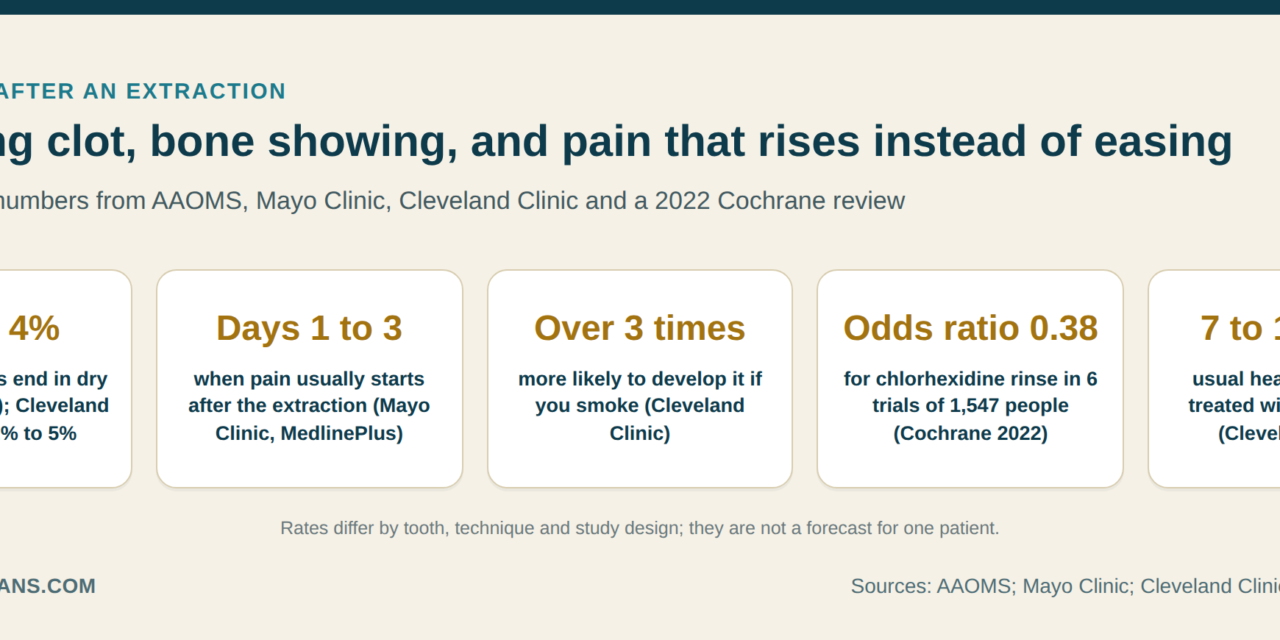
A dry socket looks like an empty hole where the tooth was, with a pale or whitish layer of bone at the bottom instead of a dark blood clot. The hole alone rarely tells the story, though. The giveaway is pain that climbs one to three days after an extraction, when it should be easing. Cleveland Clinic puts dry socket at 2% to 5% of extractions, and the American Association of Oral and Maxillofacial Surgeons says about 4%.
This article describes what a healthy extraction site looks like, how a dry socket differs, and why a quick mirror check can mislead. It covers the pain timeline, risk factors, what dentists do about it, prevention, red flags and the general price points around a dry-socket visit. It stops short of full extraction pricing, numbness questions and alcohol, which each have their own page.
Key Takeaways
- Dark clot is good news. Cleveland Clinic describes a normal clot as a dark scab, and AAOMS says the tissue that follows can be white, pink or red and look granular.
- White does not mean dry socket. Cleveland Clinic says a clot that merges with nearby tissue may look whitish and is not a sign of infection.
- Timing matters more than color. Mayo Clinic and MedlinePlus place the pain at 1 to 3 days after extraction; Delta Dental and StatPearls say 1 to 5 days.
- A rinse may lower the odds. A 2022 Cochrane review found a chlorhexidine rinse probably lowers the odds of dry socket (odds ratio 0.38 across 6 trials).
- Treatment is usually one office visit or a few. The dentist cleans the socket and places a medicated dressing; Cleveland Clinic says healing usually follows within 7 to 10 days.
- Call the same day for pain that keeps you awake or ignores medication, for pus, or for a fever of 100.4 degrees Fahrenheit or higher.

What a Healthy Extraction Socket Looks Like First
You can only spot a problem if you know what the baseline looks like. After a tooth comes out, the socket fills with blood, and that blood clots. The healthy version, in Cleveland Clinic’s words, is a dark scab that protects the area while it heals, and AAOMS calls the clot the first step of the healing process.
Over the next days the picture changes. AAOMS describes four overlapping stages: bleeding and clot formation, an inflammatory stage with swelling and redness, a proliferation stage in which new tissue and blood vessels grow in, and a maturation stage in which collagen strengthens the repair. During proliferation, the surface can be what AAOMS calls “a protective tissue that can be white, pink, or red” with a granular texture. The medical name is granulation tissue, and it is a sign healing is moving along.
Here is the part that trips people up. The clot may also merge with nearby tissue and look whitish, which Cleveland Clinic calls normal and not a sign of infection. A white or yellowish patch in the socket on day three is therefore not, by itself, a dry socket and not, by itself, pus.
The same Cleveland Clinic page says the socket heals from the bottom up and may leave a small indentation as new tissue fills it. It adds that the jawbone takes several weeks to heal completely, and that a large tooth such as a molar can need up to four months for the jaw to fully heal. So a socket that still looks like a dimple at week three is not a failure. It is a work in progress.
None of the sources opened for this article ties a specific color to a specific day, and AAOMS gives no timing for its four stages at all. Treat any day-by-day picture, including the one in Table 2 later on, as a frame for your own notes rather than a clinical schedule.
What a Dry Socket Looks Like, and How It Differs From Healing and Infection
Dry socket, formally alveolar osteitis, is the loss of the clot, either partly or completely, or a clot that never forms properly. MedlinePlus puts it plainly: the bone is left exposed to air, which causes pain and slows healing. The ADA’s MouthHealthy page adds that bone and nerves are exposed once the clot is displaced.
The visible clues the sources list are few and consistent:
- An empty-looking socket. The socket may look empty because the clot is partly or fully gone, says Mayo Clinic. Cleveland Clinic describes “an empty hole where your tooth was.”
- Visible bone. Bone visible in the socket appears on both the Mayo Clinic and Delta Dental lists. Cleveland Clinic says the whitish layer at the bottom is exposed bone.
- Food debris. Food can collect in the socket and worsen the pain, Mayo Clinic notes.
- Little or no sign of infection. StatPearls says some redness and swelling can be expected but there should be no frank signs of infection, and that vital signs are typically stable with no fever.
Notice what is missing. No source describes a dramatic color. The one visual that recurs is bone where a dark scab should be. A dentist who looks into a lower wisdom-tooth socket with a light, a mirror and sometimes an X-ray can tell far more than a phone flashlight can, and StatPearls itself says exposed bone may be hard to visualize.
That caution is worth taking seriously. The back of a lower jaw is deep, wet and dim. Swollen gum, stitches, a blood-tinged film and a normal white-pink tissue can all sit in the same few millimeters, and a hole that looks dark to you may still be a healthy clot.
Normal socket, dry socket or infection: a side-by-side look
Three different problems get lumped together in searches: a socket healing normally, a dry socket, and an infection of the extraction site. Their treatments differ, and so does the urgency. Table 1 lines up what the sources say about each.
| Feature | Normal healing | Dry socket | Infection of the site |
|---|---|---|---|
| In the socket | Dark scab-like clot first; later granular tissue that can be white, pink or red | Looks empty, bone visible, whitish layer at the bottom, no clot | Pus can form, with redness and swelling around the site |
| Pain pattern | Day 3 is usually the roughest, then it eases | Severe, often rising 1 to 3 days (some sources say up to 5) after extraction; may spread to the ear, temple or neck; may not respond to usual pain relievers | Increased pain, often with swelling |
| Taste and breath | Not described as a feature in the sources | Bad taste, bad breath or a foul smell | Salty or prolonged bad taste |
| Fever | Call if 100.4 °F (38 °C) or higher | Usually none; Delta Dental and MedlinePlus mention a slight fever | Fever is a listed sign |
| Swelling | Some swelling in the first days; effects should fade within a week | Some redness and swelling, without frank signs of infection | Increased swelling and redness |
| Usual next step | Follow aftercare, rinse gently, keep follow-up visits | Dentist cleans the socket, places a medicated dressing, helps with pain | Report to the oral surgeon right away; antibiotics, sometimes drainage |
The overlap is the point. Bad taste and a low-grade temperature can appear in either of the last two columns, which is why MedlinePlus lists worsening breath or taste as a reason to call. Plenty of people cannot tell which column they are in, and the dentist does not expect them to.

Why a mirror check is a weak test
Many readers arrive here holding a phone flashlight and a worry. A mirror check can settle one question, whether there is a dark clot filling the hole, and leave every other question open. The sockets of lower wisdom teeth are deep, covered by swollen tissue and often partly stitched.
Sticking something into the socket to look is the real hazard. Brushing directly over the extraction site should wait until your dentist says it is safe, Cleveland Clinic advises, and it also says to avoid vigorous spitting or rinsing. Poking with a finger, a toothpick or a cotton swab could dislodge a clot that is doing its job.
A better test uses three questions you can answer without touching anything:
- Is the pain heading the wrong way? Ordinary soreness should peak around day three and then ease. Pain that deepens, or returns after easing, is the classic story.
- Is it spreading? Pain that travels to the ear, eye, temple or neck on the same side appears on the Mayo Clinic and MedlinePlus lists. AAOMS adds the chin.
- Is the medicine working? StatPearls describes the pain of dry socket as unrelieved by analgesics, and Cleveland Clinic names pain that does not improve with medication as a reason to call.
Two “yes” answers justify a phone call to the office that did the extraction. One “yes” with an uneventful mouth can wait for a call in the morning, as long as nothing in the red-flag box below applies.
The Pain Clock From Day 0 to Day 7, and the Symptoms That Travel With It
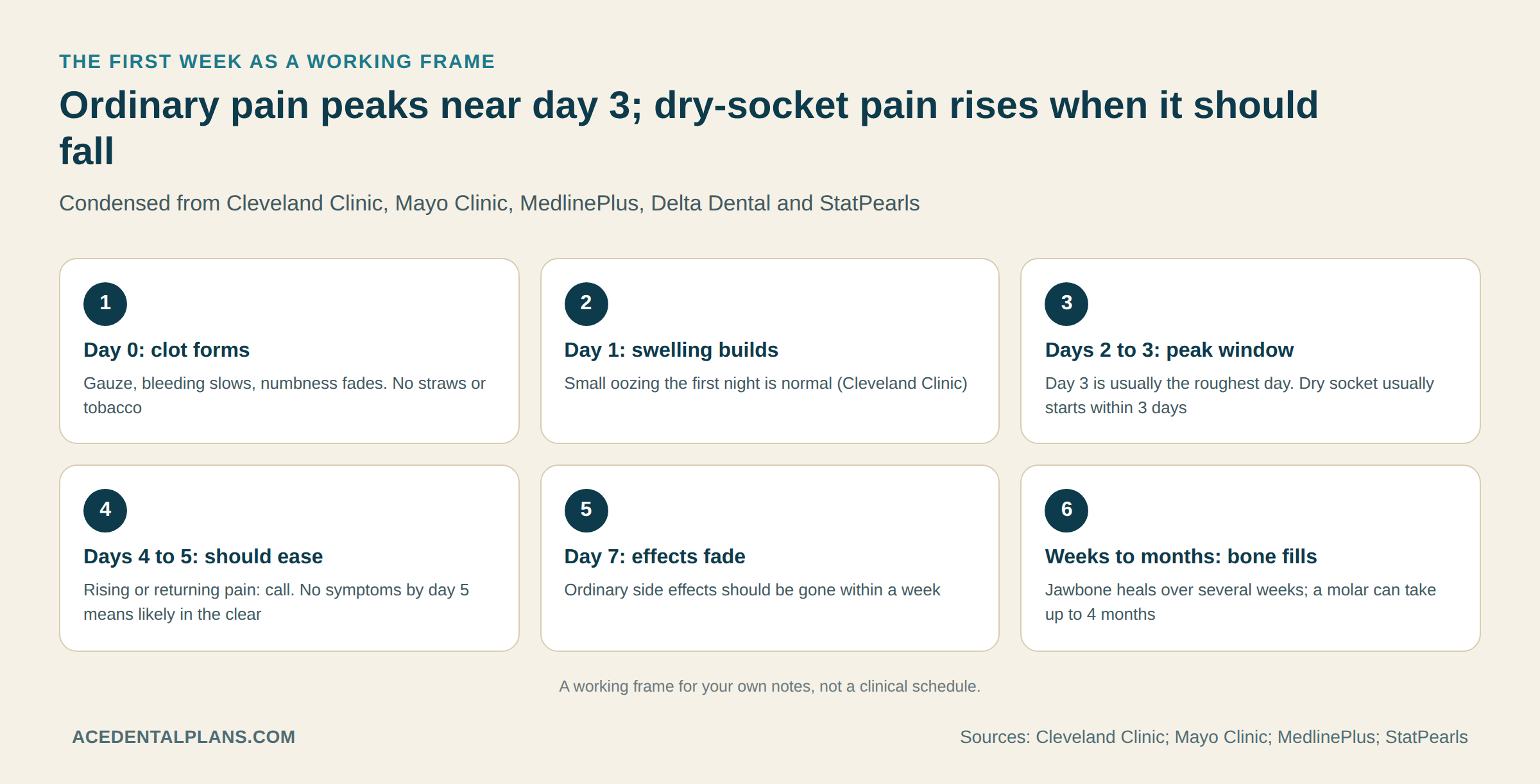
Dry socket is a timing diagnosis as much as a visual one. The sources disagree a little on the window, which is useful to see laid out. Pain usually starts 1 to 3 days after the tooth is removed, according to Mayo Clinic, and MedlinePlus says roughly 1 to 3 days. Delta Dental describes a sudden increase in pain intensity a few days after the extraction, which it specifies as one to five days, and StatPearls says pain typically occurs between one and five days afterward. Harvard Health says it can start a few days after extraction, at a point when pain should be easing.
Cleveland Clinic offers the most reassuring bookend: dry socket usually develops within the first three days, and if you have no symptoms by day five, you are likely in the clear. Table 2 turns these statements into a working frame. The day ranges are an organizing aid, not a clinical schedule.
| When | What the sources describe as ordinary | What points toward dry socket | Reasonable response |
|---|---|---|---|
| Day 0 | Bleeding and clot formation; gauze; numbness fading | Not a dry socket window | Follow the written instructions; skip straws and smoking |
| Day 1 | Small oozing the first night; swelling and soreness building | Severe pain that the first doses do not touch | Take medication as directed; call if pain is out of proportion |
| Days 2 to 3 | Day 3 is usually the roughest day of ordinary pain | Pain that deepens, spreads to the ear or temple, or comes with a bad taste | Call the office that did the extraction |
| Days 4 to 5 | Pain should be easing; bruising fading | Pain that returns or climbs after easing; foul odor | Book an exam; do not wait for the weekend to pass |
| Days 6 to 7 | Side effects usually gone within a week | Persistent pain, worsening breath or taste (could mean infection) | Call; infection signs need a prompt visit |
| Week 2 onward | Gum closing; indentation filling; jawbone still remodeling | New pain after a symptom-free spell | Call; this is outside the usual dry-socket story |
Symptoms beyond the hole: ear pain, taste, breath and fever
The sources agree on a short list of symptoms that travel with the empty-looking socket. Pain that radiates to the ear, eye, temple or neck on the same side as the extraction is listed by Mayo Clinic, MedlinePlus and Delta Dental. StatPearls describes it as radiating pain in the distribution of the trigeminal nerve, the large facial nerve that carries sensation from the jaw.
Breath and taste come next. AAOMS lists bad breath alongside severe pain, Mayo Clinic lists bad breath and a bad taste, and Delta Dental includes a foul smell or taste. StatPearls says halitosis is commonly reported but does not mention a bad taste. The practical reading is that an unpleasant taste or smell that returns soon after brushing or rinsing deserves a call, not a stronger mouthwash.
Fever is where the pages disagree, and the disagreement is informative. Delta Dental and MedlinePlus mention a slight fever; Harvard Health says a low-grade fever is possible and that a temperature above 101 degrees Fahrenheit may signal infection; Mayo Clinic does not mention fever; StatPearls describes dry socket patients as typically afebrile. Cleveland Clinic draws its call-the-dentist line at 100.4 degrees Fahrenheit (38 degrees Celsius). A fever alongside dry-socket pain does not prove infection, yet it moves you from “call in the morning” toward “call now.”
One more detail from Mayo Clinic: dry socket is painful but rarely causes infection or other serious complications, although it can delay healing, prolong pain and occasionally lead to infection in the socket. Both halves of that sentence are true at once. It is a miserable problem and, in most cases, a self-limiting one.
How Common It Is, Who Gets It and Why the Clot Fails
How common: why the percentages disagree
If you search for a single rate you will find several. AAOMS says dry socket follows approximately 4 percent of all extractions. Cleveland Clinic gives about 2% to 5% and adds that it is more common after wisdom tooth removal. StatPearls says the commonly reported range is 0.5% to 5%, with some studies reporting up to 68%, and that systematic reviews found about 30% of mandibular third molar extractions develop it.
Those numbers look contradictory, but they measure different things. A routine extraction of an upper front tooth and a surgical removal of an impacted lower wisdom tooth belong to different risk pools. Studies also define dry socket differently (some count any post-extraction pain with a lost clot, others require specific findings), follow patients for different lengths and enroll different mixes of smokers and non-smokers. A 2015 review in the Journal of Clinical and Diagnostic Research by Tarakji and colleagues quotes individual-study incidences of 0.6%, 3.2%, 19.14% and 23.45%, which shows how wide the spread can be.
For a single patient, the most useful summary is a ladder rather than a number. Lower back teeth, harder extractions and tobacco push the odds up. A simple extraction of an upper tooth sits at the low end. The national averages only tell you the ladder exists.
Risk factors with numbers attached
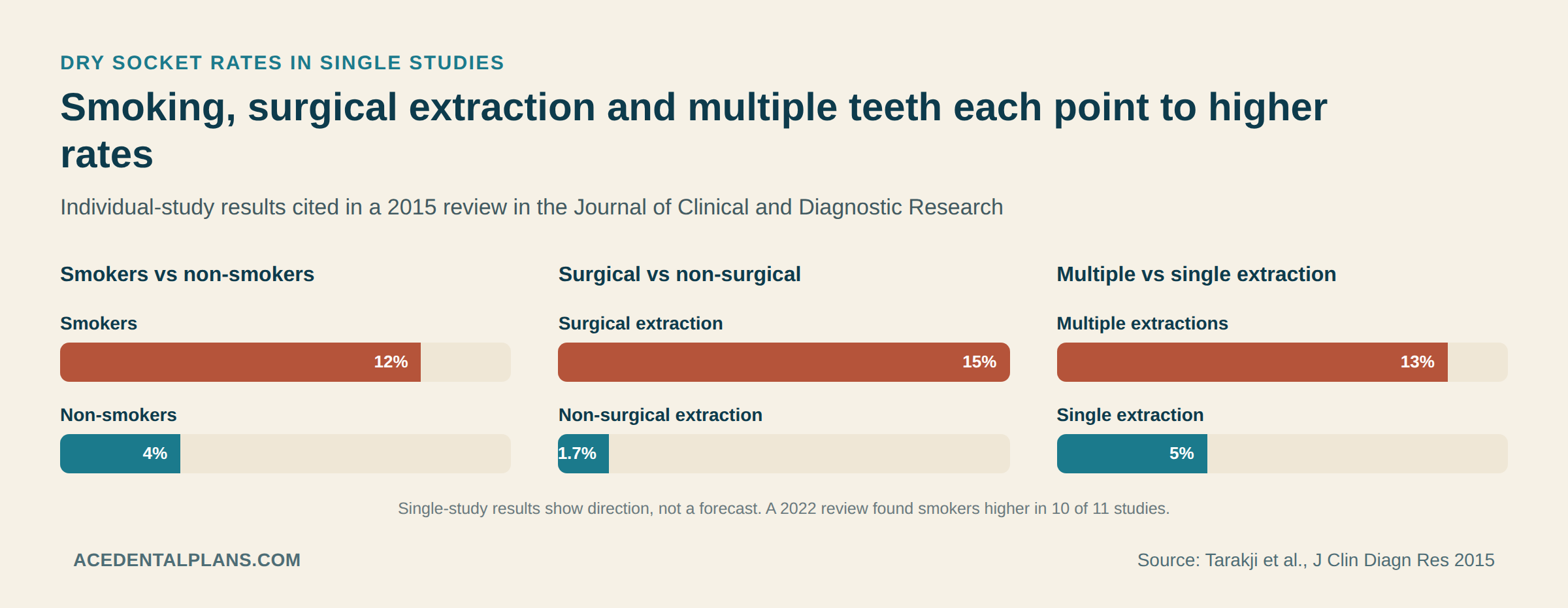
Every source lists roughly the same risk factors, but few attach numbers. The ones that do are worth reading carefully, because they come from individual studies with different designs. People who smoke are over three times more likely to develop dry socket, according to Cleveland Clinic. The Tarakji review, citing individual studies, reports 12% among smokers against 4% among non-smokers, 15% after surgical extractions against 1.7% after non-surgical ones, and 13% after multiple extractions against 5% after single ones.
Those pairs point the same way, yet they are single-study results and should not be added together or applied to one person. A 2022 systematic review of smoking and dry socket in the journal Dentistry Journal tabulated 11 studies. Smokers had a higher reported rate than the whole study group in 10 of the 11, and the two figures were equal in the remaining one. The review’s gaps were wide, from 5.0% overall versus 6.7% in smokers in one study to 11.7% versus 33.3% in another, so the direction is consistent even when the size is not.
Beyond tobacco and surgical difficulty, the lists from Mayo Clinic, Delta Dental, MedlinePlus, Harvard Health and StatPearls add the following:
- Lower wisdom teeth. StatPearls says lower third molars have a significantly higher incidence than all other extraction sites combined, and attributes part of this to the greater vascularity of that area.
- Estrogen-containing birth control. Mayo Clinic and Cleveland Clinic list birth control pills, and StatPearls links oral contraceptive use and the middle of the menstrual cycle with fibrinolysis, the process that breaks down clots. Do not stop a prescribed medication on your own; tell the dentist or surgeon what you take.
- Poor oral hygiene or poor aftercare. Listed by Mayo Clinic, Delta Dental, MedlinePlus and StatPearls.
- An infection at the site. A current or previous tooth or gum infection is on the Mayo Clinic and Delta Dental lists; AAOMS lists an infected site at the time of extraction.
- A past dry socket. Delta Dental, MedlinePlus and Harvard Health name a prior episode as a risk marker.
- Straws and frequent rinsing or spitting. MedlinePlus, Harvard Health, AAOMS and Cleveland Clinic list them as ways to dislodge the clot.
- Operator experience and flap design. StatPearls cites these among factors supported by multiple publications. Mayo Clinic suggests choosing an experienced dentist or oral surgeon.
- Age and sex. StatPearls says female sex and older age are reported to increase incidence but notes that data conflict; AAOMS lists older age.
The straw advice deserves a footnote. Several sources name straws as a trigger, yet none of the pages reviewed for this article gives a trial-based risk figure for straw use alone. The advice is cheap and costs nothing to follow, which is probably why it persists.
What actually makes the clot fail
On the cause, Mayo Clinic is frank: it is still under study. The leading explanations fit together rather than compete. A clot can be knocked out mechanically by suction, spitting or a probing tongue. It can dissolve if enzymes in the socket break it down faster than it can organize, which is the fibrinolysis idea StatPearls mentions in connection with estrogen. It can also be disrupted by bacteria or trauma at the surgical site, which Mayo Clinic notes is more likely when removal is difficult, as with an impacted wisdom tooth.
AAOMS compresses all of this into one line: the clot prematurely dislodges, dissolves or does not form properly. The first is the one patients can influence, the second mostly depends on biology and the third on the surgery. That split matters for a practical reason. A person who developed dry socket despite doing everything right has not failed at aftercare, and one who did smoke through the first day has not necessarily caused it.
Tobacco is the one factor with a plausible mechanical and chemical route at the same time. The chemicals in tobacco may slow healing, says Mayo Clinic, and that sucking on a cigarette can dislodge the clot, and Cleveland Clinic’s extraction page says vaping or smoking afterward constricts blood vessels. Both pathways work against a clot that needs blood supply to organize.
Treatment: What the Dentist Does, Relief Between Visits and Healing Time
What the dentist does at the visit
If you call with the symptoms above, expect to be seen the same day or the next, because the pain is the reason. The visit itself is short. The ADA’s MouthHealthy page lists the sequence: clean the extraction site, place a medicated dressing in the socket, and change the dressing daily until the pain diminishes and the socket begins to heal.
The details come from other pages. Harvard Health says the dentist numbs the area, cleans the socket with a sterile rinse and fills it with a medicated paste. Irrigation with salt water or antibacterial mouthwash and medicated dressings containing lidocaine or eugenol appear on the Cleveland Clinic list. Delta Dental says a dentist may place medicated gauze and replace it every day or two. MedlinePlus mentions frequent visits to change the dressing.
Antibiotics are a common misunderstanding. Delta Dental states that dry socket is not an infection, so antibiotics are usually not prescribed unless an infection is suspected. StatPearls goes further and recommends against oral antibiotics for preventing or treating dry socket because support is weak and adverse reactions are likely. Cleveland Clinic and MedlinePlus list antibiotics as an option when infection is suspected, which is consistent: the trigger is infection, not the empty socket.
What does the evidence say about the dressings themselves? Less than you might hope. The 2022 Cochrane review compared an older formulation of a medicated dressing with zinc oxide eugenol and rated the certainty of any pain difference at day 7 as very low, based on two studies and 80 people. StatPearls reports that no consensus treatment protocol exists, that irrigation has the most support as an initial step, that curettage (scraping the socket) is not recommended, and that many dressings need removal to avoid foreign-body reactions and can slow healing. That last point is why dressing visits are scheduled rather than optional.
Relief between visits: what the sources support
Dressings take much of the edge off, but you still have hours to fill. Harvard Health lists over-the-counter acetaminophen and ibuprofen, which it says can be taken together, plus a cold pack on the outside of the mouth, gentle salt-water or special-mouthwash rinsing that is allowed to drip out without spitting, and no brushing near the site for at least 24 hours. The ADA’s analgesic page says combining an NSAID and acetaminophen is highly effective for mild to moderate pain and cites a JADA overview of third-molar extraction studies in which the combination outperformed any opioid-containing regimen. The page also says opioids are reserved for cases where first-line therapy is insufficient.
Doses, and who should avoid which product, depend on age, kidney and liver health, stomach history and other medicines, so follow the label and your dentist’s instructions. For the general home-care picture before you are seen, see the guide to toothache home relief; dry socket pain is a different animal from a cavity ache, but the basic safety rules overlap.
Both MedlinePlus and Harvard Health tell patients to avoid smoking, tobacco and alcohol while the socket heals. The reasons alcohol makes that list, including its interactions with pain medicine, are covered in the guide to alcohol after tooth extraction.
Two things the sources do not endorse are worth stating. None of the pages reviewed for this article recommends packing a socket with home remedies, and StatPearls lists curettage, scraping the socket, as not recommended even in the dentist’s hands. If something is stuck in the hole, a gentle rinse as the dentist directed is the safe move, and a visit is the next one.
How long the pain lasts after treatment
Most of the good news is here. Delta Dental says dry sockets usually last up to one week and that the socket usually heals on its own in about a week. With proper care it usually heals within seven to 10 days, according to Cleveland Clinic. Harvard Health says dry socket usually goes away within days after treatment. StatPearls calls the condition self-limiting with an excellent prognosis, and says that even untreated the course is short and causes no long-term morbidity, though the page gives no exact count of days.
Read together, the sources describe a pattern. The dressing is designed to cover exposed bone, and Harvard Health says the pain goes away within days after treatment. The socket then needs several more days to build tissue over the bone. The pain should fall step by step across that stretch, not stay flat. MedlinePlus lists pain that gets worse or does not respond to pain relievers as a reason to contact the dentist, and that applies after treatment too.
Longer healing carries on quietly. Jawbone, by contrast, takes several weeks, Cleveland Clinic says, to heal after a normal extraction and up to four months for a large tooth like a molar. A dry socket can delay that process, which Mayo Clinic notes, but it does not by itself imply that the bone will fail to heal.
Look-Alikes: Infection, Nerve Numbness and Ordinary Soreness
Dry socket gets blamed for a lot that is something else. Three look-alikes come up most often.
Infection of the extraction site
AAOMS lists the signs of infection after wisdom teeth removal as fever, increased pain, swelling, redness, a salty or prolonged bad taste and pus formation. AAOMS says to report these signs to the surgeon right away; treatment may include antibiotics, and drainage may be needed if antibiotics do not work well. The overlap with dry socket is real, which is why a call beats a guess. For a deeper look at how infections start and spread, see the guide to tooth infection symptoms, and for the specific pattern of swelling, bump and fever, abscessed tooth symptoms.
Numbness that outlasts the anesthetic
Numbness is not pain, and it is not dry socket. AAOMS says numbness beyond a short period is uncommon and usually temporary, but can be permanent in rare instances. If your lip, chin or tongue still feels wrong the morning after, that is a separate conversation covered in how long extraction numbness lasts. For the ordinary anesthetic timeline across all kinds of dental work, see dental numbness timelines.
Ordinary post-extraction soreness
Swollen gums, small oozing the first night, bruising that fades after a few days and a day-three pain peak are all listed as normal by Cleveland Clinic. The distinguishing feature is direction: ordinary soreness flattens and fades, while dry-socket pain surges after a lull. Before the tooth comes out, the problem can be different again; pain from an impacted or partly erupted wisdom tooth is covered in wisdom tooth pain.
Preventing Dry Socket Before, During and After the Extraction
Prevention is the part with the strongest evidence, and some of it is in the dentist’s hands rather than yours.
Before the extraction
Mayo Clinic suggests an experienced dentist or oral surgeon, good oral hygiene, quitting tobacco if possible and reviewing medications and supplements that may affect clotting. Delta Dental advises avoiding smoking for several days before and after. If you take estrogen-containing birth control, mention it so the surgeon knows; that is information, not a reason to change the prescription.
At the chair
The 2022 Cochrane review is the most solid evidence in this topic. It found that chlorhexidine mouthrinse at 0.12% and 0.2%, used before and for 24 hours after extraction, probably reduces dry socket, with an odds ratio of 0.38 across six trials and 1,547 people. A 0.2% chlorhexidine gel placed in the socket also probably reduces it, with an odds ratio of 0.44 across seven trials and 753 people. The review rated both as moderate-certainty evidence and noted that most participants had third molar extractions, so the results may not apply equally to every tooth.
The review also calculated how many people would need treatment for one to benefit, and the answer depends heavily on baseline risk. At a baseline dry-socket rate of 1%, 162 people would need the rinse for one to benefit; at 5%, 33; at 30%, 7. In plain terms, a rinse is much more valuable for a high-risk lower wisdom tooth than for a simple extraction. The minor side effects reported for rinses were taste changes, tooth staining and mouth inflammation, and none were reported for the gel.
Whether your dentist uses chlorhexidine is their clinical decision. Medicated dressings, antibacterial rinses or gels and antiseptic solutions are provider-side measures on the Mayo Clinic list, and notes that oral antibiotics are usually reserved for people with weakened immune systems.
After the extraction
The home advice is consistent in spirit, but the sources differ on how long each rule lasts. Here are the rules with each source’s numbers:
- No straws. Mayo Clinic and Cleveland Clinic say at least a week; Delta Dental says the first 24 to 48 hours.
- No smoking, vaping or tobacco. Mayo Clinic says at least 48 hours; Delta Dental says several days before and after; Cleveland Clinic gives no number.
- Gentle rinsing only. Gentle rinsing with an antimicrobial mouthwash two to three times a day is Cleveland Clinic’s suggestion, with no vigorous spitting or rinsing. Mayo Clinic says warm salt-water rinses after the first 24 hours. Harvard Health suggests drooling into a tissue for a couple of days instead of spitting.
- Soft foods. Harvard Health advises avoiding crunchy or sticky foods and small pieces such as rice for several weeks; Delta Dental advises avoiding hard, crunchy and chewy foods and warm and carbonated drinks.
- Avoid brushing over the site. Wait until your dentist says it is safe, advises Cleveland Clinic; Harvard Health says at least 24 hours near the site.
- Rest. Skip strenuous activity and lifting more than 10 pounds for the first 48 to 72 hours, per Cleveland Clinic.
These are not all strictly necessary for every patient, and the numbers differ, so your own surgeon’s written instructions override any list on a website. What they share is a goal: leave the clot alone, keep the area clean without disturbing it, and stay away from anything that thins or dissolves it.
Red Flags and Getting Seen Quickly
Most dry sockets are painful, not dangerous. The harder judgment is separating them from the small group of problems that are urgent. The sources give a consistent set of triggers, and the disclaimer at the end of this article adds the emergency list that applies to any dental problem.
Seek prompt care if
- Pain keeps you up at night or does not improve with medication (Cleveland Clinic).
- You have a fever of 100.4 °F (38 °C) or higher, or a reading above 101 °F, which Harvard Health says may signal infection.
- Pus or drainage appears around the extraction site, or swelling and redness increase (AAOMS lists these as infection signs).
- Your breath or taste gets worse after treatment, which MedlinePlus says could mean infection.
- Pain returns after you had been improving, or begins after day five.
- You cannot reach the dentist or surgeon who did the extraction. Urgent care or the emergency room is the fallback, per Cleveland Clinic.
- Go to the emergency room or call 911 for swelling of the face or neck, trouble breathing or swallowing, or bleeding you cannot control.

A clear description helps the office decide how quickly to see you. “Extraction on Monday, pain worse today” is a better opening than “my mouth hurts.” Say the date of the extraction, which tooth, what the pain does at night, whether medication helps, any fever and any taste or odor. If you smoke, take birth control pills or had a dry socket before, say that too, because each changes the picture.
Many readers worry that calling is an overreaction. The sources point the other way. MedlinePlus lists any symptoms of dry socket as a reason to contact the dentist, and Harvard Health advises calling to make sure you are healing properly. A call that ends in “it is normal, keep going” costs nothing. An unreturned call costs another night.
Getting seen quickly: the surgeon, an urgent dental visit or the ER
The first call belongs to the office that did the extraction. They know the tooth, have the X-rays and are the most likely to treat the socket without a separate new-patient workup. Whether a follow-up visit is billed varies by office; the Select Health policy discussed below shows routine post-operative care bundled into the surgical fee.
If they cannot see you, an urgent dental visit is the next step; the guide to emergency dentist cost breaks down what exams, X-rays and common treatments run when you go to an unfamiliar office. The hospital emergency department is the last resort for dental pain, not the first. The ADA describes emergency department care for dental problems as palliative and notes that such visits can keep patients from seeing a dentist who can address the cause. It also reports that dental-pain visits to a hospital emergency department average $749 when the patient is not admitted, with typical bills from $400 to $1,500, versus $90 to $200 for a typical dentist visit.
Still, there are nights when the ER is the right call: a fever alongside facial swelling, trouble swallowing, or no dentist reachable while the pain is unbearable. The point is to match the door to the problem. The wider set of urgent mouth problems, from a knocked-out tooth to a swollen jaw, sits in the dental emergency guides collection.
What a Dry-Socket Visit May Cost and How Insurance May Treat It
There is no widely published national cash price for a dry-socket dressing visit. The Pearl dry-socket page could not be opened for this article, and no other source in this research gave a national figure for the dressing itself. What can be built is a ladder of price points around it, using a national average for an emergency exam and a state Medicaid schedule for the treatment code.
The code for treating post-surgical complications is D9930. A Select Health dental policy says it is reported “by report,” with a narrative, that routine post-operative care is bundled into the surgical fee and not billed separately, and that D9930 applies only when care goes beyond standard post-op care. Commercial plans reimburse when the narrative shows the complication was unusual, was not normally expected after surgery and needed extra attention. The policy does not name dry socket and sets no time window after the extraction, so which code an office uses, and whether it bills at all, is the office’s call.
| Item | Figure | What it is | Source and date |
|---|---|---|---|
| Emergency (problem-focused) exam, D0140 | $70 to $185; average $110 | National cash range; usually includes a targeted exam, one periapical X-ray in most cases and a diagnosis; treatment billed separately | Pearl, May 2026 (ADA fee survey data) |
| Same exam, D0140 | $50.84 | North Dakota Medicaid adult fee schedule | State schedule, as of 7/1/2025 |
| First periapical X-ray, D0220 | $20.31 | North Dakota Medicaid adult fee schedule | State schedule, as of 7/1/2025 |
| Treatment of post-surgical complications, D9930 | $60.34 | North Dakota Medicaid adult fee schedule; a code reported by report | State schedule, as of 7/1/2025 |
| Palliative emergency treatment, D9110 | $70.96 | North Dakota Medicaid adult fee schedule; per visit | State schedule, as of 7/1/2025 |
| Hospital emergency department visit for dental pain | Average $749 if not admitted; typical $400 to $1,500 | National figures for the visit alone | ADA emergency department page (undated) |
| Typical dentist visit, same comparison | $90 to $200 | ADA comparison figure for a dentist visit | ADA emergency department page (undated) |
| Cash price of a dry-socket dressing visit | No reliable national figure found | Ask the office for its fee for the code it bills | Not available |
A state Medicaid fee is what that program reimburses a dentist, not what a cash patient pays, and North Dakota is one state. It is useful as a floor that shows how small the treatment code itself can be, not as an estimate for your bill. The $110 national average for an emergency exam is the more relevant cash anchor.
For the cost of the extraction itself, rather than the complication, the site has separate guides. Simple and surgical extraction prices are in tooth extraction cost, cash prices and lower-cost routes are in extraction cost without insurance, and same-day or after-hours extraction pricing is in emergency extraction cost. Since lower wisdom teeth carry the highest dry-socket risk, the figures in wisdom teeth removal cost and the sedation-focused wisdom tooth removal with sedation guide cover the surgery that usually comes first.
How insurance may treat the visit
Insurance language here is conditional on purpose. A dental plan may pay part of an exam and a complication code, may treat the visit as part of the extraction’s global post-operative care and pay nothing extra, or may decline it. The Select Health policy shows one insurer’s logic: bundled routine care, payable exceptions only when the narrative shows an unusual complication. That is one policy, not a rule.
Four plan features decide what you owe on a covered visit. The first is the plan type and network, since an out-of-network dentist can bill above the allowed amount. The second is the deductible, which can absorb a small bill entirely if it has not been met. The third is coinsurance, the percentage you pay after the deductible. The fourth is the annual maximum, which matters little for a bill under $300 but matters for a year that also includes the extraction.
Plan sorting of the visit into preventive, basic or major also varies, and no source opened for this article states which category plans use for a post-surgical complication. Ask the plan or the office to check by procedure code. Medicaid.gov says states choose whether to provide adult dental benefits and that there are no minimum requirements for adult dental coverage, so a fee on one state’s schedule says nothing about your state’s rules.
Paying when coverage is missing or thin
For a bill this size, the practical levers are few and simple. First, ask whether the follow-up is included in the original extraction fee. Second, ask for the fee for the specific code before treatment, in writing if possible. Third, if the first office cannot see you and you are choosing a new one, ask for the cash fee for an exam and the dressing placement together, so you can compare with the ADA’s $90 to $200 typical dentist visit and the $749 average ER figure. The full set of routes for uninsured patients, including sliding-fee health centers, dental school clinics and membership plans, is in dental care without insurance.
Skipping care to save money is where the cost curve bends the wrong way. Waiting through a dry socket means more days of pain, and Mayo Clinic notes it can occasionally lead to infection in the socket, which would call for a different visit. That is an argument about the shape of the problem, not a prediction of any price.
Misreadings to Avoid and Questions to Ask
Six misreadings that delay the call
These come up often enough to deserve their own list.
- “It is white, so it must be pus.” Cleveland Clinic and AAOMS both describe white tissue as part of normal healing. Pus is an infection sign in AAOMS’s list, and it comes with the other signs.
- “I cannot see bone, so it is fine.” StatPearls says exposed bone may be hard to see. The pain pattern decides, not the view.
- “I need antibiotics.” Delta Dental says dry socket is not an infection and antibiotics are usually not prescribed unless one is suspected, and StatPearls recommends against them for preventing or treating dry socket.
- “Day five came and went, so I am done.” No symptoms by day five means, per Cleveland Clinic, you are likely in the clear, which is not the same as impossible. Pain that begins later still counts.
- “A hard salt-water flush will clean it.” The sources ask for gentle rinsing, letting liquid drip out. Vigorous rinsing is on the risk list from AAOMS, MedlinePlus and Cleveland Clinic.
- “Dry socket means the dentist did something wrong.” The cause is still under study, Mayo Clinic says, and the risk factors include biology, tobacco and aftercare. The surgeon’s skill is one factor among many.
Questions worth asking at the visit
- Is this a dry socket, an infection or ordinary healing, and how can you tell?
- What is in the dressing, and when does it come out or get changed?
- How many visits should I expect, and are the dressing changes billed?
- Which pain medicines are safe for me, and in what combination?
- What should I do about rinsing, brushing and eating until the next visit?
- What signs should make me call before the next appointment?
- Is the follow-up covered under the extraction fee, and under what code will this visit be billed?
- If I smoke or take birth control pills, is there anything that should change?
Bottom Line
A dry socket is an empty-looking extraction site with visible bone and pain that rises after the first day or two, usually within the first three days and sometimes up to the fifth. The look alone is a poor guide, because ordinary healing tissue can be white, pink or red and granular, and a clot merging with nearby tissue can turn whitish. The pattern that matters is pain heading the wrong way, spreading toward the ear or temple, and ignoring medicine.
Dentists treat it by cleaning the socket and placing a medicated dressing that is changed for a few days. Most cases settle within about a week to ten days, and antibiotics are reserved for suspected infection. Risk goes up with lower wisdom teeth, harder extractions, tobacco and, in some studies, estrogen-containing birth control. Prevention rests on a chlorhexidine rinse where the dentist uses one, no straws or tobacco, gentle rinsing and soft foods.
The published price points around a dry-socket visit are small next to a hospital emergency bill. No national cash price for the dressing visit was found, so the useful move is to ask the office what code it will bill and whether follow-up is included. Save the emergency room for fever with swelling, trouble breathing or swallowing, or uncontrolled bleeding. For the rest, a same-day phone call to the office that did the extraction is the right first step, and more recovery topics sit in the recovery and aftercare guides.
Frequently Asked Questions
What does a dry socket look like compared with a normal healing socket?
A dry socket looks like an empty hole with a whitish layer of exposed bone at the bottom and no dark clot, according to Cleveland Clinic. A normal socket first holds a dark scab-like clot, then granular tissue that AAOMS says can be white, pink or red. Because the colors overlap, the pain pattern and timing decide the question more than the view does.
Is the white stuff in my extraction site a dry socket?
Not necessarily. Cleveland Clinic says a clot that merges with nearby tissue may look whitish and that this is normal and not a sign of infection. AAOMS describes healing tissue that can be white. The warning combination is a hole that looks empty, bone you can see or feel, and pain that is rising, spreading or ignoring medicine. White tissue with steadily easing pain is usually just healing.
How soon after a tooth extraction does dry socket start?
Mayo Clinic and MedlinePlus say pain usually begins 1 to 3 days after the extraction. Delta Dental and StatPearls give a window of 1 to 5 days. Cleveland Clinic says it usually develops within the first three days and that having no symptoms by day five makes it likely you are in the clear. Pain that starts on day six or later is less typical and still deserves a call.
How long does a dry socket last?
With care, Cleveland Clinic says it usually heals within 7 to 10 days, and Delta Dental says up to about one week. Harvard Health says it usually goes away within days after treatment. StatPearls calls it self-limiting with an excellent prognosis but gives no exact count. Your dentist may change the dressing every day or two until the pain eases, per the ADA and Delta Dental.
Can a dry socket heal without treatment?
StatPearls says the course is short even without treatment and causes no long-term morbidity, and Delta Dental says the socket usually heals on its own in about a week. The catch is the pain in the meantime, which is severe for many people. Treatment covers the exposed bone and brings comfort sooner, so most dentists prefer to see you instead of watching you suffer through it.
Can you get a dry socket after a simple extraction?
Yes, though less often. Delta Dental says dry socket can follow any extraction and most often affects impacted lower third molar sites. StatPearls says lower third molars have a significantly higher incidence than all other sites combined. A 2015 review cited one study with 15% after surgical extractions against 1.7% after non-surgical ones, which shows the gap but should not be read as a rate for your tooth.
Does dry socket cause a fever or swelling?
Sometimes a slight fever, according to Delta Dental and MedlinePlus, although StatPearls describes patients as typically afebrile with no frank signs of infection and Mayo Clinic does not mention fever. Some redness and swelling can occur. A fever of 100.4 degrees Fahrenheit or higher, pus, or swelling that grows are infection warnings, and Cleveland Clinic says to call your dentist for them.
Do I need antibiotics for a dry socket?
Usually not. Delta Dental states that dry socket is not an infection and that antibiotics are usually not prescribed unless one is suspected. StatPearls recommends against oral antibiotics for preventing or treating it because support is weak and adverse reactions are likely. Cleveland Clinic and MedlinePlus list antibiotics when infection is suspected. The dentist decides after examining the site.
Which pain relievers help with dry socket pain?
Harvard Health lists over-the-counter acetaminophen and ibuprofen, which it says can be taken together, and the ADA calls the combination highly effective for mild to moderate pain. Neither source gives individual doses, so follow the label and your dentist’s advice, especially with kidney, liver, stomach or blood-thinner issues. Pain that medicine does not control is a reason to call, per Cleveland Clinic.
Can I prevent dry socket?
You can lower the odds. A 2022 Cochrane review found chlorhexidine rinse probably reduces dry socket (odds ratio 0.38), and the gel did similarly (0.44). At home, skip straws, tobacco and vigorous rinsing or spitting, eat soft foods and follow your surgeon’s written instructions. None of this guarantees you will avoid it, because biology and the difficulty of the extraction also matter.
Should I go to the emergency room for dry socket pain?
Call the dentist or surgeon first. Cleveland Clinic says that if you cannot reach the provider who did the extraction, urgent care or the emergency room is the fallback. Go straight to the ER or call 911 for facial or neck swelling, trouble breathing or swallowing, or bleeding you cannot control. The ADA notes ER care for dental pain is largely palliative and can cost much more than a dentist visit.
Sources and Disclaimers
Clinical statements in this article come from professional associations (ADA, AAOMS), federal and academic medical references (MedlinePlus, StatPearls, Harvard Health), hospital and insurer patient pages (Cleveland Clinic, Mayo Clinic, Delta Dental) and two published reviews, one of them a Cochrane review. The pages were read through a summarizing tool, so statements are limited to what each page stated explicitly, and where several sources disagree, such as on the duration of the pain window or whether fever occurs, the article reports each source separately. Price points are a national cash average from Pearl, which cites ADA fee survey data, a North Dakota Medicaid fee schedule that shows what one public program reimburses, and ADA emergency department figures. No reliable national cash price for a dry-socket dressing visit was found. The day-by-day table, the three-question check and every dollar amount in the worked examples are original illustrations, not clinical protocols or quotes. National averages cannot predict your bill, so confirm fees with the dentist and benefits with your insurer in writing.
- American Dental Association (MouthHealthy) — Dry Socket
- American Dental Association — Oral Analgesics for Acute Dental Pain
- American Dental Association — Emergency Department Referrals
- American Association of Oral and Maxillofacial Surgeons (MyOMS) — Potential Complications of Wisdom Teeth Extractions
- American Association of Oral and Maxillofacial Surgeons (MyOMS) — Stages of Wound Healing After Oral Surgery
- MedlinePlus (National Library of Medicine) — Dry Socket (patient instructions, reviewed October 2024)
- StatPearls — Alveolar Osteitis (updated May 2023)
- Mayo Clinic — Dry Socket: Symptoms and Causes
- Cleveland Clinic — Dry Socket: What It Is and How to Prevent It (updated May 2025)
- Cleveland Clinic — Tooth Extraction: Surgery and Healing (updated April 2025)
- Harvard Health Publishing — Dry Socket: Preventing and Treating a Painful Condition After Tooth Extraction (June 2025)
- Delta Dental — Dry Socket
- Cochrane Database of Systematic Reviews (Daly et al., 2022) — What Treatments Can Be Used to Prevent and Treat Alveolar Osteitis (Dry Socket)?
- Tarakji et al., Journal of Clinical and Diagnostic Research (2015) — Systemic Review of Dry Socket: Aetiology, Treatment, and Prevention
- Kuśnierek et al., Dentistry Journal (2022) — Smoking as a Risk Factor for Dry Socket: A Systematic Review
- Select Health — Policy D006: Treatment for Post-Surgical Complications
- North Dakota Health and Human Services — Dental Adult Fee Schedule (as of July 1, 2025)
- Pearl Dental Costs — Emergency Dental Exam Cost (updated May 2026)
- Medicaid.gov — Dental Care
Important Information and Disclaimers
This article is general educational information. By using it, you accept the limits described below.
Not dental or medical advice
Nothing on this page is a diagnosis, a treatment recommendation or a substitute for an examination by a licensed dentist or physician. Reading this article does not create a dentist-patient or doctor-patient relationship. Only a licensed professional who has examined you and reviewed your history can tell you what your mouth needs. Do not delay, skip or stop professional care because of something you read here.
Prices are estimates, not quotes
Cost figures are ranges reported by the third-party sources cited in this article. Actual prices depend on your location, the provider, the complexity of your case, the materials used, the date of service and other factors, so what you pay may be higher or lower. A written treatment plan and fee estimate from the dental office is the only reliable number for your situation.
Insurance and plan examples are illustrations
Examples that use named amounts or percentages are hypothetical. Real benefits depend on your plan, network, waiting periods, annual maximum, deductible and the insurer’s rules at the time of treatment. A pre-treatment estimate or benefits check is not a promise of payment. Confirm the details with your insurer or plan administrator in writing.
Not insurance, legal, tax or financial advice
AceDentalPlans is an information publisher. Nothing here is insurance, legal, tax, investment or other professional financial advice, and nothing here recommends a particular provider, insurer, lender, discount plan or financing product. Company and product names belong to their owners and appear for identification only. Read the terms of any loan, financing offer or plan before you sign, and ask a qualified professional if you need advice on your own circumstances.
Third-party sources
This article cites government agencies, professional associations, insurers, lenders and other outside organizations. We do not control those sources. Their content can change, move or disappear, and listing a source is not an endorsement of it or of anything it sells.
No warranty
We aim for accuracy, but this article is provided “as is,” without warranties of any kind, express or implied, including warranties of accuracy, completeness, timeliness or fitness for a particular purpose. Some information may be out of date or contain errors by the time you read it.
Limitation of responsibility
To the fullest extent permitted by law, AceDentalPlans and its owners, authors and contributors are not responsible or liable for any loss, cost, injury, health outcome or other damage that results from using this article or relying on it. You are responsible for your own decisions about your care, your coverage and your money.
How this article is written
This article follows AceDentalPlans’ answer-first, U.S.-focused editorial approach. It uses conditional language for insurance, because coverage depends on the specific plan, and it names its sources so that you can read them yourself.


