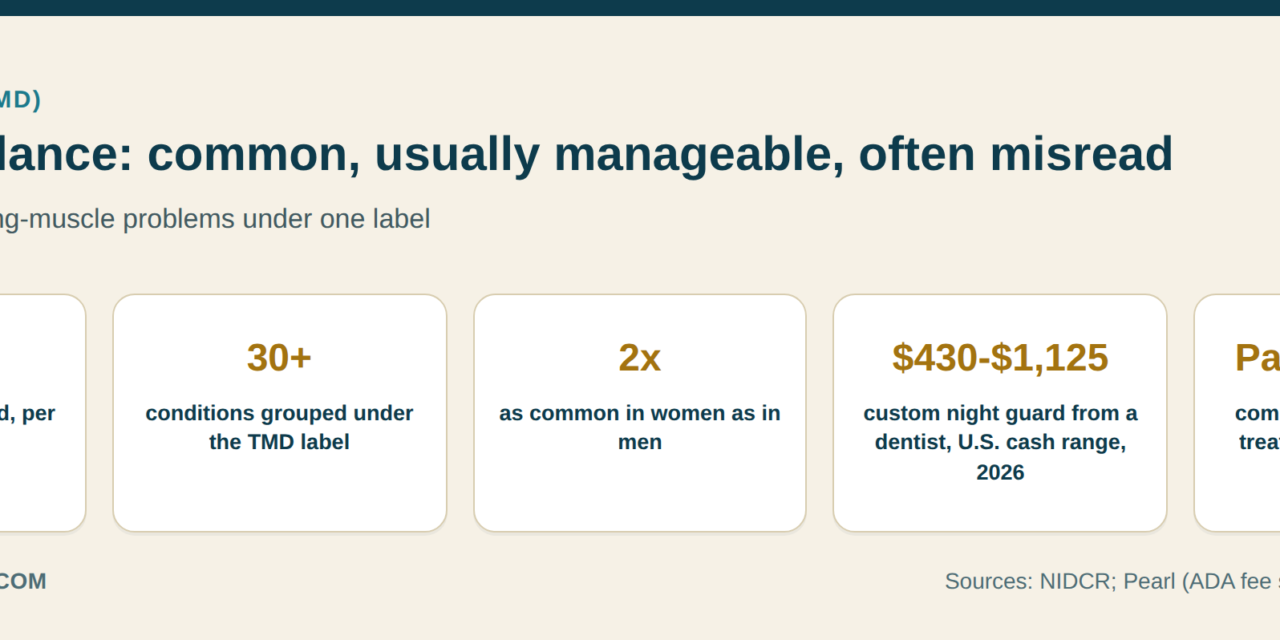
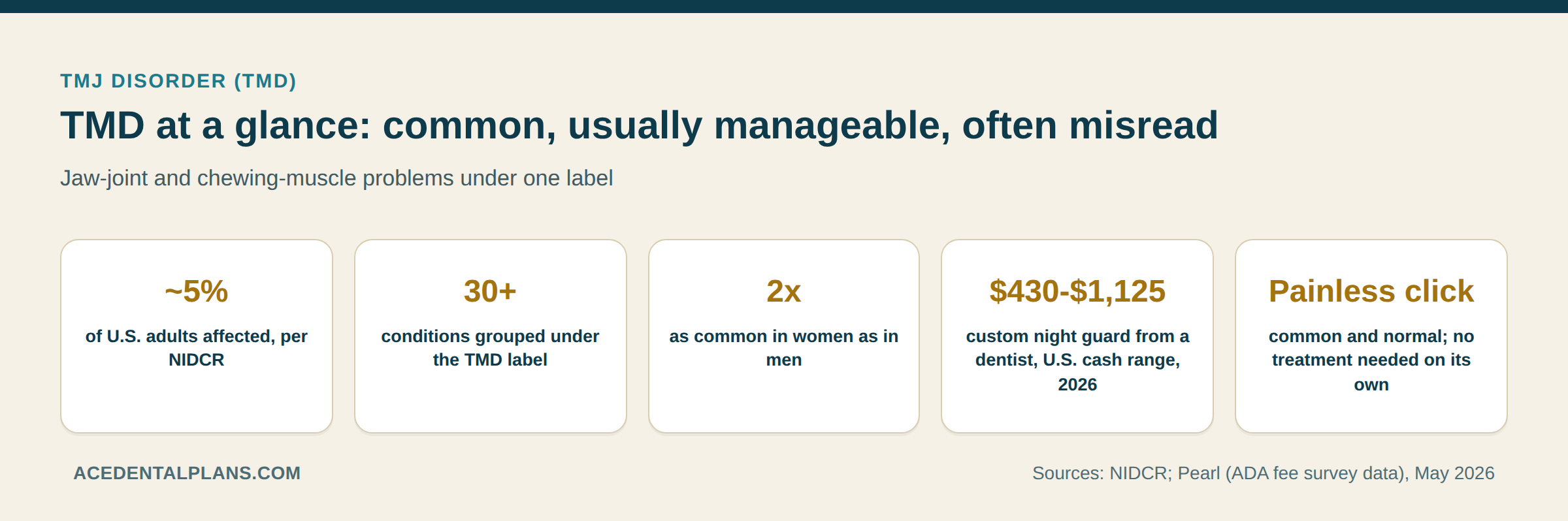
TMJ disorders, which clinicians call TMD, are a group of more than 30 conditions that cause pain and limited movement in the jaw joints and chewing muscles. The National Institute of Dental and Craniofacial Research (NIDCR) puts the figure at about 5% of U.S. adults. Most people start with low-risk steps such as soft foods, heat and jaw exercises. Painless clicking on its own usually needs no treatment.
This guide covers what TMD is, how it feels, what causes it, how dentists and specialists diagnose it, and which treatments have evidence behind them. It also covers what care may cost in the U.S. and why insurance for jaw problems is so confusing. It stops short of individual medical advice or medication doses, and it says little about sleep apnea or tooth grinding beyond what a jaw-pain reader needs.
Key Takeaways
- TMD is a label for many conditions: joint problems, chewing-muscle problems and headaches linked to them, and a person can have more than one at once (NIDCR).
- Clicking without pain is common and, according to NIDCR and AAOMS, does not by itself call for treatment.
- Reversible, low-risk care comes first. NIDCR advises avoiding treatments that permanently change the teeth, bite or joint, because the evidence for many of them is limited.
- Jaw pain can come from somewhere else. Teeth, sinuses, ears and the heart can all refer pain to the jaw; chest pressure with jaw pain is a 911 situation, per the American Heart Association.
- Typical U.S. cash ranges in 2026 pricing tools: a dental exam $65 to $165, a custom night guard $430 to $1,125, and a dentist-run TMJ splint package $1,670 to $4,390.
- Coverage often falls between dental and medical plans, so ask both insurers, in writing, before you start.
How the Jaw Joint Works and What TMD Covers
What “TMJ” Actually Names
“TMJ” is short for temporomandibular joint, the hinge-and-glide joint that connects the lower jaw to the skull. You have two, one in front of each ear, and they work as a pair every time you talk, chew, yawn or swallow. The American Dental Association’s MouthHealthy site describes the system as the joints plus the jaw muscles that open and close your mouth, with a small disc in each joint cushioning the load.
That distinction matters because people use “TMJ” for the disorder when it names the joint. The American Association of Oral and Maxillofacial Surgeons (AAOMS) says the older phrase “TMJ syndrome” caused confusion about diagnosis and treatment, and it prefers temporomandibular disease or disorder as a collective term. Throughout this article, TMJ means the joint and TMD means the problems that can affect it or the muscles around it.
The disc is worth a moment. When the FDA describes joint implants, it notes that some devices replace only part of the joint, such as the disc or the socket of the skull, while others replace the entire joint. That variety hints at how many different things can go wrong inside one small joint.
A practical consequence follows. Because the joints sit so close to the ear, the temple and the back teeth, pain from them rarely stays politely in one place. NIDCR lists pain that spreads into the face or neck among the usual symptoms, and the National Academies of Sciences, Engineering, and Medicine (NASEM) notes that TMD often travels with migraine, fibromyalgia and other widespread pain conditions.
Three Families of Problems Under One Label
NIDCR sorts TMD into three groups: joint disorders (including problems with the disc), disorders of the chewing muscles, and headaches associated with TMD. A person can have one, two or all three, and the groups behave differently, which is why a vague diagnosis of “TMJ” is only a starting point.
Muscle disorders are the most common source of pain. AAOMS describes the typical muscle pattern as a dull, aching pain in front of the ear, often the first symptom. It may spread to the temple, neck and back of the head, and it may feel worse in the morning after clenching or grinding at night. Ear fullness and joint clicking can come along.
Joint disorders are different in character. AAOMS describes pain, with or without popping or grating, that is usually continuous or intermittent, worsens with jaw use and sits at the joint itself. The jaw can move too little (hypomobility) or too much (hypermobility). The causes AAOMS lists on the joint side include internal derangement of the disc, degenerative joint disease, rheumatoid or infectious arthritis, dislocation and fractures.
TMD-associated headaches are the third group, and the hardest to separate from ordinary headaches. The diagnostic criteria clinicians use, known as DC/TMD and summarized in a 2016 paper in the Journal of the American Dental Association, include “headache attributed to TMD” as a formal diagnosis. Clinicians treat it as a category with its own criteria rather than a vague complaint.
The groups also overlap with problems outside the jaw. NIDCR says TMD can occur alone or alongside headaches, back pain, sleep problems, irritable bowel syndrome and fibromyalgia. That overlap is part of why NASEM described the care system around TMD as fragmented, a point the diagnosis section returns to.
Symptoms: What People Report and What Clicking Alone Means
Pain in the chewing muscles or the jaw joint is the most common symptom, according to both NIDCR and MedlinePlus. The rest of the list is wider than most people expect. It includes pain that spreads to the face or neck, jaw stiffness, limited movement or locking, and painful clicking, popping or grating. Ringing in the ears, hearing loss or dizziness can appear too. So can a feeling that the upper and lower teeth no longer fit together the way they used to.
One item on the list is often misunderstood. NIDCR states that clicking or popping in the jaw without pain is common, normal and does not need treatment. AAOMS agrees in its own words: painless popping or clicking is not necessarily an indication for therapeutic intervention. So a click you can hear in a quiet room, with no pain and no locking, is not by itself a disorder.
What changes the picture is the company the click keeps. A click that arrives with pain, a jaw that catches or locks, an opening that has narrowed over weeks, or pain that follows every meal deserves an exam. Table 1 groups the symptoms by the family they most often point to, based on the AAOMS and NIDCR descriptions. It is a reading aid, not a way to diagnose yourself, because the families overlap and the signs in the table can have other causes.
| Family | What people typically report | Pattern clinicians look for | Often confused with |
|---|---|---|---|
| Chewing-muscle disorder | Dull, aching pain in front of the ear; tenderness; pain that may spread to the temple, neck or back of the head | Worse in the morning after clenching or grinding; ear fullness may accompany it (AAOMS) | Tension headache, ear complaints, toothache in the back teeth |
| Joint disorder | Pain at the joint with or without popping or grating; stiffness; catching or locking | Pain that worsens with jaw use; opening that is too limited or too loose (AAOMS) | Ear infection, arthritis elsewhere, an injury to the jaw |
| Headache linked to TMD | Head pain in the temple area that appears together with jaw or muscle pain | Headache that appears together with jaw or chewing-muscle findings; DC/TMD lists it as its own diagnosis | Migraine and tension-type headache |
| Painless noises only | Clicking or popping with no pain, no locking and normal opening | Common; NIDCR says it does not need treatment | Painless noise is often only a noise; pain or locking changes that |
| Ear and bite changes | Ringing, hearing loss or dizziness; teeth that seem to meet differently | Listed by NIDCR as possible signs; needs a medical or dental exam to sort out | Primary ear conditions, dental work that has shifted |
Two cautions apply to the table. First, ringing in the ears, hearing loss and dizziness appear on NIDCR’s list of possible TMD signs, but they also have many causes unrelated to the jaw. A new hearing change should reach a physician rather than a splint. Second, a change in how the teeth meet can be a sign of TMD, yet it can also follow a loose filling, a cracked tooth or recent dental work. The dentist’s exam is what tells these apart.
How Common TMD Is and What Causes It
Why the Prevalence Numbers Disagree
NIDCR says TMD affects about 5% of U.S. adults, with the caveat that the estimate varies with the population studied and how the condition is measured. The NASEM report released in March 2020 put it in people: 11.2 million to 12.4 million U.S. adults, nearly 5% of the population, have pain that may relate to TMD.
The agency’s statistics page lays out why the figures wobble. Surveys that ask about jaw or facial pain in a recent window find roughly 5%. The National Health Interview Survey (NHIS) gave 5.3% for six months in a 1993 analysis and 4.6% for three months in 2011. A 2020 analysis found 4.8% for jaw or face pain over three months. A 2020 orofacial pain study that counted only high-impact pain found far higher figures, 33.5% over six months, in a different design that NIDCR cautions is not directly comparable.
The 2020 NASEM background paper by Gary Slade and Justin Durham adds texture. In the 2017 to 2018 NHIS, orofacial pain symptoms affected 4.8% of adults, about 11.8 million people, and the rate has stayed roughly constant since 1989. Prevalence was about twice as high in women (6.2%) as in men (3.2%) and peaked at ages 45 to 54 at 5.4%. It was 7.3% in the lowest income group against 3.7% in the highest.
You will see a different peak age elsewhere. NIDCR’s main TMJ page and MedlinePlus single out women aged 35 to 44, and the statistics page says TMD is more common among people aged 20 to 40. These statements come from different datasets and definitions. The honest reading is that TMD most often shows up in adulthood and in women, without one agreed peak.
Two more numbers help set expectations. The Slade and Durham paper reports an annual incidence of clinically classified TMD of 3.9% a year in the OPPERA cohort, and that six months later half of the new cases were still persistent. An older NIDCR page (reviewed in 2018) said about 15% of people who seek treatment go on to develop chronic TMD. Taken together, many cases settle, a meaningful share linger, and which group you fall into is hard to predict at the first visit.
The same background paper found that pain elsewhere in the body was the factor most strongly associated with orofacial pain. Its authors caution that this kind of survey cannot show cause and effect. NIDCR also ranks TMD as the second most common musculoskeletal cause of pain and disability after chronic low back pain, which is a useful reminder that this is a common, ordinary-sounding problem and not a rare disease.
Causes and Risk Factors: What the Evidence Supports
For most people the exact cause is unknown. NIDCR states that injury to the jaw joint can cause some TMD, but in most cases the cause is unclear. Research points to a mix of genetics, psychological and life stress, and the way a person perceives pain as contributors to both the start of the problem and its becoming chronic.
AAOMS gives a more mechanical list. On the muscle side it names parafunctional habits such as bruxism (grinding) and stress-related clenching, pain referred from the neck, and systemic muscle conditions such as fibromyalgia. On the joint side it names internal derangement, degenerative joint disease, rheumatoid or infectious arthritis, dislocation, tumors, fused joints, abnormal growth of the condyle (the rounded end of the jaw bone) and fractures.
The ADA’s MouthHealthy site lists arthritis, dislocation, injury, tooth and jaw alignment, and stress and teeth grinding as possible causes. The two sources do not fully agree on one point. NIDCR says research does not support the belief that a bad bite, or orthodontic treatment such as braces, causes TMD. If you have heard that orthodontic braces or a “bad bite” caused your jaw pain, the federal research institute disagrees, and the rest of this article follows NIDCR on that point.
Who is at higher risk? The consistent finding is sex and age: more women than men, mostly adults. The Slade and Durham paper also found higher prevalence in lower-income households, and it identified predictors of persistence in one cohort: younger age, female sex, white race, clinical pain and limited jaw opening. It found that examiner-assessed joint sounds, jaw function or parafunction, and depression did not predict persistence.
That last finding runs against a common assumption. Joint noises are what most people notice first, yet in that cohort they did not predict who would keep having a problem. It supports the cautious stance on painless clicking taken by NIDCR and AAOMS, and it explains why modern diagnostic criteria weigh pain and function above noise.
There is one risk factor you can actually act on. NIDCR names jaw clenching, gum chewing and nail biting as habits worth reducing, and its self-care list also includes relaxation techniques and setting specific management goals. These are not cures, but they cost nothing and carry no risk, which is exactly the profile of the first rung of care described later.
Is It TMD? Five Look-Alikes Worth Ruling Out
Pain near the jaw has a long list of possible sources, and the joint is only one of them. SDCEP, the Scottish Dental Clinical Effectiveness Programme, tells dentists to assess physical, psychological and social factors and to check for red-flag symptoms of serious conditions that can mimic TMD. NIDCR says much the same thing from the other direction: symptoms overlap with other conditions, and other conditions may need to be ruled out first.
You can do a rough version of that sorting at home, which is useful mostly for deciding whom to call. Start with where the pain sits and what changes it. Pain that gets worse when you open wide, chew or yawn, that sits near the ear, and that fades when the jaw rests points toward the joint or muscles. Pain that stays in one spot, or reacts to hot and cold, is a reason to have a tooth checked first.
Teeth. A cavity, a cracked tooth or a failing filling can all produce pain in the lower face that people describe as jaw pain. If the pain seems to come from one tooth, toothache home relief covers the safe short-term steps while you wait for an appointment, and the signs listed in cavity symptoms help you judge whether a tooth is the likelier source. A dentist separates the two with an exam and an X-ray, usually in a single visit.
Infection. A tooth infection can cause jaw pain, and it carries a different level of urgency. The warning signs of an abscess, including swelling and fever, are laid out in abscessed tooth symptoms, and the broader picture of how a tooth abscess forms and what treatment involves is a separate topic from TMD. The same goes for a tooth infection that has begun to spread. Gums can be the source too: gum disease and gum abscesses cause pain in the same neighborhood.
Sinuses. Delta Dental’s patient page notes that tooth pain doesn’t always mean a cavity and can signal sinusitis, and it lists “toothache in the upper back teeth” among the symptoms. The others are facial pain or pressure in the forehead, cheeks, nose or between the eyes, plus nasal congestion and discharge. The page adds that sinusitis after a cold can last three weeks or longer. If the ache sits in the upper back teeth and arrives with a stuffy nose or facial pressure, a physician is a reasonable first call.
Ears. The joint lies directly in front of the ear canal, so ear problems and jaw problems are easy to confuse. AAOMS lists ear fullness as part of the muscle pattern, and NIDCR lists ringing, hearing loss and dizziness among possible TMD signs. Still, a new hearing change, discharge from the ear or a fever usually belongs with a physician before it belongs with a dental splint.
The heart. The American Heart Association lists pain or discomfort in the arms, back, neck, jaw or stomach among the symptoms of a heart attack, alongside chest discomfort, shortness of breath, cold sweat, nausea and lightheadedness. Its guidance is blunt: call 911 if you have any symptoms of heart attack, and don’t wait. Jaw pain that comes with chest pressure, or that starts during exertion, is not a TMD question.
| Possible source | Clues that point toward it | Who to call first | Source for the clue |
|---|---|---|---|
| Jaw joint or chewing muscles (TMD) | Dull ache near the ear, worse with chewing or in the morning after clenching; clicking with pain; limited or locking movement | Dentist, in a non-emergency visit | AAOMS, NIDCR |
| A tooth or gum problem | Pain localized to one tooth or area; swelling; fever; reaction to hot or cold | Dentist; same day if swelling or fever is present | Dental exam and X-ray are what separate it |
| Sinus infection | Upper back-tooth ache with facial pressure, congestion and discharge after a cold | Physician or urgent care | Delta Dental patient page |
| Ear problem | Ear fullness, ringing, hearing change or dizziness; fever or discharge | Physician | NIDCR, AAOMS |
| Heart attack | Jaw, neck, back or arm discomfort with chest pressure, shortness of breath, cold sweat or nausea | 911, immediately | American Heart Association |
The table has an honest limit. People can have two of these at once, and a toothache that started a week ago can sit on top of an older jaw problem. Treat the clues as a way to choose the first phone call, not a way to rule things out.
Red Flags and When to See a Dentist
Red Flags: When Jaw Pain Cannot Wait
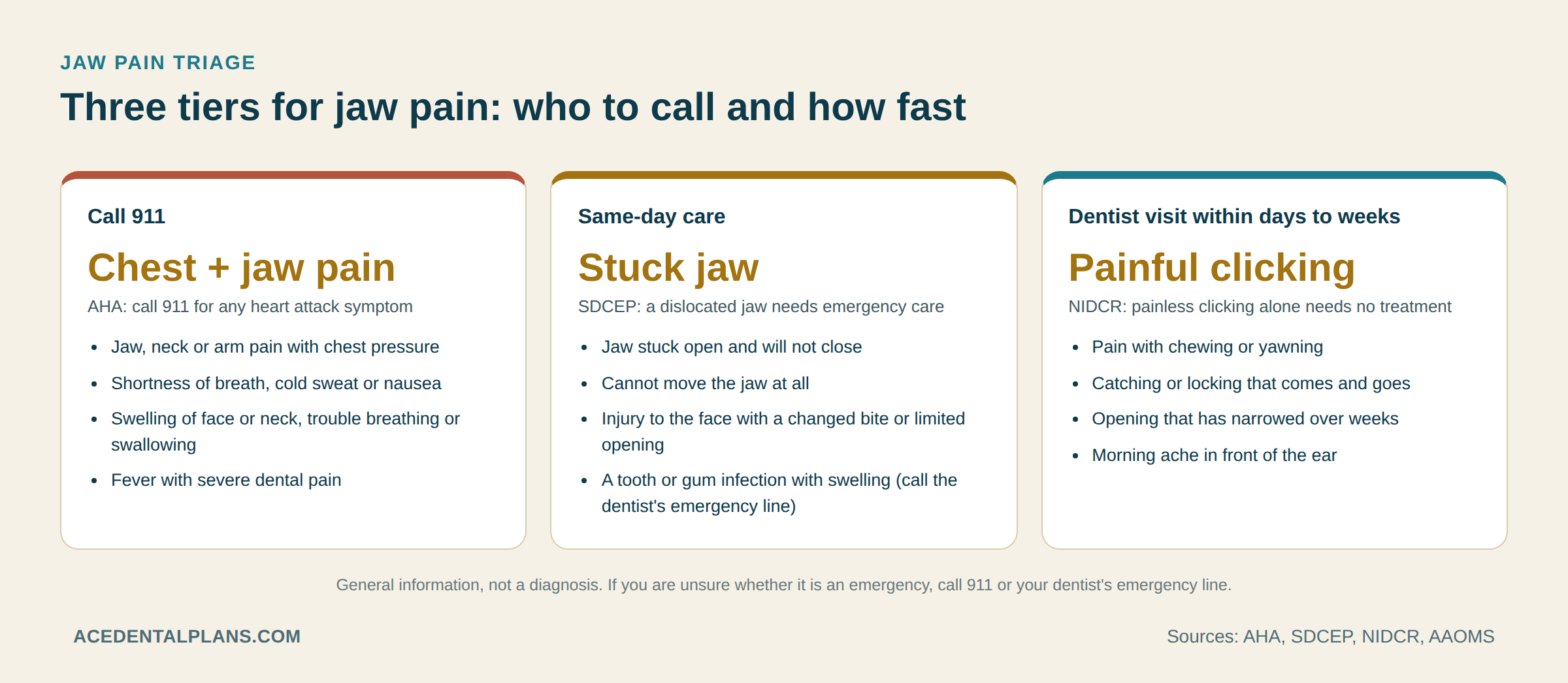
Most TMD is not an emergency. A few jaw situations are, and they have little to do with the usual symptom list. SDCEP’s guidance describes a dislocated jaw as an inability to move the jaw with the jaw displaced in the open position, and it directs those patients to emergency care. A jaw that will not close after a yawn is that situation.
Seek prompt care if
- Chest pressure, shortness of breath, cold sweat or nausea come with jaw, neck or arm pain. Call 911 (American Heart Association).
- Your jaw is stuck open and you cannot close it, or you cannot move it at all (SDCEP describes this as a dislocated jaw needing emergency care).
- Swelling of the face or neck, trouble breathing or swallowing, or fever with severe dental pain. Call 911 or go to the nearest emergency room.
- The jaw hurts after a blow to the face, and your bite feels different or you cannot open your mouth normally. An injury needs an exam, not a wait-and-see week.
If the emergency room is the right call, it helps to know what to expect on the bill. The bill is a separate question from the decision. The ranges for urgent visits and what each line costs are in the guide to emergency dentist cost, and that guide also explains when a dentist rather than an emergency room is the better first stop.
When to See a Dentist, and When Waiting Is Reasonable
NIDCR’s advice is simple: if you think you have a TMD, or you have been diagnosed with one, consult a dentist or doctor. The MouthHealthy page goes a step further and says diagnosis is an important step before treatment. The reason is not bureaucratic. Treatments differ by type, some can make a wrong guess worse, and look-alike conditions can be missed if the first step is a splint bought online.
That leaves a middle zone where the question is how soon. A reasonable decision path, drawn from the sources rather than from any single guideline, runs like this:
- Painless clicking, normal opening, no locking. NIDCR and AAOMS agree this does not need treatment. Mention it at your next routine checkup so the dentist can note it as a baseline.
- Mild jaw ache that comes and goes. The same self-care that NIDCR lists as first steps is low-risk to try for a short time. Book an exam if it lasts more than a couple of weeks, returns often, or begins to affect eating.
- Pain with every meal, opening that has narrowed, catching or locking, or headaches that track with jaw use. Book a dental exam in the next week or two rather than waiting for a routine visit.
- A sudden change after an injury, a jaw stuck open, or any red flag from the box above. Same-day or emergency care.
The two-week mark in step two is this article’s rule of thumb, not a published threshold. SDCEP and NIDCR give no day count, and you should treat any number here as a prompt to call rather than a rule. A dentist who hears “it’s been three weeks and it’s not settling” will have no trouble taking you seriously.
Before the appointment, a short note helps more than most people expect. Write down when the pain began, what sets it off (chewing, yawning, mornings, stress), whether the jaw ever catches or locks, which side hurts, any recent dental work or injury, and which medicines you have already tried. A few lines on a phone are enough. That history is what clinicians weigh first, and the DC/TMD criteria described below start with it.
For more on urgent dental problems that can masquerade as jaw pain, the oral health and dental emergencies hub lists the related guides in one place.
Who Diagnoses TMD: General Dentist, Orofacial Pain Specialist, Oral Surgeon or Physician
Most people start with their general dentist, and SDCEP notes that most TMD can be managed in primary care without referral to a specialist. A general dentist can take a history, examine the joints and muscles, order an X-ray and start conservative care. Referral becomes likely when symptoms persist, when the picture is unclear, or when the question moves toward injections or surgery.
The specialists are less clear-cut than in most areas of dentistry. The 2020 NASEM report stated that there was no certified specialty for TMD in either dentistry or medicine, and that care spans primary care, dentistry, physical therapy, chiropractic care, behavioral health and clinical psychology. It added that patients are often referred from one provider to another and sometimes left with no referral option when treatment fails. It recommended an ADA-recognized dental specialty in TMD and orofacial pain.
Later reporting describes some movement. KFF Health News reported in July 2024 that the American Dental Association officially recognized orofacial pain as a dental specialty in 2020. Residency programs now exist at a dozen or more U.S. colleges, but fewer than 300 certified orofacial pain specialists practice in the country. By the same report, at least 20 states have none. Those are the reporters’ figures, and they matter practically: in much of the country the nearest orofacial pain specialist may be hours away.
Oral and maxillofacial surgeons (OMS) enter when a joint procedure is on the table. AAOMS lists their toolkit, from arthrocentesis to open joint surgery and joint replacement, and its 2024 position paper calls for starting with the least invasive evidence-based treatment. Physicians fit in at the edges: sorting out headache, ear, sinus or widespread pain conditions, and prescribing when a medicine is warranted. Physical therapists and behavioral health clinicians are part of the team for many patients.
One piece of NIDCR advice applies before any irreversible step. It suggests getting a second opinion from a specialist, and names an orofacial pain specialist as an option, before surgery, implants or permanent dental changes. That is a sound habit whatever your coverage looks like, and it costs one more consultation fee against a decision that cannot be undone.
Diagnosis: The Exam, DC/TMD and Imaging
What the Exam Looks Like, and How DC/TMD Works
NIDCR says there is no widely accepted standard test for TMD. Clinicians take a detailed history and examine the head, neck, face and jaw, and may order X-ray, MRI or CT imaging. MouthHealthy describes the dental exam as checking the joints and muscles for tenderness, clicking, popping or difficulty moving. A typical exam therefore involves pressing on muscles around the jaw, watching how far and how smoothly you open, listening for joint sounds and checking the bite.
For structure, many clinicians use the Diagnostic Criteria for Temporomandibular Disorders, or DC/TMD. The executive summary, published in 2016 in the Journal of the American Dental Association by Eric Schiffman, Richard Ohrbach and colleagues, describes two axes. Axis I covers physical diagnoses, using history and clinical examination for pain-related TMD and for intra-articular joint disorders. Axis II is a psychosocial and behavioral screen using questionnaires, because factors such as stress, mood and pain-related disability influence how a problem starts, persists and responds to care.
The Axis II tools in the screening set include the Graded Chronic Pain Scale, a pain drawing, the Jaw Functional Limitation Scale, the PHQ-4 and the Oral Behaviors Checklist. If a dentist hands you a short questionnaire about mood and habits, it does not mean the pain is considered imaginary. It means the clinic is following a validated model in which the body and the context are assessed together.
What makes DC/TMD unusual is that its accuracy is published. The summary reports sensitivity and specificity for each diagnosis, with a target of at least 70% sensitivity and at least 95% specificity. Sensitivity answers: of people who truly have the condition, how many does the exam find? Specificity answers: of people who do not have it, how many does the exam correctly clear? Table 3 lists the figures.
| Diagnosis | Sensitivity | Specificity | Meets the 70% / 95% targets? |
|---|---|---|---|
| Myalgia (muscle pain) | 90% | 99% | Yes |
| Myofascial pain with referral | 86% | 98% | Yes |
| Arthralgia (joint pain) | 89% | 98% | Yes |
| Headache attributed to TMD | 89% | 87% | No, specificity below 95% |
| Disc displacement with reduction | 34% | 92% | No |
| Disc displacement with reduction, with intermittent locking | 38% | 98% | No, sensitivity low |
| Disc displacement without reduction, with limited opening | 80% | 97% | Yes |
| Disc displacement without reduction, without limited opening | 54% | 79% | No |
| Degenerative joint disease | 55% | 61% | No; imaging needed |
| Subluxation | 98% | 100% | Yes |
The last column is this article’s comparison of each row with the 70/95 targets, not a column in the paper. The paper’s own conclusion is that the pain-related diagnoses and disc displacement without reduction with limited opening are accurate enough for definitive diagnosis from history and exam alone. The other intra-articular criteria are screening tools, and MRI or CT is needed to confirm them.
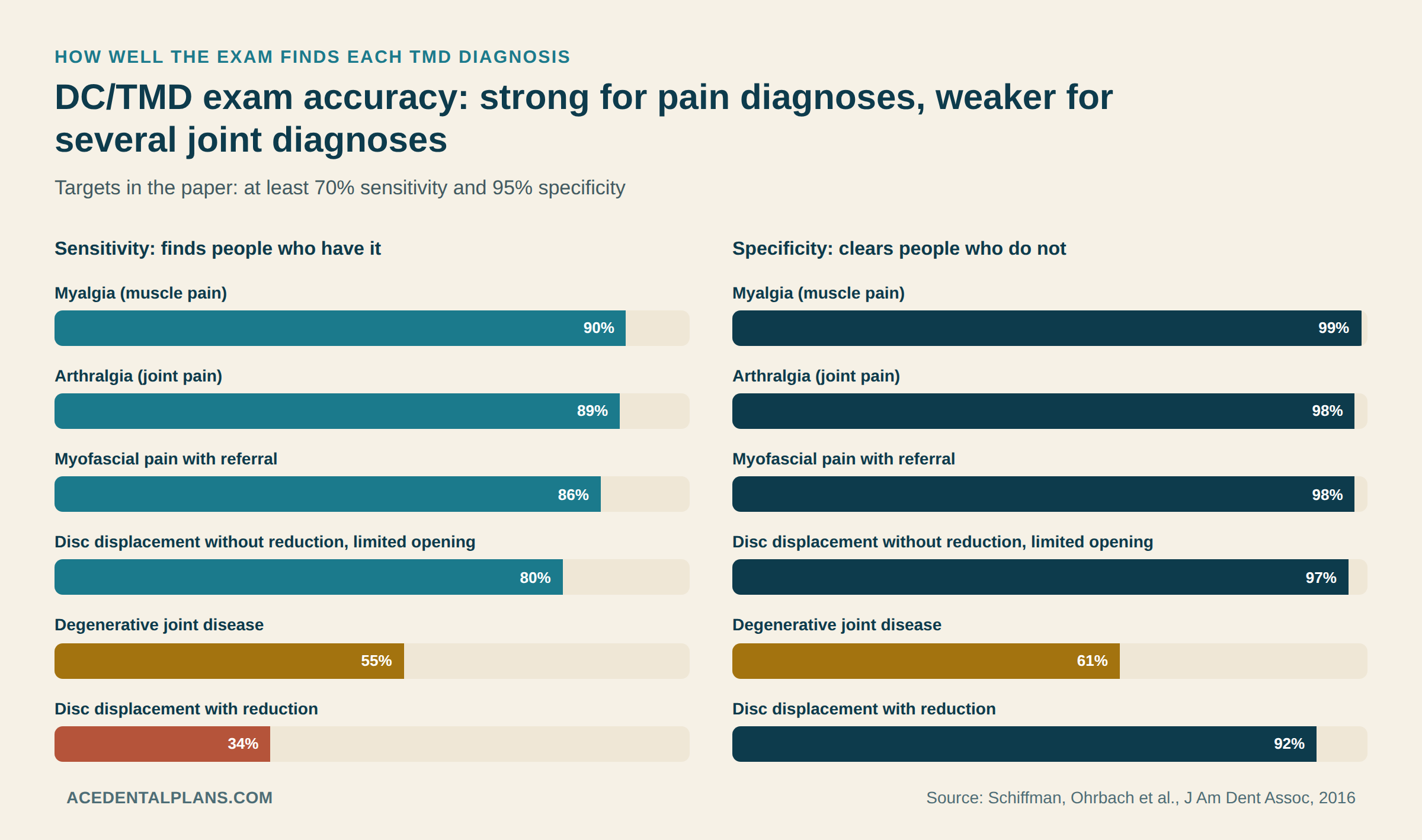
This table carries a practical message for patients. Pain-related TMD, the most common kind, can be diagnosed well in a dental chair without a scan. A disc diagnosis based on a click, with no pain and no locking, is a screening result and not a verdict, and it rarely justifies an expensive or irreversible treatment. If someone proposes a costly plan on the strength of a click alone, ask what finding would confirm it and whether imaging has been done.
Imaging: X-ray, Cone-Beam CT and MRI
Imaging is where cost and care meet most often. AAOMS’s 2024 guidance names a panoramic X-ray as the initial imaging tool and says cone-beam CT, medical-grade CT or MRI should be considered based on history, exam and differential diagnosis. AAOMS’s patient statement lists standard TMJ X-rays, CT, MRI and three-dimensional imaging among diagnostic tests. NIDCR notes that x-ray, MRI or CT may be ordered.
The divergence is in how often. Cigna’s TMJ surgery policy, effective December 15, 2025, says routine X-rays may be used to identify underlying osteoarthritis or other bony abnormalities and that arthrography, MRI and CT are generally not indicated. The exception is persistent TMD: selected studies may be appropriate when internal derangement is suspected and surgery is being considered. In plain terms, an insurer’s medical policy reads advanced imaging as a tool for decisions about surgery, not a routine part of a first TMD workup.
Each modality sees something different. A panoramic X-ray shows both jaws and both joints on one image and can reveal bony changes. CT and cone-beam CT show bone in greater detail. MRI shows the disc and soft tissues. The DC/TMD paper’s statement that disc and degenerative diagnoses need MRI or CT for confirmation is why a surgeon asks for it before a joint procedure. A general dentist often will not for a first muscle-pain visit.
Prices vary widely. A Pearl dental cost page, using ADA fee survey data, puts dental X-rays as a category at $125 to $335 in the U.S. with a $195 average, and notes that panoramic images generally cost more than bitewings. It gives no separate figure. One Arizona health system, HonorHealth, posts self-pay prices for an MRI of the TMJ (CPT 70336) of $664 for prompt pay, $863 for direct pay and $1,328 as an average estimated total, excluding hospital-based radiologist fees. That file is undated and covers one system’s outpatient imaging centers, so treat it as an example of how wide the spread can be and not as a national price. The cost section returns to these figures.
Before agreeing to a scan, three questions are fair. What finding are we looking for? Would the result change the treatment plan? Is the image being taken at the dentist’s office or an imaging center, and is the price the same? A written estimate with the CDT or CPT code for each line makes the comparison possible, and the guide to reading CDT codes on a bill explains how to decode them.
The Treatment Ladder: Reversible Steps First
The most consistent message across NIDCR, AAOMS, MedlinePlus and the 2020 NASEM report is the same: start with conservative, low-risk, reversible care. NIDCR advises avoiding treatments that permanently alter the joints, teeth or bite, or that involve surgery, because the evidence for many options is limited. The FDA, writing about implants, repeats NIDCR’s point that doing less is often the sounder course in treating TMJ disorders.
The NASEM committee was sharper. It found that less invasive, evidence-based options exist, yet some dentists continue to rely on aggressive or costly procedures as a first-line treatment. That sentence is the reason a reader should know the rungs of the ladder before sitting in the chair. Table 4 sets them out from lowest to highest risk, with what the cited evidence says about each.
| Rung | Examples | What the sources say | Reversible? |
|---|---|---|---|
| 1. Self-care | Soft foods; heat or cold; gentle stretching; less clenching, gum chewing and nail biting; relaxation | NIDCR and MedlinePlus list these as first steps; SDCEP adds rest for the jaw and sleep and stress habits | Yes |
| 2. Over-the-counter pain relief | NSAIDs such as ibuprofen, used per the label | Listed by NIDCR and MedlinePlus as an initial step | Yes |
| 3. Exercise and physical therapy | Jaw stretching and strengthening; manual therapy | A 2023 meta-analysis of 16 trials (812 people) found exercise reduced TMD pain; NIDCR says manual therapy may help | Yes |
| 4. Behavioral approaches | Cognitive behavioral therapy; biofeedback | NIDCR says they may help manage TMD; one insurer policy lists biofeedback as unproven | Yes |
| 5. Prescription medicines | Anti-anxiety, antidepressant, anti-seizure drugs; opioids | NIDCR: evidence on which works is limited and some carry addiction risk or serious side effects; AAOMS: opioids rarely indicated for chronic muscle pain | Yes, but with drug risks |
| 6. Splints and night guards | Stabilization or repositioning appliances; rigid or soft guards | NIDCR: limited evidence for pain; a 2020 review of 52 trials found very low-quality evidence | Yes if it does not alter the bite |
| 7. Injections and joint washout | Trigger point or corticosteroid injections; arthrocentesis; botulinum toxin | NIDCR: arthrocentesis results inconsistent; botulinum toxin not FDA-approved for TMD, results mixed | Procedure itself is minimally invasive |
| 8. Bite or tooth changes | Reshaping teeth, crowns, orthodontics for TMD | NIDCR: evidence insufficient and may worsen the problem | No |
| 9. Joint surgery or replacement | Arthroscopy; open surgery; TMJ implants | NIDCR: open surgery makes permanent changes with no long-term safety studies; reserved for severe cases that persist | No |
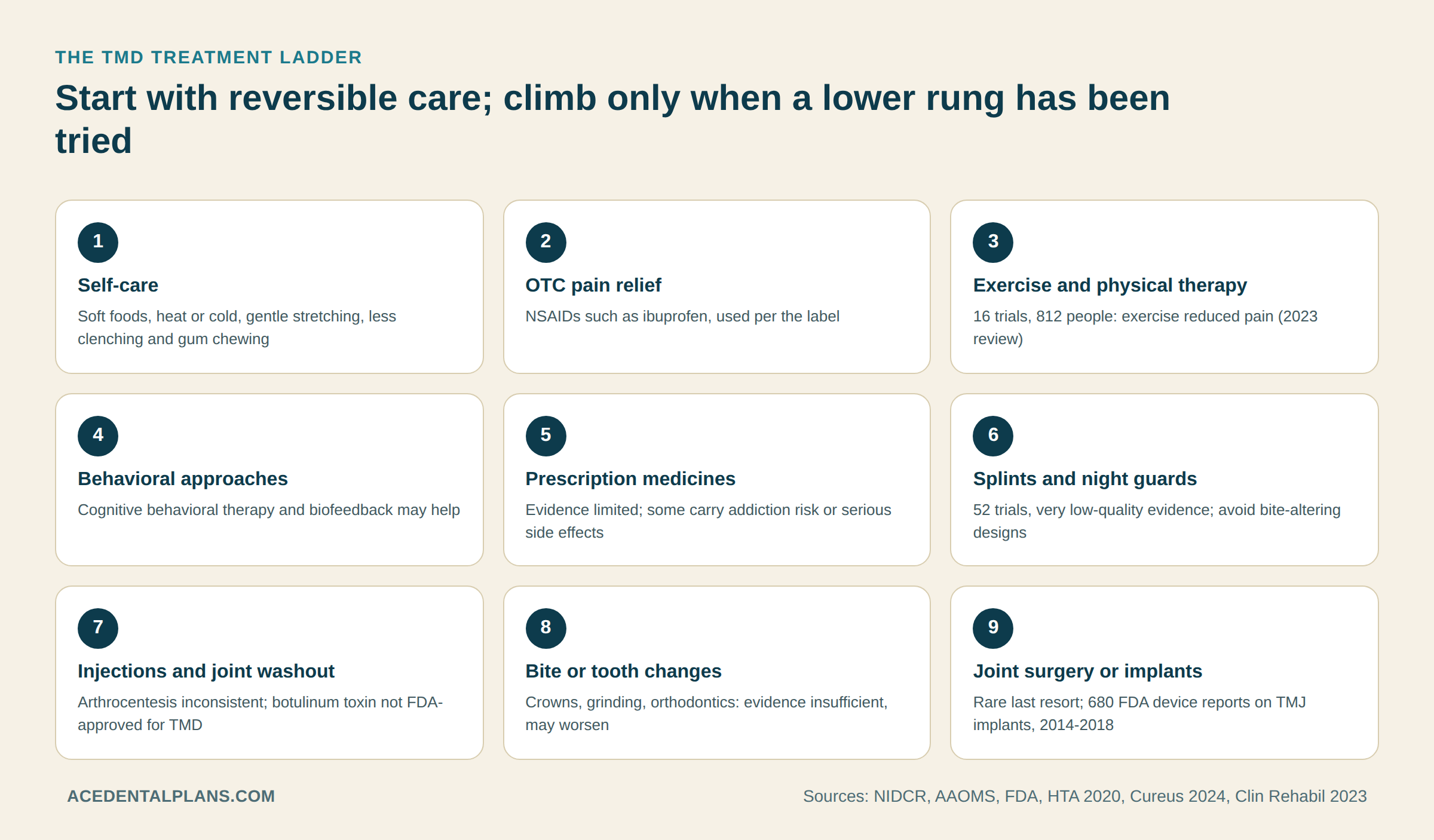
The ladder is not a strict sequence in which every person climbs every step. Someone with a locked joint after injury will skip the early rungs, and someone whose pain eases with heat and soft foods never leaves the bottom. What the ladder gives you is a test for any proposal: which rung is this, what is the evidence for it, and was a lower rung tried first?
Self-Care, Exercise and Therapy
Self-Care That Matches the Evidence
Self-care is unglamorous and it is where most care begins. NIDCR’s list is short: eat soft foods, apply heat or cold, do gentle jaw stretching and strengthening exercises, use over-the-counter NSAIDs such as ibuprofen if appropriate, and reduce jaw clenching, gum chewing and nail biting. It adds learning about your specific type of TMD, practicing meditation and relaxation, setting specific management goals and staying involved in meaningful activities.
The last items sound soft, but they reflect the way the research has moved. The DC/TMD framework treats psychosocial factors as part of the diagnosis, and NIDCR cites stress and the way a person perceives pain among contributors to chronic TMD. AAOMS’s 2024 guidance also says clinicians should identify psychosocial factors and comorbid conditions so that expectations stay realistic. Self-management is therefore not a consolation prize for people who cannot afford a splint. It is a core treatment.
Soft foods are the easiest to overdo. A few days of soft food gives an irritated joint or muscle a rest, and SDCEP pairs it with avoiding chewing gum and resting the jaw. Staying on mashed food for months is not part of any source’s advice. If chewing remains painful after a short trial of softer meals, that is information for the exam, and not a reason to cut meals down further.
Heat and cold are the simplest tools. NIDCR and SDCEP both list them, and the sources give no preference between the two, so use whichever feels better. Keep the pack wrapped, limit the time on skin, and stop if the skin looks red or numb. This is ordinary first-aid caution and not a point any of the cited TMD sources makes.
Habits matter, and noticing them is half the work. Many people clench while concentrating, driving or reading messages, without knowing it. A reminder on the phone or a note on the monitor to let the teeth come apart, lips closed and tongue resting, is a low-cost trial. Whether a given habit is behind your pain is something the dentist can help work out, and the Oral Behaviors Checklist in the DC/TMD toolkit exists for exactly that reason.
Exercise, Physical Therapy and Behavioral Therapy
NIDCR says physical therapy may help, and specifically that manual therapy may improve function and pain. A 2023 systematic review with meta-analysis in the journal Clinical Rehabilitation, by Idáñez-Robles and colleagues, pooled 16 randomized controlled trials with 812 participants. Exercise therapy reduced pain, with a standardized mean difference of -0.58 (95% confidence interval -1.01 to -0.12), and it increased active mouth opening (0.43) and passive mouth opening (0.40). The authors concluded that therapeutic exercise is an effective therapy to reduce pain in TMD.
Two points keep that result in proportion. A standardized mean difference around half a standard deviation is a moderate effect, not a cure, and the confidence interval is wide. In subgroup comparisons, the effect looked larger when exercise was compared with splint-based approaches, which the authors report without claiming that exercise should replace every splint.
For a patient, the practical meaning is that a referral to a physical therapist with experience in jaw and neck problems is an evidence-supported option, not a fringe one. The physical therapist’s role is usually to teach specific exercises, check posture of the head and neck, and apply manual techniques. The NIDCR statement is cautious about complementary approaches: acupuncture has limited evidence, and TENS, which delivers a mild electrical current through the skin, has been studied only in small, short-term trials.
Behavioral options follow the same logic. NIDCR says cognitive behavioral therapy and biofeedback may help manage TMD. The relevance becomes clearer with the NASEM background paper in mind. Pain elsewhere in the body was the factor most strongly associated with orofacial pain, and half of new cases were still persistent six months later. For people with widespread pain, poor sleep or high stress, treating only the jaw can miss part of the problem.
Coverage for this rung is uneven in an instructive way. UnitedHealthcare’s commercial medical policy on TMJ disorders, effective October 1, 2026, lists physical therapy among the services it considers proven and medically necessary for TMJ disorders, and it lists biofeedback as unproven. Same family of care, opposite coverage position. A plan’s list tells you what it pays for, and not how likely the treatment is to help you.
Medicines: Categories, Not Doses
This article does not give doses, and nothing here replaces what a prescriber or pharmacist tells you after learning your health history. What the sources describe is categories. NIDCR and MedlinePlus list over-the-counter NSAIDs such as ibuprofen as an early step. For prescription medicines, NIDCR names antianxiety medicines, antidepressants, antiseizure medicines and opioids, and states that evidence on which one works is limited and that some carry addiction risk or serious side effects.
AAOMS adds its own caution. Its patient statement lists NSAIDs, muscle relaxants, sedatives and antidepressants among conservative options for muscle disorders, and it says narcotic analgesics are rarely indicated for chronic masticatory muscle pain. It also notes that dependence on pain medications, decreased productivity and disability may occur in chronic cases. In other words, the pattern to be wary of is a long, escalating prescription for a condition that usually responds better to non-drug care.
Two practical points follow. Over-the-counter labels carry limits on amount and duration, and the label is the document to read before starting; ask a pharmacist whether an NSAID suits you given your other conditions and medicines. And if a clinician proposes a prescription medicine, ask what it is expected to do, how long it should be used, what the plan is if it does not work, and what the alternatives are. Those are routine questions that good prescribers expect.
Night Guards and Splints: What the Evidence Says
Intraoral appliances are the most familiar TMD treatment and one of the most contested. NIDCR states that evidence of benefit for pain is limited, advises avoiding any appliance designed to permanently change the bite, and says to stop using one if it causes pain. MedlinePlus repeats that splints and mouth guards have limited evidence for pain relief. AAOMS still lists an orthotic appliance among its conservative options for both muscle and joint disorders.
The strongest summary of the research is a 2020 Health Technology Assessment by Philip Riley, Anne-Marie Glenny, Helen Worthington and colleagues, published in the journal Health Technology Assessment. It reviewed 52 randomized trials of oral splints for TMD or bruxism and rated the evidence as very low quality, with unclear reporting by TMD subtype. When all TMD types were pooled, there was no evidence that splints reduced pain compared with no splint or minimal intervention, and the standardized mean difference at up to three months was -0.18 (95% confidence interval -0.42 to 0.06). The interval crosses zero, so the result is consistent with no benefit and also with a small one.
The review also found no evidence of improvement in joint noises, mouth opening or quality of life. Adverse events were generally not reported, but seemed infrequent when they were. For bruxism, no study measured tooth wear, so the review could not say whether splints protect teeth. The economic evaluation concluded that cost-effectiveness of splints remains highly uncertain, mainly because clinical effectiveness evidence was lacking.
Two sentences deserve emphasis, because both are true. Splints have not been shown to reduce pain across the TMD group as a whole. Yet they are widely used, low in risk when they do not alter the bite, and listed as medically necessary in at least one large insurer’s policy. The reconciliation is that very low-quality evidence is not evidence of no effect. It means the trials were not good enough to tell, and some individual patients may do well. A reversible appliance with a clear review date is a defensible choice; an open-ended plan of ever-changing devices is harder to defend.
Insurer policy language on this point is concrete. UnitedHealthcare’s TMJ medical policy lists occlusal splints of the stabilization and repositioning types as proven and medically necessary and lists multiple occlusal splints, such as separate daytime and nighttime devices, as unproven. Cigna’s policy describes stabilization splints and anterior positioning appliances and says such appliances should not create major alteration in occlusion, because those changes may be irreversible. These are coverage documents and not clinical guidelines, but they converge on the same cautious rule.
The type of guard also changes the billing code. UnitedHealthcare’s dental policy on occlusal guards lists D9944 for a rigid full-arch guard, D9945 for a soft full-arch guard and D9946 for a rigid partial-arch guard, with separate codes for cleaning, repair or reline and adjustment. It also says its dental policy does not treat guards used for TMD, headaches or craniofacial pain as covered indications, and it points to a separate TMJ policy. The insurance section shows what that means for the person holding the bill.
Injections, Joint Washouts and Botulinum Toxin
The next rung is procedural. AAOMS’s patient statement lists trigger point injections with a local analgesic as an option for muscle disorders, and its surgical list for joint disorders begins with manipulation under anesthesia and arthrocentesis. Arthrocentesis is a minimally invasive procedure that washes out the joint. NIDCR says its results are inconsistent and vary by patient.
Coverage documents treat this rung with more confidence than the research summaries. UnitedHealthcare’s commercial TMJ policy lists arthrocentesis, intra-articular corticosteroid injections and trigger point injections as proven and medically necessary. Cigna’s policy says arthrocentesis is considered when pain persists after six weeks of noninvasive therapy, or when the jaw is too restricted and symptoms persist after six weeks of noninvasive therapy. Both policies tie the procedure to a failed attempt at lower rungs, which is a useful standard to hold any provider to.
Botulinum toxin is the injection most often discussed online. NIDCR states that botulinum toxin type A is not FDA-approved for TMD and that study results are mixed. A 2024 systematic review in the journal Cureus by Kharraz and colleagues included 23 randomized controlled trials with 750 patients. Of 19 studies that assessed pain, six reported a significant decrease compared with placebo, four found pain reduction in both the toxin and placebo groups, and four found no significant difference. The authors still concluded the evidence supported the usefulness of toxin in reducing pain, and noted that the analgesic effect lasted up to about six months.
The same review reports downsides worth knowing. Biting force decreased in all four studies that measured it, muscle activity decreased in the treated groups, and results for mouth opening were inconsistent. The authors advise clinicians to be aware of possible adverse effects including decreased occlusal force and muscle weakness. They also flag high variation in doses, injection sites and follow-up periods, no meta-analysis, and inconsistent use of diagnostic criteria. So the honest summary is promising but unsettled, off-label, temporary and with trade-offs.
Cost and coverage follow that status. A Pearl pricing page for TMJ treatment lists Botox among items often billed separately from a splint package, and no source reviewed for this article gave a national price for it. UnitedHealthcare handles botulinum toxin in separate drug policies, and Cigna’s TMJ surgery policy does not mention it. If a provider offers it for jaw pain, ask for the price per session, how often it would be repeated, and whether your plan treats it as covered, excluded or unproven.
Bite Adjustments, Crowns and Orthodontics as a TMD Treatment
This rung deserves its own section because it is the one where cost, confidence and risk can all rise together. NIDCR says the evidence for occlusal treatments such as crowns, grinding the teeth and orthodontics is insufficient, and that they may worsen the problem. It also notes that research does not support the belief that a bad bite causes TMD in the first place.
The ADA’s MouthHealthy page is more permissive in its wording. It lists adjusting or reshaping teeth to fix an uneven bite, and orthodontic treatment, among dental options, after the simple first steps and the possibility of a night guard. The two statements can be reconciled through the word that matters most: reversibility. A change that can be undone is a different decision from drilling enamel or rebuilding the whole bite.
If a proposal involves crowns or other restorations to correct a bite for jaw pain, the questions are specific. Is this being done to treat a damaged tooth, or to treat TMD? What lower rungs were tried? Would a splint trial answer the same question first? Can I see a written plan with a price per tooth? The price side is covered in dental crown cost, which shows how quickly a multi-tooth plan reaches five figures.
NIDCR’s guidance on second opinions fits here. Before irreversible treatments, discuss benefits, risks and alternatives, and consider an orofacial pain specialist. A second opinion costs an exam fee, and a full-mouth rebuild costs far more.
Surgery and Joint Replacement: A Rare Last Resort
NIDCR describes the surgical options in ascending order of commitment. Arthroscopy, a minimally invasive procedure using a small camera, works moderately well for pain and function. Open surgery makes permanent changes to the joint, and there are no long-term safety studies; NIDCR says to consider it only for joint destruction that cannot be fixed or severe symptoms that persist despite other treatments. AAOMS’s 2024 guidance says arthroplasty and total joint replacement are for patients whose minimally invasive procedures have not worked.
The FDA’s TMJ implants page supplies the safety context. The agency describes implants that replace only part of the joint, such as the disc or the socket in the skull, and others that replace the entire joint. Materials include plastics, silicone, metals and combinations. It says candidates are generally people who have not responded to other treatment, including nonsurgical care, or whose earlier joint reconstruction failed to restore function or relieve symptoms.
The adverse-event data are plain. The FDA received 680 medical device reports about TMJ implants from 2014 to 2018, most often describing pain, swelling, infection, headache and limited joint movement. Others described excessive bone growth, increased sensitivity, disability and the need for further surgery. The page notes that all movements of a normal joint may not be possible with an artificial joint. It also estimates about 5,500 TMJ total joint replacement procedures in the U.S. from 2005 to 2014, which works out to roughly 550 a year and shows how uncommon the procedure is.
NIDCR adds history: two TMJ implants are FDA-approved, some earlier implants caused serious complications and were removed from the market, and long-term safety is still under study. Cigna’s policy requires a letter of medical necessity for all TMJ surgery requests. For prosthetic joint replacement it also requires imaging by MRI, CT or another study to confirm that one of its listed conditions applies, such as inflammatory arthritis or a failed tissue graft.
The FDA’s advice for anyone considering implants is practical. Discuss all options, choose a provider knowledgeable about TMD by looking at training, experience, board certification and patient follow-up, make sure you can receive notifications from the manufacturer, and keep your contact information current with the surgeon. It also repeats NIDCR’s less-invasive-first theme. Surgery is a real option for a small number of people with structural joint disease. It is not where a first-time jaw-pain patient should expect to end up.
Living With a Chronic Case: Flares, Habits and Realistic Expectations
Many TMD cases settle. NIDCR says many are short-lived and resolve on their own, though some become chronic. The numbers behind that sentence are more specific in the NASEM background paper. In the OPPERA cohort, half of new cases were still persistent six months later. In the UK DEEP study, among people with low-impact pain, 94% continued to have low-impact pain after six months, which suggests that mild cases tend to stay mild. In a small group of 45 people re-examined seven years later, 53% had a TMD again.
Those figures describe a waxing and waning pattern. Pain can fade for months and return, and NIDCR names life stressors among the factors that may contribute. A flare is therefore not necessarily a failure of the earlier treatment. It is often a prompt to return to the first rungs: soft foods for a few days, heat or cold, a check on clenching, and a message to the dentist if the flare is longer or sharper than before.
Expectations matter. NIDCR notes that TMD can occur alongside headaches, back pain, sleep problems, irritable bowel syndrome and fibromyalgia. For someone with several of these, a good outcome often means fewer and shorter flares and better function, not a jaw that never complains. A plan with modest, measurable goals is easier to judge than one that promises a cure.
One more reasoning point helps with decisions. The DC/TMD model, the NASEM report and AAOMS’s 2024 position paper all push in the same direction: identify the type, treat the least invasive thing that fits, and reassess. If a treatment is not making a measurable difference after a reasonable trial, repeating it or stacking another on top is rarely the logical next move. A change in approach, or a second opinion, usually is.
What Each Step May Cost in the U.S., and How to Read an Estimate
Published Cash Prices for the Building Blocks
No single national price exists for “TMJ treatment,” because the label covers everything from a $20 store-bought guard to joint replacement. What can be priced are the building blocks. Table 5 gathers the ones with a published U.S. source, names the source and its date, and says what the number includes. All dollar figures are cash-pay or list-style prices before any insurance, and none is a quote for your area.
| Item | Published range | What it includes or means | Source and date |
|---|---|---|---|
| Dental exam | $65 to $165 (average $100) | A single exam; a TMD-focused exam is not priced separately in this source | Pearl pricing tool, ADA fee survey data, May 2026 |
| Dental X-rays (category) | $125 to $335 (average $195) | Panoramic and full-mouth images generally cost more; no separate panoramic figure given | Pearl pricing tool, May 2026 |
| Store-bought guard | $20 to $30 average | One-size-fits-all, ready-to-wear; not custom-fitted | GoodRx, published June 2022 |
| Custom guard from an online retailer | $50 to $200 | You take the impression at home from a kit; no dentist exam | GoodRx, June 2022 |
| Custom night guard from a dentist (D9944) | $430 to $1,125 (average $655) | Scan or impression, lab fabrication, fitting, one or two adjustments, instructions | Pearl pricing tool, May 2026 (GoodRx, 2022: $300 to $1,000) |
| Dentist-run TMJ splint package | $1,670 to $4,390 (average $2,565) | Consultation and TMJ exam, bite analysis, custom splint, adjustments over 6 to 12 weeks, treatment plan; imaging at some practices | Pearl pricing tool, May 2026 |
| MRI of the TMJ (CPT 70336) | $664 prompt pay; $863 direct pay; $1,328 estimated total | One Arizona health system’s posted self-pay prices; excludes hospital-based radiologist fees | HonorHealth price file, undated |
| Physical therapy, injections, botulinum toxin, arthrocentesis, surgery | No national figure found | Pearl lists physical therapy, Botox, medications, MRI and surgery as often billed separately from a splint package | Not priced in the sources reviewed |
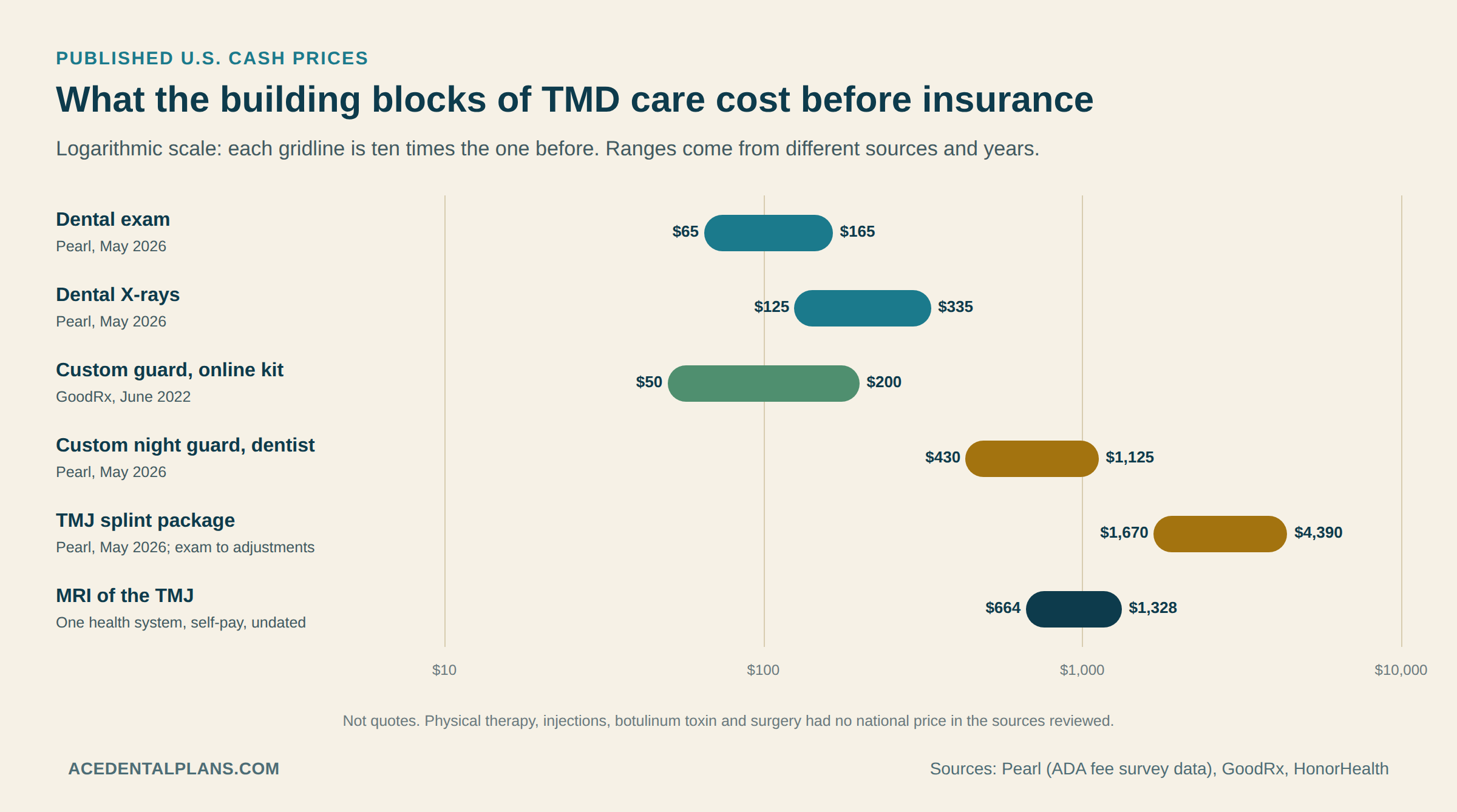
Three observations help read the table. First, the biggest spread sits in the guard rows. A store-bought guard at $20 to $30, an online-mail kit at $50 to $200 and a dentist’s custom guard at several hundred dollars are three different products, not three prices for one. GoodRx notes the dentist’s fee generally covers the impression and the lab, while the exam, deductible and copay or coinsurance are extra.
Second, the 2022 and 2026 figures do not match, and they should not be forced to. GoodRx, published in June 2022, gives $300 to $1,000 for a dentist’s custom guard, with most dual-laminated guards at $300 to $500 and some up to $1,000. Pearl’s May 2026 range is $430 to $1,125. The shift is the pattern one would expect over four years, but the two sources also measure differently, so no inflation rate can be read from the comparison.
Third, the splint package row bundles services that other rows price separately. Pearl’s $1,670 to $4,390 includes the consultation, the bite analysis, the splint and weeks of adjustments. Adding the exam row and the night guard row on top of it would double count. If a quote seems to land between the guard row and the package row, ask which services are inside it.
The other lines people encounter are real but unpriced here. KFF Health News reported in 2024 that one clinician contrasted conservative care at about $1,000 with surgery at $15,000 or $30,000. It also reported that many patients treated by orofacial pain specialists spend a few thousand dollars, and that a patient with severe disease faced a planned surgery that could cost up to $75,000. Those are quotes and case reports in a news story, not price surveys. They show the order of magnitude of the gap between the lower and upper rungs, and nothing more.
For the exam and X-ray lines, the guide to dentist visit cost without insurance goes through what a new-patient visit includes and how the pieces are priced, and the broader dental price guide sets other procedures beside them for scale.
Reading a TMD Estimate Line by Line
A written estimate is the only price that counts. For jaw care it usually has four to eight lines, and the code beside each line tells you how an insurer will read it. Pearl’s TMJ treatment page associates D9944 (a rigid full-arch occlusal guard), D7880 and D9230 with TMJ treatment. UnitedHealthcare’s dental policy lists D9944, D9945 and D9946 for guards, D9936 for cleaning and inspection, D9942 for repair or reline and D9943 for adjustment.
Those adjustment and reline codes explain a common surprise. A guard is not one charge. The fabrication is one line, and the follow-up visits, adjustments and any later repairs can be billed separately or bundled, depending on the office. Pearl states that its night guard range typically includes one or two adjustments in the first weeks, and that its TMJ splint package includes adjustments over 6 to 12 weeks. Ask what happens at the third adjustment.
Questions that clarify an estimate:
- Which lines are the guard itself, and which are exam, imaging, adjustments and follow-up?
- Is imaging included, and is it a panoramic X-ray, a cone-beam CT or an MRI done elsewhere?
- What diagnosis is the plan based on, and what finding confirmed it?
- Is the appliance meant to protect teeth from grinding, or to treat jaw pain? (The answer can affect how a dental insurer reads the claim.)
- What is the reversible first trial, and what happens if it does not help in six to twelve weeks?
- What does a replacement cost if the guard cracks or the bite changes?
One caution about the middle outcome. A claim has to describe what was actually done and why. It is legitimate to ask an office to submit a predetermination to the insurer, which is a request for the plan’s decision before treatment. It is not legitimate to ask an office to choose a diagnosis or code because it pays better. If the guard truly serves two purposes, the dentist’s records should say so.
Dental Insurance, Medical Insurance and the Gap Between Them
Insurance for jaw problems is confusing for a reason with a name. The NASEM report observed that reimbursement mechanisms for dental and medical care are generally separate in the United States. KFF Health News, quoting the report, described a “medical-dental divide”: medical insurers often see TMJ care as too dental, dental insurers see it as too medical, and patients land in the gap. The same story reports that some dental insurers consider splints medical while some medical plans consider them dental, so neither pays.
The documents bear this out, and not uniformly. GoodRx says night guards are typically covered by dental insurance if the dentist determines they are medically necessary, commonly at 50% of the allowable amount. Its plan examples include one guard every 36 months (a UnitedHealthcare guideline) and one every five years up to $150 (a Delta Dental PPO). UnitedHealthcare’s own dental policy, effective January 1, 2026, lists bruxism or clenching that causes excessive wear or fracture, and protection of natural teeth against opposing porcelain or ceramic, as covered indications. It lists treating temporomandibular disorders, headaches and craniofacial pain as not indicated under that policy, and it sends TMJ guards to a separate policy.
That separate policy is a medical policy. UnitedHealthcare’s Treatment of Temporomandibular Joint Disorders, effective October 1, 2026 for commercial and individual exchange plans, lists several services as proven and medically necessary. They are arthrocentesis, intra-articular corticosteroid injections, trigger point injections, physical therapy and occlusal splints of the stabilization and repositioning types. It lists biofeedback, jaw mobility stretching devices, multiple occlusal splints and epigenetic appliances as unproven. It then says many benefit documents have explicit exclusions for services to diagnose and treat TMJ disease, and that the member’s plan document governs in a conflict.
Cigna’s medical policy on TMJ surgery, effective December 15, 2025, says coverage for treating TMJ disorder varies across plans and the plan document always supersedes the policy. It requires a letter of medical necessity for all TMJ surgery requests. It describes noninvasive therapies (pharmacologic pain control, physical therapy, intra-oral appliances) as initial care but does not list them as separately covered services. It states that orthodontic treatment used with TMJ management is considered dental in nature and not covered under the medical benefit.
Put those documents side by side and the pattern is plain. The same guard may be a dental benefit, a medical benefit or an exclusion, depending on how it is coded, what it is for, and what the plan document says. KFF Health News quoted one expert as saying surgery is the only TMJ treatment covered by most plans in most states, and a National Academies finding that insurance tends to exclude low-risk, effective care while covering higher-risk options. Those are second-hand statements about patterns, and no single plan’s rules can be read from them. They are reasons to ask before assuming.
How a plan reaches those answers is explained in two guides: how dental insurance works covers premiums, deductibles, coinsurance and claims, and what dental insurance covers shows how plans sort services into preventive, basic and major tiers. For the full picture of plan types, exclusions and annual maximums, dental insurance explained goes deeper.
A workable sequence for a TMD patient is short. Ask the dental plan about night guards: frequency limit, percentage, waiting period, and whether TMD diagnosis changes anything. Ask the medical plan about TMJ evaluation, imaging, physical therapy and splints: whether any exclusion for TMJ or dental services applies and whether prior authorization is needed. Ask each in writing, and ask the dental office to submit a predetermination before any appliance is made. A pre-treatment estimate is not a promise of payment, but it is more than a phone call.
Medicare, Medicare Advantage and Public Coverage
For Medicare beneficiaries, the CMS page on dental coverage says Original Medicare doesn’t cover items and services for the care, treatment, filling, removal or replacement of teeth or the supporting periodontal structures. Exceptions apply where a dental service is inextricably linked to a covered medical service, such as dental exams before an organ transplant or heart valve procedure. The page includes dental splints “only when used as part of covered treatment of a covered medical condition,” with dislocated jaw joints given as an example.
The page does not mention TMJ disorders by name. Coverage for jaw-joint treatment under Original Medicare therefore turns on the specific service and condition, and a reader should confirm with Medicare or the plan before assuming either way. The wider background is in the guide to whether Original Medicare covers dental care.
Medicare Advantage is different, and plan-specific. CMS notes that some plans may cover routine dental as an added benefit. Whether a plan’s dental benefit reaches a night guard, TMJ imaging or physical therapy is a document question: read the plan’s coverage documents and call. The structure of those extras is explained in Medicare Advantage dental coverage.
October carries a seasonal point for anyone on Medicare. Medicare.gov says Open Enrollment runs October 15 to December 7, that you can join, drop or switch Medicare Advantage plans or move between Original Medicare and Medicare Advantage during it, and that changes take effect January 1 of the next year. If jaw care is on your near-term list, comparing dental benefits during open enrollment is a way to check a plan’s dental benefits before the window closes. No plan is recommended here, and a plan’s dental extras may not cover TMD care at all.
Medicaid dental benefits for adults vary by state, and this article did not review state rules, so the Medicaid agency or managed care plan is the place to ask. For people without any coverage, the playbook in dental care without insurance lists community health centers, dental school clinics and other lower-cost routes, and a dental school clinic is worth a call if you want to know whether any program near you sees TMD patients. Availability varies, so ask what the first visit includes and what it costs.
Timing: Annual Maximums, Waiting Periods and Benefit-Year End
If a dental plan pays any part of a guard, the annual maximum and the benefit year matter. An annual maximum is the most the plan pays in a benefit year, and many plans reset it on January 1, though some use a different date. Plans can also impose waiting periods for services they classify as major, and frequency limits that restrict a guard to one in several years, as in the GoodRx plan examples above.
Timing a purchase around the calendar is reasonable when the clinical situation allows it, and unreasonable when it does not. A flare with locking, a jaw injury or pain that disrupts eating should not wait for a benefit reset. For non-urgent decisions, using dental benefits before year-end explains how to read your own plan’s dates, and the answer can run in either direction: use what is left this year, or start next year with a fresh maximum.
Paying When Coverage Falls Short
When the plan pays little or nothing, three questions shape the next move. Is there a lower rung that deserves a trial first? Is there a lower-cost route to the same care? How should the remaining bill be spread over time?
On the first question, the ladder in Table 4 is also a budget. Rungs one and two cost little in cash, and rungs three and four depend on local therapist fees, for which no national price was found. A $20 to $30 store-bought guard is not equivalent to a custom appliance, and NIDCR advises stopping any appliance that causes pain, so a store-bought trial is a short-term experiment and not a replacement for an exam. The main spending decisions sit at rungs six through nine, which is where a second opinion has the most value.
On the second, a dental savings plan is a membership that reduces fees at participating dentists, and it differs from insurance. How these arrangements work and when they pay off is covered in dental savings plans. Cash-pay baselines and how to ask for an itemized price are in dental costs without insurance.
On the third, pre-tax accounts can reduce the effective cost of an eligible expense. GoodRx states that night guards are HSA- and FSA-eligible when used to prevent teeth grinding. Whether a given appliance or treatment qualifies depends on the plan administrator’s rules and the purpose documented, so ask the administrator before spending. The mechanics are compared in HSA vs FSA for dental expenses. Payment plans and credit have their own trade-offs: how to pay for dental work lays out the options, and dental financing versus payment plans compares what each costs if a payment is missed or a promotional period ends.
One last financial caution comes from the KFF Health News reporting. Patients with severe, long-running TMD described spending tens of thousands of dollars across years, with some borrowing against homes. The reporting is anecdotal, yet it points to a pattern worth guarding against: each new treatment offered as the one that will finally work, with the bill climbing. A written plan with a stop point, a second opinion before irreversible steps, and a budget agreed in advance are the practical protections.
Four Starting Points, Four Likely Paths
General rules are easier to use when they are attached to a situation. The four sketches below are hypothetical composites, built from the sources already cited, and they describe a reasonable line of thinking rather than a prescription for any real person. None of them replaces an exam.
The quiet click. A 28-year-old hears a click on the right side when opening wide. There is no pain, no locking and normal mouth opening. NIDCR and AAOMS both say this does not need treatment, so the sensible path is to mention it at the next routine exam and otherwise leave the jaw alone. The costly mistake here would be a scan or a splint ordered to “fix” a noise. If pain, catching or a narrowing opening appears later, the path changes, and the note in the chart helps the dentist see what is new.
The morning ache. A 41-year-old wakes most days with a dull ache in front of one ear, and a partner has noticed grinding at night. This matches the AAOMS description of the muscle pattern, which can be worse in the morning after clenching or grinding. A dental exam, an X-ray of the teeth and joints, and a conversation about stress and sleep come first. The likely first rungs are self-care and a short course of habit change, with a custom guard as an option if the dentist finds wear or clear clenching. The guard itself runs from several hundred dollars to just over a thousand at the Pearl 2026 figures, and the coverage question follows. Does the dental plan read the guard as protection against wear, which one insurer’s policy covers, or as TMD treatment, which that policy sends elsewhere?
The catching jaw. A 36-year-old has had pain and catching in the joint for three weeks, and the mouth now opens less than before. This is the middle row of the decision path: book an exam within a week or two, not at the next routine visit. The dentist may use DC/TMD to separate muscle pain from joint problems and may request a panoramic X-ray. If a disc problem with limited opening is suspected, the DC/TMD table shows that diagnosis can be reasonably accurate from the exam alone, and an MRI becomes a question for a specialist. A referral to physical therapy is an evidence-supported step in parallel.
The long road. A 52-year-old has had jaw pain, neck pain and headaches for years, has tried two splints and several medicines, and has been told surgery may be next. NIDCR’s guidance applies directly: avoid irreversible steps, ask simpler treatments first, understand the risks and consider a second opinion from an orofacial pain specialist. NASEM’s background paper adds that pain elsewhere in the body is a strong correlate of orofacial pain, so a plan that addresses sleep, stress, neck and the other pain conditions deserves a hearing. Cost control here is mostly about stopping the pattern of one more device, one more month, one more scan without a clear question.
Questions to Ask and Offers That Deserve a Second Look
Questions to Ask Before You Agree to Treatment
A short list helps in the moment, when a plan is being explained and the chair is reclined. Group the questions by what they reveal.
About the diagnosis
- Which kind of TMD is this: muscle, joint, headache, or a mix? What in the exam showed that?
- Were other sources of the pain considered, such as teeth, gums, sinuses, ears or neck?
- Is any imaging proposed, and what question would it answer?
About the plan
- Which rung of the ladder is this, and were lower rungs tried first?
- Is the treatment reversible? If it changes my teeth or bite, why is that necessary?
- How long should I give this approach before we judge whether it works, and what is Plan B?
- Would an orofacial pain specialist or an oral surgeon offer a second opinion on this plan?
About cost and coverage
- Can I have a written, itemized estimate with a code on each line?
- What is included in the guard or splint fee: fitting, adjustments, follow-up visits, repairs?
- Will you submit a predetermination to my dental plan, and should I ask my medical plan about the same service?
- Is there a lower-cost version of the first step, such as a trial with a simpler appliance or exercises with a physical therapist?
About stopping
- What result would tell us this is working? What would tell us to stop?
- If the appliance causes pain, who do I call, and how fast can I be seen?
A plan that holds up under these questions is easier to trust, and one that does not is worth knowing about before payment.
Offers That Deserve a Second Look
Because TMD is chronic for some people and the evidence for many treatments is thin, it is an area where offers can outrun the science. NASEM noted that some dentists continue to rely on aggressive or costly procedures as a first-line treatment. A few patterns merit caution, each anchored in the sources above.
A device or procedure meant to permanently reposition the bite. NIDCR advises avoiding any appliance designed to permanently change the bite, and says insufficient evidence supports occlusal treatments such as crowns, grinding teeth and orthodontics for TMD. The Cigna policy’s remark that appliances should not create major alteration in occlusion points the same way.
Open-ended appliance plans. A trial with defined check-ins is one thing. A succession of devices, daytime and nighttime, each replacing the last, runs against the insurer language that treats multiple occlusal splints as unproven. The HTA review found no good evidence that splints reduce pain across TMD, so there is little to be gained by escalating this rung.
A large treatment plan based on a click. The DC/TMD accuracy table shows that disc displacement with reduction, which is the diagnosis a click often suggests, is identified by the exam alone only about a third of the time (34% sensitivity). A multi-thousand-dollar plan resting on that diagnosis calls for confirmation.
Early surgery. NIDCR and AAOMS place open joint surgery and replacement late on the ladder, after simpler treatments have failed. The FDA’s 680 adverse-event reports about TMJ implants from 2014 to 2018 are the context for being deliberate.
Long-term opioids for chronic jaw muscle pain. AAOMS says narcotic analgesics are rarely indicated for chronic masticatory muscle pain, and NIDCR notes that some medicines used in TMD carry addiction or serious side-effect risks.
Prepayment pressure. A discount for paying a large treatment bill in full today is a legitimate offer in some offices. Pressure to commit before an itemized estimate, an insurer answer or a second opinion is a different matter. Ask for time.
Bottom Line
TMD is common, usually manageable, and often fluctuating. The most reliable path is a stepwise one: an exam that checks for look-alikes, then low-risk self-care and exercise. An appliance or injection needs a clear reason and a way to judge whether it helped, and surgery stays the rare exception. Ordinary clicking needs no treatment, and a handful of jaw situations need the emergency room, not the dentist.
The financial side deserves the same discipline as the clinical side. The cost ladder runs from tens of dollars to thousands, and what a plan pays depends on whether the item is coded and read as dental, medical or excluded. Get the estimate itemized, ask both insurers in writing, and treat a second opinion before any irreversible step as part of the cost of care, not an optional extra.
Frequently Asked Questions
What are the first signs of TMJ disorder?
The most common first sign is pain in the chewing muscles or the jaw joint, according to NIDCR and MedlinePlus. Other early signs include jaw stiffness, pain that spreads to the face or neck, painful clicking or grating, limited movement or locking, and ear symptoms such as ringing. A change in how the teeth fit together can also appear. Painless clicking alone is common and usually not a sign of a disorder.
Is a clicking jaw always a sign of TMJ disorder?
No. NIDCR says clicking or popping without pain is common, normal and does not need treatment, and AAOMS says painless popping is not necessarily an indication for treatment. Clicking becomes more meaningful when it comes with pain, catching, locking or a narrowing opening. In those cases a dental exam is reasonable, because the combination can point to a joint or muscle disorder.
What causes TMJ disorder?
For most people the exact cause is unknown. NIDCR says injury to the jaw can cause some cases, and that genetics, life stress and the way a person perceives pain may contribute. AAOMS lists clenching and grinding habits, referred neck pain, arthritis, disc problems, dislocation and fractures among causes. NIDCR states that research does not support a bad bite or braces as a cause.
Can TMJ disorder go away on its own?
Often, yes. NIDCR says many TMDs are short-lived and resolve on their own, while some become chronic. A National Academies background paper reports that half of new cases in one large cohort were still persistent six months later. Because mild cases tend to stay mild and symptoms can fluctuate, a low-risk approach with a planned reassessment is the usual starting point.
How do I tell TMJ pain from a toothache?
TMD pain usually sits near the ear or along the jaw and changes with chewing, yawning or clenching, while a toothache tends to stay in one tooth or area. Only an exam and X-ray can sort them out, because the two can coexist. If the pain is clearly in a tooth, the safe short-term steps are in the toothache guide linked earlier, and a dentist should see it promptly if swelling or fever appears.
Should I see a dentist or a doctor for jaw pain?
A dentist is a reasonable first stop for jaw-joint or chewing-muscle pain, and SDCEP notes most TMD is managed in primary care. See a physician first if the pain comes with a stuffy nose and facial pressure, a new hearing change, or fever. Call 911 for jaw pain with chest pressure, shortness of breath, cold sweat or nausea. A physician may also be involved when headache or widespread pain is part of the picture.
How is TMJ disorder diagnosed?
There is no widely accepted standard test, according to NIDCR. Diagnosis rests on a detailed history and an exam of the head, neck, face and jaw, and may include X-ray, MRI or CT. The DC/TMD criteria structure the exam and screen for psychosocial factors. Pain-related diagnoses can be made accurately from history and exam, while several joint diagnoses need imaging for confirmation.
Do I need an MRI for TMJ?
Not usually at the start. AAOMS describes a panoramic X-ray as the initial imaging tool and says cone-beam CT, CT or MRI should be considered based on history, exam and differential diagnosis. Cigna’s medical policy says MRI and CT are generally not indicated, apart from selected persistent cases when surgery is being considered. Ask what question the scan would answer and whether it would change the plan.
What is the first treatment for TMJ disorder?
Conservative self-care. NIDCR lists soft foods, heat or cold with gentle jaw stretching and strengthening exercises, over-the-counter NSAIDs such as ibuprofen when appropriate, and reducing clenching, gum chewing and nail biting. Physical therapy and behavioral approaches come next if those do not help. Treatments that permanently change the teeth, bite or joint are advised against early because evidence is limited.
Do night guards work for TMJ?
The evidence is uncertain. A 2020 review of 52 trials rated the evidence as very low quality and found no evidence that splints reduced pain across TMD overall, though individual patients may benefit. NIDCR says evidence of benefit for pain is limited, advises avoiding any guard designed to permanently change the bite, and says to stop if the guard causes pain. For tooth wear from grinding, a guard is a separate, established use.
Is Botox approved for TMJ?
No. NIDCR states that botulinum toxin type A is not FDA-approved for TMD and that study results are mixed. A 2024 review of 23 randomized trials found pain relief in some studies and no difference from placebo in others, with relief lasting up to about six months and some reduction in bite force. Any use is off-label and should be discussed with the cost and the trade-offs in mind.
How much does a TMJ night guard cost without insurance?
A custom guard from a dentist ran $430 to $1,125 nationally in May 2026 Pearl data, with a $655 average, and $300 to $1,000 in a June 2022 GoodRx article. A dentist-run TMJ splint package was $1,670 to $4,390. Store-bought guards cost $20 to $30 but are not custom-fitted. For more context on cash prices, see the guide to dental costs.
Does dental insurance cover TMJ treatment?
Sometimes, and it depends on the plan. One insurer’s 2026 dental policy covers guards for bruxism that causes wear or fractures but lists TMD treatment as not indicated under that policy, and sends TMJ guards to a separate policy. GoodRx cites plans covering a guard at 50% of the allowable amount or up to $150 every five years. Ask the plan for its TMJ language and a predetermination in writing; the dental insurance and plans hub collects the related guides.
Does medical insurance cover TMJ?
Possibly for some services. UnitedHealthcare’s October 2026 commercial policy lists arthrocentesis, certain injections, physical therapy and stabilization or repositioning splints as medically necessary, and also says many benefit documents have explicit exclusions for TMJ care. Cigna says coverage varies across plans and requires a letter of medical necessity for TMJ surgery. Your plan document controls, so ask for the exclusion language.
Does Medicare cover TMJ treatment?
The CMS dental coverage page says Original Medicare does not cover care of the teeth or their supporting structures. It lists dental splints as covered only when part of treatment for a covered medical condition, such as dislocated jaw joints. It does not mention TMJ disorders by name. Some Medicare Advantage plans offer dental extras, so check the plan’s documents, especially during open enrollment from October 15 to December 7.
Can stress cause TMJ disorder?
Stress is one of several factors that may contribute. NIDCR says psychological and life stressors, genetics and how a person perceives pain may play a role in developing and sustaining TMD, and AAOMS lists stress-related clenching among causes of muscle disorders. Stress does not explain every case, and treating it, through relaxation, behavioral therapy or better sleep, is part of care and not a sign that the pain is imagined.
Can TMJ pain cause ear pain, ringing or dizziness?
It can be associated with them. NIDCR lists ringing in the ears, hearing loss and dizziness among possible signs of TMD, and AAOMS notes ear fullness with muscle disorders. Because ear and balance problems have many other causes, a new hearing change or dizziness should be checked by a physician, not assumed to come from the jaw.
When is TMJ surgery needed?
Rarely. NIDCR says to consider open surgery only for joint destruction that cannot be fixed or severe symptoms that persist despite other treatments, and AAOMS reserves arthroplasty and joint replacement for people whose minimally invasive procedures have failed. The FDA received 680 adverse-event reports about TMJ implants from 2014 to 2018. Getting a second opinion from an orofacial pain specialist before any irreversible step is advised.
Sources and Disclaimers
Clinical statements in this article come from federal and professional sources: NIDCR, MedlinePlus, the FDA, CMS and Medicare.gov, the American Dental Association, AAOMS, the American Heart Association and the National Academies, plus peer-reviewed reviews of splints, exercise therapy and botulinum toxin, and the DC/TMD diagnostic criteria. Insurance statements come from published insurer policy documents and a patient-facing pricing article, and each is specific to the plan, year and policy named. Dollar figures come from consumer pricing tools (Pearl, built on ADA fee survey data, and GoodRx), one health system’s posted self-pay price file and a news report. Each is labeled with its year. The patient scenarios, the groups of 100 and the plan arithmetic are original illustrations, not data. National averages hide wide local variation, and several figures are older than 2026. Confirm prices with the dental office and benefits with your insurer in writing before treatment.
- NIDCR: TMJ Disorders
- NIDCR: Temporomandibular Disorders (TMD) and jaw pain: data and statistics
- NIDCR: Facial pain: data and statistics
- National Academies of Sciences, Engineering, and Medicine: Jaw disorders are common, but care is fragmented and evidence-based approaches are needed (news release, March 2020)
- National Academies Press via NCBI Bookshelf: Slade G, Durham J. Prevalence, Impact, and Costs of Treatment for Temporomandibular Disorders (Appendix C, 2020)
- MedlinePlus: Temporomandibular Disorders
- American Dental Association, MouthHealthy: TMJ
- AAOMS: Statement on Temporomandibular Disorders (2024)
- AAOMS (MyOMS): AAOMS develops guidance for diagnosing, managing TMJ disorders and pain (October 2024)
- Journal of the American Dental Association: Schiffman E, Ohrbach R, et al. Executive Summary of the Diagnostic Criteria for Temporomandibular Disorders (DC/TMD), 2016
- Health Technology Assessment: Riley P, et al. Oral splints for patients with temporomandibular disorders or bruxism: a systematic review and economic evaluation, 2020
- Cureus: Kharraz RH, et al. A Comparative Analysis of Botulinum Toxin Use Versus Other Therapies for Temporomandibular Disorders: A Systematic Review, 2024
- Clinical Rehabilitation: Idanez-Robles AM, et al. Exercise therapy improves pain and mouth opening in temporomandibular disorders: a systematic review with meta-analysis, 2023 (repository record)
- U.S. Food and Drug Administration: Temporomandibular Joint (TMJ) Implants
- Scottish Dental Clinical Effectiveness Programme: Acute temporomandibular disorder
- American Heart Association: Warning Signs of a Heart Attack
- Delta Dental: Tooth pain could mean sinusitis
- Centers for Medicare & Medicaid Services: Medicare Dental Coverage
- Medicare.gov: Open Enrollment
- Cigna: Medical Coverage Policy 0156: Temporomandibular Joint (TMJ) Disorder Surgery (effective December 2025)
- UnitedHealthcare: Treatment of Temporomandibular Joint Disorders, commercial medical policy (effective October 1, 2026)
- UnitedHealthcare: Dental Clinical Policy: Occlusal Guards (effective January 1, 2026)
- KFF Health News and CBS News: A Bottomless Pit: How Out-of-Pocket TMJ Costs Drive Patients Into Debt (July 2024)
- GoodRx: How much does a night guard cost? (June 2022)
- Pearl dental cost tool: Night guard national cost (May 2026)
- Pearl dental cost tool: TMJ treatment national cost (May 2026)
- Pearl dental cost tool: Dental X-rays national cost (May 2026)
- Pearl dental cost tool: Dental exam national cost (May 2026)
- HonorHealth: Average pricing for MRI (self-pay price file)
Important Information and Disclaimers
This article is general educational information. By using it, you accept the limits described below.
Not dental or medical advice
Nothing on this page is a diagnosis, a treatment recommendation or a substitute for an examination by a licensed dentist or physician. Reading this article does not create a dentist-patient or doctor-patient relationship. Only a licensed professional who has examined you and reviewed your history can tell you what your mouth needs. Do not delay, skip or stop professional care because of something you read here.
Prices are estimates, not quotes
Cost figures are ranges reported by the third-party sources cited in this article. Actual prices depend on your location, the provider, the complexity of your case, the materials used, the date of service and other factors, so what you pay may be higher or lower. A written treatment plan and fee estimate from the dental office is the only reliable number for your situation.
Insurance and plan examples are illustrations
Examples that use named amounts or percentages are hypothetical. Real benefits depend on your plan, network, waiting periods, annual maximum, deductible and the insurer’s rules at the time of treatment. A pre-treatment estimate or benefits check is not a promise of payment. Confirm the details with your insurer or plan administrator in writing.
Not insurance, legal, tax or financial advice
AceDentalPlans is an information publisher. Nothing here is insurance, legal, tax, investment or other professional financial advice, and nothing here recommends a particular provider, insurer, lender, discount plan or financing product. Company and product names belong to their owners and appear for identification only. Read the terms of any loan, financing offer or plan before you sign, and ask a qualified professional if you need advice on your own circumstances.
Third-party sources
This article cites government agencies, professional associations, insurers, lenders and other outside organizations. We do not control those sources. Their content can change, move or disappear, and listing a source is not an endorsement of it or of anything it sells.
No warranty
We aim for accuracy, but this article is provided “as is,” without warranties of any kind, express or implied, including warranties of accuracy, completeness, timeliness or fitness for a particular purpose. Some information may be out of date or contain errors by the time you read it.
Limitation of responsibility
To the fullest extent permitted by law, AceDentalPlans and its owners, authors and contributors are not responsible or liable for any loss, cost, injury, health outcome or other damage that results from using this article or relying on it. You are responsible for your own decisions about your care, your coverage and your money.
How this article is written
This article follows AceDentalPlans’ answer-first, U.S.-focused editorial approach. It uses conditional language for insurance, because coverage depends on the specific plan, and it names its sources so that you can read them yourself.