Emergency Dentist Cost: Exams, X-Rays and Common Treatments. An emergency dentist visit typically costs $70 to $185 for the exam and one X-ray, with a national average near $110. That comes from a May 2026 price database built on ADA fee-survey data. A temporary fix such as a filling, a re-cemented crown or abscess drainage often adds roughly $50 to $250 in the sources used here. The larger bill comes afterward: a molar root canal averages about $1,050, and a hospital emergency room visit for dental pain averages $749.
This article follows an emergency visit in the order the charges arrive: the exam, the X-ray, the relief measure, the temporary repair, and the treatment that may follow. It also covers when a problem belongs in a hospital instead of a dental chair, how dental and medical insurance split the bill, and what a visit costs without coverage. It stops short of full price breakdowns for extractions, root canals and crowns, which appear here only as one-line anchors.
Key Takeaways
- The emergency exam is the cheapest line on the bill: $70 to $185 nationally (average $110), usually with one X-ray included. The money is in what the exam finds.
- Relief measures such as palliative treatment, a temporary filling or a re-cemented crown ran $85 to $125 in one clinic’s 2020 fee schedule. Insurer filings from 2026 show median network rates of $52 to $82.
- No source used here publishes a reliable after-hours surcharge percentage. The code for it (D9440) has a median network rate of $74, but each office sets its own fee, so ask for it by name.
- Trouble breathing or swallowing, spreading facial or jaw swelling, uncontrolled bleeding or serious facial injury belong in an ER. Most other dental emergencies are cheaper and more fixable at a dentist.
- The ADA puts the average ER visit for dental pain at $749, against $90 to $200 for a dental office visit, and the ER usually cannot repair the tooth.
- An ER bill typically goes to your medical insurance, not your dental plan. A dentist’s emergency visit usually follows your normal deductible, coinsurance and annual maximum.
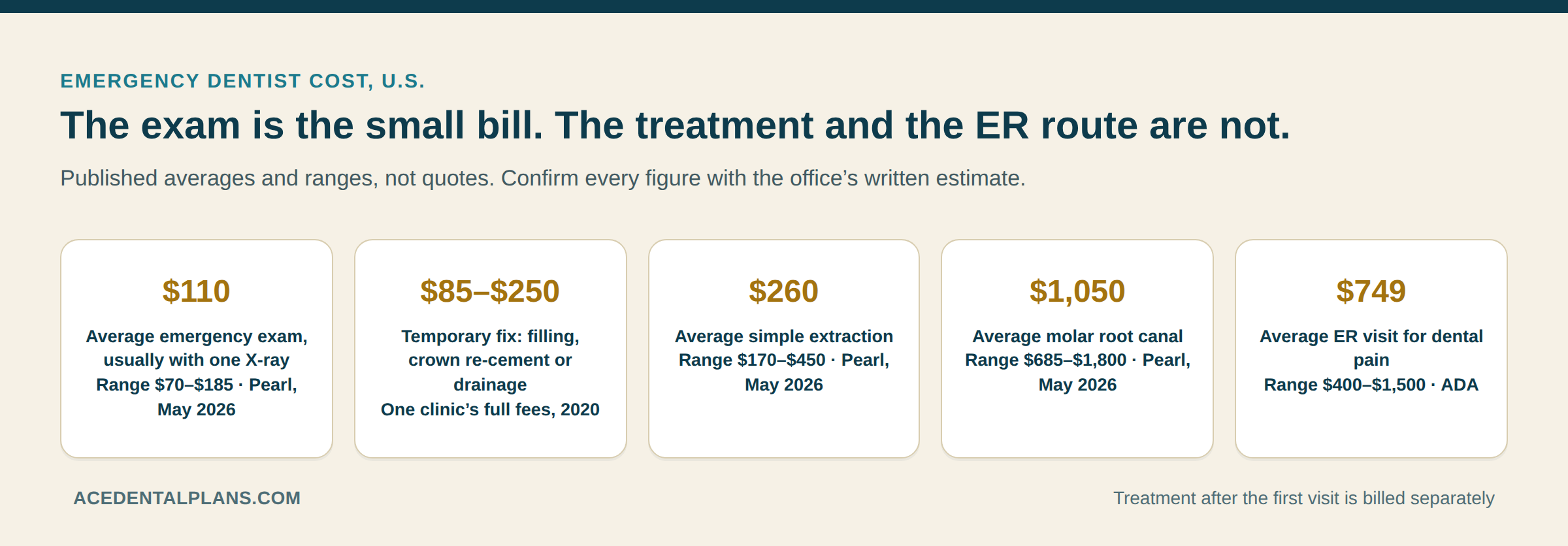 Where emergency dental money goes: the exam is small, the follow-up treatment and the ER route are not.
What the First Emergency Visit Costs Before Anyone Treats Anything
Start with the exam. Nearly every emergency patient pays it, and it has the most solid published price. Hello Pearl’s national cost database, which says it draws on ADA fee-survey data and was updated in May 2026, lists a limited emergency exam (CDT code D0140) at $70 to $185. The national average is $110.
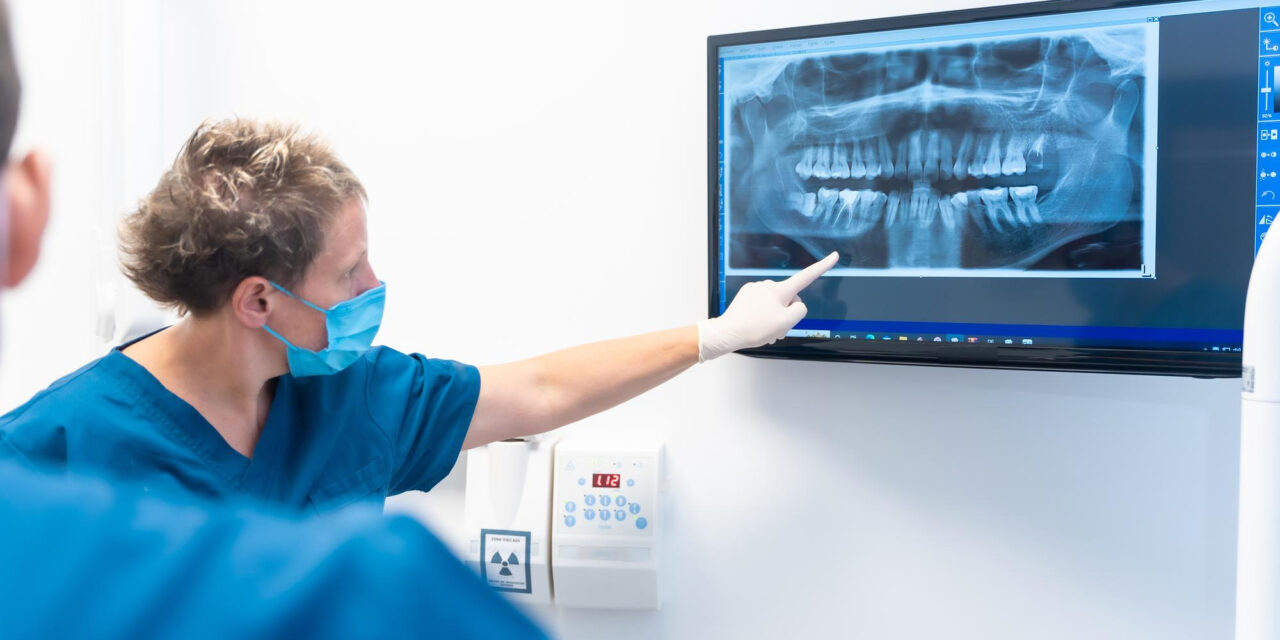
That fee buys a targeted look at the urgent area, in most cases one periapical X-ray of the tooth in question, a pain assessment, a diagnosis and a treatment plan. A prescription for antibiotics or pain relief is part of the visit when the dentist thinks it is appropriate. Everything else is billed separately: the treatment itself, a comprehensive exam of the whole mouth, a cleaning, extra X-rays and any sedation beyond local anesthetic.
A second source points the same way. New Hampshire’s public health-cost comparison tool lists the same code for more than 400 providers, with a statewide average of $113, a low of $63 and a high of $231. The tool does not say what period its data covers, and one state is not the nation, but a price-posting state landing close to the national figure is reassuring.
The same tool shows something useful about who pays what. For some hospital-based clinics it displays a lower “what you will pay” figure for uninsured patients. One academic medical center shows $98 reduced to $37, and another shows $120 reduced to $40. For many independent offices the two columns are identical, meaning no posted uninsured discount. If you have no coverage, that gap is a reason to ask what the cash price is before you sit down.
How does an emergency exam compare with a routine one? Pearl lists a periodic exam (D0150) at $65 to $165, average $100. So the emergency version averages only about $10 more. Pearl does note that some practices charge new emergency patients more, which is worth a sentence on the phone if you are calling a dentist you have never seen.
For a floor under all this, look at a 2020 fee schedule from the dental clinic of SIU’s Center for Family Medicine. Its full-fee column lists a limited oral evaluation at $60 and a first periapical X-ray at $29. It is six years old and from one clinic, so treat it as a sign of how low an exam-plus-film can go, not as a current price.
Line by Line: Every Charge That Can Appear on an Emergency Bill
Emergency invoices are short. Each line still carries a CDT code, and the code tells you what the office considers it did. Table 1 lines up the usual suspects with two different kinds of price. The first is a full-fee column from that 2020 clinic schedule. The second is the median rate that insurer filings show dentists accepting from health plans, drawn from CMS-mandated machine-readable files and summarized by the PayorMap site as of March 2026.
| Service (CDT code) | What it means on the bill | Clinic full fee, 2020 | Median network rate, March 2026 (range) |
|---|---|---|---|
| Limited exam, problem-focused (D0140) | Targeted look at the painful or damaged area | $60 | $130 ($20–$716) |
| Periapical X-ray, first image (D0220) | One film showing the whole tooth, root and surrounding bone | $29 | $15 ($9–$83) |
| Palliative treatment (D9110) | Pain relief that does not fix the cause | $125 | $72 ($26–$184) |
| Protective (sedative) filling (D2940) | Temporary filling that calms a sensitive tooth until a permanent one | $85 | $52 ($31–$233) |
| Re-cement or re-bond crown (D2920) | Putting a loose or fallen crown back on | $125 | $82 ($28–$210) |
| Incision and drainage, soft tissue (D7510) | Opening a gum abscess to let it drain | $250 | $130 ($51–$750) |
| Office visit after regular hours (D9440) | Fee for being seen outside normal office hours | Not listed | $74 ($34–$395) |
Two cautions before you read across a row. The columns differ in year, in payer and in place, so the gap between them is partly the network discount and partly everything else. And the median is the sturdier number in each filing summary. The ranges are wide enough (an exam from $20 to $716, an abscess drainage from $51 to $750) that the extremes are better ignored than quoted.
The exam row also shows why no single number is safe. PayorMap’s D0140 median of $130 sits inside Pearl’s $70 to $185 range, yet PayorMap’s average for the same code is $197, pulled up by high filings. Medians are the better guide when the tail is that long.
Look at the palliative line, D9110, because it is the one patients most often misread. It is the billing label for “we eased your pain but did not treat its cause,” and it commonly appears on a claim next to the limited exam. PayorMap notes that some insurers apply frequency limits to it, which is a reason to ask your plan, not just the office, how many times a year it pays for one.
One more trap hides in X-ray pricing. Pearl’s separate X-ray listing shows $125 to $335, average $195, for the category as a whole, and it names panoramic and full-mouth series as the costlier types. That is not what a single-tooth film costs. If an estimate for an urgent visit shows a three-figure imaging line, ask whether the dentist is planning more than one targeted image and why.
After-Hours and Weekend Fees: What the Evidence Shows and What It Doesn’t
Does an evening or weekend visit cost more? Pearl says so directly: after-hours, weekend and holiday emergency visits cost more than a same-day appointment during regular business hours. What none of the sources used here provides is a percentage. Anyone quoting “a 50 percent surcharge” or a flat $200 is describing one office’s policy, not a national rule.
The closest published figure is the network rate for the after-hours code itself, D9440. PayorMap’s summary of insurer filings shows a national average of $81, a median of $74 and a range from $34 to $395, drawn from 292 records in 38 states. State averages vary a lot: Hawaii leads at $146, Iowa is lowest at $34. A Texas-only page from the same site showed an average of $76 from just 12 providers.
Those numbers describe the extra fee that contracted dentists agree to take from a plan. An out-of-network or cash-pay office can set its own, and the 2020 clinic schedule above lists no after-hours fee at all. The practical reading is that an after-hours fee is typically a modest add-on, not a multiple of the exam. Only a price list from the specific office can prove it.
The ADA offers a related reassurance. Its MouthHealthy patient site notes that most dentists reserve time in their daily schedules for emergency patients. That suggests a call at opening time on a weekday may get you a regular-hours slot with no after-hours line, if the situation can wait for the morning. Whether it can is a judgment for the dentist who hears your symptoms on the phone, not for an article.
When you do call after hours, ask three things. Is there a separate after-hours or emergency fee? Is it billed in addition to the exam or in place of part of it? Does your plan treat it as a covered service? If the office routes after-hours calls to a recorded line, ask these questions on the call-back rather than guessing.
Common Emergencies and Where the Bill Usually Ends Up
Most emergency patients pay twice. The first visit stops the immediate problem, and the second deals with its cause. Table 2 sorts the usual emergencies by that pattern and attaches a price anchor to each stage. The anchors for root canals, extractions and crowns are national averages from Pearl’s May 2026 database, shown only so you can see how big the second bill can get.
| Situation | Who to call first | Usual first-visit work | What may follow | Price anchors |
|---|---|---|---|---|
| Filling fell out, tooth sensitive | Dentist | Limited exam, X-ray, temporary (sedative) filling | Permanent filling | Temporary filling $85 (2020 clinic) or $52 median network rate; composite filling $170–$450 |
| Crown or cap came off | Dentist | Exam, X-ray, re-cement the crown | New crown if the crown or tooth is damaged or decayed | Re-cement $125 (2020 clinic) or $82 median network rate; new crown averages $1,560 ($1,015–$2,670) |
| Severe, constant toothache | Dentist | Exam, X-ray, pain relief, possibly a prescription | Root canal or extraction | Palliative treatment $72–$125; molar root canal averages $1,050 ($685–$1,800); simple extraction averages $260 ($170–$450) |
| Gum abscess (pimple-like bump, bad taste, facial swelling) | Dentist the same day; ER if breathing or swallowing is affected | Exam, X-ray, drainage, sometimes antibiotics | Root canal or extraction of the source tooth | Drainage $250 (2020 clinic) or $130 median network rate, then the root canal or extraction anchors above |
| Cracked or broken tooth | Dentist or endodontist | Exam, X-ray, smoothing, bonding or a temporary cover | Filling, crown, or root canal if the pulp is exposed | Exam $70–$185, then the filling, crown or root canal anchors above |
| Knocked-out permanent tooth | Dentist or endodontist at once; ER if no dentist can be reached | Replant and splint the tooth | Weeks of splinting, then follow-up, sometimes root canal | No reliable national price found for replanting and splinting |
| Facial trauma, bleeding that will not stop, trouble breathing or swallowing | Hospital ER | Stabilize, control bleeding and pain, treat or prevent infection | Referral to a dentist for the tooth itself | ER visit averages $749 ($400–$1,500) per the ADA |
Reading across the rows, a pattern appears. In the sources used here the first visit runs from roughly $70 up to a few hundred dollars, while the second bill starts near $260 and can pass $1,000. Delta Dental says an abscess cannot heal on its own, so waiting does not make the later bill disappear. It just postpones it, usually with more pain in between.
The table also explains a quirk of emergency estimates. An office can quote the first visit with some confidence, because the exam and the relief measure are standard. It usually cannot quote the second stage until it has seen the X-ray, which is why many dentists give a range or a “pending exam” line for the root canal or crown. A pending line is not a trick. It is worth asking, though, whether the office will put the later figures in writing before it begins.
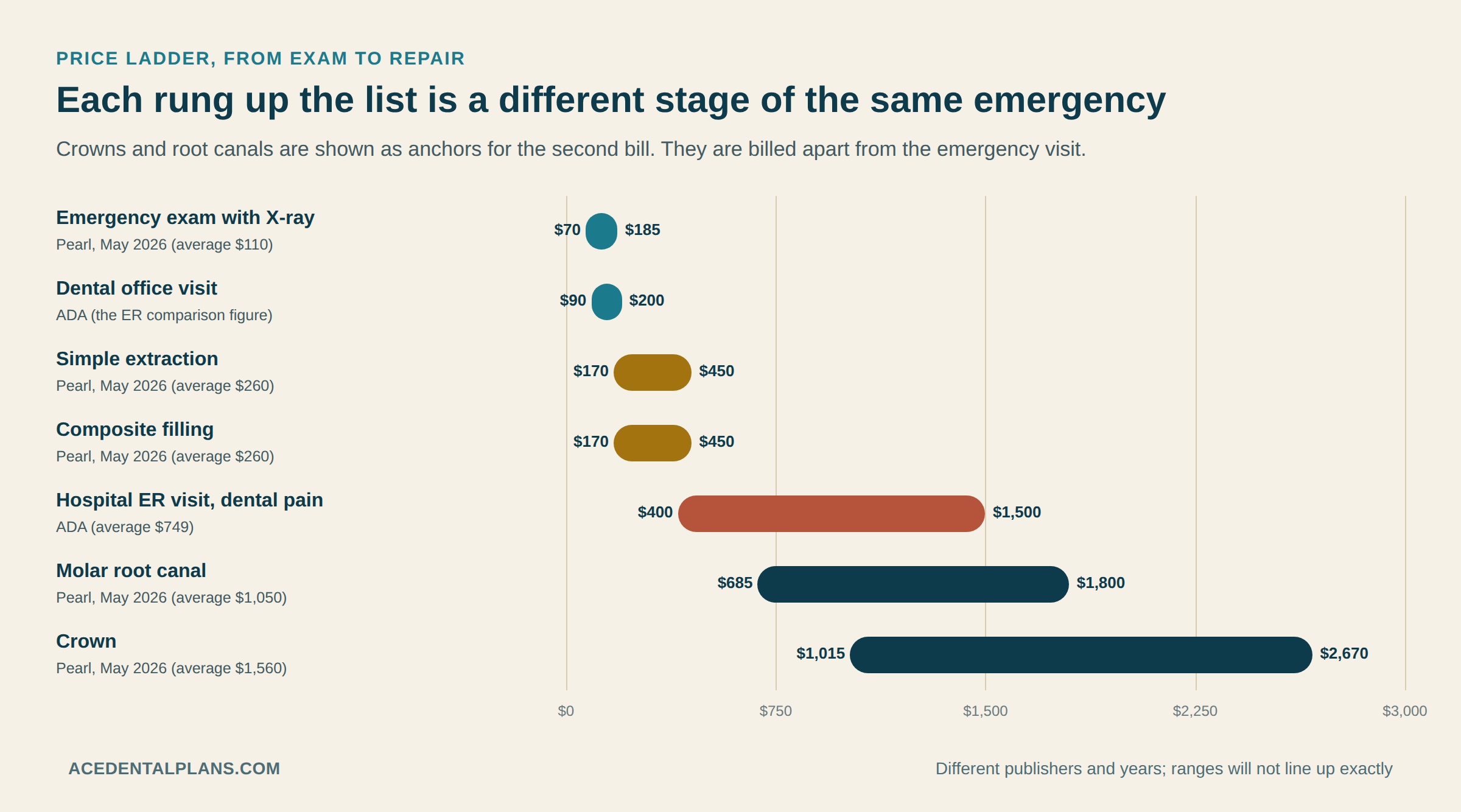 The price ladder from exam to repair, with the ER visit shown for comparison.
A Toothache or Abscess: Relief First, Treatment Second
An abscess is the emergency most likely to produce both the largest bill and the most urgent warning signs. The NIDCR describes how it develops: as tooth decay advances, an infected tooth can form a pocket of pus, with pain, facial swelling and fever. MedlinePlus, in an entry reviewed in February 2026, lists a severe, gnawing or throbbing toothache, a bad taste and fever. Other signs are pain while chewing, sensitivity to hot and cold, and a pimple-like bump on the gum. It calls swelling of the jaw a very serious symptom.
Treatment comes in layers. According to MedlinePlus, a dentist may prescribe antibiotics and recommend warm saltwater rinses or over-the-counter pain relievers. A root canal may be recommended to try to save the tooth, and severe cases may need extraction or surgical drainage, with some people needing hospitalization. Delta Dental says plainly that a tooth abscess cannot heal on its own, and that most can be handled routinely in a dentist’s office, usually with a root canal or an extraction.
In billing terms, that translates into stages you can tally. The first visit is the limited exam and film. If the dentist drains the abscess, a D7510 line appears. Antibiotics, if prescribed, are a separate prescription. Then comes the definitive step, which is where the choice between saving the tooth and removing it starts to matter financially.
Notice what the arithmetic leaves out. Pearl notes that a core build-up under a crown is often billed separately, and that a crown is almost always needed after a molar root canal. Replacing an extracted tooth, if you choose to, is another line altogether. For an emergency decision, the point is simple. The price of the visit and the price of the plan of treatment are different numbers, and only the first stays in the low hundreds.
There is also a clinical point that affects cost. MedlinePlus warns that an untreated abscess can lead to serious complications such as a brain abscess, heart inflammation and pneumonia. That is why swelling is treated with more urgency than a toothache alone, and why an abscess that makes swallowing or breathing hard belongs in a hospital, not a waiting room.
Lost Fillings, Loose Crowns and Broken Teeth: The Smaller Emergencies
Not every emergency is dramatic. A filling that drops out or a crown that comes loose is painful enough to call for a same-week visit, and the repair is usually modest. The key distinction is between putting something back and replacing it.
For a lost filling, the usual interim step is a protective or sedative filling (D2940). In the 2020 clinic schedule it was $85. The 2026 insurer-filing summary shows a median of $52 and a range of $31 to $233 from 195 records in 38 states. A permanent composite filling later costs far more, with Pearl listing $170 to $450 and an average of $260. Pearl’s database shows identical figures for composite fillings and simple extractions, so treat both as rough guides.
For a crown that has come off, the fastest fix is to re-cement or re-bond it (D2920). The clinic listed $125 in 2020; the insurer-filing median is $82, with a range of $28 to $210 across 241 records. That works only if the crown and the tooth underneath are intact. PayorMap describes the code as intended for a crown that becomes loose or dislodged, often through wear or decay. If decay has gotten under the crown, the dentist may recommend replacing it, and then the Table 2 crown anchor of $1,560 applies.
Broken teeth sit in between. BCBS North Carolina’s patient guide lists broken teeth among dental emergencies. It says you may be able to wait, but it is wise to have them looked at to avoid more severe problems. The American Association of Endodontists says minor chips may be repaired by reattaching the fragment or applying a tooth-colored filling. Larger breaks might require a crown, and exposed pulp makes root canal treatment necessary. The first two outcomes keep the bill small; the third is the one that reaches the molar root canal range.
If you are waiting for an appointment, the ADA’s advice for a cracked tooth is to rinse with warm water and apply cold compresses to the face to keep swelling down. For a toothache it suggests rinsing with warm water and gently flossing out any trapped food, and it says not to put aspirin directly on the tooth or gums. The AAE adds that, for a chipped tooth, you can bite on clean, moist gauze to ease discomfort and avoid topical pain products or aspirin on the area.
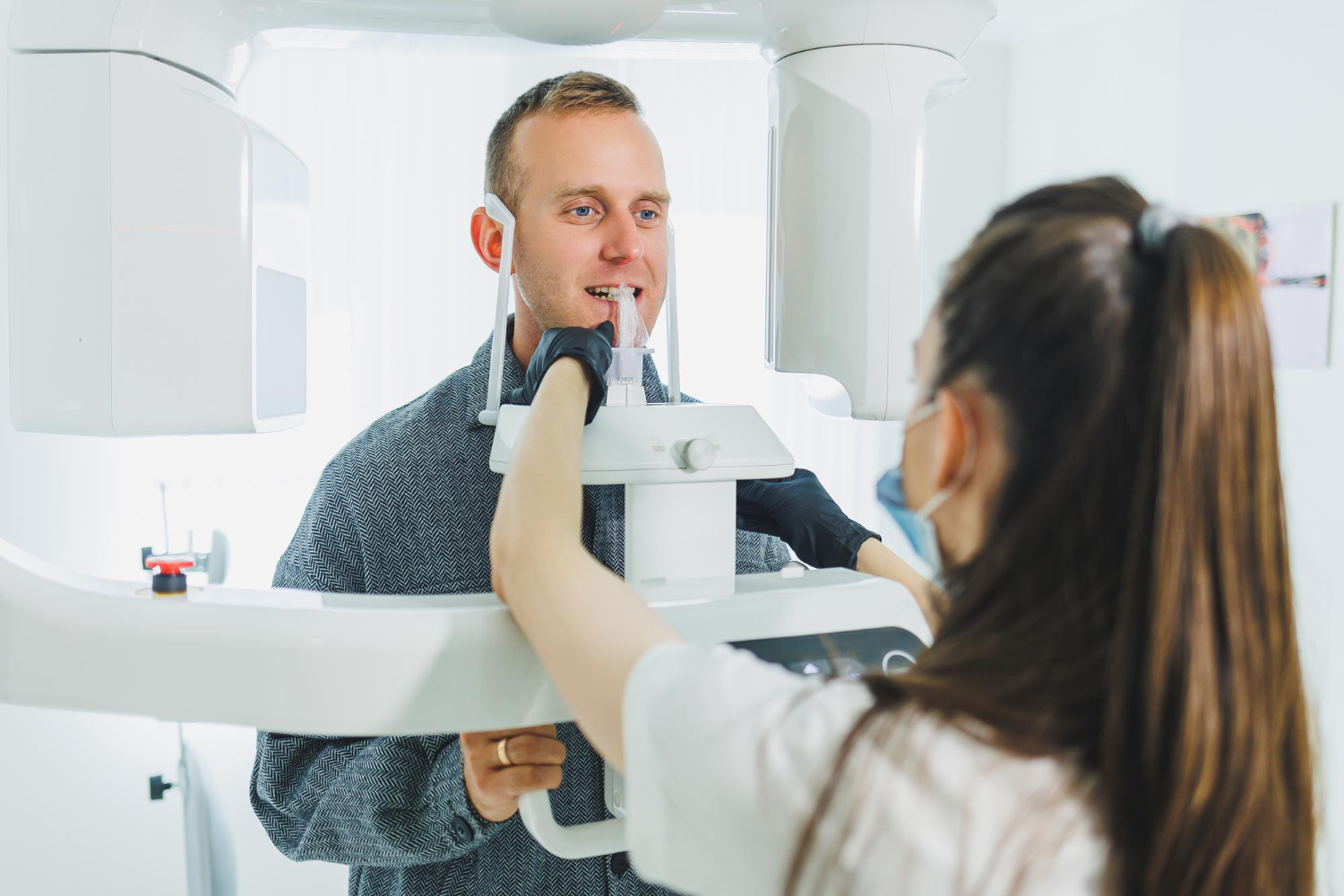
Knocked-Out Teeth and Mouth Injuries: Where Minutes Matter More Than Price
A knocked-out permanent tooth is the one dental emergency where time, not cost, should drive the decision. The AAE says that with treatment quickly, preferably within 30 minutes, there is a chance to save the tooth. The ADA says to keep the tooth moist at all times and, if you can, to place it back in the socket without touching the root. If that is not possible, it suggests holding it between your cheek and gums, in milk, or in a tooth-preservation product. Then it is a matter of getting to a dentist or endodontist at once.
The AAE describes what happens next. A dentist or endodontist replants the tooth in its socket and stabilizes it with a splint for several weeks. Displaced teeth are repositioned and stabilized, and root canal treatment typically follows several days after injury for permanent adult teeth. Children younger than 12 may not need an immediate root canal, because their developing teeth contain stem cells that can promote healing on their own.
Pricing is where an honest gap beats a guess. No reliable national price for replanting and splinting a tooth turned up in the sources used here, so Table 2 gives none. The sources do let you price the pieces around it. Those are the emergency exam and film, the root canal that often follows for an adult tooth, and an ER visit if no dentist can be reached.
Injuries that go beyond the tooth change the insurance picture. BCBS North Carolina notes that trauma, infections, draining abscesses and dental conditions related to a medical condition may be covered under medical insurance. Dental plans, it says, often cover emergency dental care with costs that vary by coverage. Which plan pays for a mouth injury from a fall or an accident depends on the plan. Ask both insurers before assuming one of them is off the hook.
Dentist or ER: Choosing by Symptoms Rather Than Price
Cost matters, but it should not be the first filter when something is wrong in your mouth. Three sources agree on the shape of the decision, even though none of them provides a checklist. The ADA tells patients to call a dentist and describe the problem in detail, and to visit a dentist or an emergency room as soon as possible. BCBS North Carolina says the first step is to call your dentist or an emergency dental clinic. If the dentist cannot see you, urgent care or a hospital ER is the next option.
The sharpest line comes from Delta Dental’s abscess page: if you are having difficulty breathing or swallowing, go to an emergency room. MedlinePlus similarly singles out jaw swelling as a very serious symptom. Taken together, those statements put airway trouble, swelling that is spreading, and significant facial injury on the ER side of the line. If you cannot breathe or swallow, call 911 or go to the nearest emergency room, and sort out the dentist afterward.
For the large middle ground of ordinary dental emergencies, the dentist is the right first call. That includes a severe toothache, a suspected abscess without breathing or swallowing problems, and a broken or lost crown or filling. It also includes a knocked-out tooth, where the AAE’s window of about 30 minutes makes the dentist, not the waiting room, the destination. Describing symptoms to the office on the phone lets staff tell you whether to come in now, come in today, or go to a hospital instead. The dentist makes that call, not a search engine.
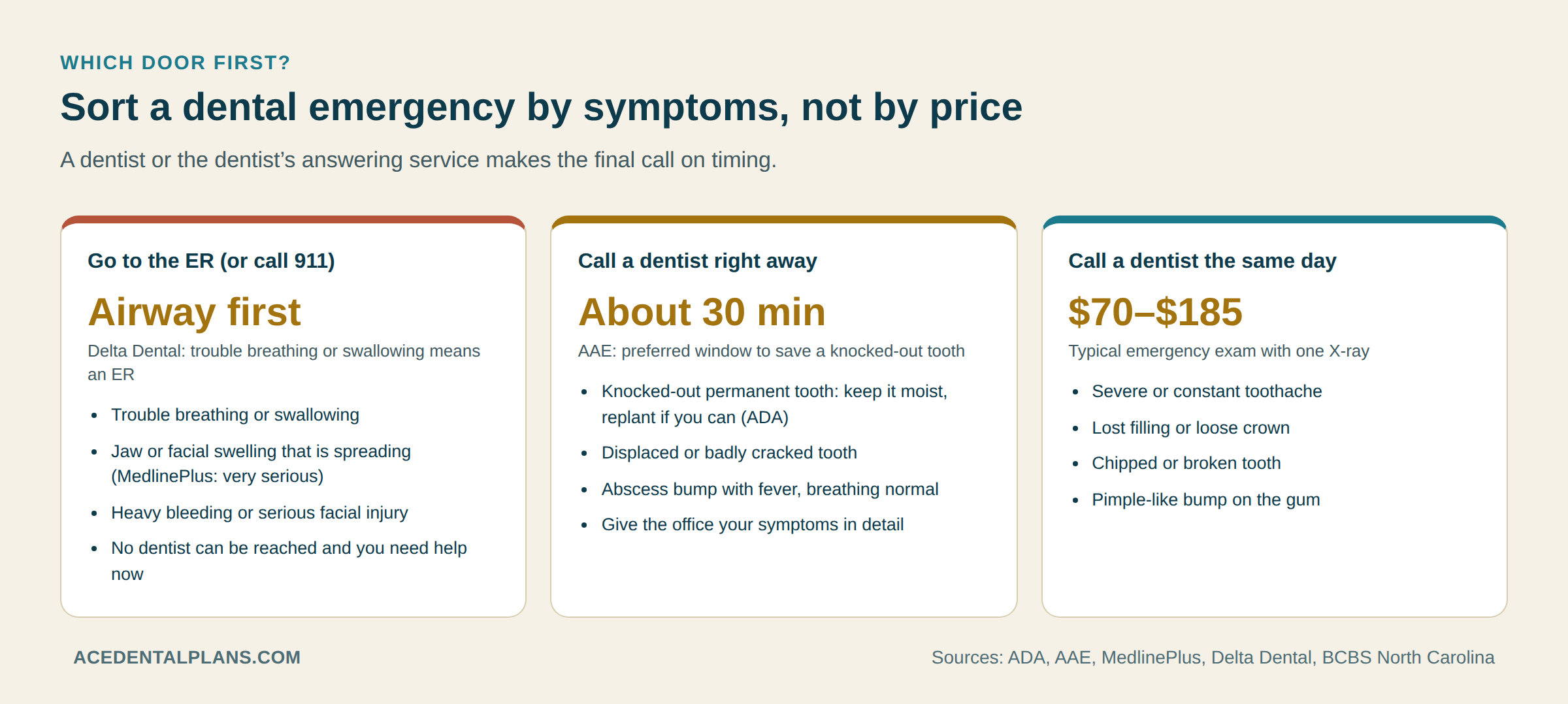 Symptom-based sorting of dental emergencies, drawn from ADA, AAE, MedlinePlus, Delta Dental and BCBS North Carolina guidance.
ER Versus Dentist: What the Price Gap Looks Like
Table 3 sets the two routes side by side. The price comparison is the ADA’s, and the rest comes from BCBS North Carolina, Medicaid.gov’s analysis of emergency department dental visits and Delta Dental of Arizona’s emergency-coverage paper.
| Factor | Emergency dentist | Hospital ER |
|---|---|---|
| Typical price per visit (ADA) | $90–$200 for a dental office visit | $400–$1,500; average $749 when the patient is not admitted |
| What it can do for the tooth | Exam, X-ray, drainage, temporary or permanent repair, extraction, root canal | Cannot repair the tooth; can stop bleeding, control pain and treat or prevent infection (BCBS NC) |
| What you usually leave with | Treatment done, or a plan with prices | Often one prescription for painkillers and antibiotics plus a referral to a local clinic (ADA) |
| Which insurance is billed | Dental plan, with your usual deductible, coinsurance and annual maximum; some trauma and infections may go to medical | Medical plan; Delta Dental of Arizona says dental coverage often does not apply to ER or urgent care visits, and prescriptions fall under medical benefits |
| Is the underlying problem solved? | Often, or the next step is scheduled | Usually not; the ADA says relying on the ER often leaves the underlying problem untreated |
| When it fits | Toothache, abscess without airway symptoms, lost filling or crown, broken or knocked-out tooth | Trouble breathing or swallowing, serious facial injury, heavy bleeding, or no dentist reachable |
The ADA estimates that about 2 million visits a year to hospital emergency departments are for dental pain, at an average of $749, which the association says is roughly three times the cost of a visit to the dentist. It puts the national total at $1.6 billion annually and estimates that routing those patients to dental providers instead could save about $1.7 billion. The ADA adds that ER patients typically get one prescription for painkillers and antibiotics and a referral, which does not address the problems behind the pain.
Counts differ by definition and year, so do not expect them to match. The ADA cites approximately 663,000 emergency department visits for non-traumatic dental conditions in 2018, which is a narrower category than “dental pain.” An older federal report, HCUP Statistical Brief 143, counted 936,482 dental-related ED visits in 2009. Medicaid.gov counts about 487,000 visits in 2019 by non-dual-eligible Medicaid adults ages 21 to 64 alone, and cites an ADA Health Policy Institute estimate of $2.7 billion for hospital ED dental visit costs in 2017, a different basis from the $1.6 billion annual figure above.
Who goes, and for what? The 2009 HCUP data are old but detailed. Uninsured patients accounted for 40 percent of dental-related ED visits, Medicaid 30 percent, private insurance 19 percent, Medicare 7 percent and other payers 4 percent. By diagnosis, dental caries made up 41.8 percent, abscess 37.4 percent and periodontitis 10.2 percent. Abscess accounted for 63 percent of the visits that ended in admission. The ADA, citing the same year, says abscesses and caries, both largely preventable, made up nearly 80 percent of dental ED visits.
 Who used the ER for dental problems in 2009, and why, from the federal HCUP Statistical Brief 143.
Does that mean never going to the ER? No. It means the ER is priced and equipped for a different job. For airway-threatening swelling, serious trauma, or a night when no dental office can be reached, it is the correct door. For a toothache, it is an expensive way to get a prescription.
How a Dental Plan Treats an Emergency Visit, in Order
The insurance mechanics of an emergency are the same as for planned care, with a few friendly exceptions. Work through them in this order, because each step changes the next. A plan summary or a call to the insurer settles every one.
Plan type. A PPO or indemnity plan lets you see many dentists and pays a share of an allowed amount. A dental HMO (DHMO) pays through a copay schedule at a limited network of offices. Delta Dental of Arizona’s October 2024 emergency-coverage paper warns that emergency care from an out-of-network dentist may not be covered depending on the plan, with a DHMO as the example. A discount plan is not insurance at all; it lowers the fee only at participating offices.
Deductible and network. The same Delta paper says deductibles, annual maximums and copays stay the same as for standard dental care. A national dental group’s guide, last updated October 2026, agrees that standard deductibles apply to emergency visits and do not change because the visit is urgent. In-network dentists bill the plan’s allowed amount; out-of-network ones may bill the full fee.
Coinsurance. That same guide says emergency exams and diagnostic X-rays are typically treated as preventive or diagnostic services typically covered at 100 percent. It describes fillings and simple extractions as basic services at 80 percent, and root canals and crowns as major services at 50 percent. Pearl’s emergency-exam page makes a similar point, noting that most PPO plans cover emergency exams at the same rate as a periodic exam and that after-hours and weekend emergency fees may not be covered. These are common patterns, not promises; many plans differ.
Annual maximum. The guide says plans typically cap benefits at $1,000 to $2,000 a year, after which you pay 100 percent of what remains. An emergency early in the year uses up part of that cap before any follow-up treatment.
Waiting periods and frequency limits. The guide says many plans have six- to twelve-month waiting periods for major work such as root canals and crowns for new enrollees. Most waive them for emergency exams and X-rays, and sometimes for basic procedures, it adds. It also says an emergency exam may be covered even if you have already used your routine exam benefit. Because that is one dental group’s description, confirm each point with your own plan.
The estimate. Put it all together by asking the dentist’s office for an itemized treatment plan with CDT codes and the insurer for a pre-treatment estimate where one is offered. Emergency visits often cannot wait for pre-approval, so the realistic path is to get the first-visit codes confirmed by phone and the follow-up work estimated afterward, before the second appointment.
A Worked Estimate: Friday-Evening Swelling on a PPO
Numbers make the mechanics concrete. The example below is hypothetical, with allowed amounts and plan rules chosen for round arithmetic, not taken from any carrier’s plan.
 Hypothetical split of a $315 emergency visit: the plan pays $234, the patient pays $81 (deductible plus coinsurance).
Several features of that example are worth pulling out. First, the deductible has the largest effect on a small bill: $50 of the patient’s $81 is deductible, not coinsurance. Second, the diagnostic lines cost the patient nothing under the assumptions, which is why a prompt exam is the cheapest part of an emergency for an insured patient. Third, the root canal costs $450 even though the plan is paying. That second bill often surprises people who thought the first visit was the whole thing.
Change one assumption and the answer moves. If the drainage were classed as major surgery at 50 percent, the patient share on that line would rise. If the dentist were out of network and billed a full fee above the allowed amount, the patient could owe the difference. If the person were new to the plan, the root canal might still be inside a waiting period and the plan might pay nothing toward it. That is why the question to the insurer is not “is emergency care covered?” Ask instead how D0140, D0220, D9110, D9440 and D7510 are classed, and what the waiting periods on endodontics are.
Paying Without Insurance: Cash Math and Lower-Cost Doors
Without a plan, the arithmetic is simpler and less forgiving. You pay the office’s fee for each line, and no allowed-amount discount applies unless the office offers one. Take the same Friday-evening swelling as in the insured example and price it in cash.
Whether the price is negotiable depends on the office. The New Hampshire cost tool shows that some hospital-based clinics post a lower uninsured price than their listed charge, while many independent offices post the same figure either way. The difference suggests asking two plain questions: what is your cash fee for this visit, and is there a lower price if I pay today? The answer may be no, and then you know.
Lower-cost routes exist, and they are slower. The federal Health Resources and Services Administration says health centers adjust their fees based on income and family size and include dentists among their staff. Health centers must serve everyone, even if they cannot pay. About 90 percent of their patients have incomes below 200 percent of the federal poverty level. A health center is not an emergency room, so call first and ask whether it holds same-day emergency slots for dental pain.
Public coverage helps in narrower ways than people expect. Medicaid.gov says states have flexibility to decide what dental benefits adults get, with no minimum requirements. For children, Medicaid’s EPSDT benefit must include relief of pain and infections, and states cannot limit it to emergencies. Separate CHIP programs must cover services to treat emergency conditions. Original Medicare, by contrast, does not cover dental services like fillings or tooth extractions. Exceptions include an oral exam and treatment before a heart valve replacement or organ transplant, and certain dental services when you are admitted to a hospital as an inpatient.
Payment plans and third-party financing are a separate topic with their own trade-offs. For an emergency, the practical point is to ask the office, before you agree to treatment, whether it offers in-house installments and what they cost. That keeps the decision about the tooth from being made under the pressure of a pain-driven checkout.
What Pushes an Emergency Bill Up or Down
Beyond the plan, a handful of variables move the total. Most are things you can ask about before the work starts.
- When you are seen. Pearl states that after-hours, weekend and holiday visits cost more than a same-day appointment during business hours. The D9440 network median is $74, but individual offices set their own fees.
- New or existing patient. Pearl notes that some practices charge new emergency patients more than their own patients.
- How many images. A single periapical film is included in most emergency exams, according to Pearl. A panoramic or full-mouth series is usually billed separately and costs more.
- Which tooth. Pearl describes the molar as the most complex of the three root canal types and lists it at $685 to $1,800. Front teeth and premolars are the other two types, though the page gives no separate figure for them.
- Network status. Delta Dental of Arizona notes that out-of-network emergency care may not be covered, depending on the plan. Where it is covered, an out-of-network dentist can bill above the plan’s allowed amount.
- Where you live. The insurer-filing summaries show wide state gaps. The average D9440 is $146 in Hawaii and $34 in Iowa, a D7510 drainage averages $224 in New York and $69 in Kansas, and a re-cemented crown averages $122 in Iowa against $31 in Michigan.
- Which facility. The ADA’s $400 to $1,500 range for an ER visit, against $90 to $200 for a dental office visit, is the largest price difference in this article.
One note on timing. The AAE’s symptoms page says the earlier you address symptoms and treat the problem, the better the outcome. That is a clinical statement about results, not a pricing one. For an abscess or a cracked tooth, though, the two point the same way: waiting narrows the options and does not make the later bill go away.
Questions to Ask on the Phone and at the Chair
An emergency call is rushed, and rushed calls skip the pricing questions. Keep these eight handy, in roughly the order a conversation unfolds.
- Do you charge a separate after-hours or emergency fee, and how much is it? The code is D9440; asking by name avoids a vague answer.
- Is the X-ray one targeted film, and is it included in the exam fee? Pearl says it usually is.
- Which codes will be on today’s bill? Exam (D0140), palliative treatment (D9110), temporary filling (D2940), crown re-cement (D2920) or drainage (D7510) each have their own price.
- Is today’s treatment temporary? If so, ask what the lasting repair is likely to be and what it typically costs, in writing.
- Are you in network with my plan, and how will you bill it? Then confirm with the insurer how those codes are classed.
- What is the cash price, and is there a discount for paying today? Uninsured patients should hear this before the exam, not after.
- Do you offer installments? If so, ask whether any interest or fees apply.
- What symptoms mean I should go to the ER instead of waiting? The dentist knows your situation; the answer is theirs to give.
Frequently Asked Questions
How much is an emergency dentist visit if I don’t have insurance?
The exam and one X-ray typically run $70 to $185, with a national average of $110, per Pearl’s May 2026 database. A temporary repair or drainage adds to that, and one 2020 clinic schedule listed $85 to $250 for those services. Definitive treatment such as a root canal or extraction is a separate and larger charge.
Does dental insurance cover an emergency dentist?
Often, yes, under your regular rules. Delta Dental of Arizona says deductibles, annual maximums and copays stay the same as for standard care. Another national dental group says emergency exams and X-rays are typically covered at 100 percent. Out-of-network emergency care may not be covered under some plans, such as a DHMO.
Is the ER cheaper than an emergency dentist for tooth pain?
Not according to the ADA. It reports an average ER visit for dental pain of $749, with a range of $400 to $1,500, against $90 to $200 for a dental office visit. The ER usually cannot repair the tooth, so a dentist visit often follows anyway.
Do emergency dentists charge more at night or on weekends?
Often. Pearl says after-hours, weekend and holiday visits cost more than a same-day appointment in regular hours, but no source here gives a standard percentage. The after-hours code D9440 has a median network rate of $74, and each office sets its own fee, so ask for it by name.
Can an emergency dentist fix my tooth in one visit?
Sometimes, for a crown that needs re-cementing or a filling that needs replacing. For an abscess or a deep toothache, Delta Dental says treatment is usually a root canal or an extraction, and the first visit often focuses on relief. Your dentist will say which pieces can be done the same day.
What counts as a dental emergency?
BCBS North Carolina lists severe tooth pain or sensitivity, a knocked-out tooth, broken teeth, loose or dislodged teeth, abscesses or oral infections, and cuts, bleeding or bruising of the mouth. The ADA lists a knocked-out tooth, a cracked tooth, a bitten tongue or lip, a toothache and stuck objects. Trouble breathing or swallowing sends you to an ER.
Does Medicaid pay for emergency dental care?
It depends on your age and your state. Medicaid.gov says there are no minimum dental requirements for adults, and states decide. For children, Medicaid’s EPSDT benefit must include relief of pain and infections, and states cannot restrict it to emergencies. Your state Medicaid office can say what adults get.
Does Medicare cover emergency dental work?
Original Medicare generally does not cover dental services like fillings or tooth extractions. Medicare.gov lists exceptions, including certain dental services during a hospital inpatient admission and exams or treatment tied to a covered procedure such as a heart valve replacement. A Medicare Advantage plan may differ, and this page does not cover those.
Will the ER give me antibiotics for a tooth infection?
Often it does. The ADA says ER patients typically receive a prescription for painkillers and antibiotics and a referral to a clinic. Medicaid.gov says non-traumatic dental conditions in the ED are usually managed palliatively with pain relief, antibiotics or both. That does not remove the infected tooth’s source, which a dentist treats.
My face is swollen from a bad tooth. Dentist or ER?
Call a dentist right away if you can breathe and swallow normally, because most dental abscesses are handled in an office. If swelling affects your breathing or swallowing, go to an emergency room, as Delta Dental advises. MedlinePlus calls jaw swelling a very serious symptom.
Sources and Disclaimers
Clinical statements come from the ADA, the AAE, NIDCR and MedlinePlus. Insurance and public-program statements come from Delta Dental of Arizona, BCBS North Carolina, Medicaid.gov, Medicare.gov, one national dental group’s patient guide and the federal HRSA. Price figures come from Hello Pearl (May 2026), PayorMap’s summaries of insurer price filings (March 2026), the ADA, a New Hampshire public cost tool and a 2020 clinic fee schedule. The worked estimates, running totals and the PPO plan rules in them are original illustrations, not quotes or data. National averages hide large local differences, so confirm every price with the dentist and every benefit with the insurer.
- American Dental Association (MouthHealthy) — Dental Emergencies
- American Dental Association — Emergency Department Referrals (Action for Dental Health)
- AHRQ HCUP — Statistical Brief 143: Emergency Department Visits for Dental-Related Conditions, 2009
- MedlinePlus — Tooth Abscess
- National Institute of Dental and Craniofacial Research — Tooth Decay
- American Association of Endodontists — Traumatic Dental Injuries
- American Association of Endodontists — Dental Symptoms
- Delta Dental — Tooth Abscess: Signs and Symptoms
- Delta Dental of Arizona — Is Emergency Treatment for Employees Covered? (white paper, October 2024)
- Blue Cross and Blue Shield of North Carolina — Dental Emergencies
- Aspen Dental (national dental group) — Does Dental Insurance Cover Emergency Visits?
- Medicaid.gov — Adult Emergency Department Visits for Non-Traumatic Dental Conditions in Medicaid
- Medicaid.gov — Dental Care
- Medicare.gov — Dental Services
- HRSA Bureau of Primary Health Care — What Is a Health Center?
- Hello Pearl Dental Costs — Emergency Dental Exam: National Cost
- Hello Pearl Dental Costs — Dental Exam: National Cost
- Hello Pearl Dental Costs — Dental X-Rays: National Cost
- Hello Pearl Dental Costs — Root Canal: National Cost
- Hello Pearl Dental Costs — Tooth Extraction: National Cost
- Hello Pearl Dental Costs — Dental Crown: National Cost
- Hello Pearl Dental Costs — Composite Filling: National Cost
- New Hampshire HealthCost — Problem-Focused Evaluation (D0140) price results
- PayorMap — D0140 national rates from insurer price filings
- PayorMap — D0220 national rates
- PayorMap — D9110 national rates
- PayorMap — D2940 national rates
- PayorMap — D2920 national rates
- PayorMap — D7510 national rates
- PayorMap — D9440 national rates
- PayorMap — D9440 rates in Texas
- SIU Center for Family Medicine — Dental fee schedule, effective February 27, 2020
Important Information and Disclaimers
This article is general educational information. By using it, you accept the limits described below.
Not dental or medical advice
Nothing on this page is a diagnosis, a treatment recommendation or a substitute for an examination by a licensed dentist or physician. Reading this article does not create a dentist-patient or doctor-patient relationship. Only a licensed professional who has examined you and reviewed your history can tell you what your mouth needs. Do not delay, skip or stop professional care because of something you read here.
Prices are estimates, not quotes
Cost figures are ranges reported by the third-party sources cited in this article. Actual prices depend on your location, the provider, the complexity of your case, the materials used, the date of service and other factors, so what you pay may be higher or lower. A written treatment plan and fee estimate from the dental office is the only reliable number for your situation.
Insurance and plan examples are illustrations
Examples that use named amounts or percentages are hypothetical. Real benefits depend on your plan, network, waiting periods, annual maximum, deductible and the insurer’s rules at the time of treatment. A pre-treatment estimate or benefits check is not a promise of payment. Confirm the details with your insurer or plan administrator in writing.
Not insurance, legal, tax or financial advice
AceDentalPlans is an information publisher. Nothing here is insurance, legal, tax, investment or other professional financial advice, and nothing here recommends a particular provider, insurer, lender, discount plan or financing product. Company and product names belong to their owners and appear for identification only. Read the terms of any loan, financing offer or plan before you sign, and ask a qualified professional if you need advice on your own circumstances.
Third-party sources
This article cites government agencies, professional associations, insurers, lenders and other outside organizations. We do not control those sources. Their content can change, move or disappear, and listing a source is not an endorsement of it or of anything it sells.
No warranty
We aim for accuracy, but this article is provided “as is,” without warranties of any kind, express or implied, including warranties of accuracy, completeness, timeliness or fitness for a particular purpose. Some information may be out of date or contain errors by the time you read it.
Limitation of responsibility
To the fullest extent permitted by law, AceDentalPlans and its owners, authors and contributors are not responsible or liable for any loss, cost, injury, health outcome or other damage that results from using this article or relying on it. You are responsible for your own decisions about your care, your coverage and your money.
How this article is written
This article follows AceDentalPlans’ answer-first, U.S.-focused editorial approach. It uses conditional language for insurance, because coverage depends on the specific plan, and it names its sources so that you can read them yourself.