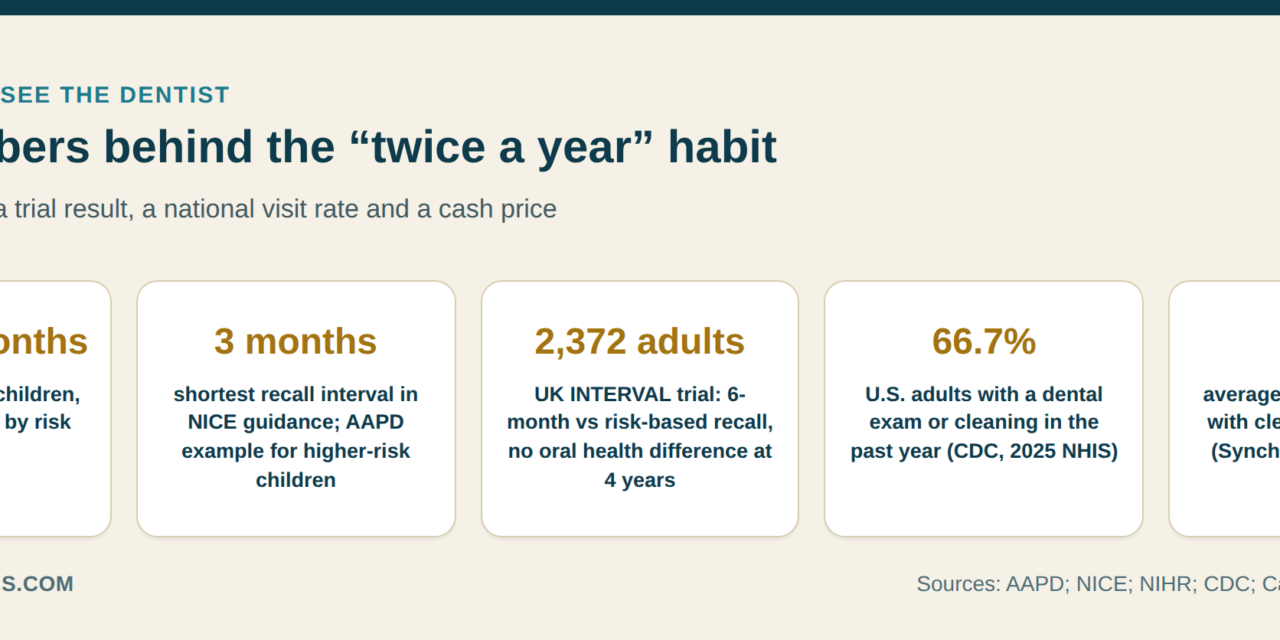
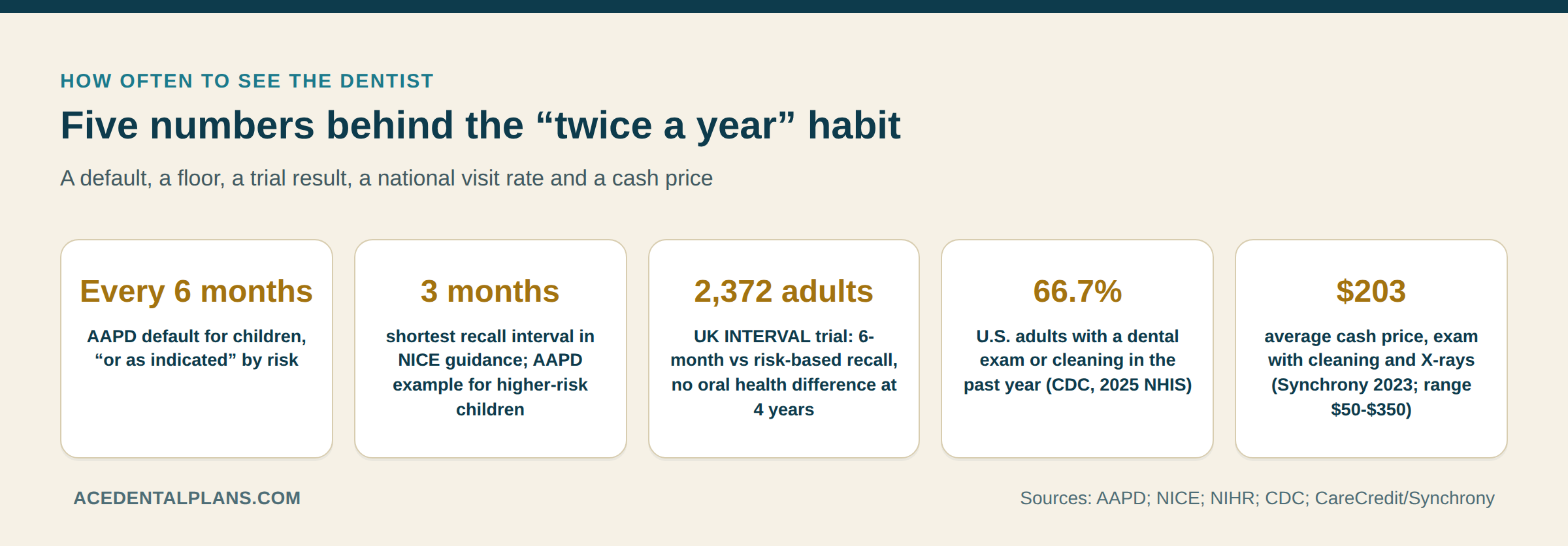
Twice a year is the usual advice, and it is a sensible starting point, but it is a default rather than a rule. The American Dental Association says there is no one-size-fits-all schedule, the CDC advises a checkup at least once a year, and pediatric dentists repeat exams “every 6 months or as indicated” by a child’s risk. Higher-risk patients may be advised to come every three to four months.
This article explains where the six-month habit came from, what the research says about it, and which health factors push your interval shorter or longer. It also covers what a checkup actually includes, how insurance frequency limits interact with clinical need, and what skipping visits can do to a budget. It stops short of price lists, X-ray schedules, deep cleaning and gum disease treatment, because each has its own page.
Key Takeaways
- Six months is a default. The ADA says “there is no one-size-fits-all dental treatment,” and the American Academy of Pediatric Dentistry (AAPD) writes its own six-month interval as “or as indicated by child’s risk status.”
- The trial evidence is reassuring for low-risk adults. In a UK trial of 2,372 regular dental attenders, risk-based recall and six-month recall produced no difference in oral health after four years.
- Risk shortens the interval. Gum disease with bone loss, diabetes, smoking, dry mouth and a history of cavities are the factors the sources tie to closer follow-up. One insurer’s criteria say periodontal maintenance patients may benefit from at least four visits a year.
- Insurance counts visits; teeth do not. One 2026 state employee plan limits exams and cleanings to two per calendar year each. A dentist who wants you back more often may be asking for visits the plan does not pay for.
- Cash math is not one-sided. Using published cash averages, ten routine visits ($2,030) can cost about as much as one neglected molar that needs a root canal and crown ($2,939 with an exam). What routine visits buy is earlier detection, not automatic savings.
- Pain is a late signal. The ADA notes that gum disease and oral cancer often cause no pain until advanced stages, which is why the schedule should not wait for symptoms.
What the Major Sources Say About Visit Frequency
No single U.S. rule sets the number of visits per year. The ADA’s patient pages say some people need one or two visits a year and others need more, and the CDC puts the floor at one checkup a year. The six-month figure survives mostly in pediatric guidance, insurance plan design and the reminder cards offices mail out.
Table 1 lines up what each source actually says, so you can see the difference between a floor, a default and a clinical recommendation for a specific condition. The sources do not contradict each other. They answer different questions: how often is enough for most people, and how often is advisable once something is wrong.
| Source | Who it covers | What it says about timing | How to read it |
|---|---|---|---|
| American Dental Association (MouthHealthy) | All patients | “There is no one-size-fits-all dental treatment”; some people need once or twice a year, others more visits | No fixed number; the interval is individual |
| CDC | U.S. adults | A checkup “at least once a year, or more often if recommended by your health care provider” | A floor, not a target |
| AAPD periodicity schedule | Infants, children, adolescents | First exam at first tooth and no later than 12 months; repeat “every 6 months or as indicated by child’s risk”; higher-risk children “every 3 months” | Six months is the default; risk moves it either way |
| ADA MouthHealthy, adults over 60 | Older adults | Checkups “at least once a year”; “do not wait until you have pain” | Aging nerves can mask advanced problems |
| NICE guideline (England and Wales) | Patients in UK practices | Shortest interval 3 months; longest 12 months under 18 and 24 months for adults; set per patient | Non-U.S. guidance, useful as an evidence benchmark |
| Delta Dental of Michigan clinical criteria (2025) | Insured patients after gum treatment | Periodontal maintenance patients “may benefit” from “at least four times per year” | An insurer’s payment criteria, not ADA guidance |
| Delta Dental patient page | General public | Cleaning “at least once a year”; text advises a visit “every six months” | Consumer advice from an insurer |
Notice that the two ends of Table 1 are not in conflict. A child with several cavities and an adult in gum maintenance sit at the short end, near three months. A low-risk adult with a long record of healthy checkups can sit at the other end, and the NICE range allows up to two years for that person. The six-month habit sits in the middle and fits no one in particular.
Where “Every Six Months” Came From and What the Trials Found
The interval has a surprisingly thin paper trail. A commentary on dental recall hosted on nature.com, written by a member of the group behind the NICE recall guideline, says the 18th-century dentist Pierre Fauchard suggested “two or three times every year.” It adds that the six-month figure was “probably popularised by American advertisers of dental products in the 1930s,” not by clinical evidence.
The same commentary says Sheiham questioned the evidence in 1977. The first systematic review of the question, by Davenport and colleagues, found “no existing high-quality evidence to support or refute the practice.” That is a cautious finding. It does not say six months is wrong, only that nobody had tested it.
Testing came later. The UK INTERVAL trial randomized 2,372 adults who attended NHS dentists regularly into three groups, across 51 practices in England, Wales, Scotland and Northern Ireland. One group was recalled every six months. A second was recalled on an interval each dentist set from the patient’s own risk. A third, made up of patients their dentists judged low risk, was recalled every 24 months.
After four years, the plain-English summary of the trial’s report says there was no evidence of a difference in oral health between the six-month and risk-based groups. Among low-risk patients, it found no evidence of a difference among the 24-month, six-month and risk-based groups either. A Cochrane review that included the trial rated the evidence as high certainty that risk-based and six-month intervals made little to no difference to tooth surfaces with caries, gum bleeding and quality of life.
Reading the result without overreading it
Three limits matter. First, the participants were adults who already attended regularly and were treated within the UK’s NHS system, so the results describe how often to see people who are engaged with care, not whether to start. Second, the 24-month arm contained only low-risk patients, as judged by their dentists. Nobody tested two-year gaps for people with active gum disease or a heavy cavity history.
Third, the Cochrane review found only two trials with 1,736 participants in total, and only one compared six-month with risk-based recall. One large trial is strong evidence for its population. It is thin evidence for everyone else. The honest summary is that a dentist’s risk judgment performed as well as the calendar did, which is an argument for asking the dentist rather than for skipping visits.
Eight Factors That Move Your Interval, With the Source Behind Each
A dentist who sets a recall interval is doing a small risk assessment, usually without calling it that. The ADA’s caries-risk pages list the inputs: frequent sugary foods and drinks, existing or past cavities and restorations, missing teeth lost to decay, special health care needs, chemotherapy or radiation, and severe dry mouth. The NICE guideline adds oral hygiene, fluoride use, tobacco, alcohol and how past treatment went.
NICE also lists two factors that have nothing to do with biology: whether you can and want to attend at the proposed interval, and what the visits cost you. That second item is worth noticing. Even a guideline written for a national health service treats the patient’s budget as a legitimate input to the schedule, which gives you permission to raise it with your own dentist.
| Situation | What the source says | Likely direction |
|---|---|---|
| Frequent cavities, many fillings, missing teeth from decay | ADA lists restorations, cavitated lesions and decay-related tooth loss as high-risk characteristics | Shorter |
| Gum disease with bone or attachment loss, after treatment | Delta Dental of Michigan criteria: patients “may benefit” from “at least four times per year”; continued “for the life of the teeth” | Shorter, about every three months |
| Diabetes | NIDCR: higher chance of gum disease, slower healing, dry mouth; “Visit your dentist for routine check-ups”; tell the dentist you have diabetes | Often shorter; the page gives no number |
| Smoking or tobacco use | CDC: about 62% of current smokers aged 30 and older had periodontitis in 2009-2014 | Shorter if gum changes appear |
| Dry mouth, including from medicines | NIDCR: “Hundreds of medicines” reduce saliva; dry mouth “increases the risk for tooth decay or fungal infections” | Often shorter |
| Pregnancy | ADA: preventive, diagnostic and restorative care is safe throughout pregnancy; a regular exam is encouraged | Stay on schedule; extra visit if gums react |
| Braces or aligners | AAO: poor cleaning can leave “white marks” when braces come off; food around brackets is “a recipe for cavities” | Ask the dentist; the AAO page gives no schedule |
| Long record of healthy checkups, low risk | NICE: adults with consistently good oral health may extend to 24 months; INTERVAL found no difference for low-risk patients | Longer, only on the dentist’s say-so |
Gum disease changes the arithmetic most
Of everything in Table 2, treated gum disease is the strongest reason to come back sooner, and the one with the clearest numbers. After scaling and root planing, the American Academy of Periodontology says most patients need ongoing maintenance therapy. Delta Dental of Michigan’s criteria describe that maintenance as an interval individualized to health, risk and compliance, with typical patients benefiting from at least four visits a year.
Those visits are billed differently from a routine cleaning, which matters in the insurance section below. The stages, symptoms and treatment ladder are covered in gum disease symptoms, stages and treatment. For recall purposes the takeaway is simple: a diagnosis of periodontitis usually converts “twice a year” into “every three months, for as long as you keep the teeth.”
Medical conditions and medicines
NIDCR’s diabetes page says people with diabetes have a higher chance of gum disease and that diabetes can slow healing. It does not name a visit frequency, so any number you hear should come from your dentist and your physician, not from a general article. What the page does say is practical: tell the dentist you have diabetes.
Medicines deserve the same attention. NIDCR says hundreds of medicines can reduce saliva, with blood pressure, depression and bladder-control drugs among those it names. Saliva carries calcium and phosphate that help protect enamel, so a new prescription can quietly change your cavity risk without any change in your brushing. Bring a current medicine list to every checkup, including vitamins and over-the-counter products, as the ADA suggests for older adults.
Fluoride, sealants and diet: levers that do not change the calendar
Some risk can be lowered without adding a single appointment. Association guidance recommends brushing twice a day with fluoride toothpaste, cleaning between teeth daily, drinking fluoridated water and limiting sugar. Its caries-risk page says patients at high risk should reduce the amount and frequency of carbohydrate intake, and that fluoride varnish or gel is recommended for people at risk.
The same page says sealants can slow the progression of early, non-cavitated lesions on chewing surfaces. These are items to ask about when risk is the reason for a shorter interval, because a dentist who adds fluoride or sealants may be able to keep the schedule at a level you can afford. The trade-off is that each carries its own fee, and plans may limit them.
What lengthening the interval looks like
Longer intervals are the part of recall that gets the least discussion. NICE allows up to 24 months for adults with a consistent record of good oral health and no significant risk, and tells dentists to discourage anything longer. No equivalent U.S. guideline sets a maximum, and the CDC’s “at least once a year” is the nearest national marker. If you are low risk and paying cash, ask your dentist directly whether twelve months would be reasonable, and ask what findings would make them change their mind.
A history of cavities is the easiest risk to underestimate. The NIDCR reports that nearly 90 percent of U.S. adults aged 20 to 64 have had decay in at least one tooth (NHANES 2011-2016), and about 1 in 5 had untreated decay in 2017 to March 2020. A cavity that exists today is a better predictor than a cavity you imagine tomorrow, which is why dentists weigh the last few years of your chart so heavily. Early cavity signs are described in early cavity symptoms.
What a Checkup, a Cleaning and a Combined Visit Each Include
People often use “checkup” and “cleaning” for the same appointment, but they are two services that tend to be scheduled together. The cleaning is the hands-on removal of plaque and tartar. The exam is the dentist’s evaluation of what the cleaning, the history and any X-rays reveal. Dental plans list them on separate lines and often limit them separately.
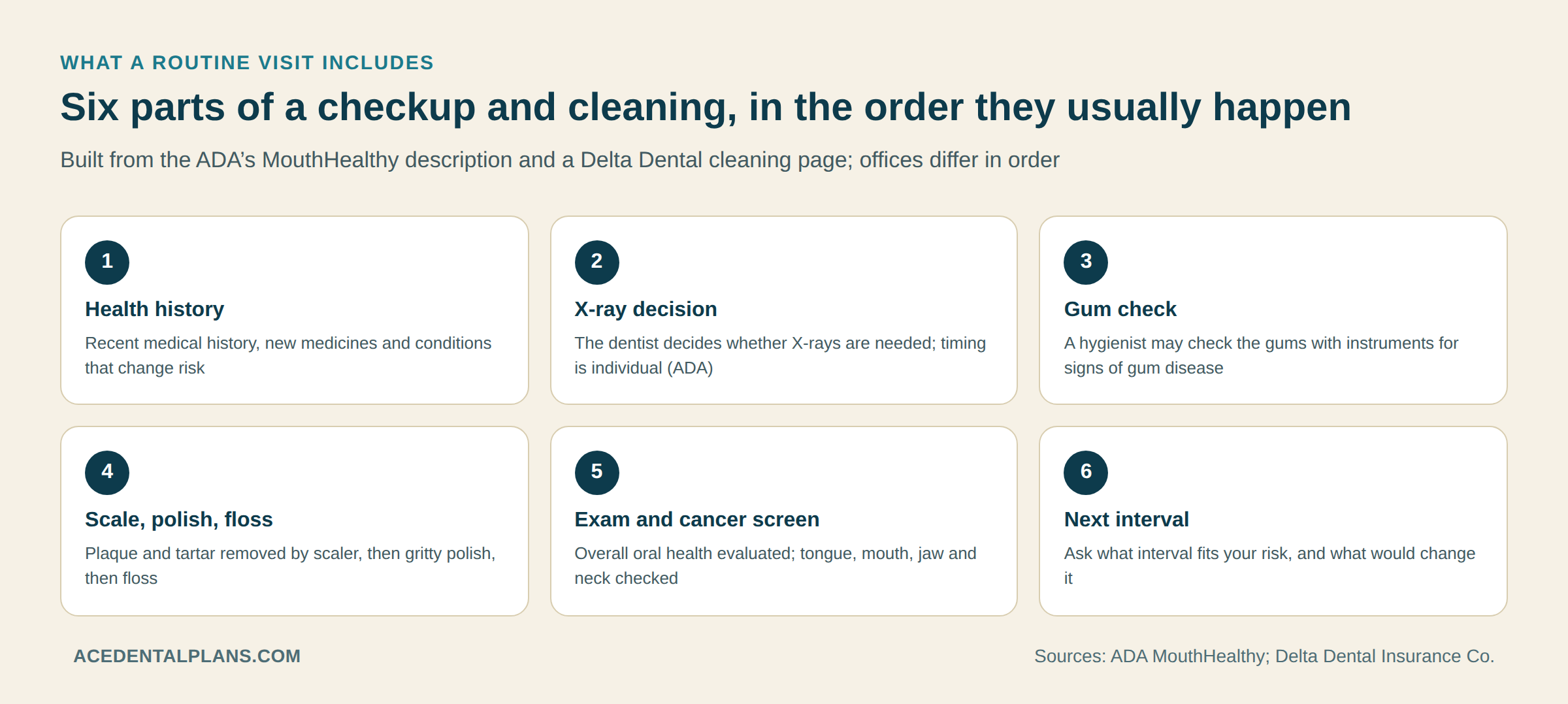
Delta Dental Insurance Company describes the cleaning in four moves. The dentist or hygienist scrapes away plaque and tartar with a metal scaler or an ultrasonic scaler, rinses and suctions, polishes with a gritty flavored paste and flosses last. Its page advises a visit every six months and says a cleaning is needed at least once a year.
The ADA’s description of the checkup side is broader. You are asked about medical history, the mouth is examined, and the dentist decides whether X-rays are needed. A hygienist may check the gums with instruments for gum disease. The dentist evaluates overall oral health and screens for oral cancer, holding the tongue with gauze to inspect it and feeling the jaw and neck.
Who does what, and why it matters for billing
A hygienist usually performs the cleaning, and the dentist performs the exam, though Delta Dental’s page says the cleaning is done by the dentist or hygienist. Because the two are separate services, plans can limit them separately, as the Wisconsin plan does with two exams and two cleanings a year. A routine visit may therefore use one of each allowance.
A problem-focused visit, such as an exam for a sore tooth, can use an exam allowance without any cleaning. Ask the office at booking which services are being scheduled. A visit booked as “checkup” may be billed as an exam, X-rays and a cleaning, and each line draws on a different part of your benefit.
Why the exam is the part worth protecting
If money forces a choice, the exam carries more diagnostic weight than the polish. The ADA’s patient pages say regular visits catch problems when treatment is “likely to be simpler and more affordable,” and the screening for oral cancer happens in the exam, not the cleaning. That is not advice to skip cleanings. It is a reason to ask your dentist what an exam-only visit can accomplish if cash is tight, and what it cannot.
X-rays are the third moving piece. According to the ADA, X-ray timing depends on current oral health, age, risk and symptoms, and that there is no one-size-fits-all interval. Their schedule is a separate decision from your recall schedule, covered in how often dental X-rays are needed. A six-month visit does not mean six-month X-rays.
When a routine cleaning is not the right visit
If the dentist or hygienist finds deep pockets, bone loss or heavy deposits under the gumline, a regular cleaning may no longer be the appropriate service. The next step is usually a deeper treatment, and the billing and insurance treatment change with it. The differences are laid out in deep cleaning versus regular cleaning. This matters for the frequency question because the code on your claim decides which annual limit the visit uses.
How the Right Interval Shifts From Childhood to Retirement
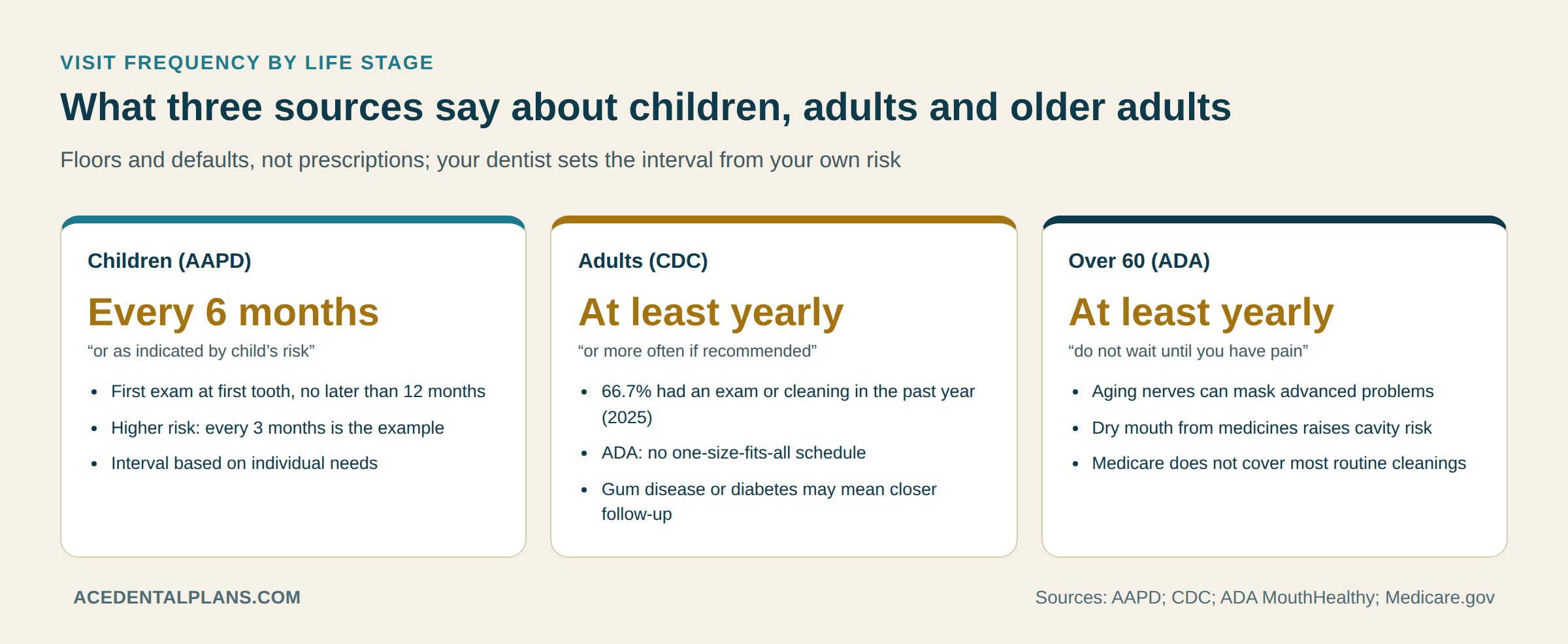
A child’s first dental visit, the ADA says, should come after the first tooth appears and no later than the first birthday. The AAPD’s periodicity schedule says the same thing in slightly different words, no later than 12 months of age. After that, the AAPD repeats exams every six months or as the child’s risk indicates, and says children at higher risk of cavities or gum disease would benefit from recall “at greater frequency than every 6 months (eg, every 3 months).”
CDC FastStats reports that 86.9 percent of children aged 2 to 17 had a dental visit in the past year (2019 data). Households juggling several children, adults and perhaps an older parent can find guidance on routine care for each age in family dental care for every age. Teen years add a wrinkle: braces and aligners make plaque harder to remove, and the AAO warns that teeth can show white marks after braces come off if cleaning was poor. The orthodontist and the family dentist should agree on who checks what.
Adults
For adults, the CDC’s “at least once a year” is the national floor, and most offices and plans work from twice a year. In the 2025 National Health Interview Survey, 66.7 percent of adults 18 and older reported a dental exam or cleaning in the past year, according to CDC FastStats. Elsewhere the ADA puts the number of Americans who fail to see a dentist each year at 100 million. Taken together, those figures mean roughly one adult in three went a full year without an exam or cleaning.
Pregnancy is the adult life event with the most outdated folklore attached. Per the ADA, preventive, diagnostic and restorative treatment is safe throughout pregnancy and encourages regular exams at every stage. It also says X-rays are considered safe at any stage. Details on timing, morning sickness and enamel are in dental care during pregnancy.
Adults over 60
For older adults, the ADA’s advice is blunt: get checkups at least once a year, and do not wait until you have pain. Its reasoning is physiological. Nerves in aging teeth become less sensitive, so a problem can be well advanced before it hurts. Dry mouth from medicines is a second reason cavity risk climbs. The CDC reports periodontitis in about 60 percent of adults 65 and older (2009-2014 data).
Coverage is the practical obstacle. Medicare.gov says that “in most cases, Medicare doesn’t cover dental services like routine cleanings,” with narrow exceptions tied to hospital stays and certain covered medical treatments. The exceptions are laid out in whether Original Medicare covers dental care, and the wider picture of cost and coverage after 60 is in senior dental care.
Three Hypothetical Patients, Three Different Intervals
Abstract factors are easier to weigh when they sit on one chart. The three patients below are invented, and the intervals are the kind of conversation a dentist might have, not recommendations. Each one shows a different way the same default fails.
Dana, 34, no fillings in six years. Her gums do not bleed, she drinks fluoridated tap water, and she has no dry-mouth medicines. Dana is the person the INTERVAL trial’s 24-month arm was built around. Her dentist might reasonably suggest twelve months, and Dana’s useful question is what finding would bring her back sooner. If she pays cash, the saving is real: one visit a year instead of two means five visits in five years rather than ten.
Marcus, 52, type 2 diabetes and a new blood pressure medicine. He has no active gum disease today, but NIDCR ties diabetes to a higher chance of gum disease and slower healing, and a new medicine may be drying his mouth. Marcus is a candidate for staying at six months and asking his dentist to check his gum measurements at each visit. If pockets appear, the conversation changes to maintenance every three or four months. He should tell the dentist about the medicine and the diabetes at the next appointment.
Priya, 41, treated for periodontitis two years ago. This is the patient for whom “twice a year” is wrong in the other direction. She had scaling and root planing, and the sources describe maintenance as ongoing, with at least four visits a year typical in one insurer’s criteria. Priya’s questions are about classification: how her plan codes those visits, whether they use her cleaning allowance and what the cash fee is if the plan stops paying.
Put side by side, the three patients show why a postcard cannot set the interval. Dana’s chart supports fewer visits, Marcus’s supports watchful continuity and Priya’s supports more. A single default would be wrong for two of the three, and the INTERVAL trial’s lesson is that a dentist’s assessment can do the sorting.
Where the Two-a-Year Limit Comes From, and What Happens When You Need More
Most dental plans are built around the six-month habit. Delta Dental says most dental benefit plans cover some or all of the cost of preventive services such as routine cleanings, and it points members to the plan itself for the details. Those details often include a cap on how many times a service can be used in a year. For the mechanics of premiums, deductibles and annual maximums, see how dental insurance works.
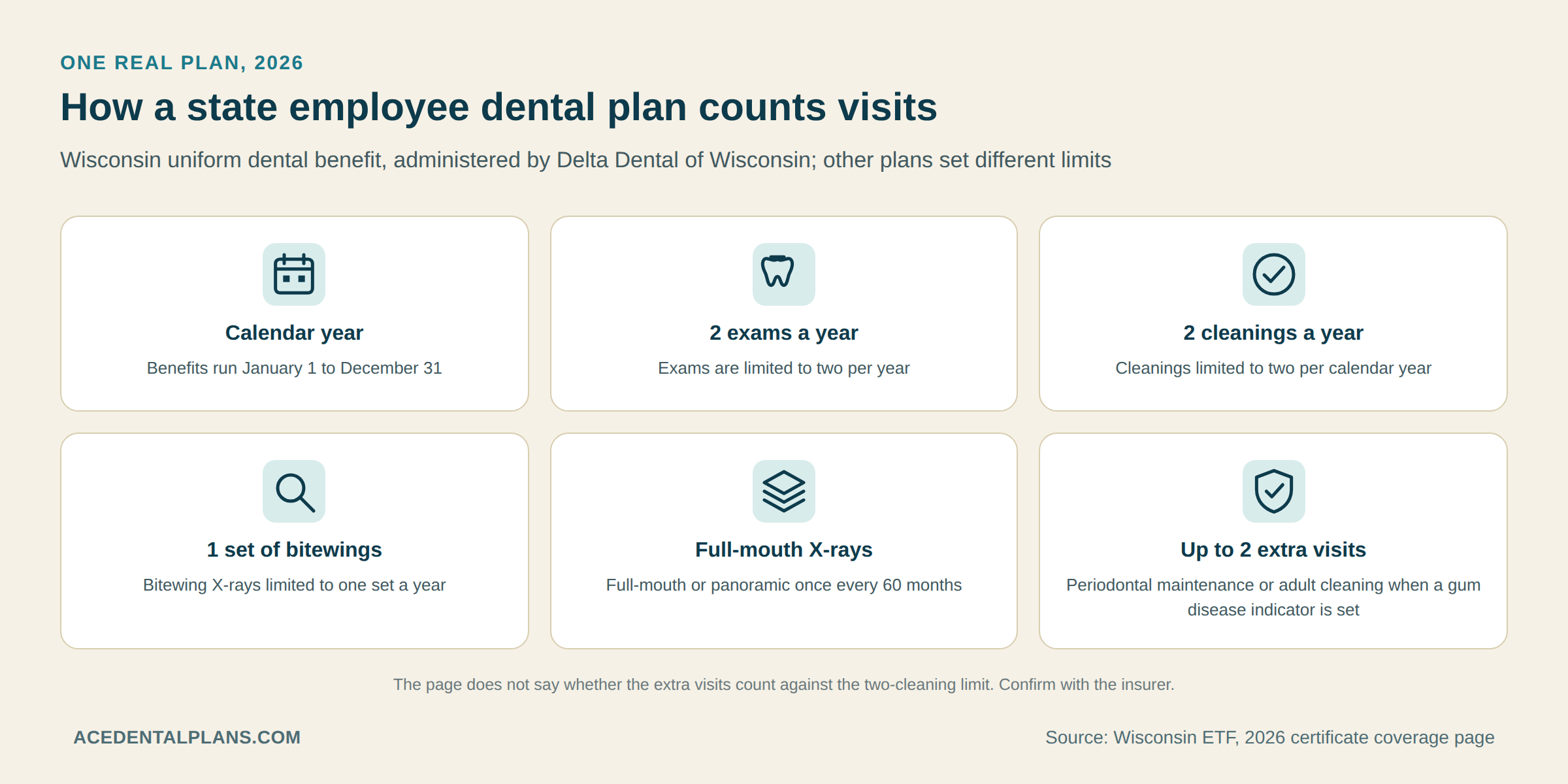
One real plan shows what a frequency limit looks like on paper. The 2026 uniform dental benefit for Wisconsin state employees, described on the state’s employee trust fund site, runs on a calendar year from January 1 to December 31. Exams are limited to two per year and cleanings to two per calendar year. Bitewing X-rays are limited to one set a year, and full-mouth or panoramic X-rays to once every 60 months.
That is one plan, not a standard. An Aetna dental PPO summary for a 2026 school-district group marks exams, cleanings, fluoride and X-rays with a footnote saying frequency or age limits may apply and are described in the booklet. In other words, the summary page will not tell you the number. The certificate does.
Two visits is a count, not a clock
The Wisconsin summary mentions no six-month spacing rule, only a count per calendar year. On a plan like that, a cleaning in December and another in January fall into different years and each draws on its own allowance. Other plans may require a minimum gap between visits, so the booklet decides. The dentist’s recommended interval and the plan’s counting rule are two separate questions, and the first should lead.
The year-end angle gets its own treatment in use-it-or-lose-it dental benefits. Waiting periods matter too, though they usually bite hardest on crowns and other major work rather than checkups. How they are counted is explained in dental insurance waiting periods.
When gum maintenance changes the category
The Wisconsin plan treats periodontal maintenance differently from a cleaning. It allows it only when a periodontal disease indicator is set, and then provides up to two additional visits in a benefit year for periodontal maintenance or adult prophylaxis. The page does not say whether those visits count against the two-cleaning limit, and the summary itself says to confirm that with the insurer.
Delta Dental of Michigan’s criteria show the other side. Payment for periodontal maintenance requires a diagnosis of periodontal disease with detectable bone or attachment loss, and a record of earlier active treatment. Maintenance billed for gum inflammation with no loss of attachment is the criteria’s own example of a claim that may be disapproved. Aetna’s summary lists scaling and root planing as a basic service at 80 percent in-network and 70 percent out-of-network for that group.
Ask for a written benefits check or predetermination before committing to a maintenance schedule. A phone representative’s verbal answer is not a promise of payment. The broader tier structure is in what dental insurance may cover, and the full picture of cost sharing sits in dental insurance explained.
What Skipping Visits Can Cost: A Five-Year Cash Ledger
Cleaning prices vary by region and office, and the details live in dental cleaning cost and cleaning cost without insurance. For a ledger, one consistent source is enough. CareCredit publishes average cash prices from Synchrony studies: $203 for a routine exam with cleaning and X-rays (range $50 to $350, 2023 study), a composite resin filling at $226, a molar root canal at $1,337 and a porcelain crown at $1,399 (2024 study). Those are uninsured prices and “for illustrative purposes only.”
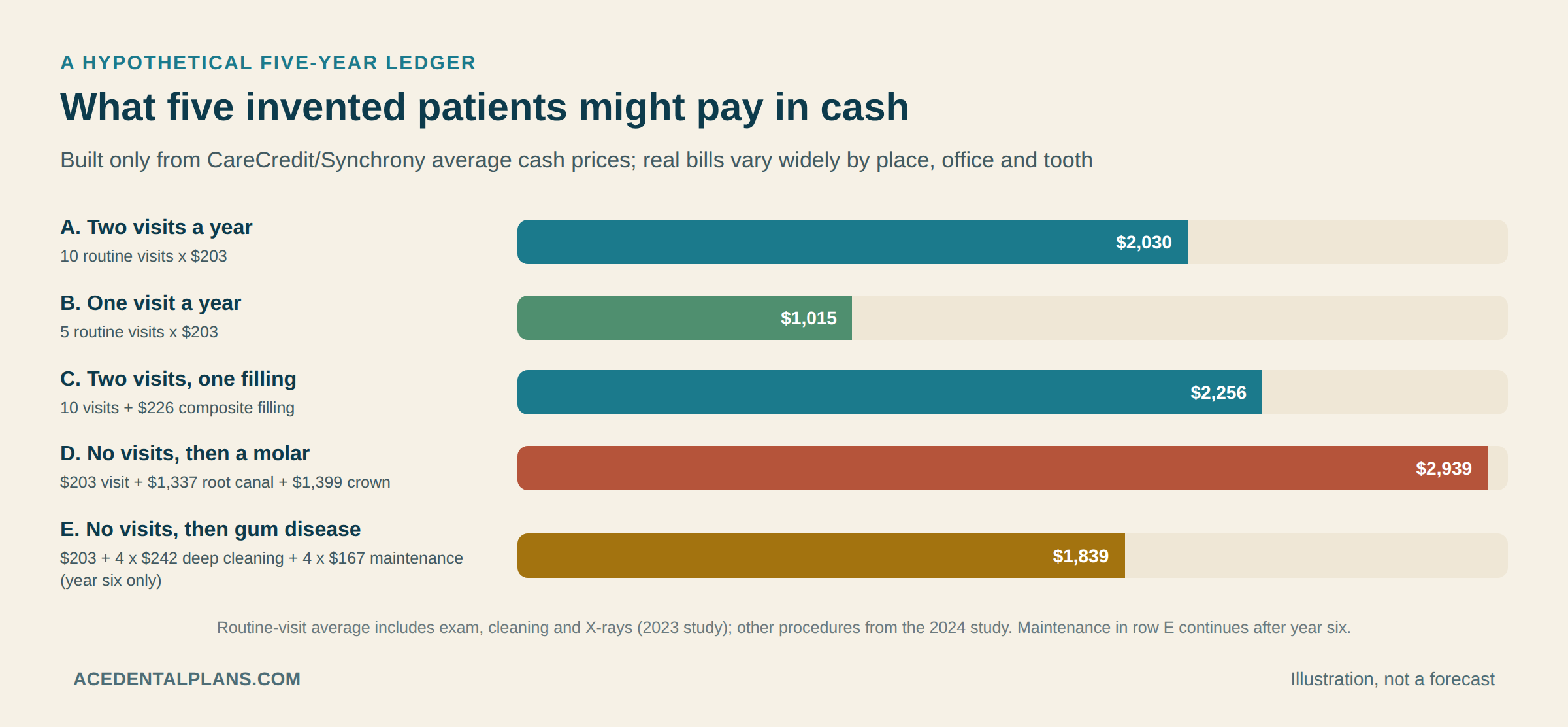
Table 3 builds five hypothetical patients from those averages. Nothing in it is a prediction, and the averages come from two different study years. Real bills vary widely by geography, material and tooth. The table exists to show the shape of the trade-off.
| Patient path | What happens in this hypothetical | Arithmetic | Cash total |
|---|---|---|---|
| A. Two visits a year | Ten routine visits in five years; no problems found | 10 x $203 | $2,030 |
| B. One visit a year | Five routine visits; low risk; dentist agrees | 5 x $203 | $1,015 |
| C. Two visits a year, one small cavity | Ten visits; a composite filling in year three | 10 x $203 + $226 | $2,256 |
| D. No visits, then a molar | Five years away; one visit finds a molar needing a root canal and porcelain crown | $203 + $1,337 + $1,399 | $2,939 |
| E. No visits, then gum disease | Five years away; one visit, four quadrants of scaling and root planing, four maintenance visits in the first year back | $203 + 4 x $242 + 4 x $167 | $1,839 in year six, then maintenance continues |
What the ledger does and does not show
Row D costs more than row A, but not by an enormous margin, and row E in its first year is cheaper than row A over five. A purely financial reading would conclude that routine visits are a mid-priced insurance policy against uncertain events. That is an accurate reading. In this hypothetical, patients A and C avoid a root canal altogether, though real mouths do not always follow the script of either path.
What the ledger leaves out is the cost that dollars measure badly. A root canal in row D means a tooth that was saved late rather than early, with a crown on top of it. Row E means a lifetime of maintenance, because Delta Dental of Michigan’s criteria say maintenance should continue for the life of the teeth being maintained. And any of those rows could end in extraction and replacement, which adds thousands that the ledger does not attempt to price.
The opposite point deserves equal weight. Row B is the cheapest path, and the INTERVAL trial gives it respectable support for low-risk adults. People who pay cash and have a clean chart are not automatically making a mistake by choosing once a year, as long as the dentist has agreed it is reasonable. Where the ADA’s statement fits is the middle: problems found early are “likely to be simpler and more affordable,” which is a claim about choices, not a guarantee about bills.
Paying for Visits Without Insurance, and Spacing Them Sensibly
About one in four people in the United States had no dental benefits in 2023, according to ADA Health Policy Institute data reported by ADA News, down from about one in three in 2003. Medicaid and CHIP dental coverage rose from roughly 1 in 7 people to 1 in 5 over the same period. If you are in the uninsured quarter, the six-month habit costs real money, and it helps to price it before deciding.
A first visit at a new office usually costs more than a return checkup, because it includes a comprehensive exam and often a larger set of X-rays. Cash figures for that visit are in dentist visit cost without insurance. The wider playbook for people with no coverage, from sliding-fee clinics to payment timing, is in dental care without insurance.
NIDCR lists several lower-cost doors. Dental school clinics treat patients through supervised students. Dental hygiene schools may offer supervised, low-cost care. Federally funded health centers charge what patients can afford based on income, and state or local health departments may know of programs. Calling 2-1-1 connects you to local services. These routes are real, though student clinics trade money for time.
Office membership plans and discount programs are the other common cash tool. They reduce prices rather than pay claims, and their break-even depends on how many visits you use. That arithmetic is worked through in dental savings plans and what you save.
If money forces a longer interval
Say it out loud to the dentist. The NICE guideline names the patient’s cost as a factor in setting the interval, and a dentist who knows your constraint can tell you which findings would justify an earlier visit. A low-risk patient might reasonably stretch from six months to twelve with the dentist’s agreement. A patient in gum maintenance should ask what the cheapest safe schedule looks like before stretching anything.
What to avoid is the silent version: quietly skipping visits and showing up when something hurts. Gum disease and oral cancer often cause no pain until their advanced stages, the ADA says. A plan to space visits is a clinical conversation with a financial constraint attached. Dropping out of care is a different thing.
What the Evidence Cannot Settle, and When to Book
The research behind recall intervals has gaps that matter to a reader making a real decision. The strongest trial was run in the UK’s NHS, where dentists and patients face different incentives from those in a U.S. fee-for-service office. Its participants were regular attenders. It tells you little about someone who has not seen a dentist in a decade, and it tested no one with untreated active gum disease on a two-year schedule.
The trial’s own summary also notes that people value frequent check-ups and are willing to pay for them. That is a legitimate preference, not a mistake to be corrected. Some people feel safer with a visit every six months, and a low-risk patient who wants that schedule is paying for reassurance and early looks at the mouth. The point is to know which of the two you are buying.
Timing is the practical side. If your plan uses a calendar year, its allowance resets on January 1, and open enrollment is the moment to read the frequency limits in the plan you are choosing. A plan that caps cleanings at two a year behaves very differently from one that adds extra periodontal visits. For a patient who needs three or four visits a year, the second plan may justify a higher premium.
For someone without coverage, timing is about spreading cost. A visit every six months is two payments a year. A visit every twelve months is one larger payment, usually with more to review at once. Neither is wrong, and a written estimate before the appointment makes either easier to plan.
A Practical Way to Set Your Own Schedule
Treat the recall interval as something you and the dentist negotiate from facts, in a visit where there is time to talk. The questions below come from the risk factors above and the way the sources describe the decision. Ask them at the end of the next checkup, while the exam findings are fresh.
- What is my cavity risk, and what is it based on? A good answer names specific findings, such as new decay, recent fillings or dry mouth.
- Do my gums show pockets, bleeding or bone loss? If yes, ask whether the visit type should change, and what the code and plan classification will be.
- What interval do you recommend for me, and what would change it? This is the NICE logic in one sentence: an individual interval with named triggers.
- Is that interval a clinical need or an office default? Offices schedule the next visit six months out by habit. It is fair to ask if a different spacing is safe.
- Which parts of the visit matter most for my mouth? This is the question for patients who must prioritize, covering the exam, X-rays, cleaning and fluoride.
- How does my plan count these visits? Bring the benefits summary, or call the insurer first, and ask about frequency limits and classification.
Do not wait for the next scheduled visit if
- You have pain or swelling in the mouth, face or neck, or difficulty chewing or swallowing. The ADA lists each as a reason to see a dentist.
- Your gums are puffy or bleed when you brush or floss and the problem does not settle.
- A mouth sore has lasted a week or longer. The ADA says any such sore should be examined.
- A tooth feels loose, a filling or crown has come out, or your bite feels different.
- Swelling reaches the face or neck, or you have trouble breathing or swallowing, or a fever with severe dental pain. That is an emergency; call 911 or go to an emergency room.
Six scheduling mistakes and the check that catches each
Treating the reminder card as a prescription. An automated six-month reminder reflects the office’s default, not a judgment about your teeth. The check: ask at the end of each visit what interval the dentist actually recommends for you, and why.
Waiting for pain. The ADA says nerves in aging teeth become less sensitive, and that gum disease and oral cancer often hurt only late. Hurting is the last signal, not the first. The check: keep routine visits on a calendar. If you have already been told you need more than a cleaning, the separate question of whether deep cleaning is necessary deserves its own look.
Letting the plan’s limit set the clinical interval. A plan’s two-visit cap tells you what it will pay, not what your mouth needs. The check: when the recommendation exceeds the benefit, ask the office for the cash fee of the extra visit before deciding.
Dropping the exam and keeping only the cleaning, or the reverse. The exam is where screening and diagnosis happen. The cleaning is where deposits come off. The check: ask which one you can safely space out, and which one you cannot.
Forgetting to report new conditions and medicines. A new diagnosis, a new medicine that dries the mouth or a pregnancy can change your interval. The ADA tells older adults to bring a full medicine list, and the same advice suits everyone. The check: update your health history at every visit.
Leaving all the benefit-year planning to December. Plans reset on a date, and appointments fill up before it. The check: look at your remaining allowance at midyear, not at the end.
Bottom Line
Six months is a reasonable guess for a person nobody has assessed yet. It stops being a guess once a dentist has examined you. The evidence suggests that a risk-based interval does as well as a fixed one for regular attenders, which means the useful move is to get a risk assessment, not to pick a number from a poster.
If you have cavities, gum disease, diabetes, dry mouth or a smoking habit, expect a shorter interval and plan the budget around it. If your chart has been clean for years, ask whether a longer one is safe. If you have no coverage, say so in the chair. A schedule built on your findings, your plan’s actual limits and your budget will serve you better than any default. More treatment explainers are collected in the dental treatments guides.
Frequently Asked Questions
Is it okay to go to the dentist only once a year?
It can be, for some adults. The CDC advises a dental checkup at least once a year, or more often if your provider recommends it, and a UK trial found no difference in oral health between six-month and risk-based recall in regular attenders. If you have gum disease, frequent cavities, diabetes or dry mouth, a longer gap may not suit you. Let the dentist who examined you decide.
Is the six-month dental checkup a myth?
It is a habit with thin evidence, not a myth in the sense of being harmful. A dental journal commentary says the interval was probably popularized by American advertisers in the 1930s. Later trials found six-month recall did no better than risk-based recall for regular attenders. The ADA’s own position is that there is no one-size-fits-all schedule, so the number should be personalized.
Is going every three months too often?
Not if there is a reason for it. The AAPD gives every three months as an example for higher-risk children, and one insurer’s criteria say patients in periodontal maintenance may benefit from at least four visits a year. For a low-risk adult with a clean chart, three months would be more than the sources suggest, and you could ask whether it is needed.
How often should children go to the dentist?
Per the ADA, the first visit should come after the first tooth appears and no later than the first birthday. The AAPD then repeats exams every six months or as the child’s risk indicates, with every three months given as an example for higher-risk children. A pediatric dentist or family dentist can set the actual interval from your child’s cavity risk.
Does dental insurance cover two cleanings a year?
Often it covers up to two, but plans differ. One 2026 state employee plan limits cleanings and exams to two each per calendar year, and an Aetna group summary says frequency limits may apply and refers you to the booklet. Coverage varies by plan, so check the certificate or call the insurer. If your dentist wants more visits than the plan allows, ask what the extras cost in cash.
How often should someone with diabetes see a dentist?
NIDCR says people with diabetes have a higher chance of gum disease and should visit the dentist for routine checkups, but it gives no number. Your dentist and physician can set one together. Tell the dentist you have diabetes, since it can slow healing and affect how gum treatment is planned.
Is it safe to go to the dentist while pregnant?
According to the ADA, preventive, diagnostic and restorative dental treatment is safe throughout pregnancy and encourages regular exams at every stage. It also says X-rays are considered safe at any stage. Mention the pregnancy when you book, because the dentist may adjust positioning and choose materials and medicines with your obstetric provider in mind.
What happens if I have not been to the dentist in years?
Expect a longer first visit. You will be asked about your medical history, the mouth will be examined, and the dentist will decide whether X-rays are needed. If the dentist finds deposits below the gumline or deep gum pockets, the plan may be a deeper treatment rather than a standard cleaning, and that is a conversation worth having before treatment starts. A second opinion is a normal request.
Does Medicare cover routine dental checkups?
Medicare.gov says that in most cases Medicare does not cover dental services like routine cleanings. It lists narrow exceptions, such as certain hospital inpatient dental services and exams tied to covered treatments like heart valve replacement or dialysis. Some Medicare Advantage plans add dental benefits, but those are plan-specific.
What if I cannot afford two visits a year?
Say so to the dentist, and ask which parts of the visit matter most for your mouth. NIDCR lists dental school clinics, hygiene schools, federally funded health centers with income-based fees and local health departments as lower-cost routes. Do not stop going altogether, since the ADA says serious conditions often cause no pain until they are advanced.
Do I still need checkups if I have dentures or no natural teeth?
Yes, in most cases. Past dental work, including dentures, is among the things the ADA says should be checked regularly, and the mouth exam also screens the mouth, tongue, jaw and neck for signs of oral cancer. Ask the dentist how often to bring in dentures for a check, since that depends on the type and age of the work.
Sources and Disclaimers
Guidance on visit frequency comes from professional and public-health sources: the American Dental Association, the American Academy of Pediatric Dentistry, the CDC, NIDCR, the American Academy of Periodontology and the American Association of Orthodontists. The trial evidence comes from a Cochrane review, the plain-English summary of the UK INTERVAL trial report and the NICE recall guideline, which are British and describe UK dental systems. Insurance examples come from published plan summaries and one insurer’s clinical criteria, each describing a single plan or group, so they illustrate how limits are written and do not describe your plan. Cash prices are national averages from one consumer cost study (Synchrony, 2023 and 2024) and the ADA and CDC figures are from the years stated. The five-year ledger and the insurance example are original hypotheticals built from those averages. National averages hide wide local variation, so confirm prices with the dental office in writing and benefits with your insurer.
- American Dental Association (MouthHealthy) — Common Questions About Going to the Dentist
- American Dental Association (MouthHealthy) — Your Baby’s First Dental Visit
- American Dental Association (MouthHealthy) — Healthy Teeth and Gums for Adults Over 60
- American Dental Association (MouthHealthy) — Reasons to See a Dentist
- American Dental Association — Caries Risk Assessment and Management
- American Dental Association — X-Rays/Radiographs
- American Dental Association — Pregnancy
- ADA News — Fewer Patients Uninsured but Gaps Remain (June 2026)
- American Academy of Pediatric Dentistry — Periodicity of Examination, Preventive Dental Services, Anticipatory Guidance and Oral Treatment
- American Academy of Periodontology — Non-Surgical Treatments
- American Association of Orthodontists — Oral Hygiene Tips During Orthodontic Treatment
- Centers for Disease Control and Prevention — About Gum (Periodontal) Disease
- Centers for Disease Control and Prevention (NCHS) — FastStats: Oral and Dental Health
- National Institute of Dental and Craniofacial Research — Diabetes and Oral Health
- National Institute of Dental and Craniofacial Research — Dry Mouth
- National Institute of Dental and Craniofacial Research — Dental Caries (Tooth Decay) in Adults
- National Institute of Dental and Craniofacial Research — Finding Dental Care
- Medicare.gov — Dental Services
- Cochrane Library — Recall Intervals for Oral Health in Primary Care Patients
- NIHR Journals Library — INTERVAL Trial: Plain-English Summary of the Health Technology Assessment Report
- National Institute for Health and Care Excellence (UK) — Dental Recall: Recommendations for the Interval Between Oral Health Reviews
- Dental journal commentary on recall intervals (nature.com) — Article 6401353
- Delta Dental of Michigan — Clinical Criteria for Periodontal Maintenance (Ref. 282.19)
- Delta Dental — Dental Cleaning Cost and Insurance Coverage
- Delta Dental Insurance Company — What to Expect at a Dental Cleaning
- State of Wisconsin Department of Employee Trust Funds — Uniform Dental Benefits Certificate of Coverage (2026)
- Aetna (Fairfax County Public Schools group) — 2026 Dental PPO Plan Summary
- CareCredit (Synchrony) — Average Dental Procedure Costs
Important Information and Disclaimers
This article is general educational information. By using it, you accept the limits described below.
Not dental or medical advice
Nothing on this page is a diagnosis, a treatment recommendation or a substitute for an examination by a licensed dentist or physician. Reading this article does not create a dentist-patient or doctor-patient relationship. Only a licensed professional who has examined you and reviewed your history can tell you what your mouth needs. Do not delay, skip or stop professional care because of something you read here.
Prices are estimates, not quotes
Cost figures are ranges reported by the third-party sources cited in this article. Actual prices depend on your location, the provider, the complexity of your case, the materials used, the date of service and other factors, so what you pay may be higher or lower. A written treatment plan and fee estimate from the dental office is the only reliable number for your situation.
Insurance and plan examples are illustrations
Examples that use named amounts or percentages are hypothetical. Real benefits depend on your plan, network, waiting periods, annual maximum, deductible and the insurer’s rules at the time of treatment. A pre-treatment estimate or benefits check is not a promise of payment. Confirm the details with your insurer or plan administrator in writing.
Not insurance, legal, tax or financial advice
AceDentalPlans is an information publisher. Nothing here is insurance, legal, tax, investment or other professional financial advice, and nothing here recommends a particular provider, insurer, lender, discount plan or financing product. Company and product names belong to their owners and appear for identification only. Read the terms of any loan, financing offer or plan before you sign, and ask a qualified professional if you need advice on your own circumstances.
Third-party sources
This article cites government agencies, professional associations, insurers, lenders and other outside organizations. We do not control those sources. Their content can change, move or disappear, and listing a source is not an endorsement of it or of anything it sells.
No warranty
We aim for accuracy, but this article is provided “as is,” without warranties of any kind, express or implied, including warranties of accuracy, completeness, timeliness or fitness for a particular purpose. Some information may be out of date or contain errors by the time you read it.
Limitation of responsibility
To the fullest extent permitted by law, AceDentalPlans and its owners, authors and contributors are not responsible or liable for any loss, cost, injury, health outcome or other damage that results from using this article or relying on it. You are responsible for your own decisions about your care, your coverage and your money.
How this article is written
This article follows AceDentalPlans’ answer-first, U.S.-focused editorial approach. It uses conditional language for insurance, because coverage depends on the specific plan, and it names its sources so that you can read them yourself.