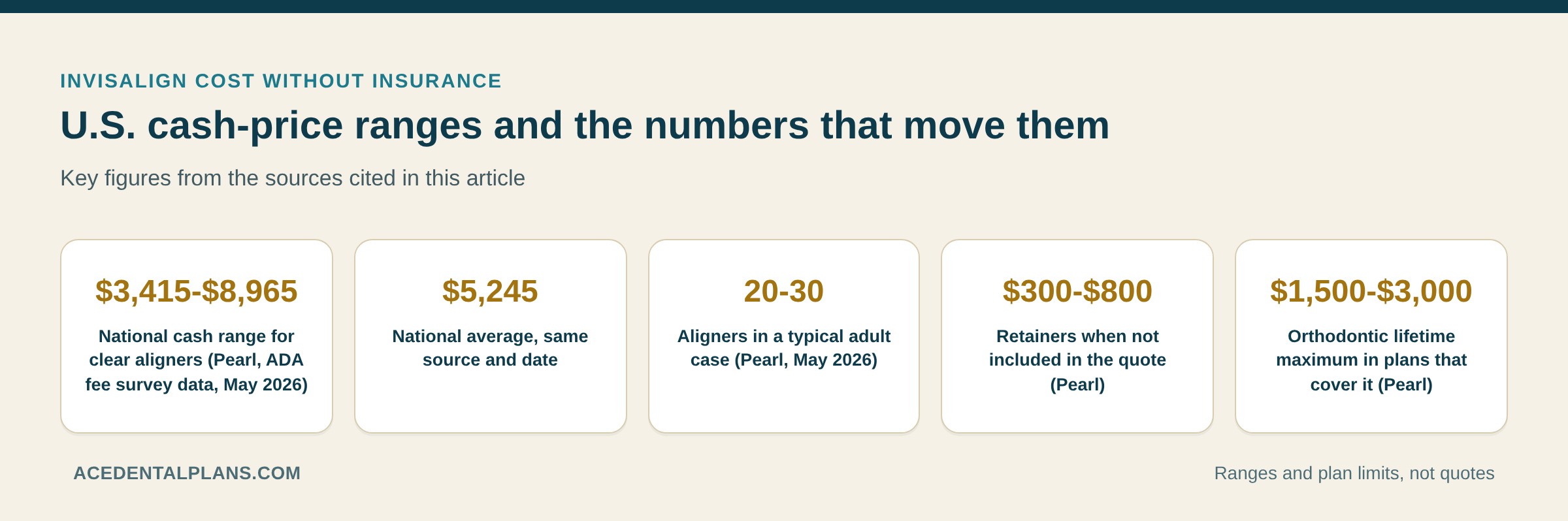
Invisalign cost without insurance usually lands between about $3,400 and $9,000 in the United States. One pricing tool built on American Dental Association (ADA) fee survey data puts the national average near $5,245 (May 2026). Other published figures start closer to $3,000 and top out between $7,000 and $8,500. Your own quote depends on case complexity, the number of aligners, what the fee includes and your local market.
This page is about paying for clear aligners when no dental plan is picking up part of the bill. It covers the published price ranges, what a quote should and should not include, and what moves the number. It then walks through the realistic ways to pay: a lump sum, an office payment plan, third-party financing, credit cards, HSA and FSA money, savings plans and dental school clinics. A section on orthodontic benefits shows how the math changes if you do have one. It stops short of telling you whether aligners suit your teeth, because that call belongs to an orthodontist (a dental specialist in tooth and jaw alignment) after an exam.
Key Takeaways
- The national range is wide. Pearl, a pricing tool built on ADA fee survey data, lists clear aligners at $3,415-$8,965 with a $5,245 average (May 2026). Guardian, citing Aflac averages, shows $3,000-$7,000. A dental school clinic in Oregon lists comprehensive aligner treatment at $5,454.
- Read what the fee includes. Pearl says retainers ($300-$800), replacement aligners ($100-$300 each), extra refinement rounds and pre-orthodontic dental work are often billed separately. Two quotes that look $800 apart may not cover the same things.
- You can usually spread the cost. The American Association of Orthodontists (AAO) says many practices offer in-house plans, and MetLife says a down payment with the rest paid over time is often interest-free. Ask about a discount for paying upfront before you choose.
- Deferred-interest cards carry a trap. The Consumer Financial Protection Bureau (CFPB) says interest can accrue on the full amount charged if the balance is not paid off by the end of the promotion. Some medical credit products charge upwards of 25% afterward.
- Pre-tax money counts. For 2026 the IRS caps health FSA salary reductions at $3,400 and HSA contributions at $4,400 (self-only) or $8,750 (family). Whether the tax saving matters depends on your bracket.
- Insurance changes the sum, not the method. Where an orthodontic benefit exists, sources describe a lifetime maximum of roughly $1,000-$3,000, often paid at 50%, and many plans exclude adults.
Invisalign Cost Without Insurance: Published U.S. Price Ranges
No single national price exists, and the sources that publish one measure different things. Some draw on dentist fee surveys, some on insurer-cited averages, and one on a fee list posted by a dental school clinic. Table 1 lines them up with the date and the scope of each figure so you can see why they disagree.
| Source | Figure | Date and scope | What to keep in mind |
|---|---|---|---|
| Pearl (pricing tool, ADA fee survey data) | $3,415-$8,965; average $5,245 | Updated May 2026; U.S. population-weighted national average; code D8090 | Survey year is not named. No state or metro figures on the page. |
| Guardian, citing Aflac averages | $3,000-$7,000 | Guardian page last updated May 6, 2026; the Aflac figures carry no date | Says “aligners,” not Invisalign by name. |
| ConsumerAffairs (consumer cost article) | Starts about $1,000-$3,000; up to $8,500 | Updated July 17, 2024; cited sources accessed in 2022 | Does not separate prescription brands from lower-priced products. Older than the other rows. |
| Oregon Health & Science University (OHSU) orthodontic clinic fee list | Comprehensive $5,454; limited, one arch $2,233; limited, two arches $2,828; records $482 | Fees as listed on the clinic page in October 2026; Oregon dental school clinic | Treatment by residents under faculty supervision. Self-pay patients not using insurance get a 12.5% discount off regular fees. |
| Align Technology (Invisalign manufacturer) example cases | Doctor’s fees of $5,490, $5,600 and $7,000 | Invisalign cost page, © 2026, undated | Illustrations for payment math. The page’s fine print is inconsistent about whether the cases are hypothetical. |

Three patterns stand out. First, the middle of the market sits around $5,000 to $5,500: Pearl’s $5,245 average, the OHSU comprehensive fee of $5,454 and the manufacturer’s $5,490 and $5,600 example fees all cluster there. Second, the lower edge of every source is far below the upper edge. Pearl’s own range spans $5,550 from bottom to top, which is more than the average price itself. Third, the lowest figures belong to limited treatment or to older, broader consumer articles, not to a full course of comprehensive aligners from an orthodontist.
That second pattern matters more than any average. A reader holding a $7,800 estimate and a reader holding a $4,200 estimate can both be inside the published range. Neither number proves a fair or unfair price until you know the aligner count, the visit schedule and the extras.
Why one “average” is only a starting point
Averages hide the shape of the market. Pearl’s page says major metro orthodontic practices “charge significantly more than smaller-market general dentists.” The manufacturer’s own cost page says only that your doctor sets the price based on how complex your case is and how many aligners you need, and that pricing is determined independently by each doctor. So two offices in the same city can quote different numbers for similar teeth without either one being wrong.
Use the national figure as a sanity check, not a target. If a quote lands inside $3,400-$9,000, it is not unusual on price alone. If it lands far outside, ask what is bundled in or left out. The next section covers exactly that.
What an Invisalign Quote Should Include, and What Often Costs Extra
Clear aligner treatment is a series of custom plastic trays, usually changed every one to two weeks, that move teeth step by step under an orthodontist’s or dentist’s supervision. For a plain-language overview of how the process works, see how Invisalign treatment works. What matters for your budget here is the bundle: a fee can cover the trays alone or the trays plus everything around them.
Pearl lists what a comprehensive aligner fee usually includes. The list covers the initial consultation and treatment planning, a 3D digital scan or impressions, and the custom aligner series (typically 20-30 trays). It adds tooth-colored attachments if needed, check-ups roughly every 6 to 10 weeks, and one round of refinement aligners. The manufacturer’s affordability guide (July 2026) says a quote “generally bundles” the personalized treatment path, digital scans, all of your clear aligners and regular check-in appointments. It adds that “some dental practices also include” final retainers or minor refinement aligners. The wording matters: some practices, not all.
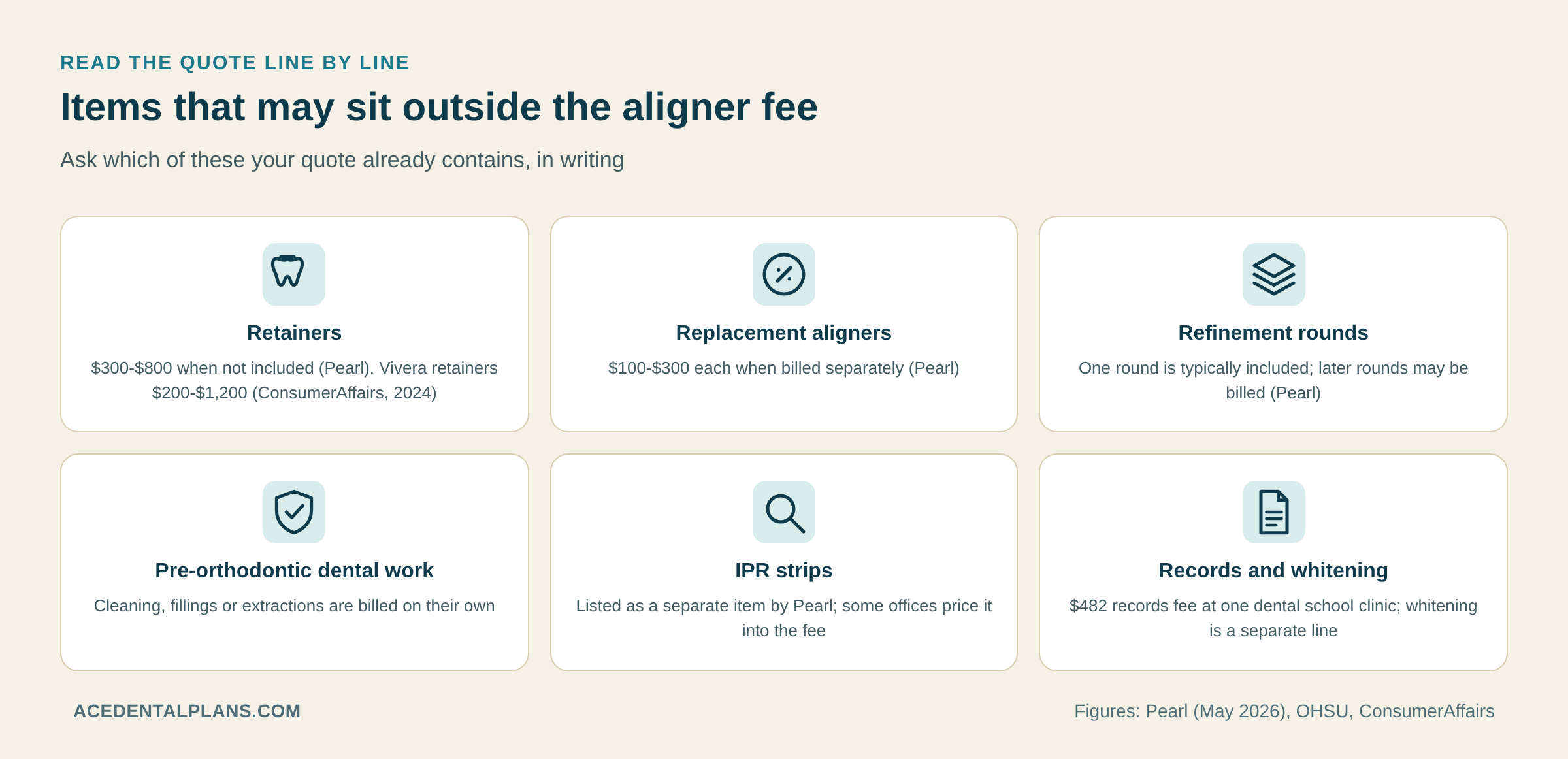
Pearl then lists items that are often billed separately. The dollar figures below are Pearl’s (May 2026) unless another source is named.
- Retainers. Pearl puts them at $300-$800 when they are not part of the quote. ConsumerAffairs (July 2024) lists Invisalign’s Vivera retainers at $200-$1,200, “depending on your needs and where you purchase.” A retainer holds teeth in their new positions after active treatment. It comes at the end, but it is still a real cost.
- Refinement rounds beyond the first. A refinement is an extra set of aligners ordered when teeth have not moved exactly as planned. One round is typically included, per Pearl; a second or third may not be.
- Replacement aligners. Pearl lists $100-$300 each. A tray that is lost, cracked or left in a napkin at a restaurant is one of the more avoidable extras.
- Pre-orthodontic dental work. The AAO advises a cleaning and check-up with your family dentist before aligner treatment starts, and Pearl lists extractions or other dental work as separate from the aligner fee. Fillings, cleanings or gum treatment found during that visit are billed on their own.
- Interproximal reduction (IPR). Pearl lists “IPR emery strips” as a separate item. IPR means polishing a tiny amount of enamel between teeth to create room for movement, and some offices price it into the main fee while others do not.
- Records and whitening. The OHSU clinic lists a $482 records fee that is non-refundable once records are made. Pearl lists tooth whitening as a separate line.
The manufacturer’s affordability guide suggests four questions that map onto this list. Are post-treatment retainers included? Is there an extra fee for refinement aligners? What happens if you lose or damage an aligner? Are all follow-up visits covered, or do extra appointments cost more? Get the answers in writing, on the treatment plan itself.
What Moves the Price of Clear Aligners
The number on your estimate is the product of a few variables that sit mostly outside your control, and a few that do not. Sorting them helps you see where a quote has room to move and where it does not.
Case complexity and the number of aligners
This is the largest driver in the sources. Pearl says mild crowding may need about 10-15 aligners, typical adult cases about 20-30, and moderate-to-severe cases “30-50+” plus refinement trays. The manufacturer’s cost page says the doctor sets the price “based on how complex your case is and how many aligners you need.” More trays usually mean more time and more visits.
Limited-treatment options exist for small movements. A 2019 Dental Products Report article on Align’s product launch described a Moderate package as a 20-stage option for cases between its Lite and Comprehensive packages. It was designed to finish in 5-12 months. That is a trade-press description from 2019, so package names, stage counts and availability may have changed. If your orthodontist offers a limited or lower-stage option, ask what it includes, what refinements cost and whether your case really fits the narrower scope.
The OHSU fee list shows how large the gap can be inside one clinic. Limited aligner treatment for one arch is listed at $2,233 and for two arches at $2,828, against $5,454 for comprehensive treatment. Two-arch limited treatment costs about 52% of the comprehensive fee, and one arch about 41%. Those percentages describe one clinic’s list, not a national discount, and whether a limited course is appropriate is the orthodontist’s call.
Who provides the treatment, and where
Pearl notes that major metro orthodontic practices charge significantly more than smaller-market general dentists. That sentence compares two variables at once, specialty and market, so it does not tell you how much of the gap belongs to each. An orthodontist has completed additional residency training in tooth movement, and some general dentists also offer aligners. Neither label is a price. What you can check is who will plan the case, who will see you at each visit, and what happens if the plan changes.
Dental school and residency clinics sit at the other end of the market and are covered in a later section. They show that the same type of treatment can be priced differently depending on who delivers it and under what supervision.
How well the plan is followed
Aligners work only when they are in your mouth. The AAO says each aligner is typically worn for one week at a time, at least 22 hours a day, and removed for eating, drinking anything but water, brushing and flossing. The U.S. Food and Drug Administration (FDA) puts the floor at “at least 20 hours per day or as directed.” It warns that “treatment may not progress as intended if clear aligners are not worn as directed.” Lost or damaged trays are another FDA-listed risk.
For your budget, the point is practical. A treatment that stalls may need extra trays or extra months, and whether the office charges for them depends on its terms. Pearl treats one refinement round as typically included and further rounds as separate. Find out where your office draws that line before you sign.
Timing and the payment arrangement itself
The same treatment plan can carry different effective prices depending on how you pay. MetLife’s consumer guide on orthodontics advises asking your orthodontist “whether you can save money by paying upfront.” The OHSU clinic puts a number on it. Self-pay patients who are not using dental insurance receive a 12.5% discount off its regular fees. Applied to the $5,454 comprehensive fee, that would be a $681.75 reduction, or $4,772.25, if the listed fee is the “regular fee” the discount refers to (the page does not say so explicitly). Private practices set their own policies, and some offer no discount at all.
The reverse can also hold. A longer payment plan sometimes carries a processing fee or interest, which raises the effective price. The financing sections below put numbers on that.
Cash Pay and Insured Scenarios Side by Side
The cleanest way to see how payment strategy changes the bill is to hold the treatment constant and vary only how it is paid. Table 2 uses Pearl’s $5,245 national average as the fee and the OHSU fee list as one real-world reference. Every scenario other than the fee itself is hypothetical, built with the allowed-amount method: the plan’s percentage applies to the plan’s allowed amount, not to a higher list price. For simplicity the examples assume an in-network orthodontist, no separate deductible and an allowed amount equal to the fee.
| Scenario | Assumptions | Plan pays | You owe | If spread over 24 months at 0% |
|---|---|---|---|---|
| A. No coverage, pay in full | No discount offered | $0 | $5,245 | Not applicable |
| B. No coverage, pay in full with a 10% upfront discount | Hypothetical discount; ask whether your office offers one | $0 | $4,720.50 | Not applicable |
| C. No coverage, $1,000 down plus in-house plan | 0% interest, no fees | $0 | $5,245 total, $4,245 financed | $176.88 a month |
| D. Orthodontic benefit, 50% up to a $1,500 lifetime maximum | Cap reached: 50% would be $2,622.50 | $1,500 | $3,745 | $156.04 a month |
| E. Orthodontic benefit, 50% up to a $3,000 lifetime maximum | Cap not reached | $2,622.50 | $2,622.50 | $109.27 a month |
| F. Dental school clinic, self-pay | OHSU comprehensive fee $5,454 less 12.5% (see caveat above) | $0 | $4,772.25 | $198.84 a month |
Three lessons come out of the table. Scenario D and scenario E have the same 50% benefit but very different outcomes, which shows that the lifetime maximum, not the percentage, often decides what you owe. Scenarios B and C show the trade-off between a lump sum and a payment plan. The discount saves $524.50 compared with paying list price in full, while the interest-free plan costs nothing extra but gives no discount. Scenario F is a reminder that the lowest list fee and the lowest total can come from different places.
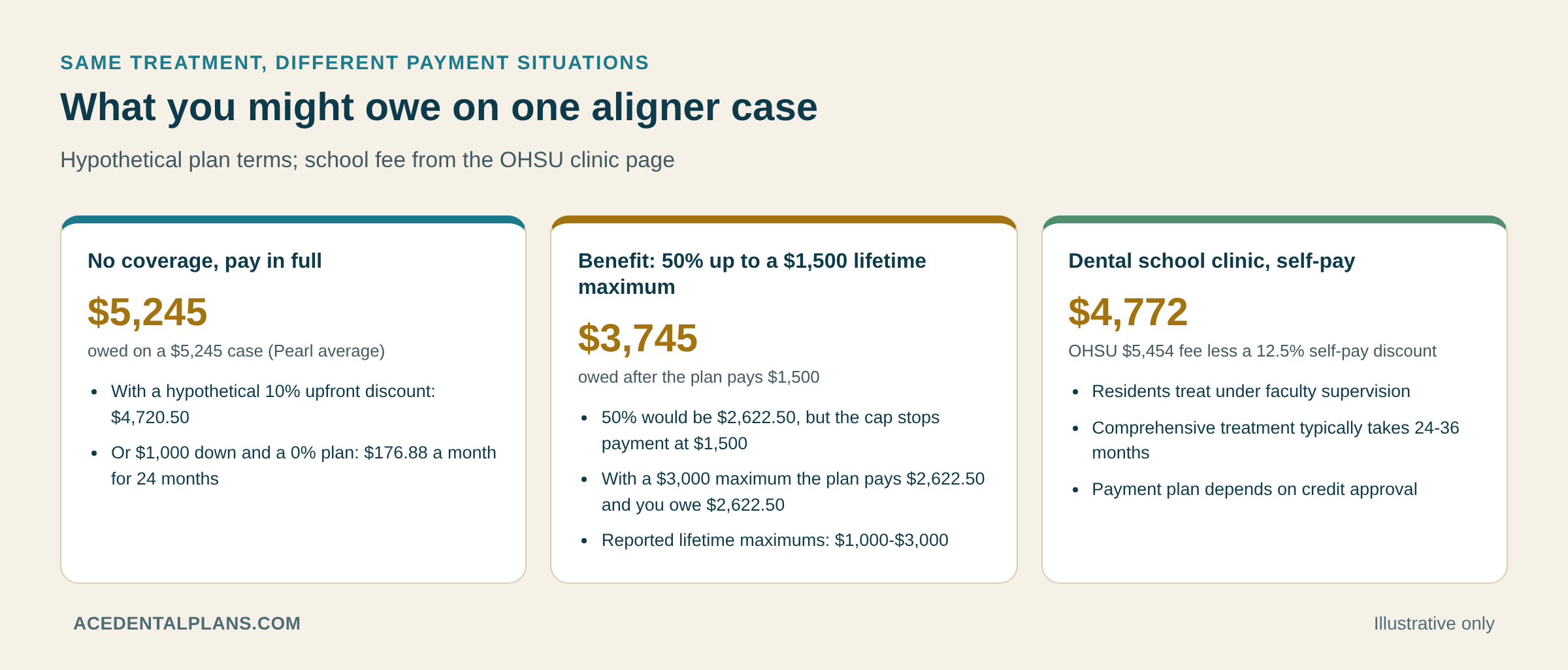
If you have no orthodontic benefit at all, scenarios A, B, C and F are the relevant ones. If you do, the next section explains why the cap, waiting period and age rules deserve a check before the fee does.
If You Do Have an Orthodontic Benefit: What the Plan Rules Do to the Bill
Plenty of people searching for the Invisalign cost without insurance actually have a dental plan and are unsure whether it counts. The short answer from the carrier and orthodontist sources: coverage for orthodontics is a separate benefit that many plans lack, and when it exists it is small relative to the fee.
Follow the usual order of plan mechanics. Start with the plan type. Cigna says not all types of dental insurance include orthodontic services and that a plan “may cover braces for children but not for adults.” MetLife says many plans do not cover orthodontics at all. Among those that do, many cover it only for people under 18. Next come network and deductible rules, then the coinsurance or copay, then the cap. For orthodontics the cap is usually a lifetime maximum rather than an annual one. MetLife puts it “often between $1,000 and $2,000” and warns that lifetime maximums “truly are lifelong.” Pearl gives $1,500-$3,000. Keep that distinction straight: a lifetime orthodontic maximum is separate from the annual maximum on cleanings and fillings, and neither is an out-of-pocket maximum in the medical-insurance sense.
Exclusions and timing come after that. MetLife says orthodontic coverage may be subject to a waiting period, “often six months or a year.” It adds that some plans cover only traditional metal braces and treat ceramic braces and clear aligners as cosmetic. The AAO takes a different view of plans that do cover orthodontics. It says they “usually cover both traditional braces and clear aligners equally.” Pearl agrees that most plans with orthodontic coverage treat aligners at the same percentage as braces, typically 50%. The sources disagree at the edges, which is exactly why the plan document matters more than any general statement.
Guardian adds one more rule that can catch adults: “Generally, dental plans that offer coverage for braces require that they be deemed medically necessary by a dentist,” with exceptions for some orthodontic plans. A purely cosmetic case may therefore fall outside a plan that otherwise lists orthodontics.
How big is the benefit in practice? The manufacturer cites OrthoFi data for calendar year 2021 (112,243 U.S. patients, data on file as of January 19, 2023). Average orthodontic coverage was $1,772, with 92% of patients qualifying for up to $3,000 and 77% for up to $2,000. That is a manufacturer-supplied figure, not an independent survey, and it describes people whose plans had orthodontic coverage. Set against a $5,245 average fee, a $1,772 benefit covers about 34%.
For a detailed comparison of how the same plan treats braces and aligners, with insurance and payment scenarios side by side, see the Invisalign vs braces cost comparison. For the cash-pay reader, the practical steps are these:
- Ask the plan, in writing, whether orthodontics is a covered category, for which ages and for which appliances.
- Ask for the lifetime maximum, the percentage, the waiting period and whether previous orthodontic benefits have been used.
- Ask the orthodontist’s office to send a preauthorization (a pre-treatment estimate) to the insurer, as MetLife suggests. The estimate describes how the plan may handle the claim. It is not a promise of payment.
- Subtract the plan’s expected share from the fee, and treat the remainder as your cash-pay balance for the rest of this article.
Paying Over Time: Office Plans, Third-Party Financing and Credit Cards
Most people paying for aligners out of pocket spread the cost. The sources describe three broad routes, each with different risks.
In-house payment plans
The AAO (article published March 12, 2026, modified April 15, 2026) says many orthodontic practices offer in-house financing plans that let patients spread the cost over time. MetLife says many offices allow a down payment with the rest paid over time, “often with zero interest.” ConsumerAffairs adds a caution. Some offices split the total into a few payments, and you “may have to agree to a payment processing fee or an interest rate.”
The two dental school clinics reviewed for this article show what a formal arrangement looks like. The University of Maryland orthodontic clinic says patients are placed “on a contract with an initial downpayment and regular monthly payment, pending credit approval.” If credit is not approved, full payment is due before treatment starts. OHSU says payment is due in full at the start or through a payment plan for those who qualify, with plans available through CareCredit and Lending Tree. The detail to notice is the credit check: a payment plan is not automatic, and the backup is paying everything up front.
Third-party financing
Companies that finance medical and dental care sit between you and the office. The AAO names CareCredit as a healthcare credit card for medical and dental expenses. The manufacturer’s affordability guide (July 2026) says third-party platforms can stretch payments “across up to 72 months, often with 0% interest options available.” It puts initial down payments “as low as $0, $199, or $499” depending on credit. That is the manufacturer’s description of a financing platform it names, not an independent review, and the “depending on your credit” qualifier carries weight.
The manufacturer’s cost page also shows three example cases with monthly payments. A $7,000 fee with $5,600 from insurance leaves $1,400 and $58 a month for 24 months. A $5,600 fee with $2,800 from insurance leaves $2,800 and $233 a month for 12 months. A $5,490 fee with a $1,700 down payment leaves $3,790 and $105 a month for 36 months. The arithmetic checks out. Still, the page calls the cases “hypothetical examples only” in one place and describes compensated patients in its footnotes. Use them to see how payment math works, not as typical prices.
The CFPB’s guidance on medical credit cards and payment plans (last reviewed May 8, 2023) is the useful counterweight. It says interest on medical credit cards is often deferred for a period of time. Rates after a promotion can reach “upwards of 25 percent in some cases,” and medical credit products are “often more expensive than other forms of payment.” The CFPB suggests four checks. Ask whether you are eligible for financial assistance instead. Confirm the financing can be used for the service you want. Read when interest may start to accrue or change. Find out who is responsible for any processing fees.
How deferred interest works, with numbers
Deferred interest is the term that deserves the most caution. Under a deferred-interest promotion, interest quietly accumulates in the background and is waived only if you pay the full balance before the promotion ends. The CFPB says that if the balance is not paid off, “interest will accrue on the full amount charged, rather than only on the remaining amount due.” NerdWallet (updated November 8, 2025) shows how small a miss can be. On a $3,000 purchase paid down at $250 a month, one payment of $240 instead of $250 left a $10 balance after 12 months. About $325 in back interest landed on the next bill. NerdWallet also says the hidden rate is typically 20% or higher.
Table 3 compares seven hypothetical ways to finance the same balance. It assumes Pearl’s $5,245 average fee with $1,000 paid up front, leaving $4,245 to repay. Interest rates in the table are assumptions chosen to bracket the figures the CFPB and NerdWallet describe, not offers from any lender.
| Structure | Monthly payment | Total repaid on the $4,245 | Extra cost of credit |
|---|---|---|---|
| 0% in-house plan, 12 months | $353.75 | $4,245 | $0 |
| 0% in-house plan, 24 months | $176.88 | $4,245 | $0 |
| 0% in-house plan, 36 months | $117.92 | $4,245 | $0 |
| 10% APR loan, 24 months | $195.89 | $4,701.25 | $456.25 |
| 20% APR loan, 36 months | $157.76 | $5,679.34 | $1,434.34 |
| 25% APR card or loan, 36 months | $168.78 | $6,076.10 | $1,831.10 |
| Deferred-interest card, 12-month promotion, paying $176.88 a month, 25% APR assumed after | $176.88 | $2,122.44 still owed at month 12, plus about $818 in back interest | About $818 added at once |
The last row tells the story. A payment that would have cleared the balance in 24 months at 0% leaves half the principal outstanding when a 12-month deferred-interest promotion ends, and the back interest is charged on top. The 36-month, 25% row shows the cost of a long payment at a high rate: $1,831 of interest on a $4,245 balance, which is 43% of the amount borrowed.

Credit cards you already hold
A regular credit card with a stated APR is simpler than a deferred-interest card because interest starts at the stated rate on the balance you carry. It also tends to be less flexible than a payment plan negotiated at the office, since the terms are not tied to the treatment. Maybe a card earns rewards, or a payment plan was declined. Either way, run the same math as Table 3 at the card’s actual APR and compare it with a 0% office plan before deciding.
A card or loan also changes the risk picture. If treatment is delayed, paused or stopped, a card balance still has to be repaid, whereas an office plan can sometimes be adjusted by agreement. Ask the office what happens to the payment schedule if you stop treatment or move, and get the answer in writing.
Using HSA, FSA and Tax Rules to Lower the Net Cost
Pre-tax accounts do not change the fee. They change what each dollar of the fee costs you after taxes. The AAO says an HSA or FSA lets you set money aside “on a pre-tax basis to pay for qualified medical expenses, including orthodontic treatment.” The manufacturer says the same about its aligners. Confirm with your plan administrator that your account accepts the specific expense and what paperwork it wants.
The 2026 limits
Two federal numbers frame the options. IRS Publication 15-B (2026) states that a cafeteria plan may not allow salary reductions for a health FSA above $3,400 for plan years beginning in 2026. Employers can, at their option, allow unused amounts to carry over to the next plan year, so whether leftover money survives depends on your employer’s plan. Revenue Procedure 2025-19 sets the 2026 HSA contribution limit at $4,400 for self-only coverage and $8,750 for family coverage. It also sets the minimum annual deductible for a qualifying high-deductible health plan (HDHP) at $1,700 self-only or $3,400 family. ConsumerAffairs notes the practical consequence: you need a high-deductible policy to contribute to an HSA. For how the two account types differ in practice, including who can open one and what happens to leftover balances, see how HSA and FSA rules differ for dental bills.
A caution on dates: the manufacturer’s affordability guide still lists 2025 limits ($3,300 for an FSA, $4,300 or $8,550 for an HSA). The 2026 figures above are the ones in the IRS documents reviewed here, and limits are set by plan year.
Timing and the deduction route
The medical expense deduction is the other tax route, and it has a high bar. IRS Publication 502 (for 2025 returns) says you can deduct only the part of your medical and dental expenses that exceeds 7.5% of your adjusted gross income (AGI). At an AGI of $80,000, the threshold is $6,000, so a $5,245 aligner fee by itself would not clear it, though it could count toward a year with other large medical bills. The publication lists dental expenses, specifically including braces, as medical expenses. It excludes most cosmetic procedures and does not mention clear aligners in the portions reviewed here, so a tax professional is the right person to ask whether your treatment qualifies.
Two timing rules in the same publication matter if you pay in installments. You can include only expenses you paid in that year, and credit card charges count in the year the charge is made rather than when the card bill is paid. The publication also says current payments for care to be provided substantially beyond the end of the year generally cannot be included. Prepaying a full treatment fee in December for work that starts the next spring is the kind of arrangement to run past a tax professional first. Publication 502 does not address office installment contracts in the portion reviewed, so that question is also one for an adviser.
Dental Savings Plans and Discount Programs
A dental savings plan (also called a discount plan) is a membership: you pay a monthly or annual fee and receive reduced prices from participating dentists. It is not insurance. MetLife’s explainer says discount plans “are not insurance plans,” that you “must visit a participating dentist to receive the discount,” and that there is generally no paperwork, annual limit or deductible. It also warns that you may be responsible for a greater portion of the treatment cost than with insurance. Out-of-pocket expenses are generally higher with discount plans, and the plans are not offered in all states. For how these plans work and what members typically save, see how dental savings plans work.
Cigna says that if a dental plan does not cover orthodontic services, you may still be eligible for discounts on them, and that the discounts might require an in-network orthodontist. That is a limited statement, since it gives no percentage. Still, it points to a question worth asking any plan you hold. Is there an orthodontic discount even though there is no orthodontic benefit?
The right test is simple: get the discount schedule in writing, confirm that your orthodontist participates, and check whether aligner treatment is on the discounted list. Then run the numbers. Compare the net saving, after the membership fee, with what you could get by asking the office for a pay-in-full discount or a 0% payment plan. Savings plans and payment plans can work together; the discount lowers the fee, and the plan spreads what remains.
Lower-Priced Routes: Dental Schools, Limited Treatment and Second Quotes
Dental school and residency clinics
Orthodontic clinics at dental schools are a documented way to pay less for supervised treatment. The University of Maryland School of Dentistry says its orthodontic clinic is staffed by licensed dentists completing three years of advanced training. It offers clear aligners for adults, and patients can receive services “at a lower cost than at private practices.” OHSU describes an assigned orthodontic resident plus a supervising faculty instructor, free initial screenings, and posted fees. MetLife also notes that many dental schools run clinics where student dentists treat patients at a discounted price.
The trade-off is time and logistics, not just money. OHSU says comprehensive treatment time in its clinic is typically 24-36 months, and that the clinic can change its fees without advance notice before payment. Maryland’s page says it does not accept any HMOs. Appointments at teaching clinics can take longer, and the clinic decides whether your case fits its program. Call to ask about screening, the fee list and the payment contract before assuming a school clinic is open to you.
Limited treatment, if your orthodontist says it fits
Earlier in this article, the OHSU limited-treatment fees ($2,233 for one arch and $2,828 for two) showed how much the scope of care moves the price. Limited treatment is a clinical decision. It usually suits small movements, and a dentist or orthodontist has to say whether yours qualify. Asking “is a limited option medically reasonable for my teeth, and what would it include and exclude?” is fair. Asking for a smaller scope than the exam supports risks paying twice.
Braces as the price comparison
Braces are the obvious alternative when cost drives the decision. Guardian, citing Aflac averages, lists traditional metal braces at $3,000-$7,500 and aligners at $3,000-$7,000, so the published ranges overlap rather than separate. The manufacturer’s affordability guide says Invisalign “can cost about the same as traditional metal braces.” It cites a survey in which 53.5% of doctors reported that Invisalign costs the same or less than braces. That is a manufacturer-cited figure. The takeaway is modest: do not assume switching appliances will cut the bill much, and treat the choice as a clinical and lifestyle one first. Treatment time, comfort, wear demands and which problems each approach handles are covered in braces and Invisalign compared on speed, comfort and results.
Written quotes from two or three offices
For non-urgent orthodontic work, it is reasonable to shop around for written estimates, as long as the estimates cover the same services. Ask each office for the aligner count, the visit schedule, what happens if you need extra trays, whether retainers are included, and the price with and without a pay-in-full discount. Price is one factor among several; the orthodontist’s plan and your confidence in the office matter as well.
A caution on direct-to-consumer aligners
Mail-order aligner products advertise much lower prices, and some readers will reasonably ask about them. The FDA says clear aligners are prescription devices, only safe to use under the supervision of a licensed practitioner. It “has not authorized clear aligners that are sold directly to consumers without a prescription.” An in-person exam by a dentist or orthodontist, the agency adds, can help lower the risk of an uneven bite. The risk is not only clinical: SmileDirectClub, a widely advertised direct-to-consumer brand, shut down on December 8, 2023 after filing for bankruptcy, according to WUSF reporting. Customers lost customer care and its lifetime guarantee, those on its Smile Pay arrangements were expected to keep paying, and a bankruptcy expert quoted in the story said refunds were unlikely. An orthodontist and a lower fee are not mutually exclusive; a lower fee without supervision carries risks that a price table does not show.
A Sensible Order for Working Through Your Options
Because several of the tools above can be combined, the order matters. This sequence follows the logic of the sources as a reasonable default, though your own circumstances may reorder it.
- Find out what coverage exists. Even a small orthodontic benefit or a plan discount lowers the balance before any other step, and it may carry a waiting period that affects when you start.
- Get two or three itemized quotes. Include the aligner count, retainers, refinements, visits and records. This is the step that makes the rest apples-to-apples.
- Ask about a pay-in-full or self-pay discount. MetLife suggests asking; the OHSU example shows one clinic offering 12.5%. A discount only helps if you can pay without borrowing at a worse rate.
- Apply pre-tax money. Use FSA or HSA funds you have already set aside, within the limits and rules your administrator sets.
- Finance only the remainder, and prefer 0% office plans. If a card or third-party loan is the only option, run the Table 3 math at the actual APR and avoid a promotion you cannot clear before it ends.
- Read the contract. The next section covers what to look for.
What You Pay and When: From Scan to Last Tray
Cash flow matters as much as the total when you are paying without a plan. The AAO describes the sequence. First comes a cleaning and check-up with your family dentist. Then an in-office scan (10-15 minutes), then production and shipping of the aligners, which “can take up to 6 weeks for some offices.” Last is a delivery visit of 45 minutes to an hour where attachments are placed and wear instructions given. Delivery from the manufacturer can take 4-6 weeks, and the AAO adds that aligners are not necessarily faster than braces.
When money changes hands varies by office, and the sources describe only a few arrangements. A records fee may apply at the start, as at the OHSU clinic. The dental school clinics described earlier use a contract with an initial down payment and monthly payments, and require full payment before treatment starts if credit is not approved. Ask your office when the down payment is due, when the first monthly payment starts, and what happens to money already paid if the plan changes before trays are ordered.
After delivery, the AAO says each aligner is typically worn for a week and that regular check-ups are recommended throughout, though some offices offer remote monitoring to reduce visits. Pearl says check-ups typically happen every 6 to 10 weeks. Payment schedules and treatment schedules do not always match. A 36-month payment plan on a course that finishes in 14 months leaves you paying after the trays are gone, while refinements that extend treatment can outlast a 12-month plan. Tie the two together in the contract, and ask what a shorter or longer course does to the payments.
Contract and Risk Checks Before You Pay
The largest financial risks with aligners rarely come from the sticker price. They come from terms that nobody reads until something changes.
Pause before signing if
- The quote lists a single total with no description of what is inside it, or the office will not put inclusions in writing.
- A financing offer is described as “no interest” but you cannot see whether interest is deferred or waived, what happens if you miss a payment, or when a promotion ends.
- You are asked to pay the whole fee up front, and no refund policy is stated for stopping treatment, moving, or a change in the treatment plan.
- The product is sold directly to you without an in-person exam or supervision by a licensed dentist or orthodontist. The FDA says it has not authorized aligners marketed that way.
Contract language worth finding includes what the fee covers if more trays are needed, how a lost aligner is handled, the late-payment terms, and what happens to the balance if you stop treatment. If the office finances through a third party, find out whether the lender or the office handles refunds. The CFPB advises confirming “whether you or your provider will be responsible” for processing fees that apply, and reading the agreement for when interest may start to accrue or change.
Clinical issues also have financial consequences. The FDA lists risks including treatment that does not progress as intended when aligners are not worn as directed, lost or damaged trays, and aligners being inappropriate for some patients. The AAO states plainly that clear aligners “are not right for everyone” and that some cases are treated more predictably with braces. If an exam concludes that aligners are not suitable for your teeth, a quote for aligners becomes irrelevant. That is one reason to get the exam before putting down a deposit that may be hard to recover. Call your orthodontist’s office promptly if a tray cracks, goes missing or stops fitting, so the problem is fixed before it costs extra weeks.
Questions to Ask Before You Sign
Bring this list to the consultation, and ask for answers on the written treatment plan rather than by phone.
- How many aligners does my plan include, and what does the fee cover beyond the trays: scan, attachments, visits, one refinement round?
- Are retainers included, and if not, what do the first set and any replacements cost?
- What is the charge for a refinement round beyond the first, and for a replacement aligner?
- Is IPR priced into the fee? Is any dental work needed first, and what would it add?
- Is there a discount for paying in full or for self-pay patients?
- Do you offer an in-house plan? What are the down payment, term, interest rate and any processing fee?
- If financing is through a third party, is the promotional interest waived or deferred, and what happens if I miss a payment?
- What is the refund policy if I stop treatment, move, or the plan changes?
- Will you send a preauthorization to my insurer, and can you estimate my share before I sign?
- Can my HSA or FSA be charged directly, and what receipt do you provide for my administrator?
Bottom Line
Paying for Invisalign without insurance is mostly a question of three numbers: the fee, what the fee includes, and the cost of spreading it out. Published fee ranges ($3,415-$8,965 from Pearl, $3,000-$7,000 from Guardian citing Aflac) are wide enough that your own quote is the only figure that counts. Make sure two quotes cover the same things before you compare them, ask about a pay-in-full discount, and prefer a 0% office plan to a card with deferred interest.
Pre-tax HSA or FSA money, a savings plan or a dental school clinic may lower the net cost, depending on your account, network and location. If you have an orthodontic benefit, learn its lifetime maximum, age rule and waiting period before you start. Next step: ask two offices for itemized written estimates this month.
Frequently Asked Questions
How much is Invisalign per month without insurance?
It depends on the fee, the down payment and the term. On a $5,245 fee with $1,000 down, a 0% plan over 24 months works out to $176.88 a month, while 36 months is $117.92 (Table 3). The manufacturer’s example cases show $58 a month for 24 months, $233 for 12 months and $105 for 36 months, but those figures also depended on insurance or a down payment. Interest raises the monthly amount and the total.
Is it possible to get Invisalign with no money down?
Sometimes. The manufacturer says doctors may offer financing with low-to-no down payment, and its affordability guide cites a third-party platform with down payments as low as $0, $199 or $499 depending on credit. The dental school clinics reviewed here ask for an initial down payment, and one says full payment is due if credit is not approved. Credit approval and the terms of the loan or plan decide the answer, and a low down payment often means a larger balance financed over a longer period.
Does Invisalign cost more than braces?
Published ranges overlap. Guardian, citing Aflac averages, lists traditional metal braces at $3,000-$7,500 and aligners at $3,000-$7,000. The manufacturer says Invisalign “can cost about the same as traditional metal braces,” and cites a survey in which 53.5% of doctors said it costs the same or less. Your orthodontist’s quote for each appliance is the comparison that matters, because case complexity affects both.
Can I use my HSA or FSA to pay for Invisalign?
The AAO and the manufacturer both say pre-tax HSA and FSA dollars can be used for orthodontic treatment. For 2026, the IRS caps health FSA salary reductions at $3,400 and HSA contributions at $4,400 (self-only) or $8,750 (family). Your plan administrator decides what documentation it requires, so check before you pay, and keep the itemized statement from the office.
Will dental insurance help pay for Invisalign as an adult?
It may, but many plans do not cover orthodontics for adults. Cigna gives the example of a plan covering braces for children but not adults, and MetLife says many plans that do cover orthodontics only cover people under 18. Plans that include adult coverage commonly pay a percentage of the allowed amount up to a lifetime maximum, with a possible waiting period. Ask your insurer in writing.
Is Invisalign tax deductible?
Possibly. IRS Publication 502 says dental expenses count as medical expenses and names braces, and that you can deduct only the part of total medical and dental expenses above 7.5% of AGI. The text reviewed here does not discuss clear aligners specifically, and it excludes most cosmetic procedures. A tax professional can tell you whether your treatment and your income make a deduction worthwhile.
Are retainers included in the price of Invisalign?
Sometimes. The manufacturer’s affordability guide says some practices include final retainers or minor refinement aligners in the quote. Pearl lists retainers at $300-$800 when they are not included, and ConsumerAffairs lists Vivera retainers at $200-$1,200. Ask for a yes or no in writing, and for the price of replacements.
Do orthodontists offer discounts for paying in full?
Some do, some do not. MetLife suggests asking whether you can save money by paying upfront, and the OHSU orthodontic clinic gives self-pay patients not using insurance 12.5% off its regular fees. A private practice may offer a smaller discount, none, or a discount only on a full prepayment. Compare any discount with the cost of borrowing if you would need a loan to pay in full.
What happens if I lose an aligner, and do I pay for it?
The FDA lists lost or damaged aligners as a risk, and Pearl puts replacement aligners at $100-$300 each when billed separately. Whether your fee includes any replacement allowance is a question for the written plan. Call the office as soon as it happens, and ask before the next visit what the replacement and the schedule will look like.
Does Medicaid cover Invisalign?
The Medicaid.gov page on the early and periodic screening, diagnostic and treatment (EPSDT) benefit covers children under 21 enrolled in Medicaid. States must furnish medically necessary services, and each state determines medical necessity case by case. That page does not mention orthodontia. ConsumerAffairs says Medicaid sometimes covers braces and other orthodontic care. Aligner coverage, if any, depends on state rules and on whether the treatment is judged medically necessary, so ask your state program directly.
How long does Invisalign take, and does a longer course cost more?
Length depends on the case. The AAO says each aligner is typically worn for about a week, and Pearl says typical adult cases use 20-30 aligners. A 2019 trade report described a limited Moderate package designed to be completed in 5-12 months, and the OHSU dental school clinic says comprehensive treatment typically takes 24-36 months. Whether extra time costs extra depends on the contract, in particular its refinement and visit terms.
What are lower-priced alternatives to a full Invisalign course?
Options with published support include a limited course if your orthodontist says it fits and treatment at a dental school or residency clinic. Braces have an overlapping price range, and a pay-in-full or self-pay discount may also help. A dental savings plan may reduce the fee if your orthodontist participates. Aligners sold without a prescription or supervision are not authorized by the FDA, and the price saving does not remove that risk.
Sources and Disclaimers
Price ranges come from a pricing tool built on ADA fee survey data (Pearl), an insurer page citing Aflac averages (Guardian), a consumer cost article (ConsumerAffairs) and a posted dental school fee list (OHSU), each named with its date in the text. Plan mechanics come from MetLife, Cigna, Guardian and the American Association of Orthodontists. Tax and account limits come from IRS publications and a revenue procedure, and financing cautions come from the CFPB and NerdWallet. Figures from Align Technology are manufacturer statements. Every worked example, discount, interest rate, tax rate and plan benefit in the tables and callouts is hypothetical and is labeled that way. National averages blend very different practices, cases and markets, so treat them as context, not as a quote. Confirm pricing and payment terms with the dentist or orthodontist, and confirm benefits with your insurer, plan administrator or tax professional.
- Pearl (pricing tool based on ADA fee survey data): Invisalign and clear aligners cost in the U.S. (May 2026)
- Align Technology: Invisalign cost page (examples and payment options)
- Align Technology: Invisalign insurance and payment options
- Align Technology: Invisalign cost and affordability guide (July 2026)
- American Association of Orthodontists: Aligners
- American Association of Orthodontists: Plan now, save throughout the year (March 2026)
- U.S. Food and Drug Administration: Clear dental aligners (content current as of 09/09/2026)
- MetLife: Orthodontics: what to know about braces for kids and adults
- MetLife: What is a discount dental plan?
- Cigna Healthcare: Orthodontic insurance
- Guardian Life: Braces and orthodontics (last updated May 6, 2026)
- ConsumerAffairs: Average cost of braces (updated July 17, 2024)
- Consumer Financial Protection Bureau: Medical credit cards and payment plans for medical bills (reviewed May 8, 2023)
- NerdWallet: Deferred interest promotions and large interest charges (updated November 8, 2025)
- Internal Revenue Service: Publication 502, medical and dental expenses (2025 returns)
- Internal Revenue Service: Publication 15-B, employer’s tax guide to fringe benefits (2026)
- Internal Revenue Service: Revenue Procedure 2025-19 (2026 HSA and HDHP limits)
- Medicaid.gov: Early and periodic screening, diagnostic and treatment (EPSDT)
- Oregon Health & Science University: Orthodontic services (fee list and payment options)
- University of Maryland School of Dentistry: Advanced specialty education in orthodontics clinic
- Dental Products Report: Align launches Invisalign Moderate packages in U.S. and Canada (November 6, 2019)
- WUSF Public Media: SmileDirectClub is shutting down: where does that leave its customers? (December 16, 2023)
Important Information and Disclaimers
This article is general educational information. By using it, you accept the limits described below.
Not dental or medical advice
Nothing on this page is a diagnosis, a treatment recommendation or a substitute for an examination by a licensed dentist or physician. Reading this article does not create a dentist-patient or doctor-patient relationship. Only a licensed professional who has examined you and reviewed your history can tell you what your mouth needs. Do not delay, skip or stop professional care because of something you read here.
Prices are estimates, not quotes
Cost figures are ranges reported by the third-party sources cited in this article. Actual prices depend on your location, the provider, the complexity of your case, the materials used, the date of service and other factors, so what you pay may be higher or lower. A written treatment plan and fee estimate from the dental office is the only reliable number for your situation.
Insurance and plan examples are illustrations
Examples that use named amounts or percentages are hypothetical. Real benefits depend on your plan, network, waiting periods, annual maximum, deductible and the insurer’s rules at the time of treatment. A pre-treatment estimate or benefits check is not a promise of payment. Confirm the details with your insurer or plan administrator in writing.
Not insurance, legal, tax or financial advice
AceDentalPlans is an information publisher. Nothing here is insurance, legal, tax, investment or other professional financial advice, and nothing here recommends a particular provider, insurer, lender, discount plan or financing product. Company and product names belong to their owners and appear for identification only. Read the terms of any loan, financing offer or plan before you sign, and ask a qualified professional if you need advice on your own circumstances.
Third-party sources
This article cites government agencies, professional associations, insurers, lenders and other outside organizations. We do not control those sources. Their content can change, move or disappear, and listing a source is not an endorsement of it or of anything it sells.
No warranty
We aim for accuracy, but this article is provided “as is,” without warranties of any kind, express or implied, including warranties of accuracy, completeness, timeliness or fitness for a particular purpose. Some information may be out of date or contain errors by the time you read it.
Limitation of responsibility
To the fullest extent permitted by law, AceDentalPlans and its owners, authors and contributors are not responsible or liable for any loss, cost, injury, health outcome or other damage that results from using this article or relying on it. You are responsible for your own decisions about your care, your coverage and your money.
How this article is written
This article follows AceDentalPlans’ answer-first, U.S.-focused editorial approach. It uses conditional language for insurance, because coverage depends on the specific plan, and it names its sources so that you can read them yourself.