
Emergency Tooth Extraction Cost Without Insurance. An emergency tooth extraction without insurance typically runs about $220 to $495 at a private dental office during regular hours, once an urgent exam and a simple extraction are added together. Surgical extractions, sedation and after-hours fees push that higher. A hospital emergency department visit for a dental problem averaged $2,437 in 2022, and it is usually managed with pain relief and antibiotics rather than treatment of the tooth.
This article prices the urgent side of an extraction: the exam, the fee for pulling the tooth, the lines that appear only because it is urgent, and the routes that cost less than a private office or more than one. It covers dental school emergency clinics, health centers, insurance billing and the questions to ask on the phone. It doesn’t explain how a simple extraction differs from a surgical one, it leaves general cash-pay savings to other guides, and it can’t tell you whether your tooth needs to come out. That decision belongs to the dentist who examines it.
Key Takeaways
- Adding Pearl’s 2026 national range for an emergency exam ($70–$185) to Delta Dental’s 2024 out-of-network range for a simple extraction ($150–$310) gives $220–$495. A surgical extraction ($260–$460) brings the same arithmetic to $330–$645.
- No national benchmark exists for an after-hours fee. The few published figures run from $50 to $300, and one practice states that its prices follow the tooth, not the calendar.
- Four dental school emergency clinics post fees: $110 for an exam alone, $197 for exam, X-ray and a simple extraction, $99 plus $165 for an extraction, and $231–$450 for a typical visit.
- The mean hospital emergency department bill for a dental condition was $2,437 in 2022, up from $1,887 in 2019, and the visit generally ends with a prescription and a referral.
- Many insurers treat the after-hours visit code as patient-paid even when the extraction itself is covered, and waiting periods of six months to a year can apply to non-surgical extractions.
- Swelling that reaches the neck, trouble breathing or trouble swallowing is a hospital matter first. Price comes second.
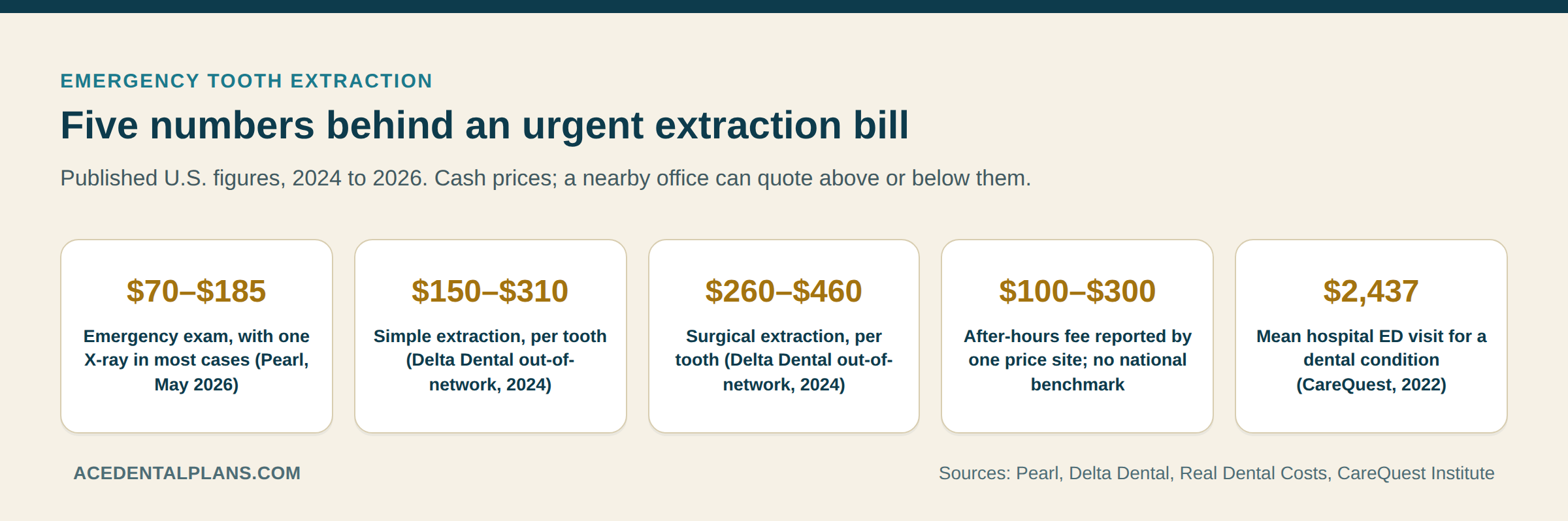 The five figures that frame an urgent extraction bill, from published national data and one price site.
What Lands on an Urgent Extraction Bill, Line by Line
An urgent visit is rarely billed as one price. Pearl, a dental cost-data company that bases its national figures on ADA fee survey data, describes the emergency exam (CDT code D0140, a limited, problem-focused evaluation) as a targeted look at the painful area, usually one periapical X-ray, a pain assessment, a diagnosis and treatment plan, and a prescription when appropriate. Its May 2026 national range for that exam is $70 to $185, with an average of $110. Pearl adds that definitive treatment, such as the extraction, is billed separately.
That separation matters, because the first number a receptionist quotes is often only the exam. The extraction comes next, and Delta Dental’s 2024 out-of-network data describe that fee as covering the anesthesia and the extraction itself. Exams, imaging, sedation and complex cases can add to it. Table 1 lines up what each published source says about every piece.
| Line on the estimate | What it is | Published range | Source and year |
|---|---|---|---|
| Emergency exam (D0140) | Targeted exam, usually one X-ray, diagnosis, prescription if appropriate | $70–$185 (average $110) | Pearl, May 2026 |
| Consultation and imaging, when billed apart | Consult $50–$200; imaging $60–$250 | $110–$450 combined at the extremes | Sunbit, January 2026 |
| Simple extraction (D7140) | Visible tooth, removed with forceps | $150–$310 out-of-network; $170–$450 national (average $260); $75–$300 in one city | Delta Dental 2024; Pearl 2026; Zocdoc, Feb. 2026 |
| Surgical extraction | Gum cut, bone removed, or tooth sectioned | $260–$460 out-of-network; $225–$600+ in one city | Delta Dental 2024; Zocdoc, Feb. 2026 |
| Nitrous oxide | Inhaled gas for anxiety | $50–$150 per visit | Pearl, May 2026 |
| Oral conscious sedation | Sedative pill taken before treatment | $200–$400 | Pearl, May 2026 |
| IV moderate sedation | Sedation through a vein | $400–$1,000+ | Pearl, May 2026 |
| Medications and a follow-up visit | Prescriptions; a recheck of the site | $10–$50; $60–$100 | Sunbit, January 2026 |
| After-hours or same-day fee (D9440) | “Office visit – after regularly scheduled hours” | No benchmark. $50 suggested in a bank’s advice to dentists; $100–$300 on one price site | TowneBank; Real Dental Costs, Sept. 2026 |
Two cautions about reading Table 1. The consult-and-imaging row sums the low ends and the high ends of two separate ranges, so it marks the outer edges, not a typical bill. And the sources differ in kind: Delta Dental’s figures come from its own out-of-network claims data, Pearl’s from a national fee model, and Sunbit and Zocdoc from consumer price guides. Treat the ranges as a map of what to expect, not a quote.
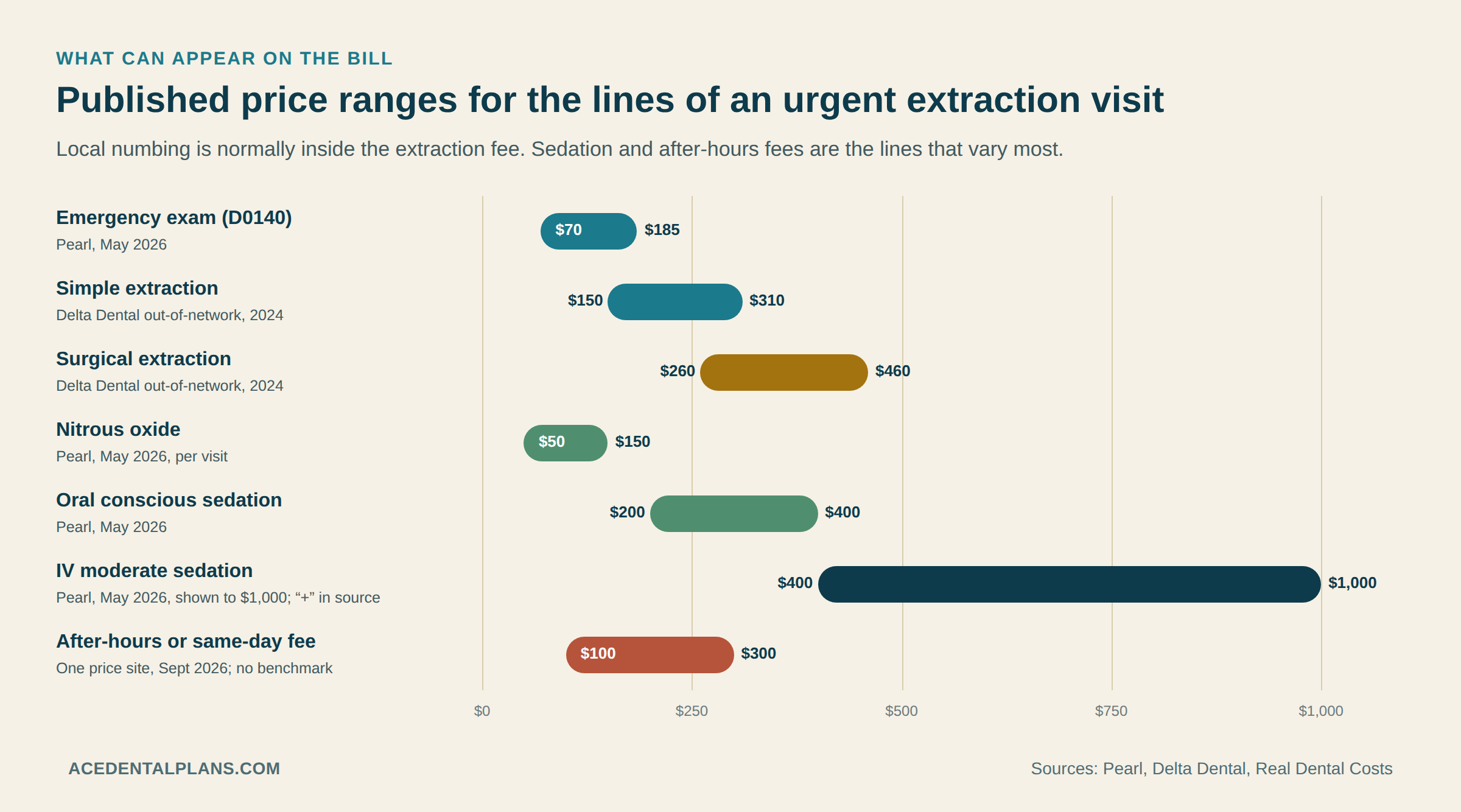 Seven lines that can appear on one urgent extraction bill, on a shared dollar axis.
Is There Really an Emergency Surcharge? What the Published Evidence Shows
Searching for a surcharge benchmark turns up very little. The national price sources used here give extraction ranges but no after-hours percentage. Whether a weekend or evening visit costs more depends on the office, and the offices that publish their policies disagree with one another.
One practice, Omega Dental Specialists, states on its emergency extraction page that its prices follow “the tooth’s, not the calendar’s,” so an urgent appointment carries no added fee. Its published simple-extraction price is $420, which sits above Delta Dental’s out-of-network range and near the top of Pearl’s national one. At the other end, TowneBank’s resource page for dental practice owners calls “a modest $50 fee added onto after-hours visits” very reasonable. And an independent price site, Real Dental Costs, reports that nights and weekends add $100 to $300. That site says its figures come from published payer and provider fee data from 2024 to 2026, but it doesn’t show the individual fee schedules, so its range is a signal, not a standard.
The billing code itself is better documented. D9440 is the CDT code for an office visit after regularly scheduled hours. Dental Claim Support, a billing-education site, notes that D9430 and D9440 are usually considered non-covered services and can be billed to the patient even under a PPO plan. If an office adds the line, it is generally yours to pay.
The practical answer is to ask for it by name. “Is there a D9440 or after-hours fee on top of the exam and extraction?” takes ten seconds and removes the one line that no published source can predict.
Why an Urgent Extraction Can Cost More Than a Planned One
The calendar may not add much. The tooth often does. Several things tend to move an urgent bill up from the planned-extraction ranges.
The tooth is broken or decayed past the gumline. Pearl defines a surgical extraction as one that involves cutting the gum, removing bone or sectioning the tooth, used for impacted teeth, roots that have broken off, and teeth that won’t come out simply. Omega Dental Specialists makes the same point from the practice side: teeth broken below the gumline require a surgical extraction, quoted from X-rays before treatment begins. A tooth that snapped while you were eating is more likely to be in that category than one a dentist planned to pull months ago.
An infection is involved. A published 2018 study of 35 acutely infected teeth in Brazilian Oral Research concluded that acute infection with severe percussion pain is not a contraindication for extraction and that such teeth should not be postponed by giving antibiotics first. The ADA’s 2019 guideline, summarized by the CDC, says antibiotics are not needed for the urgent management of most dental pain and intraoral swelling and calls for definitive conservative dental treatment instead; the CDC summary does not list which procedures that covers. It reserves antibiotics for cases with systemic involvement. For the bill, this means a dentist may treat the problem in one visit instead of two. Whether that is the right call for a particular tooth is the dentist’s clinical decision, and the study is a single small one.
Comfort measures get added. Local numbing is inside the extraction fee, but an anxious or in-pain patient may be offered nitrous oxide ($50–$150 per visit in Pearl’s data) or stronger sedation. The IV end of that scale begins at the price of a surgical extraction.
There’s no time to compare prices. A planned extraction gives you days to call three offices. Zocdoc’s February 2026 Chicago guide puts a simple extraction at $75 to $300 and a surgical one at $225 to $600 or more in a single city, so the spread between two nearby offices can exceed the cost of the exam. In pain at 7 p.m., you tend to take the first office with an opening.
Payment is expected at once. Dental school clinics, covered below, collect before or at treatment. A private office may do the same, and an urgent patient usually has no time to arrange financing first.
You may not get a written estimate in advance. The federal good faith estimate rule, described on CMS’s No Surprises Act pages, says providers usually must give uninsured or self-pay patients an estimate if they request one or schedule services at least 3 business days in advance. The CMS page doesn’t say how same-day urgent care is handled. Asking for a line-item price in writing before treatment starts is reasonable either way.
Five Hypothetical Emergency Scenarios, Priced From the Published Ranges
Ranges are hard to use until they’re stacked. Table 2 prices five hypothetical situations by adding the published line items from Table 1. The sums are arithmetic on ranges from different sources and years, so a real bill can land outside them.
| Scenario | Lines added | Arithmetic total | What could change it |
|---|---|---|---|
| A. Weekday morning, accessible molar that lifts out whole | Exam $70–$185 + simple extraction $150–$310 | $220–$495 | A pricier city or a separate X-ray line |
| B. Friday 7 p.m., same tooth, office adds an after-hours fee | Scenario A + fee $100–$300 | $320–$795 | Many offices add nothing; a $50 fee would give $270–$545 |
| C. Molar broken below the gumline, surgical extraction with nitrous oxide | Exam $70–$185 + surgical $260–$460 + nitrous $50–$150 | $380–$795 | Sectioning time, imaging beyond one X-ray |
| D. Same broken molar, IV sedation requested | Exam + surgical (from C, without nitrous) + IV $400–$1,000+ | $730–$1,645 and up | Sedation billed per minute or hour; facility fees |
| E. Hospital ED first, then a dentist for a simple extraction | ED visit $2,437 mean (CareQuest, 2022) + simple extraction $150–$310 | $2,587–$2,747 | ADA’s older $400–$1,500 ED range would give $550–$1,810 |
Scenario D shows the way a total escapes: sedation can cost more than the extraction. Scenario E shows the opposite lesson. The tooth is the same, the dentist’s fee is the same, and the ED visit is a layer on top of it, not a substitute. A dental school bundle, such as the University of Maryland’s $197 for exam, X-ray and one simple extraction, undercuts Scenario A, though it comes with trade-offs the next sections describe.
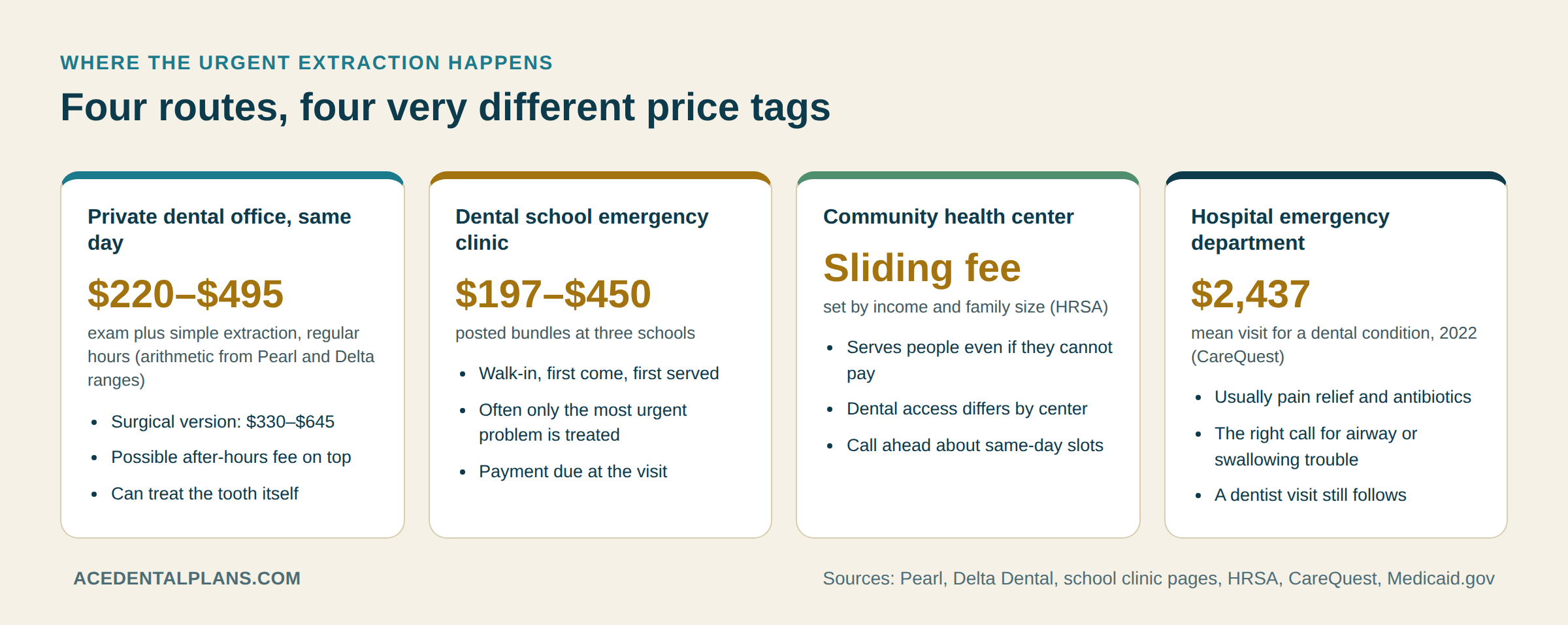 The four places people end up with a tooth problem, and the price signal for each.
Hospital Emergency Department or Dentist: What Each Bill Looks Like
People often go to a hospital because it is open. The price and the result are both different. The ADA’s emergency department referral page estimates 2 million hospital ED visits a year for dental pain, at an average of $749 for patients who aren’t admitted, and gives a per-visit range of $400 to $1,500 against $90 to $200 for a dentist visit. That page is undated, and its figures look older than the most recent data.
CareQuest Institute’s analysis of emergency department visits for non-traumatic dental conditions is newer. It counted 1.8 million visits at a total cost of $3.4 billion in 2019 and 1.6 million visits at $3.9 billion in 2022. The mean cost per visit rose from $1,887 to $2,437, a 29% increase, and uninsured patients made up 18.5% of all such visits, with Medicaid covering 48.1%. Those figures describe the whole ED encounter, not what an uninsured patient necessarily pays after discounts or financial assistance, which vary by hospital.
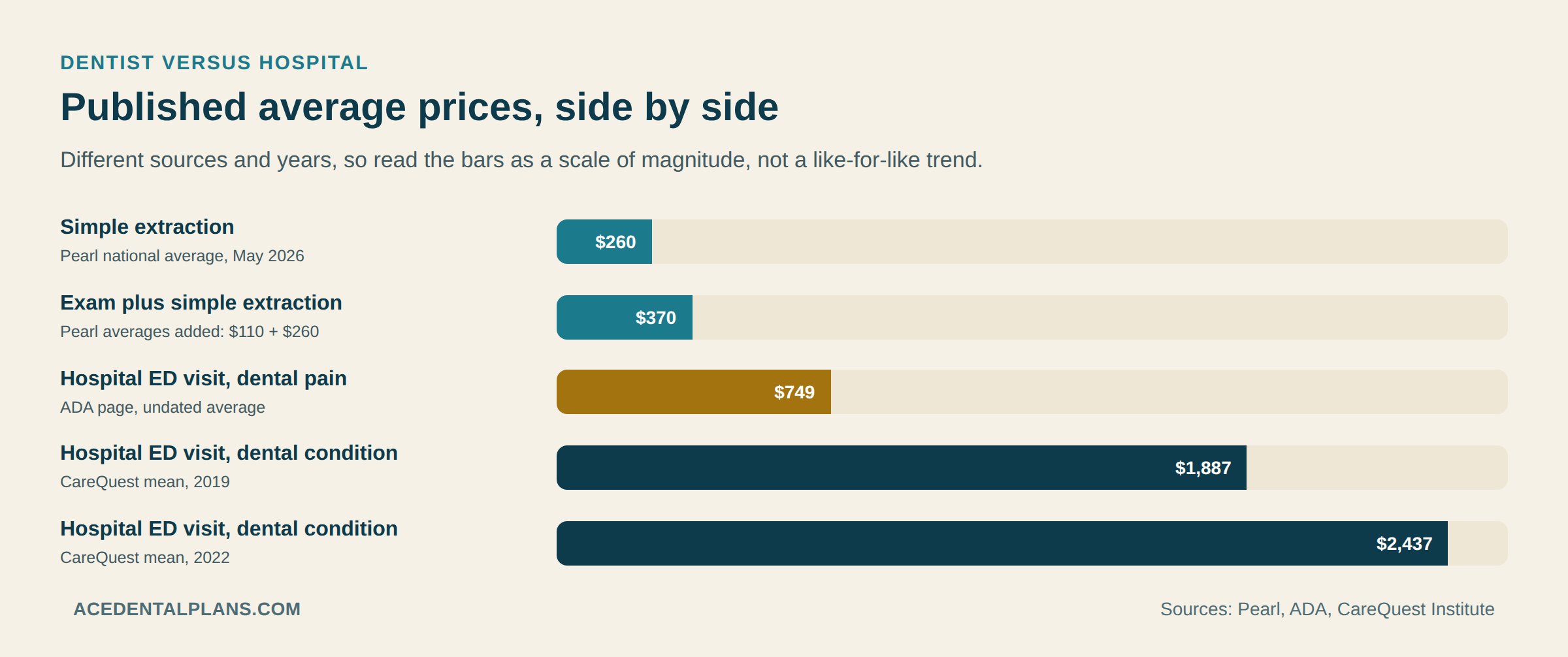 Dentist averages next to hospital ED averages. The sources and years differ, so the bars show scale, not a trend.
What the ED visit buys is the larger problem. Medicaid.gov’s analysis of 2019 data says non-traumatic dental conditions in emergency departments are usually managed palliatively with pain relief agents, antibiotics, or both. Aspen Dental, a dental chain, states on its own resource page that emergency rooms generally do not perform routine extractions, because they are not staffed or equipped for standard dental procedures. That is a provider’s description, not a rule, so a hospital with an oral surgeon on call may differ. The usual pattern is the one in Scenario E: the ED bill arrives, and the tooth still needs a dentist.
There is one case where price should not decide. Mayo Clinic advises going to an emergency room for a tooth abscess if you have fever and facial swelling and can’t reach a dentist, and also if you have trouble breathing or swallowing. MedlinePlus says breathing difficulty from a spreading tooth-root infection is an emergency and to go to the ER or call 911 right away. Swelling that blocks the airway is a medical emergency regardless of what the extraction would have cost.
Dental School Emergency Clinics: Posted Fees, Hours and the Catch
Dental schools run walk-in emergency clinics, and several post their fees. That makes them one of the few places where an urgent price can be read before you leave the house. The catch is time and scope. Table 3 collects what five schools state on their own pages.
| School clinic | Posted fee | Access | Limits stated by the school |
|---|---|---|---|
| University of Maryland School of Dentistry, Urgent Care Clinic | $197, which includes exam, X-ray and one simple extraction (effective July 1, 2023) | Mon–Fri walk-in; limited slots fill each weekday morning, first come, first served | Only the most urgent need is addressed; payment due at time of service |
| Indiana University School of Dentistry, Emergency Clinic | $99 down payment applied to exam, X-rays and procedures, plus an additional $165 due for an extraction | Mon, Wed, Fri, 8–11 a.m. and 1–3:30 p.m.; walk-in | New patients only; acute emergencies only, no ongoing care; more fees possible depending on treatment |
| Ohio State University College of Dentistry, Dental Emergency | Average estimated cost of $231–$450, depending on services | Mon–Thu 7:30 a.m.–noon (15-patient limit); Fri 7:30–10:30 a.m. (10-patient limit); no appointments | Offers extraction and root canals; no fillings, crowns, cleanings or general wisdom tooth extractions |
| Rutgers School of Dental Medicine, Emergency Care | $110 emergency clinic fee, including a diagnostic exam and medical review | Walk-in sessions at 10 a.m. and 2 p.m.; register at 9 a.m. or 1 p.m. | X-rays, extractions and root canals are extra, due at service; the clinic often fills to capacity |
| University of Oklahoma College of Dentistry, Emergency Care | No amounts listed; call for extraction clinic fees | Mon–Fri 8 a.m.–5 p.m.; Tulsa walk-in Mon and Thu afternoons | Patients are expected to pay before the procedure |
The posted amounts aren’t directly comparable, and the differences are the point. Maryland’s $197 is an all-in bundle for the simple case. Indiana’s $99 plus $165 comes to $264 if both apply, which is the sum of two posted numbers, not a figure the school states. Ohio State’s $231 to $450 is an estimate for the visit, and Rutgers’ $110 covers the exam only.
Three practical things follow from Table 3. First, capacity is limited, and Ohio State states daily patient caps. Calling before you travel is worth the minute, and arriving before the posted registration time matters at schools that fill early. Second, hours are weekday daytime hours, so an evening or weekend problem generally can’t be handled this way until the next morning. Third, scope is narrow. Maryland says only the patient’s most urgent need will be addressed, and Ohio State doesn’t take general wisdom tooth extractions. A clinic that pulls the painful tooth may leave the rest of your mouth untouched.
Maryland’s page adds that an urgent care visit does not make you a regular patient of the school, and Oklahoma’s makes the same point about its student program. Fees are as the schools posted them when this article was reviewed, and schools revise them.
Health Centers and Public Programs When Cash Is the Problem
Federally funded health centers are the other low-cost route. The Health Resources and Services Administration says health centers adjust their fees based on income and family size, serve everyone even if they cannot pay, and employ dentists among their staff. About 90% of their patients have incomes below 200% of the federal poverty level. Dental access still differs from one center to the next, so ask whether they hold same-day pain slots.
Medicaid is more complicated. Medicaid.gov says states decide which dental benefits adult enrollees get and that there are no minimum requirements for adult dental coverage. HealthInsurance.org reported in November 2025 that seven states offered emergency-only adult coverage (Arizona, Florida, Georgia, Mississippi, Missouri, Nevada and Texas) and nine offered limited coverage. A 2016 KFF brief described emergency-only coverage as dental care for pain relief or emergency care for injuries, trauma or extractions, which means an extraction can sit inside the benefit even in a state with little else. The rules are specific to each state, and the KFF description is older than the state counts, so confirm with your state Medicaid office or plan.
For children, the rules are different. Medicaid.gov says dental services for children entitled to EPSDT must include relief of pain and infections and may not be limited to emergency services. It adds that separate CHIP programs must cover dental services necessary to treat emergency conditions.
Original Medicare is not an answer for most adults. Medicare.gov says that in most cases Medicare doesn’t cover dental services such as routine cleanings, fillings or tooth extractions. It does describe exceptions for certain dental services received as a hospital inpatient and for services directly related to specific covered medical treatments such as transplants or cancer treatment. That page doesn’t address Medicare Advantage, whose dental benefits differ by plan.

If You Have Dental Insurance: How an Urgent Extraction Gets Billed
The reader with a card in the wallet has a different set of questions, and the order they’re answered in matters. Start with the plan type. A PPO pays a percentage of an allowed amount, a dental HMO usually pays through fixed copays at a restricted network of offices, and a discount plan isn’t insurance. Next come the network and the deductible. Delta Dental says out-of-network costs are calculated as a percentage of the dentist’s full fee, while in-network dentists give discounted fees.
Then comes coinsurance. Humana describes a common structure of 100% for preventive care, up to 80% for basic procedures and up to 50% for major procedures. Zocdoc’s 2026 Chicago guide says simple extractions typically fall under basic and surgical extractions under major. Delta Dental says most of its plans do help cover the cost of tooth extractions, though coverage varies by plan.
After coinsurance come the annual maximum, which Zocdoc’s guide says commonly ranges from $1,000 to $2,000, and the waiting periods that matter most in an emergency. Guardian says waiting periods typically range from six months to one year, that services beyond cleanings often require at least six months, and that non-surgical extractions and oral surgery are among the services where delays apply. Dental HMOs, it adds, generally don’t have waiting periods. Humana puts basic-procedure waits at 3 to 6 months where they exist. The Guardian page doesn’t say whether emergency care is treated differently, so a new policy is worth a phone call before you assume any exception.
Two more notes for insured patients. If the office is out-of-network, the plan’s percentage applies to its own allowed amount, and the dentist may bill the difference. And sedation is usually the most restricted line: Forbes Advisor wrote in 2022 that anesthesia is typically covered by dental insurance only when it is considered medically necessary to the procedure. Ask the office to send a pre-treatment estimate to the insurer if time allows. In an urgent case it often doesn’t, which is another reason to ask the insurer afterward how each line was classified.
Reading a Sample Urgent Estimate, Line by Line – Emergency Tooth Extraction Cost Without Insurance
Written estimates for urgent visits tend to use dental billing codes instead of plain words, and the codes are the reason two quotes look different. The sample below is hypothetical, but each code is real and each description follows the source cited earlier.
- D0140, limited oral evaluation, problem-focused. The exam. Pearl’s national range is $70–$185. Ask whether the X-ray is bundled into it.
- Periapical X-ray. Often inside the exam price per Pearl, though Sunbit lists imaging as a separate $60–$250 line. If it appears twice, ask why.
- D7140, extraction, erupted tooth or exposed root. The simple extraction. Delta Dental’s out-of-network range is $150–$310.
- Surgical extraction line. If this replaces D7140, the fee should be higher, and the dentist should be able to say what made the case surgical.
- D9230, nitrous oxide. An optional comfort line. You can decline it.
- D9440, office visit after regularly scheduled hours. The fee that depends entirely on the office. If it’s there, ask whether it applies to your appointment time.
- Follow-up visit and medications. Sunbit’s ranges are $60–$100 and $10–$50. A recheck is sometimes included; ask.
The lines to question are the ones that appear without a reason you can name: duplicate imaging, sedation you didn’t request, or a surgical line when the dentist said the tooth came out easily. Questioning isn’t accusing. Billing mistakes happen, and an itemized estimate is how they get caught.
Ways to Lower an Urgent Extraction Bill Before You Agree to It
Most of the savings in an emergency come from asking, not from finding a special program. The questions below take about five minutes by phone. They work at private offices, and several apply to school clinics too.
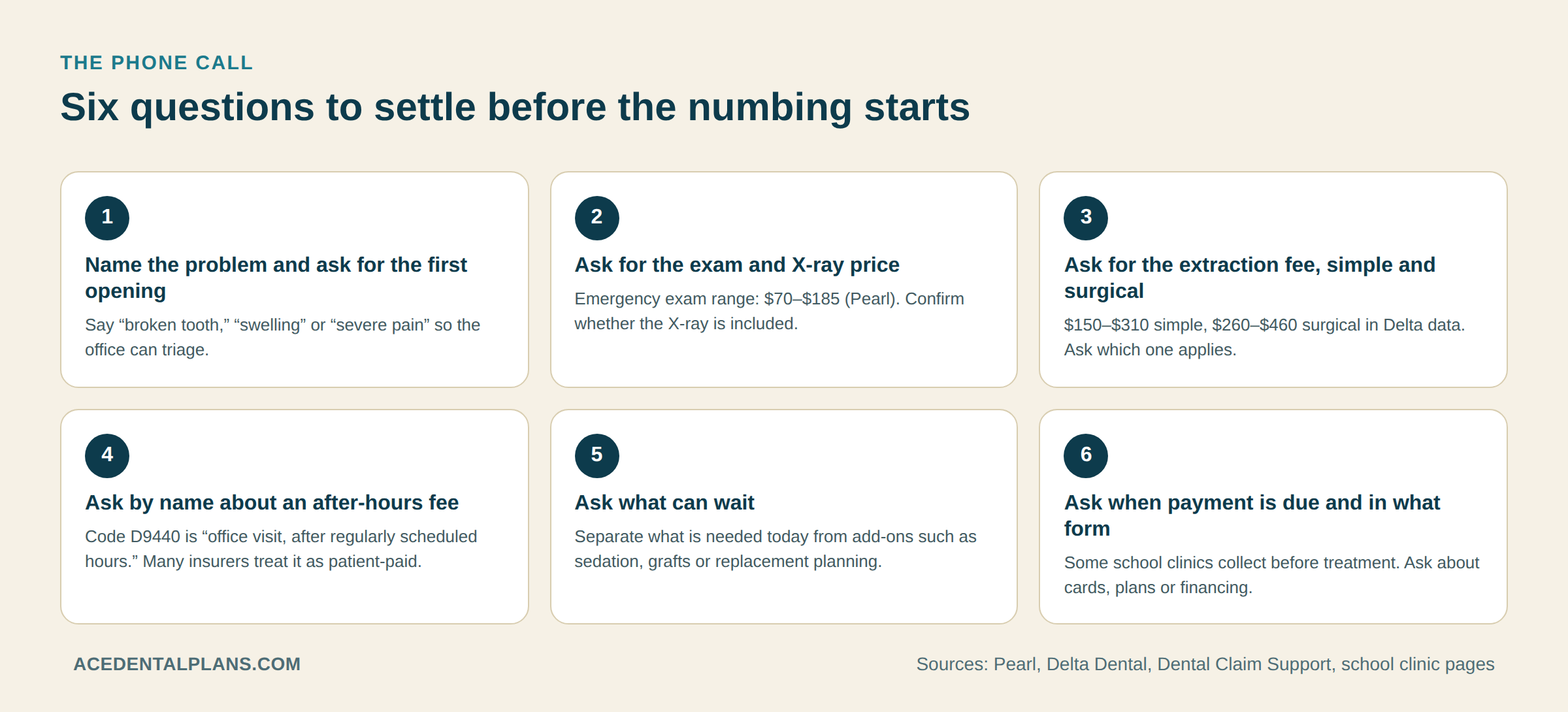 A six-step phone script for pricing an urgent extraction before you sit in the chair.
Ask for the cash price when you have no insurance, and ask whether the office has a lower fee for paying at the visit. Offices set their own policies, and there is no published rule that says they must discount, so treat a yes as a favor and a no as information.
Ask what must happen today. This isn’t a request to skip care. It’s a way to separate the urgent items from the ones that can be scheduled: the exam, the X-ray and the extraction on one side; a bone graft, a replacement tooth or a general treatment plan on the other. The ADA’s antibiotic guideline is relevant here in a cost sense. It says the definitive treatment, not a prescription alone, is what addresses most urgent dental pain and swelling, so a plan to take pills and wait can leave the underlying cost in place and the infection untreated. Whether a particular tooth can safely wait is the dentist’s call.
Ask whether a nearby dental school or health center could see you sooner or cheaper than the quote suggests. And ask the office, not the receptionist alone, whether nitrous oxide or stronger sedation is necessary for this tooth, since those are the optional lines that can double a bill.
Paying for an Unplanned Extraction: Time, Cards and Tax Rules
Because urgent care doesn’t wait for a financing application, the payment options that work fastest tend to be the ones already in your wallet. A credit card with room on it is the fastest. CareCredit, which is a health-focused credit card accepted by many dental offices, advertises options with 0 interest if paid in full within 6, 12, 18 or 24 months, along with reduced-APR plans for longer terms. Its dental page doesn’t spell out what happens if a promotional balance isn’t paid off in time, so read the cardholder agreement before signing. The mechanics of promotional financing versus an office payment plan are a topic of their own.
If you have a health savings account or flexible spending account, Delta Dental notes that these can be used to set aside pre-tax money for eligible dental expenses, though since coverage varies by plan it is a good idea to confirm whether an extraction qualifies.
Tax rules offer a smaller benefit after the fact. IRS Publication 502 (2025) says you can include in medical expenses the amounts you pay for the prevention and alleviation of dental disease, but generally you can deduct only the amount above 7.5% of your adjusted gross income, and only if you itemize on Schedule A. The publication also says that if you use a credit card, you include the expense in the year the charge is made, not when you pay the card. For a $400 extraction, the deduction is unlikely to matter. For a year with large medical bills, it might.
Common Situations That Change the Price
A broken tooth with no pain. Pain isn’t what makes a visit urgent in billing terms. The exam fee is the same, and the cost depends on whether the tooth can be removed simply or has to be sectioned. A tooth broken below the gumline tends to be priced as surgical, according to the practice pricing page cited earlier.
A wisdom tooth that suddenly hurts. Wisdom teeth are priced differently from other teeth, by how deeply they sit, and some emergency clinics won’t take them. Ohio State’s clinic says it doesn’t offer general wisdom tooth extractions. An urgent exam can still identify the problem, and the removal may be scheduled separately.
A child with a painful tooth. Children enrolled in Medicaid are entitled to relief of pain and infections under EPSDT, and Medicaid.gov says those services can’t be limited to emergencies. The adult ranges in this article may not match pediatric fees.
An older adult on Medicare. Original Medicare generally doesn’t cover extractions, so the cash ranges above are the starting point unless a Medicare Advantage plan, Medicaid or a separate dental policy applies. Medicare.gov notes exceptions tied to specific medical treatments, which a dentist’s office can confirm only after reviewing the medical context.
An uninsured patient with a low income. This is where the health center route matters most. The sliding fee scale means the bill depends on income and family size, not the office’s standard fee, and HRSA says health centers serve people even if they cannot pay.
What the Published Numbers Can’t Tell You
Several gaps are worth naming. There’s no neutral national figure for after-hours fees; the numbers in this article come from a bank’s advice column and a price site. The Delta Dental ranges are out-of-network claims data, which reflect what dentists charge and what the insurer processes, not what a cash patient with no insurance is always quoted. Pearl’s numbers are a national model, and local prices vary. The ADA’s ED figures are undated, and CareQuest’s are for the whole ED encounter.
Dental school posted fees can also change, and they describe the simple case. If your tooth turns out to need something a clinic doesn’t offer, the visit may end without treatment. Ohio State’s page, for example, lists several services it doesn’t provide.
What follows from all this is a method more than a number. Get the exam price, get the extraction price, ask about the hour-based fee, and keep the hospital for situations where the problem is bigger than the tooth.

Frequently Asked Questions – Emergency Tooth Extraction Cost Without Insurance
Can a dentist pull a tooth the same day I call?
Often, yes. The ADA’s MouthHealthy site notes that most dentists reserve time in their daily schedules for emergency patients. Same-day availability depends on the office, and you may need to describe the problem so the staff can fit you in.
Does an infected tooth have to be treated with antibiotics before it can come out?
Not necessarily. A 2018 study of acutely infected teeth concluded that infection with severe percussion pain is not a contraindication to extraction, and the ADA’s 2019 guideline reserves antibiotics for cases with systemic involvement. The dentist decides based on the exam, so don’t expect a single rule to apply to your tooth.
Will a hospital ER pull my tooth?
Usually not. Medicaid.gov says emergency departments generally manage non-traumatic dental conditions with pain relief, antibiotics or both, and Aspen Dental says ERs generally don’t perform routine extractions. The ER is the right place for trouble breathing or swallowing, or swelling that spreads toward the neck.
Is there usually a weekend fee at a dental office?
It depends on the office. One practice publishes that it charges the same price on any day, while a dental-business bank resource suggests a $50 fee and a price site reports $100 to $300. Ask for the fee by name when you call.
How much should I expect to pay at the door?
Dental school clinics generally collect at or before treatment. Maryland says payment is due at the time of service, Rutgers collects its fee before you are seen, and Oklahoma expects payment before the procedure. Private offices vary, so ask what form of payment they take.
Why did two offices in my city quote me prices $200 apart?
Local prices spread widely. Zocdoc’s February 2026 Chicago guide gives $75 to $300 for a simple extraction in one city, and one practice publishes $420. The tooth, the complexity and whether the quote includes the exam and X-ray also change the number.
Does Medicaid pay for an emergency extraction?
It can. Medicaid.gov says states set adult dental benefits, and a KFF brief described emergency-only coverage as including pain relief and extractions. HealthInsurance.org counted seven emergency-only states in 2025. Children enrolled in Medicaid are entitled to relief of pain and infections under EPSDT.
Does Medicare cover an emergency extraction?
In most cases, no. Medicare.gov says Original Medicare generally doesn’t cover tooth extractions, with limited exceptions tied to a hospital stay or certain medical treatments. Medicare Advantage plans vary.
Can I use a payment plan or a credit card for an emergency extraction?
Many offices accept cards, and CareCredit advertises promotional options for dental care. The terms differ by product. Read what happens to the balance if it isn’t paid within the promotional period.
Is an emergency extraction tax deductible?
Possibly. IRS Publication 502 says dental expenses count as medical expenses, but only the portion above 7.5% of adjusted gross income is deductible, and only if you itemize. A tax professional can say whether it applies to you.
What if I can’t pay anything today?
Call a community health center, which HRSA says adjusts fees by income and family size and serves people even if they cannot pay. A dental school clinic, a state Medicaid office or a local dental society may also point you to a clinic. If swelling is spreading or breathing is affected, go to an emergency room first.
Sources and Disclaimers
Price figures come from published sources named in the text: Delta Dental’s 2024 out-of-network data, Pearl’s May 2026 national fee model, consumer price guides from Zocdoc, Sunbit and Forbes Advisor, a dental business advice page, an independent price site, and fee pages posted by five dental schools. Clinical statements are drawn from the ADA, MedlinePlus, Mayo Clinic and a peer-reviewed study, and coverage statements from Medicaid.gov, Medicare.gov, HRSA, KFF, HealthInsurance.org, Humana, Guardian and Delta Dental. The totals in Table 2, the insurance example and the sample estimate are original arithmetic and hypothetical scenarios, not quotes. National averages hide wide local differences, the sources differ in year and method, and no source here publishes an after-hours benchmark. Confirm any price with the dentist and any benefit with your insurer before treatment.
- Delta Dental — Tooth extraction cost and insurance coverage
- Pearl — National tooth extraction cost data
- Pearl — National emergency dental exam cost data
- Pearl — National sedation dentistry cost data
- American Dental Association — Emergency department referrals for dental conditions
- CareQuest Institute for Oral Health — Dental care in crisis: emergency department visits for non-traumatic dental conditions
- Medicaid.gov — Adult non-traumatic dental ED visits analysis (PDF)
- Medicaid.gov — Dental care benefits in Medicaid and CHIP
- Medicare.gov — Dental services coverage
- HealthInsurance.org — Medicaid adult dental coverage by state
- KFF — Access to dental care in Medicaid: nonelderly adults
- HRSA Bureau of Primary Health Care — What is a health center?
- CMS No Surprises Act — Good faith estimate rights
- CDC — ADA antibiotic treatment guidelines for dental pain and swelling (PDF)
- Brazilian Oral Research via PubMed — Acutely infected teeth: to extract or not to extract?
- MedlinePlus — Ludwig angina
- Mayo Clinic — Tooth abscess symptoms and causes
- ADA MouthHealthy — Dental emergencies
- University of Maryland School of Dentistry — Urgent Care Clinic
- Indiana University School of Dentistry — Emergency Care Clinic
- Ohio State University College of Dentistry — Dental Emergency clinic
- Rutgers School of Dental Medicine — Emergency care
- University of Oklahoma College of Dentistry — Emergency care
- Guardian — Dental insurance waiting periods
- Humana — What does dental insurance cover?
- Zocdoc — Tooth extraction cost in Chicago (consumer price guide, 2026)
- Forbes Advisor via Nasdaq — Tooth extraction costs and how to afford it (2022)
- Sunbit — Wisdom teeth removal cost guide, with consult, imaging and anesthesia fees (2026)
- Real Dental Costs — Emergency dentist cost without insurance (independent price site, 2026)
- TowneBank — Handling after-hours visits (business resource for dental practices)
- Dental Claim Support — Codes D9430 and D9440 (billing education)
- Coding Ahead — CDT code D9440 descriptor
- Omega Dental Specialists — Emergency tooth extraction (single-practice pricing page)
- Aspen Dental — Emergency room vs. dental office (provider resource page)
- CareCredit — Dental financing
- Internal Revenue Service — Publication 502, Medical and Dental Expenses
Important Information and Disclaimers
This article is general educational information. By using it, you accept the limits described below.
Not dental or medical advice
Nothing on this page is a diagnosis, a treatment recommendation or a substitute for an examination by a licensed dentist or physician. Reading this article does not create a dentist-patient or doctor-patient relationship. Only a licensed professional who has examined you and reviewed your history can tell you what your mouth needs. Do not delay, skip or stop professional care because of something you read here.
Prices are estimates, not quotes
Cost figures are ranges reported by the third-party sources cited in this article. Actual prices depend on your location, the provider, the complexity of your case, the materials used, the date of service and other factors, so what you pay may be higher or lower. A written treatment plan and fee estimate from the dental office is the only reliable number for your situation.
Insurance and plan examples are illustrations
Examples that use named amounts or percentages are hypothetical. Real benefits depend on your plan, network, waiting periods, annual maximum, deductible and the insurer’s rules at the time of treatment. A pre-treatment estimate or benefits check is not a promise of payment. Confirm the details with your insurer or plan administrator in writing.
Not insurance, legal, tax or financial advice
AceDentalPlans is an information publisher. Nothing here is insurance, legal, tax, investment or other professional financial advice, and nothing here recommends a particular provider, insurer, lender, discount plan or financing product. Company and product names belong to their owners and appear for identification only. Read the terms of any loan, financing offer or plan before you sign, and ask a qualified professional if you need advice on your own circumstances.
Third-party sources
This article cites government agencies, professional associations, insurers, lenders and other outside organizations. We do not control those sources. Their content can change, move or disappear, and listing a source is not an endorsement of it or of anything it sells.
No warranty
We aim for accuracy, but this article is provided “as is,” without warranties of any kind, express or implied, including warranties of accuracy, completeness, timeliness or fitness for a particular purpose. Some information may be out of date or contain errors by the time you read it.
Limitation of responsibility
To the fullest extent permitted by law, AceDentalPlans and its owners, authors and contributors are not responsible or liable for any loss, cost, injury, health outcome or other damage that results from using this article or relying on it. You are responsible for your own decisions about your care, your coverage and your money.
How this article is written
This article follows AceDentalPlans’ answer-first, U.S.-focused editorial approach. It uses conditional language for insurance, because coverage depends on the specific plan, and it names its sources so that you can read them yourself.