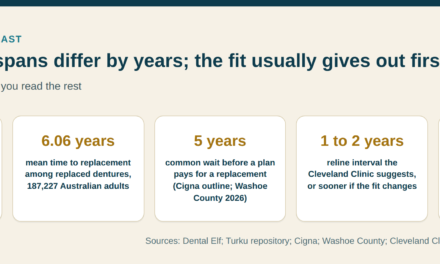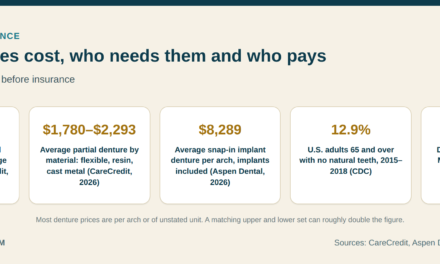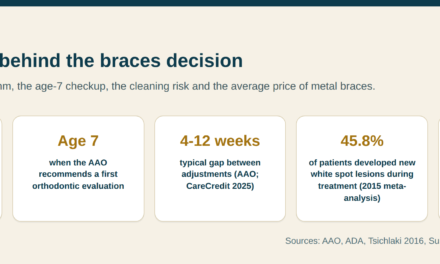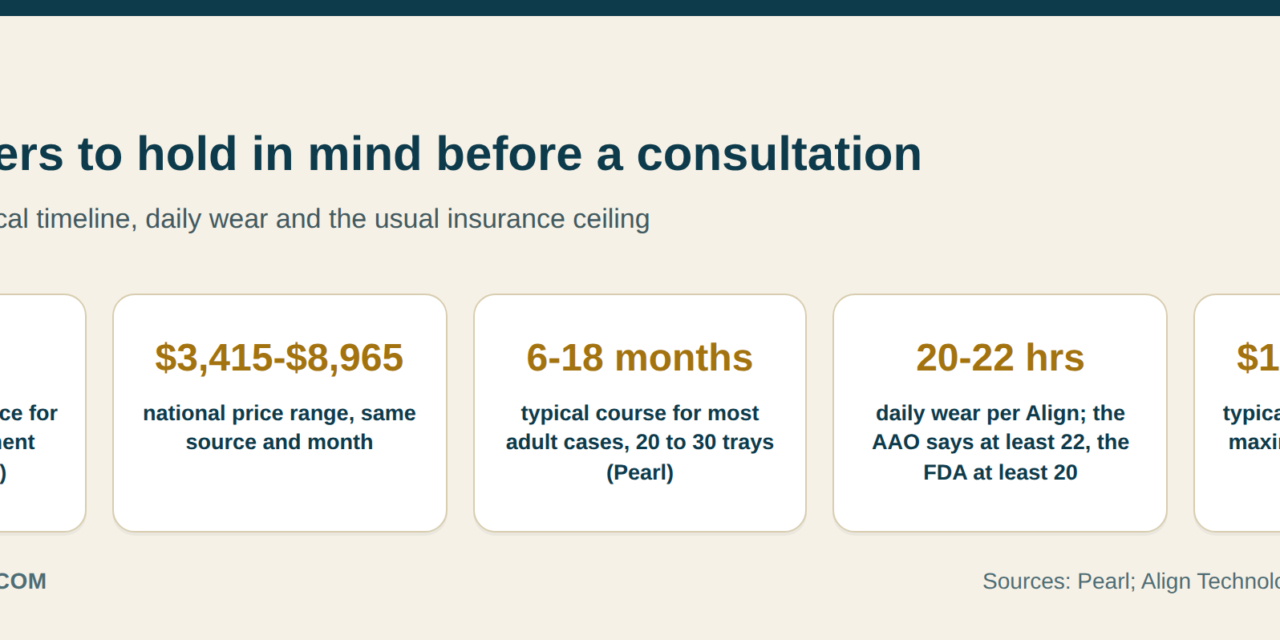
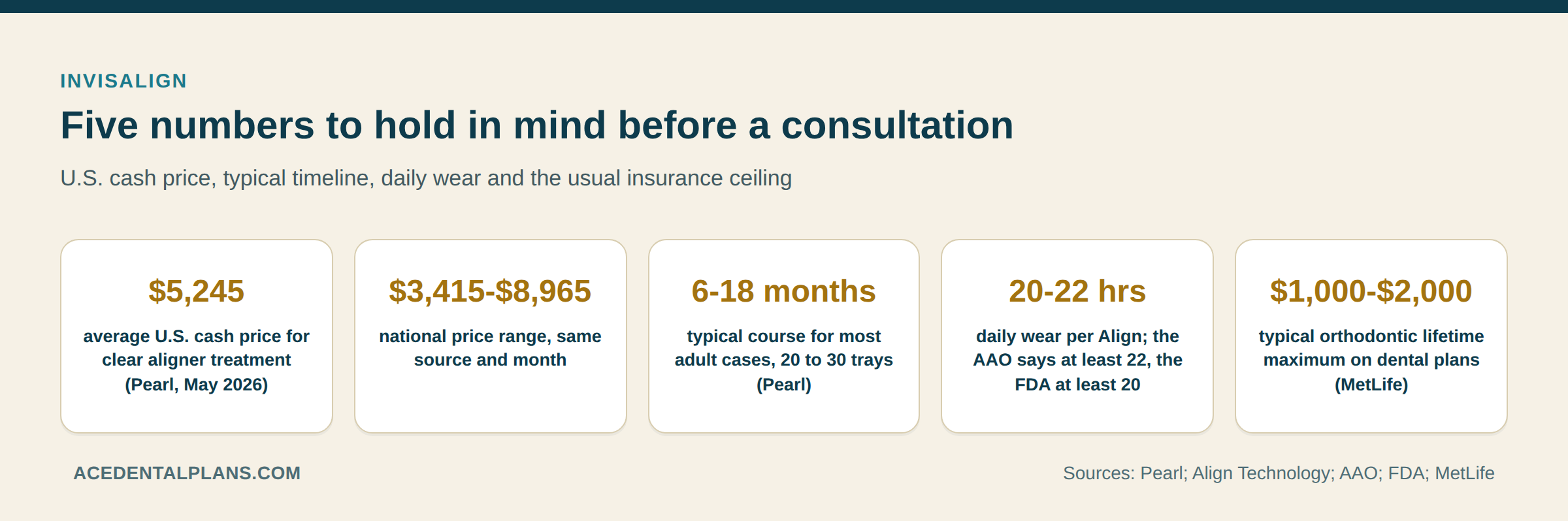
Invisalign is a brand of removable clear aligners that move teeth through a series of custom plastic trays, each worn for about one to two weeks and for roughly 20 to 22 hours a day. In the U.S., Pearl’s May 2026 national figures, built on ADA fee survey data, put the cash price of a full course at $3,415 to $8,965, with an average of $5,245. Most adult cases run 6 to 18 months, followed by retainers.
This article explains how the treatment works, who may be a candidate, what the process and timeline look like, what daily life with aligners involves, how results hold up, and where the risks and limits sit. It also covers provider types, at-home aligners, and the mechanics of orthodontic insurance, tax-favored accounts and payment. It stops short of package-by-package pricing and a full braces comparison, which have their own pages, and it cannot tell you whether your teeth suit aligners. Only an examination can do that.
Key Takeaways
- Invisalign is a regulated medical device. An FDA letter dated August 29, 2025 lists the Invisalign System as Class II, intended for orthodontic treatment of malocclusion in patients with primary, mixed or permanent dentition.
- Wear rules differ by source but point the same way. The FDA says at least 20 hours a day, Align says 20 to 22, the AAO says at least 22, and Cleveland Clinic says 22 to 23. Aligners come out for eating, for any drink except water, and for cleaning.
- Treatment time is tray count times change interval. Twenty trays changed weekly is 20 weeks of active wear; changed every two weeks it is 40 weeks. Refinements, retainers and delays come on top.
- Planned movement is not always achieved. In a 2020 prospective study of 38 patients and 899 teeth, aligners achieved about 50% of the movement the software predicted, which is why refinement rounds are routine to plan for.
- Retainers are part of the treatment. A retainer is typically necessary for a lifetime, the AAO says, though how often it is worn may decrease. A 2023 Cochrane review found low to very low certainty evidence on which retainer type holds teeth better.
- Orthodontic insurance is a lifetime pot, not an annual one. On a $5,245 fee, four published plan designs would pay between $1,000 and $2,500 in this article’s illustration, leaving $2,745 to $4,245 for the patient.
Invisalign in Ten Facts, With the Source Behind Each One
People searching for Invisalign usually want the same few answers first: what it is, how long it takes, what it costs and who pays. Table 1 collects those answers in one place and names the publisher, because the sources do not always agree with each other.
| Question | What the source reports | Source and date |
|---|---|---|
| What is it? | Removable clear plastic trays, custom-formed from a digital scan, that move teeth a fraction of a millimeter at a time. Invisalign is the trade name of Align Technology’s system. | AAO aligner page; Align Technology consumer pages |
| Is it regulated? | The Invisalign System is Class II under 21 CFR 872.5470, product codes NXC and PNN, for orthodontic treatment of malocclusion in primary, mixed or permanent dentition. | FDA letter K252380, Aug. 29, 2025 |
| How often are trays changed? | Weekly (AAO), about every two weeks (Cleveland Clinic), every 1 to 3 weeks (Delta Dental), one to two weeks (FDA), weekly or biweekly (Align). | AAO; Cleveland Clinic; Delta Dental; FDA; Align (pages read October 2026) |
| How many hours a day? | At least 20 (FDA), 20 to 22 (Align), at least 22 (AAO, Delta Dental, MetLife), 22 to 23 (Cleveland Clinic). | FDA; Align; AAO; Delta Dental; MetLife; Cleveland Clinic (pages read October 2026) |
| How long does a typical course take? | 6 to 18 months for most adult cases, with 20 to 30 aligners in total. | Pearl, May 2026 |
| What does it cost in cash? | $3,415 to $8,965 nationally, average $5,245, filed under CDT code D8090. | Pearl, May 2026 (ADA fee survey basis) |
| What do the quotes include? | Consultation and planning, a 3D scan, 20 to 30 trays, attachments if needed, check-ups every 6 to 10 weeks and one round of refinement aligners. Retainers ($300–$800) are often billed separately. | Pearl, May 2026 |
| Does insurance pay? | Plans with orthodontic coverage usually treat braces and aligners equally, but many cap the benefit at a lifetime maximum, often $1,000 to $2,000 per person. | AAO; MetLife consumer library |
| How common is it? | More than 23 million patients treated to date, and 691,785 clear aligner cases shipped worldwide in the second quarter of 2026. | Align Technology, Q2 2026 results release |
| Who supervises? | Clear aligners are prescription devices. The FDA has not authorized aligners sold directly to consumers without a prescription and dentist or orthodontist supervision. | FDA consumer page, Sept. 9, 2026 |
Two caveats apply before reading any row as settled. Align’s case counts and patient totals are company figures covering all countries, not a U.S. measure of quality or demand. And the 6-to-18-month range is a summary of typical adult cases, not a promise about yours, because the number of trays and the number of refinements drive the calendar.
For a package-level price list, with what each tier tends to include, the pricing guide on Invisalign cost is the right companion to this page. Here, the price appears only as context for decisions about treatment, insurance and payment.
How Aligners Move Teeth: Trays, Attachments, IPR and Refinements
Teeth move because steady, gentle pressure makes the bone around them remodel. The AAO describes tooth movement as a lifelong natural process of bone remodeling, which is the same process that lets teeth drift after treatment ends. An aligner borrows that process on purpose. Each tray is shaped a little differently from the tooth positions it replaces, and the AAO says each one moves teeth only a fraction of a millimeter at a time.
That is why there are so many trays. A plan of 20 to 30 aligners, the typical range in Pearl’s summary, divides the total movement into small, sequential steps. Each step is worn for a week or two, then replaced by a tray that asks for the next fraction. The maker calls its trays SmartTrack material and builds the sequence in treatment-planning software it names ClinCheck, working from a 3D scan the doctor takes with a scanner Align calls iTero. Those are brand names for the material, software and scanner; the AAO’s description of the principle holds for aligner systems in general.
Attachments: the small bumps that give a tray something to push against
Many plans include attachments, small tooth-colored shapes bonded to selected teeth. Cleveland Clinic says the orthodontist places tiny dental attachments on teeth to help the aligners move them, and the AAO says they are placed at the delivery appointment. Pearl lists tooth-colored attachments, “if needed,” among the items usually included in a quoted price. The sources I opened do not describe how attachments are removed or whether removal is included in the fee, so that is a question for the office.
IPR: making room by polishing a sliver of enamel
Interproximal reduction, or IPR, removes a small amount of enamel between neighboring teeth to create room. Cleveland Clinic says dentists usually remove no more than half a millimeter per tooth, using a thin sanding strip or a rotating hand instrument. The same page says the procedure should not hurt because enamel has no nerves, that teeth may be slightly sensitive for a few days, and that IPR is permanent and irreversible. It also reports a study in which 71% of 500 people having Invisalign treatment needed it.
The takeaway is not that IPR is alarming. It is that IPR is a decision with a one-way door, and it deserves a plain explanation: which teeth, how much in total, and why the plan needs it. People with thin enamel are not good candidates, per the same page, which is one reason the scan and X-rays come before the plan.
Elastics and the optional mandibular advancement feature
Aligners can also be combined with orthodontic elastics, the AAO notes, small rubber bands that apply force between the upper and lower teeth. The FDA letter for the Invisalign System also lists an optional mandibular advancement feature, indicated for skeletal malocclusion in patients with mixed or permanent dentition. The pages I opened do not describe how that feature works in daily use, so treat it as a question for the consultation rather than a detail this article can resolve.
Refinements: the second batch of trays
No plan moves every tooth exactly as drawn. In a 2020 prospective study in the American Journal of Orthodontics and Dentofacial Orthopedics, covering 38 patients and 899 teeth, the mean accuracy of tooth movement with Invisalign was 50%. Accuracy here means the share of the predicted movement that was actually achieved. The authors reported a marked improvement over earlier work, and they said the strengths and weaknesses of the system remained relatively the same.
That is the logic behind refinements. When teeth lag behind the plan, the office takes a new scan and orders another set of trays aimed at the remaining gap. Pearl describes a typical quote as including one refinement round and lists further rounds as an item often billed separately. A refinement is therefore not a sign that something went wrong. A fee that says nothing about refinements is a problem, because it leaves the largest unknown in the treatment unpriced.
Who May Be a Candidate, and Who May Be Steered Toward Braces
Clear aligners can treat gapped teeth, crowded teeth, overbite, underbite, open bite, crooked teeth and crossbite, the AAO says. It adds, in the same breath, that clear aligners are not right for everyone and that some cases respond more predictably to braces. Delta Dental says aligners cannot correct all kinds of orthodontic problems. The FDA’s consumer page says they may not effectively treat more complex problems.
None of those sources gives a checklist, and for good reason. Candidacy turns on the whole picture: the position of each tooth, the jaw relationship, the health of the gums and bone, the condition of existing dental work, and how reliably a person can wear the trays. Align’s own consumer page says Invisalign may not be suitable for everyone and recommends an evaluation by a dentist or orthodontist.
What the sources suggest examiners look at
Read together, the pages suggest a handful of questions. None is a rule, and several belong to the dentist rather than to you.
- Is the mouth healthy enough to start? According to the AAO, dental work must be completed before the scan, and it recommends a cleaning and checkup with a family dentist first. The ADA’s consumer site says teeth being moved should be confirmed healthy and sound.
- Are there complex movements in the plan? Rotations were the least accurate category in the 2020 study (46% overall), and a 2019 systematic review in BMC Oral Health found braces did better at controlling torque, producing occlusal contacts and widening the arch.
- Is the periodontal support reduced? A 2024 narrative review of 18 studies said aligners can treat pathologic tooth migration but that the approach is limited by high tooth mobility and incisor inclination, and that no studies had compared the two appliances in people with periodontitis.
- Can the person wear the trays? Cleveland Clinic says treatment requires discipline, because aligners work only if worn as directed and stored safely when removed.
- Is there existing dental work in the way? The FDA lists crowns, fillings and implants that may loosen or dislodge among the risks of aligner treatment.
If the examiner leans toward braces, that is a clinical finding, not a sales tactic. The two appliances have different strengths, and the head-to-head is laid out in the comparison of braces versus Invisalign. How braces themselves work, and how long they run, is covered in the guide to braces types and treatment time.
Dentist or Orthodontist: Who Provides Invisalign and What to Ask
Invisalign is prescribed and supervised by a licensed dentist. That dentist may be a general dentist who provides aligners as one service among many, or an orthodontist, a dental specialist. All orthodontists are dentists, the AAO says, but only about 6% of dentists are orthodontists, and that an orthodontist completes a two- to three-year residency after dental school.
Neither route is wrong on its face. A general dentist may be a good fit for a straightforward case, and an orthodontist brings narrower training and, usually, a larger volume of tooth-movement cases. The AAO states its own position plainly: an orthodontist is the professional qualified to decide whether braces or clear aligners suit you. That is the view of a specialty society, and a general dentist may reasonably answer the same question for a simple case.
What matters more than the title is how the practice works. Ask who plans the movements and who reviews the plan before trays are ordered, who sees you at check-ups, and what happens if a tray cracks or a tooth lags. Ask whether X-rays and a scan are taken before any plan is proposed. The AAO’s own list of questions for mail-order providers works equally well for a local office: who supervises the plan, what their credentials are, how to reach them with problems, and which diagnostic records are taken first.
One more point is worth knowing. Align’s consumer page says the cost of Invisalign is comparable to the cost of braces in most cases and that the final cost depends on the complexity of the case. It publishes no price list, and Pearl’s national range comes from what offices report in fee surveys. Two offices examining the same mouth can therefore quote different fees without either being wrong.
From First Visit to Retainer: The Process Step by Step
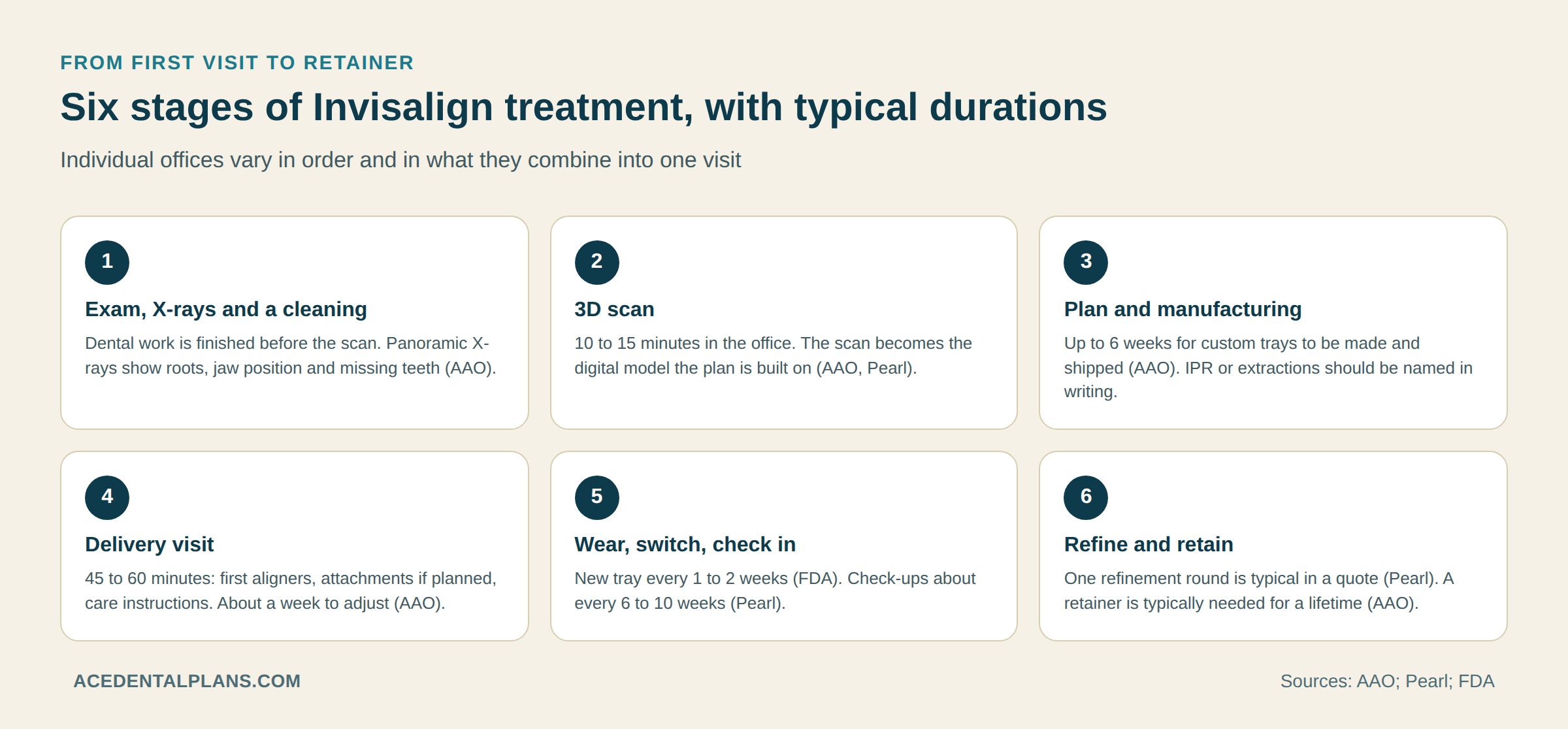
The sequence below follows the AAO’s walk-through of clear aligner treatment, with Pearl’s description of what a quote usually covers. Offices vary in the order of steps and in what they fold into one visit, so treat the durations as the AAO’s typical figures rather than a schedule.
Step 1: Exam, X-rays and a healthy starting point
Treatment starts with an examination and records. In-person care, the AAO says, includes reviewing dental records and taking panoramic X-rays, which show jaw position, missing teeth, tooth roots and the structure of the jawbone. It also says any needed dental work should be finished before the scan, and it recommends a cleaning and checkup with a family dentist first.
That last point has a cost side. A cavity filled or gum inflammation treated before aligners is a separate bill, and Pearl lists extractions and pre-aligner work, such as treating cavities or gum problems, among the items often billed separately from the aligner fee. If you have not seen a dentist in a while, the dental cleaning cost guide shows what the visit itself tends to run.
Step 2: The scan
Per the AAO, the in-office scan takes 10 to 15 minutes. Pearl notes that a quote typically includes a 3D digital scan or impressions. The scan becomes a digital model of your teeth, and the doctor uses planning software to map where each tooth should travel and in what order. Align’s consumer page says patients can preview a new smile from the scan. Treat the preview as the plan’s target, not a forecast, given what the 2020 accuracy study found.
Step 3: Planning and manufacturing
Manufacturing and shipping take up to six weeks, according to the AAO, or four to six weeks from the manufacturer. If IPR, extractions or other preparatory steps are part of the plan, they should be named in writing before the trays are ordered, along with who bills for them.
Step 4: The delivery appointment
At delivery, per the AAO, the visit covers the first aligners, any attachments and care instructions, and runs 45 minutes to an hour. Expect an adjustment period of about a week, with mild discomfort in the first few days, the AAO adds. This is also the visit to ask for the written schedule: when to change trays, when the next check-up is, and what to do if a tray cracks or goes missing.
Step 5: Wearing, switching and checking in
Each tray is worn for one to two weeks. Pearl says progress check-ups typically come every 6 to 10 weeks, and the AAO notes that some offices offer remote monitoring to cut down on in-person visits. The FDA is clear that periodic in-person visits help confirm teeth are moving as planned and that virtual visits can supplement care but do not replace it.
Step 6: Finishing, refining and retaining
When the last tray is done, one of two things happens. If the teeth match the plan, the office moves to retainers. If they do not, the office orders a refinement set, and Pearl says a typical quote includes one such round. Either way, Align’s consumer pages say you will need a retainer after treatment, and the AAO says a retainer is typically necessary for a lifetime. The retention section later in this article covers types and costs.
How Long Treatment Takes: Tray Arithmetic and Published Ranges
Pearl’s national summary gives 6 to 18 months for most adult cases, with 20 to 30 aligners in all. Cleveland Clinic says a few slightly crooked teeth may need aligners for up to nine months and more serious problems several more months. Align’s consumer page says treatment can be completed in as little as six months, and then adds in a footnote that timing depends on the product, wear time and case complexity. That is three sources, three different framings, and one underlying equation.
The equation is the number of trays multiplied by the days each one is worn. Table 2 runs it for four tray counts at three change intervals, using the intervals the sources actually report (weekly, every two weeks, and the upper end of Delta Dental’s one-to-three-week range). Months are weeks divided by 4.35.
| Trays in the plan | Changed weekly | Changed every 2 weeks | Changed every 3 weeks | How it lines up with published ranges |
|---|---|---|---|---|
| 10 | 10 weeks (2.3 months) | 20 weeks (4.6 months) | 30 weeks (6.9 months) | A short plan for minor movement; hypothetical tray count |
| 20 | 20 weeks (4.6 months) | 40 weeks (9.2 months) | 60 weeks (13.8 months) | Low end of Pearl’s 20 to 30 trays; the biweekly figure matches Cleveland Clinic’s “up to nine months” |
| 30 | 30 weeks (6.9 months) | 60 weeks (13.8 months) | 90 weeks (20.7 months) | High end of Pearl’s 20 to 30 trays; biweekly sits inside Pearl’s 6 to 18 months |
| 40 | 40 weeks (9.2 months) | 80 weeks (18.4 months) | 120 weeks (27.6 months) | Above Pearl’s typical tray count; hypothetical, for a complex plan |
Three things stand out. First, the change interval matters as much as the tray count: a 30-tray plan can be 30 weeks or 90 weeks of wear depending on whether the doctor changes trays weekly or every three weeks. Second, Pearl’s 6 to 18 months is consistent with 20 to 30 trays changed every one to two weeks. Third, the table leaves out everything that happens around the trays.
What the table leaves out
Time before the first tray: up to six weeks of manufacturing, per the AAO, plus any preparatory dental work. Time after the last one: a refinement round if needed, and then retention. Time lost to missed wear, which Pearl calls the biggest factor in the timeline. Time lost to lost or cracked trays, with Pearl’s replacement aligner range of $100 to $300 each.
Do aligners finish faster than braces?
The honest answer is that sources disagree. A 2019 systematic review in BMC Oral Health pooled three non-extraction studies and found a statistically significant shorter treatment duration with clear aligners, while also saying the evidence was limited, with only two randomized trials among eight studies. Aligners are not necessarily faster than braces, the AAO says, and Cleveland Clinic says braces may work faster and aligners may need more time and more device changes to reach similar results.
Align’s page makes its own comparative speed claim, and its footnote says one of the supporting studies was sponsored by Align. Nobody in this set has the final word. The reasonable stance is to compare the tray count and the interval in your own plan, not the marketing average. The braces comparison linked earlier lays out the full side-by-side.
Wear Time: 20, 22 or 23 Hours, and What That Means in a Real Day
Every source agrees that aligners must be in the mouth most of the day. They disagree on the number. The FDA’s consumer page says at least 20 hours a day unless the provider directs otherwise. Align says 20 to 22. At least 22, say the AAO and MetLife, while Delta Dental says about 22. Cleveland Clinic says 22 to 23.
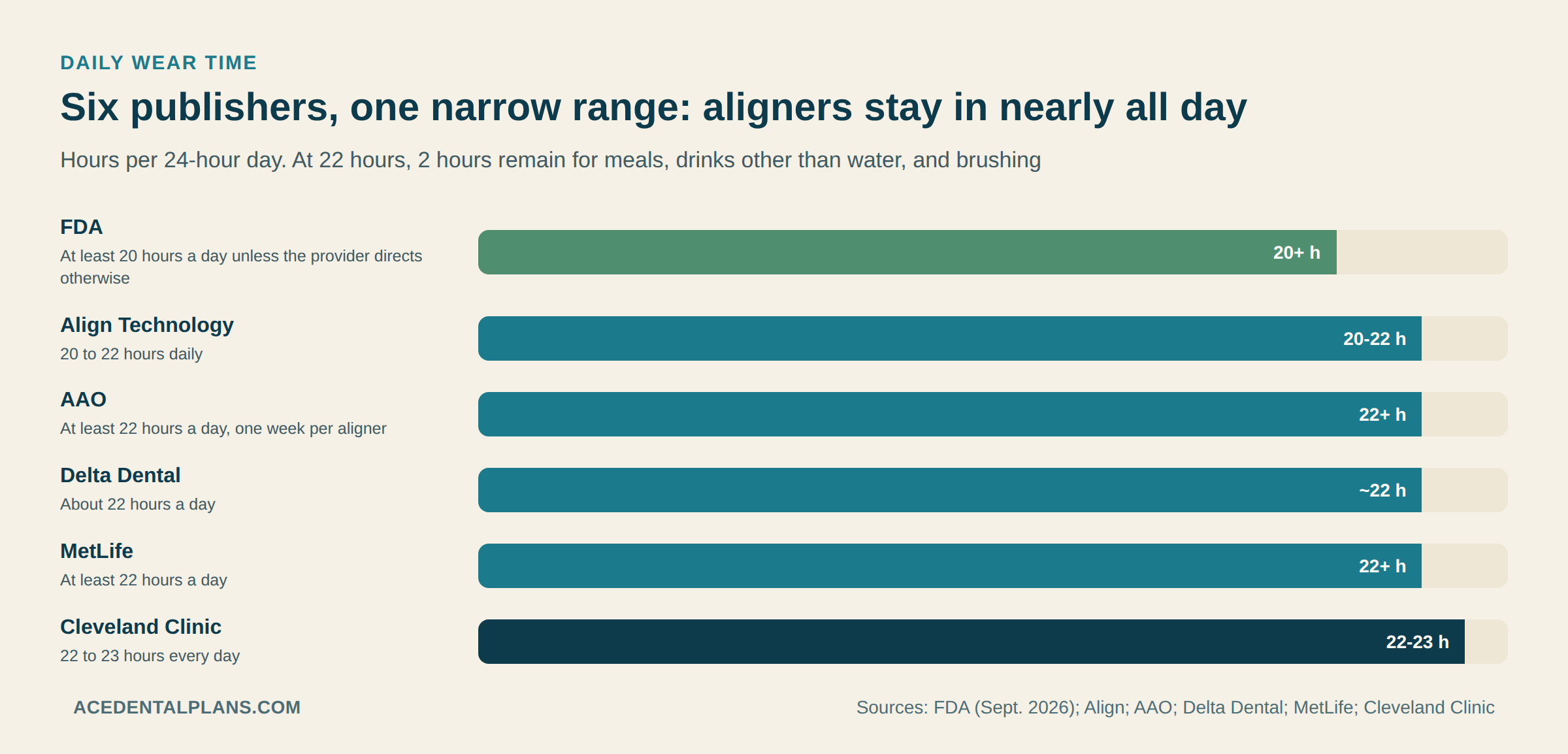
Do not read the gap between 20 and 23 as room to negotiate. The FDA and the AAO both say “at least,” so their numbers are floors. Your doctor’s instruction is the one that governs your case.
The two-hour budget
The arithmetic is unforgiving. At 22 hours of wear, a day contains two hours with the trays out. At 20 hours, four. At 23, one.
What follows is practical rather than moral. People who graze, sip coffee or tea all morning, or nibble in the evening spend their out-of-mouth time quickly. The usual remedy is to consolidate eating into defined windows instead of treating each snack as an occasion to remove trays. That is a scheduling idea, not a clinical instruction, and your office may have its own guidance.
What happens when wear slips
The FDA’s page states that treatment may not progress as intended if aligners are not worn as directed. Pearl calls wearing aligners 20 to 22 hours a day the biggest factor in the timeline. If a tray stops fitting well, or you have been out of them for days, call the office before moving to the next tray, because skipping ahead is a clinical decision. The FDA also says providers should be told about pain, bite problems or other unexpected symptoms.
Eating, Drinking and Cleaning While You Wear Aligners
The rule on food is simple: trays out. Aligners are removed to eat or drink, brush and floss, the AAO says, and Align says to remove them for anything besides water. That leaves no food restrictions in the way braces carry, which Cleveland Clinic lists as one advantage of aligners over braces. What the rule does not remove is the mess of cleaning up afterward. You need to brush before the trays go back in, which Align stresses, because a tray worn over food residue holds it against the teeth.
That explanation is an inference rather than a quotation, and it fits what ADA Forsyth researchers describe. In a 2025 ADA News report, they say aligners significantly reduce the access of saliva to the tooth surface, which weakens saliva’s ability to rinse microorganisms away. The study, which looked at aligner patients with progressing gingivitis, is ongoing and the article offers no hygiene advice. It does give a reason the brushing step matters.
Cleaning the aligners themselves
Align’s patient guidance says to use a soft toothbrush and lukewarm water and to avoid hot water, which can warp the material. Trays go in their case when they are out of the mouth. Cleveland Clinic makes the same point on storage, saying aligners work only if they are worn as directed and stored safely when removed. A lost tray is not only a delay: Pearl’s replacement range is $100 to $300 per aligner.
Drinks
Align says to stay hydrated and avoid sugary drinks, and to remove the aligners when drinking anything but water. In practice, water is the one drink you can take with the trays in. The hot-water warning above is about cleaning, so whether it extends to hot drinks is a fair question for the office. Sipping sugary drinks with trays in is the situation Align’s advice is steering you away from.
Brushing, flossing and the gums
A 2023 systematic review and meta-analysis in BMC Oral Health pooled eight studies and found less plaque accumulation with clear aligners than with fixed appliances, a finding rated as moderate-quality evidence, though most included studies had high or moderate risk of bias. Three of four studies on white spot lesions reported fewer lesions with aligners. The comparison is with braces, not with having no appliance, and it does not mean aligner wearers can brush less.
The First Weeks: Pressure, Speech and What Counts as Normal
New aligners feel tight. Align describes the first week as mostly about adjusting and says the pressure fades within a few days. It says some patients notice a slight lisp in the first few days that usually resolves as the mouth adjusts. The AAO puts the adjustment period at about a week, with mild discomfort in the first few days. Cleveland Clinic says pressure or soreness when chewing or removing the aligner typically eases within a few days, and that soft foods such as soup or scrambled eggs may help at first.
Each new tray repeats the pattern in milder form. Align suggests switching to the next tray before bed so any pressure is less noticeable. Its page says soreness can be managed with over-the-counter pain relievers. This article cannot say which one or how much is right for you, so follow the label and ask your dentist or pharmacist if you have health conditions or take other medicines.
What the FDA lists as possible problems
The FDA names temporary speech changes, irritation or allergic reactions to materials, lost or damaged aligners, and treatment that does not progress if trays are not worn as directed. It also lists swelling and lacerations among adverse events and warns that existing crowns, fillings and implants may loosen or dislodge. Few of those are alarming on their own, but they define what to report.
Call the office promptly if
- You have sharp pain, or pain that lasts more than a few days after a new tray, as Cleveland Clinic advises.
- Your gums are bleeding or swollen.
- A tray is loose or no longer fits.
- A crown, filling or other dental work has come loose.
- You develop a rash, swelling of the lips or mouth, or another reaction after starting aligners. Facial or neck swelling, trouble breathing or swallowing, or fever with severe dental pain needs 911 or an emergency room, not a callback.
What the Research Says About Results, Movement by Movement
Marketing pages speak of results in general terms. The research is more specific, and the details help set expectations. Four studies, opened for this article, cover different questions: how accurately planned movements happen, how aligners compare with braces on time and outcome, what happens to plaque and enamel, and what happens to gums and roots.

The bars show why the average hides so much. Tipping a crown sideways, the highest-scoring movement in that study, reached 56% of what the plan predicted. Rotating a tooth around its long axis, the weakest category, reached 46%. Individual movements went lower still: a mesial rotation of a lower first molar achieved 28%. The authors described a marked improvement over earlier work and said strengths and weaknesses of the system had stayed relatively similar.
Two cautions belong here. The study measured 38 patients, which is a small sample, and the page I read reproduced the article rather than the journal’s own site. And accuracy percentages describe movements, not the final smile: a plan can end well if the doctor reorders trays and corrects the gap. That is what refinements are for.
| Outcome | What the study reports | Study and strength of evidence |
|---|---|---|
| Planned movement achieved | Mean accuracy 50%; crown tip 56%; rotation 46%; distal rotation of upper canine 37%; mesial rotation of lower first molar 28%. | Prospective study, 38 patients and 899 teeth, AJODO 2020. Small sample, single study. |
| Treatment duration versus braces | Statistically significant shorter duration with aligners, pooled from three non-extraction studies with low heterogeneity. | Systematic review of 8 studies (2 randomized, 6 cohort), BMC Oral Health 2019. Authors call the evidence limited. |
| Torque, occlusal contacts, widening the arch | Braces did better on each. Overall occlusal score showed no significant difference, with high heterogeneity (I² = 88%). | Same 2019 review. Limited evidence, small number of randomized trials. |
| Alignment relapse during retention | One study in the review found more relapse of alignment with aligners. | Same 2019 review. A single study, so treat as a flag, not a finding. |
| Plaque accumulation | Less plaque with aligners than with fixed appliances (pooled SMD −1.58), with very high heterogeneity. | 14 studies, 8 in the meta-analysis, BMC Oral Health 2023. Moderate certainty; most studies at some risk of bias. |
| White spot lesions | Three of four studies reported fewer lesions with aligners; one found no difference. Methods too varied to pool. | Same 2023 review. Low volume of data. |
| Apical root resorption | Every included study found smaller and less frequent resorption with aligners, in people with a healthy periodontium. | Narrative review of 18 studies (4 randomized), Applied Sciences 2024. Mixed quality. |
| Patients with periodontitis | No studies compared aligners with fixed appliances in people with periodontitis. | Same 2024 review. A gap in the evidence, not a finding of safety or harm. |
Reading Table 3 without over-reading it
The table is useful less for any single row than for its pattern. Aligners looked good on the hygiene and root outcomes, and braces looked better on a few of the finer points of bite control. Both appliances treat malocclusion. Neither systematic review nor the narrative review found one appliance superior across the board, and every one of them calls for better trials.
Be careful about the word “faster” in particular. The 2019 duration finding comes from three non-extraction studies. It says nothing about cases with extractions or complex movements. It sits alongside the AAO’s statement that aligners are not necessarily faster, and a result that depends so heavily on which cases are studied is a poor basis for a promise about yours.
Relapse and Retainers: Keeping the Result You Paid For
Teeth do not stop moving when treatment ends. Tooth movement, the AAO says, is a lifelong natural process of bone remodeling, and chewing, biting and speaking apply forces that cause teeth to drift. Its wording on retainers is blunt: wearing a retainer is the only surefire way to prevent post-treatment movement, and skipping retainers for even a few days could cause teeth to shift significantly.
Retainers are typically worn full time right after treatment, during a settling-in period, and then often only at night, the AAO says. It also says you will likely need to wear retainers for the rest of your life, though the frequency may decrease. If teeth have moved a lot, the options it lists run from adjusting or remaking the retainer, through a short course of braces or aligners, to a full round of treatment in severe cases.
The three main kinds
Three types appear on the AAO’s retainer page. A Hawley retainer combines acrylic or hard plastic with a metal wire. A clear retainer is a removable plastic tray that fits over the teeth. A fixed retainer is a slender wire cemented or bonded to the inner side of the upper or lower teeth, and it is not removable. Align’s consumer page says that, depending on the doctor, you may receive custom Vivera retainers, which it describes as crafted with the same technology as its aligners, or another brand.
| Type | What it is (AAO) | How it is used | What Cochrane 2023 found |
|---|---|---|---|
| Hawley | Acrylic or hard plastic with a metal wire, removable. | Removed to eat; cleaned daily with a soft brush and water; kept in its case. | Tooth movement may be similar to clear plastic retainers worn full or part time. Hawley retainers may last longer. |
| Clear removable | A plastic tray that sits over the teeth, removable. | Removed to eat; avoid hot water, alcohol and bleach-containing products when cleaning. | May bring better patient satisfaction but be less likely to last than Hawley retainers. |
| Fixed wire | A slender wire cemented or bonded to the inner side of the teeth, not removable. | Brushed around; floss or an alternative; avoid hard or sticky foods. | Part-time clear retainers may allow slightly more relapse than fixed retainers, though the difference was so small it may not be important. |
| Fixed, by wire material | Multistrand, CAD/CAM nitinol or fibre-reinforced composite. | As above. | The first two may perform similarly. Fibre-reinforced composite may hold teeth slightly better but fail earlier. |
What the evidence behind retainers can support
The Cochrane review, published in May 2023 and covering 47 studies with 4,377 children and adults, concluded that it could not draw firm conclusions about any one approach to retention over another. Certainty was low to very low because the studies were small, and most followed patients for less than a year. The authors called for studies with at least two years of follow-up.
For a patient, the useful reading is practical. Which type to choose is a conversation with the doctor about durability, appearance, cleaning and your own habits, not a question the research has settled. What the research and the specialty society do agree on is that retention matters.
The cost of retention
Billing for retainers differs from office to office. Per the AAO, the first set is often included in the overall orthodontic fee and replacements may be billed separately. Pearl lists retainers at $300 to $800 as an item often billed separately from aligner treatment, if not included. Delta Dental says its plans usually cover one set of post-treatment retainers, and that retainers are usually covered after each phase for two-phase treatment, although the AAO notes insurance coverage varies.
Ask three questions about retainers before signing: whether the first set is in the fee, which kind it is, and what a replacement costs. The answers are cheap to get at the start and expensive to discover at the end of treatment.
Risks and Limits: Teeth, Gums, Cavities and Existing Dental Work
The studies above do not describe aligner treatment as unusually risky. That is not the same as risk-free. The FDA’s consumer page lists the limits and risks it associates with clear aligners, and the other sources add detail.
Teeth and enamel
IPR removes enamel, and the removal is permanent. Cleveland Clinic says the main risk is removing too much, which can leave teeth weaker and more vulnerable to damage. Sensitivity to heat and cold after IPR should pass in a few days. Attachments are bonded to the teeth. The pages I opened do not discuss any enamel effect from attachment placement or removal, so ask.
Gums and the bone beneath
Healthy gums and bone are a precondition for moving teeth. The ADA warns, in the context of do-it-yourself aligners, that moving teeth without knowing the full condition of the mouth can cause jawbone loss, tooth loss, gum recession, bite problems and jaw pain. In supervised care the exam and X-rays exist to catch those problems first. If you already have signs of gum disease, such as bleeding or swelling, the stages, treatment and cost of gum disease stages are worth reading before any orthodontic plan is finalized.
Roots
Apical root resorption, a shortening of the root tip, is a recognized concern whenever teeth are moved. In the 2024 narrative review, every included study found less resorption with aligners than with fixed appliances, in people with a healthy periodontium. That is reassuring, but the review also stresses it has no data on people with periodontitis.
Cavities and white spots
Less plaque with aligners than with braces, per the 2023 meta-analysis, does not remove the need for vigilance. The ADA Forsyth research on saliva access is a reminder that a tray worn over the teeth changes the mouth’s defenses. Pain, sensitivity or a dark spot on a tooth during treatment deserves a call; the list of cavity symptoms shows what early decay can look like.
Crowns, fillings, implants and other existing work
The FDA warns that existing crowns, fillings and implants may loosen or dislodge. Whether an attachment can be bonded to a restored tooth is a question for the office. If a crown needs to be remade, crown cost by material and tooth is the next number you need. Ask the office to list, before starting, which restorations sit on teeth that will be moved.
Bite and jaw
Aligners change how the teeth meet. The 2019 review found braces did better at producing occlusal contacts, and the 2024 review said obtaining ideal occlusion is comparably difficult with either appliance. If your bite feels off or the jaw aches, tell the office; the FDA lists bite problems among the symptoms to report.
What the evidence cannot yet say
The honest limits are these. Randomized trials are few. Many studies compare small groups over short follow-up. Several widely repeated claims about speed and comfort come from company-sponsored work, a point Align’s own footnotes disclose. And none of the pages I read provides a rate of serious complications for supervised aligners that could be quoted responsibly as a national figure.
At-Home and Mail-Order Aligners: What the AAO, ADA and FDA Say
Direct-to-consumer aligners are the same basic idea sold without regular in-person care. Such companies, the AAO says, usually do not include an in-person evaluation or supervision, and that a dentist or orthodontist may oversee the plan without the patient ever meeting them. Three bodies have commented directly, and they agree.
The AAO says it strongly discourages even considering mail-order orthodontic treatment because of the potential risks, and describes orthodontic treatment as a professional medical service, not a product. It says mail-order services usually lack an in-person evaluation or in-person supervision by a licensed orthodontist, often skip X-rays and a thorough exam, and can cause potentially irreversible and expensive damage, such as tooth and gum loss and changed bites. It frames the alternative as a one-size-fits-most plan.
The ADA’s consumer site says moving teeth without knowing the full condition of the mouth can cause jawbone loss, tooth loss, gum recession, bite problems and jaw pain, and that diagnostic X-rays cannot be done at home. It also says do-it-yourself dentistry can cost more than routine care if it damages the mouth or worsens existing problems. In October 2018 the ADA adopted a policy that strongly discourages direct-to-consumer dental laboratory services, saying that bypassing the dentist removes oversight and creates a risk of irreversible harm.
The FDA’s consumer page adds a regulatory point. It says it has not authorized aligners sold directly to consumers without a prescription and dentist or orthodontist supervision, and it describes aligners as prescription devices. It reports receiving complaints involving non-authorized direct-to-consumer aligners, including new or worsening dental pain, jaw pain, bite problems, worsening misalignment and new gaps between teeth.
Questions the AAO says to ask any provider
The AAO’s checklist for mail-order providers also works as a test of any office: does the fee include in-person visits to a dentist or orthodontist, who supervises the plan and what is their training, how do you reach them if problems arise, can you read reviews from past patients, which state do they practice in, and are X-rays and diagnostic records taken before treatment? Practices that cannot answer plainly are telling you something.
If you already started with an at-home product
The ADA says anyone who used a DIY aligner and wants professional care can find an ADA dentist or orthodontist through its Find-a-Dentist service. It adds that patients affected by the sudden closure of a direct-to-consumer aligner company can also get help continuing their goals from an ADA dentist or orthodontist. Serious adverse events should be reported to both the FDA and the manufacturer through FDA’s MedWatch program.
Price is the draw of at-home products, and no verified national price for them appears in the sources I opened. What the sources do say is that the cost of repairing damage can erase a lower sticker price.
Other aligner brands: context only
Invisalign is one of several clear aligner brands on the U.S. market, and no brand is recommended or ranked here. The FDA says it reviews and authorizes clear aligners before they are marketed in the U.S. A brand’s clearance can be checked by searching FDA’s 510(k) database for product code NXC.
As a sourced example of how a clearance reads, an FDA letter dated April 4, 2024 covers Clear Moves Aligners from Space Maintainers Laboratories. It lists Class II, regulation 21 CFR 872.5470, product code NXC, and indicates the aligners for the treatment of tooth malocclusion in patients with permanent dentition, which the letter glosses as all second molars. The Invisalign System letter of August 29, 2025 uses the same regulation and product code but a broader age indication, covering primary, mixed and permanent dentition.
The comparison teaches two modest lessons. The first is that clearances are product-specific, so the question to ask an office is which aligner product it uses and for which patients it is cleared, as the FDA suggests. The second is that a different brand is not a different category: the same assessments of candidacy, wear time, retention and supervision apply, and the sources opened for this article do not support a claim that one cleared brand produces better results than another.
Children, Teens and Adults: Different Questions at Each Age
A first orthodontic check-up no later than age 7 is the AAO’s recommendation. Early evaluations, it says, can guide jaw growth and create room for incoming teeth, and may lead to monitoring or interceptive options such as a palatal expander that make later treatment shorter and simpler. Whether a child needs aligners at all is secondary to whether a child needs orthodontic guidance.
The FDA letter for the Invisalign System covers primary, mixed and permanent dentition, so the system is cleared across childhood stages. Align describes its aligners as for kids, teens and adults. What changes by age is the practical side. Teens and younger children bring compliance and growth into the plan. MetLife says many plans that cover orthodontics limit coverage to children under 18, so the same appliance may be covered for a teenager and excluded for a parent.
Adults are a major group of orthodontic patients. The ADA’s consumer site says many adults now seek orthodontic treatment to correct long-standing problems and problems from maturational changes. Clear aligners appear among the AAO’s adult options alongside ceramic and lingual braces in select cases. Adults on Medicare who wonder whether any orthodontic help exists can start with the guide to whether Medicare covers dental care, since plans treat orthodontics separately from routine care.
Special Situations: Gum Disease, Jaw Pain, Pregnancy and Extractions
Several health situations change the planning, and each deserves a sentence of context plus a pointer.
If you have periodontitis, the 2024 narrative review concluded that both aligners and fixed appliances should be considered for patients with a reduced periodontium and that the choice should depend on the individual dental condition. Treatment of the gum disease comes first. What that costs is laid out in the guide to gum disease treatment cost.
If you have jaw pain, clicking or a diagnosed temporomandibular disorder, tell the orthodontic team before the scan. Aligners change how the teeth meet, and the FDA lists jaw pain among the symptoms patients reported with unsupervised products. For what a TMJ disorder is and how it is treated, see the page on TMJ disorder symptoms and treatment.
If you are pregnant or planning to be, the issue is the timing of dental care generally, not a rule against aligners, and the sources I opened for this article do not address aligners and pregnancy specifically. The guide to dental care during pregnancy covers what dentists generally do and avoid, and your dentist and obstetric clinician can address your case.
If the plan includes extractions, Pearl lists them as an item often billed separately. What a simple or surgical extraction costs is covered in the guide to tooth extraction cost, and if wisdom teeth are involved, wisdom teeth removal cost shows the one-tooth and four-tooth ranges.
When the real question is shade or shape, not position
Some people ask about aligners when the thing that bothers them is the color or edge of a tooth. Straightening does not whiten, and Pearl lists whitening as an extra. If the concern is cosmetic, the page on veneers versus whitening versus bonding shows what each option does and costs, and the broader cosmetic dentistry cost guide covers the rest.
What Invisalign Costs: The Short Version and What the Number Leaves Out
The short version is one range and one average. Pearl’s May 2026 summary, which says it rests on ADA fee survey data weighted by population, gives $3,415 to $8,965 for clear aligner treatment in the U.S., with an average of $5,245, filed under CDT code D8090. That is a cash-pay view of a full course of treatment from consultation through the last tray. The package-by-package breakdown, what moves a quote, and the school-clinic fees all sit on the pricing page linked earlier and are not repeated here.
Two pieces of context from this article’s sources are worth adding. First, Align says the cost of Invisalign is comparable to the cost of braces in most cases and that the final cost depends on the complexity of the case. For braces prices by type, the guide to braces prices by type is the right comparison. Second, a single national average hides a wide spread, as the range shows. For a map of where aligners sit among other treatments, the dental price guide lists typical prices across common procedures.
What the maker’s revenue does and does not tell you
Align’s second-quarter 2026 results report clear aligner revenue per case shipment of $1,260, compared with $1,250 in the first quarter of 2026 and in the second quarter of 2025. It is tempting to treat that as the manufacturing cost inside a $5,245 fee. It is not. The figure is Align’s company-wide revenue per case shipped, not limited to U.S. cases, and it excludes everything the dental office does and charges for. The release does not itemize what the rest of the patient’s fee covers.
The useful comparison is narrower: aligner trays are one component of the fee. The balance pays for examination, planning, the scan, chair time at delivery and check-ups, the doctor’s time and the office’s overhead, none of which the sources I opened break down. That gap is a reason to ask what the fee includes, not a reason to assume markup.
Monthly arithmetic that keeps the fee in proportion
Dividing the average fee over the time a course runs makes a large number more concrete. At Pearl’s $5,245 average:
- Over 12 months of active treatment: about $437 a month.
- Over 18 months, the top of Pearl’s adult range: about $291 a month.
- Over 24 months, including a refinement round: about $219 a month.
Those are arithmetic, not payment plan terms. They exclude retainers, interest and anything insurance pays. They also show why the same fee can feel manageable stretched over two years and hard to carry over one.
How Orthodontic Insurance Works: Lifetime Maximums, Age Limits and Waiting Periods
Orthodontic benefits do not behave like a cleaning or a filling, and that is the single most useful thing to know before an estimate arrives. Most dental plans apply an annual maximum that resets each plan year. Orthodontic benefits typically carry a lifetime maximum instead, a one-time amount for each person across all years. MetLife’s consumer library says a policy likely has a lifetime maximum per person, often between $1,000 and $2,000, and describes these maximums as lifelong.
Where orthodontics sits among the usual tiers is also plan-specific. Dental plans typically group care into preventive, basic and major services, a structure described in the guide to what dental insurance covers. Some plans, including both examples below, list braces and teeth alignment as a separate line with its own percentage and cap. The broader mechanics of plan types, network rules and claims are in the pillar on dental insurance explained.
Following the plan in order
The cleanest way to read an orthodontic benefit is to walk through it in the same order every time: plan type, network and deductible, coinsurance, the maximum, exclusions and timing, and then a worked estimate.
Plan type. Per the AAO, plans with orthodontic coverage usually cover both traditional braces and clear aligners equally, although coverage varies by plan and provider. Delta Dental says Invisalign is covered as a standard benefit on many of its plans that include adult orthodontic coverage, and that if a plan excludes alternative appliances it may still cover part of the overall orthodontic care. MetLife warns that some plans may only cover traditional metal braces, treating ceramic braces and clear aligners as cosmetic. Those three statements cannot all describe the same plan. They describe three kinds of plans, and only your plan document says which one you have.
Network and deductible. A published Delta Dental of South Dakota group plan document from 2023 says the deductible does not apply to preventive care or braces, and that braces are exempt from the annual maximum. Nothing here applies universally. It shows that the orthodontic rules in a plan can differ sharply from the rules for the rest of the plan, so find the orthodontic section.
Coinsurance. The same document lists braces and teeth alignment at 50% paid by Delta Dental. GEHA’s 2026 dental benefits guide lists orthodontic coinsurance at 30% on its High plan and 50% on its Standard plan. Those are the percentages the plans pay before the cap, and they apply to the plan allowance, not necessarily to the office’s fee.
Maximum. The Delta Dental of South Dakota document lists a lifetime orthodontic benefit of $1,000 per person. GEHA lists $3,500 for the High plan, $2,500 for the Standard plan in network and $1,500 for the Standard plan out of network.
Exclusions, age and waiting periods. MetLife says many plans limit orthodontic coverage to children under 18, and that waiting periods are often six months or a year, so a plan cannot simply be bought to start aligners. The Delta Dental of South Dakota document attaches a one-year wait to its braces benefit. GEHA states it has no waiting periods and covers child and adult orthodontia, with no age cutoffs listed in the guide.
The same fee under five plan designs
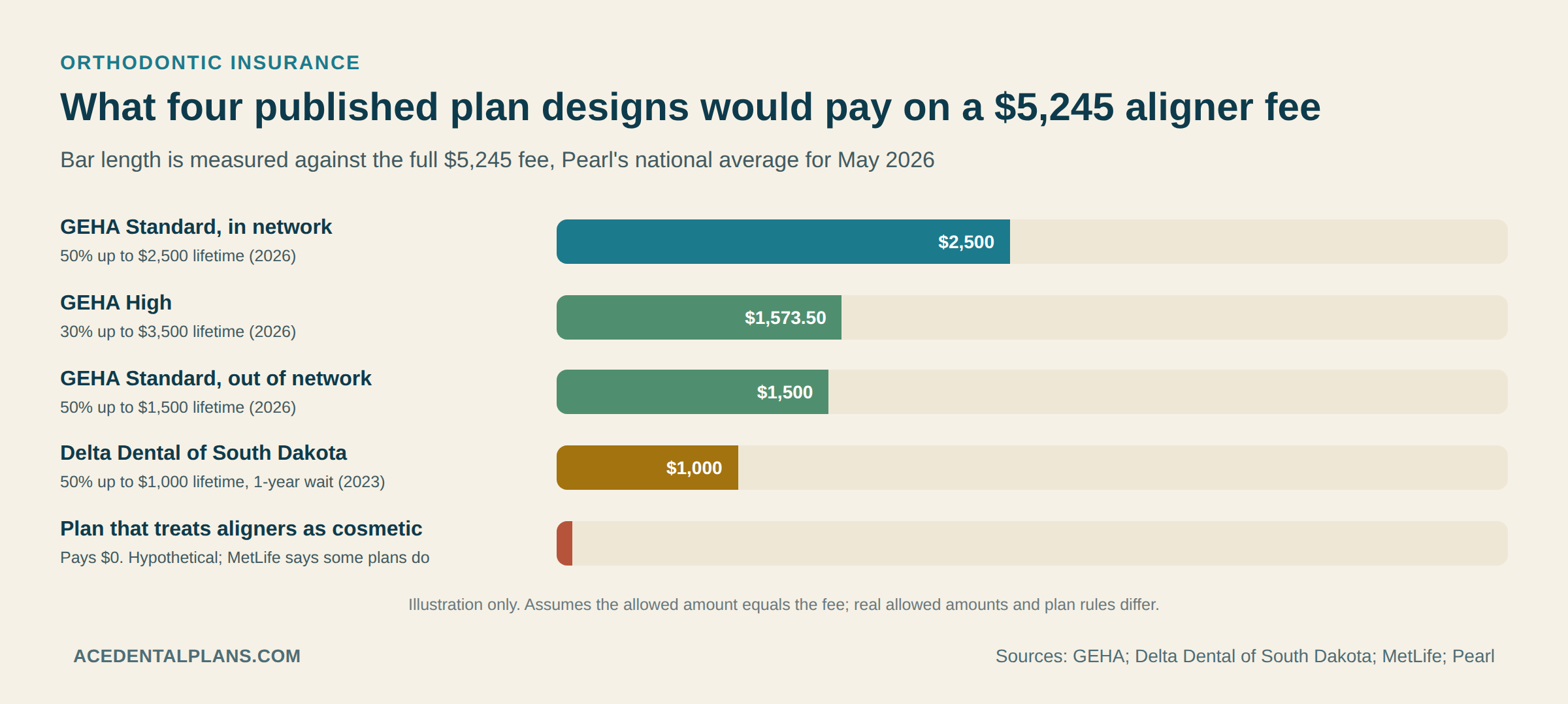
Table 5 applies those published designs to one hypothetical case: a $5,245 aligner fee, which is Pearl’s national average, with the allowed amount assumed equal to the fee. The plan details are real; the case, and therefore the dollar results, are illustrative. Real in-network allowed amounts and claim rules can change every number.
| Plan design and source | Coinsurance | Lifetime maximum | Waiting period | Plan pays | Patient pays | Fee at which the cap starts to bind |
|---|---|---|---|---|---|---|
| Delta Dental of South Dakota group plan (2023 document) | 50% | $1,000 | One year | $1,000 | $4,245 | $2,000 |
| GEHA Standard, in network (2026) | 50% | $2,500 | None stated | $2,500 | $2,745 | $5,000 |
| GEHA Standard, out of network (2026) | 50% | $1,500 | None stated | $1,500 | $3,745, plus any balance billing | $3,000 |
| GEHA High (2026) | 30% | $3,500 | None stated | $1,573.50 | $3,671.50 | $11,667 |
| Hypothetical plan that treats aligners as cosmetic, or covers children only (MetLife describes both patterns) | Not applicable | Not applicable | Not applicable | $0 | $5,245 | Not applicable |
Reading Table 5
Three patterns jump out. The first is that a bigger lifetime maximum is not a bigger payment. GEHA’s High plan carries the largest cap in the table, $3,500, but at 30% it pays $1,573.50 on this fee, less than the Standard plan’s $2,500 in network. The High plan only overtakes the Standard plan in network when 30% of the fee exceeds $2,500, which is a fee above about $8,333. At $8,965, the top of Pearl’s national range, High would pay $2,689.50 against the Standard plan’s $2,500.
The second pattern is the cap itself. In the Delta Dental of South Dakota design, 50% of a $2,000 fee is exactly $1,000, so every dollar of fee above $2,000 falls to the patient. The plan pays $1,000 on a $2,000 fee and $1,000 on a $5,245 fee. As a share of the $5,245 fee, the plan pays about 19%. The Standard plan in network pays about 48%, the Standard plan out of network about 29%, and the High plan 30%.
The third is the out-of-network row. GEHA’s guide says orthodontic benefits are based on the plan allowance, the amount allowed for a procedure. If an office charges more than the allowance and is not in network, the difference may land on the patient. Whether that is permitted, and how much, depends on the plan and the contract, so ask.
How the money moves: the first payment and the second
Orthodontic benefits are usually paid in stages instead of all at once. A Delta Dental company’s billing guidance for dentists says its first payment is 50% of the total amount payable and the remaining 50% is paid 12 months later. It adds that if the total amount payable is $500 or less, it pays the whole amount in one payment, and that plan provisions for a different payment method override its default.
Applied to the $1,000 design, that is $500 near the start and $500 a year later, with the patient paying the office on whatever schedule the office sets. Delta Dental’s page also refers to the monthly fee the provider intends to collect from the patient, which hints at how the other side of the ledger usually works. The practical question is whether the office will wait for the insurer or expects you to carry the whole fee and be reimbursed.
The same guidance explains what happens when circumstances change. If you change orthodontists, remaining benefits are calculated from the date of the first adjustment with the new one. If coverage begins partway through treatment, Delta Dental says it subtracts fees for treatment months before the patient’s effective date and calculates payment on the remaining fee and months.
Estimates, codes and claims
Before treatment, the office can ask the insurer for an estimate. Delta Dental says to ask the orthodontist’s office to submit a pre-treatment estimate, and it also offers a cost estimator tool. An estimate is not a promise of payment. Ask which CDT code the office will file: Pearl files aligner treatment under D8090, and CDT procedure codes explains how to read them on a claim. If the claims process itself is unfamiliar, the plain-English guide to how dental insurance works walks through deductibles, networks and explanations of benefits.
Delta Dental also says plans typically cover the pre-treatment visit, exam and start-up records, X-rays, recommended extractions, comprehensive treatment and post-treatment records. That list describes what some plans may include, not what yours does. When a plan lists services as covered, the benefit still runs against the same lifetime pot.
Timing the start: waiting periods, plan years and year-end
A waiting period is a clock that starts at enrollment. With a one-year wait, a plan effective January 1 would not pay for orthodontics until the following January, and MetLife says waits are often six months or a year. That makes enrollment season a real planning moment for anyone who knows orthodontics is coming. It does not make buying a plan only for braces or aligners a reliable strategy, since the pot is small and the clock is long.
The lifetime maximum, by contrast, does not reset at year-end. Other benefits do. In the Delta Dental of South Dakota design, braces are exempt from the annual maximum, so the orthodontic benefit does not compete with fillings and crowns for the same dollars. Whether your plan works that way is a document question. The guide to year-end dental benefits covers how to use annual benefits before they lapse.
Medicaid, age limits and adults
For children, Medicaid.gov says Medicaid covers dental services for all child enrollees under the Early and Periodic Screening, Diagnostic and Treatment benefit, which requires that services be provided if determined medically necessary, and that states determine medical necessity. The page does not mention orthodontia, so it does not settle whether aligners qualify; your state program does. For adults, Medicaid.gov says states have flexibility to decide what dental benefits to provide and that there is no minimum requirement for adult dental coverage.
For adults on commercial plans, the age limit is the first filter. MetLife says many plans limit orthodontic coverage to children under 18. Others, such as the GEHA plans above, cover adult orthodontia. The age rule is a coverage decision, not a clinical one.
HSA, FSA and the Tax Deduction for Aligners
Tax-favored accounts do not reduce the fee, but they change what you pay it with. The IRS says health FSA salary reductions are limited to $3,400 for plan years beginning in 2026, per its Publication 15-B and a newsroom release. Revenue Procedure 2025-19 sets the 2026 HSA contribution limit at $4,400 for self-only coverage under a high-deductible health plan and $8,750 for family coverage. Who may contribute to an HSA, and whether an FSA conflicts with it, are eligibility questions covered in the guide to HSA versus FSA for dental expenses.
Whether aligners are an eligible expense is the part the IRS text I read leaves open. Publication 502 lists braces among services of a dentist for treatment to alleviate dental disease. It says only the portion of medical and dental expenses above 7.5% of adjusted gross income is deductible, and the edition I opened is for 2025 returns. It does not discuss aligners by name in the sections I read. Ask your plan administrator whether aligners are reimbursable, and ask a tax professional about the deduction.
With a health FSA, the arithmetic is a limit, not a floor. Suppose an employee elects the full $3,400 for 2026 and applies it to a $5,245 fee. That leaves $1,845, before any insurance payment, for another source. Whether unused FSA money carries over is an employer decision; Publication 15-B describes carryover as optional.
Paying Over Time: Office Plans, Credit and Savings Programs
Orthodontic fees are commonly spread over the treatment period, which is why monthly arithmetic is the natural frame. Delta Dental’s billing guidance refers to a monthly fee the provider intends to collect from the patient, which fits that picture, though individual offices set their own terms. The sources I opened do not state a typical down payment or interest rate for in-office aligner plans, so those are questions for the office.
When a payment plan is offered by a lender rather than the office, the details change, because deferred-interest promotions behave differently from true 0% terms. The comparison in dental financing versus payment plans shows how the structures differ, and the guide to ways to pay for dental work compares the full set of options side by side.
Dental savings plans work differently from insurance. They are membership programs that offer reduced fees at participating dentists instead of paying claims, as the guide to dental savings plans explains, and whether a given plan’s discounts reach orthodontics or aligner providers is plan-specific. If you have no coverage at all, dental care without insurance collects the lower-cost routes, such as school clinics and health centers, though availability for orthodontics varies by program.
Choosing an Office and Reading the Estimate
A good aligner estimate is itemized or at least answers the same questions an itemized one would. The AAO points patients toward its Find an Orthodontist locator, and a general dentist who provides aligners is also a legitimate option for suitable cases. Either way, a written plan matters more than a verbal range, because the lines that cost money later are usually the ones nobody mentioned.
Lines worth finding on the estimate
- Records and consultation. Pearl lists the initial consultation and treatment planning among typical inclusions. Confirm whether a records fee is separate.
- The package or tray allowance. How many trays are planned, and how many does the fee cover?
- Attachments and IPR. Pearl lists attachments as included if needed and IPR as often separate.
- Check-ups. Pearl says progress check-ups every 6 to 10 weeks are typically included. Confirm how many are in the fee and what a missed visit costs.
- Refinements. One round is typical in Pearl’s description. Ask what a second round costs.
- Retainers. The AAO says the first set is often included and replacements may be billed separately; Pearl gives $300 to $800 where retainers are separate.
- Replacement trays. Pearl gives $100 to $300 each.
- Pre-treatment work. Extractions, cavities and gum treatment are often billed separately, per Pearl.
- Insurance and payment lines. Is an insurer estimate attached? When is each payment due?
A second opinion costs time, not necessarily money
Two offices can examine the same mouth and recommend different plans, tray counts or tools, and neither is necessarily wrong. A second consultation is a way to see whether the difference is clinical or commercial. Ask both to put the same items in writing so that the quotes can be compared line by line.
A month-by-month sketch of one hypothetical course
Numbers in a table are easier to trust once they have been laid along a calendar. The sketch below strings together the AAO’s process times, Pearl’s typical inclusions and the tray arithmetic from Table 2 for one invented patient. It is an illustration of how the pieces fit, not a forecast, and a real plan will differ in its dates and tray count.
- February to mid-March: The scan takes 10 to 15 minutes, and manufacturing takes up to six weeks, which puts delivery around the middle of March.
- Mid-March: The delivery visit takes about an hour. The first week brings pressure and possibly a slight lisp.
- Late March through the following mid-February: Twenty-four trays at two weeks each is 48 weeks, so the last tray is worn in mid-February of the next year, give or take missed days. Check-ups fall roughly every 6 to 10 weeks, so five or six visits in all.
- Mid-February to early June: The final scan shows two teeth lagging, so the office orders a six-tray refinement set. Three weeks of waiting and six trays at two weeks each carry the calendar to early June.
- June onward: Retainers begin, worn full time at first and then often at night, which the AAO describes as a lifelong habit.
From scan to the last refinement tray is about 16 months in this sketch, inside Pearl’s 6-to-18-month range, and retention begins after that. The dates, the 24-tray plan and the two lagging teeth are invented.
What the sketch shows is how much of the timeline is waiting and following up, not wearing trays. Roughly two of the sixteen months are manufacturing and refinement waiting. A patient who plans a wedding, a job change or a move around the nominal tray count may find those gaps matter more than a week gained or lost from a faster change interval.
Common Misreadings of an Aligner Plan
Most surprises with aligners come from reading one number as if it described the whole treatment. These are the ones the sources make easy to spot.
Treating the tray count as the whole timeline
Tray count times change interval gives active wear, and Table 2 shows how far that can swing. It does not include manufacturing, refinements, retention or missed days, so a plan described as 24 trays does not mean a finish line 24 weeks away.
Assuming aligners are covered the way braces are
Plans with orthodontic coverage usually treat the two the same, the AAO says, but MetLife says some plans cover only metal braces. Both statements are true of different plans. Confirm in writing which appliances your plan names, and whether a restriction means no benefit or a reduced one, a distinction Delta Dental draws when it says a plan that excludes alternative appliances may still cover part of the overall care.
Counting the lifetime maximum as an annual one
An orthodontic benefit does not renew each January. Delta Dental of South Dakota’s document calls it a lifetime orthodontic benefit of $1,000 per person, and MetLife describes these maximums as lifelong. If a family member used part of a pot years ago under the same plan, the remainder is what is left, and a plan estimate should say so.
Reading an at-home price as a like-for-like bargain
The AAO, ADA and FDA all describe missing supervision and X-rays as the issue with direct-to-consumer aligners. A lower sticker price that omits the exam, the in-person visits and the refinement policy is a different product, and the ADA notes that do-it-yourself dentistry can cost more than routine care if it causes damage.
Forgetting what happens after the last tray
The AAO and the Cochrane review both treat retention as part of the work, even though Cochrane could not say which type holds teeth better. Budgeting only for the trays leaves out the retainer, its replacements and the visits needed to check them.
Comparing quotes without comparing inclusions
One office may quote a lower fee but exclude retainers, refinements and attachments, while another quotes more with all three included. Pearl’s inclusion list is a useful template: set both quotes against it, line by line, before deciding which is cheaper.
A Decision Path for the Next Few Weeks
If you are weighing aligners now, the order of operations matters more than the speed. The path below puts the inexpensive, reversible steps first and the commitments last.
- Get your mouth examined first. A general dentist can confirm cavities and gum health and take X-rays. Treat problems before orthodontic planning, as the AAO advises.
- Book one or two consultations. Ask each the same list of questions and ask for the same items in writing. A consultation is not a commitment, and records fees, where charged, should be known in advance.
- Check your plan document, not the brochure. Look for the orthodontic section: coinsurance, lifetime maximum, age limit, waiting period, and whether aligners are named. Ask for a pre-treatment estimate.
- Line up the payment side. Total the fee, subtract the insurance estimate, and decide how much will come from tax-favored accounts and how much from monthly payments. Confirm the account administrator accepts aligner charges.
- Pick a start date with the calendar in mind. Waiting periods, plan years and open enrollment can all change what you receive. A start date a few weeks later is cheap if it keeps a benefit intact.
- Sign only after the written plan names the tray count, refinements and retainers. Then take the scan.
The path assumes you are an adult deciding for yourself or a parent deciding for a child. If the first examination finds problems that need attention, the sequence simply starts one step earlier, with treatment of those problems.
Questions to Ask at the Consultation
These questions follow the order of a typical visit. Bring them in writing and ask for the answers in writing as well.
About the diagnosis and the plan
- What is wrong with my bite or alignment, in plain terms, and is that what I came in to fix?
- Why aligners rather than braces for my case? What would you do differently if I preferred braces?
- How many trays are planned, how often will I change them and how long should active treatment take?
- Does the plan include IPR, extractions or attachments, and where on my teeth?
- Which movements are hardest in my plan, and what happens if the teeth lag?
About the practice
- Are you an orthodontist or a general dentist, and how many aligner cases do you treat?
- Who sees me at each visit? Who do I call if a tray cracks or a tooth hurts?
- Which aligner product do you use, and is it FDA authorized for my age group? The FDA suggests asking this directly.
About money
- What exactly does the fee include? What is billed separately?
- How many refinement rounds are included and what does another cost?
- Are retainers included, which type, and what does a replacement cost?
- Will you submit a pre-treatment estimate to my insurer? What CDT code will you file?
- What are the payment terms, and is there interest, a down payment or a penalty for paying early?
About life during treatment
- How many hours a day do you want me to wear the trays, and how will you know whether I am?
- What should I do if I lose a tray or fall behind?
- Which of my existing fillings, crowns or implants could be affected?
- What happens at the end: retainers, how often to wear them, and what follow-up looks like?
Bottom Line
Invisalign is a regulated orthodontic tool with real strengths and real limits. It moves teeth in small steps through trays that must be worn nearly all day, it works on many but not all kinds of crowding, spacing and bite problems, and it asks more of the patient than the marketing suggests. The research on speed, accuracy and gum health is mixed in the way research on a young, widely used appliance often is: promising in places, thin in others, and sometimes funded by the company that sells it.
The decisions that shape the experience come in a predictable order. First, a thorough exam by someone who will take responsibility for the plan, because the AAO, ADA and FDA all say supervision matters. Second, an honest conversation about tray count, refinements and retainers, because those lines decide both the calendar and the final bill. Third, a close look at the plan document, because orthodontic benefits sit in a different pot, with a lifetime cap, an age rule and a clock that may not match your timeline.
If you take one habit from this article, make it asking for the fee, the refinement policy and the retainer terms in writing before the first scan. The rest of the decision follows more easily from there. For more on related procedures, browse the dental treatment guides, and for other head-to-head questions, the comparison guides.
Frequently Asked Questions
How much does Invisalign cost in the U.S.?
Pearl’s May 2026 figures, which it says rest on ADA fee survey data, put clear aligner treatment at $3,415 to $8,965 nationally with an average of $5,245. That is a cash-pay price for a full course, typically covering consultation, a scan, 20 to 30 trays, attachments, check-ups and one refinement round. Retainers, extra refinements, replacement trays and pre-treatment dental work are often billed separately. Your own quote depends on the case and the office.
How long does Invisalign take?
Pearl reports 6 to 18 months for most adult cases, while Cleveland Clinic says a few slightly crooked teeth may need up to nine months. The arithmetic behind those ranges is the number of trays multiplied by the days per tray: 20 trays changed every two weeks is 40 weeks of wear. Manufacturing time before the first tray, refinements and retainer wear come on top, and missed wear stretches the calendar.
How many hours a day do you have to wear Invisalign?
Sources give a narrow range. The FDA says at least 20 hours, Align says 20 to 22, the AAO and MetLife say at least 22, and Cleveland Clinic says 22 to 23. Aligners come out for eating, for any drink except water, and for brushing and flossing. Follow your own doctor’s instruction, which governs your case. Treatment may not progress as intended if the trays are not worn as directed, according to the FDA.
Does Invisalign hurt?
Pressure or soreness is common with each new tray and typically eases within a few days, according to Cleveland Clinic and Align. The AAO expects mild discomfort in the first few days of a new treatment. Sharp pain, pain lasting more than a few days, bleeding or swollen gums, or a loose tray are reasons to call the office, per Cleveland Clinic. Facial swelling or trouble breathing needs emergency care.
Can you eat and drink with Invisalign in?
No, apart from plain water. Align says to remove the trays for anything besides water, and the AAO says they come out to eat, drink, brush and floss. Brush before putting them back, as Align advises, and store them in their case when they are out. A lost tray can mean a $100 to $300 replacement, per Pearl, plus a delay.
Does dental insurance cover Invisalign?
Coverage varies by plan. The AAO says plans with orthodontic coverage usually cover braces and clear aligners equally. Delta Dental says Invisalign is a standard benefit on many of its plans that include adult orthodontics, while MetLife notes some plans cover only metal braces. Most orthodontic benefits are capped by a lifetime maximum, and many have age limits or waiting periods. Ask the office to request a pre-treatment estimate and confirm the details with the insurer in writing.
How much does insurance usually pay toward Invisalign?
No single national figure exists in the sources I opened. MetLife says orthodontic lifetime maximums are often between $1,000 and $2,000. Published plan designs in this article range from $1,000 (Delta Dental of South Dakota, 2023) to $3,500 (GEHA High, 2026), at 30% to 50% coinsurance. On a hypothetical $5,245 fee, those designs would pay between roughly $1,000 and $2,500. Your plan document gives your numbers.
Is there a waiting period for orthodontic coverage?
Often, but not always. MetLife says orthodontic waiting periods are often six months or a year. A 2023 Delta Dental of South Dakota group plan document lists a one-year wait for braces and teeth alignment, while GEHA’s 2026 guide says its plans have no waiting periods. Check the waiting period and the effective date before choosing a start date, since benefits may be prorated if treatment began before coverage did.
Can I use an HSA or FSA for Invisalign?
Often, but eligibility is plan-specific, so ask the account administrator. IRS Publication 502 lists braces among dentist services to treat dental disease, and says the portion of medical expenses above 7.5% of adjusted gross income is deductible. For 2026 the IRS sets the health FSA limit at $3,400 and the HSA limit at $4,400 for self-only high-deductible coverage and $8,750 for family coverage.
Do I need a retainer after Invisalign?
Yes, according to Align and the AAO. The AAO says a retainer is typically necessary for a lifetime, though how often you wear it may decrease. Teeth keep moving after treatment because tooth movement is a lifelong process. Retainers may be included in the fee or billed separately; Pearl gives $300 to $800 where they are not included, and replacements may cost extra.
Is Invisalign better than braces?
Neither is better in every case. A 2019 systematic review found a significantly shorter treatment duration with aligners in pooled non-extraction studies, and also found braces did better on torque, occlusal contacts and arch widening, with limited evidence overall. The AAO says an orthodontist is the professional qualified to decide which suits you. Cost is similar in most cases, according to Align.
Can Invisalign fix an overbite or an underbite?
Sometimes. The AAO lists overbite, underbite, open bite and crossbite among conditions clear aligners can treat, while saying they are not right for everyone and that some cases respond more predictably to braces. The FDA letter for the Invisalign System also lists an optional mandibular advancement feature for skeletal malocclusion in patients with mixed or permanent dentition. Only an exam can say whether your bite qualifies.
Can a regular dentist provide Invisalign?
Licensed dentists can prescribe and supervise aligner treatment, and some general dentists do. The AAO notes that all orthodontists are dentists but only about 6% of dentists are orthodontists, and that orthodontists complete a two- to three-year residency after dental school. Ask who plans and reviews your case, how many aligner cases the office treats and who handles problems between visits.
Are at-home aligners safe?
The AAO strongly discourages mail-order orthodontic treatment, the ADA warns of jawbone loss, tooth loss, gum recession, bite problems and jaw pain from unsupervised movement, and the FDA says it has not authorized aligners sold directly to consumers without a prescription and professional supervision. In-person exams and X-rays are the safeguard those sources point to. The FDA also invites reports of problems through MedWatch.
What should I do if I lose an aligner?
Call the office rather than guessing. Whether to wear the previous tray, move ahead or order a replacement is a clinical decision. Pearl gives $100 to $300 per replacement aligner as a separate charge, and the FDA lists lost or damaged aligners among the limitations of the treatment. Asking at the start what the policy is on replacements avoids a surprise.
Can teenagers or children use Invisalign?
The FDA letter covers primary, mixed and permanent dentition, so the system is cleared across childhood stages, and Align describes its aligners as for kids, teens and adults. The AAO recommends a first orthodontic check-up no later than age 7. Compliance matters more with younger patients because trays must be worn most of the day. MetLife notes many orthodontic benefits are limited to children under 18.
Will Invisalign change the way I talk?
Possibly for a few days. Align says some patients notice a slight lisp in the first few days that usually resolves as the mouth adjusts, and the FDA lists temporary speech changes among aligner risks. If the change lasts or gets worse, tell the office, since a poorly fitting tray is something it can check.
What happens if my teeth shift after treatment?
Teeth can move after any orthodontic treatment, and the AAO calls wearing a retainer the only surefire way to prevent it. If teeth have moved a lot, the AAO lists adjusting or remaking the retainer, a short course of braces or aligners, or in severe cases a full round of treatment. Call your orthodontist or dentist early, because small shifts are usually simpler to address.
Sources and Disclaimers
Clinical and process statements in this article come from the American Association of Orthodontists, the American Dental Association and its consumer site, the U.S. Food and Drug Administration, Cleveland Clinic, peer-reviewed studies and reviews, and Align Technology’s own pages, which are marked as company material where relevant. Price figures come from Pearl’s national summary, which cites ADA fee survey data, and are cash-pay figures for the U.S. as of May 2026. Insurance statements come from MetLife and Delta Dental consumer or provider pages, a 2023 Delta Dental of South Dakota group plan document and GEHA’s 2026 benefits guide. Tax figures come from IRS publications. Every table row, calculation, worked example and monthly payment figure that combines these inputs is an original illustration built for this article, not a quote. National averages hide wide local variation, orthodontic benefits differ sharply from plan to plan, and published plan designs are examples, not norms. Confirm prices with the dentist in writing and benefits with the insurer.
- American Association of Orthodontists — Clear Aligners: Discreet Ways to Straighten Teeth
- American Association of Orthodontists — At-Home Orthodontics: Cons and Considerations
- American Association of Orthodontists — Orthodontic Retainers: Types, Care, and Life After Braces
- American Association of Orthodontists — Will My Teeth Keep Moving Post Treatment?
- American Association of Orthodontists — Family Orthodontic Health
- American Association of Orthodontists — What Is an Orthodontist? Specialized Training Explained
- American Dental Association (MouthHealthy) — Orthodontics
- American Dental Association (MouthHealthy) — Do-it-yourself (DIY) Dentistry
- American Dental Association — ADA Adopts Further Policy Discouraging Direct-to-Consumer Dental Services (2018)
- ADA News — ADA Forsyth Friday: How Clear Aligners Shape the Mouth’s Bacterial Ecosystem (2025)
- U.S. Food and Drug Administration — Clear Dental Aligners (September 2026)
- U.S. Food and Drug Administration — 510(k) clearance letter K252380, Invisalign System (August 29, 2025)
- U.S. Food and Drug Administration — 510(k) clearance letter K240038, Clear Moves Aligners (April 4, 2024)
- Align Technology — How Invisalign Works (company consumer page)
- Align Technology — What Invisalign Aligners Are and How They Differ From Braces (company consumer page)
- Align Technology — Invisalign Week 1 vs Week 2 (company consumer page)
- Align Technology — Second Quarter 2026 Financial Results (investor release)
- Cleveland Clinic — Clear Aligners
- Cleveland Clinic — Interproximal Reduction (IPR)
- Ke Y, Zhu Y, Zhu M. BMC Oral Health, 2019 — A comparison of treatment effectiveness between clear aligner and fixed appliance therapies
- Raghavan S, et al. BMC Oral Health, 2023 — White spot lesions, plaque accumulation and salivary caries-associated bacteria in clear aligners compared to fixed orthodontic treatment
- Samulak R, et al. Applied Sciences, 2024 — Evaluating Clear Aligners Versus Fixed Appliances for Periodontal Patients: A Narrative Review
- American Journal of Orthodontics and Dentofacial Orthopedics, 2020 — Has Invisalign improved? A prospective follow-up study on the efficacy of tooth movement with Invisalign (reproduced text)
- Cochrane, 2023 — Retention procedures for stabilising tooth position after treatment with orthodontic braces (evidence summary)
- Pearl — Invisalign / Clear Aligners cost summary (May 2026)
- MetLife — Orthodontics: What to Know About Braces for Kids and Adults
- Delta Dental — Braces (consumer page)
- Delta Dental Insurance Company — Adult Orthodontics FAQ (broker update, 2022)
- Delta Dental Insurance Company — Dentist update on billing orthodontic claims (2021)
- Delta Dental of South Dakota — 10 Plus with Orthodontics, Group 9020 plan document (2023)
- GEHA — 2026 Dental Benefits Guide
- Internal Revenue Service — Publication 502, Medical and Dental Expenses (for 2025 returns)
- Internal Revenue Service — Publication 15-B, Employer’s Tax Guide to Fringe Benefits (2026)
- Internal Revenue Service — Tax inflation adjustments for tax year 2026 (news release)
- Internal Revenue Service — Revenue Procedure 2025-19 (2026 HSA limits)
- Medicaid.gov — Dental Care
Important Information and Disclaimers
This article is general educational information. By using it, you accept the limits described below.
Not dental or medical advice
Nothing on this page is a diagnosis, a treatment recommendation or a substitute for an examination by a licensed dentist or physician. Reading this article does not create a dentist-patient or doctor-patient relationship. Only a licensed professional who has examined you and reviewed your history can tell you what your mouth needs. Do not delay, skip or stop professional care because of something you read here.
Prices are estimates, not quotes
Cost figures are ranges reported by the third-party sources cited in this article. Actual prices depend on your location, the provider, the complexity of your case, the materials used, the date of service and other factors, so what you pay may be higher or lower. A written treatment plan and fee estimate from the dental office is the only reliable number for your situation.
Insurance and plan examples are illustrations
Examples that use named amounts or percentages are hypothetical. Real benefits depend on your plan, network, waiting periods, annual maximum, deductible and the insurer’s rules at the time of treatment. A pre-treatment estimate or benefits check is not a promise of payment. Confirm the details with your insurer or plan administrator in writing.
Not insurance, legal, tax or financial advice
AceDentalPlans is an information publisher. Nothing here is insurance, legal, tax, investment or other professional financial advice, and nothing here recommends a particular provider, insurer, lender, discount plan or financing product. Company and product names belong to their owners and appear for identification only. Read the terms of any loan, financing offer or plan before you sign, and ask a qualified professional if you need advice on your own circumstances.
Third-party sources
This article cites government agencies, professional associations, insurers, lenders and other outside organizations. We do not control those sources. Their content can change, move or disappear, and listing a source is not an endorsement of it or of anything it sells.
No warranty
We aim for accuracy, but this article is provided “as is,” without warranties of any kind, express or implied, including warranties of accuracy, completeness, timeliness or fitness for a particular purpose. Some information may be out of date or contain errors by the time you read it.
Limitation of responsibility
To the fullest extent permitted by law, AceDentalPlans and its owners, authors and contributors are not responsible or liable for any loss, cost, injury, health outcome or other damage that results from using this article or relying on it. You are responsible for your own decisions about your care, your coverage and your money.
How this article is written
This article follows AceDentalPlans’ answer-first, U.S.-focused editorial approach. It uses conditional language for insurance, because coverage depends on the specific plan, and it names its sources so that you can read them yourself.