
Cosmetic Dentistry Cost. In CareCredit’s 2024 cost data, a professional whitening treatment averaged $583 to $792 (UV and in-office laser), bonding about $431 per tooth, a composite veneer $872 to $1,373 per tooth, and a porcelain veneer $1,765 per tooth. Whitening costs the least on the day. Bonding is among the least expensive ways to change a tooth’s shape, and veneers cost the most but are reported to last the longest.
This article puts the three treatments on one ruler: price per unit, price per year of use, what each can and cannot change, and how insurance and tax rules treat them. It stops short of explaining the whole cosmetic menu (contouring, gum reshaping and so on) and it does not tell you which treatment suits your teeth. That decision belongs to an exam with your dentist.
Key Takeaways
- The units differ. Whitening is priced per session or per arch, bonding and veneers per tooth, so a fair comparison has to pick a number of teeth first.
- For six front teeth, the 2024 national averages work out to roughly $2,586 for bonding, $5,232 for chairside composite veneers and $10,590 for porcelain veneers, against $583 to $792 for one whitening treatment.
- Divide price by reported lifespan and the gaps shrink: a porcelain veneer works out to about $88 to $177 per tooth per year, a chairside composite veneer about $174, and bonding about $43 to $144.
- Whitening only changes natural teeth. The ADA says crowns, fillings and other tooth-colored restorations stay the shade they are, which is why whitening usually comes before bonding or veneers.
- Veneers remove enamel and the ADA says that cannot be undone. Bonding typically does not, according to Cleveland Clinic, so it can be reversed.
- Dental insurance usually treats all three as cosmetic and often pays nothing. Check the plan’s exclusions before the appointment, not after.
 National average cash prices from CareCredit’s 2024 data, one unit at a time.
Cash Prices Side by Side, With the Units Spelled Out
Most price lists mix units without saying so. A whitening quote covers every tooth in one or both arches; a bonding or veneer quote covers one tooth. Put them in the same column and whitening looks like a bargain next to a veneer, when really you are comparing one visit that touches 20-plus teeth with one tooth’s worth of lab work.
Table 1 lines up the figures we could source. The main column is CareCredit’s 2024 average, as shown on CareCredit’s own cost page and reported by Becker’s Dental Review in September 2024. The right-hand column adds ranges published by Delta Dental, Humana and Sunbit, plus Healthline’s reviewed ranges, so you can see how far a single average can mislead.
| Treatment | Priced per | CareCredit 2024 average | Other reported figures |
|---|---|---|---|
| Professional whitening, UV | Treatment (unit not stated) | $583 | Delta Dental: $40–$700 per in-office visit, out-of-network average. Humana (2026): about $303 per arch |
| Professional whitening, laser (in office) | Treatment (unit not stated) | $792 | Sunbit (May 2025): $300–$1,500 per in-office session |
| Take-home kit from a dentist | Kit | Not listed | Sunbit (May 2025): $200–$500 |
| Store-bought strips, trays, toothpaste | Box or tube | Not listed | Sunbit (May 2025): strips $20–$50 a box; trays or gels $30–$100; toothpaste $5–$15 |
| Dental bonding | Tooth | $431 | We found no second national range we could open and read |
| Composite veneer, in-office | Tooth | $872 | Humana chairside resin: $500–$1,400, average $800 |
| Composite veneer, lab-made | Tooth | $1,373 | Humana lab resin: $800–$2,300, average $1,100 |
| Porcelain veneer | Tooth | $1,765 ($1,817 for a laminate veneer) | Delta Dental (2024 internal data): $1,180–$2,185. Humana: $900–$2,500, average $1,500 |
| Full set of porcelain veneers | 6–8 teeth | $15,486 | Works out to about $1,936 (8 teeth) to $2,581 (6 teeth) each |
Two things stand out. First, the Delta Dental, Humana and CareCredit porcelain figures overlap, which is reassuring, but the full-set quote of $15,486 averages higher per tooth than the single-veneer price. The source does not say why. A bundled case may include design work, temporaries or extra visits, so ask what a set quote contains before you divide it.
Second, the whitening range is enormous because “whitening” names several products. Delta Dental’s $40 floor and Sunbit’s $1,500 ceiling probably describe different service levels. Humana’s per-arch average of about $303 roughly doubles to $606 for both arches, which lands close to CareCredit’s $583 to $792. CareCredit labels those figures only “UV” and “Laser (in office)” and does not say whether they cover one arch or both, so treat the match as loose.
Why Veneer Quotes Scatter From $250 to $2,500 a Tooth
The spread in the chart below is not noise. It reflects three real differences: the material, where the veneer is made, and when and how the source collected its numbers.
Material comes first. Porcelain veneers, the ADA says, are strong, long-lasting and natural-looking but pricier, and composite veneers as made of a tooth-colored filling material bonded to the tooth. “Chairside” in Humana’s table means the dentist builds the veneer in the office rather than sending it to a lab. A lab-made composite veneer adds a technician and a second appointment, and the CareCredit data shows the price gap: $872 in-office versus $1,373 lab-made.
Timing matters too. Healthline’s ranges were reviewed in November 2020, so they predate several years of price drift. Delta Dental’s range comes from its own 2024 internal data. When two sources disagree by a few hundred dollars, the newer one is the safer anchor.
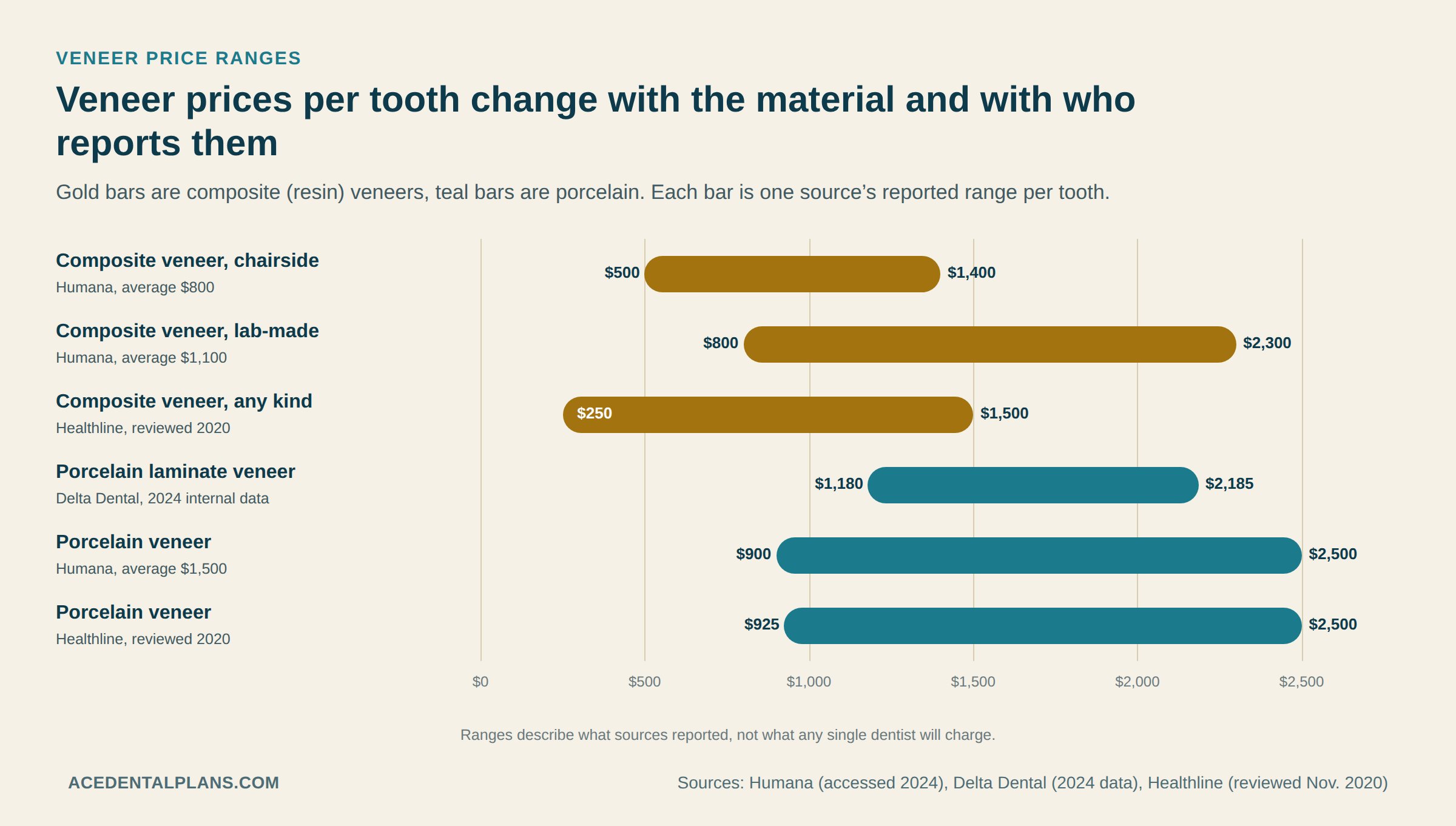 Six reported veneer price ranges per tooth. Composite sits lower; porcelain overlaps its upper end.
Notice how much the ranges overlap. A lab-made composite veneer can cost more than a low-end porcelain one ($2,300 versus $900 at the extremes in Humana’s table). Material alone does not decide the quote; the office, the region, the lab and the case do.
What Each Treatment Physically Does to the Tooth
Price makes sense only once you know what you are buying. These three treatments differ in how much of your tooth they touch.
Whitening changes color inside the existing tooth structure. It comes in three forms, per the ADA: over-the-counter products, dentist-supervised at-home systems, and in-office treatment. At-home systems from a dentist typically use 10% to 38% carbamide peroxide worn for several hours a day over one to four weeks, and in-office treatment uses professional-strength gels, with or without light activation. Over-the-counter products use lower concentrations and take longer; an ADA-cited study found one over-the-counter technique needed 16 days to match a seven-day tray system and a one-day in-office procedure.
Bonding adds tooth-colored composite resin to the surface. Cleveland Clinic says it typically does not require enamel removal and can often be finished in one office visit. It describes bonding as one of the least expensive cosmetic procedures, suited to small changes such as hiding a chip, closing a small gap or making a tooth look slightly longer.
Veneers are thin custom coverings over the front of a tooth. On enamel the ADA is blunt: tooth enamel is removed to place a veneer and that the treatment cannot be undone. That is not a reason to rule them out. It is the reason the price, the lifespan and the dentist’s skill all carry more weight here than for the other two.
Keep the reversibility point in mind when you read price comparisons. A cheaper treatment that can be changed later and a more expensive one that cannot are not the same kind of purchase, even when the annual cost works out similar.
What Each One Can and Cannot Change
A treatment that is cheap and wrong for the problem is the most expensive kind. Table 2 matches common complaints to what the ADA and Cleveland Clinic say each option does. The cells that say “no effect” matter as much as the ones that promise something.
| Concern | Whitening | Bonding | Veneers |
|---|---|---|---|
| Overall dullness or surface staining on natural teeth | Its intended use. Works on natural teeth only (ADA) | Can camouflage discoloration on the tooth it covers (Cleveland Clinic) | Stained teeth are on the ADA’s list of what veneers address |
| Deep or stubborn discoloration | Healthline notes whitening works better on surface stains than deep internal ones | Can cover it on individual teeth | Covers the front surface, so the color underneath matters less |
| Chipped or cracked front tooth | No effect on shape | Hides chips and cracks (Cleveland Clinic) | ADA lists chipped or broken teeth |
| Small gap between teeth | No effect | Can fill small gaps | ADA mentions gaps in the smile |
| Teeth that are uneven, short or misshapen | No effect | Can change shape and length slightly; suited to small changes | ADA lists crooked or misshapen teeth |
| Crowns, fillings or older bonding that no longer match | Does not change them. The ADA warns of possible color mismatch | The dentist picks a resin shade to match the teeth around it | New veneers can be matched, but only if the teeth beside them are not later whitened |
| Wanting a change you can reverse later | Yes, in the sense nothing is removed; results fade on their own | Typically no enamel removal, so it can be reversed (Cleveland Clinic) | No. Enamel is removed and the ADA says it cannot be undone |
Read across the rows and a pattern appears. Whitening is the only one of the three that does nothing for shape. Bonding handles small shape problems and stops being a good fit as the change gets bigger. Veneers cover the widest range but are the only irreversible choice.
Orthodontic problems, such as crowding that needs teeth moved, sit outside all three options. Veneers can make crooked teeth look straighter, and the ADA lists that use, but they do not move a tooth. Whether that trade suits you is a clinical conversation.
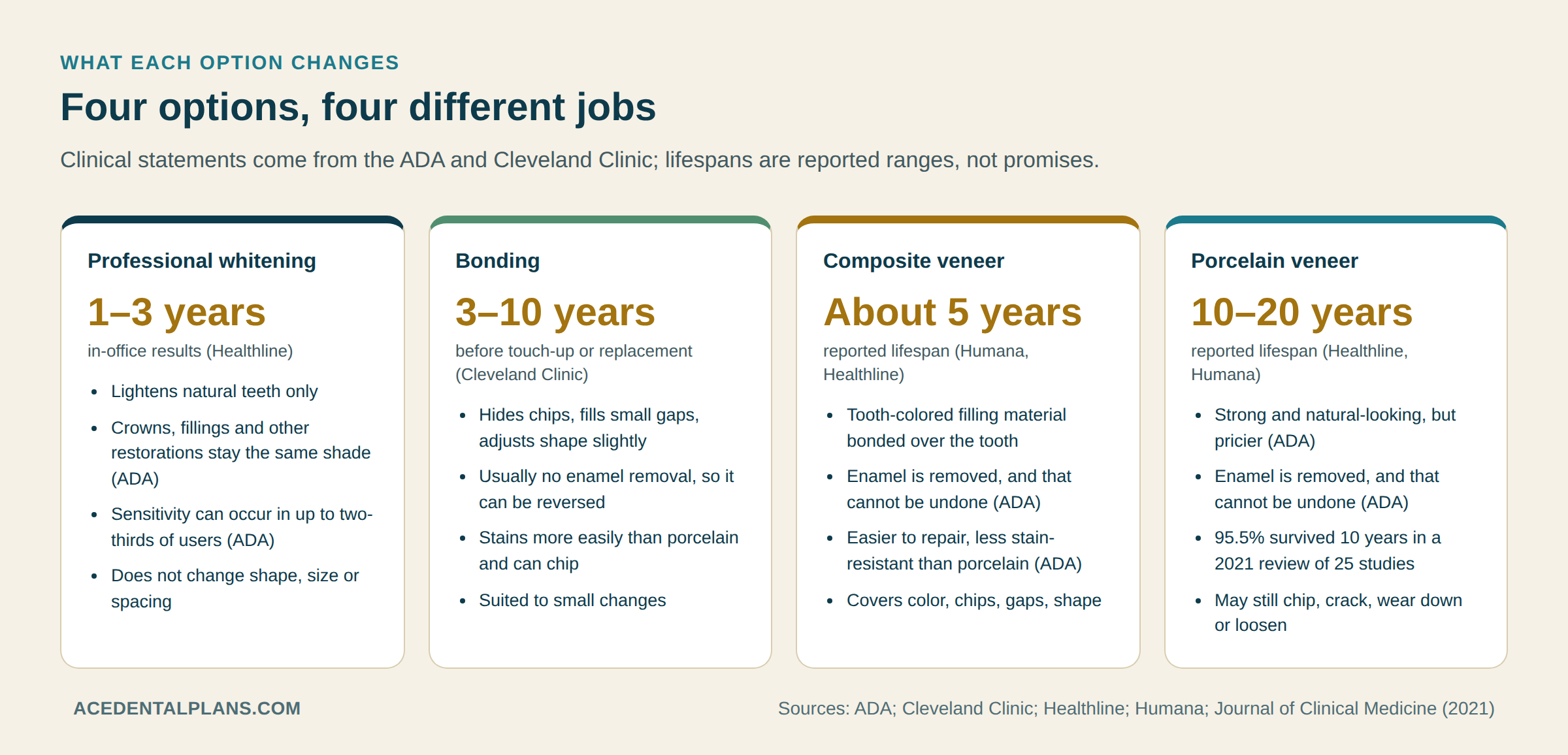 Reported lifespan and the main trade-off for each option, drawn from ADA, Cleveland Clinic, Healthline and Humana.
How Long Each One Lasts, According to the Research
Lifespan figures vary more than price figures, and they come from very different kinds of evidence. Sorting them by quality helps.
Porcelain veneers have the strongest evidence. A 2021 systematic review in the Journal of Clinical Medicine pooled 25 clinical studies and estimated a 10-year cumulative survival rate of 95.5% for porcelain laminate veneers. Fracture was the most common complication, followed by debonding, and both tended to happen in the first years after placement. Consumer pages are looser: Healthline says porcelain veneers can last 10 years or longer and perhaps up to 20, and Humana says around 20.
“Survival” deserves a careful reading. In studies it usually means the veneer was still in place and functioning, not that it looked new. A veneer can survive ten years while a margin stains or a corner gets repaired.
Composite veneers have less tidy numbers. Healthline puts them at five years or more and Humana at about five. A 2022 systematic review of direct composite restorations in front teeth, published in the Journal of Conservative Dentistry, covered 25 studies and found annual failure rates from 0% to 27.11%. That spread is huge. The review named fracture as the most common reason for failure, followed by color mismatch and staining.
Bonding typically lasts three to ten years before it needs a touch-up or replacement, according to Cleveland Clinic. It adds that bonding is somewhat stain-resistant but not as resistant as porcelain, and that it can chip over time.
Whitening is the shortest-lived. Healthline’s January 2021 review, medically reviewed by a dentist, says in-office treatment should give one to three years of results, dentist-made gel trays a year or longer, over-the-counter strips up to six months and whitening toothpaste three to four months. Humana says in-office results may last well over a year. All of these depend heavily on what you drink, whether you smoke, and how you clean your teeth. The ADA page we read does not give a duration, so treat these as consumer-source ranges.
One more caveat applies to every lifespan figure here. They describe typical materials under typical conditions. Veneers may chip, crack, wear down or loosen, the ADA notes, and your dentist may need to re-bond, repair or replace them. Nail-biting, chewing hard objects and staining foods or drinks sit on its list of habits to avoid.
Cost per Year of Use, Tooth by Tooth
Price divided by lifespan is crude, but it answers a question the sticker price hides: what does a year of looking this way cost? The chart uses CareCredit’s 2024 single-unit averages and the sourced lifespans.
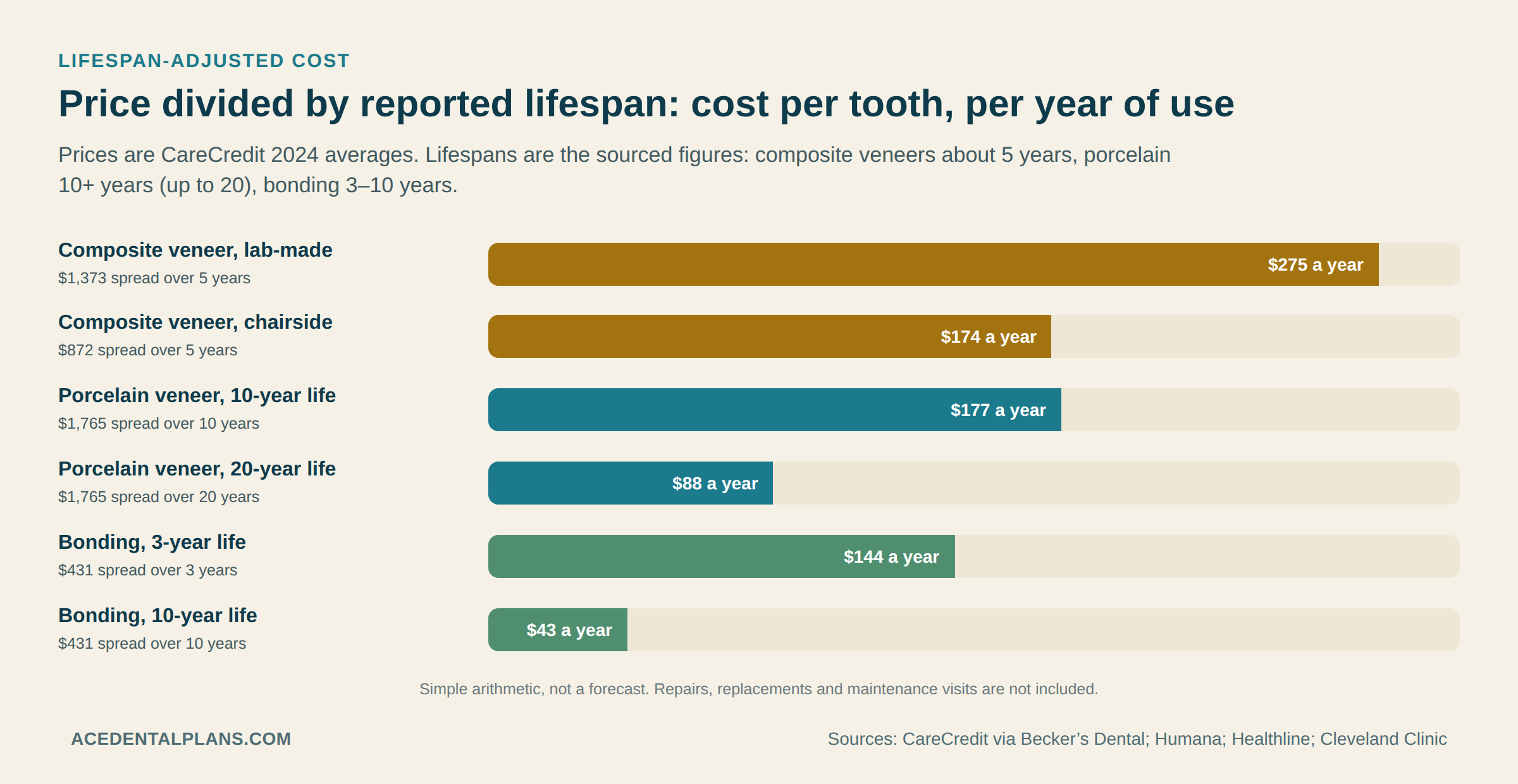 Price spread over reported lifespan. Arithmetic on sourced figures, not a forecast.
The result is less intuitive than the price list. A chairside composite veneer ($872 over about five years) comes to roughly $174 a year, almost identical to a porcelain veneer that lasts ten years ($177). If the porcelain veneer reaches twenty years, it halves to about $88. Bonding spans the widest range: $43 a year if it lasts ten years, $144 if it needs replacing at three.
What this tells you is that lifespan assumptions drive the answer more than the sticker price does. A treatment that is half the price but needs replacing twice as often is a wash. A treatment that fails early in the first few years can turn into the most expensive of the group.
It also tells you what the math leaves out. Dividing by years treats a tooth that looks great in year one and tired in year five the same as one that looks the same throughout. It ignores that composite is easier to repair than porcelain, as the ADA puts it, so a chipped composite veneer may not mean starting over. And it ignores reversibility, which has value that no division captures.
A Ten-Year Ledger for a Six-Tooth Smile
Single-tooth math is tidy, but nobody buys one veneer for the front six. Many people ask about the six upper teeth that show when they smile, so Table 3 prices that case. It multiplies CareCredit’s 2024 averages by six, then counts how many times each treatment would need to be done to cover ten years at the sourced lifespans.
| Option | Upfront cost | Lifespan used | Treatments in 10 years | Ten-year total |
|---|---|---|---|---|
| Porcelain veneers, 6 teeth | $10,590 (6 × $1,765) | 10 years or more | 1 | $10,590 |
| Composite veneers, in-office, 6 teeth | $5,232 (6 × $872) | About 5 years | 2 | $10,464 |
| Composite veneers, lab-made, 6 teeth | $8,238 (6 × $1,373) | About 5 years | 2 | $16,476 |
| Bonding, 6 teeth | $2,586 (6 × $431) | 3 to 10 years | 4 to 1 | $10,344 down to $2,586 |
| Professional whitening, whole mouth | $583 to $792 per treatment | Redone every 1 to 3 years | 10 to 4 | $5,830 to $2,332 at $583; up to $7,920 at $792 |
Several caveats come before any conclusion. These totals assume the full price is paid again at each replacement, which overstates the cost wherever a repair or a cheaper touch-up would do. They ignore inflation and any change in price. They treat the lifespan figures as dependable when the evidence behind them is thin for composite and for whitening. And whitening covers every tooth, while the other rows cover only six.
 Ten-year totals from Table 3. Bonding and whitening swing widely with how long each lasts.
With that said, the ledger shows something worth seeing. Porcelain and in-office composite veneers land within about $130 of each other over a decade, even though one costs twice the other on day one. Bonding is the cheapest option only if it lasts: at three years it matches the veneers, at ten it costs a quarter as much. Whitening, even redone every year, stays below the veneer totals.
Costs That Do Not Appear on the First Quote
The treatment line is rarely the whole bill. A few extras are worth asking about, because they change the ledger above.
The exam and images. Humana’s veneer page notes that additional costs may include examinations, X-rays and cleanings. An office may fold these into the quote, charge them separately, or waive them for a new cosmetic patient. Ask which.
Temporaries and shade trials. For lab-made veneers, the weeks between preparation and final placement may involve temporary coverings. We did not find a national figure for these, so they belong on your list of questions rather than in our totals.
Repair and replacement terms. The ADA says veneers may chip, crack, wear down or loosen and may need to be re-bonded, repaired or replaced. Whether the office offers a repair window, a warranty, or a discount on a replacement in the first years is a real money question, and it belongs in writing.
Sensitivity management. Transient mild to moderate sensitivity can occur in up to two-thirds of whitening users early in treatment, according to the ADA, typically appearing within two to three days and resolving by about day four. That is a common, short-lived side effect rather than a cost, but it may change which product or schedule your dentist recommends.
Maintenance habits. For veneers the ADA recommends brushing twice daily with fluoride toothpaste and cleaning between teeth daily. That costs little, but the habits it lists to avoid (nail-biting, chewing hard objects, heavy coffee or red wine) are the kind that shorten the lifespans used in Table 3.
Reading a Cosmetic Quote Line by Line
Quotes for cosmetic work often arrive as a single total. Ask for the lines. A written quote that can be compared with another office has, at minimum, a unit for each charge, a material for each tooth, and a statement of what happens if something goes wrong.
Three lines deserve a second look. First, the unit: per tooth, per arch or per case. Second, the material and where it is made, because Table 1 shows how much those two details move the price. Third, the follow-up terms. A quote that says nothing about repairs has not answered the most expensive question.
If you are comparing a cosmetic quote against a restorative one, say a bonded repair against a crown, keep in mind that crowns often sit in a different insurance category from veneers. The crown question has its own pricing; here, the point is only to ask the plan how each service would be classed.
Order of Operations When You Want More Than One
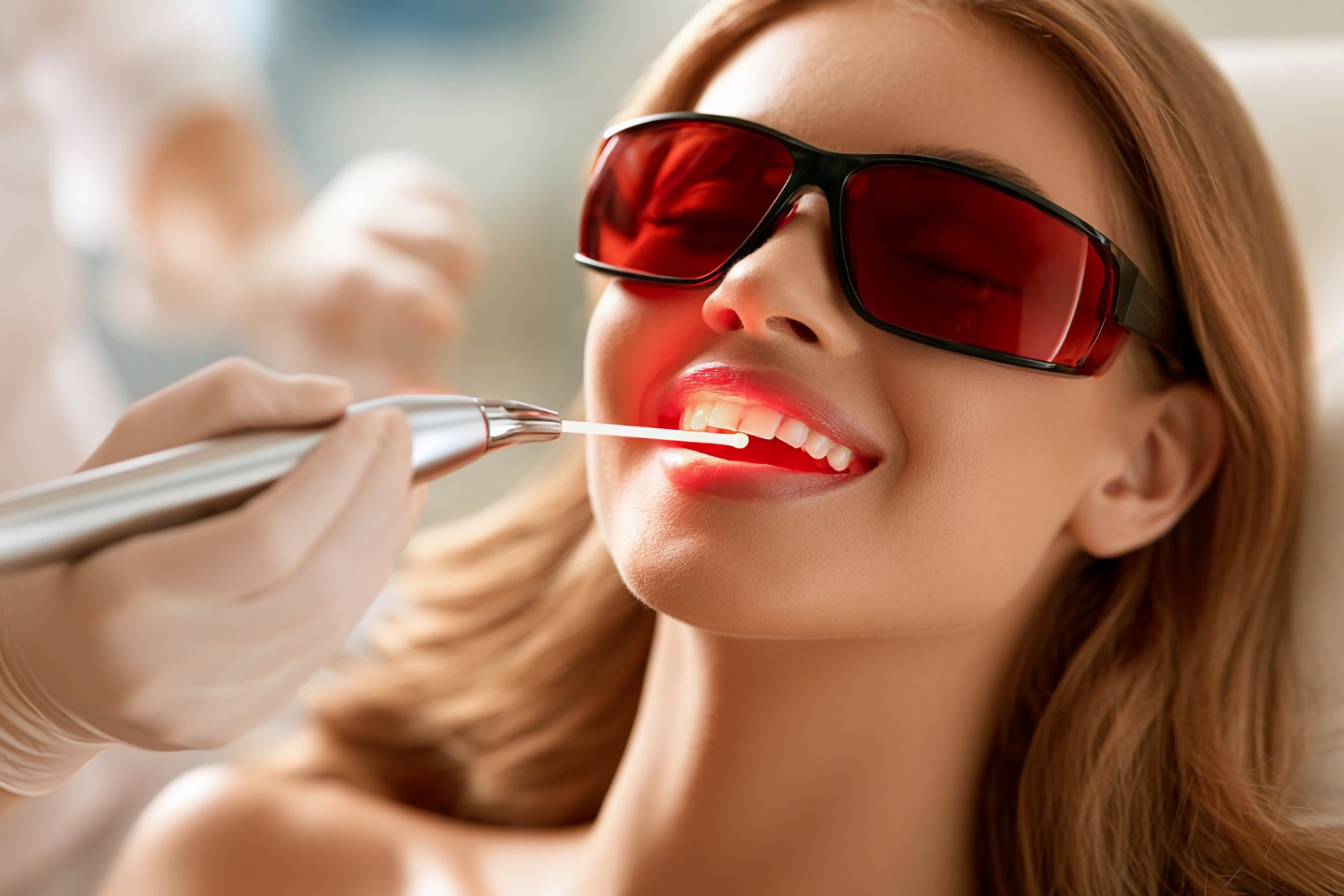
Combining treatments is common, and sequence matters because of one fact: only natural teeth can be whitened, not tooth-colored restorations, the ADA says. Crowns, implants and fillings stay the same, which can leave a visible color mismatch.
That fact sets a sensible order. If you want brighter natural teeth and also need bonding or veneers, the whitening typically happens first, so the dentist can choose the resin or porcelain shade against the final color of the neighboring teeth. Whiten after the restoration and the new material stays put while the teeth next to it lighten.
One more line from the ADA page: the American Academy of Pediatric Dentistry discourages full-arch cosmetic bleaching for children and adolescents with primary or mixed dentition. For younger patients, this one is a conversation for a pediatric dentist.
How Insurance and Tax Rules Treat Each One
The short version is that cosmetic work is rarely covered. The details, in the order that tends to matter for a plan, look like this.
Plan type and exclusions. Delta Dental states that veneers are commonly considered a cosmetic procedure and are often not covered by employer, family or individual dental plans, though some plans include coverage. Its whitening page says bleaching is typically cosmetic and usually not covered, although some plans may. A November 2022 post from Delta Dental of Colorado makes the same point for bonding and describes cosmetic coverage as sometimes offered as an optional benefit. Humana says some of its plans include an allowance for in-office whitening, while describing cosmetic work as generally elective.
Medicare and Medicaid. Delta Dental says Medicare and Medicaid usually do not cover veneers, though certain Medicare Advantage plans might.
Where a coverage argument can exist. Humana says most dental plans will not pay for veneers unless they are medically necessary, giving a tooth damaged in an accident as an example. A tooth that is chipped or decayed is a restorative question as much as a cosmetic one. Whether a given repair is restorative is the dentist’s clinical call and the insurer’s coverage call; the honest question to ask is “is this restoring function, or only changing appearance?” Coding a cosmetic service as something else is not a workaround.
Deductible, coinsurance and annual maximum. If a plan does cover a restorative composite on a front tooth, the usual machinery applies: a deductible, a coinsurance percentage, and an annual maximum shared with every other service that year.
HSA and FSA money. IRS Publication 502 (2025) says you cannot include amounts paid for teeth whitening in medical expenses, and generally not cosmetic surgery either, except where it corrects a deformity from a congenital abnormality, an accident or trauma, or a disfiguring disease. Publication 969 defines HSA-qualified expenses by reference to the same section of the tax code. Whether a veneer after an accident qualifies is a question for the plan administrator or a tax professional.
Lower-Cost Routes That Exist
Dental school clinics. UT Health San Antonio’s page on veneers says its student clinic charges 60% to 70% less than private practice, its graduate dentist clinic averages about 60% of private-practice cost, and its specialist clinic matches private practice. Expect longer appointments and supervision, and ask whether a given clinic offers cosmetic work at all.
ADA Seal over-the-counter products. The ADA evaluates tooth bleaching products for safety and whitening efficacy. Over-the-counter toothpastes and strips can carry the Seal; professional products do not. Sunbit’s 2025 article lists strips at $20 to $50 a box and store-bought trays or gels at $30 to $100, a fraction of any in-office price.
A dentist-made tray kit. Sunbit’s $200 to $500 range for take-home professional kits sits between store-bought and in-office. The ADA says such systems typically use stronger gels than over-the-counter ones.
Doing less. Bonding one or two teeth costs a fraction of a full set of veneers. That is not advice to pick the smaller treatment, only a reminder that the scope of the job is the biggest cost lever you control.
We do not cover financing here, and we have no sourced figures on discount plan savings for cosmetic work, so we leave that out rather than guess.
Questions to Ask Before Accepting a Quote
- How many teeth does this price cover, and is it per tooth, per arch or for the whole case?
- Is the veneer or bonding material composite or porcelain, and is it made in the office or sent to a lab?
- Do the exam, X-rays, temporaries and follow-up visits sit inside the quote?
- If a veneer chips or comes off in the first few years, what does a repair or replacement cost, and what is written down?
- Will whitening come first, and what happens to existing crowns, fillings or bonding that will not change shade?
- Is enamel being removed, and what does that mean for going back later?
- Could a smaller version of the work (fewer teeth, or bonding instead of veneers) reach the same goal?
- Does my plan have a cosmetic exclusion, and can I get a written predetermination before I commit?+
Frequently Asked Questions – Cosmetic Dentistry Cost
Is whitening always cheaper than veneers?
Per visit, yes: professional whitening averaged $583 to $792 in CareCredit’s 2024 data, against $1,765 for a single porcelain veneer. Over years it depends on how often you redo it. Redone every year for a decade, the whitening totals in Table 3 still stay below the veneer totals.
Can I whiten my teeth after I get veneers?
Veneers will not lighten, since the ADA says only natural teeth whiten. Whitening the teeth beside a veneer can open up a mismatch. Dentists typically sequence whitening before the veneer shade is chosen.
Is a composite veneer the same thing as bonding?
Both use tooth-colored composite resin, and the ADA describes composite veneers as filling material bonded to the tooth. The price lines differ: CareCredit lists $431 for bonding and $872 for an in-office composite veneer. How the office defines the two, including how much of the tooth is covered, is worth asking about.
Which lasts longer, bonding or veneers?
Reported lifespans favor porcelain veneers: 10 years or more and up to 20, against 3 to 10 years for bonding (Cleveland Clinic) and about 5 for composite veneers. A 2021 review found a 95.5% 10-year survival rate for porcelain laminate veneers.
Are veneers reversible?
No, according to the ADA, which says enamel is removed to place a veneer and the treatment cannot be undone. Cleveland Clinic says bonding typically does not require enamel removal and can be reversed.
Does dental insurance cover veneers if I chipped a tooth?
Often not, but accident damage is the example insurers themselves give. Humana says most plans will not pay for veneers unless medically necessary, such as a tooth damaged in an accident. Ask the plan before treatment, and keep in mind that many plans limit what they pay per year.
Can I pay for whitening with an HSA or FSA?
Probably not. IRS Publication 502 says you cannot include teeth whitening in medical expenses, and HSA-qualified expenses are tied to that definition. Your plan administrator has the final word on a specific purchase.
Do over-the-counter whitening strips work?
Some do. The ADA says over-the-counter products can carry its Seal for safety and effectiveness, but they use lower peroxide concentrations and take longer. In one study it cites, an over-the-counter technique took 16 days to reach the result of a seven-day tray system.
How much does a full set of veneers cost?
CareCredit’s 2024 data puts a full set of porcelain veneers (6 to 8 teeth) at $15,486, which works out to about $1,936 to $2,581 per tooth. Single-tooth ranges from Delta Dental and Humana run roughly $900 to $2,500.
Is a dental school a cheaper option for cosmetic work?
It can be. UT Health San Antonio says its student clinic charges 60% to 70% less than private practice for veneers. Availability varies by school, and not every clinic offers cosmetic procedures.
Why do prices differ so much between offices?
Material, lab, region and what the quote includes all shift the number. The sources we read show composite veneers from $250 to $2,300 and porcelain from $900 to $2,500 per tooth. Comparing two quotes only works if both are written for the same number of teeth, material and visits.
Sources and Disclaimers
Price averages for whitening, bonding and veneers come from CareCredit’s 2024 data, published on its cost page and reported by Becker’s Dental Review. Ranges come from Delta Dental, Humana, Sunbit and Healthline, as labeled in the text and tables. Clinical statements come from the ADA, Cleveland Clinic, and two systematic reviews of veneer and composite performance. Insurance statements are drawn from carrier pages, and tax statements from IRS publications. The worked examples, the cost-per-year figures and the ten-year ledger are our own illustrative arithmetic on those sources, not quotes or forecasts. National averages hide large local differences, and lifespan figures are typical rather than promised. Confirm prices with your dentist and benefits with your insurer before treatment.
- American Dental Association (Mouth Healthy) — Veneers: materials, enamel removal and care
- American Dental Association — Whitening: Oral Health Topics
- American Dental Association — ADA Seal of Acceptance product categories
- Cleveland Clinic — Dental bonding
- CareCredit — Average costs of dental procedures (2024 Synchrony cost study)
- Becker’s Dental Review (CareCredit data, September 2024) — Average cost of cosmetic dental procedures in 2024
- Delta Dental — Dental veneers cost and insurance
- Delta Dental — Teeth whitening cost and insurance
- Delta Dental of Colorado — Does dental insurance cover cosmetic dentistry? (November 2022)
- Humana — Dental veneers: cost, lifespan and insurance coverage
- Humana — Teeth whitening: cost and insurance coverage
- Healthline — How long veneers last by type (reviewed November 2020)
- Healthline — How long whitening results last (January 2021)
- Sunbit — Teeth whitening cost: professional and over-the-counter options (May 2025)
- UT Health San Antonio School of Dentistry — Veneers clinic information
- Journal of Clinical Medicine (2021), via PubMed Central — Survival and complication rates of porcelain laminate veneers: systematic review
- Journal of Conservative Dentistry (2022), via PubMed Central — Long-term survival of direct anterior composite restorations: systematic review
- Internal Revenue Service — Publication 502 (2025), Medical and Dental Expenses
- Internal Revenue Service — Publication 969 (2025), Health Savings Accounts
Important Information and Disclaimers
This article is general educational information. By using it, you accept the limits described below.
Not dental or medical advice
Nothing on this page is a diagnosis, a treatment recommendation or a substitute for an examination by a licensed dentist or physician. Reading this article does not create a dentist-patient or doctor-patient relationship. Only a licensed professional who has examined you and reviewed your history can tell you what your mouth needs. Do not delay, skip or stop professional care because of something you read here.
Prices are estimates, not quotes
Cost figures are ranges reported by the third-party sources cited in this article. Actual prices depend on your location, the provider, the complexity of your case, the materials used, the date of service and other factors, so what you pay may be higher or lower. A written treatment plan and fee estimate from the dental office is the only reliable number for your situation.
Insurance and plan examples are illustrations
Examples that use named amounts or percentages are hypothetical. Real benefits depend on your plan, network, waiting periods, annual maximum, deductible and the insurer’s rules at the time of treatment. A pre-treatment estimate or benefits check is not a promise of payment. Confirm the details with your insurer or plan administrator in writing.
Not insurance, legal, tax or financial advice
AceDentalPlans is an information publisher. Nothing here is insurance, legal, tax, investment or other professional financial advice, and nothing here recommends a particular provider, insurer, lender, discount plan or financing product. Company and product names belong to their owners and appear for identification only. Read the terms of any loan, financing offer or plan before you sign, and ask a qualified professional if you need advice on your own circumstances.
Third-party sources
This article cites government agencies, professional associations, insurers, lenders and other outside organizations. We do not control those sources. Their content can change, move or disappear, and listing a source is not an endorsement of it or of anything it sells.
No warranty
We aim for accuracy, but this article is provided “as is,” without warranties of any kind, express or implied, including warranties of accuracy, completeness, timeliness or fitness for a particular purpose. Some information may be out of date or contain errors by the time you read it.
Limitation of responsibility
To the fullest extent permitted by law, AceDentalPlans and its owners, authors and contributors are not responsible or liable for any loss, cost, injury, health outcome or other damage that results from using this article or relying on it. You are responsible for your own decisions about your care, your coverage and your money.
How this article is written
This article follows AceDentalPlans’ answer-first, U.S.-focused editorial approach. It uses conditional language for insurance, because coverage depends on the specific plan, and it names its sources so that you can read them yourself.