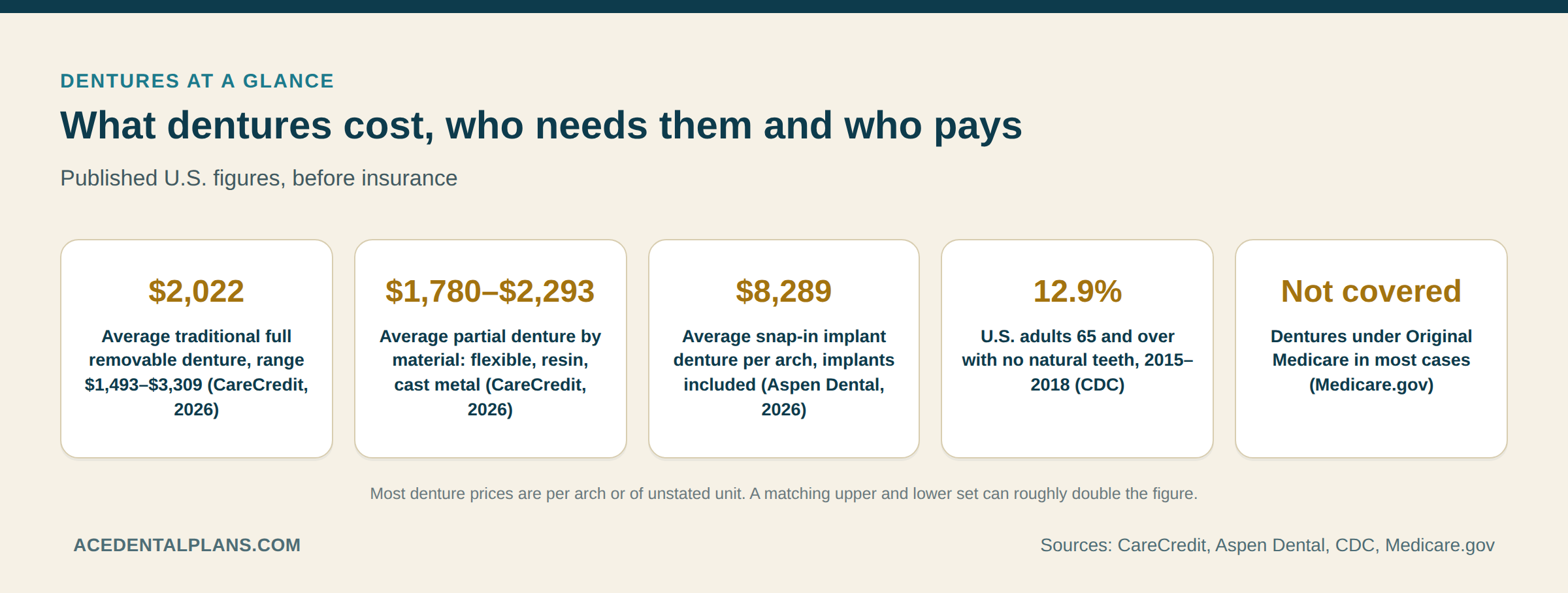
Dentures are removable replacement teeth: complete dentures for an empty jaw, partials that fill gaps and clip to remaining teeth, and implant-retained versions that snap onto posts in the jawbone. In 2026 national averages from CareCredit, a traditional full removable denture cost $2,022 and a partial $1,780 to $2,293, while one national chain averaged $8,289 per arch for snap-in dentures with implants. Original Medicare doesn’t cover them in most cases.
This guide explains each denture type, who tends to be a candidate, and the visit sequence from extraction to delivery. It covers the first weeks of fit and adjustment, eating, adhesive, daily care, and the signs that need a call to the dentist. It then summarizes costs, shows how to read an estimate, and sets out how dental plans, Medicare, Medicaid and the VA treat dentures. It leaves detailed price tiers, relining signs and implant surgery to their own guides, and it can’t say which design suits your mouth.
Key Takeaways
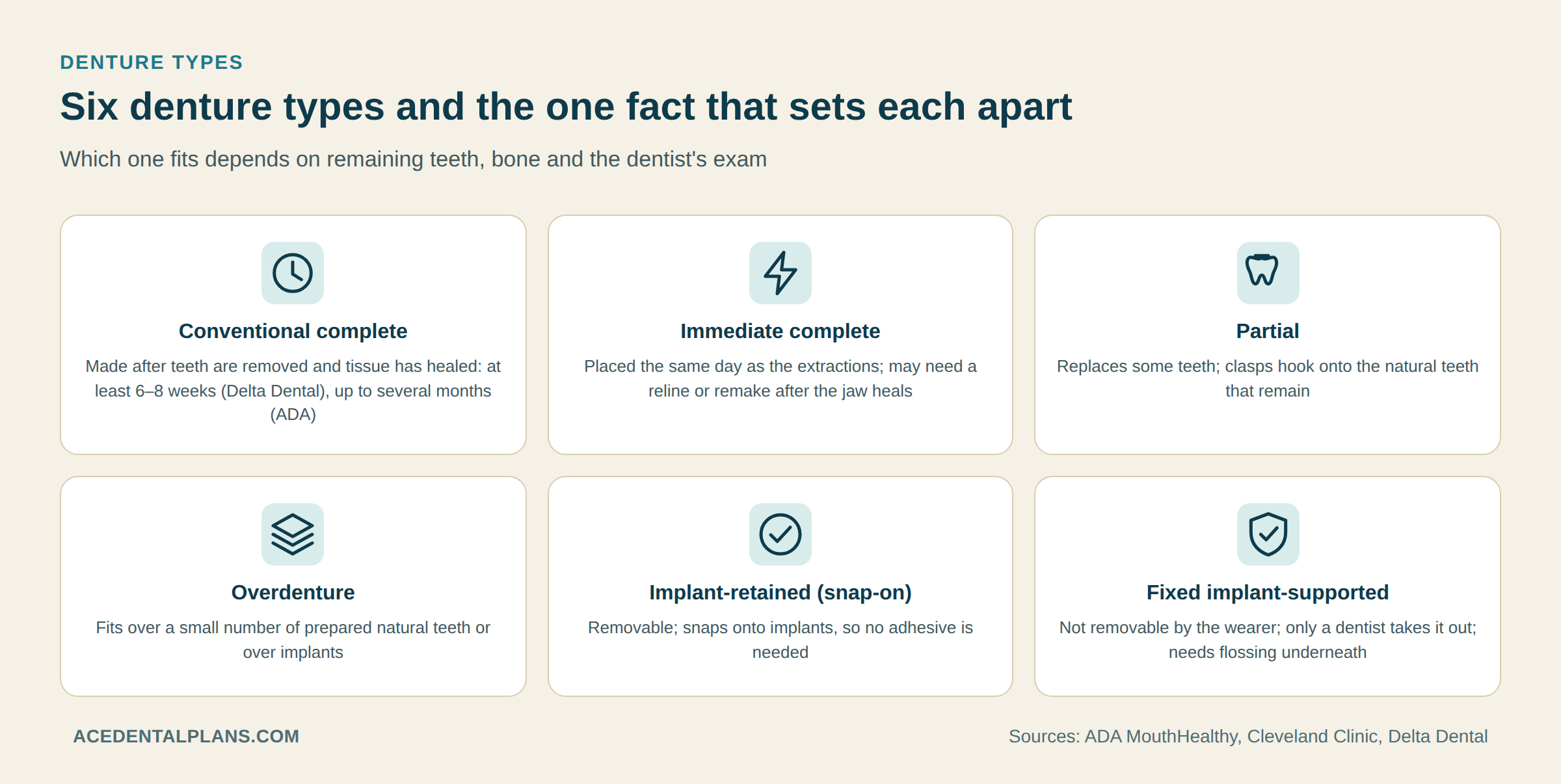
- Five main forms exist: conventional and immediate complete dentures, partials, overdentures that sit over a few remaining teeth or implants, and implant-retained or fixed implant-supported dentures.
- Timing differs by type. The ADA says a conventional denture is made after the teeth are out and the tissue has healed, which may take several months. An immediate denture goes in the same day but may need a reline or remake after the jaw heals.
- Plan on an adjustment period. The ADA says new dentures may feel awkward for a few weeks. The Cleveland Clinic says getting used to them can take weeks or sometimes months, with several adjustments in the first couple of weeks.
- Adhesive has a limit. The FDA says excess zinc in the body can lead to nerve damage, and that a 2.4-ounce tube for upper and lower dentures should last seven to eight weeks.
- Prices span classes, not just dollars. CareCredit’s 2026 averages run from $460 for a low-cost full denture to $6,703 for a premium one, and a chain’s snap-in implant package averaged $8,289 per arch.
- Coverage depends on the payer. Medicare.gov says Original Medicare doesn’t cover items like dentures and implants in most cases. Medicaid dental benefits for adults are set by each state, and a sample MetLife plan summary for 2026–27 lists dentures at 50% in network with one replacement every 10 years.
What Dentures Are, and What They Can and Can’t Restore
MedlinePlus draws the basic line in two sentences. Complete dentures cover your entire upper or lower jaw, and partial dentures replace one or a few teeth. The Cleveland Clinic’s description of partials is slightly wider, saying they replace several or most teeth in one or both jaws and rely on clasps that hook onto the natural teeth that remain. Either way, the appliance is custom-made from impressions of your mouth and sits on the gums or on remaining teeth, not in the bone.
Who needs them? The CDC’s National Center for Health Statistics reported that 12.9% of U.S. adults aged 65 and over had complete tooth loss in 2015–2018, rising to 17.8% among those 75 and older. The age-adjusted rate for older adults fell from 29.9% in 1999–2000 to 13.1% in 2017–2018. That is a large drop, though it still leaves roughly one older adult in eight without any natural teeth.
What does a denture do well? The ADA notes that losing all your teeth can make facial muscles sag and can make you look older, and that dentures can help fill out the face and profile. The Clinic lists improved chewing, appearance and speech among the benefits. The Clinic also credits better chewing with better nutrition.
What does it not do? It doesn’t behave like a set of natural teeth. MedlinePlus warns that dentures may reduce your ability to sense hot foods and liquids and that you may not notice when you bite down on a bone in your food. Cleveland Clinic guidance adds that traditional dentures may shift, wobble or slip while you chew or speak. And the American College of Prosthodontists describes dentures as “medical devices with limited lifespans.” That’s a useful way to think about cost. You are buying a device that will need servicing and eventual replacement.
One more point about the word itself. On a dental estimate, “denture” is rarely a single item. The ADA’s procedure codes, which the next sections return to, separate complete dentures from immediate ones, partials by their base material, overdentures, and the implant-supported versions. When a friend says “my dentures cost $X,” ask which of those they had.
Denture Types at a Glance
Table 1 sorts the main types by what they replace, how they stay in, and what you give up. It draws on the ADA’s MouthHealthy page, MedlinePlus and two Cleveland Clinic pages. The type your dentist proposes follows from how many teeth are left, how healthy they are and how much bone you have. Treat the table as a vocabulary lesson, not a menu.
| Type | What it replaces | How it is held in | Wearer can remove it? | Main trade-off |
|---|---|---|---|---|
| Conventional complete denture | All teeth in the upper or lower jaw | Rests on the gums and palate or lower ridge; adhesive may be needed (Cleveland Clinic) | Yes | Made after extraction and healing, which the ADA says may take several months |
| Immediate complete denture | All teeth in the arch, placed the day the last teeth come out | Same as conventional | Yes (after the first day or so, per dentist) | May need a reline or remake after the jaw heals (ADA) |
| Partial denture | One, a few or several teeth | Clasps that hook onto remaining natural teeth (Cleveland Clinic) | Yes | Fit depends on the remaining teeth staying healthy and in position |
| Overdenture on natural teeth | Most teeth, leaving a small number of prepared natural teeth | Fits over those remaining teeth (ADA) | Yes | The supporting teeth must stay healthy |
| Implant-retained (snap-on) denture | All teeth in the arch | Snaps or clips onto implants in the jawbone (Cleveland Clinic) | Yes | Needs surgery and enough bone; costs more than a conventional denture |
| Implant-supported fixed denture | All teeth in the arch | Attached to implants and not removable; only a dentist can take it out (Cleveland Clinic) | No | More thorough daily cleaning, including flossing underneath |
Complete Dentures: Conventional and Immediate
A complete denture replaces every tooth in an arch. CareCredit describes the base as acrylic and flesh-colored, sitting over the gums, with artificial teeth set in it. According to the Clinic, a full denture rests on the gums and palate in the upper jaw and on the ridge in the lower jaw. The University of Michigan’s hospital dentistry instructions add a practical note: lower dentures are often looser than upper ones.
Conventional: made after the gums have healed
The ADA says a conventional denture is “made and placed in your mouth after the remaining teeth are removed and tissues have healed,” which “may take several months.” Delta Dental gives a floor for the wait: conventional dentures are made at least six to eight weeks after the natural teeth are removed so that the gum tissue can heal first. The two statements don’t conflict. One is a minimum and the other is the range patients are told to expect.
The wait has a purpose: it lets the tissue settle before the final impressions are taken. The cost is real, though. During those weeks a person without a temporary denture has no teeth in that arch, which matters for work, eating and confidence. The immediate option exists to close that gap.
Immediate: teeth the same day
The ADA describes an immediate denture as one inserted on the same day the remaining teeth are removed. Measurements and models of the jaw are taken at a preliminary visit, before the extractions. The upside is plain: you leave the office with teeth. The Cleveland Clinic notes that some immediate dentures are temporary until healing is done and that others may become the final denture.
The downside is the fit. Because the dentist makes the denture before the gums shrink, the ADA warns that you “may need to have the denture relined or remade after your jaw has healed.” The University of Michigan’s instructions say the gums shrink over the first six months to a year. An immediate denture may therefore be temporary, need a reline, or use a soft tissue-conditioning liner during healing. A tribal community dental clinic (Swinomish) that publishes its process says permanent dentures after an immediate placement are started about three to six months later, once healing is complete.
So which should you ask for? That depends on the number of teeth coming out, your work and social needs, and what your dentist thinks the jaw will do. Ask the office to price both routes on paper, including the reline or second denture that an immediate plan often needs. The dentist can tell you which is realistic for your mouth, and the written comparison will show whether the “same-day” premium is a few hundred dollars or a few thousand.
Partial Dentures: Clasps, Frameworks and Flexible Bases
A partial denture fills the spaces between teeth you are keeping. The South Australian public dental service describes it as an acrylic plate with attached teeth held in place by metal clasps that rest on the remaining teeth. Cleveland Clinic guidance makes the dependency explicit: because the clasps hook around natural teeth, how well the partial fits depends on those teeth staying healthy and in position.
Several designs exist, and the billing codes keep them apart. In the Delta Dental Patient Direct fee schedule effective November 1, 2025, a resin-base partial, a cast-metal-framework partial with resin denture bases, and a flexible-base partial each carry a separate procedure code. CareCredit’s December 2024 guide describes the same families in everyday language:
- Flipper: a custom partial for one or two teeth that is lightweight and easy to remove. CareCredit says it can break easily and is usually a temporary solution, for example while waiting for an implant.
- Resin partial: teeth attached to an acrylic framework with clasps. CareCredit calls it lighter and easier to adjust, and notes that acrylic wears down more quickly than porcelain.
- Metal (cast) partial: a metal framework or clasps that make the appliance more noticeable but durable.
- Flexible partial: a clear thermoplastic base with no clips or attachments. CareCredit says it is thin and realistic-looking but can be more prone to bacteria growth.
CareCredit’s descriptions come from a consumer guide, not a clinical comparison, so treat the durability and bacteria points as questions for the dentist and not settled facts. The sources do agree on the practical advice around partials. The Delaware Division of Public Health says never to force a partial denture into position by biting down, because that can bend or break the clasps. Delta Dental says to take a partial out before brushing your natural teeth.
There is a quieter point about partials: they protect and endanger the teeth they clasp. CareCredit says a partial helps stop natural teeth from shifting into the gap. The American College of Prosthodontists lists loss of the teeth that support a partial denture or overdenture as one of the reasons to evaluate the appliance for replacement. In other words, brushing and checkups around those anchor teeth matter as much as cleaning the plastic.
Implant-Retained and Fixed Dentures: What Changes
Adding implants changes the denture from an appliance that rests on tissue to one that is anchored in bone. The Clinic separates two designs. A removable implant-retained denture “snaps on” to implants and can be taken out daily for cleaning. A fixed implant-supported denture, sometimes called a hybrid, attaches to the implants and stays in, and only a dentist can remove it. All-on-4, the Clinic adds, is one fixed design that replaces an entire arch using four implants.
What does the research say about benefits? A 2002 consensus statement from McGill University, published in Gerodontology, took the position in its title that two-implant overdentures in the lower jaw should be the first-choice standard of care for edentulous patients. A 2018 systematic review in the Journal of Prosthodontic Research pooled 26 articles, most comparing conventional complete dentures with a lower overdenture on two implants. It found implant overdentures linked to better chewing performance and oral health-related quality of life. Its authors concluded that lower overdentures retained by two unsplinted implants outperform conventional complete dentures on efficacy, satisfaction and quality of life.
Those are findings about groups of patients. They don’t tell an individual whether implants are the right call, and they don’t weigh cost. The Cleveland Clinic says plainly that dental implants cost more than dentures. It also lists the trade-offs. You need enough jawbone, though grafts can add volume. Implants generally take about three to six months to integrate with the bone, and you wear a healing denture in the meantime. Possible complications include infection, nerve damage, injury to the mouth and sinus perforation, which it calls usually minimal. It puts the overdenture itself at replacement every 15 to 20 years, with the implants able to last a lifetime with care.
On price, the sources are far apart because they measure different things. CareCredit’s 2026 national average for a snap-on, implant-retained denture is $2,540, and its page doesn’t say whether implants and surgery are included. Aspen Dental reports an average of $8,289 per arch ($7,628 to $13,297) for a snap-in package that includes the implants, abutments, a healing prosthetic and the final teeth. It names three variables: the number of implants (two to four or more), pre-treatment such as bone grafting or extractions, and the type of anesthesia. The full-arch price classes have their own breakdown in full mouth dental implants cost, and the surgical steps, candidacy and complications are covered in the dental implants guide. If implants are on your list, the dental implant recovery timeline shows what the healing months look like.
Questions that separate a snap-on plan from a conventional one
The sources point to a short list of questions that decide whether implants belong in the conversation at all.
- Which arch is the problem? The Michigan handout says lower dentures are often looser than upper ones and suggests asking about implants if lower-denture problems continue. The 2018 review’s evidence centers on lower overdentures on two implants.
- Is there enough bone? According to the Clinic, you need enough jawbone, and that grafts can add volume where bone has been lost. A graft adds a procedure and a bill.
- How many implants, and why that number? Aspen Dental says some patients may need two implants while others may benefit from four or more. Ask the dentist to explain the choice for your jaw.
- What does the price include? The gap between CareCredit’s $2,540 and Aspen’s $8,289 shows how much the answer matters. Ask whether implants, abutments, a healing denture, the final denture and follow-up are all inside the figure.
- What is the time line? Three to six months for integration, with a healing denture in between (Cleveland Clinic), is a different commitment from a conventional denture’s visit sequence.
Who Is a Candidate: What the First Exam Checks
Nobody is “approved” for dentures by a checklist. The first visit is an examination. The Clinic says the dentist examines your jaws, gums and remaining teeth and takes X-rays to check jawbone thickness. The choice of denture then depends on how many teeth are missing and for how long, jawbone density and volume, and the relationship between the upper and lower jaws.
Those factors explain why two people with “no teeth” can leave with different plans. The Clinic’s list includes how long the teeth have been gone, which is one reason a person whose teeth are being removed now may be offered an immediate denture. Someone with enough bone and a wish for a firmer fit may be offered implants. The exam sorts those paths, and the dentist records which one fits.
If some teeth are still in the mouth, a second question comes first: which ones are worth keeping? A partial denture leans on those teeth, so gum health around them matters. If the dentist finds gum problems, treatment decisions usually come before the denture is designed, and the gum disease guide explains the stages and what care involves. Ask to see two written versions of the plan when a tooth could be saved or removed: one that keeps it and one that doesn’t. The price and the timeline can differ more than you would expect.
What to bring and say at the first appointment
- Any dentures you already own, even if they no longer fit. The dentist can read a lot from an old appliance, and it may serve as a spare during treatment.
- A list of medications and supplements. The University of Michigan’s instructions note that dry mouth can make denture wear harder, so tell the dentist if your mouth often feels dry.
- What bothers you most: looseness, appearance, speech, eating, cost. Priorities change which type and material the dentist recommends.
- Your plan information, if you have dental coverage, so the office can request a predetermination (a pre-treatment estimate) before work starts.
Be ready for questions about how long the teeth have been missing and whether you have had dentures before. A first-time wearer and a wearer on a fourth set start from different places, and the plan should say so.
From Extraction to Delivery: The Visit Sequence
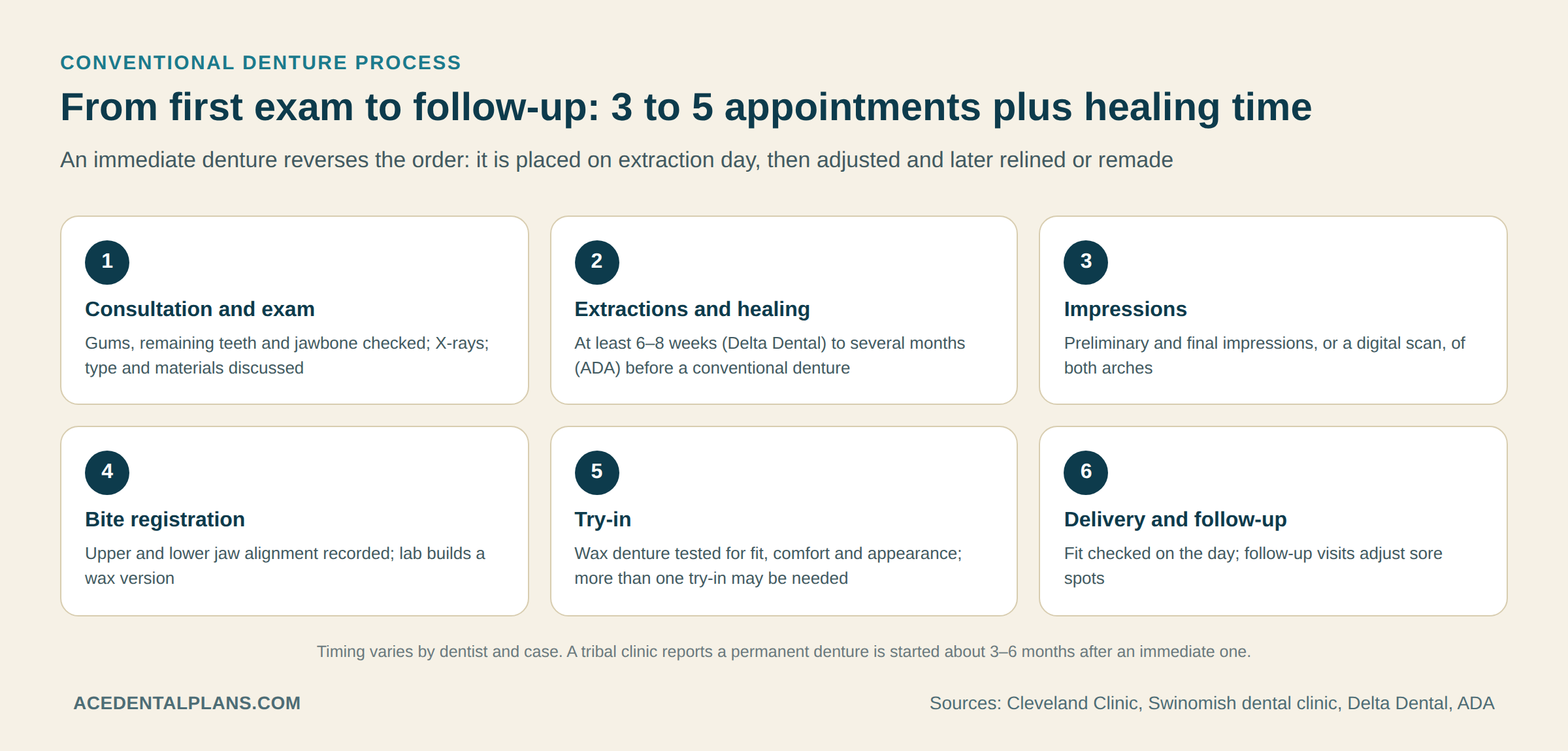
Published descriptions of the process agree on the order and disagree on the count of visits. Cleveland Clinic guidance describes impressions of the upper and lower jaws, often two sets (a preliminary and a final). A lab makes a stone model from them, adds wax blocks, a base and artificial teeth, and returns a polished denture for fitting. It says the fitting usually takes several office visits because the soft tissues need time to adjust. A tribal community dental clinic (Swinomish) that publishes its process lays out five appointments and says dentures are typically completed over three to five.
A conventional denture, step by step
- Consultation and exam. The dentist checks gums and remaining teeth, discusses type, materials and appearance goals, and takes X-rays. At the Swinomish clinic, front-desk staff also verify insurance, and a lab fee agreement is signed before work proceeds.
- Extractions, if teeth remain, and healing. Delta Dental says a conventional denture is made at least six to eight weeks after the natural teeth are removed. The ADA says healing may take several months.
- Impressions. Traditional impressions or an intraoral scan record both arches. The scan, at the Swinomish clinic, becomes a virtual model sent to the lab.
- Bite registration. The dentist records how the upper and lower jaws align, using silicone, wax or digital methods. The lab then builds a wax version of the denture.
- Try-in. You wear the wax denture and give feedback on fit, comfort, appearance and tooth position. The clinic notes that more than one try-in may be needed, and the permanent denture is made once the design is final.
- Delivery. The finished denture is placed, checked for fit and function, and adjusted on the spot. You receive care instructions and sign acceptance paperwork.
- Follow-up. The ADA says follow-up appointments are generally needed after insertion so the dentist can check the fit and adjust it.
An immediate denture runs on a different clock
With an immediate denture the order changes. Measurements and jaw models come first, at the preliminary visit the ADA describes. On extraction day the dentist removes the teeth and places the denture in the same appointment. Several follow-up adjustments are typically needed as the gums heal, according to the Swinomish clinic, which says a permanent denture is started about three to six months afterward.
The First 24 Hours and First Week With an Immediate Denture
Most of the anxiety around immediate dentures concentrates in the first day. The University of Michigan’s hospital dentistry handout gives a detailed set of instructions that is worth reading even if your dentist hands you a different sheet. Where the two disagree, your dentist’s sheet wins, because the dentist knows what was done in your mouth.
According to the Michigan instructions, the denture stays in for the first 24 hours. It acts as a bandage, and removing it can make the gums swell. Mild oozing is normal for the first two to three days. If you need to slow bleeding, bite down gently for 10 minutes without rapidly clenching and releasing, and call the dentist right away if bleeding is excessive. Don’t spit forcefully; let liquid drool gently into the sink. Ice packs go on for 20 minutes on and 20 minutes off during the first few hours, switching to a warm compress after 24 hours, and never directly on the skin. The handout says most patients have only mild pain after about 36 hours. For pain medicine, follow the prescription or label directions your dentist gave you.
The first removal comes after the 24-hour mark. Michigan describes a salt-water rinse (half a teaspoon of salt in a cup of warm water) held in the mouth and forced under the denture to loosen it. The lower denture usually lifts straight up, it notes, while the upper often comes out downward and forward. Dark blood inside the denture is normal, and bruising on the mouth or face usually fades within a couple of days. Clean the denture inside and out with dishwashing liquid, rinse it, and reinsert it. For the first five days the handout keeps the denture in except for cleaning, then moves to removing it at night and soaking it in denture cleanser unless your dentist says otherwise.
Numbness is the other early question, since it can affect how you eat and how you notice a sore spot. How long it typically lasts after extractions is covered in the guide to numbness after tooth extraction.
Call the dentist promptly if
- Bleeding is heavy or does not slow with gentle pressure.
- The denture cracks, breaks or suddenly stops fitting.
- A sore spot develops. The Michigan handout says to call as soon as a sore appears so it can be adjusted, and warns that numbing ointments can hide problems and cause larger sores if used too long.
Swelling of the face or neck, trouble breathing or swallowing, or fever with severe dental pain needs 911 or an emergency room.
What changes over the following months
Michigan says the gums shrink over the first six months to a year. That is why an immediate denture may be temporary, need a reline, or carry a soft liner during healing. The handout also says to keep regular dental visits, even without natural teeth, because the dentist checks for oral cancer. That last point surprises people who assume the appointments stop when the teeth do.
Weeks One to Six: Sore Spots, Speech, Saliva and Gagging
New dentures feel strange, and that is normal. The ADA says they may feel awkward for a few weeks and loose while your cheek and tongue muscles learn to keep them in place. Minor irritation or soreness, it adds, is not unusual. Saliva flow can temporarily increase. The Cleveland Clinic puts the outer range at “weeks or sometimes months,” varying by person, and says several adjustments may be needed during the first couple of weeks.
Several specific problems show up often enough to plan for.
- Sore spots. Pressure points are the most common reason for the early adjustment visits. The South Australian public dental service gives a practical tip worth borrowing: wear the denture for 24 hours before the appointment so the dentist can see exactly where it rubs. It also advises rinsing with warm salty water and leaving the denture out as much as possible while you wait.
- Do-it-yourself fixes. Don’t adjust the denture yourself. Cleveland Clinic guidance warns you could break it, and the Michigan handout says that even a minor change can be costly to fix.
- Speech. Some sounds are harder at first. The Delaware Division of Public Health suggests practicing by reading aloud and repeating the words that give you trouble. Michigan says speech usually improves over time.
- Gagging. Michigan says gagging from fullness in the roof of the mouth usually decreases over time. If it doesn’t, say so at the follow-up visit.
- Looseness, especially in the lower jaw. Michigan notes that lower dentures are often looser than upper ones, that adhesive may help, and that it can be worth asking about implants if lower-denture problems continue.
- Ulcers that linger. The South Australian service says to contact the clinic if ulcers have not healed after 10 to 14 days.
A simple habit helps more than it sounds: keep a short note on your phone of what rubbed, where, and when. “Upper left, back, after chewing, third day” gives the dentist something far more useful than “it hurts sometimes,” and it shortens the number of visits it takes to find the right spot.
Eating With New Dentures: A Four-Stage Food Ladder
Every source that mentions eating says some version of the same thing: start soft, cut small, chew on both sides. The Delaware Division of Public Health says to “start out by eating soft foods that are cut into small pieces.” It adds that you should chew on both sides of the mouth for even pressure, avoid very sticky or hard foods, and skip chewing gum during the adjustment period. The South Australian service adds rinsing after meals.
The Michigan handout is the most specific on staging. For the first 24 to 36 hours after an immediate denture it recommends soft, no-chew foods, naming thin oatmeal, mashed potatoes, pureed soups, smoothies, scrambled eggs, pureed meats and milk or nutritional shakes. After the first or second day it suggests gradually increasing the consistency, cutting food into small pieces, eating slowly and chewing straight up and down with food on both sides. It also says to bite food at the corners of the mouth, not the front, and to drink plenty of fluids.
Combining those instructions gives a four-stage ladder. It is an organizing idea built from the sources above, not a prescribed diet, so follow your dentist’s timetable where it differs.
- Days one and two (after an immediate denture): no-chew foods only, such as smoothies, thin cereals, pureed soups, scrambled eggs.
- Days three through about fourteen: soft foods in small pieces, such as pasta, soft fish, cooked vegetables, bananas. Chew slowly, on both sides.
- Weeks three through six: firmer textures, introduced one at a time. If a food brings a sore spot, note it and mention it at the adjustment visit.
- After the fit settles: a normal varied diet, still going easy on very sticky or hard items and cutting tough foods small.
Two safety points from MedlinePlus
MedlinePlus says dentures may reduce your ability to sense hot foods and liquids, and that you may not notice when you bite down on a bone in your food. Test the temperature of soup and coffee with a spoon on your lips or tongue first, and pick over fish and poultry for bones. Neither habit is dramatic, and both cost almost nothing.
Does the denture change what you eat over the long run?
A 2022 trial protocol in Frontiers in Nutrition, summarizes earlier work. It says tooth loss is linked to shifts toward softer, higher-carbohydrate and higher-fat diets with less fruit and vegetables. It cites a systematic review finding a 21% higher likelihood of malnutrition or risk of malnutrition in people without functional teeth. And it states that prior evidence that dentures alone improve nutrient intake is limited. That is a statement about averages in research, and a protocol reports no results. Still, it is a fair reason to treat “I can eat soft foods” as a starting point. Keep working toward produce and protein, with help from your dentist and, if needed, a registered dietitian.
If you are having implants placed as part of the plan, the surgery brings its own food rules, which are laid out in what to eat after dental implant surgery.
Denture Adhesive: What It Is For and the Zinc Warning
Adhesives come as creams, powders, pads or wafers, strips and liquids, according to the ADA, which says to use them exactly as directed and to ask your dentist for products carrying the ADA Seal. MedlinePlus agrees that adhesive can help when dentures slip. So far, uncontroversial. The part people skip is the FDA’s guidance on how much.
The FDA says denture adhesives are pastes, powders or pads, and that some contain zinc. Its warning is specific: an excess of zinc in the body can lead to health problems such as nerve damage, which develops slowly over an extended period. It adds that overusing zinc-containing adhesives, especially alongside zinc supplements, can add to zinc excess. Case reports linked numbness and tingling to users of at least two tubes of zinc-containing adhesive each week. The agency says it has not found conclusive evidence that these problems occur when products are used as labeled.
Its practical advice fits in a short list:
- Do not use more adhesive than recommended. Start with a small amount, and if it oozes into your mouth, you are probably using too much.
- A 2.4-ounce tube for upper and lower dentures should last seven to eight weeks. Mark a calendar when you open a tube and when it runs out.
- If you prefer, choose a zinc-free product; the FDA notes these exist.
- If you have numbness or tingling, stop using the product and consult your physician.
That question deserves a visit. The FDA says a large amount of adhesive will not fix ill-fitting dentures, that prolonged use of ill-fitting dentures may increase bone loss, and that properly fitted dentures usually don’t need adhesive. The American College of Prosthodontists reaches the same place from the clinical side. Needing adhesive to eat, or to keep the denture in place socially, or applying it more than once a day is on its list of reasons to evaluate a denture for replacement. Adhesive can tide you over between fits. It isn’t a substitute for one.
Daily Care: Cleaning, Soaking and Sleeping
The routines published by the Cleveland Clinic, the Delaware Division of Public Health and Delta Dental overlap closely. Combined, they look like this.
- Before putting the denture in: brush your gums, tongue and roof of the mouth with a soft-bristled toothbrush. The Clinic recommends doing this morning and night, including any natural teeth. The Delaware guidance specifies fluoride toothpaste for the mouth, not the denture.
- After meals and snacks: remove the denture and rinse it. The Cleveland Clinic recommends this after every meal or snack.
- At night: clean the denture over a folded towel or a sink partly filled with water so a slip doesn’t break it. Brush all surfaces with a soft brush made for dentures and a small amount of hand soap, mild dishwashing liquid or denture cleanser, then rinse thoroughly.
- Overnight: take the denture out and keep it in cool water or a denture-cleansing solution.
A monthly home check
Once a month, take five minutes to look at the appliance in good light, over a towel. Check for cracks or chips, a tooth that has loosened, discoloration, and on a partial, any clasp that looks bent. Those are the damage signs the Cleveland Clinic lists, and catching one early is cheaper than a break at breakfast. If you use adhesive, glance at your calendar note: a tube that ran out much earlier than the FDA’s seven to eight weeks is a prompt to book a fit check. Then look at your gums in a mirror. Red, sore or swollen areas under the denture are worth a call (the ADA and Delaware guidance both say persistent irritation should be discussed with the dentist).
What to leave out of the routine
- Regular toothpaste and stiff brushes. According to the Clinic, they are abrasive and can scratch the plastic. Delaware says toothpaste and household cleaners are too harsh.
- Hot or boiling water. The Clinic says heat can warp the plastic, and Delta Dental says not to clean or sterilize dentures in boiling water.
- Bleach and whitening toothpaste. According to the Clinic, bleach can weaken dentures and change their color, and that the plastic won’t whiten.
- Glue and over-the-counter repair kits. They may irreparably damage the denture, according to the Cleveland Clinic.
- Home adjustments. You could break the appliance, the Clinic warns.
For cleansers, Delaware advises a denture cleaner carrying the ADA Seal of Acceptance, or hand soap or mild dishwashing liquid. Ultrasonic cleaners are an optional extra the Clinic mentions, which use sound waves in a liquid cleanser to loosen food and deposits.
Sleeping in dentures: where the guidance splits
U.S. sources lean one way. Cleveland Clinic guidance says to try not to sleep in dentures, and that most people sleep without them to rest gum tissue. It recommends at least eight hours out each day to protect gums, reduce bacteria and help keep the jawbone strong. MedlinePlus says to remove them at night. The Delaware guidance says to follow your dentist’s instructions on how long to wear them.
There is a research angle. A 2015 narrative review by Müller in the Journal of Dental Research looked at oral hygiene and aspiration pneumonia in frail elders. It reported that wearing dentures during sleep roughly doubles the risk of pneumonia in very old persons, citing a study by Iinuma and colleagues. It concluded that night-time denture wear should be discouraged in geriatric patients when possible. That population is frail and often institutionalized, so the finding doesn’t automatically transfer to a healthy 55-year-old. It does fit the broader advice to give the gums a rest and the denture a clean.
What about storing the denture overnight? Here even government sources differ. The South Australian service says current guidelines there call for storing dentures dry overnight, while U.S. sources (Cleveland Clinic, Delaware, Delta Dental, MedlinePlus) say to keep them in water or solution so they don’t warp. The Clinic warns that dentures left to dry out can permanently lose their shape. Ask your dentist which they prefer for your denture’s material, and follow that.
Care for partial and implant-supported dentures
Partial wearers add one step: remove the partial before brushing natural teeth (Delta Dental), and don’t bend the clasps when cleaning (South Australia). Fixed implant-supported dentures flip the removal rule. According to the Clinic, they need more thorough daily cleaning, including flossing underneath, and that you brush and floss thoroughly around the implants. Regular dental visits matter in every case. The Clinic names checking denture fit and protecting gum health, and the Michigan handout adds oral cancer screening.
When Fit Changes: Bone Loss, Relines, Replacement and Warning Signs
A denture is made for the mouth you had on the day of the impression. The mouth doesn’t hold still. The Cleveland Clinic says the jawbone gradually shrinks following tooth loss, which over time can cause facial collapse such as sunken cheeks. The Michigan handout says the gums change most in the first six months to a year after extractions. MedlinePlus puts it simply: over time your mouth will change and you may need to have your dentures adjusted or replaced.
The word “reline” gets used loosely, so keep the vocabulary straight. According to the Cleveland Clinic, a reline means the dentist adds material to improve comfort, and it recommends one every one to two years or whenever the fit changes. The Delta Dental Patient Direct fee schedule lists chairside relines separately from laboratory relines, and lists rebases as their own procedures. An estimate may therefore show several different lines for what you’d call “fixing the fit.” Ask what each will involve, how long you’ll be without the denture, and whether the work is covered by any warranty.
How long does a denture last?
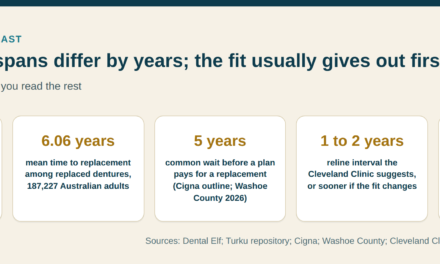
Cleveland Clinic guidance gives an average lifespan of seven to 10 years with proper care, and GoodRx says full dentures last about 10 years on average. The American College of Prosthodontists is more cautious. It says there is currently no evidence to determine the frequency of denture relines, and that dentures should be replaced periodically depending on how well they adapt to a given patient. A denture in use for more than five years meets one of its criteria for evaluation. A calendar age is a prompt to get checked, not a deadline. The lifespan and relining signs have their own guide in how long dentures last, which goes into the evidence and the replacement decision.
A first-year check-in calendar
The sources don’t publish one schedule for everyone, but together they imply a rhythm. This is an organizing idea built from them, so replace any step your dentist sets differently.
- First 24 hours to first week: follow the written instructions for an immediate denture (Michigan’s handout keeps it in for 24 hours), and attend the first follow-up the dentist schedules.
- Weeks two to six: sore-spot adjustments. According to the Clinic, several may be needed in the first couple of weeks, and the ADA says follow-ups are generally needed to check and adjust the fit.
- Months three to six: for an immediate denture, ask whether the fit has settled or a permanent denture should start. A tribal clinic’s published process puts that start about three to six months after placement.
- Months six to twelve: Michigan says the gums shrink over the first six months to a year, so this is the window in which a reline or a soft liner decision usually comes up.
- Year one to two, then yearly: the Cleveland Clinic suggests a reline every one to two years or whenever the fit changes, and regular check-ups in between. Michigan notes the dentist also screens for oral cancer.
- Year five onward: the American College of Prosthodontists lists more than five years of use among its criteria for evaluating a denture. The Clinic suggests a check for dentures more than 10 years old.
Signs that a denture needs a dentist
The Cleveland Clinic’s list: the denture feels loose, hurts or pinches your gums, clicks when you speak, shows damage or discoloration, or is more than 10 years old. The American College of Prosthodontists adds ongoing irritation or inflammation under the base, such as ulcers or antifungal-resistant Candida denture stomatitis. Its list also includes a denture you will not or cannot wear, a worn denture that makes eating difficult, and loss of the teeth that support a partial or overdenture.
See a dentist promptly if
- A sore or ulcer has not healed after 10 to 14 days (South Australian Dental Service).
- The denture cracks, a tooth comes loose or a clasp bends. Don’t use glue or a repair kit (Cleveland Clinic).
- Soreness or irritation persists after a few weeks of wear (ADA).
- The denture suddenly fits differently, wobbles or slips when you speak or chew.
- Numbness or tingling appears while you are using a zinc-containing adhesive (FDA).
Facial or neck swelling, trouble breathing or swallowing, or fever with severe dental pain calls for 911 or an emergency room.
Risks and Trade-Offs, Stated Plainly
Most of the risks here are ordinary ones: irritation, fit change, and the work of keeping an appliance clean. Listing them honestly helps you spot a problem early, and it helps you compare dentures with the alternatives on equal terms.
Everyday risks
- Sore spots and irritation. Minor soreness is common early on (ADA). Poorly fitting dentures can cause sores or infections, per the Delaware guidance.
- Slipping and clicking. Traditional dentures may shift, wobble or slip while you chew or speak (Cleveland Clinic).
- Reduced sensing. Less ability to sense hot foods and liquids, and to notice bones in food (MedlinePlus).
- Bone and facial change. The jawbone shrinks gradually after tooth loss (Cleveland Clinic). A fixed implant-supported denture is described by the same source as helping to prevent jawbone loss, and the ADA says an overdenture can help preserve the jawbone.
- Denture stomatitis. The American College of Prosthodontists lists antifungal-resistant Candida denture stomatitis among the reasons to re-evaluate a denture. Daily cleaning and nightly removal are the standard preventive habits in the sources above.
- Zinc overexposure from adhesive. Slow-developing nerve damage is the FDA’s concern with heavy use of zinc-containing products.
Risks that rise with frailty or dependence
The Müller review concerns frail and institutionalized elders. It reports pneumonia incidence of about 25 to 44 per 1,000 in community-dwelling elders and 33 to 114 per 1,000 in institutionalized elders, and concludes that mechanical oral hygiene appears to reduce pneumonia in frail elders. If you care for someone who wears dentures and cannot clean them, building the cleaning step into the daily care plan is not optional. Remove, brush, rinse and store, every day. Ask the dentist or a care team to show you how.
Added risks with implants
Implant-based options add surgical risks. The Clinic lists infection, nerve damage, injury to the mouth and sinus perforation, and describes them as usually minimal. It also lists healing time (three to six months for integration, longer if grafting is needed) as a trade-off. The implant guide linked earlier covers the surgical risks in more depth.
Situations that call for extra attention
- Dry mouth. The Michigan handout says dry mouth can make denture wear harder and that the dentist can recommend products to help. Mention it early, because it changes how the fit feels.
- Partial wearers with natural teeth left. The clasps lean on those teeth, so their health decides how long the partial works. The American College of Prosthodontists lists loss of the supporting teeth as a reason to re-evaluate.
- Waiting for implants. The Cleveland Clinic says you wear a healing denture while implants integrate over three to six months, so the denture you have may be one you need to keep comfortable for a while.
- A lower denture that won’t stay put. Michigan says lower dentures are often looser and that adhesive may help, while repeated trouble is a reason to ask about implants.
- Someone who can’t clean their own denture. The Müller review’s findings on frail elders make cleaning a daily task for the caregiver, not an occasional one.
- No natural teeth at all. The checkups still matter. Michigan says the dentist checks for oral cancer, and the Cleveland Clinic names regular check-ups for confirming denture fit.
What the evidence leaves unanswered
The studies on pneumonia, bone loss and quality of life that this guide draws on involve specific groups, often older or frailer than the typical person getting a first partial. Where a source states a number, this article states it with its population. Where it doesn’t, the safest reading is that the sources describe general patterns and the dentist describes your mouth.
What Dentures Cost: A Compact Summary
This section gives the order of magnitude, nothing more. Full tier-by-tier pricing lives in the cost guide for dentures cost by type, and cash-pay prices, dental school clinics and ways to lower the total are in dentures cost without insurance. For where dentures sit among other procedures, the dental price guide lists them beside fillings, crowns and extractions.
| Type | Published figure | Source and year | What the figure leaves unclear |
|---|---|---|---|
| Low-cost complete, removable | $460 average ($340–$760) | CareCredit, 2026 | The page doesn’t say whether the figure is per arch or per set; it excludes consultation fees, insurance and maintenance or repair |
| Traditional complete, removable | $2,022 average ($1,493–$3,309); GoodRx $1,800 | CareCredit, 2026; GoodRx, Feb. 2025 | Extractions, exam and X-rays are separate lines at many offices |
| Immediate complete | $2,243 average ($1,670–$3,573); GoodRx $1,900 | CareCredit, 2026; GoodRx, Feb. 2025 | Whether the later reline or remake is included |
| Premium complete, removable | $6,703 average ($4,484–$11,018) | CareCredit, 2026 | What “premium” means differs by office and lab |
| Partial (resin, flexible nylon, cast metal) | Averages $1,780 to $2,293; GoodRx $1,500 resin, $1,700 flexible, $2,000 cast metal | CareCredit, 2026; GoodRx, Feb. 2025 | A cast-metal partial averages above a traditional full denture in both sources |
| Snap-on implant-retained | CareCredit $2,540 average ($1,886–$4,124); Aspen Dental $8,289 per arch ($7,628–$13,297) with implants | CareCredit, 2026; Aspen Dental, 2026 | CareCredit doesn’t say whether implants and surgery are inside its figure; Aspen’s includes them |
| Fixed implant-supported | GoodRx $10,500–$21,500; CareCredit $4,093 per implant ($2,830–$7,203) | GoodRx, Feb. 2025; CareCredit, 2026 | Number of implants, grafting and sedation drive the total |
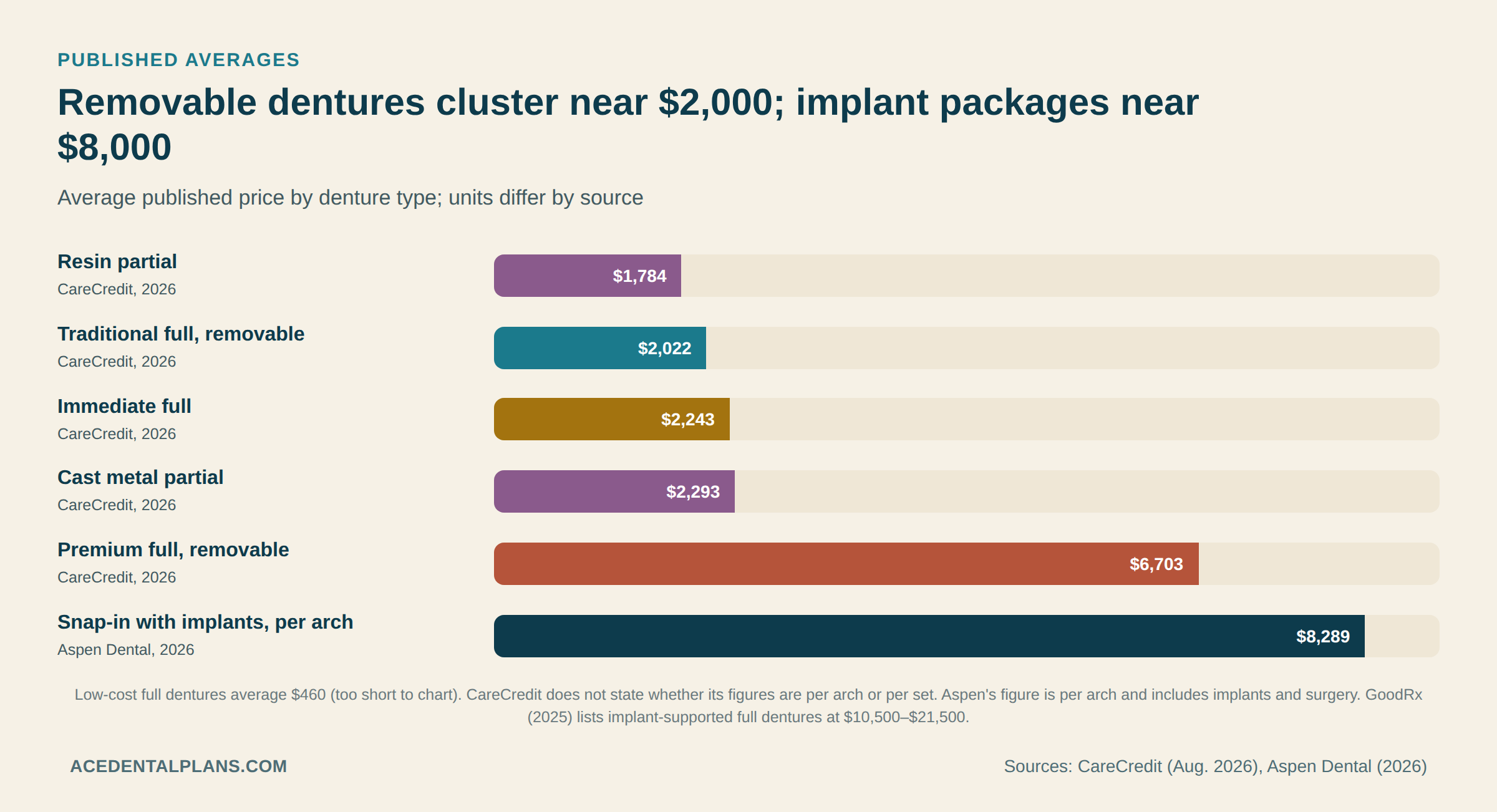
Three things stand out. First, removable dentures cluster around $2,000 in two independent sources, and the spread inside any one type is wide: CareCredit’s traditional full range is $1,493 to $3,309, a gap of more than $1,800. Second, a metal partial can cost more than a full denture, so “partial” does not mean “cheaper.” Third, anything with implants belongs to a different price class, and the unit changes too. Aspen quotes per arch with implants included, CareCredit quotes fixed implant-supported dentures per implant, and GoodRx quotes whole implant-supported full dentures.
The unit is the trap. Aspen’s $8,289 is per arch, so two arches would be $16,578 by simple multiplication, which sits inside GoodRx’s $10,500 to $21,500 range for implant-supported full dentures. Meanwhile CareCredit’s $2,540 for a snap-on denture is a fraction of that, and its page doesn’t say whether implants are included. Neither is wrong, and both can be quoted in a headline, so always ask what a number includes before comparing it with another one.
Reading a Denture Estimate: Codes, Lines and a Worked Example
Treatment plans and insurance explanations use ADA procedure codes, called CDT codes, that start with D. The code and its descriptor tell you exactly what the office intends to bill, and they are what the insurer sees. The guide to CDT codes on your bill explains how the system works. Table 3 lists the ones that most often appear on a denture estimate. The descriptors are shortened from the Delta Dental Patient Direct fee schedule effective November 1, 2025, and the fees are left out on purpose, since dollar amounts belong in the cost guides.
| Code | Descriptor (shortened) | What it means on your estimate |
|---|---|---|
| D5110 / D5120 | Complete denture, maxillary / mandibular | A conventional full denture for the upper or lower jaw |
| D5130 / D5140 | Immediate denture, maxillary / mandibular | A full denture placed the day the last teeth are removed |
| D5211 / D5212 | Partial denture, resin base, with clasps, rests and teeth | An acrylic-base partial, upper or lower |
| D5213 / D5214 | Partial denture, cast metal framework with resin denture bases | A metal-framework partial, upper or lower |
| D5225 / D5226 | Partial denture, flexible base | A flexible-base partial, upper or lower |
| D5410 to D5422 | Adjust complete or partial denture, maxillary or mandibular | A visit to relieve a sore spot or fine-tune the fit |
| D5730 / D5731 | Reline complete denture, chairside | A reline completed at the office |
| D5750 / D5751 | Reline complete denture, laboratory | A reline completed by sending the denture to a lab |
| D5710 / D5711 | Rebase complete denture | A separate procedure from a reline; ask what it involves |
| D5850 / D5851 | Tissue conditioning | A soft lining used to ease sore tissue |
| D5863 / D5865 | Overdenture, complete, maxillary / mandibular | A denture designed to fit over remaining teeth or implants |
| D6110 / D6111 | Implant/abutment-supported removable denture for edentulous arch | A snap-on style denture, not including the implants themselves |
| D6114 / D6115 | Implant/abutment-supported fixed denture for edentulous arch | A fixed denture attached to implants |
| D7140 / D7210 | Extraction, erupted tooth; extraction requiring bone removal or sectioning | A simple extraction versus a surgical one, priced separately |
Two reading habits pay off. First, check that the tooth arch matches the code: D5110 and D5120 are different lines, which is why a “full set” appears as two items. Second, look for what has no code yet. The implant placement itself has its own codes (surgical placement, abutments, bars and so on), so an estimate for a snap-on denture with no implant lines is describing only part of the treatment.
What sits outside the denture line
The denture is rarely the only entry. GoodRx lists an oral exam at about $75 to $100 or more, a panoramic X-ray at about $130, and extractions at about $300 each as typical separate charges. Extraction pricing is its own subject, covered in tooth extraction cost. GoodRx also lists tissue conditioning at an average of $190 and says adjustments, about $100 each, may be included in the original cost. CareCredit’s page says its denture averages exclude consultation fees, insurance coverage and maintenance or repair. The pattern is consistent: the denture line is the headline and the lines around it are the surprise.
Before you compare an estimate with anyone else’s, check six things:
- The unit: per arch or per set.
- Whether extractions and imaging are inside the number.
- How many adjustment visits are included, and for how long.
- Whether a reline or remake is part of an immediate plan.
- Who the lab is and whether a separate lab fee applies. The Swinomish clinic requires a signed lab fee agreement before work proceeds.
- What the warranty says about breakage and remakes.
Dental Plans and Dentures: From Plan Type to the Annual Maximum
Dental insurance rules for dentures follow the same order as every other major service. Start with the plan type, then the deductible and network, the coinsurance, and the annual maximum. Last come the exclusions and limits that can override everything else. The guides on how dental insurance works and what dental insurance may cover go through those steps for all services, and the broader dental insurance guide covers plan types in depth. Here is how the pieces apply to dentures specifically.
Tier and percentage
Humana describes a 100/80/50 pattern. Preventive care is covered at up to 100%, basic procedures such as fillings at up to 80%, and major restorative work such as crowns and dentures at up to 50%, all after the deductible and usually for in-network care. Blue Cross Blue Shield of North Carolina says the same thing in its own words: dentures are a major service, and after the deductible the insurer will typically pay half. A specific plan can differ. The MetLife dental plan summary for Old Dominion University’s research foundation, 2026–27, lists “Type C: Major Restorative (bridges, dentures)” at 50% in network and 40% out of network.
Waiting periods, maximums and frequency limits
Humana says waiting periods for major work range from three months to a year. Blue Cross NC says a wait of up to a year may apply before denture coverage begins. Humana puts typical annual maximums at $1,000 to $2,000, and notes that dental HMOs normally have none. The MetLife summary shows how several limits stack. A $25 individual deductible applies to basic and major services, a $2,000 annual maximum is shared by those two tiers, and denture or bridge replacement is limited to one every 10 years. Blue Cross NC says replacement dentures may be covered every five to eight years, and advises checking with the plan to confirm.
The clauses that surprise people
- Alternate benefit. The MetLife summary says that when two or more professionally acceptable treatments exist, reimbursement is based on the least costly alternative. A plan may therefore base payment on a resin partial even if you choose a flexible one.
- Missing-tooth clause. The same summary covers initial placement to replace natural teeth lost while covered, and excludes initial installation of a denture or implant for teeth missing before coverage began (except congenitally missing teeth). The ADA says some group plans exclude preexisting conditions such as missing teeth, and that the exclusion period must be reduced by any prior creditable coverage.
- Adjustment limits. The MetLife summary excludes adjustments made within six months by the same dentist. Check whether early adjustments are the dentist’s responsibility or the plan’s.
- Not necessary, or late. Blue Cross NC lists dentures not considered clinically necessary, dentures obtained before the plan began, late premiums and missed appointments among situations where coverage may not apply.
- Not a promise. Delta Dental says nothing on its site guarantees eligibility, coverage or payment, and that your plan documents control. Some plans require pre-authorization.
The practical step is a predetermination: ask the office to send the plan the codes and fees from Table 3 before treatment starts, then compare the plan’s response with the written estimate. Humana says only about 2% to 4% of Americans reach their annual maximum in a year. A denture bill is the kind that can push a patient into that group, as the second example shows.
Medicare, Medicaid, the VA and Health Centers
If a dental plan won’t cover most of the bill, the next question is whether a public program might. Table 4 sets out what each source says, and the third column turns it into a question to ask.
| Program | What the source says | What to check for a denture |
|---|---|---|
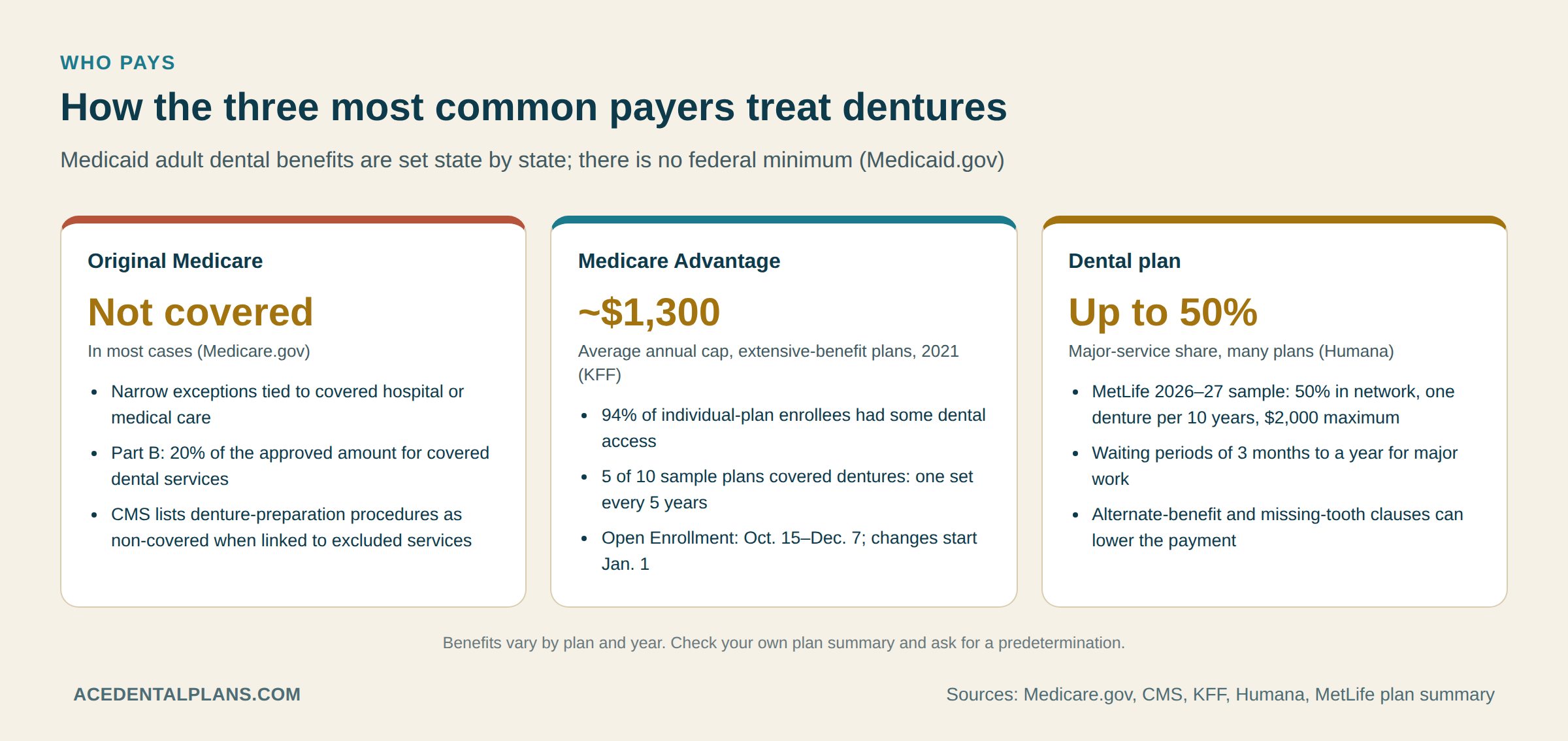
| Original Medicare | Medicare.gov: doesn’t cover items like dentures and implants in most cases; exceptions are tied to covered hospital stays or medical treatment. CMS lists preparing the mouth for dentures (alveoplasty, ridge reconstruction, frenectomy, torus palatinus removal) as non-covered when done in connection with excluded services | Whether the work is linked to a covered medical treatment, and which items were excluded |
| Medicare Advantage | KFF, 2021: 94% of individual-plan enrollees were in a plan with some dental coverage; among those with more extensive benefits, 78% had an annual cap averaging about $1,300. In KFF’s 10 sample plans, five covered dentures, each limiting coverage to one set every five years | The plan’s annual cap, waiting period, network and denture frequency limit; plan benefits change each year |
| Medicaid (adults) | Medicaid.gov: states decide adult dental benefits and there are no minimum requirements. CareQuest: as of Dec. 31, 2022, seven states plus D.C. offered an extensive adult benefit, and complete dentures were among the services most commonly added in 2020–2022 | Your state’s covered services, annual limit, replacement frequency and which dentists accept the program |
| Dual-eligible (Medicare and Medicaid) | CMS: some states may cover routine dental services for people eligible for both programs | Ask the state Medicaid agency directly |
| VA dental care | VA: Classes I, IIC and IV may qualify for any needed dental care; other classes qualify for limited or one-time care; a VA Dental Insurance Program is available at reduced cost to enrollees who don’t qualify | Your eligibility class; the VA page doesn’t mention dentures by name |
| Community health centers | HRSA: health centers provide primary and preventive care regardless of ability to pay | Whether the center offers dental services and makes dentures or refers out |
Original Medicare
The statement is short. Medicare.gov says Original Medicare generally doesn’t cover routine cleanings, fillings or tooth extractions, or items like dentures and implants. The limited exceptions are dental services during a hospital inpatient stay, or services linked to covered treatment such as exams before a heart valve replacement or certain cancer treatments. When Part B does pay for a covered dental service, the patient pays 20% of the Medicare-approved amount after the Part B deductible. The longer explanation of who qualifies and what the exceptions mean is in does Original Medicare cover dental care.
Medicare Advantage and the October window
Medicare Advantage plans are where most Medicare-based dental coverage comes from, and the KFF figures in Table 4 rest on 2021 benefit data. Plans change every year, so read them as a pattern, not a prediction. Medicare.gov says Open Enrollment runs from October 15 to December 7. You can join, drop or switch a Medicare Advantage plan, or move between Original Medicare and Medicare Advantage, and changes take effect January 1 of the next year.
If you expect dentures in 2027, the weeks between now and December 7 are the natural time to read each candidate plan’s dental benefit page. What to compare: is a complete denture listed, what is the copayment or coinsurance, what is the annual cap, is there a waiting period, and does the plan include your dentist? The guides to Medicare Advantage dental coverage and comparing dental benefits at open enrollment walk through that comparison. The category hub for dental insurance and plans collects the rest.
Medicaid, the VA and health centers
Medicaid.gov says plainly that states have flexibility to determine what dental benefits are provided to adults and that there are no minimum requirements. In practice, dentures could be fully covered, partly covered or not at all, depending on the state. CareQuest counted seven states plus the District of Columbia offering an extensive adult benefit at the end of 2022 (Alaska, Iowa, Maine, Montana, New Jersey, Oregon and Wisconsin). It also noted that 32 states had no annual limit on dental spending per member. The VA’s page lists the eligibility classes and a reduced-cost insurance program but doesn’t mention dentures. HRSA says health centers provide primary and preventive care regardless of ability to pay, which makes a call to the nearest one a reasonable early step.
Paying for Dentures Without Insurance: Where the Real Choices Are
When coverage runs out or never existed, the choices are mostly about sequence and structure. The broader playbook is in dental care without insurance, and the eight payment routes are compared in how to pay for expensive dental work. Three points apply to dentures in particular.
Ask the dentist to phase the work. Denture treatment has natural stages: extractions, healing, impressions, delivery, adjustments. Each is a billable line at its own time. Ask the office when each charge falls due, and whether it will quote one arch first. A patient paying on a plan needs that calendar anyway, and a patient paying cash gains time.
Compare structures, not only prices. A dental savings plan changes the fee schedule rather than paying a claim, which is the subject of dental savings plans and what they save. A payment plan spreads a fee over months, and a financing product adds interest rules. The difference between those is explained in dental financing versus payment plans, and the section on deferred interest there is worth reading before you sign anything. For a view of how a no-insurance year of dentistry adds up, dental costs without insurance walks through it.
Make the phone call specific. A call that starts with “how much are dentures?” gets a range or a pitch. A call that lists what you need gets a number you can compare. Try: “I’m looking at a full upper and a lower partial. Is your fee per arch? Do the extractions, exam and X-rays sit inside it? How many adjustment visits are included, and for how long? Is there a lab fee? If I pay in cash or in stages, does the price change?” Write the answers down with the date and the name of the person who gave them, then ask for the same figures on the written treatment plan.
Use the tax rules if they fit. IRS Publication 502 (2025) says you can include in medical expenses the amount you pay for artificial teeth. Only the medical and dental expenses above 7.5% of your adjusted gross income can be deducted. For many households that threshold is too high to matter, but a large denture bill in a year with other medical costs can change the math. Whether an HSA or FSA can pay for dentures depends on your account’s rules, and HSA vs FSA for dental expenses explains how to check.
Alternatives to Dentures: Bridges, Single Implants and Implant Overdentures
Dentures aren’t the only way to replace teeth, and a good estimate often shows more than one route. Table 5 lines up the options a dentist may raise, using what the sources say about each. It is not a ranking. Which route fits depends on how many teeth are missing, which ones, the health of the neighbors and the bone, and what you can spend.
| Option | What it needs | Removable by the wearer? | What the sources say | Price class (published) |
|---|---|---|---|---|
| Complete denture | A toothless arch; healed tissue for a conventional denture | Yes | Rests on gums and palate or lower ridge; may shift or slip (Cleveland Clinic) | $2,022 average, traditional full (CareCredit, 2026) |
| Partial denture | Healthy remaining teeth to hold the clasps | Yes | Helps stop natural teeth from shifting (CareCredit); fit depends on those teeth (Cleveland Clinic) | $1,780 to $2,293 averages (CareCredit, 2026) |
| Fixed bridge | Sound neighboring teeth for support | No; only a dentist can remove it | Also called a fixed partial denture; made of gold, alloys, porcelain or a combination (ADA) | Priced by unit; see the bridge cost guides |
| Single implant with crown | Enough jawbone; grafts can add volume | No | Replaces both the root and the tooth (MedlinePlus) | Costs more than dentures (Cleveland Clinic); see implant cost guides |
| Implant overdenture (removable) | Enough bone for usually two or more implants | Yes | Two-implant lower overdentures outperform conventional dentures on satisfaction and chewing in a 2018 review | Aspen Dental, 2026: $8,289 per arch with implants |
| Fixed implant-supported denture | Enough bone for the implants, often four for a full arch | No | All-on-4 uses four implants for an arch (Cleveland Clinic) | GoodRx, 2025: $10,500 to $21,500 for implant-supported full dentures |
Bridge or partial denture
The ADA describes a fixed bridge as attached to surrounding teeth for support, which means those teeth must be sound enough to carry it. A partial denture also uses neighbors, through clasps, but sits on the gums as well and can be taken out. For one or two missing teeth with healthy neighbors, a bridge is a common comparison point. The price of each design, and how it changes with the number of teeth, is in dental bridge cost by type and teeth, and cash-pay prices and the plan rules that affect them are in dental bridge cost without insurance.
Single implants
MedlinePlus says that in some cases your dentist may suggest switching to dental implants, and describes them as permanent replacements for both roots and teeth. The Clinic is blunt about the trade: implants cost more than dentures. For one missing tooth, the comparison with a partial or a bridge turns on neighboring teeth and bone, not on the denture itself. The price breakdown is in dental implant cost for a single tooth.
Implant overdentures
For people who have worn a lower denture and found it loose, the research already described points to the two-implant overdenture as a middle route between a conventional denture and a fixed arch. The Michigan handout says as much in plain language: ask your dentist about implants if lower-denture problems continue. Whether that is worth the extra surgery and expense is a personal and clinical call, and a dentist with implant training is the person to answer it.
What waiting does
One option is simply to delay. According to the Clinic, the jawbone gradually shrinks following tooth loss, and the ADA notes that losing all your teeth can cause facial muscles to sag. Neither source describes how fast that happens in an individual, so there’s no honest deadline to offer. If cost is the reason to wait, ask the dentist whether a staged plan or a temporary appliance can protect your options in the meantime.
Choosing Who Makes Your Dentures: General Dentist, Prosthodontist or Denturist
Most dentures are made by general dentists working with a dental laboratory. Three other routes exist, and each has its own questions.
Prosthodontists
The American College of Prosthodontists says the ADA recognizes prosthodontics as a dental specialty and that prosthodontists complete three years of advanced training in restorative dentistry after dental school. The specialty treats missing or damaged teeth using crowns, bridges, implants and complete or partial dentures, along with bite problems and maxillofacial work. A referral can make sense when the case is complex: severe bone loss, a full-arch implant plan, or repeated problems with prior dentures. It is not a requirement for an ordinary denture.
Denturists, where licensed
A denturist is a separately trained and licensed provider in states that allow the profession. The Washington State Department of Health requires applicants to complete formal denturism training, with a major course of study of at least two years at a board-recognized institution. Applicants must also pass written and clinical exams, and the state lists endorsement pathways from Maine, Montana, Oregon and Arizona. A 2023 Idaho licensing analysis compared state requirements. Montana asked for two years of formal education plus a clinical internship of at least one year, 2,000 clock hours in total. Oregon asked for an associate degree in denture technology plus 1,000 hours of supervised clinical practice, and Washington for a program of at least two years. The same analysis listed Alaska, Nevada, South Dakota, Utah and Wyoming as states that do not license denturists.
What follows from that? Availability and scope vary by state, and the Idaho analysis notes that in Washington, dentists, and dental labs and technicians working under a dentist’s written prescription, may practice denturism without a denturist license. Check your state dental board for who may legally make and fit dentures, what a denturist there may and may not do, and how to verify a license. Don’t assume a rule from one state applies in another.
Questions that apply to any provider
- Who will make the denture, and is the lab inside the office or outside? (A fee agreement for lab work is part of the Swinomish clinic’s first appointment.)
- How many try-in visits are normal for this office, and what happens if the try-in isn’t right?
- What does the written warranty cover? Aspen Dental’s implant-denture page, for example, lists a 7-year warranty on the snap-in denture. Its money-back guarantee covers the permanent denture only, with a refund request due within 90 days of the final insert. That’s one chain’s terms, shown here as an example of how specific the language gets, not as a standard.
- Who handles follow-up adjustments, and for how long are they included?
Questions to Ask Before You Agree to a Denture Plan
The questions below are grouped by what they protect. Put the answers on the written treatment plan, with procedure codes where the office uses them.
About the denture
- Which type is proposed (conventional, immediate, partial, overdenture, implant-retained, fixed), and why this one for my mouth?
- What is the base made of, and what are the teeth made of?
- Will you give me a price for the other realistic option, so I can compare?
About the process
- How many appointments, and over how many weeks, from extraction (if any) to delivery?
- If teeth come out, will I have a temporary denture while the tissue heals?
- What will I be able to eat on the first day, the first week and after a month?
About the money
- Is the fee per arch or for a set, and are extractions, exam, X-rays and anesthesia inside it?
- When is each payment due, and is there a deposit?
- Are adjustments included, for how long, and what do later relines or a remake cost?
- Can you submit a predetermination to my plan and tell me what the plan’s allowed amount, remaining maximum and frequency limit are?
About aftercare
- Which cleanser and adhesive do you recommend for this denture material?
- How should the denture be stored overnight?
- When should I come back for a fit check, even if nothing hurts?
More guides on treatments and the choices around them are collected in the dental treatments category.
Bottom Line
Dentures are a family of appliances, not a single product, and every answer in this guide depends on which member of the family is meant. A conventional full denture, an immediate one, a clasp-retained partial and an implant-retained overdenture differ in timing, fit, upkeep and price class. The first useful step is to get the type and the unit named in writing.
The weeks after delivery matter as much as the procedure itself. Sore spots, looseness and an unfamiliar bite are common and are handled with follow-up visits, not with glue, self-adjustment or waiting out an ulcer. The daily routine is short: clean the denture, rest the gums, check the fit, and keep the dental visits even when the teeth are gone.
On money, the numbers span from a few hundred dollars to five figures because the services differ, not because the market is chaotic. Compare estimates only when they line up on units and inclusions. Ask the plan for a predetermination, read the clauses on alternate benefits, replacement limits and missing teeth, and check whether the timing of extractions and delivery crosses a plan year. If you are on Medicare, the October enrollment window is the moment to read dental benefit pages, with the expectation that Original Medicare will not pay and Medicare Advantage plans vary widely.
Last, a denture is a device with a limited life. Plan for adjustments, expect a reline or replacement at some point, and treat a change in fit as a reason to call, not a reason to tolerate.
Frequently Asked Questions
What are the different types of dentures?
The ADA’s patient site lists three kinds. Conventional dentures are made after teeth are removed and the tissue has healed. Immediate dentures are placed the same day as extractions, and overdentures fit over a few remaining teeth or implants. Partial dentures replace some teeth and use clasps on the rest. Implant-retained dentures snap onto implants, and fixed implant-supported dentures attach to implants and are removed only by a dentist.
How long does it take to get dentures after teeth are pulled?
For a conventional denture, Delta Dental says at least six to eight weeks, and the ADA says healing may take several months. An immediate denture is placed the same day, using measurements taken beforehand. A tribal clinic’s published process says a permanent denture after an immediate one is started about three to six months later. Your dentist sets the actual timetable, so ask for the calendar in writing.
How long does it take to get used to dentures?
The ADA says new dentures may feel awkward for a few weeks. Cleveland Clinic guidance says getting used to them can take weeks or sometimes months, varying by person, with several adjustments often needed in the first couple of weeks. Extra saliva, a feeling of looseness and minor soreness are common early on. Sores that persist or have not healed after 10 to 14 days (South Australian Dental Service) deserve a call to the dentist.
Can I eat normally with dentures?
Eventually, many people eat a wide range of foods, but the start is gradual. The Delaware Division of Public Health says to begin with soft foods cut into small pieces, chew on both sides, and avoid very sticky or hard foods and chewing gum while you adjust. MedlinePlus adds that dentures may reduce your ability to sense hot foods and to notice bones, so check temperature and bones yourself.
Should I sleep with my dentures in?
Most U.S. sources say no. According to the Clinic, most people sleep without them to rest the gum tissue, recommends at least eight hours out each day, and suggests soaking overnight in cool water or denture solution. MedlinePlus says to remove them at night. A 2015 review in the Journal of Dental Research reported about double the pneumonia risk with night-time wear in very old persons. Follow your dentist’s instructions, especially in the first days after an immediate denture.
How do I clean my dentures?
Remove them, then clean over a towel or a sink partly filled with water. Brush all surfaces with a soft brush made for dentures and hand soap, mild dishwashing liquid or denture cleanser, as the Cleveland Clinic advises, and rinse thoroughly. Avoid regular toothpaste, hot or boiling water, bleach and whitening toothpaste, because they can scratch, warp or weaken the plastic. Rinse after meals, and brush your gums, tongue and any natural teeth too.
Is denture adhesive safe?
Used as labeled, the FDA says it has not found conclusive evidence of problems. It does warn that excess zinc in the body can cause nerve damage, and that case reports linked numbness and tingling to heavy use of zinc-containing products. Use a small amount, expect a 2.4-ounce tube to last seven to eight weeks, consider a zinc-free product, and stop and see your physician if you notice numbness or tingling. Frequent adhesive use is also a reason for a dentist to check the fit.
How much do dentures cost?
Published U.S. averages for 2026 from CareCredit run from $460 for a low-cost full denture to $2,022 for a traditional one and $6,703 for a premium one, with partials from $1,780 to $2,293. Aspen Dental’s 2026 average for a snap-in implant denture is $8,289 per arch with implants. Units differ across sources, and extractions, exams and follow-up visits can be separate lines, so use Table 2 and a written estimate.
Does dental insurance cover dentures?
Often in part. Humana says major work such as crowns and dentures is covered at up to 50% on many plans, with waiting periods of three months to a year. The MetLife summary cited above lists 50% in network and one replacement every 10 years. Annual maximums, alternate-benefit clauses and missing-tooth exclusions can reduce what a plan pays. A predetermination shows the plan’s own figures before you commit.
Does Medicare cover dentures?
Original Medicare generally does not, according to Medicare.gov, which lists items like dentures and implants among those not covered, with narrow exceptions tied to covered medical treatment. Some Medicare Advantage plans include dental benefits, usually with annual caps; KFF found an average cap of about $1,300 in 2021 among plans with more extensive benefits. Read each plan’s own summary during Open Enrollment, October 15 to December 7.
Does Medicaid cover dentures?
It depends on the state. Medicaid.gov says states decide what dental benefits adults receive and there are no minimum requirements. CareQuest reported that complete dentures were among the services states most often added to adult benefits from 2020 to 2022, and that seven states plus D.C. had an extensive adult benefit at the end of 2022. Your state Medicaid agency can tell you what applies now.
What is the difference between immediate and conventional dentures?
Timing and fit. An immediate denture is placed the same day the teeth are removed, so you are never without teeth, but the ADA says it may need a reline or remake after the jaw heals. A conventional denture is made after healing, which takes weeks to months, and fits the settled tissue better at delivery. CareCredit’s 2026 averages put immediate dentures at $2,243 against $2,022 for conventional ones.
Why do my new dentures hurt?
Pressure points are common early on, and the ADA calls minor irritation or soreness not unusual. Dentures that rub need a dentist’s adjustment; the Cleveland Clinic warns against adjusting them yourself. Wearing the denture for 24 hours before the appointment helps the dentist find the spot, per the South Australian service. Michigan’s handout also cautions that numbing ointments used too long can hide a problem and cause larger sores.
Is a partial denture the same as a bridge?
No. A partial is removable and uses clasps on remaining teeth, according to the Cleveland Clinic. A fixed bridge is attached to surrounding teeth for support, and only a dentist can remove it, per the ADA, which also calls it a fixed partial denture. A partial can be added to later, since fee schedules list a code for adding a tooth to an existing partial, while a bridge depends on sound anchor teeth.
Can a snap-on denture replace a regular one?
For people with enough jawbone, yes, and the research favors lower overdentures on two implants over conventional dentures for satisfaction and chewing, according to a 2018 review. The Cleveland Clinic says implants cost more, need healing of about three to six months, and carry surgical risks that are usually minimal. The overdenture itself is typically replaced every 15 to 20 years.
Are dentures tax deductible?
They can be part of deductible medical expenses. IRS Publication 502 (2025) says you can include the amount you pay for artificial teeth, but only the total medical and dental expenses above 7.5% of adjusted gross income are deductible. Whether a given household benefits depends on its income and other medical costs, so a tax professional can say how it works for you.
Who can make dentures: a dentist or a denturist?
Dentists and, in some states, licensed denturists. The American College of Prosthodontists describes prosthodontists as specialists who complete three more years of training after dental school and treat complete and partial dentures. Washington State requires denturists to complete at least two years of formal training and pass exams, but not every state licenses the profession, so check your state dental board.
What happens if my dentures feel loose later?
A loose denture is a reason to see a dentist, not to add more adhesive. Cleveland Clinic guidance lists looseness, pinching, clicking when you speak, damage or discoloration, and an age over 10 years as signs to call. The American College of Prosthodontists says relines, rebases and remakes should follow a full examination. Never repair a denture with glue or a kit.
What is a flipper denture?
A flipper is a custom-made partial denture, usually for one or two missing teeth. CareCredit’s 2024 guide describes it as lightweight and easy to insert and remove, but says it can break easily and is usually a temporary solution, for example while waiting for an implant. Because it is lightly built, ask the dentist whether it is meant as an interim appliance or something you would wear for years.
Do I still need dental visits if I have no natural teeth?
Yes. The University of Michigan’s instructions say to keep regular dental visits even without natural teeth, because the dentist also checks for oral cancer. The Clinic recommends regular check-ups to protect gum health and confirm denture fit. Visits are also when a reline, a worn tooth or a changing bite gets noticed before it becomes a sore or a break.
Sources and Disclaimers
Clinical and process descriptions in this article come from the ADA’s MouthHealthy pages, MedlinePlus, the FDA, the CDC, the American College of Prosthodontists, the Cleveland Clinic, state and university patient materials, and peer-reviewed or published reviews. Coverage rules come from Medicare.gov, CMS, Medicaid.gov, KFF, CareQuest, the VA, HRSA and the IRS, plus plan documents and insurer pages from MetLife (a specific employer plan), Humana, Blue Cross Blue Shield of North Carolina and Delta Dental. Prices come from consumer cost surveys and pricing pages (CareCredit, GoodRx) and one dental chain (Aspen Dental), and procedure codes from a published discount-plan fee schedule. All worked examples, estimates, timelines and the food ladder are original illustrations built for this article and are labeled hypothetical. National averages blend very different practices, the figures in Table 2 use different units, and several pages did not say whether a figure is per arch or per set. Check prices with your dentist in writing and benefits with your insurer before treatment.
- American Dental Association (MouthHealthy) — Dentures
- American Dental Association (MouthHealthy) — Bridges
- American Dental Association — Typical Dental Plan Benefits and Limitations
- MedlinePlus — Dentures
- Centers for Disease Control and Prevention (NCHS) — Prevalence of Tooth Loss Among Older Adults, Data Brief No. 368
- U.S. Food and Drug Administration — Denture Adhesives
- American College of Prosthodontists — Position Statement: What Is a Prosthodontist and the Dental Specialty of Prosthodontics
- American College of Prosthodontists — Position Statement: The Frequency of Denture Replacement
- Cleveland Clinic — Dentures
- Cleveland Clinic — Denture Care
- Cleveland Clinic — Implant-Supported Dentures
- Delta Dental — Dentures
- Delaware Division of Public Health — Denture Care Patient Information
- University of Michigan, Hospital Dentistry — Immediate Denture Instructions
- South Australian Dental Service — Dentures
- Swinomish Indian Tribal Community Dental Clinic — Denture Fabrication: A Step-by-Step Guide
- Gerodontology (PubMed) — The McGill Consensus Statement on Overdentures: Mandibular Two-Implant Overdentures as First Choice Standard of Care for Edentulous Patients (2002)
- Journal of Prosthodontic Research (PubMed) — A Systematic Review of Studies Comparing Conventional Complete Denture and Implant Retained Overdenture (2018)
- Journal of Dental Research (PubMed Central) — Müller F., Oral Hygiene Reduces the Mortality from Aspiration Pneumonia in Frail Elders (2015)
- Frontiers in Nutrition — Effects of Dental Implants and Nutrition on Elderly Edentulous Subjects: Protocol for a Factorial Randomized Clinical Trial (2022)
- Medicare.gov — Dental Services
- Medicare.gov — Open Enrollment
- Centers for Medicare & Medicaid Services — Medicare Dental Coverage
- Medicaid.gov — Dental Care
- KFF — Medicare and Dental Coverage: A Closer Look
- CareQuest Institute for Oral Health — Five Key Takeaways About Medicaid Adult Dental Benefits
- U.S. Department of Veterans Affairs — Dental Care
- Health Resources and Services Administration — Health Center Data
- Internal Revenue Service — Publication 502, Medical and Dental Expenses (2025)
- Humana — What Does Dental Insurance Cover?
- MetLife via Old Dominion University Research Foundation — MetLife Dental Plan Summary, 2026–27
- Blue Cross and Blue Shield of North Carolina — Does Insurance Cover Dentures?
- Delta Dental Patient Direct — General Dentist Fee Schedule, effective November 1, 2025
- CareCredit — How Much Do Dentures Cost? (August 2026)
- CareCredit — Types of Dentures (December 2024)
- GoodRx — Cost of Dentures (February 2025)
- Aspen Dental — Implant Dentures Cost
- Washington State Department of Health — Denturist Licensing Requirements
- Idaho Division of Occupational and Professional Licenses — Denturist Prospective Analysis (2023)
Important Information and Disclaimers
This article is general educational information. By using it, you accept the limits described below.
Not dental or medical advice
Nothing on this page is a diagnosis, a treatment recommendation or a substitute for an examination by a licensed dentist or physician. Reading this article does not create a dentist-patient or doctor-patient relationship. Only a licensed professional who has examined you and reviewed your history can tell you what your mouth needs. Do not delay, skip or stop professional care because of something you read here.
Prices are estimates, not quotes
Cost figures are ranges reported by the third-party sources cited in this article. Actual prices depend on your location, the provider, the complexity of your case, the materials used, the date of service and other factors, so what you pay may be higher or lower. A written treatment plan and fee estimate from the dental office is the only reliable number for your situation.
Insurance and plan examples are illustrations
Examples that use named amounts or percentages are hypothetical. Real benefits depend on your plan, network, waiting periods, annual maximum, deductible and the insurer’s rules at the time of treatment. A pre-treatment estimate or benefits check is not a promise of payment. Confirm the details with your insurer or plan administrator in writing.
Not insurance, legal, tax or financial advice
AceDentalPlans is an information publisher. Nothing here is insurance, legal, tax, investment or other professional financial advice, and nothing here recommends a particular provider, insurer, lender, discount plan or financing product. Company and product names belong to their owners and appear for identification only. Read the terms of any loan, financing offer or plan before you sign, and ask a qualified professional if you need advice on your own circumstances.
Third-party sources
This article cites government agencies, professional associations, insurers, lenders and other outside organizations. We do not control those sources. Their content can change, move or disappear, and listing a source is not an endorsement of it or of anything it sells.
No warranty
We aim for accuracy, but this article is provided “as is,” without warranties of any kind, express or implied, including warranties of accuracy, completeness, timeliness or fitness for a particular purpose. Some information may be out of date or contain errors by the time you read it.
Limitation of responsibility
To the fullest extent permitted by law, AceDentalPlans and its owners, authors and contributors are not responsible or liable for any loss, cost, injury, health outcome or other damage that results from using this article or relying on it. You are responsible for your own decisions about your care, your coverage and your money.
How this article is written
This article follows AceDentalPlans’ answer-first, U.S.-focused editorial approach. It uses conditional language for insurance, because coverage depends on the specific plan, and it names its sources so that you can read them yourself.