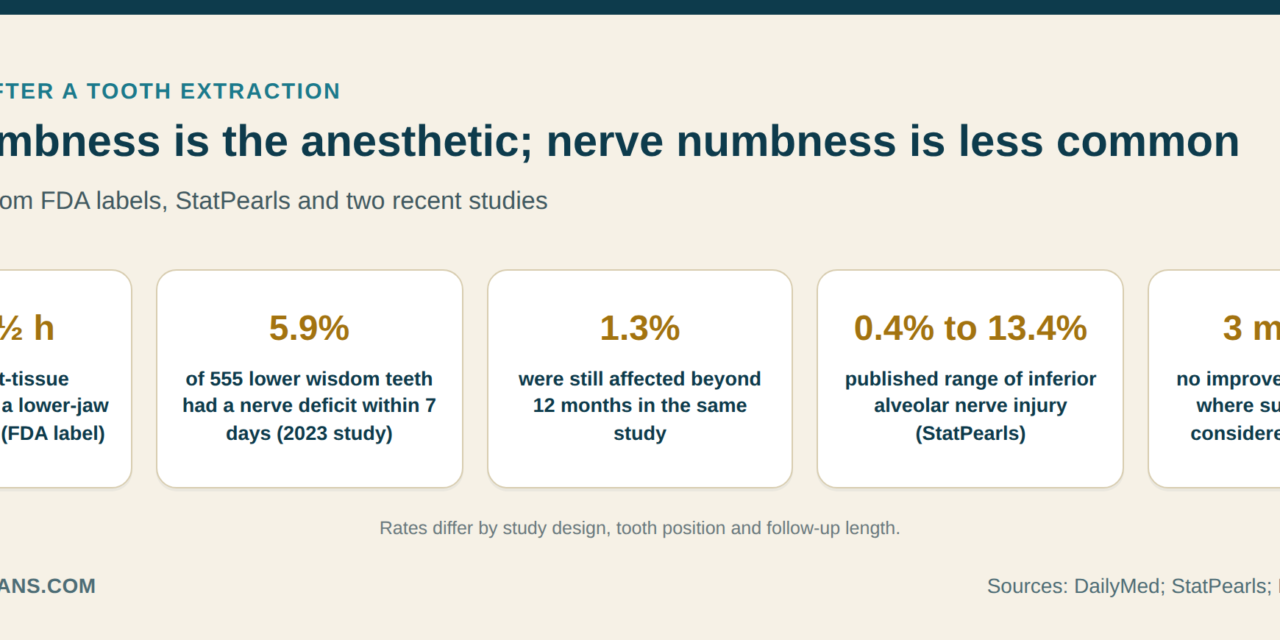
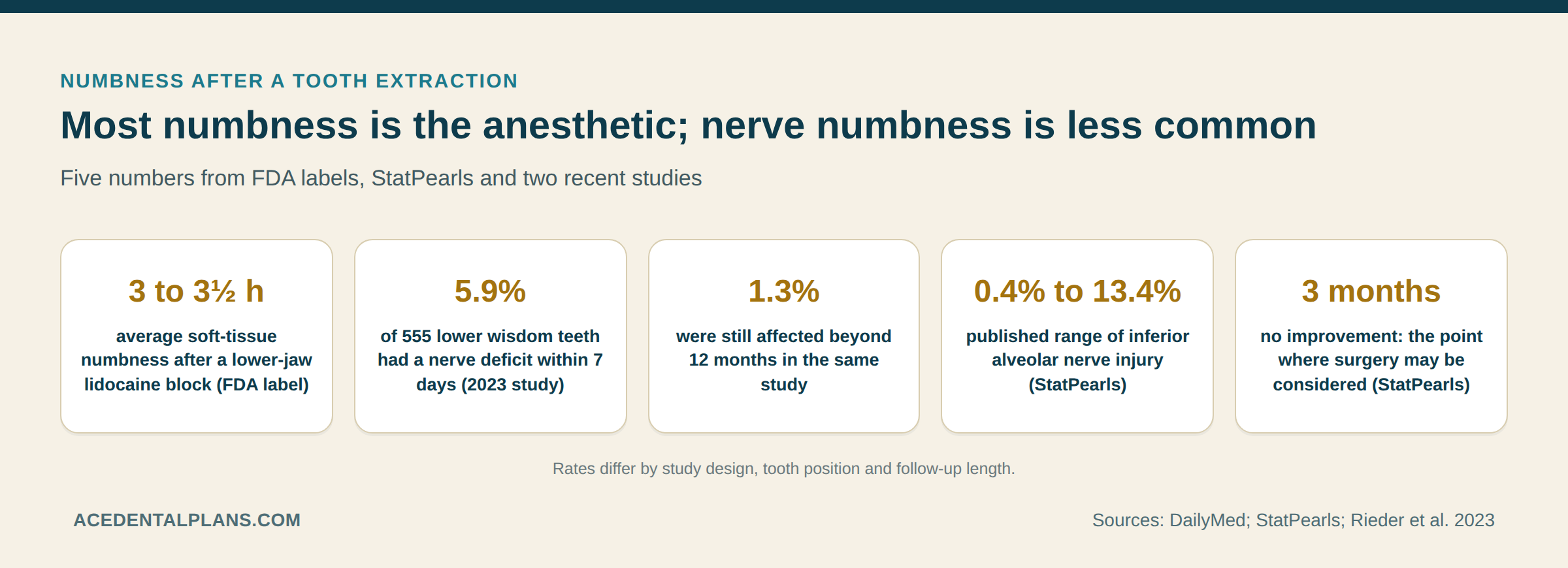
Numbness right after a tooth extraction is usually the anesthetic wearing off, and it fades within about 3 to 3½ hours after a typical lower-jaw lidocaine block, longer with some drugs. Numbness that outlasts the anesthetic is uncommon. In a 2023 study of 555 lower wisdom teeth, 5.9% had a nerve deficit in the first week and 1.3% were still affected after 12 months. Call the surgeon if feeling is not returning.
This article covers the normal course of numbness after extraction and why lower molars and wisdom teeth carry nerve risk. It reports published rates and recovery timelines, sorts symptoms into call now and watch, and describes what an oral surgeon checks and may do. It also covers protecting the lip and tongue, eating, records and the cost questions that follow. General anesthetic durations after any dental work have their own page, and extraction prices are linked rather than repeated.
Key Takeaways
- Two kinds of numbness exist. Anesthetic numbness fades within hours, while nerve-related numbness shows up as feeling that is missing, altered or painful after the anesthetic should have worn off.
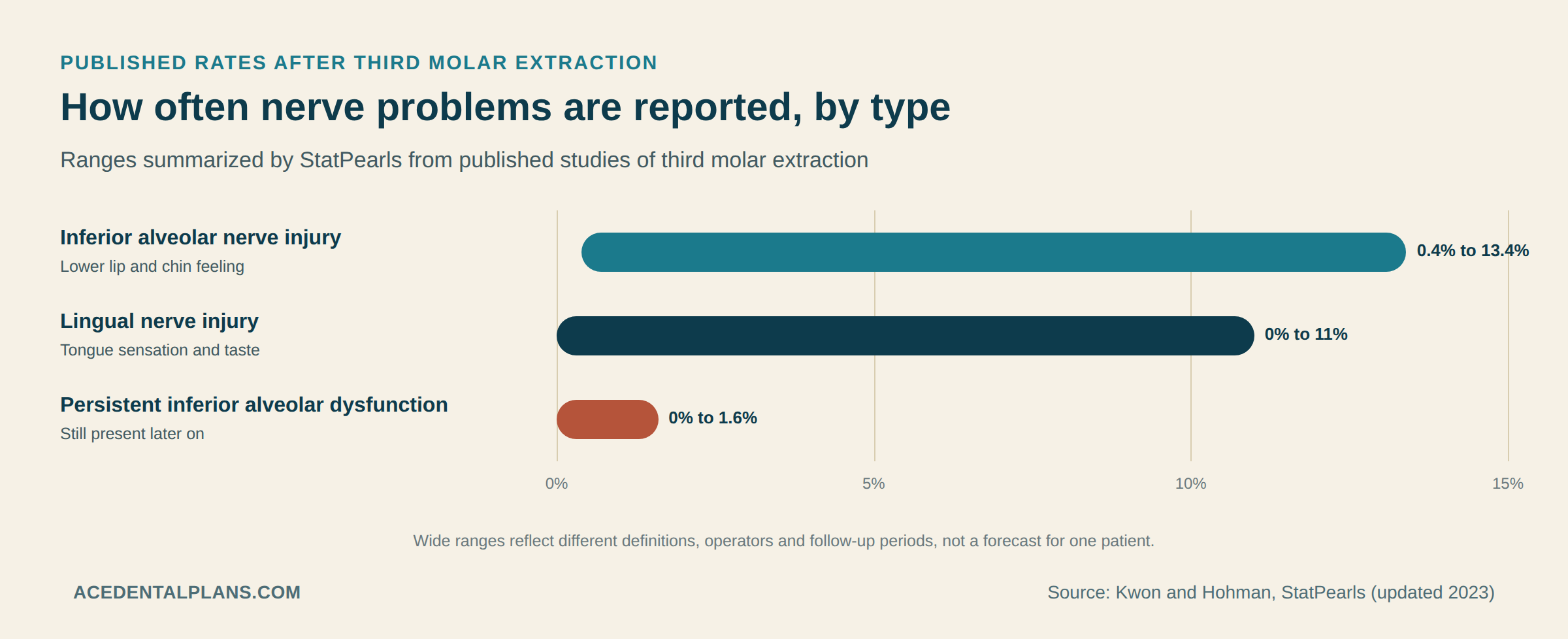
- Lower teeth carry the risk. StatPearls summarizes published rates of 0.4% to 13.4% for inferior alveolar nerve injury and 0% to 11% for lingual nerve injury after third molar extraction. Persistent inferior alveolar dysfunction ranges from 0% to 1.6%.
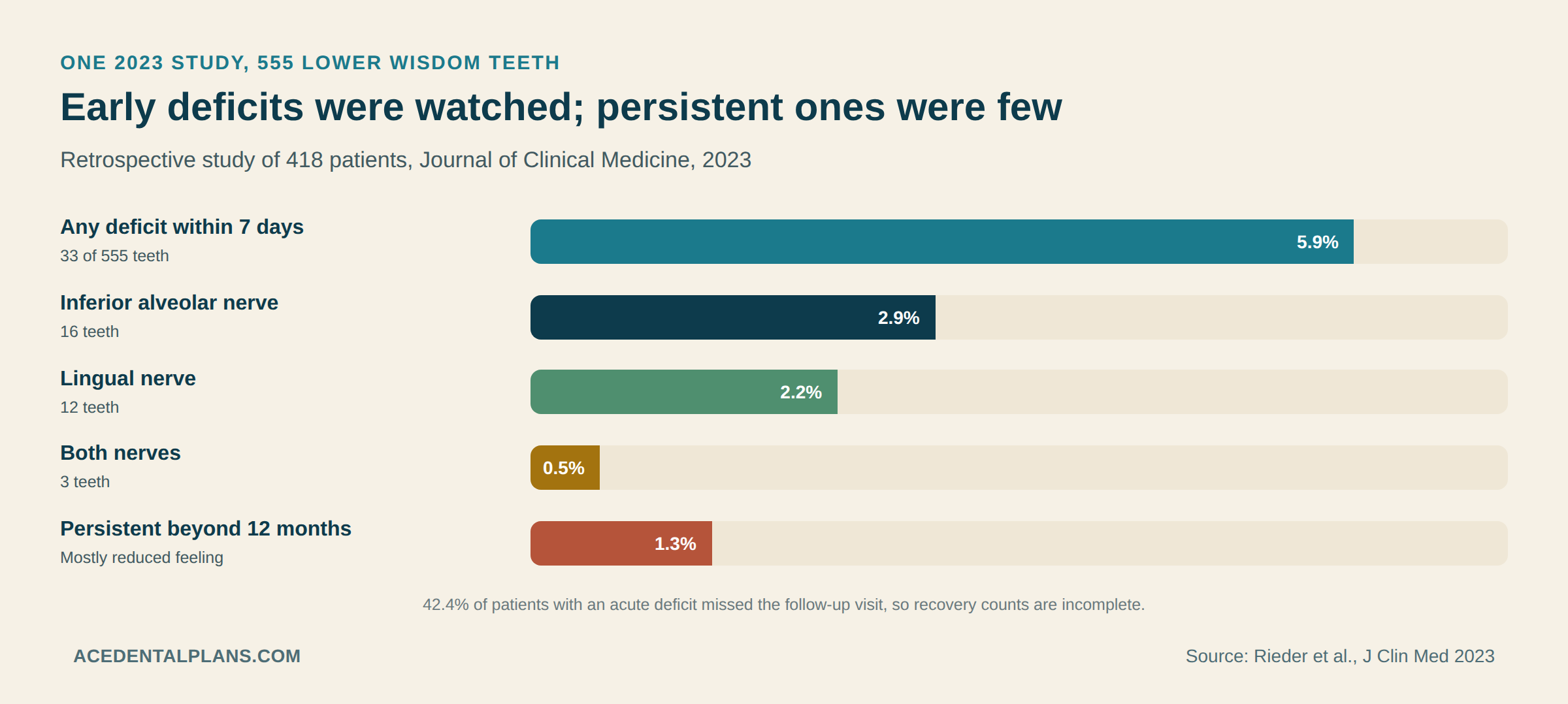
- Most deficits resolve. In a 2023 study, deficits usually resolved within the first 6 months, and 1.3% of teeth were left with a deficit beyond 12 months.
- Three months is a decision point. StatPearls says surgery is considered when there has been no improvement for more than 3 months and the deficit is unacceptable to the patient.
- Protect the area until feeling returns. FDA labels tell patients to avoid eating and to guard the lips, tongue and cheek while they are numb.
- Follow-up is usually part of the surgery fee. One insurer policy defines a surgical extraction code as including local anesthesia, suturing and routine post-operative care, but nerve treatment is a separate question.
Anesthetic Numbness Versus Nerve Numbness: The Expected Course
The word “numbness” hides two different things. The first is the local anesthetic your dentist or surgeon injected before the procedure. It is temporary by design, and its clock starts at the injection. The second is a change in nerve function that follows the extraction itself, which can look like numbness, tingling, a heavy feeling or a burning sensation after the anesthetic should have worn off.
Telling them apart is mostly a matter of time. The FDA label for lidocaine with epinephrine gives an average of 3 to 3½ hours of soft-tissue anesthesia after a lower-jaw nerve block. The mepivacaine label gives 2.5 to 5.5 hours in the lower jaw with a vasoconstrictor. Bupivacaine, used for some oral surgery, can last two or three times longer than lidocaine according to its label. The reasons the clock differs by drug are covered in the guide to how long dental numbness lasts. Start there if your question is about a filling or a crown.
Extractions add three wrinkles to that clock. Lower wisdom teeth and molars are usually numbed with a block, which is the longer-lasting injection. Surgical extractions often involve more than one cartridge. And sedation or general anesthesia may be layered on top, although the local anesthetic still determines how long the lip and tongue stay numb. The AAPD notes that local anesthesia given while a child is under general anesthesia may raise the risk of postoperative trauma, because the child wakes up numb.
A reasonable expectation, then, is this. On the label averages, numbness begins to fade after about three hours, and on every figure above except the longest bupivacaine one, the lip and chin should feel normal by the next morning. Numbness that has not begun to retreat by the next morning, or any numbness with pain, burning or a change in taste, is the point at which a call is warranted. The AAOMS puts the general pattern plainly: numbness “beyond a short period of time is uncommon and usually temporary but can be permanent in rare instances.”
Upper Teeth, Lower Teeth and Sedation: How the Setup Changes the Clock
Which tooth comes out matters before anything else. Upper teeth are usually numbed with an infiltration, in which the anesthetic is placed beside the root. The lidocaine label gives an average of about 2½ hours of soft-tissue anesthesia for that technique, and the mepivacaine label with levonordefrin gives 1 to 2.5 hours in the upper jaw. Lower teeth usually need a block, with the longer figures quoted above. So an upper molar extraction normally leaves you numb for a shorter time. It also sits outside the nerve risk that the rest of this article concerns, because the inferior alveolar and lingual nerves belong to the lower jaw.
Sedation adds a second layer without changing the first. The ADA’s patient page describes sedation as inhaled gases, pills or injected medicine, and says general anesthesia is used on occasion to cause temporary loss of consciousness. The ADA’s sedation guidelines define four levels, from minimal sedation, where the patient responds normally to touch and spoken commands, to general anesthesia, where the patient cannot be aroused even by painful stimulation. At every level the guidelines require verbal and written post-operative instructions for the patient and the escort or caregiver. Local anesthetic is typically still placed at the site, and it is the local anesthetic that decides how long the lip and tongue stay numb.
That has a practical consequence. After IV sedation or general anesthesia, you may wake up with a numb face and little memory of how to protect it. The escort should hear the instructions and keep them. Cost lines differ too: a 2024 billing article describes nitrous oxide as coded per visit and intravenous moderate sedation in 15-minute increments, which is why the same extraction can come with different totals. The page on wisdom teeth removal with sedation shows what each level adds to a cash bill.
Why Lower Molars and Wisdom Teeth Carry the Nerve Risk
Two nerves matter for lower teeth. The inferior alveolar nerve runs through the lower jaw and supplies feeling to the lower teeth, lip and chin. The lingual nerve supplies sensation to the front part of the tongue and carries taste on that side. StatPearls lists mandibular third molar extraction as the leading surgical cause of injury to both, and notes that rates vary with operator experience and technique.
Three things raise the odds. The first is distance: roots that sit close to the nerve canal are harder to remove without pressure or contact. In a 2023 retrospective study from Graz, acute deficits occurred in 12.9% of teeth when the inferior alveolar nerve lay lingual to the roots. The rate was 3.7% when it lay on the cheek side, 5.6% between the roots and 0% below the roots. The second is the type of tooth. The Graz study followed impacted lower third molars, the group most likely to need a surgical approach.
The third is age. A 2024 single-surgeon study of 172 patients found that those with nerve injury averaged about 32 years against about 25 for those without. The authors also listed several imaging measures of root position as independent risk factors. The sample was small and retrospective, and the paper’s own tables had internal inconsistencies, so treat the age finding as a signal rather than a rule. The Graz study did not find age or the surgeon’s experience significant, which is a reminder that studies do not agree on every factor.
The injection itself can also injure a nerve, although rarely. StatPearls lists inferior alveolar block injections among the causes and says patients recover spontaneously 85% to 94% of the time in that case. The Septocaine label reports that persistent paresthesias were “reported chiefly following nerve blocks in the mandible.” A Canadian review of voluntary reports put the rate at 1 in 609,000 injections. The lingual nerve was affected more than twice as often as the inferior alveolar nerve. That is why a surgeon will ask whether the numbness began at the injection or after the tooth came out.
How Often Numbness Persists: What Published Studies Report
Published figures vary widely, because studies differ in what they count and how long they follow patients. Some count any reduced feeling reported in the first week, while others count only deficits that remain at six or twelve months. Some operators handle only simple cases, and others handle deeply impacted teeth. Table 1 sets the main sources side by side with what each measured.
| Source and year | What was measured | Reported result |
|---|---|---|
| StatPearls, Kwon and Hohman (updated 2023), citing a 2012 review | Injury after third molar extraction, across studies | Inferior alveolar nerve injury 0.4% to 13.4%; lingual nerve 0% to 11%; persistent inferior alveolar dysfunction 0% to 1.6% |
| Rieder and colleagues, Journal of Clinical Medicine (2023); 555 impacted lower third molars | Acute deficit within 7 days, and deficit beyond 12 months | 5.9% acute (inferior alveolar 2.9%, lingual 2.2%, both 0.5%); 1.3% persistent beyond 12 months |
| He and Ruan, Medicina Oral (2024); 172 patients | Inferior alveolar nerve injury after extraction in one surgeon’s cases | 8.72% (15 of 172); the paper cites 0.4% to 8.4% overall and 0.014% to 3.6% permanent from other work |
| AAOMS patient information | Nerve injury after wisdom tooth removal | “In some cases”; numbness beyond a short period is uncommon, usually temporary, rarely permanent; no percentage given |
| Gaffen and Haas, Journal of the Canadian Dental Association (2009) | Paresthesia reports after any dental local anesthetic injection | About 1 in 609,000 injections (2006 to 2008, voluntary reports) |
The spread is the useful part. If you read only the low end, extraction numbness looks like a rare event, and if you read only the high end, it looks common. Both are true of different populations. A healthy 22-year-old with a straightforward lower wisdom tooth sits near the low end of these ranges. An older patient with a deeply impacted tooth, whose roots wrap around the canal, sits near the high end. Your surgeon can tell you which end you are closer to, usually after looking at the X-ray or a 3D scan.
One caution on the numbers. Retrospective studies, including the two from 2023 and 2024, depend on the patients who came back to be examined. The Graz paper notes that 42.4% of patients with an acute deficit did not attend follow-up after the first review. The people who stop returning may have recovered, or may not have, and the study cannot say which. That is a reason to keep follow-up appointments, not just a methodological footnote.
Before the extraction: reading the risk on your own scan
The published ranges describe groups, and your own X-ray tells you more about you. Two of the studies above looked at what imaging showed. The Graz team used cone-beam CT, a 3D scan, in a subset of teeth. Deficits were more common when the nerve canal lay lingual to the roots, at 12.9% of those teeth. The figure was 3.7% when it lay on the cheek side and 0% when it lay below the roots. The 2024 study measured the distance between the second and third molars on imaging and found some of those measures were independent risk factors. Neither study offers a score you can apply to yourself, but both show why surgeons look at the picture before they decide how to remove the tooth.
That makes the pre-surgery visit a good time to ask. A plain panoramic X-ray shows the outline of the roots and the canal, and a 3D scan shows depth and the side-to-side relationship, which is what the Graz result turned on. Ask whether the roots touch or overlap the canal, whether a scan is advised for your tooth and whether there is a different way to approach the removal if the roots are close. Surgeons weigh those choices case by case, and the studies cannot say which approach suits you. They can only show that the question is worth asking.
The consent form is the second place to look. The AAOMS lists nerve injury among the possible complications of wisdom tooth removal, with altered or total loss of feeling in the lip, tongue, cheek or chin. A form that mentions “numbness” without any frame can feel alarming, and a form that mentions nothing is a reason to ask. A useful way to bring the numbers into the conversation is to quote the ranges and ask where you fall. StatPearls gives 0.4% to 13.4% for inferior alveolar injury and 0% to 1.6% for persistent dysfunction. It also helps to ask what happens next if numbness appears, who sees you and how soon, and whether the surgeon will examine you or an assistant will.
Nothing here argues for or against removing a tooth. Whether a wisdom tooth should come out at all is a clinical decision, and some are left in place. The point is narrower: if you are going ahead, knowing your own anatomy turns a generic risk into a specific one, and it gives you words to use on the follow-up call.
Temporary, Persistent, Permanent: The Recovery Timelines
Nerve injuries are graded by how much of the nerve was affected, and the grade drives the expected recovery. StatPearls describes the Seddon scale in three steps. Neuropraxia, a bruise-like conduction block, “typically results in a full, spontaneous recovery.” Axonotmesis involves damage to the nerve fibers inside an intact sheath. In neurotmesis the nerve is severed, and “the likelihood of spontaneous recovery is low.” The Sunderland scale splits the same ground into five degrees. The first three are likely to recover on their own, and the fourth and fifth are unlikely to recover fully.
The grade is not visible at the time of surgery, so clinicians watch the clock. The Graz study found that deficits usually resolved within the first six months, with follow-up running to twelve. StatPearls says that if there is no improvement within three months, spontaneous recovery becomes less likely, and that the ideal window for reconstruction is within three to six months of injury. It adds that repairs made more than nine months after injury have a poorer prognosis. A 2024 paper repeats the common rule that symptoms still present after two years are considered permanent loss of function.
Those milestones are not a countdown to panic. Most people never reach the month-three question, because most numbness resolves or improves long before it. They guide when a conversation with the surgeon should move from “let’s watch it” to “let’s test it” and, in a few cases, to “let’s consider repair.” Table 2 lays them out in order.
| Time after surgery | What the sources describe | What usually happens next |
|---|---|---|
| First few hours | Anesthetic wearing off; lidocaine label averages 3 to 3½ hours after a lower-jaw block | Protect the lip, cheek and tongue; wait to eat until feeling returns |
| Same day to next morning | Anesthetic numbness should be gone on the longer published ranges, apart from the longest bupivacaine figures | Call the office if the lip, chin or tongue is still fully numb or the feeling is changing in an odd way |
| Days 1 to 7 | The Graz study counted “acute” deficits within 7 days: 5.9% of teeth | A surgeon may examine, test sensation and plan close follow-up |
| Weeks 1 to 12 | Most deficits improve; the Graz study saw spontaneous resolution mostly within 6 months | Regular sensory checks; medication categories discussed in some cases |
| Around month 3 | StatPearls: surgery considered when there is no improvement for more than 3 months and the deficit is unacceptable to the patient | Decision point: continue observation, refer to a nerve specialist, or consider repair |
| Months 3 to 6 | StatPearls: ideal window for reconstruction when repair is chosen | Repair evaluated in selected cases |
| Months 6 to 12 | The Graz study followed patients to 12 months and counted 1.3% of teeth with a persistent deficit beyond that | Residual numbness is monitored; quality-of-life effect is discussed |
| After 9 months to 2 years | StatPearls: poorer outlook for repair after 9 months; a 2024 paper treats 2 years without improvement as permanent loss of function | Long-term management and protection of the area |
One more distinction is useful. Sensations are described in four ways that sound alike. StatPearls defines paresthesia as an abnormal sensation that is not necessarily unpleasant, such as pins and needles, and hypesthesia as a decrease in sensation. Anesthesia means no sensation, and dysesthesia is an abnormal sensation that is unpleasant, such as pain. A change from numb to tingling is not a warning on its own. A change from numb to burning or shooting pain is worth reporting, because dysesthesia belongs on the surgeon’s list of findings.
Three hypothetical extractions and what each might look like
Timelines are easier to judge against a day. These three scenarios are illustrations built from the published averages and ranges above, not predictions, and each assumes the injection goes in about five minutes into the visit.
Call Now or Monitor: Symptoms Sorted
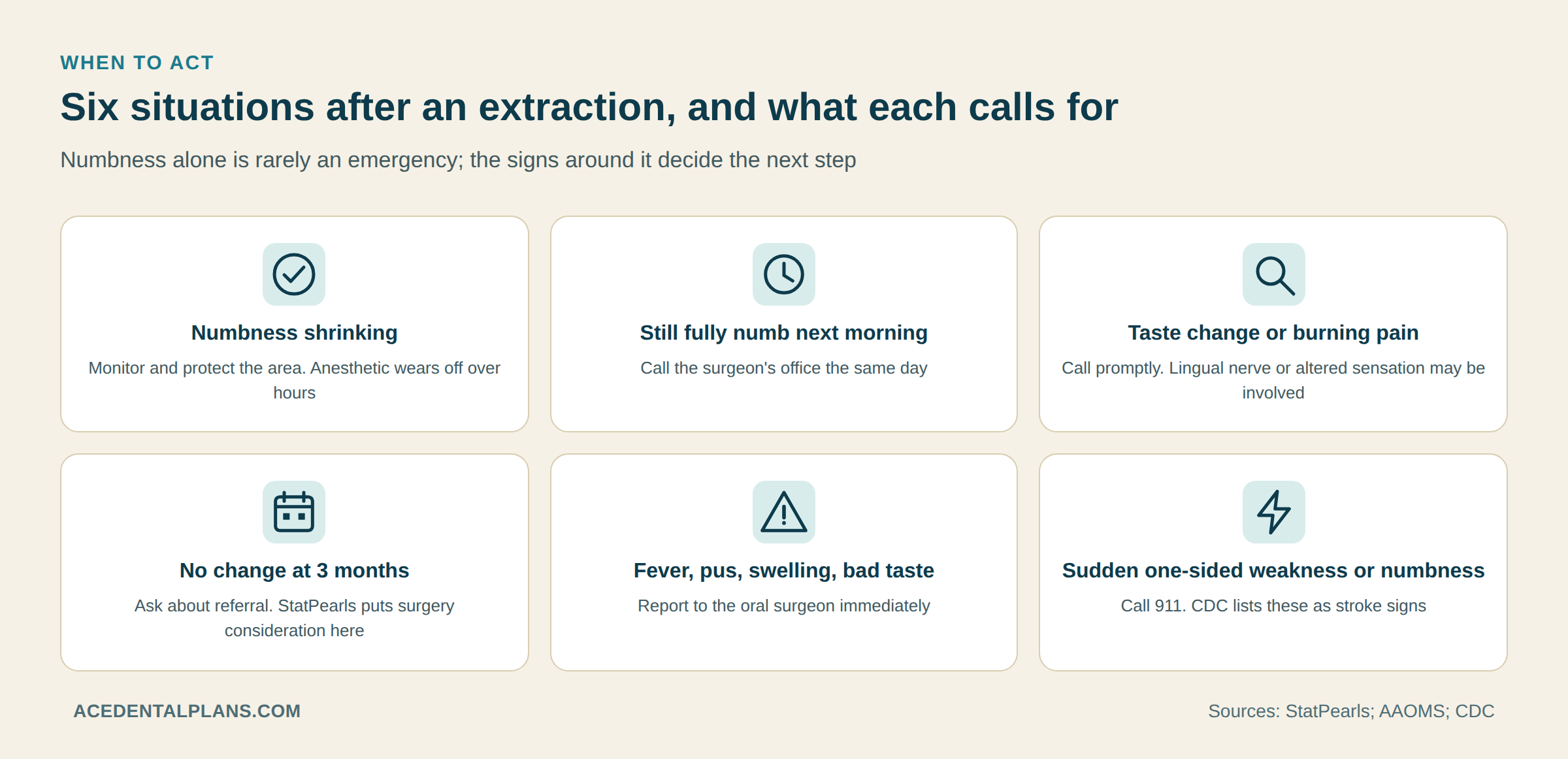
The labels and the surgical literature agree on a rough division. Numbness that is shrinking is expected, and numbness that is stable, spreading or painful needs a person to look at it. Taste is a clue worth including. StatPearls notes that lingual nerve injury may alter taste on the same side of the front of the tongue. A changed or missing taste on one side, combined with numbness, belongs in the first phone call.
| What you notice | How to read it | What to do |
|---|---|---|
| Lip, chin or tongue numbness shrinking over the first hours | The anesthetic is wearing off as the labels describe | Monitor; protect the area; no chewing on the numb side |
| Numbness still full the next morning | Beyond the usual anesthetic window; a long-acting drug or a nerve effect | Call the surgeon’s office the same day |
| Numbness plus loss or change of taste on one side of the tongue | May involve the lingual nerve, which carries tongue sensation and taste | Call promptly and say which side |
| Burning, electric or constant unpleasant sensations in the lip, chin or tongue | Dysesthesia, a type of altered sensation described in the nerve-injury literature | Call; do not wait for the next routine visit |
| Improving week by week but not yet normal | Consistent with the usual course in the Graz and StatPearls figures | Monitor; keep follow-up appointments; note changes |
| Little or no change after about 3 months | The point at which StatPearls says surgery may be considered | Ask about referral to a nerve specialist and the options |
| Fever, swelling, pus, salty or lasting bad taste, increasing pain | AAOMS lists these as signs of infection | Contact the oral surgeon immediately |
| Sudden numbness or weakness of the face or a limb with trouble speaking, seeing or walking | CDC stroke signs, unrelated to the extraction | Call 911 right away |
Seek prompt care if
- You have swelling of the face or neck, trouble breathing or swallowing, or bleeding you cannot control. Call 911 or go to the nearest emergency room.
- Numbness or weakness comes on suddenly in the face, an arm or a leg, especially on one side, with confusion, trouble speaking or seeing, or a severe headache. The CDC lists these as stroke signs.
- Fever, increasing swelling, pus or a salty, lasting bad taste appears after the extraction. The AAOMS asks patients to report these signs of infection to the oral surgeon immediately.
- Pain is severe or persistent, or bleeding is excessive. The AAOMS postoperative instructions say to contact the oral surgeon right away.
Two situations commonly get mistaken for nerve trouble. The first is infection or a failed clot, where pain, bad taste and swelling dominate; the guide to tooth infection symptoms and causes explains what spreading infection looks like. The second is ordinary pain from a healing socket. AAOMS says pain and swelling after wisdom tooth removal are normal, and the short-term steps in toothache home relief apply to comfort measures in general. Neither should be assumed without a clinician’s opinion if numbness is also present.
Pain that spreads is not numbness
One more mix-up is worth separating. The AAOMS describes dry socket as a condition in which the blood clot dislodges, dissolves or does not form properly. It affects “approximately 4 percent of all extractions,” and the pain often spreads toward the ear, temple or chin. A person with dry socket may describe a deep ache along the jaw and a bad taste, not a loss of feeling. If that is the pattern, the call is the same, but the question for the surgeon is different. Say whether the main symptom is pain or numbness, because the examination follows from that.
What an Oral Surgeon Checks and Does
A visit about lingering numbness usually follows a pattern, though the details vary by office. The surgeon asks when the numbness started, whether it began at the injection or after the tooth came out, which areas are affected and whether sensations are changing. Then comes an examination. StatPearls describes subjective tools, such as pain questionnaires and visual analog scales, and objective sensory tests: light touch, brush stroking, two-point discrimination (roughly 5 mm is normal), pinprick and thermal testing. Results are graded in levels, and mild injury shows abnormal results only on the simplest level.
Imaging may come into play as well. The Graz study used cone-beam CT, as described above, to look at the relationship between the nerve canal and the tooth roots. The nerve lying lingual to the roots was the factor that stood out. Whether a scan is warranted is the surgeon’s call, and it may be billed separately.
Observation, medicines and other early options
Most of the time the first plan is observation with scheduled rechecks, because most deficits recover. StatPearls describes medicine categories that are sometimes tried: corticosteroids, whose evidence it calls “weak,” topical agents, and systemic drugs such as tricyclic antidepressants and antiepileptics, which are mainly aimed at nerve-pain symptoms. The Graz study reports using cortisone, vitamin B-complex and laser treatment in small groups, with recoveries in the single-digit patient counts, so its numbers cannot show whether any of them helped. I am naming categories only; whether any medicine is appropriate depends on your history and is for the surgeon to decide.
Referral and microsurgery in selected cases
When there is no improvement after about three months and the deficit is bothersome, the discussion turns to referral. StatPearls lists several surgical routes. External decompression reached 85% sensory recovery in one study. Direct repair of the cut ends has recovery that “may be as high as 90%” with careful technique. Collagen sleeves show success above 80% when the gap is 3 mm or less. For larger gaps, nerve grafts reached 87.3% sensory recovery against 60% for vein grafts. Those figures come from published series, not from a promise about any one patient, and they describe the portion of patients who regain some sensation, not a full return to normal.
Surgery is chosen for selected cases, not routinely. The page ties the decision to a deficit that is unacceptable to the patient and to the time elapsed. A surgeon will also weigh the type of injury, the nerve involved and the patient’s symptoms. If you are told that repair might be worth considering, ask about timing, because StatPearls puts the ideal window at three to six months.
Living with numbness that does not fully resolve
For a small group, some numbness remains. In the Graz study, 1.3% of teeth were left with a persistent deficit beyond 12 months. Most were described as reduced feeling, and none of those patients reported a permanent reduction in quality of life. The group was small, about seven people, so that finding is encouraging, not a promise. The authors of other studies describe a range of experiences, and the AAOMS says permanent numbness is possible in rare instances.
Day-to-day, protection becomes a habit. A numb lower lip can drool, hold liquid poorly or be bitten without notice, and a numb tongue edge can be burned or bitten. Hot drinks deserve a test with the other side of the mouth or a hand first. Regular dental visits matter more, not less, because a dentist can look for bite injuries or ulcers you cannot feel. Partial recovery can continue for months, so keep appointments for sensory rechecks and note the date and a short description of each change. If symptoms turn painful, such as burning or electric sensations, report them, because StatPearls names dysesthesia as a separate problem with its own medicine categories.
Protecting the Numb Area and Eating Safely
Lip, cheek and tongue
The most useful thing you can do about extraction numbness is protect the area until feeling returns. The FDA label for lidocaine says patients should be advised “to exert caution to avoid inadvertent trauma to the lips, tongue, cheek mucosae or soft palate when these structures are anesthetized.” The Vivacaine label adds that patients should not test the anesthetized area by biting or probing it. The mepivacaine label warns of biting trauma if a patient tries to eat or chew gum too soon.
After an extraction there is an extra reason for care. The surgical site is tender, and the nearby lip or cheek can swell. A numb, swollen lip is easy to catch between the teeth, and the swelling hides the first signs of a bite. If the numbness spreads to the tongue, the risk shifts to the tongue edge, which can slide against a sharp tooth surface or a suture. In children and adults who have been sedated, someone else needs to watch for the habit of chewing the lip, which the AAPD identifies as a recognized complication in young patients.

A bite injury looks like a white or ulcerated patch that swells over a day or two. Rinse gently once the dentist says rinsing is allowed, keep the area clean and watch for worsening. Persistent bleeding, a wound that keeps growing or signs of infection are reasons to call. Because the wound sits inside a numb area, pain is not a reliable alarm; look in a mirror instead.
Eating and drinking while numb
There are two rules, and they apply at different times. The first is the numbness rule: no chewing and no hot food or drink until feeling returns, as the labels advise. The Septocaine label tells patients not to eat or drink until normal sensation returns, and the lidocaine label says eating should be postponed until normal function returns. The second is the healing-site rule, which lasts longer. The AAOMS postoperative instructions advise a soft diet for the first few days. They say to avoid “hot, spicy, hard, chewy or crunchy foods that can irritate the healing site,” and suggest soups, yogurt and smoothies.
The ADA’s MouthHealthy page on extractions adds two rules: avoid drinking through a straw for 24 hours, and avoid smoking and vigorous rinsing. It also says you can brush and floss your other teeth as usual but should not clean the teeth next to the extraction site. A straw is the easy one to forget, because it feels like the safe way to drink while the lip is numb. It is the opposite.
A sensible sequence follows from these. Start with cool water in small sips once the lip responds. Then move to lukewarm soft foods such as yogurt, scrambled eggs, mashed potatoes or a cooled soup, eaten on the side opposite the extraction. If a graft or an implant is planned for the site, the soft-food stage tends to be longer. The diet guide for what to eat after dental implant surgery lays out that progression stage by stage. The AAOMS and MouthHealthy pages do not give a food list by day, so details beyond the points above are a matter for your surgeon’s instructions.
Records, Questions and Follow-Up Worth Having
Numbness that lingers is easier to evaluate if the story is documented from the first day. Write down when the injection was given, the time the numbness began to fade, the areas affected and anything that changes: tingling, burning, taste, drooling, trouble with certain sounds. Take a note of dates for calls and visits, and keep copies of the discharge instructions and any imaging reports. These notes help a different clinician understand the course, and they matter if an insurer later asks for the sequence of events.
The surgeon’s own record matters as well. For a lower wisdom tooth, the chart usually has the pre-operative X-ray or scan, the type of anesthetic, the surgical approach and the follow-up plan. You are entitled to ask what was recorded and to request copies, which can be useful if a referral is made. Questions that tend to produce specific answers include these.
- How close are the roots to the nerve canal on my X-ray or scan, and does that change the risk for me?
- Which anesthetic was used, and when should the numbness end?
- If the numbness lasts past tomorrow morning, whom do I call, and is there an after-hours number?
- When will you recheck my sensation, and what tests will you use?
- At what point would you refer me to a nerve specialist?
- Are follow-up visits included in the extraction fee?
Five lines to find on your discharge sheet
Discharge sheets differ, but a useful one answers five things. It names the anesthetic or at least the type of injection, so you can compare it with the durations above. It says roughly when the numbness should end. It lists the symptoms that justify a call and gives a number that works after hours. It gives the date of the first recheck. And it says what to do about bleeding, swelling and food. If one of the five is missing, ask before you leave, because it is much easier to ask in the chair than to reconstruct it from a voicemail at 9 p.m.
One note for people who arrive here after a different procedure. Numbness after a root canal or a filling follows the injection pattern, and the pain that comes with a root canal has its own timeline in how long root canal pain lasts. If the extraction was the first step toward an implant, the stages that follow are in the dental implant recovery timeline, and the price side of that decision sits in dental implant cost.
Six mistakes that make numbness harder to manage
Most of the avoidable trouble with extraction numbness comes from a handful of habits. None needs special skill to avoid.
- Testing the lip by biting or pinching it. The Vivacaine label specifically advises against testing the anesthetized area by biting or probing, and a bitten lip swells for days.
- Eating on the first sign of tingling. Tingling means feeling is partly back, not fully back. The labels say to wait until normal sensation or function returns.
- Using a straw because the lip is numb. The ADA advises avoiding straws for 24 hours after an extraction, and a numb lip is not an exception.
- Waiting silently for three months. The sources set the third month as a decision point, not a waiting period. Mention changes at each visit so the surgeon can track direction, not just the endpoint.
- Skipping follow-up because the numbness is improving. In the Graz study, 42.4% of patients with an acute deficit did not attend the follow-up visit after the first review, so the final outcome for those patients is unknown. A recheck turns “it seems better” into a documented measurement.
- Assuming numbness and pain are the same problem. Dry socket pain, infection and nerve numbness have different causes and different next steps, so describe which one you have.
The common thread is that numbness removes the usual warning system. A burn, a bite or a developing wound may not hurt, so sight and routine have to stand in for sensation. Looking in a mirror twice a day, keeping the first-week instructions and writing down what changes is a modest routine that covers most of the risk.
What Follow-Up for Numbness May Cost and What Insurance May Cover
The first thing to know is what the extraction fee already includes. One insurer’s clinical policy for surgical extraction, the Envolve Dental policy for code D7210 reviewed in December 2025, states that the service “includes administration of local anesthesia, suturing (if required), and routine post-operative care.” Other plans define their codes in their own documents. Treat this as an example of how a code can be defined, not a universal rule. In practice it means the first recheck is often part of the surgery fee, and the anesthetic is rarely a separate line.
Prices for the extraction itself are covered elsewhere. The comparison of tooth extraction cost, simple vs surgical shows how the work is priced, and tooth extraction cost without insurance covers cash-pay routes. For wisdom teeth, wisdom teeth removal cost explains how pricing changes from one tooth to four, and the sedation price page mentioned earlier shows what each sedation level adds. A same-day removal has its own price page, emergency tooth extraction cost, and an urgent visit for bleeding or infection after hours is covered in emergency dentist cost.
The prices for what comes after a nerve complication are harder to pin down. I searched for a national figure for specialist nerve evaluation or microsurgical repair and found no reliable one, so there is none in this article. What can be said is how the bill tends to be built. An evaluation visit is billed as an exam, and imaging and sensory testing may be extra lines. Repair surgery is billed by the surgeon, with a facility and anesthesia component if it is done in an operating room. Whether a dental plan, a medical plan or both respond depends on the plan, the diagnosis and the codes. Ask the office to put the codes in writing, then ask the insurer for a pre-treatment estimate. That estimate is not a promise of payment.
If a nerve complication follows a procedure you paid for, a few steps are reasonable and none requires a dispute. Ask whether follow-up visits are included in the fee and for how long. Ask the surgeon to document the findings in the chart. Keep every referral and invoice together, and ask for itemized codes so that a claim can be filed correctly. A written treatment plan and fee estimate from each office is the only dependable number for your situation.
Bottom Line
Most numbness after an extraction is the anesthetic, and it ends within hours. Numbness that outlasts the anesthetic is uncommon, more likely after lower wisdom teeth, and usually improves over weeks to months. The sources agree on a short list of signals. Call if the lip, chin or tongue is not returning to normal by the next morning, if taste or tongue feeling changes, or if burning pain appears.
Between the extraction and recovery, three habits do the most. Protect the numb area from biting and heat, keep every follow-up appointment, and write down what changes and when. Three months without improvement is the point at which the conversation moves to referral. The Recovery & Aftercare guides collect related timelines for other procedures.
Frequently Asked Questions
How long does numbness last after a tooth extraction?
Anesthetic numbness usually fades within about 3 to 3½ hours after a lower-jaw lidocaine block, according to the FDA label, and some drugs last longer. If feeling has not begun to return by the next morning, call the office. Numbness beyond a short period is uncommon and usually temporary, according to the AAOMS.
Is it normal to be numb the day after a wisdom tooth is removed?
It is not typical. The longest published figures for common dental anesthetics are 5.5 hours for mepivacaine in the lower jaw and, with bupivacaine, up to 12 hours according to a 2025 review. If you are still fully numb the next morning, call the surgeon the same day so that someone can examine you.
How common is nerve damage after wisdom teeth removal?
Published rates vary. StatPearls summarizes 0.4% to 13.4% for inferior alveolar nerve injury and 0% to 11% for lingual nerve injury, with persistent inferior alveolar dysfunction at 0% to 1.6%. A 2023 study of 555 teeth found 5.9% acute deficits and 1.3% persistent beyond 12 months. Your risk depends on the position of your tooth.
Will my numbness go away on its own?
Often it does. StatPearls describes neuropraxia as typically recovering fully and spontaneously, and a 2023 study found deficits usually resolved within 6 months. If there is no improvement within 3 months, spontaneous recovery becomes less likely and a surgeon may discuss options. Recovery varies with the type of injury.
When is numbness after extraction an emergency?
Numbness alone is rarely an emergency, but the symptoms around it can be. Call 911 for swelling of the face or neck, trouble breathing or swallowing, or uncontrolled bleeding. Sudden numbness or weakness of the face or a limb with trouble speaking or seeing may be a stroke, and the CDC says to call 9-1-1 right away.
Can I eat while my mouth is still numb?
It is better to wait. The lidocaine label says food should be postponed until normal function returns, and the mepivacaine label warns about biting trauma. After an extraction, the AAOMS also advises soft foods for the first few days and avoiding hot, spicy, hard, chewy or crunchy foods. The ADA says to avoid straws for 24 hours.
What does an oral surgeon do for lingering numbness?
The surgeon takes a history, tests sensation with light touch, two-point and other tests, and may order imaging. Most cases are watched with rechecks. StatPearls lists corticosteroids (weak evidence), topical agents and certain nerve-pain drugs as options in some cases, and surgery when there is no improvement after more than 3 months. The surgeon decides based on your case.
Does the numbness mean the surgeon made a mistake?
Not necessarily. StatPearls says rates vary with operator experience and technique, but the studies also show that the position of the nerve relative to the roots affects risk. A Graz study found deficits more often when the nerve lay lingual to the roots. Ask the surgeon what the scan showed and what was recorded.
Is a follow-up visit for numbness covered by insurance?
It depends on the plan. One insurer policy defines a surgical extraction code as including routine post-operative care, so a first recheck may be included in the fee. Specialist evaluation or repair may be billed under a dental or medical plan. Ask the office for the codes and ask your insurer for a pre-treatment estimate, which is not a promise of payment.
Why does my tongue feel numb after a lower tooth extraction?
The anesthetic often reaches the tongue, because the lingual nerve runs near the lower nerve block site. If tongue numbness or a change in taste continues after the anesthetic should have worn off, tell the surgeon. A Canadian review of injection-related paresthesia found the lingual nerve affected more than twice as often as the inferior alveolar nerve.
How long does numbness last after an upper tooth extraction?
Usually a shorter time than for a lower tooth. The lidocaine label averages about 2½ hours of soft-tissue anesthesia after an upper-jaw infiltration, and the mepivacaine label with levonordefrin gives 1 to 2.5 hours in the upper jaw. The nerves that carry the lower-jaw risk discussed here do not apply to upper teeth. Still, numbness that does not retreat deserves a call.
Does sedation change how long my mouth stays numb?
Not directly. Sedation changes how you feel in the chair, while the local anesthetic placed at the site decides how long the lip, cheek and tongue stay numb. The AAPD notes that local anesthesia given during general anesthesia may raise the risk of biting injuries afterward. Ask your escort to hear the aftercare instructions, because you may not remember them.
Sources and Disclaimers
Rates, timelines and surgical options come from a StatPearls review of nerve injury, two recent retrospective studies of lower third molar extraction and the AAOMS patient pages. Anesthetic duration and warning statements come from FDA-approved prescribing information, and the 2025 review figure for bupivacaine comes from a peer-reviewed narrative review. Stroke signs come from the CDC, sedation definitions from the ADA, and extraction aftercare from the ADA and the AAOMS. Billing-code statements come from a 2024 trade article by a dental billing specialist, so they describe common coding practice, not any insurer’s policy. The statement about what a surgical extraction code includes comes from one insurer’s clinical policy and does not describe every plan. Published rates differ because studies define injury, follow-up and patient groups differently, so a national range cannot predict your own outcome. The clock times and the billing sequence in the examples are original illustrations with no dollar figures. Confirm your risk and your recovery plan with your oral surgeon, and confirm prices and benefits with the dental office and your insurer.
- Kwon G, Hohman MH, StatPearls (NCBI Bookshelf, updated 2023) — Inferior Alveolar Nerve and Lingual Nerve Injury
- Rieder M, Remschmidt B, Schrempf V, et al., Journal of Clinical Medicine (2023) — Neurosensory Deficits of the Mandibular Nerve Following Extraction of Impacted Lower Third Molars: A Retrospective Study
- He H, Ruan N, Medicina Oral, Patologia Oral y Cirugia Bucal (2024) — Factors influencing inferior alveolar nerve injury after extraction of mandibular third molar
- American Association of Oral and Maxillofacial Surgeons (MyOMS) — Potential Complications of Wisdom Teeth Extractions
- American Association of Oral and Maxillofacial Surgeons (MyOMS) — Wisdom Tooth Extraction: Postoperative Instructions
- American Dental Association, MouthHealthy — Extractions
- Gaffen AS, Haas DA, Journal of the Canadian Dental Association (2009) — Retrospective Review of Voluntary Reports of Nonsurgical Paresthesia in Dentistry
- DailyMed (U.S. National Library of Medicine) — Xylocaine Dental (lidocaine HCl and epinephrine) prescribing information
- DailyMed (U.S. National Library of Medicine) — Septocaine (articaine HCl and epinephrine) prescribing information
- DailyMed (U.S. National Library of Medicine) — Carbocaine (mepivacaine HCl) dental prescribing information
- DailyMed (U.S. National Library of Medicine) — Vivacaine (bupivacaine HCl and epinephrine) prescribing information
- Rodrigues GA, Bronzato JD, Journal of Oral and Maxillofacial Anesthesia (2025) — A narrative review on local anesthetics in dentistry: mechanism of action, characteristics, and clinical considerations
- American Academy of Pediatric Dentistry — Use of Local Anesthesia for Pediatric Dental Patients
- Envolve Dental (Centene) — Clinical Policy CP.DP.23: Surgical Extraction
- Centers for Disease Control and Prevention — Signs and Symptoms of Stroke
- American Dental Association, MouthHealthy — Anesthesia and Sedation
- American Dental Association — Guidelines for the Use of Sedation and General Anesthesia by Dentists
- Vargas E, Dr. Bicuspid (February 2024) — Numb and number: Coding and billing for anesthesia services in the dental practice
Important Information and Disclaimers
This article is general educational information. By using it, you accept the limits described below.
Not dental or medical advice
Nothing on this page is a diagnosis, a treatment recommendation or a substitute for an examination by a licensed dentist or physician. Reading this article does not create a dentist-patient or doctor-patient relationship. Only a licensed professional who has examined you and reviewed your history can tell you what your mouth needs. Do not delay, skip or stop professional care because of something you read here.
Prices are estimates, not quotes
Cost figures are ranges reported by the third-party sources cited in this article. Actual prices depend on your location, the provider, the complexity of your case, the materials used, the date of service and other factors, so what you pay may be higher or lower. A written treatment plan and fee estimate from the dental office is the only reliable number for your situation.
Insurance and plan examples are illustrations
Examples that use named amounts or percentages are hypothetical. Real benefits depend on your plan, network, waiting periods, annual maximum, deductible and the insurer’s rules at the time of treatment. A pre-treatment estimate or benefits check is not a promise of payment. Confirm the details with your insurer or plan administrator in writing.
Not insurance, legal, tax or financial advice
AceDentalPlans is an information publisher. Nothing here is insurance, legal, tax, investment or other professional financial advice, and nothing here recommends a particular provider, insurer, lender, discount plan or financing product. Company and product names belong to their owners and appear for identification only. Read the terms of any loan, financing offer or plan before you sign, and ask a qualified professional if you need advice on your own circumstances.
Third-party sources
This article cites government agencies, professional associations, insurers, lenders and other outside organizations. We do not control those sources. Their content can change, move or disappear, and listing a source is not an endorsement of it or of anything it sells.
No warranty
We aim for accuracy, but this article is provided “as is,” without warranties of any kind, express or implied, including warranties of accuracy, completeness, timeliness or fitness for a particular purpose. Some information may be out of date or contain errors by the time you read it.
Limitation of responsibility
To the fullest extent permitted by law, AceDentalPlans and its owners, authors and contributors are not responsible or liable for any loss, cost, injury, health outcome or other damage that results from using this article or relying on it. You are responsible for your own decisions about your care, your coverage and your money.
How this article is written
This article follows AceDentalPlans’ answer-first, U.S.-focused editorial approach. It uses conditional language for insurance, because coverage depends on the specific plan, and it names its sources so that you can read them yourself.