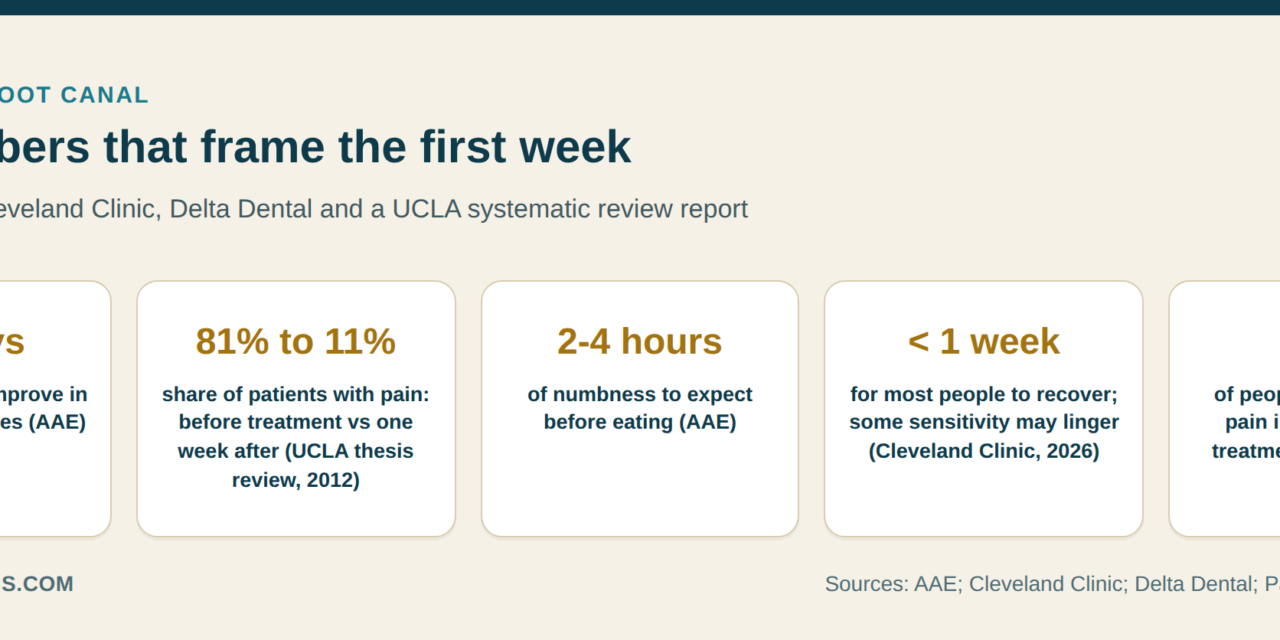
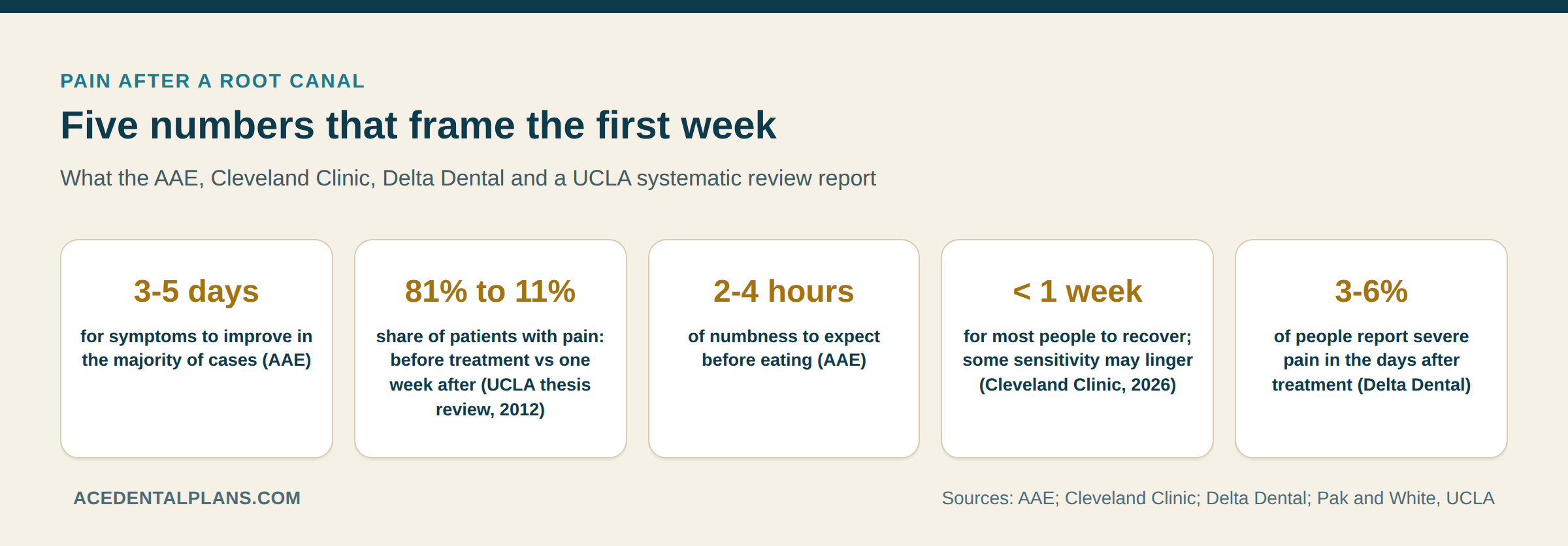
Soreness after a root canal usually improves within three to five days, according to the American Association of Endodontists, and Cleveland Clinic says most people recover in less than a week. Severe pain, swelling, an uneven bite, or pain that gets worse after the second or third day is not ordinary healing. It deserves a call to the dentist or endodontist.
This article follows the pain hour by hour and day by day. It covers what is normal, why a treated tooth can hurt, which pain-relief categories the sources name, how the temporary filling and crown fit in, and what happens when pain does not settle. It touches retreatment, apicoectomy and extraction at a decision level only. Prices for root canals and crowns, infection signs and sensitivity after fillings each have their own pages, linked where they come up.
Key Takeaways
- Three to five days. In the majority of cases symptoms improve within that window, per the AAE, and prolonged or increasing pain is uncommon.
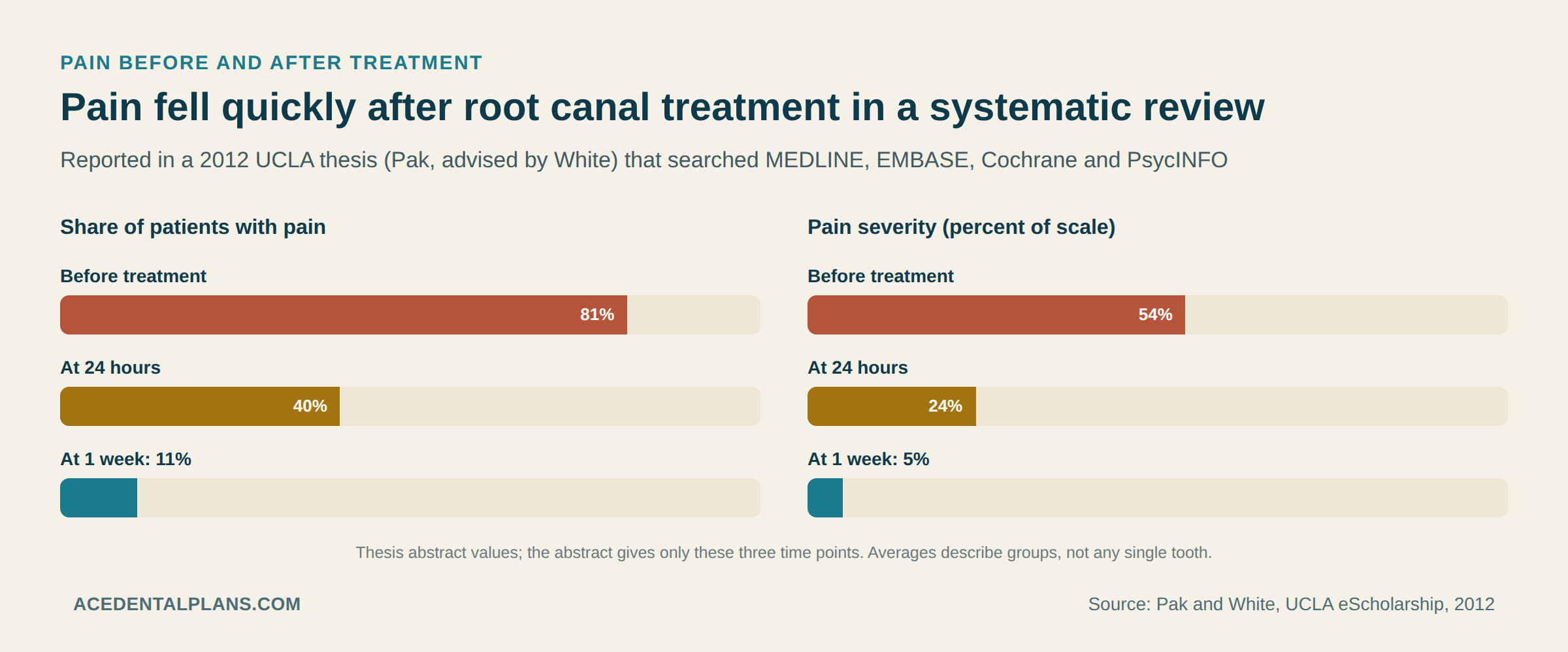
- Pain usually falls fast. In a systematic review reported in a 2012 UCLA thesis, pain prevalence dropped from 81% before treatment to 40% at 24 hours and 11% at one week.
- Numbness lasts hours, not days. Expect about 2 to 4 hours, with no eating until it is completely gone (AAE).
- Call the same day for severe pain or pressure lasting more than a few days, swelling, an uneven bite, a temporary filling that comes out, or the original symptoms returning (AAE).
- The crown matters. The AAE lists a restoration placed late among the reasons a treated tooth may need retreatment.
- Persistent pain has options that range from a bite adjustment to retreatment, apicoectomy or extraction, and the order is a clinical decision.
The First Week, Hour by Hour and Day by Day
A root canal removes the inflamed or infected tissue from inside the tooth, cleans the canals and seals them. MedlinePlus describes the aim as saving a tooth by removing dead or dying nerve tissue and bacteria. The procedure itself is not where recovery starts, though. It starts when the anesthetic wears off.
You will most likely be numb for 2 to 4 hours, according to the AAE patient page. Delta Dental says discomfort may begin an hour or two after the procedure, once the local anesthetic fades. Those two statements fit together: expect the first real feeling in the tooth within the first afternoon. How numbness behaves and what shifts its timing is covered in how long dental numbness lasts.
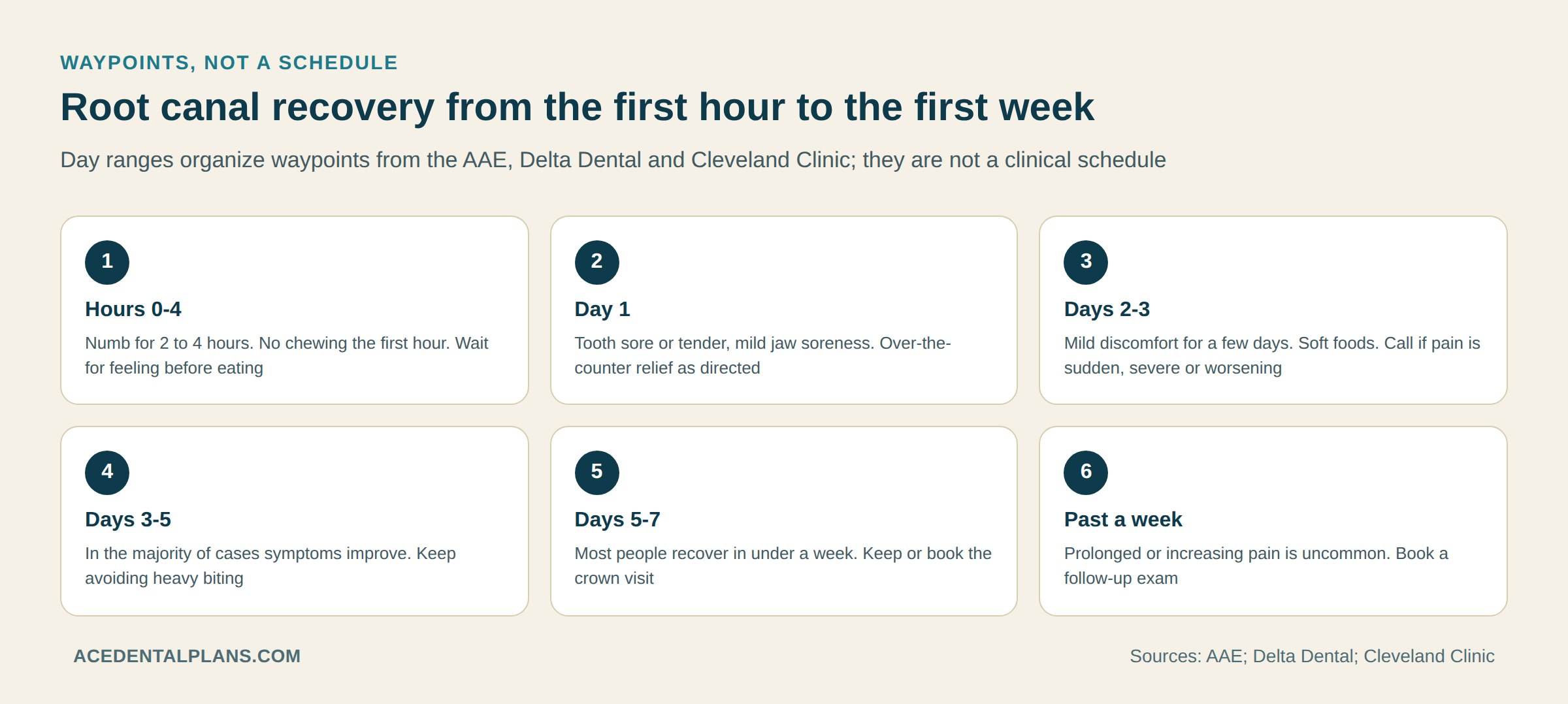
No source I opened gives a day-by-day pain curve for an individual tooth, and it would be misleading to invent one. What the sources give is a set of waypoints. A few days of tenderness. Improvement within three to five days for most people. Recovery in under a week, according to Cleveland Clinic. And a call to the dentist if pain is severe or worsening after two or three days. Table 1 lines those waypoints up. The day ranges are an organizing frame, not a clinical schedule.
| Window | What the sources describe as usual | What helps | Call the dentist if |
|---|---|---|---|
| Hours 0-4 | Numbness of 2 to 4 hours (AAE); discomfort may begin an hour or two after treatment (Delta Dental) | No chewing for the first hour and no hot or cold drinks (AAE); wait for feeling before eating | The temporary filling comes out |
| Day 1 | Soreness or tenderness in the tooth, plus mild jaw soreness from holding the mouth open | Over-the-counter pain relievers as directed; gentle brushing and flossing | Pain is severe or pressure builds instead of settling |
| Days 2-3 | Mild discomfort for a few days; tenderness on touching or biting | Soft foods, chewing on the other side, no hard or sticky foods | Pain is sudden, severe or worsening after two or three days (Delta Dental) |
| Days 3-5 | In the majority of cases, symptoms improve within three to five days (AAE) | Same routine; keep avoiding heavy biting on the treated tooth | Pain is steady rather than easing, or the bite feels uneven |
| Days 5-7 | Most people recover in less than a week; some sensitivity may linger (Cleveland Clinic) | Book or keep the crown appointment; keep care gentle for a few weeks | Swelling appears inside or outside the mouth |
| Past one week | Prolonged or increasing pain is uncommon (AAE); the tooth may still feel slightly different from its neighbors (AAE) | A follow-up visit instead of waiting | Throbbing, pressure or the original symptoms return |
The pattern to watch is the direction. A tooth that was sore on day one, tender on day three and mostly quiet by day six is doing what the sources describe. A tooth that was calm on day two and then hurts more on day four is telling you something different. That second pattern is the one the AAE and Delta Dental flag for a call.
What the Numbers Say About Pain After Treatment
Most of what patients read about root canal pain is a sentence or two of reassurance. The better evidence is a count: how many people hurt, and when. A systematic review by Jaclyn Pak, advised by Shane White at UCLA and reported in a 2012 thesis, searched MEDLINE, EMBASE, Cochrane and PsycINFO for pain data around root canal treatment. Its abstract reports pain prevalence of 81% before treatment, 40% at 24 hours and 11% at one week. Pain severity fell from 54% before treatment to 24% at 24 hours and 5% at one week, on a percent-of-scale basis.
Read those figures twice, because they reverse the popular story. The bulk of the pain in this analysis came before the root canal, not after it. The conclusion stated in the abstract is that pain prevalence and severity decreased after treatment. A tooth that throbbed for a week with an infection is, on average, calmer a week after the work. That matches Delta Dental’s statement that most people feel less pain afterward because the damaged pulp has been removed.
What a single small study adds
A 2024 paper in Cureus by Zaneva-Hristova and Borisova-Papancheva followed 71 patients after single-visit or multi-visit root canal treatment and recorded pain on a visual analog scale at several points. About 70% reported mild pain immediately after the canals were filled. At 24 hours, 67.7% reported no pain, and at one week 90.3% reported none. Three patients, 7.5% of the sample, reported severe pain at some point.
The authors say the sample is too small for a representative conclusion and that they found no statistical preference for either technique. It is worth quoting for a narrower reason. It shows a real minority of patients with a rough few days, which sits alongside Delta Dental’s statement that 3 to 6 percent of people report severe pain in the days after treatment. The Delta Dental page does not name where that range comes from, so treat it as a patient-education figure rather than a measured rate.
Why the averages do not settle your own case
Averages describe groups. A tooth treated for an acute infection, a tooth with a long-standing lesion and a tooth treated without symptoms may follow different curves. The AAE says plainly that the tooth may feel sensitive, especially if there was pain or infection before the procedure. If you came in with a swollen, throbbing tooth, give yourself the benefit of the longer end of the sources’ ranges. If you came in with a quiet tooth flagged on an X-ray, expect the soreness to be mostly about the procedure itself.
One more consequence is that a tooth which stays quiet after treatment tells you very little. Pain scores do not measure healing. They measure pain. A tooth can be symptom-free and still need a follow-up X-ray, which MedlinePlus lists as the check that the infection is gone.
Why a Treated Tooth Can Hurt: Six Causes From Routine to Rare
The sources are clearer about what to do than about why, and some of the explanations below are labelled as proposals. Still, the possible causes line up from the most common and least worrying to the least common and most important, which is also a sensible order in which to consider them.
1. Soreness from the procedure itself
Afterward the tooth is generally a bit sore or numb, and mild discomfort can last a few days, the AAE says. It lists mild jaw soreness from keeping your mouth open as part of the expected picture, and Delta Dental says the same. This is the group of symptoms the numbers in the last section describe, and it is the one most likely to explain what you feel in the first 48 hours.
2. Inflammation around the tip of the root
Longer exposure to medicaments and irrigants in multi-visit treatment may trigger an immune response in the periapical tissues, the tissues around the root tip. That is the proposal of the 2024 Cureus authors. They present this as a possible explanation, not a tested finding. The practical point is milder. Tissue that was inflamed before treatment may take time to settle, and the AAE notes that the tooth may be more sensitive if there was pain or infection beforehand.
3. A bite that is slightly off
An uneven bite is among the reasons the AAE gives for contacting the endodontist right away. After a root canal the tooth may be temporarily filled or sit differently against its partner. Delta Dental says the bite may feel different and the tooth may be more prone to damage while the filling is temporary. A bite adjustment is quick to check and can remove a source of ache that no pain reliever fully touches.
4. A temporary filling that is thinning or lost
Losing a thin layer of the temporary material is normal, the AAE says, but a temporary filling or crown that comes out entirely is a reason to call. Delta Dental likewise advises contacting the dentist promptly if it comes out. An open tooth is exposed to food and saliva, and the same AAE page says a restoration that does not block saliva from entering the tooth can allow contamination. The longer the delay, the more room for trouble.
5. A canal that was missed or cannot be cleaned
Narrow or curved canals, the AAE’s retreatment page says, may not have been treated in the first procedure and that complex canal anatomy can go undetected the first time. This cause is rare, but it is a classic explanation when pain does not settle or returns after improving. In rare cases, Delta Dental notes, a second cleaning of the tooth’s interior may be needed.
6. A crack, new decay or a late crown
The retreatment page lists new decay that exposes the root canal filling to bacteria, a loose, cracked or broken crown or filling, a fracture, and a crown or other restoration placed late. MedlinePlus adds that the infection that requires a root canal in the first place may start from a crack, a cavity, an injury or a deep gum pocket. If the starting problem was decay, early cavity symptoms explains how that damage tends to announce itself before it reaches the nerve.
That last cause is why the AAE says to schedule the permanent restoration as soon as the endodontist finishes. A root canal protects the inside of the tooth. Without a sealed top, the inside is still reachable from the mouth.
Reading Your Own Pattern: Three Hypothetical Weeks
Averages tell you what is likely. Patterns tell you what to do. The three invented patients below all had a root canal on a Monday, and each reads the same sources differently because their weeks unfold differently. They are illustrations, not diagnoses.
Elena has a lower molar treated for an abscessed tooth that ached for days beforehand. By Monday night the tooth is tender when she touches it, but the pulsing from last week is gone. On Tuesday she bites on the tooth by accident and winces. By Thursday she notices the tenderness only when she presses. This is the shape the AAE describes: sensitivity, especially when biting or touching, that improves within three to five days, in a tooth that was infected beforehand. Her next task is the crown appointment, not another dose of worry.
Marcus has an upper premolar treated with a temporary filling. The tooth feels fine through Wednesday. On Thursday he notices a rough spot with his tongue, and by Friday a dull ache starts when he chews. If the whole temporary comes out, both the AAE and Delta Dental say to call promptly. A thin or cracked temporary falls into a gray zone. A new ache after a quiet stretch is still a reason to phone the office on Friday morning instead of waiting for the crown date.
Priya has a front tooth treated and feels mild soreness for two days. On day four the pain returns as a steady throb, her gum looks puffy near the tooth, and the bite feels higher than before. Three items on the AAE list are in play: pain that is worsening, visible swelling and an uneven bite. Her call is a same-day call, and if the swelling spreads or she develops a fever, the emergency guidance in this article applies. These three stories end differently, and the only thing that separated them was the direction of travel.
| What you notice | What the sources say about it | Reasonable next step |
|---|---|---|
| Tender when touching or biting, easing day by day | Sensitivity especially on biting or touching is typical during healing (AAE) | Soft foods, gentle care, over-the-counter relief as directed |
| Dull jaw ache that fades quickly | Mild jaw soreness from holding the mouth open is expected (AAE, Delta Dental) | Rest the jaw; no action needed beyond watching it |
| Pain that stays steady after day three or four | The AAE says most symptoms improve within three to five days and that prolonged pain is uncommon | Call the office and ask for a follow-up visit |
| Throbbing pain or pain that is increasing | Cleveland Clinic says to contact your provider for throbbing pain; the AAE lists worsening or continuous throbbing for evaluation | Call the same day |
| Bite feels high or uneven | The AAE lists an uneven bite as a reason to contact the endodontist right away | Ask for a bite check |
| Swelling in the gum, cheek or face | The AAE lists visible swelling inside or outside the mouth | Call right away; emergency care if breathing or swallowing is affected |
| Temporary filling or crown gone | The AAE and Delta Dental both say to contact the dentist | Same-day call; avoid chewing on that side |
| Pain returns weeks or months later | The AAE says a treated tooth can become painful or diseased long after treatment | Book an exam; ask whether retreatment is an option |
Pain Control: The Categories the Sources Name
The sources agree on a short list, and none of them gives a dose for an individual. Symptoms usually respond to over-the-counter pain relievers, the AAE says, and ibuprofen or acetaminophen are often enough. MedlinePlus suggests an over-the-counter anti-inflammatory such as ibuprofen. For Delta Dental, over-the-counter acetaminophen or NSAIDs usually work, and the dentist may prescribe something stronger if needed.
Two points keep this safe. First, follow the package directions for whichever product you choose, and do not combine products without checking that they do not share an active ingredient. Second, ask a pharmacist or physician before taking anything if you have a medical condition, are pregnant or take other medicines. This article does not suggest doses for any individual, and neither do the sources.
Prescription medicine and what to watch for
Stronger narcotics may be prescribed, the AAE notes, and they can cause drowsiness, so use care when driving or operating machinery. Take any prescription exactly as directed. MedlinePlus says antibiotics may be prescribed to treat and prevent infection.
An allergic reaction to medication also appears on the AAE list (rash, hives or itching) among the reasons to contact the endodontist immediately. That is a call, not a wait-and-see item.
Cold, sleep and other non-drug measures
The AAE page says a cold compress on the outside of the cheek can help with swelling. Brushing and flossing can continue as usual, gently near the treated area, and the AAE says to avoid smoking because it can slow healing. For general short-term steps that apply to many tooth pains, safe toothache relief at home goes through what is reasonable until you can be seen and what to leave alone.
Eating and drinking in the first days
Both the AAE and Delta Dental tell patients to wait until numbness is gone before eating, so as not to bite the cheek, tongue or the tooth. For the first hour the rule is stricter: no chewing, and no hot or cold drinks (AAE). After that, Delta Dental recommends soft foods that require little chewing and avoiding hard or sticky foods while the tooth is temporary. Hard foods and heavy biting on the treated tooth should wait until the dentist clears you, according to the AAE.
In practice, that means a menu such as scrambled eggs, yogurt, oatmeal, mashed vegetables, soup that has cooled slightly and soft pasta, chewed on the opposite side. That list is common sense, not a sourced protocol. For a more detailed stage-by-stage soft-food plan built for a different surgery but useful as a menu source, see what to eat after dental surgery. Skip the parts that do not apply, because a root canal does not involve a surgical site.
Contact the dentist or endodontist right away if
- You have severe pain or pressure, or pain that lasts more than a few days or keeps getting worse (AAE; Delta Dental adds sudden, severe pain after two or three days).
- You can see swelling inside or outside the mouth.
- The bite feels uneven on the treated tooth.
- The temporary filling or crown comes out entirely.
- The symptoms you had before treatment come back.
- You have a rash, hives or itching after taking a medicine.
Call 911 or go to an emergency room if swelling affects breathing or swallowing, or if you have a fever with severe dental pain.

Those six items come from the AAE’s post-treatment page. Two of them, swelling and returning symptoms, overlap with signs of infection. The guides on abscessed tooth symptoms and on the tooth infection and how it spreads explain what an infection looks like and why swelling changes the urgency. The AAE’s symptoms page says the earlier you address symptoms and treat the problem, the better the outcome.
The Temporary Filling, the Crown and the Gap Between Them
A finished root canal is not a finished tooth. A temporary filling is typically in place afterward, Delta Dental says, and the final restoration, a filling or a crown, should be scheduled as soon as possible. Back teeth usually need crowns for strength, while front teeth can often be restored with a filling. Expect two more appointments after the root canal, Cleveland Clinic says: one to prepare the crown and one to place it. Wait until the permanent crown is placed before biting down on the treated tooth.
The reason for the hurry is not cosmetic. A crown or other restoration placed late, or one that does not block saliva, is among the AAE’s reasons a tooth may need retreatment. MedlinePlus says a permanent restoration must follow to restore the tooth’s shape and strength. The temporary seal is made to bridge a short gap, and the sources do not describe it as built to last for months.
What pain during the gap can mean
If the tooth was quiet and then starts to ache while the temporary filling is in place, three explanations deserve a check. The temporary may have worn thin or cracked. The bite may have shifted so that the tooth is taking extra force. Or the problem may have nothing to do with the temporary at all. The AAE says to contact the endodontist if the whole temporary comes out, and Delta Dental says the tooth may be more prone to damage because the bite feels different. Eat on the other side, do not chew ice or hard candy, and keep the crown appointment.
The money side of the gap is the subject of root canal and crown cost. It prices the whole sequence and shows how a December root canal and a January crown can land in different benefit years. The crown on its own, by material and tooth position, is priced at dental crown cost. Neither is repeated here.
Smoking, brushing and the weeks after
Special care of the tooth is advised for a few weeks, or until the tooth is fully restored. Brushing and flossing continue as usual with a gentle hand near the treated area, and smoking is discouraged because it can slow healing. The same page says a properly treated and restored tooth can last as long as your natural teeth. Cleveland Clinic is more measured: most root canals are successful and can last for many years, often a lifetime, though sometimes root canals do not work if the damage is too severe.
When Pain Does Not Settle: The Options in Order
If the tooth is still sore after a week, or the pain improved and then returned, the next step is a visit. Nothing in the sources suggests waiting out a pain that is getting worse. What the visit decides is which of a short list of responses fits, and the list tends to run from simple to substantial. Table 2 sets out what the AAE, Cleveland Clinic and MedlinePlus say about each.
| Response | What it involves | Why it may be raised | Recovery notes in the sources |
|---|---|---|---|
| Follow-up exam and bite check | Looking at the temporary or final restoration, checking the bite and taking an X-ray (MedlinePlus lists an X-ray to check the infection is gone) | Uneven bite, a thinning temporary filling, or pain beyond the expected few days | The sources describe no added recovery time for a bite correction or a replaced temporary |
| Second cleaning or retreatment | Reopening the tooth, removing the earlier filling material, looking for extra canals or new infection, cleaning, shaping and refilling the canals (AAE) | Missed or narrow canals, a late or leaking restoration, new decay, a cracked crown or filling | Sealed with a temporary, then a permanent restoration such as a crown (AAE) |
| Apicoectomy (root-end surgery) | Opening the gum, removing inflamed tissue and the end of the root, a small filling and stitches (AAE) | Inflammation or infection persists in the bone around the root tip after a root canal (AAE) | Most patients return to normal activities the next day; discomfort generally mild; bone heals over months (AAE) |
| Extraction and replacement | Removing the tooth, typically followed by an implant or bridge (Cleveland Clinic) | When damage is too severe for a root canal to work (Cleveland Clinic); the AAE says to consider extraction after specialist consultation when a tooth is questionable or unfavorable in multiple areas | Separate recovery from the extraction, plus a replacement plan to discuss |
What a follow-up visit checks
Expect questions about what triggers the pain, how long it lasts and whether it is changing. Then the dentist may tap or press on the tooth, check how the teeth meet, and look at the restoration. MedlinePlus says a dental X-ray checks that the infection is gone. A practical tip from the earlier sections applies here too: the AAE says the tooth may feel slightly different from its neighbors for a while, and that by itself is not a problem. What the dentist wants to know is whether it feels worse than it did.
If you have also had a recent filling in a neighboring tooth, say so. Sensitivity after a filling follows its own pattern, discussed in tooth sensitivity after a filling, and a sore tooth next door can be mistaken for the treated one.
Retreatment: a second chance, not a verdict
Retreatment is a second chance to save the tooth, in the AAE’s words, and its retreatment page explains that a tooth can heal improperly and become painful or diseased long after treatment. The causes it lists are the ones from earlier: canals not treated the first time, a crown placed late, a restoration that leaks, new decay or a fracture. Retreatment is not a sign that the first dentist failed in every case, since new decay or a cracked crown can threaten a tooth that was treated well.
That page gives no success rate for retreatment, and I did not find a reliable figure in the sources I opened, so I will not offer one. A nearby AAE document does say that the vast majority of teeth with apical periodontitis can be expected to heal after nonsurgical or surgical treatment. It adds that a preoperative lesion lowers the prognosis only slightly. That statement is about teeth with an infection at the root tip, a group that overlaps with but is not identical to teeth that need retreatment.
Apicoectomy and the specialist referral
An apicoectomy is described by the AAE as the most common surgical endodontic procedure and as something a nonsurgical approach may not replace when infection persists in the bone. The same page says surgery can locate small fractures or hidden canals not seen on X-rays. That is a different category of care from a bite adjustment, and the AAE decision guide recommends referral to a specialist for any case that falls outside its favorable category.
The decision guide, written for dentists, rates teeth as favorable, questionable or unfavorable. One factor is the amount of tooth structure left above the gum, with ferrule thresholds of more than 1.5 mm, 1.0 to 1.5 mm and under 1 mm. Others are the health of the gum and bone, canal anatomy, complications during treatment, and the patient’s preferences and finances. That list is useful to a patient for one reason: it shows that saving a tooth is a judgment about the whole tooth, not only the pain.
Retreat, Replace or Extract: The Cost Questions at Decision Level
Prices for a first root canal, for retreatment and for an apicoectomy sit on the page about root canal cost, and the price of removing a tooth is in tooth extraction cost. I did not open a source with a national price for any of these specific to this question, so this section compares structures, not dollar quotes. The structure is what lets you read an estimate when your dentist offers a choice.
Three sets of costs sit behind a decision about a painful treated tooth. First, the cost of saving it: an exam and X-ray, the retreatment or surgery, and the permanent restoration if it is not yet placed. Second, the cost of replacing it: the extraction and a replacement such as an implant or bridge, which Cleveland Clinic names as the alternative to saving the tooth. Third, the cost of doing nothing, which is not zero if pain, infection or a damaged neighbor follows. The dental implant cost and dental bridge cost pages price the replacement side.
How insurance may treat each path
Insurance language is always conditional here, because the same procedure sits in different categories under different plans. Retreatment may be classed like a root canal, or limited if the plan restricts repeat treatment of the same tooth. An apicoectomy may be classed as oral surgery. Extraction may be a basic or major service. Replacement teeth may face their own percentages, waiting periods and annual maximum limits. None of this can be assumed. The questions that matter are these. Which category does each code fall into? Does a waiting period apply? How much of the annual maximum remains? Does the plan limit endodontic treatment of the same tooth?
Ask the office to send a predetermination before retreatment or surgery, and to show you the codes. A predetermination is an estimate of benefits, not a promise of payment, so confirm the details with the insurer in writing.

If you have no insurance
Without a plan, the numbers above become cash prices, and the order of the steps matters more because each one is paid on its own. The playbook in dental care without insurance covers dental school clinics, community health centers, payment plans and discount programs, and it applies to endodontic follow-ups as much as to anything else. Ask whether a recheck for pain after a recent root canal is charged at all; some offices may handle post-treatment follow-up as part of the original fee, and others may not. That is the office’s policy, so ask before you book.
One Visit or Several, Infected or Quiet: Why Two Root Canals Recover Differently
People compare notes after a root canal as if the procedure were a single thing, and then wonder why one friend barely noticed and another had a hard weekend. The sources hint at several reasons. None of them predicts your course, but each explains why the same procedure can feel different.
Number of visits
Cleveland Clinic says the procedure itself takes about 60 to 90 minutes and that some cases need more than one visit. The 2024 Cureus authors compared single-visit and multi-visit treatment. They attributed the greater pain in multi-visit patients to longer exposure to medicaments and irrigants, and still found no statistical preference for either technique. That is a small study with an explanation the authors offer as a proposal. The practical takeaway is simple. If your treatment is split across visits, a sore tooth between visits is not unusual enough on its own to alarm anyone. Severe pain or swelling between visits is still a reason to call.
The tooth before treatment
Sensitivity is likelier, the AAE says, if there was pain or infection before the procedure. Delta Dental adds that most people feel less pain afterward because the damaged pulp has been removed, and the AAE says relief from infection-related pain is expected almost immediately. Put together, a tooth that was in acute pain tends to improve quickly in the way that matters most, and may still be tender to touch for days.
The tooth itself
Delta Dental says back teeth usually need crowns for strength, and Cleveland Clinic says a crown means two more appointments. That puts an extra step ahead of a back tooth, and the AAE says the final restoration should follow quickly. The pain you feel after a molar root canal may be partly the pain of waiting for the next step.
Children and teenagers
The American Academy of Pediatric Dentistry’s pulp therapy guideline (2025 revision) describes pulpectomy for primary teeth. For permanent teeth it describes root canal treatment, apexification and regenerative endodontics, depending on pulp status and root development. The guideline addresses which treatment fits which pulp condition, not the recovery afterward, and I did not open pediatric aftercare guidance. Questions about pain relief for a child, including the choice and dose of any medicine, belong to the dentist or pediatrician, not to a web page.
Questions to Ask Before and After the Appointment
Most of the avoidable trouble after a root canal comes from missing information, such as when the crown is scheduled, what a normal week looks like and who to call. The list below is built from the points the sources return to again and again.
- When will the permanent crown or filling be placed, and who schedules it?
- How long should I expect soreness to last for this particular tooth, given what it was like before treatment?
- Which pain reliever do you suggest, and are any ruled out for me?
- What counts as a reason to call you, and what number reaches someone after hours?
- If the temporary filling comes out, should I come in the same day?
- Will there be a follow-up X-ray, and when?
- If the tooth still hurts in a week, what are the next steps and who performs them?
- Is retreatment or apicoectomy something your office does, or would you refer me to an endodontist?
- Is a recheck for post-treatment pain charged separately?
Five Missteps That Make Recovery Harder
- Treating the temporary as permanent. Both organizations stress getting the final restoration placed promptly. A temporary that stays in place for months risks the leak the AAE warns about.
- Chewing on the tooth to “test” it. Both organizations say to avoid hard foods and heavy biting until the tooth is restored. Tapping or biting to check whether it still hurts only irritates a tooth that is already tender.
- Waiting out worsening pain. Both say pain that is worsening after two or three days is a reason to call. Stoicism helps nobody here.
- Stacking medicines without reading labels. Follow the package directions and ask a pharmacist if you take other medicines.
- Letting cost postpone the crown. A late restoration is on the AAE’s list of reasons for retreatment, and retreatment is another procedure on top of the crown. If the crown is the problem, recovery and aftercare guides gather the related pages, and the payment options are in the pages linked above.
Bottom Line
A root canal is meant to end a toothache, and for most people the soreness that follows is a short chapter. The sources converge on a small set of waypoints: tenderness for a few days, improvement for most people by day three to five, and recovery within about a week. They converge just as firmly on the exceptions, which are pain that is severe, swelling, an uneven bite, a lost temporary filling and old symptoms coming back.
Three decisions shape the outcome more than the pain itself. One is whether you know whom to call and when. Another is whether the permanent restoration gets scheduled promptly. The last is whether, if the tooth does not settle, you ask for the full sequence of options and their costs before accepting any single step.
Cost and coverage matter, but they are secondary to the pattern of the pain. A tooth that is steadily easing needs patience. A tooth that is steady or worsening needs a visit, and the earlier the visit, the more of the simpler options remain available.
Frequently Asked Questions
How long does pain last after a root canal?
Most people have mild discomfort for a few days, and the AAE says symptoms improve within three to five days in the majority of cases. Cleveland Clinic says most people recover in less than a week, though some sensitivity may linger. Pain that is severe, worsening or still present after a week is a reason to call your dentist or endodontist.
Is it normal for a root canal tooth to hurt when I bite?
Some tenderness on biting or touching is typical early in healing, according to the AAE, especially if there was pain or infection before treatment. Avoid heavy biting until the tooth is restored. An uneven bite is different: the AAE lists it among the reasons to contact the endodontist right away, and a bite adjustment is a common check at a follow-up.
When should I worry about pain after a root canal?
Warning signs on the AAE list include severe pain or pressure lasting more than a few days, visible swelling inside or outside the mouth, an uneven bite, a temporary filling or crown that comes out, and the return of pre-treatment symptoms. Delta Dental adds sudden, severe or worsening pain after two or three days. Fever with severe dental pain, or swelling that affects breathing or swallowing, calls for emergency care.
What can I take for pain after a root canal?
The AAE says over-the-counter pain relievers usually work, naming ibuprofen and acetaminophen, and MedlinePlus suggests an over-the-counter anti-inflammatory such as ibuprofen. Delta Dental describes acetaminophen or NSAIDs as usually sufficient. Follow the package directions and ask a pharmacist or physician if you have a medical condition, are pregnant or take other medicines. Prescription medicines should be taken exactly as directed.
Can pain come back weeks or months after a root canal?
Yes, though it is not the usual pattern. A tooth can heal improperly and become painful or diseased long after treatment, the AAE says, for reasons such as a missed canal, a late or leaking restoration, new decay or a fracture. If pain returns, book an exam instead of waiting, because retreatment is an option the AAE calls a second chance to save the tooth.
Can I go to work after a root canal?
Usually yes. Most patients can return to school or work directly after a root canal, according to the AAE, and MedlinePlus says most people resume normal activities the same day. Plan your meals around the numbness, which the AAE says lasts about 2 to 4 hours, and skip hard or sticky foods on that side until the tooth is restored.
Why does my root canal tooth still hurt after a week?
The sources describe several possibilities: an uneven bite, a thinning temporary filling, a canal that could not be fully cleaned, new decay or a crack. Pain that lingers past a week is outside the usual range described by the AAE and Cleveland Clinic, so an exam is reasonable. The dentist can check the bite and the restoration and decide whether an X-ray or specialist referral is needed.
How soon should I get the crown after a root canal?
As soon as the dentist or endodontist says the root canal is complete. Delta Dental advises scheduling the final restoration as soon as possible, and the AAE says to return to your dentist for the permanent crown right after the endodontist finishes. Cleveland Clinic says you will likely have two more appointments, one to prepare and one to place the crown. Avoid biting down on the tooth until it is placed.
Is retreatment or extraction the better choice if a root canal fails?
That is a clinical decision, and the AAE says extraction should be considered after specialist consultation when a tooth is questionable or unfavorable in multiple areas. Cleveland Clinic says a second root canal may be performed, with extraction and an implant or bridge as the alternative. Ask for the cost of the whole sequence on each path, including the restoration or replacement tooth, before you choose.
Does dental insurance cover retreatment after a root canal?
It may, depending on the plan. Coverage varies by plan type, category, deductible, annual maximum, waiting periods and any limit on repeat treatment of the same tooth. Ask the office for a predetermination with procedure codes, and confirm the answer with your insurer in writing. A predetermination is an estimate, not a promise of payment.
Sources and Disclaimers
Clinical statements come from patient pages and professional documents. The publishers are the American Association of Endodontists, the American Academy of Pediatric Dentistry, MedlinePlus, Cleveland Clinic and Delta Dental. The remaining sources are a UCLA thesis reporting a systematic review and a 2024 clinical study in Cureus. Pages were read through a summarizing tool, so statements are limited to what each page stated explicitly. The day-by-day frame in Table 1 organizes the waypoints those sources give and is not a clinical schedule. The dollar figures in the save-versus-replace example are invented to show the arithmetic. No national price for retreatment, apicoectomy or extraction is quoted here, because pricing belongs to the pages linked in the text. Check prices with the dentist and benefits with the insurer, in writing.
- American Association of Endodontists — Root Canal Pain: What to Expect
- American Association of Endodontists — Root Canal Post Treatment Care
- American Association of Endodontists — What Is a Root Canal?
- American Association of Endodontists — Patient FAQs: Root Canal Treatment
- American Association of Endodontists — Endodontic Retreatment
- American Association of Endodontists — Endodontic Surgery
- American Association of Endodontists — Treatment Options for the Compromised Tooth: A Decision Guide
- American Association of Endodontists — Dental Symptoms (patient page)
- MedlinePlus Medical Encyclopedia — Root canal
- Cleveland Clinic — Root Canal: Procedure & Recovery
- Delta Dental — Root Canal Pain
- Pak JG, White SN, UCLA thesis (2012) — Patient-Based Endodontic Outcomes, Systematic Reviews of Pathology and Pain Prevalences
- Zaneva-Hristova D, Borisova-Papancheva T, Cureus 2024 — Incidence of Postoperative Flare-Up After Single-Visit and Multi-visit Endodontic Therapy
- American Academy of Pediatric Dentistry — Pulp Therapy for Primary and Immature Permanent Teeth (2025 revision)
Important Information and Disclaimers
This article is general educational information. By using it, you accept the limits described below.
Not dental or medical advice
Nothing on this page is a diagnosis, a treatment recommendation or a substitute for an examination by a licensed dentist or physician. Reading this article does not create a dentist-patient or doctor-patient relationship. Only a licensed professional who has examined you and reviewed your history can tell you what your mouth needs. Do not delay, skip or stop professional care because of something you read here.
Prices are estimates, not quotes
Cost figures are ranges reported by the third-party sources cited in this article. Actual prices depend on your location, the provider, the complexity of your case, the materials used, the date of service and other factors, so what you pay may be higher or lower. A written treatment plan and fee estimate from the dental office is the only reliable number for your situation.
Insurance and plan examples are illustrations
Examples that use named amounts or percentages are hypothetical. Real benefits depend on your plan, network, waiting periods, annual maximum, deductible and the insurer’s rules at the time of treatment. A pre-treatment estimate or benefits check is not a promise of payment. Confirm the details with your insurer or plan administrator in writing.
Not insurance, legal, tax or financial advice
AceDentalPlans is an information publisher. Nothing here is insurance, legal, tax, investment or other professional financial advice, and nothing here recommends a particular provider, insurer, lender, discount plan or financing product. Company and product names belong to their owners and appear for identification only. Read the terms of any loan, financing offer or plan before you sign, and ask a qualified professional if you need advice on your own circumstances.
Third-party sources
This article cites government agencies, professional associations, insurers, lenders and other outside organizations. We do not control those sources. Their content can change, move or disappear, and listing a source is not an endorsement of it or of anything it sells.
No warranty
We aim for accuracy, but this article is provided “as is,” without warranties of any kind, express or implied, including warranties of accuracy, completeness, timeliness or fitness for a particular purpose. Some information may be out of date or contain errors by the time you read it.
Limitation of responsibility
To the fullest extent permitted by law, AceDentalPlans and its owners, authors and contributors are not responsible or liable for any loss, cost, injury, health outcome or other damage that results from using this article or relying on it. You are responsible for your own decisions about your care, your coverage and your money.
How this article is written
This article follows AceDentalPlans’ answer-first, U.S.-focused editorial approach. It uses conditional language for insurance, because coverage depends on the specific plan, and it names its sources so that you can read them yourself.