A regular cleaning (prophylaxis) removes plaque and tartar from teeth whose gums and bone are still healthy, usually in one visit. A deep cleaning (scaling and root planing) goes below the gumline to treat gum disease that has caused bone or attachment loss, is done by quadrant and often uses local anesthesia. In one 2024 cash-price study, deep cleaning averaged $242 per quadrant, or $968 for four.
This article sets the two side by side, along with the two services that sit between and after them: full-mouth debridement and periodontal maintenance. It covers who qualifies, how the visits differ, how dental plans classify each service and what declining a deep cleaning can mean. It stops short of price detail, day-by-day recovery, the question of whether you truly need one and the stages of gum disease, because each of those has its own page.
Key Takeaways
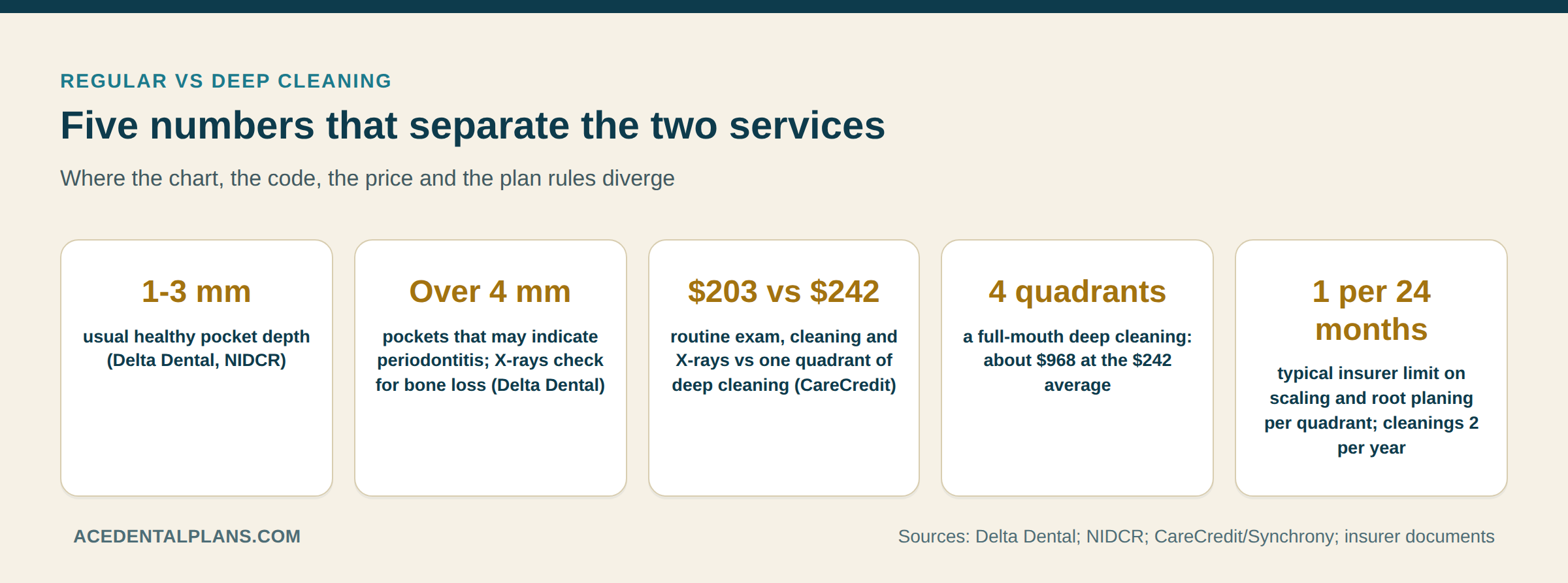
- The dividing line is the gum chart. Delta Dental says healthy pockets usually measure 1 to 3 millimeters and pockets deeper than 4 millimeters may indicate periodontitis. A deep cleaning is typically done only when periodontitis with some bone loss has been diagnosed.
- The two services use different billing codes. An insurer billing guide lists D1110 for an adult prophylaxis, D4341 or D4342 for scaling and root planing, D4355 for full-mouth debridement and D4910 for periodontal maintenance.
- Plans do not agree on how to treat deep cleaning. One 2026 plan summary lists it as a basic service at 80 percent in-network. Another 2026 plan lists it as a major service at 50 percent with a six-month waiting period for adults.
- Frequency limits differ too. A typical insurer limit is two prophylaxes a year but only one scaling and root planing per quadrant per 24 months, according to two insurer documents.
- A deep cleaning is rarely the last visit. The American Academy of Periodontology says most patients need ongoing maintenance therapy after scaling and root planing.
- Declining is a decision with a direction. NIDCR says untreated gum disease can spread to the bone, and in severe cases teeth may loosen or need removal.
Regular Cleaning, Deep Cleaning, Maintenance and Debridement Side by Side
People usually ask about two choices, but dental offices bill four. A regular cleaning is a prophylaxis. A deep cleaning is scaling and root planing. Periodontal maintenance is the cleaning that follows deep cleaning when gum disease has been treated. Full-mouth debridement is a heavier first pass for mouths where deposits are so thick that an exam cannot be completed.
Table 1 lines up the four. The purpose and code rows come from an insurer’s billing guide and the other clinical criteria cited below. The price rows are national averages and ranges, not quotes, and they are not like for like: the $203 figure bundles an exam and X-rays with a cleaning, while the quadrant figure is for one quarter of the mouth.
| Feature | Regular cleaning (prophylaxis) | Deep cleaning (scaling and root planing) | Periodontal maintenance | Full-mouth debridement |
|---|---|---|---|---|
| Purpose | Remove plaque, tartar and stains from a healthy or mildly inflamed mouth | Treat periodontitis by cleaning below the gumline and smoothing roots | Keep treated gum disease stable | Remove heavy deposits so an exam can be done |
| Gum status it is meant for | Generally healthy periodontium; localized gingivitis | Bone and attachment loss; deeper pockets | History of periodontal therapy | Gross deposits obscuring the teeth |
| CDT code (Delta Dental billing guide) | D1110 adult, D1120 child | D4341 (four or more teeth in a quadrant), D4342 (one to three) | D4910 | D4355 |
| Anesthesia | Not part of the described steps | Local anesthetic may be used (ADA); Cleveland Clinic says providers give it | Not described in the sources opened | Not described in the sources opened |
| Visits and time | One visit; scaling, polish, floss | One to two hours; one visit or split in halves; may take more than one visit | Recurring visits, often several a year | May take multiple visits |
| Average cash price (CareCredit, 2023-2024) | $203 for exam, cleaning and X-rays (range $50-$350) | $242 per quadrant | $167 | $126 |
| Cash price range (Delta Dental, no year shown) | $85-$160 | $180-$295 per quadrant | $140-$220 | $150-$260 |
Two patterns stand out. The first is that the deep cleaning’s price is per quadrant, so a full mouth is four units. At the CareCredit average, four quadrants come to $968, which is about 4.8 times the $203 routine visit. The second is that maintenance, which people call “just a cleaning,” is priced and billed as its own service. That has consequences for insurance, covered below.
What Each Service Does, Step by Step
Regular cleaning
Delta Dental Insurance Company describes four moves. The dentist or hygienist scrapes plaque and tartar off the teeth with a metal scaler or an ultrasonic scaler, rinses and suctions, polishes with a gritty paste and flosses last. The work happens on the visible crown of the tooth and just under the edge of the gum.
An insurer’s billing guide ties the code to the patient: a prophylaxis is for a generally healthy periodontium, and also for localized gingivitis, to prevent it from progressing. Delta Dental’s gingivitis page says gingivitis is the earliest stage of gum disease, its effects are reversible and it typically clears up after a thorough professional cleaning when home hygiene continues.
Deep cleaning: scaling and root planing
The ADA calls scaling and root planing “a deep cleaning below the gumline used to treat gum disease.” Scaling removes plaque and tartar above and below the gumline, down to the bottom of each pocket. Root planing then smooths the tooth roots so the gums can reattach. It may require a local anesthetic, and it may take more than one visit.
The ADA’s 2015 clinical practice guideline voted in favor of scaling and root planing as the initial nonsurgical treatment for chronic periodontitis and judged its benefit moderate, with benefits outweighing potential adverse effects. The page does not give outcome numbers. What it does show is that the service has a defined clinical purpose, which is why plans ask for evidence before paying for it.
Full-mouth debridement
Debridement is the odd one out. The insurer billing guide describes it as removing gross deposits so that a comprehensive oral evaluation can be done, and says it may take multiple visits. It is not treatment for gum disease. It clears the view. The same guide lists it as a once-in-a-lifetime service in its most common frequency limit, and says an additional debridement is paid as a routine prophylaxis, with the patient responsible for the added fee.
Scaling in the presence of inflammation
One more code exists for the gap between a regular cleaning and a deep cleaning. D4346 applies when the mouth has generalized moderate to severe gum inflammation and bleeding but no bone loss and no periodontitis. The billing guide says it should not be reported with a prophylaxis, scaling and root planing or debridement on the same date. If your estimate shows this code, it signals inflamed gums without bone loss, and it is a reason to ask whether a recheck after healing is planned.
Periodontal maintenance
After active treatment, the cleaning changes name. The code D4910 is for patients previously treated for periodontal disease, and UnitedHealthcare’s clinical policy says it is not indicated if there is no previous history of scaling and root planing or surgical periodontal therapy. It adds that maintenance continues at varying intervals, determined by the dentist’s clinical evaluation.
Who Qualifies: Pocket Depths, Bleeding, Bone Loss and X-Rays
Which service you are offered depends on measurements, not on how long it has been since your last visit. The dentist or hygienist slides a thin probe between each tooth and the gum and reads how deep it goes. Delta Dental puts it plainly: in healthy areas of the gum the pocket depth is usually between 1 and 3 millimeters, and that pockets deeper than 4 millimeters may indicate gum disease more severe than gingivitis.
Depth alone does not decide it. When pockets are deeper than normal, Delta Dental says dentists will usually take X-rays to check for potential bone loss. Scaling and root planing, in Delta Dental’s words, is typically only done when you already have a diagnosis of periodontitis with some bone loss present. Bleeding on probing and gum inflammation tell the dentist how active the disease is, while the X-rays and attachment readings tell how much supporting tissue is already gone.
| What the exam finds | What the sources say | Service it usually points toward |
|---|---|---|
| Pockets of 1 to 3 mm, little or no bleeding, no bone loss | Delta Dental and NIDCR: 1 to 3 mm is the usual healthy range; an insurer guide describes prophylaxis for a generally healthy periodontium | Regular cleaning |
| Red, swollen or bleeding gums, no bone loss | Delta Dental: gingivitis is reversible and typically clears after a thorough professional cleaning with good home care | Regular cleaning, with a recheck |
| Generalized moderate to severe inflammation and bleeding, no bone loss | Insurer billing guide: code D4346 for scaling in the presence of inflammation, no periodontitis | Scaling in the presence of inflammation |
| Pockets deeper than 4 mm | Delta Dental: may indicate more severe disease; dentists usually take X-rays to check for bone loss | Periodontal evaluation, X-rays, possible deep cleaning |
| Bone or attachment loss confirmed by charting and X-rays | UnitedHealthcare policy: scaling and root planing for Stage II to IV periodontitis with Grade B or C progression; not for gingivitis without attachment loss | Deep cleaning (scaling and root planing) |
| Heavy deposits that block a full exam | Insurer billing guide: debridement removes gross deposits so a comprehensive evaluation can be done | Full-mouth debridement, then reassessment |
| Gum disease already treated and stable | UnitedHealthcare and Delta Dental of Michigan: maintenance follows active therapy; not indicated without prior treatment | Periodontal maintenance |
Reading the staging language without overreading it
UnitedHealthcare’s 2026 clinical policy uses the current staging vocabulary. Stage II has a maximum probing depth of 5 millimeters or less and radiographic bone loss of 15 to 33 percent. Stage III has probing depths of 6 millimeters or more and bone loss reaching the middle third of the root or beyond. Grade B means under 2 millimeters of bone or attachment loss over five years, and Grade C means 2 millimeters or more.
You do not need to memorize those numbers. They explain why an estimate might say “Stage III, Grade B,” and why an insurer asks for charting and X-rays before it pays. The detail of what each stage means for your gums belongs in gum disease stages, symptoms and treatment.
What the insurer wants to see
Insurers write the evidence into their rules. An older Delta Dental billing guide says claims for three or more quadrants of scaling and root planing on the same date are reviewed, and require current dated X-rays, current periodontal charting and a record of the service and time spent. UnitedHealthcare’s policy says scaling and root planing is not indicated for gingivitis without clinical attachment loss, or for removing heavy deposits without attachment loss.
That second rule matters to patients who are told they need a deep cleaning because their teeth look heavily stained or have a lot of tartar. Heavy deposits alone are not the insurer’s test. Ask which measurements justified the recommendation, and whether you can see them. Whether a recommendation is warranted at all is the question of whether deep cleaning is necessary.
How the Visit Itself Differs: Numbing, Quadrants and Scheduling
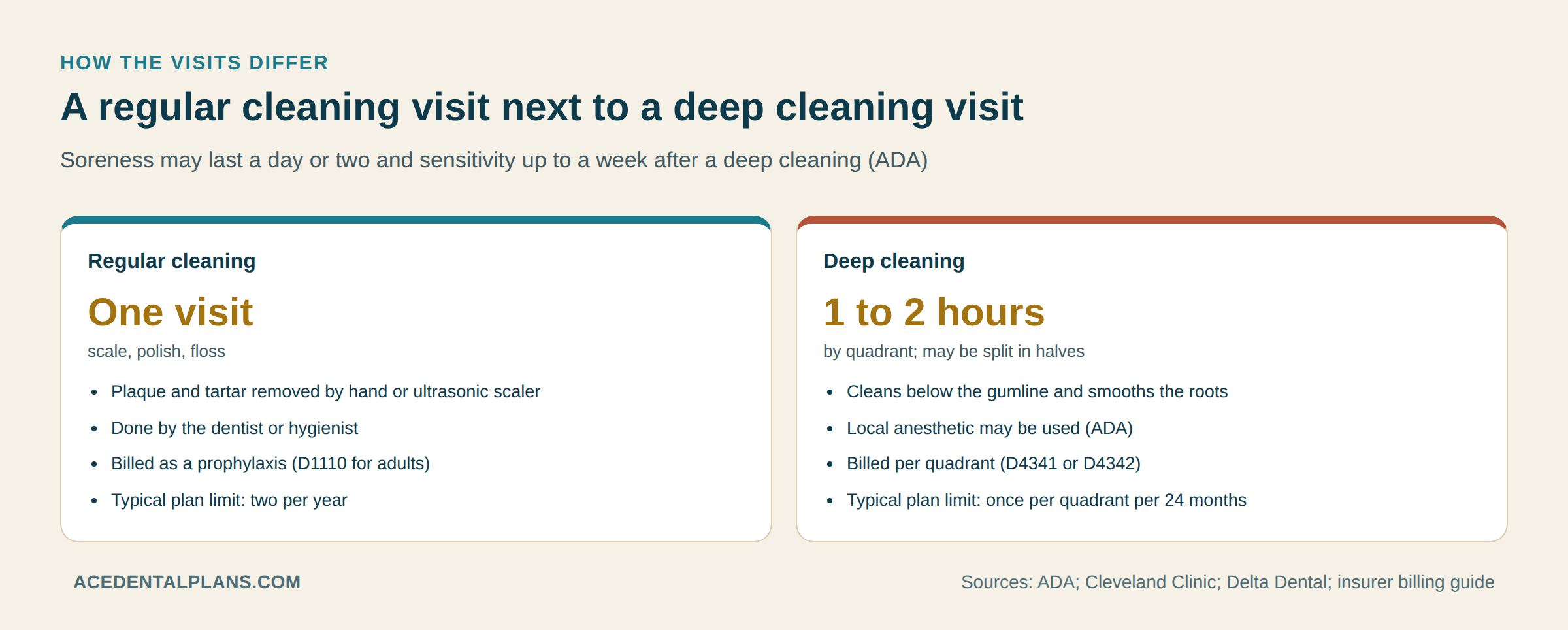
A regular cleaning follows a script that most adults have seen: scale, polish, floss. The deep-cleaning visit differs on four points. The work goes below the gumline. The ADA says it may require a local anesthetic, and Cleveland Clinic says providers give local anesthesia to numb the gums. It takes longer: Cleveland Clinic says one to two hours in total. And it is organized by quadrant, which is also how it is priced and how plans count it.
One visit or two
Cleveland Clinic says a deep cleaning may be done in one visit or split so that half of the teeth are cleaned in one appointment and the other half in a second, depending on your situation and your insurance. The reference to insurance is not casual. The Delta Dental billing guide says a claim for three or more quadrants of scaling and root planing on one date get a closer look from the insurer, and that without documentation of extenuating circumstances the services may not be billable to the patient.
In practice that means an in-network dentist may schedule a full-mouth deep cleaning as two half-mouth visits for payment reasons. The split lengthens the calendar, and it is one way an office can work within the review rule. It also changes timing: if the two visits fall on either side of a benefit-year boundary, they draw on different annual maximums. The calendar side of that is covered in use-it-or-lose-it dental benefits.
Quadrants, teeth counts and the code
The code depends on how many teeth in a quadrant are being treated. D4341 is for four or more teeth in a quadrant and D4342 is for one to three. A quadrant with only two involved teeth is billed under the other code, which carries its own fee. The cost article deep cleaning cost per quadrant works through that arithmetic, so here the point is only that your estimate may mix the two codes.
Pain and recovery in brief
According to the ADA, pain after scaling and root planing may last a day or two, with tooth sensitivity for up to a week, and gums that are swollen, tender and prone to bleeding. Cleveland Clinic says most people return to normal routines the same day, that complications are rare, and that sensitivity to heat and cold should fade within a month or two. Listed risks include small amounts of bleeding, gum recession as swollen gums shrink, infection and temporarily loose teeth.
A dentist may also prescribe a pill or mouth rinse, or place subantimicrobial-dose doxycycline into the cleaned pocket, the ADA adds, and a follow-up visit checks healing and pocket depth. If pockets have deepened, more treatment may be needed. Hour-by-hour aftercare and what to eat belong to deep cleaning recovery. A regular cleaning, by comparison, is not described as having a recovery period in the Delta Dental page opened for this article, so the two are not usually compared on that axis.
What Can Be Added to a Deep Cleaning
Scaling and root planing is the foundation of non-surgical gum treatment, but it is not always the whole plan. The ADA’s 2015 guideline reviewed several adjuncts. It recommended subantimicrobial-dose doxycycline in favor, recommended systemic antimicrobials only weakly because of the potential for adverse effects, and gave weak recommendations to chlorhexidine chips and photodynamic therapy with a diode laser. It voted against other lasers as adjuncts, citing uncertain benefit, and it noted that evidence-poor items should be combined with clinical judgment and patient preferences.
UnitedHealthcare’s policy adds a billing angle. A locally delivered antimicrobial placed in a pocket is indicated as an adjunct in patients with pocket depths of 5 millimeters or more, and the policy treats gingival irrigation as not indicated because of insufficient evidence of efficacy. If your estimate includes a product placed in a pocket, ask which pockets, why and what it adds to the fee. The ADA’s patient page confirms that a dentist may place subantimicrobial-dose doxycycline into the cleaned pocket.
When deep cleaning does not bring pockets under control, NIDCR says surgical treatment may be required in advanced cases. The cost ladder beyond deep cleaning belongs to the gum disease cost guide, and surgery is outside this comparison. The point for a patient weighing deep against regular cleaning is that a deep cleaning is a first step with a follow-up measurement, not a guarantee of an outcome. A follow-up visit checks healing and pocket depth, the ADA says, and more treatment may be needed if pockets have deepened.
Who Needs Extra Care: Diabetes, Tobacco, Pregnancy and Age
Several conditions raise the stakes of the choice. NIDCR says people with diabetes have a higher chance of gum disease, and that diabetes can slow healing, which may make gum treatment less effective. It also advises telling the dentist you have diabetes. The CDC puts periodontitis at about 60 percent of adults 30 and older living with diabetes, using 2009 to 2014 data.
Tobacco is the other large factor. NIDCR calls smoking or using tobacco products the most significant risk factor for gum disease and says quitting may improve treatment results. The CDC reports that about 62 percent of current smokers 30 and older had periodontitis in 2009 to 2014. For a smoker, a diagnosis of gum disease is not an unusual finding, and it should not be taken as a judgment.
Pregnancy raises a different worry, and the ADA addresses it directly. It says preventive, diagnostic and restorative treatment is safe throughout pregnancy, and that scaling and root planing is recognized as safe to perform if periodontitis develops. That does not mean every plan of care is the same, so tell both the dentist and the prenatal provider. Age matters too: the CDC reports periodontitis in about 60 percent of adults 65 and older, which is part of why maintenance becomes a long-running line in many older adults’ budgets.
How Plans Classify and Count Each Service
Insurance is where the two cleanings diverge most. A routine cleaning is a preventive service in the plan summaries opened for this article, so it tends to carry the lowest cost share. Scaling and root planing has no such consistency. One plan puts it with basic services, another with major ones, and each applies its own deductible, waiting period and frequency limit. General background on how plans sort care is in what dental insurance may cover.
Table 3 shows what several real documents say. Each describes one plan or one insurer’s rules, so none is a standard. The useful thing to take from the table is the list of questions it raises: which tier, which deductible, which frequency limit, whether maintenance counts against cleaning visits, and whether a waiting period applies.
| Document | Routine cleaning | Deep cleaning (SRP) | Maintenance and debridement |
|---|---|---|---|
| Delta Dental PPO, Covered California small-business plan (2026) | Preventive; $0 in-network; no deductible; 2 per calendar year | Major; 50% in and out of network; deductible applies; once per quadrant per 24 months; 6-month waiting period for adults | Maintenance is a Basic service and counts toward the 2-per-year cleaning limit; debridement once in a lifetime with conditions |
| Aetna dental PPO, school-district group summary (2026) | Preventive; frequency limits may apply per booklet | Basic; 80% in-network, 70% out-of-network; limits may apply per booklet | Periodontal maintenance not mentioned in the summary |
| Delta Dental of Michigan billing guide (provider document, March 2019 version) | D1110 and D1120: most common limit two per 12-month period or calendar year | D4341 and D4342: most common limit one per 24-month period; three or more quadrants on one date reviewed | D4910: two per period; D4355: one per lifetime; a prophylaxis is not payable with D4910 or full-mouth SRP on the same day |
| UnitedHealthcare clinical policy DCP004.14 (effective March 1, 2026) | Not addressed | For Stage II to IV periodontitis, Grade B or C; not for gingivitis without attachment loss | Maintenance not indicated without prior SRP or surgical therapy; interval set by the dentist |
| Wisconsin state employee plan (2026) | Cleanings limited to two per calendar year | Not described on the page read | Up to two additional visits for maintenance or adult cleaning when a periodontal indicator is set; unclear if they count toward the two-cleaning limit |
Three of the differences in Table 3 change what a patient pays. Tier decides the percentage. The waiting period decides whether anything is paid in the first months. The frequency counter decides whether the maintenance visits that follow use up the same allowance as your routine cleanings. That last one is the least obvious, and it is spelled out in the Covered California plan: periodontal maintenance counts toward the two-per-calendar-year cleaning limit.
The same deep cleaning, two classifications
The practical stakes show up in arithmetic. Using the CareCredit national average of $242 per quadrant, a four-quadrant deep cleaning comes to $968 in cash. The next example assumes that figure is also the plan’s allowed amount, which is a simplification.
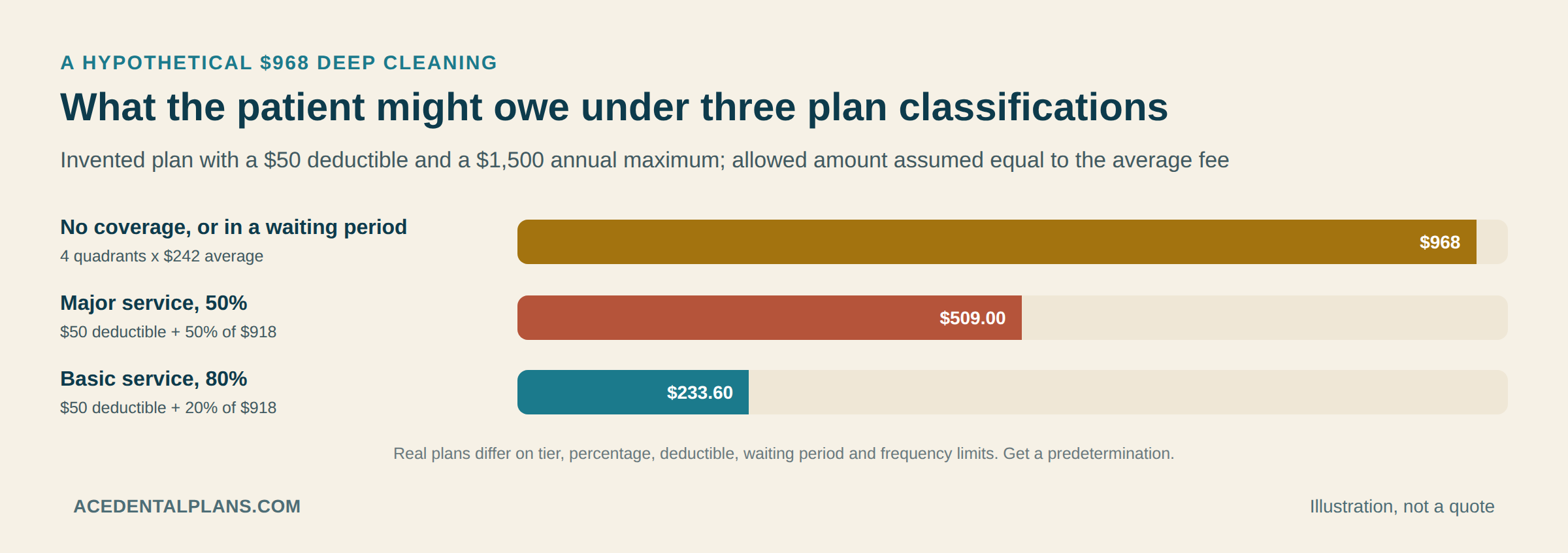
Two more things shape the result. A plan’s annual maximum limits what it pays across all services, and in the basic-tier version of the example the plan has used $734.40 of a $1,500 limit before any other treatment. How that ceiling works is covered in what a dental insurance annual maximum is. And when a waiting period applies, how it is counted and whether prior coverage can waive it are explained in dental insurance waiting periods.
The 30-day wait after a deep cleaning
The Covered California document includes a clause that is easy to miss. Regular cleanings, periodontal cleanings and full-mouth debridement are subject to a 30-day wait after scaling and root planing by the same provider office. A patient who books a routine cleaning two weeks after finishing deep cleaning on that plan could find the cleaning unpaid. The clause is from one plan, not a rule, but it shows why the sequence of visits can matter to the claim.
Get it in writing before the first quadrant
Ask the office to submit a predetermination, or call the insurer with the codes from the written treatment plan. Verbal answers do not bind the insurer, and a benefits check is not a promise of payment. The cost-sharing vocabulary, from deductible to coinsurance to allowed amount, is covered in dental insurance explained. A check should confirm the classification of D4341 or D4342, the frequency limit, any waiting period, and whether D4910 counts toward your cleaning allowance.
What Each Service Costs in Cash, in One Place
The cost articles have the detail, so this section keeps to the comparison. For a routine visit, see dental cleaning cost and cleaning cost without insurance. For scaling and root planing, deep cleaning cost without insurance covers cash fees, hygiene-school clinics and sliding fees.

Delta Dental’s published ranges and CareCredit’s averages agree on the shape. A standard cleaning runs $85 to $160. One quadrant of scaling and root planing runs $180 to $295, so a four-quadrant course spans $720 to $1,180 before any numbing or X-rays. CareCredit’s $968 average sits inside that band. Maintenance costs $140 to $220 a visit in the Delta range and $167 in the CareCredit average, and it comes around repeatedly. Four visits a year at $167 would be $668.
The lines outside the quadrant fee are what surprise people: charting, X-rays, anesthesia and any medicated product placed in a pocket. The ADA mentions that a dentist may place subantimicrobial-dose doxycycline into the cleaned pocket. CareCredit lists anesthesia and sedation as separate averages ($639 and $349), but its page does not say how they apply to a deep cleaning, so ask whether numbing is included in the quadrant fee. A wider look at the whole treatment ladder is in gum disease treatment cost.
For readers without insurance, dental care without insurance lays out sliding-fee clinics, dental schools and payment timing. NIDCR lists dental school clinics, dental hygiene schools, federally funded health centers and local health departments as lower-cost routes. Ask each whether scaling and root planing is offered and what it costs there. Do not trade the diagnosis for the discount, since the charting and X-rays still need to be current.
Reading a deep cleaning estimate line by line
An estimate usually lists a line per quadrant plus the extras. Take a hypothetical four-quadrant plan priced at the CareCredit average. Each of four lines for scaling and root planing carries $242, for $968. A bitewing X-ray set adds $65 on the CareCredit average, and anesthesia may or may not be inside the quadrant fee. A line for a medicated product placed in a pocket would be an extra.
A Year of Care for Two Different Mouths
The comparison gets concrete when you follow two patients through twelve months. Both are hypothetical, and both are priced at the CareCredit national averages used earlier. Neither represents a typical patient, and the figures leave out numbing, X-rays beyond the routine bundle and local variation.
Under a plan, the gap narrows or widens depending on the clauses in Table 3. If Patient B’s plan classes deep cleaning as basic at 80 percent and maintenance as basic too, much of the $1,639 for the treatment and maintenance lines could be shared with the plan, subject to the deductible and the annual maximum. If it classes deep cleaning as major at 50 percent with a waiting period, the first months may be fully out of pocket. The difference is not the dentist’s fee but the plan’s wording.
Maintenance counting against the cleaning allowance is the other swing factor. Under the Covered California document, Patient B’s four maintenance visits would count toward a two-per-year cleaning limit, leaving two visits in the year without that allowance. The Wisconsin plan instead describes up to two additional periodontal visits when an indicator is set. Neither plan is the standard, which is the reason to ask your own insurer in writing. Where the plan is silent on a point, ask the insurer to put its answer in writing.
What Declining or Delaying a Deep Cleaning Can Mean
Nobody should be rushed into a deep cleaning, and a second opinion is a normal request. But declining has a direction, and it helps to know what the sources say about it. NIDCR states that if gum disease is left untreated, it can spread to the bones supporting the teeth, making it painful to chew. In severe cases, it says, teeth may become loose or need to be removed. Bone loss shows on X-rays.
The sources do not put a probability on an individual’s course, and no honest article can. Some gum disease progresses slowly and some quickly. Risk factors push the pace: NIDCR calls tobacco use the most significant, and also names older age, diabetes and genetics. The CDC reports periodontitis in about 4 in 10 U.S. adults 30 and older in 2009 to 2014, and in about 60 percent of adults 65 and older.
Asking for a second opinion without friction
A second opinion is a routine request. Ask the first office for a copy of the periodontal charting and the X-rays, and say why: you want another dentist or a periodontist to read the same measurements. Offices can often send them electronically. A second examiner may take fresh measurements, so expect small differences without alarm.
What matters is whether the two recommendations agree on the diagnosis, the number of quadrants and the sequence. If they differ, ask each office to explain the finding behind the difference. Cost is a separate comparison, and it should use the same codes on each estimate so that the two fees describe the same work.
Delay is not the same as refusal
There are reasonable ways to pause. You can ask for a recheck of the numbers in a few months. You can ask whether treatment can start with the most affected quadrants. You can ask for a second opinion with the X-rays sent along. What you give up by waiting is information: the same mouth may have deeper pockets next time or the same ones. A recommendation that is stable across two examiners carries more weight than one examiner’s chart.
If the diagnosis is gingivitis, the picture is different. Its effects are reversible, Delta Dental says, and NIDCR says early plaque-caused gum disease can often be reversed with daily brushing and flossing. In that case a thorough regular cleaning and better home care is the described path. If an estimate offers a deep cleaning for a mouth with no measured pockets or bone loss, ask which finding supports it, because UnitedHealthcare’s policy lists gingivitis without attachment loss as a case where the service is not indicated.
Do not wait on a routine appointment if
- Gums bleed persistently, are swollen or tender, or have pulled away from the teeth.
- A tooth feels loose or your bite has changed.
- You have pain on chewing, or a bad taste or pus near the gum line.
- Your face or neck is swollen, you have a fever with severe dental pain, or you have trouble breathing or swallowing. That is an emergency: call 911 or go to the nearest emergency room.
After a Deep Cleaning: Periodontal Maintenance Takes Over
Cleveland Clinic says that, ideally, you need the deep cleaning only once. The American Academy of Periodontology is more guarded: many patients do not require additional treatment after scaling and root planing, but the majority will require ongoing maintenance therapy to sustain periodontal health. At a follow-up visit, the ADA says, the dentist checks healing and pocket depth and, if pockets have deepened, more treatment may be needed.
Maintenance is the long phase. Delta Dental of Michigan’s clinical criteria say typical patients may benefit from periodontal maintenance at least four times per year, and that it should be continued for the life of the teeth being maintained. UnitedHealthcare’s policy defines the interval as varying, determined by the dentist’s clinical evaluation. Both agree the number is individual. How often a healthy mouth should be seen is the subject of how often to go to the dentist.
A sketch of the first year after treatment
No source publishes a universal calendar, so treat this as a sequence rather than a schedule. First comes the deep cleaning itself, in one visit or two. Then a follow-up visit to check healing and pocket depth, which the ADA describes. If pockets have improved, the dentist moves the patient to maintenance at an interval set by clinical evaluation. If they have not, the ADA says more treatment may be needed.
On a plan like the Covered California one, the order matters for payment. The document puts a 30-day wait on cleanings and debridement after scaling and root planing by the same office, and counts maintenance toward the cleaning limit. Ask the office to sequence the first maintenance visit with that wait in mind, and to tell you how many cleaning visits the plan will pay for in the same calendar year.
What maintenance changes on the bill
Maintenance is not a cheaper deep cleaning, and it is not a regular cleaning with a new name. It has its own code, D4910, and its own rules. A prophylaxis, Delta Dental of Michigan says, is not payable on the same day as D4910, and that maintenance requires prior periodontal therapy. Under the Covered California plan in Table 3, maintenance counts toward the two-per-year cleaning limit and is paid as a basic service.
In cash terms, the CareCredit average is $167 per maintenance visit, against $203 for an exam, cleaning and X-rays. The two are not the same bundle, so the gap is not a saving. A patient on a four-visit schedule would pay $668 a year at that average, plus any exam or X-ray fees. Planning that expense is part of accepting the diagnosis. Asking early whether the plan treats maintenance as a cleaning or as a basic service is the cheapest way to avoid a surprise.
A Decision Path From Recommendation to Appointment
The question “deep or regular?” is easier to answer in a sequence than in a single sitting. The path below works from the clinical question to the money question and back to the calendar. It does not replace the dentist’s judgment.
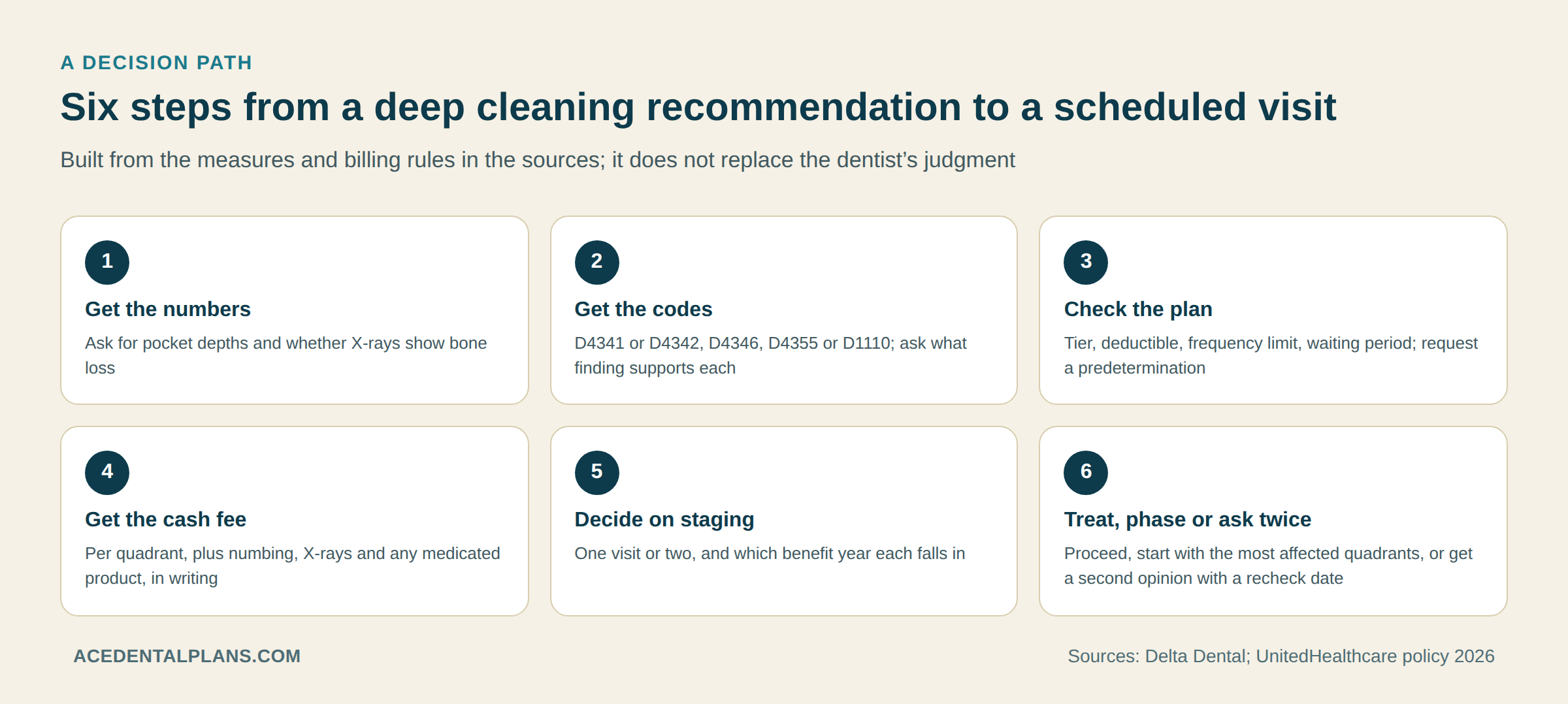
First, get the numbers. Ask for the pocket depths and whether X-rays show bone loss. Delta Dental’s pages tie the 4 millimeter mark and X-ray review to the diagnosis. Second, get the codes. D4341 or D4342 is deep cleaning, D4346 is scaling with inflammation, D4355 is debridement, and D1110 is a regular cleaning. Third, check the plan. Ask about tier, deductible, frequency and waiting period, and request a predetermination.
Fourth, get the cash fee. The estimate should list the fee per quadrant, anesthesia, X-rays and any medicated product. Fifth, decide on staging. One visit or two, and which year the visits fall in. Sixth, treat, phase or get a second opinion. Each is legitimate. The wrong move is leaving the diagnosis unresolved without a recheck date.
Five Mix-Ups That Cause Surprise Bills
“My plan covers two cleanings, so a deep cleaning is covered.” Frequency limits for cleanings do not describe scaling and root planing, which has its own tier and, in the plans above, its own frequency limit of once per quadrant per 24 months. The check: ask for the classification of D4341 or D4342.
“A deep cleaning is just a longer cleaning.” It treats a disease and uses different codes, different tools, usually numbing, and a different plan category. The check: ask the office what finding justifies the code.
“Once it is done, I am back to regular cleanings.” For many patients maintenance follows. The check: ask what the schedule after treatment looks like and what it costs.
“Maintenance and cleaning are interchangeable.” Plans can bill them differently, and some insurers will not pay maintenance without a record of prior periodontal therapy. The check: ask whether the plan counts maintenance against your cleaning allowance.
“Heavy tartar means I need a deep cleaning.” Heavy deposits alone may call for debridement or a regular cleaning, and UnitedHealthcare’s policy says scaling and root planing is not indicated for removing heavy calculus without attachment loss. The check: ask which measurements support the recommendation.
Questions to Ask Before You Agree to Either Service
- What are my pocket depths, and where are the deepest ones? Ask to see the chart, not only hear a summary.
- Do my X-rays show bone loss? Delta Dental says X-rays are usually taken when pockets are deeper than normal.
- Which codes will appear on the claim? Regular cleaning, scaling and root planing, debridement and maintenance each have their own.
- Is numbing included in the quadrant fee? Ask for the fee in writing, with anesthesia, X-rays and any medicated product listed.
- Will this be one visit or two, and which benefit year will each fall in? Staging can change what a plan pays.
- What will my plan do with each code? Tier, percentage, deductible, waiting period, frequency limit and annual maximum, confirmed in writing.
- What does the follow-up schedule look like? Ask how soon the pockets will be rechecked and how often maintenance will be advised.
- Does the plan count maintenance against my cleaning allowance? This one is easy to miss.
- What happens if I wait three months? A dentist can tell you what findings would make waiting riskier.
- Would you mind if I got a second opinion? A good office sends the X-rays and chart without fuss.
Bottom Line
A regular cleaning and a deep cleaning are different services for different mouths, and the dividing line is measured. Pockets in the 1 to 3 millimeter range with no bone loss point to a regular cleaning. Deeper pockets with bone loss and a periodontitis diagnosis point to scaling and root planing, usually followed by maintenance for years.
The money follows the code. Cash prices differ, classification varies by plan, and frequency limits differ by service. Ask for the measurements, the codes and a written estimate before treatment, and ask for a second opinion if the numbers do not seem to support the plan. More side-by-side explainers are collected in the compare guides, and symptom and condition guides are in the oral health and dental emergencies section.
Frequently Asked Questions
What is the difference between a deep cleaning and a regular cleaning?
A regular cleaning (prophylaxis) removes plaque and tartar from a mouth whose gums and bone are generally healthy. A deep cleaning (scaling and root planing) cleans below the gumline to treat gum disease, smooths the roots, is done by quadrant and may use local anesthetic. The ADA describes it as a deep cleaning below the gumline used to treat gum disease.
How do I know if I need a deep cleaning?
Your dentist decides from measurements. Pockets deeper than 4 millimeters may indicate periodontitis, Delta Dental says, and X-rays are usually taken to check for bone loss. Scaling and root planing is typically done when periodontitis with some bone loss has been diagnosed. Ask for your pocket numbers and X-rays, and request a second opinion if you are unsure.
Is a deep cleaning more painful than a regular cleaning?
It can be more uncomfortable afterward, but the procedure is usually numbed. Per the ADA, it may require a local anesthetic, and pain may last a day or two with sensitivity for up to a week. Cleveland Clinic says most people return to normal routines the same day. Specific aftercare is in the recovery guide.
Does insurance cover deep cleaning the same as a regular cleaning?
Often not. A routine cleaning is usually preventive. One 2026 plan classes scaling and root planing as major at 50 percent with a six-month waiting period for adults, and another classes it as basic at 80 percent in-network. Coverage varies by plan, so get a predetermination.
How many visits does a deep cleaning take?
Cleveland Clinic says the procedure takes one to two hours in total, and may be done in one visit or split so that half the teeth are cleaned in each of two appointments. Per the ADA, it may take more than one visit. Insurers may review claims for three or more quadrants on one date, which can influence how an office schedules.
Can I get a regular cleaning instead of a deep cleaning?
If you have gingivitis without bone loss, a thorough professional cleaning is the usual treatment, and Delta Dental says its effects are reversible. If you have periodontitis, a regular cleaning does not reach below the gumline in the same way. The ADA says that when gum disease is caught early and has not damaged structures below the gumline, a professional cleaning should do.
What is periodontal maintenance, and is it the same as a cleaning?
Periodontal maintenance is the recurring cleaning for patients previously treated for gum disease. It has its own code and rules. Delta Dental of Michigan’s criteria say typical patients may benefit from at least four visits a year and that it continues for the life of the teeth being maintained. A routine prophylaxis is not payable the same day.
What is a full-mouth debridement?
It is a first pass to remove gross deposits so a dentist can complete a comprehensive exam. An insurer billing guide says it may take multiple visits and lists a once-per-lifetime limit as the most common. The cash average in one study is $126. It is not treatment for gum disease itself.
How much does a deep cleaning cost compared with a regular one?
CareCredit’s averages are $203 for a routine exam with cleaning and X-rays and $242 per quadrant for scaling and root planing, or $968 for four. Delta Dental lists $85 to $160 for a standard cleaning and $180 to $295 per quadrant. Those are national averages and ranges for patients without insurance, not quotes.
What happens if I skip the deep cleaning?
NIDCR says untreated gum disease can spread to the bones supporting the teeth, and in severe cases teeth may loosen or need to be removed. No source predicts how quickly it progresses for you. Ask your dentist what a recheck interval would be, and whether staging the treatment is possible.
Sources and Disclaimers
Clinical descriptions come from the American Dental Association, the American Academy of Periodontology, NIDCR, the CDC and Cleveland Clinic, along with patient pages from Delta Dental. Billing codes, frequency limits and clinical criteria come from insurer documents: a Delta Dental provider billing guide (a March 2019 version), Delta Dental of Michigan’s periodontal maintenance criteria and UnitedHealthcare’s 2026 clinical policy. Plan classifications come from two 2026 plan documents and a Wisconsin state plan page, each describing a single plan, so they show how rules are written and do not describe your plan. Cash prices are national averages and ranges from CareCredit (Synchrony studies, 2023 and 2024) and Delta Dental, and national averages hide wide local variation. The $968 four-quadrant figure and the classification example are original arithmetic built on those averages with invented plan terms. Confirm prices with the dental office in writing and benefits with your insurer.
- American Dental Association (MouthHealthy) — Scaling and Root Planing for Gum Disease
- American Dental Association — Nonsurgical Treatment of Chronic Periodontitis Clinical Practice Guideline (2015)
- American Academy of Periodontology — Non-Surgical Treatments
- National Institute of Dental and Craniofacial Research — Periodontal (Gum) Disease
- National Institute of Dental and Craniofacial Research — Finding Dental Care
- Centers for Disease Control and Prevention — About Gum (Periodontal) Disease
- Cleveland Clinic — Scaling and Root Planing: Why You Might Need a Deep Dental Cleaning
- Delta Dental — Periodontitis Diagnosis and Treatment
- Delta Dental — Gingivitis Diagnosis and Treatment
- Delta Dental — Dental Cleaning Cost and Insurance Coverage
- Delta Dental Insurance Company — What to Expect at a Dental Cleaning
- Delta Dental of Michigan, Ohio and Indiana — Prophylaxis and Root Planing Code and Billing Guidelines
- Delta Dental of Michigan — Clinical Criteria for Periodontal Maintenance (Ref. 282.19)
- UnitedHealthcare Dental — Clinical Policy DCP004.14: Non-Surgical Periodontal Therapy (2026)
- Covered California for Small Business — Delta Dental PPO Family Dental Evidence of Coverage (2026)
- Aetna (Fairfax County Public Schools group) — 2026 Dental PPO Plan Summary
- State of Wisconsin Department of Employee Trust Funds — Uniform Dental Benefits Certificate of Coverage (2026)
- CareCredit (Synchrony) — Average Dental Procedure Costs
Important Information and Disclaimers
This article is general educational information. By using it, you accept the limits described below.
Not dental or medical advice
Nothing on this page is a diagnosis, a treatment recommendation or a substitute for an examination by a licensed dentist or physician. Reading this article does not create a dentist-patient or doctor-patient relationship. Only a licensed professional who has examined you and reviewed your history can tell you what your mouth needs. Do not delay, skip or stop professional care because of something you read here.
Prices are estimates, not quotes
Cost figures are ranges reported by the third-party sources cited in this article. Actual prices depend on your location, the provider, the complexity of your case, the materials used, the date of service and other factors, so what you pay may be higher or lower. A written treatment plan and fee estimate from the dental office is the only reliable number for your situation.
Insurance and plan examples are illustrations
Examples that use named amounts or percentages are hypothetical. Real benefits depend on your plan, network, waiting periods, annual maximum, deductible and the insurer’s rules at the time of treatment. A pre-treatment estimate or benefits check is not a promise of payment. Confirm the details with your insurer or plan administrator in writing.
Not insurance, legal, tax or financial advice
AceDentalPlans is an information publisher. Nothing here is insurance, legal, tax, investment or other professional financial advice, and nothing here recommends a particular provider, insurer, lender, discount plan or financing product. Company and product names belong to their owners and appear for identification only. Read the terms of any loan, financing offer or plan before you sign, and ask a qualified professional if you need advice on your own circumstances.
Third-party sources
This article cites government agencies, professional associations, insurers, lenders and other outside organizations. We do not control those sources. Their content can change, move or disappear, and listing a source is not an endorsement of it or of anything it sells.
No warranty
We aim for accuracy, but this article is provided “as is,” without warranties of any kind, express or implied, including warranties of accuracy, completeness, timeliness or fitness for a particular purpose. Some information may be out of date or contain errors by the time you read it.
Limitation of responsibility
To the fullest extent permitted by law, AceDentalPlans and its owners, authors and contributors are not responsible or liable for any loss, cost, injury, health outcome or other damage that results from using this article or relying on it. You are responsible for your own decisions about your care, your coverage and your money.
How this article is written
This article follows AceDentalPlans’ answer-first, U.S.-focused editorial approach. It uses conditional language for insurance, because coverage depends on the specific plan, and it names its sources so that you can read them yourself.