Safe short-term toothache relief means rinsing with warm water, flossing gently and taking an over-the-counter pain reliever exactly as its label directs. A cold compress against the outside of a swollen or injured cheek can help too. The American Dental Association (ADA) lists ibuprofen or naproxen, alone or with acetaminophen, for people 12 and older when dental care is not immediately available. None of it treats the cause, so the exam still has to happen. Nationally it averages about $110.
This guide covers the first hours and days. It explains what each home step does, what the labels on common products say and what to avoid. It also shows which signs move you from home care to a phone call or the ER, how to get seen, and what the first visit may cost. It stops short of decoding individual symptoms, which the guide to abscessed tooth symptoms handles. Nothing here is a diagnosis or a personal dosing instruction.
Key Takeaways
- Relief is a bridge, not a repair. Even a clove-oil toothache product label tells you to “See a dentist as soon as possible whether or not the pain is relieved.”
- Pain medicine comes from the label, not from guesswork. The ADA lists NSAIDs such as ibuprofen and naproxen, alone or with acetaminophen, for ages 12 and up. Each label carries its own limits on age, stomach, heart and liver risk.
- Never put aspirin on the tooth or gum. The ADA’s MouthHealthy site, Mayo Clinic and MedlinePlus all say so, and Mayo adds that it may burn the gum tissue.
- Benzocaine gels are off the table for children under 2, and the FDA says adults and older children should use them sparingly. Its warning is a blood disorder called methemoglobinemia.
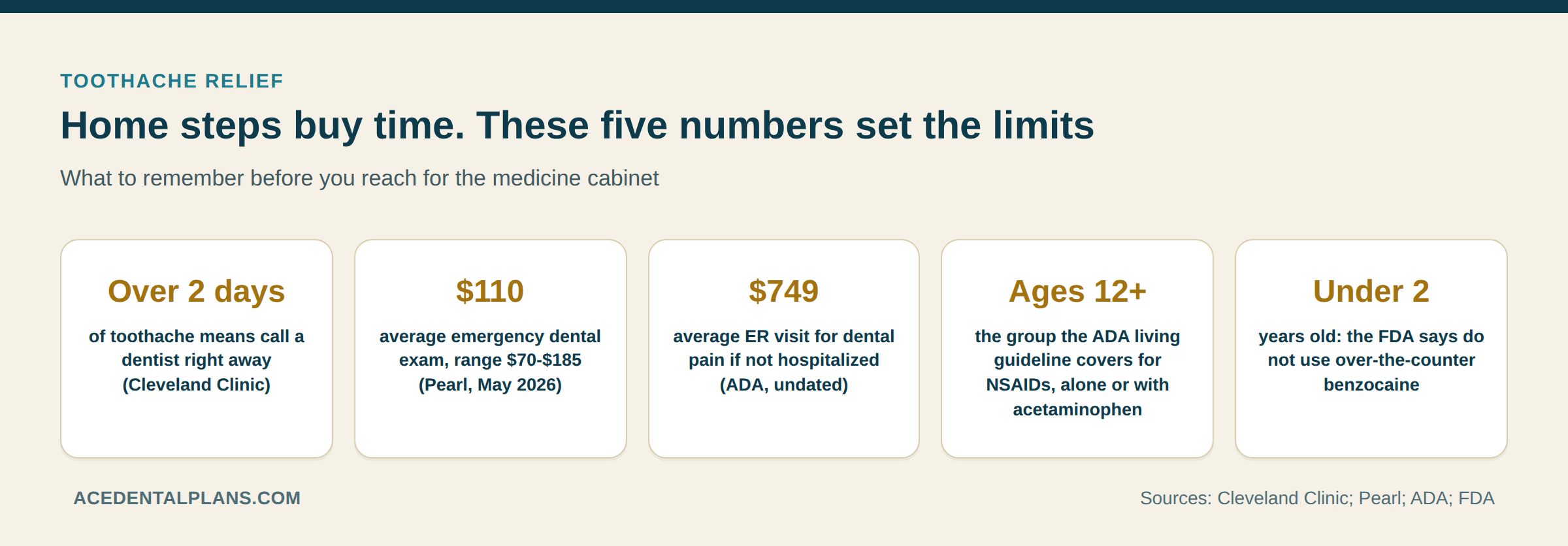
- Two days is a common line. Cleveland Clinic says to call a dentist right away if a toothache lasts longer than two days, or sooner with facial swelling or fever.
- Cost anchors (U.S., 2026): emergency exam about $110, simple extraction about $260, molar root canal about $1,050, and an average emergency-room visit for dental pain of $749 (ADA, undated).
What Home Relief Can and Cannot Do
A toothache is a signal, and home care only turns the volume down. The pain usually traces back to something a dentist has to fix: a cavity, a crack, a failing filling, an infected nerve, a gum problem. Those same causes appear on Cleveland Clinic’s list, along with teeth grinding. Pain relievers and rinses do not change any of them.
That is also how the labels read. One eugenol (clove oil) toothache liquid, in its FDA-listed label, says it “temporarily relieves throbbing, persistent toothache due to a cavity until a dentist can be seen.”
Cleveland Clinic makes the same point about antibiotics and pain relievers in general. Even if an infection quiets down, it “will come back unless you treat the underlying issue.” Treat everything in the next sections as a way to get through the hours between the problem and the appointment.
There is one more reason not to coast. The American Association of Endodontists (AAE) says the earlier you address symptoms, “the better the outcome.” Early on, a cavity can be a simple filling. Left alone it can reach the nerve, and the fix grows from a filling to a root canal or an extraction. The bill climbs the same ladder as the tooth, and the bottom rung is covered in the guide to dental filling cost without insurance.
Not every sore tooth needs the same speed. Severe toothache, an abscess and a badly cracked tooth count as emergencies for Cleveland Clinic, which separates them from a dull or mild toothache that can wait for a regular appointment. If you are not sure which one you have, call the office and describe it. Making that call is the quickest way to find out.
Seven Steps for the First Hours
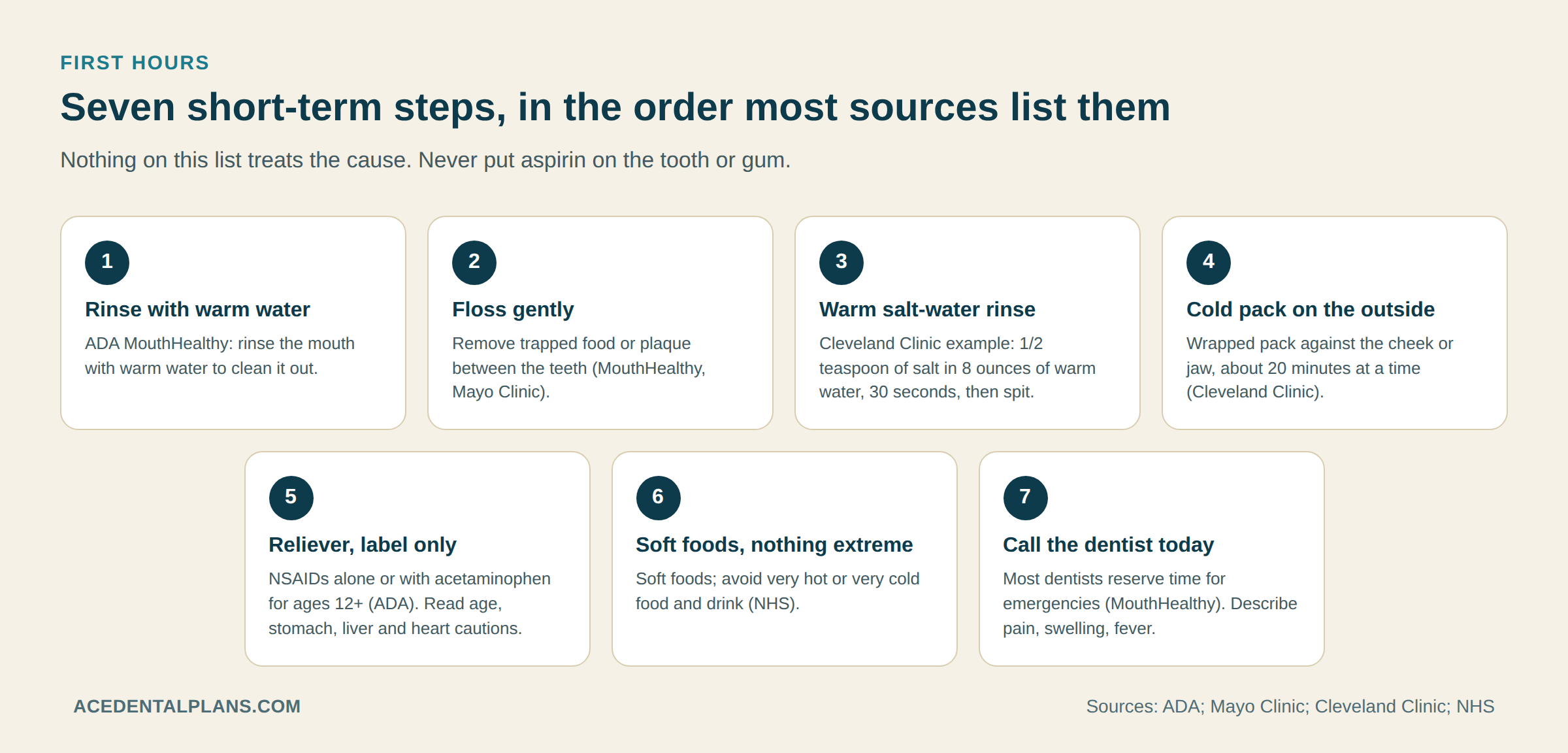
The sources agree on a short list. They differ a little on emphasis, so Table 1 shows which source says what, and what each step cannot do. Read it as a menu, not a sequence you must complete.
| Step | What the sources say | What it cannot do |
|---|---|---|
| Rinse with warm water | ADA MouthHealthy: “rinse the mouth with warm water to clean it out.” Mayo Clinic gives the same first step. | Remove decay, a crack or an infection; it only clears debris |
| Floss gently | MouthHealthy and Mayo Clinic: remove trapped food bits or plaque between teeth. | Help if nothing is stuck between the teeth |
| Warm salt-water rinse | Cleveland Clinic: about 1/2 teaspoon of salt in 8 ounces of warm water, swished for 30 seconds, then spat out. | Reach inside the tooth; spit it out rather than swallow it |
| Cold compress outside the cheek | Cleveland Clinic and Mayo Clinic: a wrapped cold pack against the outside of the jaw or cheek. Cleveland suggests about 20 minutes at a time. | Treat infection; the swelling returning is a reason to call |
| Over-the-counter pain reliever, per label | ADA guideline: NSAIDs alone or with acetaminophen for ages 12 and up when dental care is not immediately available. Mayo Clinic and Cleveland Clinic also name this step. | Fix the cause; labels set age, health and duration limits |
| Soft foods, avoid very hot or very cold | NHS (UK): soft foods such as soup, scrambled eggs, mashed potatoes and yoghurt; avoid very hot or cold food and drink. | Lower inflammation in the nerve |
| Phone the dentist | MouthHealthy: “Call your dentist and provide as much detail as possible” and “Most dentists reserve time in their daily schedules for emergency patients.” | Nothing; this is the step that actually leads to treatment |
A few details deserve a closer look. Start with the rinse. Plain warm water and the salt-water version open nearly every list of home steps. The salt-water recipe above comes from one clinic’s page, so treat the proportions as one published example, not a rule.
The cold compress comes with a wrinkle. Mayo Clinic ties it to a toothache caused by trauma, Cleveland Clinic ties it to swelling, and MouthHealthy mentions it for a cracked tooth. None of the pages consulted for this guide recommends ice directly on the tooth, and Cleveland Clinic describes a wrapped pack against the outside of the jaw.
Flossing is the step people skip because the area hurts. It is still worth one careful try, since food wedged between two teeth is a common and fixable cause of sudden pain. If a gentle pass with floss brings out a piece of popcorn husk and the ache fades within an hour or two, you have probably found your cause. You still need a checkup, because the same gap that trapped the food may also be a cavity.
Over-the-Counter Pain Relievers: What the ADA and FDA Labels Say
The ADA’s page on oral analgesics for acute dental pain, last updated in February 2024, calls nonsteroidal anti-inflammatory drugs (NSAIDs) first-line. It says they “have been shown to be more effective at reducing pain than opioid analgesics.” Acetaminophen works by a different route, so the page describes the two together as highly effective for mild to moderate pain.
The ADA’s living guideline for toothaches, with an evidence search through July 2026, narrows that to adults and adolescents 12 or older. It names NSAIDs such as ibuprofen and naproxen, “alone or in combination with acetaminophen,” for when dental care is not immediately available.
Notice what is missing. No page consulted for this guide gives a dose for a particular person, and this guide does not either. The ADA page itself says no specific regimen produces a high level of relief in every individual. Doses live on the package. A pharmacist can read that package against your health history in a couple of minutes.
| Option | What the sources say | Cautions to read on the box first |
|---|---|---|
| Ibuprofen (an NSAID) | ADA living guideline (July 2026 search): NSAIDs alone or with acetaminophen for ages 12 and up when care is not immediately available. | The FDA-posted Advil label warns of severe stomach bleeding and of heart attack and stroke. Higher stomach-bleeding risk at age 60 or older, with ulcers or bleeding problems, with blood thinners or steroids, or with 3 or more alcoholic drinks a day. |
| Naproxen and other NSAIDs | ADA names naproxen beside ibuprofen. The ADA page lists gastrointestinal, kidney and serious cardiovascular risks for the NSAID class. | Read the specific product’s own Drug Facts label, since only the ibuprofen label was read in full for this guide. |
| Acetaminophen | ADA: a different mechanism from NSAIDs and useful in combination. FDA: for ages 12 and older the total in 24 hours “should not be more than 4,000 mg.” | FDA: overdose can cause liver failure, severe liver damage is possible with 3 or more alcoholic drinks a day, and it “may cause rare but serious skin reactions.” Do not use more than one acetaminophen-containing product at a time. |
| Ibuprofen plus acetaminophen as one product | ADA page notes an FDA-approved over-the-counter combination from 2020. | Both ingredients’ cautions apply at once, and a combination product counts as an acetaminophen product for the duplicate rule. |
| Aspirin | The sources address it mainly for what not to do: never on the tooth or gum (MouthHealthy, Mayo Clinic, MedlinePlus). The NHS says children under 16 should not take aspirin. | The ibuprofen label says ibuprofen may reduce the heart-protective effect of aspirin taken for heart attack or stroke, so ask a pharmacist if you take daily aspirin. |
| Opioids | ADA: “reserved for clinical situations when the first-line therapy is insufficient”; advises against “just-in-case” prescribing. Codeine and tramadol are contraindicated for acute pain in children. | Prescription only, so a dentist or physician decides; not a home option. |
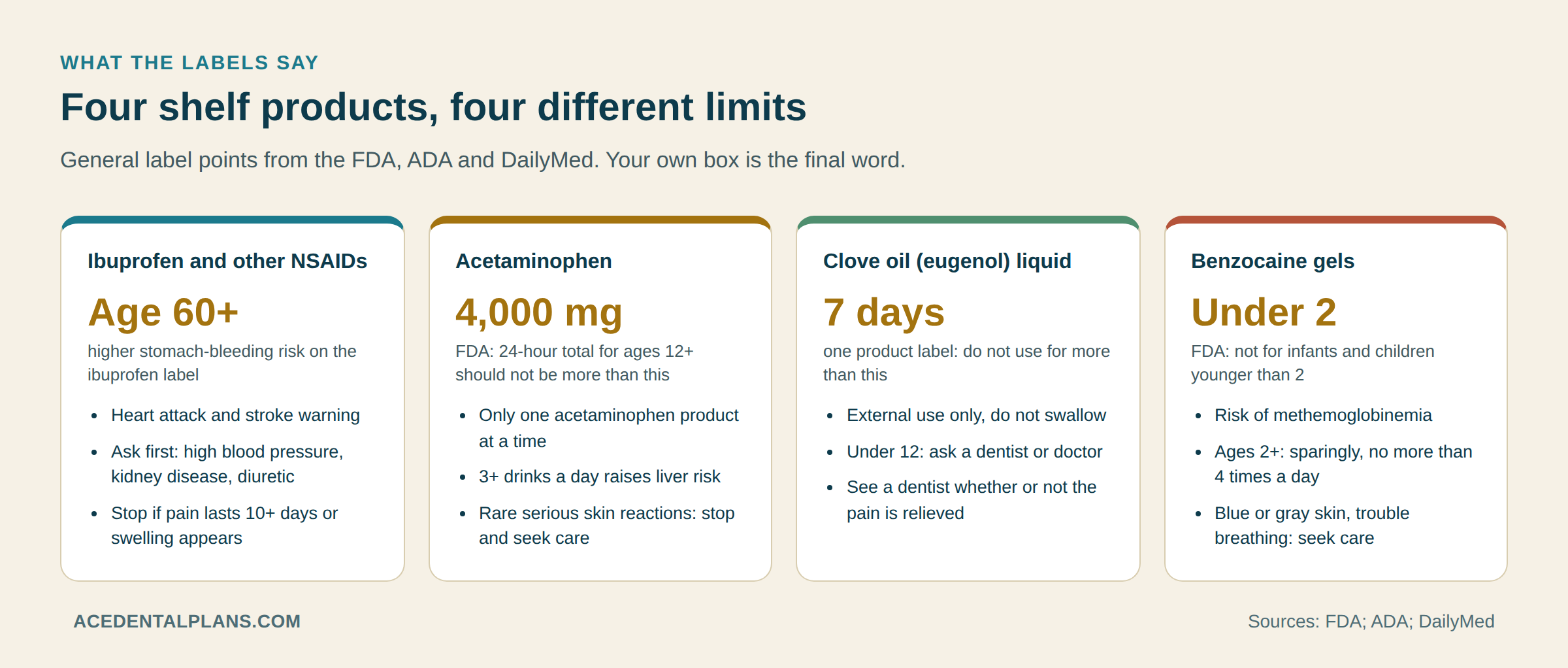
Reading the Drug Facts label with a toothache in mind
Most people read the dose line and nothing else. For a toothache, four other lines matter more. First, the active ingredient, because duplicate ingredients are how people double up by accident. FDA says acetaminophen sits in many prescription and over-the-counter products.
Second, the “ask a doctor before use” list. On the ibuprofen label it includes high blood pressure, heart disease, liver cirrhosis, kidney disease, asthma, a prior stroke and taking a diuretic. If any of those describes you, the pharmacist counter is the right stop before the tooth is even examined.
Third, the pregnancy line. The label says to ask a health professional first, and it is “especially important” not to use ibuprofen at 20 weeks or later in pregnancy unless a doctor directs it. The section on children, pregnancy and older adults returns to this.
Fourth, and most useful for this topic, the “stop use” list. The ibuprofen label says to stop and ask a doctor in several cases: pain that gets worse or lasts more than 10 days, fever that gets worse or lasts more than 3 days, or “redness or swelling is present in the painful area.” That last phrase is the label telling you, in plain print, that a swollen tooth or cheek is not a home-care problem.
A final note on combining products. The ADA page treats an NSAID plus acetaminophen as a standard pairing, and the living guideline names it. That is a clinical pairing of two different medicines, taken within each box’s limits. It is not a license to stack two products that share an ingredient. When the two ingredients arrive in one tablet, the box counts them as one product with two sets of cautions.
Clove Oil, Benzocaine Gels and Other Shelf Products
The pharmacy aisle sells two kinds of toothache product that go on the tooth or gum. One is a numbing gel, usually benzocaine. The other is a clove-oil liquid, whose active ingredient is eugenol. Neither one is a pain reliever in the sense of the section above, and both come with limits worth reading before you open them.
Benzocaine: the FDA’s warning in plain terms
In a May 2018 drug safety communication, the FDA said over-the-counter oral benzocaine products carry a risk of methemoglobinemia. The condition reduces the oxygen the blood can carry and “can be life-threatening and result in death.” The agency said these products “should not be used to treat infants and children younger than 2 years.” For adults and children 2 and older, it said to use them only if the label includes the required warnings, sparingly, and no more than four times a day.
The warning signs it listed are pale, gray or blue skin, lips and nail beds, shortness of breath, fatigue, confusion, headache, lightheadedness and a rapid heartbeat. Symptoms can begin within minutes to two hours after use, including after the first use, and the FDA says to seek medical attention immediately. Mayo Clinic repeats the core warning and adds that anyone using benzocaine should talk to a health professional first and never exceed the recommended amount.
The FDA also suggested alternatives for mouth pain in older children and adults: a diluted salt-water rinse and over-the-counter pain relievers. For teething babies it said not to use benzocaine or other local anesthetics at all. It pointed instead to the American Academy of Pediatrics advice of gum massage with a finger or a firm rubber teething ring.
Clove oil and eugenol: what the label allows
Clove oil appears all over the internet as a toothache remedy. The ADA, Mayo Clinic and Cleveland Clinic pages consulted for this guide do not mention it. The one authoritative statement available is a product label, so that is what this section uses. It is a single product’s label, not a ruling on every clove product.
The Red Cross Toothache label on DailyMed (updated June 2025) lists eugenol 85% as the active ingredient. Its warnings include external use only, an allergy alert for anyone allergic to eugenol, and “DO NOT SWALLOW to avoid irritation.” If swallowed, the label says to get medical help or contact a Poison Control Center right away. It also says to stop use if irritation persists, inflammation develops, or fever and infection develop.
Two more lines stand out. The label says children under 12 should ask a dentist or doctor. It also says “do not use for more than 7 days.” Then comes the sentence that matters most: “See a dentist as soon as possible whether or not the pain is relieved.”
Hydrogen peroxide and the rest of the cabinet
A hydrogen peroxide rinse appears among Cleveland Clinic’s remedies, with a firm rule. Dilute it with equal parts water, spit it out, and “never rinse your mouth with pure hydrogen peroxide.” That is the only cabinet item besides salt water in the pages consulted. For garlic, peppermint tea bags, whiskey on the gum and similar folk remedies, no support turned up in the clinical pages consulted, so this guide does not recommend or rule on them.
What Not to Do: Aspirin on the Gum and Other Mistakes
The mistakes below show up in the clinical pages consulted, and each one has a reason attached. A few are about doing something harmful. Others are about doing nothing for too long.
- Putting aspirin on the tooth or gum. ADA MouthHealthy says “Do not put aspirin on the aching tooth or gum tissues.” Mayo Clinic warns that a painkiller placed against the gum “may burn your gum tissue.” MedlinePlus repeats the instruction. Swallowing medicine and dissolving it against the gum are two different things.
- Using full-strength hydrogen peroxide as a rinse. Cleveland Clinic says never to do this. Dilute it with equal parts water.
- Doubling up on acetaminophen. The FDA says not to use more than one acetaminophen-containing product at a time, and to check every label because the ingredient hides in many products.
- Taking more, or for longer, than the box says. The ibuprofen label lists “take more or for a longer time than directed” among the stomach-bleeding risk factors. A toothache that needs ten days of medicine needs a dentist.
- Waiting out swelling or fever. The ibuprofen label, Cleveland Clinic and Mayo Clinic all treat these as reasons to stop self-care and call. The section on red flags lists the exact triggers.
- Treating antibiotics as a toothache remedy. The ADA’s August 2026 statement on antibiotic use says dental procedures manage localized conditions. Antibiotics “should be reserved for cases with systemic involvement or signs of spreading infection.” A prescriber, after an exam, makes that call.
- Patching a crown with super glue or a lost filling with sugary gum. Neither is advised, according to Cleveland Clinic, which notes that sugar-filled gum “will cause pain.”
What about heat on a swollen cheek? None of the clinical pages consulted recommend it, and the compress advice they give is consistently cold, applied to the outside of the face. The National Institute of Dental and Craniofacial Research (NIDCR) does list heat or cold on the face as self-care for jaw-muscle (TMD) pain, but that is a different problem. When a face is swelling because a tooth may be infected, the question is not which temperature is more comfortable. It is whether a dentist has seen it.
Sleeping, Eating and the Next Few Days
This is the part of the topic with the thinnest evidence, and it is worth saying so. None of the ADA, Mayo Clinic, Cleveland Clinic or NHS pages consulted gives a sleeping position for a toothache. The question gets asked often because throbbing tends to feel worse when you lie flat. If an extra pillow makes the night more bearable, it is a comfort choice with no published backing in those pages, and it is no reason to delay the call.
Food has firmer ground. The NHS suggests soft foods such as soup, scrambled eggs, mashed potatoes and yoghurt, and says to avoid very hot or very cold food and drink. That fits with the American Association of Endodontists page on tooth pain, which treats lingering pain after hot or cold as a signal worth reporting. If a hot drink sets off a pain that stays for half a minute or more, that is useful information for the dentist, not something to push through.
Alcohol is the other practical item. The ibuprofen label lists three or more alcoholic drinks a day as a stomach-bleeding risk, and the FDA says the same amount can contribute to severe liver damage with acetaminophen. Neither warning is about one glass of wine at a birthday dinner. Both are about regular heavy drinking combined with a daily pain reliever, which is exactly what a week-long toothache invites.
What to write down before the call
Dentists sort toothaches by pattern, so a short note helps. The AAE’s tooth-pain page and its diagnostic newsletter describe the patterns. One is a flash of sensitivity that fades in a second or two. Others are pain that lingers 30 seconds or longer after hot or cold, pain on biting, pain that starts on its own, and constant pressure with gum swelling. Jot down which of these you have, when it began, whether there is swelling or fever, and which medicines you took and when. A few minutes of notes makes the phone call faster and more specific.
- Which tooth or area hurts, and whether the pain moves to the jaw or ear.
- What sets it off: cold, heat, sweets, biting, lying down, or nothing at all.
- How long it lingers once the trigger is gone.
- Whether you have swelling, a gum bump, a bad taste, or a temperature.
- Which medicines you took, with the time of each.
- Any recent dental work on that side.
Red Flags That Move You From Home Care to a Call or the ER
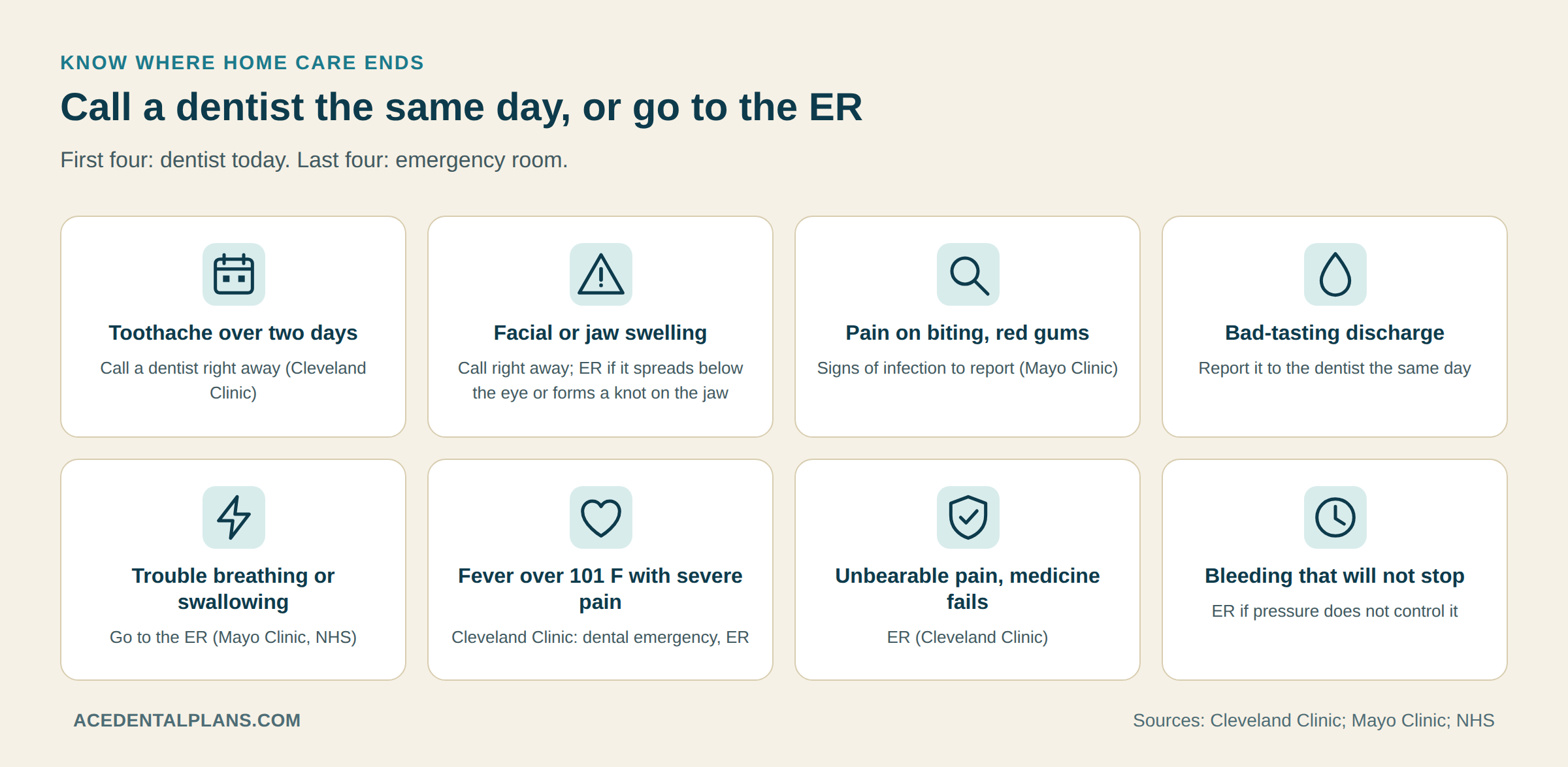
Home relief has a built-in time limit, and the sources agree on where it falls. Cleveland Clinic says to call a dentist right away for a toothache that lasts longer than two days, for facial or jaw swelling, or for pain when opening your mouth wide. Mayo Clinic adds fever and signs of infection such as swelling, pain on biting, red gums or a foul-tasting discharge to the same list. MedlinePlus says to contact a dentist for a throbbing toothache that will not go away or for a bump or pimple on the gum.
The emergency-room tier is narrower. Mayo Clinic says that with trouble breathing or swallowing you should go to the emergency department. Swelling below the eye or a knot on the jaw qualifies, according to Cleveland Clinic. So do unbearable pain that medication does not relieve, bleeding that does not stop with pressure, and a fever over 101°F (38.33°C) with severe tooth pain. The NHS adds a swollen or painful eye and a lot of swelling in the mouth. Mayo Clinic also says that with fever and facial swelling when you cannot reach a dentist, an ER is the right place.
Go to the ER or call 911 if
- Breathing, speaking or swallowing becomes difficult.
- Swelling spreads below the eye or toward the neck.
- Fever of more than 101°F comes with severe tooth or jaw pain, or you have chills.
- Bleeding from the mouth does not stop with pressure.
- An eye becomes swollen or painful.
Two traps catch people here. The first is mistaking relief for recovery. Mayo Clinic describes an abscess that ruptures with a sudden rush of foul-tasting fluid and then relief, and warns that the improvement is misleading because the infection is still there. The tooth abscess guide covers the types and treatment in depth.
The second trap is waiting for the pain to confirm the danger. The AAE says an infection around a root “may or may not be painful,” and the same page lists aching, pain on chewing and swollen gums. A tooth that has gone quiet after days of pain may have lost its nerve rather than healed. The guide on how a tooth infection can spread explains why a quiet tooth with a swollen face still needs a same-day call.
In the middle sits a large group: pain that is real but not alarming, with no swelling and no fever. A dull or mild toothache, in Cleveland Clinic’s classification, can wait for a regular appointment. That does not mean wait indefinitely. It means a booked visit within days is reasonable where an emergency slot might not be.
Children, Pregnancy and Older Adults: Where the Rules Change
Every general rule above has an age or health exception, and the labels print them. The most important comes first: no benzocaine for children under 2, per the FDA, and the FDA says not to use benzocaine or other local anesthetics for teething pain at all. The eugenol toothache label says children under 12 should ask a dentist or doctor. The ibuprofen label gives a dose only for ages 12 and over and says to ask a doctor for children under 12.
The FDA acetaminophen page says not to use a product intended for adults if the child is less than 12 years of age. It also warns against giving a child more than one acetaminophen product at a time. The NHS says children under 16 should not take aspirin. On the prescription side, the ADA says codeine and tramadol are contraindicated for acute pain in children. If a child has a toothache, the practical path is a call to the dentist or pediatrician, who can name a product and an amount for that child’s weight.
Pregnancy has its own wrinkle. The ibuprofen label says to ask a health professional before use if pregnant or breast-feeding. It is especially important not to use ibuprofen at 20 weeks or later unless a doctor directs it. Untreated tooth problems do not pause for pregnancy, so the better move is a quick call to the dentist and the obstetric provider together. The guide to dental care during pregnancy covers what dentists do and do not delay.
Older adults and people with chronic conditions get a different set of cautions. The ibuprofen label names age 60 or older as a stomach-bleeding risk factor. It also lists high blood pressure, heart disease, kidney disease, liver cirrhosis, asthma, prior stroke and diuretics as reasons to ask a doctor first. Blood thinners and steroids appear on the bleeding-risk list. Anyone on those medicines should ask a pharmacist which pain reliever fits before they start.
How to Get Seen: A Phone Script and the Routes Beyond Your Own Dentist
MouthHealthy says most dentists reserve time in their daily schedules for emergency patients. That is a good reason to call before the swelling or the weekend arrives. Say plainly that you have a dental emergency or severe pain, since that is the time the office sets aside. Then give the details from your notes. “Lower right molar, throbbing since Tuesday, cheek puffy this morning, no fever” gives the front desk far more to work with than “my tooth hurts.”
Three questions are worth asking on that call. Can the dentist see you today, and if not, who covers after hours? What will the first visit cost without insurance, or what is the likely patient share with it? Does the office credit the exam toward treatment? Ask rather than assume.
If you do not have a dentist, the NIDCR page on finding dental care lists the main routes. Dental schools run clinics where students treat patients under the supervision of licensed dentists at reduced cost, and dental hygiene schools may offer similar supervised care. Federally funded health centers charge by income. The HRSA says they “Adjust their fees based on income and family size” and “Serve everyone, even if they cannot pay.” State or local health departments, and the 2-1-1 line, may know of free or reduced-cost programs.
After hours is where people drift to the emergency room. When the dentist’s office is closed, Cleveland Clinic says to go to the nearest ER, but its staff “don’t perform restorative treatments, such as fillings or crowns.” The ADA describes the typical ER dental visit as palliative care. In a Maine program, each patient with dental pain left with one prescription for painkillers and antibiotics and a referral to a local clinic or oral surgeon. In other words, the ER is the right door for the red flags above and a poor substitute for a dentist for everything else.
What the Dentist Does First
The first visit has a predictable shape. The dentist or hygienist asks the questions you prepared, then examines the mouth. MedlinePlus says the dentist may tap the tooth or ask you to bite down, and that the gums may be checked for swelling, redness or drainage. “Dental x-rays and other tests can help your dentist determine which tooth or teeth are causing the problem.”
The AAE’s diagnostic newsletter lists the tools. They include a cold test, compared against neighboring teeth, with a normal tooth settling in a second or two. The list also names an electric pulp test, percussion and palpation, a bite test and radiographs. For a full endodontic work-up the same list calls for at least two new periapical X-rays, plus a bitewing or cone-beam scan when needed. A typical emergency exam is narrower. Pearl describes it as a targeted exam of the urgent area, usually one periapical X-ray, a pain assessment, a diagnosis and treatment plan, and a prescription if appropriate.
Then comes the decision. The possible treatments, per Cleveland Clinic, are a filling, a crown, an inlay or onlay, root canal therapy or an extraction. If the diagnosis is an infection, MouthHealthy describes antibiotics, drainage and, depending on the cause, a root canal. If the area is numbed, expect the lip or cheek to stay asleep for a while after you leave; the guide on how long dental numbness lasts explains what is normal.
Sometimes the first visit ends with relief and a plan rather than a finished repair. A dentist may clean out the tooth, place a temporary filling, drain a swelling or prescribe medicine, then schedule the definitive work. That sequence explains why a single toothache can produce two bills a week or two apart.
What the First Visit May Cost, and How Insurance Treats It
No national average describes “a toothache,” because the diagnosis sets the price. What does exist is a ladder of published figures for each possible stop. Table 3 collects them. The exam, extraction and root canal rows come from the ADA fee survey as presented by Pearl in May 2026. The palliative and drainage rows are average rates negotiated by insurers, taken from federal transparency files, so they are not the same kind of number. The ER row is the ADA’s undated summary.
| Stop | Published figure | What it usually includes | Source and date |
|---|---|---|---|
| Emergency dental exam | $70-$185, average $110 | Targeted exam, usually one periapical X-ray, pain assessment, diagnosis and plan | Pearl, ADA fee survey data, May 2026 |
| Palliative (emergency) treatment | Average $75, median $72, range $26-$184 | Insurer-negotiated rate for temporary pain relief; page does not describe the procedure further | PayorMap, CMS transparency files, March 2026 |
| Incision and drainage, soft tissue | Average $139, median $130, range $51-$750 | Insurer-negotiated rate; the page covers soft-tissue drainage in general, not only dental abscess | PayorMap, March 2026 |
| Simple extraction | $170-$450, average $260 | Local anesthesia, tooth removal, socket dressing, follow-up call or visit | Pearl, May 2026 |
| Molar root canal | $685-$1,800, average $1,050 | Anesthesia, canal cleaning and sealing, temporary filling, final X-ray; crown billed separately | Pearl, May 2026 |
| Hospital ER visit for dental pain | Average $749 if not hospitalized; $400-$1,500 vs $90-$200 for a dentist visit | ER evaluation and medicines; no restorative treatment | ADA, undated |
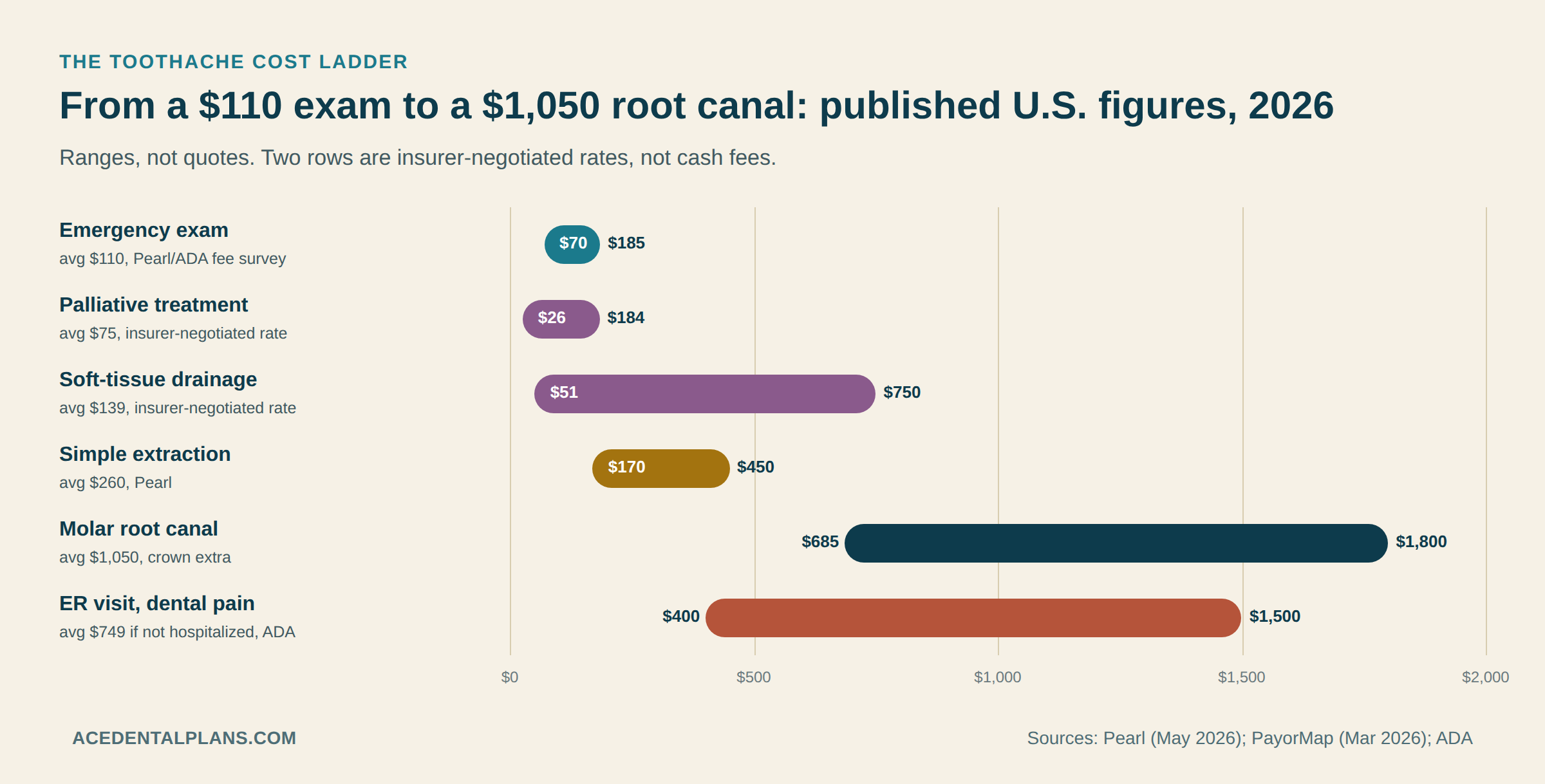
The ladder shows why timing matters financially. The same afternoon that costs a few hundred dollars at a dentist’s chair can run to four figures if it starts at an ER and ends up at a dentist anyway. The detailed breakdowns live in the guides to emergency dentist cost and emergency tooth extraction cost. Pricing for the two treatments most often at the end of a toothache is covered in root canal cost and in the comparison of simple and surgical extraction prices. No filling price was opened for this guide, so Table 3 leaves that rung out; the filling guide linked earlier covers it.
Where dental insurance enters
With a dental plan, think in this order: plan type, then network and deductible, then coinsurance for the category the plan assigns, then the annual maximum, then waiting periods and exclusions. Pearl says most PPO plans cover emergency exams at the same rate as a periodic exam, and it adds that after-hours and weekend fees may not be covered. A plan with a waiting period for basic services may also delay the extraction or root canal that follows. The plain-English guide to how dental insurance works walks through those layers.
Hospital care follows different rules. An ER visit is billed as a medical service, so ask the hospital and your medical insurer how it will be processed, because a deductible or copay may apply. Public programs have their own limits: NIDCR says adult Medicaid dental coverage varies by state, and the guide on whether Original Medicare covers dental care covers the Medicare side.
Paying When Coverage or an Appointment Is Missing
The ordering matters more than any single trick. Start with a call to a dentist for the exam, since it is the smallest number on the ladder and it tells you what the bigger numbers will be. Ask for a written estimate before any treatment beyond the exam, and ask whether the office offers a cash discount or a payment plan. The detailed playbook is in the guide to dental care without insurance, and the longer comparison of financing choices sits in the guide on how to pay for dental work.
For low-income patients, the health-center and dental-school routes in the previous section matter most, because both publish discounted fees in many areas. The NIDCR also notes that Medicaid is state-run, that states must provide dental benefits for children covered by Medicaid, and that adult coverage varies and is limited in most states. Check your state’s program before assuming it either does or does not help.
One practical rule: a plan that ends with “get the exam, then decide” keeps the bill small. A plan that ends with “wait until it stops hurting” tends to grow it, because the treatments further along the ladder cost more.
Questions to Ask Once You Are in the Chair
Toothache visits move quickly, and the person in the chair is rarely at their sharpest. A short list taped to the back of your phone case does more good than memory. Each question below ties to something the published sources describe.
- Is today’s treatment temporary or definitive? Pearl’s root canal price includes a temporary filling, and an emergency visit can end with relief and a plan. Knowing which one you are paying for tells you whether a second bill is coming.
- What is the diagnosis, in plain words? You will need it for the insurer, and for any second opinion. Ask the dentist to write it on the estimate.
- What are the options, and what does each cost in writing? A filling, a root canal and an extraction are different roads from the same tooth, and Cleveland Clinic lists all of them as possibilities. Ask for the estimate before the work begins, and ask whether the office offers a cash discount or a payment plan.
- Is the exam fee credited toward treatment? Ask rather than assume, and get the answer on the estimate.
- What happens if I wait a month? The honest answer varies by diagnosis, and hearing it from the dentist who has seen your X-ray is worth more than any article.
- What should I use for pain afterward, and for how long? The ADA page says dentists are advised to discuss pain strategies and set realistic expectations, and it classes pain after a simple extraction as mild and after a surgical extraction as moderate. Ask which product suits your health history.
- Which symptoms mean I should call tonight, and what number do I use? Get the after-hours line before you leave the building.
- Does my plan need a predetermination? A pre-treatment estimate from the insurer is not a promise of payment, but it shows how the plan sorts the procedure and how much of the annual maximum it may use.
Pain That Looks Like a Toothache but Is Not Home-Care Territory
Several problems feel like dental pain and need a different first call. The AAE lists a dull ache and pressure in the upper teeth and jaw as possibly bruxism (teeth grinding) or a sinus headache. Mayo Clinic says a sinus infection can cause a toothache because “The roots of the upper teeth are very near or may even extend into the sinus cavity.” Its advice is to see a dentist first, then a doctor if the dentist rules out a dental cause.
Jaw-joint problems add another source. NIDCR says pain in the chewing muscles or jaw joint is the most common symptom of temporomandibular disorders (TMD). Pain in the mouth, jaw or face, it adds, “may or may not be related to TMDs.” If the ache sits in front of the ear, clicks or locks, the guide to TMJ disorder is the better starting point.
Pain after recent dental work is a separate category again. The AAE says sensitivity after a procedure may be the pulp irritated by treatment, and that you should wait a short time and then get it checked if it continues. Two guides handle the common cases: tooth sensitivity after a filling and pain after a root canal.
Finally, a quick zing from cold that fades in a second or two is a different pattern from a lingering ache. The AAE describes momentary sensitivity as usually minor, unless it stays for an extended period of time, and the NIDCR says decay in its early stage often has no symptoms at all. The guide to early cavity symptoms explains the beginning of the path that ends in a toothache.
Bottom Line
Think of toothache relief as a short bridge with a firm far end. On this side are a handful of low-risk moves and one label-guided pain reliever. On the other side is a dentist who can find out why the tooth hurts. The sources disagree on very little: rinse, floss, cold outside the cheek, medicine from the box, nothing on the gum, and a phone call that does not wait for the weekend.
What changes the plan is a short list of signals. Swelling, fever, a pain that stays for more than two days, trouble swallowing and a child under two with a gel in hand each move you to a different decision. Money rarely needs to be the deciding factor in the first call, because the exam is the cheapest rung and the most informative. Price the next steps after that, with a written estimate in hand.
When the visit is over, the oral health and dental emergencies hub collects the guides for whatever the dentist found.
Frequently Asked Questions
What is the fastest way to relieve a toothache at home?
Rinse with warm water and floss gently to remove trapped food. Use a cold compress on the outside of the cheek if there is swelling, and take an over-the-counter pain reliever as its label directs. The ADA living guideline lists NSAIDs such as ibuprofen or naproxen, alone or with acetaminophen, for ages 12 and up. These steps ease pain but do not treat the cause, so call a dentist the same day if you can.
Can I take ibuprofen and acetaminophen together for a toothache?
The ADA living guideline says NSAIDs can manage toothache pain “alone or in combination with acetaminophen” for people 12 and older, and the ADA notes an FDA-approved over-the-counter combination product. Each ingredient keeps its own label limits, and the FDA says not to use more than one acetaminophen product at a time. Ask a pharmacist if you take blood thinners, have kidney, liver or heart conditions, or are pregnant.
Does clove oil really help a toothache?
One eugenol (clove oil) toothache liquid label says it temporarily relieves throbbing toothache due to a cavity until a dentist can be seen. It is for external use only, must not be swallowed, should not be used for more than 7 days, and says children under 12 should ask a dentist or doctor first. The label also says to see a dentist as soon as possible whether or not the pain is relieved.
Is it safe to use benzocaine gel on a toothache?
The FDA says over-the-counter oral benzocaine products should not be used for infants and children younger than 2. For adults and children 2 and older it says to use them only if the label has the required warnings. Use them sparingly, no more than four times a day, because of the risk of methemoglobinemia. Seek medical attention immediately for gray or blue skin, lips or nails, shortness of breath, or a rapid heartbeat after use.
Should I put aspirin on a sore tooth or gum?
No. ADA MouthHealthy says not to put aspirin on the aching tooth or gum tissues. MedlinePlus says not to place it directly on the tooth or gums, and Mayo Clinic warns that it may burn the gum tissue. Swallowed pain relievers are a separate matter and follow their own labels. Aspirin is not for children under 16 per the NHS.
How long can I wait to see a dentist for a toothache?
Cleveland Clinic says to call a dentist right away for a toothache that lasts longer than two days, and sooner for facial swelling or pain on opening wide. It treats a dull or mild toothache as something that can wait for a regular appointment, while a severe one counts as an emergency. If you are unsure which you have, call the office and describe the pain and any swelling.
When should I go to the ER for a toothache?
Go for trouble breathing or swallowing, or for swelling below the eye or a knot on the jaw. A fever over 101°F with severe tooth pain counts, as do unbearable pain that medication does not relieve and bleeding that does not stop with pressure. Those triggers come from Mayo Clinic and Cleveland Clinic. The ER can ease symptoms and prescribe medicine, but it does not do fillings or crowns, so a dentist visit still follows.
Can a toothache go away on its own?
A brief flash of sensitivity can fade, and the AAE calls momentary hot-or-cold sensitivity usually minor. Ongoing pain is different. The AAE says an infection around a root may or may not be painful, and the NHS says a dental abscess will not go away on its own. A toothache that quiets down has not necessarily healed, and a quiet tooth with swelling still needs a call.
Is heat or cold better for a toothache?
The clinical pages used for this guide describe cold: a wrapped cold pack held against the outside of the cheek or jaw, about 20 minutes at a time in Cleveland Clinic’s version. None of them recommends heat on a swollen face. NIDCR lists heat or cold on the face as self-care for jaw-muscle pain, but that is a different condition. If the face is swelling, call a dentist rather than comparing temperatures.
How much does it cost to see a dentist for a toothache without insurance?
The first stop, an emergency exam, averages about $110 with a published range of $70 to $185 (Pearl, ADA fee survey data, May 2026). A simple extraction averages about $260 and a molar root canal about $1,050, with a crown billed separately. An average ER visit for dental pain is $749 if not hospitalized, per the ADA, and it does not repair the tooth.
What helps a toothache at night?
The sources opened for this guide do not give a sleeping position or a bedtime routine. What they support is the same short list: a label-directed pain reliever, a cold compress if there is swelling, soft foods and no very hot or cold drinks. Write down when the pain wakes you or starts without a trigger, because dentists use that pattern. A new swelling or fever overnight is a reason to call, not wait.
Sources and Disclaimers
Clinical statements in this guide come from professional and government health sources. They are the American Dental Association (ADA) and its MouthHealthy site, the American Association of Endodontists (AAE), the National Institute of Dental and Craniofacial Research (NIDCR), the Food and Drug Administration (FDA) and its posted labels, and MedlinePlus. Mayo Clinic and Cleveland Clinic supply home-care and urgency detail, and the UK National Health Service is cited only for general self-care. Price figures come from two different kinds of data: Pearl’s presentation of ADA fee-survey data (May 2026) and average insurer-negotiated rates from federal transparency files (March 2026, via PayorMap). The ER figures are the ADA’s undated summary. National averages hide wide local differences. The worked examples are hypothetical illustrations, and the $50 after-hours fee in one of them is invented. Nothing here gives a dose for any person. Confirm prices with the dentist and benefits with the insurer before treatment.
- American Dental Association — Adult/Adolescent Acute Dental Pain Management for Toothaches (living guideline)
- American Dental Association — Oral Analgesics for Acute Dental Pain
- American Dental Association — Action for Dental Health: Emergency Department Referrals
- ADA News — ADA Council highlights need for evidence-based antibiotic prescribing (August 12, 2026)
- ADA MouthHealthy — Dental Emergencies
- ADA MouthHealthy — Abscess
- American Association of Endodontists — Tooth Pain
- American Association of Endodontists — Abscessed Teeth
- American Association of Endodontists — Dental Symptoms
- American Association of Endodontists — Endodontic Diagnosis (Fall 2013 newsletter)
- U.S. Food and Drug Administration — Risk of serious and potentially fatal blood disorder prompts FDA action on oral over-the-counter benzocaine products (May 2018)
- U.S. Food and Drug Administration — Acetaminophen
- U.S. Food and Drug Administration (label file) — Ibuprofen Tablets 200 mg, over-the-counter Drug Facts label (2025)
- National Library of Medicine, DailyMed — Red Cross Toothache (eugenol) drug label
- MedlinePlus — Tooth abscess
- National Institute of Dental and Craniofacial Research — Tooth Decay
- National Institute of Dental and Craniofacial Research — TMD (Temporomandibular Disorders)
- National Institute of Dental and Craniofacial Research — Finding Dental Care
- Health Resources and Services Administration — What is a health center?
- Mayo Clinic — Toothache: First aid
- Mayo Clinic — Sinus infection and toothache: Any connection?
- Cleveland Clinic — Toothache: Symptoms, Causes and Remedies
- Cleveland Clinic — What Is a Dental Emergency and Where To Go for Care
- National Health Service (UK) — Dental abscess
- Pearl Dental Costs — Emergency Dental Exam Cost
- Pearl Dental Costs — Tooth Extraction Cost
- Pearl Dental Costs — Root Canal Cost
- PayorMap — D9110 Palliative (Emergency) Treatment rates
- PayorMap — D7510 Incision and Drainage, Intraoral Soft Tissue rates
Important Information and Disclaimers
This article is general educational information. By using it, you accept the limits described below.
Not dental or medical advice
Nothing on this page is a diagnosis, a treatment recommendation or a substitute for an examination by a licensed dentist or physician. Reading this article does not create a dentist-patient or doctor-patient relationship. Only a licensed professional who has examined you and reviewed your history can tell you what your mouth needs. Do not delay, skip or stop professional care because of something you read here.
Prices are estimates, not quotes
Cost figures are ranges reported by the third-party sources cited in this article. Actual prices depend on your location, the provider, the complexity of your case, the materials used, the date of service and other factors, so what you pay may be higher or lower. A written treatment plan and fee estimate from the dental office is the only reliable number for your situation.
Insurance and plan examples are illustrations
Examples that use named amounts or percentages are hypothetical. Real benefits depend on your plan, network, waiting periods, annual maximum, deductible and the insurer’s rules at the time of treatment. A pre-treatment estimate or benefits check is not a promise of payment. Confirm the details with your insurer or plan administrator in writing.
Not insurance, legal, tax or financial advice
AceDentalPlans is an information publisher. Nothing here is insurance, legal, tax, investment or other professional financial advice, and nothing here recommends a particular provider, insurer, lender, discount plan or financing product. Company and product names belong to their owners and appear for identification only. Read the terms of any loan, financing offer or plan before you sign, and ask a qualified professional if you need advice on your own circumstances.
Third-party sources
This article cites government agencies, professional associations, insurers, lenders and other outside organizations. We do not control those sources. Their content can change, move or disappear, and listing a source is not an endorsement of it or of anything it sells.
No warranty
We aim for accuracy, but this article is provided “as is,” without warranties of any kind, express or implied, including warranties of accuracy, completeness, timeliness or fitness for a particular purpose. Some information may be out of date or contain errors by the time you read it.
Limitation of responsibility
To the fullest extent permitted by law, AceDentalPlans and its owners, authors and contributors are not responsible or liable for any loss, cost, injury, health outcome or other damage that results from using this article or relying on it. You are responsible for your own decisions about your care, your coverage and your money.
How this article is written
This article follows AceDentalPlans’ answer-first, U.S.-focused editorial approach. It uses conditional language for insurance, because coverage depends on the specific plan, and it names its sources so that you can read them yourself.