Mild sensitivity to cold, sweets or biting pressure for a week or two after a filling is common, and a Cleveland Clinic patient page says these effects should go away in that window. Pain that is severe, lingers after hot or cold, wakes you up or arrives with swelling or fever is not routine healing. Most cases sit between those poles, so the pattern and its direction matter more than any single twinge.
This article covers why a filled tooth can hurt and what each kind of sensitivity may point to. It also offers a practical timeline for the first weeks, safe self-care, and what dentists do when the problem does not fade. It also explains how a recheck, a bite adjustment or a redone filling tend to be billed. It stops short of filling prices and cavity symptoms, and it only touches root canal pain, because each of those has its own page.
Key Takeaways
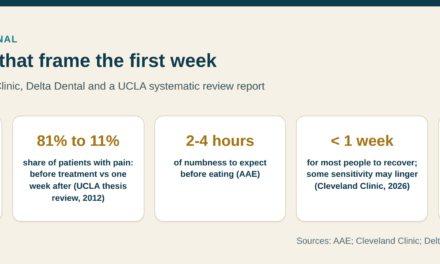
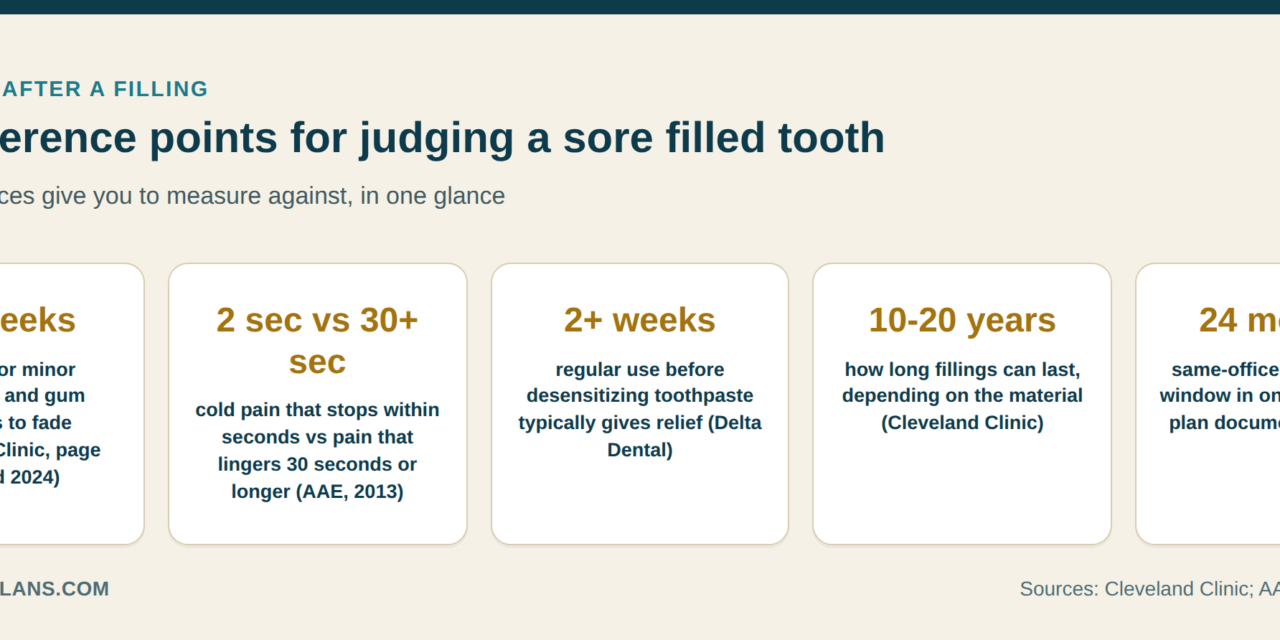
- A week or two is the window Cleveland Clinic gives for minor sensitivity and gum soreness after a filling to fade (page last updated May 2024).
- Seconds versus half a minute. In an American Association of Endodontists newsletter, cold pain that stops within a couple of seconds fits reversible inflammation, while pain lasting 30 seconds or longer fits irreversible inflammation.
- Pain on biting can mean the filling sits too high. Cleveland Clinic says the dentist can fix that by reshaping it.
- Call right away for a broken filling, severe pain that medication does not touch, a swollen face or jaw, or fever and chills.
- Desensitizing toothpaste is slow: Delta Dental says it typically takes regular use over two or more weeks before relief.
- Redoing work has a cost beyond money. NIDCR notes that repeated replacement of restorations can increase the risk of tooth loss over time.

What the First Two Weeks Usually Look Like
A filling is repair work on a living tooth. The dentist removes decayed or damaged structure, cleans the space and seals it with a material, and all of that happens close to a nerve that has no say in the matter. Some irritation afterward is expected, which is why the Cleveland Clinic page describes minor tooth sensitivity and gum soreness as normal and temporary.
The same page says you can usually return to routine activities right after the appointment unless you were sedated. It also says you can eat right away without damaging the filling, although waiting for the numbness to wear off helps you avoid biting your cheek or tongue. The duration of numbness is its own question, covered in how long dental numbness lasts. It is worth separating from sensitivity, because the two can overlap for an hour or two and then part ways.
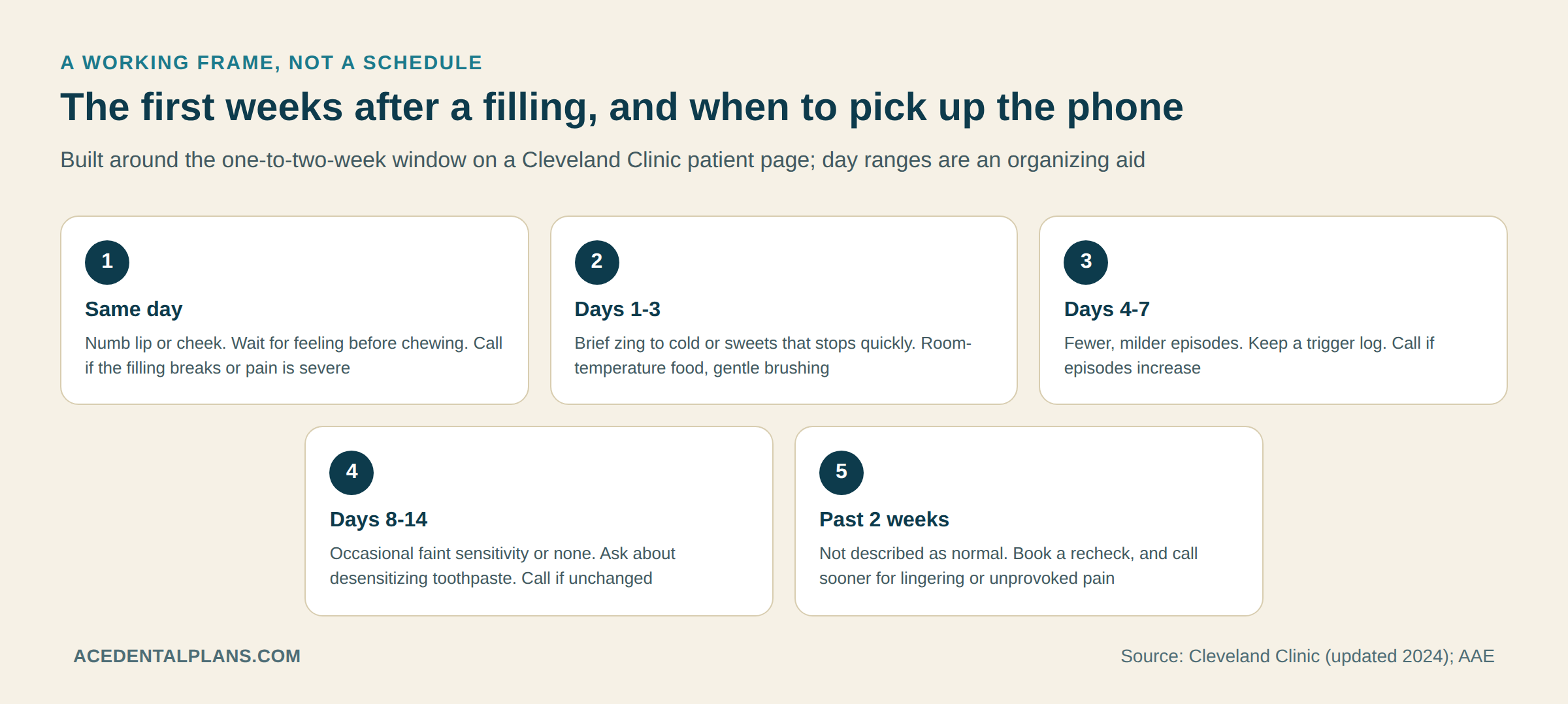
No national standard divides recovery into day-by-day stages. What the sources I opened offer is an outer window (“a week or two”) and a set of patterns that fall outside it. Table 1 turns those into a working frame. Treat the day ranges as a way to organize your own notes, not as a clinical schedule. A tooth with a small, shallow filling and a tooth with a deep one will not follow the same curve.
| Window | What is commonly reported as normal | Reasonable self-care | Call the dentist if |
|---|---|---|---|
| Same day | Numb lip, cheek or tongue; a filling that feels slightly “different”; gum soreness near the tooth | Wait for feeling to return before chewing; chew slowly if you eat early | The filling breaks, or pain is severe and ordinary medication does not touch it |
| Days 1-3 | Brief zing with cold air, cold drinks or sweets that stops quickly; tenderness of the gum | Room-temperature food and drinks; gentle brushing with fluoride toothpaste | Pain when biting down, or a bite that feels high on that tooth |
| Days 4-7 | Fewer and milder episodes; sensitivity still present but easing | Keep a short log of triggers; avoid chewing hard foods on that side | Episodes are getting worse or more frequent instead of fewer |
| Days 8-14 | Occasional faint sensitivity, or none | Continue gentle care; try a desensitizing toothpaste if the dentist agrees | Sensitivity is unchanged from day 3, or any lingering ache has appeared |
| Past two weeks | Not described as normal in the sources reviewed | Book a recheck rather than waiting for a “fresh” ache | Pain lingers after hot or cold, throbs on its own, wakes you at night, or comes with swelling or fever |
The most useful column is the last one. A tooth that is slowly getting better can stay slightly twitchy for days without any treatment. A tooth that is staying level or getting worse is telling you something the calendar alone will not. Direction of travel beats the absolute level of discomfort.
Why a Freshly Filled Tooth Can Hurt
There is rarely one cause, and the dentist cannot always name it on the spot. Still, the reasons fall into a short list, and knowing the list helps you describe symptoms in a way that points the dentist toward the right one.
Irritated dentin and its nerve supply
Under the enamel sits dentin, a layer crossed by microscopic channels that lead toward the nerve. A 2018 review in Dental Update by Sabbagh, Fahd and McConnell describes the hydrodynamic theory of sensitivity: pain follows movement of fluid inside those channels, which stimulates nerve endings. Drilling, etching and sealing all disturb that system, and it can take the tooth a while to settle.
The same review reports that the incidence of post-operative sensitivity has increased, with the highest incidence in posterior composite restorations, meaning tooth-colored fillings in back teeth. It also says sensitivity can be difficult to manage and that patients often report it with no sign the restoration has failed. That last point is reassuring and frustrating in equal measure. A filling can look flawless on an X-ray and still be a nuisance for a couple of weeks.
How the filling was placed
Composite fillings involve more steps than most patients picture. According to the FDA, composite resin is often light cured with a blue light in layers to build up the final restoration. It may be more difficult to place than amalgam in certain clinical situations, and it may not bond to the tooth as well in the presence of moisture. The Dental Update review adds that a more complex placement, including etching of enamel and dentin and the use of acidic adhesive monomers, may be related to the higher incidence of pain.
None of this means composite is a poor choice. The FDA calls it the most common alternative to amalgam and credits it with high strength and the ability to preserve healthy tooth structure. It means the material is technique-sensitive, which is why a small difference in isolation or layering can change how a tooth feels afterward.
A bite that is too high
If the new surface stands a hair above its neighbors, that tooth takes more force than it should every time you close your jaw. Pain when biting is listed by Cleveland Clinic as a sign the filling may interfere with your bite, and the dentist can fix it by reshaping the filling. The tooth may not be damaged at all, only overworked, and the remedy is simpler than most of the others in this article.
Decay that was already close to the nerve
A deep cavity brings the work near the pulp, the soft center of the tooth that holds nerves and blood vessels. Cleveland Clinic says a throbbing toothache may mean decay reached the pulp, and that lingering pain from heat or cold may mean the nerve is damaged. For readers who want to know how cavities progress toward that point, early cavity symptoms are covered separately.
This is the cause that deserves the most respect. A shallow filling rarely threatens the nerve. A filling placed after deep decay was removed may leave the pulp inflamed to a degree that no amount of patience will reverse. The AAE’s diagnostic newsletter, discussed in the next section, describes how that condition differs from a mild, passing irritation.
A crack, a worn neighbor or a different problem altogether
ADA MouthHealthy lists several causes of sensitivity that have nothing to do with a new filling: cavities, cracked or broken teeth, worn fillings, gum disease, thinning enamel and exposed roots. It also says pain when chewing is a reason to see a dentist because a crack may be hard to detect. Delta Dental adds teeth grinding and gum recession to the list and names recent procedures such as fillings, gum surgery and whitening.
That matters because timing creates a convincing story. You had a filling on Tuesday, the tooth hurts on Friday, so the filling must be at fault. Sometimes. But the tooth next door, an older filling on the same side or a clenching habit can produce the same sensation. Part of the dentist’s job on a recheck is to sort out which one is responsible. If gum recession turns out to be the driver, gum disease symptoms and treatment are the relevant next read.
Reading the Symptom: Cold, Heat, Sweets, Biting and Throbbing
Dentists work from patterns, and so can you. The questions that matter are what sets the pain off, how long it lasts after the trigger is gone, and whether it ever starts without a trigger. Write the answers down for a few days before you call, because “it hurts sometimes” is much harder to act on than “cold water, one to two seconds, only on the left side.”
| Pattern you notice | What it may suggest | Usual next step |
|---|---|---|
| Brief zing from cold or sweets that stops within a couple of seconds | Mild irritation consistent with the reversible category the AAE describes; also the expected pattern of early healing | Gentle care, room-temperature food, watch the trend for a week or two |
| Pain from heat or cold that lingers, in the AAE’s wording often 30 seconds or longer | Inflammation that may not reverse; Cleveland Clinic says lingering heat or cold pain may mean the nerve is damaged | Call the dentist for an exam and pulp testing; do not wait out the full two weeks |
| Pain only when biting or releasing | A filling that sits too high, or a crack that is hard to see | Bite check and adjustment; further testing if a crack is suspected |
| Throbbing or aching that starts without any trigger | Cleveland Clinic says a throbbing toothache may mean decay reached the pulp; the AAE lists unprovoked pain with irreversible inflammation | Prompt exam; discuss whether the pulp can recover |
| Swollen face or jaw, fever, chills | Possible infection | Call right away; use emergency care if swelling affects breathing or swallowing |
| Zing at the gum line, near exposed root surface | Gum recession or worn enamel rather than the filling itself (ADA MouthHealthy and Delta Dental list both) | Ask the dentist to check the gums; desensitizing products are often considered |
The two-second rule, and why it is a clue and not a verdict
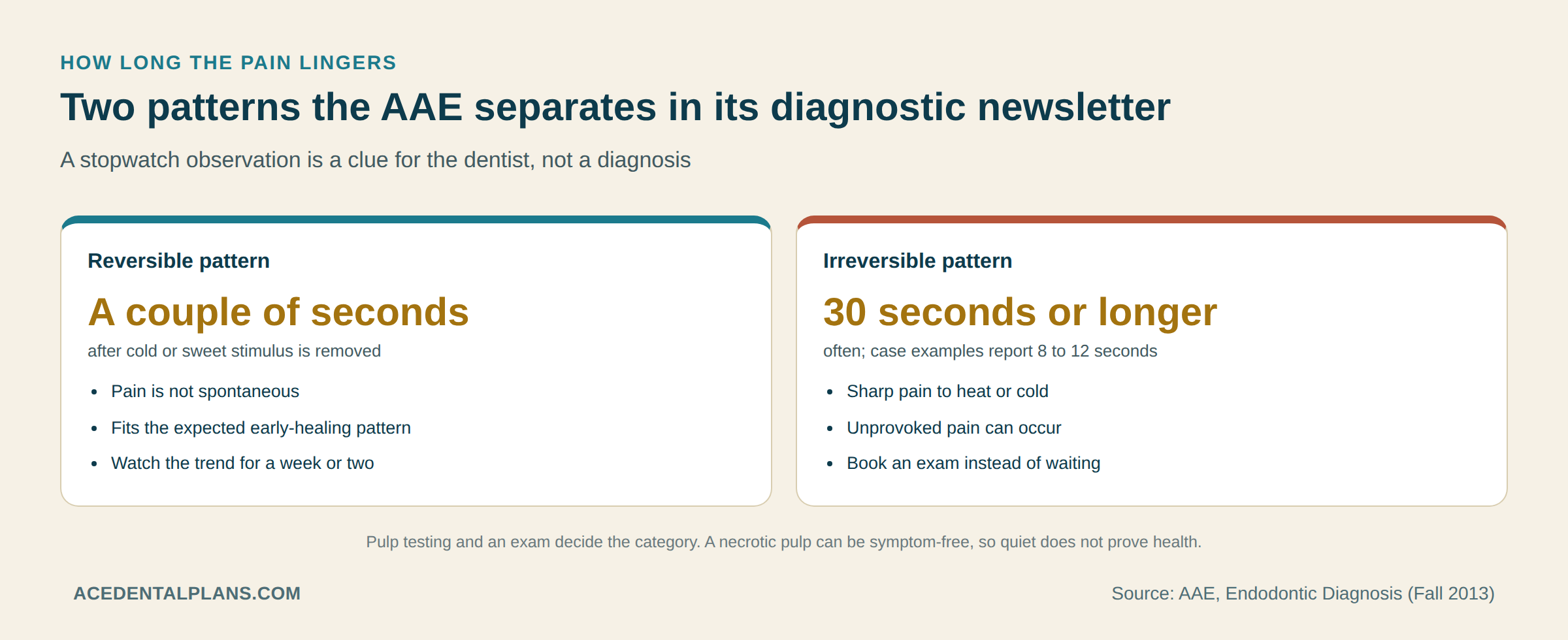
The AAE’s “Endodontic Diagnosis” newsletter (Fall 2013), written for dentists, separates two inflammatory states of the pulp. In reversible pulpitis, discomfort from cold or sweet stimuli goes away within a couple of seconds after the stimulus is removed, and the pain is not spontaneous. In symptomatic irreversible pulpitis, the pain after a thermal stimulus persists, often 30 seconds or longer, and unprovoked pain can occur.
For a reader with a cold drink and a stopwatch, the practical translation is simple. A tooth that complains and then quiets down within a breath is behaving like the first category. A tooth that keeps aching well after the ice is gone is behaving like the second, and that is the point to stop waiting and call. The same newsletter gives case examples where lingering lasted 8 to 12 seconds, so the line between the categories is a range of judgment, not a switch that flips at exactly 30.
Why silence does not guarantee health
The newsletter also says that a necrotic pulp is non-responsive to pulp testing and may be asymptomatic, and that necrosis by itself does not cause apical periodontitis, the inflammation around the root tip. Put plainly, a tooth with a dead nerve can be quiet. Pain to tapping appears when the canal becomes infected. That is why dentists rely on pulp testing and tapping instead of symptoms alone, and why a recheck is worthwhile even when the tooth has stopped complaining but never felt quite right.
It also means this article cannot tell you which category your tooth is in. What it can do is show you which observations to bring to the appointment. Should the pain come from the pulp and a root canal be on the table, pain after a root canal covers what that recovery looks like. The cost side sits in root canal cost.
Amalgam, Composite, Glass Ionomer or an Inlay: Does the Material Change How It Feels?
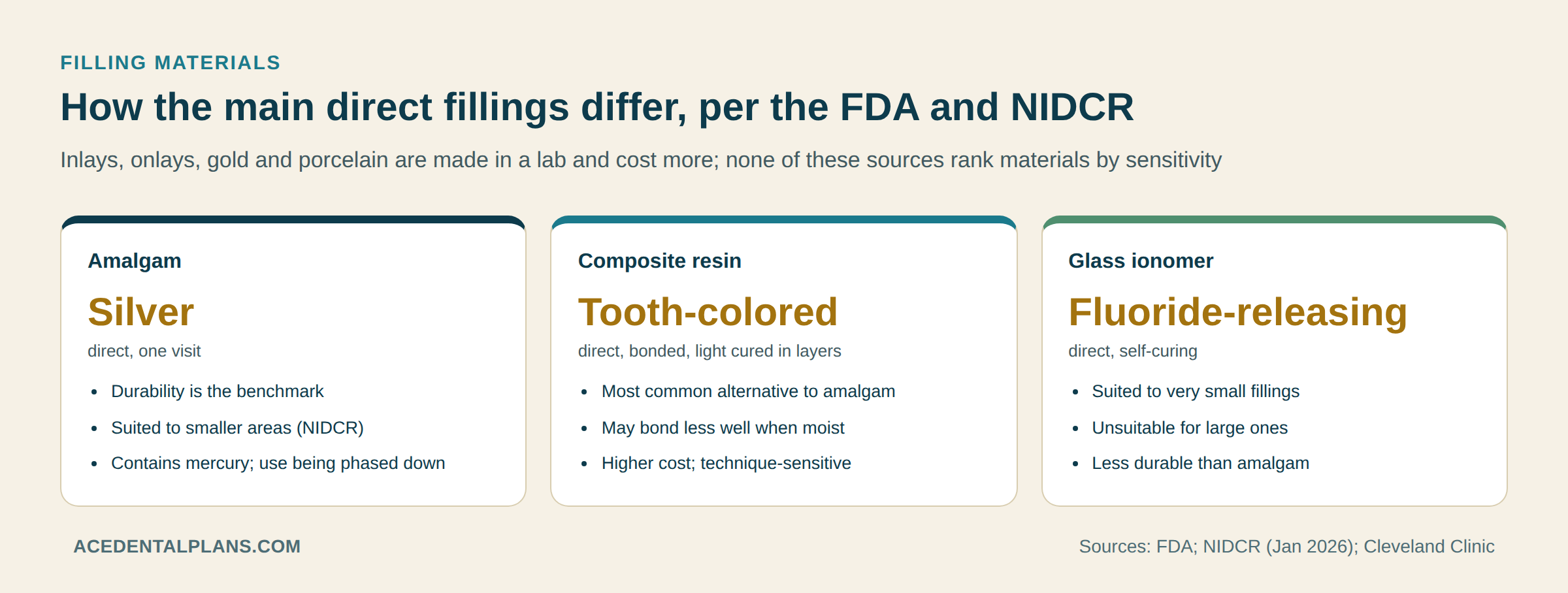
Patients often ask whether a silver filling hurts less than a white one, or the reverse. The honest answer from the sources I opened is that none of them ranks filling materials by how sensitive the tooth feels afterward. The one explicit link between material and discomfort is the technique load of composites: the Dental Update review ties the higher incidence of post-operative sensitivity in back-tooth composites to the more complex placement. That is a statement about steps, not a verdict against the material.
What the sources do provide is a clear picture of how each material is placed, what it is suited to and where it falls short. Table 3 collects that. The material also drives the other things you will care about if the tooth needs more work: how long the filling may last, how much it costs and whether a bigger repair is likely.
| Material | How it is placed | What the sources say it is good for | Limits to know |
|---|---|---|---|
| Amalgam (silver) | Direct, in one visit | NIDCR describes it as suited to smaller areas of decay or damage; the FDA treats its durability as the benchmark that composite and glass ionomer are compared against | Contains mercury; NIDCR says its use is being phased down. Not tooth-colored |
| Composite resin (tooth-colored) | Direct, in one visit; bonded to the tooth and often light cured in layers | The FDA calls it the most common alternative to amalgam, with high strength and minimal removal of healthy tooth | May bond less well in the presence of moisture, can be harder to place in some situations, potentially lower durability than amalgam, higher cost (FDA) |
| Glass ionomer | Direct; self-curing, usually without a blue light | Tooth-colored; releases fluoride over time (FDA) | The FDA describes it as suited to very small restorations, unsuitable for large ones and less durable than amalgam |
| Indirect (inlay, onlay, gold, porcelain) | Made in a lab, usually over two visits (Cleveland Clinic) | The FDA calls ceramic and gold indirect restorations the most durable and costly options | An extra visit and, typically, a higher fee than a direct filling |
Depending on the material, some fillings can last up to 20 years, Cleveland Clinic says, and elsewhere on the same page it gives a range of 10 to 20 years. Both figures describe fillings in general, not any single material or tooth, so they are a ceiling rather than a promise. NIDCR adds a caution about the opposite direction: chewing, saliva, bacteria, acidity and temperature swings degrade restorations and their adhesives over time.
What this means if your tooth is already sensitive
If sensitivity persists, the material is one of several things your dentist will consider, not the first. A very large composite in a back tooth, a deep restoration placed after extensive decay and a small shallow filling can behave differently regardless of what they are made from. It is reasonable to ask the dentist two questions: how deep was the decay relative to the nerve, and how was the tooth isolated from moisture during placement? Those answers carry more information than the brand name on the syringe.
The materials also tie into money. A tooth-colored filling often costs more than a silver one, and an inlay costs more than either. Filling prices have a dedicated page, covered in the cost section below. The relevant point here is narrower: the cheapest filling is not cheaper if it has to be redone, and the most expensive one is not insurance against sensitivity.
What Dentists Do About Sensitivity That Does Not Fade
The sequence below follows what the sources describe, from the least invasive step to the most. Which step you land on depends on the findings at the exam, not on how long you have waited. Offices differ, and a dentist who sees a clearly high bite will skip straight to the first item.
- Check the bite. Pain on biting can mean the filling interferes with your bite, according to Cleveland Clinic, and the dentist can reshape it. This is the cleanest fix when it applies, because it addresses the cause without touching the nerve.
- Test the tooth and examine neighbors. Pulp testing and tapping, the tools the AAE newsletter describes, help separate a reversible irritation from an inflamed pulp and a tooth with a crack or a sore gum. The dentist may also look at older fillings, gum recession and signs of grinding.
- Calm the dentin. Delta Dental lists desensitizing toothpaste, prescription fluoride, in-office desensitizing agents and a plastic coating or filling over exposed areas. These options are aimed at sensitive dentin. An inflamed nerve is a different problem, so the dentist needs to be fairly sure which one is operating.
- Repair or replace the restoration. ADA MouthHealthy says a crown, inlay or bonding may be used to correct a flaw or decay that results in sensitivity. If the original filling is leaking, overhanging or too small for the damage, redoing it can solve a problem that desensitizer cannot.
- Treat the nerve. MouthHealthy says a root canal may be recommended when sensitivity is severe and persistent and cannot be treated by other means. Delta Dental gives the same direction for decay or a crack that reaches the pulp.
Notice that a root canal sits at the end of the list, not the beginning. The expected window for minor sensitivity is a week or two on the Cleveland Clinic page, so the later steps are for the cases where it does not. A pattern that already points toward them would be lingering pain, unprovoked throbbing, or a deep restoration placed over decay that was close to the pulp.
A caution about repeated redoing
NIDCR’s fact sheet says repeated replacement of restorations can increase the risk of tooth loss over time. Every time a filling is drilled out and replaced, more of the original tooth tends to go with it, and the cavity gets bigger. That is not a reason to refuse a needed redo. It is a reason to ask what the plan is if the second attempt does not work. Also ask whether a larger restoration such as an inlay, onlay or crown cost should be weighed against a third filling in the same tooth.
Safe Self-Care While You Wait for the Tooth to Settle
Home care for post-filling sensitivity is mostly about not provoking the tooth and giving it time. The measures below come from ADA MouthHealthy, Delta Dental and Cleveland Clinic patient pages, plus ordinary common sense where I say so. None of it replaces a call to the dentist if the warning signs in the next section appear.
Temperature, sugar and pressure
Cold air, cold drinks, hot drinks and sweets are the usual triggers for a tooth that is still irritated. Skipping them for a few days is not a treatment, but it keeps you from testing the tooth fifty times a day. Take cold drinks through the other side of your mouth, or let them warm slightly, and keep the first bite of hard foods away from the new filling. That advice is practical rather than sourced, so treat it as a courtesy to your own tooth rather than a protocol.
Eating right away will not damage the filling, Cleveland Clinic says. The only reason to wait is numbness: an anesthetized cheek or tongue is easy to bite. If you do eat early, the page advises chewing slowly. After that, the working rule is simple. Eat on the other side while the tooth is tender, and return to normal chewing as the tenderness goes.
Brushing, floss and acidic drinks
Delta Dental recommends a soft-bristled toothbrush, fluoride toothpaste and gentle strokes during the usual two minutes of brushing, with regular flossing. It also advises limiting acidic foods and drinks and swishing water around your teeth afterward. A tooth that is already sensitive does not need extra enamel wear, so a heavy hand with a hard brush works against you. Don’t skip brushing around the new filling because it hurts; plaque left along the edge is a separate problem you do not want to add.
Desensitizing toothpaste: slow, but low risk
ADA MouthHealthy lists desensitizing toothpaste among its treatments for sensitivity and says it usually needs several uses before sensitivity drops. Delta Dental is more specific: regular usage over two or more weeks before effective relief. That timeline means starting one on day three is a different decision from starting one on day thirteen, and it is worth asking the dentist whether the product suits this particular tooth. If the dentist suspects a high bite or an inflamed nerve, toothpaste will not touch the cause.
Over-the-counter pain relievers
Over-the-counter acetaminophen or ibuprofen can help with soreness or sensitivity after a filling, Cleveland Clinic says. Follow the package directions, and ask a pharmacist or physician first if you have a medical condition, are pregnant or take other medicines. This article does not suggest doses for any individual. One more point deserves emphasis: if a standard pain reliever barely changes the pain, Cleveland Clinic lists that as a reason to call right away. Dentists want to hear about that.
For a broader look at short-term pain steps that apply to many dental problems, see safe toothache relief at home.
Clenching, grinding and whitening
Delta Dental lists teeth grinding among the causes of sensitivity and suggests addressing clenching through stress management or a dentist-fitted splint or mouthguard. If you wake with a sore jaw and a tooth that hurts more in the morning, tell the dentist. The same page notes that whitening can cause temporary sensitivity and suggests a break from bleaching if it does. By that reasoning, it makes sense to ask whether to postpone a whitening session until the filled tooth is calm, since you would be stacking two irritants.
Call the dentist the same day if
- The filling breaks, chips or falls out (Cleveland Clinic lists a broken filling as a reason to call right away).
- Pain is severe and does not respond to standard over-the-counter medication.
- The face, jaw or gum is swollen.
- You have fever, chills or other signs of infection.
- Pain throbs on its own, wakes you at night or lingers long after hot or cold has gone.
- Biting down hurts sharply, or the bite feels uneven on that tooth.
Go to an emergency room or call 911 if swelling affects your breathing or swallowing, or if you have a fever with severe dental pain.
Two points on this list. First, the same-day items overlap with the signs of dental infection described on the tooth infection symptoms and treatment page. A swollen gum or fever should be treated as a possible infection, not as a filling that needs more time. Second, a pain that is annoying but stable is not an emergency, and an office will not be surprised by a call about it. The AAE’s patient page says the earlier you address symptoms and treat the problem, the better the outcome. Calling early costs a few minutes.
What a Recheck, Adjustment or Redo May Cost, and Who May Pay
Prices for new fillings are the job of the page on composite and amalgam filling costs, so this section stays with the follow-up. Four kinds of charge can show up after a sensitive filling. They are an exam to look at the tooth, a bite adjustment, a sensitivity treatment such as fluoride or a desensitizing agent, and a replacement or upgrade of the restoration. I did not find a reliable national figure for the first three as stand-alone items, and I will not invent one. Some offices may waive a quick bite adjustment on their own work, and others may bill it. The office’s front desk can tell you in a sentence.
If the visit is billed as a problem-focused exam, an insurer may handle it differently from a routine checkup. For what an ordinary exam, X-rays and cleaning usually involve, see dental cleaning cost. Where the cause turns out to be gum recession or periodontal disease, the next step may be a scaling and root planing visit, whose pricing is on deep cleaning cost.
Replacement within a window: one plan’s wording
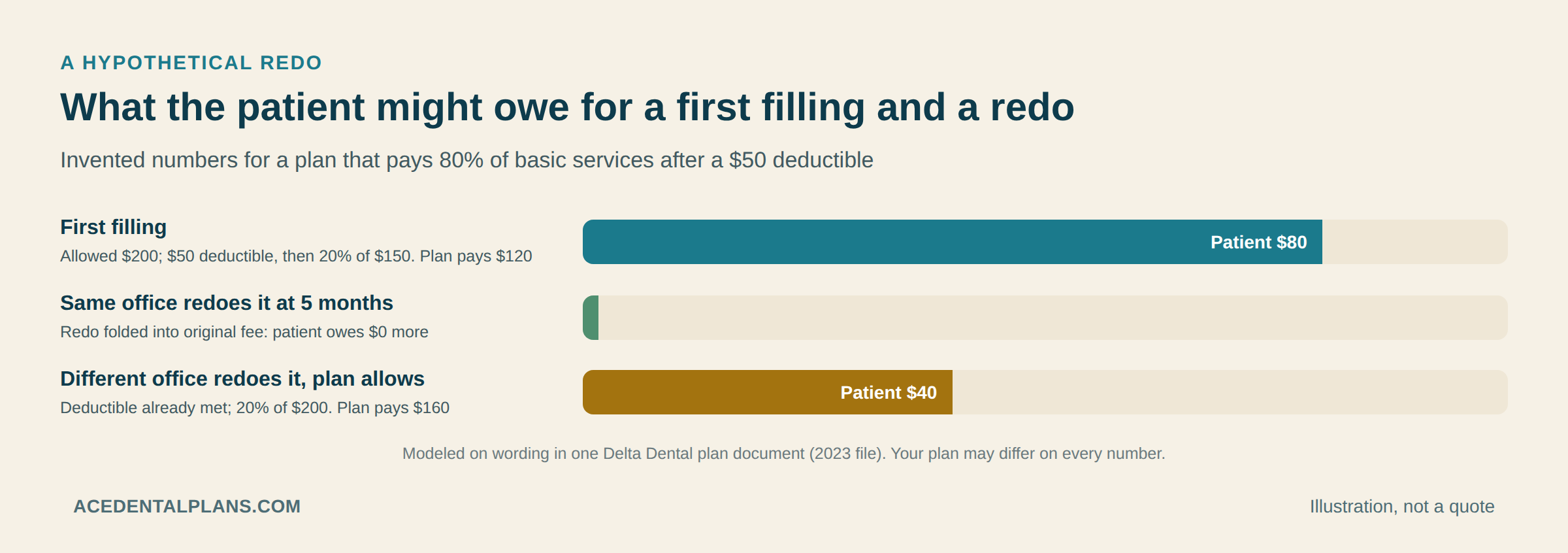
Plan rules about redoing fillings vary, so one document is an example and not a rule. One Delta Dental individual and family PPO plan document, posted for 2023, says the plan will not cover replacing amalgam or resin-based composite fillings within 24 months if the same provider office does the work. It adds that replacement restorations within 24 months are included in the fee for the original restoration. In plain terms, if the same office redoes its own filling inside two years, the office may not be able to bill that plan again for it.
The same document classes fillings as basic services at 80% Delta Dental and 20% enrollee for Preferred Providers, with a $50 adult deductible and a $1,000 adult annual maximum per calendar year. Your plan may differ on every one of those numbers. The pattern worth checking is the clock: when did the original filling happen, which office placed it, and what does your plan say about replacement and who performs it?
When the answer is a bigger restoration or a root canal
If the dentist recommends an inlay, onlay or crown, ask for a written estimate and a predetermination from the insurer before you commit. Crowns may be classed differently from fillings, with a lower percentage or a waiting period, and crown prices by material and tooth are on their own page. A root canal is a separate decision with its own price and its own insurance treatment.
Timing matters in October. Suppose you have already met your deductible and used little of your annual maximum. A recommended repair may then be easier to fit inside this benefit year than next January, when the deductible starts over. Whether that is true for you depends on your plan, and using dental benefits before year-end walks through the checks. Do not rush a treatment decision to chase a benefit, though. A sensitive tooth that needs a month of watching is better watched.
Questions that keep a redo from turning into a surprise bill
- Does the office have a policy on redoing a filling it placed, and for how many months?
- Is the recheck billed as an exam, and is a bite adjustment charged separately?
- If the plan limits replacement within a set number of months, which date does it count from?
- Would an inlay, onlay or crown be recommended instead of another direct filling, and why?
- Can the office send a predetermination before treatment starts?
Wait, Watch or Call: A Four-Question Path
The sources agree on the outer limits (a week or two for ordinary sensitivity, and prompt contact for severe or worsening signs) but leave the middle to judgment. The path below is a rule of thumb this article builds from those sources, not a clinical protocol. Follow it in order, and stop at the first question you answer yes to.
- Is there a red flag? A broken filling, swelling of the face or jaw, fever or chills, or severe pain that ordinary medication does not touch all point to a same-day call, as Cleveland Clinic lists them.
- Does it hurt when you bite or release? That pattern points toward a high filling or a crack. Phone the office within a few days and say plainly that it is a bite problem.
- Does cold or heat pain linger, or does the tooth ache without a trigger? In the AAE’s wording, lingering pain after a thermal stimulus, often 30 seconds or longer, and unprovoked pain go with irreversible inflammation. Book an exam within a day or two instead of waiting out the full two weeks.
- Is it a short zing that is getting milder? Wait, use the self-care steps above, and set a calendar reminder for day 14. If it is not clearly improving by then, book a recheck.
The timeframes in questions two to four are editorial judgment. Offices vary in how quickly they can see a patient, and a dentist who has examined your tooth may give you different instructions that should take precedence. The reason for the order is that the cost of being wrong is lopsided: a needless call costs a few minutes, whereas a missed infection can cost far more.
A symptom log that actually helps
Dentists cannot reproduce your pain in the chair, so the quality of your description decides how fast they can narrow the cause. For three to five days, jot down five items each time the tooth bothers you. Note what triggered it, which tooth or side, what it felt like (zing, ache, throb, pressure), how many seconds it lasted, and what you did about it. A note such as “cold water, lower left, sharp, about two seconds, gone without anything” fits the pattern in Table 2 almost perfectly. “Hurts on and off” fits nothing.
Add two more lines if they apply: any night-time waking from pain, and any change in the bite. Those two features separate several of the causes above more reliably than temperature does.
What the dentist is likely to ask
Expect the same handful of questions at the recheck, and having answers ready shortens the visit. Which tooth, and does the pain come from one spot? What starts it: cold, heat, sweets, air, chewing or nothing at all? How many seconds does it last after the trigger is gone? Is it better, the same or worse than on the day of the filling? Do you clench or grind, and do you wake with a sore jaw? Have you taken anything for it, and did that help?
None of these questions requires a medical background. They map directly onto the patterns in Table 2 and the AAE’s two categories. A patient who arrives with answers gives the dentist more to work with than one who arrives with “it just hurts.”
When a recheck finds nothing
Sometimes the exam is unremarkable. The bite is even, the tooth responds normally to testing, and nothing shows up on imaging. That result is useful, not a dismissal. It means the sensitivity is probably in the dentin-irritation category the Dental Update review describes, where patients report symptoms without any sign the restoration has failed. The usual plan then is time plus gentle care, with a second recheck if nothing changes. If the dentist says to monitor the tooth, ask what would change that plan and how long to wait before the next visit.
Children, Pregnancy and Older Fillings: Where the Advice Shifts
Children and teens
The AAPD’s pulp therapy guideline (revised 2025) describes reversible pulpitis in primary and immature teeth as pain that is provoked and short-lived. It is relieved by over-the-counter pain medicine, by brushing or by removing the stimulus. Among the indicators of irreversible pulpitis or necrosis it lists a history of spontaneous, unprovoked pain. It also lists a sinus tract and findings on X-rays. The guideline also says thermal and electric pulp tests are unreliable in primary and immature permanent teeth.
For a parent, the practical lesson is that history matters more than testing. A child who says the tooth hurts only with a popsicle is giving different information from one who cried at night with no trigger, and the dentist will lean on exactly that distinction. Kids often cannot describe timing, so watch what they do: avoiding one side, flinching at cold, waking up. Those are observations, not diagnoses, and the dentist will want them.
The Delta Dental plan document discussed in the cost section applies the same 24-month replacement wording to children under 19, and its pediatric benefits carry no annual maximum. Both are features of one plan, so verify your own.
Pregnancy
Pregnancy adds questions about medicines, X-rays and timing, and those belong with the dentist and your prenatal provider. The page on dental care during pregnancy covers what is generally considered safe and what to ask. The call-now list above does not change: swelling, fever or severe pain deserve a prompt call whether or not you are pregnant. For over-the-counter pain medicine in particular, check with a physician or pharmacist before taking anything.
Old fillings and teeth that were filled before
Sensitivity in a tooth that was filled years ago is a different question from sensitivity after a fresh one. ADA MouthHealthy lists worn fillings among the causes of sensitivity, and NIDCR notes that chewing, saliva, bacteria, acidity and temperature changes can degrade restorations and their adhesives. A new bout of sensitivity under an old filling may point to a leak, a crack or new decay at the margin, all of which a dentist can check. The warning signs of a new cavity overlap with these, which is why the exam matters more than the guess.
Five Mistakes That Prolong a Sensitive Filling
These come from reading the sources against the way people tend to handle a sore tooth, so they are editorial observations rather than study findings. They are worth checking yourself against anyway.
- Assuming the filling is guilty. ADA MouthHealthy and Delta Dental both list causes unrelated to a new filling, including cracks, gum recession, grinding and worn older restorations. If the pain is in a neighboring tooth, redoing the new filling will not help.
- Testing the tooth with ice every morning. Each test irritates the tooth again, and the answer you get tells you little. Use the symptom log and test only when a trigger occurs naturally.
- Treating a high bite as a nerve problem. Biting pain after a filling is the one pattern Cleveland Clinic says the dentist can fix by reshaping.
- Skipping the recheck because the pain faded. A fading pain is usually good news, but silence is not proof of health: the AAE newsletter notes that a pulp that has died can be free of symptoms. If a tooth hurt hard for days and then simply stopped, mention it at your next routine visit even if you do not make a special trip.
- Letting cost decide the timing. A recheck sits at the start of the chain of possible treatments, and the AAE’s patient page says the earlier a problem is treated, the better the outcome. If cost is the barrier, dental care without insurance lays out ways to reduce the bill, and the Recovery & Aftercare section has related guides, collected at all recovery and aftercare guides.
Bottom Line
Sensitivity after a filling is one of those problems where the first day tells you little and the second week tells you a great deal. A tooth that is clearly easing needs gentle handling and time. A tooth that holds steady, lingers, throbs or hurts on a bite needs an appointment, and the earlier the visit, the more options stay open.
Three habits do most of the work. Track the trigger, the duration in seconds and the direction of change. Call for the red-flag items without trying to judge them yourself. And ask about the plan before treatment begins. Who placed the filling? What does the office do when its own work has to be redone? What does your insurer say about replacement within a set window?
Money enters the story late and quietly. A bite adjustment or desensitizing step is a small matter compared with a crown or a root canal, so deciding early is both the medical and the financial move. Do not rush an expensive decision, though. If the dentist recommends something large, a written estimate and a predetermination give you time to think.
Frequently Asked Questions
How long is tooth sensitivity normal after a filling?
A week or two, according to Cleveland Clinic, which says minor sensitivity and gum soreness should go away in that time. The pattern should be easing, not holding steady. If it is unchanged after two weeks, or if cold or heat pain lingers, book a recheck. A call is also reasonable earlier if the tooth throbs on its own or hurts sharply when you bite.
Why does my tooth hurt when I bite down after a filling?
The most common explanation named by Cleveland Clinic is a filling that interferes with your bite, and the dentist can fix it by reshaping the surface. ADA MouthHealthy also says pain when chewing deserves a visit because a crack may be hard to detect. Either way, phone the office instead of waiting for it to disappear, because a high filling keeps overloading the tooth.
Is it normal for a filled tooth to be sensitive to cold?
Brief sensitivity to cold is a recognized part of early healing. The AAE newsletter describes the reversible pattern as discomfort from cold or sweet stimuli that goes away within a couple of seconds after the stimulus is removed. Pain that stays for 30 seconds or longer is a different pattern, and it is a reason to see the dentist rather than wait out the two weeks.
Can a new filling lead to a root canal?
Sometimes, though it is not the usual outcome. ADA MouthHealthy says a root canal may be recommended when sensitivity is severe, persistent and cannot be treated by other means, and Delta Dental names decay or a crack that reaches the pulp. A filling placed over deep decay carries more risk of pulp trouble than a shallow one. The tooth may recover without it, and the dentist will test it before recommending anything.
Does a composite filling hurt more than a silver one afterward?
None of the sources I opened rank materials by post-filling discomfort. A 2018 Dental Update review links the higher incidence of post-operative sensitivity in back-tooth composites to the more complex placement, which includes etching, bonding and layering. That describes the technique, not a defect of the material. Ask your dentist how deep the decay was and how the tooth was kept dry during placement.
What helps tooth sensitivity after a filling at home?
Soft-bristled brushing with fluoride toothpaste, gentle strokes, flossing, fewer acidic drinks and a rinse with water afterward are the measures Delta Dental lists. A desensitizing toothpaste may help but can take two or more weeks. Cleveland Clinic says over-the-counter acetaminophen or ibuprofen can ease soreness; follow the package directions and ask a pharmacist or physician if you have health conditions. These steps do not replace a call for warning signs.
Should I go back to the dentist if sensitivity lasts longer than two weeks?
Yes, a recheck is reasonable at that point. The sources I reviewed describe a week or two as the normal window and describe ongoing pain or discomfort as a reason to contact the dentist. Bring a short log of triggers, how many seconds the pain lasts, and whether it ever starts on its own. That detail speeds up the exam.
Will insurance cover redoing a filling that is still sensitive?
It depends on the plan. One Delta Dental individual and family PPO plan document, posted for 2023, says it will not cover replacing a filling within 24 months if the same office does the work. Such replacements are included in the original fee. Other plans have different frequency limits or none. Ask your insurer and the office what applies, and request a predetermination if a larger restoration is proposed.
Is sensitivity after a filling different for children?
The warning signs are similar, but testing is harder. The AAPD’s 2025 pulp therapy guideline says thermal and electric pulp tests are unreliable in primary and immature permanent teeth. It lists a history of spontaneous, unprovoked pain among the indicators of irreversible pulpitis or necrosis. Tell the dentist if your child complains at night or avoids one side when chewing.
Is a throbbing toothache after a filling normal?
No, it is not part of the routine pattern. A throbbing toothache may mean decay reached the pulp, Cleveland Clinic says. It lists severe pain that does not go away with medication, swelling, fever and chills as reasons to call right away. Mild, short-lived zinging is different from a deep ache that begins on its own. If you can identify the difference, tell the office which one you have.
Sources and Disclaimers
Clinical statements in this article come from patient pages and professional documents. The publishers are the American Dental Association (MouthHealthy), the American Association of Endodontists, the American Academy of Pediatric Dentistry, NIDCR, the FDA, Cleveland Clinic, Delta Dental and a peer-reviewed review in Dental Update. Pages were read through a summarizing tool, so statements are limited to what each page stated explicitly. The day-by-day timeline, the four-question path and the symptom log are editorial frameworks built from those sources, not clinical protocols. The dollar amounts in the worked examples are invented to show the arithmetic. The plan terms quoted come from one Delta Dental plan document, so they are an example and not a rule. No national price for a bite adjustment, recheck exam or desensitizing treatment is given because no reliable figure was found. Confirm fees with the dental office and benefits with your insurer in writing.
- American Dental Association (MouthHealthy) — Sensitive Teeth – Heat and Cold Sensitivity
- American Dental Association (MouthHealthy) — Top 10 Dental Symptoms
- Cleveland Clinic — Dental Fillings: Types, Materials & What They’re For
- Delta Dental — What Can I Do About My Sensitive Teeth?
- American Association of Endodontists — Colleagues for Excellence: Endodontic Diagnosis (Fall 2013)
- American Association of Endodontists — Dental Symptoms (patient page)
- National Institute of Dental and Craniofacial Research — Dental Materials Fact Sheet (January 2026)
- U.S. Food and Drug Administration — Treatment Options for Dental Caries
- Sabbagh J, Fahd JC, McConnell RJ, Dental Update 2018 — Post-operative sensitivity and posterior composite resin restorations: a review
- American Academy of Pediatric Dentistry — Pulp Therapy for Primary and Immature Permanent Teeth (2025 revision)
- Delta Dental — Individual and Family PPO plan document, Deductibles and Maximums (2023 file)
Important Information and Disclaimers
This article is general educational information. By using it, you accept the limits described below.
Not dental or medical advice
Nothing on this page is a diagnosis, a treatment recommendation or a substitute for an examination by a licensed dentist or physician. Reading this article does not create a dentist-patient or doctor-patient relationship. Only a licensed professional who has examined you and reviewed your history can tell you what your mouth needs. Do not delay, skip or stop professional care because of something you read here.
Prices are estimates, not quotes
Cost figures are ranges reported by the third-party sources cited in this article. Actual prices depend on your location, the provider, the complexity of your case, the materials used, the date of service and other factors, so what you pay may be higher or lower. A written treatment plan and fee estimate from the dental office is the only reliable number for your situation.
Insurance and plan examples are illustrations
Examples that use named amounts or percentages are hypothetical. Real benefits depend on your plan, network, waiting periods, annual maximum, deductible and the insurer’s rules at the time of treatment. A pre-treatment estimate or benefits check is not a promise of payment. Confirm the details with your insurer or plan administrator in writing.
Not insurance, legal, tax or financial advice
AceDentalPlans is an information publisher. Nothing here is insurance, legal, tax, investment or other professional financial advice, and nothing here recommends a particular provider, insurer, lender, discount plan or financing product. Company and product names belong to their owners and appear for identification only. Read the terms of any loan, financing offer or plan before you sign, and ask a qualified professional if you need advice on your own circumstances.
Third-party sources
This article cites government agencies, professional associations, insurers, lenders and other outside organizations. We do not control those sources. Their content can change, move or disappear, and listing a source is not an endorsement of it or of anything it sells.
No warranty
We aim for accuracy, but this article is provided “as is,” without warranties of any kind, express or implied, including warranties of accuracy, completeness, timeliness or fitness for a particular purpose. Some information may be out of date or contain errors by the time you read it.
Limitation of responsibility
To the fullest extent permitted by law, AceDentalPlans and its owners, authors and contributors are not responsible or liable for any loss, cost, injury, health outcome or other damage that results from using this article or relying on it. You are responsible for your own decisions about your care, your coverage and your money.
How this article is written
This article follows AceDentalPlans’ answer-first, U.S.-focused editorial approach. It uses conditional language for insurance, because coverage depends on the specific plan, and it names its sources so that you can read them yourself.