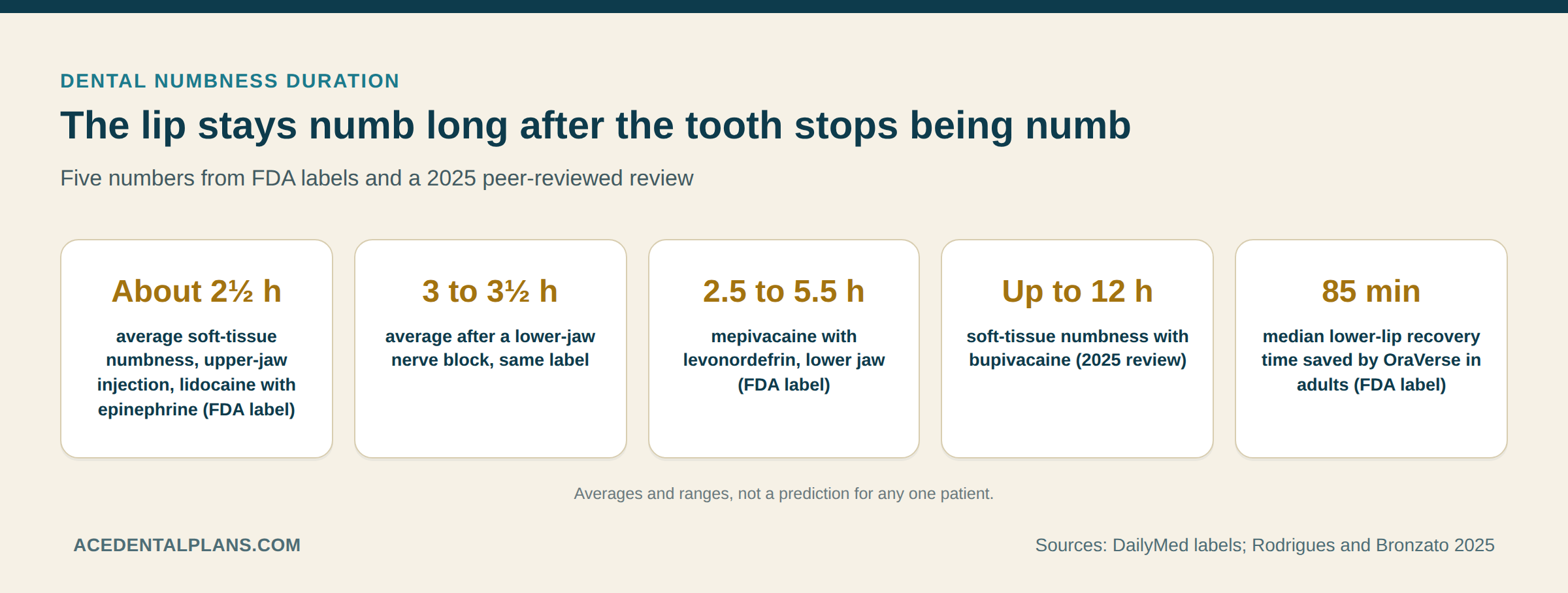
Numbness from a dental injection usually fades in about 2 to 5 hours. On the FDA label for lidocaine with epinephrine, average soft-tissue numbness is about 2½ hours after an upper-jaw injection and 3 to 3½ hours after a lower-jaw nerve block. Lower-jaw numbness lasts longer, and a few anesthetics run well past five hours. Numbness that never begins to retreat is a reason to call the office.
This article covers the common dental anesthetics and their published durations, why the lower jaw stays numb longer, and what else moves the clock. It also covers eating while numb, children and lip biting, the reversal injection, nitrous oxide and sedation, and the point where lingering numbness needs a call. Numbness after tooth removal and nerve injury have their own page. The cost note is short because the numbing itself is rarely a separate charge.
Key Takeaways
- Soft tissue outlasts the tooth. The lidocaine label gives pulp anesthesia of at least 60 minutes but soft-tissue numbness of about 2½ hours after an upper-jaw injection. Your lip can stay numb long after the tooth stops being numb.
- Lower-jaw blocks last longer. The same label gives 3 to 3½ hours for a nerve block. The mepivacaine label gives 1 to 2.5 hours in the upper jaw against 2.5 to 5.5 hours in the lower.
- The drug sets the range. A 2025 peer-reviewed review lists 2 to 3 hours of soft-tissue numbness for plain mepivacaine and 3 to 5 hours for lidocaine with epinephrine. It gives 2 to 6 hours for articaine and up to 12 hours for bupivacaine.
- Do not eat or chew until feeling returns. Several FDA labels tell patients to wait because of the risk of biting the lip, tongue or cheek. In one 2020 study, 9% of children without intellectual disability and 19% of children with it had a self-inflicted soft-tissue injury after dental anesthesia.
- A reversal injection exists. OraVerse (phentolamine) cut the median recovery time for the lower lip by 85 minutes in the label’s adult trial, but it is an extra injection and not every office stocks it.
- Call if numbness is not retreating. Persistent numbness after a dental injection is uncommon; a Canadian review of reports put it at about 1 in 609,000 injections, most often after lower-jaw blocks.
How Long Each Dental Anesthetic Stays Active
A dentist chooses a numbing drug for the job, not for how long the lip will tingle afterward. Four families cover most U.S. dental work: lidocaine, articaine, mepivacaine and bupivacaine. Each comes in cartridges, usually with a vasoconstrictor such as epinephrine that narrows blood vessels and keeps the drug near the nerve for longer.
Two kinds of numbness are worth separating. Pulpal anesthesia is the part that matters to the tooth: the nerve inside it is quiet and the drill is comfortable. Soft-tissue anesthesia is the lip, cheek, tongue and gum, the part you feel as a thick, rubbery face. The two do not end together. Soft tissue is the slower one to wake up.
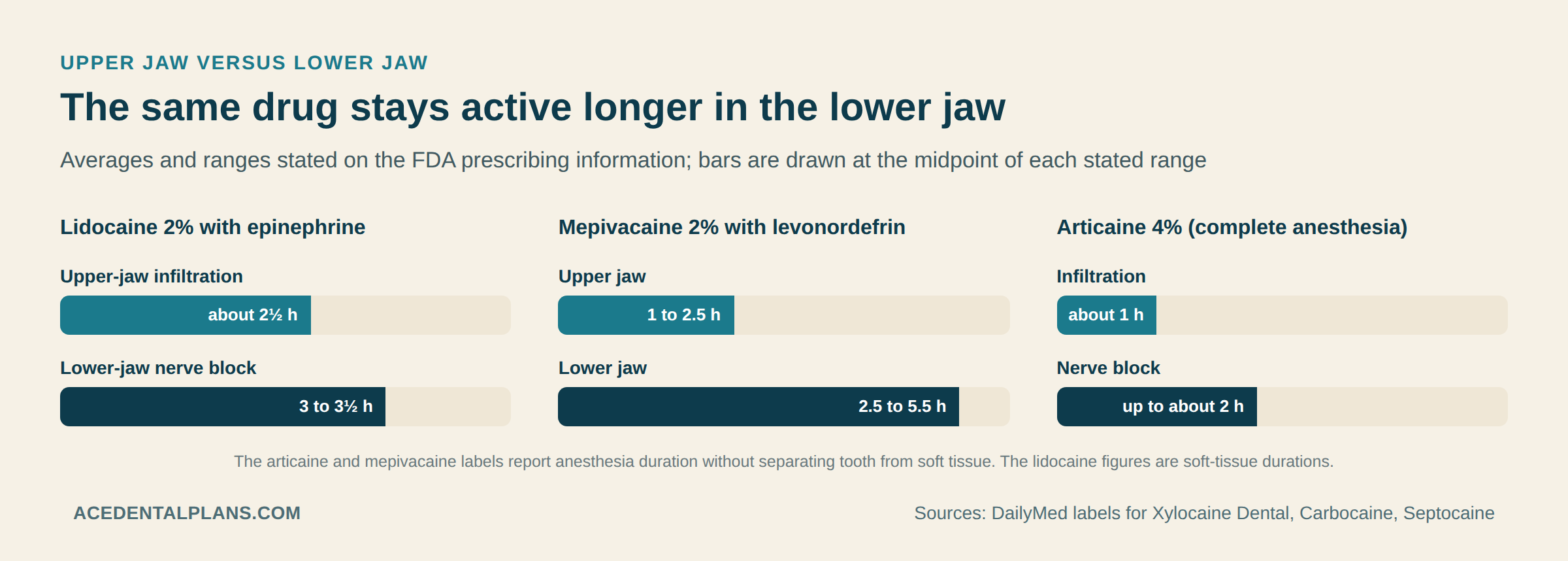
The FDA label for 2% lidocaine with epinephrine (Xylocaine Dental) states the gap in numbers. After an infiltration, the injection style used for most upper teeth, it describes “an average pulp anesthesia of at least 60 minutes with an average duration of soft tissue anesthesia of approximately 2½ hours.” After a nerve block, the style used for most lower teeth, pulp anesthesia averages at least 90 minutes. Soft-tissue anesthesia lasts 3 to 3½ hours. The label gives the same figures for both epinephrine strengths it covers.
Other drugs shift those numbers. A 2025 narrative review in the Journal of Oral and Maxillofacial Anesthesia by Rodrigues and Bronzato states soft-tissue durations in its text, and Table 1 sets them beside the label figures. Treat every number as an average. The AAPD’s local anesthesia guideline notes that duration “varies greatly” with concentration, total dose, injection site, epinephrine use and patient age.
| Anesthetic | Vasoconstrictor | Tooth (pulpal) numbness | Lip, tongue, cheek (soft tissue) |
|---|---|---|---|
| Lidocaine 2% | Epinephrine 1:100,000 or 1:50,000 | Label: at least 60 min (infiltration); at least 90 min (nerve block) | Label averages: about 2½ h (infiltration); 3 to 3½ h (nerve block). Review: 3 to 5 h |
| Articaine 4% | Epinephrine | Label: complete anesthesia about 1 h (infiltration), up to about 2 h (nerve block). Review: 1 to 2 h | Review: 2 to 6 h. Label does not split tooth and soft tissue |
| Mepivacaine 2% | Levonordefrin 1:20,000 | Review (3% with vasoconstrictor): about 1 h | Label (does not split tooth and soft tissue): 1 to 2.5 h upper jaw; 2.5 to 5.5 h lower jaw. Review: 3 to 5 h |
| Mepivacaine 3% | None (plain) | Label: operating anesthesia about 20 min in the upper jaw. Review: 20 to 40 min | Review: 2 to 3 h |
| Bupivacaine 0.5% | Epinephrine 1:200,000 | Review: 1.5 to 3 h | Review: up to 12 h. Label: may last two or three times longer than lidocaine and mepivacaine |
Read the table as ranges from different sources, not as a promise. The label averages describe specific injection techniques. The review summarizes the clinical literature, which is why its lidocaine range of 3 to 5 hours is wider than the label’s averages. The review also lists prilocaine 3% with felypressin at 3 to 5 hours of soft-tissue numbness, a combination the table leaves out.
It also helps to know what the labels measured. The Septocaine label reports that its pulp-tester studies took “the success rate (maximum EPT value within 10 minutes)” as the outcome, which is a measure of how quickly a tooth stops responding to a small electrical stimulus. That tells you when the tooth is ready for the dentist, not when your lip will feel normal again, and the label does not report pulpal and soft-tissue duration separately. The soft-tissue averages in the lidocaine and mepivacaine labels are the closest thing to a clock for the part you will actually notice.
One drug deserves a longer note. The Vivacaine label for bupivacaine with epinephrine is written for oral surgical procedures “generally associated with significant postoperative pain.” It states that anesthesia “may last two or three times longer than lidocaine and mepivacaine for dental use.” That long tail is part of the design, since the first hours of recovery after surgery are when comfort matters most. It is also why the same label says the drug is not recommended for children.

Why Lower-Jaw Blocks Last Longer, and What Else Moves the Clock
Upper jaw versus lower jaw
The labels draw the same line over and over: injections in the lower jaw last longer. The lidocaine label gives about 2½ hours of soft-tissue numbness after an infiltration and 3 to 3½ hours after a block. The mepivacaine label with levonordefrin gives 1 to 2.5 hours in the upper jaw and 2.5 to 5.5 hours in the lower jaw. The articaine label reports complete anesthesia of about an hour for infiltrations and up to about two hours for nerve blocks.
In general terms, the two injection styles differ in where the drug is placed. An infiltration deposits the anesthetic beside the tooth’s root, and it soaks into the nearby bone and gum. A mandibular block places a larger share of the drug near the main nerve that carries sensation from the lower teeth, and that same area also reaches the lip and often the tongue. That is why a lower-molar filling can leave half your face numb, while an upper front tooth may leave only the lip.
The sources I read describe the pattern rather than a single mechanism, so it is safest to say what the numbers show. Lower-jaw blocks reach more soft tissue and last longer on every label that separates the two. The AAPD guideline adds a practical consequence: bilateral mandibular blocks, with both sides numb, may carry more risk of self-inflicted injury than a one-sided block or an upper-jaw infiltration.
What speeds up or slows down the clock
Averages hide a spread, and several things move you along it. The 2025 review names four: protein binding, local blood flow, vasoconstrictors and the amount of drug. A drug that binds firmly to the membrane proteins around a nerve blocks it for longer. Tissue with a rich blood supply carries the drug away faster. Epinephrine and similar agents narrow the vessels and slow that removal.
Volume matters too, and not only for the drug itself. The review cites a meta-analysis in which a 3.6 mL dose outperformed 1.8 mL for lower-jaw blocks, a reminder that one cartridge is not always the whole story. A second injection, a second cartridge or a block on both sides can all add time. Plain mepivacaine, which has no vasoconstrictor, is the clearest example of the opposite: the review gives it a soft-tissue range of 2 to 3 hours, shorter than most of the epinephrine-containing options.
The fourth factor is you. The AAPD footnote lists patient age among the things that change duration, and every label presents averages, not guarantees. Two people given identical injections can have recovery times an hour or more apart. If your last visit left you numb for four hours, that hints at the clock this time. It does so only if the dentist used the same drug, the same injection and the same dose, which is reasonable to ask.
One thing is not a factor, however much people suspect otherwise: how brave you are. Numbness is pharmacology, not temperament. Nothing in the labels or the review suggests that moving the jaw, massaging the cheek or drinking something warm shortens the clock, and the sources I read recommend none of these. The tools that actually change the timeline are choosing a shorter-acting drug before treatment and, in selected cases, the reversal injection covered below.
A Numbness Clock: What to Expect and Do Hour by Hour
Putting the label averages together gives a timeline with a useful middle stretch. The tooth wakes up first, the lip and tongue wake up later, and in between lies a window where the tooth may feel fairly normal while the soft tissue is still numb. That window is when people forget, take a bite of lunch and discover the numb cheek the hard way. Table 2 lays out the stages with the numbers behind them.
| Time after injection | What the numbers suggest | What to do |
|---|---|---|
| 0 to 4 minutes | Onset averages under 2 minutes for infiltration and 2 to 4 minutes for a block (label) | Tell the dentist right away if the tooth still feels sharp, before work begins |
| Up to 60 to 90 minutes | Tooth numbness lasts at least 60 minutes (infiltration) or 90 minutes (block) | The procedure window; hold still and say if sensation returns |
| About 1 to 2½ hours | The tooth may wake first while the lip is still numb (infiltration) | No food, no hot drinks, no chewing gum; keep fingers and tongue away from the lip |
| About 1½ to 3½ hours | Block numbness fades from the soft tissue after 3 to 3½ hours on average | Drink cool water through the other side of the mouth if needed; test feeling before eating |
| 3 to 5 hours | Upper end of the review’s lidocaine range, and typical for articaine and mepivacaine with a vasoconstrictor | Stay with soft or lukewarm foods once feeling is back; skip chewing on the numb side |
| 5 to 12 hours | Possible with bupivacaine; also the long tail for articaine (up to 6 hours) | Ask the office at checkout how long to expect; plan meals around the answer |
| Next morning | Beyond every published range for the common agents, apart from the longest bupivacaine figures | Call the office if the lip, chin or tongue is still numb, or if feeling seems patchy rather than returning |
The “about 1 to 2½ hours” row is the one to remember. With an infiltration, the gap between a tooth that feels normal and a lip that does not is roughly an hour and a half on the label averages. With a lower-jaw block it is similar, closer to two hours. If an appointment ends at noon and you have a one o’clock meeting with lunch included, the numbers say you will probably still be numb when you sit down.
Scheduling around the clock
If you have a choice of appointment time, the ranges in Table 1 argue for putting the visit where a long numb stretch costs the least. A mid-morning slot lets the soft tissue wake up by mid-afternoon on the label averages, while a late-afternoon slot can push the end of numbness into the evening. Neither is better for the mouth. The question is whether you have a meal, a presentation or a long conversation in the window. A lower-jaw block before a day of phone calls is worth a thought, because speech can feel thick while the lip and tongue are numb.
People who sing, teach or speak for work sometimes ask whether the dentist can use a shorter-acting drug. The answer comes from the table: plain mepivacaine has the shortest published soft-tissue range, 2 to 3 hours in the review, but it also has the shortest tooth numbness, about 20 to 40 minutes, so it suits short procedures only. Whether it fits your treatment is the dentist’s call.
Three sample days
Averages become more useful when they are laid against a day. The three scenarios below are illustrations, not predictions. The clock times use the published figures in Table 1, and every one assumes the first injection went in about five minutes after the appointment began.
Eating, Drinking and Protecting Your Lip Until Feeling Returns
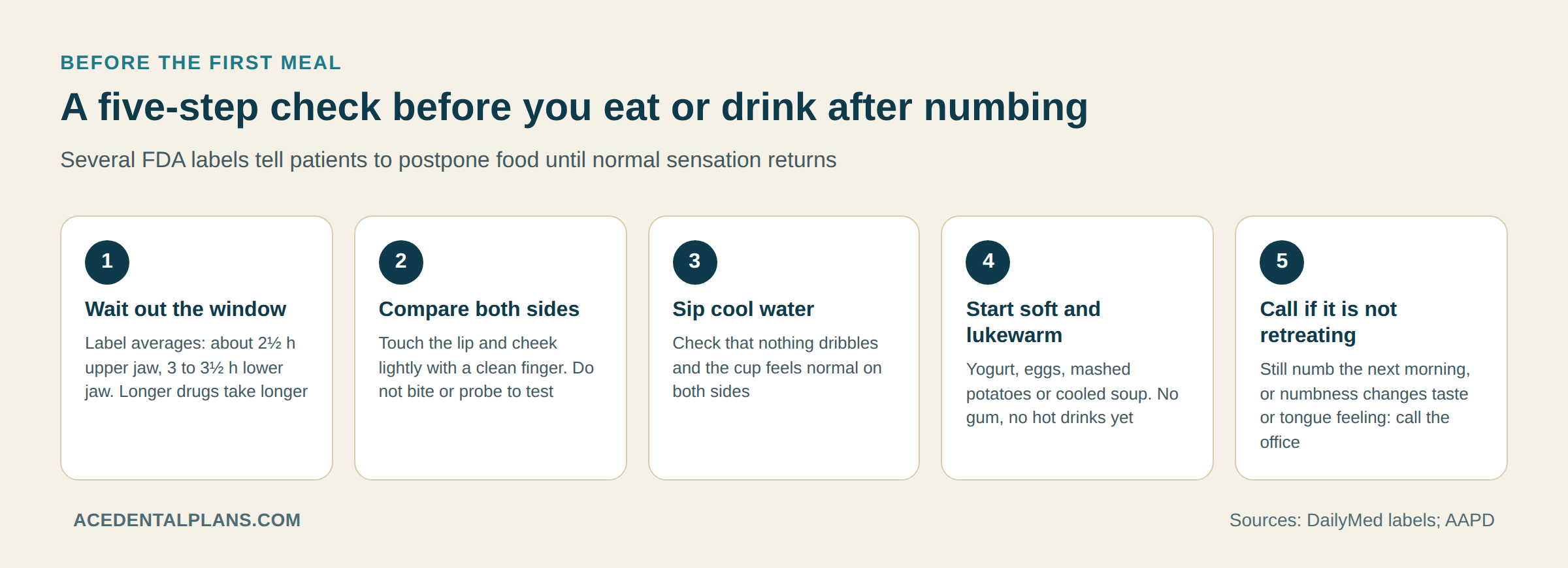
The instruction to wait is printed in the prescribing information itself, not just in the aftercare sheet. The lidocaine label says patients should be advised “to exert caution to avoid inadvertent trauma to the lips, tongue, cheek mucosae or soft palate when these structures are anesthetized.” Eating, it adds, “should therefore be postponed until normal function returns.” The mepivacaine label warns of “biting trauma” if a patient tries to eat or chew gum before sensation comes back. The Septocaine label tells patients not to eat or drink until normal sensation returns. The bupivacaine label adds that patients should not test the numb area by biting or probing it.
Why drinks too? A numb mouth cannot tell you how hot something is, and it often cannot hold a liquid in. A cup of coffee can scald the lip without a warning twinge, and a numb cheek can slide against the cup so that the drink dribbles. The labels do not single out hot drinks, so this part is common-sense caution rather than a quoted rule. If you do need water, take small sips of something cool and look in a mirror afterward.
Food is the bigger risk. Chewing is a reflex, and with the lower lip or cheek numb the teeth can catch soft tissue without any sensation to stop them. The injury that results is often a bite wound that swells and ulcerates over the next day, which is when people assume the dentist did something wrong. The wound is real, the cause is ordinary, and it is preventable in most cases by waiting.
What to eat first once feeling returns
Test gently before you trust it. Touch the lip and cheek with a clean finger and compare the two sides, without biting or probing, since the bupivacaine label warns against testing the area that way. Then take a sip of cool water and check that nothing dribbles. When both sides feel the same, begin with something soft and lukewarm, such as yogurt, scrambled eggs, mashed potatoes or soup that has cooled. Wait on crunchy, sticky or very hot foods until the area is fully normal. If the dentist placed a new filling or a temporary crown, ask which foods to avoid for the next day, because that guidance has nothing to do with the numbing drug.
A short habit list that works
- Plan the meal before the visit: eat beforehand if the appointment is long, and have soft food ready at home.
- Skip chewing gum and hard candy until feeling is back; the mepivacaine label names gum specifically.
- Keep fingers, pens and tongue away from the numb area, and do not check the lip by pinching or biting it.
- Look in a mirror once feeling returns; a white or swollen patch on the lip, cheek or tongue suggests a bite.
- Set a reminder to try a sip of water at the time the label average ends, not an hour earlier.
Children, Special-Needs Patients and Accidental Biting
Children are the group most likely to bite a numb lip, and the evidence is specific. In a 2020 prospective study in the European Archives of Paediatric Dentistry, Bagattoni and colleagues followed 241 children given dental local anesthesia, phoning families two days later. Self-induced soft-tissue injury occurred in 9% of the 159 children without intellectual disability and in 19% of the 82 children with intellectual disability. Children aged six or younger had a higher frequency, and the lower arch carried the greater risk in both groups. The authors concluded that these injuries are “common complications of local anesthesia in young children and individuals with intellectual disability.”
The American Academy of Pediatric Dentistry reaches a similar view in its reference manual. It calls self-induced trauma “an unfortunate clinical complication.” Most lesions resolve on their own, though bleeding and infection are possible. The guideline names the factors that raise risk: soft-tissue numbness outlasting the tooth, bilateral mandibular blocks, and local anesthesia given while a child is under general anesthesia. It says that a link between shorter-acting agents and fewer injuries “has not been demonstrated,” so a shorter drug is not a safeguard by itself.
The AAPD guideline says parents and caregivers should be told how long the numbness may last and how to reduce biting of the lip, cheek or tongue. The chart should record that the instructions were reviewed. That is a fair thing to ask for. Before a child leaves, ask when numbness is expected to end and whether a block went in on one side or both. Ask, too, whether the child needs an adult nearby until feeling returns.
Practical steps for a child who is numb
Keep the child within sight, on soft cool foods only after feeling is back, and away from lollipops, gum and pencils. Younger children can be told, in plain language, that the “sleepy lip” will wake up soon and that chewing on it is how it gets sore. Some parents find a short, written timeline on the fridge helps older siblings stop offering snacks. If the child does bite the lip, a clean, gentle rinse is reasonable. Call the office for bleeding that continues, swelling that spreads or a wound that looks infected. An emergency dentist visit and its cost is a realistic scenario after hours, so it is worth knowing the office’s after-hours number before you need it.
Drug choice carries a few age rules too. The Septocaine label states that safety and effectiveness in children under age 4 have not been established. The Vivacaine label says it is not recommended for children, and the AAPD adds that bupivacaine is contraindicated in children and in patients with intellectual disability because of the risk of self-inflicted injury. Dosing is weight-based for every agent, which is a decision for the dentist, not something a parent should estimate.
The Reversal Injection: What OraVerse Does and Who May Get It
OraVerse is the brand name of phentolamine mesylate, an FDA-approved injection that reverses soft-tissue numbness. The label lists it for “adult and pediatric patients ages 3 years and older for the reversal of soft-tissue anesthesia” after an intraoral injection of a local anesthetic that contains a vasoconstrictor. It goes in at the same place and by the same technique as the numbing shot. The dose is matched to how much anesthetic was used, from 0.2 mg after half a cartridge to 0.8 mg after two. The label advises against use under age 3.
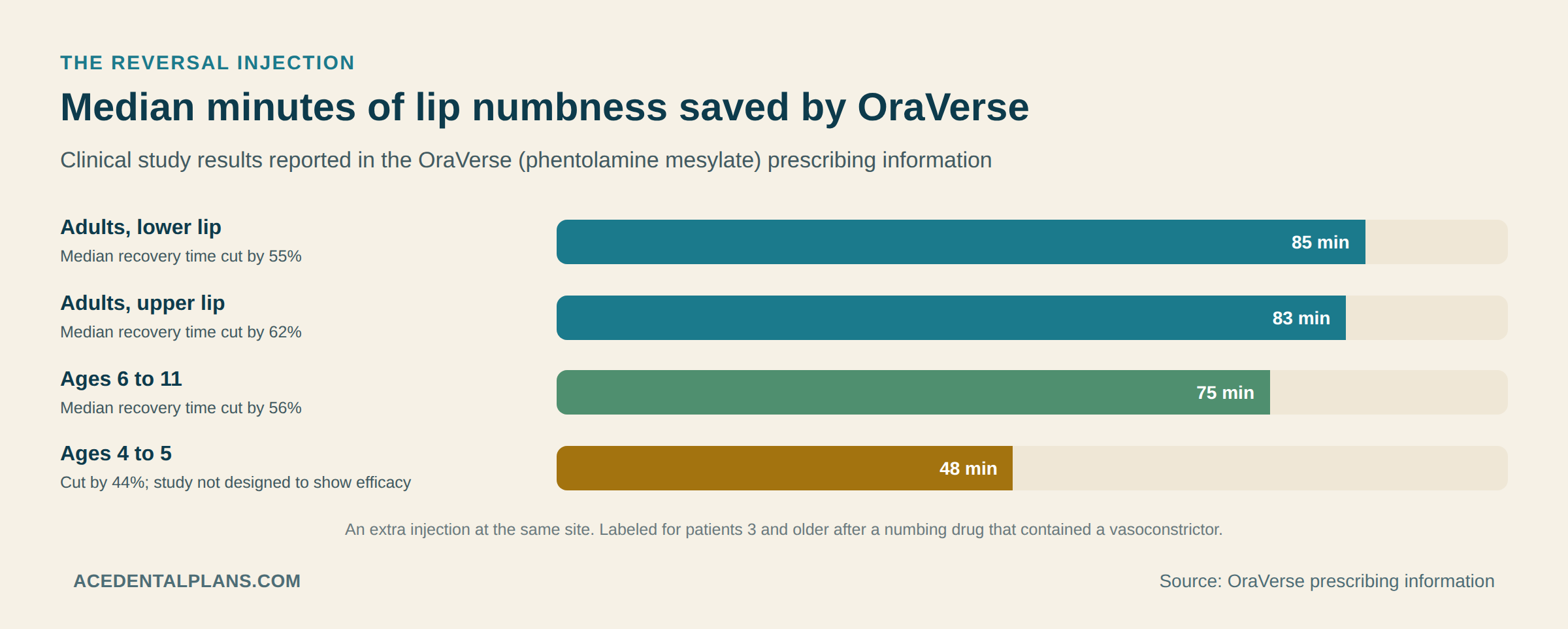
The label’s numbers show what it does. In adults, OraVerse reduced the median time to recovery of normal sensation in the lower lip by 85 minutes, or 55%, and in the upper lip by 83 minutes, or 62%. In children aged 6 to 11 the reduction was 75 minutes (56%). In children aged 4 to 5 it was 48 minutes (44%), though the label states the study “was not designed to demonstrate efficacy.” The AAPD reports that phentolamine shortens soft-tissue numbness by about 47% in the upper jaw and 67% in the lower jaw.
Several limits matter before you ask for it. It requires an extra injection into the same area, and the label’s most common adverse reaction was injection-site pain. Post-marketing reports include low blood pressure, irregular heartbeat, dizziness and flushing, and the label notes cardiovascular events with phentolamine given by other routes. It is contraindicated with hypersensitivity to the drug. Its labeled use is after an anesthetic that contained a vasoconstrictor, so plain mepivacaine falls outside it, and it does not erase the need to avoid eating until feeling returns. The label repeats that patients should wait.
The practical question is price and availability. I found no reliable national price for a reversal injection, and many offices may not stock it. Dental billing guides describe local anesthesia as bundled into the procedure, so a reversal injection would be a separate decision to price. If you want it, raise it when the appointment is scheduled, not after the numbness has set in. Ask what the fee would be and whether your plan treats it as covered.
Nitrous Oxide and Sedation Run on Different Clocks
A common mix-up is to blame the lingering face numbness on sedation, or the reverse. They are separate. Local anesthesia numbs an area, and sedation changes how you feel about being in the chair. A dentist can give both at the same visit, and then you are on two clocks that end at different times.
Nitrous oxide is the short one. The ADA’s patient page says the effects “wear off soon after the mask is removed.” The clinician-facing ADA page says the end-of-visit step is 100% oxygen for 5 minutes before the mask comes off, to purge residual gas. It describes nitrous oxide as having “the fastest onset among inhalation agents” and as “removed rapidly from the body.” If you had nitrous oxide and a local anesthetic, the gas is long gone by the time your lip wakes up.
Oral, intravenous and general sedation are longer and deeper. The ADA’s sedation guidelines define four levels. Under minimal sedation the patient responds normally to touch and spoken commands. Under moderate sedation the patient responds purposefully to verbal commands. Under deep sedation the patient is not easily aroused. Under general anesthesia the patient cannot be aroused even by painful stimulation. The guidelines require verbal and written post-operative instructions to go to the patient, parent, escort, guardian or caregiver. They also require the dentist to document that consciousness, oxygenation, ventilation and circulation are satisfactory before discharge. Rules about driving and who must accompany you come from the dentist’s protocol and state rules, so ask rather than guess.
Local anesthetic is typically still given during sedated dental work, which means the numb lip survives the sedation. The AAPD points out the consequence for children: local anesthesia placed while a child is under general anesthesia may raise the risk of postoperative trauma, because the child wakes up numb. The same applies to adults, who tend to remember the instruction to avoid chewing less well after sedation. Ask whoever is taking you home to hear the instructions with you.
Pricing for sedation is a separate subject. A billing article published in 2024 notes that nitrous oxide is coded per visit and that intravenous moderate sedation is coded in 15-minute increments, which is why quotes vary. For cash prices by sedation level on wisdom tooth surgery, see wisdom teeth removal cost with sedation.
When Lingering Numbness Needs a Call
Most numbness is routine and will be gone by dinner. A small minority persists, and the literature is candid that the cause is not always clear. The labels for articaine, mepivacaine and others all list persistent paresthesia as a reported effect. The Septocaine label says persistent paresthesias of the lips, tongue and oral tissues have been reported, with “slow, incomplete, or no recovery.” They were “reported chiefly following nerve blocks in the mandible.” The same label says hypoesthesia with articaine is usually reversible.
How common is it? A retrospective review in the Journal of the Canadian Dental Association by Gaffen and Haas examined 182 voluntary reports to an Ontario professional liability program from 1999 to 2008. They cite a reported incidence of 1 in 609,000 injections for 2006 to 2008. Nearly all reports followed lower-jaw blocks. The tongue’s lingual nerve was affected more than twice as often as the lower jaw’s inferior alveolar nerve. Articaine and prilocaine, the two drugs supplied as 4% solutions, were reported more often than their usage would predict. The authors suggest local anesthetic neurotoxicity “may be at least partly involved.” Voluntary reports cannot give a true rate. Read the figure as a reminder that this is uncommon, not as a precise risk.
No source I read sets a single cutoff hour for calling. A workable reading of the published ranges is simple. Call the office the same day if numbness is still full after the longest expected window, or if you wake up with the same numb lip, chin or tongue. If you were told bupivacaine was used, the window is longer, so ask the office what to expect. If the area is numb and also changing your taste, speech or ability to feel food on the tongue, say so on the call. The office can check which injection was given and what the next step should be. Numbness after a tooth removal has its own timeline, covered in the guide to numbness after tooth extraction.
| What you notice | What it may mean | What to do |
|---|---|---|
| Lip or tongue feeling slowly returning within the expected window | The anesthetic is wearing off as the labels describe | Keep avoiding food and chewing until the feeling matches the other side |
| Still fully numb after the longest window for the drug used | A long-acting agent, a large dose or, rarely, nerve irritation | Call the office the same day and ask which drug and injection were used |
| Numb the next morning, or numbness with changed taste or tongue feeling | Persistent paresthesia is uncommon but reported, mostly after lower-jaw blocks | Call the dentist; do not wait for it to pass on its own |
| A white, swollen or bleeding patch on the lip, cheek or tongue | A bite or burn injury while numb | Rinse gently; call if bleeding continues or the wound looks infected or keeps worsening |
| Child chewing the lip or cheek | Self-induced injury, which is common in young children | Redirect, supervise, and call the office for bleeding or swelling |
| Sudden numbness or weakness of the face or limb, with trouble speaking or seeing | Possible stroke signs, which are unrelated to a dental injection | Call 911 right away |
Seek prompt care if
- You have swelling of the face or neck, trouble breathing or swallowing, or bleeding that will not stop. Call 911 or go to an emergency room.
- Numbness or weakness appears suddenly in the face, an arm or a leg, especially on one side, with confusion, trouble speaking or seeing, or a severe headache with no known cause. The CDC lists these as stroke signs and says to call 9-1-1 right away.
- You have fever with severe dental pain, which the disclaimer below lists as a reason for emergency care.
- Numbness has not begun to retreat by the next day, or it is spreading beyond the area that was injected.
Pain is a separate issue from numbness, and it can appear just as feeling returns. If that is your situation, the steps in toothache home relief cover safe short-term measures until you see the dentist.
Same Numbness, Different Visit: Fillings, Crowns, Root Canals, Implants and Extractions
Numbness depends on the injection, not the procedure name. A lower-molar filling with a block and a lower-molar crown preparation with the same block leave you numb for about the same time. The crown visit is longer, and the dentist may add a second cartridge. The procedure matters mainly through how many injections are needed and whether the dentist has reason to choose a long-acting drug. So use the sections above for the numbness and the pages below for everything else that follows the visit.
After a filling, the question that follows numbness is often sensitivity, a different sensation entirely. Numbness is gone when feeling returns equally on both sides. Sensitivity is the tooth reacting to cold, heat, sweet or biting pressure, and its timeline is covered in tooth sensitivity after a filling. The ADA’s MouthHealthy site lists fillings, preparing teeth for crowns and treating gum disease as common reasons for an injectable anesthetic. That is why the same numbness rules show up across so many appointments. If a crown is on the plan, dental crown cost explains how the price is built.
A root canal is usually discussed in terms of pain afterward, not numbness. Once feeling returns, the soreness, tenderness on biting and the days that follow are covered in pain after a root canal, and the bill is covered in root canal cost. Implant surgery is longer and often involves sedation as well as local anesthetic, and the timeline for the weeks that follow sits in the dental implant recovery timeline.
Cleanings are the lightest case. The ADA notes that a dentist may apply a topical anesthetic before an injection, and many routine cleanings need neither. Deeper gum treatment is different, because it can need injections in one or more sections of the mouth. The price pages for dental cleaning cost and deep cleaning cost show where numbing appears on estimates.
Extractions belong to a neighboring topic. Numbness there follows the same injection pharmacology. Tooth removal near the lower nerve adds its own questions about what is normal, and the separate guide to numbness after an extraction takes them up. For the money side of removal, the pages on tooth extraction cost, tooth extraction without insurance and wisdom teeth removal cost list the numbers.
What the Numbing Adds to a Dental Bill and an Insurance Claim
For most patients, the answer is nothing extra. A 2024 article by a dental billing specialist describes code D9215 as local anesthesia “in conjunction with operative or surgical procedures.” Local anesthetics generally are “not billed as a separate procedure, no matter how many vials are used.” A second code, D9210, covers local anesthesia not tied to such a procedure. In other words, if you are getting a filling, the numbing is normally part of the filling’s fee and does not appear as its own line item.
The extras come from three places. Nitrous oxide is coded per visit, and intravenous moderate sedation is coded in 15-minute increments, so the higher the sedation level and the longer the case, the more lines you may see. A reversal injection, if offered, would be an additional charge, and I found no national price for it. A longer or more complex appointment may also cost more simply because the underlying procedure does.
Coverage works the way it does for any dental service. Many plans sort services into preventive, basic and major. What a plan does with sedation and nitrous oxide varies, so a service one policy treats as covered can be excluded by another. The guide to what dental insurance covers walks through how procedures are classified. Before a sedated appointment, ask the office for the CDT codes it plans to bill, then ask the insurer for a pre-treatment estimate for those codes. That estimate is not a promise of payment, but it is the only way to see the plan’s position in writing.
Before the Injection: Health Conditions and Questions to Ask
Pregnancy, heart conditions and other things to mention
The ADA’s MouthHealthy pregnancy page says numbing medicines used for fillings, root canals or extractions are “safe for both you and your baby.” It describes a study comparing pregnant patients given anesthetic such as lidocaine with those who received none. The study found no difference in miscarriage, birth defects, premature birth or birth weight. The page also says to tell the dental team right away, even if you are not sure you are pregnant. A dentist or doctor may postpone some treatment if the pregnancy is high-risk.
Other conditions change the conversation as well. The Carbocaine label recommends extra caution with the vasoconstrictor product in patients with hypertension, heart disease or diabetes, and the 2% product contains a sulfite that the 3% product lacks. Those are notes for the clinician, not instructions for you, but they explain why the intake form asks about medications and conditions. A drug without epinephrine is one choice some dentists make, and as the table shows, it also changes how long you stay numb.
Questions worth asking at the chair
A two-minute conversation before the first shot saves the afternoon. The questions below turn the numbers in this article into specifics for your appointment.
- Which numbing drug will you use, and does it contain epinephrine or another vasoconstrictor?
- Will this be an infiltration or a nerve block, and will it be on one side or both?
- About what time should the lip and tongue feel normal, and what is the longest I should expect?
- Is a long-acting drug such as bupivacaine planned, and if so, why?
- Do you offer a reversal injection such as OraVerse, and what would it cost?
- Is nitrous oxide or other sedation planned, and how will that be coded and billed?
- For a child, what instructions will you give about lip biting, and who should I call after hours?
- When should I call if numbness has not changed?
Write the answers on the aftercare sheet. That makes it easy to compare the expected end time with the real one, and it gives you a precise description if you need to call the office later.
What to note for your next visit
Numbness is easier to plan for the second time. Jot down the drug the office named, whether it was a block or an infiltration, the time of the injection and the time your lip felt normal again. If you bit your lip or cheek, note that too. The AAPD guideline asks pediatric offices to record that aftercare instructions were reviewed with the family, and a short log of your own gives any dentist something concrete to work from. It also makes a difference if you ever need to describe an unusual recovery to a different provider.
Bottom Line
Dental numbness runs on two clocks, the tooth and the soft tissue, and the soft tissue is slower. A lower-jaw block lasts longer than an upper-jaw infiltration, the drug changes the range, and individual variation widens it. The published figures are averages and ranges, so the useful questions are which drug, which injection and when to expect the end.
The habit that prevents most problems is simple. Wait to eat, chew or sip hot liquids until feeling matches the other side, keep a close eye on children, and treat a bite wound as an injury, not an annoyance. A reversal injection is available in some offices if the timing matters, and sedation adds a second clock. If numbness is not retreating when the expected window has passed, call the office the same day. For other aftercare questions, the Recovery & Aftercare guides collect the related timelines in one place.
Frequently Asked Questions
How long does dental numbness last?
Most dental numbness fades within about 2 to 5 hours. FDA label averages for lidocaine with epinephrine are about 2½ hours after an upper-jaw injection and 3 to 3½ hours after a lower-jaw block. A 2025 review gives 2 to 6 hours for articaine and up to 12 hours for bupivacaine. Your dentist can tell you which drug was used.
Why is my lip still numb hours after the dentist?
Soft tissue stays numb longer than the tooth. Lidocaine labels give at least 60 to 90 minutes for the tooth but 2½ to 3½ hours for the soft tissue, and lower-jaw blocks last the longest. Long-acting drugs and extra cartridges extend it further. If the lip is still fully numb the next morning, or the tongue is affected too, call the office.
Can I eat or drink while my mouth is numb?
The labels advise waiting. The lidocaine label says food should be postponed until normal function returns, the Septocaine label says not to eat or drink until normal sensation returns, and the mepivacaine label names gum chewing. A numb mouth cannot sense heat or tell you when you are biting down on the lip, so test with a sip of cool water before eating.
Can I make dental numbness go away faster?
One FDA-approved option exists: a phentolamine injection (OraVerse) given after the procedure, which cut median lower-lip recovery time by 85 minutes in adults in the label’s study. It is an extra injection, not every office offers it, and I found no reliable national price. The sources I read do not support massage, heat or exercise as ways to shorten it.
How long does numbness last in children?
Children receive smaller doses, but the same drugs and the same lower-jaw effect apply, and the AAPD notes that soft-tissue numbness outlasts the tooth. Because young children are more likely to bite a numb lip, parents are usually asked to supervise until feeling returns. Ask the office for an expected end time on the day.
Is it safe to have numbing shots while pregnant?
The ADA’s MouthHealthy page says local anesthetics used for dental work are safe for both mother and baby. It cites a study that found no differences in miscarriage, birth defects, premature birth or birth weight. Tell the dental team about the pregnancy first. The guide to dental care during pregnancy covers timing and what to ask.
How long does numbness last after a dental cleaning?
It depends on whether any anesthetic was used. The ADA notes that a dentist may apply a topical anesthetic before an injection, and many routine cleanings use neither, so there may be no numbness at all. Deeper gum treatment can need injections, and then the durations in Table 1 apply. Ask the hygienist what was used and when to expect feeling to return.
Does epinephrine make numbness last longer?
Yes. The 2025 review says vasoconstrictors slow absorption and prolong duration, and it lists plain mepivacaine at 2 to 3 hours of soft-tissue numbness against 3 to 5 hours with a vasoconstrictor. The trade-off is that plain mepivacaine gives a shorter window of tooth numbness. Your dentist weighs that against the length of the procedure and your health history.
Does nitrous oxide make my face numb?
No. Nitrous oxide is a sedative gas that makes you feel relaxed, and the ADA says its effects wear off soon after the mask is removed. Numbness in your lip or cheek comes from the local anesthetic injection, which keeps working after the nitrous oxide has cleared. Both can be used at the same visit.
Do I pay extra for numbing at the dentist?
Usually not. A 2024 billing article describes code D9215 as local anesthesia with procedures that is generally not billed separately. Sedation is different: nitrous oxide is coded per visit and intravenous sedation in 15-minute increments. Ask for the codes in your estimate and check with your insurer about what your plan counts as covered.
How common is long-lasting numbness from a dental injection?
It is uncommon. A Canadian review of voluntary reports cited about 1 in 609,000 injections for 2006 to 2008, mostly after lower-jaw blocks, and noted that voluntary reports undercount. Labels list persistent numbness as a reported effect with “slow, incomplete, or no recovery” in some cases. Call the dentist if numbness has not started to retreat.
When should I go to the emergency room for numbness?
Go if numbness or weakness comes on suddenly in the face, an arm or a leg, especially on one side, with confusion, trouble speaking or seeing, or a severe headache. The CDC lists these as stroke signs and says to call 9-1-1 right away. Also seek emergency care for swelling of the face or neck, or trouble breathing or swallowing.
Sources and Disclaimers
Duration figures come from two source families. FDA-approved prescribing information for specific dental anesthetic products reports manufacturer averages for particular injection techniques. One 2025 peer-reviewed narrative review summarizes the clinical literature in wider ranges. Child-injury, nerve-complication and reversal-agent figures come from a published prospective study, a retrospective review of voluntary reports, a pediatric dentistry guideline and the OraVerse label. Safety statements on pregnancy and nitrous oxide come from the ADA, and stroke signs come from the CDC. Billing statements come from a 2024 trade article by a dental billing specialist, so they describe common coding practice, not any insurer’s policy. The clock times in the worked examples are original illustrations built from those averages. National averages cannot predict your own recovery or your own bill. Confirm the drug and expected duration with your dentist, and confirm prices and benefits with the dental office and your insurer.
- DailyMed (U.S. National Library of Medicine) — Xylocaine Dental (lidocaine HCl and epinephrine) prescribing information
- DailyMed (U.S. National Library of Medicine) — Septocaine (articaine HCl and epinephrine) prescribing information
- DailyMed (U.S. National Library of Medicine) — Carbocaine (mepivacaine HCl) dental prescribing information
- DailyMed (U.S. National Library of Medicine) — Vivacaine (bupivacaine HCl and epinephrine) prescribing information
- Drugs.com Pro — OraVerse (phentolamine mesylate) prescribing information
- Rodrigues GA, Bronzato JD, Journal of Oral and Maxillofacial Anesthesia (2025) — A narrative review on local anesthetics in dentistry: mechanism of action, characteristics, and clinical considerations
- American Academy of Pediatric Dentistry — Use of Local Anesthesia for Pediatric Dental Patients
- Bagattoni S, D’Alessandro G, Gatto MR, et al., European Archives of Paediatric Dentistry (2020) — Self-induced soft-tissue injuries following dental anesthesia in children with and without intellectual disability
- Gaffen AS, Haas DA, Journal of the Canadian Dental Association (2009) — Retrospective Review of Voluntary Reports of Nonsurgical Paresthesia in Dentistry
- American Dental Association — Nitrous Oxide (Oral Health Topics)
- American Dental Association, MouthHealthy — Nitrous Oxide – Laughing Gas
- American Dental Association, MouthHealthy — Anesthesia and Sedation
- American Dental Association, MouthHealthy — Pregnancy Dental Concerns
- American Dental Association — Guidelines for the Use of Sedation and General Anesthesia by Dentists
- Vargas E, Dr. Bicuspid (February 2024) — Numb and number: Coding and billing for anesthesia services in the dental practice
- Centers for Disease Control and Prevention — Signs and Symptoms of Stroke
Important Information and Disclaimers
This article is general educational information. By using it, you accept the limits described below.
Not dental or medical advice
Nothing on this page is a diagnosis, a treatment recommendation or a substitute for an examination by a licensed dentist or physician. Reading this article does not create a dentist-patient or doctor-patient relationship. Only a licensed professional who has examined you and reviewed your history can tell you what your mouth needs. Do not delay, skip or stop professional care because of something you read here.
Prices are estimates, not quotes
Cost figures are ranges reported by the third-party sources cited in this article. Actual prices depend on your location, the provider, the complexity of your case, the materials used, the date of service and other factors, so what you pay may be higher or lower. A written treatment plan and fee estimate from the dental office is the only reliable number for your situation.
Insurance and plan examples are illustrations
Examples that use named amounts or percentages are hypothetical. Real benefits depend on your plan, network, waiting periods, annual maximum, deductible and the insurer’s rules at the time of treatment. A pre-treatment estimate or benefits check is not a promise of payment. Confirm the details with your insurer or plan administrator in writing.
Not insurance, legal, tax or financial advice
AceDentalPlans is an information publisher. Nothing here is insurance, legal, tax, investment or other professional financial advice, and nothing here recommends a particular provider, insurer, lender, discount plan or financing product. Company and product names belong to their owners and appear for identification only. Read the terms of any loan, financing offer or plan before you sign, and ask a qualified professional if you need advice on your own circumstances.
Third-party sources
This article cites government agencies, professional associations, insurers, lenders and other outside organizations. We do not control those sources. Their content can change, move or disappear, and listing a source is not an endorsement of it or of anything it sells.
No warranty
We aim for accuracy, but this article is provided “as is,” without warranties of any kind, express or implied, including warranties of accuracy, completeness, timeliness or fitness for a particular purpose. Some information may be out of date or contain errors by the time you read it.
Limitation of responsibility
To the fullest extent permitted by law, AceDentalPlans and its owners, authors and contributors are not responsible or liable for any loss, cost, injury, health outcome or other damage that results from using this article or relying on it. You are responsible for your own decisions about your care, your coverage and your money.
How this article is written
This article follows AceDentalPlans’ answer-first, U.S.-focused editorial approach. It uses conditional language for insurance, because coverage depends on the specific plan, and it names its sources so that you can read them yourself.