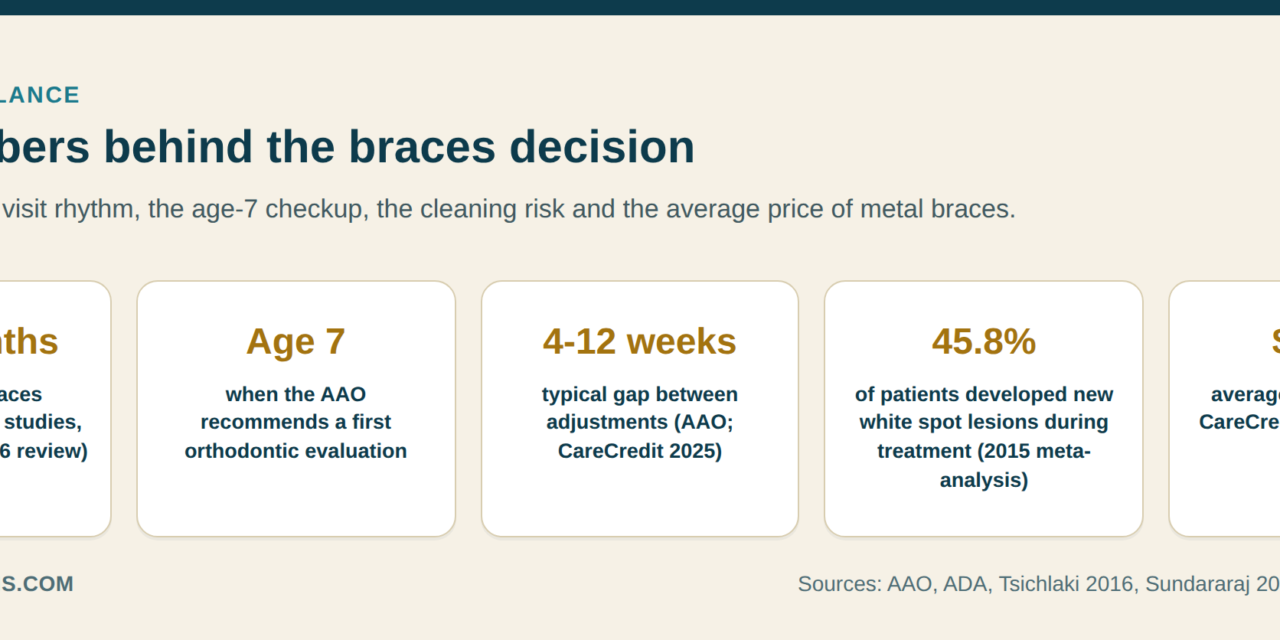
Braces are brackets and wires that move teeth into better positions, and most people wear them for 12 to 24 months, according to the American Association of Orthodontists (AAO). A 2016 review of 22 studies put the average at 19.9 months. In the U.S., CareCredit’s 2025 averages run from $5,834 for ceramic to $9,221 for lingual braces, and plans that cover orthodontics often cap what they pay at a lifetime maximum.
This guide covers the whole braces journey: the four main types, who needs treatment, the visits from consultation to retainer, realistic timelines, soreness, food, cleaning, emergencies and risks. It then explains what braces cost at a summary level and how orthodontic insurance, Medicaid, tax-favored accounts and payment plans work. It stops short of diagnosing anyone, and it leaves detailed price tiers and clear-aligner pricing to the neighboring guides linked along the way.
Key Takeaways
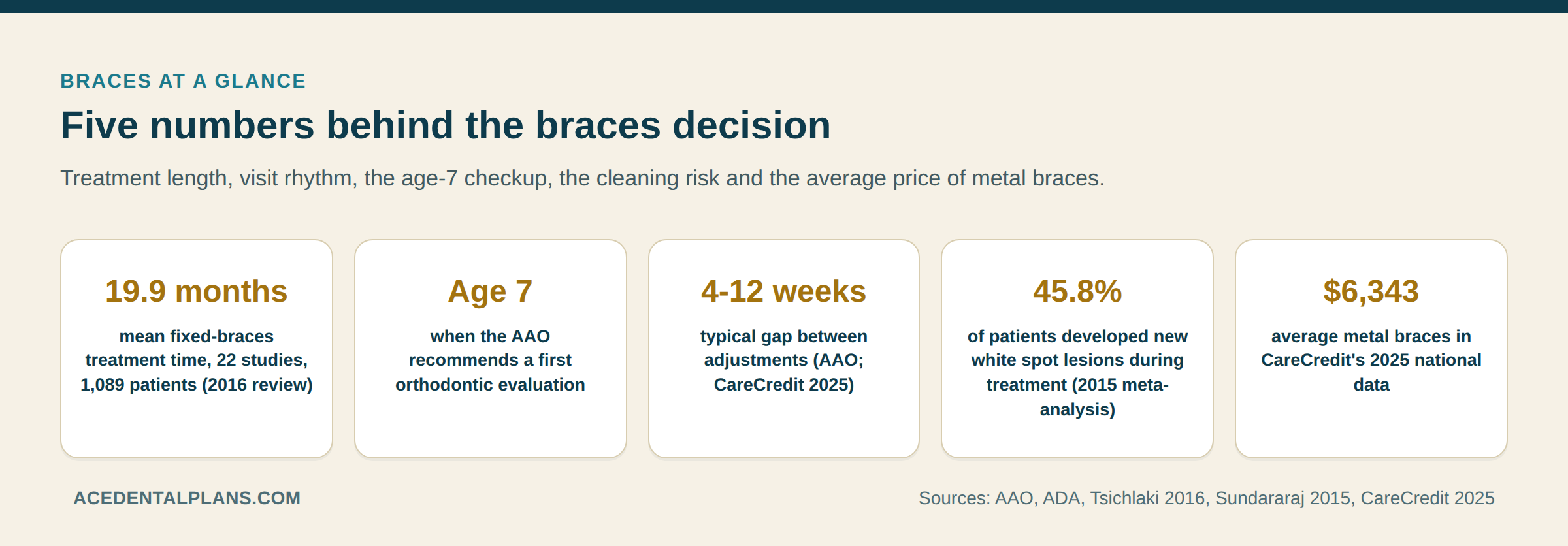
- Time: the AAO says most people wear braces 12 to 24 months; the ADA says one to three years; a 2016 systematic review found a mean of 19.9 months across 22 studies.
- Age: the AAO recommends a first orthodontic evaluation around age 7, and the ADA says healthy teeth can be treated at any age. One in three orthodontic patients is over 18, according to the AAO.
- Money: CareCredit’s 2025 data put average metal braces at $6,343, ceramic at $5,834 and lingual at $9,221. Insurance that covers orthodontics commonly pays about half, up to a lifetime cap such as $1,000 to $1,500 in the plan samples reviewed here.
- Timing traps: waiting periods (12 months in one published plan), age limits and quarterly or monthly payout schedules can matter more to your bill than the coinsurance percentage.
- Risks: a 2015 meta-analysis found new white spot lesions in 45.8% of patients during treatment, which is why daily cleaning around brackets is part of the job, not an extra.
- After the braces: the AAO says a retainer is typically necessary for a lifetime, with wear tapering over time, so ask what a replacement costs before you start.
Braces at a Glance: The Facts Behind the Short Answer
Start with the facts that almost every braces question circles back to. Table 1 collects them with the source and year beside each, so you can see which numbers are firm and which are one organization’s estimate.
| Question | What the source says | Source |
|---|---|---|
| How long do braces stay on? | Most people wear them 12 to 24 months; simple crowding or spacing about 8 to 12 months; complex bite problems a couple of years or more | AAO braces and treatment-timeline pages |
| What is the measured average? | 19.9 months (95% CI 19.58 to 20.22), 22 studies, 1,089 participants, all in hospital or university settings | Tsichlaki and colleagues, 2016 |
| How often are adjustments? | Every 4 to 12 weeks on one AAO page and in CareCredit’s guide; every 6 to 10 weeks on two other AAO pages | AAO; CareCredit, July 2025 |
| When should a child be seen? | First evaluation around age 7; treatment often begins between ages 8 and 14 | AAO; ADA MouthHealthy |
| What do average prices look like? | Metal $6,343; ceramic $5,834; lingual $9,221; clear aligners $5,108 | CareCredit national averages, 2025 |
| What does a covering plan pay? | Often 50% of the allowed charge up to a lifetime maximum, such as $1,500 with a 12-month waiting period in one Delta Dental of Washington plan | Delta Dental of Washington; Delta Dental of Iowa |
| Who is more likely to have coverage? | Children under 18 more often than adults | AAO; CareCredit; Cigna |
| How long is a retainer worn? | “Typically, a retainer is necessary for a lifetime, though the frequency of wear may decrease over time” | AAO retainers page |
| What can tax-favored money pay for? | Health FSA limit $3,400 and HSA limits $4,400 (self-only) or $8,750 (family) for 2026; braces count as dental treatment for the medical expense deduction | IRS Rev. Procs. 2025-32 and 2025-19; Publication 502 |
Two rows deserve a second look. The adjustment interval differs between AAO pages, which is a good reminder that “every few weeks” is a practice habit, not a rule. And the measured average of 19.9 months comes from clinics at hospitals and universities, where trainee providers and tougher cases may stretch the figure, as the authors themselves note.
What Braces Are Made Of and What Each Part Does
The AAO’s glossary defines the pieces plainly. Brackets are the small metal, ceramic or plastic attachments bonded to each tooth with a tooth-colored adhesive. The archwire is the metal wire attached to the brackets that moves the teeth. Bands are metal rings, usually placed on a back tooth, cemented on for strength and anchorage.
Elastics, the small rubber bands worn during certain stages, add force for individual teeth or for lining up the jaws. Separators, either tiny elastics or small wire loops, are slipped between molars beforehand to make room for bands.
The principle behind all of it is simple. Successful treatment, in the AAO’s words, “depends on three things – pressure, time and cooperation.” Braces apply sustained, gentle pressure, and teeth respond gradually. The patient’s part is keeping teeth clean, avoiding foods that break brackets, limiting sugary drinks and wearing elastics as prescribed.
Other tools can join the plan. The glossary describes a palatal expander as a fixed or removable appliance used to make the upper jaw wider. Headgear is an appliance worn outside the mouth to provide traction. A temporary anchorage device is a miniature surgical screw that resembles an earring stud when in place. None of these is a type of braces on its own. They are add-ons an orthodontist may choose, and each can appear as a separate line on an estimate.
What Braces Correct, in Plain Terms
MedlinePlus defines malocclusion simply: the teeth are not aligned properly. It says malocclusion is most often hereditary, and it lists other causes including thumb sucking, tongue thrusting, prolonged bottle use, extra, lost or impacted teeth, and jaw fractures that healed out of line. Class 1, the most common type, means the bite is normal but the upper teeth slightly overlap the lower ones. Class 2 is an overbite pattern, and Class 3 is an underbite, where the lower jaw juts forward.
The AAO glossary adds the vocabulary you will hear in a consultation:
- Overjet: the upper front teeth protrude in front of the bottom front teeth when the back teeth are closed.
- Overbite: the upper front teeth overlap the bottom front teeth too much when the back teeth are closed.
- Crossbite: upper back teeth erupt and contact inside or outside the lower back teeth.
- Open bite: some teeth do not make contact with each other.
- Crowding and spacing: too little or too much room for the teeth in the arch. The AAO lists crooked or crowded teeth and jaw alignment problems as the main things braces correct.
Signs that justify an evaluation, per the AAO, include trouble flossing or brushing effectively, frequently biting the tongue or inside of the cheek, and jaw discomfort or clicking when chewing or on waking. Irregular loss of baby teeth, delayed adult tooth eruption, trouble chewing efficiently, and missing or extra teeth are also on the list. Several of these are about function, not looks.
The ADA says the purpose of orthodontic treatment is “to create a healthy bite.” It adds that untreated bad bites may contribute to tooth decay, gum disease, tooth loss, speech or chewing problems, abnormal enamel wear and jaw problems. “May contribute” is the careful phrase there. A crooked tooth is not a diagnosis of future disease, and only an examination can tell you whether your bite carries any of those risks.
Metal, Ceramic, Lingual and Self-Ligating: Four Types Side by Side
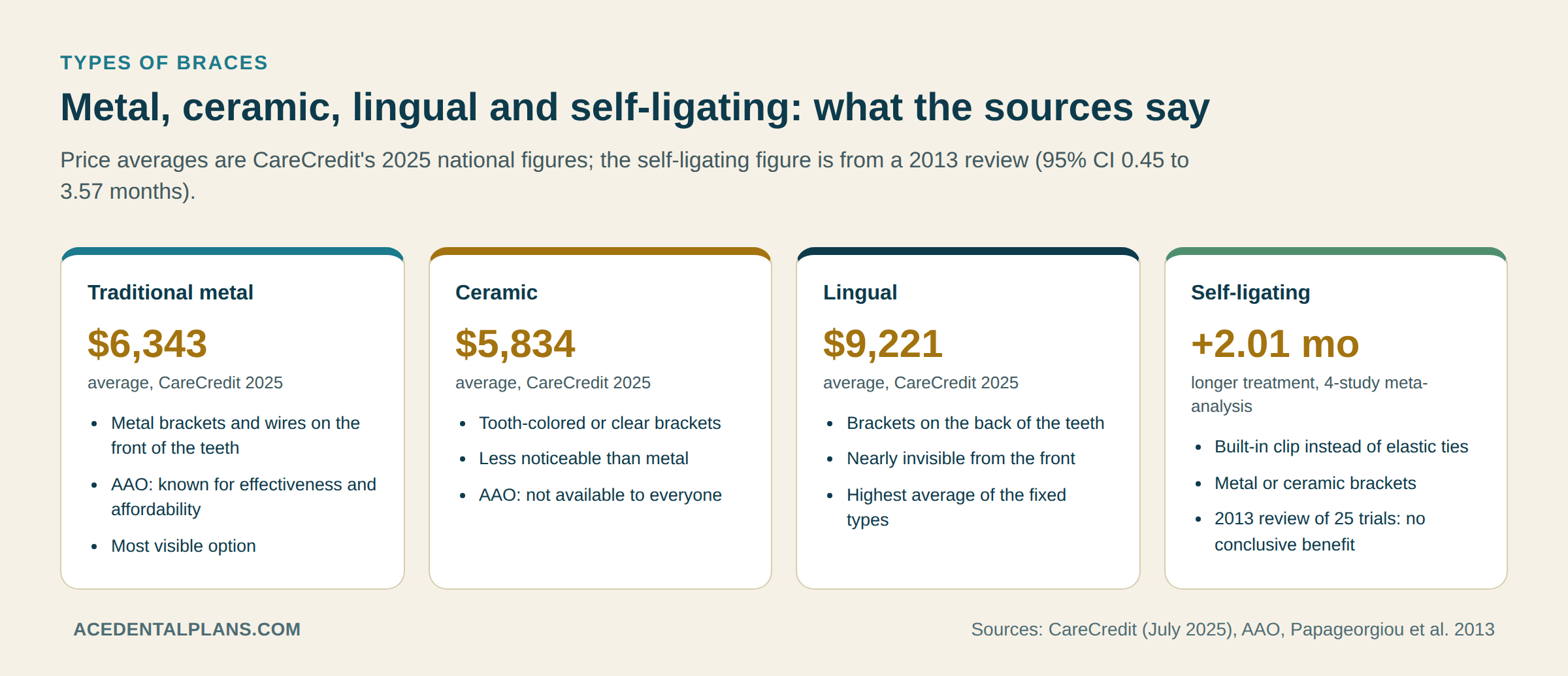
The AAO describes six families of braces. Four matter for most households, and Table 2 sets them next to each other. Appearance is the obvious difference, but the more useful column is the last one, which records what the sources actually say instead of what marketing implies.
| Type | Where it sits and what it is | How visible | What the sources say |
|---|---|---|---|
| Traditional metal | Metal brackets and wires on the front of the teeth, held by small elastic ties | Most visible | AAO: known for effectiveness and affordability. ADA: today’s braces are more comfortable than before and need fewer adjustments with newer materials |
| Ceramic | Tooth-colored or clear brackets on the front of the teeth | Less noticeable than metal | AAO: tends to move teeth faster than clear aligners; “not available to everyone.” No comparative comfort or speed data against metal was found on the pages reviewed |
| Lingual | Brackets mounted on the back (tongue side) of the teeth | Nearly invisible from the front | AAO and ADA both describe placement behind the teeth. The pages reviewed gave no comparison of comfort, speech effects or treatment time against front-mounted braces |
| Self-ligating | Brackets with a built-in clip or door instead of elastic ties; made in metal or ceramic | Same as the bracket material | AAO: reduces friction and generally allows longer gaps between appointments. A 2013 review of 25 trials found no conclusive benefit and 2.01 months longer treatment in a four-study meta-analysis |
| Designer and custom-fit | Colored or themed brackets (stars, hearts, sports designs); or brackets crafted to the individual’s anatomy | Varies | AAO: designer brackets are described as equally effective as conventional braces |
Metal braces: the baseline
Metal braces are the version most people picture, and the AAO describes them as effective and affordable. The ADA’s wording on comfort is worth repeating because it corrects an old assumption: newer materials “apply a constant, gentle force to move teeth and usually require fewer adjustments.”
Ceramic braces: less visible, with caveats
Ceramic brackets trade visibility for a different set of trade-offs, though the sources reviewed here do not itemize them. The AAO’s own caution is that ceramic braces are not available to everyone, which usually reflects the orthodontist’s judgment about the case. Ask directly whether your bite is a good fit for ceramic, and ask how the office handles a bracket that chips or breaks.
Lingual braces: hidden, and different to live with
Because lingual brackets sit behind the teeth, the AAO calls them nearly invisible. Nothing in the pages reviewed puts a number on how they feel, how they affect speech, or whether they take longer. Treat any confident claim you hear in either direction as the office’s experience rather than published evidence. The price difference, by contrast, is well documented. Lingual averaged $9,221 in CareCredit’s 2025 data, the highest of the fixed types.
Self-ligating braces: what 25 trials found
Self-ligating brackets are often presented as faster. Papageorgiou and colleagues pooled 25 randomized or quasi-randomized trials with 1,321 patients in a review published online in the European Journal of Orthodontics in 2013. A meta-analysis of four of those studies found treatment was 2.01 months longer with self-ligating brackets (95% confidence interval 0.45 to 3.57 months), and the authors concluded that no conclusive benefits could be proven. That is a single review from 2013, and your orthodontist may have clinical reasons for choosing them. Still, “will this shorten my treatment?” is a fair question to ask before paying for the upgrade.
Braces or Aligners: Where Clear Aligners Fit
The AAO describes the trade-off in one breath. Braces stay on throughout treatment, handle a wide range of problems including severe bite issues, and usually work faster, but they are more visible. Clear aligners are hard to see and removable, but they work more slowly, can be lost, and generally treat only light to moderate alignment issues. The ADA notes that aligners are an option under the direct supervision of a dentist or orthodontist.
That is as far as this guide goes. A full head-to-head on cost, speed, comfort and results is in braces vs Invisalign, the procedure itself is covered in the Invisalign treatment guide, and aligner packages, insurance limits and monthly payments sit in Invisalign cost. If you like comparing options this way, the compare hub collects the other side-by-side guides.
One caution belongs here, because it concerns braces specifically. The AAO warns against “fashion braces,” fake appliances sold online or placed by unlicensed individuals. It says they serve no real purpose and can push teeth out of position, shed loose parts, cause infection, and contain materials that cannot be verified. The AAO cites Thailand’s 2018 ban after infections linked to heavy metals led to the deaths of two adolescents. Real braces come from a licensed dentist or orthodontist after an exam.
Who Needs Braces: Children, Teens and Adults
Age shapes the timing and the conversation, though not the basic fact that teeth can move at any age. The ADA says abnormal bites usually become noticeable between ages 6 and 12, and that treatment often begins between ages 8 and 14. It also says “healthy teeth can be orthodontically treated at any age.” For children, the AAO recommends a first orthodontic evaluation around age 7.
The age-7 visit is a look, not a commitment
The AAO is explicit that an early evaluation “does not automatically mean treatment will begin.” Its reasoning is that some concerns are easier to identify before they are obvious at home. One possible outcome of that first visit is simply a plan to watch and re-check as permanent teeth arrive, which is a result in itself.
When treatment does start early, the AAO says interceptive measures such as palatal expanders or partial braces may reduce the time needed in full braces later. The AAO glossary defines this kind of care as treatment performed to intercept or correct a developing problem. Budget-wise, an early phase can mean two courses of care instead of one, so it is worth asking whether the fee for the second phase is credited.
What a Cochrane review found about starting early
The fairest test of “earlier is better” comes from controlled trials. A Cochrane review of orthodontic treatment for prominent upper front teeth (Class II malocclusion) compared two-phase treatment, with a first phase in childhood, against a single phase in adolescence. For the main bite measurement, pooled results from three trials (343 participants) showed no clear difference in final overjet: early treatment ended 0.21 mm larger, with a 95% confidence interval of -0.10 to 0.51 mm.
One result did favor starting early. New injuries to the upper front teeth were less common after early treatment, with an odds ratio of 0.56 (95% CI 0.33 to 0.95) in 332 participants. In plain numbers, the review estimated about 298 children per 1,000 had new front-tooth trauma without early treatment versus about 192 per 1,000 with it, and rated that evidence as moderate in certainty. The overjet finding was rated low certainty. The fair summary: early treatment did not produce a clearly better final bite, but it may protect protruding front teeth from injury in the meantime.
Questions parents can bring to the age-7 visit
Because the first evaluation is a look rather than a commitment, the most useful questions are about what the orthodontist sees and what happens next. These work for most families:
- Do you see anything now that could affect how the permanent teeth come in, or is this a watch-and-wait situation?
- If an early phase is advised, which appliance would you use (a palatal expander or partial braces, in the AAO’s examples), and what would it aim to change?
- Would a first phase be a separate fee from later full braces, and is any of it credited toward the second phase?
- How often would you want to see my child between now and treatment, and are those observation visits billed?
- Given the Cochrane finding about front-tooth injuries, does my child’s overjet make early treatment worth discussing for protection rather than only for the final result?
That last question is deliberately specific. The Cochrane evidence on early treatment applied to children with prominent upper front teeth, so it says little about crowding, crossbites or other patterns. Asking the orthodontist which category your child falls into keeps a general statistic from being applied to the wrong bite.
Adults are a large share of patients
The AAO reports that one in three orthodontic patients is over 18, in a September 2025 article that does not name a survey year. It says treatment works as well for adults as for children and that aesthetics remain the top reason adults seek braces, with more now citing oral health. It also lists real differences. Adult bone has stopped growing, so some skeletal problems may need surgery or restorative care, and adults often have restorations, missing teeth or gum concerns that must be stabilized first.
That last point is where a general checkup and a braces consult overlap. In the AAO’s wording, gum concerns must be stabilized first, and the guide to gum disease symptoms, stages and costs explains what that kind of problem involves. If you are pregnant or planning to be, the dental care during pregnancy guide covers general dental visits, and the timing of any elective orthodontic start is a question for your dentist and your obstetric provider together.
Do adults take longer?
Per the AAO, treatment can take slightly longer in adults, because adult bone turns over more slowly. The research is less settled. A 2020 systematic review in Progress in Orthodontics by Abbing and colleagues pooled 11 studies (2,969 adolescents and 1,380 adults). It found a mean difference of -0.8 months, meaning adults were on average slightly shorter, with a confidence interval of -4.2 to 2.6 months. The authors found no statistically or clinically significant difference, though the certainty was low to very low and none of the studies was randomized.
For planning, the sensible reading is that your own case matters more than your birthday. Ask the orthodontist for a length estimate based on your records, and for the reasons behind it.
Orthodontist or General Dentist: Who Does the Work
Both may treat braces cases. The ADA’s braces page says treatment may come from a dentist or an orthodontist, depending on the provider’s experience and the severity of the case. What differs is training. Dentists complete four years of dental school after college, the AAO says, and orthodontists “spend two to three more years in an accredited orthodontic residency program.” Only dentists who have completed such a program can call themselves orthodontists.
A second distinction is about roles, and the AAO draws it clearly. The dentist monitors the health of your teeth and gums; the orthodontist focuses on alignment, tooth movement and the bite. In its words, “Orthodontic visits do not replace regular dental exams and cleanings.” Keeping both relationships matters during braces, because plaque collects around brackets and a regular dentist is the one watching for cavities and gum changes. Cleanings during treatment are still billed as cleanings, and the dental cleaning cost guide breaks down what a routine visit includes.
Which kind of provider suits your case is a clinical judgment. For a mild alignment issue, a dentist with orthodontic experience may be a reasonable option; for jaw-related problems or a complicated plan, a specialist is the usual route. No source reviewed for this guide compares fees between the two provider types, so do not assume either is cheaper. Ask each office what experience it has with cases like yours, and ask for the fee in writing.
From Consultation to Retainer: The Visits in Order
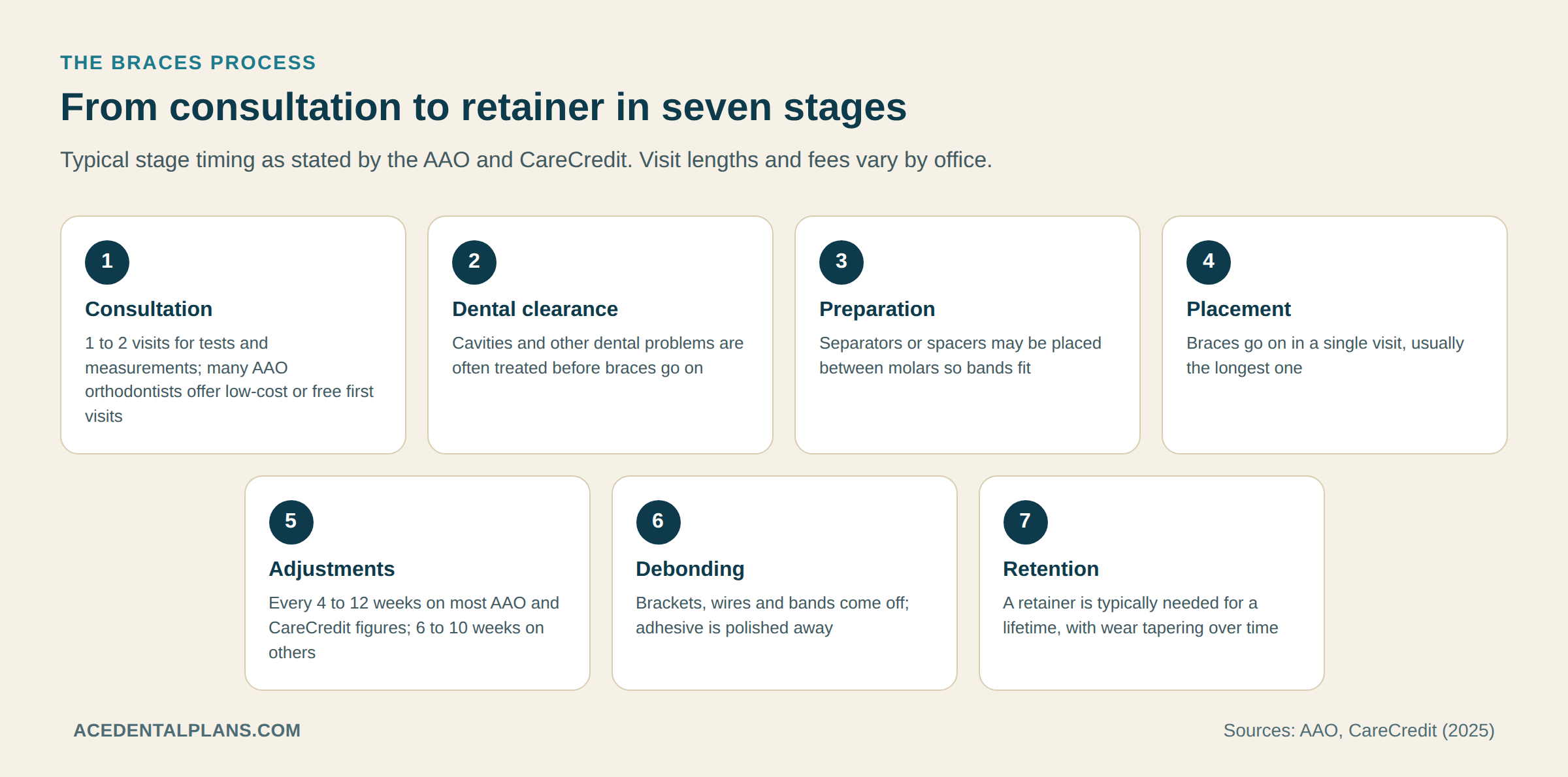
AAO and ADA pages describe the stages in pieces, and none lays out a full timetable, so Table 3 assembles what each source states and marks what it does not. Visit lengths and record fees are not given by these sources and vary by office.
| Stage | What happens | Timing the sources give | Worth asking |
|---|---|---|---|
| 1. Consultation | One or two initial visits for tests and measurements; the orthodontist estimates treatment length after the exam | AAO: 1 to 2 visits; most AAO orthodontists offer low-cost or free initial consultations | Is there a records fee if I do not start? |
| 2. Dental clearance | Cavities and other dental problems are often treated before braces go on | AAO: before starting; see a family dentist for a cleaning and checkup first | Does my general dentist need to send anything? |
| 3. Preparation | Separators or spacers may be placed between molars so bands can fit later | AAO glossary: no timing given | Will I need a separate visit for this? |
| 4. Placement | Brackets bonded, wires threaded, bands cemented; braces “go on in a single visit and start working right away” | AAO: usually the longest single visit | When is my first adjustment? |
| 5. Adjustments | Wires and elastics checked and changed to keep teeth moving correctly | 4 to 12 weeks (AAO braces page; CareCredit); 6 to 10 weeks (two other AAO pages); mean 17.81 visits in one 5-study analysis | What is the visit schedule, and what do missed visits cost? |
| 6. Debonding | Brackets, wires and bands removed; leftover adhesive polished away; photos, scans, impressions or X-rays may be taken | AAO: appointment length not stated | Do I leave with a retainer, or get it later? |
| 7. Retention and follow-up | Retainer fitted and wear schedule explained; several follow-up appointments are common | AAO: retainer typically needed for a lifetime, with wear tapering | What does a replacement retainer cost? |
The consultation, step by step
Plan on one or two visits for tests and measurements. The AAO says the orthodontist estimates your treatment length after the exam, which makes that visit the moment to ask what the estimate rests on. A mild crowding case and a case with a deep overbite and a narrow upper jaw can sit at very different points on the timeline.
Bring a list of questions, plus any dental records and X-rays your regular dentist has. Ask for the fee in writing before you leave, together with what it includes, and compare it against at least one other office’s written estimate. A consultation that ends with a verbal number and a nudge to sign today does not give you much to compare.
Before the first consultation: a short checklist
A consultation goes further when you arrive prepared. The AAO suggests seeing a family dentist for a cleaning and checkup before braces, and it says cavities and other dental problems often need treatment first, so that visit is worth booking early. Beyond that, a few small tasks save time:
- Ask your regular dentist to send recent X-rays and notes, so the orthodontic office does not repeat what already exists.
- Write down health conditions, medicines and allergies. A 2023 review lists allergic reactions among possible side effects and names uncontrolled diabetes and smoking as risk factors for gum problems around braces, so the orthodontist should hear about them up front.
- Check your benefits before you go, not after. Find out whether orthodontics is included, the waiting period, the age rule and the lifetime maximum, using the call script in the insurance section.
- Decide what you want to compare. If you plan to visit two or three offices, bring the same list of questions to each, so the answers line up on paper.
- Note any jaw clicking, mouth breathing or habits such as thumb sucking. MedlinePlus lists thumb sucking, tongue thrusting and prolonged bottle use as causes of malocclusion, and those details help the orthodontist understand how a bite developed.
None of this requires special knowledge. It simply turns the consultation into a two-way conversation, with the orthodontist’s findings on one side and your questions about time, money and risk on the other.
Placement day
Placement is usually the longest single visit, per the AAO, and braces start working right away. In the AAO glossary, brackets are bonded to each tooth with tooth-colored adhesive, and CareCredit’s description adds that wires are threaded through the brackets and secured with small bands. Elastics may be added for extra force. Soreness usually peaks over the next day or two, which the soreness section below covers.
Debonding day
Removal is less dramatic than many people expect. The AAO says the orthodontist gently removes the brackets, wires and bands with specialized instruments, then polishes away remaining bonding adhesive so tooth surfaces feel smooth. You may hear clicks or feel pressure as each bracket comes off, and teeth or gums can feel slightly sensitive afterward; the AAO says mild sensitivity usually improves on its own.
Before you leave, the orthodontist should discuss your retainer, including type and wear schedule. You may receive it the same day or shortly after, and many offices schedule a few follow-up visits. If a retainer feels snug because it was not worn as directed, the AAO advises contacting the orthodontist when it is painful or will not seat, rather than forcing it into place.
How Long Braces Stay On: Five Sources, Five Answers
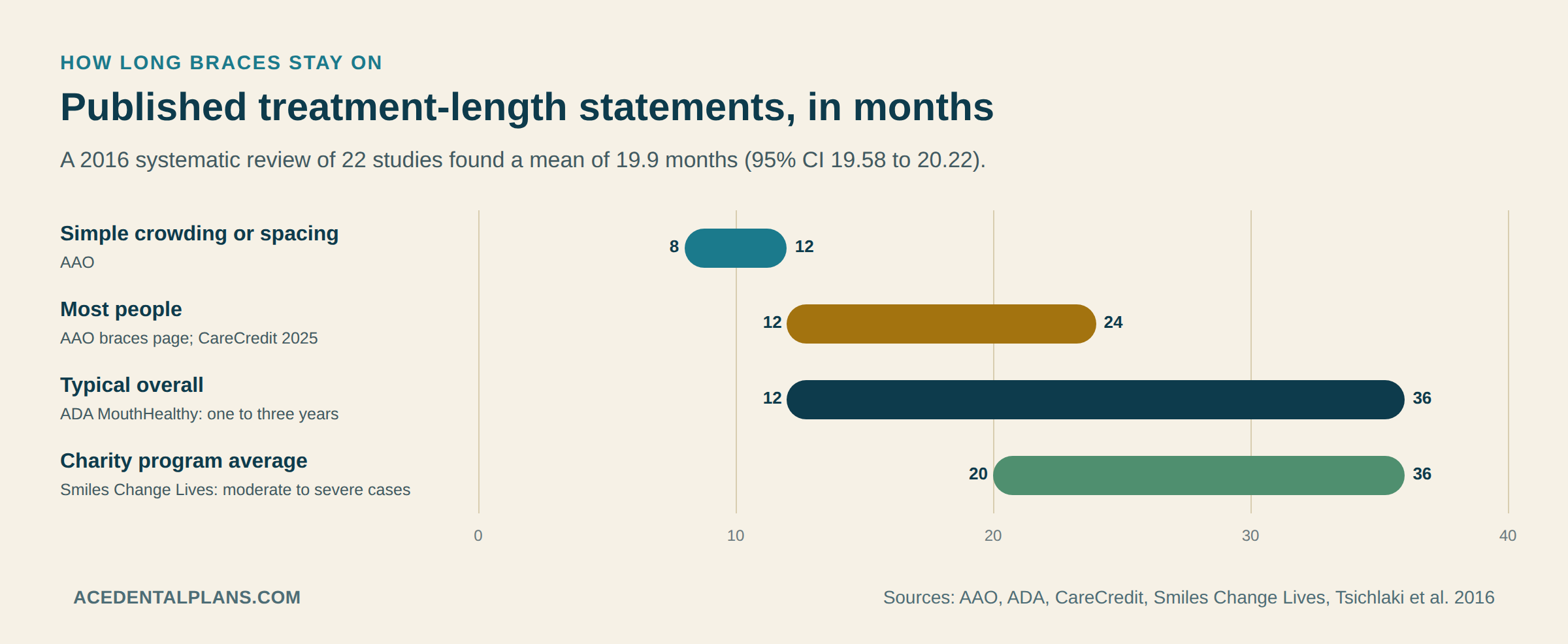
Ask five reputable sources and you get five slightly different answers, which is useful in itself. The AAO’s braces page says “it could take a few months if you only need slight corrections” and that most people wear braces for 12 to 24 months, with complex cases taking years. A separate AAO page puts simple crowding or spacing at about 8 to 12 months and says more complex bite issues may take a couple of years. The ADA says most people are in treatment for one to three years, followed by a retainer. CareCredit’s 2025 guide says one to two years.
Then there is the measured evidence. Tsichlaki and colleagues, in the American Journal of Orthodontics and Dentofacial Orthopedics in 2016, reviewed fixed-appliance treatment and found a mean of 19.9 months (95% CI 19.58 to 20.22) across 22 studies with 1,089 participants. Twenty-five studies were included overall, and the authors concluded the average duration of comprehensive treatment is less than two years. The same analysis found a mean of 17.81 visits in five studies. All of the included studies took place in hospital or university settings, which may overstate the figure slightly.
What stretches a timeline
The sources agree on a short list. Per the AAO, broken brackets and wires “alter your treatment and do not apply the pressure needed to shift your teeth,” and treatment may take longer as a result. It also names patient cooperation as one of three pillars of success, along with elastic wear and tooth cleanliness. From these statements it follows that missed appointments, repeated breakage and skipped elastics are the controllable causes of delay, while case complexity is the uncontrollable one.
Smiles Change Lives, a charitable program discussed below, reports that its treatment plans average between 20 and 36 months. That is a program for children with moderate to severe need, so it describes harder-than-average cases, not a typical private-practice patient.
Why the number matters for money
Time is not only a scheduling question. A fee that covers a fixed number of months may or may not cover additional ones, and an insurance benefit that pays monthly can run out before treatment does. Both topics come up in the cost and insurance sections. For now, the useful habit is to ask the orthodontist for an expected range in months and what happens to the fee if treatment runs past it.
Soreness: What to Expect and What Helps
Braces are uncomfortable more often than they are painful. In the first days, according to the AAO, teeth, gums, lips, cheeks and tongue may feel tender, and “most describe it as a dull ache rather than sharp pain.” The soreness is usually strongest in the first 24 to 48 hours and typically fades after a few days. After adjustments, which the AAO’s pain page places every four to six weeks, soreness is usually manageable and eases within a few days.
The AAO lists several home measures:
- Over-the-counter pain relievers such as ibuprofen or acetaminophen, taken before or after an adjustment. Follow the product label and ask a pharmacist or physician if you have a health condition or take other medicine.
- Oral anesthetic gels containing benzocaine, applied in a small amount to a sore spot with a clean finger or cotton swab.
- A cold compress on the outside of the cheek for 10 to 15 minutes.
- A warm salt-water rinse, one teaspoon of salt in a glass of warm water, swished for about 30 seconds.
- Orthodontic wax pressed over a bracket or wire that rubs the cheek or lips.
- Softer foods such as mashed potatoes, smoothies, yogurt, soups and scrambled eggs, while avoiding acidic items such as citrus and soda.
What the trials say about painkillers
A 2017 Cochrane review of painkillers for orthodontic pain pooled 32 randomized trials with 3,110 participants aged 9 to 34. Analgesics reduced pain more than placebo or no treatment at 2, 6 and 24 hours, with moderate certainty. The review found no clear difference between ibuprofen and paracetamol (acetaminophen), though that comparison was low certainty. Taking ibuprofen before treatment reduced pain at 2 hours but not at 6 or 24 hours, and that evidence was very low certainty. Only one included study was judged at low risk of bias, so the authors call for better research.
When soreness is not just braces
Call the orthodontist when pain is severe or lasts a long time, or when a broken bracket or wire is irritating the mouth. MedlinePlus adds a general rule: contact your dentist if toothache, mouth pain or other new symptoms develop during orthodontic treatment. A sharp, localized ache in one tooth is a different problem from the broad tenderness after an adjustment, and the guide to toothache relief explains safe short-term steps until a dentist can look.
Eating and Cleaning With Braces
The food rules are short, and the logic behind them is mechanical. Anything hard can snap a bracket or bend a wire, anything sticky can pull one off, and anything sugary feeds the plaque that collects around the hardware. The ADA lists popcorn, corn on the cob, chewing gum, whole apples and other sticky foods as the ones to avoid, and says to limit sugary foods. The AAO’s wording is “avoid hard, sticky foods that could potentially break brackets,” and it adds that fruits and vegetables can be cut into smaller pieces.
A practical sorting of the plate
- Leave alone for now: popcorn, corn on the cob, chewing gum, and anything sticky or hard enough to feel risky against a bracket. The ADA recommends asking your dentist or orthodontist for the specific list that fits your appliance.
- Cut up first: whole apples, raw carrots and similar crisp produce. The AAO suggests smaller pieces; the ADA singles out whole apples as a food to avoid.
- Soft options for the sore days: mashed potatoes, smoothies, yogurt, soups and scrambled eggs, the AAO’s own examples. It also suggests avoiding acidic items such as citrus, soda and vinegar-based dressings while the mouth is tender.
- Drinks: the AAO says to limit sugary drinks such as sports drinks and soda, and to rinse with water after every sugary snack or drink.
Planning ahead helps on school days and trips. A travel kit helps: toothbrush, interproximal brush, floss, toothpaste and extra elastics, as the AAO suggests. It sounds fussy until the first lunch away from home.
Cleaning around brackets
Plaque is the real enemy here. The ADA warns that plaque build-up around brackets could permanently stain or damage teeth, and the AAO’s routine is straightforward:
- Brush multiple times a day with toothpaste, ideally after every meal. The AAO’s braces page recommends a soft-bristled brush and fluoride toothpaste.
- Use the small interproximal brush from your orthodontist to clean hard-to-reach spaces.
- Floss at least once a day. Flossing is just as important as brushing, in the AAO’s words.
- Consider tools that reach further: the AAO’s braces page says water flossers and proxy brushes help with hard-to-reach areas.
- Keep every scheduled adjustment and cleaning appointment.
Fluoride deserves a question to your own orthodontist. A 2015 meta-analysis of fluoride in orthodontic patients, discussed in the risks section, found regular fluoride rinse reduced white spot risk in several studies, but it also noted that the benefit depends heavily on patient compliance. One narrative review recommends a daily fluoride mouthwash. Whether you need a prescription-strength product or an over-the-counter rinse is for your orthodontist or dentist to say.
Broken Wires, Loose Brackets and When to Call
Most braces problems are annoying rather than urgent. The AAO defines an orthodontic emergency as “an acute problem related to your braces, aligners, or orthodontic appliances.” Loose or broken brackets, poking or loose wires, loose bands, lost or cracked aligners and mouth sores are on its list of things to report. Report does not mean panic. It means call during office hours and ask what the practice wants you to do.
The AAO’s home steps are modest:
- Broken or loose bracket still attached to the wire: slide it toward the center of the tooth, then use a small piece of orthodontic wax to hold it in a more comfortable position. Avoid hard, chewy or sticky foods and contact the orthodontist.
- Poking wire: gently push it flat with a clean pencil eraser or cotton swab. If it will not sit comfortably, cover the end with wax.
- Wire piece that breaks off: if you can safely remove it with clean tweezers, you may do so.
- Loose band: do not wiggle or pull on it. If it comes off, keep it in a small container and bring it to your appointment.
The AAO makes a second point that matters for time and money. Broken brackets and wires do not apply the pressure that moves teeth, so ignoring a break can lengthen treatment. Whether an office charges for repairs or emergency visits is a policy question that none of the national sources answers, which is why it appears on the contract checklist later in this guide.
Go to urgent or emergency care for these
- Heavy or continuous bleeding from the mouth or face.
- Difficulty breathing or swallowing.
- A suspected broken or dislocated jaw.
- A permanent tooth knocked out, pushed deep into the gums, or moved far out of position.
- Sudden, severe pain with facial swelling, fever or signs of infection.
The list above follows the AAO’s guidance on when to call 911 or go to an emergency room or urgent dental clinic; contact the orthodontist about any damaged appliance once you are safe. For swelling, fever and pain that could signal infection, the tooth infection symptoms guide explains the warning signs in more detail. A blow to the face during sports is a separate risk. The ADA says a blow to the face could damage brackets or other fixed appliances. A properly fitted mouthguard may be especially important for people who wear braces, and your dentist or orthodontist may suggest one on the lower teeth if braces are there. The ADA also says not to wear a retainer or other removable appliance during contact sports.
Risks and Side Effects: What Is Common, What Is Rare
Braces have a good track record, and they also have side effects that deserve plain numbers. Table 4 summarizes what the sources reviewed here say about the main ones. Two caveats apply. Some of the sources are narrative reviews, which give few precise figures, and several findings come from studies with a high risk of bias, so treat the numbers as indications rather than predictions for one patient.
| Issue | What the sources report | What lowers the risk | When to call |
|---|---|---|---|
| Soreness | Dull ache, strongest in the first 24 to 48 hours, fading after a few days (AAO) | Soft foods, wax, over-the-counter relief per the label | Pain that is severe or long-lasting |
| White spot lesions | 45.8% of patients developed new lesions (935 of 2,041) and 68.4% had them (850 of 1,242) in a 2015 meta-analysis of 14 studies; can appear within about a month | Thorough daily cleaning; fluoride (27% incidence with fluoride gel vs 59% without in one study) | New chalky patches around brackets, or after removal |
| Gum inflammation | Plaque around appliances often causes gum inflammation, usually temporary without attachment loss (2023 narrative review) | Brushing, flossing, regular cleanings; control of diabetes and smoking, which are listed risk factors | Bleeding or swollen gums that persist |
| Root shortening | About 1 mm of root length typically, rarely threatening a tooth’s outlook; a 2022 systematic-review abstract of 118 articles called it a seemingly inevitable result of orthodontic force, with severity varying | Risk factors include prior trauma and root shape; ask how progress is monitored | Loose teeth or new pain in a tooth |
| Broken brackets or wires | Broken parts stop applying force and can lengthen treatment (AAO) | Avoid hard and sticky foods; use a mouthguard in sports (ADA) | Right away for sharp or poking pieces |
| Mouth sores | Traumatic ulcers are among the main adverse effects listed in a 2023 review | Orthodontic wax over rubbing parts (AAO) | Sores that do not heal |
| Jaw joint symptoms | The same review states no increase in TMJ disease prevalence with comprehensive treatment, citing a 2010 systematic review | Tell the orthodontist about existing jaw clicking or pain before starting | New or worsening jaw pain |
| Teeth shifting afterward | Teeth tend to revert toward earlier positions over time (AAO) | Wear the retainer as directed | A retainer that no longer fits |
White spot lesions: the most common problem with the clearest numbers
White spots are early decalcified patches of enamel that show up as chalky marks around where brackets sat. Sundararaj and colleagues pooled 14 studies in the Journal of International Society of Preventive and Community Dentistry in 2015. They found new lesions in 935 of 2,041 patients during treatment (45.8% incidence) and lesions present in 850 of 1,242 (68.4% prevalence). Lesions can be visible within about one month of bracket placement, whereas ordinary cavities usually take at least six months to form. The review also noted that some lesions faded during the first year after debonding, though the cause was unclear.
On prevention, the review reported that regular fluoride mouth rinse reduced risk in several studies, with one study showing 27% incidence with fluoride gel versus 59% without. It also stressed that benefit depends on compliance, which it described as often low. The AAO notes that you may see white spots or discolored areas after removal that were less noticeable while the braces were on, and says your orthodontist or dentist can determine the cause.
Gums, roots and everything else
A 2023 narrative review by Alotaibi in The Open Dentistry Journal lists root resorption, loss of periodontal support, decalcification, temporomandibular disorders, traumatic ulceration and pulpal death among the main adverse effects of fixed treatment. It estimates about 1 mm of root length is usually resorbed, concentrated in the upper front teeth, and that this rarely jeopardizes a tooth’s prognosis. Its stated risk factors include root shape, previous trauma, treatment duration and heavy force. It also mentions allergic reactions and stresses informed consent, especially for patients with a history of trauma or allergic reactions.
If you already have jaw clicking, pain on chewing or morning jaw tightness, mention it at the consultation; the guide to TMJ disorder symptoms and treatment describes what those signs may mean. The AAO’s own list of reasons to be evaluated includes jaw discomfort or clicking, so you would not be raising something unusual.
None of these risks is a reason to avoid treatment that a dentist or orthodontist recommends. They are the reason to treat the cleaning routine as part of the treatment. They are also a reason to ask how your own case will be monitored, for example how often X-rays are taken and what would prompt a change of plan.
Retainers: The Part That Lasts Longer Than the Braces
Retainers are the least glamorous part of orthodontics and the part that protects the investment. The ADA says retainers “preserve and stabilize the results of your orthodontic treatment.” Retainers counter the natural tendency of teeth to revert to their original positions over time, the AAO explains. The bone around the teeth adapts to new positions, and bodies and teeth keep changing with age.
Three kinds
- Hawley retainers combine acrylic or hard plastic with a metal wire that supports the teeth, and sit on the roof of the mouth or under the tongue.
- Clear retainers are removable plastic trays that fit over the teeth.
- Fixed retainers are custom-fitted slender wires cemented or bonded to the inner side of the upper or lower teeth.
How long, in the AAO’s words
“Typically, a retainer is necessary for a lifetime, though the frequency of wear may decrease over time.” That sentence reframes retainers from a phase into a habit, and your orthodontist will give the specific schedule. The AAO adds that the first set is often included in the treatment fee, that replacements may be billed separately, and that insurance coverage varies. Some orthodontists offer all-inclusive pricing that bundles braces, appointments and post-treatment retainers, so the question to ask is what your estimate covers.
Fixed or removable: what the evidence can and cannot say
A 2023 Cochrane review of retention after braces included 47 studies with 4,377 participants and searched through April 2022. Among eight studies comparing fixed and removable retainers, part-time clear plastic retainers had a mean difference of 0.92 mm on the Little’s Irregularity Index compared with multistrand fixed retainers, and full-time wear showed 0.60 mm. The authors judged both differences not clinically significant. Clear removable retainers were associated with better gum health than fixed ones, with no difference in decay for full-time wear.
The evidence was low to very low certainty, and the authors said they “cannot draw firm conclusions about any one approach to retention over another.” For a patient, the choice between fixed and removable rests on your orthodontist’s judgment, your habits and your willingness to wear a removable one. Care is simple but non-negotiable. The AAO advises brushing removable retainers daily with a soft brush and water and soaking them weekly in a retainer-cleaning solution. Avoid hot water, alcohol and bleach, and keep the retainer in its case when not in use. For fixed retainers, brush around the wire and use floss or an interdental tool.
What Braces Cost: The Short Version and What to Compare
The national averages come first, because everyone asks. CareCredit’s July 2025 guide lists average metal braces at $6,343, ceramic at $5,834 and lingual at $9,221, and puts its overall national average range at $5,108 to $9,221 when clear aligners are included. Those are CareCredit’s own data, they describe the U.S. as a whole, and the guide notes that its state-by-state metal averages do not include accessory gear or potential insurance coverage. The AAO gives no dollar figures; it says cost depends on type, complexity and duration of treatment.
Each type spans thousands of dollars from low to high, and the ranges overlap, so a ceramic case in one office can cost less than a metal case in another. The full breakdown, with low and high ends for each type, is in the braces cost by type guide. For a sense of how braces sit among other procedures, the dental price guide lists typical prices for the work people ask about most, and the dental costs hub gathers every price guide in one place.
The pieces of a braces bill
A braces fee is a package, and the edges of the package are where surprises live. The sources reviewed point to these lines:
- Consultation: most AAO orthodontists offer low-cost or free initial consultations.
- Records and diagnostics: CareCredit’s process description starts with an initial appointment for dental records and diagnostics. No source here gives a national price for records, so ask whether they are included.
- Dental work first: the AAO says cavities and other dental issues often need treatment before braces. That is a general dentist’s bill, not the orthodontist’s.
- The appliance and adjustment visits: the core of the fee, usually covering a stated number of months.
- Add-ons: expanders, anchorage screws, headgear and elastics are tools the AAO says may be incorporated, and each may or may not sit inside the base fee.
- Retainers: the AAO says the first set is often included, replacements may be billed separately, and some orthodontists price all-inclusively.
- Repairs and missed visits: office policy; none of the national sources puts a number on them.
Costs that sit outside the orthodontic bill
Several expenses land with other providers or at the drugstore, and they rarely appear on an orthodontic estimate. The sources reviewed point to a handful:
- General dentist visits. Cleanings and exams continue during treatment, and cavities found before braces go on are treated first, according to the AAO. The cleaning cost guide linked earlier explains what a routine visit includes.
- Cleaning tools. The AAO mentions interproximal brushes, water flossers and proxy brushes, and fluoride toothpaste. Orthodontic wax is the stopgap for rubbing wires. These are small purchases, though they add up over a year or two.
- A mouthguard. The ADA says custom-made guards are made by your dentist for you personally, boil-and-bite guards adapt to the shape of your mouth, and stock guards often do not fit very well. Sports families may want to ask which type the orthodontist suggests for the brackets, and what it costs.
- Replacement parts. A lost retainer, a replacement elastic supply or a repair visit may be a charge or may be free, depending on the office.
- Time. Adjustment visits every several weeks mean time away from school or work, and the AAO says treatment can run longer when appliances break.
Adding these to the headline fee gives a more honest picture of the total. A family that expects only the orthodontic bill can be surprised by the rest, while a family that has listed them can decide which ones matter.
How Orthodontic Insurance Works, From Plan Type to Payment Schedule
Orthodontic coverage follows the same order of questions as other dental benefits, with extra turns at the end. The general mechanics of premiums, deductibles and claims are in how dental insurance works, and the tiers plans use for exams, fillings and crowns are explained in what dental insurance covers. What follows is the braces-specific version.
1. Does the plan include orthodontics at all?
Cigna says “not all types of dental insurance include coverage for orthodontic services,” and that full-coverage plans “often include” it. HealthCare.gov adds a wrinkle for Marketplace shoppers. Dental coverage is an essential health benefit for children and must be available for a child 18 or younger, in a health plan or a separate dental plan. Families are not required to buy it. It also says adult dental coverage is not an essential health benefit. The HealthCare.gov page does not mention braces, so a children’s dental plan’s orthodontic terms still have to come from the plan documents. The dental insurance explained guide covers plan types in more depth, and the dental insurance hub lists the rest of the coverage articles.
2. Who is eligible, by age and by medical need?
CareCredit says children under 18 are more likely than adults to have braces covered, and that for adults the dentist will likely need to show braces are medically necessary rather than purely cosmetic. The AAO makes the same point: insurance often covers orthodontics for children under 18 but less commonly for adults. Some plans differ. One Delta Dental of Washington plan covers dependent children through age 25 and says it covers orthodontic care for adults, including braces and aligners. Eligibility is a plan feature, not a law of nature.
3. Network and cost sharing
Cigna advises checking that your preferred orthodontist participates in the plan’s network. The Washington plan describes its 50% as a percentage of the allowed amount, not of whatever the office bills, and a Delta Dental of Iowa sample sheet says you may be subject to a deductible. In general, an in-network office has agreed to an allowed amount, and a percentage of that figure is what the plan works from.
4. The lifetime maximum
Cigna says orthodontic treatment commonly carries a lifetime maximum when orthodontic coverage is part of the plan. The samples reviewed use modest numbers. The Washington plan lists a $1,500 lifetime maximum with a 12-month waiting period, and the Iowa sample uses $1,000. Those are one insurer’s published examples, not market averages. A lifetime figure does not reset each year, so a second course of braces later in life draws on what is left.
5. Waiting periods, and how they can be waived
Cigna notes some plans have waiting periods before they pay for treatment such as braces. In the Washington plan, the insurer says it will not pay toward orthodontics until the member has been enrolled for 12 continuous months. The waiting period can be waived if the family had another plan with orthodontic coverage for at least 12 months, with documentation and a gap of no more than 63 days. Switching plans can therefore restart a clock or not, depending on the new plan’s rules.
6. How the money actually arrives
Orthodontic benefits are often paid in installments over treatment instead of in one lump sum. Two published examples show the shape. In the Delta Dental of Iowa sample, the plan pays an initial amount when braces go on (in the example, $750, half of a $1,500 down payment). It then pays quarterly until treatment is completed or the lifetime maximum is reached, provided the child has continuous coverage. Beam Benefits’ help center describes a different pattern. The plan pays 25% of the overall maximum when appliances are inserted, then the remaining 75% monthly as claims are submitted. Each payment depends on the dependent remaining insured and on proof that treatment continues. Beam also says the lifetime maximum is inclusive of any prior carrier’s payments.
Because schedules differ, two plans with the same cap can pay on different timelines and respond differently if you change jobs midway. That is the reason the table below includes a row for coverage ending partway through.
7. A call script for the insurer
Plan documents bury orthodontic terms in a rider or a separate page, so a phone call or written message to the insurer often gets the clearest answer. Before you call, have the member ID and the proposed start date ready. Then work down this list, and write down the date, the representative’s name and any reference number:
- Does my plan include orthodontic benefits for this patient, given the patient’s age?
- What percentage does the plan pay, and is that percentage applied to the allowed amount for an in-network orthodontist?
- Does a deductible apply to orthodontics?
- What is the lifetime maximum, and how much of it has already been used, including payments by a previous carrier?
- Is there a waiting period, and what is the first date on which treatment would be eligible? Can a prior plan’s orthodontic coverage waive it?
- At what age does coverage end, and does payment continue if the patient passes that age during treatment?
- How are benefits paid: an initial amount at placement, then monthly or quarterly installments? What stops the payments?
- Do orthodontic payments count against the annual maximum that applies to other dental work?
- Are records, retainers and repairs covered?
- Can the orthodontic office submit a pre-treatment estimate, and how long does the insurer take to answer it?
Remember that a benefits quote over the phone is not a promise of payment, a point every insurer’s own paperwork makes in some form. Ask for the answers in writing or for the page number in the benefits document, and keep both with your treatment contract.
One $6,000 Case Under Six Plan Situations
Table 5 uses a single hypothetical fee to show how plan terms, not the coinsurance percentage alone, drive what a family pays. Every number is invented for illustration, modeled on the published patterns described above. For simplicity it treats the $6,000 as the allowed amount and ignores deductibles.
| Situation | How the plan works (hypothetical) | Plan pays | You pay |
|---|---|---|---|
| A. Cap binds | 50% coinsurance, $1,500 lifetime maximum, waiting period met | $1,500 (50% would be $3,000) | $4,500 |
| B. Higher cap | 50% coinsurance, $2,500 lifetime maximum | $2,500 | $3,500 |
| C. Percentage binds | 50% coinsurance, $4,000 lifetime maximum | $3,000 | $3,000 |
| D. Waiting period not met | Plan A, but braces go on in month 8 of a 12-month waiting period | $0 | $6,000 |
| E. Coverage ends partway | Plan A pays 25% ($375) at placement, then $1,125 spread evenly over 24 months; coverage ends after month 6 | $656 ($375 + 6 x $46.88) | $5,344 |
| F. Adult excluded | Plan covers orthodontics for dependents under 19 only; patient is 24 | $0 | $6,000 |
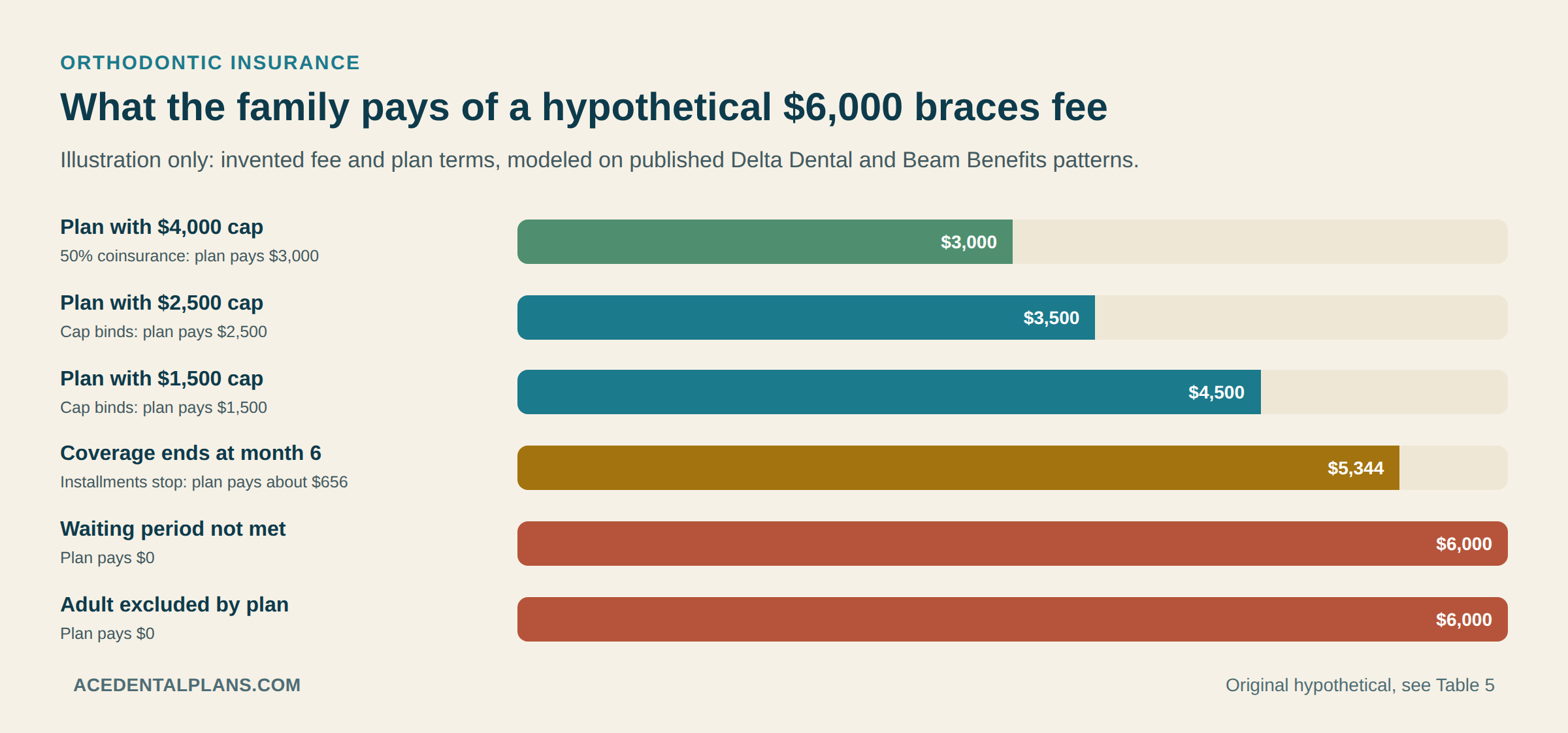
Read the rows from the top and a pattern appears. Rows A, B and C show the lifetime maximum and coinsurance taking turns as the limit: only in row C does the 50% rule actually decide the payment. Rows D and F show that eligibility can wipe out a benefit entirely, which is why the questions about waiting periods and age limits belong before the contract, not after. Row E is the quiet one. An installment benefit that stops when coverage stops pays less than the cap suggests, and a new plan may count prior payments against its own maximum, as Beam’s help center describes.
One hypothetical family across three calendar years
Table 5 shows totals. A ledger shows when the money leaves the account, which matters for FSA elections and household budgets. Suppose a teenager starts treatment on October 20, 2026, with a $5,800 fee for 24 months. The family’s plan resembles row A, so the insurer’s lifetime maximum of $1,500 is paid to the office as an initial 25% at placement and installments afterward, leaving the family a share of $4,300.
Assume the office asks for $600 down at placement and then divides the remaining $3,700 into 24 equal monthly payments of about $154.17, starting in November 2026. The family’s payments by calendar year then look like this:
- 2026: $600 down plus two monthly payments (November and December), about $908.
- 2027: twelve monthly payments, $1,850.
- 2028: ten monthly payments through October, about $1,542.
The three years add up to the family’s $4,300 share. A replacement retainer, if one is needed after 2028, would be additional. The point of the exercise is the spread. If the family uses a health FSA, the amount to elect for each plan year is roughly what falls due in that year, so $1,850 for 2027 rather than the whole fee. The IRS limit for 2026 is $3,400, and the limit for later years is set each year, so confirm it when you enroll.
If the family prepaid the whole fee in 2026 to capture a discount, the picture would change. The prepayment might earn a pay-in-full discount, which the AAO says some offices offer, but IRS Publication 502 says payments for care substantially beyond the end of the year generally cannot be included as medical expenses. A prepayment decision deserves a look by the orthodontic office and a tax professional at the same numbers.
Timing a Start Around Open Enrollment, Plan Years and Age Limits
October is when many workers choose benefits for the coming year, and braces are one of the few dental treatments where the calendar can change what you pay by thousands. The facts in this section come from the plan samples above and from IRS limits for 2026; the enrollment windows themselves vary by employer, so confirm dates with your benefits office.
If your child is close to an age limit
Plans that restrict orthodontics to dependents under a set age can end the benefit on a birthday, sometimes before the course is over. The Delta Dental of Washington plan covers dependents through 25, and CareCredit says children under 18 are more likely to have braces covered, so no single age applies. The Iowa sample sheet refers to “a specified age” without naming one. Ask the insurer for the age rule in writing and whether payments already started continue after the birthday.
If you are choosing between plans
Three questions help in an enrollment window. Does the plan include orthodontics, and for adults or only children? Is there a waiting period, and does a prior plan with orthodontic coverage waive it? The Washington plan does, when documented prior coverage lasted at least 12 months with a gap of no more than 63 days. And does the lifetime maximum carry over from your old plan, as Beam’s help center says its maximum is inclusive of prior carriers? Most of this is invisible in a plan’s summary page, so request the orthodontic section of the benefits document.
If you have an annual maximum that other dental work also uses, the guide to using dental benefits before year-end walks through that clock. Whether orthodontic payments count against the annual maximum depends on the plan, and none of the sources reviewed settles it, so ask.
If you are planning FSA contributions
An FSA election is typically made at enrollment, which is why braces and open enrollment collide. The IRS limit for a health FSA in 2026 is $3,400 under Rev. Proc. 2025-32, and if a plan permits carryover, the maximum is $680. FSA money follows a use-it-or-lose-it rule at the end of the plan year or grace period, the AAO notes. A braces payment schedule that stretches across two plan years should therefore be mapped to elections in each.
Working backward from a start date
Because several clocks run at once, it helps to plan backward. This is a general sequence, not a schedule any source prescribes, and your plan may differ:
- Six to twelve months ahead: if you are switching plans, ask the new plan about its orthodontic benefit, waiting period and any waiver for prior coverage. If a waiting period applies, count forward from the coverage date to the earliest date benefits begin.
- Three to four months ahead: book consultations with two or three offices and collect written estimates. Send the winning estimate to the insurer as a pre-treatment request, and keep the response with the contract.
- One to two months ahead: complete any dental work that has to come first, and confirm FSA or HSA contributions against the payments you expect in each calendar year.
- Start date: check that the plan is active, the age rule is satisfied and the down payment matches what the insurer’s first payment and your own accounts can cover.
- Each plan year during treatment: reconfirm coverage, because a change of employer or plan midway can interrupt installment payments.
The sequence may feel heavy for something as ordinary as straightening teeth, but the amounts involved are large enough to justify a few phone calls. Checking early leaves more options if a problem turns up.
Medicaid and Medical Necessity for Children
Public coverage reaches braces through a narrow door. Medicaid.gov says EPSDT (Early and Periodic Screening, Diagnostic, and Treatment) provides comprehensive and preventive health care services for children under 21 enrolled in Medicaid, and that states must furnish all coverable, appropriate and medically necessary services. According to its summary, covered dental care includes relief of pain and infection, restoration of teeth, preventive care and medically necessary orthodontics. The page also says states determine medical necessity case by case. The AAO makes the same practical point: Medicaid may cover braces if they are medically necessary, and that varies by state.
What a medical-necessity test looks like
California’s Medi-Cal program offers a public example of how a state makes the call. Its dental form DC016 uses the Handicapping Labio-Lingual Deviation (HLD) index to decide whether orthodontic services are medically necessary. Some conditions qualify automatically, among them cleft palate, craniofacial anomaly, a deep impinging overbite that damages the palate’s soft tissue, and certain crossbites with attachment loss. Otherwise, scored conditions must total 26 or more points to qualify. Each condition has a multiplier; for instance, open bite is multiplied by 4, anterior crowding by 5 per arch, and each ectopic eruption by 3.
The form adds that patients who do not meet the score “may still be eligible” under EPSDT criteria. Other states use other tools, and thresholds differ, so a California score is not a prediction for Texas or Ohio. The practical sequence is to ask whether the orthodontic office accepts your child’s Medicaid plan, what the prior-authorization process involves, and whether a denial can be appealed.
Paying for Braces: Payment Plans, Charities, Savings and Pre-Tax Accounts
A braces fee is large but predictable, which makes it easier to plan around than most dental bills. Many practices offer in-house plans that spread cost “over several months or years,” according to the AAO, and these “often come with low or no interest.” Discounts for paying in full or for treating multiple family members also exist, so it is reasonable to ask. How those offers compare with outside financing is covered in dental financing vs payment plans, and the wider menu of ways to fund a big bill appears in how to pay for expensive dental work.
Lower-cost options when there is no benefit
If there is no orthodontic coverage at all, a broader playbook applies. The guide to dental care without insurance lays out clinics, sliding fees and sequencing, and dental costs without insurance covers cash-pay price differences. For braces specifically, dental savings plans are worth reading about, but check whether a plan lists orthodontics and what discount it applies, since some discount programs for plans without orthodontic coverage may also require a network orthodontist, as Cigna notes.
Charity programs exist for children. Gifted Smiles, Smiles Change Lives and Smile for a Lifetime are listed by the AAO as organizations that provide orthodontic treatment to children under 18 at low or no cost. Smiles Change Lives publishes its own terms. Applicants must be 7 to 18 (the application has to arrive before the 19th birthday) and have good oral hygiene with no unfilled cavities. They must show a moderate to severe need for braces and meet financial guidelines that vary by location. There is a $30 non-refundable application fee and a $650 non-refundable family investment per child, subject to the current fee structure, and the program says treatment averages between 20 and 36 months. Eligibility is narrow by design, so read the criteria before counting on it.
Pre-tax money: FSA, HSA and the medical expense deduction
The AAO says you can use HSA or FSA funds for most orthodontic treatments, including consultations, diagnostic tests, braces, aligners, retainers and follow-up care. One limit matters: only the portion of your orthodontic payments not paid by dental insurance qualifies. An HSA requires enrollment in a high-deductible health plan and rolls over from year to year. An FSA does not require one but follows a use-it-or-lose-it rule at the end of the plan year or grace period.
The 2026 numbers come from IRS Revenue Procedures 2025-32 and 2025-19. A health FSA has a salary reduction limit of $3,400, with a maximum carryover of $680 if the plan allows it. HSA contribution limits are $4,400 for self-only coverage and $8,750 for family coverage. For how the two accounts compare in practice, see HSA vs FSA for dental expenses.
The medical expense deduction is a different tool. IRS Publication 502 lists braces among dental treatments that count as medical expenses. The deduction applies only to the amount of medical and dental expenses above 7.5% of adjusted gross income, so many households will not clear the threshold. The same publication says you can include only expenses paid this year, and it treats credit card charges as paid in the year of the charge. Payments for care substantially beyond the end of the year generally cannot be included. That last rule can matter if a family prepays a multi-year braces fee, so a tax professional should confirm how it applies. The deduction excludes cosmetic surgery, with exceptions for deformity from a congenital abnormality, injury or disfiguring disease. Whether orthodontia counts as cosmetic or corrective in a specific case is a question for a tax adviser and the dentist’s records.
Choosing an Orthodontist and Reading the Contract
You are committing to a provider for a year or two of regular visits, sometimes three. Start with credentials, using the AAO’s rule that only dentists who completed an accredited orthodontic residency can call themselves orthodontists, then compare two or three written estimates. Because most AAO orthodontists offer low-cost or free initial consultations, comparing is cheaper than it sounds.
Questions that tell you something
- How many cases like mine does this office treat, and what is the expected length in months?
- What type of braces do you recommend for my bite, and what would the alternatives cost?
- What happens to the fee if treatment runs longer than the estimate?
- Are records, the first retainers, repairs and emergency visits included, and what does a replacement retainer cost?
- Is there a fee for missed or rescheduled visits?
- Do you work with my insurer, and will you request a pre-treatment estimate so the lifetime maximum, waiting period and age rule are checked before I sign?
- What is the payment schedule, with down payment, monthly amount, interest and early-payoff terms?
- If I move or change offices, what happens to the balance and to any insurance payments already made?
Plan documents differ from one insurer to the next, and the AAO tells patients to ask about coverage percentages, lifetime maximums, age limits and whether the orthodontist must be in-network. An office that cannot answer these in writing is giving you information too.
How a hidden cost shows up
The example shows why a written estimate must state the length of treatment and what happens beyond it. It also explains why vague phrases such as “all-inclusive” deserve a follow-up question. The AAO does say that some orthodontists offer all-inclusive pricing covering braces, appointments and post-treatment retainers, so the term can be genuine; the point is to see what it includes.
Mistakes that cost money or time
- Treating the percentage as the benefit. A plan that pays 50% can still pay far less than half, because the lifetime maximum decides the total, as Table 5 shows.
- Starting inside a waiting period. Braces placed before the waiting period ends may get no payment at all, and the plan documents decide.
- Reading a pre-treatment estimate as a guarantee. It is a statement of how the plan would apply its rules to the submitted plan, and eligibility can change before the first payment.
- Comparing headline fees. Two offices can quote the same type of braces with different lengths, retainers, repair policies and payment terms, so compare totals under the same assumptions.
- Dropping regular dental care. Orthodontic visits do not replace regular dental exams and cleanings, the AAO says.
- Letting a broken bracket sit. Broken brackets and wires do not apply the pressure that shifts teeth, so treatment may take longer, per the AAO.
- Skipping the retainer. Teeth tend to revert toward their original positions, and the AAO says a retainer is typically needed for a lifetime.
- Buying fashion or do-it-yourself braces. In the AAO’s view, they serve no real purpose and carry health risks.
Red flags
- No written estimate, or pressure to sign at the first visit.
- No clear answer on whether the provider is an orthodontist or a general dentist, and how much orthodontic experience the office has.
- Offers of braces without an exam, from retailers, kits or unlicensed individuals. These are what the AAO calls fashion or DIY braces, and it recommends against them.
- A fee that is far below every other written estimate with no explanation of what was left out.
Braces are one of many dental treatments a family may meet over the years, from fillings to crowns to wisdom tooth removal. The dental treatments hub collects the procedure guides in one place.
Bottom Line
Braces are a long, predictable treatment: one or two consultation visits, a single placement visit, adjustments every several weeks, a debonding day, and a retainer that may stay in the picture for life. The published timelines cluster around 12 to 24 months, with a measured average a little under 20, and the biggest controllable factors are keeping appointments, wearing elastics, protecting brackets and cleaning thoroughly.
On money, the national averages sit in the high four figures. The more useful numbers are the ones in your own written estimate: the total fee, the months it covers, what falls outside it and when each payment is due. Insurance can help, but only if you check the plan for orthodontic coverage, age and waiting rules, the lifetime maximum and the payout schedule before treatment starts. Pre-tax accounts reduce the effective price without changing the fee, and children may have a route through Medicaid or a charity if the criteria fit.
Take two or three written estimates, ask the questions above, and put timing in front of money when plans, birthdays and enrollment windows are involved. A good braces experience is mostly a matter of clear expectations on both sides of the desk.
Frequently Asked Questions
How long do you have to wear braces?
Most people wear braces for 12 to 24 months, according to the AAO, though simple corrections can take a few months and complex cases can take years. The ADA says one to three years, followed by a retainer. A 2016 systematic review of 22 studies found a mean of 19.9 months. Your own estimate depends on the severity of your bite, how well you keep appointments and wear elastics, and whether brackets or wires break along the way.
How much do braces cost in the U.S.?
CareCredit’s 2025 national averages are $6,343 for metal, $5,834 for ceramic and $9,221 for lingual braces, with wide ranges around each. Per the AAO, cost depends on type, complexity and duration. Averages are orientation, not quotes: the number that matters is the total on a written estimate, with the months it covers and what is billed separately. Insurance, if it applies, reduces the family share but rarely by the full amount.
Does dental insurance cover braces?
Sometimes. Cigna says not all dental plans include orthodontic coverage, and a plan may cover braces for children but not for adults. Where coverage exists, it often pays a percentage up to a lifetime maximum, and it may have a waiting period or age limit. One Delta Dental of Washington plan lists 50%, a $1,500 lifetime maximum and a 12-month waiting period, while its coverage extends to adults. Check the orthodontic section of your own benefits document.
Do braces hurt?
Braces usually cause tenderness more than sharp pain. The AAO says most people describe a dull ache that is strongest in the first 24 to 48 hours and fades after a few days, and that soreness after adjustments is usually manageable. Wax, soft foods, a cold compress, a warm salt-water rinse and over-the-counter pain relievers used according to the label are the AAO’s suggestions. Call the orthodontist if pain is severe or lasts a long time.
What foods should you avoid with braces?
The ADA lists popcorn, corn on the cob, chewing gum, whole apples and other sticky foods, and says to limit sugary foods. The AAO adds hard and sticky foods that could break brackets, foods that get stuck, and sugary drinks such as sports drinks and soda. Cutting fruits and vegetables into smaller pieces is a common workaround. Ask your orthodontist for the specific list that fits your appliance.
At what age should a child first see an orthodontist?
The AAO recommends a first orthodontic evaluation around age 7, and MetLife’s orthodontic brochure says no later than 7 as well. The AAO stresses that the visit does not automatically mean treatment will begin. The ADA says abnormal bites usually become noticeable between ages 6 and 12 and that treatment often begins between ages 8 and 14, though healthy teeth can be treated at any age.
Am I too old for braces?
No. The ADA says healthy teeth can be orthodontically treated at any age, and the AAO reports that one in three orthodontic patients is over 18. Adults often need gum or restorative issues stabilized first, and some skeletal problems may need surgery or restorative care. Insurance is less likely to help, since plans more often cover children. Whether adults take longer is unsettled: a 2020 review found no significant difference in duration.
What are the main types of braces?
Traditional metal, ceramic (tooth-colored or clear), self-ligating (built-in clips instead of elastic ties), lingual (behind the teeth), designer and custom-fit braces are the types the AAO describes. Metal is known for effectiveness and affordability; ceramic is less noticeable; lingual is nearly invisible from the front. Table 2 compares them. Which one suits your teeth is for an orthodontist to decide after an exam.
Are self-ligating braces faster?
The evidence does not show it. A 2013 review of 25 trials with 1,321 patients found no conclusive benefit and, in a four-study meta-analysis, treatment that was 2.01 months longer with self-ligating brackets (95% CI 0.45 to 3.57). The AAO says they reduce friction and generally allow longer gaps between appointments. If an office charges extra for them, ask what the difference is based on.
Do I have to wear a retainer forever?
The AAO says a retainer is typically necessary for a lifetime, though the frequency of wear may decrease over time. Teeth tend to revert toward their old positions, and your orthodontist will specify the schedule. A 2023 Cochrane review found low to very low certainty about which kind of retainer holds teeth more reliably, so the choice between fixed and removable rests on your orthodontist’s judgment and your habits.
What should I do if a bracket or wire breaks?
Call the orthodontist’s office, since the AAO says broken parts do not apply the pressure that moves teeth and can lengthen treatment. At home, slide a loose bracket toward the center of the tooth if it is still on the wire. Cover rough or poking parts with wax, and push a poking wire flat with a clean pencil eraser or cotton swab. Avoid hard, chewy or sticky foods until it is fixed.
Can I use an HSA or FSA to pay for braces?
Generally yes. The AAO says you can use HSA or FSA funds for most orthodontic treatments, including consultations, braces, aligners and retainers, but only for the portion not paid by dental insurance. For 2026 the IRS limits are $3,400 for a health FSA (with up to $680 carryover if the plan allows it) and $4,400 for self-only or $8,750 for family HSA coverage. FSA money is typically lost if unspent at the end of the plan year or grace period.
Does Medicaid cover braces?
For some children, if the treatment is medically necessary. Medicaid.gov says EPSDT covers children under 21 and that states must cover medically necessary services, with dental care that includes medically necessary orthodontics. States decide necessity case by case. California’s Medi-Cal, for example, uses an HLD index in which scored conditions must total 26 or more points unless an automatic qualifying condition applies. Rules and offices that accept Medicaid vary by state.
Can braces damage your teeth?
Mostly through plaque that is not cleaned away. A 2015 meta-analysis found new white spot lesions in 45.8% of patients during treatment, and the ADA warns plaque around brackets could permanently stain or damage teeth. A 2023 narrative review lists root shortening, usually about 1 mm and rarely threatening a tooth’s prognosis, among other effects. Brushing after meals, flossing daily, regular dental cleanings and attention to fluoride advice reduce the risk.
How often are braces adjusted?
It depends on the office and the case. The AAO’s braces page and CareCredit say every 4 to 12 weeks, two other AAO pages say every 6 to 10 weeks, and the AAO’s pain page mentions every four to six weeks. The ADA notes that newer materials usually require fewer adjustments. Ask your orthodontist for the expected schedule, and ask what a missed or rescheduled visit costs.
Are braces or clear aligners faster?
Braces usually work faster and handle a wider range of problems, including severe bite issues, according to the AAO, while clear aligners are removable, work more slowly and generally treat light to moderate alignment issues. That is a general statement, not a prediction for your teeth. The orthodontist who examines you can say which approach fits your bite and how long each is likely to take.
Can a general dentist put braces on?
The ADA says treatment may come from a dentist or an orthodontist, depending on the provider’s experience and the severity of the case. The AAO notes that orthodontists complete two to three more years in an accredited residency, and only they can use the title. Ask any provider how many cases like yours they treat, and compare written estimates.
What is an orthodontic lifetime maximum?
It is the most a plan will pay toward orthodontic treatment over your lifetime, and it does not reset each year. Cigna says lifetime maximums on orthodontics are common when a plan covers them. Published examples are modest: $1,500 in one Delta Dental of Washington plan and $1,000 in a Delta Dental of Iowa sample. Some plans pay in installments, so ask whether the maximum is reached by payment or by treatment.
Sources and Disclaimers
Braces timelines, patient instructions, risk descriptions and definitions come from the American Association of Orthodontists, the American Dental Association, MedlinePlus, Cochrane reviews and other published research, each named in the text. Price figures are CareCredit’s 2025 national averages, a consumer financing company’s data, and they are not collected on the same basis as an orthodontic office’s fee schedule. Insurance statements come from Cigna, two Delta Dental plan documents, Beam Benefits and the AAO, and each describes one plan or one organization, not the whole market. Public-program and tax facts come from Medicaid.gov, HealthCare.gov, a Medi-Cal form and IRS publications and revenue procedures for 2025 and 2026. Every worked example, the table of six plan situations, the monthly-payment arithmetic and the tax illustration are original hypotheticals built from those published patterns. They are not quotes, and no real office or plan is described. National averages hide wide ranges, so confirm fees with the orthodontic office and benefits with your insurer or plan documents before committing.
- American Association of Orthodontists — How Do Braces Work? Types, timing and cost factors
- American Association of Orthodontists — How braces work: pressure, time and cooperation
- American Association of Orthodontists — What to expect during orthodontic treatment
- American Association of Orthodontists — Do braces hurt? Managing orthodontic pain
- American Association of Orthodontists — What is an orthodontic emergency and how do you handle it?
- American Association of Orthodontists — Orthodontic retainers: types, care and life after braces
- American Association of Orthodontists — What to expect after your braces come off
- American Association of Orthodontists — Oral hygiene tips during orthodontic treatment
- American Association of Orthodontists — How to use HSA benefits to pay for orthodontics
- American Association of Orthodontists — How much do braces cost? Financing options for orthodontic treatment
- American Association of Orthodontists — 1 in 3 orthodontic patients is an adult (September 2025)
- American Association of Orthodontists — Dentist vs. orthodontist vs. oral surgeon: what is the difference?
- American Association of Orthodontists — Orthodontic FAQs
- American Association of Orthodontists — Orthodontic glossary of terms
- American Association of Orthodontists — The rise of fashion braces
- American Dental Association (MouthHealthy) — Orthodontics
- American Dental Association (MouthHealthy) — Braces
- American Dental Association (MouthHealthy) — Mouthguards
- MedlinePlus — Malocclusion of teeth
- Medicaid.gov — Early and Periodic Screening, Diagnostic, and Treatment
- HealthCare.gov — Dental coverage in the Marketplace
- California Department of Health Care Services (Medi-Cal Dental) — Form DC016, Handicapping Labio-Lingual Deviation index score sheet
- Internal Revenue Service — Revenue Procedure 2025-32 (2026 inflation adjustments, including health FSA limit)
- Internal Revenue Service — Revenue Procedure 2025-19 (2026 HSA limits)
- Internal Revenue Service — Publication 502 (2025), Medical and Dental Expenses
- Cochrane Library — Orthodontic treatment for prominent upper front teeth (Class II malocclusion) in children and adolescents, CD003452
- Cochrane — Retention procedures for stabilising tooth position after treatment with orthodontic braces, CD002283 (2023)
- Cochrane — Painkillers for relieving pain caused by orthodontic treatment, CD003976 (2017)
- The Dental Elf (National Elf Service) — Summary of Tsichlaki and colleagues, duration of fixed-appliance treatment, American Journal of Orthodontics and Dentofacial Orthopedics (2016)
- The Dental Elf (National Elf Service) — Summary of Abbing and colleagues, treatment duration in adolescents and adults, Progress in Orthodontics (2020)
- The Dental Elf (National Elf Service) — Summary of Papageorgiou and colleagues, self-ligating versus conventional brackets, European Journal of Orthodontics (2013)
- Journal of International Society of Preventive & Community Dentistry (PubMed Central) — Sundararaj and colleagues, incidence and prevalence of white spot lesions during fixed orthodontic treatment: a meta-analysis (2015)
- The Open Dentistry Journal — Alotaibi, potential side effects of comprehensive fixed orthodontic treatment: a narrative review (2023)
- Journal of Clinical Periodontology (University of Birmingham repository) — Dawood and colleagues, root resorption risk factors, systematic review conference abstract (2022)
- CareCredit — How much do dental braces cost? Pricing and insurance guide (July 2025)
- Cigna — Orthodontic insurance
- Delta Dental of Washington — Orthodontic coverage plan page
- Delta Dental of Iowa — Orthodontic new-treatment benefit sheet
- Beam Benefits — How is my orthodontic claim processed?
- MetLife — Orthodontics brochure (hosted by Cornell HR, November 2025)
- Smiles Change Lives — Apply for braces
Important Information and Disclaimers
This article is general educational information. By using it, you accept the limits described below.
Not dental or medical advice
Nothing on this page is a diagnosis, a treatment recommendation or a substitute for an examination by a licensed dentist or physician. Reading this article does not create a dentist-patient or doctor-patient relationship. Only a licensed professional who has examined you and reviewed your history can tell you what your mouth needs. Do not delay, skip or stop professional care because of something you read here.
Prices are estimates, not quotes
Cost figures are ranges reported by the third-party sources cited in this article. Actual prices depend on your location, the provider, the complexity of your case, the materials used, the date of service and other factors, so what you pay may be higher or lower. A written treatment plan and fee estimate from the dental office is the only reliable number for your situation.
Insurance and plan examples are illustrations
Examples that use named amounts or percentages are hypothetical. Real benefits depend on your plan, network, waiting periods, annual maximum, deductible and the insurer’s rules at the time of treatment. A pre-treatment estimate or benefits check is not a promise of payment. Confirm the details with your insurer or plan administrator in writing.
Not insurance, legal, tax or financial advice
AceDentalPlans is an information publisher. Nothing here is insurance, legal, tax, investment or other professional financial advice, and nothing here recommends a particular provider, insurer, lender, discount plan or financing product. Company and product names belong to their owners and appear for identification only. Read the terms of any loan, financing offer or plan before you sign, and ask a qualified professional if you need advice on your own circumstances.
Third-party sources
This article cites government agencies, professional associations, insurers, lenders and other outside organizations. We do not control those sources. Their content can change, move or disappear, and listing a source is not an endorsement of it or of anything it sells.
No warranty
We aim for accuracy, but this article is provided “as is,” without warranties of any kind, express or implied, including warranties of accuracy, completeness, timeliness or fitness for a particular purpose. Some information may be out of date or contain errors by the time you read it.
Limitation of responsibility
To the fullest extent permitted by law, AceDentalPlans and its owners, authors and contributors are not responsible or liable for any loss, cost, injury, health outcome or other damage that results from using this article or relying on it. You are responsible for your own decisions about your care, your coverage and your money.
How this article is written
This article follows AceDentalPlans’ answer-first, U.S.-focused editorial approach. It uses conditional language for insurance, because coverage depends on the specific plan, and it names its sources so that you can read them yourself.