
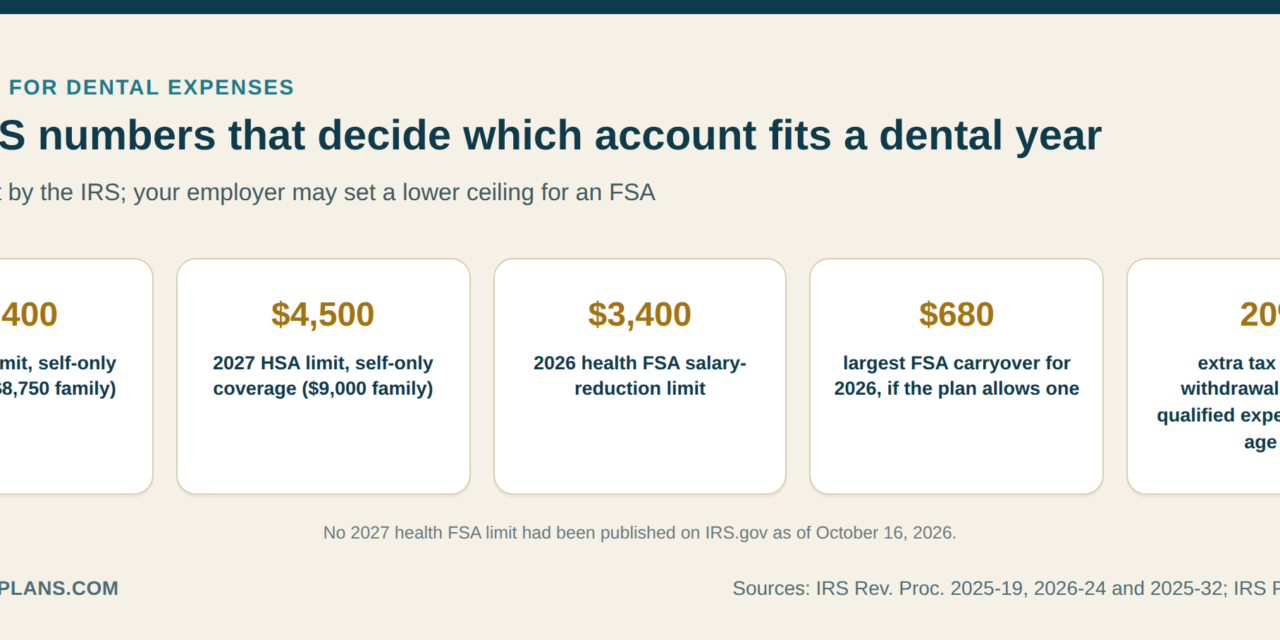
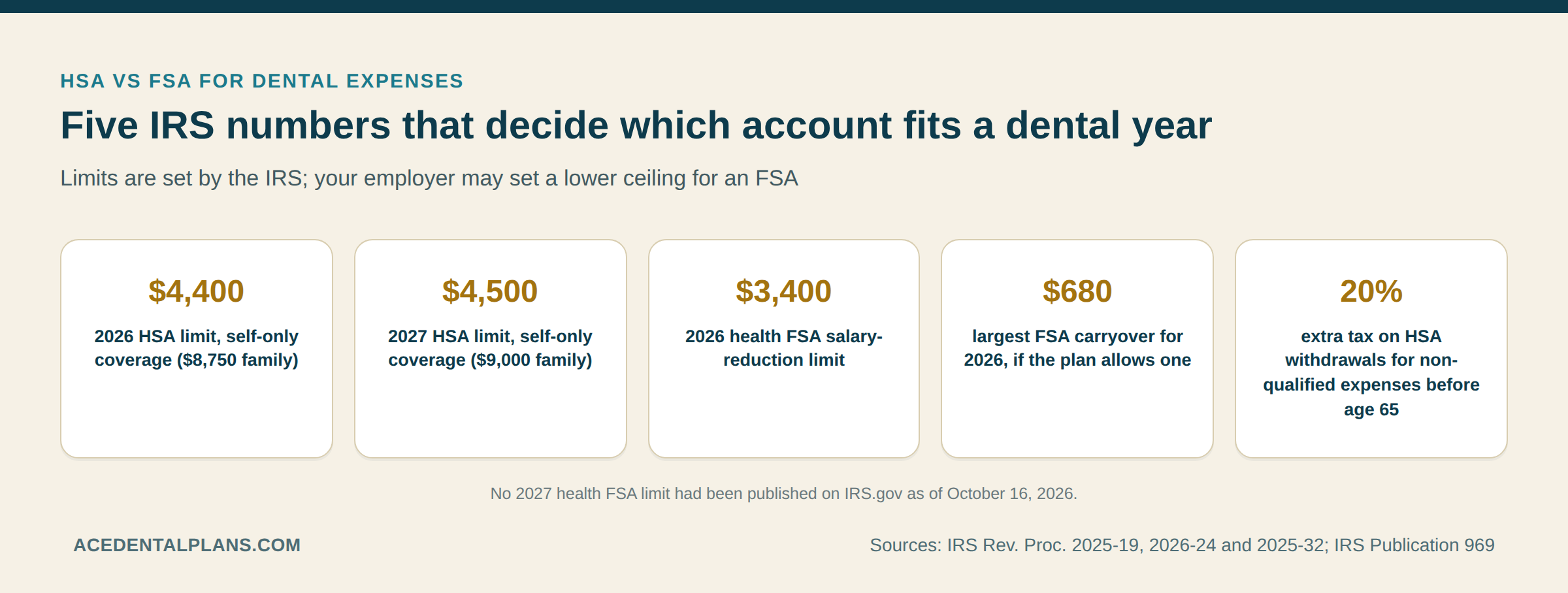
An HSA and a health FSA both let you pay dental bills with pre-tax money, but they split on who can open one and what happens to leftover dollars. A health FSA reimburses up to $3,400 of salary reductions in 2026 and usually forfeits what you don’t spend. An HSA requires a qualifying high-deductible health plan, allows $4,400 (self-only) or $8,750 (family) in 2026, and keeps the balance year after year.
This article compares the two accounts for dental use only: eligibility, the 2026 and 2027 numbers, which dental services qualify, how to time large bills such as braces, how to coordinate with a dental plan, and what the tax savings look like in hypothetical cases. It does not rank investment choices or cover every medical use of these accounts. General ways to fund a big bill sit elsewhere, and the pages that cover them are linked where they matter.
Key Takeaways
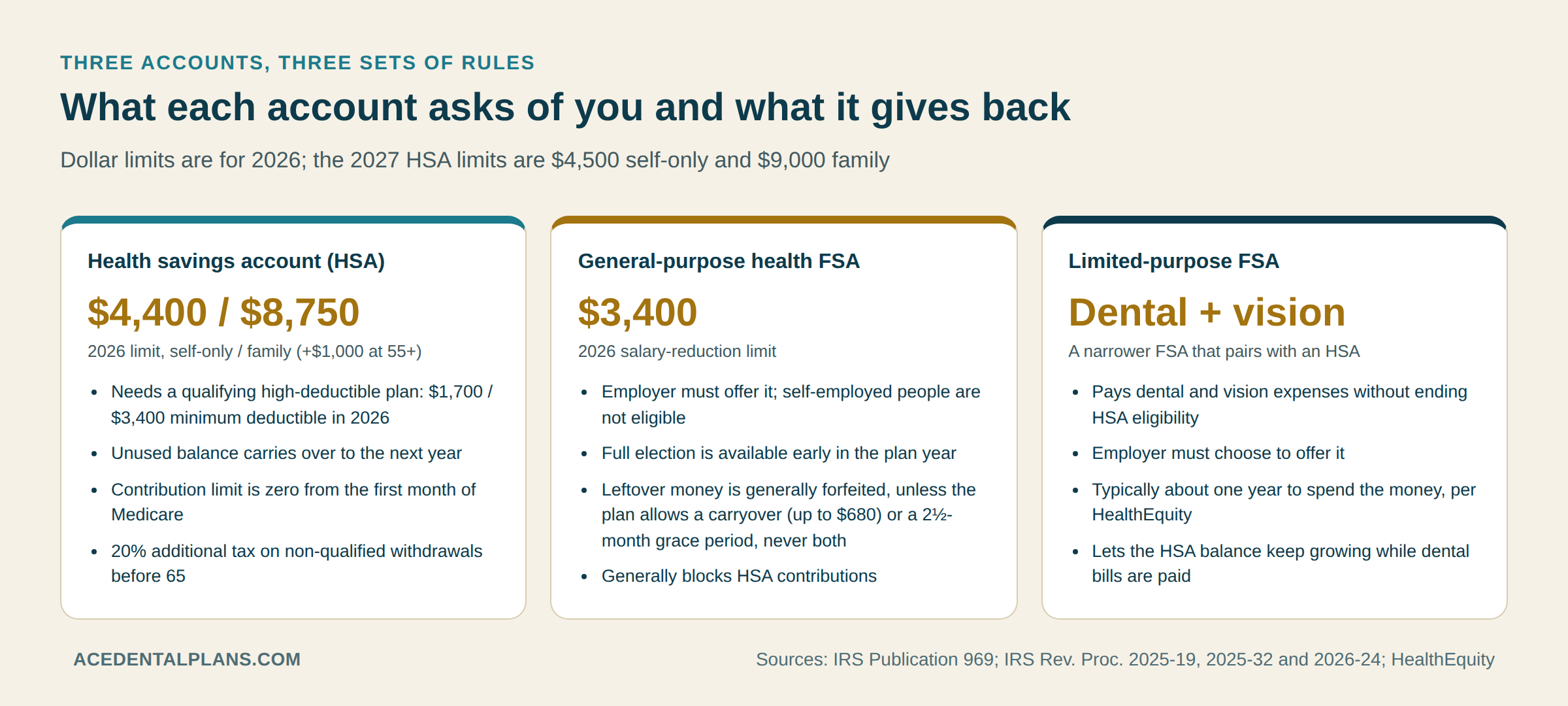
- Eligibility is the first fork. An HSA needs a qualifying high-deductible plan (2026 minimum deductible $1,700 self-only, $3,400 family) and no Medicare enrollment. A health FSA needs an employer that offers one, and self-employed people can’t use it.
- Limits differ and one 2027 number is missing. The IRS published 2027 HSA limits of $4,500 and $9,000. No 2027 health FSA limit had appeared on IRS.gov when this article was prepared; 2026 is $3,400.
- Unused money behaves differently. HSA balances carry over. Health FSA balances are generally lost at plan-year end, except for a carryover of up to $680 in 2026 or a grace period of up to 2½ months, if the employer offers one (never both).
- Fillings, extractions, dentures and braces qualify; teeth whitening and toothpaste do not. Veneers are a documentation question, not an automatic yes.
- Insurance comes first. Both accounts pay only the part your dental plan hasn’t paid, and an expense reimbursed by one cannot also be deducted.
- A dental-only FSA exists for HSA holders. A limited-purpose FSA can pay dental and vision bills without ending HSA eligibility.
HSA and FSA Side by Side: Where the Rules Part Ways
Most comparison pages stop at “HSA money rolls over, FSA money doesn’t.” That’s true, and it isn’t the whole story. The two accounts also differ in who sets them up, when your money becomes spendable and what the IRS lets you buy.
Start with the table, then read the sections that unpack each row. The 2026 figures come from IRS revenue procedures 2025-19 and 2025-32; the 2027 HSA figures come from Revenue Procedure 2026-24. Everything in the right-hand column about carryovers and grace periods comes from IRS Publication 969.
| Feature | Health savings account (HSA) | Health flexible spending arrangement (FSA) |
|---|---|---|
| Who can have one | Someone covered by a qualifying high-deductible plan, with no disqualifying other coverage, not enrolled in Medicare and not claimed as another person’s dependent | An employee of an employer that sets up the plan; self-employed people aren’t eligible |
| 2026 annual limit | $4,400 self-only, $8,750 family, plus $1,000 if you are 55 or older | $3,400 in salary reductions |
| 2027 annual limit | $4,500 self-only, $9,000 family, plus $1,000 if 55 or older | No 2027 figure found on IRS.gov as of October 16, 2026 |
| Money left at year end | Generally carried over to the next year | Generally forfeited; the plan may allow a carryover (up to $680 in 2026) or a grace period of up to 2½ months, not both |
| What you can spend | What is in the account when you pay | The employer must make the full election available for claims during the coverage period |
| Dental insurance premiums | Generally not payable, with narrow exceptions (long-term care insurance, continuation coverage, certain Medicare coverage) | Not reimbursable |
| Withdrawals for non-qualified expenses | Taxable, plus a 20% additional tax before age 65, disability or death | Not allowed; reimbursements must match qualified expenses |
| Paperwork | You keep records; Form 8889 goes with your tax return | The plan requires an independent statement or itemized receipt for each claim |
Two rows deserve emphasis before we go deeper. The first is “what you can spend.” An FSA is a promise your employer makes on January 1: you elected $1,200, so $1,200 is available even though only a few paychecks have gone in. An HSA is a bank-style account, so you can only spend what has actually arrived.
The second is the paperwork row. The HSA looks more relaxed because nobody reviews each claim. The IRS still expects you to prove, if asked, that every withdrawal paid for a qualified expense that nobody else reimbursed. Freedom and responsibility arrive together.
Who Can Open an HSA: The Plan Test, Medicare and the 2026 Changes
Though an HSA belongs to a person, a health plan decides who qualifies. IRS Publication 969 says you must be covered by a high-deductible health plan (HDHP) on the first day of the month, have no other health coverage that disqualifies you, not be enrolled in Medicare, and not be claimable as someone else’s dependent.
For 2026, the IRS set the HDHP floor at a $1,700 annual deductible for self-only coverage and $3,400 for family coverage. The plan’s out-of-pocket maximum, excluding premiums, can’t exceed $8,500 (self-only) or $17,000 (family). For 2027 those numbers become $1,750 and $3,500 for the deductible and $8,700 and $17,400 for the cap, according to Revenue Procedure 2026-24. A plan that doesn’t meet them isn’t an HDHP for HSA purposes, however it’s marketed. HealthCare.gov describes an HSA-eligible plan as generally one that covers only preventive services before the deductible.
Dental coverage doesn’t disqualify you
Many people assume a separate dental plan blocks an HSA. It doesn’t. Dental care and vision care appear in Publication 969 among the coverage you can hold in addition to an HDHP. The conflict arises with a general-purpose health FSA or health reimbursement arrangement that pays medical expenses before the HDHP deductible is met. That pairing generally ends HSA eligibility, which is why the limited-purpose FSA discussed later exists.
Marketplace plans changed in 2026
IRS Notice 2026-5 explains changes made by the One, Big, Beautiful Bill Act (Public Law 119-21). For months beginning after December 31, 2025, bronze and catastrophic plans bought through a Marketplace are treated as HDHPs even if their deductibles fall below the usual minimum. A plan bought off the Exchange counts if the same plan is available on one. Small-business (SHOP) coverage generally doesn’t. If you buy your own coverage and wondered whether a bronze plan opens the door to an HSA, the answer for 2026 is often yes, but confirm with the insurer that the specific plan qualifies.
The same law and notice also allow certain direct primary care arrangements (fixed monthly fees up to $150 per person) to coexist with an HSA, and make the telehealth safe harbor permanent. Neither changes how dental bills are paid, so they stop here.
Medicare, the last-month rule and one dental trap
From the first month you are enrolled in Medicare, your HSA contribution limit is zero, the IRS states in Publication 969. Money already in the account stays yours to spend on qualified expenses, but you can’t add more. What Medicare itself pays toward dental care is a separate question, answered in does Original Medicare cover dental care. An HSA balance built before enrollment can still pay qualified dental bills afterward.
If you are eligible on December 1, the last-month rule treats you as eligible for the full year. The catch is a testing period that runs through the end of the following year. Fail it for a reason other than death or disability, and the contributions that the rule allowed become taxable income plus a 10% additional tax.
The dental trap is timing. Expenses incurred before you establish your HSA aren’t qualified medical expenses, according to Publication 969. Suppose you book a crown for January 5, open the HSA on January 20 and deposit money on the 21st. The crown bill can’t be paid tax-free from that account, because the treatment came first. If you know an expensive procedure is near, open and fund the account before the date of service, not after.
2026 and 2027 Limits, Catch-Ups and Deadlines
Numbers drive the choice, so here they are with their dates. All HSA and FSA limits are set by the IRS and change with inflation. Employers and HSA custodians can’t raise them.
For HSAs, Revenue Procedure 2025-19 sets 2026 at $4,400 for self-only HDHP coverage and $8,750 for family coverage. Revenue Procedure 2026-24 sets 2027 at $4,500 and $9,000. That’s an increase of $100 for self-only coverage and $250 for family coverage, by simple subtraction. Anyone 55 or older adds $1,000, according to Publication 969.
The catch-up works per person, not per household. When both spouses are 55 or older and have family coverage, each must make the additional contribution to their own HSA, as Publication 969 explains. For 2025 the combined ceiling was $10,550. By the same arithmetic, the 2026 combined ceiling for such a couple would be $10,750 ($8,750 plus two $1,000 catch-ups), though you should confirm that with a tax professional before relying on it.
Who gets the family limit
If either spouse has family HDHP coverage, both are treated as having it, Publication 969 states. The contribution limit is then divided equally between them unless they agree on another split. A couple with one family plan therefore shares one family limit, not two.
Deadlines
You have until the tax-filing deadline to fund an HSA for a year. For 2025, contributions could be made through April 15, 2026, per Publication 969. A health FSA works on the plan year instead: elections are set in advance, claims must relate to expenses incurred in that year, and the plan decides the filing deadline for claims (often called the run-out period). Ask HR for that date in writing.
The 2027 health FSA gap
The 2026 health FSA limit of $3,400 and the carryover maximum of $680 appear in Revenue Procedure 2025-32 and, for the $3,400 figure, in the 2026 edition of Publication 15-B. For 2027, no published IRS figure had appeared when this article was prepared. Employers will announce their own 2027 maximums during open enrollment, and those must stay within whatever the IRS sets. If you’re electing for 2027 this fall, treat any number you hear as the employer’s statement until the IRS notice is out.
The limit applies to salary reductions. An employer may add its own money to an FSA if the plan says so. That contribution doesn’t count against your $3,400, but your plan’s terms control it.
A different account sometimes gets confused with the health FSA. The dependent care FSA is built for the care of dependents, and for 2026 Publication 15-B puts its annual limit at $7,500 ($3,750 if married filing separately). Dentist invoices don’t belong there. They go to the health FSA or the limited-purpose FSA.
How a Health FSA Works: Elections, Reimbursement and the Calendar
You choose an amount during enrollment, and your employer withholds it from pay in equal pieces. IRS Publication 969 notes that FSAs are usually funded through voluntary salary reduction agreements, and that no employment or federal income taxes are deducted from those contributions. Because the money never shows up as taxable wages, a $2,000 election costs you less than $2,000 in take-home pay.
Then the reverse happens. Under the uniform coverage rule, described in IRS Notice 2013-71, the maximum reimbursement amount must be available for claims incurred at all times during the period of coverage. In plain terms, you can use all $2,000 on a January crown even though you’ve contributed only one paycheck’s worth. The employer, not you, carries that gap until later paychecks catch up. That’s the standout feature of an FSA when a big bill arrives early.
The rules that bind a claim
- Expenses must be incurred in the plan year. Notice 2013-71 states that current-year contributions may be used only for expenses incurred in the current plan year.
- No advances. An FSA can’t make advance reimbursements of future or projected expenses, the publication says. Paying a dentist in advance for treatment that happens next year doesn’t count this year.
- Proof is required. You must give the FSA a written statement from an independent third party (an itemized receipt or an insurer’s explanation of benefits) confirming the expense and its amount, plus a statement that no one else paid or reimbursed it.
- Cards are allowed. Debit, credit and stored-value cards issued by your employer can reimburse expenses, the publication adds.
- No refund. Your employer isn’t permitted to pay any unused balance back to you.
Carryover, grace period and the year-end scramble
Health FSAs are generally “use-it-or-lose-it” plans, Publication 969 says. Two exceptions exist and the employer chooses at most one. A plan may let you carry over a limited amount (up to $680 for 2026, per Revenue Procedure 2025-32), or it may give a grace period of up to 2½ months after the plan year ends. A plan can’t offer both. Many plans offer neither.
That choice shapes how you plan dental work. With a carryover, a $300 balance on December 31 survives. Without one, that $300 disappears unless you’ve scheduled something before the deadline. The checklist for those last weeks lives in what to check before year-end, which also covers the dental insurance side of the calendar.
The example shows why guesses should lean low. An FSA rewards precision, and a dental plan helps you be precise. Ask the office for a treatment plan, subtract what your plan pays, and elect close to that figure. For how that subtraction works, see how dental insurance works.
Limited-Purpose FSAs: A Dental-and-Vision Account for HSA Holders
A general-purpose health FSA pays for nearly any qualified medical expense, including those below your HDHP deductible. That’s exactly why it blocks HSA contributions. Under Publication 969, an employee covered by an HDHP and a health FSA that pays qualified medical expenses generally can’t make HSA contributions.
The workaround is a limited-purpose health FSA. Per Publication 969, these arrangements can pay or reimburse items such as dental care and vision care (but not long-term care), and they can also cover preventive care without requiring the deductible first. People with an HDHP can have a limited-purpose FSA or health reimbursement arrangement and still contribute to an HSA.
The federal employee program FSAFEDS runs a version, which it calls a Limited Expense Health Care FSA, and describes it as paying for qualifying dental and vision services. Private employers may use other names, so search your benefits guide for “limited purpose,” “LPFSA” or “dental and vision FSA.”
What the pairing does for a dental year
The two accounts then split the work. The limited-purpose FSA pays dental and vision bills, so the HSA balance stays untouched and keeps growing for later. The HSA stays available for medical expenses the limited account can’t touch, such as the HDHP deductible.
There’s a cost: the limited-purpose account has FSA problems. HealthEquity, an HSA custodian, notes that holders typically have about one year to spend limited-purpose FSA money before it goes away. Size it to dental and vision needs you can see coming, and let the HSA absorb surprises.
Post-deductible plans
A third arrangement, named in the same publication, is a post-deductible FSA or HRA, which pays nothing until the minimum HDHP deductible is met. Because it doesn’t pay early dental bills, it generally doesn’t block HSA contributions. It’s also less useful for planned dental work, since it opens only after you’ve spent your deductible.
Which Dental Expenses Qualify, and Where the Cosmetic Line Sits
Both accounts follow the same list, because both use the IRS definition of medical care. Publication 502 says you can include amounts paid for the prevention and alleviation of dental disease. It names X-rays, fillings, braces, extractions and dentures, plus preventive work such as teeth cleaning, sealants and fluoride treatments. It also says you can include the cost of artificial teeth.
Each plan administrator then publishes its own detailed list. The federal employee program FSAFEDS posts one for its limited-expense account, 107 items long, which is a useful model of how administrators label dental items. Table 2 combines the two layers: what the IRS names and what FSAFEDS’s list says. Your own employer’s administrator may differ on documentation, so treat the last column as a pattern, not a guarantee.
| Dental purchase | IRS Publication 502 | FSAFEDS list status |
|---|---|---|
| Fillings, X-rays, extractions | Named as treatment of dental disease | Dental: eligible with a detailed receipt |
| Cleanings, sealants, fluoride | Named as preventive treatment | Sealants: eligible with a detailed receipt |
| Dentures and bridges | Dentures named; artificial teeth includible | Denture and bridge: eligible with a detailed receipt |
| Braces and retainers | Braces named | Orthodontia (braces and retainers): eligible with a detailed receipt |
| Clear aligners, including mail-order | Not named in the text reviewed | Eligible with a detailed receipt |
| Dental implants | Not named in the dental section reviewed | Eligible with a detailed receipt |
| Deductible, copay and coinsurance | Only amounts not paid by insurance count | Eligible with a detailed receipt |
| Night guards for teeth grinding | Not named in the text reviewed | Eligible with a detailed receipt |
| Veneers | Subject to the cosmetic-procedure rule | Eligible with appropriate documentation, including a letter of medical necessity |
| Teeth whitening | Amounts paid to whiten teeth can’t be included | Not eligible |
| Toothpaste, toothbrush, floss | Toothbrush and toothpaste are nondeductible personal items | Not eligible; medicated toothpaste needs a letter plus proof of the cost difference |
| Dental insurance premiums | Not payable from an HSA, with narrow exceptions | Not reimbursable from an FSA |

The cosmetic boundary
Publication 502 says that, generally, you can’t include the cost of cosmetic surgery, which covers any procedure directed at improving appearance that doesn’t meaningfully support normal body function or treat illness. Its exception covers surgery to correct a deformity from a congenital abnormality, a personal injury resulting from an accident or trauma, or a disfiguring disease. Whitening is called out separately and excluded.
Veneers fall in the gray zone between those rules. FSAFEDS lists them as eligible only with documentation, and HealthEquity says cosmetic veneers need a letter of medical necessity. A veneer placed to restore a fractured or worn tooth might qualify with a dentist’s letter. A veneer placed to change the shade or shape of a healthy tooth may not. The administrator decides what documentation is enough, so ask before you pay. For what these treatments cost, see cosmetic dentistry cost.
Two quiet traps in the table
The first is assuming that “dental” means everything a dentist’s office sells. Offices also sell retail products, whitening kits and electric toothbrushes. Swiping an HSA debit card at the front desk isn’t proof that the item qualifies, and the IRS looks at the item, not the merchant.
The second is the discount or membership plan. The plan fee isn’t insurance, but the IRS publications reviewed here don’t address whether such a fee is a qualified medical expense. Ask your account administrator before paying one from the account. How these plans work, and what they save, is covered in dental savings plans.
Braces, Aligners and Implants: Paying Large Bills Over Months
Small dental bills fit neatly into either account. The awkward ones are multi-month treatments, where the plan year, the payment schedule and the service dates all matter.
Orthodontics is the classic case. The fee is bundled, the office often offers a down payment plus monthly installments, and those installments can straddle two plan years. For an FSA, FSAFEDS’s own guidance says you can claim expenses you pay during the current plan year, even if the braces went on earlier, and that work finished before your plan’s effective date isn’t reimbursable. Other administrators may follow service dates instead of payment dates, so ask which rule your plan uses for installments. The prices behind these fees are in braces cost by type, and the clear-aligner version is in Invisalign cost and payment plans.
The same bill looks different in an HSA. An HSA has no use-it-or-lose-it clock, and you can pay installments whenever the balance is there. The tradeoff is the opposite of the FSA’s: you can’t spend money you haven’t deposited. A family who contributes $8,750 in 2026 has a lot of room, but a self-only contributor with a $4,400 limit and a $1,700 deductible to cover also has other claims on the same money.
For a fuller view of how treatment type affects fees, braces, with types, treatment time and insurance and Invisalign results and coverage carry the clinical side. Here, one rule matters: ask the office for the contract with its payment schedule written down, because the administrator may want to see it.
Implants and other staged work
Implants are billed in stages: extraction, bone work, the post, the abutment and the crown, often months apart. IRS Publication 502 doesn’t name implants in the dental passage reviewed, but FSAFEDS lists dental implants as eligible with a detailed receipt, and HealthEquity includes them among typical qualifying items. That’s reasonable, because an implant replaces a tooth the way a denture does. The staged billing makes plan-year planning harder: a stage in December falls in one FSA year, and the crown in February falls in the next. The cost side is in single-tooth dental implant cost.
Large bills can also run through a payment plan or loan, and that’s where an account interacts with financing. Paying a dentist’s installment from your HSA is straightforward. Paying a lender’s interest or fees is a different question, which the account administrator has to answer. How the financing options differ is the subject of dental financing versus payment plans.
Insurance First, Account Second: The Order of Operations
If you have a dental plan, both accounts sit behind it. Qualified HSA expenses, as Publication 969 limits them, exclude amounts compensated for by insurance or otherwise. A health FSA can’t reimburse expenses covered by another health plan. Neither account is a way to pay for something the plan already paid.
That ordering matters for timing. A dental plan processes a claim and sends an explanation of benefits (EOB) showing the allowed amount, what the plan paid and what you owe. The EOB is often strong proof for an FSA, because it is an independent statement of the amount owed. The mechanics of that document are in what dental insurance covers, and the larger picture is in the dental insurance explained guide.
A sequence that avoids rework
- Get a written treatment plan and estimate. It should list each procedure, the fee and the expected insurance payment.
- Ask for a pre-treatment estimate from the insurer if the plan offers one, so the patient share is a firm figure.
- Let the claim process, or pay the estimate with a plan to true up. Either works, as long as the final amount comes from the EOB.
- Pay the patient share from the account and save the EOB and the itemized receipt together.
- Check the plan-year calendar. Date of service, payment date and the FSA claim deadline may fall in different periods.

The annual maximum adds a wrinkle. When a plan hits its yearly dollar limit, you owe the remainder at full fee, and that remainder is still a qualified expense. That’s a good moment to use an account, since the unpaid part would otherwise come from after-tax pay. If you’re deciding whether to schedule work this year or next, the account balance and the plan maximum are two separate clocks.
Reading a dentist’s estimate for HSA or FSA use
A treatment plan from the dental office rarely separates qualified from non-qualified items for you. You can do that in five minutes with a pencil. Take each line, subtract what the plan is expected to pay, then ask whether the remainder is an item the account may reimburse.
That gap of $350 is the reason to read before you swipe. Using an account for the whole $1,484 would leave $350 as a non-qualified expense. In an HSA that is a taxable withdrawal with the 20% additional tax if you’re under 65. In an FSA the administrator would likely deny it or ask for repayment.
At a hypothetical 30% combined rate, the qualified $1,134 saves about $340 in taxes. If the same patient is choosing an FSA election for next year based on this plan, $1,134 is the number to start from, not $1,484. A few extra questions sharpen it. Does the office quote the allowed amount or its own list fee? Is the crown’s price dependent on a buildup that may be added? Will the plan’s annual maximum already be partly used? Each answer moves the qualified total.
What the Tax Savings Look Like: Four Hypothetical Cases
The savings come from not paying income and payroll tax on money that goes to a qualified expense. How large that is depends on your marginal rate, which the IRS doesn’t publish for you and which differs by income, filing status and state. So every rate below is hypothetical. Replace it with your own and the arithmetic still works.
HSA contributions other than employer contributions are deductible whether or not you itemize, Publication 969 says. It also says HSA distributions used for qualified medical expenses are tax free. Publication 15-B says that excluded cafeteria plan benefits are generally not subject to federal income tax withholding, Social Security tax or Medicare tax. That is why a payroll-deducted contribution can save more than a self-funded deposit that you deduct later. State tax treatment can differ from federal, and this article covers federal rules only.
Case 2 also contains a rule people overlook. Publication 502 says you can’t include expenses that insurance paid, amounts for which your FSA fully reimbursed you, or amounts you contribute to an HSA. One dollar gets one tax benefit. If you used an account for the crown, the crown isn’t also a deduction.
The cases show a pattern. The accounts help most when the bill is predictable (FSA) or when the household can leave money to accumulate (HSA). They help least when the bill is small or a guess.

Receipts and Records: What to Keep and Who Will Ask
Documentation differs by account, and both start with the same pile of paper. Keep the treatment plan, the itemized invoice showing the date of service and procedure, the EOB and proof of payment. Credit card statements alone rarely show enough.
HSA records are your job
You must keep records sufficient, Publication 969 requires, to show that distributions were exclusively to pay or reimburse qualified medical expenses, that the expenses weren’t previously reimbursed from another source, and that they weren’t claimed as an itemized deduction. Contributions and distributions are reported on Form 8889, filed with your Form 1040. The publication says you must file it if you or your spouse had any HSA activity during the year, even if only an employer contributed. Employer contributions appear in box 12 of your Form W-2 with code W.
Nobody checks each swipe, so a drawer of receipts is the audit file. A simple habit helps: when you pay, scan the itemized receipt and EOB into a folder labeled with the tax year.
FSA records are the plan’s job, and yours to supply
The FSA administrator reviews claims. FSAFEDS labels most dental items “eligible with a detailed receipt,” and veneers and medicated toothpaste need a letter of medical necessity. Cards often work through automatic substantiation, but if the system can’t match a swipe to an eligible merchant and amount, you get a request for documents and a deadline to answer. Answer by the deadline the administrator sets, and ask in advance what happens if a request goes unanswered, because that consequence is a plan rule.
Employer Rules That Change What You Can Do
An FSA exists only if an employer set one up. The HSA depends on the health plan that an employer, a Marketplace or a spouse’s job provides. Several features are the employer’s decision, within IRS limits.
- Carryover or grace period. Employers pick at most one, or neither.
- The election ceiling. The employer can set a limit below the IRS’s $3,400 for 2026.
- Whether a limited-purpose FSA is offered. Without one, an HSA-eligible employee may have no dental-only account.
- Employer HSA deposits. Some employers contribute. KFF’s 2025 Employer Health Benefits Survey found that 3% of covered workers in HSA-qualified HDHPs received an employer contribution at least equal to their single-coverage deductible, and 10% received enough to bring their annual liability under $1,000.
- The claim deadline. The run-out period after the plan year is set by the plan.
Scale matters too. KFF reported that 33% of covered workers were enrolled in a high-deductible plan with a savings option in 2025. Meanwhile, the Bureau of Labor Statistics found that dental care benefits were available to 44% of private industry workers in March 2026, with 32% participating. Dental plan access and HDHP enrollment are separate decisions, so a worker can have one without the other. With an HDHP and no dental plan, an HSA can pay dental bills that no insurer ever sees.
Self-employed people have one fewer option. Self-employed persons aren’t eligible for FSAs, Publication 969 says. They can still use an HSA if they hold a qualifying HDHP. Where a household has no employer plan, the alternatives to an account are laid out in ways to pay for expensive dental work.
Questions for HR are better asked in writing, because verbal answers disappear. Ask whether a carryover or grace period applies, what the 2027 election ceiling is, how installment payments to an orthodontist are reimbursed, whether a limited-purpose FSA is offered and what happens to the balance if your job ends.
Planning the 2027 election this fall
For most employees, the health FSA decision is made once a year, during the employer’s enrollment window, so check when yours opens and closes. The decision locks in a dollar amount before you know how the year will unfold, so the useful preparation is a short list built from the dentist’s chair outward.
- List the work you already know about. Ask the dentist for a written treatment plan covering anything diagnosed but not done: a crown, a replacement filling, orthodontic installments.
- Subtract the plan’s share. Use the plan’s 2027 percentages and annual maximum, not this year’s remaining benefits.
- Add routine costs you can predict. Cleanings are often preventive, but copays, deductible and a night guard or retainer may not be.
- Drop what isn’t eligible. Whitening, toothpaste and retail items come out, as in the earlier estimate.
- Elect close to the total, and a little under if there is no carryover. A slightly low election loses a few tax dollars. A high one forfeits real money.
Take the earlier estimate. If $1,134 is the likely qualified patient share for 2027, an election of $1,100 would leave $34 of eligible bills unreimbursed but protect the household from forfeiting anything. If the plan has a carryover, rounding up to $1,200 risks only a $66 balance that survives into the next year, so the tradeoff is gentler. Neither number is “right” in general. They are choices with a known cost on each side.
Work already booked for the current year raises a separate question: should it move to December to use this year’s balance, or wait for January and the next election? Moving a procedure for tax reasons alone isn’t wise if the clinical timing is different, so let the dentist’s recommendation decide and the account follow it.
Seven Mistakes That Cost Money
Common errors with dental HSAs and FSAs
- Over-electing an FSA. Lena’s example earlier shows how a $400 overshoot turned a $330 gain into $50.
- Paying a bill that happened before the HSA existed. Publication 969 says those expenses aren’t qualified.
- Combining a general-purpose FSA and an HSA. Publication 969 says an employee covered by an HDHP and such a health FSA generally can’t contribute to an HSA.
- Funding an HSA after Medicare starts. The limit is zero from the first month of enrollment.
- Using the card for whitening or toothpaste. Neither qualifies under Publication 502 or the FSAFEDS list.
- Counting the same dollar twice. A deduction and a reimbursement can’t cover the same expense.
- Prepaying for next year’s FSA treatment. No advance reimbursements are allowed.
A related risk is assuming a dentist’s estimate equals the qualified amount. Estimates change, insurers adjust, and an account claim should match the final EOB and invoice, not the first number you heard.
Which Account Fits Which Household
No single account wins for everyone, and a household’s answer can change from year to year. What helps is a short list of situations and the account each tends to suit. Table 3 keeps the reasoning visible so you can swap in your own facts.
| Situation | Account that tends to fit | Why | Check first |
|---|---|---|---|
| Covered by a qualifying HDHP; dental needs hard to predict | HSA | Unused balance carries over, so a quiet dental year costs nothing | Open and fund the HSA before any date of service |
| No HDHP; crown or fillings planned with a known patient share | Health FSA sized to that share | Full election is available early, and the bill is predictable | Carryover or grace period, and the plan-year end |
| HDHP, and the employer offers a dental-and-vision FSA | HSA plus limited-purpose FSA | The FSA pays dental while the HSA balance stays put | The limited-purpose FSA’s own spending deadline |
| Self-employed with a qualifying HDHP | HSA only | Self-employed people aren’t eligible for FSAs | Whether the plan meets the HDHP minimums |
| Braces or aligners paid in installments across two years | FSA elected each year to match installments, or an HSA | Both can pay installments; the FSA saves most when amounts are known | Whether payment dates or service dates drive reimbursement |
| Enrolling in Medicare soon | Existing HSA balance; no new contributions | The contribution limit is zero from the first month of enrollment | The month Medicare starts, and the stop date for contributions |
A decision path in four questions
- Can you hold a qualifying HDHP? If your plan’s deductible and out-of-pocket maximum meet the IRS definitions, an HSA is available. If not, go to question two.
- Does the employer offer a health FSA, and a limited-purpose FSA? A general-purpose FSA and an HSA don’t mix, but a limited-purpose FSA and an HSA do.
- How well can you predict next year’s dental bills? If you can name the procedures and the patient share, an FSA election can be exact. If you can’t, lean toward the HSA or a smaller FSA.
- Is Medicare within a year or two? If so, an HSA may be most useful as a fund you build before enrollment and spend after.
An HSA as a long-term dental fund
An FSA is a one-year tool. An HSA can be a ten-year tool, which changes the question for people who expect expensive dental work later. Dentures, a bridge or implants can arrive years after a household stops contributing, and a balance built earlier is available when they do.
Two limits shape the plan. Contributions stop when Medicare coverage starts, as discussed earlier, so the building years are the ones before enrollment. And the money must be used on qualified expenses to stay tax free. After age 65, Publication 969 says the 20% additional tax no longer applies, though non-qualified withdrawals are still taxed as income. The cost side of this later-life scenario is in dentures cost: full, partial and implant-supported.
If none of these paths fits because there’s no employer plan at all, cash prices become the starting point. The pricing side is in what dental care costs without insurance, and the account question returns the moment you hold a qualifying HDHP. For a side-by-side look at other dental choices, the Compare guides gather them in one place.
Bottom Line
Match the account to the kind of year you expect. A predictable dental year, with a crown scheduled and a known patient share, suits an FSA election sized tightly to that share. An unpredictable year, or a household that wants to build a reserve for later, suits an HSA if a qualifying plan is available. Households with both a high-deductible plan and a dental-and-vision FSA can use the limited account for current bills and leave the HSA to grow.
Two habits protect the savings in every scenario. First, put insurance ahead of the account and pay only the final patient share from the EOB. Second, keep the paperwork, because the IRS holds HSA owners responsible for proving each withdrawal and administrators hold FSA users to a detailed receipt.
The rest is arithmetic you can do at your kitchen table, using your own tax rate and your dentist’s written estimate. Do that before open enrollment ends, not after the first bill arrives.
Frequently Asked Questions
Can I use an HSA to pay for dental work?
Yes, for qualified dental expenses. IRS Publication 502 names fillings, X-rays, extractions, braces and dentures, and preventive care such as cleanings and sealants. The expense must have been incurred after the HSA was established, and amounts your dental plan paid don’t count. Teeth whitening and everyday toothpaste do not qualify.
Can I have an HSA and an FSA at the same time?
Not with a general-purpose health FSA, because Publication 969 says an employee covered by an HDHP and such an FSA generally can’t contribute to an HSA. A limited-purpose FSA that pays only dental and vision expenses can coexist with an HSA. A dependent care FSA is a different account with its own rules.
Are braces and Invisalign eligible for HSA or FSA payment?
Publication 502 lists braces among qualifying dental treatments. The FSAFEDS expense list also shows orthodontia (braces and retainers) and clear aligners, including mail-order, as eligible with a detailed receipt. Administrators differ on how installments are reimbursed, so ask whether your plan follows payment dates or service dates before you elect.
Can an HSA or FSA pay my dental insurance premium?
Generally no. Publication 969 bars HSA funds from paying for insurance, with exceptions such as long-term care insurance, continuation coverage and certain Medicare coverage. It also says an FSA can’t reimburse health insurance premiums. Out-of-pocket dental costs such as deductibles, coinsurance and copays are another matter and are eligible.
What happens to FSA money I don’t use by year end?
Under the IRS framework in Publication 969, it is generally forfeited, and your employer isn’t permitted to refund it to you. Some plans allow a carryover (up to $680 for 2026) or a grace period of up to 2½ months, but never both. Check your plan documents before the end of the plan year.
Is teeth whitening or a veneer HSA or FSA eligible?
Whitening is not. Publication 502 says amounts paid to whiten teeth can’t be included, and FSAFEDS marks it not eligible. Veneers are conditional: FSAFEDS lists them as eligible with appropriate documentation, and HealthEquity says cosmetic veneers need a letter of medical necessity. Ask the administrator what documentation it accepts before paying.
Can I use my HSA for my spouse’s or child’s dental care?
Qualified expenses, per Publication 969, include those incurred by you, your spouse and all dependents you claim on your tax return. The passage reviewed doesn’t say whether a spouse or dependent must also be covered by the HDHP, so confirm with a tax professional if your family’s situation is unusual.
Can I reimburse myself from an HSA years after paying a dental bill?
The IRS text reviewed does not state a deadline. It requires that the expense was incurred after the HSA was established, that it hasn’t been reimbursed elsewhere or deducted, and that you keep records. Because of those rules, saving itemized receipts matters more than the timing of the withdrawal. Ask a tax professional before relying on a long delay.
What are the HSA and FSA limits for 2027?
The IRS set 2027 HSA limits at $4,500 for self-only coverage and $9,000 for family coverage in Revenue Procedure 2026-24, plus $1,000 for people 55 or older. For health FSAs, the 2026 limit is $3,400, and no 2027 figure had been published on IRS.gov when this article was prepared. Your employer may set a lower ceiling.
Which is better for braces, an HSA or an FSA?
It depends on eligibility and predictability. An FSA lets you elect the amount you expect to pay in the plan year and gets the full election available early, which suits fixed installments. For households with a qualifying plan, an HSA offers flexibility and no forfeiture. The orthodontic fee, the insurance maximum and the payment schedule decide the numbers.
Should I still use dental insurance if I have an HSA or FSA?
Yes, in most cases. Both accounts pay what insurance leaves behind. Qualified expenses stop where insurance compensation starts, according to Publication 969. Using the plan first lowers the patient share, and the account then handles the remainder, including deductibles and coinsurance.
Sources and Disclaimers
Tax limits, eligibility rules, forfeiture and carryover rules, and the definition of dental expenses come from IRS revenue procedures, notices and publications, read in October 2026. Which items an administrator treats as eligible, and how it documents them, come from the FSAFEDS expense list and FAQ and from an HSA custodian’s guidance, used as examples of administrator practice rather than as rules for your employer. Plan-design shares (high-deductible enrollment, employer deposits, dental benefit access) come from KFF and the Bureau of Labor Statistics. Every tax rate, income level, dental fee, insurance percentage and payment schedule in the worked examples is invented for illustration and labeled hypothetical. National rules and averages don’t describe your plan, your state tax treatment or your employer’s choices, and the IRS had not published a 2027 health FSA limit when this article was prepared. Confirm account rules with your plan administrator, treatment prices with your dentist and benefits with your insurer, and ask a qualified tax professional about your own return.
- Internal Revenue Service — Revenue Procedure 2026-24: 2027 inflation-adjusted amounts for Health Savings Accounts
- Internal Revenue Service — Revenue Procedure 2025-19: 2026 inflation-adjusted amounts for Health Savings Accounts
- Internal Revenue Service — Revenue Procedure 2025-32: 2026 cost-of-living adjustments, including the health FSA limit and carryover
- Internal Revenue Service — Notice 2026-5: Expanded Availability of Health Savings Accounts under the One, Big, Beautiful Bill Act
- Internal Revenue Service — Notice 2013-71: Modification of the “Use-or-Lose” Rule for Health Flexible Spending Arrangements
- Internal Revenue Service — Publication 969 (2025): Health Savings Accounts and Other Tax-Favored Health Plans
- Internal Revenue Service — Publication 502 (2025): Medical and Dental Expenses
- Internal Revenue Service — Publication 15-B (2026): Employer’s Tax Guide to Fringe Benefits
- FSAFEDS (U.S. Office of Personnel Management program) — LEX HCFSA eligible expenses list
- FSAFEDS — Frequently asked question on orthodontia expenses
- HealthEquity — HSA and FSA for dental care
- HealthCare.gov — Health Savings Account (HSA) glossary entry
- KFF — 2025 Employer Health Benefits Survey
- U.S. Bureau of Labor Statistics — Employee Benefits in the United States, March 2026
Important Information and Disclaimers
This article is general educational information. By using it, you accept the limits described below.
Not dental or medical advice
Nothing on this page is a diagnosis, a treatment recommendation or a substitute for an examination by a licensed dentist or physician. Reading this article does not create a dentist-patient or doctor-patient relationship. Only a licensed professional who has examined you and reviewed your history can tell you what your mouth needs. Do not delay, skip or stop professional care because of something you read here.
Prices are estimates, not quotes
Cost figures are ranges reported by the third-party sources cited in this article. Actual prices depend on your location, the provider, the complexity of your case, the materials used, the date of service and other factors, so what you pay may be higher or lower. A written treatment plan and fee estimate from the dental office is the only reliable number for your situation.
Insurance and plan examples are illustrations
Examples that use named amounts or percentages are hypothetical. Real benefits depend on your plan, network, waiting periods, annual maximum, deductible and the insurer’s rules at the time of treatment. A pre-treatment estimate or benefits check is not a promise of payment. Confirm the details with your insurer or plan administrator in writing.
Not insurance, legal, tax or financial advice
AceDentalPlans is an information publisher. Nothing here is insurance, legal, tax, investment or other professional financial advice, and nothing here recommends a particular provider, insurer, lender, discount plan or financing product. Company and product names belong to their owners and appear for identification only. Read the terms of any loan, financing offer or plan before you sign, and ask a qualified professional if you need advice on your own circumstances.
Third-party sources
This article cites government agencies, professional associations, insurers, lenders and other outside organizations. We do not control those sources. Their content can change, move or disappear, and listing a source is not an endorsement of it or of anything it sells.
No warranty
We aim for accuracy, but this article is provided “as is,” without warranties of any kind, express or implied, including warranties of accuracy, completeness, timeliness or fitness for a particular purpose. Some information may be out of date or contain errors by the time you read it.
Limitation of responsibility
To the fullest extent permitted by law, AceDentalPlans and its owners, authors and contributors are not responsible or liable for any loss, cost, injury, health outcome or other damage that results from using this article or relying on it. You are responsible for your own decisions about your care, your coverage and your money.
How this article is written
This article follows AceDentalPlans’ answer-first, U.S.-focused editorial approach. It uses conditional language for insurance, because coverage depends on the specific plan, and it names its sources so that you can read them yourself.


