Early cavities usually cause no symptoms at all, which is why the first sign is often an X-ray, not a toothache. As decay deepens, the common signals are a white, brown or black spot, a pit you can feel with your tongue, sensitivity to sweets, heat or cold, and pain when you bite. Lingering pain, facial swelling or fever needs prompt care.
This article follows a cavity from its first mineral loss to the pulp, says what each stage tends to feel like, and shows who is at higher risk. It explains how dentists find decay, what treatment looks like at each stage, and how quickly to book for each symptom. Costs appear as a stage-by-stage summary, because filling prices, post-filling sensitivity, toothache relief and abscesses each have their own guides, linked where they come up.
Key Takeaways
- Early decay is usually silent. The National Institute of Dental and Craniofacial Research says there are not usually any symptoms in early tooth decay, and a white spot at that stage can still be reversed with fluoride.
- Sensitivity usually means decay has gone deeper. Mayo Clinic says sensitivity increases once decay reaches the softer dentin under the enamel, and pain from the pulp follows if it goes further.
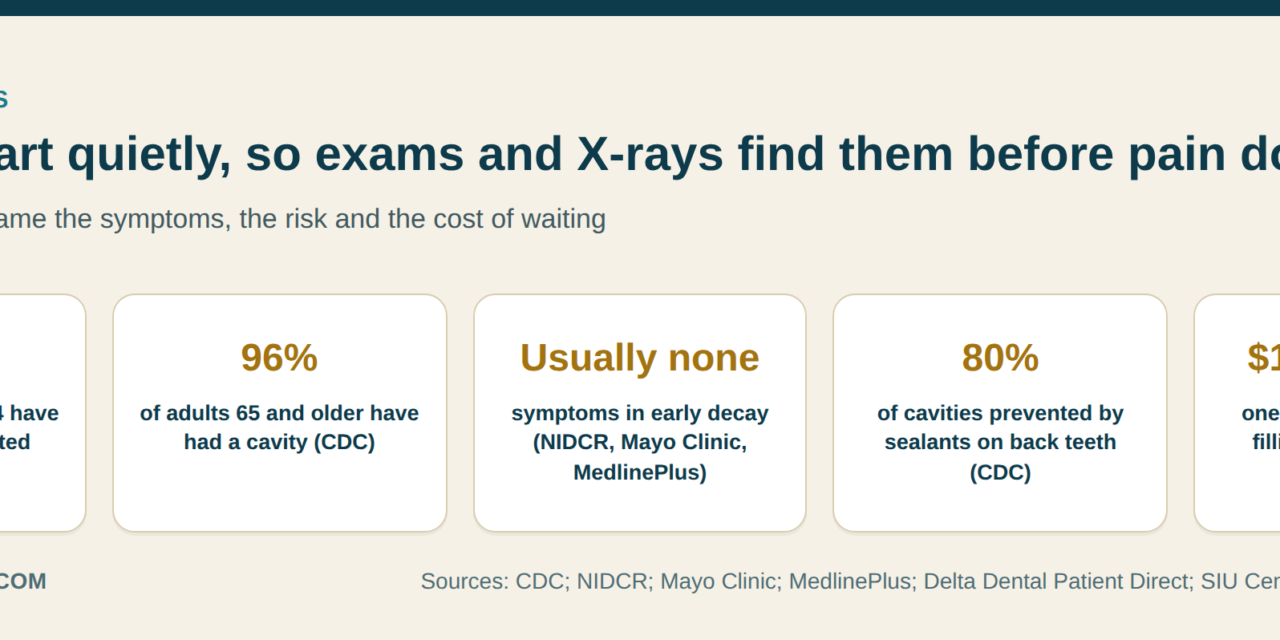
- Untreated cavities are common. The CDC reports that 21% of U.S. adults aged 20 to 64 have at least one untreated cavity, and 96% of adults 65 and older have had one.
- Timing changes the bill. In two published 2025 fee schedules, a one-surface back-tooth filling ran $110 to $150, while a molar root canal, build-up and crown together ran $1,767 to $2,925.
- Prevention has numbers behind it. The CDC says sealants on back teeth prevent 80% of cavities, and fluoride varnish reduces cavities in baby teeth by one-third.
- Facial swelling with fever, or trouble breathing or swallowing, is an emergency, not a cavity appointment.
How a Cavity Forms, and Why the Earliest Stage Can Heal
A cavity is a hole that decay has worn through the tooth’s hard outer layer. The American Dental Association puts the cause in one sentence: when you eat or drink foods containing sugars, the bacteria in plaque produce acids that attack tooth enamel. Plaque is sticky, so the acid stays against the tooth.
Enamel doesn’t break all at once. NIDCR describes a white spot where minerals have been lost as a sign of early decay. At that stage, it says, enamel can still rebuild itself using minerals from saliva and fluoride, or fluoride applied by a dentist or hygienist. It’s when more minerals are lost than restored that the enamel weakens and eventually breaks down into a cavity. That is the dividing line between a problem you can manage with home care and fluoride and one that needs a filling.
How common is this? Per the CDC, half of children aged 6 to 9 have had at least one cavity. Among adults aged 20 to 64, 21% have at least one untreated cavity, and 96% of adults 65 and older have had one. One in six adults in that older group has untreated decay right now. The same page says untreated cavities can lead to tooth loss at any age and, rarely, to an abscess that spreads.
Two details shape everything below. Decay is a process that moves through layers, and each layer has its own symptoms. And the first layer feels like nothing.
Cavity Stages and What Each One Feels Like
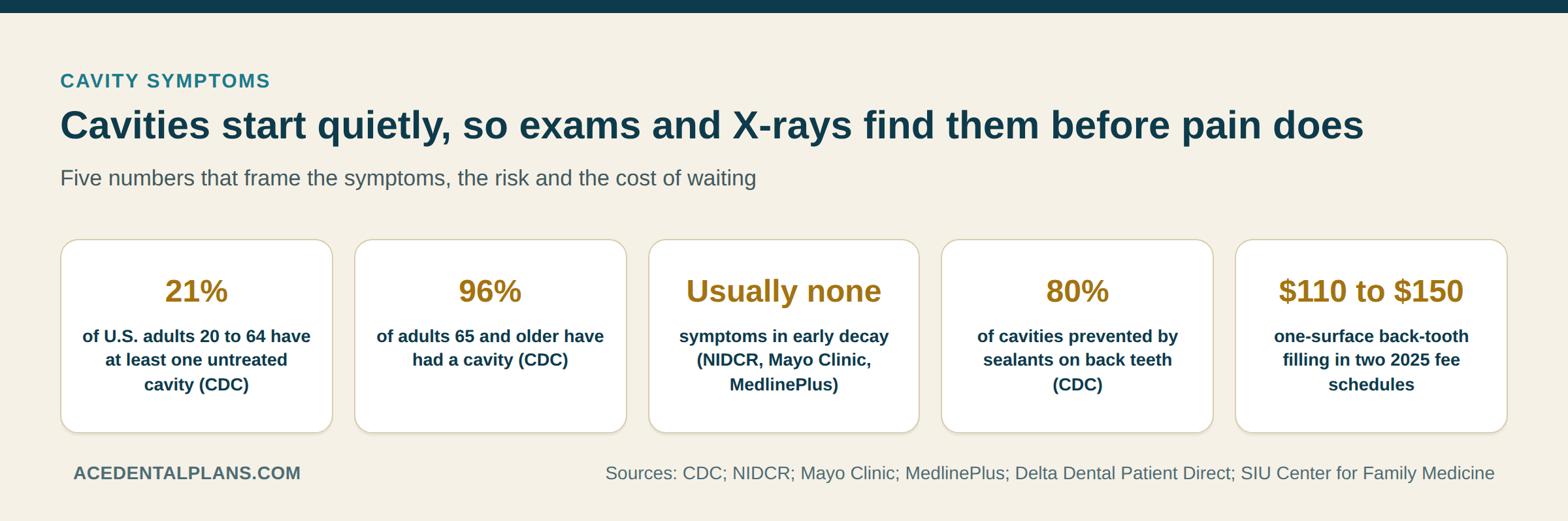
Dentists use several staging systems, and the boundaries blur in practice. Table 1 uses the sequence that NIDCR, MedlinePlus, Mayo Clinic and the American Association of Endodontists describe. Decay moves through enamel, then dentin, then the pulp with its nerves and blood vessels, then into infection beyond the tooth. Read the third column as typical, not guaranteed. Some people feel nothing at a stage where others feel plenty.
| Stage | What is happening | What you may notice | Usual dental response |
|---|---|---|---|
| 1. Early demineralization | Minerals leave the enamel; the surface is still intact | Usually nothing; sometimes a chalky white spot | Fluoride, better cleaning, fewer acid attacks; can be reversed |
| 2. Enamel cavity | Enamel has broken down and a small hole has formed | Often nothing; a rough spot, pit, or brown or black stain | Filling is the common treatment; some small lesions may be managed without drilling |
| 3. Dentin involved | Decay reaches the softer layer under the enamel | Sensitivity to sweets, hot or cold; pain when biting; food catching | Filling; a crown if too little tooth is left to hold a filling |
| 4. Pulp involved | Decay reaches the nerves and blood vessels inside the tooth | Lingering sensitivity to hot or cold, severe pain when chewing or biting | Root canal to save the tooth, or extraction in severe cases |
| 5. Infection beyond the tooth | An abscess, a pocket of pus, forms at the root | Pain, a pimple on the gum, facial swelling, fever | Prompt dental care; emergency care if swelling spreads or breathing or swallowing is hard |
Two small notes on the table. First, the “may be managed without drilling” line in stage 2 reflects a 2018 ADA guideline on nonrestorative caries treatment, which presents 11 recommendations tied to lesion type, tooth surface and dentition. It lists options such as 38% silver diamine fluoride, sealants, resin infiltration and fluoride varnish. Which lesions suit which option is a clinical call, and the ADA News summary doesn’t map them. Second, the crown in stage 3 comes from the ADA’s own wording: a crown can strengthen a tooth with a large filling when there isn’t enough tooth remaining to hold the filling.
Early and Late Symptoms: How Soon to Book Each One
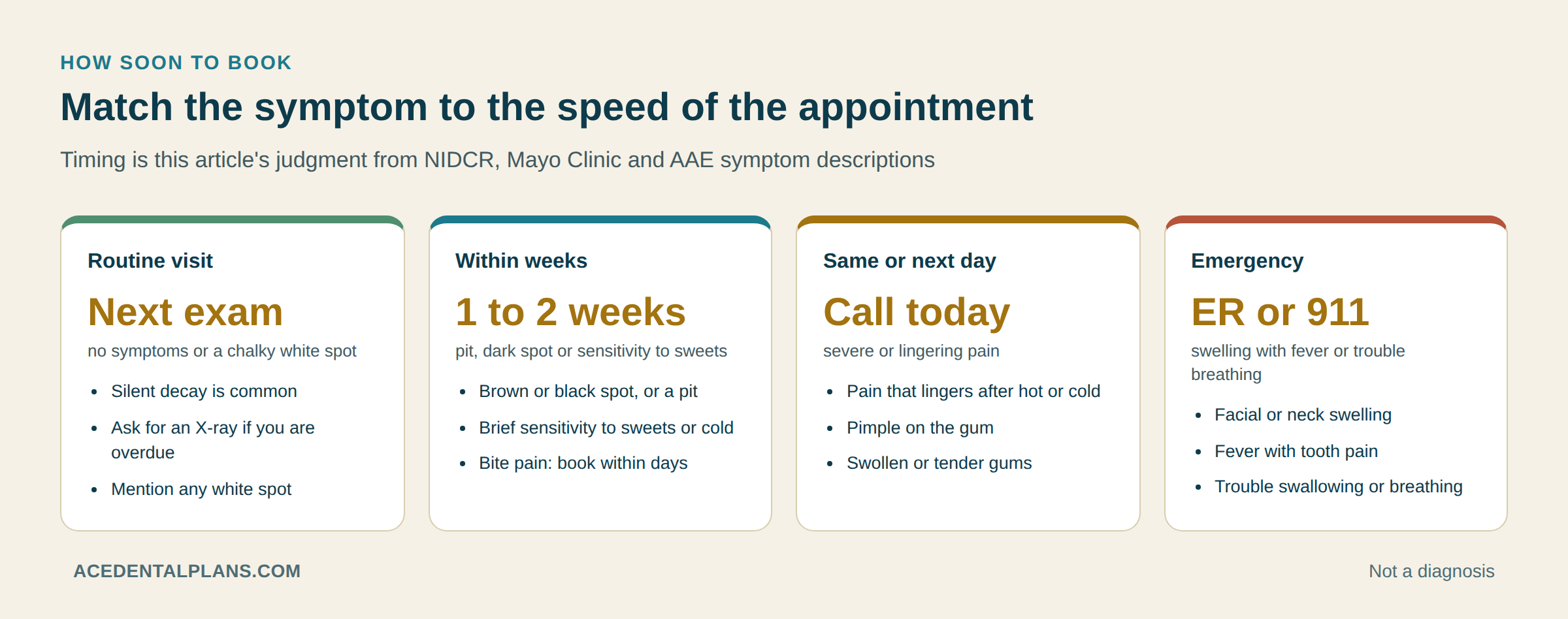
Table 2 sorts what people actually notice into a rough order of urgency. It isn’t a diagnosis. The same symptom can come from decay, a cracked or worn tooth, gum recession or an old filling, and the ADA lists all of those as causes of tooth sensitivity. A dentist has to look.
| What you notice | What it may mean | How soon to book |
|---|---|---|
| Nothing at all | Early decay is usually silent, so a clean-feeling mouth proves little | Keep regular exams and X-rays |
| A chalky white spot on a tooth | Possible early demineralization | Mention it at the next visit; sooner if it is spreading |
| A brown or black spot, or a pit your tongue catches on | Decay may have broken through the enamel | Within weeks |
| Brief sensitivity to sweets | Decay near or in the dentin, or exposed root, worn enamel or a worn filling | Within weeks |
| Pain with hot or cold that fades quickly | Dentin exposure from decay, recession or a crack | Within a week or two |
| Pain when you bite down, or food packing in one spot | A deeper cavity, a broken filling or a cracked tooth | Within days |
| Pain that is severe or lingers after hot or cold | The pulp may be inflamed or infected | Call the dentist the same or next day |
| A pimple on the gum, or swollen or tender gums | Possible infection at the root | Same day |
| Facial swelling, fever, trouble swallowing or breathing | Infection that may be spreading | Emergency room or 911 |
The timing column is this article’s judgment, built from the symptom descriptions in NIDCR, Mayo Clinic and the AAE, not a published triage chart. Mayo Clinic’s own advice is simple: with a toothache or mouth pain, see the dentist as soon as possible. Everything in the first four rows is short of that, but none of it is a reason to wait for pain.
Seek prompt care if
- Pain is severe or lingers after hot or cold (the AAE lists severe pain while chewing and lingering sensitivity as signs the pulp is involved).
- There is a pimple on the gum, or the gums near a sore tooth are swollen or tender.
- Your face or jaw is swollen, or you have a fever with tooth pain. NIDCR notes that an infected tooth can cause facial swelling and fever.
Swelling of the face or neck, trouble breathing or swallowing, or bleeding you can’t control calls for 911 or an emergency room.
Why Many Cavities Cause No Pain Until Late
A reader with a quiet mouth might reasonably ask whether symptoms are a reliable early warning. They aren’t. Mayo Clinic says early cavities often cause no symptoms, and NIDCR says the same. MedlinePlus puts it plainly: “In early tooth decay, you usually don’t have symptoms.” Sensitivity shows up once decay reaches the dentin, and pain from the nerve comes later still.
That sequence means a cavity can grow for a long time between stage 1 and the first twinge. The practical consequence is that the two tools for finding it early are not symptoms. They are the exam and the X-ray. NIDCR says decay is often found at a routine dental check-up. The ADA says X-rays can reveal damage or disease not visible during an exam, including new cavities, and that you may not need one at every visit. How often depends on your oral health, age, disease risk and signs or symptoms.
Symptoms That Look Like Cavities but May Have Another Cause
Sensitivity and tooth pain are shared by several problems, so a symptom alone can’t name the cause. The ADA’s page on sensitive teeth lists tooth decay, fractured teeth, worn fillings, gum disease, worn tooth enamel and exposed tooth roots. When dentin is exposed, its tiny tubules let hot, cold, acidic or sticky substances reach the tooth’s nerves. That is why the same jolt from an ice cube can come from a cavity, a receding gumline or a worn spot.
The American Association of Endodontists adds a second branch. The pulp can become inflamed or infected from deep decay, repeated dental procedures, faulty crowns, or a crack or chip. Trauma may also damage the pulp even when the tooth shows no visible chip or crack. So a lingering ache in a tooth with no visible hole doesn’t prove that decay is absent. A visible hole doesn’t prove it is the source of the pain either.
The dentist sorts these out with an exam, tests and imaging. You can speed that up by arriving with specifics. Dentists can’t see your pain, and “it hurts” covers a lot of ground.
- Which tooth or side, and whether it is upper or lower.
- The trigger: sweets, cold, heat, biting, or releasing a bite.
- How long it lasts after the trigger is gone. The AAE treats lingering sensitivity as a sign worth reporting.
- When it started, and whether it is getting worse.
- Recent dental work or an injury to that area.
- Medicines you take, since many can cause dry mouth.
Advice from the American Dental Association on plain sensitivity is a good limit on self-treatment. Desensitizing toothpaste usually requires several applications before sensitivity is reduced, and if the pain is severe and persistent, the sensitivity may need more than toothpaste can do.
Who Is at Higher Risk: Six Conditions That Raise the Odds
Anyone with teeth can get decay, NIDCR notes, from childhood through older age. But some situations tilt the balance toward mineral loss, and several of them have nothing to do with how well you brush. Mayo Clinic, MedlinePlus, NIDCR and the ADA each name some of the following.
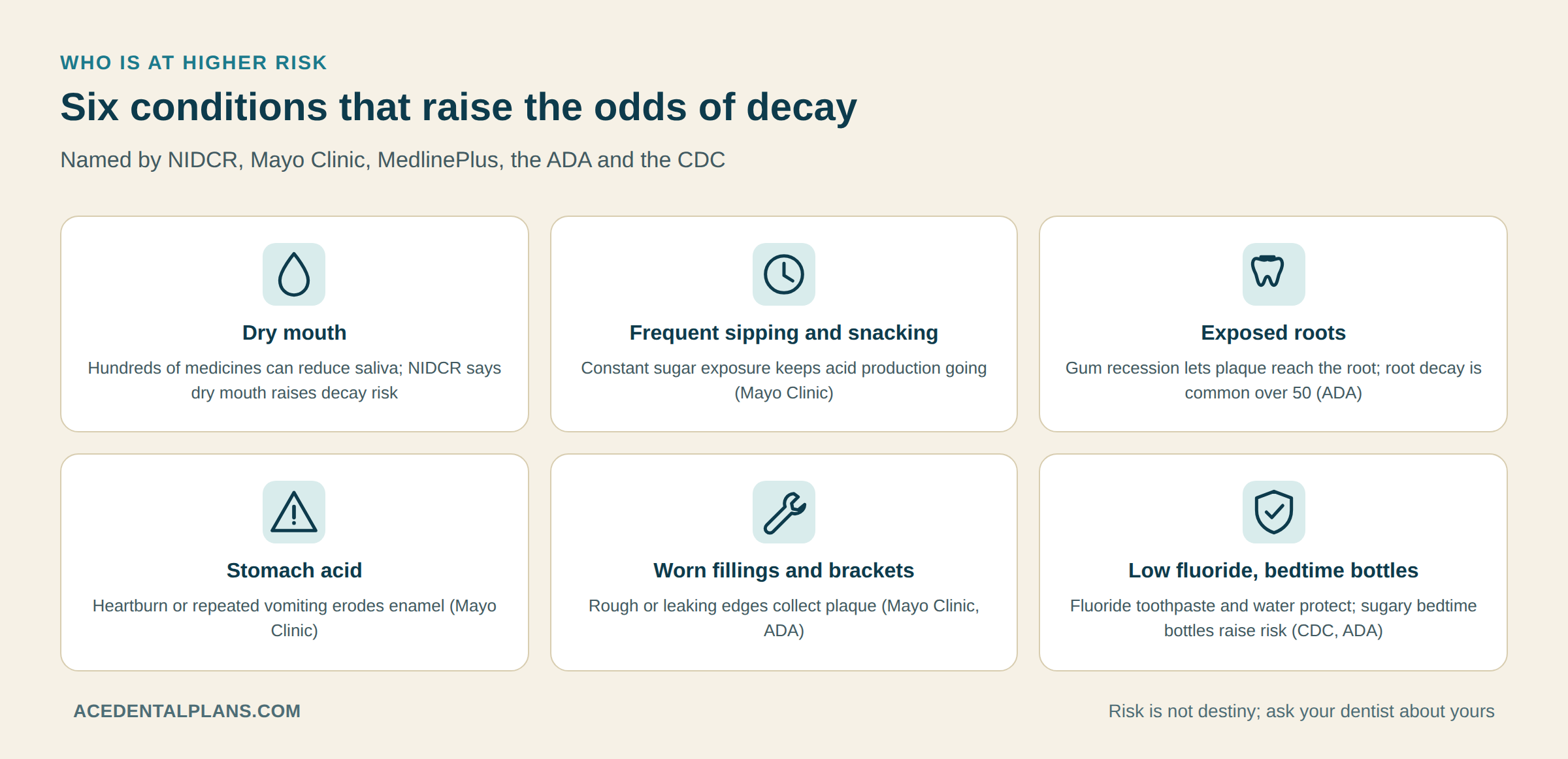
Dry mouth. NIDCR says dry mouth increases the risk of tooth decay, because saliva contains calcium and phosphate that help keep teeth strong. Hundreds of medicines can reduce saliva; blood pressure, depression and bladder medicines often do. Sjögren’s disease, HIV/AIDS, diabetes and cancer treatment can too. NIDCR adds that dry mouth is not a normal part of aging, so it is worth raising with a dentist or doctor rather than accepting it.
Frequent sipping and snacking. The ADA advises balanced meals and limiting snacking, and Mayo Clinic explains why: constant sugar exposure keeps acid production going. The number of exposures matters as much as the amount.
Exposed roots. The ADA says gum recession combined with an increased incidence of gum disease can expose tooth roots to plaque, and that people over 50 commonly develop root decay. If you have bleeding or receding gums, the guide to gum disease symptoms, stages and costs covers that side of the picture.
Acid from the stomach. Mayo Clinic lists heartburn (GERD) and eating disorders with repeated vomiting as risks, because stomach acid reaching the mouth erodes enamel. The ADA’s pregnancy guidance gives a practical step for anyone who vomits: rinse immediately with water, or warm water with baking soda, to minimize the erosive effects of the acid.
Worn fillings and dental devices. Mayo Clinic says rough or failing fillings make plaque easier to collect, and the ADA says older fillings may weaken and tend to fracture and leak around the edges. The ADA also warns that plaque build-up around braces brackets could permanently stain or damage teeth.
Low fluoride and bedtime bottles. MedlinePlus lists low fluoride intake and young children who use bottles, especially with juice or at bedtime. The ADA says baby bottle tooth decay most often affects the upper front teeth. And tobacco: NIDCR lists avoiding tobacco, including smokeless tobacco, among its prevention steps.
How Dentists Find a Cavity: Exam, Probe and X-Ray
Decay is rarely found by symptoms. NIDCR says dentists find it at routine check-ups. They look for white, brown or black staining, check for soft or sticky areas and may take an X-ray, which can show decay. MedlinePlus adds that dentists usually find decay by looking at the teeth and probing them with dental instruments, and that they ask about symptoms. Between teeth and under old fillings, where the eye can’t see, the X-ray does the work. The ADA’s guidance is that you may not need one at every visit, and the schedule depends on your oral health, age, disease risk and symptoms.
Those pieces explain the usual contents of a visit. A routine exam looks at the whole mouth. A limited or problem-focused exam looks at one complaint. Fee schedules list X-rays as single periapical images, two- or four-image bitewing sets, and panoramic images. What each costs, with and without a plan, is covered in the guides to dental cleaning cost with exam and X-rays and dentist visit cost without insurance. A cleaning with no plan is covered in dental cleaning cost without insurance. Two 2025 fee schedules give a sense of scale in Table 3 below.
Other detection aids exist beyond the eye, probe and X-ray. The sources opened for this article describe only those three. If an office proposes another, ask what it adds, what it costs and whether your plan treats it as a separate charge.
Treatment by Stage: From Fluoride to Extraction
MedlinePlus gives the ladder in one line: fluoride treatments for early decay, fillings for cavities, root canals for pulp infection and extraction in severe cases. Which treatment you get depends on how bad the problem is. Here is each step at decision level, not as a prescription.
Stages 1 and 2: fluoride, other nonrestorative options and fillings
A white spot is a candidate for fluoride, which NIDCR says can reverse early decay when a dentist applies it. For some small lesions, the ADA’s 2018 guideline lists additional options without drilling, including silver diamine fluoride, sealants and resin infiltration. When the enamel has broken down into a cavity, NIDCR says dentists commonly treat it by filling it: they remove the decayed tissue and restore the tooth. Fee schedules list a caries-arresting medicament per tooth as its own line, $33 in one Colorado discount-plan schedule and $10 at one Illinois health center in 2025. Filling prices are broken out in dental filling cost without insurance, and sensitivity after the filling goes in has its own answer in tooth sensitivity after a filling.
Stage 3: larger fillings and crowns
When decay has reached the dentin and a lot of tooth is gone, the question becomes whether a filling can hold. The ADA says a crown can strengthen a tooth with a large filling when there isn’t enough tooth remaining to hold the filling. Crowns are priced by material and tooth in dental crown cost by material and tooth.
Stages 4 and 5: root canal, extraction and infection care
The American Association of Endodontists says root canal treatment is necessary when the pulp becomes inflamed or infected as a result of deep decay. Among the signs it lists are sensitivity especially to hot and cold, severe pain while chewing or biting, pimples on the gums, lingering sensitivity after the stimulus is gone, and swollen or tender gums. Prices by tooth, with and without a plan, are in the guide to root canal cost. If the tooth can’t be saved, extraction is the next step, as MedlinePlus notes for severe cases.
An abscess is a separate emergency track, covered in abscessed tooth symptoms and in the guide to tooth infection and how it can spread. The CDC calls spread from a cavity rare, but says it can be fatal. That is why swelling with fever isn’t a “wait and see” symptom.
When Your Risk Is High: What Dentists May Add
For some mouths, brushing twice a day isn’t enough on its own, and the dentist may add to the routine. The ADA’s 2018 guideline on nonrestorative caries treatment lists fluoride products in several forms. They include 5% sodium fluoride varnish, 1.23% acidulated phosphate fluoride gel, and 5,000 ppm fluoride toothpaste or gel. Sealants, resin infiltration and 38% silver diamine fluoride sit alongside them. The ADA News summary doesn’t say which product suits which lesion or which patient, so the choice belongs in the exam room.
Dry mouth calls for its own steps. NIDCR suggests drinking water, with sips during meals, and chewing sugarless gum or sucking sugarless candy to stimulate saliva. It lists caffeine, tobacco and alcohol as things that dry the mouth, and a humidifier at night as another option. Some sugarless gums and candies contain xylitol, which NIDCR says may help prevent cavities. None of this replaces fluoride toothpaste or a dental visit, and NIDCR says a dentist or doctor should look into why the mouth is dry.
When risk is high, ask four questions. How often should my teeth be examined and X-rayed? Which fluoride products fit my situation? Would sealants help any back teeth? Is any medicine I take likely to be causing dry mouth? The ADA’s X-ray guidance ties frequency to your oral health, age, disease risk and symptoms, so a higher-risk mouth may get X-rays more often than a lower-risk one.
Children, Adults and Older Adults: Where Cavities Differ
Children. The CDC says half of children aged 6 to 9 have had at least one cavity. Children aged 5 to 19 from low-income families are about twice as likely to have cavities (25% versus 11%). Fluoride varnish reduces cavities in baby teeth by one-third, per the CDC, and dental sealants on back teeth prevent 80% of cavities. The age-by-age routine follows this section.
Adults. Adults get new cavities, and they also get decay around old fillings. The ADA says fillings may weaken and tend to fracture and leak around the edges over the years. Among adults 20 to 64, 21% had at least one untreated cavity, according to the CDC, so a long gap between visits is common and not unusual.
Older adults. Ninety-six percent of adults 65 and older have had a cavity, and one in six has untreated decay, the CDC reports. Receding gums expose root surfaces, which NIDCR and the ADA both name as a site for decay. The ADA adds that people over 50 commonly develop root decay. Because dry mouth from medicines is a risk, a medication review can be part of a cavity conversation. NIDCR says a provider may review your medical history and medications and may suggest a saliva-production test. Talk to the prescriber before changing any prescribed medicine; a dentist can often add fluoride and dry-mouth steps without touching it.
During pregnancy. According to the ADA News summary, preventive, diagnostic, restorative and emergency dental treatment may be performed in pregnant patients. Tell your dentist how many weeks pregnant you are. People who vomit should rinse with water or a mix of warm water and baking soda. For what dentists consider safe and what to ask, the guide to dental care during pregnancy goes further.
An Age-by-Age Routine for Babies and Young Children
The ADA’s baby bottle tooth decay page gives a sequence that works as a checklist. It is a general routine from one source, so your pediatrician or dentist may adjust it for your child.
- Before the first tooth: wipe the gums with a clean, damp gauze pad or washcloth after each feeding.
- When the first tooth appears: brush gently with a child-size toothbrush and a rice-grain smear of fluoride toothpaste, and talk to a dentist about scheduling the first visit.
- Bottles and cups: fill bottles only with formula, milk or breast milk, not sugar water, juice or soft drinks, and finish bedtime and nap bottles before the baby sleeps. Encourage drinking from a cup by the first birthday.
- Saliva sharing: cavity-causing bacteria can pass from a caregiver through saliva, so avoid sharing a feeding spoon, cleaning a pacifier with your mouth, or dipping a pacifier in sugar or honey.
- Ages 3 to 6: move to a pea-sized amount of fluoride toothpaste.
- Until about age 6 or 7: supervise brushing until the child can reliably spit out toothpaste.
- School age: ask about sealants, which NIDCR describes as covering the chewing surfaces of permanent teeth, and about supplemental fluoride.
The ADA page doesn’t describe what early decay looks like in a baby’s mouth. If you notice any change in a child’s teeth, have a dentist look. The 2025 fee schedules in Table 3 list a sealant at $39 to $60 per tooth and fluoride varnish at $31 to $55, which is the preventive end of the cost ladder.
Four Cavity Myths Checked Against the Sources
“If it doesn’t hurt, it’s fine.” NIDCR, Mayo Clinic and MedlinePlus all say early decay usually has no symptoms. Pain is a late signal, not a clearance.
“Only candy causes cavities.” NIDCR says decay-causing bacteria form acid when they meet sugars and starches from foods and drinks, and MedlinePlus says the same. Starchy foods count, and so does how often you eat or drink, because Mayo Clinic says frequent snacking or sipping keeps acid production going.
“Baby teeth don’t matter because they fall out.” The CDC says cavities in children can affect eating, speaking, playing and learning. Talk to a dentist about a first visit when the first tooth appears, the ADA says. It also notes that baby bottle decay most often shows on the upper front teeth.
“A cavity can be rinsed or brushed away.” Only the earliest stage can heal. NIDCR says a white spot can rebuild with minerals from saliva and fluoride, but once enamel has broken down into a cavity, dentists commonly treat it by filling it. That is why the dentist’s view of a pit or a dark spot matters more than any home product.
Prevention That Has Numbers Behind It
The CDC’s summary is blunt: cavities can be prevented. Most of the steps below appear on at least two of the ADA, NIDCR and CDC pages, which is as close to consensus as dental advice gets.
- Fluoride toothpaste, twice a day. Both the ADA and NIDCR say to brush twice a day with fluoride toothpaste. Children who brush daily with it have fewer cavities, according to the CDC.
- Cleaning between teeth daily. Floss or another interdental cleaner, per the ADA and NIDCR.
- Fewer sugar exposures. Limit sugary drinks and snacking, which the ADA, NIDCR and Mayo Clinic all stress. Mayo’s reasoning is that constant exposure keeps acid production going.
- Fluoridated water. Children who drink fluoridated tap water have fewer cavities, per the CDC. NIDCR lists fluoride from water as one of three routes alongside toothpaste and rinse.
- Sealants. Dental sealants on back teeth prevent 80% of cavities, says the CDC. NIDCR describes them as covering the chewing surfaces of teeth.
- Fluoride varnish for young children. It reduces cavities in baby teeth by one-third, the CDC says.
- No tobacco. NIDCR lists avoiding tobacco, including smokeless tobacco.
- Regular exams and cleanings. Visit regularly for professional cleanings and oral examination, the ADA says. It doesn’t set a schedule on that page, so ask your dentist what yours should be.
If you have dry mouth, NIDCR adds a few steps. Sip water, and chew sugarless gum or suck sugarless candy to stimulate saliva. Xylitol in some sugarless gums and candies may help prevent cavities. It also advises seeing a dentist or doctor to find out why the mouth is dry.
Home Care Limits and When to See a Dentist
Home care works at one stage only. Once enamel has broken down into a cavity, NIDCR’s treatment advice is a filling by a dentist. Fluoride toothpaste, a rinse or a sugar-free gum can protect a white spot and the surrounding enamel, but none of them replaces a diagnosis.
For sensitivity, the ADA says desensitizing toothpaste usually requires several applications before the sensitivity is reduced. A root canal may be considered if the sensitivity is severe and persistent and can’t be treated by other means. If you’re already in pain, the steps that are safe to try while waiting for an appointment are covered in toothache home relief. That guide stops where the dentist’s work starts.
A short path for deciding when to call
- Is there facial swelling, a fever with tooth pain, or trouble swallowing or breathing? Go to an emergency room or call 911.
- Is the pain severe, lingering after hot or cold, or accompanied by a pimple or swollen gums? Call a dentist the same or next day. Say it may be infected.
- Does it hurt to bite or to eat sweets or cold things? Book within days to a couple of weeks, and say which foods set it off.
- Do you see a pit, a dark spot or a white spot, and feel nothing? Book the next routine visit, and ask for an X-ray if you are overdue.
- Have you had no exam in a year or more? Book one. Silence is not the same as health.
What Cavity Care Costs, Stage by Stage
Dollar figures for dental care vary by office, region and plan, and national averages hide a wide spread. Table 3 doesn’t try to average. It lists published 2025 cash fees from two sources. The first is the Delta Dental Patient Direct general-dentist fee schedule for Colorado (effective November 1, 2025), a discount plan the schedule says is not insurance. The second is the full-fee schedule of the SIU Center for Family Medicine in Illinois, a federally qualified health center (effective March 1, 2025). A private practice in your area may charge differently, and neither source includes anesthesia or follow-up visits unless it says so.
| Service | Where it usually fits | Delta Dental Patient Direct, Colorado | SIU Center for Family Medicine, Illinois, full fee |
|---|---|---|---|
| Periodic exam plus two bitewing X-rays | Finding decay | $34 ($10 + $24) | $102 ($60 + $42) |
| Fluoride varnish | Stage 1 and prevention | $31 | $55 |
| Caries-arresting medicament (silver diamine fluoride) | Stage 1 to 2 in some cases | $33 | $10 |
| Sealant | Prevention | $39 | $60 |
| Composite filling, one surface, back tooth | Stage 2 | $110 | $150 |
| Composite filling, three surfaces, back tooth | Stage 3 | $166 | $225 |
| Core build-up | Stage 3 to 4, when a crown is planned | $138 | $225 |
| Porcelain or ceramic crown | Stage 3 to 4 | $825 | $1,200 |
| Root canal, molar | Stage 4 | $804 | $1,500 |
| Simple extraction | Stage 4 to 5, if the tooth cannot be saved | $102 | $175 |
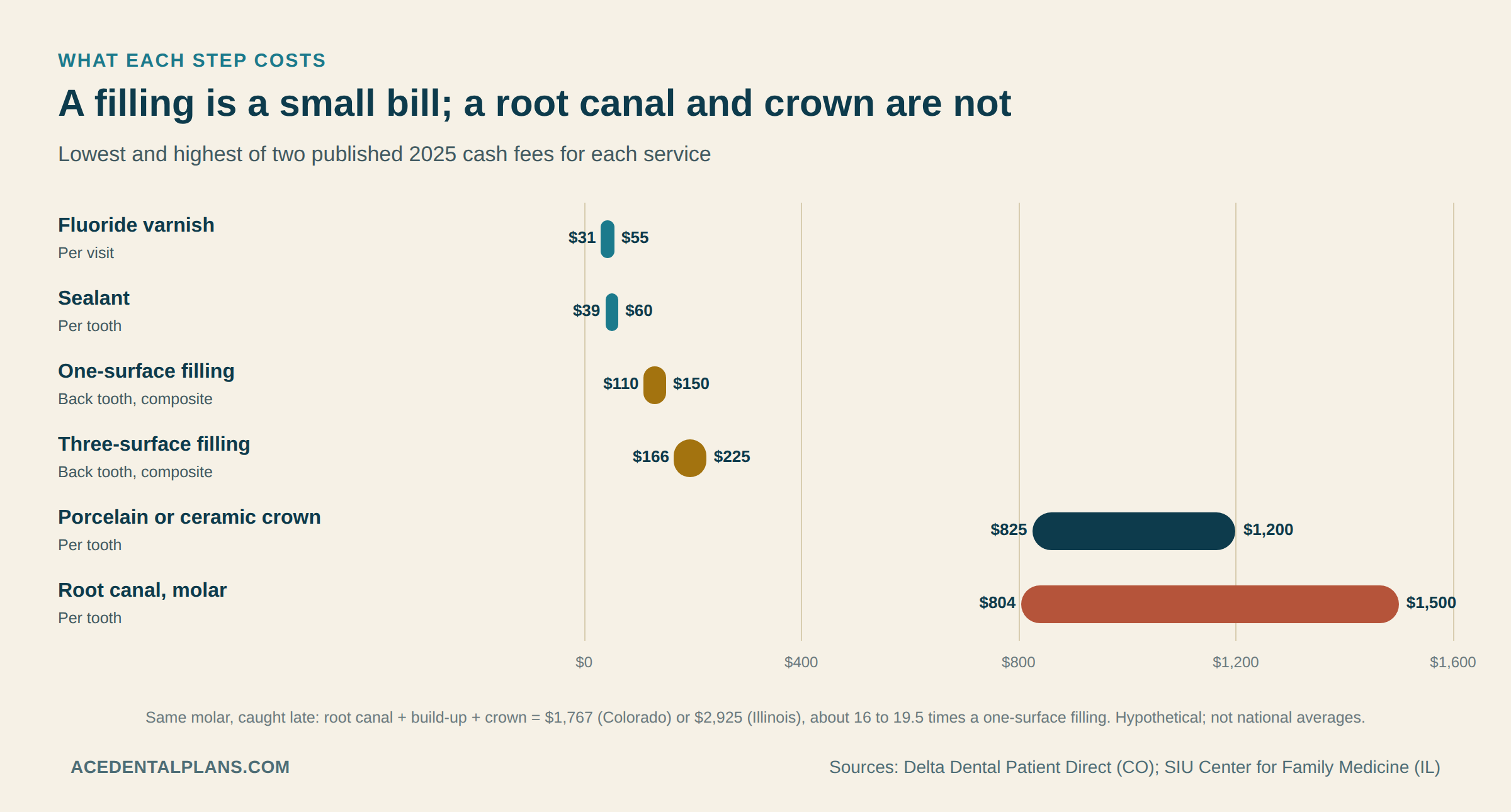
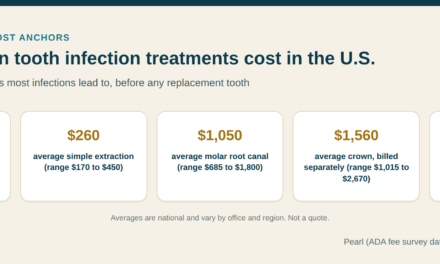
The ladder in Table 3 is steep. A fluoride varnish is $31 to $55, a one-surface filling $110 to $150, a molar root canal $804 to $1,500 and a porcelain crown $825 to $1,200. The deeper the decay, the more steps the tooth needs.
Reading the cavity lines on an estimate
Both schedules in Table 3 use ADA procedure codes (CDT codes), and the codes explain why prices step up as a cavity grows. Composite fillings on back teeth run D2391 for one surface, D2392 for two, D2393 for three and D2394 for four or more. Delta lists them at $110, $140, $166 and $195, and the Illinois clinic at $150, $175, $225 and $275. Amalgam fillings follow the same surface count in D2140, D2150, D2160 and D2161. The surface count, not how big the tooth feels, drives the filling code.
Crowns are D2740 for porcelain or ceramic, build-ups D2950, and root canals D3310, D3320 and D3330 for front teeth, premolars and molars. Exams are D0120 (periodic), D0140 (limited, problem-focused) and D0150 (comprehensive). A visit for pain relief alone has its own code, D9110 for palliative treatment of dental pain, listed at $63 in Colorado and $125 in Illinois. If an estimate shows lines with no code, ask for them, because the code is what a plan reads.
Insurance, Paying Without It, and Where to Start
Coverage is conditional, and it varies by plan. Humana’s consumer page says many dental insurance plans cover 100% of in-network routine preventive care. It puts basic procedures such as fillings at usually up to 80% and crowns or dentures at up to 50%, with typical annual maximums of $1,000 to $2,000. Those percentages come from one insurer’s overview, and your plan’s tiers, deductible, waiting periods and annual maximum decide the real figure. The guide to what dental insurance may cover goes through the tiers in order.
Without coverage, the ladder in Table 3 is the argument for an early visit. The playbook for lowering cash prices is in dental care without insurance. The Illinois schedule also shows how income-based fees can change a line. Its one-surface filling ranges from $8 to $98 across five sliding-fee tiers, and a molar root canal from $75 to $975, depending on family size and income. More guides on symptoms and emergencies sit in the oral health and dental emergencies hub.
From Diagnosis to Treatment Plan: A Practical Sequence
A cavity diagnosis often arrives as a printed treatment plan with several lines. Reading it in the right order saves money and avoids delaying the wrong item.
- Sort by urgency. Pain, infection and swelling come first. The AAE says untreated inflammation or infection of the pulp can cause pain or lead to an abscess, and the CDC says an abscess from a cavity can spread. Ask the dentist which lines can’t wait.
- Ask which lines are monitoring, prevention or repair. A fluoride varnish and a filling are not the same kind of decision, and some early spots may be watched.
- Get the codes and fees in writing. Table 3’s code-based fees give you a way to judge whether a line is in the range of published cash fees, though local fees differ.
- Check the plan before the visit. Look at the plan’s tier for each line, the deductible and the annual maximum. The guide to how to pay for expensive dental work compares eight ways to fund a larger bill if the plan leaves a gap.
- Decide the order with the dentist. If several teeth need work, ask whether the order can match your budget and benefit year without letting any tooth get worse in the meantime.
That last step is the hardest one, because the answer depends on the tooth. A small cavity may tolerate a few weeks’ delay and a tooth with lingering pain may not. Only the dentist who has seen the X-ray can say which is which.
Words on Your Chart and Estimate
Dental paperwork borrows terms the sources use in specific ways. These definitions come from the pages cited in this article and from the fee schedules.
- Cavity and tooth decay. The ADA uses the two together: cavities, or tooth decay, is the destruction of tooth enamel, and a cavity is a small hole in the tooth. NIDCR also uses the term “caries,” as in early childhood caries.
- Demineralization. The loss of minerals from enamel. NIDCR’s white spot is the visible sign of the early form.
- Enamel, dentin and pulp. The hard outer layer, the softer layer under it, and the center that holds nerves and blood vessels, as Mayo Clinic describes them.
- Bitewing and periapical X-rays. Fee schedules list two- and four-image bitewing sets and single periapical images, along with panoramic images.
- Sealant. A plastic protective coating on the chewing surfaces of back teeth, per the ADA.
- Fluoride varnish. A fluoride treatment applied in the office; the CDC says it reduces cavities in baby teeth by one-third.
- Caries-arresting medicament. The fee-schedule name for a code that covers silver diamine fluoride-type products. The ADA’s 2018 guideline names 38% silver diamine fluoride among its options.
- Core build-up. A line that appears with a crown when the dentist rebuilds part of the tooth first; the Colorado schedule describes it as a core build-up, including any pins when required.
- Palliative treatment. A minor procedure to relieve dental pain, priced as its own visit.
Questions to Ask Your Dentist About a Cavity
- How deep is it? Ask which layer the decay has reached and whether the X-ray shows it near the pulp.
- Can it be watched or treated without drilling? If it is early, ask whether fluoride, a sealant or another option applies.
- What is the plan if it is bigger than it looks? Ask whether a crown or root canal could follow and what triggers that change.
- What will it cost, with the code? Ask for a written estimate with the procedure codes and the fee for each.
- What does my plan do with this service? Ask whether a predetermination is available for anything above a basic filling.
- Why did this cavity form? Dry mouth, a worn filling, diet pattern or exposed root each lead to a different prevention step.
- When should I come back, and do I need an X-ray? Frequency depends on your risk, per the ADA, so ask for yours.
- What should I watch for in the days after? Ask which symptoms mean call the office.
Bottom Line
A cavity is a process that moves inward through enamel, dentin and pulp, and the sensations arrive late. A white spot can heal with fluoride. A hole needs a filling. Pain that lingers, a pimple on the gum, swelling or fever means the nerve or beyond is involved, and that changes both the urgency and the price.
The sources opened for this article agree on the habits that matter. Use fluoride toothpaste twice a day, clean between teeth, and cut the number of sugar exposures through the day. Add fluoridated water, sealants for children, and regular exams and X-rays so decay is found before it hurts. Risk isn’t evenly spread. Dry mouth, exposed roots, reflux, worn fillings and bedtime bottles each deserve a conversation.
What the fee schedules add is the cost of waiting. A one-surface filling runs $110 to $150, against $1,767 to $2,925 for a root canal, build-up and crown on the same kind of tooth. If you’ve been putting off a visit because nothing hurts, that is the number to weigh, together with what your plan covers.
Frequently Asked Questions
What are the first signs of a cavity?
Often there are none. NIDCR, Mayo Clinic and MedlinePlus all say early decay usually causes no symptoms. When signs appear, they include a white, brown or black spot, a pit or hole, sensitivity to sweets, heat or cold, and pain when biting. A dentist finds many cavities on exam or X-ray before any of that shows up, which is why regular visits matter even when nothing hurts.
Can a cavity heal on its own?
Only the earliest stage. NIDCR says a white spot where minerals have been lost can still rebuild from saliva minerals and fluoride, or with fluoride applied by a dentist or hygienist. Once enamel has broken down into a cavity, NIDCR says dentists commonly treat it with a filling. Better brushing alone won’t close a hole, so a dentist should look at any pit or dark spot.
How can I tell if I have a cavity if nothing hurts?
You usually can’t, which is the point. Look for white, brown or black staining and for a pit your tongue catches on. Still, the ADA says X-rays can reveal new cavities not visible during an exam, and NIDCR says decay is often found at routine check-ups. If you’re overdue, book an exam and ask whether an X-ray is needed.
Why does my tooth hurt when I eat sweets or drink something cold?
Sensitivity to sweets, heat or cold can mean decay has reached the dentin. Mayo Clinic says sensitivity increases at that stage. The ADA also lists worn enamel, exposed roots, a fractured tooth, worn fillings and gum disease as causes. Because several of those look alike, an exam is the way to sort them out. Pain that lingers after the cold is gone is a stronger signal to call soon.
When should I see a dentist for a possible cavity?
Mayo Clinic says to see the dentist as soon as possible for a toothache or mouth pain. For a spot or mild sensitivity, book within weeks. For severe or lingering pain, a pimple on the gum or swollen gums, call the same or next day. Facial swelling, fever with tooth pain, or trouble swallowing or breathing calls for an emergency room or 911.
How fast does a cavity grow?
The sources opened for this article give no reliable timeline, and rates vary with saliva, diet, fluoride and the tooth. NIDCR describes decay as a balance: enamel rebuilds when minerals are restored and breaks down when more are lost than restored. What the sources do say is that symptoms arrive late, so the safe assumption is that a cavity is larger than it feels.
Can a cavity cause swelling or fever?
Yes, if the tooth becomes infected. NIDCR says an infected tooth can form an abscess, a pocket of pus, causing pain, facial swelling and fever. The CDC calls spread of that infection rare but says it can be fatal. Swelling with fever, or any swelling that makes it hard to swallow or breathe, needs emergency care rather than a routine appointment.
Are cavities contagious?
The bacteria involved can pass between people. The ADA says cavity-causing bacteria can pass from a caregiver to a baby through saliva, for example by sharing a feeding spoon or cleaning a pacifier with the mouth. That doesn’t mean a cavity itself is caught like a cold. Decay also depends on sugar exposure, fluoride and saliva, which the ADA and Mayo Clinic both describe.
How much does it cost to fill a cavity?
Two 2025 cash-fee schedules list a one-surface composite filling on a back tooth at $110 (Colorado discount plan) and $150 (Illinois health center full fee). Larger fillings cost more: $166 and $225 for three surfaces. Private offices vary, and plans may pay up to 80% of basic fillings, according to Humana’s overview. Ask for a written estimate with the procedure code.
Do I need a crown or root canal for every deep cavity?
No. A larger cavity can still be restored with a filling when enough tooth remains. The ADA says a crown can strengthen a tooth with a large filling when there isn’t enough tooth left to hold the filling. The AAE says a root canal is necessary when the pulp is inflamed or infected from deep decay. The dentist decides from the exam and X-ray.
Is it safe to treat a cavity during pregnancy?
According to the ADA News summary, preventive, diagnostic, restorative and emergency dental treatment may be performed in pregnant patients, and that you should tell your dentist how far along you are. It also says some procedures need to be discussed with a dentist. Rinsing with water, or warm water with baking soda, after vomiting helps limit acid on the teeth.
Can children get cavities in baby teeth?
Yes. The CDC says half of children aged 6 to 9 have had at least one cavity in primary or permanent teeth, and cavities can affect a child’s eating, speaking, playing and learning. The ADA says baby bottle tooth decay most often affects the upper front teeth, and advises talking to a dentist about the first visit when the first tooth appears.
Sources and Disclaimers
Clinical statements come from the American Dental Association (MouthHealthy and ADA News) and the National Institute of Dental and Craniofacial Research. They also draw on the Centers for Disease Control and Prevention, MedlinePlus, the American Association of Endodontists and Mayo Clinic. Prevalence figures are the CDC’s. Dollar figures come from two published 2025 fee schedules, one discount plan in Colorado and one health center in Illinois. They are cash fees for a single location each and not national averages. The insurance percentages come from one insurer’s consumer overview and show common patterns, not the rules of any plan. The worked examples, the stage-by-stage cost comparison and the urgency timing in Table 2 are original illustrations or judgments built from those sources. Check prices with the dentist and benefits with the insurer.
- American Dental Association, MouthHealthy — Cavities
- American Dental Association, MouthHealthy — X-rays
- American Dental Association, MouthHealthy — Sensitive teeth
- American Dental Association, MouthHealthy — Crowns
- American Dental Association, MouthHealthy — Baby bottle tooth decay
- American Dental Association, MouthHealthy — Braces
- ADA News — ADA releases guideline on nonrestorative caries treatments (October 2018)
- ADA News — Maintaining good oral health during pregnancy
- National Institute of Dental and Craniofacial Research — Tooth decay
- National Institute of Dental and Craniofacial Research — Dry mouth
- Centers for Disease Control and Prevention — About cavities (tooth decay)
- MedlinePlus (National Library of Medicine) — Tooth decay
- Mayo Clinic — Cavities and tooth decay: symptoms and causes
- American Association of Endodontists — What is a root canal?
- Delta Dental Patient Direct — General dentist fee schedule, effective November 1, 2025
- SIU Center for Family Medicine — Dental fee schedules: full fee and sliding fees, effective March 1, 2025
- Humana — What does dental insurance cover?
Important Information and Disclaimers
This article is general educational information. By using it, you accept the limits described below.
Not dental or medical advice
Nothing on this page is a diagnosis, a treatment recommendation or a substitute for an examination by a licensed dentist or physician. Reading this article does not create a dentist-patient or doctor-patient relationship. Only a licensed professional who has examined you and reviewed your history can tell you what your mouth needs. Do not delay, skip or stop professional care because of something you read here.
Prices are estimates, not quotes
Cost figures are ranges reported by the third-party sources cited in this article. Actual prices depend on your location, the provider, the complexity of your case, the materials used, the date of service and other factors, so what you pay may be higher or lower. A written treatment plan and fee estimate from the dental office is the only reliable number for your situation.
Insurance and plan examples are illustrations
Examples that use named amounts or percentages are hypothetical. Real benefits depend on your plan, network, waiting periods, annual maximum, deductible and the insurer’s rules at the time of treatment. A pre-treatment estimate or benefits check is not a promise of payment. Confirm the details with your insurer or plan administrator in writing.
Not insurance, legal, tax or financial advice
AceDentalPlans is an information publisher. Nothing here is insurance, legal, tax, investment or other professional financial advice, and nothing here recommends a particular provider, insurer, lender, discount plan or financing product. Company and product names belong to their owners and appear for identification only. Read the terms of any loan, financing offer or plan before you sign, and ask a qualified professional if you need advice on your own circumstances.
Third-party sources
This article cites government agencies, professional associations, insurers, lenders and other outside organizations. We do not control those sources. Their content can change, move or disappear, and listing a source is not an endorsement of it or of anything it sells.
No warranty
We aim for accuracy, but this article is provided “as is,” without warranties of any kind, express or implied, including warranties of accuracy, completeness, timeliness or fitness for a particular purpose. Some information may be out of date or contain errors by the time you read it.
Limitation of responsibility
To the fullest extent permitted by law, AceDentalPlans and its owners, authors and contributors are not responsible or liable for any loss, cost, injury, health outcome or other damage that results from using this article or relying on it. You are responsible for your own decisions about your care, your coverage and your money.
How this article is written
This article follows AceDentalPlans’ answer-first, U.S.-focused editorial approach. It uses conditional language for insurance, because coverage depends on the specific plan, and it names its sources so that you can read them yourself.