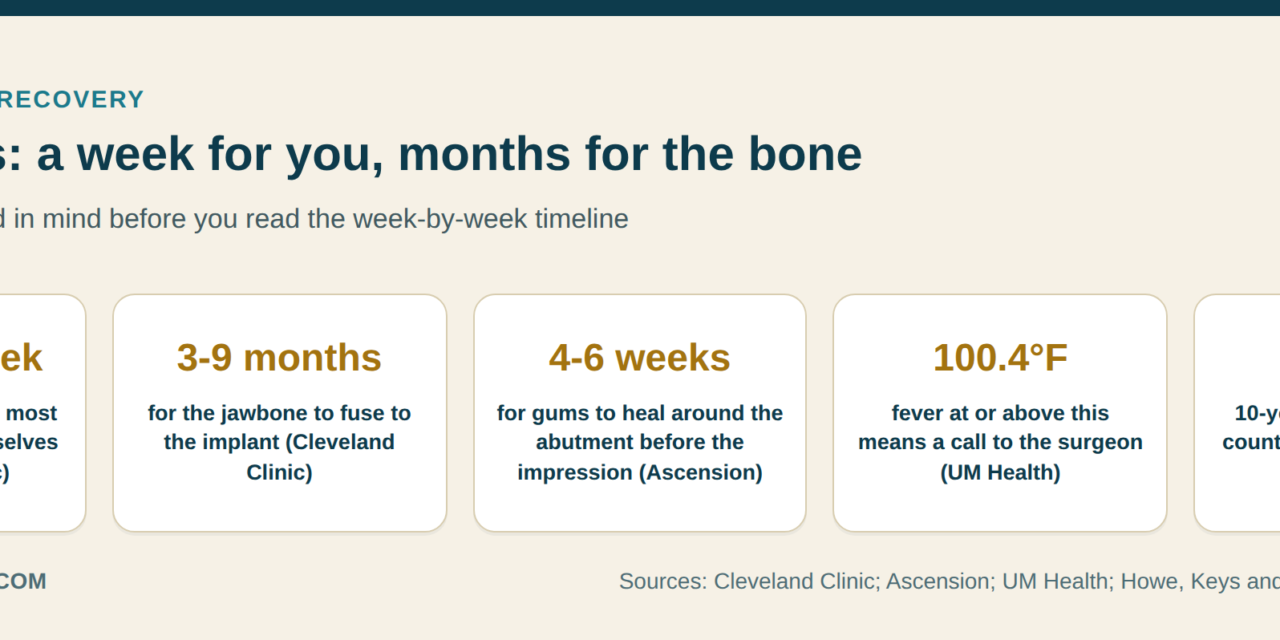
Most people feel close to normal about a week after dental implant surgery, but the implant itself needs far longer: bone commonly takes three to nine months to fuse to it before the final tooth goes on. Swelling usually peaks within the first few days. If a second stage is needed, the gums take roughly four to six weeks to heal around the connector before impressions and the crown.
This guide follows recovery in the order it happens: surgery day, the first week, the long wait while bone fuses, the second-stage visits and the crown. It also covers what a bone graft or sinus lift adds, where pain medicine fits, and which symptoms deserve a phone call. How the procedure works, and what each part is, is laid out in the dental implants guide. Prices get one section here, near the end, because the calendar affects the bill.
Key Takeaways
- Two clocks run at once. Cleveland Clinic puts the first stage of healing at about one week, while bone fusion (osseointegration) takes 3 to 9 months.
- Bleeding and swelling follow a pattern. Oozing is expected for the first 12 to 24 hours (University of Washington), and swelling climbs for 24 hours to about 3 days before it falls.
- Day three is a checkpoint. Swelling or pain that is rising after day 3, rather than easing, is on the University of Washington call-us list.
- A fever of 100.4°F (38°C) or higher, bleeding that will not stop, or pain that prescribed medicine does not relieve means calling the surgeon (UM Health).
- Grafts and sinus lifts add months. A British oral surgeons’ patient sheet says implants usually follow a graft after 3 to 6 months of healing.
- Tobacco is the habit with the strongest evidence. In a 2024 review, 25 of 33 studies found a significant link between smoking and higher implant failure.

The Whole Recovery at a Glance, Stage by Stage
Two clocks run after implant surgery. Your body recovers from the operation in days to a couple of weeks. The implant recovers on a slower clock, measured in months, because bone has to grow against its surface before it can carry a tooth. Most of the confusion in online timelines comes from mixing the two.
Table 1 lays out each stage with the window a published source gives for it. The windows are ranges, not promises. A single implant in a healthy jaw with good bone sits at the short end; a graft, a sinus lift, diabetes that is not well controlled or tobacco use can stretch the calendar.
| Stage | Window | What is happening | Where the window comes from |
|---|---|---|---|
| Surgery day | Day 0 | Numbing (sedation optional), an incision, a drilled channel, the implant, then stitches. A temporary tooth may go on at the front of the mouth. | Cleveland Clinic, page dated June 2026 |
| First hours | Hours 0 to 24 | Bleeding and oozing are expected. Gauze, a cold pack, soft food once the numbness fades. | University of Washington; Penn Dental Medicine |
| Swelling peak | 24 hours to about 3 days | Swelling rises, then falls. Facial bruising can appear. | Penn (24 to 48 hours); University of Washington (2 to 3 days) |
| First follow-up | About 1 week | Loose stitches come out. Many people feel like themselves again. | University of Washington; Cleveland Clinic |
| Soft-diet stretch | First few weeks | Gentle foods while the implant settles. | American Academy of Implant Dentistry |
| Gum healing around the connector | About 4 to 6 weeks | The gum matures around a healing cap or abutment before the final impression. | Ascension health encyclopedia, reviewed June 2025 |
| Bone fusion | 3 to 9 months | The jawbone grows onto the implant surface (osseointegration). | Cleveland Clinic; American Academy of Implant Dentistry (whole process 3 to 9 months) |
| Crown fitting | Several weeks to make, several visits | Impressions, a lab-made crown, adjustments, attachment. | Ascension health encyclopedia |
| Graft first, implant later | 3 to 6 months before placement | New bone builds before the implant goes in. | British Association of Oral Surgeons patient sheet (UK) |

One more point about reading the table. The windows come from different organizations writing for different audiences, so they do not always line up to the day. Penn Dental Medicine says swelling increases for 24 to 48 hours; the University of Washington says 2 to 3 days. Both are describing the same ramp. Your surgeon’s written sheet should win over any web page, including this one.
Surgery Day and the First 24 Hours
Cleveland Clinic describes the operation in plain steps: local anesthesia numbs the gum, the surgeon opens the gum to expose bone, drills a small hole and widens it, seats the implant, repositions the gum and closes it with stitches. Sedation is optional. You are numb, so the surgery itself is not what hurts; the evening is where recovery begins.
Bleeding is the first thing to plan for. Penn Dental Medicine says minor bleeding and oozing are expected, that bleeding usually stops within an hour or two, and that oozing can last several hours. A slightly longer window comes from the University of Washington: bleeding or oozing for the first 12 to 24 hours. Upper implants can cause a brief nosebleed, according to Penn.
Both schools describe the same first-aid pattern. Bite on gauze with steady pressure for 30 to 45 minutes (Penn), or on surgical sponges for at least an hour and up to two or three (University of Washington). Heavy bleeding gets a clean, damp gauze pad pressed firmly for 20 minutes, then a repeat if needed. Penn adds a moistened tea bag after repeated gauze attempts fail, and both say to call if bleeding still will not stop.
Swelling control on day zero
Cold is the day-of-surgery tool. Penn suggests a cold pack on the cheek for 15 to 20 minutes, off for 10, repeated until bedtime. At the University of Washington the rhythm is 15 minutes on and 15 off, with a blunt addition: after the first day, ice will not help swelling. Both advise sleeping with the head raised; the University of Washington says to keep the head up and move as little as possible for 8 to 12 hours.
Heat is where the sheets split. Penn tells patients to switch from ice to moist heat on day three. Washington’s sheet says not to apply heat to the face unless the surgeon says so. That is not a contradiction worth agonizing over, because the sheets belong to different clinics with different habits. It is a reason to follow the one you were handed.
What to leave alone
Suction is the enemy of a fresh surgical site. Straws, sucking and smoking can dislodge the blood clot that protects the wound, the University of Washington says, which means more bleeding and slower healing. Penn adds: do not spit, wipe your mouth with a tissue or swallow instead, and keep fingers and tongue away from the site. For a sinus precaution, the University of Washington says to wipe rather than blow your nose and to sneeze with your mouth open.
Rinsing waits. No rinsing for 24 hours, says the University of Washington, and the British sheet for grafts says the same for the day of surgery. After that, both describe gentle warm salt-water rinses. Brushing can resume carefully around the area, and UM Health says to brush the other teeth after every meal with a soft brush but not to brush the incisions themselves.
Numbness deserves its own note. It is normal while the anesthetic wears off, but UM Health lists numbness that persists after the anesthesia should have worn off as a reason to contact the surgeon. For typical durations and what counts as lingering, see how long dental numbness lasts. If a tooth was removed in the same visit, the separate guide on numbness after tooth extraction applies to that site.
Days 2 to 7: Swelling Peaks, Then Settles
Day two and day three are usually the least photogenic part of recovery. Swelling is at or near its peak, and Penn adds that facial bruising may occur. Bruising is called normal in the University of Washington sheet. After the peak, swelling lasts several days to about a week, in Penn’s wording, and then fades.
A graft changes the numbers. The British Association of Oral Surgeons sheet says swelling and discomfort after grafting, inside and outside the mouth, usually settle after about three days but the area can stay sore for up to two weeks. The jaw may feel stiff. If your surgery included a graft or sinus lift, read the later section on that before judging your own pace.
The day-three checkpoint
The most useful rule in the sources is a trend, not a symptom. Patients are told to call if swelling or pain increases after 3 days (University of Washington). Rising is the signal. Both swelling and soreness should be heading down by then, however slowly, and a day-four morning that feels worse than day three deserves a call rather than another night of waiting.
Plenty of readers search for a reassuring number here: how much pain is too much? The sources do not give one, and for good reason, because pain is personal and procedures vary. What they give is a comparison. UM Health says to call about jaw, mouth or sinus pain that prescribed medicine does not relieve. That standard compares pain to the plan your surgeon set up, not to a number.
Eating in the first week
A general oral surgery pattern from the University of Washington runs like this: liquids and soft foods on days one and two, soft foods that need little chewing on day three, and for most patients a return to a normal diet at seven days. The implant-specific sources run longer: the American Academy of Implant Dentistry advises a soft-food diet for the first few weeks. Penn’s sheet says to avoid chewing directly on the surgical site. The full stage-by-stage menu, with textures and sample days, is in the guide on what to eat after dental implant surgery.
The first follow-up visit
Follow-up is usually about one week after surgery, the University of Washington says, and loose stitches are removed then. Stitches vary, though. The British sheet says dissolvable stitches are often used for grafts, and the Cleveland Clinic page simply says the incision is closed with stitches. Ask on surgery day which kind you have, and whether you need to come back to have them out.
If you wear a removable partial or full denture that sits over the surgical area, ask before putting it back in. The University of Washington says to check with your surgeon or regular dentist, to avoid any pressure on the site, and to call if your bite feels different or the device seems to hit the implant. UM Health similarly says not to wear a temporary prosthesis or denture for as long as your provider specifies.
Weeks 2 to 9 and Beyond: The Long Wait While Bone Fuses
By the second week the surgery itself is mostly behind you, and the implant is not. Cleveland Clinic puts the bone-bonding phase at three to nine months and says the timing depends on how quickly your body heals. The American Academy of Implant Dentistry says osseointegration can take up to a few months. ADA MouthHealthy says some patients wait up to several months before replacement teeth are attached, and others have implant and teeth placed in one visit.
That spread is wide because the number measures something invisible. Nobody can see bone growing against titanium from the outside, so the schedule is an estimate, and setting it is the surgeon’s call. A person who heals quickly may sit at the short end. A person who needed a graft, or who smokes, or whose diabetes is not well controlled, may not.
What the quiet months look like
Most of this stretch is routine life with a few appointments. UM Health says to expect several visits with your surgeon over a few months while the jawbone attaches to the implants. If you wear a denture, your restorative dentist may add a new lining to keep it comfortable. For implants near the front of the mouth, Cleveland Clinic notes that a temporary tooth may be worn during healing, while back implants may not need one.
The sources do not describe a symptom you should expect during these months, and that is informative in itself. The waiting period is meant to be uneventful. What they do list is a set of reasons to call: a loose or wobbly implant, bleeding gums, fever, pus around the implant, swollen gums, and swollen lymph nodes in the neck alongside any of those (Cleveland Clinic).
Keeping the site clean without disturbing it
The American Academy of Periodontology describes two stages of trouble around an implant. Peri-implant mucositis is gum inflammation without bone loss; the academy says it may be successfully treated and is reversible if caught early. Peri-implantitis adds deterioration of the bone that supports the implant and, in the academy’s words, usually requires surgical treatment. Early signs are red or tender gums and bleeding when brushing, the same signs as ordinary gum disease.
The practical message is the one the academy repeats: brush and floss implants regularly, as with natural teeth, and keep regular checkups. A history of periodontal disease, poor plaque control, smoking and diabetes are the risk factors the academy names. If you have had gum trouble before, the guide to gum disease stages and treatment explains what the early stages look like in natural teeth.
Uncovering, Impressions and the Crown
The last third of the timeline is the most visible, because the new tooth finally appears. It also depends on how your surgeon builds the implant, so it helps to know the two common designs. Ascension’s health encyclopedia describes them: in a one-stage approach the abutment, the connector between implant and tooth, goes in during the implant surgery. In a two-stage approach it is added during a second, small surgery.
The second surgery is minor by comparison. A small incision in the gum exposes the implant, and a healing abutment, sometimes called a healing cuff or cap, is secured to it so the gum can heal around it. Attaching the abutment and final restoration takes about an hour, Cleveland Clinic says, and a second minor surgery may be needed. ADA MouthHealthy lists the same sequence: implant, bone growth, then the replacement tooth.
From healing cap to final tooth
- Gum healing. Ascension says gums take about 4 to 6 weeks to heal around abutments. MetLife’s consumer guide says the gums need another two weeks after the abutment goes in before the crown. Two organizations, two figures; both are in the range of weeks, not months.
- Impression. Once the gum has healed, the dentist replaces the healing cap with a transfer coping screwed onto the implant. A final impression and a bite registration are taken, and a model is made to build the custom tooth.
- Fabrication. Ascension says making the prosthesis may take several weeks and several office visits. Because the tooth is built to a model of your mouth, there is a gap between the impression and the day the crown arrives.
- Fitting. After several fittings and adjustments, the crown, bridge or denture is attached to the abutments.
Two different clinicians often handle these steps. The American Association of Oral and Maxillofacial Surgeons’ patient sheet says the surgeon places the implant, then the restorative dentist creates and connects the abutment and manages follow-up dental care. In practice that means two offices to coordinate with, two sets of instructions, and sometimes two bills. Knowing who to call about what saves a few frustrating phone calls.
After the crown arrives
Ascension says you may be told to avoid hard or crunchy foods for a few weeks after the prosthesis is attached. That detail surprises people who assume the hardest part is over once the tooth is in. The bone has fused, but the new crown is still being learned by the bite. The American Academy of Implant Dentistry adds that new teeth need the same routine care, checkups and cleanings as natural ones.
The restorative dentist is the right call, rather than the surgeon, for problems with the tooth itself. Ascension lists jaw pain, a bite that feels wrong, and a prosthesis that is loose, chipped or broken, along with loose implants or abutments. The surgeon is the call for bleeding that will not stop, jaw, mouth or sinus pain that prescribed medicine does not relieve, fever over 100.4°F (38°C), and an abutment that feels loose, in the period right after abutment placement.
Do and Avoid, Phase by Phase
Most instruction sheets are written as one long list, which makes it hard to see which advice applies today. Table 2 sorts the guidance by phase. Every row comes from the university or specialty-society sheets named in the last column, and a surgeon’s own sheet takes priority where it differs.
| Phase | Do | Avoid | Source |
|---|---|---|---|
| First 24 hours | Bite on gauze with steady pressure. Use a cold pack in rounds. Keep the head raised. Start prescribed pain medicine before the numbness fades. Eat soft food once the anesthetic wears off. | Straws, spitting, sucking and smoking. Rinsing for the first 24 hours. Fingers or tongue on the site. | University of Washington; Penn Dental Medicine |
| Days 2 to 3 | Rinse gently with warm salt water after meals. Brush the other teeth carefully. Use a prescribed rinse as directed. Stay on soft foods. | Forceful rinsing or spitting. Alcohol-containing rinses for a few days. Tough, crunchy, spicy or acidic foods. Chewing directly on the site. | University of Washington; Penn Dental Medicine |
| Days 4 to 14 | Go to the first follow-up. Finish antibiotics if prescribed. Keep cleaning carefully. | Pressure on the site from a removable denture or temporary tooth unless cleared. After a sinus lift: nose blowing, pinched-nostril sneezing, flying, wind instruments. | University of Washington; Penn; UM Health; British Association of Oral Surgeons |
| Months 2 to 9 | Keep scheduled visits. Brush and floss around the implant. Tell the dentist about diabetes or any change in health. | Tobacco and vaping. Skipping hygiene or checkups. | ADA MouthHealthy; Cleveland Clinic; American Academy of Periodontology |
| After the crown | Routine cleanings and checkups, as with natural teeth. | Hard or crunchy foods for a few weeks. | American Academy of Implant Dentistry; Ascension |
Smoking, vaping and alcohol
Tobacco is the habit with the clearest evidence. ADA MouthHealthy states plainly that using tobacco can slow healing, and Cleveland Clinic says smoking or vaping may disrupt it. Penn warns against smoking on the day of surgery because it raises infection risk and can dislodge the clot. A 2024 review in Dentistry Journal (Stiller and colleagues) looked at 33 studies covering 29,519 implants in more than 18,301 patients. Twenty-five of the 33 found a significant link between smoking and higher implant failure, and the risk rose with the number of cigarettes per day.
That review also says more research is needed on e-cigarettes, so no one can honestly say vaping is safer or equally risky from these sources. Cleveland Clinic lumps the two together as things that may disrupt healing. Asking your surgeon for a plan to stop before surgery, rather than the day before, is the practical step.
Alcohol has less direct evidence in the sources used here. Penn says to avoid alcoholic drinks while taking narcotic pain medication and to skip alcohol-containing mouth rinses for a few days. Beyond that the sheets do not set an alcohol date, so the honest answer for anything else is to ask the surgeon, especially if you take any prescription pain medicine.
Diabetes and other conditions
ADA MouthHealthy says chronic illnesses such as diabetes may interfere with healing and that overall health matters more than age. Unmanaged diabetes appears on Cleveland Clinic’s list of conditions that may raise complication risk, along with active gum disease, bone disorders, some autoimmune diseases and severe jaw bone loss. The CDC adds that high blood sugar weakens white blood cells that fight infection and that mouth infections can take longer to heal in people with diabetes. The National Institute of Dental and Craniofacial Research says diabetes can slow healing and advises telling your dentist you have it.
None of these pages tells a person with diabetes what to do on the day of surgery, and this article will not either. Medication and meal timing around a procedure are decisions for the surgeon and the doctor who manages the diabetes together.
Pain Control: Categories, Timing and Limits
Pain after implant surgery is usually described as manageable, and the sources agree on the shape of it. The American Academy of Implant Dentistry says most patients have less pain than expected and manage it with over-the-counter medication. Slight discomfort and swelling are normal, says Cleveland Clinic, and over-the-counter pain relievers can help. What the sources also say is that prescribed medicine should be doing its job, and when it is not, that is a call.
The categories, in plain terms
The American Dental Association’s page on oral analgesics, dated February 2024, sets out the framework dentists use. Its 2016 policy says dentists should consider nonsteroidal anti-inflammatory drugs (NSAIDs, such as ibuprofen) as first-line therapy for acute pain. The 2024 adult guideline recommends nonopioid medications first after tooth extraction and for temporary toothache management. Implant surgery is its own procedure, but the sheets from Penn, the University of Washington and UM Health describe the same approach.
Combining an NSAID with acetaminophen, the ADA page says, has been shown to be highly effective for mild to moderate pain, and adverse effects are not clearly greater than with each drug alone. Whether that suits you is a question for the surgeon or pharmacist, who know your other medicines, your stomach, your liver and your kidneys. The page does not give an individual schedule and neither does this article.
Opioids sit last in the ladder. The ADA page says they are suited to moderate to severe acute pain and should be reserved for when first-line therapy is insufficient or NSAIDs cannot be used, and it advises against routine just-in-case prescribing. If one is prescribed, Penn notes that narcotics cause drowsiness, so no driving, heavy machinery or alcohol while taking them.
Timing and warnings that matter
Two timing points come up repeatedly. First, the University of Washington says to start pain medicine before the local anesthetic wears off and to continue as prescribed. Waiting for pain to arrive makes it harder to catch. Second, antibiotics, when prescribed, should be finished. Penn says to finish the whole bottle and to call the office for severe nausea, severe diarrhea or inability to swallow pills.
Labels carry warnings worth reading. The ADA page notes that prescription NSAIDs carry a boxed warning about cardiovascular and gastrointestinal risks, that prescription acetaminophen carries a liver warning at high daily totals, and that opioids carry boxed warnings that include addiction and breathing problems. Reading the label, and not stacking several products that contain the same active ingredient, is the sort of thing a pharmacist will gladly confirm.
Not all soreness after implant surgery belongs to the implant. A neighboring tooth that has had a root canal may ache for its own reasons, and the pattern differs; the guide to pain after a root canal describes what is normal there. A new sharp, localized, worsening pain at the implant site after day three is the one to report.
When a Graft, Sinus Lift or Extraction Changes the Calendar
Everything above assumes enough bone and no extra surgery. Many people need something first, and the calendar changes accordingly. The British Association of Oral Surgeons, in a patient sheet produced in March 2019 with a revision date of March 2021, groups the options. Guided bone regeneration uses artificial bone from animal or mineral sources as a scaffold, often held under a dissolvable membrane. An own-bone graft takes bone from a donor site, usually the lower wisdom tooth area or the chin, and larger amounts may come from the hip or skull in hospital. A sinus lift raises the bone between the gum and the sinus.
The sheet is from the United Kingdom, and surgical practice in the United States differs in details, but the healing biology it describes is the same. Implants are usually placed after 3 to 6 months of healing, though in a few cases the implant goes in at the same time as the graft. Bone regeneration can take 3 to 12 months. After the graft itself, swelling usually settles after about three days, soreness can last up to two weeks, a soft diet may be needed for about a week, and a few days off work may be necessary.
Sinus lift precautions
A sinus lift is a small operation at the back of the upper jaw. The surgeon cuts the gum, does a small amount of drilling, lifts the sinus lining, places bone or artificial bone in the gap and stitches the gum. Until it has healed, the sheet says to avoid blowing your nose, sneezing with pinched nostrils, flying, playing woodwind or brass instruments, and blowing up balloons or air mattresses. For any patient told to follow a sinus precaution, the University of Washington gives a shorter version: wipe rather than blow, sneeze with your mouth open, no straws, no smoking.
The risks the sheet lists are modest and specific. The graft may fail or dissolve, sometimes because of infection and sometimes for no clear reason. A small chance of sinusitis symptoms follows a sinus lift. Nerves may be bruised, which can change sensation in the mouth, lips or tongue. UM Health lists jaw, mouth or sinus pain that prescribed medicine does not relieve as a reason to call.
When a tooth has to come out first
If the tooth being replaced is still in the mouth, removal comes first, sometimes with a graft in the socket. Each step adds its own healing period, and the sources used here do not give a single figure for it because it depends on the case. The cost of that step is a separate bill; the guide to simple and surgical extraction prices shows how it is priced.
Immediate Loading Versus the Delayed Route
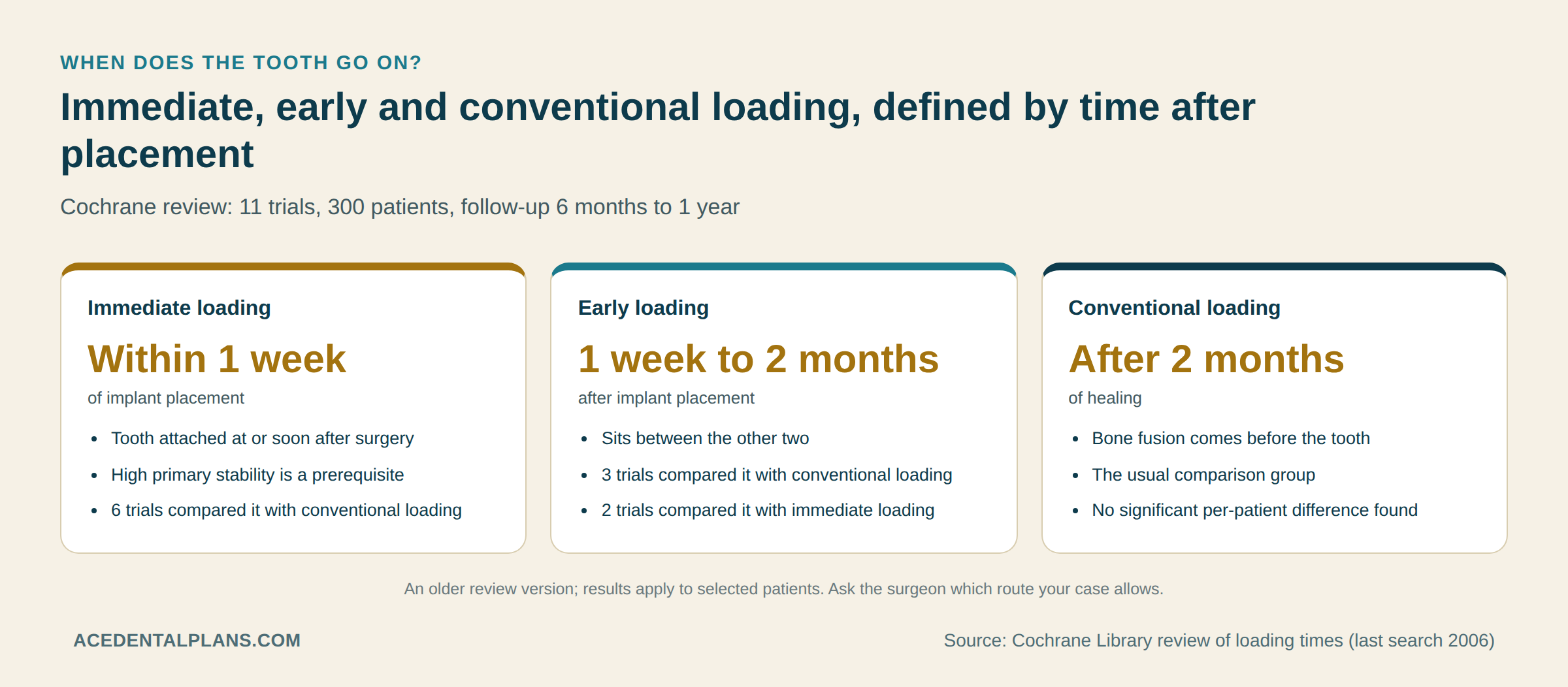
Not every implant waits months for its tooth. Some are loaded, meaning a tooth is attached, within days. A Cochrane review of loading times defines the terms: immediate loading is within one week of placement, early loading is between one week and two months, and conventional loading is after two months. The version of the review opened for this article reports a last search in August 2006, so treat its trial numbers as dated.
Within that limit, the findings are worth knowing. The review included 11 trials with 300 patients, followed for six months to a year, and none of the per-patient meta-analyses showed a statistically significant difference between loading times. Its authors concluded that implants can be loaded immediately or early in selected patients, that high primary stability is a prerequisite, and that not every clinician may achieve optimal results with immediate loading.
What same-day teeth change about recovery
They change who you are while you wait. ADA MouthHealthy says some patients have the implant and replacement teeth placed in one visit, and that a temporary crown, bridge or denture may be used in the meantime when the final tooth waits. According to Cleveland Clinic, front implants may carry a temporary tooth while back implants may not need one. That is more visible, and more fragile, than a covered gum.
The sources used here do not claim that bone fuses faster when a tooth goes on early, and they should not be read as saying so. The first stage of healing and the bone-fusion clock still apply. An early tooth changes the instructions around it: Penn says to avoid chewing directly on the surgical site, and UM Health says not to put pressure on the jaw. Ask what your temporary tooth can and cannot be asked to do.
Same-day teeth on an entire arch are a bigger project with a different price class and their own recovery questions. The article on full mouth dental implants cost covers the money side of that route, which this guide does not repeat.
Back to Work, Exercise, Driving and Travel
The first question most people ask is when life resumes. The American Academy of Implant Dentistry says most patients return to work the next day. Cleveland Clinic says most people feel like themselves within about a week. The British sheet for bone grafts says a few days off work may be necessary. Those three statements fit together: the more extensive the surgery, the longer the buffer.
The clearest activity pattern comes from the University of Washington: relax and limit activity for the rest of the day of surgery, then resume light activities the day after if you feel up to it. It also asks for rest in the first 8 to 12 hours, with the head up and as little movement as possible.
Exercise, driving and flying
Exercise is where the sources go quiet. Neither the University of Washington nor the Penn sheet used here sets a date for strenuous exercise, and UM Health sheet gives no exercise guidance beyond not putting pressure on the jaw. A straight answer is that the date is the surgeon’s to give. Ask on the pre-op visit, and ask separately about heavy lifting if your job involves it.
Driving depends on what you were given. Penn says that narcotic pain medicine causes drowsiness, so avoid driving and heavy machinery while taking it. Sedation raises the same question on the day itself; ask the office whether a ride home is required. Flying has one source-backed restriction: after a sinus lift, the British sheet says to avoid it until the area has healed.
Warning Signs, Normal Variation and What Failure Looks Like
The hard part of recovery is not pain; it is deciding whether a symptom belongs to ordinary healing. Table 3 sorts the main ones into three columns. The first lists what the sources describe as expected. The second lists what they say to call about. The third repeats the emergency symptoms that call for 911 or an emergency room, which are the same ones in this site’s disclaimer below. Where a source says nothing about a symptom being normal, the cell says so rather than guessing.
| Symptom | Described as expected | Call the surgeon or dentist | Emergency care |
|---|---|---|---|
| Bleeding | Minor oozing for the first 12 to 24 hours; bleeding usually stops within an hour or two (University of Washington; Penn) | Bleeding that will not stop after the gauze steps (University of Washington; UM Health) | Bleeding you cannot control |
| Swelling | Rises for 24 hours to about 3 days, then falls; facial bruising can appear (Penn; University of Washington) | Swelling or pain increasing after day 3 (University of Washington); swollen gums or neck lymph nodes (Cleveland Clinic) | Swelling of the face or neck, or large swelling under the tongue; trouble breathing or swallowing |
| Pain | Slight discomfort; most patients manage it with over-the-counter medication (Cleveland Clinic; AAID) | Jaw, mouth or sinus pain not relieved by prescribed medicine (UM Health) | Severe dental pain with fever |
| Fever | Not listed as expected in the sources used | 100.4°F (38°C) or higher, or as the surgeon directs (UM Health; Ascension) | Fever with severe dental pain |
| Numbness | While the anesthetic wears off | Numbness that persists after it should have worn off (UM Health) | With facial swelling or trouble swallowing |
| Implant or tooth feel | Not listed as expected | A loose or wobbly implant, loose abutment, bite that feels wrong, a chipped or loose prosthesis (Cleveland Clinic; Ascension; University of Washington) | Not applicable alone |
| Gums and discharge | Not listed as expected | Pus around the implant, bleeding gums, red or tender gums that bleed on brushing (Cleveland Clinic; American Academy of Periodontology) | With fever, facial swelling or trouble swallowing |
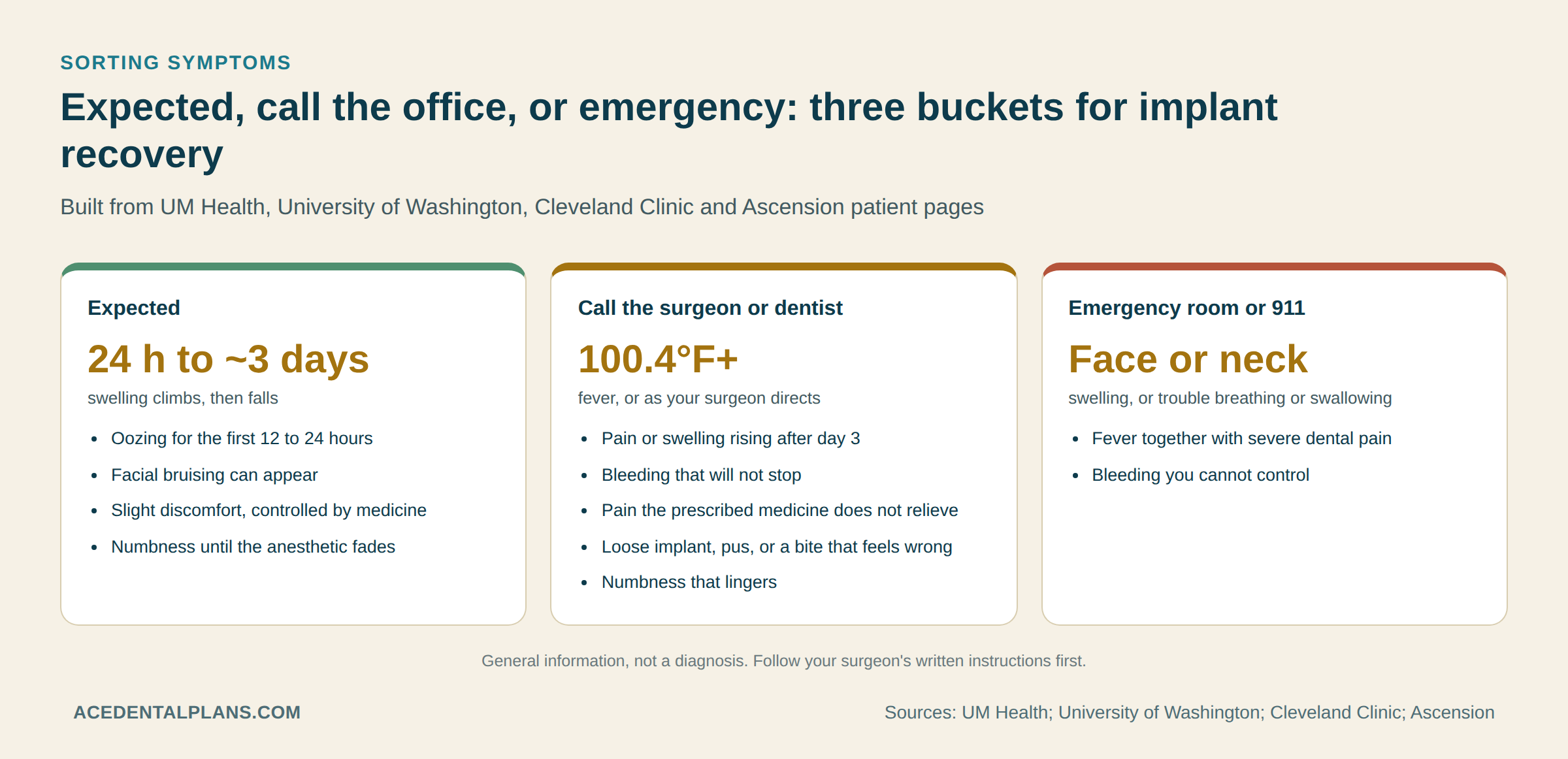
Go to the emergency room or call 911 if
- Swelling spreads across the face or neck, or you cannot breathe or swallow normally.
- You have a fever together with severe dental pain.
- Bleeding keeps going after the gauze steps and you cannot control it.
For the infection symptoms in the second column, the page on tooth infection symptoms and treatment covers swelling, fever and pus in natural teeth, which is helpful context but no substitute for a call about an implant.
What failure looks like, and how often
Implants usually succeed, and the large reviews say so. Howe, Keys and Richards searched studies from 1997 to January 2018 and included 18 prospective studies with at least ten participants and 35 implants each. Their ten-year survival at the implant level was 96.4% (95% confidence interval 95.2% to 97.5%). When they ran a sensitivity analysis that accounted for missing data, it fell to 93.2% (90.1% to 95.8%). In patients 65 or older, the sensitivity figure was 91.5%, and the authors say the risk of implant loss may be roughly doubled in older patients.
Implant-level means each implant is counted, not each person. A person with four implants contributes four data points, which is one reason the figure is not a personal forecast. The abstract does not say when failures occurred, so no one can honestly say from it whether the risk sits in the first weeks or the later years. For a person in recovery, that means a symptom that fits the call column is worth a call at any point on the calendar.
Failure shows up in the sources as a short set of signs. A loose or wobbly implant, bleeding gums, fever, pus around the implant and swollen gums all make Cleveland Clinic’s list. The American Academy of Periodontology adds that peri-implant disease starts as red or tender gums and bleeding when brushing and that mucositis, the early stage, may be reversible. If bone loss is already present, peri-implantitis usually requires surgical treatment. Catching it early is what makes the mildest stage reversible, which is a reasonable argument for erring toward the phone.
What the Staged Timeline Does to Cost and Your Plan Year
Because an implant is built in stages across months, the bill often arrives in pieces and sometimes crosses the new year. MetLife’s consumer guide gives a single implant total of $3,000 to $6,000 (no date shown on the page), and says the procedures are spaced out over several months. The article on dental implant cost breaks that figure into its lines. Recovery visits are the question to put on the estimate: MetLife says there are a few dentist visits after the implants, then regular follow-ups, so ask which are included in the fee and which are billed separately.
Insurance language here has to stay conditional. MetLife says a PPO may cover 50% of the cost depending on the plan, and that basic plans often exclude implants as cosmetic or restorative. It also says plans often have deductibles. Annual maximums and waiting periods apply on top; the guide to what dental insurance covers shows how plans sort services into preventive, basic and major tiers, which is where an implant claim has to fit if the plan covers implants at all.
One implant, two plan years
The calendar matters because annual maximums reset. The numbers below are invented to show the mechanism. They are not a quote and not a prediction for any plan.

None of that is a reason to move surgery for tax or benefit reasons if your surgeon wants it done sooner. It is a reason to ask about the sequence. If benefits are about to reset at year-end, the guide to using dental benefits before year-end covers what to check, and the same logic runs the other way when a new plan year is just ahead.
For the part insurance does not pay, the options are in the comparison of ways to pay for dental work, and the differences between loans, deferred interest and in-office plans are in the article on dental financing versus payment plans. With a long timeline, ask whether payments can follow the stages instead of arriving in one lump, and check the contract for what happens if healing takes longer than planned.
Questions to Ask Before Surgery Day
A good pre-op conversation shortens recovery anxiety more than any web page can. These are written to fit the stages covered above; take the list to the consult and write the answers on your own sheet.
- Is this a one-stage or two-stage implant, and who will place the abutment, you or my regular dentist?
- Do I need a graft or sinus lift, and how many months does that add before the implant?
- Will I have a temporary tooth, and what can it be used for?
- Which stitches are used, and do I need to come back to have them out?
- What pain medicine am I being given, what are its limits, and who do I call if it is not enough?
- When may I rinse, brush the area and eat on the implant side?
- When may I exercise, lift, fly or return to a physical job?
- What are the specific numbers or symptoms that mean a same-day call, and what is the after-hours number?
- If I smoke, vape or have diabetes, what plan do you want in place before surgery?
- Which follow-up visits are included in the fee, and which are billed separately?
- What happens to the schedule and the money if the implant needs more time?
Frequently Asked Questions
How long does dental implant recovery take?
It depends which recovery you mean. Most people feel close to normal in about a week, according to Cleveland Clinic. The bone-fusion phase that makes the implant solid takes 3 to 9 months, and the full process from surgery to finished tooth is often described as three to nine months or longer, depending on grafts and the number of implants. A second-stage visit and the crown add weeks on top.
What does the first week after dental implant surgery look like?
Expect oozing for the first 12 to 24 hours, swelling that peaks somewhere between 24 hours and about three days, possible facial bruising, soft foods and gentle cleaning. Light activity can resume the day after surgery if you feel up to it, per the University of Washington. A follow-up around day seven is common, where loose stitches come out. Swelling or pain that grows after day three is the one development to report.
How long does swelling last after dental implant surgery?
Penn Dental Medicine says swelling increases for 24 to 48 hours and then lasts several days to one week. At the University of Washington it rises for two to three days and then decreases. After a bone graft, the British oral surgeons’ sheet says swelling usually settles after about three days but soreness can last up to two weeks. Swelling that is spreading to the neck or making swallowing hard is an emergency.
Is it normal to have more pain on day three?
Not usually. Swelling or pain that increases after three days is a reason to call, per the University of Washington. Soreness is common early on and should be easing by then, even slowly. If it has been controlled with prescribed medicine and then climbs, or if the medicine stops working, telephone the surgeon rather than waiting for the one-week visit.
When can I exercise after dental implant surgery?
The sources used here do not give a day count. Limit activity for the rest of the day of surgery, the University of Washington says, and to resume light activities the next day if you feel up to it. Anything strenuous is a question for the surgeon, who knows whether you had stitches, a graft or sedation. Ask before the day of surgery so you have the answer in writing.
How long after a bone graft can the implant go in?
The British Association of Oral Surgeons says implants are usually placed after 3 to 6 months of healing, and in a few cases at the same time as the graft. It also notes that bone regeneration can take 3 to 12 months. The right interval is set by the surgeon from imaging and from how the graft looks. Treat any figure as a planning range, not a promise.
When do I get the final crown after the implant?
After bone fusion and, in a two-stage approach, after the gums heal around the connector. Ascension says gums take about 4 to 6 weeks to heal around abutments, and MetLife says another two weeks after abutment placement before the crown. Making the crown takes several weeks and visits. Some patients get a temporary tooth at the first visit, and the final one months later.
What are the signs that a dental implant is failing?
Cleveland Clinic lists a loose or wobbly implant, bleeding gums, fever, pus around the implant, swollen gums and swollen lymph nodes in the neck. The American Academy of Periodontology describes red or tender gums and bleeding when brushing as early signs of peri-implant disease. Call the surgeon or restorative dentist when you notice any of these; do not wait for a scheduled visit to bring it up.
Can I smoke or vape while my implant heals?
The evidence says no. ADA MouthHealthy says tobacco can slow healing, and Cleveland Clinic says smoking or vaping may disrupt it. A 2024 review found a significant link with higher implant failure in 25 of 33 studies. The same review says e-cigarettes need more research, so there is no reliable evidence that vaping is safer. If stopping is hard, ask the surgeon for support before the date is set.
Can I wear my denture while the implant heals?
Only if your surgeon or dentist says you can. UM Health says not to wear a temporary prosthesis or denture for the period your provider specifies, and the University of Washington says to avoid pressure on the surgical site and to call if the bite feels different. Dentures may be relined during healing for comfort, according to the UM Health sheet.
Bottom Line
Implant recovery is two schedules sharing one calendar. The short one belongs to you: oozing, swelling, soft food, a first checkup, and a return to ordinary life. The long one belongs to the bone, and nobody can speed it by wishing. Planning around both, rather than treating the first week as the whole story, removes most of the unpleasant surprises.
The useful habits are few. Read your surgeon’s sheet and let it override any web page. Treat the day-three trend as the checkpoint. Keep tobacco out of the picture. Learn which symptoms go in the call column and which in the emergency column before surgery, not during it. Keep the numbers on the estimate attached to a date, because the calendar can decide which benefit year pays.
If you are still gathering information, the Recovery and Aftercare guides collect the neighboring topics in one place.
Sources and Disclaimers
Clinical timelines in this article come from university and hospital patient-instruction sheets, specialty-society pages, the American Dental Association and peer-reviewed reviews. They differ in detail, so where two sources give different windows both are shown. Cost and coverage statements come from a single insurer consumer guide and are national, undated ranges that may not match your area. The calendar examples, the first-evening schedule, the work plan and the $4,500 plan-year example are original illustrations built on the published ranges, not data or quotes. The British Association of Oral Surgeons sheet is from the United Kingdom. Confirm prices with the dental office and benefits with your insurer in writing.
- ADA MouthHealthy — Implants
- American Academy of Implant Dentistry — What to Expect: Dental Implant Placement
- American Academy of Periodontology — Peri-Implant Diseases
- American Association of Oral and Maxillofacial Surgeons — Dental Implant Surgery (patient information)
- American Dental Association — Oral Analgesics for Acute Dental Pain
- Ascension — Dental Implants: Placing Abutments and Making Your Prosthesis
- British Association of Oral Surgeons — Patient Information Sheet: Bone Grafting, Guided Bone Regeneration and Sinus Lift
- Centers for Disease Control and Prevention — Oral Health and Diabetes
- Cleveland Clinic — Dental Implants
- Cochrane Library — Interventions for Replacing Missing Teeth: Different Times for Loading Dental Implants
- Howe MS, Keys W, Richards D, Journal of Dentistry, 2019 — Long-Term (10-Year) Dental Implant Survival: A Systematic Review and Sensitivity Meta-Analysis
- MetLife — How Much Do Dental Implants Cost?
- National Institute of Dental and Craniofacial Research — Diabetes and Oral Health
- Penn Dental Medicine — After Treatment Instructions: Implants
- Stiller HL, Ionfrida J, Kämmerer PW, Walter C, Dentistry Journal, 2024 — The Effects of Smoking on Dental Implant Failure: A Current Literature Update
- UM Health (University of Maryland) — Dental Implants: After Surgery
- University of Washington School of Dentistry — After Your Oral Surgery
Important Information and Disclaimers
This article is general educational information. By using it, you accept the limits described below.
Not dental or medical advice
Nothing on this page is a diagnosis, a treatment recommendation or a substitute for an examination by a licensed dentist or physician. Reading this article does not create a dentist-patient or doctor-patient relationship. Only a licensed professional who has examined you and reviewed your history can tell you what your mouth needs. Do not delay, skip or stop professional care because of something you read here.
Prices are estimates, not quotes
Cost figures are ranges reported by the third-party sources cited in this article. Actual prices depend on your location, the provider, the complexity of your case, the materials used, the date of service and other factors, so what you pay may be higher or lower. A written treatment plan and fee estimate from the dental office is the only reliable number for your situation.
Insurance and plan examples are illustrations
Examples that use named amounts or percentages are hypothetical. Real benefits depend on your plan, network, waiting periods, annual maximum, deductible and the insurer’s rules at the time of treatment. A pre-treatment estimate or benefits check is not a promise of payment. Confirm the details with your insurer or plan administrator in writing.
Not insurance, legal, tax or financial advice
AceDentalPlans is an information publisher. Nothing here is insurance, legal, tax, investment or other professional financial advice, and nothing here recommends a particular provider, insurer, lender, discount plan or financing product. Company and product names belong to their owners and appear for identification only. Read the terms of any loan, financing offer or plan before you sign, and ask a qualified professional if you need advice on your own circumstances.
Third-party sources
This article cites government agencies, professional associations, insurers, lenders and other outside organizations. We do not control those sources. Their content can change, move or disappear, and listing a source is not an endorsement of it or of anything it sells.
No warranty
We aim for accuracy, but this article is provided “as is,” without warranties of any kind, express or implied, including warranties of accuracy, completeness, timeliness or fitness for a particular purpose. Some information may be out of date or contain errors by the time you read it.
Limitation of responsibility
To the fullest extent permitted by law, AceDentalPlans and its owners, authors and contributors are not responsible or liable for any loss, cost, injury, health outcome or other damage that results from using this article or relying on it. You are responsible for your own decisions about your care, your coverage and your money.
How this article is written
This article follows AceDentalPlans’ answer-first, U.S.-focused editorial approach. It uses conditional language for insurance, because coverage depends on the specific plan, and it names its sources so that you can read them yourself.