A root canal with dental insurance often leaves you paying 20% to 50% of the plan’s allowed amount, plus any deductible. Plans commonly pay 50% to 80% of the cost once the deductible is met. On a $1,050 procedure (a national average in 2026 fee-survey data), that is roughly $210 to $525 before the deductible. The total climbs if the annual maximum runs out or the dentist is out of network.
This page works through the arithmetic in order: allowed amount, deductible, coinsurance, annual maximum, then the rules that can shrink a payment (network status, waiting periods, frequency limits, and a crown that follows). It pairs published price ranges and 2025-2026 plan summaries with hypothetical examples you can rerun with your own numbers. It stops short of explaining the procedure itself or predicting what your plan will pay, because only a written estimate from your insurer can do that.
Key Takeaways
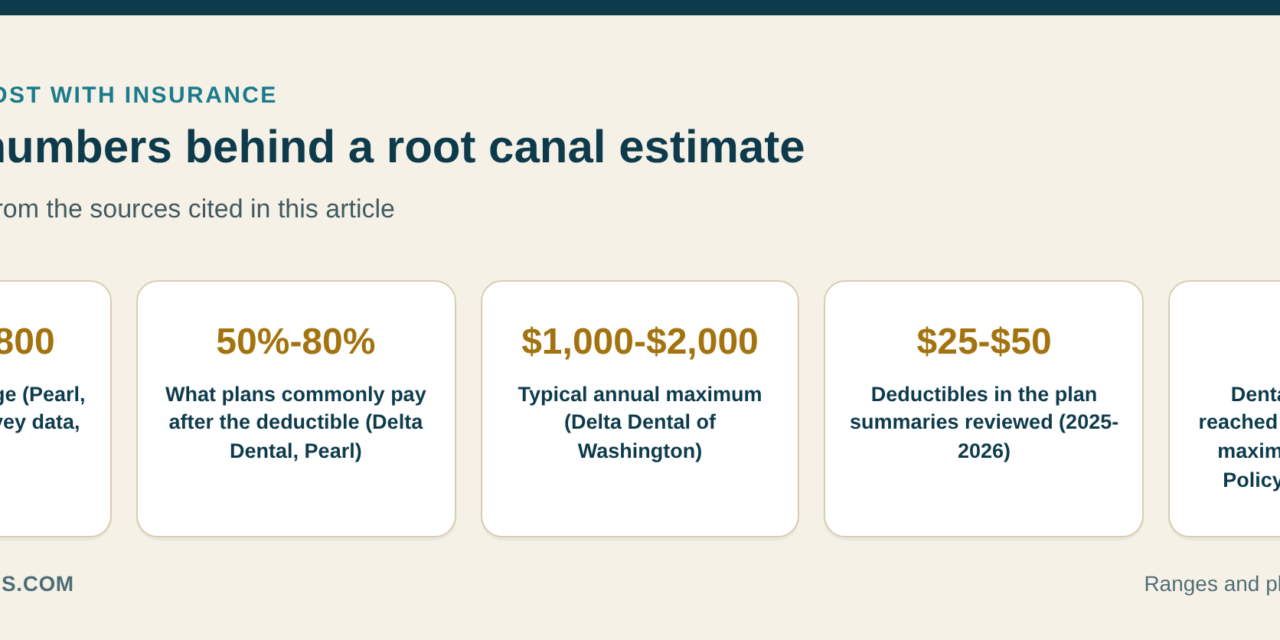
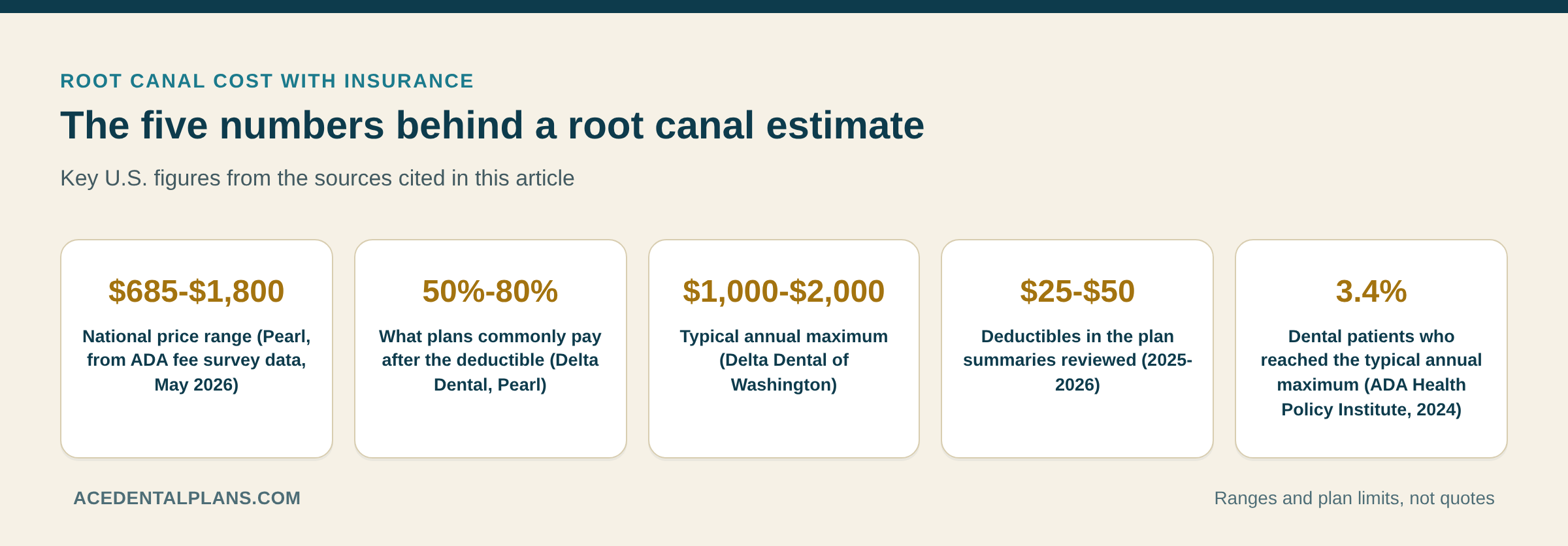
- Plans usually pay a share, not the whole fee. Delta Dental says it is common for plans to cover 50%-80% of a root canal after the deductible is met. Pearl, which builds on American Dental Association fee survey data, gives the same range for PPO plans.
- The starting price is a range. Pearl’s May 2026 national range is $685-$1,800 (average $1,050). In Delta Dental’s 2025 data, out-of-network root canals run roughly $1,200 for a front tooth, $1,300 for a premolar and $1,500 for a molar.
- Coinsurance applies to the allowed amount. A contracted dentist’s discounted fee can sit far below the out-of-network figure. One Delta Dental of Washington estimate for the Seattle area shows $681-$1,102 in network against $1,043-$1,850 out of network.
- The annual maximum is a cap on the plan’s payment. Typical limits run $1,000-$2,000 (Delta Dental of Washington). Only 3.4% of dental patients reached the maximum in a 2024 ADA Health Policy Institute analysis. Even so, a root canal followed by a crown is the kind of sequence that can get close.
- Class matters. Of six plan summaries reviewed, four list root canals with basic care (three at a stated 80%). One shows conflicting basic and major entries, and one individual plan places endodontics in its major class. The same procedure can cost you $250 or $525 depending on that line.
- Timing rules are easy to miss. Waiting periods, once-per-tooth frequency limits and the date a claim is counted (for a root canal, Delta Dental says it is the date the canals are permanently filled) can all change the payment.
From the Dentist’s Fee to Your Share: Five Steps Insurers Use
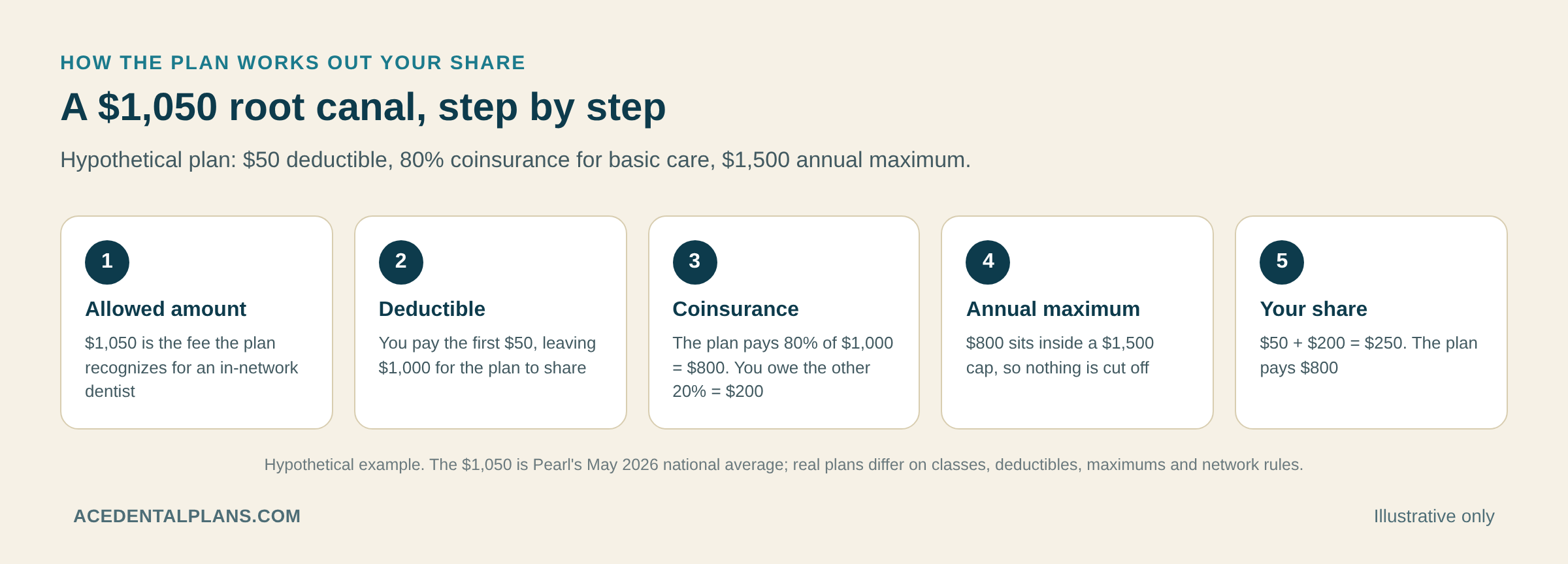
Every percentage-based dental claim runs through the same short sequence, whether the tooth is a front tooth or a back molar. Learn the order and you can rebuild most estimates on a napkin. (Plans that list a flat copay for each procedure, a design often sold as DHMO or prepaid dental, skip the middle steps: the copay on the schedule is your share.)
Step 1: the allowed amount. This is the fee the plan recognizes for the procedure, not necessarily the number on the dentist’s price sheet. For a dentist in the plan’s network it is the contracted (negotiated) fee. For an out-of-network dentist it is usually a plan-set ceiling, often called a maximum allowable or reasonable-and-customary charge, and the office can bill you for the difference.
Step 2: the deductible. The deductible is the amount you pay first, before the plan starts sharing the cost of covered care. According to Delta Dental of Illinois, it has to be met once a year, not once per service, and it does not apply to preventive care such as exams, X-rays and cleanings. The plan summaries reviewed for this article list deductibles of $25-$50 per person, though yours may differ.
Step 3: coinsurance. Coinsurance is the percentage of the allowed amount, after the deductible, that the plan pays. You pay the rest. A plan that pays 80% for basic care and 50% for major care is describing this step, and which label your root canal carries is worth a phone call (more on that below).
Step 4: the annual maximum. Per Delta Dental of Washington, it is the most your plan will pay per person toward care in a 12-month benefit period. It caps the plan’s payment, not yours. Once the plan has paid that much, benefits stop, the carrier says, and you’re responsible for additional services until the next benefit period begins. Don’t confuse it with a medical plan’s out-of-pocket maximum, which caps what you pay; a dental maximum does the opposite.
Step 5: everything the claim doesn’t include. A balance bill from an out-of-network office, a crown, a build-up and a waiting period that delays benefits all sit outside the clean arithmetic of steps 1-4. So does a frequency limit that denies a second root canal on the same tooth. They are often where an estimate and a final bill drift apart.
One more distinction before the prices. A root canal fee covers the root canal, not the restoration that protects the tooth afterward. Per Delta Dental, the dentist’s fee covers all appointments and X-rays for the treatment, whether it takes one visit or five, while the final filling or crown is billed separately. The same point appears on Delta Dental of Washington’s page about crowns. Plan on at least two separate claims, and see whether a crown after a root canal is typical for the reasoning behind the second one.
Root Canal Prices Before Insurance: What Published Figures Show
Insurance math starts with a price, and the published prices come from different places that measure different things. A carrier’s out-of-network average is not a fee survey, and neither is a consumer-finance estimate. Table 1 sets the four sources next to each other so you can see the spread rather than trust one number.
| Source and date | What the figure represents | Front tooth | Premolar | Molar | All teeth |
|---|---|---|---|---|---|
| Delta Dental, page dated July 2026 (2025 internal data) | Average out-of-network cost | About $1,200 | About $1,300 | About $1,500 | About $1,200-$1,500 |
| Pearl, updated May 2026 | Population-weighted national figure from ADA fee survey data; network status not stated | Not split | Not split | Not split | $685-$1,800 (average $1,050) |
| ValuePenguin, updated June 30, 2026 | Cost without insurance; data source not named | $912 | $1,044 | $1,246 | $1,067 average |
| ValuePenguin, same page | Publisher’s own estimate with insurance (method not stated) | $182-$547 | $209-$626 | $249-$748 | $213-$640 |
| Delta Dental of Washington, Seattle-area estimates (year not stated) | In-network range, then out-of-network range | Not split | Not split | Not split | $681-$1,102 in network; $1,043-$1,850 out of network |
Three patterns stand out. First, molars cost more than front teeth in every source that splits them, and the American Association of Endodontists (AAE) says molars usually cost more because they take more time and expertise. Second, the out-of-network and in-network ranges barely overlap in the one source that shows both, which is exactly why network status shows up in the next section. Third, the “with insurance” row implies you pay about 20% to 60% of the uninsured price, a spread that lines up with plans paying 40% to 80%.
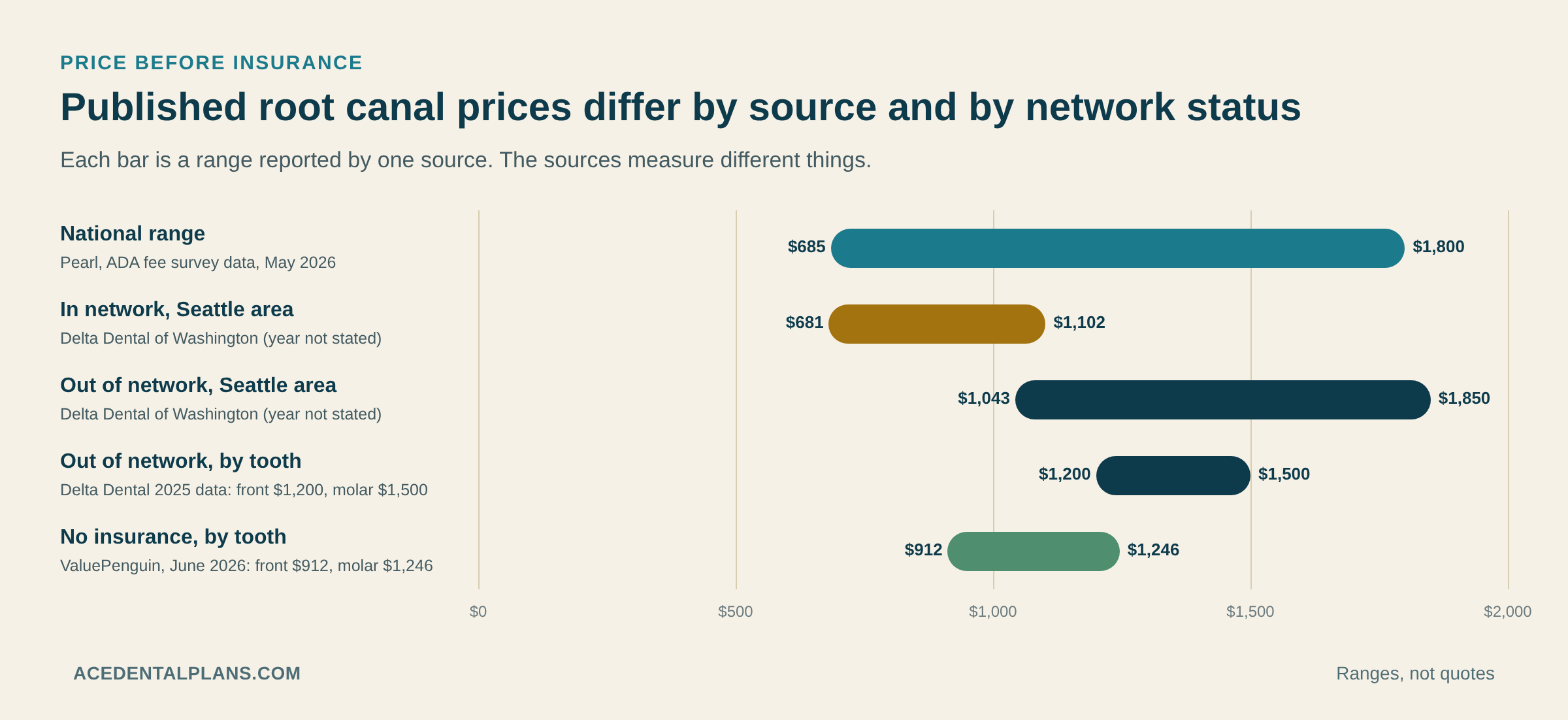
Keep in mind that none of these figures says what your dentist charges. The Pearl page does not state whether its numbers are cash, in-network or out-of-network, and ValuePenguin does not name its data source, so both are more useful as orientation than as price points. Your dentist’s written fee, and your plan’s allowed amount for that dentist, are the only numbers that go into the formula.
Does a specialist cost more, and does insurance treat the fee differently?
An endodontist, a dentist who specializes in the pulp and the tissues around the teeth, may perform the treatment instead of a general dentist, sometimes after a referral. The AAE says endodontists complete at least two additional years of advanced training beyond dental school. None of the sources reviewed gives a dependable specialist-versus-generalist price comparison, so no figure is offered here. Pearl says specialist fees are often covered at the same percentage as a general dentist’s, though some plans have specialist-specific terms.
The practical question is network status, which is set office by office. A general dentist in your network and the endodontist down the hall are separate contracts, so ask whether the specialist participates in your plan before the referral, not after the bill. How the treatment itself works, and why a dentist may recommend it, is covered in our full root canal treatment guide.
Is a Root Canal Basic or Major Care? What Six Plan Summaries Show
Dental plans sort procedures into classes, and the class sets the coinsurance. Preventive care is usually the most generous, basic restorative care sits in the middle, and major work such as crowns and bridges pays the smallest percentage. Where a root canal lands is the single biggest lever on your share, and plans don’t agree.
Table 2 summarizes six plan documents published for employers and individuals in 2025 and 2026. They are examples of how real summaries are written, not a market sample. A few are hard to read, which is itself a lesson: the line that matters can be buried or repeated under two headings.
| Plan summary (year) | Deductible | Annual maximum | Where a root canal sits and what it pays | Limits worth noticing |
|---|---|---|---|---|
| Cigna Dental Select, State of Georgia (effective Jan. 1, 2026) | $50 individual, $150 family; not applied to Class 1 | $750 | Class 2 (basic): 80% in network and out of network | Worded “limited to 1 per lifetime”; ask whether that counts per tooth. Class 1 includes diagnostic, preventive and emergency care. |
| Delta Dental Basic and Enhanced plans, employer comparison (published Oct. 2025) | Basic: $50 on classes II and III. Enhanced: none | Basic $1,500; Enhanced $3,000 | Class II (basic): 80% after deductible on Basic, 80% on Enhanced | Maximum excludes orthodontics and certain diagnostic items. Class III (major) pays 50%. |
| Guardian dental plan, Washoe County (calendar-year 2025 file) | $50 per calendar year | $3,000, including preventive care | Basic services: 80%. The schedule lists root canal treatments and root canal fillings under endodontics. | Major services pay 50%. No waiting period appears in the summary. |
| MetLife PPO summary, City of San Diego Local 127 (copyright 2025) | $50 individual, $150 family | $2,000 | Endodontics appears under both Type B (80%) and Type C (50%), so the class needs confirming in the plan booklet | Root canal treatment limited to once per tooth per 24 months. A one-year waiting period applies to late enrollees. |
| Delta Dental PPO, Unified Government of Wyandotte County (effective Jan. 1, 2025) | None stated; no benefits subject to a deductible | $1,500 per contract year | Endodontics is in the basic class; the percentage table is hard to read, so confirm it in the benefits booklet | Root canal treatment and fillings limited to once per tooth in any 24-month period. |
| Humana Smart Choice Low, Illinois individual plan (2025) | $25 per adult | $1,000 per adult | Endodontics appears in Class III (the major class); the adult column for that class on this low-tier plan reads “not covered” | A 6-month waiting period applies to adult Class II services. Out-of-network dentists can bill above the covered amount. |
Read the table for the spread, not the average. Four of the six list root canals with basic services (three at a clearly stated 80%), which matches the 50%-80% range carriers and fee-survey sites quote. One summary repeats endodontics under both an 80% and a 50% heading. One individual plan files it with major services and, on its lowest tier, shows no adult coverage at all. A mistake of that kind (counting on 80% when the plan pays 50%) shifts the bill by hundreds of dollars.
The Georgia summary adds a useful detail on the front end. Its first class bundles diagnostic, preventive and emergency care and waives the deductible for them. The exam and X-rays that find the problem may therefore be billed at a different percentage than the root canal. If your first visit was an emergency exam, expect a separate line for it on the explanation of benefits (EOB), the statement the plan sends after processing a claim.
How to find the class and percentage in your own paperwork
Look for the schedule of benefits in your summary plan description or evidence of coverage, then search it for endodontic or root canal. If the procedure appears under two headings, or only a general category such as restorative is listed, call the plan and ask for the class and percentage for the specific procedure code the dentist will use. The dental office can supply that code from its treatment plan. Root canal codes vary by tooth type (front, premolar and molar), so it’s the office’s code, not a guess, that the plan needs.
Deductibles, Coinsurance and Annual Maximums: Typical Values and How They Interact
Three numbers do most of the work, and each has a typical range. Knowing the range tells you whether the figure on your plan is generous, ordinary or thin, and it frames the examples later in this article.
Deductible
The plan summaries in Table 2 list deductibles from $25 to $50 per person, with two plans listing none. Delta Dental of Illinois explains that the deductible has to be met once each year, not for every service. Its example: with a $100 deductible and a $600 crown, you pay the first $100 and the plan then pays its share of the rest. In practice that means the first major or basic service of the year absorbs the deductible, and later claims don’t.
One more point from Delta Dental of Washington surprises people: your deductible doesn’t count toward the annual maximum, and neither do copays. Only what the plan actually pays is subtracted from the maximum. A $50 deductible therefore costs you $50 and leaves the plan’s cap untouched.
Coinsurance
Both Delta Dental and Delta Dental of Washington describe 50%-80% as the usual range for a root canal after the deductible. Pearl says the same of most PPO plans. ValuePenguin widens it to 40%-80% and notes that top-tier plans can pay 80%, leaving a 20% share. Those figures are descriptive, not promises, and the plan’s own class assignment (see Table 2) is what applies to you.
Two quick conversions help. At 80% coverage you owe 20% of the allowed amount after the deductible, so a $1,000 allowed amount means $200 plus any deductible. At 50% coverage you owe half, so the same $1,000 means $500. The difference between the two classes on one tooth is $300, before the crown enters the picture.
Annual maximum
Annual maximums typically range between $1,000 and $2,000, according to Delta Dental of Washington. A December 2025 ADA News article cites National Association of Dental Plans (NADP) data on in-network maximums. In that data, 32.8% fall between $1,000 and $1,500 and 48.2% between $1,500 and $2,500, while 17.2% sit at $2,500 or higher, a group that includes plans with no annual maximum. The same article quotes a dental benefits council officer saying many plans’ maximums haven’t increased in 50 years. It also notes that the ADA does not support annual or lifetime maximums in any dental benefit program.
How often do patients hit the ceiling? A 2024 ADA Health Policy Institute analysis, summarized in that article, found 3.4% of dental patients reached the typical annual maximum and another 3.3% came within $100 of common maximums. Most people never get close, which is worth saying plainly. The people who do are usually the ones with several major services in one year. A root canal plus crown is a textbook example: in the worked example later in this article, the two together use most of a $1,500 maximum.
That same article also makes a point that matters for planning. When a patient is near the limit, coinsurance shifts more of the spending onto them, and raising the maximum alone does not remove that imbalance. For a root canal, “near the limit” means the dollars left in the cap, not the percentage printed on the plan.
How the three interact
Think of the deductible as a toll paid once, coinsurance as a split on everything after it, and the annual maximum as a ceiling on the plan’s side of the split. Because the plan’s payment is calculated on the allowed amount, a lower contracted fee also means a smaller draw on the maximum. That is one reason in-network care can stretch a limited benefit further than out-of-network care.
Benefit periods matter too. The maximum applies over a specific period, usually a calendar year, says Delta Dental of Illinois, and Delta Dental of Washington says it is set at the start of each benefit period. Confirm your plan’s dates, because an employer plan can run July to June. The summaries reviewed didn’t say whether unused amounts carry into the next year, so ask the plan rather than assume.
In-Network or Out-of-Network: One Root Canal, Two Different Bills
A network dentist has agreed to the plan’s fee schedule, so the plan’s allowed amount is the contracted fee and the office writes off the difference. The consequence, as Delta Dental puts it: in network, your share is calculated on a lower, discounted fee, while with an out-of-network provider you pay a percentage of the dentist’s full, non-discounted fee. The Seattle-area estimates from Delta Dental of Washington, $681-$1,102 in network against $1,043-$1,850 out of network, show the scale of that gap.
Plans differ on how they treat out-of-network claims. In the MetLife summary in Table 2, out-of-network reimbursement is based on the lesser of the dentist’s actual fee or a Maximum Allowable Charge. Some services on that schedule are tied to reasonable and customary fees. The Cigna summary bases reimbursement on a maximum reimbursable charge and notes that a dentist may balance bill up to usual fees. Humana’s Illinois summary says plainly that out-of-network dentists can bill you for charges above the amount the plan covers.
That produces a counterintuitive pattern. Both the Cigna and MetLife summaries show the same coinsurance percentage in and out of network (80%, in Cigna’s case). Even so, the bills can differ widely, because the percentage is applied to different fees and balance billing sits on top. A matching percentage is not a matching price.
Questions that sort out network status
- Is this dentist, at this address, a participating provider for my specific plan and not just for the same insurer’s other products?
- If the dentist is out of network, what does the plan use as its maximum allowable charge for this procedure, and can the office accept it?
- Is the referring endodontist, if there is one, in network too?
- Does the plan apply a separate, higher deductible or lower percentage out of network?
Those four answers decide which row of the worked examples in the next section looks most like your bill.
Seven Worked Examples: What You May Pay Under Different Plan Rules
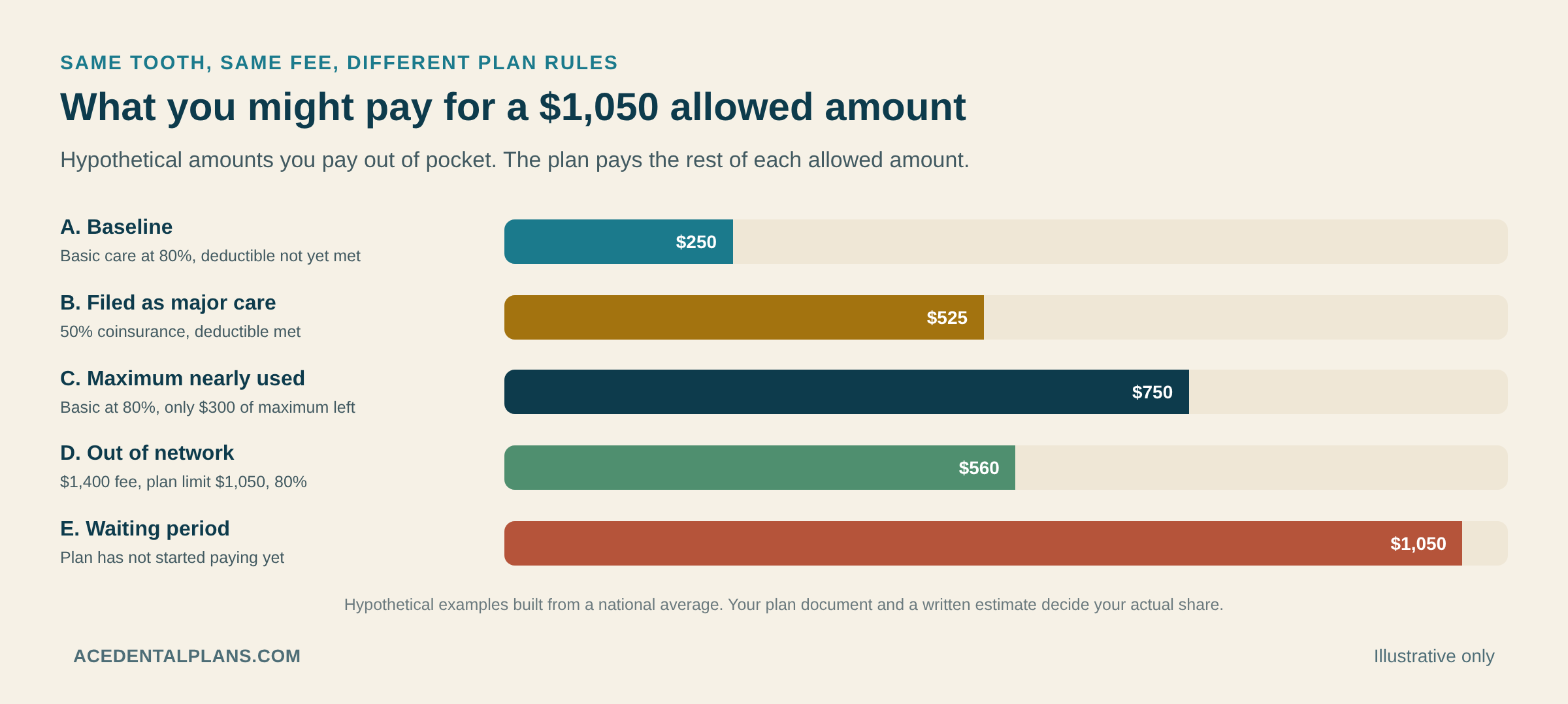
The examples below hold the procedure constant and change one plan rule at a time. That isolates what each rule costs you. Unless a row says otherwise, assume a dentist in the plan’s network and a plan-allowed amount of $1,050 for the root canal (Pearl’s 2026 national average). The plan has a $50 deductible, 80% coinsurance for basic care, 50% for major care and a $1,500 annual maximum. Where a crown appears, its allowed amount is $1,560, Pearl’s national average for a crown in May 2026. Every dollar figure in Table 3 is hypothetical.
| Scenario | What changes | Plan pays | You pay |
|---|---|---|---|
| A. Baseline | Basic class at 80%; deductible not yet met; maximum untouched | $800 | $250 ($50 deductible + $200) |
| B. Major class | Plan files root canals under major care at 50%; deductible already met this year | $525 | $525 |
| C. Maximum nearly used | Basic at 80%, deductible met, but only $300 of the annual maximum remains | $300 (80% would be $840) | $750 |
| D. Out-of-network | Dentist charges $1,400; plan’s maximum allowable charge is $1,050; 80%; deductible met | $840 | $560 ($210 coinsurance + $350 balance bill) |
| E. Waiting period | Plan hasn’t started paying basic care yet (new enrollee) | $0 | $1,050, or the dentist’s regular fee if the contracted fee doesn’t apply |
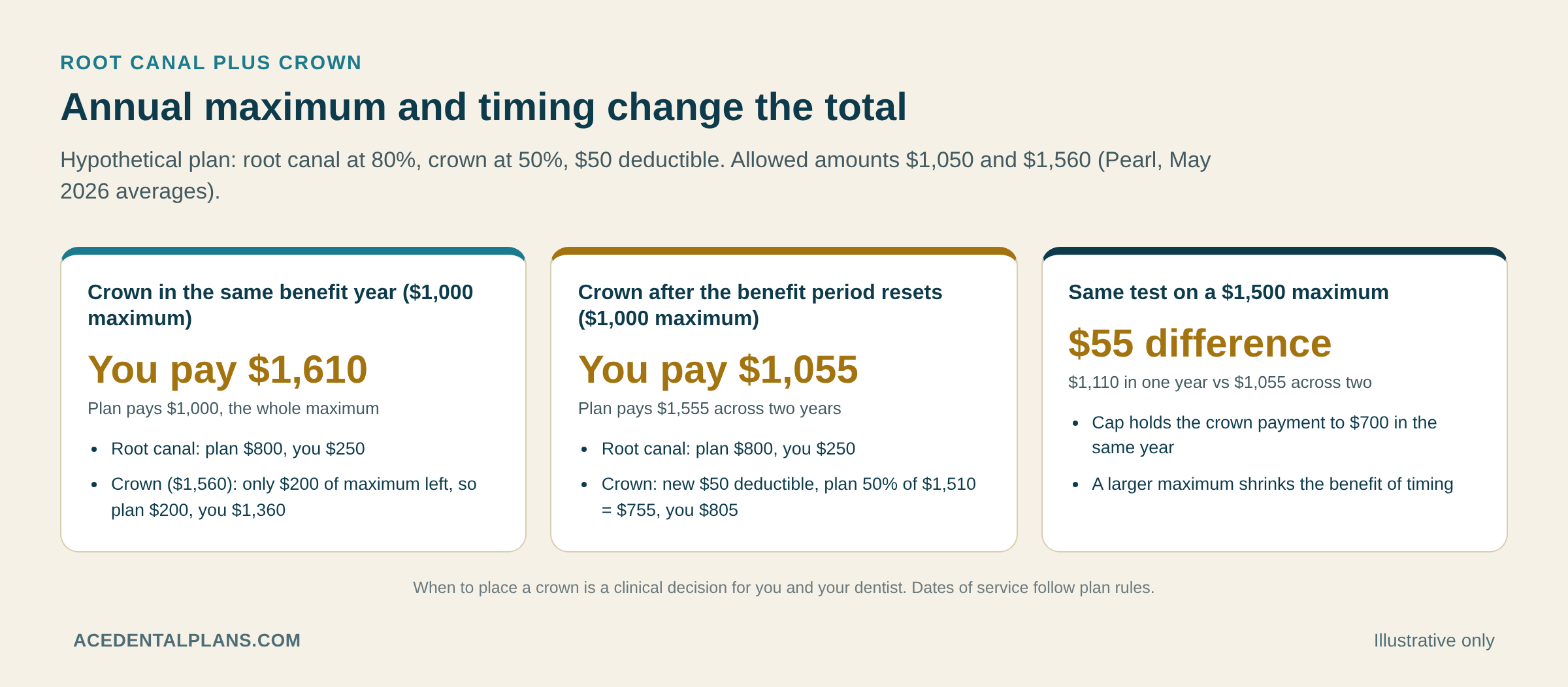
| F. Root canal and crown, same benefit year | $1,000 maximum; root canal at 80%, crown at 50%; deductible not yet met | $1,000 total ($800 + $200) | $1,610 total ($250 + $1,360) |
| G. Crown in the next benefit year | Same plan and prices; the crown is completed after the benefit period resets and the $50 deductible applies again | $1,555 total ($800 + $755) | $1,055 total ($250 + $805) |
Reading rows A through E
Row A is the five-step example from earlier. The only reason it isn’t simply 20% of $1,050 ($210) is the deductible, which adds $50 and reduces the base the plan works from. Always check whether the deductible has already been used. If you met it on a filling earlier in the year, your bill drops by $40: the plan pays 80% of the full $1,050 ($840) and you pay $210.
Row B is the class effect. The same procedure, the same fee and the same deductible status produce a $525 bill instead of a $210 one, a gap of $315 created by a single line in the plan document. That’s why the phone call about class and percentage is worth making before the appointment rather than after the claim.
Row C shows the annual maximum doing its quiet work. Eighty percent of $1,050 would be $840, but with only $300 left the plan stops at $300 and you owe the balance. Nothing in the percentage tells you this is coming; only the remaining benefit does. Ask the plan, or ask the dental office to check, how much of the maximum has been used so far.
Row D combines two effects. The plan applies 80% to its maximum allowable charge of $1,050, which comes to $840. The office then bills the gap between its $1,400 fee and the plan’s recognized amount on top. Your total of $560 compares with $210 for the same 80% in network once the deductible is met, and the label on the plan summary looked identical. Whether the office is allowed to balance bill depends on the contract and the plan, so confirm it.
Row E depends on the plan’s rules and on state law, so the cell offers a range. Waiting periods are common in individual plans. HealthCare.gov says separate dental plans can have waiting periods before they cover adult services. You pay premiums during the wait, and the site advises getting the details from the insurer before you enroll. The Humana Illinois summary in Table 2 lists a 6-month wait for adult Class II services. Whether to wait out a waiting period is a clinical question for you and your dentist, since MedlinePlus warns that an untreated abscess may worsen and can lead to life-threatening complications.
What the spread teaches
The five outcomes run from $250 to $1,050 for one tooth and one fee. None of them involves a pricing error by anyone. They’re what happens when classes, caps, networks and clocks interact. That is the real answer to the question of what you’ll pay with insurance: a range that your own plan document narrows to a single figure.
A second lesson sits in the order of operations. Because the plan applies the deductible and coinsurance to the allowed amount, a lower allowed amount helps twice: your percentage share is smaller, and the plan’s payment draws less from the annual maximum. In-network pricing therefore compounds with every other rule on the table.
Root Canal Plus Crown: How the Annual Maximum and Benefit Year Change the Total
Many root canals end with a crown, and that pairing is where annual maximums start to bind. Pearl’s May 2026 data put a crown at $1,015-$2,670 (average $1,560), and Pearl says typical PPO coverage for a crown is 50% after the deductible, up to the annual maximum. Add the average root canal and the two procedures total about $2,610 in allowed amounts, which is larger than the entire annual maximum on many plans.
Rows F and G of Table 3 test one scenario on a $1,000-maximum plan. Completed in the same benefit year, the plan pays $1,000 and the patient pays $1,610 for both procedures. If the crown is completed after the benefit period resets, the plan pays $1,555 and the patient pays $1,055, a difference of $555. Part of that is the second year’s $50 deductible, which is why the swing is smaller than the unused maximum alone would suggest.
Which date counts: the start, the finish or the crown?
A claim carries a date of service, and the date decides which benefit period pays. Guidance from Delta Dental of New Jersey, published in 2018, says the completion date for root canal therapy is the date the canals are permanently filled. For a crown, it is the cementation date, not the preparation date. The AAE’s 2017 claims guide, written for endodontic offices, notes that plans differ on when they pay and that the patient’s plan governs.
The consequence is simple. A root canal started in late December and finished in early January would, under a completion-date rule, land in the new benefit period, along with a fresh deductible and a fresh maximum. Whether your plan follows that rule is a question for the plan, and the answer can help you decide when to schedule a non-urgent second visit.
Timing is a clinical decision first
Do not let a benefit calendar drive treatment that a dentist says is time-sensitive. The ADA’s MouthHealthy site says a follow-up visit is needed to replace the temporary filling with a regular filling or a crown. The AAE says the tooth is restored with a crown or filling for protection. How long a temporary restoration is designed to last, and whether the crown can reasonably wait, are questions only your dentist can answer for your tooth. If the dentist says the crown should be done promptly, the numbers above are still useful, because they show what to budget and which payment tools to line up.
Ask the office to submit a pre-treatment estimate for both procedures at once. The ADA’s guidance on predetermination says estimated payments are not guaranteed. An estimate reflects eligibility and remaining benefits at the time it was issued, so it can change if you reach the maximum or lose coverage before the claim. Request it as close to the planned service date as practical.
Waiting Periods, Frequency Limits and Other Clauses That Reduce a Payment
The arithmetic above assumes the plan is ready to pay. Several clauses decide whether it is, and each one appears in at least one of the plan documents reviewed here.
Waiting periods
A waiting period is the length of time before full dental benefits are payable. During that time, Delta Dental of Washington says, the plan may not pay for certain services. In the MetLife summary, a one-year waiting period applies to late enrollees. The Humana individual plan lists six months for adult Class II services, and HealthCare.gov says separate dental plans can have waiting periods for adults. The Guardian and Georgia summaries state no waiting period, though a summary’s silence isn’t proof, so confirm it with the plan.
Frequency and lifetime limits
Three summaries limit root canal treatment on the same tooth. MetLife and Delta Dental of Wyandotte County allow it once per tooth in 24 months, and Cigna’s Georgia summary words its limit as one per lifetime. A limit like this matters for retreatment (repeating the procedure on a tooth that already had one) and for a second claim on the same tooth after a failed restoration. If your tooth has had previous endodontic work, ask the plan whether the earlier claim triggers a limit.
Which services count against the maximum
Only what the plan pays is subtracted from the maximum, per Delta Dental of Washington. In the Delta Dental comparison in Table 2, the maximum excludes some diagnostic items and orthodontics. In the Guardian summary, preventive care counts toward the $3,000 maximum. Two plans with the same dollar cap can therefore leave different amounts for a root canal. Ask what has been charged against the maximum so far this year, not only what the cap is.
Coordination with a second plan
Some people have two dental plans, and a secondary plan can sometimes pick up part of what the primary plan leaves. None of the sources reviewed here describes the rules for coordinating benefits, so no numbers are offered. If you have two plans, ask both insurers for a written explanation of which pays first and how the second treats the balance.
Seek prompt care if
- Swelling of the face or jaw is spreading, or you have trouble breathing or swallowing: seek prompt dental or medical care, and go to an emergency room if you can’t reach a dentist.
- You have a fever along with severe, continuous dental pain.
- A gum bubble or pimple appears near a tooth that hurts.
- Pain or swelling worsens after treatment instead of settling. Call the treating dentist, who can tell you what is expected for your case.
Some soreness is expected. The AAE says treatment can cause mild discomfort for a few days. If you’re unsure whether what you feel is in that range, how long root canal pain lasts after treatment lays out a typical timeline. The dental office remains the right first call for anything that worries you.
Paying the Balance: Savings Plans, Payment Options and Tax-Favored Accounts
Even a well-matched plan leaves a balance, and some readers have no plan, or have used up the maximum. A few options exist for each situation, and each has its own trap.
Dental savings plans
A dental savings (or discount) plan isn’t insurance. In Delta Dental’s description, it is a membership: you pay an annual fee up front, show a card at a participating dentist and pay the dentist directly at a pre-negotiated rate. It says there usually is no waiting period, no annual maximum and no deductible, that the discount varies by service, and that the discount applies only at participating dentists. Its own example is a $200 filling with a 40% discount, which would cost the member $120.
Run the same method on a root canal. Suppose a plan offers 30% off a $1,400 fee and charges a $100 annual fee (both hypothetical). The procedure would cost $980 plus the fee, with no cap on the benefit. Row A, by contrast, left a $250 balance on a $1,050 allowed amount, but only after premiums and under a $1,500 ceiling. The two cases use different fees, so they aren’t a verdict. Which route comes out lower depends on the discount, the fee, the premium and how much care you expect in a year. For a side-by-side framework, see how dental insurance and a savings plan compare.
Payment plans and health care credit cards
Many offices offer in-house plans or third-party financing. The Consumer Financial Protection Bureau (CFPB) warns that health care providers often suggest deferred-interest credit cards without explaining them. If the balance isn’t paid in full by the end of the promotional period, the CFPB says, you’ll be charged interest for each month starting from the original purchase date. Minimum payments usually aren’t enough to clear the balance in time.
The math is plain. A $1,050 balance on a 12-month promotional period needs about $88 a month to reach zero ($1,050 divided by 12), not the lower minimum on the statement. Choose the payoff date first, then divide. Before signing, ask whether the offer is deferred interest or a true zero-percent period, because the CFPB’s warning applies to the first kind.
Tax-favored accounts
IRS Publication 502 (for 2025 returns) says you can include in medical expenses amounts paid for the prevention and alleviation of dental disease, but not amounts paid by insurance. Whether your health savings account or flexible spending arrangement can reimburse a particular dental charge is a question for the plan administrator, who can tell you what documentation they need. Keep the explanation of benefits and the dentist’s itemized receipt, since both show what you paid after insurance.
If you’re on Medicare or buying coverage on the Marketplace
Medicare.gov says that in most cases Medicare doesn’t cover dental services like routine cleanings, fillings and tooth extractions, with narrow exceptions such as certain hospital-related care. You pay all costs for non-covered services. The page does not mention root canals, so ask your plan directly. HealthCare.gov says health plans don’t have to offer adult dental coverage and that separate dental plans carry their own premium and may have waiting periods.
Root Canal or Extraction on a Benefits Plan: How the Insured Math Compares
When a tooth is badly damaged, a dentist may discuss saving it or removing it. The clinical decision belongs to you and your dentist, but the insurance math is easy to sketch. Pearl’s May 2026 data show a simple extraction at $170-$450 (average $260), and Pearl says most PPO plans cover medically necessary extractions at 50%-80% after the deductible.
Take the average. A $260 allowed amount at 80% with the $50 deductible unmet leaves a plan payment of $168 and a patient share of $92 ($50 plus $42). Next to row A’s $250 for a root canal, the extraction looks far cheaper on day one. That’s the part of the comparison that is easy to see. The AAE cautions that it isn’t the whole picture: extraction may look less expensive at first, but a missing tooth typically needs replacing with an implant or bridge, which tend to cost more and take more appointments. The AAE is a specialty society for the procedure under discussion, so weigh that statement accordingly.
A fair comparison adds the replacement, the plan’s rules for it (many plans limit or exclude missing-tooth replacement, so check) and the remaining years of maintenance. Root canal versus extraction on cost, pain and long-term trade-offs sets out those factors in detail.
Reading Your Estimate: Questions to Settle Before You Schedule
Ask the dental office for a written treatment plan listing each procedure, its fee and its procedure code, then take it to your plan or ask the office to submit a pre-treatment estimate. The ADA calls this predetermination (sometimes called a pre-estimate), says it is voluntary, and says estimated payments are not guaranteed. Use these questions as a checklist:
- What is the plan’s allowed amount for this procedure code at this dentist, and is that dentist in network for my exact plan?
- Does my plan classify this root canal as basic or major, and what percentage does it pay?
- Have I met my deductible this year, and how much is left?
- What is my annual maximum, how much of it has been used, and when does the benefit period reset?
- Is there a waiting period, or a frequency limit on root canals for this tooth?
- Which date will the claim carry: the date the canals are filled, or something else?
- Will the crown (and any build-up or post) be a separate claim, and what class and percentage apply?
- If the endodontist is a different office, is that office in network too?
- If the plan pays less than the estimate, what are the dentist’s balance-billing rules?
Checking the explanation of benefits afterward
When the claim is processed, the EOB should show the dentist’s billed fee, the allowed amount, the amount applied to the deductible, the plan’s payment and your responsibility. Compare each against the estimate. A difference usually traces to one of the same causes as the examples above: a different class, a different date, a cap reached or a network mismatch. If a line looks wrong, ask the plan for the reason in writing and ask the dental office whether it can resubmit the claim with the supporting records.
The Bottom Line: One Procedure, Several Possible Bills
Insurance usually turns a root canal into a share of an allowed amount. The share depends on a handful of lines in your plan: network status, class, deductible, annual maximum, waiting and frequency rules, and the date a claim counts. The published price ranges in this article give you the starting point. The worked examples show how far the same procedure can swing, from $250 to $1,050 on a $1,050 allowed amount. A crown on top of the root canal is where limited annual maximums are most likely to matter.
The practical next step is a short list. Get the dentist’s written fee and procedure codes, ask the plan for the class, percentage and remaining maximum, and request a pre-treatment estimate for the root canal and the crown. If the number still doesn’t fit, ask about savings plans or a payment structure before the appointment, and don’t delay care your dentist considers time-sensitive.
Frequently Asked Questions
How much does a root canal cost with dental insurance?
Often 20% to 50% of the plan’s allowed amount plus any deductible, since plans commonly pay 50%-80% after the deductible. On Pearl’s $1,050 national average, that works out to about $210-$525 before the deductible. ValuePenguin’s own with-insurance estimates average $213-$640. A crown, an out-of-network dentist or a nearly exhausted annual maximum can push the total higher.
Does dental insurance cover root canals?
Many plans do. The American Association of Endodontists says many dental plans provide coverage, with the patient paying the remaining balance such as deductibles or copays, and that pre-authorization may be required in some cases. Coverage still varies: the lowest-tier Humana individual plan summary in Table 2 shows no adult coverage for the major class where it lists endodontics. Read the schedule of benefits for your plan, not the insurer’s marketing page.
Is a root canal basic or major care?
It depends on the plan. Four of the six summaries in Table 2 list root canals with basic services, one repeats endodontics under both basic and major headings, and one individual plan lists it as major. The difference is typically 80% against 50% of the allowed amount, so ask the plan to confirm the class for the exact procedure code.
Does a root canal count toward my annual maximum?
The amount your plan pays does. Per Delta Dental of Washington, the cost the carrier paid on your behalf is subtracted from the maximum, while your deductible and any copays don’t count. A root canal paid at $800 uses $800 of a $1,500 maximum and leaves $700 for the rest of the benefit period.
What happens if I’ve already reached my annual maximum?
Benefits stop, Delta Dental of Washington says, and you’re responsible for additional services until the next benefit period begins. Ask your dentist how long the tooth can safely wait before the next step, and ask the office about payment plans or a dental savings plan for the gap. Don’t delay care your dentist considers urgent just to reach a new benefit year.
Will insurance pay for the crown after a root canal?
Possibly. Pearl says typical PPO coverage for a crown is 50% after the deductible, up to the annual maximum. It adds that coverage generally depends on medical necessity such as a root canal, a large filling or a fracture. The crown is billed as a separate claim, often in a lower-paying class than the root canal, so it’s the step most likely to meet the annual maximum.
Do I have to meet my deductible before insurance pays for a root canal?
On most plans in Table 2, yes: the deductible applies to basic and major services and has to be met once a year, not per service. A few plans list no deductible, and preventive care is typically exempt. If you met the deductible on an earlier claim this year, it is already behind you.
Does insurance pay more if I see an endodontist?
Not necessarily. Pearl says specialist fees are often covered at the same percentage as a general dentist’s, though some plans have specialist-specific terms. The bigger variable is whether the endodontist is in your plan’s network, so check that before the referral appointment.
Can I get a root canal covered right after I enroll?
Sometimes not. Waiting periods can delay payment for basic and major services. Examples include the 6-month wait for adult Class II services in the Humana Illinois summary and the one-year wait for late enrollees in the MetLife summary. HealthCare.gov says separate dental plans can have waiting periods for adults and that you pay premiums during the wait, so get the details in writing before you enroll.
Is a pre-treatment estimate a guarantee of payment?
No. The ADA says estimated payments are not guaranteed and are based on eligibility and remaining benefits at the time the estimate was issued. Reaching your maximum, losing coverage or a change in the plan’s rules before the claim can lower the payment.
Does the date I finish the root canal matter for my benefits?
It can. Guidance from Delta Dental of New Jersey says the completion date for a root canal is the date the canals are permanently filled, and the AAE says plans differ on when they pay. A root canal begun in one benefit period and finished in the next may be counted in the second, along with a new deductible and a new maximum.
Can I use an HSA or FSA to pay for a root canal?
Often, but confirm with your account administrator. IRS Publication 502 (2025) says you can include in medical expenses amounts paid for the prevention and alleviation of dental disease, and you can’t include amounts paid by insurance. Keep the explanation of benefits and an itemized receipt so you can show what you paid after insurance.
Does Medicare cover root canals?
Medicare.gov says that in most cases Medicare doesn’t cover dental services like routine cleanings, fillings and tooth extractions, with narrow exceptions such as certain hospital-related care. The page doesn’t mention root canals specifically, so a Medicare Advantage or other dental plan’s own documents are the place to look.
Sources and Disclaimers
Price ranges come from a carrier’s published data (Delta Dental), a fee-survey-based pricing site (Pearl) and a consumer-finance publisher (ValuePenguin), and each is named with its date in the text. Coverage rules come from carrier education pages, ADA material, specialty-society pages and six published plan summaries; those summaries are examples of how plans are written, not a representative sample. A few were hard to read. The scenarios in Table 3 and the savings-plan and payment-plan figures are hypothetical and built from the national averages cited above. National averages hide wide local variation. Confirm the fee with your dentist and your benefits with your insurer in writing before treatment.
- Delta Dental — How much does a root canal treatment cost?
- Delta Dental of Washington — Dental coverage: root canal
- Delta Dental of Washington — What is a dental insurance annual maximum?
- Delta Dental of Illinois — The difference between annual maximum and deductible
- Delta Dental — What is a dental discount plan?
- Delta Dental of New Jersey — Dental claim date should match service completion date (2018)
- American Dental Association, ADA News — Dear ADA: Annual maximums (December 2025)
- American Dental Association — Pre-authorizations and predetermination of benefits
- ADA MouthHealthy — Root canals
- American Association of Endodontists — How much does a root canal cost?
- American Association of Endodontists — What is a root canal?
- American Association of Endodontists — Guide to claims submission and payment (2017)
- Pearl — Root canal cost, based on ADA fee survey data (updated May 2026)
- Pearl — Dental crown cost (updated May 2026)
- Pearl — Tooth extraction cost (updated May 2026)
- ValuePenguin — Average cost of a root canal (updated June 30, 2026)
- State of Georgia, Cigna — 2026 Cigna Dental Select plan summary
- Oak Ridge National Laboratory benefits, Delta Dental — Delta Dental plan comparison (Basic and Enhanced plans, October 2025)
- Washoe County Human Resources, Guardian — Dental plan summary, calendar year 2025
- City of San Diego, MetLife — Local 127 MetLife dental PPO summary (2025)
- Delta Dental of Kansas — 2025 summary sheet, Unified Government of Wyandotte County
- Humana — Illinois Smart Choice Low individual dental plan summary (2025)
- HealthCare.gov — Dental coverage in the Marketplace
- Medicare.gov — Dental services
- Internal Revenue Service — Publication 502, Medical and Dental Expenses (for 2025 returns)
- Consumer Financial Protection Bureau — What’s the deal with health care credit cards? Four things you should know
- MedlinePlus — Tooth abscess
Important Information and Disclaimers
This article is general educational information. By using it, you accept the limits described below.
Not dental or medical advice
Nothing on this page is a diagnosis, a treatment recommendation or a substitute for an examination by a licensed dentist or physician. Reading this article does not create a dentist-patient or doctor-patient relationship. Only a licensed professional who has examined you and reviewed your history can tell you what your mouth needs. Do not delay, skip or stop professional care because of something you read here.
Prices are estimates, not quotes
Cost figures are ranges reported by the third-party sources cited in this article. Actual prices depend on your location, the provider, the complexity of your case, the materials used, the date of service and other factors, so what you pay may be higher or lower. A written treatment plan and fee estimate from the dental office is the only reliable number for your situation.
Insurance and plan examples are illustrations
Examples that use named amounts or percentages are hypothetical. Real benefits depend on your plan, network, waiting periods, annual maximum, deductible and the insurer’s rules at the time of treatment. A pre-treatment estimate or benefits check is not a promise of payment. Confirm the details with your insurer or plan administrator in writing.
Not insurance, legal, tax or financial advice
AceDentalPlans is an information publisher. Nothing here is insurance, legal, tax, investment or other professional financial advice, and nothing here recommends a particular provider, insurer, lender, discount plan or financing product. Company and product names belong to their owners and appear for identification only. Read the terms of any loan, financing offer or plan before you sign, and ask a qualified professional if you need advice on your own circumstances.
Third-party sources
This article cites government agencies, professional associations, insurers, lenders and other outside organizations. We do not control those sources. Their content can change, move or disappear, and listing a source is not an endorsement of it or of anything it sells.
No warranty
We aim for accuracy, but this article is provided “as is,” without warranties of any kind, express or implied, including warranties of accuracy, completeness, timeliness or fitness for a particular purpose. Some information may be out of date or contain errors by the time you read it.
Limitation of responsibility
To the fullest extent permitted by law, AceDentalPlans and its owners, authors and contributors are not responsible or liable for any loss, cost, injury, health outcome or other damage that results from using this article or relying on it. You are responsible for your own decisions about your care, your coverage and your money.
How this article is written
This article follows AceDentalPlans’ answer-first, U.S.-focused editorial approach. It uses conditional language for insurance, because coverage depends on the specific plan, and it names its sources so that you can read them yourself.