Tooth Extraction Cost. A simple extraction usually runs about $150 to $310 per tooth and a surgical one about $260 to $460, according to Delta Dental’s 2024 out-of-network data. The tooth, not the dentist’s preference, moves a quote from one to the other: a tooth that sits above the gumline and lifts out whole is simple, while one that has to be cut, sectioned or freed from bone is surgical.
This article prices the extraction itself and the lines stacked around it: wisdom teeth by how deeply they sit, sedation, imaging, grafts, after-hours visits, and how dental plans, Medicare and Medicaid treat the bill. It also shows, at a glance only, what the common replacements cost so the extraction fee has context. It doesn’t price implants, bridges or dentures in detail, and it can’t tell you whether your tooth should come out. That call belongs to your dentist.
Key Takeaways
- Per tooth, Delta Dental’s 2024 out-of-network data put simple extractions at $150–$310 and surgical ones at $260–$460. Consumer price guides run wider, from about $75 to $600 and up.
- Wisdom teeth climb in price with depth. A 2022 consumer guide put soft-tissue impaction at $225–$850, partial bony at $300–$900 and full bony at $350–$1,100 per tooth.
- Local numbing is normally inside the extraction fee. Nitrous oxide adds roughly $40–$150, and IV sedation or general anesthesia can add several hundred dollars to more than $1,000 depending on the source and the minutes billed.
- Many dental plans file a simple extraction as basic care and a surgical one as major care or oral surgery, often with waiting periods and tighter limits on sedation.
- Original Medicare usually doesn’t pay for extractions, and adult Medicaid dental benefits are set state by state, with some states limiting them to emergencies.
- Ask for a line-item estimate. Imaging, sedation and a socket graft often move the total more than the extraction fee does. Tooth Extraction Cost…
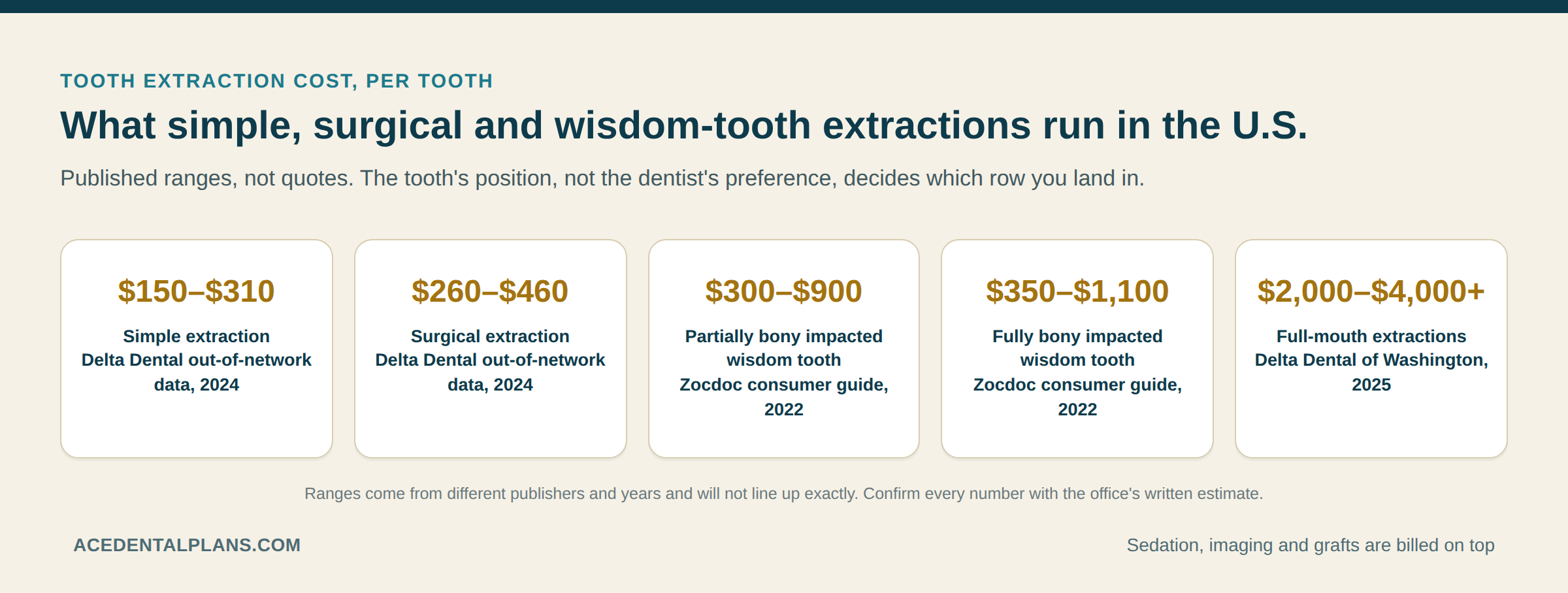 Published per-tooth ranges for simple, surgical and impacted wisdom-tooth extractions, with the publisher and year on each card.
Simple or Surgical: What Moves a Quote From One Price to the Other
Start with what actually happens in the chair. According to the ADA’s MouthHealthy page on extractions, the dentist numbs the area, removes the tooth, and the socket then fills in with bone through the formation of a blood clot. Everything that separates a $200 visit from a $500 one sits inside that first step, the removal.
A simple extraction is a tooth the dentist can see, grip and loosen. Delta Dental of Washington describes these visits as taking about 20 to 40 minutes including the local anesthetic. A surgical extraction is a tooth that can’t be reached that way: the gum is opened, bone may be trimmed, and the tooth may be cut into pieces so it comes out without force. The same Delta page puts surgical visits at up to an hour or longer, depending on how complicated the case is.
Three things typically push a tooth into the surgical column. One is a crown that has broken off at or below the gumline, leaving nothing to grip. Another is roots that curve, spread or fuse in a way that won’t slide out after loosening. The third is impaction, which the American Association of Oral and Maxillofacial Surgeons describes as a tooth that can’t break through the gums, usually because there isn’t enough room. The pattern is that each of these is a fact about the tooth, visible on the X-ray, and none is a billing choice.
That has a practical consequence. A quote written before the X-ray is a guess, and a quote written after it is a diagnosis with a price attached. If your first call to an office produces a number, ask whether it assumes a simple extraction and what changes if the film shows otherwise. A tooth planned as simple can also fracture during removal and become surgical in the middle of the visit. Offices handle that differently, so it’s worth asking in advance whether the quote is a fixed fee or an “up to” figure.
The published ranges, side by side
No single national price list exists, so the ranges below come from several publishers who measured different things. Delta Dental’s figures are out-of-network averages from its own 2024 data. Pearl is a dental-AI company whose cost tool says it builds on ADA fee survey data and published fee schedules. The consumer guides from Zocdoc, Forbes Advisor and CareRoute compile what offices report. Treat the table as a map of where prices cluster, and treat any single row as one publisher’s view.
| Category (label) | What the dentist does | What puts a tooth here | Published range per tooth |
|---|---|---|---|
| Simple extraction (D7140) | Numbs, loosens and lifts out the visible tooth with an elevator and forceps | Tooth is erupted with intact crown and a root shape that slides out | $150–$310 (Delta Dental out-of-network, 2024); $170–$450, national average $260 (Pearl, May 2026); $75–$300 (Zocdoc, 2026) |
| Surgical extraction of an erupted tooth (D7210) | Opens the gum, may remove bone or section the tooth, then closes with stitches | Crown broken at the gumline, curved or spread roots, little tooth left to grip | $260–$460 (Delta Dental, 2024); $180–$550 (Forbes Advisor, 2022); $225–$600+ (Zocdoc, 2026) |
| Impacted, soft tissue (D7220) | Cuts the gum that covers the tooth, then removes it | Tooth is under gum but not held in bone | $200–$450 (CareRoute, 2026); $225–$850 (Zocdoc, 2022) |
| Impacted, partial bony (D7230) | Opens the gum and removes some bone around the crown or root | Part of the tooth is locked in the jawbone | $300–$550 (CareRoute, 2026); $300–$900 (Zocdoc, 2022) |
| Impacted, full bony (D7240) | Removes more bone, often divides the tooth into pieces | Tooth is fully encased in bone | $350–$650+ (CareRoute, 2026); $350–$1,100 (Zocdoc, 2022) |
| Retained root tip (D7250) | Removes a root fragment left after a break or an earlier extraction | Root piece remains in the socket | No separate published range found; ask for this line by name |
Two things stand out. The ranges overlap: the top of Delta’s simple range ($310) sits above the bottom of its surgical range ($260), which is a reminder that a pricey simple extraction in one city can cost more than a modest surgical one in another. And the wider consumer bands, such as $350 to $1,100 for a fully bony wisdom tooth, are wide because they pool different cities, years and office types.
You can put a rough number on the gap. Taking the midpoints of Delta’s 2024 ranges, a simple extraction lands near $230 and a surgical one near $360, a difference of about $130 per tooth. That is arithmetic on a range, not a statistic Delta publishes, but it matches the way the quotes tend to feel: the surgical step costs more, not several times more.
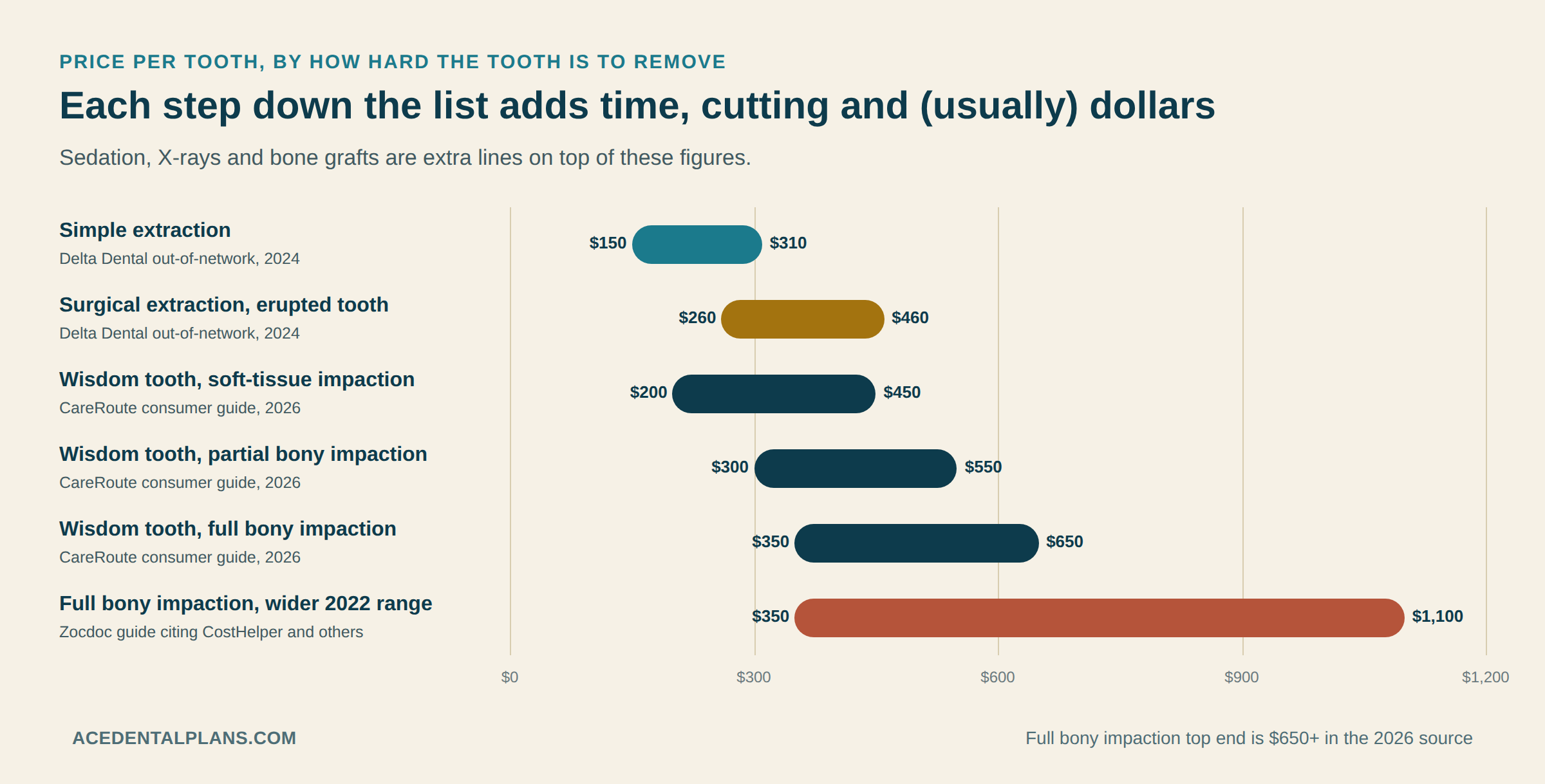 Per-tooth price ranges from simple extraction to full bony impaction, with the source and year on each bar.
Wisdom Tooth Prices by How Deeply the Tooth Sits
Wisdom teeth are where “simple versus surgical” gets three more steps. The ADA says impacted wisdom teeth are trapped in the jaw or under the gums, and that a partly erupted one can give bacteria a way into the gum and set up an infection. The AAOMS recommends an evaluation between ages 17 and 25 and says wisdom teeth that are healthy and properly positioned should still be checked annually. Removal generally follows when there are complications, such as infection, cysts or damage to neighboring teeth.
For billing, the depth of the tooth is the whole story. A wisdom tooth that has fully erupted and comes out like any other molar is priced like a simple extraction. One that is covered only by gum is a soft-tissue impaction. One that is partly held in bone is a partial bony impaction, and one that is entirely enclosed in bone is a full bony impaction. Each step means more cutting, more time and a higher fee, and the dentist reads which step applies from the panoramic X-ray.
| Impaction level | What is different about the surgery | Zocdoc guide (Oct. 2022, citing CostHelper, DirectBenefits, GoodRx) | CareRoute guide (Sept. 2026) |
|---|---|---|---|
| Fully erupted | Comes out like any other molar | $70–$200 | $75–$250 |
| Soft-tissue impaction | Gum is cut back to expose the tooth; no bone removal | $225–$850 (average $350) | $200–$450 |
| Partial bony impaction | Some bone is removed around the tooth | $300–$900 (average $450) | $300–$550 |
| Full bony impaction | More bone removal; tooth is often divided into pieces | $350–$1,100 (average $550) | $350–$650+ |
| All four, surgical, as one package | Often done in one session under sedation | Not given as a package | Delta Dental (2021, out-of-network): $3,120 for four surgical extractions with up to an hour of general anesthesia; $720 for four erupted teeth |
The Zocdoc ranges include local anesthesia and any stitches, according to the guide. They run higher at the top end than CareRoute’s, which fits a guide that pools several sources against one that cites fee-survey and fair-price data, though neither page explains the gap. Pearl’s May 2026 wisdom-tooth listing doesn’t split by impaction level. It gives a national range of $400 to $1,055 per tooth and a national average of $615, which sits above the 2022 per-level averages in the table. Prices moving up over four years is one explanation. A different mix of teeth is another.
The Delta Dental package figures deserve a closer look. A single surgical extraction averaged $550 out of network in the 2021 data, and four of them would be $2,200 at that rate. The package price of $3,120 is about $920 higher, and the page says it includes up to an hour of general anesthesia. It doesn’t itemize the difference, but it suggests that for a four-tooth visit the anesthesia can be a large share of the total rather than a footnote.
One more billing habit is worth checking. Some offices quote wisdom teeth per tooth, some quote all four, and some quote per quadrant. If the number you were given is for “wisdom teeth” without a count, ask which it is before comparing it to anyone else’s.
Anesthesia and Sedation: What Each Level Adds to the Bill
Numbing the area is part of almost every extraction, and most price guides fold it into the base fee. Delta Dental’s 2024 cost page says the extraction fee typically covers the anesthesia and the extraction itself, with extra charges possible for exams, X-rays, sedation or complex cases. Forbes Advisor listed local anesthesia as its own line in 2022, averaging $53, which is a reminder that some offices itemize what others bundle.
Sedation is the layer that changes the bill. The University of Washington’s oral surgery department lists three options for wisdom tooth surgery: local anesthesia, intravenous sedation or general anesthesia. Dentists also use two lighter options, nitrous oxide and an oral sedative pill. Pearl’s May 2026 national data put each in a different price band, and other publishers land in similar neighborhoods.
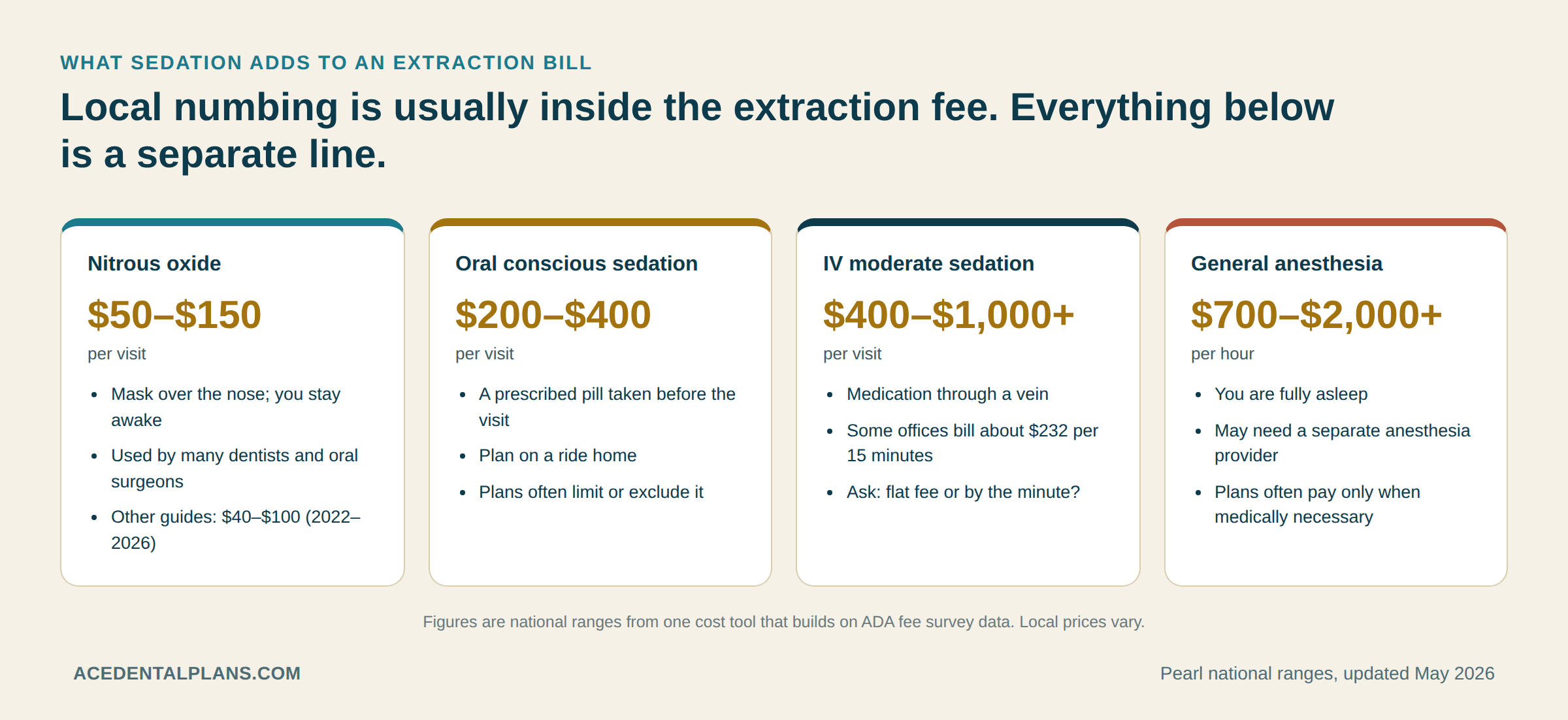 What each sedation level typically adds on top of the extraction fee, using Pearl’s May 2026 national ranges.
Other sources give a sense of how much the figures move. Zocdoc’s 2026 Chicago guide put nitrous oxide at $50 to $100 and IV sedation at $250 to $500. Forbes Advisor’s 2022 averages were $76 for nitrous oxide and $232 per 15-minute increment of IV sedation. Sunbit, a patient-financing company, listed general anesthesia at $500 to $800 in its price guide. The ranges differ because the units differ: a flat fee, a per-visit fee and a per-15-minutes fee are different products.
That last point is the one to ask about. If an office bills IV sedation at the Forbes-style average of $232 per 15 minutes, a 45-minute visit comes to about $700 (three increments), while a flat $350 fee for the same visit would cost half. Neither is wrong, but they aren’t comparable until you know the unit and how long the office expects the procedure to take.
Who offers which level
The AAOMS says oral and maxillofacial surgeons are trained in all aspects of anesthesia and administer local anesthesia and all forms of sedation, including general anesthesia. It also says their training includes at least four years of hospital-based surgical residency. The organization notes that anesthesia delivery in an oral surgery office is regulated by state boards of dentistry, which set training, staffing and facility requirements.
For a general dentist, the answer varies by office and by state rule. Guardian’s wisdom teeth page says many dentists or oral surgeons use a form of partial sedation such as laughing gas or IV sedation, which fits what the price guides show. If your tooth needs deeper sedation than your dentist is set up to give, the practical result is a referral and a second bill, and a second set of insurance rules.
Insurance treats sedation more tightly than the extraction. Forbes Advisor noted in 2022 that anesthesia is generally paid for by insurance only when it is considered medically necessary for the procedure. On its wisdom teeth page, Delta Dental says sedation or general anesthesia costs may be covered by a dental plan. “May” is the operative word: look in your plan document for an anesthesia clause before you assume either answer.
General Dentist or Oral Surgeon: Where a Price Difference Really Comes From
None of the sources used here publishes a price split by provider type, so any claim that surgeons charge more, or that general dentists charge less, would be a guess. What can be said is where differences tend to originate. A surgeon’s quote may fold sedation, imaging and the surgical suite into one number, while a general dentist’s quote may show the extraction alone and refer the rest. Compared line against line, the two can be closer than the headline figures suggest.
Network status often matters more than specialty. Out-of-network costs, Delta Dental’s wisdom teeth page explains, are calculated as a percentage of the dentist’s full fee, while in-network providers give discounted fees. A surgeon who is in your plan’s network can cost you less than a general dentist who isn’t, and the reverse is equally possible. Guardian adds that if a service isn’t covered at all, you may still receive a network discount when you use a network provider.
Setting is the third variable. Some medically complex patients have extractions in a hospital operating room, where a facility fee and a separate anesthesia provider are added. Pearl’s sedation data flags that general anesthesia is often billed per hour with a separate anesthesia provider. When a referral comes, ask who will bill you, how many bills to expect, and whether each one is in your network.
Everything Else That Can Appear on the Bill
The extraction fee is one line on a statement that can have five or six. Most of the surprise in a final bill comes from the others, and nearly all of them are optional or conditional, which means you can ask about them in advance.
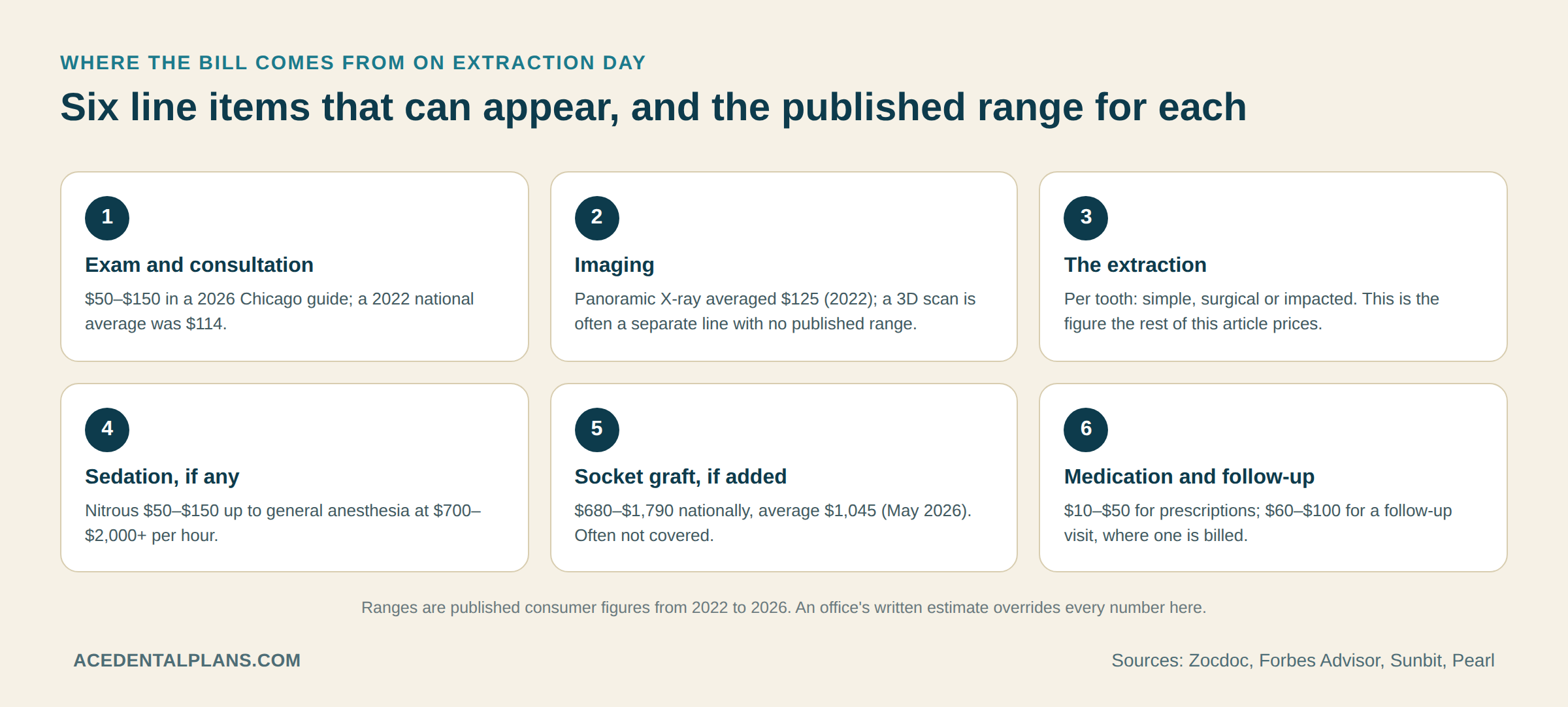 The six line items that can appear on an extraction bill, with the published range for each.
Exam and consultation. Zocdoc’s 2026 Chicago guide put X-rays and consultations together at $50 to $150. Forbes Advisor’s 2022 average for a consultation was $114, and Sunbit lists $50 to $200. If you’re already a patient, the exam may have happened at a recall visit and not reappear.
Imaging. Forbes put the average panoramic X-ray at $125 in 2022, and Sunbit gives $60 to $250 for diagnostic imaging. Zocdoc’s wisdom-teeth guide notes that an X-ray or CT scan is billed as a separate line item but gives no price for the scan. The sources used here include no published range for 3D scans, so ask the office for its fee if one is proposed.
Stitches. After a surgical extraction the dentist usually closes the gum. Zocdoc’s per-level wisdom-tooth ranges describe stitches as possibly included in the price, so don’t expect a separate line unless the office itemizes.
Socket graft. This is the line that can double a bill. Pearl’s May 2026 data put a dental bone graft at $680 to $1,790, with a national average of $1,045. That average is roughly four times the $260 average for a simple extraction on the same site. A graft placed in the socket right after the tooth comes out is sometimes called socket or ridge preservation. Whether one is useful depends on whether a replacement is planned and where in the mouth the tooth sat, and that decision is clinical.
Insurance is rarely generous here. Aetna’s clinical policy bulletin on dental and oral surgery services under medical plans says that, in general, placing bone grafts in extraction sites is considered not medically necessary, with a narrow exception for significant defects at impacted third molar sites in patients 26 or older. That is one carrier’s medical policy, not a rule for every plan, but it signals why a graft often becomes out-of-pocket money.
Medication and follow-up. Sunbit lists prescription costs of $10 to $50 and follow-up visits at $60 to $100 each, and Forbes put medications near $30 in 2022. Many offices include a routine post-op check in the extraction fee. Ask whether a visit for a dry socket or a suture removal is a separate charge, because that’s where policies differ.
How to read the estimate line by line
A written estimate for a surgical wisdom tooth might show a description, a tooth number, a fee and a plan portion on each line. Read down the description column first. You should be able to match each line to a thing that happened: “surgical removal of impacted tooth, partial bony” is the extraction; “IV moderate sedation, first 15 minutes” and “each additional 15 minutes” are the sedation; “panoramic image” is the film.
Then check the units. A sedation line that says “each additional 15 minutes” means the total depends on the clock, and an estimate with only the first increment understates a long visit. Finally, look for lines your plan may treat differently: sedation, graft, and any second-opinion or consultation fee.
Emergency and After-Hours Extractions
Does a same-day or after-hours extraction carry a premium? None of the price sources used here publishes an after-hours surcharge benchmark, so there isn’t a defensible percentage to quote. What can be priced is the pattern around an urgent visit: a limited exam, a targeted X-ray and the extraction itself, at the ranges above, plus any weekend or evening fee the specific office sets. Ask for that fee by name when you call.
The better-documented cost is what happens when someone skips the dentist and goes to a hospital emergency department instead. The ADA reports an estimated 2 million emergency department visits a year for dental pain, with an average cost of $749, about three times the cost of a dentist visit. The ADA gives a per-visit range of $400 to $1,500 for the ER, against $90 to $200 for a dental visit. It also notes that relying on the emergency department often keeps people from choosing a dentist who can treat the underlying problem.
Medicaid.gov’s analysis of 2019 data counted about 487,000 emergency department visits for non-traumatic dental conditions among adults ages 21 to 64 who were enrolled in Medicaid and not dually eligible for Medicare. That is a costly route to care, and on the ADA’s account it often doesn’t lead to a dentist who can treat the underlying problem.

How Dental Plans Classify an Extraction
The order of the explanation matters, because each step changes the one after it. Start with the plan type. A PPO or indemnity plan lets you see many dentists and pays a percentage of an allowed amount. A dental HMO typically pays through a fixed copay schedule at a restricted network of offices. A discount plan isn’t insurance at all, and it only lowers the fee at participating offices. Which of these you have decides what the next steps look like.
Next come the deductible and the network. On network status, Delta Dental’s wisdom teeth page says out-of-network costs are calculated as a percentage of the dentist’s full fee, while in-network providers give discounted fees. One fee schedule can therefore produce different patient bills depending on the office’s network status.
Then the coinsurance. Zocdoc’s 2026 guide describes the common “100-80-50” structure: 100% for preventive care, 80% for basic and 50% for major, with simple extractions typically falling under basic and surgical extractions under major. Guardian says wisdom teeth removal tends to fall under a different classification than basic and preventive care, as a major procedure or oral surgery. Its own plans typically pay about 50% to 80% of the cost of wisdom tooth removal, Delta says, depending on the plan. Forbes Advisor, writing in 2022, gave 50% to 80% for basic care when the work is medically necessary.
After that, the annual maximum and the exclusions. Waiting periods are where extraction coverage most often trips people up. The Washington branch of Delta notes that some of its individual and family plans cover portions of non-surgical extractions after a waiting period, and that its Premium and Plus Ortho plans cover 50% of surgical extractions after a 12-month waiting period. Guardian says many plans don’t provide oral surgery benefits right away, particularly for new enrollees. Age limits can also apply to wisdom teeth, so ask whether your plan has one.
One thing to check separately is replacement. If a plan excludes or limits replacing a tooth, the extraction can be paid while the next step isn’t. Ask before the extraction, not after.
When the medical plan may be the right one to ask
Sometimes an extraction is billed to medical insurance instead of, or alongside, a dental plan. The source for this is Aetna’s medical policy bulletin, last reviewed in March 2026. It states that removal of bone-impacted teeth may be covered under some Aetna medical plans, that HMO plans typically exclude impacted tooth care, and that dental services can be covered when they are incident to and an integral part of a covered medical service, such as extracting teeth before head and neck radiation therapy. The bulletin repeatedly directs members to their plan documents.
The takeaway is narrow. A medically necessary surgical case may be eligible under a medical plan in some circumstances, but that comes from one carrier’s published policy, and other carriers differ. The usual path is to ask the oral surgeon’s billing staff whether they submit to medical insurance and to request a pre-determination in writing.
Medicare and Medicaid for Adult Extractions
Medicare.gov states that in most cases Original Medicare doesn’t cover dental services, including tooth extractions. It does describe narrow exceptions where dental work is tied to a covered medical treatment: an oral exam and dental treatment before a heart valve replacement or a bone marrow, organ or kidney transplant, and a procedure such as a tooth extraction to treat a mouth infection before cancer treatment such as chemotherapy. That page describes Original Medicare only, so whether a Medicare Advantage plan or a separate dental plan adds extraction coverage is a question for that plan’s documents.
The gap is large. The ADA Health Policy Institute reports that 55% of adults ages 65 and older have no dental benefits, compared with 21% of adults ages 19 to 64. Among adults 19 to 64, 63% have private dental benefits and 16% have public ones.
Medicaid works differently. According to Medicaid.gov, states decide which dental benefits to provide to adult enrollees, and there are no minimum requirements for adult dental coverage. For children, the rules are stricter: Medicaid.gov says dental services can’t be limited to emergency services for children entitled to the EPSDT benefit, and the minimum includes relief of pain and infections.
For adults, coverage varies. HealthInsurance.org, summarizing 2025 data, reports that seven states offered emergency-only adult dental coverage (Arizona, Florida, Georgia, Mississippi, Missouri, Nevada and Texas), nine offered limited coverage, and 33 states plus DC offered enhanced coverage. It adds that a CareQuest survey found only 11 states and DC provided “extensive” adult benefits as of 2024. Because state programs change every year, treat the lists as a snapshot and check your state’s current Medicaid dental page.
Emergency-only doesn’t necessarily mean no extractions. A 2016 KFF brief described the emergency-only states as covering only dental care for pain relief or emergency care for injuries, trauma or extractions, and that wording is old. Whether a particular extraction qualifies, and how much a participating dentist is paid, depends on the state rule. If you’re on Medicaid, call the dental office first and ask whether it accepts your plan before booking.
Several Teeth at Once, and Full-Mouth Extraction Before Dentures
Multiple extractions are priced tooth by tooth, but they aren’t always billed that way. Full-mouth extractions, Delta Dental of Washington says, run $2,000 to $4,000 or more without coverage. At the per-tooth ranges above, a full set is not a simple multiplication, since the mix of simple and surgical teeth, the sedation and any bone shaping change the total.
Ask how the office quotes. Some state a fee per tooth, some a fee per visit or per arch, and some a package that includes sedation. A per-arch package can look expensive until you notice it includes the anesthesia that a per-tooth quote lists separately. Whatever the format, get the sedation, the follow-up visits and any bone contouring written on the same page.
Before dentures, the extra detail is timing. Pearl notes that immediate dentures are placed on the day of the extraction and typically cost more overall because they need relining as the gums heal. An extraction-then-wait approach spreads the cost differently: the extraction fee comes first and the denture fee comes after healing. Comparing denture options is outside this article; the point here is that one visit can carry both bills.
The plan year matters when the work is large. Suppose the plan pays 50% for surgical work, has a $1,500 annual maximum, and the deductible is already met. A $4,000 allowed bill in one plan year yields a $2,000 plan share, capped at $1,500, so the patient owes $2,500. Split the same work across December and January with $2,000 in each year, and the plan pays $1,000 in each, or $2,000 in total, leaving the patient $2,000. The $500 difference is hypothetical, and it only exists if the dentist agrees the sequencing is clinically sound and the plan doesn’t restrict it. Infection or pain can override the calendar entirely.
Paying for an Urgent Extraction Without Insurance
The first step costs nothing: ask the office for its cash price and what it includes. A quote that says “extraction” and one that says “extraction, local anesthesia, post-op check” are different offers. Ask, too, whether there is a discount for paying the full amount that day.
Then work through the options in order of how quickly they can help:
- Community health centers. The Health Resources and Services Administration says health centers adjust their fees based on income and family size, and their staff include dentists. Call to confirm that a given center offers extractions and what it would charge.
- Dental school clinics. CareRoute’s 2026 guide lists dental school fee reductions among the ways to lower the price. Students typically work under faculty supervision, which can mean longer appointments and a wait for an opening, so this may not be the fastest route when you’re in pain.
- HSA, FSA and HRA money. Delta Dental’s cost page notes that HSAs, HRAs and FSAs can pay for eligible dental expenses. That moves the cost to pre-tax dollars, which is worth doing if the account has a balance.
- Office payment plans and patient financing. These are loans or deferred-payment products, and the terms vary. Read the interest rate and what happens if a promotional period ends before the balance is paid.
- Medicaid eligibility. If your income qualifies, check whether your state’s program covers adult dental care and whether the office participates.
Staging the work is another lever, with the dentist’s agreement. If one tooth is infected and others are only scheduled for removal, doing the urgent tooth first and the rest later spreads the cost. That is a clinical sequencing question, so ask rather than assume.
What Replacing the Tooth Costs, at a Glance
Whether to replace an extracted tooth, and how, is a decision for you and your dentist, and some extractions, such as a wisdom tooth, are not replaced at all. For readers who are weighing the whole sequence, Table 3 shows only the national price band for each common option. It is a pointer, not a price guide to these procedures, and it leaves out the factors that move each one.
| Option | National range | National average | What the figure leaves out |
|---|---|---|---|
| Simple extraction (for comparison) | $170–$450 | $260 | Sedation, imaging and surgical complexity |
| Bone graft in the extraction socket | $680–$1,790 | $1,045 | Often not covered; only applies if a graft is advised |
| Partial denture | $1,250–$3,280 | $1,920 | Materials, number of teeth, lab fees |
| Denture (Pearl’s combined listing) | $1,360–$3,565 | $2,085 | Pearl doesn’t say whether this is per arch; immediate dentures typically cost more overall because of relining |
| Single dental implant | $2,005–$5,255 | $3,075 | Whether the listing includes the crown and abutment is not stated; bone grafting if needed |
| Dental bridge | $3,010–$7,900 | $4,620 | Number of units and the condition of the neighboring teeth |
Pearl describes its figures as population-weighted national averages that build on ADA fee survey data, regional fee schedules and its own modeling, so they’re a reasonable guide to scale but not a quote. Even so, the table makes one thing plain. A simple extraction at the $260 average is a small fraction of a $3,075 implant, which is roughly twelve times as much, or a $4,620 bridge, closer to eighteen times. The extraction is the entry fee, not the main expense, when a replacement is part of the plan.
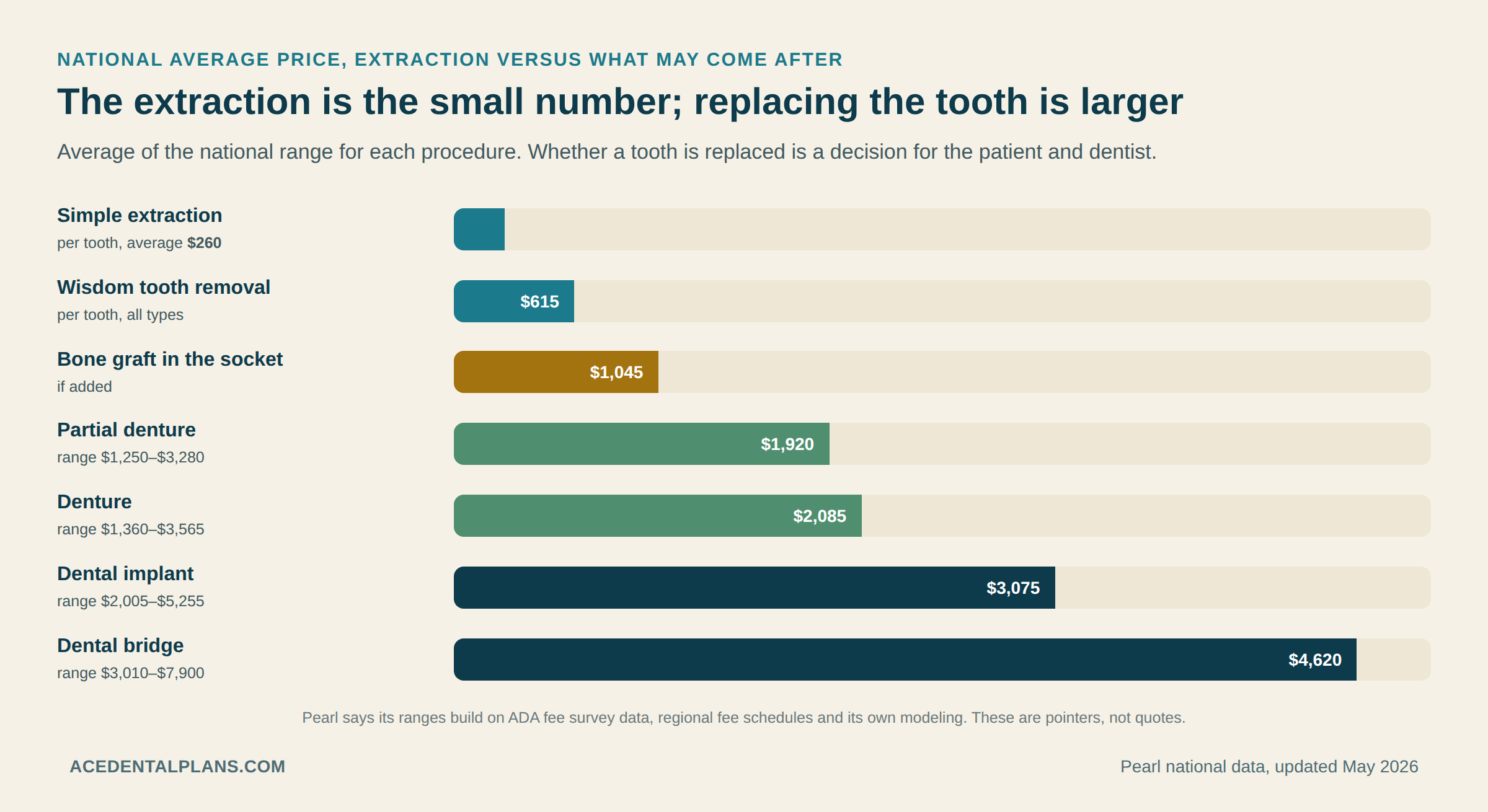 National average price of an extraction compared with a socket graft and the common replacement options.
What Waiting Can Add to the Cost
No source used here measures how much a delay adds to an extraction bill, and any single percentage would be invented. What the clinical bodies do describe is why a tooth can move from “watch it” to “treat it now.” The ADA says a partly erupted wisdom tooth can give bacteria a place to enter the gum and cause an infection, and that wisdom teeth left in place should keep being monitored because problems can still develop. The AAOMS says wisdom teeth should generally be removed when complications appear, including infection, cysts, tumors or damage to adjacent teeth.
That points to two kinds of cost. The first is the cost of watching: the AAOMS says healthy, well-positioned wisdom teeth call for professional cleanings, annual checkups and periodic X-rays, each of which is a small recurring charge. The second is the cost of an urgent visit when watching stops working. That could be an emergency department visit at the ADA’s $749 average, or a same-day appointment at a dental office with an exam and an X-ray ahead of the extraction.
Delay also interacts with insurance. A waiting period of 12 months, like the one Delta Dental of Washington lists for surgical extractions on some individual plans, is a reason to ask early. But infection doesn’t follow the plan calendar, and whether a tooth can safely wait is a clinical call. Ask the dentist what the safe window is, in days or weeks, and get it in the chart.
Aftercare Costs and What Normal Recovery Looks Like
Delta Dental of Washington describes typical recovery as seven to ten days of healing. The ADA’s MouthHealthy page advises against smoking, rinsing vigorously and drinking through a straw for the first 24 hours, so that the clot that fills the socket stays in place. Most aftercare supplies, including gauze, ice packs and soft food, cost little.
The real line items are the prescription ($10 to $50 in Sunbit’s guide, near $30 in Forbes Advisor’s) and any follow-up visit, which Sunbit puts at $60 to $100 each when billed. The larger hidden cost is time. A surgical wisdom tooth session with sedation commonly means a day of reduced work and someone to drive you, and those are real money for hourly workers even though no dentist bills for them.
If something goes wrong, such as pain that rises after the first few days, call the office. Ask in advance whether a problem visit is included in the original fee, because policies differ and none of the price sources used here states a standard charge.
Frequently Asked Questions – Tooth Extraction Cost
How much does it cost to pull one tooth with no insurance?
For a simple extraction, Delta Dental’s 2024 out-of-network data show $150 to $310 and Pearl’s May 2026 national figure is $170 to $450, with a $260 average. A surgical extraction runs higher, about $260 to $460 in Delta’s data. Add sedation, imaging or a graft only if they apply to your visit.
Why did my quote go up after the X-ray?
The film shows what the tooth looks like below the gum: the root shape, any bone around it, and how a wisdom tooth is angled. A tooth that looked simple from above can turn out to need cutting. Because the category is a fact about the tooth, the revised number is normally the more reliable one, but ask what in the image changed it.
Is every wisdom tooth removal surgical?
No. A wisdom tooth that has fully erupted can come out like any other molar and is priced like a simple extraction, which the 2022 and 2026 guides cited here put at roughly $70 to $250. It becomes surgical when it is under the gum or held in bone.
Does the extraction fee include numbing?
Usually, yes. According to Delta’s 2024 cost page, extraction pricing typically covers the anesthesia and the extraction itself, and its wisdom teeth page says local anesthesia is included. Some offices itemize it separately, and sedation is nearly always a separate line.
Can I get sedation for a simple extraction, and what does it add?
Many offices offer nitrous oxide, which the sources cited here put between about $40 and $150. Deeper sedation is possible depending on the office and your health, but it can add several hundred dollars. Ask whether the sedation fee is flat or billed per 15 minutes.
Will my dental insurance cover a surgical extraction?
Many plans cover part of it, often at 50% for surgical work, but the details depend on the plan. Look for a waiting period, an annual maximum and any exclusion for sedation. A written pre-treatment estimate from the plan is the most reliable answer.
Can medical insurance pay instead of dental?
Sometimes. Aetna’s published medical policy says removal of bone-impacted teeth may be covered under some of its medical plans, and extractions needed before certain medical treatments can qualify. Other carriers differ, so ask the oral surgeon’s office to check your medical plan before the procedure.
Is it cheaper to take out all four wisdom teeth at once?
The sources cited here don’t show a standard multi-tooth discount. A single visit can still reduce the number of sedation sessions and recovery periods, which is where a saving would most likely come from. Ask whether the package price is lower than four separate per-tooth fees.
Does Medicaid pay for tooth extractions for adults?
It depends on the state. Medicaid.gov says states decide what dental benefits to offer adults and that there is no minimum requirement. Seven states offered emergency-only dental coverage in 2025, according to HealthInsurance.org, so check your state’s program and confirm that the dentist accepts it.
What happens to the price if the tooth breaks during the extraction?
A tooth that fractures can turn a simple extraction into a surgical one mid-visit, and the fee may change to match. Offices handle this differently, so ask before the appointment whether the quote is fixed or an estimate that adjusts.
Sources and Disclaimers – Tooth Extraction Cost
The price ranges in this article come from the publishers named in the text: Delta Dental (2021, 2024 and 2025 pages), Pearl’s national cost data (May 2026), and consumer guides from Zocdoc (2022 and 2026), Forbes Advisor (2022), CareRoute (September 2026) and Sunbit. Clinical statements come from the ADA, the AAOMS and its MyOMS patient site, and coverage statements come from Medicare.gov, Medicaid.gov, HealthInsurance.org, Aetna’s published policy and Guardian. The worked examples, the midpoint arithmetic and the plan-year scenario are original illustrations built from those ranges, not quotes or survey results. Averages blend cities, years and office types, publishers measured different things, and the figures will not match any one office’s fee. Confirm prices in a written estimate from the dentist and benefits with your insurer before treatment.
- Medicare.gov — Dental services: what Original Medicare covers
- Medicaid.gov — Dental care benefits in Medicaid
- Medicaid.gov — Adult non-traumatic dental emergency department visits in Medicaid (2019 data)
- American Dental Association — Emergency department referrals for dental pain
- ADA Health Policy Institute — Dental benefits coverage, access and outcomes statistics
- ADA MouthHealthy — Wisdom teeth
- ADA MouthHealthy — Extractions
- American Association of Oral and Maxillofacial Surgeons — Wisdom teeth management
- AAOMS MyOMS — Wisdom teeth management (patient information)
- AAOMS MyOMS — Anesthesia in the oral surgeon’s office
- AAOMS — Anesthesia in OMS practice
- University of Washington School of Dentistry — Wisdom teeth: patient information from oral surgery
- HRSA Bureau of Primary Health Care — What is a health center?
- Delta Dental — Tooth extraction costs and insurance coverage (2024 data)
- Delta Dental — Wisdom teeth removal costs (2021 data)
- Delta Dental of Washington — Tooth extractions: costs, types and what to expect (February 2025)
- Guardian Life — Wisdom teeth and dental insurance
- Aetna — Clinical policy bulletin: dental services and oral and maxillofacial surgery under medical plans (reviewed March 2026)
- HealthInsurance.org — To what degree does Medicaid provide adult dental coverage?
- KFF — Access to dental care in Medicaid: spotlight on nonelderly adults (2016)
- Zocdoc consumer guide — Tooth extraction cost in Chicago, February 2026
- Zocdoc consumer guide — How much does wisdom teeth removal cost? (October 2022)
- Forbes Advisor via Nasdaq — Tooth extraction costs and how to afford it (October 2022)
- Pearl dental cost data — Tooth extraction national cost (May 2026)
- Pearl dental cost data — Sedation dentistry national cost (May 2026)
- Pearl dental cost data — Dental bone graft national cost (May 2026)
- CareRoute consumer guide — Wisdom tooth extraction cost (September 2026)
- Sunbit patient-financing guide — Wisdom teeth removal cost guide
Important Information and Disclaimers
This article is general educational information. By using it, you accept the limits described below.
Not dental or medical advice
Nothing on this page is a diagnosis, a treatment recommendation or a substitute for an examination by a licensed dentist or physician. Reading this article does not create a dentist-patient or doctor-patient relationship. Only a licensed professional who has examined you and reviewed your history can tell you what your mouth needs. Do not delay, skip or stop professional care because of something you read here.
Prices are estimates, not quotes
Cost figures are ranges reported by the third-party sources cited in this article. Actual prices depend on your location, the provider, the complexity of your case, the materials used, the date of service and other factors, so what you pay may be higher or lower. A written treatment plan and fee estimate from the dental office is the only reliable number for your situation.
Insurance and plan examples are illustrations
Examples that use named amounts or percentages are hypothetical. Real benefits depend on your plan, network, waiting periods, annual maximum, deductible and the insurer’s rules at the time of treatment. A pre-treatment estimate or benefits check is not a promise of payment. Confirm the details with your insurer or plan administrator in writing.
Not insurance, legal, tax or financial advice
AceDentalPlans is an information publisher. Nothing here is insurance, legal, tax, investment or other professional financial advice, and nothing here recommends a particular provider, insurer, lender, discount plan or financing product. Company and product names belong to their owners and appear for identification only. Read the terms of any loan, financing offer or plan before you sign, and ask a qualified professional if you need advice on your own circumstances.
Third-party sources
This article cites government agencies, professional associations, insurers, lenders and other outside organizations. We do not control those sources. Their content can change, move or disappear, and listing a source is not an endorsement of it or of anything it sells.
No warranty
We aim for accuracy, but this article is provided “as is,” without warranties of any kind, express or implied, including warranties of accuracy, completeness, timeliness or fitness for a particular purpose. Some information may be out of date or contain errors by the time you read it.
Limitation of responsibility
To the fullest extent permitted by law, AceDentalPlans and its owners, authors and contributors are not responsible or liable for any loss, cost, injury, health outcome or other damage that results from using this article or relying on it. You are responsible for your own decisions about your care, your coverage and your money.
How this article is written
This article follows AceDentalPlans’ answer-first, U.S.-focused editorial approach. It uses conditional language for insurance, because coverage depends on the specific plan, and it names its sources so that you can read them yourself.