
Dental Price Guide. Dental prices cluster at four levels. A checkup visit with cleaning and X-rays typically runs $50 to $350, averaging $203 in a 2023–2024 national survey. A filling is usually $100 to $335. A crown or a root canal generally averages between about $900 and $1,400 per tooth, depending on the tooth and the material. A finished single-tooth implant adds up to roughly $2,800 to $4,350 once every part is counted.
This page is a lookup reference. It sorts typical U.S. prices by category of care, shows how the lines on an estimate add up, defines the four terms that decide what you personally owe (fee schedule, usual and customary fee, allowed amount, out-of-pocket), and ends with a method for comparing two quotes. Implants, root canals, crowns and extractions get a range and a sentence here, because each one deserves a longer treatment than a reference table can give.
Key Takeaways
- One survey of 2023–2024 prices puts an exam, cleaning and X-rays at $203 on average, a composite filling at $226, a molar root canal at $1,337, a porcelain crown at $1,399 and a single full-size implant at $2,143.
- Published fee schedules can differ by nearly two-fold on the same procedure. A molar root canal runs from $721 on a Medicaid schedule to $1,352 on a university dental center schedule.
- A procedure is rarely one line. A crown on a root-canal tooth can mean an exam, an X-ray, the root canal, a buildup, the crown itself and possibly anesthesia, each priced separately.
- Many plans sort care into preventive, basic and major tiers, with coinsurance often described as up to 100%, 80% and 50%. The tier, the deductible and the annual maximum decide your share, not the sticker price alone.
- Two quotes only compare fairly when the tooth, the procedure code, the material and everything bundled in (buildup, temporary, anesthesia, follow-up) match.
- National ranges are a yardstick, not a forecast. Your ZIP code, the office, and whether the dentist is in your plan’s network can move a price more than the procedure’s name does.
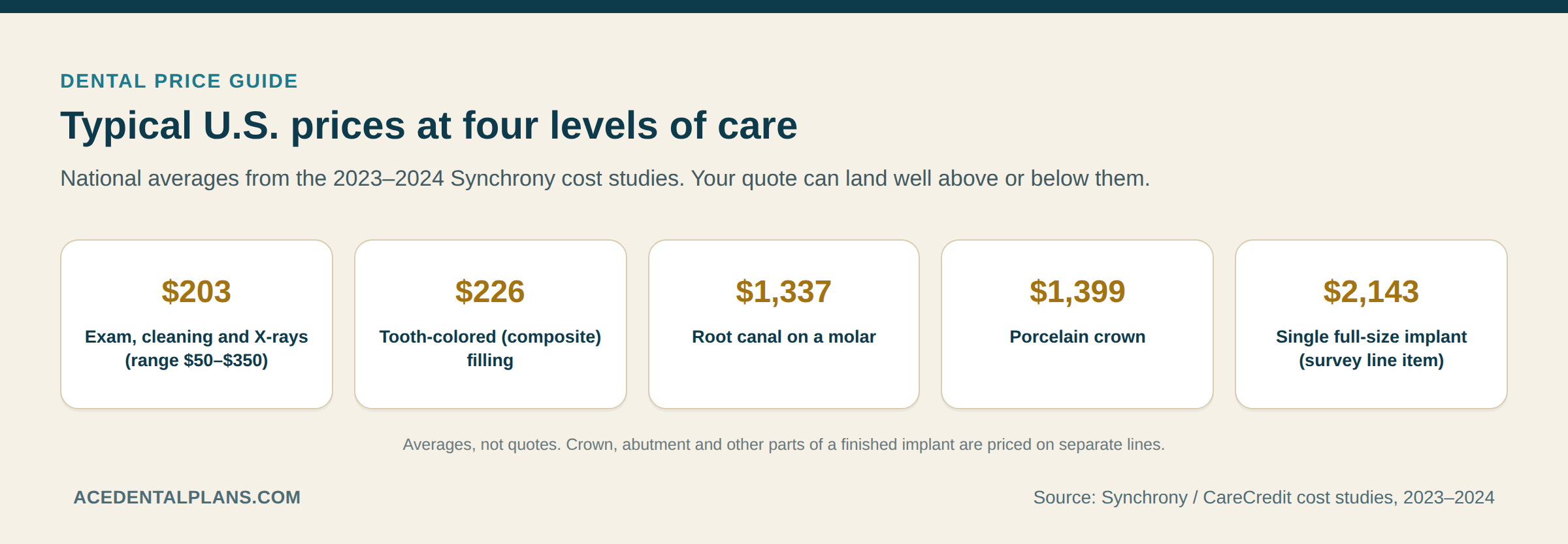 Average prices at four levels of care from the 2023–2024 Synchrony cost studies. Treat them as midpoints, not quotes.
What the Numbers in This Guide Are Made Of
No single free, public price list covers U.S. dentistry. What exists is a patchwork, and the honest way to use it is to know which patch you’re looking at. This guide draws on three kinds of figures, and each table says which is which.
The first kind is a published fee schedule: a list of what a payer or an institution charges or pays for each procedure code. Three are used here. Boston University’s Dental Health Centers published a 2024 schedule of its own charges. Delta Dental of Colorado issued a Patient Direct schedule effective November 1, 2025, which is a discount plan (explicitly not insurance) listing fixed prices for general dentistry. North Dakota’s Medicaid program posted an adult dental fee schedule effective July 1, 2025, showing what the program pays. Those three sit at different heights, and that spread is useful. It shows how much the same code can be worth depending on who is paying.
The second kind is a national cost survey. Synchrony, the company behind the CareCredit card, commissioned ASQ360 to research prices across the 50 states and D.C. in 2023 and 2024, and both CareCredit and Guardian publish the resulting averages. These are averages of what offices reported, so they blend high-cost and low-cost markets, and they don’t say how many offices sat at each end.
The third kind is a local or tool-based figure. Humana’s cost page lists average prices for one city, Orlando, pulled from its internal procedure pricing tool and updated in June 2026. The University of Louisville School of Dentistry compares its student-clinic fees with 2024 private-practice rates from the National Dental Advisory Service. Both are useful as single data points, and neither stands in for the country.
Why you’ll see ranges instead of one “average price”
Averages hide the thing a patient with a quote needs to know, which is where that quote sits. So each row gives a low-to-high spread from the fee schedules, then the survey or tool figure beside it. The low end tends to come from Medicaid or discount-plan schedules, which are built around what a payer will accept. The high end tends to come from university dental centers and private-practice surveys. A Medicaid fee isn’t a retail price that a walk-in patient would be quoted, and it’s included to show the floor of what published schedules attach to a code, not to suggest you’ll find it.
Units matter as much as dollars. Fillings are priced per tooth and by number of surfaces. Gum treatment is priced per quadrant (a quarter of the mouth). Dentures are priced per arch (upper or lower). Sealants are priced per tooth, braces per course of treatment. If a figure in your estimate looks double the one in a table, check the unit before assuming you’re being overcharged.
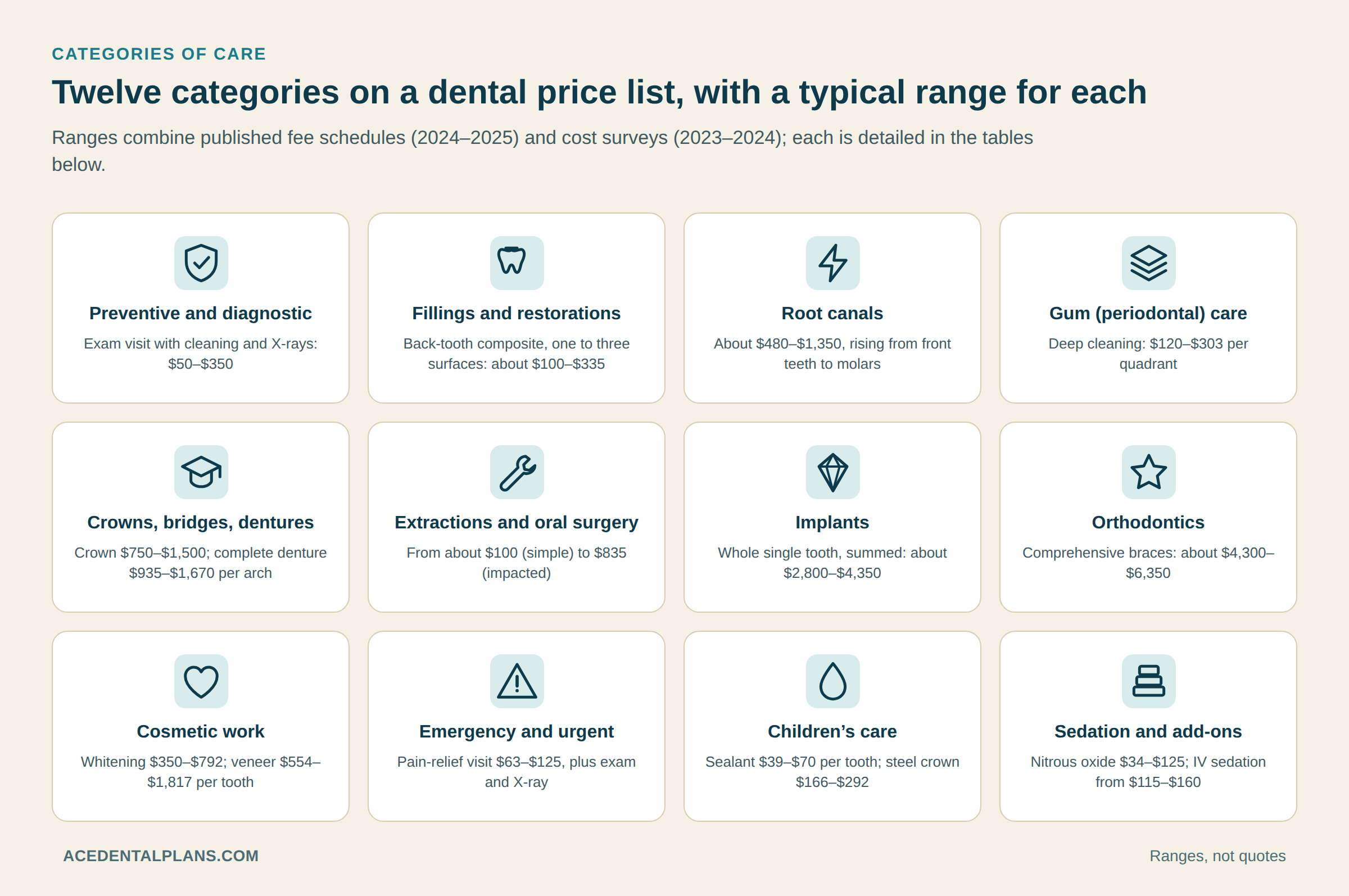 The twelve categories used in the tables below, each with a typical range drawn from fee schedules (2024–2025) and surveys (2023–2024).
The tables that follow run from routine care up through the expensive end. Each row lists the procedure and its CDT code where one applies (a code is only a label; you can read it as a lookup key, nothing more), then the published fee-schedule spread, then the survey or tool figures, then how plans usually classify the service. That last column is conditional by design. Classification belongs to the plan document, and two plans from the same carrier can disagree.
Preventive and Diagnostic Care: Exams, X-Rays, Cleanings, Fluoride and Sealants
The routine visit is the one price almost every adult will meet, so it’s the place to learn how an estimate is built. A typical checkup isn’t a single service. It combines an exam, a set of X-rays and a cleaning, and each has its own code and its own fee.
The 2023–2024 Synchrony figures put that combined routine visit at $203 on average, with a range of $50 to $350 across the country. Adding up individual lines gives a similar picture. Take a comprehensive exam, four bitewing X-rays and an adult cleaning. On the Delta Dental of Colorado discount schedule that’s $15 + $39 + $60 = $114. On the North Dakota Medicaid schedule it’s about $165. On Boston University’s 2024 schedule it’s $92 + $79 + $112 = $283. The survey average sits comfortably inside that band.
| Procedure (CDT code) | Published fee schedules (low to high) | Surveys and pricing tools | Usual plan category |
|---|---|---|---|
| Routine visit: exam + X-rays + cleaning (summed from lines) | $114 (Delta Dental CO discount plan) to $165 (ND Medicaid) to $283 (BU) | $203 average, $50–$350 range (Synchrony, 2023–24) | Preventive; many plans pay the highest share here |
| Periodic exam, established patient (D0120) | $10 / $33 / $48 | Included in the visit average above | Preventive or diagnostic; frequency limits are common |
| Comprehensive exam, new patient (D0150) | $15 / $55 / $92 | Included in the visit average above | Preventive or diagnostic |
| Adult cleaning (D1110) | $60 / $65 / $112 | Up to $109 in Orlando (Humana, 2026) | Preventive |
| Four bitewing X-rays (D0274) | $39 / $45 / $79 | $65 for bitewing X-rays (Synchrony) | Preventive or diagnostic; many plans limit how often |
| Panoramic X-ray (D0330) | $62 / $78 / $131 | $200 (Synchrony); up to $160 in Orlando (Humana) | Diagnostic; many plans limit how often |
| Full-mouth X-ray series (D0210) | $83 / $99 / $137 | $226 (Synchrony) | Diagnostic; many plans limit how often |
| Fluoride varnish (D1206) | $31 (Delta Dental CO) / $52 (BU) | Not listed in the survey | Preventive; some plans limit by age |
| Sealant, per tooth (D1351) | $39 (Delta Dental CO) / $70 (BU, patients under 14) | $42 per tooth (Synchrony) | Often preventive; some plans limit by age |
In the fee-schedule column, three numbers separated by slashes are, in order, Delta Dental of Colorado’s discount-plan price, North Dakota Medicaid’s payment and Boston University’s charge. Where only two appear, the third source doesn’t list the code in the data I could read.
What drives a gap between a $60 cleaning and a $112 one
Sometimes the gap is geography, and sometimes it’s the type of cleaning. A code for a routine adult cleaning (D1110) is a different service from a periodontal maintenance visit, which exists for patients treated for gum disease and costs more. Check the code before you compare. A $154 line on a BU-style schedule labelled “periodontal prophylaxis” and a $112 line labelled “adult prophylaxis” are not a price disagreement. They’re two services.
X-rays follow a similar logic. Bitewings show the crowns of the back teeth, a panoramic image shows the whole jaw in one pass, and a full-mouth series is a set of individual images. The American Dental Association says how often X-rays are needed depends on a person’s current oral health, age, risk for disease and symptoms, adding that there is no “one size fits all” interval. So the number of X-ray lines on your estimate is a clinical decision, and the fee for each line is a pricing decision. Only the second is covered in this guide.
Sealants and fluoride sit here because plans usually file them under prevention. The CDC describes a sealant as a protective coating painted on the chewing surfaces of the back teeth, and says that applied at the right time it can prevent up to 80% of cavities for two years and continue to protect against 50% of cavities for up to four years. At $39 to $70 per tooth in the fee schedules, and $42 in the survey, a sealant is one of the cheapest line items on any treatment plan.
Fillings, Buildups and Root Canals: What Restorative and Endodontic Work Costs
Filling prices turn on two things you can see on the estimate: the material and the number of surfaces. A one-surface filling touches one face of the tooth. A three-surface filling wraps around more of it and costs more because it takes longer and uses more material. Posterior (back) teeth and anterior (front) teeth have separate codes, so the same patient can see two different prices for what feels like one kind of filling.
Root canals are priced by tooth type, because front teeth generally have one canal and molars have more. Keep that in mind when you compare quotes. A root canal estimate that doesn’t say which tooth it’s for is missing the most important number on the page. The fee covers the root canal itself; the restoration that follows (a buildup, a crown) is a separate set of lines and often the larger share of the bill.
| Procedure (CDT code) | Published fee schedules (low to high) | Surveys and pricing tools | Usual plan category |
|---|---|---|---|
| Amalgam (silver) filling, one surface (D2140) | $103 (Delta Dental CO) / $135 (BU) | $139 (Synchrony) | Basic |
| Composite filling, one surface, back tooth (D2391) | $110 / $118 (ND Medicaid) / $175 | $217 in Orlando (Humana); $240 private-practice figure for a one-surface filling (NDAS 2024, via University of Louisville); $226 composite average (Synchrony) | Basic |
| Composite filling, two surfaces, back tooth (D2392) | $140 / $151 / $235 | $274 in Orlando (Humana) | Basic |
| Composite filling, three surfaces, back tooth (D2393) | $166 (Delta Dental CO) / $260 (BU) | $333 in Orlando (Humana) | Basic |
| Composite filling, one surface, front tooth (D2330) | $100 (Delta Dental CO) / $155 (BU) | $199 in Orlando (Humana) | Basic |
| Porcelain inlay or onlay; CEREC same-day; gold | Not in these schedules | Porcelain inlay/onlay $976; CEREC $810; gold $466 (Synchrony) | Often basic or major, depending on the plan’s wording |
| Core buildup under a crown (D2950) | $138 / $199 / $320 | Not listed in the survey | Usually follows the crown’s category |
| Pulpotomy, mainly children (D3220) | $87 (Delta Dental CO) / $175 (BU) | Not listed | Often basic |
| Root canal, front tooth (D3310) | $548 / $478 / $929 | $984 (Synchrony) | Basic on some plans, major on others |
| Root canal, premolar (D3320) | $604 (Delta Dental CO) / $1,152 (BU) | $984 for a bicuspid (Synchrony) | Basic on some plans, major on others |
| Root canal, molar (D3330) | $804 / $721 / $1,352 | $1,337 (Synchrony); $900–$1,175 across tooth types in Orlando (Humana, excluding the final restoration) | Basic on some plans, major on others |
| Retreatment of an earlier molar root canal (D3348) | $906 (Delta Dental CO) / $1,450 (BU) | Not listed | Same category as the original on many plans |
| Apicoectomy (root-end surgery) | $800 front, $900 premolar (BU) | $1,119 (Synchrony) | Often major or surgical |
For fee-schedule cells with three numbers, the order is Delta Dental of Colorado, North Dakota Medicaid, then Boston University.
Two fillings that look alike and price differently
An amalgam and a composite filling can fill the same cavity, yet the composite line costs more on both schedules that list the two. At the Delta Dental of Colorado discount price, a two-surface amalgam is $132 and a two-surface back-tooth composite is $140, a small gap. At Boston University the amalgam is $165 and the composite $235, a wider one. Some plans may pay for the composite at the amalgam rate and leave the difference to the patient. Whether yours does is written in the plan document, usually under a heading like “alternate benefit.”
Inlays, onlays and same-day ceramic restorations sit in a band of their own. Synchrony’s 2023–2024 survey puts a porcelain inlay or onlay at $976, a CEREC same-day restoration at $810 and a gold restoration at $466. These are closer to crown territory than to filling territory, and plans may treat them that way.
Root canal prices in context
Across the sources here, a root canal runs from the high $400s on the lowest Medicaid line (a front tooth at $478) to about $1,350 on the highest molar line. The Synchrony survey lands at $984 for front teeth and premolars and $1,337 for molars. The University of Louisville’s 2024 private-practice figure is $1,130 for a root canal, and its student clinic charges $345. Retreatment, when an earlier root canal needs to be redone, carries a higher fee in both schedules that list it. In plain terms: the tooth type moves the price more than almost anything else, and the part of the bill people forget is what comes after.
That “what comes after” is a buildup (a foundation of material that restores the structure a crown can grip) at $138 to $320 in the schedules, plus the crown. Humana’s Orlando range of $900 to $1,175 is explicitly labelled as excluding the final restoration, which is the sort of footnote worth hunting for on any quote.
Gum Treatment, Crowns, Bridges and Dentures: The Prosthodontic End of the Price List
This group is where one decision can turn into a four-figure estimate, so it pays to know what’s in each line. Crowns, bridges and dentures are made in a dental laboratory from a specific material, and the material is usually the largest variable in the price. Gum disease treatment starts much cheaper per visit but often repeats over years. Dental Price Guide…
| Procedure (CDT code) | Published fee schedules (low to high) | Surveys and pricing tools | Usual plan category |
|---|---|---|---|
| Full-mouth debridement (D4355) | $85 (Delta Dental CO) / $190 (BU) | $126 for gross debridement (Synchrony) | Varies; often basic |
| Scaling and root planing, 1–3 teeth in a quadrant (D4342) | $120 (Delta Dental CO) / $172 (BU) | Not listed separately | Basic or major, depending on the plan |
| Scaling and root planing, 4+ teeth in a quadrant (D4341) | $172 / $193 (ND Medicaid) / $255 | $242 per quadrant (Synchrony); $235–$303 per quadrant in Orlando (Humana) | Basic or major, depending on the plan |
| Periodontal maintenance (D4910) | $92 (Delta Dental CO) / $154 (BU) | $167 (Synchrony) | Varies; frequency limits are common |
| Gum surgery (osseous), 4+ teeth per quadrant (D4260) | $746 (Delta Dental CO) / $1,392 (BU) | Gum graft $2,742 per procedure; full-mouth osseous surgery $7,889 (Synchrony) | Often major |
| Crown, porcelain/ceramic (D2740) | $825 / $752 / $1,475 | $1,399 (Synchrony); $1,387 in Orlando (Humana); $1,396 private-practice figure (NDAS 2024, via University of Louisville) | Major |
| Crown, porcelain fused to high noble metal (D2750) | $831 (Delta Dental CO) / $1,475 (BU) | $1,114 for porcelain and metal (Synchrony); $1,192 in Orlando (Humana) | Major |
| Crown, full cast high noble metal (D2790) | $792 (Delta Dental CO) / $1,475 (BU) | $1,211 for a metallic crown (Synchrony); $1,440 in Orlando (Humana) | Major |
| Three-unit bridge, built from lines: pontic + two retainer crowns (D6240, D6740) | $2,309 (Delta Dental CO: $779 + 2 × $765) / $4,475 (BU: $1,475 + 2 × $1,500) | $5,197 for a single-tooth traditional bridge; $1,569 Maryland bridge; $1,041 cantilever (Synchrony) | Major |
| Complete denture, one arch (D5110/D5120) | $935 / $1,142 (ND Medicaid) / $1,670 (BU, upper) | $1,968 upper and lower, traditional; $452 basic; $6,514 premium (Synchrony); $1,626–$2,104 for partial and complete dentures in Orlando (Humana) | Major |
| Partial denture, resin base (D5211/D5212) | $637 (Delta Dental CO) / $1,000 (BU) | $605 for an acrylic partial or flipper (Synchrony) | Major |
| Partial denture, cast metal framework (D5213/D5214) | $1,058 (Delta Dental CO) / $1,700 (BU) | $2,229 for a metal partial (Synchrony) | Major |
| Denture reline, laboratory (D5750) | $269 (Delta Dental CO) / $453 (BU) | Not listed | Varies |
Three-number cells follow the same order as before: Delta Dental of Colorado, North Dakota Medicaid, Boston University.
Why the crown material doesn’t settle the price
Look at the crown rows. On the Delta Dental of Colorado schedule a porcelain/ceramic crown is $825, a porcelain-fused-to-metal crown $831 and a full gold-alloy crown $792. Those are close. On the Boston University schedule all three are $1,475 for a porcelain crown, a porcelain-to-high-noble crown and a full cast crown. So within a single schedule the material hardly changes the fee. Across the surveys it does: Synchrony lists a temporary resin crown at $697, a porcelain and metal crown at $1,114 and a porcelain crown at $1,399. The lesson is that you can’t infer a material from a price, or a price from a material. Ask for both on the quote.
Bridges: add up the units
A traditional bridge replaces a missing tooth by crowning the teeth on either side and joining a false tooth (a pontic) between them. That’s three units, and the schedules price each unit separately. Adding one pontic and two retainer crowns gives $2,309 on the Delta Dental of Colorado schedule and $4,475 on Boston University’s. The Synchrony survey’s $5,197 for a single-tooth traditional bridge sits above both. If a quote for a bridge lists one price with no units, ask how many units and which materials it assumes.
Dentures: a range from $452 to $6,514
Dentures hold the widest spread of any prosthodontic item, and it is mostly a quality-tier story. Synchrony’s survey lists basic dentures (upper and lower) at $452, traditional at $1,968 and premium at $6,514. A university private-practice comparison puts a complete set higher still: the University of Louisville cites $4,600 for complete dentures in private practice against $1,275 in its student clinic (2024). The fee schedules list a complete denture per arch at $935 to $1,670, so a full upper-and-lower set is roughly double that. Partial dentures run from $605 for an acrylic flipper to $2,229 for a metal framework in the survey, and reline and rebase work is priced separately again.
Gum treatment: priced per quadrant, repeated over time
Scaling and root planing is a deep cleaning below the gumline, billed per quadrant. At $120 to $303 per quadrant across the sources, treating all four quadrants adds up to roughly $480 to $1,200, depending on how many teeth in each quadrant need it. After that, periodontal maintenance visits ($92 to $167 each) replace the standard cleaning at intervals the dentist or periodontist sets. Surgical gum treatment is a different tier of cost: $746 to $1,392 per quadrant in the two schedules that list it, and $7,889 for the full-mouth osseous surgery figure in the survey. Plans frequently put non-surgical gum treatment and surgical gum treatment in different tiers, so confirm which one your plan uses.
Extractions, Bone Grafts and Implants: Surgical Prices and the Implant Parts List
Extractions are priced by difficulty, not by the tooth’s name. A tooth that has erupted and can be lifted out with forceps is a simple extraction. One that needs bone removed, or has to be cut into sections, is surgical. A wisdom tooth that is still stuck under gum or bone is an impaction, and the code depends on whether soft tissue or bone covers it. The category can depend on what the dentist finds during the procedure, so an estimate may be revised once the tooth is seen up close.
Implants are the opposite problem. A single quoted number often hides several parts that the schedules list separately: the surgically placed post, the abutment that connects to it, and the crown that goes on top. Add them up before you compare.
| Procedure (CDT code) | Published fee schedules (low to high) | Surveys and pricing tools | Usual plan category |
|---|---|---|---|
| Simple extraction (D7140) | $102 / $105 (ND Medicaid) / $150 | $177 (Synchrony); $225–$500 across simple to complex cases in Orlando (Humana) | Basic |
| Surgical extraction (D7210) | $163 / $215 / $287 | $363 (Synchrony) | Basic or major, depending on the plan |
| Impacted tooth, full bony (D7240) | $296 / $367 / $667 | $532 for a full bony impaction; $835 for a single impacted wisdom tooth (Synchrony) | Often major; varies |
| Removal of residual roots (D7250) | $178 (Delta Dental CO) / $307 (BU) | Not listed | Basic or major, depending on the plan |
| Four wisdom teeth removed | Sum of the lines above, per tooth | $2,685 for four; $3,340 for four impacted (Synchrony) | Varies; ask how the plan treats wisdom teeth |
| Bone graft at an extraction site | $299 (Delta Dental CO) / $490 (BU) for a graft at a retained tooth, first site (D4263) | Socket graft $558; sinus lift $2,022; ridge expansion $2,511 (Synchrony) | Often excluded or limited; depends on the plan |
| Implant post, surgical placement (D6010) | $1,441 (Delta Dental CO) / $2,070 (BU) | $2,143 for a single full-size implant; $860 for a mini implant (Synchrony); $2,695 for a dental implant (Guardian, citing the 2024 Synchrony study) | Major on some plans; excluded on others |
| Abutment, prefabricated (D6056) | $419 (Delta Dental CO) / $650 (BU) | Not listed separately | Follows the implant |
| Implant-supported porcelain crown (D6065) | $957 (Delta Dental CO) / $1,600 (BU) | Not listed separately | Follows the implant |
| Whole single-tooth implant (post + abutment + crown, summed) | $2,817 (Delta Dental CO) / $4,320 (BU) | $4,344 per tooth for a standard endosteal implant; $4,593 with allograft; $5,580 with autograft (Synchrony) | Depends on the plan |
| Whole-arch implant solutions (all-on-4 and similar) | Not in these schedules | $15,176 for all-on-4; $29,980 for all-on-6 (Synchrony) | Depends on the plan; arch-level cases are their own topic |
When three numbers appear in a fee-schedule cell, they run Delta Dental of Colorado, North Dakota Medicaid, Boston University.
The implant discrepancy worth knowing about
Humana’s Orlando cost page lists dental implants at $856 to $2,122 and describes the figure as covering the implant, abutment, crown and other necessary procedures. That is well below every other source here, which suggests it reflects negotiated network pricing for one market rather than a typical retail charge. Nothing on the page says so directly, so treat it as a reminder that the same word, “implant,” can mean the post alone or the finished tooth. Always ask for the all-in price for a restored tooth, and which parts it includes.
A reasonable summary, for orientation only: a single implant post tends to run between $1,441 and $2,143 in these sources, and a finished tooth between about $2,800 and $4,350. Bone grafting, sinus lifts and extractions before the implant are billed on top.
Wisdom teeth and the multiplication problem
Synchrony’s survey lists a single impacted wisdom tooth at $835 and four at $3,340, which is about $835 each, so the per-tooth price barely moves when you do all four. What changes the bill more is the anesthesia line. The survey puts general anesthesia at $639 and sedation at $349, and the fee schedules list sedation by 15-minute increments. Two quotes for the same four teeth can differ by several hundred dollars on this line alone.
Braces, Cosmetic Work, Emergencies, Children’s Care and Sedation
The last table gathers the categories that don’t fit elsewhere, and each one has its own pricing logic. Orthodontics is priced as a course of treatment, usually with a down payment and monthly installments. Cosmetic work is usually a per-tooth or per-arch fee that plans often exclude. Emergency care is priced by visit and then by whatever treatment follows. Children’s procedures borrow codes from adult dentistry with smaller-scale materials.
| Procedure (CDT code) | Published fee schedules (low to high) | Surveys and pricing tools | Usual plan category |
|---|---|---|---|
| Comprehensive orthodontics, adult (D8090) | $4,302 (Delta Dental CO) / $6,200 (BU) | Metal braces $6,343; ceramic $5,834; clear aligners $5,108; lingual $9,221 (Synchrony) | Often excluded for adults; some plans cover children |
| Comprehensive orthodontics, adolescent (D8080) | $4,142 (Delta Dental CO) / $5,900 (BU) | Same survey figures as above | Some plans cover children under 18 if medically necessary (Humana) |
| Limited orthodontics, adult (D8040) | $2,011 (Delta Dental CO) | Not listed | Same as comprehensive |
| Retainer | Not listed | Clear plastic $181; molded acrylic $302; bonded $344 (Synchrony) | Often bundled into the orthodontic fee |
| In-office whitening (D9972) | $350 per arch (Delta Dental CO) | $792 laser; $583 UV (Synchrony) | Cosmetic; many plans exclude it |
| Porcelain veneer, per tooth (D2962) | $554 (Delta Dental CO) / $1,310 (BU) | $1,765–$1,817 (Synchrony) | Cosmetic; many plans exclude it |
| Dental bonding, per tooth | Not listed | $431 (Synchrony) | Basic if it repairs a tooth; cosmetic if not |
| Limited exam for a problem (D0140) | $15 (Delta Dental CO) / $88 (BU) | Not listed | Diagnostic |
| Palliative treatment of dental pain (D9110) | $63 (Delta Dental CO) / $125 (BU) | Not listed | Basic |
| Drainage of an abscess (D7510) | $102 (Delta Dental CO) / $204 (BU) | Not listed | Basic or major, depending on the plan |
| Re-cementing a crown (D2920) | $105 (BU) | $126 for a dislodged crown (Synchrony) | Basic |
| Stainless steel crown, child, primary tooth (D2930) | $175 (Delta Dental CO) / $292 (BU) | Not listed | Basic |
| Space maintainer, one side (D1510) | $225 (Delta Dental CO) / $412 (BU) | Not listed | Basic or preventive, depending on the plan |
| Nitrous oxide (D9230) | $34 (Delta Dental CO) / $125 (BU) | $349 for sedation (Synchrony) | Varies by plan |
| IV moderate sedation, first 15 minutes (D9239) | $115 (Delta Dental CO) / $160 (BU) | $639 for general anesthesia (Synchrony) | Varies by plan |
| Hard night guard, full arch (D9944) | $383 (Delta Dental CO) / $455 (BU) | $611 for a mouthguard (Synchrony) | Varies by plan |
Braces: what the fee includes matters more than the headline
The American Association of Orthodontists notes that some orthodontists offer all-inclusive pricing, which covers the braces, all appointments (including emergency visits) and post-treatment retainers, and says costs are influenced by the type, complexity and duration of treatment. That sentence explains most of the range. A $4,302 line on a discount schedule and a $6,343 survey average for metal braces can describe the same treatment with different things bundled in. A separate retainer fee of $181 to $344 is one of the add-ons that turns up late.
Humana’s coverage guide says orthodontics are not covered for most adults, though some plans cover braces for children under 18 if medically necessary. Because the policy decides that, the “usual plan category” column for orthodontics says what is typical and no more.
Emergency visits: two lines before treatment starts
A toothache visit usually starts with a limited exam ($15 to $88) and an X-ray ($18 to $33 for a single periapical image on the two schedules that list it, $55 in the survey), followed by a palliative treatment fee ($63 to $125) if the dentist treats the pain before doing definitive work. The definitive treatment, whether a root canal, extraction or filling, is a second set of lines. Drainage of an abscess adds $102 to $204. None of these figures include a separate after-hours fee if the office charges one, which you should ask about when you call.
Children’s care follows adult codes at smaller scale
Stainless steel crowns on baby teeth ($175 to $292), pulpotomies ($87 to $175), space maintainers ($225 to $412 for one side) and sealants ($39 to $70) are the common children’s line items. The sealant is the one with the strongest prevention case, according to the CDC. Many plans file space maintainers and stainless steel crowns as basic services, though the plan document decides.
Where Each Level Sits: Seven Procedures Side by Side (Dental Price Guide)
Tables are good for lookups and poor for comparisons. The chart below pulls seven common procedures onto one axis, using the lowest and highest figure found across all sources for each. Read it as a map of how the four price levels separate: fillings and extractions cluster under $250, root canals, crowns and dentures overlap between roughly $700 and $1,700, and implants and braces sit in their own band above $2,800.
 Lowest and highest figure found for each procedure across the fee schedules and surveys in this guide (2023–2025).
A few things stand out. The root canal and crown bars overlap almost entirely, around $750 to $1,350. That is a coincidence of pricing and not a rule. Stack a molar root canal, a buildup and a porcelain crown and the lines sum to $1,767 on the Delta Dental of Colorado schedule and $3,147 on Boston University’s, before any exam, X-ray or anesthesia lines. The complete denture bar is shown for one arch, so a full upper-and-lower set roughly doubles it. And the implant bar assumes a complete tooth built from three lines. The post alone is closer to the survey’s $2,143.
The bars also give a sense of proportion. A $150 difference is wider than the entire filling bar, but only about a fifth of the crown bar. Gaps matter in proportion to the procedure, and a quote that falls outside its bar is the one to ask questions about.
How Plans Usually Sort These Procedures Into Preventive, Basic and Major
The price tables tell you what the dentist’s office lists. Whether that number is what you pay depends on a chain of plan rules, and the order of the chain matters. Start with the plan type. Dental insurance typically comes as a preferred provider (PPO) plan with a contracted network, or as a managed-care plan with a fixed list of copayments. A discount plan isn’t insurance at all. The Delta Dental of Colorado schedule used in this guide says so in plain words: it is a “non-insurance” plan that doesn’t meet the minimum creditable coverage standard in the Affordable Care Act. Humana’s guide describes discount plans as paying none of the bill; they offer discounts of 10% to 60% on services instead.
Next come the deductible and the network. A deductible is the amount you pay before coinsurance starts, and some plans waive it for preventive care. Network status decides which fee the plan uses as its starting point, which the next sections cover. Then comes coinsurance, the percentage of the allowed amount you and the plan split. Many plans use a three-tier pattern, and Humana’s coverage guide describes it this way: preventive care at up to 100% after the deductible, basic procedures at up to 80%, and major procedures at up to 50%. All three come with conditions, including in-network use and a met deductible.
After coinsurance comes the annual maximum, which the ADA defines as the maximum dollar amount a plan may reimburse each year, even if the patient’s dental costs exceed it. Humana puts the typical range at $1,000 to $2,000 and says only 2% to 4% of Americans reach it in a year. A single crown-plus-root-canal sequence can get you there, though, as the worked example below shows. The last layer is exclusions, waiting periods and frequency limits. Humana’s guide describes waiting periods of three to six months for fillings and three months to a year for crowns, bridges and dentures on plans that use them, and the ADA notes that some plans restrict coverage for conditions that existed before enrollment, such as missing teeth.
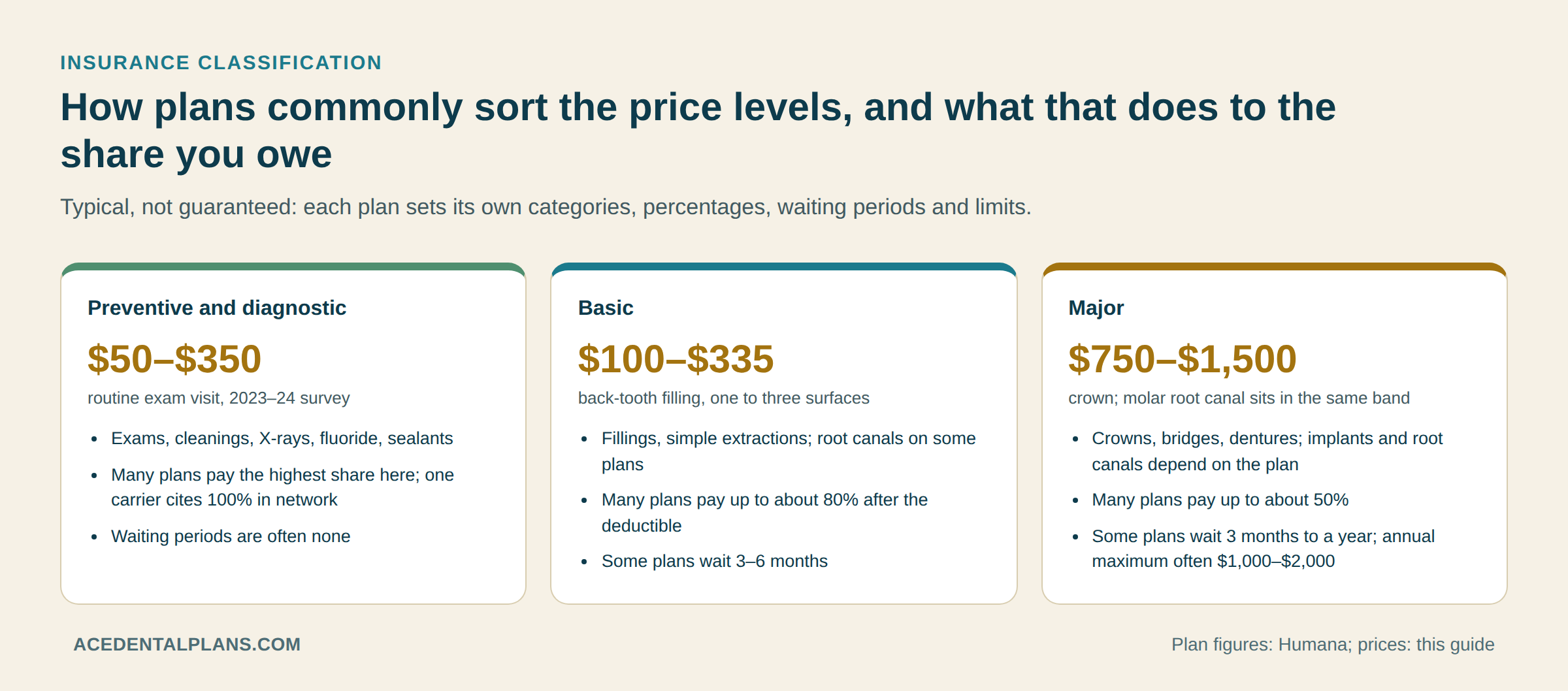 The preventive, basic and major tiers with the price band for each. Percentages and waiting periods come from one carrier’s guide; plans differ.
Which tier does a procedure land in?
Humana’s guide gives the broad pattern: exams, cleanings and X-rays are preventive; fillings and extractions are basic; crowns and dentures are major. Everything else is where plans disagree. Root canals are basic under some policies and major under others, which changes the coinsurance on a $1,000 service from 80% to 50%. Gum treatment, surgical extractions and wisdom teeth are similarly split. Implants might be major or might be excluded outright, and a plan that restricts coverage for pre-existing conditions such as missing teeth (a restriction the ADA lists among common plan limits) may not cover a tooth that was already gone at enrollment. Adult orthodontics is usually excluded, and cosmetic work often is.
That variation is why the “usual plan category” columns above use words like “often” and “depends.” They describe the pattern. Your plan summary of benefits, which lists services by tier, is the only document that settles the question for you.
Reading a Treatment Plan Line by Line
A treatment plan or estimate is a table of its own. Each row is one billable service, and almost every row has the same six parts. Learn to read one row and the whole page opens up.
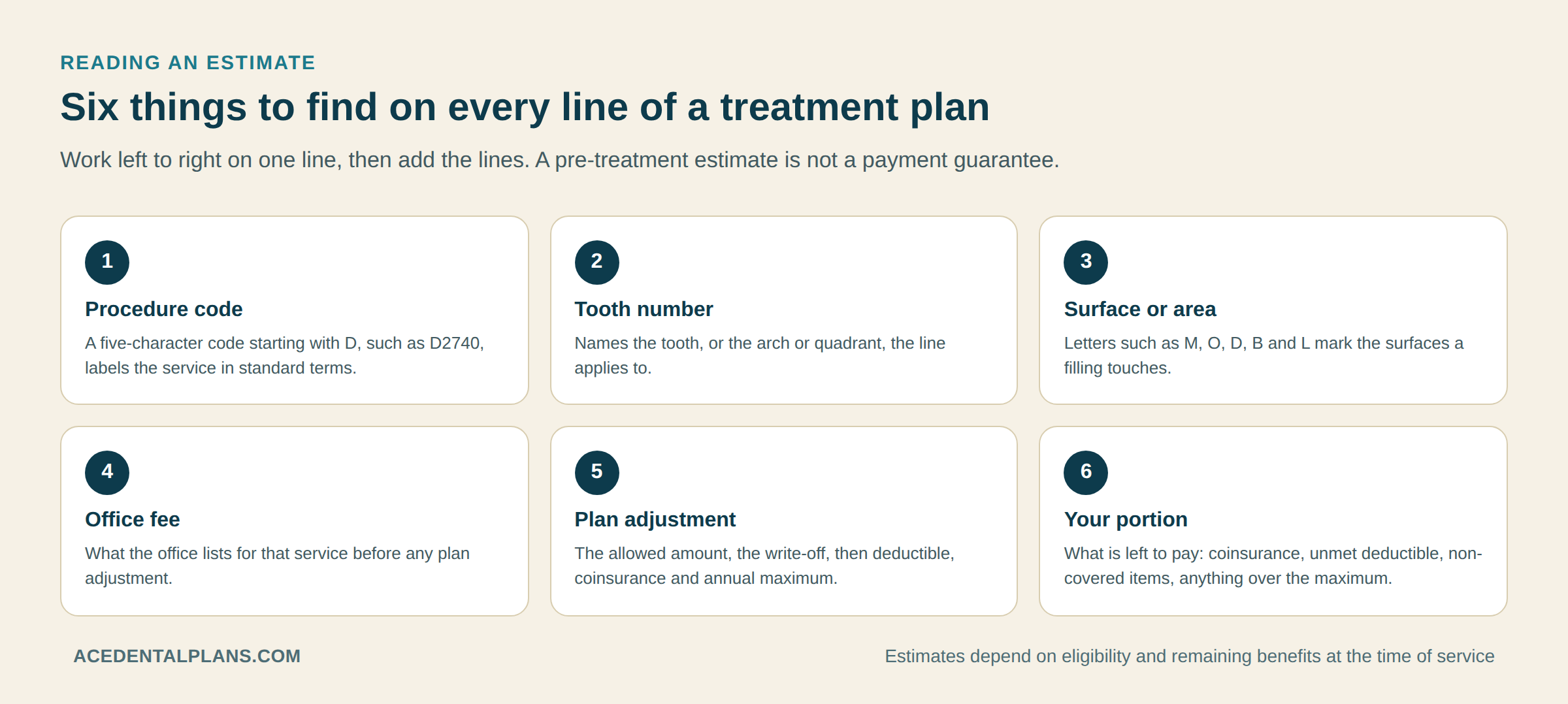 The six parts of a treatment-plan line, read left to right. Add the lines at the end.
The procedure code. It’s the five-character label beginning with D, such as D2391 for a one-surface back-tooth composite filling or D3330 for a molar root canal. The code, not the dentist’s description, is what the insurer reads. Two offices describing the work differently may still bill the same code, and one office may use two codes for what a patient thinks of as a single treatment.
The tooth number. It names the tooth involved. On most U.S. estimates permanent teeth run from 1 to 32, so a line marked “#30” points to a single lower-right molar. Some codes apply to a quadrant or an arch rather than one tooth, and the estimate will say “UR,” “LL” or “upper” instead.
The surface. For fillings, letters mark which faces of the tooth are involved. M faces toward the front midline (mesial), D faces away from it (distal), O the chewing surface (occlusal), B the cheek side (buccal) and L the tongue side (lingual). A line reading “MOD” is a three-surface filling, which maps to a three-surface code and a higher fee than a one-surface line.
The fee. It’s the office’s listed price for that service before any insurance adjustment. Offices keep their own fee lists, so one office’s number for D2740 is not another’s.
The plan portion. This is where several figures usually appear: the allowed amount (the fee your plan recognizes), the write-off or adjustment (the gap between the office fee and the allowed amount, if the office is in network), the deductible applied, the coinsurance percentage, and the amount the plan expects to pay.
The patient portion. It’s what is left. For an in-network line it’s deductible plus coinsurance, plus anything over the annual maximum, plus any non-covered item. For an out-of-network line, it may also include the difference between the office fee and what the plan recognizes.
How the line items combine on a typical estimate
Most estimates mix up to six kinds of line. Diagnostic lines are the exam and X-rays that identify the problem. The treatment line is the procedure itself. Materials are often built into the treatment fee (a crown’s fee includes the laboratory work, for example) but are itemized for things like implant components, bone graft material and some prosthetics. Anesthesia varies: local numbing is commonly part of the procedure fee, while nitrous oxide, oral sedation and IV sedation are separate lines billed by time or by level. Supporting procedures such as a buildup, a post, or a temporary crown add up quickly. Follow-up may be included, or separate, as with an adjustment visit, a night guard or a retainer.
No source in this guide breaks a bill into those six categories for you, and the grouping here is this guide’s own organizing device, not an industry standard. Use it as a checklist of questions when you look at an estimate. If a category is absent, ask whether it’s included in another line or simply not needed.
An illustrative example: Suppose tooth #19 needs a molar root canal, a buildup and a porcelain crown after a limited exam and one X-ray. The office fees below are borrowed from Boston University’s 2024 schedule, which sits close to national survey averages. The plan terms are made up: an in-network PPO, a $50 deductible that doesn’t apply to diagnostic lines, diagnostic services at 100%, root canal treated as basic at 80%, buildup and crown treated as major at 50%, and a $1,500 annual maximum with nothing used yet.
- D0140 limited exam, office fee $88, allowed $70. Plan pays $70; you pay $0. (The $18 gap is the in-network write-off.)
- D0220 periapical X-ray, office fee $33, allowed $25. Plan pays $25; you pay $0.
- D3330 molar root canal, office fee $1,352, allowed $1,100. After the $50 deductible, 80% of $1,050 is $840. Plan pays $840; you pay $260.
- D2950 buildup, office fee $320, allowed $260, and D2740 crown, office fee $1,475, allowed $1,200. At 50% of $1,460 the plan would pay $730, but its running total would reach $1,665. The $1,500 maximum caps the plan’s payment at $565. You pay $895.
Totals: office fees $3,268, allowed $2,655, plan pays $1,500, you pay $1,155. Quick math that applies 50% to the full $3,268 would have predicted $1,634 and missed both the write-off and the annual maximum. If the same dentist were out of network and billed the full fees on the same allowed amounts, you could owe the $613 write-off on top, for $1,768. This is a hypothetical built from published fees and invented plan terms, not a quote.
Three things are worth taking from that example. The annual maximum can matter more than the coinsurance percentage on a multi-step treatment. The write-off is a real saving, and it only exists when the office is in network. And a single procedure that people call “a crown” produced five lines.
When you’re handed a printed treatment plan, check that it lists a code, a tooth and a fee on each line. Ask whether the plan has been sent to your insurer as a pre-treatment estimate (also called a predetermination). The ADA says that preauthorization and predetermination are distinct processes, and that neither guarantees payment: estimated payments depend on the patient remaining eligible and not having exhausted the plan maximum at the time of service. Delta Dental of Iowa makes a similar point, saying a pre-treatment estimate helps you avoid surprise bills, though the dentist’s office submits it.

Fee Schedule, Usual and Customary, Allowed Amount and Out-of-Pocket: Four Terms, Four Different Numbers
These four phrases get used as if they meant the same thing. They don’t, and mixing them up is how a patient ends up with a bill that’s $400 higher than the quote.
A fee schedule is a list of prices by procedure code. Every dental office has its own. A PPO network has another, which the dentist agrees to accept when joining. A state Medicaid program has a third, and a discount plan a fourth. The same code (say, D2740) can have four different prices in four schedules, which is exactly what the tables above show.
Usual, customary and reasonable (UCR) is an older way for an insurer to decide what to pay a dentist outside a contracted fee schedule. The ADA’s plan-benefits page breaks it into three: the usual fee is what the dentist normally charges, the customary fee is set by the insurance company (and often lower), and the reasonable fee covers unusual cases. It adds that there is no universally accepted method for setting the customary fee schedule, which may vary a great deal among plans, and that insurers don’t generally publish those schedules. That’s why patients often can’t know their out-of-pocket cost in advance without an estimate.
The allowed amount is the fee a plan recognizes for a service. FAIR Health, a nonprofit that publishes claims-based cost data for consumers, defines it for in-network care as the total fee contracted between an insurance plan and a provider, and defines a charge as the amount billed by a provider. The allowed amount is the number your coinsurance is applied to. Delta Dental of Colorado’s materials say that claims are paid according to the PPO fee schedule (its “maximum allowable charge”), meaning you will pay more when you select a non-PPO provider.
Out-of-pocket is the total you personally owe. It adds the deductible, the coinsurance, services beyond the annual maximum, services the plan excludes and, for out-of-network care, the gap between the dentist’s fee and what the plan will recognize.
An illustrative example: Suppose a porcelain crown is listed at $1,400 in the dentist’s own fee schedule. The plan has met its deductible and treats crowns as major at 50%.
- In network: the contracted allowed amount is $1,050. The $350 difference is written off. The plan pays 50% of $1,050, which is $525, and you owe $525.
- Out of network, balance billing allowed: the plan recognizes $900 for the code. It pays 50% of $900, which is $450. You owe $1,400 − $450 = $950.
Same tooth, same crown, same plan, and a $425 difference to you. The numbers are invented for illustration. Real allowed amounts vary by plan, by region and by year.
Out-of-network doesn’t always cost more, and in-network doesn’t always cost less than a cash-pay discount. Some offices quote lower prices to patients who pay up front or who join an in-house membership. If you’re comparing an in-network estimate with a cash price, set both on the same basis: after the plan pays, what do you owe?
Why Two Quotes for the Same Procedure Can Differ, and How to Compare Them Fairly
Before you run the numbers on two quotes, know what usually separates them. The causes come from a short list. The tooth may differ (a molar root canal costs more than a front-tooth one). The material may differ (porcelain, zirconia, metal and resin all price differently). The scope may differ: one office includes the buildup and the temporary crown, another doesn’t. Network status may differ, and with it the allowed amount. The laboratory may differ, since an office using an in-house milling unit prices differently from one sending work to an outside lab. And the office’s own fee schedule may simply be higher, because overhead, location and equipment differ.
To compare two quotes on the same basis, work through these checks in order:
- Match the code and tooth. Every line should name a CDT code and a tooth. If one quote says “crown” with no code, ask for it.
- Match the material. Porcelain-fused-to-metal, full-contour zirconia and full gold are different products with different fees, as the crown rows in Table 3 show.
- List what each quote bundles. Buildup, post, temporary crown, anesthesia or sedation, X-rays, follow-up visits, a retainer or night guard. Write the bundle out for both.
- Put both on the same network basis. Ask whether each office is in your plan’s network, then ask for the patient portion rather than the office fee.
- Check the payment terms. Does one offer a cash discount, an in-house plan or a payment arrangement, and are there interest or fees attached?
- Ask what happens if the plan changes mid-treatment. If treatment spans two benefit years, the annual maximum resets at some point, and the schedule of visits can move the bill.
A related caution: a lower number isn’t an error and a higher one isn’t a rip-off. Fee schedules sit on a broad spread, as every table above shows. A quote far outside the national spread for its code, in either direction, is a reason to ask what it includes. It’s not a verdict on the office.
National Ranges Versus Your ZIP Code, and When to Ask for a Second Estimate
National figures are a yardstick. Local prices depend on the office’s costs, local wages and the mix of insurance contracts. Three tools in the sources help you localize a range.
FAIR Health’s consumer site draws on what it calls the nation’s largest repository of commercial healthcare claims data. Its 2026 newsletter says users can view typical costs from the 20th to the 90th percentile for a procedure in their local area, and that its dental and hospital cost lookup tools were recently enhanced with sliders. That is useful because it shows a spread, not a point. Delta Dental’s cost estimator, described by Delta Dental of Iowa, covers cleanings, exams, fillings, crowns, root canals, extractions and more, and gives a cost range based on average charges in your region. Humana’s Orlando page shows how one market can differ from the national picture: its crown prices sit close to the national survey averages, while its implant figure sits well below them.
Dental school clinics are another reference point. The University of Louisville’s student clinic prices a one-surface filling at $98 against $240 at private practice, a root canal at $345 against $1,130 and a crown at $530 against $1,396, using 2024 National Dental Advisory Service rates for the private-practice side. CU Anschutz says its clinics typically run 30% to 50% below private practices in the area. Student care is supervised and the fees reflect the setting, so the comparison is mostly useful as a reality check on what the same code can cost.
When a second estimate makes sense
A second estimate is a pricing exercise. A second opinion is a clinical one, and only a dentist can give it. Both are ordinary. A reasonable time to ask for either is when the plan is large (several teeth, a bridge, an implant, orthodontics), when the first quote is unclear about what’s included, or when the diagnosis is unfamiliar to you. Ask the first office for a copy of your X-rays and the itemized treatment plan with codes. You can generally request your records, and an itemized plan is the only thing that makes a second quote comparable.
Waiting to compare has its own cost when the problem is painful or progressing, and that call belongs to the dentist who has examined you. If you’re told that a tooth can’t wait, ask what the realistic window is and whether a temporary measure would hold it. A pre-treatment estimate from your insurer, if your plan supports one, covers the insurance side. The ADA is clear that such an estimate doesn’t guarantee payment, so keep the figure in perspective.
Frequently Asked Questions – Dental Price Guide
What is the average cost of a dental visit without insurance?
A routine exam with cleaning and X-rays averaged $203 in a 2023–2024 national survey, with prices ranging from about $50 to $350. Summing individual codes gives a similar span: $114 to $283 across three published fee schedules. A first visit with a full-mouth X-ray series or a panoramic image costs more.
Why does the same filling cost $110 in one place and $240 in another?
Because the numbers come from different kinds of price lists. A discount-plan schedule, a Medicaid schedule, a university center schedule and a private-practice survey each set the price for a different purpose. Geography, the number of surfaces, the material and the office’s overhead add to the gap.
Is a quote the same thing as an estimate?
Not exactly. A quote is the office’s price for planned work. An estimate often adds your plan’s expected payment. The ADA says that insurer estimates aren’t guaranteed, because eligibility and remaining benefits at the time of service decide what’s paid.
How do I find out what my plan will pay before treatment?
Ask the dentist’s office to submit a pre-treatment estimate (a predetermination) to your insurer, or call the insurer with the CDT codes and tooth numbers. Check your deductible status and how much of your annual maximum you’ve used. Delta Dental of Iowa notes that a pre-treatment estimate helps you avoid surprise bills.
Do dental prices include the follow-up visit?
It depends on the office and the code. Some offices bundle a post-treatment check, a temporary crown or retainers into the fee, and some bill them separately. The American Association of Orthodontists notes that some orthodontists offer all-inclusive pricing covering appointments and post-treatment retainers. Ask what the fee includes before comparing.
Are dental school fees really lower?
In the sources here, yes. The University of Louisville lists a one-surface filling at $98 in its student clinic against $240 in private practice, and CU Anschutz says its clinics typically run 30% to 50% below private offices in the area. Check the school’s own listing for current fees and how appointments are run.
What does “allowed amount” mean on my explanation of benefits?
It’s the fee your plan recognizes for that service. In network, it’s the amount contracted between the plan and the dentist, and the difference from the office’s billed charge is generally written off. Your coinsurance is calculated on the allowed amount, not on the billed charge.
Why is a root canal quote so different from a root canal plus crown quote?
The root canal treats the inside of the tooth, and the crown restores its outside, so they are separate procedures with separate codes. A buildup may sit between them. Across the sources here, a molar root canal runs about $721 to $1,352 and a porcelain crown about $752 to $1,475, before the buildup.
How often do prices in a guide like this change?
Prices move, so check the date on any figure you rely on. This page uses fee schedules from 2024 to 2025, surveys from 2023 to 2024 and one pricing tool updated in June 2026. Treat every figure as a snapshot from the date of its source.
Can I negotiate a dental bill?
Some offices offer a cash discount, an in-house membership or a payment plan, and it’s reasonable to ask. Negotiation looks different when the dentist is in your plan’s network, because the contract usually fixes the fee. The practical first step is asking for an itemized estimate so both of you are looking at the same lines.
Sources and Disclaimers
Price figures in this guide come from three source families: published fee schedules (Boston University Dental Health Centers 2024, Delta Dental of Colorado Patient Direct effective November 1, 2025, and North Dakota Medicaid adult dental effective July 1, 2025), national cost surveys (the 2023–2024 Synchrony Average Procedural Cost Studies by ASQ360, as published by CareCredit and Guardian), and local or tool-based figures (Humana’s Orlando pricing tool, updated June 2026, and the University of Louisville’s comparison with 2024 National Dental Advisory Service rates). Plan-design statements come from the ADA and from Humana and Delta Dental materials. The clinical statement about sealants comes from the CDC, and the statement about X-ray frequency from the ADA. The estimate examples, the bridge and implant sums, the quote comparison and the visit totals are illustrations calculated by this guide from those published fees and from invented plan terms; they are labelled as hypothetical where they appear. Averages hide wide spreads, a fee schedule is not a quote, and plan terms differ from policy to policy. Confirm pricing with your dentist and benefits with your insurer, and defer treatment decisions to the dentist who has examined you.
- Synchrony / CareCredit — Average cost of dental procedures (2023–2024 cost studies)
- Guardian — Cost of dental procedures without insurance
- Humana — Cost of common dental procedures (Orlando pricing tool)
- Humana — What does dental insurance cover?
- Boston University Dental Health Centers — 2024 fee schedule
- Delta Dental of Colorado — Patient Direct general practice fee schedule, effective November 1, 2025
- Delta Dental of Colorado — Maximum allowable charge (MAC) plan explanation, 2025
- North Dakota Health and Human Services — Medicaid adult dental fee schedule, July 1, 2025
- University of Louisville School of Dentistry — Student clinic and private practice fee comparison
- CU Anschutz School of Dental Medicine — Dental fees
- American Dental Association — Typical dental plan benefits and limitations
- American Dental Association — Preauthorizations and predeterminations
- American Dental Association — X-rays (radiographs)
- Centers for Disease Control and Prevention — About dental sealants
- FAIR Health Consumer — Cost lookup tools and percentile ranges
- Delta Dental of Iowa — Plan ahead for care (pre-treatment estimates)
- American Association of Orthodontists — How much do braces cost?
Important Information and Disclaimers
This article is general educational information. By using it, you accept the limits described below.
Not dental or medical advice
Nothing on this page is a diagnosis, a treatment recommendation or a substitute for an examination by a licensed dentist or physician. Reading this article does not create a dentist-patient or doctor-patient relationship. Only a licensed professional who has examined you and reviewed your history can tell you what your mouth needs. Do not delay, skip or stop professional care because of something you read here.
Prices are estimates, not quotes
Cost figures are ranges reported by the third-party sources cited in this article. Actual prices depend on your location, the provider, the complexity of your case, the materials used, the date of service and other factors, so what you pay may be higher or lower. A written treatment plan and fee estimate from the dental office is the only reliable number for your situation.
Insurance and plan examples are illustrations
Examples that use named amounts or percentages are hypothetical. Real benefits depend on your plan, network, waiting periods, annual maximum, deductible and the insurer’s rules at the time of treatment. A pre-treatment estimate or benefits check is not a promise of payment. Confirm the details with your insurer or plan administrator in writing.
Not insurance, legal, tax or financial advice
AceDentalPlans is an information publisher. Nothing here is insurance, legal, tax, investment or other professional financial advice, and nothing here recommends a particular provider, insurer, lender, discount plan or financing product. Company and product names belong to their owners and appear for identification only. Read the terms of any loan, financing offer or plan before you sign, and ask a qualified professional if you need advice on your own circumstances.
Third-party sources
This article cites government agencies, professional associations, insurers, lenders and other outside organizations. We do not control those sources. Their content can change, move or disappear, and listing a source is not an endorsement of it or of anything it sells.
No warranty
We aim for accuracy, but this article is provided “as is,” without warranties of any kind, express or implied, including warranties of accuracy, completeness, timeliness or fitness for a particular purpose. Some information may be out of date or contain errors by the time you read it.
Limitation of responsibility
To the fullest extent permitted by law, AceDentalPlans and its owners, authors and contributors are not responsible or liable for any loss, cost, injury, health outcome or other damage that results from using this article or relying on it. You are responsible for your own decisions about your care, your coverage and your money.
How this article is written
This article follows AceDentalPlans’ answer-first, U.S.-focused editorial approach. It uses conditional language for insurance, because coverage depends on the specific plan, and it names its sources so that you can read them yourself.