How to Pay for Dental Work. Dental work is usually paid for through one of eight routes, or a mix: a cash discount, an office payment plan, third-party financing, a 0% credit card, a personal loan, HSA or FSA money, a discount plan, or a lower-fee clinic. Borrowed money shows the widest spread. A bank personal loan averaged 11.86% in the second quarter of 2026, while the typical medical credit card carries 26.99%.
This guide puts the eight routes side by side on cost, speed and risk, then adds the tax rules and the clinics that charge less. A decision table at the end lets you match the options to your own situation. It stops short of the line-by-line contract mechanics that separate financing from payment plans, and it leaves everyday ways to save without insurance to a separate topic. Every procedure price here is a hypothetical used for arithmetic, not a quote.
Key Takeaways
- Finance the gap, not the sticker. If a plan pays part of a $3,600 treatment, the amount left to cover might be $2,100, and that is the figure to shop financing for.
- Lowering the price comes before spreading it out. A university clinic typically charges 30% to 50% less than private practices nearby, according to CU Anschutz, and no loan can match that.
- Published borrowing rates in this guide run from 11.86% (24-month bank personal loan, Q2 2026) to 35.99% (the top of one point-of-sale lender’s range). The typical medical credit card sits between them at 26.99%.
- “No interest if paid in full” is not the same as 0% APR. In a hypothetical $2,000 case, a $200 leftover balance grows to about $517 owed once deferred interest is added back.
- For 2026, HSA contributions are capped at $4,400 for self-only coverage and $8,750 for family coverage, and a health FSA at $3,400. The medical expense deduction only applies to costs above 7.5% of adjusted gross income.
- Discount plans and memberships cut a price but do not spread it over time, and a free program such as Donated Dental Services has waitlists and narrow eligibility.
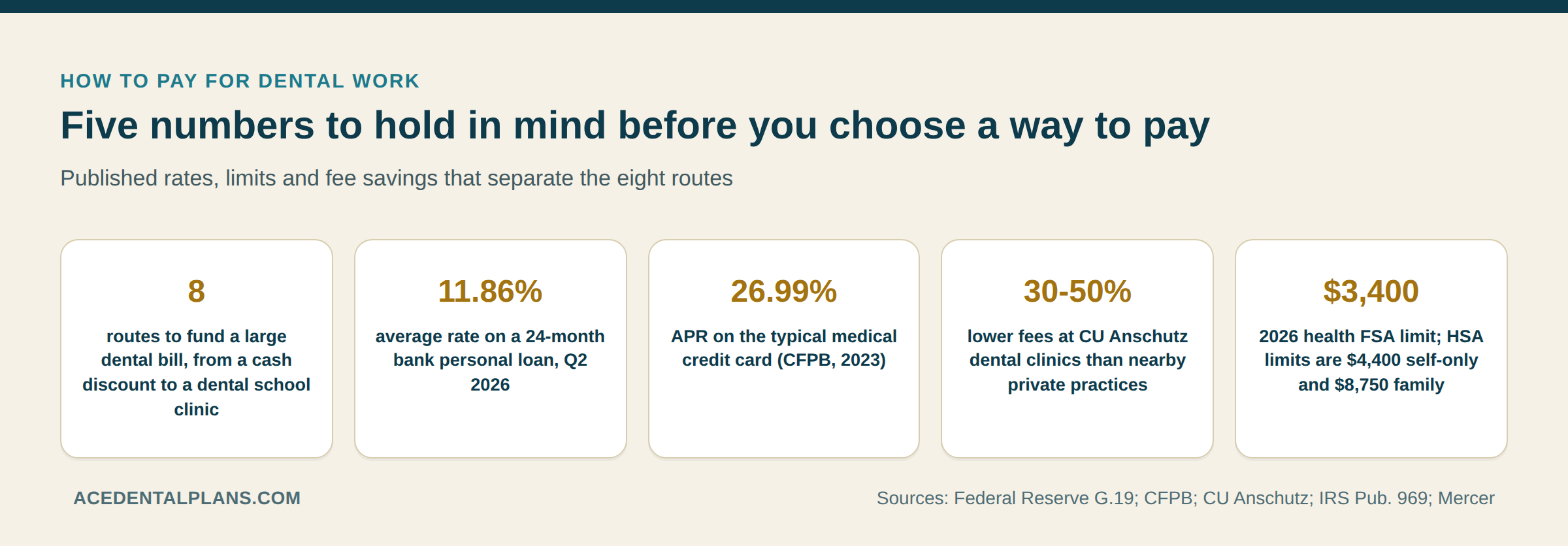 Five reference numbers for comparing ways to pay for a large dental bill.
Four Numbers to Pin Down Before You Pick a Way to Pay
The choice of payment method comes after four facts about the treatment, and most people skip straight to the method. A financing offer made at the front desk, with a pen already in your hand, tends to hide the fact that the underlying number was never settled.
The first is the total, written and itemized. A bundled figure such as “crown and build-up, $2,400” can’t be compared with another office’s quote, and it can’t be matched against an insurer’s estimate either. Ask for a printed treatment plan that lists each procedure, the tooth or area it applies to, and the fee charged for it.
The second is what any coverage you have will pay. Many plans will issue a predetermination (sometimes called a pre-treatment estimate) before the work starts, which shows the allowed amount, the deductible, the coinsurance and how much of the annual maximum is left. Without it, you’re borrowing against a number that may drop later.
The third is the timeline, and that one belongs to the dentist. Some treatment is urgent, and some can be staged over several months. Asking “which of these lines can safely wait, and for how long?” is a reasonable question. The answer determines whether you need one large payment now or several smaller ones over a year. It also decides whether a slow route, such as a school clinic waitlist, is realistic.
The fourth is a monthly amount you can repay without strain. Be strict about it. Write down what is actually left each month after rent, food, transport, insurance premiums and existing debt, then take a bit off, because new debt rarely arrives alone. That figure sets the longest loan you can carry and the highest rate you can tolerate.
The Eight Routes Compared on Cost, Speed and Risk
Table 1 is the overview. It doesn’t pick a winner, because the right route depends on how soon the work is needed, how fast you can repay, and what your credit looks like. What it does show is two groups. Some routes lower the price (a discount, a membership, a school clinic, public coverage), and others spread it over time (a plan, a card, a loan). A few, like HSA money, are simply a cheaper way to use dollars you already have. How to Pay for Expensive Dental Work
| Route | Who supplies the money | What it costs you | Speed | Main risk |
|---|---|---|---|---|
| 1. Cash or prepayment discount | You | A percentage off the fee, set by the office. GoodRx says many dentists offer one for upfront payment; no national figure was found. | Same visit | Needs the cash on hand; the discount isn’t automatic, so you have to ask. |
| 2. Office payment plan | The dental practice | Terms are the office’s own. The ADA says plans longer than 90 days can make a practice a lender. | Same visit, at the practice’s discretion | Short terms and strict schedules; missed payments can stop treatment. |
| 3. Third-party financing (health care credit card or point-of-sale loan) | An outside lender or card issuer | Promotional “no interest if paid in full” periods of 6 to 24 months, or longer reduced-APR plans around 17.90% to 20.90% (CareCredit provider page); one lender states 0% to 35.99% APR. | Often decided at the front desk | Deferred interest billed back to the purchase date; credit card opened for you. |
| 4. 0% introductory credit card | A general-purpose card issuer | No interest on purchases for an introductory period, then the card’s regular rate (about 21% average across accounts in Q2 2026). | After approval, once the card is active | Needs good enough credit; a high rate if a balance is left when the period ends. |
| 5. Personal loan | A bank, credit union or online lender | Bank 24-month loans averaged 11.86% in Q2 2026; credit union payday alternative loans are capped at 28% APR. | Varies by lender | Fees and a fixed payment whether or not the dental work goes as planned. |
| 6. HSA or health FSA | Your own pre-tax money | The tax saved on the dollars spent; no interest at all. | Immediate if the balance exists | HSA needs a qualifying high-deductible plan; FSA money can expire. |
| 7. Discount plan or in-office membership | A plan company or the office | An annual fee (reported at $300 to $400 for membership plans in 2021) in exchange for reduced fees, with one plan advertising 20% off. | Starts when you join | Lowers a price but doesn’t spread it; thin oversight of membership plans. |
| 8. Dental school, health center, charity program, Medicaid or CHIP | Training clinics, public funding, volunteers | Typically 30% to 50% less at one university clinic; sliding-fee scales at health centers; free for those who qualify for Donated Dental Services. | Slowest: screenings, waitlists, longer visits | Eligibility limits, narrower services, uncertain timing. |
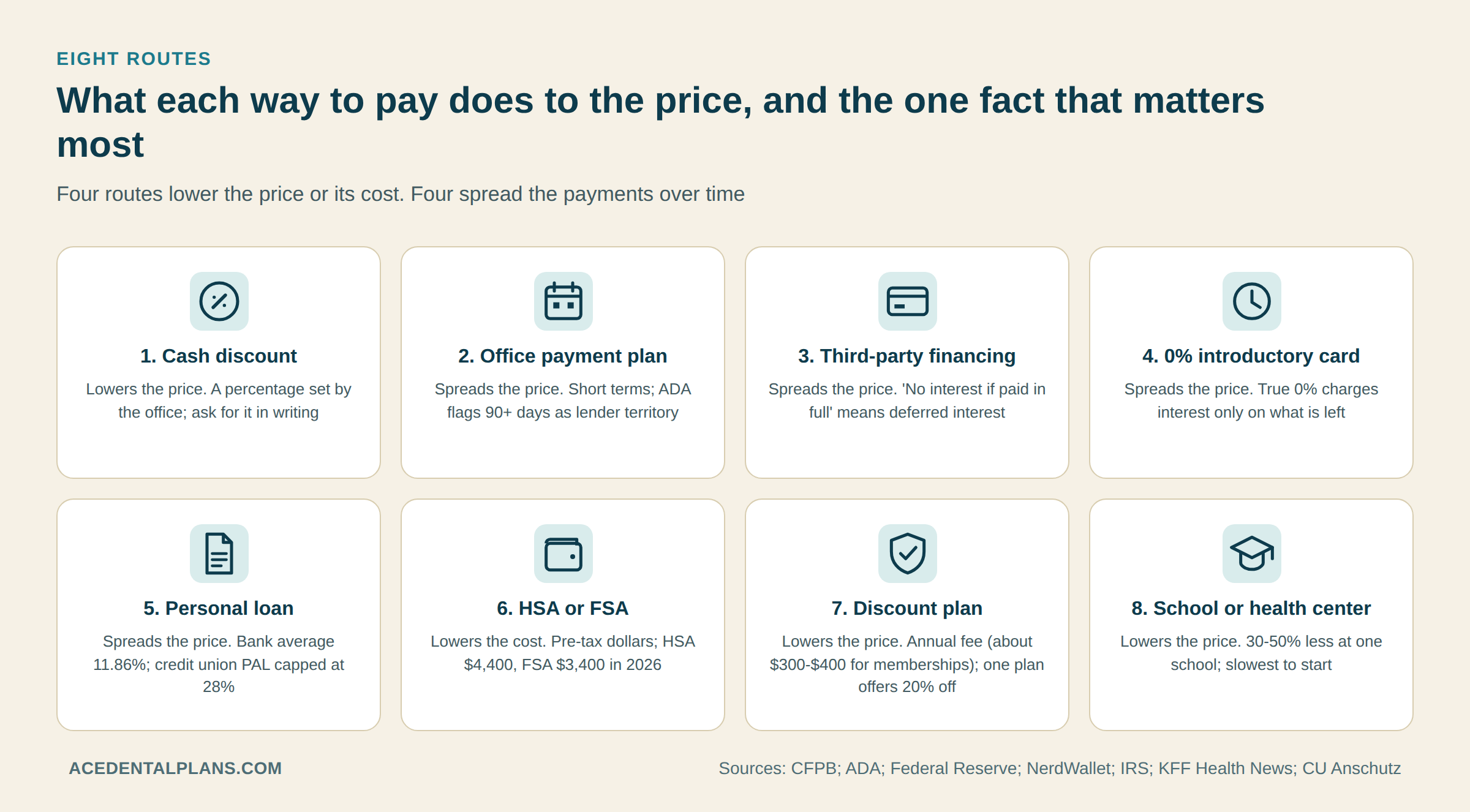 The eight routes at a glance, with the one fact that matters most about each.
Asking for a Cash or Prepayment Discount
This is the cheapest option on the list, and the one most people never try. GoodRx, in a page updated in April 2025, says many dentists offer payment plans or a percentage discount when the total is paid upfront. It doesn’t give a typical percentage, and neither did any other source reviewed for this guide, so treat any figure an office quotes as that office’s own policy rather than a norm.
Why would an office discount at all? One plausible reason, though no source states it, is that financing isn’t free for the practice. Sunbit’s page for dental offices describes a per-transaction fee “as low as 1.9%” charged to the practice, and a card payment carries processing costs of its own. Money in hand avoids all of that, so some offices pass part of the saving on.
The ask itself is simple. Request the fee schedule for the itemized plan, then ask whether there’s a different price for paying in full at or before the first visit. Also ask about paying each stage as it’s done. Say it plainly: “Is there a discount if I pay in full today?” If the answer is yes, ask whether it applies to every line or only some. Then get the discounted total written on the treatment plan.
Two cautions apply. First, if you have coverage and the dentist is in your plan’s network, a contract may limit how fees can be adjusted, so ask the office rather than assume. Second, think hard before prepaying a long, multi-visit plan in a lump sum. Ask what happens to the unused balance if you move, change dentists or stop treatment, and get the answer on paper. A discount for paying stage by stage often captures most of the benefit with far less exposure.
What an Office Payment Plan Is, and What It Isn’t
An office payment plan means the dental practice itself lets you pay in installments. No bank or card company stands in the middle. The terms are whatever the office decides, and they can be generous or tight. Many plans are short, often a few months, and structured so the balance is cleared before or around the time treatment ends.
The ADA’s guidance to practices explains why these plans are limited. It says in-office financing “should not necessarily be offered to every patient,” and lists what a practice weighs. That includes its relationship to the patient, the patient’s ability to pay, payment history, the type of work, and the value of the treatment plan. It also warns that certain programs could make the practice a “lender,” especially if patients get more than 90 days to settle accounts, and that complying with truth-in-lending rules can be complex. Read that as a reason offices tend to keep these plans short.
For a patient, the useful questions are practical ones. Is there any interest or administrative fee? Is a down payment required, and is it refundable? What happens if a payment is a week late: a fee, a paused appointment, or a referral to a collection agency? And is the schedule in a document you’ve signed, with dates and amounts, rather than a verbal promise from the front desk?
An office plan suits a bill that you can clear in a handful of months from income. It suits a bill that’s too large for cash at once but small enough that interest would be a nuisance. It doesn’t suit a $6,000 case you’d like to repay over three years, because most practices won’t carry that. That gap is where third-party financing and loans come in.

Health Care Credit Cards and Point-of-Sale Loans
The third route is financing offered through a company that works with the dental office. Two names come up most often, CareCredit and Sunbit, and they work differently, so it pays to know which kind of product you’re being offered. This section covers what each states publicly. The line-by-line mechanics of how financing differs from a payment plan are a separate topic.
CareCredit is a credit card that can be used only at participating providers. Its public dental page says it is accepted at more than 290,000 network locations and offers a prequalification check described as having no effect on your credit score. Its provider FAQ describes two kinds of offer. One is a promotional period of 6, 12, 18 or 24 months with “no interest” on purchases of $200 or more if the full amount is paid by the end of the period. If it isn’t, in the page’s words, “interest is charged from the original purchase date.” The other is a longer plan with a reduced APR and fixed monthly payments. Examples on that page: 17.90% for 24 months on purchases of $1,000 or more, 18.90% for 36 months and 19.90% for 48 months. A 60-month offer at 20.90% needs a purchase of $2,500 or more. That page is undated, so check the current offer.
Sunbit is described on its own page for dental offices as financing a patient can apply for at the front desk or on a phone. The company states that applying doesn’t require a hard credit check and that it approves scores starting at 500. Terms run from 3 to 72 months, some plans are no-interest for up to 24 months, and APRs run from 0% to 35.99%. It also says it approves 87% of applicants, which is the company’s own claim. The 35.99% at the top of that range is the highest published rate in this guide.
The Consumer Financial Protection Bureau studied this market in a May 2023 report. It found the typical medical credit card carried a 26.99% APR, against roughly 16% for general-purpose cards at the time of the report. In 2020, about 25% of promotional periods lasted 6 to 11 months, 38% lasted 12 to 17 months and 37% lasted longer than 18 months. The bureau also documented patients enrolled without clear consent. One complaint it quotes says a dentist’s office “opened up a credit card in my name in order to pay for these services without my consent.”
None of this makes third-party financing a bad idea. For a patient who knows they can clear the balance inside the promotional window, it can be a free loan. It’s the patient who plans to pay “over time” and doesn’t hit the date who gets hurt, which is the subject of the next section. How to Pay for Expensive Dental Work.
A True 0% Card Versus “No Interest If Paid in Full”
These two phrases sound alike and behave very differently. The CFPB’s advice is to look for the “if.” In its words, zero interest offers use language like “0% intro APR on purchases for 12 months.” Deferred interest offers use language like “No interest if paid in full within 12 months.” The “if” means you could end up paying more than you expected.
With a true 0% introductory APR on a general-purpose credit card, interest never accrues during the promotional period. When the period ends, interest starts on whatever balance remains, at the card’s regular rate. With deferred interest, the interest is calculated all along in the background. Clear the whole balance by the deadline and it vanishes. Miss by a dollar and the accumulated amount is added to your account all at once, back to the date of the purchase.
The scale of the problem shows up in the CFPB’s 2023 data. Across 2018 to 2020, consumers paid about $1 billion in deferred interest on roughly $23 billion of health care purchases made with these cards. Between 2015 and 2020, about 20% of purchases ended up incurring interest, and for people with credit scores below 619 the share was 34%. Where interest was charged in 2020, it came to roughly 23% of the original purchase amount. One complaint the report quotes says it plainly: “This is not a zero percent promotion as I was led to believe.”
Minimum payments are the usual trap. The CFPB has pointed out that making only the minimum on a deferred-interest purchase typically won’t pay it off in time. Divide the purchase by the number of promotional months, round up, and set that as the payment. Set an automatic payment for that amount and a calendar reminder for the month before the end date.
On a general-purpose card, the CFPB notes that an introductory rate has to stay in effect for at least six months, unless you’re more than 60 days late on a payment. Either way, check how the card applies payments if you also carry other balances, and whether new purchases start accruing interest right away.
Personal Loans and Credit Union Loans: What Published Rates Show
A personal loan is the plainest way to borrow for dental work. A bank, credit union or online lender sends the money, you pay the dentist in full (which can earn the cash discount from earlier), and you repay the lender in fixed monthly amounts. There’s no promotional cliff, because the rate is the rate from day one.
The Federal Reserve gives the broadest reference point. Its G.19 consumer credit release, issued in September 2026, shows commercial banks charged an average of 11.86% on 24-month personal loans in the second quarter of 2026. That’s an average across borrowers. A person with strong credit may see less, and a person with thin or damaged credit may see much more, so treat it as a reference point, not a quote.
Credit unions add a specific product. Federal credit unions can offer payday alternative loans (PALs). NerdWallet’s March 2026 summary of the National Credit Union Administration’s rules puts a PAL II at up to $2,000, repaid over one to 12 months. The maximum APR is 28%, including an application fee capped at $20. A borrower is limited to one PAL at a time and three in six months. PAL II is open as soon as membership is established, while PAL I (amounts from $200 to $1,000, up to six months) requires one month of membership first. These are small loans, so they fit a single crown or a few fillings but not an implant.
Loan offers also carry fees that a quoted interest rate can hide, such as an origination fee deducted from the amount you receive. The annual percentage rate is meant to capture those costs, so compare APRs between offers, not the headline interest rate. Also ask whether checking your rate is a soft inquiry or a hard one. Applying to several lenders for the same bill can add up if each one pulls your credit in full.
| Route | Published rate | Source and date | Monthly payment | Interest over 12 months |
|---|---|---|---|---|
| Deferred-interest promotion, paid off by the deadline | 0% effective | CareCredit provider FAQ; CFPB | $166.67 | $0 |
| Bank personal loan, 24-month average | 11.86% | Federal Reserve G.19, Q2 2026 | $177.57 | about $131 |
| Reduced-APR card plan, lowest example (24-month term) | 17.90% | CareCredit provider FAQ, undated | $183.26 | about $199 |
| Credit cards, all accounts, average | 20.94% | Federal Reserve G.19, Q2 2026 | $186.17 | about $234 |
| Credit cards, accounts assessed interest, average | 22.15% | Federal Reserve G.19, Q2 2026 | $187.33 | about $248 |
| Typical medical credit card | 26.99% | CFPB, May 2023 | $192.03 | about $304 |
| Credit union PAL II, maximum | 28% cap | NerdWallet summary of NCUA rules, March 2026 | $193.01 | about $316 |
| Point-of-sale lender, top of stated range | 35.99% | Sunbit dental page | $200.91 | about $411 |
Read the last two columns with care. Terms differ by product, and a real 24-month bank loan would be spread over twice as long. The payments above compare rates; they don’t predict any one offer. They do show the size of the gap. On $2,000, the bank average and the top of the point-of-sale range are about $280 apart over a year, and a deferred-interest balance that goes wrong can widen that further.
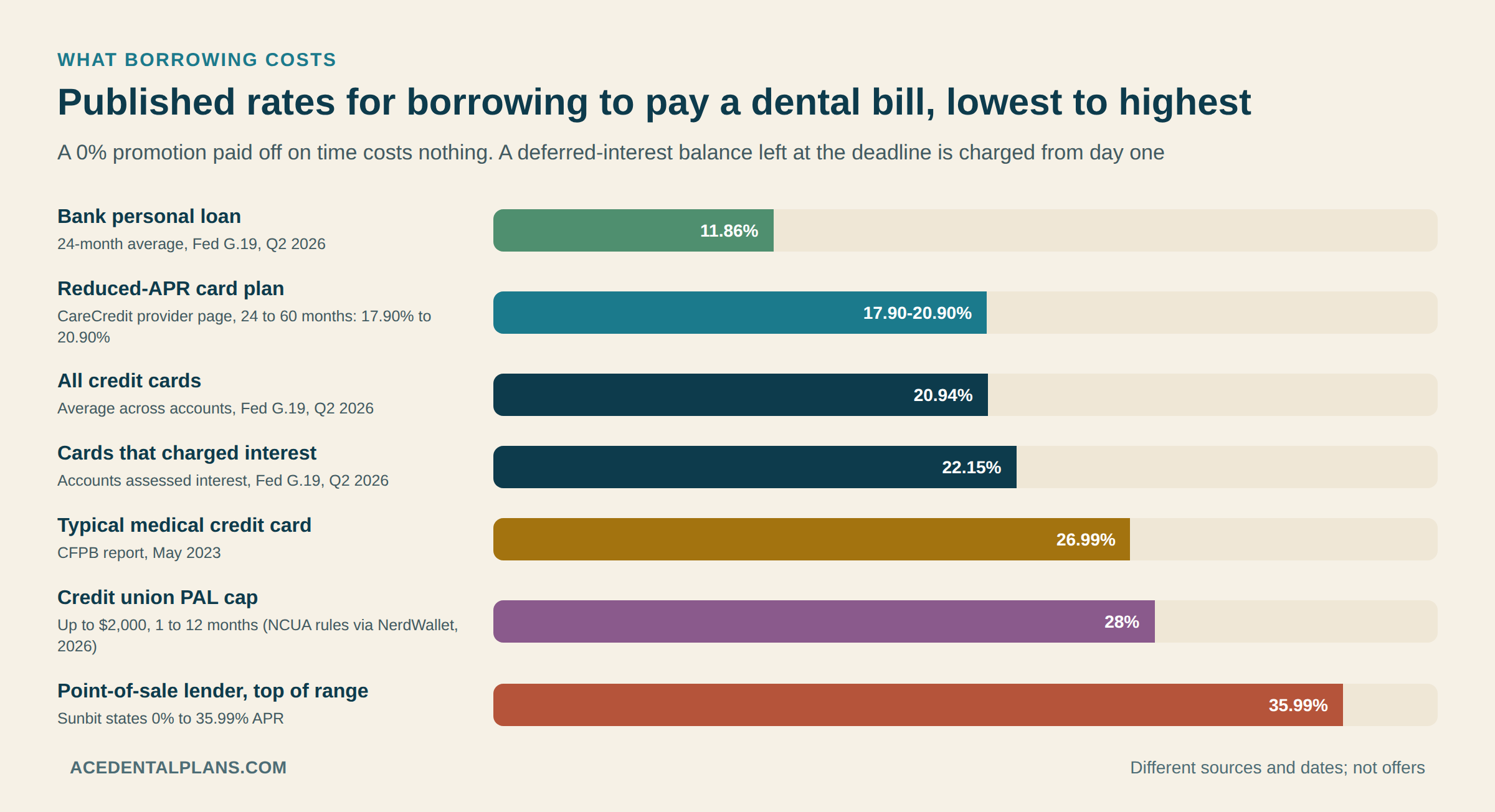 Published rates from different sources and dates, lowest to highest. They aren’t offers; your rate depends on your credit.
HSA, FSA and the Medical Expense Deduction
Pre-tax accounts don’t change a dentist’s fee, but they change what the fee costs you. Money placed in a health savings account or a flexible spending account hasn’t been taxed as income, so paying a dental bill from it is cheaper than paying from take-home pay. There’s no interest, no application, and no credit check. The catch is that the money has to exist before the bill arrives.
Start with the HSA. IRS Publication 969 lists the 2026 contribution limits as $4,400 for self-only coverage and $8,750 for family coverage, plus an extra $1,000 for people 55 and older. You can contribute only while covered by a qualifying high-deductible health plan. For 2026 that means a minimum deductible of $1,700 for self-only coverage or $3,400 for family coverage, and an out-of-pocket maximum no higher than $8,500 or $17,000. Dental care is a qualified expense, and having separate dental coverage doesn’t disqualify you. One timing rule matters: expenses incurred before you establish the HSA aren’t qualified medical expenses.
The health FSA works through an employer. The 2026 salary-reduction limit is $3,400, and plans may let up to $680 carry into the next year, according to Mercer’s summary of IRS Revenue Procedure 2025-32. The general rule for FSAs is use it or lose it, so the money has to match the timing of your treatment. A patient who knows a crown is coming in the autumn is the ideal FSA user. Someone still deciding may leave a balance behind.
Then there’s the itemized medical deduction. IRS Publication 502 treats dental expenses as medical expenses, but you can deduct only the part that exceeds 7.5% of your adjusted gross income, and you must itemize on Schedule A. Teeth whitening is specifically excluded. For most people with an ordinary dental bill, this lands as nothing at all. How to Pay for Expensive Dental Work…
| Tool | 2026 figure | Who can use it | Rules that matter for dental bills |
|---|---|---|---|
| Health savings account (HSA), self-only | $4,400 contribution limit; $1,000 more at 55+ | People covered by a qualifying high-deductible plan (minimum deductible $1,700) | Dental care qualifies; expenses before the HSA existed don’t |
| HSA, family coverage | $8,750 contribution limit; $1,000 more at 55+ | Family high-deductible plan (minimum deductible $3,400) | A separate dental plan is permitted alongside it |
| Health FSA | $3,400 salary reduction; up to $680 carryover | Employees whose employer offers one | Generally use it or lose it; carryover only if the plan allows it |
| Itemized medical deduction | Only the part of medical and dental costs above 7.5% of AGI | Taxpayers who itemize on Schedule A | Whitening is excluded; works only when total medical costs are large |
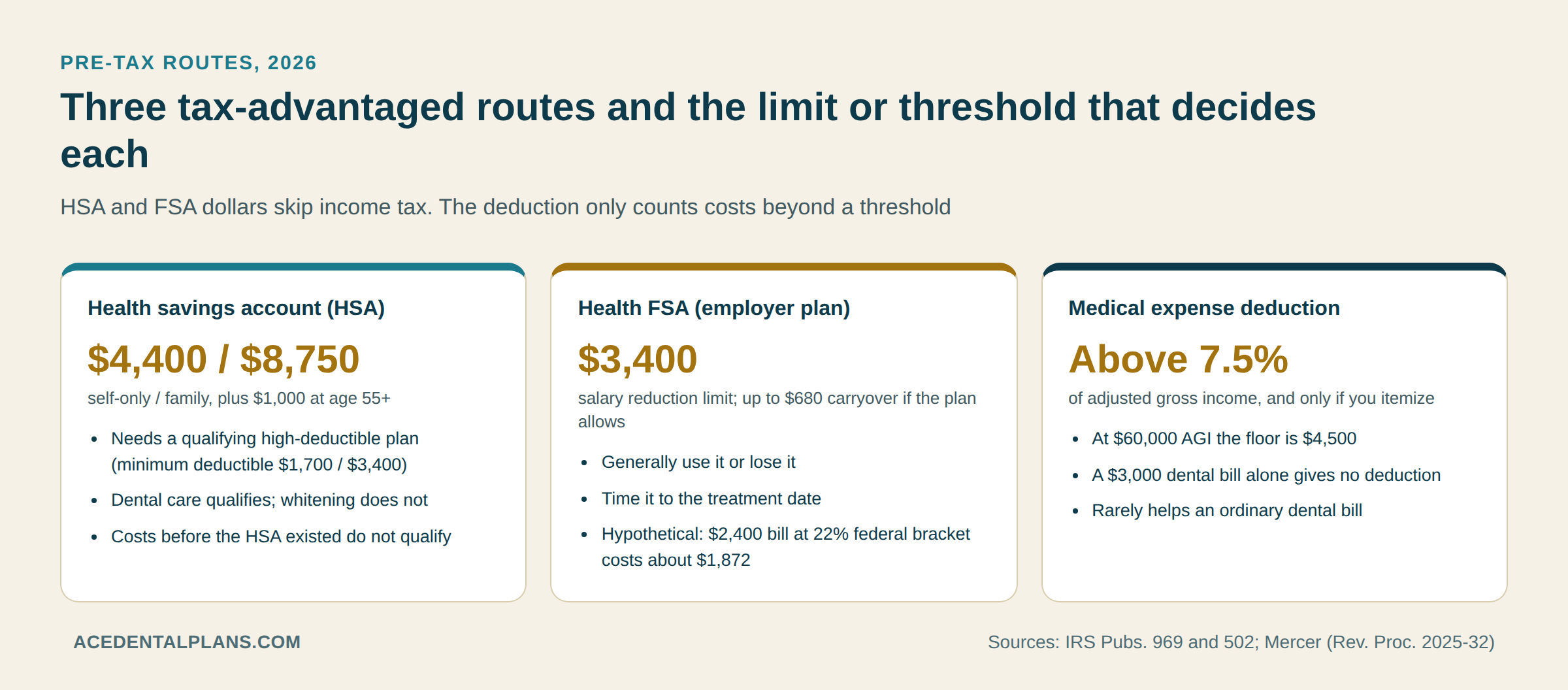 The 2026 limits and thresholds for the three pre-tax routes.
Discount Plans and Memberships: They Cut the Price, They Don’t Spread It
It’s easy to confuse these with financing because they involve a recurring fee. They’re closer to a loyalty card: you pay an annual amount and the price of treatment falls. If you then need the remaining price spread out, you still need one of the other routes.
There are two kinds. A discount plan, which the ADA’s plan overview says is “technically not insurance,” uses a contracted network of dentists who agree to discount their fees. You pay the contracted rate for treatment yourself, and there are no claim forms. An in-office membership plan is run by one practice. According to a September 2021 KFF Health News report, annual fees ran roughly $300 to $400, with examples at $348, $285 for adults and $245 for children. The example plans included exams, cleanings and X-rays, and the Nevada plan the report profiled took 20% off fillings and extractions. The same report warned that the field is largely unregulated, in an advocate’s words, “buyer beware.”
How common are they? A July 2023 survey of 874 owner dentists, run by the ADA’s Health Policy Institute and reported by Becker’s Dental Review, found that 26% of practices had an in-office dental plan. Another 22% were considering one, and 45% weren’t interested. GoodRx describes dental savings plans as offering discounts of “up to 60% on preventive procedures,” which is a top-of-range figure, not an expected saving on any one procedure.
Break-even is simple arithmetic. If a membership costs $348 and gives 20% off, with no included preventive visits counted, it takes $1,740 of discountable treatment to recover the fee ($348 divided by 0.20). If the plan also includes two cleanings and X-rays you would have bought anyway, the break-even is lower. If you need only one small filling, it’s higher.
- Ask whether the discount applies to treatment already diagnosed, or only to work diagnosed after you join.
- Ask for the plan’s fee for your specific procedure before paying the annual fee, and compare it with the cash price.
- Check whether the discount stacks with a cash-payment discount or is the same discount under another name.
- Confirm the plan’s dentist list and the cancellation terms in writing.
Dental Schools, Health Centers, Charity Programs and Public Coverage
The routes above all assume you’re paying a private practice’s fee one way or another. This group changes who treats you and what the fee is. It’s the slowest set of options and the one with the biggest price effect, which is why it belongs near the front of any plan that can wait a few weeks.
Dental school clinics let supervised students and residents treat patients at reduced fees. NIDCR says these programs give students experience while providing care at a lower cost. The American Dental Association’s MouthHealthy site notes that some schools limit what they charge to the cost of materials and equipment. CU Anschutz publishes a percentage. Its fees are typically 30% to 50% less than private practices in the area, up to 55% less at its Dental Care Team Clinic, and up to 45% less in its graduate periodontics and general practice residency clinics. It also offers a complimentary screening exam and X-rays at the Dental Care Team Clinic. GoodRx says such programs can offer savings of up to 50%. Expect longer appointments and more of them, because the work is supervised, and expect an intake screening before you are accepted for treatment.
Federally funded health centers are the second route. HRSA says health centers provide primary medical and dental care to people of all ages on a sliding fee scale based on ability to pay, whether or not they have health insurance. Its Find a Health Center tool searches by address. GoodRx puts the typical saving at up to 24%, a smaller cut than a school clinic but with a much shorter route to an appointment in some areas. Not every center has dental service on site, so call and ask.
Then there are the programs with eligibility rules. Dental Lifeline Network’s Donated Dental Services program arranges comprehensive treatment at no cost from volunteer dentists. To apply you must be 65 or older, permanently disabled, or need medically necessary dental care; you must show you can’t afford care; and you must first exhaust other benefits, including Medicaid. The program excludes cosmetic work, and its page says sedation, implants and complex care may not be provided, since scope is at the volunteer dentist’s discretion. Help can be received only once, waitlists run from several months to more than a year, and many counties have closed applications because of demand. It’s a real resource, but not a quick one.
Public coverage depends heavily on age and state. Medicaid.gov says states decide which dental benefits adult enrollees get and that there are “no minimum requirements” for adult dental coverage. For children, dental coverage through Medicaid’s early and periodic screening benefit is mandatory, and CHIP programs must cover services to prevent disease, restore oral structures and treat emergencies. Medicare.gov states that in most cases Original Medicare doesn’t cover routine cleanings, fillings, extractions, dentures or implants. The narrow exceptions include dental work tied to certain transplants, heart valve replacements or cancer treatment. The ADA Health Policy Institute reported in 2026, using 2023 data, that 55% of seniors had no dental benefits when Medicare Advantage plans were excluded from the count. HealthCare.gov adds that dental coverage isn’t an essential health benefit for adults, so Marketplace health plans don’t have to offer it, while for children it is.
| Route | Who qualifies | What the sources state | Trade-off |
|---|---|---|---|
| Dental school clinic | Patients accepted after a screening | CU Anschutz: typically 30% to 50% less than local private practices; up to 55% less at one clinic. GoodRx: up to 50%. | Longer and more frequent visits; acceptance and scope vary |
| Federally funded health center | Anyone, insured or not | Sliding fee scale based on ability to pay (HRSA); GoodRx: savings of up to 24% | Dental service varies by center; waits possible |
| Donated Dental Services (Dental Lifeline Network) | Age 65+, permanently disabled or medically necessary need, who cannot afford care | Comprehensive treatment at no cost from volunteer dentists; excludes cosmetic work | Waitlists of months to over a year; closed counties; complex care may not be offered |
| Medicaid or CHIP for children | Children and teens who meet state eligibility rules | Dental coverage is mandatory for children in Medicaid (Medicaid.gov) | Needs a participating dentist; eligibility rules vary by state |
| Medicaid for adults | Adults enrolled in state Medicaid | States choose adult dental benefits; no minimum requirements (Medicaid.gov) | Ranges from little to broad coverage depending on the state |
| Original Medicare | People enrolled in Medicare | Doesn’t cover routine dental in most cases; limited exceptions tied to other treatment (Medicare.gov) | Some Medicare Advantage plans add dental; check the specific plan |
| Community events and local referrals | Varies by program | Give Kids A Smile and similar volunteer events; NIDCR points to 2-1-1, health departments and United Way | One-off or limited-scope care |
Finance the Gap, Not the Sticker: Putting Insurance First
If you have dental coverage, even a plan with a waiting period or a low annual maximum, it changes how much you need from any other route. Work it out in the plan’s own order. Start with the type of plan (HMO-style, PPO or indemnity) and whether the dentist is in the network. Then take the deductible, the coinsurance or copay for that category of care, and the annual maximum. Last come any exclusions, waiting periods or frequency limits.
The waiting period is the one that catches people. HealthCare.gov warns that stand-alone dental plans may impose waiting periods before coverage starts, during which monthly premiums continue even though no benefits are available. A plan bought the week before a crown is scheduled may pay nothing toward it. If a waiting period applies, ask the plan how long it lasts, and ask the dentist whether the work can be phased so the covered part falls after the waiting period ends.
That example makes a plain point. A financing application signed for the full treatment total, before the insurer has responded, can leave you borrowing thousands you don’t need. Ask the office to hold the financing paperwork until the predetermination is back, or to apply only for the patient portion.
Assembling One Bill From Several Routes
Few large bills need a single method. Splitting a treatment plan by urgency and by what each route does well often beats choosing one route for everything. The dentist decides what is urgent and what can wait, so this section only shows how the arithmetic can work once that’s settled.
The pattern works for three reasons. Pre-tax money goes first to the work with a date on it, because FSA dollars can expire. A lower-fee route is used where time allows, because it’s the only one that shrinks the debt instead of renting it. Borrowing is left for the remainder, and only at the shortest term you can manage.
One $3,000 Bill, Five Monthly Paths
Rates are abstract until they turn into a monthly payment and a total. Here is a single hypothetical bill, $3,000 for work the dentist says can be scheduled in stages, run through five of the routes. The figures are arithmetic from the published rates earlier in this guide, not offers.
- Save first, then pay. Setting aside $250 a month takes 12 months to reach $3,000. It costs no interest, but treatment starts a year later, and whether that delay is acceptable is the dentist’s call, not an arithmetic one.
- Save, then pay with a discount. If the office takes 10% off for payment in full, the target drops to $2,700, or $225 a month for 12 months.
- Promotional financing, paid on schedule. A 12-month deferred-interest offer cleared at $250 a month costs $3,000 in total. The same offer with only $200 a month paid leaves $600 at the deadline. With about $513 of interest added back at 26.99%, roughly $1,113 would then be owed.
- Bank personal loan. At the 11.86% average for a 24-month loan, the payment is about $141 a month and the interest about $385, for a total near $3,385.
- Medical credit card, no promotion. At 26.99% over 24 months the payment is about $163 and the interest about $915, for a total near $3,915.
Read the list for what changes between lines. Moving from the card to the bank loan saves about $530 over two years but needs approval at that rate. Moving from the bank loan to a well-managed promotion saves another $385 but demands a payment $109 higher each month. And the missed-promotion line, with a total of about $1,113 owed on the last $600, is the reason the third bullet comes with a warning.
What Applying Does to Your Credit, and What to Ask First
Every borrowing route involves a credit decision of some kind, and the first question is how the lender looks at you. Sunbit says applying doesn’t require a hard credit check. CareCredit says you can see if you prequalify without affecting your credit score. Both statements are about the first step; the final account opening may be different, so ask before you sign what kind of inquiry the lender will make.
The practical risk is repetition. A person turned down at the front desk may apply for a card, a loan and a second card within days. Each full application can leave a mark, and each approval adds a new account. Prequalification tools exist so you can compare offers without that cost, and a soft-check comparison of two or three lenders is a better use of an afternoon than a string of full applications.
Credit history also decides who gets the lower rates in the first place. The CFPB found that among health care deferred-interest purchases, 34% of those made by people with credit scores below 619 ended up incurring interest, compared with 20% across all purchases. That’s the part of the market where promotional offers are most likely to turn into expensive balances, and where an office plan, a school clinic or a credit union loan deserves a close look.
If you have an existing card with room on it, that is a financing route too, with a stated APR and a known statement date. Compare its rate with the offers in Table 2: the Federal Reserve put the average at 20.94% across all accounts in the second quarter of 2026, so a card you already hold is rarely the cheap choice, but it can be a bridge for a week while a cash-discount payment clears.
Which Route for Which Situation
Table 5 turns the comparison into a decision path. Find the row closest to your own circumstances and read across: the first route to check, a fallback, and what to watch for. These are options to bring to the dentist’s office and the lender’s loan officer, not instructions about treatment.
| Your situation | First route to check | Fallback | Watch for |
|---|---|---|---|
| The dentist says the work is urgent and cash is short | Office payment plan, or a cash discount if you can raise the money in days | Third-party financing with a prequalification check | Signing deferred-interest terms in a hurry |
| You can repay within 6 to 12 months from income | Promotional financing or a true 0% card, with payment set at total divided by months | Office payment plan | Minimum payments that leave a balance at the deadline |
| You need two to five years to repay | Bank or credit union personal loan; reduced-APR card plan | Smaller loan plus staged treatment | Fees, term length and the APR rather than the headline rate |
| Thin or damaged credit | Office plan, school clinic or health center | Credit union PAL (up to $2,000); point-of-sale lender with lower score minimums | Rates near 28% to 36%; a card opened without your clear consent |
| You have HSA or FSA money | Pay from the account first | Cash discount for paying the rest in full | Expiring FSA balances; HSA rules for expenses before the account existed |
| Low income and the work can wait | Dental school clinic or health center with sliding fees | State Medicaid dental benefits if you qualify | Waits, screenings and limits on complex work |
| Age 65 or older, disabled or medically fragile, and cannot afford care | Donated Dental Services; health center; Medicaid | School clinic | Waitlists of months to more than a year |
| A child needs treatment | Medicaid or CHIP dental benefits for the child | Health center; school clinic | Network limits and state rules |
 A sequence for working through the routes: lower the price first, use your own pre-tax money next, borrow last.
Reading an Offer Before You Sign It, and What to Do If It Goes Wrong
A financing offer is a contract, even when it’s presented on a tablet at the front desk. Ask for a copy you can read away from the counter, and look for these things in it.
- Whether it is a credit card, an installment loan or an office plan, because each follows different rules.
- The APR that applies after any promotional period, and whether interest is deferred or waived.
- The exact date the promotional period ends, and the monthly payment needed to clear the balance by then.
- Any application, origination, late or annual fee, and whether you can pay off early without a penalty.
- Whether the application is a soft or hard credit inquiry, and whether payments are reported to credit bureaus.
- What happens to the financing if treatment is changed, paused or cancelled, and who refunds what.
Things do go wrong, and the most common problems are predictable. The CFPB’s 2023 report includes complaints from patients who say a card was opened for them without their consent. Check your credit reports after any financing application. If an account shows up that you didn’t agree to, contact the lender first and the dental office second. File a complaint with the CFPB if you aren’t getting answers.
If you’re going to miss a payment, say so before the due date. Office plans, lenders and card issuers differ in what they can offer. A call beforehand gives you a chance at a revised schedule, while a missed payment often starts fees or a collection process. Sometimes a deferred-interest deadline is close and the balance is still too large. A personal loan used to clear it may then cost less than letting the deferred interest post, if you can get one. Run the numbers before deciding.
Finally, keep paper. Save the signed treatment plan, the financing agreement, every receipt and the dates of payments. If a dispute comes up about refunds for work that wasn’t completed, the file is your evidence.

Frequently Asked Questions – How to Pay for Expensive Dental Work
Can I get dental work done now and pay later if my credit is poor?
Often yes, but the options narrow and the rates rise. An office payment plan depends on the practice’s judgment rather than a credit score, and one point-of-sale lender says it approves scores starting at 500, with APRs up to 35.99%. A school clinic, health center or credit union may cost less than the highest-rate loan.
Is a health care credit card the same thing as dental insurance?
No. A card such as CareCredit is a way to borrow money and can be used only at participating providers. Insurance pays part of a bill according to a benefit schedule, and a discount plan changes the price you’re charged. A card does neither of those things; it just lets you pay later.
Does a no-interest offer really cost nothing?
It costs nothing only if the whole balance is paid by the deadline. The CFPB says to watch for the “if” in phrases like “no interest if paid in full,” because the interest from the purchase date is added back if any balance remains. A true 0% introductory APR charges interest only on what is left after the period ends.
Which dental bills can I pay with HSA or FSA money?
IRS Publication 502 treats dental expenses as medical expenses, and GoodRx lists dentures, fillings and root canals as eligible. Teeth whitening is excluded in the IRS guidance. For anything borderline, ask the account administrator before you pay.
How much can I save at a dental school?
One school, CU Anschutz, says its fees are typically 30% to 50% less than private practices in its area. GoodRx’s figure is up to 50%. Both are ceilings, not guarantees, and schools differ in which procedures students perform.
Do dentists have to offer a payment plan?
Nothing reviewed for this guide says they do. The ADA tells practices that in-office financing should not necessarily be offered to every patient, and that some programs could make a practice a lender. It’s a request, not an entitlement, so ask early and in writing.
Is a personal loan cheaper than a medical credit card?
Often, when you can’t clear the balance inside a promotional window. Banks averaged 11.86% on 24-month personal loans in the second quarter of 2026, against 26.99% for the typical medical card in the CFPB’s 2023 report. Your own rate depends on your credit, so compare actual offers by APR.
What if I’m on Medicare and need a crown or dentures?
Medicare.gov says Original Medicare doesn’t cover routine dental in most cases, including dentures and implants. Some Medicare Advantage plans include dental benefits, so the plan documents are the place to look. A school clinic, health center or discount plan may reduce the price where coverage doesn’t.
Should I finance the full treatment total before insurance responds?
Waiting is usually cheaper. If a plan pays part of the bill, financing the whole amount means borrowing money you won’t need. Ask for the predetermination first and finance only the patient portion.
What happens to my financing if I stop treatment partway through?
That depends on the agreement, which is why the cancellation and refund terms belong on the checklist. Charges already made to a card or loan generally remain yours to repay, while any refund is a matter between you, the dentist and the lender. Ask who handles it before you sign.
Is there one cheapest way to pay for a $5,000 dental bill?
Not one for everyone, but there is a sequence. Lower the price first (school clinic, health center, cash discount), then use your own pre-tax money, then borrow the smallest amount for the shortest term at the lowest APR. On the published rates in Table 2, that last step alone can mean a difference of several hundred dollars.
Can I put dental work on a credit card I already have?
Yes, if the dentist accepts it, and it can serve as a bridge. The cost is the card’s regular APR, which the Federal Reserve measured at 20.94% on average across accounts in the second quarter of 2026. Unless the card has a true 0% introductory period, that makes it more expensive than a bank personal loan at the 11.86% average.
Can I split one treatment plan across more than one payment method?
Nothing prevents it. Many people pay the urgent part from an FSA or HSA balance and handle the rest with an office plan or a loan. Ask the office to bill each stage separately so receipts and financing paperwork match the work done.
Sources and Disclaimers – How to Pay for Expensive Dental Work
Rates, limits and program rules in this guide come from federal agencies (the CFPB, the Federal Reserve, the IRS, HRSA, Medicaid.gov, Medicare.gov, HealthCare.gov and NIDCR) and the American Dental Association. Other figures come from a university clinic page, company pages (CareCredit, Sunbit) and consumer finance reporting (GoodRx, KFF Health News, Mercer, NerdWallet, Becker’s Dental Review). Company pages describe the companies’ own products and claims, and the CareCredit provider FAQ is undated, so current offers may differ. Every payment, interest, tax and break-even figure in the examples was calculated for this article from the stated inputs and is illustrative, not a quote or a prediction for any particular loan. Averages hide wide ranges by state, credit profile, lender and practice. Confirm prices and payment terms with the dentist, financing terms with the lender, benefits with the insurer, and tax questions with a tax professional.
- Consumer Financial Protection Bureau — Medical Credit Cards and Financing Plans (May 2023 report)
- Consumer Financial Protection Bureau — How to understand special promotional financing offers on credit cards
- Consumer Financial Protection Bureau — Four things to know about deferred interest credit cards
- Consumer Financial Protection Bureau — How long can I keep a low rate on a balance transfer or other introductory rate?
- Board of Governors of the Federal Reserve System — Consumer Credit (G.19) release, interest rate table
- Internal Revenue Service — Publication 969, Health Savings Accounts and Other Tax-Favored Health Plans
- Internal Revenue Service — Publication 502, Medical and Dental Expenses
- Mercer — 2026 health FSA and other health and fringe benefit limits (summary of IRS Rev. Proc. 2025-32)
- CareCredit — Dental financing page
- CareCredit — Provider FAQ on promotional and reduced-APR financing (undated)
- Sunbit — Dental financing page for practices
- American Dental Association — Patient financing options for dental practices
- American Dental Association — Dental plan overview, including discount plans
- American Dental Association Health Policy Institute — Dental coverage, access and outcomes statistics
- Becker’s Dental Review — Report on the ADA Health Policy Institute survey of in-office dental plans (July 2023)
- KFF Health News — Dentists offer membership plans to uninsured patients (September 2021)
- GoodRx — Managing dental costs without insurance (updated April 2025)
- NerdWallet — Payday alternative loans: summary of NCUA terms (March 2026)
- National Institute of Dental and Craniofacial Research — Finding dental care
- American Dental Association MouthHealthy — Places to look for affordable dental care
- Health Resources and Services Administration — Get health care: health centers
- University of Colorado Anschutz School of Dental Medicine — Dental fees
- Dental Lifeline Network — Apply for help: Donated Dental Services
- Medicaid.gov — Dental care
- Medicare.gov — Dental services
- HealthCare.gov — Dental coverage in the Marketplace
Important Information and Disclaimers
This article is general educational information. By using it, you accept the limits described below.
Not dental or medical advice
Nothing on this page is a diagnosis, a treatment recommendation or a substitute for an examination by a licensed dentist or physician. Reading this article does not create a dentist-patient or doctor-patient relationship. Only a licensed professional who has examined you and reviewed your history can tell you what your mouth needs. Do not delay, skip or stop professional care because of something you read here.
Prices are estimates, not quotes
Cost figures are ranges reported by the third-party sources cited in this article. Actual prices depend on your location, the provider, the complexity of your case, the materials used, the date of service and other factors, so what you pay may be higher or lower. A written treatment plan and fee estimate from the dental office is the only reliable number for your situation.
Insurance and plan examples are illustrations
Examples that use named amounts or percentages are hypothetical. Real benefits depend on your plan, network, waiting periods, annual maximum, deductible and the insurer’s rules at the time of treatment. A pre-treatment estimate or benefits check is not a promise of payment. Confirm the details with your insurer or plan administrator in writing.
Not insurance, legal, tax or financial advice
AceDentalPlans is an information publisher. Nothing here is insurance, legal, tax, investment or other professional financial advice, and nothing here recommends a particular provider, insurer, lender, discount plan or financing product. Company and product names belong to their owners and appear for identification only. Read the terms of any loan, financing offer or plan before you sign, and ask a qualified professional if you need advice on your own circumstances.
Third-party sources
This article cites government agencies, professional associations, insurers, lenders and other outside organizations. We do not control those sources. Their content can change, move or disappear, and listing a source is not an endorsement of it or of anything it sells.
No warranty
We aim for accuracy, but this article is provided “as is,” without warranties of any kind, express or implied, including warranties of accuracy, completeness, timeliness or fitness for a particular purpose. Some information may be out of date or contain errors by the time you read it.
Limitation of responsibility
To the fullest extent permitted by law, AceDentalPlans and its owners, authors and contributors are not responsible or liable for any loss, cost, injury, health outcome or other damage that results from using this article or relying on it. You are responsible for your own decisions about your care, your coverage and your money.
How this article is written
This article follows AceDentalPlans’ answer-first, U.S.-focused editorial approach. It uses conditional language for insurance, because coverage depends on the specific plan, and it names its sources so that you can read them yourself.