
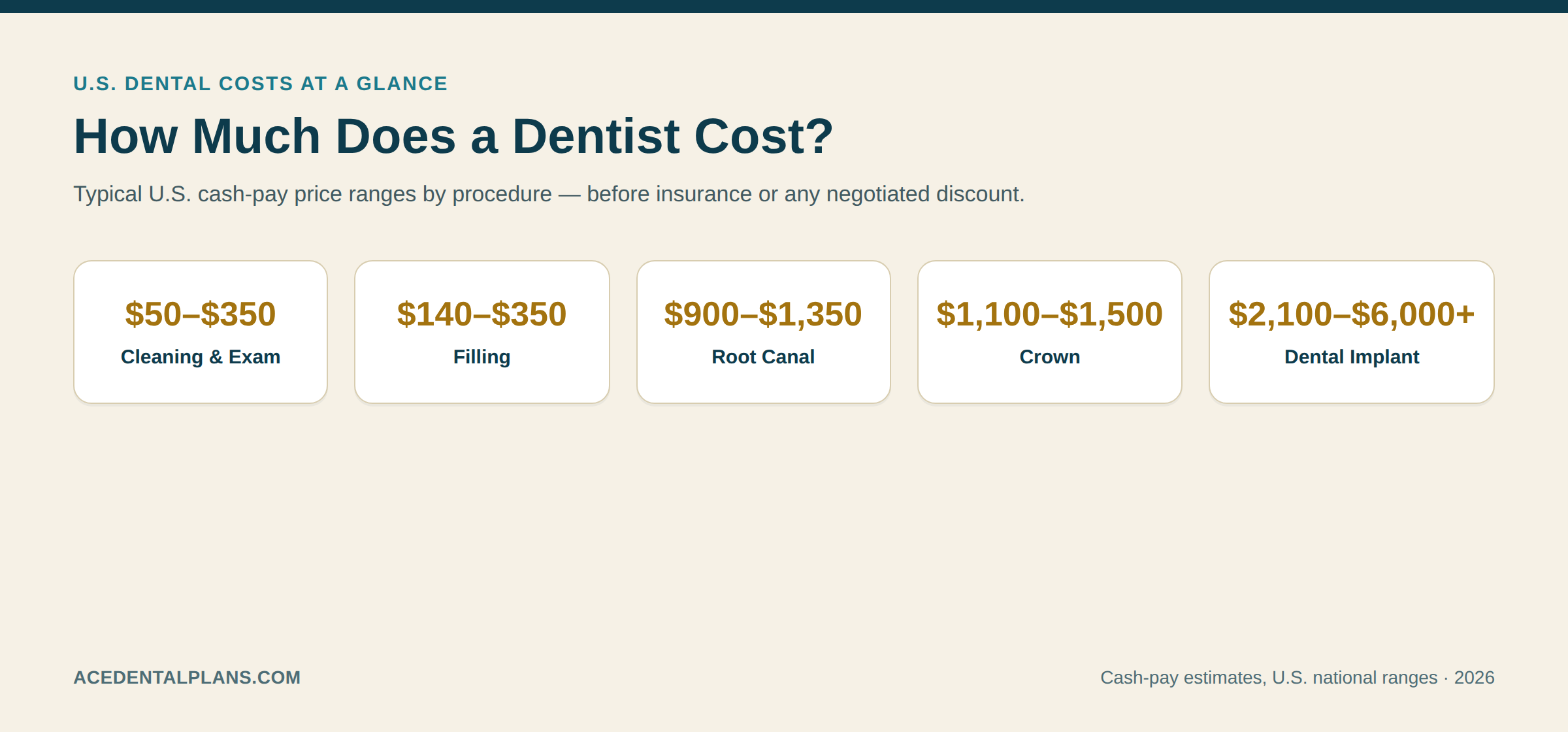
How Much Does a Dentist Cost? A routine cleaning typically runs $50 to $350, a filling $140 to $350, and a crown $1,100 to $1,500, while a single dental implant can run $2,100 to $6,000 or more once the abutment and crown are included. The number that applies to you depends on where you live, which dentist you see, what materials are used, and whether dental insurance is sharing the cost. This guide breaks down typical U.S. prices by procedure and explains what pushes a bill higher or lower. It also walks through insurance, cash-pay strategies, and lower-cost options, so you can plan for a treatment estimate with realistic expectations.
Key Takeaways
- Routine preventive care (exams, cleanings, X-rays) generally costs the least and is the service most dental plans cover most generously.
- Restorative work like fillings, crowns, and root canals varies widely by tooth location, material, and whether a specialist is involved.
- Dental implants and full-mouth reconstruction are the most expensive category, often running from a few thousand dollars per tooth to tens of thousands of dollars for a full arch.
- Dental insurance rarely covers 100% of anything beyond preventive care — deductibles, coinsurance, annual maximums, and waiting periods all shape your actual out-of-pocket cost.
- Dental schools, community health centers, discount plans, and financing can meaningfully lower the cost of care if you don’t have insurance or your plan’s annual maximum runs out.
What Drives the Cost of Going to the Dentist
“How much does a dentist cost?” doesn’t have one answer. A dental office bills for dozens of distinct services, each identified by its own procedure code, rather than charging a flat visit fee like an urgent care clinic. A checkup and cleaning might run under $200, while a full-mouth implant case can exceed $40,000. Both are “going to the dentist,” but they represent entirely different scopes of work, materials, and chair time.
Dentists in the United States generally bill using Current Dental Terminology (CDT) codes, a standardized system maintained by the American Dental Association. These codes identify each procedure precisely — for example, a single-surface composite filling on a back tooth is billed differently from a three-surface filling on the same tooth. That precision is useful once you understand it, because it means a written treatment plan can (and should) itemize exactly what you’re paying for rather than quoting one lump number.
Three broad categories account for most dental spending:
- Preventive care — exams, cleanings, X-rays, and sealants. Lower cost, and the category most insurance plans cover most generously.
- Restorative and basic care — fillings, simple extractions, and non-surgical deep cleanings. Moderate cost, moderate insurance coverage.
- Major and prosthodontic care — crowns, root canals, dentures, implants, and oral surgery. The highest cost per procedure, and the category where insurance coverage is thinnest relative to the bill.
Geography also matters more in dentistry than many people expect. A routine cleaning that costs $153 on average in New Hampshire can run $263 in North Dakota, according to CareCredit’s national dental cost research. Local cost of living, rent, staff wages, and even state licensing requirements all factor into what a practice charges. Keep that regional variation in mind as you read the ranges below: they represent national averages and typical spreads, not a quote for your specific dentist.
Dentistry also has less price transparency than many other parts of U.S. health care. Federal price transparency rules require hospitals to post standard charges, but those rules don’t extend to private dental practices. That means there’s no single public database where you can look up what your specific dentist charges for a specific procedure before you walk in. That’s part of why a written, itemized estimate matters so much. It’s often the only reliable price information you’ll get before treatment begins, and it’s the only version of “the cost” that applies directly to you rather than to a national average.
It’s also worth separating the sticker price from what you’ll actually be asked to pay. The number on a treatment plan is typically the practice’s full fee. If you have insurance, your actual responsibility is calculated against your plan’s allowed amount for that procedure. That allowed amount is frequently lower than the full fee — sometimes considerably lower, depending on the network agreement. If you’re paying cash, the full fee is usually the number that applies, though some practices offer a modest reduction for patients who pay in full at the time of service. Both scenarios are covered in more detail later in this guide.
For a broader look at how dental pricing works across procedure categories, see our dental cost guide.
Typical U.S. Dental Costs by Procedure – How Much Does a Dentist Cost
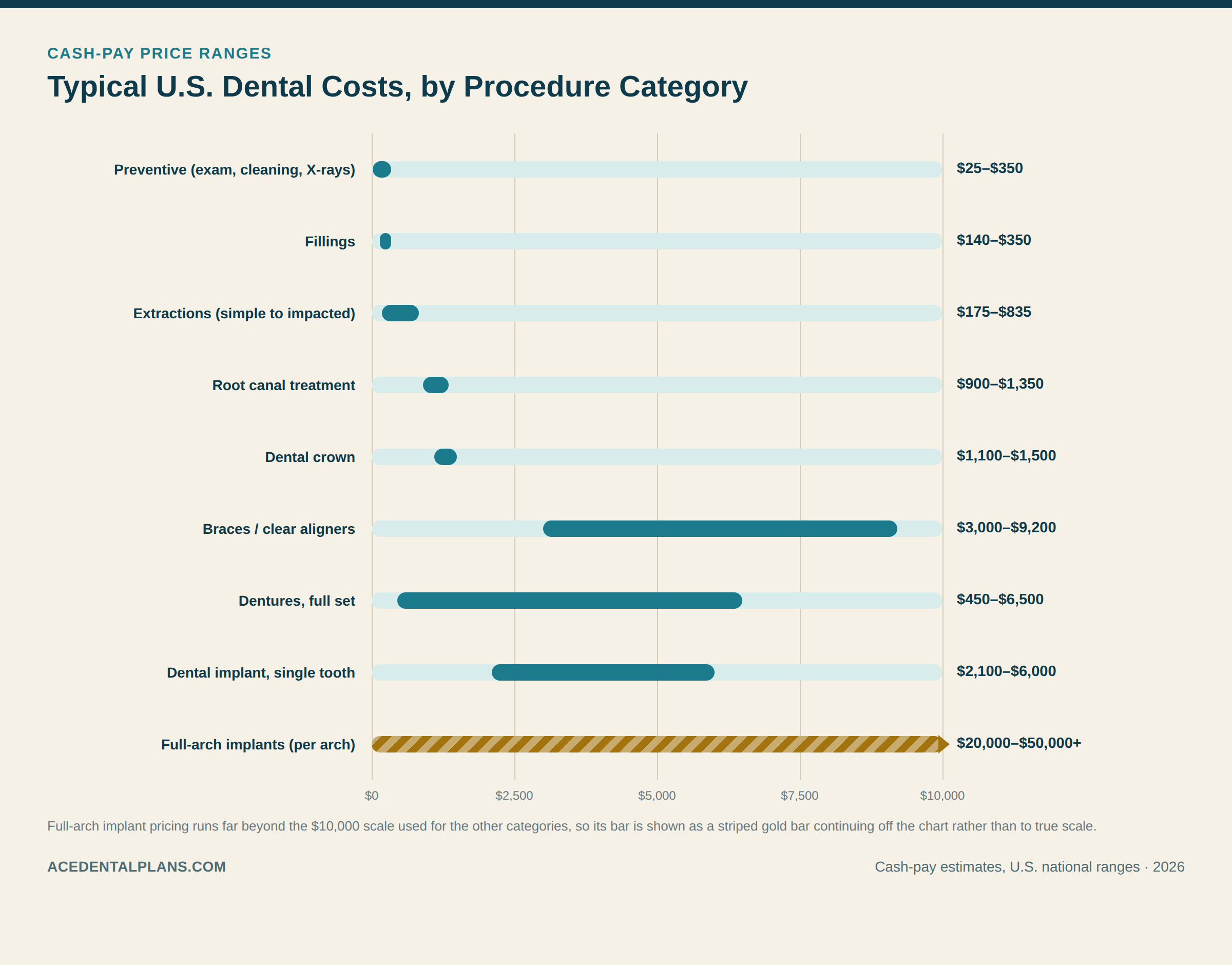
The table below compiles typical cash-pay price ranges reported by major U.S. dental-cost and dental-benefits sources, including a 2023–2024 nationwide procedure-cost study conducted for CareCredit and Guardian, and metro-market examples from Humana’s dental pricing tool. These are cash-pay ranges before any insurance coinsurance or negotiated network discount is applied.
Reading the table by category makes the pattern easier to follow. Preventive procedures near the top — the exam, the cleaning, the X-rays — sit in the tens to low hundreds of dollars. They’re also the services most dental plans cover most generously, which is part of why routine visits are the least expensive way to stay ahead of larger problems. Restorative procedures in the middle of the table, like fillings and simple extractions, generally run a few hundred dollars. Endodontic, prosthodontic, and surgical procedures — root canals, crowns, dentures, and extractions of impacted teeth — move into four figures per tooth. Implants, full-arch reconstruction, and orthodontics sit at the top of the range, both in dollar terms and in how much the price can vary from one case to the next.
| Procedure | Typical cash-pay range | What can push it higher |
|---|---|---|
| Routine exam and cleaning | $50 – $350 (national average around $203) | First-visit comprehensive exam fees, additional X-rays |
| Dental X-rays | $25 – $250, depending on the number of images | A full-mouth series or panoramic image instead of a single bitewing |
| Filling, composite resin | $150 – $350 per tooth | Number of surfaces involved; front-tooth vs. back-tooth placement |
| Filling, silver amalgam | $140 – $230 per tooth | Number of surfaces involved |
| Scaling and root planing (deep cleaning) | $235 – $300 per quadrant | Treating all four quadrants, or adding local anesthesia |
| Simple tooth extraction | $175 – $225 per tooth | Additional imaging or sedation |
| Surgical or impacted tooth extraction | $325 – $835 per tooth | Depth of impaction and whether an oral surgeon is needed |
| Root canal treatment | $900 – $1,350 per tooth (molars cost more than front teeth) | Treatment by an endodontist, retreatment of a prior root canal |
| Dental crown | $1,100 – $1,500 per tooth | Porcelain or all-ceramic material, same-day milled crowns, lab fees |
| Dentures, full set | $450 – $6,500, depending on style | Immediate dentures, precision attachments, implant-supported designs |
| Dental implant, single tooth (implant + abutment + crown) | $2,100 – $6,000 per tooth | Bone grafting, sinus lifts, premium implant systems, specialist fees |
| Full-arch or full-mouth implants | $20,000 – $50,000+ per arch | Number of implants placed, bone grafting, sedation, lab work |
| Braces or clear aligners | $3,000 – $9,200 | Case complexity, treatment length, orthodontist vs. general dentist |
| Porcelain veneers | $900 – $2,500 per tooth (more for a full smile set) | Number of teeth treated, lab used, design revisions |
| Professional teeth whitening | $400 – $800 per treatment | In-office laser whitening vs. take-home custom trays |
A single implant case can involve several separate charges — the surgical placement, the abutment, and the final crown are often billed as three line items rather than one. The total depends heavily on what a quote actually includes. Ask any office for an itemized, written estimate before you compare prices between providers.
What a full treatment episode can add up to
Table 1 prices individual procedure codes, but most real dental visits combine several of them into one episode of care. Adding the individual line items together, using the low and high ends of the ranges above, gives a more realistic picture of what a full episode can cost before any insurance is applied:
- A single cavity, start to finish: exam ($50–$150) + one X-ray ($25–$60) + one composite filling ($150–$350) totals roughly $225 to $560.
- A root canal with a crown to protect the tooth: root canal ($900–$1,350) + core buildup (often $150–$350, not shown separately in Table 1) + crown ($1,100–$1,500) totals roughly $2,150 to $3,200 per tooth.
- A single-tooth implant, from extraction through the final crown: extraction ($175–$835, more if surgical) + implant with abutment and crown ($2,100–$6,000) totals roughly $2,275 to $6,835 per tooth, before adding a bone graft if one is needed.
- A full set of dentures after multiple extractions: several extractions ($175–$835 each) + the denture itself ($450–$6,500) can push a full-mouth case well past the denture price alone, particularly for an immediate or implant-supported design.
These totals are illustrative estimates built from the ranges in Table 1, not a quote, since they don’t reflect any specific dentist, region, or insurance plan. Ask your dentist’s office for a written treatment plan that lists every procedure code involved so you can see your own full-episode total before you commit.
Curious how a specific procedure breaks down in more depth? See our dedicated guides on dental implant costs, root canal costs, crown costs, and denture costs.
What Changes Your Total Bill
Two people can have “the same” procedure and receive very different bills. The price drivers below explain most of that gap, and knowing them ahead of time makes a treatment estimate much easier to evaluate.
| Price driver | Why it matters | Typical effect |
|---|---|---|
| Where you live | Rent, staff wages, and local cost of living vary by state and by metro area | Can shift a $1,200 crown to $1,800 or more in a higher-cost market |
| General dentist vs. specialist | Endodontists, oral surgeons, periodontists, and prosthodontists typically bill more than general dentists for comparable procedures | Adds a specialist fee on top of the base procedure cost |
| Material and lab choice | Porcelain, zirconia, and other premium materials cost more to fabricate than metal or resin alternatives | Can meaningfully raise the cost of a crown, filling, or veneer |
| Case complexity | Impacted teeth, infection, bone loss, and unusual anatomy add chair time and skill | Can move a routine extraction from roughly $200 toward $500 or more |
| Sedation and anesthesia | Nitrous oxide, oral sedation, and IV sedation are typically billed separately from the procedure itself | Adds roughly $100 to $600 or more, depending on the sedation type |
| Number of visits | Multi-step treatment such as crowns, dentures, and implants requires separate appointments, each with its own charges | Spreads the total cost across several billing events over weeks or months |
| Timing (emergency or after-hours care) | Same-day and after-hours appointments often carry a premium over a scheduled weekday visit | Can add roughly $50 to $200 to the base fee |
| Insurance network status | In-network dentists agree to a plan’s negotiated rate; out-of-network dentists can bill their full fee | Out-of-network care can cost meaningfully more, even with insurance |
 Eight variables that explain most of the difference between two “identical” dental bills.
None of these drivers works in isolation. An impacted wisdom tooth removed by an oral surgeon under IV sedation in a high-cost metro area can easily land at the top of every range in Table 1 at once. A simple filling from a general dentist in a lower-cost area, by contrast, can land near the bottom. Ask your dentist’s office which of these factors apply to your specific treatment plan before you accept an estimate.
Comparing Costs: Save the Tooth or Replace It?
Several of the most expensive decisions in dentistry come down to the same basic question: repair and keep a natural tooth, or remove it and replace it with something else. Cost is only one part of that decision. A dentist may recommend one option over another based on how much healthy tooth structure remains, the tooth’s position, and your overall oral health — but the cost trade-offs are real and worth understanding before your appointment.
Root canal and crown vs. extraction
Extracting a damaged tooth is almost always cheaper up front than treating it. A simple extraction ($175–$225) costs a fraction of a root canal and crown ($2,150–$3,200 combined, per the estimate above). But an extraction creates an empty space, and leaving that space unaddressed can allow neighboring teeth to shift over time. Replacing an extracted tooth later with a bridge, a partial denture, or an implant typically costs more in total than treating and crowning the original tooth would have. The up-front savings of extraction, in other words, can be offset later by the cost of replacing the tooth, if replacement turns out to be necessary or desired.
Dentures vs. dental implants
For replacing multiple missing teeth, traditional dentures generally cost less up front than implants. A full set of traditional dentures can run $450 to $2,200, compared with $20,000 or more for a full-arch implant-supported solution. Dentures also involve lower up-front cost per tooth than individual single-tooth implants placed one at a time. In exchange, implants are designed to function more like natural teeth and don’t rely on the gum tissue and suction that traditional dentures use to stay in place. Traditional dentures, on the other hand, require adjustment visits over time as your gums and jawbone change shape, and may need periodic relining or eventual replacement. Longevity for either option depends on bone health, oral hygiene, and maintenance — no restoration is guaranteed to last a specific number of years. Long-term value, in other words, depends on more than the initial price tag.
Braces vs. clear aligners
Traditional metal braces and clear aligners like Invisalign are typically priced in a comparable range, from roughly $3,000 to $9,200, according to Invisalign’s own cost comparison. Neither option is consistently cheaper than the other. The price difference for a specific case usually comes down to treatment complexity, length of treatment, and whether an orthodontist or general dentist is providing the care, rather than the appliance type itself.
Crowns vs. veneers for a damaged or discolored tooth
Crowns and veneers both change the appearance of a tooth, but they solve different problems and are priced differently for a reason. A veneer is a thin shell bonded to the front surface of a tooth. It’s generally chosen for cosmetic reasons — reshaping, closing a small gap, or masking discoloration — because it preserves more of the underlying tooth structure. A crown covers the entire tooth. It’s generally recommended when the tooth needs more structural support than a veneer can provide, such as after a large filling, a root canal, or significant decay. Porcelain veneers ($900–$2,500 per tooth) and porcelain crowns ($1,100–$1,500 per tooth) occupy a similar price range, so cost alone rarely decides between them. The deciding factor is usually how much of the tooth’s structure needs to be restored — a clinical judgment your dentist makes based on an exam, not a preference you specify upfront.
There is no one-size-fits-all winner in any of these comparisons. Bone support, adjacent teeth, remaining tooth structure, and your own budget and priorities all factor into which option makes sense. A dentist may recommend a specific option for your case; ask what the recommendation is based on and what the realistic alternatives would cost if you chose differently.
How Dental Insurance Changes What You Pay
Dental insurance does not work like medical insurance, and importing medical-plan assumptions into a dental decision is one of the most common ways people misjudge their bill. The plan mechanics below explain why a coverage percentage on paper doesn’t always translate into the savings you’d expect.
The core plan mechanics
- Premium — the amount you pay to keep the plan in force, usually monthly, regardless of whether you use any dental care.
- Deductible — the amount you may need to pay for covered services before the plan starts sharing certain costs, often waived for preventive care.
- Coinsurance or copay — the percentage (coinsurance) or fixed dollar amount (copay) you pay for a covered service after the deductible is met. Plans typically don’t use these interchangeably for the same service.
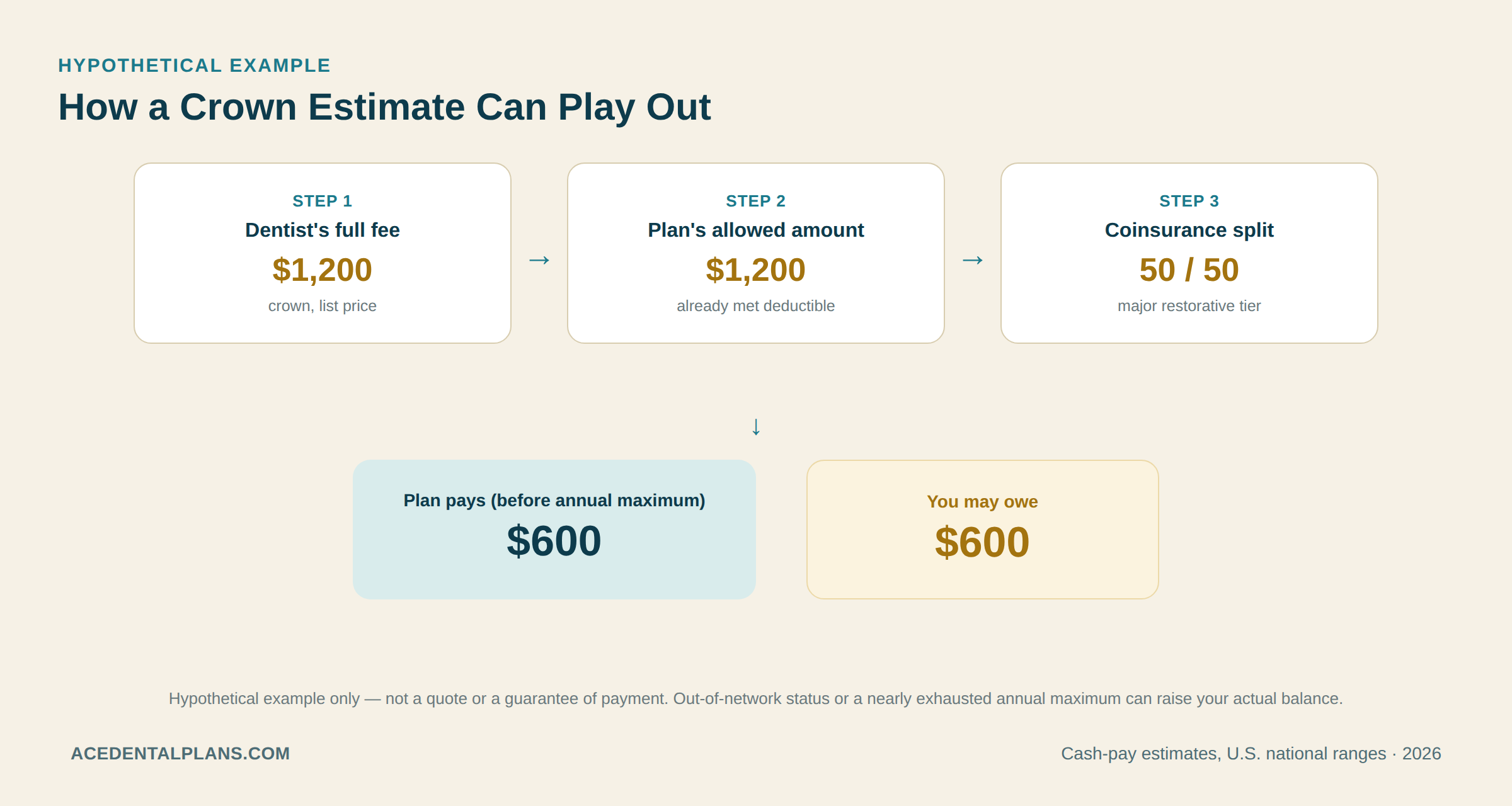
- Allowed amount — the amount a plan recognizes for a covered service, which is often lower than the dentist’s full listed fee. Your coinsurance is calculated against this allowed amount, not the sticker price.
- Annual maximum — the most the plan will pay toward covered dental services during a benefit period, commonly in the range of $1,000 to $2,000 per person per year for many employer and marketplace plans, though this varies by plan and should always be confirmed in your plan documents.
- Waiting period — a period after enrollment during which certain services, often major restorative work, are not yet eligible for coverage.
- Network status — whether your dentist has a contractual agreement with your plan. In-network dentists agree to the plan’s allowed amount; out-of-network dentists may bill you for the difference.
How Much Does a Dentist Cost? Many dental plans are structured around a tiered pattern: preventive services may be covered close to 100%, basic restorative services (like fillings) often around 70–80%, and major services (like crowns, dentures, and some implant components) often around 50%. This pattern is common but not universal, and it applies to the plan’s allowed amount, not necessarily to your dentist’s full fee. Your plan document, not this general pattern, is the only reliable way to confirm your exact benefits.
PPO, DHMO, indemnity, and discount plans aren’t the same thing
“Dental insurance” and “dental savings plan” get used loosely in everyday conversation, but they work differently enough that it’s worth keeping the categories straight:
- PPO (Preferred Provider Organization) plans let you see any dentist, but pay a higher percentage of the allowed amount when you choose an in-network provider. Most employer dental plans in the U.S. are PPO-style.
- DHMO (Dental Health Maintenance Organization) plans generally require you to choose a primary dentist from the plan’s network and use set copays rather than coinsurance. Premiums tend to run lower, but your choice of dentist is more restricted.
- Indemnity (fee-for-service) plans reimburse a percentage of the dentist’s fee regardless of network status, with fewer network restrictions but often a higher premium.
- Dental discount or savings plans are not insurance at all — there’s no claims process, no annual maximum, and no waiting period. You pay an annual membership fee for access to a pre-negotiated, discounted fee schedule at participating dentists, covered in more detail later in this guide.

How to verify your benefits before treatment
The safest way to avoid a coverage surprise is to verify your specific benefits before, not after, a major procedure. A few concrete steps help:
- Call your insurer directly and ask about your remaining annual maximum, whether the specific procedure code is covered, and whether a waiting period applies.
- Ask your dentist’s office for a pre-treatment estimate (predetermination) for any expensive or multi-step procedure. Your dentist submits the proposed treatment to your insurer, which responds with an estimate of how it may be paid under your current benefits — useful information, though still not a guarantee of final payment.
- Review your explanation of benefits (EOB) after any visit to see exactly how the allowed amount, your coinsurance, and your remaining annual maximum were calculated. An EOB is also the easiest way to catch a billing error.
- Re-verify annually, since plan rules, networks, and your remaining annual maximum reset and can change at renewal, even if you keep the same employer or the same insurer.
Common exclusions and waiting periods
Even a generous plan won’t cover everything, and the exclusions tend to follow a predictable pattern across carriers:
- Cosmetic procedures such as teeth whitening and most veneers are typically excluded, since dental insurance is generally built around treating disease and restoring function rather than changing appearance.
- Orthodontic treatment is often covered only under plans that specifically include an orthodontic benefit, frequently with its own separate lifetime maximum rather than sharing your annual maximum.
- Missing tooth clauses in some plans exclude coverage for replacing a tooth that was already missing before your coverage started, which can affect a bridge, denture, or implant claim if you’re new to a plan.
- Waiting periods commonly apply to major restorative work and sometimes to basic restorative work, meaning a newly enrolled plan may not pay toward a crown or root canal for the first six to twelve months of coverage, even though the procedure itself is a covered benefit type.
None of these exclusions are universal, and some employer plans waive waiting periods entirely. Reading your plan’s summary of benefits, or calling your insurer to ask about a specific procedure, is the only way to know which of these apply to you.
Marketplace and ACA-specific rules
If you’re shopping for coverage through the federal Health Insurance Marketplace, a few rules are specific to that channel. According to HealthCare.gov, pediatric dental coverage (through age 18) is considered an essential health benefit and must be available, either bundled into a health plan or offered separately. Parents, however, aren’t required to purchase it. Adult dental coverage is not an essential health benefit, so Marketplace health plans aren’t required to include it. Standalone Marketplace dental plans exist, but you generally can’t buy one unless you’re also enrolling in a health plan at the same time. These plans may also include waiting periods before covering major adult services.
Original Medicare works differently still. It generally doesn’t cover routine dental care, and covers dental services only when they’re directly tied to a covered medical procedure, according to the National Institute of Dental and Craniofacial Research. Some Medicare Advantage plans add optional dental benefits, but the scope and cost-sharing for those benefits vary by plan and should be confirmed directly with the plan rather than assumed.
For a closer look at how plan types differ and how to read your own benefits, see our guides on dental insurance basics and types of dental plans.
What You’ll Likely Pay in Cash Without Insurance
If you don’t have dental insurance, or your plan doesn’t cover a particular procedure, you’ll pay the practice’s cash-pay (sometimes called “self-pay”) rate directly. The ranges in Table 1 above are cash-pay ranges, so they already reflect what an uninsured patient might expect to see on a bill before any discount is applied. Being an uninsured patient doesn’t mean you have no leverage over the price — it just means the negotiation happens directly with the practice rather than through an insurer’s network agreement.
A few strategies can lower a cash-pay bill without changing the underlying treatment:
- Ask about a self-pay or prompt-payment discount. Many practices reduce their fee for patients who pay in full at the time of service rather than billing insurance, since it saves the practice the administrative cost of processing a claim. Ask directly whether one is available; it’s rarely advertised.
- Get more than one written estimate for major work. A crown, root canal, or implant is expensive enough that a second opinion can reveal a meaningfully different price, or even a different recommended treatment approach, for the same problem. This is standard practice for any major expense and isn’t something you need to justify to your current dentist.
- Ask whether treatment can be staged. Some non-urgent work, like a full mouth of restorative treatment, can sometimes be sequenced over multiple visits or months without compromising your care, which can make the cost easier to plan around even if it doesn’t lower the total.
- Compare an itemized quote, not a single number. Ask both offices for an apples-to-apples estimate that includes the same components — for example, whether an implant quote includes the abutment and crown, or only the surgical placement, and whether a bone graft is anticipated.
- Ask what’s included versus billed separately. A low headline price for an implant or a full denture is only meaningful if you know whether imaging, sedation, follow-up visits, and adjustments are bundled in or charged on top.
For non-urgent care, it’s reasonable to shop around for written estimates the same way you would for any major purchase. The price drivers in Table 2 explain most of what you’ll see change from one office to the next. For urgent problems like an infection, a broken tooth, or significant swelling, treat the timeline as the priority. Address cost strategy — a payment plan, financing, or a lower-cost provider — once the immediate problem is being treated.
Ways to Lower the Cost: Financing and Assistance Options
If a treatment estimate is more than you can pay upfront, several legitimate options exist beyond simply postponing care. None of these is one-size-fits-all, because eligibility, savings, and the type of care each option is best suited for all differ.
| Option | How it works | Typical cost or savings | Best for |
|---|---|---|---|
| Dental insurance | Employer or marketplace plan shares the cost of covered services after your deductible | Coverage varies by plan; annual maximum often $1,000–$2,000 per person | People with predictable, ongoing dental needs |
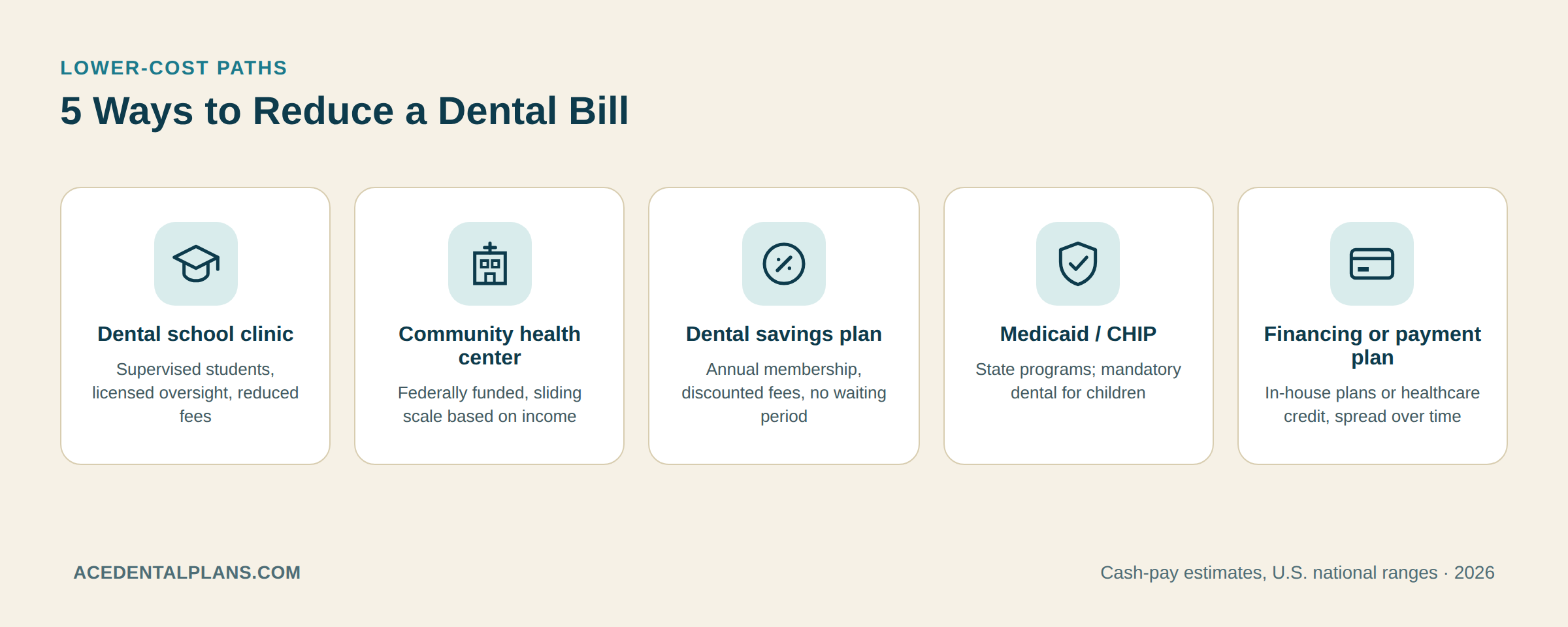
| Dental savings (discount) plan | An annual membership fee gives you discounted fees at participating dentists; this is not insurance and doesn’t reimburse claims | Plans often start around $80–$100 per year; providers report average savings near 50% at participating dentists | People without insurance who want lower fees with no waiting period |
| Dental school clinic | Supervised dental students perform treatment under a licensed dentist’s direct oversight | Typically priced well below private-practice fees, though appointments usually take longer | People with flexible schedules and straightforward treatment needs |
| Community health center | Federally funded clinics charge on a sliding scale based on income | Cost is based on what you can afford to pay | Lower-income and uninsured patients |
| Medicaid or CHIP | State-run programs; dental benefits are mandatory for children and optional (and variable) for adults, depending on the state | Cost depends on your state’s program rules and your eligibility | Eligible children, and eligible adults in states that cover adult dental benefits |
| In-house payment plan or third-party financing | The practice offers an installment plan, or you apply for a healthcare credit line such as CareCredit | Cost depends on plan terms and whether a promotional interest-free period applies | People who need treatment now and want to spread out payments |
| FSA or HSA | Pre-tax funds set aside through an employer plan or opened individually can pay for eligible dental care | Effectively reduces your cost by your marginal tax rate | People with access to one of these accounts through their employer or health plan |
| Membership-based (direct) dental practice | A smaller number of practices charge patients a flat annual or monthly membership fee directly, bundling routine preventive visits and offering discounted rates on other treatment, instead of billing an insurer | Cost and what’s included vary by practice | People who want predictable routine-care pricing and prefer not to deal with insurance claims |
According to the National Institute of Dental and Craniofacial Research’s guidance on finding dental care, dental and dental-hygiene schools, federally funded community health centers, and state or local health departments are among the most reliable starting points. This is especially true if cost is the main barrier to treatment. The federal Health Resources and Services Administration maintains a locator for sliding-scale health centers, and calling 2-1-1 can connect you to regional assistance programs you might not find through a web search alone.
A closer look at each option
Dental schools and dental-hygiene schools let supervised students treat patients under a licensed dentist’s direct oversight as part of their clinical training. Fees are typically well below private-practice rates for comparable procedures, but expect longer appointments and a teaching-clinic pace, since each step is usually reviewed by faculty before treatment continues.
Community health centers funded by the federal government are required to charge on a sliding scale tied to household income. That means the same procedure can cost dramatically different amounts for two different patients at the same clinic. Availability and exact services offered vary by location, so it’s worth calling ahead to confirm which dental services a specific center provides.
Medicaid and CHIP dental benefits are mandatory for children under both programs. Adult dental coverage under Medicaid, however, is optional and set at each state’s discretion — some states offer comprehensive adult dental benefits, others offer emergency-only coverage, and a few offer none. Check your specific state Medicaid program to confirm what’s covered before assuming either way.
In-house payment plans and third-party financing like CareCredit let you spread a large bill over time instead of paying it all at once. Many offer promotional interest-free windows if the balance is paid within a set period. Standard interest rates can apply retroactively, though, if the balance isn’t paid off in time — read the terms carefully before committing to any financing agreement.
FSA and HSA accounts let you pay for eligible dental expenses with pre-tax dollars set aside through an employer plan (FSA) or a qualifying high-deductible health plan (HSA). Because the money is pre-tax, it effectively lowers your real cost by whatever your marginal tax rate is. FSA funds are typically subject to a “use it or lose it” rule each plan year, though, while HSA funds roll over.
Membership-based (direct) dental practices are a smaller but growing model in which you pay the practice a flat recurring fee directly instead of — or sometimes alongside — traditional insurance. In exchange, routine preventive visits are often included, and other treatment is billed at a discounted, predetermined rate. Because there’s no insurer setting the terms, availability, pricing, and exactly what’s bundled into the membership vary considerably from one practice to another, so ask for the full fee schedule before joining.
Dental savings plans are worth understanding on their own terms. Unlike insurance, they don’t have annual maximums or waiting periods, and there’s no claims process — you simply pay the discounted, published fee directly to a participating dentist at the time of service. The trade-off is that you’re responsible for the full discounted fee yourself, rather than sharing the cost with an insurer. That’s why they tend to work best for people who need savings on a specific upcoming procedure, rather than broad financial protection against a major, unplanned dental problem.
For more on comparing your payment options side by side, see our guide to paying for dental care.
Building a simple budget for a major procedure
For a large, non-urgent procedure like an implant, a full set of dentures, or orthodontic treatment, a short planning process can prevent the total from feeling like a single overwhelming number:
- Get a written, itemized treatment plan so you know the full scope of what’s being proposed, not just a headline figure.
- Verify your insurance benefits, including your remaining annual maximum and whether a waiting period applies, before assuming a specific dollar amount will be covered.
- Ask about staging the treatment if the full plan isn’t urgent, so the cost can be spread across more than one benefit period or paycheck cycle.
- Compare financing terms if you’ll need to borrow any portion of the cost, including any promotional interest-free window and what the interest rate becomes if the balance isn’t paid off in time.
- Set aside a contingency for the possibility that a procedure turns out to be more complex than the initial exam suggested, since a written estimate is based on what’s visible before treatment begins.
Questions to Ask Before You Accept a Treatment Plan
A large or unexpected treatment estimate is stressful, but a few direct questions can help you evaluate it with more confidence before you commit.
- Can I get this in writing, itemized by procedure code? A written treatment plan with CDT codes or clear procedure descriptions lets you compare estimates from two offices line by line, rather than comparing two different bundles of work. It also becomes your reference point if a bill later doesn’t match what you expected.
- Is this dentist in my plan’s network? Network status can change the allowed amount and your coinsurance significantly, even for the exact same procedure, so it’s worth confirming even if you’ve been seeing the same dentist for years — networks and contracts can change at renewal.
- Can my insurer give me a pre-treatment estimate? A predetermination is a plan’s advance estimate of how a proposed treatment may be handled under your current benefits. It isn’t a guarantee of payment, but it can catch a coverage surprise before treatment starts rather than after, and it typically takes only a few business days to come back.
- What does this quote include, and what could add to it later? Ask specifically whether imaging, anesthesia, a bone graft, or a temporary restoration is included, or billed separately, and ask what would happen to the price if the treatment turns out to be more complex than expected once the dentist starts.
- Is a payment plan or financing option available if I need one? Many practices can offer this without your having to ask about it upfront, and knowing your options ahead of time removes some of the pressure of a same-day decision.
- For a large or irreversible procedure, would a second opinion make sense? This is a reasonable question for major restorative work, oral surgery, or a full treatment plan involving multiple procedures — not a sign of distrust in your dentist, and a second opinion can also confirm that the recommended treatment is the right one.
- How urgent is this, really? Ask your dentist to distinguish between what needs to happen now, what can reasonably wait a few weeks or months, and what’s elective. That distinction can help you sequence treatment in a way that fits your budget without ignoring anything time-sensitive.
A missing written estimate or a reluctance to explain what a quote includes are reasonable reasons to pause. The same goes for pressure to commit to major treatment in a single visit — either is a reasonable reason to ask more questions or seek a second opinion before you proceed. None of these questions require confrontation — a dental office that regularly works with insurance and payment plans will expect them.
Frequently Asked Questions – How Much Does a Dentist Cost
How much does a dentist visit cost without insurance?
A routine exam and cleaning without insurance typically costs $50 to $350, with a national average around $203, according to CareCredit’s national dental cost research. The total for a single visit rises quickly if X-rays, a deep cleaning, or treatment for a specific problem is added to a routine checkup.
Why do dental prices vary so much by state and by dentist?
Local cost of living, rent, and staff wages all factor into what a practice charges, which is why the same routine cleaning can cost roughly $100 more in one state than another. Whether you see a general dentist or a specialist, and what materials or lab a practice uses, add further variation on top of geography.
Is dental insurance worth it if I mostly need cleanings and exams?
This depends on your plan’s premium compared with what you’d pay in cash for the preventive visits you actually use, since preventive care is usually the service dental plans cover most generously. If you expect to need major restorative work, a crown, or an implant during the plan year, insurance is more likely to offset a meaningful portion of that larger cost. That offset is still subject to your deductible, coinsurance, and annual maximum.
Can a dentist charge me a different price than what’s billed to my insurance?
An in-network dentist agrees to accept your plan’s allowed amount as full payment for covered services, so you shouldn’t be billed the difference between that allowed amount and the dentist’s full list price. An out-of-network dentist isn’t bound by that agreement and can bill you for the difference, which is one reason network status matters even when a procedure is technically covered.
Are dental school clinics safe, and is the work good quality?
Treatment at a dental school clinic is performed by supervised students under the direct oversight of a licensed, practicing dentist. It’s a resource the National Institute of Dental and Craniofacial Research specifically recommends for lower-cost care. Appointments typically take longer than at a private practice because of the teaching format, which is the main trade-off for the lower fee.
What’s the least expensive way to get dental work done without insurance?
Dental school clinics and federally funded community health centers, which charge on a sliding scale based on income, are generally the lowest-cost legitimate options for uninsured patients. A dental savings plan can also lower your fee at a participating private practice immediately, with no waiting period. You still pay the discounted fee yourself, though, rather than sharing the cost with an insurer.
Does dental insurance cover cosmetic procedures like veneers or teeth whitening?
Most dental plans classify veneers and teeth whitening as cosmetic and don’t cover them, since dental insurance is generally structured around treating disease and restoring function rather than changing appearance. A dentist may recommend a crown instead of a veneer when a tooth needs more structural support than a cosmetic procedure can provide. A crown placed for a functional reason is more likely to be covered than a veneer placed primarily for appearance, so check your specific plan document to confirm how it classifies each procedure.
How often will insurance cover routine cleanings and exams?
Many plans cover two routine cleanings and exams per year. Frequency limitations — a rule limiting how often a service is eligible for benefits — vary by plan, though, so a third cleaning within the same benefit period may not be covered even if it’s clinically recommended. Check your plan document or ask your insurer directly to confirm your specific frequency limits.
Do all dentists charge the same price for the same procedure?
No. Dentists set their own fees, so the price for the same CDT procedure code can vary between two offices in the same city, not just between different states. Practice overhead, the dentist’s experience and specialty training, the equipment and materials used, and local competition all factor into an individual practice’s fee schedule. That’s why getting more than one estimate for a costly procedure is a reasonable step, not an unusual one.
Can I negotiate the price of dental work?
Some practices are willing to discuss a self-pay discount, a payment plan, or a lower-cost alternative treatment, particularly for patients paying entirely out of pocket. It’s reasonable to ask directly what flexibility exists rather than assuming the quoted price is fixed, though a practice is under no obligation to reduce its fee, and some won’t.
What if I can’t afford a large treatment plan all at once?
Ask your dentist whether the treatment can be reasonably sequenced in stages, and ask about in-house payment plans or third-party financing. It’s also worth checking whether a dental savings plan, community health center, or dental school could lower the cost of specific components of the plan. For a genuinely urgent problem, such as an infection or significant pain, discuss timing directly with your dentist rather than delaying care solely over cost. Untreated urgent problems can become more complicated, and more expensive to treat, later.
Is emergency dental care more expensive than a scheduled appointment?
Same-day and after-hours emergency visits often carry a premium over a routine scheduled appointment. Emergency treatment itself — such as a surgical extraction or a root canal for an infected tooth — also tends to fall on the higher-cost end of its procedure category, because it’s rarely a simple, uncomplicated case by the time it becomes an emergency. If cost is a concern during a dental emergency, ask the office directly about payment plans or financing before treatment begins; most practices can offer options even under time pressure.
Does dental insurance cover children’s orthodontic treatment?
Some employer and Marketplace plans include a pediatric orthodontic benefit, often with its own lifetime maximum separate from the plan’s general annual maximum, but this isn’t universal across all dental plans. Check your specific plan’s summary of benefits or ask your insurer directly whether orthodontic treatment is included and, if so, what the lifetime maximum and any age limits are.
The bottom line: no single number answers “how much does a dentist cost,” because the honest answer depends on which procedure, which dentist, which state, and which insurance plan are actually in play. What you can control is how prepared you are to evaluate whatever number you’re given. A written, itemized estimate, a verified insurance benefit, and a clear sense of your lower-cost alternatives together turn an unpredictable bill into a decision you can actually plan around.
Sources and Disclaimers (How Much Does a Dentist Cost)
Cost figures in this guide are drawn from a 2023–2024 nationwide dental procedure-cost survey conducted for CareCredit, a 2024 Synchrony dental cost study cited by Guardian, and metro-market pricing examples from Humana’s dental pricing tool. These figures are cross-checked against ranges published by HealthPartners. Where sources reported overlapping but slightly different figures for the same procedure, this guide presents the wider combined range rather than a single averaged number. Dental fees are set independently by each practice, and a national average can understate the true spread. The full-episode cost estimates in this guide (for example, a root canal plus crown, or an extraction plus implant) are original additive calculations built from the individual procedure ranges in Table 1. They are not figures reported directly by any single source, and they’re labeled as illustrative estimates rather than quotes. Insurance and coverage terminology follows definitions used by the American Dental Association, HealthCare.gov, and major dental carriers. Prices change over time and by location; treat every figure here as a planning range, not a quote, and confirm current pricing directly with your dentist and current benefits with your insurer.
- American Dental Association — CDT Code (dental procedure terminology)
- American Dental Association Health Policy Institute — Dental Practice Research
- CareCredit / Synchrony — Dentist Prices: Dental Procedure Cost List (2023–2024 national survey)
- Guardian — Cost of Common Dental Procedures Without Insurance (2024 Synchrony data)
- Humana — Costs of Common Dental Procedures
- HealthPartners — Is Dental Insurance Worth It?
- HealthCare.gov — Dental Coverage in the Marketplace
- National Institute of Dental and Craniofacial Research — Finding Dental Care
- Invisalign — Braces vs. Invisalign Cost
- DentalPlans.com — Costs of Common Dental Procedures Without Insurance
Important Information and Disclaimers
This article is general educational information. By using it, you accept the limits described below.
Not dental or medical advice
Nothing on this page is a diagnosis, a treatment recommendation or a substitute for an examination by a licensed dentist or physician. Reading this article does not create a dentist-patient or doctor-patient relationship. Only a licensed professional who has examined you and reviewed your history can tell you what your mouth needs. Do not delay, skip or stop professional care because of something you read here.
Prices are estimates, not quotes
Cost figures are ranges reported by the third-party sources cited in this article. Actual prices depend on your location, the provider, the complexity of your case, the materials used, the date of service and other factors, so what you pay may be higher or lower. A written treatment plan and fee estimate from the dental office is the only reliable number for your situation.
Insurance and plan examples are illustrations
Examples that use named amounts or percentages are hypothetical. Real benefits depend on your plan, network, waiting periods, annual maximum, deductible and the insurer’s rules at the time of treatment. A pre-treatment estimate or benefits check is not a promise of payment. Confirm the details with your insurer or plan administrator in writing.
Not insurance, legal, tax or financial advice
AceDentalPlans is an information publisher. Nothing here is insurance, legal, tax, investment or other professional financial advice, and nothing here recommends a particular provider, insurer, lender, discount plan or financing product. Company and product names belong to their owners and appear for identification only. Read the terms of any loan, financing offer or plan before you sign, and ask a qualified professional if you need advice on your own circumstances.
Third-party sources
This article cites government agencies, professional associations, insurers, lenders and other outside organizations. We do not control those sources. Their content can change, move or disappear, and listing a source is not an endorsement of it or of anything it sells.
No warranty
We aim for accuracy, but this article is provided “as is,” without warranties of any kind, express or implied, including warranties of accuracy, completeness, timeliness or fitness for a particular purpose. Some information may be out of date or contain errors by the time you read it.
Limitation of responsibility
To the fullest extent permitted by law, AceDentalPlans and its owners, authors and contributors are not responsible or liable for any loss, cost, injury, health outcome or other damage that results from using this article or relying on it. You are responsible for your own decisions about your care, your coverage and your money.
How this article is written
This article follows AceDentalPlans’ answer-first, U.S.-focused editorial approach. It uses conditional language for insurance, because coverage depends on the specific plan, and it names its sources so that you can read them yourself.