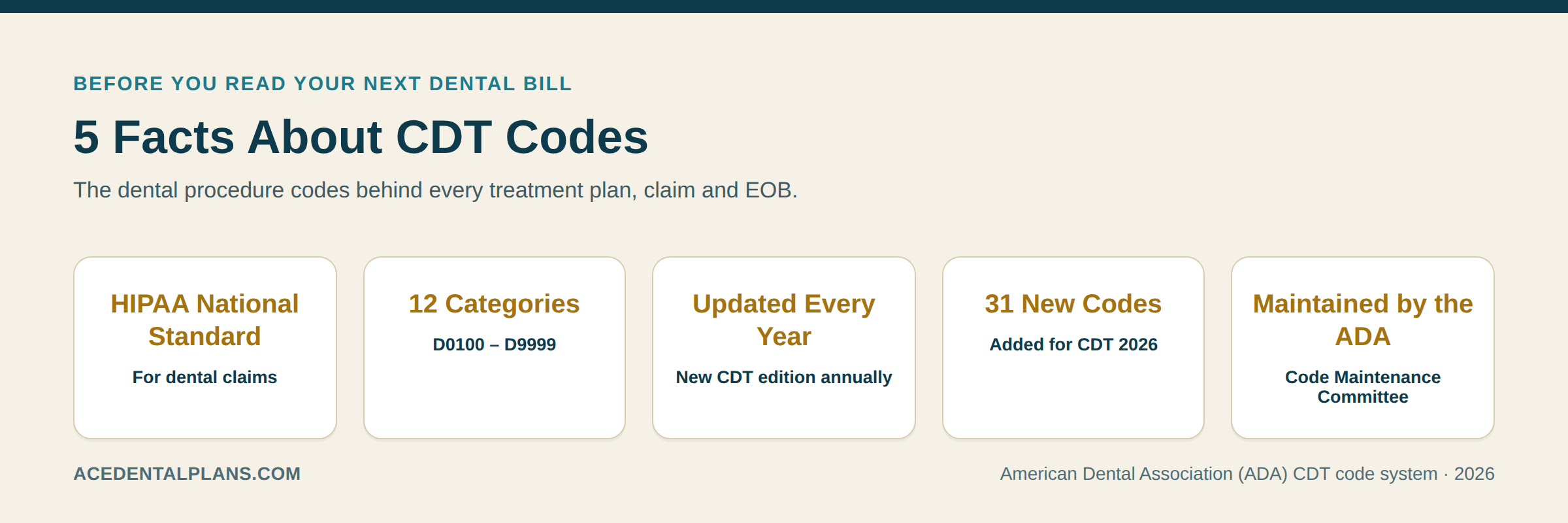
CDT codes are the five-character “D” codes, running from D0100 through D9999, that dentists use to identify every procedure on your chart, your insurance claim, and your bill. The American Dental Association creates and updates this code set every year, and it’s the federally recognized standard for reporting dental treatment on electronic claims. You don’t need to memorize any codes to use your dental benefits well. But knowing what a CDT code is, how it’s structured, and where it shows up can help you read a treatment plan or an EOB with real confidence instead of guesswork.
Key Takeaways
- CDT stands for Current Dental Terminology, a standardized code set the American Dental Association maintains and updates every year.
- CDT codes are the HIPAA-designated national standard for reporting dental procedures on insurance claims and related paperwork.
- Codes are grouped into 12 categories, from Diagnostic (D0100–D0999) through Adjunctive General Services (D9000–D9999).
- The same code should appear on your dentist’s chart, the insurance claim, and your EOB, which makes it a useful tool for catching billing mistakes.
- A code identifies the procedure, not the price. What you actually pay depends on your dentist’s fee and, if you have insurance, your plan’s allowed amount for that specific code.
- CDT codes are distinct from CPT codes and ICD-10 codes, which cover medical procedures and diagnoses rather than dental treatment.
What CDT Codes Are and Why the ADA Maintains Them
CDT stands for Current Dental Terminology, formally called the Code on Dental Procedures and Nomenclature. It’s the standardized list of codes and descriptions dentists use to document treatment, first published by the American Dental Association and updated on an annual cycle ever since. According to the ADA, the purpose of the code set is to “achieve uniformity, consistency and specificity in accurately reporting dental treatment.” In plain terms, that means a filling billed in Ohio and a filling billed in Oregon are described the same way, using the same code. That consistency lets claims be processed the same way no matter which dentist or insurer is involved.
The ADA doesn’t update the code set on its own. An ADA-appointed Code Maintenance Committee, made up of dentists, specialty organizations, third-party payers, and other members of the dental community, convenes each year to review proposed additions, revisions, and deletions. Anyone can submit a request to change a code, though the ADA notes that dentists, as the primary providers of care, are an especially important source of those requests. This annual review is also why you’ll sometimes see a new code on a bill for a procedure your dentist has performed for years. The service itself isn’t new; the committee simply approved a more precise way to document it.
CDT codes matter to you for a reason beyond dental office paperwork. Under HIPAA, electronic dental claims have to use a specific, federally recognized set of codes. According to the ADA’s own guidance, “HIPAA requires information to be exchanged in a standard format and use specific code taxonomies,” and CDT is that dental code set. That’s a different point than coverage. HIPAA requires the industry to use CDT codes consistently; it doesn’t require any insurer to pay for every code that exists. Whether a specific procedure is covered, and at what percentage, is still entirely up to your individual dental plan.
Your dentist’s office isn’t the only party relying on this system. Insurers and third-party administrators use CDT codes to process claims and set coverage rules. Clearinghouses, the companies that route electronic claims between dental offices and insurers, require CDT codes to route a claim correctly. State Medicaid and CHIP dental programs use the same code set to pay providers, and practice-management software is built around it to generate treatment plans, claims, and statements automatically. That’s a lot of infrastructure sitting behind a five-character code, and it’s part of why the system stays standardized rather than letting each dentist or insurer describe procedures in their own words.
Once you know what a CDT code is, a treatment plan stops looking like an opaque list of numbers. It becomes something closer to an itemized receipt, one you can compare line by line against a second opinion, a claim, or an EOB. That’s useful on its own. It’s also the foundation for understanding how much a dentist visit actually costs, since almost every price you’re quoted traces back to one or more of these codes.
How CDT Codes Are Built: Categories, Ranges and the Anatomy of a Code
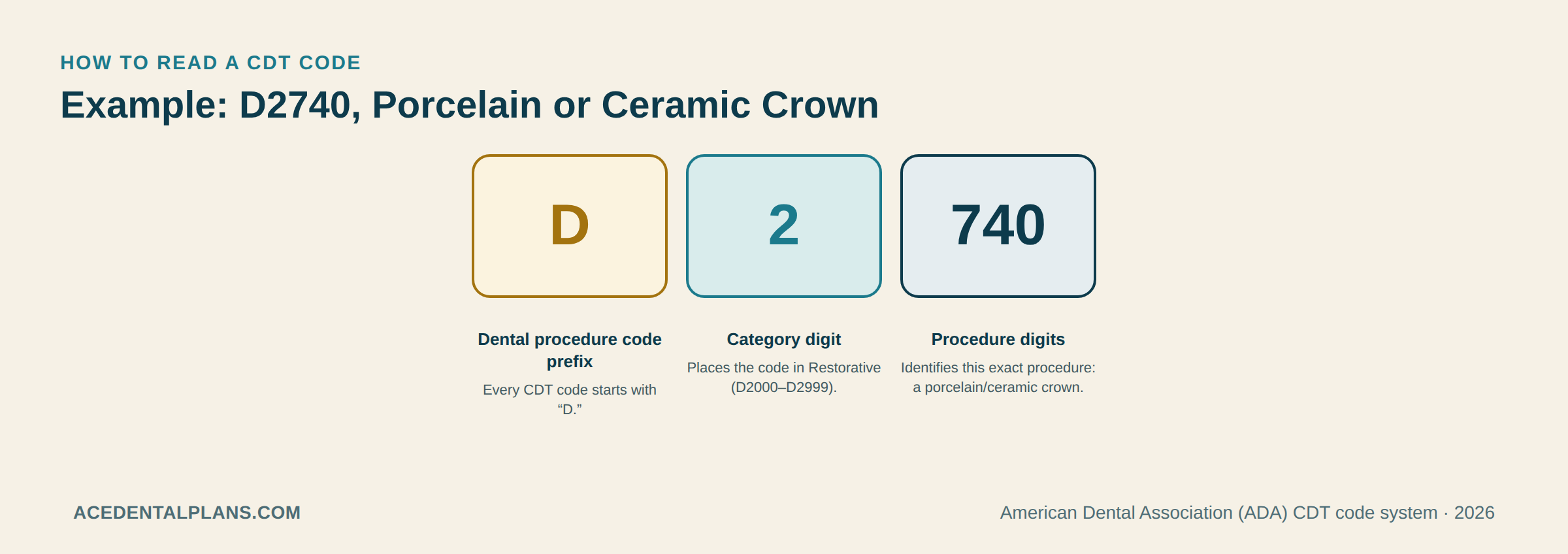
Every CDT code follows the same basic format: the letter “D,” followed by four digits. The “D” simply marks the code as a dental procedure code within the broader family of HIPAA-recognized code sets. The four digits that follow place the code into one of 12 categories of service and identify the specific procedure within that category. Codes within a category are generally numbered in a logical sequence, though the exact numbering reflects decades of additions, revisions, and occasional deletions rather than a perfectly even system.
The table below lists all 12 categories and the code range each one covers. Knowing the category a code falls into tells you a lot before you even read the procedure description. The ranges are broad enough to separate routine preventive care from complex surgical and prosthetic work.
| Category | Code range | What it generally covers |
|---|---|---|
| I. Diagnostic | D0100–D0999 | Exams, X-rays and other imaging, and tests used to plan treatment |
| II. Preventive | D1000–D1999 | Cleanings, fluoride treatments, sealants and other prevention-focused services |
| III. Restorative | D2000–D2999 | Fillings, crowns and other repairs for decayed or damaged teeth |
| IV. Endodontics | D3000–D3999 | Root canal treatment and other procedures involving the tooth pulp |
| V. Periodontics | D4000–D4999 | Scaling and root planing and other treatment for the gums and supporting bone |
| VI. Prosthodontics, removable | D5000–D5899 | Complete and partial dentures |
| VII. Maxillofacial prosthetics | D5900–D5999 | Specialized prosthetics for facial and oral structures |
| VIII. Implant services | D6000–D6199 | Surgical placement and related components of dental implants |
| IX. Prosthodontics, fixed | D6200–D6999 | Bridges and implant-supported crowns and restorations |
| X. Oral and maxillofacial surgery | D7000–D7999 | Extractions, biopsies and other surgical procedures |
| XI. Orthodontics | D8000–D8999 | Braces, clear aligners and related orthodontic treatment |
| XII. Adjunctive general services | D9000–D9999 | Anesthesia, sedation, occlusal guards and other services that don’t fit neatly into the other categories |

Two of these ranges deserve a quick note because they’re easy to confuse. Implant services (D6000–D6199) cover the surgical side of getting an implant, primarily placing the implant body itself. Fixed prosthodontics (D6200–D6999) picks up from there, covering the abutment and the crown or bridge that attaches to the implant. That’s why a single dental implant case is often billed as several separate line items, each with its own code, rather than one all-in-one implant charge.
The category a code falls into also foreshadows how insurance is likely to treat it, even though the category itself isn’t the coverage rule. Most dental plans build their coverage tiers around roughly the same groupings: Diagnostic and Preventive codes are typically covered most generously, and Restorative and Periodontics codes usually sit in a middle tier. Prosthodontics, Implant Services, and Oral and Maxillofacial Surgery codes often fall into the lowest-coverage major tier. That pattern isn’t universal, and your plan document is the only way to confirm it for your specific coverage. Still, it explains why a routine cleaning and a crown, both single procedures, are so rarely reimbursed at the same percentage.
It’s also worth knowing that this structure isn’t frozen in time. As one recent example, the ADA added a new set of codes inside the Adjunctive General Services category in 2025 specifically for sleep-related breathing disorder appliances. This reflects how often dentists now fabricate and adjust oral devices for sleep apnea. An earlier example is D9995 and D9996, added to cover synchronous (live video) and asynchronous (store-and-forward) teledentistry visits, reflecting how much virtual dental consultation grew in recent years. The categories are stable, but which specific procedures live inside them continues to evolve as dental care itself evolves.
Reading a single code: an example
Take the code D2740, which describes a porcelain or ceramic crown. The “D” identifies it as a dental procedure code. The leading digit, 2, places it in the Restorative category (D2000–D2999), which covers fillings, crowns, and other repairs to a damaged tooth. The remaining three digits, 740, distinguish this specific procedure, a full-coverage porcelain or ceramic crown, from other codes in the same category, such as different crown materials or a simple filling. Once you can break down one code this way, the rest of the system reads the same way. The leading digit tells you the broad category, and the full number tells you the exact procedure.
Common CDT Codes You’ll Actually See on a Bill or EOB
You’ll never need to memorize the full CDT code set, which runs to several hundred individual codes. In practice, most patients encounter the same relatively small group of codes over and over, across routine visits and common procedures. The table below lists codes you’re likely to recognize from a treatment plan, a claim, or an EOB, based on the category structure above and commonly published dental coding references.
| CDT code | Common name | Category |
|---|---|---|
| D0120 | Periodic oral evaluation, established patient | Diagnostic |
| D0140 | Limited oral evaluation, problem-focused (for a specific complaint, not a routine checkup) | Diagnostic |
| D0150 | Comprehensive oral evaluation, new or established patient | Diagnostic |
| D0210 | Intraoral, complete series of radiographic images (full-mouth X-rays) | Diagnostic |
| D0220 / D0272 | Periapical X-ray, first image / bitewings, two images | Diagnostic |
| D1110 / D1120 | Prophylaxis (cleaning), adult / child | Preventive |
| D1206 / D1208 | Topical fluoride, varnish / other than varnish | Preventive |
| D1351 | Sealant, per tooth | Preventive |
| D2140–D2161 | Amalgam (silver) fillings, one to four or more surfaces | Restorative |
| D2330–D2394 | Composite (tooth-colored) fillings, front and back teeth, various surfaces | Restorative |
| D2740 | Crown, porcelain or ceramic | Restorative |
| D3310–D3330 | Root canal treatment, front tooth / bicuspid / molar | Endodontics |
| D4341 / D4342 | Scaling and root planing (deep cleaning), four or more teeth / one to three teeth per quadrant | Periodontics |
| D4910 | Periodontal maintenance | Periodontics |
| D6010 | Surgical placement of implant body | Implant services |
| D7140 | Extraction, erupted tooth or exposed root | Oral and maxillofacial surgery |
| D7210–D7240 | Surgical removal of an impacted tooth, by depth of impaction | Oral and maxillofacial surgery |
| D8080 / D8090 | Comprehensive orthodontic treatment, adolescent / adult dentition | Orthodontics |
| D9110 | Palliative (emergency) treatment of dental pain | Adjunctive general services |
| D9230 | Nitrous oxide, analgesia, anxiolysis | Adjunctive general services |
The diagnostic codes at the top of the table capture a distinction worth understanding before your next appointment. D0120 is for a routine periodic check-in with a dentist you’ve already seen. D0140 is a limited, problem-focused evaluation, the code typically used when you come in specifically because a tooth hurts or something feels wrong, rather than for a scheduled cleaning visit. D0210, a full-mouth series, and D0220 or D0272, single images or a pair of bitewings, exist separately for a reason. A full diagnostic series involves far more images, and far more radiation exposure, than a routine bitewing check. Plans often limit how frequently a full series is covered as a result.
A few of these pairs exist specifically to capture a distinction that changes the clinical work involved, and often the fee. D0120 and D0150 both describe an oral evaluation, but D0150 is reserved for a new patient or a more comprehensive first assessment, while D0120 covers a routine periodic check-in with an established patient. The amalgam and composite filling ranges (D2140–D2161 and D2330–D2394) exist because the fee for a filling depends heavily on how many tooth surfaces are involved, not just which material is used. Pediatric dentistry has its own set of codes for the same reason. A stainless steel crown placed on a primary (baby) tooth, for example, uses a different code than a permanent-tooth crown. The tooth, the technique, and the expected lifespan of the restoration are all different. And the extraction codes split simple extractions (D7140) from surgical removal of an impacted tooth (D7210–D7240) because the latter typically involves more time, more skill, and often a different provider.
Codes for children’s and adults’ versions of the same basic service, such as D1110 and D1120 for a cleaning, exist for a similar reason. A pediatric prophylaxis on primary teeth is documented separately from an adult prophylaxis on permanent teeth, even though both are routine cleanings. None of this precision is designed to make your bill harder to read. Once you know why a code splits the way it does, an itemized treatment plan actually becomes easier to check line by line, not harder.
The two Adjunctive General Services codes at the bottom of the table, D9110 and D9230, are worth flagging. They often show up as add-ons rather than as the main reason for a visit. D9110 documents emergency, pain-relief-focused treatment, separate from whatever procedure ultimately addresses the underlying problem. D9230 documents nitrous oxide or another form of mild sedation, billed on top of the procedure it accompanies. Seeing either code alongside a filling or an extraction on your bill doesn’t usually mean something extra or unnecessary was done. It typically means the visit involved an emergency component or sedation, which has its own separate code and, often, its own separate fee.
Where CDT Codes Show Up: Treatment Plans, Claims and Your EOB
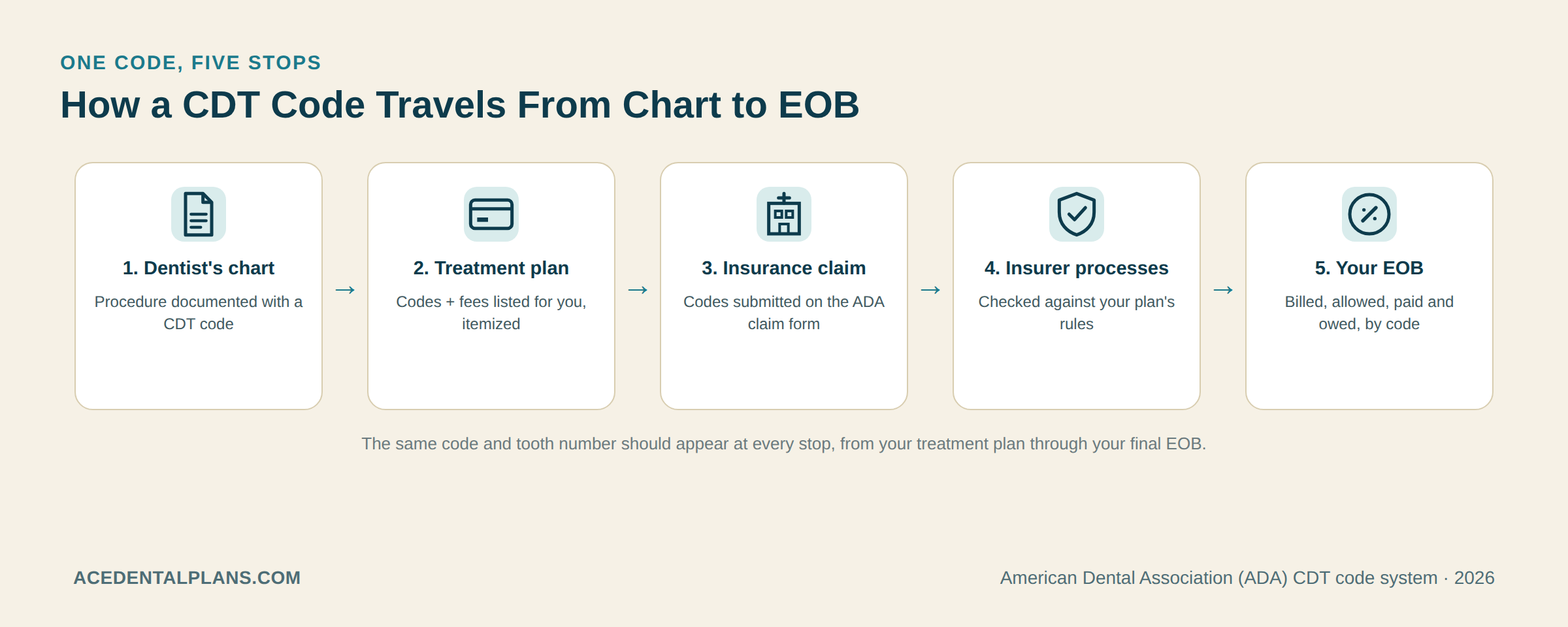
A CDT code doesn’t stay in one place. The same code typically travels through several documents before a dental visit is fully settled, and knowing that path makes it much easier to catch a mistake or ask an informed question.
- Your dentist’s chart. During or after your visit, your dentist or their staff records the procedures performed using the applicable CDT codes, along with which tooth or teeth were treated.
- Your treatment plan or pre-treatment estimate. Before major work, a written treatment plan should list each proposed procedure by its CDT code and description, alongside the fee, so you can see exactly what’s being recommended.
- The insurance claim. After treatment, the dental office typically submits an electronic claim, most often using the ADA’s standard claim form. That claim lists the CDT codes for every procedure performed, along with the fee charged for each one.
- Your insurer’s processing. The insurer checks each code against your specific plan: whether it’s a covered benefit, which coverage tier it falls into, whether a frequency limit or waiting period applies, and what the plan’s allowed amount is for that code.
- Your explanation of benefits (EOB). The insurer sends you an EOB summarizing what was billed by code, what the allowed amount was, what the plan paid, and what you may owe.
An EOB can look intimidating the first time you read one, mostly because it’s formatted for insurance processing rather than for a casual read. Look for a column labeled procedure code or CDT code; that’s the same code that should also appear on your original treatment plan. Next to it, you’ll typically see the amount billed, the plan’s allowed amount for that code, what the plan paid, and your remaining responsibility. If a code on your EOB doesn’t match a code on your treatment plan, that’s worth asking about. Raise it with your dentist’s billing office or your insurer, rather than puzzling over it alone.
A single EOB line typically reads something like this: procedure code D2740, description “crown, porcelain/ceramic,” amount billed $1,200, allowed amount $1,050, plan paid $525, your responsibility $525. Reading it left to right, in that order, tells you the full story behind one number on your bill: what was actually billed, what your plan recognized as the covered charge, what it paid toward that charge, and what’s left for you to cover. Multiply that same line by however many procedures were performed in one visit, and you have your full EOB.
A treatment plan or claim typically pairs each CDT code with a tooth number as well. This follows the ADA’s Universal Numbering System, which labels adult teeth 1 through 32 and primary teeth with letters. A specific code plus a specific tooth number is what lets an insurer tell the difference between two similar procedures. A crown on tooth 3 and a separate crown on tooth 14 use the identical CDT code, but they aren’t the same line item. If you’re ever comparing two estimates for the same problem, check that both list the same tooth number alongside the same code. It’s a quick way to confirm you’re comparing the same proposed treatment.
This same claims process applies well beyond employer and marketplace dental plans. State Medicaid and CHIP dental programs also process claims using CDT codes, following the same code-by-code logic. The specific procedures covered and the payment amounts still differ significantly by state and by program.
For a closer look at the plan mechanics behind that allowed-amount calculation, see our guides on how dental insurance works and dental insurance terms explained.

How CDT Codes Affect What You’re Billed and What Insurance Pays
A CDT code identifies what procedure was performed. It does not, by itself, set a price. Each dentist independently decides what to charge for every code in their fee schedule. That’s why the exact same code, say D2740 for a porcelain crown, can cost noticeably different amounts from one practice to the next, even within the same city. Location, overhead, the dentist’s training, and local competition all factor into that individual fee, the same price drivers covered in our dental cost guide.
A related term, usual, customary and reasonable (UCR), sometimes shows up instead of “allowed amount,” particularly with indemnity plans that don’t negotiate fixed fees with a network of dentists. A UCR-based plan bases its payment on typical fees for that code in your geographic area, rather than on a specific in-network contract. That can produce a different reimbursement than an allowed amount would under a PPO for the exact same code. If you have insurance, the code matters in a second, separate way: it determines which coverage tier the procedure falls into under your specific plan. Most dental plans group covered procedures into broad tiers, commonly preventive, basic restorative, and major, and assign each tier its own coinsurance percentage. Your plan maps each CDT code to one of these tiers internally. That’s why two procedures that feel similarly serious to you can be reimbursed very differently, depending on which tier their codes fall into.
Two related terms are worth knowing because they explain a common source of confusion on an EOB. Bundling is when a plan’s policy combines two or more procedures you may think of as separate into a single code for payment purposes. This often happens because one procedure is considered a routine part of another. Downcoding is when a plan pays based on a different, typically lower-cost code than the one your dentist actually billed, based on the plan’s own documentation standards or medical policy. Neither practice means an error was made on your dentist’s side. Both are reasons the amount on your EOB can differ from what a treatment plan led you to expect. Both are also reasonable things to ask your insurer to explain if you see them. A third term, upcoding, describes billing a more complex or higher-paying code than what was actually performed. Unlike bundling or downcoding, which are insurer-side payment decisions, upcoding is a documentation problem on the billing side and is generally considered improper billing rather than a normal part of claims processing. You’re unlikely to be able to tell upcoding apart from an accurate but unfamiliar code on your own. Still, if a code seems clearly inconsistent with the treatment you remember receiving, that’s worth raising directly with your dentist’s office.
None of this changes with a quick phone call alone. The most reliable way to know how a specific code will be treated under your plan is to ask your dentist’s office for a written pre-treatment estimate before major work begins. From there, verify your coinsurance and remaining annual maximum directly with your insurer.
Frequency limits and waiting periods work code by code
Plan rules like frequency limitations and waiting periods aren’t written against broad categories; they’re attached to specific codes. A plan might cover D1110 (adult prophylaxis) twice per benefit period and D0210 (a full-mouth X-ray series) only once every several years. It might also require a waiting period of six to twelve months before it pays anything toward D2740 (a crown) or other major-category codes. Two codes that sound similarly routine to you, such as a cleaning and a fluoride treatment, can carry completely different frequency rules under the same plan.
This is one more reason a specific code matters more than a general procedure name when you’re checking your benefits. Asking your insurer “is a cleaning covered” is a weaker question than asking “how many times per year is D1110 covered, and when was the last one paid on my plan.” The second version gives the representative something precise to check against your claims history. It’s far less likely to produce a vague or incomplete answer.
CDT Codes vs. CPT and ICD-10 Codes: When Dental Crosses Into Medical Billing
CDT isn’t the only code set you might encounter around a dental procedure. Two others come up often enough to be worth knowing, especially for treatment that touches both dental and medical care.
| Feature | CDT codes | CPT codes | ICD-10 codes |
|---|---|---|---|
| Maintained by | American Dental Association | American Medical Association | World Health Organization, adapted for U.S. use |
| Format | “D” plus four digits (e.g., D2740) | Five numeric digits | A letter followed by numbers (e.g., K02.9) |
| What it identifies | A dental procedure | A medical procedure | A diagnosis or medical condition, not a procedure |
| Typically filed on | The ADA dental claim form, to a dental plan | A medical claim form, to a medical plan | Filed alongside CPT codes on a medical claim |
| Required together? | An ICD-10 code is optional on most dental claims | ICD-10 codes are generally required alongside CPT codes on medical claims | Explains why a procedure was medically necessary |
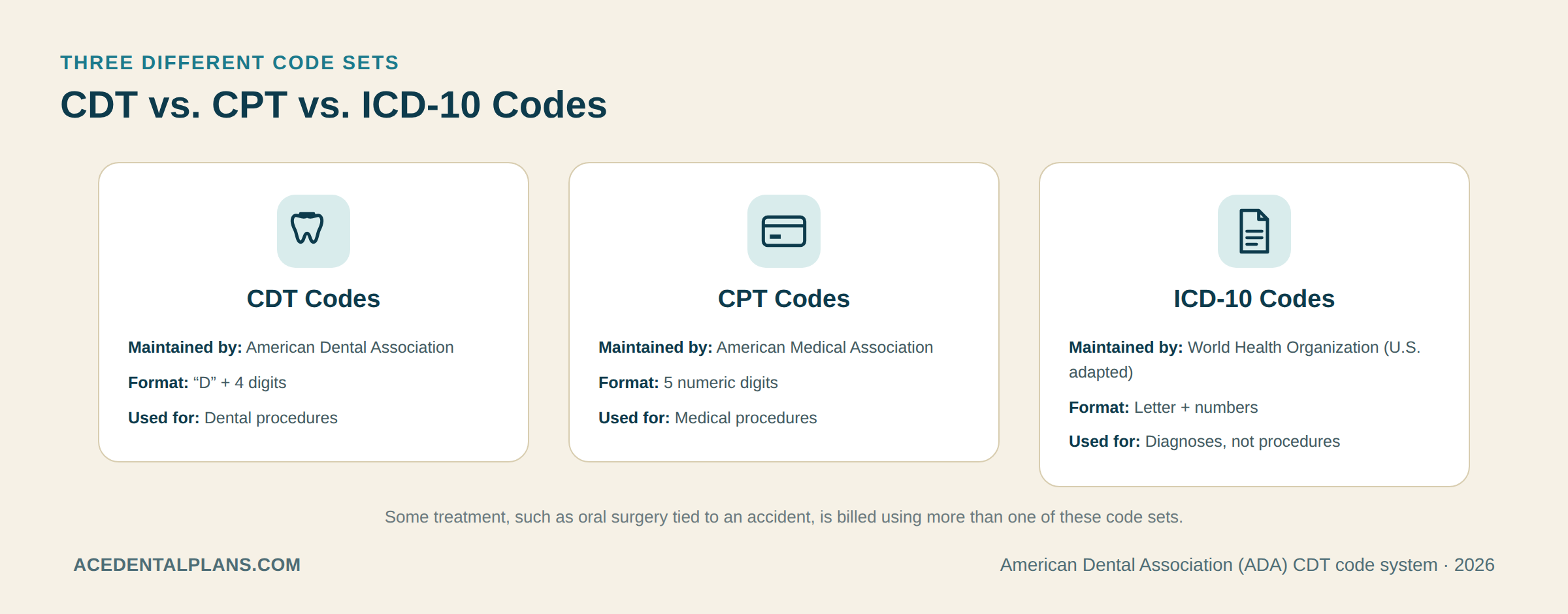
Some dental treatment is billed with both types of codes, or billed to medical insurance first and dental insurance second, when a procedure has a clear medical basis. Oral surgery following an accident, a biopsy of a suspicious lesion, treatment tied to a diagnosed medical condition, and some sleep apnea oral appliances are common examples. In these cases, a medical claim using CPT and ICD-10 codes may apply before, or alongside, a dental claim using CDT codes. Removal of impacted wisdom teeth performed under general anesthesia, treatment for a jaw fracture, and TMJ disorder treatment are other situations where a medical claim sometimes applies. Whether it does depends on the specific circumstances and your plan’s rules.
When both a medical and a dental claim apply to the same episode of care, insurers coordinate which plan pays first, a process generally called coordination of benefits. In practice, this usually means the medical plan is billed first, using CPT and ICD-10 codes to establish that the treatment was medically necessary. The dental plan is then billed second, using CDT codes, for any remaining dental-specific portion of the treatment. This can meaningfully change what you owe, since a medical plan and a dental plan calculate their own deductibles, coinsurance, and maximums independently of each other. A procedure that would exhaust your dental annual maximum on its own might cost you less once a medical plan shares part of the bill.
Coordination of benefits also comes up when you have two dental plans rather than a medical and a dental plan, such as coverage through your own employer and a spouse’s employer. In that situation, both plans still process the same CDT codes. One is designated the primary plan and pays first against its own allowed amount, while the secondary plan may cover some or all of the remaining balance, up to its own limits. Having two dental plans doesn’t necessarily mean 100% of every code is covered; it depends on both plans’ specific coordination rules, which your insurers, not the CDT code itself, determine.
You generally don’t need to sort out which code set applies to your own case. If your treatment might have a medical component, ask your dentist’s office directly whether they’ll also file to medical insurance. Also ask what documentation, such as a referral or a diagnosis code, that would require. It’s a reasonable question, not an unusual one, particularly for oral surgery, trauma-related treatment, or a sleep appliance.
Why CDT Codes Change Every Year (and What It Means for Your Bill)
The ADA publishes a new version of the CDT code set every year, and each edition typically adds, revises, or deletes a meaningful number of codes. CDT 2026, for example, included 60 total code changes, 31 of them brand-new additions, according to ADA News. New codes for 2026 include ways to document point-of-care saliva testing, testing for a cracked tooth across multiple teeth, and fabricating a duplicate denture from an existing mold. Others cover treating an implant affected by peri-implantitis without a surgical flap, and routine cleaning and inspection of an occlusal guard.
These annual changes matter to you in a few concrete ways. A new code appearing on your bill for the first time usually reflects a service your dentist has already been performing, now documented with more precision, rather than a brand-new or experimental treatment. A code your dentist has used for years can also be revised or deleted. That occasionally requires an office to update its own fee schedule and can shift a familiar line item on your treatment plan. Insurers update how they map codes to coverage tiers and allowed amounts on a similar annual cycle. That’s one more reason your coverage details are worth re-verifying at the start of a new plan year, not just once when you first enroll.
A code that gets deleted doesn’t disappear from the world; it disappears from the current year’s official list. Dental offices generally have to retire a deleted code from their fee schedule and software templates once it’s no longer valid. A claim submitted with an outdated code after the transition period can be rejected and need resubmission with the current equivalent. Between annual editions, the ADA also publishes errata, official corrections to the current year’s code book, for the rare case where a description needs a fix before the next full update. None of this back-office process should affect the treatment you receive; it’s simply the maintenance work that keeps a shared national code set usable for everyone billing against it.
None of this is something you need to track yourself. If a code on a bill or EOB looks unfamiliar, that’s a normal, reasonable thing to ask your dentist’s office or insurer to explain, and it doesn’t necessarily mean anything was billed incorrectly.
How to Look Up or Question a CDT Code on Your Bill
You don’t need a dental billing background to make sense of a specific code. A few practical steps cover almost every situation:
- Ask your dentist’s front desk or billing staff directly. They work with these codes daily and can tell you in plain language what a specific code on your treatment plan or bill represents.
- Request a written, itemized treatment plan before major work. Ask that it list the CDT code and a description for each proposed procedure, not just a single total, so you can compare it against a second opinion or your eventual EOB.
- Compare your EOB against your treatment plan, code by code. If a code, an allowed amount, or a payment doesn’t match what you expected, call your insurer’s member services line with the specific code in hand rather than describing the procedure from memory.
- Ask for a pre-treatment estimate on expensive or multi-step procedures. Your dentist submits the proposed codes to your insurer, which responds with an estimate of how they may be handled under your current benefits. It isn’t a guarantee of final payment, but it can surface a coverage surprise before treatment starts.
- Use the ADA’s own glossary as a plain-language reference. The American Dental Association publishes a glossary of dental terms alongside the CDT code set, which can help translate an unfamiliar procedure name into something more familiar.
- Use a third-party code lookup cautiously. Several dental billing websites publish free CDT code lookup tools. They can be a convenient starting point for a plain-language description, but they aren’t official ADA resources, and they say nothing about how your specific plan covers the code. Treat them as a translation tool, not a coverage answer.
- Ask about the appeals process if a claim is denied or downcoded. You, or your dentist’s office with your permission, can generally appeal a denied or downcoded claim directly with your insurer. Ask specifically what documentation the appeal requires, such as X-rays or a written narrative from your dentist, and what the deadline is to file it.
Keep in mind that a code only tells you what procedure was performed, not what your specific plan will pay toward it. For that, your plan document and a direct call to your insurer remain the only fully reliable sources, since coverage rules vary by plan even when the underlying CDT code is identical.
Smart Questions to Ask About the Codes on Your Treatment Plan
A treatment plan full of unfamiliar codes can feel like something you’re expected to accept without much discussion. A short list of direct questions can turn it into an ordinary conversation instead, one your dentist’s office will be used to answering.
- Can I get the CDT code for each procedure, not just a description? A code-level treatment plan lets you compare two estimates line by line and gives you something specific to reference if you call your insurer.
- Why this code and not a related one? When a category includes several similar codes, such as different filling sizes or different extraction types, asking why a specific one applies to your case helps you understand what’s actually being treated.
- Will this be filed to dental insurance, medical insurance, or both? This matters most for oral surgery, trauma-related treatment, or a sleep appliance, where a medical claim using different codes might apply first.
- Can you request a pre-treatment estimate before starting? For any expensive or multi-step procedure, a predetermination shows how your insurer expects to handle the specific codes involved before you commit to treatment.
- Is there a frequency limit or waiting period on this specific code under my plan? Your dentist’s office may not always know your plan’s rules in detail, but asking prompts them to check or to suggest you call your insurer directly.
- What tooth number is this code billed against? Confirming the tooth number alongside the code is a quick, concrete way to make sure a written estimate matches the treatment you discussed.
None of these questions require any dental billing background to ask, and a practice that regularly works with insurance will expect them. For the broader picture of what a treatment plan can add up to once every code is priced out, see our dental cost guide and our guide to dental insurance basics.

Frequently Asked Questions
What does the “D” in a CDT code stand for?
The “D” identifies the code as a dental procedure code within the CDT system, distinguishing it from other HIPAA-recognized code sets such as CPT (medical procedures) or ICD-10 (diagnoses). It doesn’t stand for a specific word on its own; it’s simply the prefix the American Dental Association uses for every code in the set.
Are CDT codes the same in every state?
Yes. CDT codes are a single national standard maintained by the American Dental Association. The code for a given procedure, such as D2740 for a porcelain crown, is the same whether you’re treated in California or Maine. What varies by state and by dentist is the fee charged for that code, and what varies by plan is how that code is covered.
Why did my dentist bill a different code than I expected?
This usually means the procedure performed was more, or less, extensive than originally planned once your dentist could see the tooth directly. A filling might have needed an additional surface, or an extraction might have turned out to require surgical removal. It can also reflect a coding correction. If a code on your final bill doesn’t match your original treatment plan, ask your dentist’s office to explain the specific reason for the change.
Can I look up what my treatment code means?
Yes. Your dentist’s office can tell you directly what any code on your treatment plan or bill represents, and the American Dental Association publishes a glossary of dental terms alongside the CDT code set. Third-party dental billing websites also list common code descriptions, though your dentist’s office remains the most reliable source for what was actually billed in your case.
Do CDT codes tell me how much I’ll pay?
No. A CDT code identifies the procedure, not the price. What you pay depends on your dentist’s individual fee for that code and, if you have insurance, your plan’s allowed amount, coinsurance, deductible, and remaining annual maximum for that specific procedure. The same code can result in very different out-of-pocket amounts for two different patients.
What’s the difference between CDT and ICD-10 codes?
CDT codes describe dental procedures, such as a filling or a cleaning. ICD-10 codes describe diagnoses or medical conditions, such as a specific type of tooth decay or a jaw fracture. ICD-10 codes are generally required alongside CPT codes on medical claims, but they’re optional on most dental claims that use CDT codes.
How often do CDT codes change?
The American Dental Association publishes an updated CDT code set every year. Each annual edition, such as CDT 2026, typically adds new codes, revises existing descriptions, and occasionally deletes codes that are no longer needed, based on recommendations from the ADA’s Code Maintenance Committee.
Will my insurance still pay if my dentist uses a new CDT code?
Whether a new code is covered, and at what percentage, depends entirely on your specific plan’s policies, which insurers also update on their own annual cycle. A brand-new code isn’t automatically covered just because it exists. If your dentist plans to bill a recently added code for expensive treatment, ask for a pre-treatment estimate so you know how your plan is likely to handle it before you commit.
Why does my EOB list a different code than my treatment plan?
This can happen for a few reasons. The treatment actually performed may have differed from what was originally planned. Or your insurer may have applied a bundling rule that combined two procedures into one code, or downcoded the claim to a different code based on its own documentation policy. Any of these is a reasonable thing to ask your insurer to explain, using the specific codes shown on both documents.
Who decides which procedures get a CDT code?
The American Dental Association’s Code Maintenance Committee, made up of dentists, dental specialty organizations, third-party payers, and other dental community members, reviews and approves changes to the code set each year. Dentists are a particularly important source of requests for new or revised codes, since they’re the ones documenting treatment day to day.
Does Medicaid use CDT codes too?
Yes. State Medicaid and CHIP dental programs process claims using the same CDT code set as private dental insurance. What differs by state and by program is which specific codes are covered, at what payment amount, and under what frequency or age limits. Check your specific state program’s dental benefits for those details.
Can two dentists bill the same procedure with different codes?
Two dentists should use the same code for genuinely identical treatment, since the code describes the procedure rather than the provider. If two treatment plans for what looks like the same problem list different codes, it usually means the two dentists assessed the case differently. One might recommend a simple filling and another a more extensive restoration, rather than the two disagreeing on how to code identical work. Asking each office to explain the code they chose is a reasonable way to understand the difference.
What should I do if my claim is denied for a specific code?
Start by asking your insurer for the specific reason the code was denied. A denial can result from a documentation issue, a frequency limit, a waiting period, or the procedure not being a covered benefit at all under your plan. From there, you or your dentist’s office can typically file an appeal with any additional documentation the insurer requests, such as X-rays or a written clinical narrative supporting the treatment.
The bottom line: a CDT code is a piece of dental billing infrastructure, not a mystery. A code identifies a procedure rather than a price. The same code should travel unchanged from your treatment plan to your EOB, and categories like Restorative or Major Services drive how insurance treats it. Once you know all of that, a dental bill stops feeling like a black box. Ask for an itemized, code-level treatment plan before major work, and you’ll have exactly what you need to compare estimates, question a discrepancy, or simply understand what you’re paying for.
Sources and Disclaimers
The definitions and structure of the CDT code set in this guide are drawn directly from the American Dental Association, the organization that owns and maintains CDT. That includes the ADA’s own description of the code set’s purpose and its guidance on how CDT relates to HIPAA. The category ranges and example codes in Tables 1 and 2 reflect the ADA’s official category structure as reproduced in published dental coding references, including materials from the American Academy of Pediatric Dentistry. Figures on CDT 2026’s code changes come from ADA News, the ADA’s own publication. The comparison between CDT, CPT, and ICD-10 codes in Table 3 reflects standard dental billing industry usage, cross-checked against ADA guidance on when dental and medical claims coordinate. This guide does not reproduce the ADA’s proprietary, copyrighted code descriptions verbatim; procedure names are described in plain language for consumer reference. Insurance and coverage terminology follows definitions used by the American Dental Association and major dental carriers. CDT codes and their coverage treatment can change annually; confirm any specific code and its coverage directly with your dentist’s office and your insurer.
- American Dental Association — The Code on Dental Procedures and Nomenclature (CDT Code)
- American Dental Association — Guide to Understanding and Documenting Teledentistry Events (D9995 and D9996)
- American Dental Association — Frequently Asked Questions Regarding Dental Codes
- ADA News — New CDT Codes You Should Know for 2026
- American Academy of Pediatric Dentistry — Code on Dental Procedures Reference Manual Chapter
- Dental Claim Support — CDT Codes vs. CPT Codes: What’s the Difference?
- HealthCare.gov — Dental Coverage in the Marketplace
Important Information and Disclaimers
This article is general educational information. By using it, you accept the limits described below.
Not dental or medical advice
Nothing on this page is a diagnosis, a treatment recommendation or a substitute for an examination by a licensed dentist or physician. Reading this article does not create a dentist-patient or doctor-patient relationship. Only a licensed professional who has examined you and reviewed your history can tell you what your mouth needs. Do not delay, skip or stop professional care because of something you read here.
Prices are estimates, not quotes
Cost figures are ranges reported by the third-party sources cited in this article. Actual prices depend on your location, the provider, the complexity of your case, the materials used, the date of service and other factors, so what you pay may be higher or lower. A written treatment plan and fee estimate from the dental office is the only reliable number for your situation.
Insurance and plan examples are illustrations
Examples that use named amounts or percentages are hypothetical. Real benefits depend on your plan, network, waiting periods, annual maximum, deductible and the insurer’s rules at the time of treatment. A pre-treatment estimate or benefits check is not a promise of payment. Confirm the details with your insurer or plan administrator in writing.
Not insurance, legal, tax or financial advice
AceDentalPlans is an information publisher. Nothing here is insurance, legal, tax, investment or other professional financial advice, and nothing here recommends a particular provider, insurer, lender, discount plan or financing product. Company and product names belong to their owners and appear for identification only. Read the terms of any loan, financing offer or plan before you sign, and ask a qualified professional if you need advice on your own circumstances.
Third-party sources
This article cites government agencies, professional associations, insurers, lenders and other outside organizations. We do not control those sources. Their content can change, move or disappear, and listing a source is not an endorsement of it or of anything it sells.
No warranty
We aim for accuracy, but this article is provided “as is,” without warranties of any kind, express or implied, including warranties of accuracy, completeness, timeliness or fitness for a particular purpose. Some information may be out of date or contain errors by the time you read it.
Limitation of responsibility
To the fullest extent permitted by law, AceDentalPlans and its owners, authors and contributors are not responsible or liable for any loss, cost, injury, health outcome or other damage that results from using this article or relying on it. You are responsible for your own decisions about your care, your coverage and your money.
How this article is written
This article follows AceDentalPlans’ answer-first, U.S.-focused editorial approach. It uses conditional language for insurance, because coverage depends on the specific plan, and it names its sources so that you can read them yourself.